English
1.Select the most appropriate direct form of the given sentence.
I asked the carpenter how long he would take to polish my furniture.
A. I said to carpenter, “How long he would take to polish his furniture?”
B. I said to carpenter, “How long will you take to polish my furniture?”
C. I said to carpenter, “How long you would take to polish my furniture?”
D. I said to carpenter, “How long he would take to polish my furniture?”
Solutions
The correct direct speech is (b).
Explanation:
· Indirect: “I asked… how long he would take…”
· Direct → convert to question: “How long will you take…?”
· Pronouns: “he” → “you”, “my furniture” remains same
· “Would” → “Will” (reverse tense shift) in direct form
Correct Sentence:
I said to the carpenter, “How long will you take to polish my furniture?”
2. Select the most appropriate ANTONYM of the given word.
Altercation
A. Argument
B. Quarrel
C. Controversy
D. Agreement
Solutions
The correct antonym of the given word is (d) Agreement.
Altercation: A loud or heated argument or dispute between people, often public and emotional. (झगड़ा, बहस)
Example: The two men had a serious altercation in the market.
Agreement: A mutual arrangement, contract, or harmony in opinion. (सहमति, समझौता)
Example: The countries finally came to an agreement after months of negotiation.
Synonyms of Altercation: Argument, quarrel, dispute, squabble
Antonyms of Altercation: Agreement, harmony, accord, peace
Meanings of all the other given options:
· (a) Argument: A verbal exchange of differing opinions (बहस)
· (b) Quarrel: A heated argument, typically between people who know each other (झगड़ा)
· (c) Controversy: Prolonged public disagreement or heated discussion (विवाद)
3. The following sentence has been split into four segments. Identify the segment that contains a grammatical error.
My boss keeps telling me / all the time / that money / doesn’t grows on trees.
A. My boss keeps telling me
B. all the time
C. that money
D. doesn’t grows on trees
Solutions
Option (d) contains an error.
Explanation of the Error:
The verb “grows” in the phrase “doesn’t grows” is grammatically incorrect. After “doesn’t” (which is a helping verb), the main verb should be in its base form, not in the -s form.
· Correct: doesn’t grow
· Incorrect: doesn’t grows
Grammatical Rule Used:
When using does/doesn’t (third person singular in present tense), the main verb must be in the base (V1) form.
Rule:
Subject + does/doesn’t + base form of verb + object/complement
E.g.,
· She doesn’t like spicy food.
· It doesn’t work properly.
· He doesn’t know the answer.
Example:
He doesn’t sings well.
He doesn’t sing well.
Information Booster:
This rule applies to all subjects when the auxiliary verb does is used—never add -s to the main verb. The -s is already represented in the auxiliary verb ( does), so it is not repeated.
4. The following sentence has been split into four segments. Identify the segment that contains a grammatical error.
She will be / write her / examination by this / time tomorrow.
A. examination by this
B. time tomorrow
C. She will be
D. write her
Solutions
Option (d) contains the grammatical error.
Explanation:
· The verb “write” is incorrect here. The correct form should be “writing” to match the future continuous tense.
· The phrase “She will be…” must be followed by verb + ing form to indicate an action in progress in the future.
Correct sentence:
She will be writing her examination by this time tomorrow.
5. Given below are four jumbled sentences. Select the option that gives their correct order forming a meaningful and coherent paragraph.
A. Miss Tredgold rapped on the door twice with her gloved knuckle.
B. A few moments passed before the door opened to reveal a man in grey sweater and blue jeans.
C. Florentyna stood by her side, silent for the first time since leaving school.
D. At last they came to a halt outside a newly painted red door which displayed the number 118.
A. DACB
B. ADBC
C. CDAB
D. DBCA
Solutions
Option (a) DACB is the correct order of the paragraph.
Explanation:
· D starts the action: arriving at the red door
· A continues with Miss Tredgold knocking
· C gives Florentyna’s behavior during this scene
· B shows the response to the knock: door opening
Coherent Flow:
· D (setting/place) → A (action) → C (description/emotion) → B (result/reaction)
Sentence Arrangement Tip:
Start with scene setup, follow with action, add character response, and finish with reaction/outcome.
6. Select the option that expresses the given sentence in passive voice.
Alfred’s doctor treated Rohan for his fever.
A. Rohan will be treated by Alfred’s doctor for his fever.
B. Rohan has been treated by Alfred’s doctor for his fever.
C. Rohan was treats by Alfred’s doctor for his fever.
D. Rohan was treated by Alfred’s doctor for his fever.
Solutions
The correct passive voice of the given sentence is (d) Rohan was treated by Alfred’s doctor for his fever.
Definition:
· Active Voice: The subject performs the action.
· ➤ Alfred’s doctor treated Rohan…
· Passive Voice: The subject receives the action.
· ➤ Rohan was treated…
Rules of Conversion (Active to Passive – Simple Past Tense):
· Active structure: Subject + V2 + Object
· Passive structure: Object + was/were + V3 + by + subject
Breakdown of the Sentence:
· Subject: Alfred’s doctor
· Verb (V2): treated
· Object: Rohan
· In passive, “Rohan” becomes the subject, and “treated” changes to was treated (past simple passive form).
Correct Passive Sentence:
Rohan was treated by Alfred’s doctor for his fever.
7. Select the most appropriate synonym of the given word.
Abandon
A. Quit
B. Rescue
C. Possess
D. Retain
Solutions
The correct synonym of the given word is (a) Quit.
Abandon: To leave a place, thing, or person permanently or suddenly; to give up something completely. (छोड़ देना / त्याग देना)
Example: They had to abandon the car due to engine failure.
Quit: To leave or stop doing something, especially a job or place. (छोड़ना / त्यागना)
Example: He quit his job to start his own business.
Synonyms: abandon, quit, desert, forsake
Antonyms: retain, keep, hold, maintain
Meanings of all the other given options:
· (b) Rescue: To save someone from danger (बचाना)
· (c) Possess: To own something (स्वामित्व रखना)
· (d) Retain: To continue to have or hold (बनाए रखना)
8. Select the most appropriate option to improve the highlighted segment in the given sentence. If there is no need to improve it, select ‘no improvement required’.
You can have a comfortable journey only then you are getting your seats reserved in advance.
A. only then you get
B. no improvement required
C. only when you are getting
D. only if you get
Solutions
The correct substitution is (d) only if you get.
Explanation:
· The phrase “only then” is used for consequences, not conditions.
· The sentence is conditional in nature, so we need to use “only if” to show the condition for a comfortable journey.
· “You are getting” is grammatically awkward here; correct form is “you get” (simple present for real conditions).
Correct Sentence:
You can have a comfortable journey only if you get your seats reserved in advance.
9. Given below are four jumbled sentences. Select the option that gives their correct order forming a meaningful and coherent paragraph.
A. And every time I stood under the shower, she shouted, “Don’t waste water.”
B. She had poisoned my mind with the lectures on social awareness, equal rights for the poor, India’s socio-ecological problems.
C. Every time I was about to take my first bite of a hot buttered Roti she reminded me of the starving millions in our country and in the whole wide world.
D. It was Priyanka’s fault – that stupid sister of mine- the social activist.
A. DBCA
B. DACB
C. ADBC
D. CDAB
Solutions
Option (a) DBCA is the correct order of the given sentences.
Explanation of the correct order:
· D. This is the best opening line. It introduces Priyanka, the narrator’s sister, along with a description of her character ( social activist) and sets a personal, blaming tone.
· B. Follows naturally, explaining what kind of influence Priyanka had — she filled the narrator’s mind with social and ecological lectures.
· C. Provides a specific example of her activism interfering with normal life – when eating food, she would remind about starving millions.
· A. Gives another example in daily life — shouting during showers about wasting water — connecting with the socio-ecological awareness introduced earlier.
Final Logical Order:
D (introduces the sister and blame) →
B (her ideological influence) →
C (example: food) →
A (example: water usage)
This sequence builds a personal anecdote, starting from the person (Priyanka), to her ideology, and finally its practical effects on the narrator’s daily life.
Structure Tip for Para Jumbles:
· Start with the sentence that introduces a character or topic.
· Then move to descriptions or causes.
· Follow with examples or effects.
· Keep track of pronouns like she, which refer back to earlier nouns like Priyanka.
10. Select the option that expresses the given sentence in direct speech.
I told you that I had bought a new book for you the day before.
A. I told to you, “I have bought a new book for you yesterday.”
B. I said to you, “I have bought a new book for you the day before.”
C. I said to you, “I bought a new book for you yesterday.”
D. I said to you, “You have bought a new book for me the day before.”
Solutions
The correct direct speech is (c).
Explanation:
· In indirect speech:
· “had bought” → direct = “bought”
· “the day before” → direct = “yesterday”
· Correct pronouns and tense shift must be reversed
· “for you” remains the same
Correct Sentence:
I said to you, “I bought a new book for you yesterday.”
11. Select the option that expresses the given sentence in active voice.
The flyer for the international symposium is being sent by students to institutes all over the country.
A. Students are being sent the flyer for the international symposium to institutes all over the country.
B. The flyer for the international symposium is sent by students to institutes all over the country.
C. Students are sending the flyer for the international symposium to institutes all over the country.
D. The flyer is sending the students to institutes all over the country for the international symposium.
Solutions
The correct active voice of the given sentence is (c) Students are sending the flyer for the international symposium to institutes all over the country.
Definition:
· Passive Voice: The subject receives the action.
· ➤ The flyer… is being sent by students…
· Active Voice: The subject performs the action.
· ➤ Students are sending the flyer…
Rules of Conversion (Passive to Active – Present Continuous Tense):
· Passive structure: Object + is/are being + V3 + by + subject
· Active structure: Subject + is/are + V1+ing + object
Conversion of the Given Sentence:
· Subject (in passive): students (agent)
· Verb (passive): is being sent → are sending (students = plural)
· Object: the flyer for the international symposium
· Remainder: to institutes all over the country
Correct Active Form:
Students are sending the flyer for the international symposium to institutes all over the country.
Explanation of Other Options:
· (a) Students are being sent the flyer… – Changes the meaning; makes students the recipient instead of the agent.
· (b) is sent – Simple present tense; doesn’t match original present continuous tense.
· (d) The flyer is sending the students… – Illogical and incorrect structure.
12. Select the most appropriate ANTONYM of the given word.
Devious
A. Crafty
B. Crooked
C. Dishonest
D. Sincere
Solutions
The correct antonym of the given word is (d) Sincere.
Given word: Devious
Meaning: Someone who is dishonest or indirect in achieving goals; deceptive or underhanded. (Hindi meaning: चालाक / कपटी / धोखेबाज़)
Example: The devious politician manipulated the truth for his benefit.
Correct answer word: Sincere
Meaning: Honest, genuine, and straightforward in what one says or does. (Hindi meaning: ईमानदार / सच्चा)
Example: She gave a sincere apology for her mistake.
Synonyms: dishonest, crafty, sly, manipulative
Antonyms: sincere, honest, straightforward, genuine
Meanings of other options:
· (a) Crafty: Skilled in deceit or cunning (चालाक)
· (b) Crooked: Dishonest or not straight (बेईमान, टेढ़ा)
· (c) Dishonest: Not truthful (बेईमान)
13. The following sentence has been split into four segments. Identify the segment that contains a grammatical error.
Arunima Sinha / is first amputee / to scale / Mount Everest.
A. Mount Everest
B. is first amputee
C. Arunima Sinha
D. to scale
Solutions
Option (b) contains an error.
Explanation: Superlative degrees like “first” must be preceded by the definite article “the”.
Correct sentence: …is the first amputee…
Grammatical Rule: Use “the” before ordinal numbers (first, second, etc.)
Example: She was the first woman to win.
Information Booster: Always use “the” before superlative and ordinal adjectives.
14. Select the option that expresses the given sentence in direct speech.
Your sister will say that she has lost her pen again.
A. Your sister said, “She has lost my pen again.”
B. Your sister will say, “I have lost my pen again.”
C. Your sister will say, “I lost my pen again.”
D. Your sister says, “I lost her pen again.”
Solutions
The correct direct speech is (b).
Rules of conversion (Indirect to Direct – Future reporting verb):
· No change in the tense of reported speech when reporting verb is in future tense.
· Pronouns change accordingly:
· → “She” becomes “I”
· → “her pen” becomes “my pen”
Explanation:
· “Your sister will say” = reporting verb in future.
· So, “she has lost her pen again” becomes “I have lost my pen again.”
Example:
Indirect: He will say that he has passed the test.
Direct: He will say, “I have passed the test.”
Why other options are incorrect:
• (a) Wrong pronoun usage “she” instead of “I” and “my”
• (c) “have lost” changed to “lost” – tense change not allowed
• (d) Wrong tense and pronouns again
Grammar Booster:
When the reporting verb is in future or present, no backshift of tense is done in reported speech.
15. Select the most appropriate meaning of the given idiom.
On cloud nine
A. Good number
B. Travel by airplane
C. Extremely happy
D. Heavy rain
Solutions
Option (c) is the correct meaning of the given idiom.
Idiom: On cloud nine – Feeling extremely happy or joyful. (बेहद खुश होना)
Example: She was on cloud nine after receiving the job offer.
3 Other related idioms and their meanings:
· Over the moon – Extremely delighted (बहुत प्रसन्न)
· In seventh heaven – In a state of extreme happiness (सातवें आसमान पर)
· Walking on air – Feeling very happy (खुशी से झूम उठना)
16. Select the option that expresses the given sentence in indirect speech.
She said to me, “Can you look after my baby for a short while?”
A. She asked me that if I could look after her baby for a short while.
B. She asked me if you can look after my baby for a short while.
C. She asked me if I can look after my baby for a short while.
D. She asked me if I could look after her baby for a short while.
Solutions
The correct indirect speech is (d).
Explanation:
· Reporting verb: “said to” becomes “asked” (interrogative sentence).
· Direct question begins with “Can you…” which changes to “if I could…”
· Pronoun changes:
· you → I (referring to the listener i.e., me)
· my → her (referring to the speaker i.e., she)
· Tense change:
· can → could (as per backshift rule in reported speech)
Correct Sentence:
She asked me if I could look after her baby for a short while.
17. Select the most appropriate passive form of the given sentence.
Please do not pluck any flowers from the temple compound.
A. You are requested not to pluck any flowers from the temple compound.
B. No flowers can be plucked from the temple compound.
C. How can any flowers be plucked from the temple compound?
D. Let any flowers not to be plucked from the temple compound.
Solutions
The correct passive voice is (a).
Explanation:
· For imperative sentences (requests, orders) in passive voice, use:
· ✔ You are requested/ordered/advised + to/not to + base verb
· The word “please” changes to “You are requested to” in the passive form.
Structure:
Active: Please + base verb
Passive: You are requested/asked + to + base verb
Correct Sentence:
You are requested not to pluck any flowers from the temple compound.
18. Given below are four jumbled sentences. Select the option that gives their correct order forming a meaningful and coherent paragraph.
A. He never jumped or ran to chase another dog.
B. They looked very peaceful, the old man and his dog.
C. Every day at a few minutes past 5 o’clock they passed by our house and went down the street to the park.
D. The dog walked a few steps ahead of his master, slow and steady as if he were held on a leash.
A. CABD
B. BADC
C. ADCB
D. BCDA
Solutions
Option (d) BCDA is the correct order of the paragraph.
Explanation:
· B introduces the pair (the old man and his dog) – peaceful image.
· C describes their daily routine (passing the house).
· D gives details of the dog’s slow, steady pace.
· A concludes with a fact about the dog’s calm behavior.
Sequence Tip:
• Begin with overall impression (B)
• Continue with routine (C)
• Add descriptive imagery (D)
• End with character trait (A)
19. Select the option that expresses the given sentence in passive voice.
She is going to serve tea in silver cups today.
A. Tea will be served in silver cups today.
B. Tea will have been served in silver cups today.
C. Tea is going to be served in silver cups today.
D. Tea should be served in silver cups today.
Solutions
The correct passive voice is (c).
Explanation:
· Tense: “is going to + base verb” → Future intention.
· Passive structure:
· Subject + is/am/are + going to be + V3 (past participle)
Active Voice:
She is going to serve tea…
Passive Voice:
Tea is going to be served…
Structure:
Active: Subject + is going to + V1 + object
Passive: Object + is going to be + V3 + by + subject
Voice Rule Booster:
✔ For “going to” constructions, retain “is/am/are going to be + V3” in passive.
20. Select the most appropriate option that can substitute the highlighted segment in the given sentence.
It was an horrible day at the office for Roy, but he didn’t allow it to spoil his evening plans.
A. horrible day at the office
B. was a horrible day at the office
C. were a horrible day at office
D. No substitution
Solutions
The correct substitution of the highlighted words is (b) was a horrible day at the office.
Explanation:
· The article “an” is used before vowel sounds, not just letters.
· The word “horrible” begins with a consonant sound (/h/), so “a” should be used, not “an”.
· Additionally, “It” is the subject, so “was” is correct.
· Hence, “It was a horrible day…” is the grammatically and contextually correct structure.
Grammatical Rule Used:
Use “a” before consonant sounds and “an” before vowel sounds (like apple, honest).
Example:
· Incorrect: He is an honest man.
· Incorrect: He is an university student.
· Correct: He is a university student.
Information Booster:
Sound matters more than spelling in choosing a/an. “Honest” starts with a silent “h” — so it sounds like a vowel word.
21. Select the option that will improve the highlighted part of the sentence. In case no improvement is needed, select ‘No Improvement’.
She is as good if not better than her sister.
A. No Improvement
B. as good as
C. good as
D. more good
Solutions
The correct substitution of the highlighted words is (b) as good as.
Explanation:
The original sentence is grammatically incorrect because it mixes two comparison structures improperly.
The correct expression should be:
“She is as good as, if not better than, her sister.”
In informal use, many drop the second ‘as’, but for standard grammar, the full comparison form must be used:
“as + adjective + as”
Thus, the improved sentence is:
She is as good as her sister. ✔
Grammatical rule used:
✔ The standard form for equality comparison is:
→ as + adjective + as
✔ When an interruption such as “if not better than” occurs, it must be inserted after the full comparative form.
Correct Usage Example:
· He is as tall as, if not taller than, his brother.
· This movie is as interesting as, if not more than, the previous one.
Why other options are incorrect:
· (a) No Improvement – incorrect because the phrase “as good if not better than” breaks comparison syntax.
· (c) good as – incomplete and incorrect without “as” before and after.
· (d) more good – incorrect usage; the comparative of “good” is “better”, not “more good”.
22. Select the most appropriate meaning of the given idiom.
To pay lip service
A. To express loyalty, respect, or support for something insincerely
B. To face a risk
C. To pretend to be very old
D. To ignore what someone is saying
Solutions
Option (a) is the correct meaning of the given idiom.
Idiom: Pay lip service – To say that you support or believe in something without doing anything to prove it. (मुंह दिखावे के लिए समर्थन करना)
Example: Many politicians pay lip service to climate change but take no real action.
3 Other related idioms and their meanings:
· Actions speak louder than words – Real actions are more meaningful than empty promises (काम शब्दों से बड़े होते हैं)
· All talk and no action – Only promises, no results (सिर्फ बातें, कोई काम नहीं)
· Cry wolf – Raise a false alarm (झूठा खतरा दिखाना)
23. The following sentence contains a grammatical error. Select the option that correctly rectifies the error.
In its August 1992 issue, the highly respected British Journal of Addiction describe three unusual cases of carrot dependence.
A. In its August 1992 issue, the highly respected British Journal of Addiction was describing three unusual cases of carrot dependence.
B. In its August 1992 issue, the highly respected British Journal of Addiction describing three unusual cases of carrot dependence.
C. In its August 1992 issue, the highly respected British Journal of Addiction described three unusual cases of carrot dependence.
D. In its August 1992 issue, the highly respected British Journal of Addiction has been described three British Journal of Addiction.
Solutions
The correct sentence is (c) In its August 1992 issue, the highly respected British Journal of Addiction described three unusual cases of carrot dependence.
Explanation:
· The verb “describe” in the original sentence is in the present tense, which is incorrect as the action refers to August 1992 — a point in the past.
· Therefore, it should be changed to the simple past tense: “described.”
Grammatical Rule Used:
· When an action took place at a definite time in the past, we use the simple past tense:
· ➤ Subject + V2 + object
· Words/phrases indicating a specific time in the past (e.g., in 1992, yesterday, last year) require the simple past.
Example:
· Incorrect: The report mention this detail in 2005.
· Correct: The report mentioned this detail in 2005.
Explanation of Other Options:
· (a) was describing – past continuous; not appropriate as no continuous context is implied
· (b) describing – incorrect participle usage without a helping verb
· (d) has been described – passive voice and incorrect structure; also repeats “British Journal of Addiction”
24. Select the most appropriate idiom for the given situation focusing on the highlighted segment.
I know every detail of his accident because I heard the facts directly from him.
A. Speak of the devil
B. Get something out of your system
C. Pour one’s heart out
D. Straight from horse’s mouth
Solutions
Option (d) is the correct meaning of the given idiom.
Given Idiom: Straight from the horse’s mouth – Information received directly from the original or most reliable source. (सीधे स्रोत से जानकारी प्राप्त करना)
Example: I confirmed the news about the promotion straight from the horse’s mouth.
Other related idioms and their meanings:
· Heard it through the grapevine – Heard something unofficially or as a rumor.
· In the loop – To be informed about something regularly.
· Word of mouth – Information passed from person to person.
25. Select the most appropriate antonym of the given word.
indolent
A. energetic
B. listless
C. torpid
D. languid
Solutions
The correct antonym of the given word is energetic.
Indolent: means lazy, avoiding activity or exertion (आलसी).
Example: The indolent student avoided his homework for days.
Energetic: means active and full of energy (ऊर्जावान).
Example: He is an energetic athlete who trains every day.
Synonyms: lazy, lethargic, idle, sluggish
Antonyms: active, energetic, industrious, dynamic
Meanings of all the options:
· (a) Energetic – full of energy (ऊर्जावान)
· (b) Listless – lacking energy or enthusiasm (उदासीन)
· (c) Torpid – inactive, sluggish (सुस्त)
· (d) Languid – weak or faint from illness or fatigue (थका हुआ)
26. Select the most appropriate antonym of the given word.
IMPECCABLE
A. Blemished
B. Unsullied
C. Flawless
D. Exquisite
Solutions
The correct antonym of the given word is (a) Blemished.
Impeccable: something that is flawless, perfect, or without fault.
(Hindi meaning: त्रुटिरहित, निर्दोष)
Example: Her manners and dressing sense were impeccable.
Blemished: having imperfections, defects, or flaws.
(Hindi meaning: दोषयुक्त, धब्बेदार)
Example: His blemished reputation affected his career.
Synonyms: faultless, unblemished, perfect, immaculate
Antonyms: flawed, defective, blemished, impure
Meanings of other options:
· Unsullied – not spoiled or made impure (निर्मल, पवित्र)
· Flawless – without any imperfections (बिलकुल सही)
· Exquisite – extremely beautiful or delicate (अत्यंत सुंदर)
27. Complete the sentence with an appropriate synonym of the word mentioned in the bracket.
Watching the setting sun and the ______________ (tranquil) surface of the water relaxes my mind.
A. calm
B. unsettled
C. moving
D. roaring
Solutions
The correct synonym of the given word is (a) calm.
Tranquil: Free from disturbance; peaceful and quiet. (शांत, निश्चल)
Example: The lake looked tranquil under the moonlight.
Calm: Peaceful and still; free from noise or disturbance. (शांत, स्थिर)
Example: He enjoyed sitting by the calm sea.
Synonyms: serene, peaceful, placid, quiet.
Antonyms: stormy, noisy, agitated, turbulent.
Meanings of other options:
· (b) Unsettled: Unstable or disturbed (अस्थिर)
· (c) Moving: In motion (गतिशील)
· (d) Roaring: Loud and noisy (गर्जन करता हुआ)
28. Select the option that gives the most appropriate meaning of the highlighted idiom.
The new electrician is a green horn, but will learn fast.
A. Proficient
B. Efficient
C. Inexperienced
D. Professional
Solutions
Option (c) is the correct meaning of the given idiom.
Green horn: This idiom is used to refer to a person who is new to a particular activity, field, or job and therefore lacks experience or skill. (अनुभवहीन व्यक्ति)
Example: Rohan is just a green horn in programming, but he learns quickly.
Other related idioms and their meanings:
· Wet behind the ears: Lacking experience
· New kid on the block: Someone new to a place or organization
· Still learning the ropes: Still learning how things work
29. Identify the segment in the sentence which contains a grammatical error. If there is no error, select ‘No error’.
The gentleman had a suitcase full with wigs, ornaments and dresses.
A. a suitcase full with
B. The gentleman had
C. wigs, ornaments and dresses.
D. No error
Solutions
Option (a) contains the error.
Explanation:
· The adjective “ full” is followed by the preposition “of”, not “with”.
· Correct phrase: “full of” means containing or filled with.
Correct Sentence:
The gentleman had a suitcase full of wigs, ornaments and dresses.
30. Select the most appropriate option that can substitute the highlighted segment in the given sentence.
People was empty out of the malls and roads.
A. was emptying out of
B. were emptying of
C. was emptying of
D. were emptying out of
Solutions
The correct substitution is (d) were emptying out of.
Explanation:
The subject “people” is plural, so it should be followed by the plural verb “were”. The correct phrasal verb is “emptying out of”, which conveys the idea of crowds leaving or vacating a place.
Grammatical Rule Used:
Subject-Verb Agreement + Past Continuous Tense
Structure:
Plural Subject + were + verb-ing + prepositional phrase
Example:
· The students were walking out of the auditorium.
· People were filing out of the theater.
Why Other Options Are Incorrect:
· (a) was emptying out of – Incorrect verb form for plural subject.
· (b) were emptying of – Incorrect phrase; not idiomatic.
· (c) was emptying of – Incorrect subject-verb agreement and wrong phrasal usage.
Information Booster:
“Empty out of” is often used to describe the movement of crowds from enclosed or public spaces like malls, offices, and roads, especially after an event or emergency.
31. Select the option that expresses the given sentence in passive voice.
In the theatre, the audience threw flowers on the screen.
A. In the theatre, flowers were thrown by the audience.
B. In the theatre, flowers had been thrown by the audience.
C. In the theatre, flowers was thrown by the audience.
D. In the theatre, flowers are thrown by the audience.
Solutions
The correct passive voice of the given sentence is (a) In the theatre, flowers were thrown by the audience.
Definition:
· Active Voice: The subject performs the action (e.g., The audience threw flowers).
· Passive Voice: The subject receives the action (e.g., Flowers were thrown by the audience).
Rules of Conversion (Active to Passive – Simple Past Tense):
1. Identify:
· Subject: the audience
· Verb: threw (simple past of “throw”)
· Object: flowers
2. Convert:
· Object becomes the subject: Flowers
· Verb changes to was/were + V3 (thrown)
· Subject becomes agent with “by”: by the audience
Structure:
· Active (Simple Past): Subject + V2 + object
· Passive (Simple Past): Object + was/were + V3 + by + subject
Correct sentence:
In the theatre, flowers were thrown by the audience.
Explanation of Other Options:
· (b) had been thrown – past perfect tense, changes the original tense
· (c) was thrown – incorrect agreement; “flowers” is plural, so use “were”
· (d) are thrown – present tense, whereas original is in past
32. Given below are four sentences in jumbled order. Pick the option that gives their correct order.
A. It was interesting to find out that the centre operates 24 hours a day all year round.
B. The recent trip to the recycling centre was a very useful experience.
C. However, it was surprising to learn that the centre only collects 50% of the waste as a lot of it is used as landfill.
D. The main aim of the visit was to find out about the systems put in place to recycle waste.
A. BCAD
B. ACDB
C. BDAC
D. ABCD
Solutions
Option (c) BDAC is the correct order of the given sentences.
Explanation:
· B opens the paragraph with the general impression of the trip.
· D provides the specific purpose of the visit.
· A gives an interesting fact learned during the visit.
· C adds a surprising detail – despite the efforts, only 50% waste is recycled.
Rearrangement Strategy Tip:
Begin with the event/experience (B), then explain objective (D), share interesting info (A), and finish with contrast/surprise (C).
33. Select the most appropriate antonym of the given word.
CONGENIAL
A. Merciful
B. Mellow
C. mild
D. Mean
Solutions
The correct antonym of the given word is (d) Mean.
Congenial: refers to someone or something that is pleasant, agreeable, friendly, or suited to one’s taste.
(Hindi meaning: अनुकूल, मिलनसार, अनुरूप)
Example: She found the office atmosphere very congenial for working.
Mean: refers to someone who is unkind, unpleasant, selfish or nasty in nature.
(Hindi meaning: नीच, तुच्छ, क्रूर)
Example: It was mean of him to make fun of his friend’s mistake.
Synonyms of congenial: friendly, sociable, pleasant, agreeable
Antonyms of congenial: mean, hostile, unfriendly, disagreeable
Meanings of other options:
· Merciful – showing mercy or compassion (दयालु)
· Mellow – soft, gentle, relaxed (मुलायम, शांत)
· Mild – gentle in nature or behavior (नरम, कोमल)
34. Select the most appropriate option to fill in the blank.
If you had consulted me, I would have ________ you.
A. advising
B. advises
C. advised
D. advise
Solutions
The correct option to fill in the blank is (c) advised.
Explanation: The sentence is in third conditional form – used to express regret about a past event.
Grammatical rule used:
· Third conditional: If + past perfect, would have + past participle
· “Had consulted” + “would have advised”
Example: If he had studied, he would have passed.
Other options:
· (a) advising – Present participle (Incorrect in structure)
· (b) advises – Simple present (Incorrect)
· (d) advise – Base form (Incorrect with “would have”)
Information Booster:
· Always use V3 (past participle) after “would have” in third conditionals.
35. The following sentence has been split into four segments. Identify the segment that contains a grammatical error.
Whenever he is / on a holiday, / he travels by foot / to the temple nearby.
A. to the temple nearby
B. Whenever he is
C. he travels by foot
D. on a holiday
Solutions
Option (c) contains an error.
Explanation: The phrase “by foot” is incorrect. The correct phrase is “on foot”.
Grammatical rule used:
· The correct preposition with “foot” is “on” (used for walking).
· “By” is used with modes of transport (by car, by bus, etc.) but not with “foot.”
Example:
· Incorrect: He goes to school by foot.
· Correct: He goes to school on foot.
Information Booster:
· Use “on foot” = walking
· Use “by” + transport = by train, by car
36. Select the most appropriate meaning of the given idiom.
Come about
A. To happen
B. To explode
C. To support
D. To deduce
Solutions
Option (a) is the correct meaning of the given idiom.
Idiom: Come about – To happen or occur. (घटित होना)
Example: How did the accident come about?
3 Other related idioms and their meanings:
· Turn up – To appear or arrive (आ जाना)
· Take place – To happen or occur (होना)
· Crop up – To arise unexpectedly (अचानक आना)
37. Select the most appropriate indirect form of the given sentence.
Rahul said to Mohit, “I am taking my family to Kashmir for a vacation tomorrow.”
A. Rahul told Mohit that he was taking his family to Kashmir for a vacation the following day.
B. Rahul told Mohit that he is taking his family to Kashmir for a vacation tomorrow.
C. Rahul told Mohit that I was taking my family to Kashmir for a vacation the following day.
D. Rahul told Mohit that I am taking my family to Kashmir for a vacation tomorrow.
Solutions
The correct indirect speech is (a).
Explanation:
· Reporting verb: “said to” changes to “told”
· “I am taking” → he was taking (subject and tense change)
· Time expression: “tomorrow” → the following day
· Pronoun shift:
· I → he (Rahul)
· my → his
Correct Sentence:
Rahul told Mohit that he was taking his family to Kashmir for a vacation the following day.
38. Select the most appropriate option that can substitute the highlighted segment in the given sentence.
The dress may pleasantly be delivered to us at the earliest.
A. must pleasantly
B. may kindly
C. No substitution required
D. might kindly
Solutions
The correct substitution of the highlighted words is (b) may kindly.
Explanation:
· The word “pleasantly” is used incorrectly here. The intended tone of the sentence is polite, requesting or expecting a service—not describing the manner of delivery.
· “Kindly” is the appropriate adverb used in formal or polite requests.
· Hence, “may kindly be delivered” is the correct and conventional expression.
Correct sentence:
The dress may kindly be delivered to us at the earliest.
39. Select the most appropriate synonym of the given word.
Monotonous
A. Momentous
B. Boring
C. Compulsory
D. Eventful
Solutions
The correct synonym of the given word is (b) Boring.
Monotonous: Dull and repetitive, lacking in variety and interest. (नीरस / उबाऊ)
Example: The job was so monotonous that she felt drowsy every afternoon.
Boring: Not interesting or exciting; dull. (उबाऊ)
Example: The speech was long and boring.
Synonyms: dull, tedious, boring, unvaried
Antonyms: exciting, engaging, lively, interesting
Meanings of all the other given options:
· (a) Momentous: Very important or significant (महत्वपूर्ण)
· (c) Compulsory: Required by law or rule; obligatory (अनिवार्य)
· (d) Eventful: Full of interesting or important events (घटनापूर्ण)
40. Fill in the blank with an appropriate option.
I envy the way she ______ all tasks with such ease and speed.
A. bring about
B. dwindles out
C. account for
D. carries out
Solutions
The correct option to fill in the blank is (d) carries out.
Carries out: To perform or complete a task. (पूरा करना, अमल में लाना)
Example: She carries out her responsibilities very efficiently.
Other options:
· (a) Bring about – To cause to happen (लाना)
· (b) Dwindles out – Not a standard phrasal verb.
· (c) Account for – To explain or justify (विवरण देना)
41. Select the most appropriate meaning of the highlighted word in the given sentence.
Police fear that terrorists may try to assassinate the president during his appearance at the summit.
A. Distress
B. Murder
C. Rebuke
D. Deceive
Solutions
The correct synonym of the given word is (b) Murder.
Assassinate: To deliberately kill someone, especially a prominent or political figure, usually for ideological or political reasons.
(हिंदी अर्थ: किसी प्रमुख व्यक्ति की हत्या करना, विशेषकर राजनीतिक कारणों से)
Example: The rebel group planned to assassinate the prime minister during the rally.
Correct Answer Word: Murder
Meaning: The unlawful killing of a person, often with intent and planning.
(हिंदी अर्थ: हत्या करना)
Example: The detective solved the case of the mysterious murder in the old mansion.
Synonyms: Execute, Kill, Eliminate, Slay.
Antonyms: Save, Protect, Rescue, Guard.
Meanings of the other given options:
· (a) Distress: Mental or emotional suffering. (कष्ट या पीड़ा)
· (c) Rebuke: Sharp criticism or scolding. (फटकार लगाना)
· (d) Deceive: To mislead or trick someone. (धोखा देना)
42. Select the most appropriate direct form of the given sentence.
The policeman told the boys that they could not park their car there.
A. The policeman said to the boys, “You could not park their car there.”
B. The policeman said to the boys, “You cannot park your car here.”
C. The policeman said to the boys, “How could you park your car here?”
D. The policeman told to the boys, “They could not park their car there.”
Solutions
The correct direct speech is (b).
Rules of Conversion (Indirect to Direct):
· Reported verb “told” → change to “said to” for speech.
· Pronoun “they” → changes to “you” (when converted to direct speech).
· “Their car” becomes “your car”, and “there” becomes “here” (based on narration).
· Reported speech in present/future when reporting verb is in past + universal fact or strong instruction.
Example:
Indirect: He told me that I should sit there.
Direct: He said to me, “You should sit here.”
Why other options are incorrect:
• (a) Wrong verb forms and mismatched pronouns.
• (c) Converts to an interrogative sentence – incorrect type.
• (d) “told to” is grammatically wrong. It should be just “told” + object or “said to”.
Grammar Booster:
When converting speech, match pronouns, tense, and place/time words properly.
43. Select the most appropriate direct form of the given sentence.
Father told Avika to stop watching the TV and eat her food.
A. Father said to Avika, “Stop eating the TV and watch your food.”
B. Father said, “Avika, Why can’t you stop watching the TV and eat your food?”
C. Father said, “Avika, stop watching the TV and eat her food.”
D. Father said, “Avika, stop watching the TV and eat your food.”
Solutions
The correct direct speech is (d).
Explanation:
· The indirect sentence is an imperative sentence with two commands: “stop watching…” and “eat…”
· In direct form, the command is issued directly:
· Start with “Avika,”
· Maintain the base verbs: “stop” and “eat”
· Use correct pronouns: your (not “her” – which is used only in indirect speech)
Correct Sentence:
Father said, “Avika, stop watching the TV and eat your food.”
Why others are wrong:
· (a) Reverses actions: “eating the TV” – illogical
· (b) Changes tone to interrogative
· (c) Wrong pronoun usage: “her” instead of “your”
Grammar Booster:
Imperative indirect → direct form uses base verb, second-person pronouns (you/your) are retained directly.
44. Select the most appropriate passive form of the given sentence.
Let your son manage your business after your retirement.
A. Your business is being managed by your son after your retirement.
B. Your business can be managed by your son after your retirement.
C. Let your business be managed by your son after your retirement.
D. Let your retirement be managed by your son after your business.
Solutions
The correct passive voice of the given sentence is (c).
Explanation:
· The sentence begins with “Let”, which is a common imperative structure.
· In passive voice, the structure becomes:
· Let + object + be + past participle + (by + agent)
· Subject: your son
· Object: your business
· Passive: Let your business be managed by your son
Structure:
Active voice: Let + person + base verb + object
Passive voice: Let + object + be + past participle + (by + person)
Example:
Active: Let him finish the work.
Passive: Let the work be finished by him.
Grammar Booster:
To convert “Let + object + verb” into passive, use the structure “Let + object + be + V3”.
45. Select the most appropriate option to fill in the blank.
You will find it difficult ______ but later you will get used to wearing a mask.
A. at the first
B. firstly
C. on first
D. at first
Solutions
The correct option to fill in the blank is (d) at first.
· “ At first” is the correct phrase to show an initial difficulty or experience.
· It refers to the beginning stage of an action or event. (Hindi meaning: शुरुआत में)
Example:
At first, she struggled to learn cycling, but now she’s great at it.
Meanings of other options and why they are incorrect:
· (a) at the first – incorrect phrase; not idiomatic
· (b) firstly – used to list points, not suitable here
· (c) on first – grammatically incorrect phrase
· (d) at first – ✅ idiomatic and contextually accurate
46. Select the option that expresses the given sentence in active voice.
All the electric poles in the suburbs were destroyed by the cyclone last year.
A. The cyclone destroyed all the electric poles in the suburbs last year.
B. The cyclone was being destroyed with all the electric poles in the suburbs last year.
C. The cyclone was destroyed by the all the electric poles in the suburbs last year.
D. The cyclone destroyed all the suburbs by the electric poles last year.
Solutions
The correct active voice of the given sentence is (a) The cyclone destroyed all the electric poles in the suburbs last year.
Definition:
· Passive voice: object + was/were + V3 + by + agent
· Active voice: subject + V2 + object
Structure:
· Passive: All the electric poles were destroyed by the cyclone
· Active: The cyclone destroyed all the electric poles
Example:
· Passive: The house was built by them.
· Active: They built the house.
47. Fill in the blank with an appropriate option.
Wash, rinse and drain water from quinoa and _____.
A. set in
B. set upon
C. set off
D. set aside
Solutions
The correct option to fill in the blank is (d) set aside.
Explanation: The phrasal verb “set aside” means to put something to one side, especially for later use. In cooking, this is the standard usage after preparing an ingredient. (Hindi: अलग रखना)
Example: After boiling the rice, set it aside to cool.
Why other options are incorrect:
· (a) Set in – to begin (used for processes like decay)
· (b) Set upon – to attack
· (c) Set off – to start a journey or trigger an event
Information Booster: In cooking instructions, “set aside” often appears after prepping an ingredient.
48. Select the most appropriate synonym of the given word.
Eventually
A. Ultimately
B. Initially
C. Primarily
D. Originally
Solutions
The correct synonym of the given word is (a) Ultimately.
Given word: Eventually means in the end, especially after a long delay or series of events. (Hindi: अंततः, आख़िरकार)
Example: Eventually, he accepted the job offer after much consideration.
Correct answer word: Ultimately also means in the end or after a process or series of events. (Hindi: अंततः)
Example: Ultimately, we all agreed on the same plan.
Synonyms: finally, in the end, ultimately, sooner or later
Antonyms: immediately, initially, instantly, early
Meanings of other options:
· (b) Initially: At the beginning (शुरुआत में)
· (c) Primarily: For the most part; mainly (मुख्यतः)
· (d) Originally: At first; in the beginning (मूल रूप से)
49. Select the most appropriate direct form of the given sentence.
Taru asked Kavya if she would help her in setting up her new dressing table.
A. Taru said to Kavya, “Will you help me in setting up her new dressing table?”
B. Taru said to Kavya, “Will you help me in setting up my new dressing table?”
C. Taru said to Kavya, “How would you help me in setting up my new dressing table?”
D. Taru said to Kavya, “Would you help her in setting up my new dressing table?”
Solutions
The correct direct speech is (b).
Explanation:
· Indirect: Taru asked Kavya if she would help her…
· Convert to direct question form: use “Will you…”
· Pronoun transformation:
· “she” → you (to Kavya)
· “her” (Taru in indirect) → me in direct
· “her new…” → my new…
Correct sentence:
Taru said to Kavya, “Will you help me in setting up my new dressing table?”
50. Select the most appropriate indirect form of the given sentence.
“Don’t be late tomorrow morning,” my mother said to me.
A. My mother asks me not to be late tomorrow morning.
B. My mother warned me not to be late tomorrow morning.
C. My mother told me don’t be late tomorrow morning.
D. My mother warned me not to be late the next day morning.
Solutions
The correct indirect speech is (d).
Explanation:
· Reporting verb: “said to me” + imperative → becomes warned me (since it’s a caution).
· Negative imperative “Don’t be” → not to be
· Time expression: “tomorrow morning” → the next day morning
Correct Sentence:
My mother warned me not to be late the next day morning.
51. Select the most appropriate synonym of the given word.
fictitious
A. factual
B. imaginary
C. confirmed
D. genuine
Solutions
The correct synonym of the given word is (b) imaginary.
• Fictitious: Not real or true; invented or fabricated (काल्पनिक).
Example: The story was purely fictitious and meant only for entertainment.
• Imaginary: Existing only in the mind or imagination; not real (कल्पनात्मक).
Example: The child had an imaginary friend.
Synonyms: fabricated, unreal, mythical, illusionary
Antonyms: real, factual, genuine, authentic
Meanings of other options:
• factual – based on facts (तथ्यात्मक)
• confirmed – proven or established (पक्का या सुनिश्चित)
• genuine – real and authentic (असली)
52. Select the most appropriate option that can substitute the highlighted segment in the given sentence. If there is no need to substitute it, select ‘No substitution required’.
I imagine you have learnt a valuable lesson from this experience, didn’t you?
A. did you?
B. No substitution required
C. have you?
D. haven’t you?
Solutions
The correct substitution of the highlighted words is (d) haven’t you?
Explanation: This is a question tag. Since the main sentence is in present perfect tense (have learnt) and is positive, the tag must be negative and use the same auxiliary (‘have’).
Correct: You have learnt, haven’t you?
Incorrect: “didn’t you?” is past simple and doesn’t match “have learnt”.
Grammatical rule used:
· A positive sentence gets a negative question tag.
· The auxiliary verb used in the main sentence must be repeated in the tag.
Example:
· She has finished her work, hasn’t she?
Booster:
· If main verb is in present perfect (has/have + V3), then the tag must be “hasn’t/haven’t” accordingly.
53. Identify the segment in the sentence which contains a grammatical error. If there is no error, select ‘No error’.
During the seventeenth century there were great developments at the sphere of knowledge.
A. During the seventeenth century
B. there were great developments
C. No error
D. at the sphere of knowledge.
Solutions
Option (d) contains the error.
Explanation:
· The correct preposition to use with “sphere” is “in”, not “at”.
· “In the sphere of knowledge” is the proper collocation, meaning within the area or field of knowledge.
Correct Sentence:
During the seventeenth century there were great developments in the sphere of knowledge.
Grammatical Rule Used:
Use “in” when referring to enclosed areas or abstract domains like in the field of science, in the world of literature, in the sphere of…
Example:
There have been many innovations in the sphere of medicine.
Grammar Booster:
Prepositions are often dictated by collocation. “ In the sphere of” is a fixed phrase in formal English.
54. Spot the error in the given sentence and select the correct sentence from the options given.
Is Savita is joining us for lunch today?
A. Is Savita joining us for lunch today?
B. Savita is joined us for lunch today?
C. Savita joining us for lunch today?
D. Are Savita joining us for lunch today?
Solutions
Option (a) is the correct sentence.
Explanation:
· The original sentence “Is Savita is joining us…” contains a grammatical error because it uses two auxiliary verbs (“is” and “is”), which is redundant and incorrect in a simple present continuous interrogative sentence.
· Only one helping verb is needed — “Is”, which is sufficient to form the interrogative structure.
Correct Structure (Interrogative – Present Continuous):
Helping Verb (is/are/am) + Subject + Verb + ing + (rest of the sentence)
✔ Correct: Is Savita joining us for lunch today?
❌ Incorrect: Is Savita is joining…
Grammatical Rule Used:
· For interrogative sentences in the present continuous tense, the correct word order is:
· ➤ Is/Are/Am + Subject + V1+ing + …?
· The auxiliary verb “ is” already includes the tense information, so an additional “is” is not required.
Example:
· Correct: Is he working on the project
· Incorrect: Is he is working on the project?
55. The statement below has been given with bracketed text. Select the option with correct idiom for the bracketed text.
I’m sorry I snapped at you earlier, I think I (am just in a bad mood today).
A. clam up
B. two wrongs don’t make right
C. got up on the wrong side of the bed
D. dressed to the nines
Solutions
Option (c) is the correct meaning of the given idiom.
Got up on the wrong side of the bed: To be in a bad mood from the beginning of the day without any specific reason. (Hindi: सुबह से ही चिड़चिड़े मूड में होना)
Example: He shouted at everyone today; he must’ve gotten up on the wrong side of the bed.
At least 3 Other related idioms and their meanings:
• Bent out of shape – To be very angry or upset.
• Have a chip on your shoulder – To be easily angered due to past experiences.
• A storm in a teacup – A lot of anger or worry about a small problem.
56. Select the option that expresses the given sentence in passive voice.
One expects better behaviour from a senior student.
A. Better behaviour was expected from senior student.
B. As a senior student you need to behave.
C. Better behaviour is expected from a senior student.
D. Senior student behaviour is expected better.
Solutions
The correct passive voice of the sentence is (c) Better behaviour is expected from a senior student.
Voice Definitions:
· Active voice: subject does the action.
· Passive voice: object becomes the subject.
Conversion Rule – Active to Passive:
· Active: One expects better behaviour →
· Passive: Better behaviour is expected (by one – optional)
Structure:
· Active: Subject + V1 + object
· Passive: Object + is/are + V3 + (by + subject)
Example:
· Active: People admire her.
· Passive: She is admired (by people).
57. Select the option that will improve the highlighted part of the given sentence.
Farmers have harvested wheat by using whatever labour that was available to them.
A. by using amalgamated labour
B. by using limited labour
C. by using dispersed labour
D. by using united labour
Solutions
The correct substitution of the highlighted words is (b) by using limited labour.
Explanation: The phrase “whatever labour that was available” implies that only a small or restricted number of workers were accessible.
The most contextually suitable and concise replacement is “limited labour”, which reflects the scarcity of workers.
Example: They managed the construction with limited resources.
Meanings of other options:
· (a) amalgamated labour – Combined or unified workforce. (मिलित श्रमिक)
· (c) dispersed labour – Scattered or spread-out workforce. (विखरी हुई श्रमिक शक्ति)
· (d) united labour – Collaborative or jointly working labour force. (एकजुट श्रमिक)
58. Select the most appropriate option to improve the highlighted segment in the given sentence. If there is no need to improve it, select ‘no improvement required’.
The first step in making a kite is to fasten two sticks of bamboo together in the form of a cross.
A. in making a kite is to be fastened
B. in making a kite is to fastening
C. into making a kite is fasten
D. no improvement required
Solutions
The correct substitution of the highlighted words is (d) no improvement required.
Explanation:
· The sentence uses the infinitive form “to fasten” after the linking verb “is”, which is grammatically correct.
· “The first step is to + base verb” is the correct structure.
· The preposition “in” after “step” + gerund “making” is also correctly placed.
Grammatical Rule Used:
Correct pattern: The first step in + verb-ing + is to + base verb
Incorrect forms: “to fastening” (gerund after ‘to’) or “is fasten” (bare infinitive with linking verb).
Example: The first step in learning English is to build vocabulary.
Info Booster:
\Verbs after “to” must be in base form (infinitive), unless “to” is part of a phrasal verb or preposition.
59. Rearrange the parts of the sentence in correct order.
The issue of
P. compulsory vaccination is difficult
Q. multiple interests all protected by human
R. because the governments need to consider
S. rights law and strike a fair balance between them
A. PQRS
B. QSPR
C. PRQS
D. RSPQ
Solutions
Option (c) PRQS is the correct order of the given sentences.
Explanation of the correct order:
· P continues the introductory phrase: “The issue of compulsory vaccination is difficult”
· R provides the reason: “because the governments need to consider”
· Q introduces what the governments must consider: “multiple interests all protected by human”
· S concludes: “rights law and strike a fair balance between them”
Tip: Look for connectors like “because” (R) which signal the cause/reason, and match noun phrases logically.
60. Select the most appropriate option to improve the highlighted segment in the given sentence. If there is no need to improve it, select ‘no improvement required’.
Mr. Fogg thought that it is possible to a man to go round the world in eighty days.
A. no improvement required
B. it was possible to the man
C. it is possible to a man
D. it was possible for a man
Solutions
The correct substitution is (d) it was possible for a man.
Explanation:
· The reporting verb is “thought” (past tense), so the subordinate clause should also be in the past: is → was.
· The correct preposition is “for”, not “to” with the adjective “possible”.
Correct Sentence:
Mr. Fogg thought that it was possible for a man to go round the world in eighty days.
61. Select the most appropriate meaning of the highlighted idiom.
My friend was playing the devil’s advocate in the discussion.
A. One who is composed at all times
B. One who argues against something just for the sake of arguing
C. One who is good at judgement
D. One who pits the culprit against the lawyer
Solutions
Option (b) is the correct meaning of the given idiom.
Idiom – Devil’s Advocate: A person who expresses a contentious opinion in order to provoke debate or test the strength of the opposing arguments. (वह
व्यक्ति जो केवल बहस के लिए विरोधी पक्ष रखता है)
Example: She wasn’t against the plan but played devil’s advocate to test its weaknesses.
3 Other related idioms:
· Split hairs – To make fine or overly subtle distinctions.
· Beat around the bush – To avoid talking about the main point.
· Add fuel to the fire – To make a bad situation worse.
62. Identify the segment that contains a grammatical error.
The people living in coastal areas were evacuated by time.
A. were evacuated
B. living in coastal areas
C. by time.
D. The people
Solutions
Option (c) contains the error.
Explanation:
· The phrase “by time” is incorrect because “by” is not used with general time references.
· The intended meaning is “before it was too late” or that it happened in time, so the correct phrase is “in time”, not “by time”.
Correct Sentence:
The people living in coastal areas were evacuated in time.
Grammatical Rule Used:
Use “in time” to mean before something bad happens or before a deadline.
Use “by” with specific points in time, e.g., by 6 PM.
Example:
We reached the station in time to catch the train.
63. Select the most appropriate option that can substitute the highlighted segment in the given sentence. If there is no need to substitute it, select ‘No substitution required’.
I am watching a movie, when my mother came into the room.
A. I watched a movie
B. I was watching
C. I would be watching
D. No substitution required
Solutions
The correct substitution is (b) I was watching.
Explanation:
· The use of “came” indicates past tense, so the clause before it must also be in past continuous.
· “I am watching” (present continuous) is tense mismatch.
Grammatical Rule Used:
· When two actions happen in the past, and one is in progress when another occurred, use past continuous + simple past.
Example:
· I was reading when she called me.
Information Booster:
· “When” clauses often trigger the use of past continuous in the main action.
64. Select the option that expresses the given sentence in passive voice.
Who could have made such a silly mistake?
A. By whom could such a silly mistake be made?
B. By whom could such a silly mistake have been made?
C. By whom can such a silly mistake have been made?
D. By whom can such a silly mistake be made?
Solutions
The correct passive voice of the given sentence is (b).
Explanation:
This sentence is in the interrogative form and uses the modal “could have” + past participle “made.” In passive voice, we maintain the question format and restructure it as:
Structure:
Active Voice: Who + could have + V3 + object?
Passive Voice: By whom + could + object + have been + V3?
Correct passive: By whom could such a silly mistake have been made?
Example:
· Active: Who could have stolen the bike?
· Passive: By whom could the bike have been stolen?
Information Booster:
In passive voice, the verb “be” takes the same tense as the main verb. The structure “have been + V3” is used for perfect modals in passive voice.
65. Select the most appropriate synonym of the given word.
INCUMBENT
A. Occupant
B. Adventurer
C. Contestant
D. Prophet
Solutions
The correct synonym of the word “incumbent” is (a) Occupant.
Given Word – INCUMBENT:
· Meaning: Someone who currently holds a position, office, or post.
· (किसी पद पर वर्तमान में कार्यरत व्यक्ति)
Example:
The incumbent president will face a tough competition this year.
Correct Answer – OCCUPANT:
· Meaning: Someone who occupies a position or space.
· (अधिकारी / वर्तमान पदधारी)
Synonyms: holder, office-bearer, official, occupant
Antonyms: challenger, successor, aspirant
Meanings of Other Options:
· (b) Adventurer – risk-taker (साहसी व्यक्ति)
· (c) Contestant – a competitor in a contest (प्रतियोगी)
· (d) Prophet – a predictor or messenger of god (भविष्यवक्ता)
66. In the following passage, some words have been deleted. Read the passage carefully and select the most appropriate option to fill in each blank.
If you thought that yoga was all about bending and twisting your body in odd shapes, it’s time to rethink. Yoga is (1) ______ more. In very simple words, giving care (2) ______ your body, mind and breath is yoga. Derived (3) ______ the Sankrit word ‘yuj’ which me‘to unite or integrate’, yoga is (4) ______ 5,000-year-old Indian body of knowledge. Yoga is all about harmonising the body (5) ______ the mind and breath through meof various breathing exercises, yoga poses (asanas) and meditation.
Select the most appropriate option to fill in blank no. 1.
A. all
B. much
C. many
D. few
Solutions
The word that can be filled in the blank is ‘ much’ to make the sentence grammatically and contextually correct.
• ‘ Much’ is used as a determiner or quantifier with uncountable nouns, and “more” in this context refers to an uncountable abstract idea—meaning yoga is “much more” than just physical bending.
• As per the context, the word ‘ much’ fits in very well & hence, it is the correct option.
Context of the passage in Hindi:
यह पैरा यह समझाने की कोशिश कर रहा है कि योग केवल शरीर को मोड़ने और मरोड़ने का नाम नहीं है बल्कि यह उससे कहीं अधिक है—एक संपूर्ण प्रणाली है जो शरीर, मन और श्वास को जोड़ती है।
Meanings of other given words and why they are incorrect:
• All – (सभी): Refers to the total quantity, not suitable with “more” which implies comparison.
• Many – (बहुत): Used with countable nouns; “more” here is about uncountable concept.
• Few – (कुछ): Implies a small number (countable), which doesn’t make sense in this context.
Thus, all the other given words have different meanings and do not fit the context of the sentence.
67. In the following passage, some words have been deleted. Read the passage carefully and select the most appropriate option to fill in each blank.
If you thought that yoga was all about bending and twisting your body in odd shapes, it’s time to rethink. Yoga is (1) ______ more. In very simple words, giving care (2) ______ your body, mind and breath is yoga. Derived (3) ______ the Sankrit word ‘yuj’ which me‘to unite or integrate’, yoga is (4) ______ 5,000-year-old Indian body of knowledge. Yoga is all about harmonising the body (5) ______ the mind and breath through meof various breathing exercises, yoga poses (asanas) and meditation.
Select the most appropriate option to fill in blank no. 2.
A. on
B. to
C. for
D. at
Solutions
The word that can be filled in the blank is ‘ to’ to make the sentence grammatically and contextually correct.
• ‘ To’ is used when something is given, directed, or transferred toward someone/something. Since care is being given or directed to the body, mind, and breath, “to” is the most appropriate choice.
• As per the context, the word ‘ to’ fits in very well & hence, it is the correct option.
Context of the passage in Hindi:
इस वाक्य में यह बताया जा रहा है कि योग का अर्थ अपने शरीर, मन और श्वास की देखभाल करना है। चूँकि देखभाल किसकी ओर दी जाती है, इसलिए “to” उपयुक्त है।
Meanings of other given words and why they are incorrect:
• On – (पर): Used to show position or surface (e.g., on the table); not suitable with “care”.
• For – (के लिए): Although close in meaning, “give care for” sounds awkward and is less commonly used than “give care to”.
• At – (पर): Indicates location/time, irrelevant in this context.
Booster:
“Give care to” is the standard and natural usage in English.
“Give care for” is grammatically tolerable but stylistically awkward and uncommon.
Correct Sentence:
Giving care to your body, mind and breath is yoga.
68. In the following passage, some words have been deleted. Read the passage carefully and select the most appropriate option to fill in each blank.
If you thought that yoga was all about bending and twisting your body in odd shapes, it’s time to rethink. Yoga is (1) ______ more. In very simple words, giving care (2) ______ your body, mind and breath is yoga. Derived (3) ______ the Sankrit word ‘yuj’ which me‘to unite or integrate’, yoga is (4) ______ 5,000-year-old Indian body of knowledge. Yoga is all about harmonising the body (5) ______ the mind and breath through meof various breathing exercises, yoga poses (asanas) and meditation.
Select the most appropriate option to fill in blank no. 3.
A. from
B. of
C. out
D. by
Solutions
The word that can be filled in the blank is ‘ from’ to make the sentence grammatically and contextually correct.
• ‘ From’ is used to indicate the origin of something, and in this case, yoga is derived from a Sanskrit word.
• As per the context, the word ‘ from’ fits in very well & hence, it is the correct option.
Context of the passage in Hindi:
यहाँ यह बताया गया है कि ‘योग’ शब्द संस्कृत के ‘युज्’ शब्द से आया है, इसलिए ‘from’ का प्रयोग सही बैठता है।
Meanings of other given words and why they are incorrect:
• Of – (का): Shows possession, not suitable for indicating source.
• Out – (बाहर): Used as an adverb or preposition of movement, incorrect here.
• By – (द्वारा): Indicates agency/doer, not the source or origin.
Hence, “from” is the only suitable preposition for derivation context.
69. In the following passage, some words have been deleted. Read the passage carefully and select the most appropriate option to fill in each blank.
If you thought that yoga was all about bending and twisting your body in odd shapes, it’s time to rethink. Yoga is (1) ______ more. In very simple words, giving care (2) ______ your body, mind and breath is yoga. Derived (3) ______ the Sankrit word ‘yuj’ which me‘to unite or integrate’, yoga is (4) ______ 5,000-year-old Indian body of knowledge. Yoga is all about harmonising the body (5) ______ the mind and breath through meof various breathing exercises, yoga poses (asanas) and meditation.
Select the most appropriate option to fill in blank no. 4.
A. a
B. an
C. the
D. one
Solutions
The word that can be filled in the blank is ‘ a’ to make the sentence grammatically and contextually correct.
• ‘ A’ is the correct indefinite article here because while “5,000” starts with a digit, the actual sound that follows is ” five“, which begins with a consonant sound.
• We use “ a” before words that start with a consonant sound, regardless of whether the first letter is a number or vowel.
• As per the context, the word ‘ a’ fits in very well & hence, it is the correct option.
Context of the passage in Hindi:
यहाँ बताया गया है कि योग एक 5,000 साल पुराना भारतीय ज्ञान का स्रोत है। चूंकि यहाँ यह सामान्य रूप में बताया जा रहा है—”एक 5,000 साल पुराना ज्ञान का स्रोत”—इसलिए ‘a’ उपयुक्त है।
Meanings of other given options and why they are incorrect:
• (b) an – (एक): Used before vowel sounds; but “five” starts with a consonant sound /f/, so it’s incorrect.
• (c) the – (वह): Definite article used for something specific or previously mentioned; not suitable here.
• (d) one – (एक): Number, not an article, and would make the sentence awkward in this context.
Booster Tip:
· Article use is based on sound, not just spelling.
70. In the following passage, some words have been deleted. Read the passage carefully and select the most appropriate option to fill in each blank.
If you thought that yoga was all about bending and twisting your body in odd shapes, it’s time to rethink. Yoga is (1) ______ more. In very simple words, giving care (2) ______ your body, mind and breath is yoga. Derived (3) ______ the Sankrit word ‘yuj’ which me‘to unite or integrate’, yoga is (4) ______ 5,000-year-old Indian body of knowledge. Yoga is all about harmonising the body (5) ______ the mind and breath through meof various breathing exercises, yoga poses (asanas) and meditation.
Select the most appropriate option to fill in blank no. 5.
A. on
B. across
C. at
D. with
Solutions
The word that can be filled in the blank is ‘ with’ to make the sentence grammatically and contextually correct.
• ‘ With’ is used to indicate accompaniment or association, and here, it correctly conveys the idea of harmonising the body with the mind and breath.
• As per the context, the word ‘ with’ fits in very well & hence, it is the correct option.
Context of the passage in Hindi:
यहाँ योग के तीनों पहलुओं—शरीर, मन और श्वास—को आपस में जोड़ने की बात हो रही है। इसलिए ‘with’ का प्रयोग सही बैठता है क्योंकि वह मेल या संयोजन दर्शाता है।
Meanings of other given words and why they are incorrect:
• On – (पर): Indicates position, not suitable for harmony between elements.
• Across – (आर-पार): Refers to movement or spread, contextually wrong.
• At – (पर): Refers to specific location/time, not applicable here.
Hence, only “with” appropriately conveys the connection and harmony intended in the sentence.
71. In the following passage some words have been deleted. Fill in the blanks with the help of the alternatives given. Select the most appropriate option for each number.
Human activities are changing Earth’s natural greenhouse 1. ____________ Burning fossil fuels like coal and oil puts 2. _____________ carbon dioxide into our atmosphere. NASA has 3. ____________ increase in the amount of carbon dioxide and some other greenhouse gases in 4. ____________ atmosphere. Too much of these greenhouse gases can 5._____________ Earth’s atmosphere to trap more and more heat. This causes Earth to warm up.
Select the most appropriate option to fill in the blank No. 1.
A. Effect
B. Affect
C. Aspect
D. Impact
Solutions
The word that can be filled in the blank is ‘effect’ to make the sentence grammatically and contextually correct.
• ‘Effect’ (is used as a noun meaning the result or outcome of a cause.)
• As per the context, the word ‘effect’ fits in very well & hence, it is the correct option.
• Context in Hindi: मानवीय गतिविधियाँ पृथ्वी के प्राकृतिक ग्रीनहाउस प्रभाव (effect) को बदल रही हैं, यानी उनके कार्यों का प्रभाव इस प्रक्रिया पर पड़ रहा है।
Meanings of other given words and why they are incorrect:
• Affect – (used as a verb meaning to influence, not a noun like in this blank.)
• Aspect – (a part or feature of something, but not relevant to the ‘greenhouse effect’.)
• Impact – (can be a noun but more associated with force or strong influence; ‘effect’ is more suitable here for the scientific term.)
• Thus, all the other given words have different meanings and do not fit in the context of the sentence.
72. In the following passage some words have been deleted. Fill in the blanks with the help of the alternatives given. Select the most appropriate option for each number.
Human activities are changing Earth’s natural greenhouse 1. ____________ Burning fossil fuels like coal and oil puts 2. _____________ carbon dioxide into our atmosphere. NASA has 3. ____________ increase in the amount of carbon dioxide and some other greenhouse gases in 4. ____________ atmosphere. Too much of these greenhouse gases can 5._____________ Earth’s atmosphere to trap more and more heat. This causes Earth to warm up.
Select the most appropriate option to fill in the blank No. 2.
A. Much
B. More
C. Many
D. Most
Solutions
The word that can be filled in the blank is ‘more’ to make the sentence grammatically and contextually correct.
• ‘More’ (is used as a comparative adjective to indicate a greater quantity of something uncountable like carbon dioxide.)
• As per the context, the word ‘more’ fits in very well & hence, it is the correct option.
• Context in Hindi: कोयला और तेल जैसे जीवाश्म ईंधनों को जलाने से वातावरण में अधिक (more) कार्बन डाइऑक्साइड जाती है।
Meanings of other given words and why they are incorrect:
• Much – (used with uncountable nouns, but here we need a comparative form.)
• Many – (used with countable nouns, which doesn’t fit carbon dioxide.)
• Most – (superlative, but we only need comparative here.)
• Thus, all the other given words have different grammatical uses and do not fit in the context.
73. In the following passage some words have been deleted. Fill in the blanks with the help of the alternatives given. Select the most appropriate option for each number.
Human activities are changing Earth’s natural greenhouse 1. ____________ Burning fossil fuels like coal and oil puts 2. _____________ carbon dioxide into our atmosphere. NASA has 3. ____________ increase in the amount of carbon dioxide and some other greenhouse gases in 4. ____________ atmosphere. Too much of these greenhouse gases can 5._____________ Earth’s atmosphere to trap more and more heat. This causes Earth to warm up.
Select the most appropriate option to fill in the blank No. 3.
A. to observe
B. Observing
C. Observe
D. Observed
Solutions
The word that can be filled in the blank is ‘observed’ to make the sentence grammatically and contextually correct.
• ‘Observed’ (past tense verb meaning to notice or detect something.)
• As per the context, the word ‘observed’ fits in very well & hence, it is the correct option.
• Context in Hindi: नासा ने वायुमंडल में कार्बन डाइऑक्साइड की मात्रा में वृद्धि को ‘देखा’ यानी ‘observed’ किया है।
Meanings of other given words and why they are incorrect:
• To observe – (infinitive form, doesn’t fit grammatically here.)
• Observing – (present participle, needs auxiliary verb to fit.)
• Observe – (base form of the verb; past tense is required.)
• Thus, all the other given words do not match the required tense or grammatical structure.
74. In the following passage some words have been deleted. Fill in the blanks with the help of the alternatives given. Select the most appropriate option for each number.
Human activities are changing Earth’s natural greenhouse 1. ____________ Burning fossil fuels like coal and oil puts 2. _____________ carbon dioxide into our atmosphere. NASA has 3. ____________ increase in the amount of carbon dioxide and some other greenhouse gases in 4. ____________ atmosphere. Too much of these greenhouse gases can 5._____________ Earth’s atmosphere to trap more and more heat. This causes Earth to warm up.
Select the most appropriate option to fill in the blank No. 4.
A. its
B. our
C. their
D. ours
Solutions
The word that can be filled in the blank is ‘our’ to make the sentence grammatically and contextually correct.
• ‘Our’ (is a possessive adjective used to refer to something that belongs to or is associated with the speaker and one or more people.)
• As per the context, the word ‘our’ fits in very well & hence, it is the correct option.
• Context in Hindi: वायुमंडल हमारी पृथ्वी का हिस्सा है, इसलिए ‘our atmosphere’ उपयुक्त है।
Meanings of other given words and why they are incorrect:
• its – (used to refer to things or animals, not humans.)
• their – (used for other people, not including the speaker.)
• ours – (possessive pronoun, not used directly before a noun like ‘atmosphere’.)
• Thus, all the other given words have different grammatical uses and do not fit in the context of the sentence.
75. In the following passage some words have been deleted. Fill in the blanks with the help of the alternatives given. Select the most appropriate option for each number.
Human activities are changing Earth’s natural greenhouse 1. ____________ Burning fossil fuels like coal and oil puts 2. _____________ carbon dioxide into our atmosphere. NASA has 3. ____________ increase in the amount of carbon dioxide and some other greenhouse gases in 4. ____________ atmosphere. Too much of these greenhouse gases can 5._____________ Earth’s atmosphere to trap more and more heat. This causes Earth to warm up.
Select the most appropriate option to fill in the blank No. 5.
A. effect
B. reason
C. source
D. cause
Solutions
The word that can be filled in the blank is ‘cause’ to make the sentence grammatically and contextually correct.
• ‘Cause’ (is a verb meaning to make something happen or bring about.)
• As per the context, the word ‘cause’ fits in very well & hence, it is the correct option.
• Context in Hindi: बहुत अधिक ग्रीनहाउस गैसें वायुमंडल में गर्मी को फँसाने का कारण (cause) बन सकती हैं।
Meanings of other given words and why they are incorrect:
• effect – (a noun; here a verb is required.)
• reason – (a noun meaning justification, not suitable as a verb here.)
• source – (a noun; refers to origin, not a verb.)
• Thus, all the other given words do not match the verb requirement of the sentence.
76. In the given passage some words have been deleted. Fill in the blanks with the help of the alternatives given. Select the most appropriate option for each number.
Over the past year, Dr Hemmings has been conducting research on the big cat phenomenon and has already 1. ____________ the remains of some wild animals that may have been eaten by 2. __________ far larger than any of the country’s known carnivores. The project has 3. ___________ an analysis of twenty skeletal animal remains 4. ____________ from across Gloucestershire and other nearby counties. The bones were selected because the 5. _______________ of their death led people to believe that these animals may have been killed by a big cat.
Select the most appropriate option to fill in blank No. 1
A. decided
B. invented
C. settled
D. identified
Solutions
The word that can be filled in the blank is ‘identified’ to make the sentence grammatically and contextually correct.
• ‘Identified’ means recognized or established as being a particular person or thing.
• As per the context, the word ‘identified’ fits in very well & hence, it is the correct option, as Dr Hemmings recognized animal remains.
• Context in Hindi: डॉ. हेमिंग्स ने कुछ जंगली जानवरों के अवशेषों की पहचान की है जिन्हें बड़े बिल्लियों द्वारा खाया गया हो सकता है।
Meanings of other given words and why they are incorrect:
• decided – (निर्णय लेना) doesn’t fit as the action was about finding, not choosing.
• invented – (आविष्कार करना) irrelevant here; nothing new was created.
• settled – (स्थिर करना या समाधान करना) not about recognizing something.
• Thus, all the other given words have different meanings and do not fit the context.
77. In the given passage some words have been deleted. Fill in the blanks with the help of the alternatives given. Select the most appropriate option for each number.
Over the past year, Dr Hemmings has been conducting research on the big cat phenomenon and has already 1. ____________ the remains of some wild animals that may have been eaten by 2. __________ far larger than any of the country’s known carnivores. The project has 3. ___________ an analysis of twenty skeletal animal remains 4. ____________ from across Gloucestershire and other nearby counties. The bones were selected because the 5. _______________ of their death led people to believe that these animals may have been killed by a big cat.
Select the most appropriate option to fill in blank No. 2
A. creatures
B. mortals
C. individuals
D. people
Solutions
The word that can be filled in the blank is ‘creatures’ to make the sentence grammatically and contextually correct.
• ‘Creatures’ refers to living beings, especially animals or unknown beings—suitable here when referring to possible large carnivores.
• As per the context, the word ‘creatures’ fits in very well & hence, it is the correct option.
• Context in Hindi: यह संकेत दिया गया है कि कुछ बड़े जीव-जंतु (creatures) ने इन जानवरों को खाया हो सकता है।
Meanings of other given words and why they are incorrect:
• mortals – (नश्वर व्यक्ति) refers to humans, not suitable for wild animals.
• individuals – (व्यक्ति) more formal and human-specific.
• people – (लोग) incorrect, as the passage refers to animals or beasts, not humans.
• Thus, only ‘creatures’ fits the idea of wild animal-like beings.
78. In the given passage some words have been deleted. Fill in the blanks with the help of the alternatives given. Select the most appropriate option for each number.
Over the past year, Dr Hemmings has been conducting research on the big cat phenomenon and has already 1. ____________ the remains of some wild animals that may have been eaten by 2. __________ far larger than any of the country’s known carnivores. The project has 3. ___________ an analysis of twenty skeletal animal remains 4. ____________ from across Gloucestershire and other nearby counties. The bones were selected because the 5. _______________ of their death led people to believe that these animals may have been killed by a big cat.
Select the most appropriate option to fill in blank No. 3
A. related
B. concerned
C. connected
D. involved
Solutions
The word that can be filled in the blank is ‘involved’ to make the sentence grammatically and contextually correct.
• ‘Involved’ means included or took part in something—in this case, the project includes the analysis.
• As per the context, the word ‘involved’ fits in very well & hence, it is the correct option.
• Context in Hindi: इस परियोजना में 20 कंकालों की जांच शामिल (involved) थी।
Meanings of other given words and why they are incorrect:
• related – (संबंधित) suggests a connection, not direct inclusion.
• concerned – (चिंतित/संबंधित) may imply emotional response, not structural inclusion.
• connected – (जुड़ा हुआ) implies a link, not active participation.
• Thus, only ‘involved’ matches the context of a study including a task.
79. In the given passage some words have been deleted. Fill in the blanks with the help of the alternatives given. Select the most appropriate option for each number.
Over the past year, Dr Hemmings has been conducting research on the big cat phenomenon and has already 1. ____________ the remains of some wild animals that may have been eaten by 2. __________ far larger than any of the country’s known carnivores. The project has 3. ___________ an analysis of twenty skeletal animal remains 4. ____________ from across Gloucestershire and other nearby counties. The bones were selected because the 5. _______________ of their death led people to believe that these animals may have been killed by a big cat.
Select the most appropriate option to fill in blank No. 4
A. redeemed
B. revoked
C. reclaimed.
D. recovered
Solutions
The word that can be filled in the blank is ‘recovered’ to make the sentence grammatically and contextually correct.
• ‘Recovered’ means found or regained something that was lost—in this case, bones were found across different counties.
• As per the context, the word ‘recovered’ fits in very well & hence, it is the correct option.
• Context in Hindi: हड्डियाँ विभिन्न स्थानों से प्राप्त (recovered) की गई थीं ताकि उन पर अध्ययन किया जा सके।
Meanings of other given words and why they are incorrect:
• redeemed – (मुक्त करना / सुधारना) has a religious or moral tone.
• revoked – (रद्द करना) used in legal/policy contexts, unrelated to physical objects.
• reclaimed – (पुनः प्राप्त करना) often used for land or rights, not for found bones.
• Thus, ‘recovered’ is the best contextual fit.
80. In the given passage some words have been deleted. Fill in the blanks with the help of the alternatives given. Select the most appropriate option for each number.
Over the past year, Dr Hemmings has been conducting research on the big cat phenomenon and has already 1. ____________ the remains of some wild animals that may have been eaten by 2. __________ far larger than any of the country’s known carnivores. The project has 3. ___________ an analysis of twenty skeletal animal remains 4. ____________ from across Gloucestershire and other nearby counties. The bones were selected because the 5. _______________ of their death led people to believe that these animals may have been killed by a big cat.
Select the most appropriate option to fill in blank No. 5
A. opportunities
B. potential
C. affairs
D. circumstances
Solutions
The word that can be filled in the blank is ‘circumstances’ to make the sentence grammatically and contextually correct.
• ‘Circumstances’ refers to the facts and conditions surrounding an event—here, the suspicious or unusual nature of the animal deaths.
• As per the context, the word ‘circumstances’ fits in very well & hence, it is the correct option.
• Context in Hindi: जानवरों की मौत के हालात (circumstances) ऐसे थे कि लोगों को शक हुआ कि उन्हें बड़ी बिल्लियों ने मारा है।
Meanings of other given words and why they are incorrect:
• opportunities – (अवसर) irrelevant to cause-of-death context.
• potential – (संभावना) too vague, doesn’t describe a situation.
• affairs – (मामले/घटनाएं) often used in political or personal contexts, not suitable here.
• Thus, ‘circumstances’ is contextually appropriate for describing causes/situations of death.
81. In the following passage, some words have been deleted. Select the most appropriate option to fill in each blank.
Pollution is destroying nature. The smoke that is (1) ______ from the chimneys of the factories, and from vehicles is the mixture of poisonous gases. Due to environmental pollution, there is (2) ______ in nature, so, many birds, animals, and plants are on the verge of (3) ______ day by day. The only way to (4) ______ environmental pollution is to plant many trees. By planting trees, we can get rid of many harmful poisonous gases. It is the responsibility of everyone to (5) ______ and protect our environment.
Select the most appropriate option for blank 1.
A. absorbed
B. created
C. generated
D. emitted
Solutions
The word that can be filled in the blank is ‘ emitted’ to make the sentence grammatically and contextually correct.
• ‘ Emitted’ means released or discharged into the air, especially gas, heat, light, etc. (निकालना / उत्सर्जित करना)
• As per the context, smoke is released from chimneys and vehicles, which makes ‘emitted’ the most suitable choice.
• Passage context in Hindi: प्रदूषण से प्रकृति नष्ट हो रही है; फैक्ट्रियों और वाहनों से जो धुआं निकलता है, वह जहरीली गैसों का मिश्रण है।
Meanings of other given words and why they are incorrect:
• Absorbed – Taken in or soaked up (सोखना); opposite in meaning.
• Created – Made something new (बनाना); too general for smoke emission.
• Generated – Produced (उत्पन्न करना); better for electricity or energy, not for gas release.
• Thus, only ‘emitted’ correctly fits the context of smoke being discharged into the air.
82. In the following passage, some words have been deleted. Select the most appropriate option to fill in each blank.
Pollution is destroying nature. The smoke that is (1) ______ from the chimneys of the factories, and from vehicles is the mixture of poisonous gases. Due to environmental pollution, there is (2) ______ in nature, so, many birds, animals, and plants are on the verge of (3) ______ day by day. The only way to (4) ______ environmental pollution is to plant many trees. By planting trees, we can get rid of many harmful poisonous gases. It is the responsibility of everyone to (5) ______ and protect our environment.
Select the most appropriate option for blank 2.
A. an imbalance
B. a difference
C. an inequality
D. a balance
Solutions
The word that can be filled in the blank is ‘ an imbalance’ to make the sentence grammatically and contextually correct.
• ‘ Imbalance’ refers to a lack of proportion or equality between things, especially in ecosystems. (असंतुलन)
• As per the passage, pollution is disturbing the natural balance, hence the word ‘imbalance’ suits the context.
• Passage context in Hindi: प्रदूषण के कारण प्रकृति में असंतुलन हो रहा है।
Meanings of other given words and why they are incorrect:
• Difference – Variation (अंतर); too vague and not contextually specific.
• Inequality – Unevenness in status/rights (असमानता); mostly used socially, not environmentally.
• Balance – Opposite of the intended meaning; we need a negative term.
• Hence, ‘imbalance’ is the accurate contextual choice.
83. In the following passage, some words have been deleted. Select the most appropriate option to fill in each blank.
Pollution is destroying nature. The smoke that is (1) ______ from the chimneys of the factories, and from vehicles is the mixture of poisonous gases. Due to environmental pollution, there is (2) ______ in nature, so, many birds, animals, and plants are on the verge of (3) ______ day by day. The only way to (4) ______ environmental pollution is to plant many trees. By planting trees, we can get rid of many harmful poisonous gases. It is the responsibility of everyone to (5) ______ and protect our environment.
Select the most appropriate option for blank 3.
A. appearance
B. extinction
C. distinction
D. survival
Solutions
The word that can be filled in the blank is ‘ extinction’ to make the sentence grammatically and contextually correct.
• ‘ Extinction’ means the state of no longer existing; dying out of a species. (विलुप्ति)
• The sentence refers to species being endangered or disappearing, so ‘extinction’ fits best.
• Passage context in Hindi: प्रदूषण के कारण कई पक्षी, जानवर और पौधे विलुप्त होने के कगार पर हैं।
Meanings of other given words and why they are incorrect:
• Appearance – Coming into view (प्रकट होना); opposite meaning.
• Distinction – Difference or honor (विशेषता / भेद); irrelevant.
• Survival – Continuing to live (बचना); opposite of extinction.
• Only ‘extinction’ expresses the decline or end of species.
84. In the following passage, some words have been deleted. Select the most appropriate option to fill in each blank.
Pollution is destroying nature. The smoke that is (1) ______ from the chimneys of the factories, and from vehicles is the mixture of poisonous gases. Due to environmental pollution, there is (2) ______ in nature, so, many birds, animals, and plants are on the verge of (3) ______ day by day. The only way to (4) ______ environmental pollution is to plant many trees. By planting trees, we can get rid of many harmful poisonous gases. It is the responsibility of everyone to (5) ______ and protect our environment.
Select the most appropriate option for blank 4.
A. sustain
B. radiate
C. eradicate
D. introduce
Solutions
The word that can be filled in the blank is ‘ eradicate’ to make the sentence grammatically and contextually correct.
• ‘ Eradicate’ means to eliminate or completely remove something harmful. (समाप्त करना)
• Here, the aim is to eliminate pollution, so ‘eradicate’ is the correct fit.
• Passage context in Hindi: पर्यावरणीय प्रदूषण को समाप्त करने का एकमात्र तरीका अधिक पेड़ लगाना है।
Meanings of other given words and why they are incorrect:
• Sustain – Maintain or support (बनाए रखना); opposite of required meaning.
• Radiate – Emit rays or heat (प्रसारित करना); not relevant.
• Introduce – Bring in something new (परिचय कराना); not appropriate.
• ‘Eradicate’ is the best fit for removal of pollution.
85. In the following passage, some words have been deleted. Select the most appropriate option to fill in each blank.
Pollution is destroying nature. The smoke that is (1) ______ from the chimneys of the factories, and from vehicles is the mixture of poisonous gases. Due to environmental pollution, there is (2) ______ in nature, so, many birds, animals, and plants are on the verge of (3) ______ day by day. The only way to (4) ______ environmental pollution is to plant many trees. By planting trees, we can get rid of many harmful poisonous gases. It is the responsibility of everyone to (5) ______ and protect our environment.
Select the most appropriate option for blank 5.
A. ruin
B. preserve
C. neglect
D. destroy
Solutions
The word that can be filled in the blank is ‘ preserve’ to make the sentence grammatically and contextually correct.
• ‘ Preserve’ means to maintain or keep safe from harm or damage. (संरक्षित करना)
• It complements “protect” in the sentence and fits the positive environmental action theme.
• Passage context in Hindi: पर्यावरण को संरक्षित और सुरक्षित रखना सभी की जिम्मेदारी है।
Meanings of other given words and why they are incorrect:
• Ruin – To destroy or spoil (बर्बाद करना); opposite in meaning.
• Neglect – To ignore (अनदेखी करना); not suitable.
• Destroy – To damage completely (नष्ट करना); again, opposite of the context.
• Only ‘preserve’ matches the intended sense of care and protection.
86. Read the passage and answer the following questions.
Ever since Meera adopted Bruno, a Golden Retriever puppy, her life had changed. Bruno had been abandoned on a rainy night, trembling in a cardboard box outside Meera’s gate. Despite her initial hesitation, something about Bruno’s pleading eyes compelled her to take him in.
They became inseparable. From morning walks to late-night cuddles, Bruno filled the void Meera had carried since losing her parents in a car crash. He became her family, her therapist, her home. Bruno sensed her emotions – sitting quietly beside her during breakdowns, licking away her tears without question.
Years passed, and Bruno grew old. His fur lost its shine, his legs began to tremble, and his once energetic bark turned into a soft whimper. Meera, now a successful writer, dedicated her first book to Bruno – her “guardian angel in fur.”
One winter morning, Bruno didn’t wake up. Meera sat beside him, cradling his body with trembling hands. She wept not just for losing her pet but for the part of her soul that Bruno had silently healed. She buried him in the garden under his favorite tree, placing his worn-out ball beside him.
To this day, Meera keeps Bruno’s collar on her writing desk. Every time she feels lost, she touches it and remembers the silent love that never asked for anything in return but gave her everything.
What is the most appropriate title for the passage?
A. A Rainy Night
B. The Writer and the Word.
C. Br. no – A Silent Healer
D. The Garden Grave
Solutions
The correct answer is option (c).
The title captures both the central character (Bruno) and the emotional role he played in Meera’s life – silently healing her trauma.
(Explanation of context: The passage revolves around Bruno, who emotionally supports Meera through life’s darkest times. / यह कहानी ब्रूनो के इर्द-गिर्द घूमती है, जो मीरा की जिंदगी के अंधेरे पलों में उसे भावनात्मक सहारा देता है।)
Other options are incorrect because:
(a) Too vague; it refers only to the setting where Bruno was found.
(b) Doesn’t reflect the emotional theme of the story.
(d) Focuses on the end only, not the essence of the story.
87. Read the passage and answer the following questions.
Ever since Meera adopted Bruno, a Golden Retriever puppy, her life had changed. Bruno had been abandoned on a rainy night, trembling in a cardboard box outside Meera’s gate. Despite her initial hesitation, something about Bruno’s pleading eyes compelled her to take him in.
They became inseparable. From morning walks to late-night cuddles, Bruno filled the void Meera had carried since losing her parents in a car crash. He became her family, her therapist, her home. Bruno sensed her emotions – sitting quietly beside her during breakdowns, licking away her tears without question.
Years passed, and Bruno grew old. His fur lost its shine, his legs began to tremble, and his once energetic bark turned into a soft whimper. Meera, now a successful writer, dedicated her first book to Bruno – her “guardian angel in fur.”
One winter morning, Bruno didn’t wake up. Meera sat beside him, cradling his body with trembling hands. She wept not just for losing her pet but for the part of her soul that Bruno had silently healed. She buried him in the garden under his favorite tree, placing his worn-out ball beside him.
To this day, Meera keeps Bruno’s collar on her writing desk. Every time she feels lost, she touches it and remembers the silent love that never asked for anything in return but gave her everything.
What is the tone of the passage?
A. Humorous
B. Melancholic
C. Critical
D. Indifferent
Solutions
The correct answer is option (b).
The tone throughout the passage is filled with sadness, emotion, and love — especially reflecting the loss and healing in Meera’s journey.
(Context: The passage evokes sorrow and nostalgia around the bond between Meera and Bruno. / यह लेख मीरा और ब्रूनो के रिश्ते की उदासी और भावुकता को दर्शाता है।)
Other options are incorrect because:
(a) There is no humor in the narrative.
(c) There is no criticism involved.
(d) The passage is deeply emotional, not indifferent.
88. Read the passage and answer the following questions.
Ever since Meera adopted Bruno, a Golden Retriever puppy, her life had changed. Bruno had been abandoned on a rainy night, trembling in a cardboard box outside Meera’s gate. Despite her initial hesitation, something about Bruno’s pleading eyes compelled her to take him in.
They became inseparable. From morning walks to late-night cuddles, Bruno filled the void Meera had carried since losing her parents in a car crash. He became her family, her therapist, her home. Bruno sensed her emotions – sitting quietly beside her during breakdowns, licking away her tears without question.
Years passed, and Bruno grew old. His fur lost its shine, his legs began to tremble, and his once energetic bark turned into a soft whimper. Meera, now a successful writer, dedicated her first book to Bruno – her “guardian angel in fur.”
One winter morning, Bruno didn’t wake up. Meera sat beside him, cradling his body with trembling hands. She wept not just for losing her pet but for the part of her soul that Bruno had silently healed. She buried him in the garden under his favorite tree, placing his worn-out ball beside him.
To this day, Meera keeps Bruno’s collar on her writing desk. Every time she feels lost, she touches it and remembers the silent love that never asked for anything in return but gave her everything.
What can be inferred about Meera’s emotional state after Bruno’s death?
A. She immediately adopted another pet
B. She was relieved
C. She felt emotionally lost but continued to cherish his memory
D. She forgot Bruno soon after
Solutions
The correct answer is option (c).
After Bruno’s death, Meera kept his collar and often touched it for comfort, showing her lasting attachment.
(Context: The passage conveys how deeply Meera cherished Bruno’s memory. / यह दर्शाता है कि मीरा ब्रूनो की यादों को संजोकर रखती थी।)
Other options are incorrect because:
(a) There is no mention of another pet.
(b) She was clearly heartbroken.
(d) Contradicted by her emotional attachment.
89. Read the passage and answer the following questions.
Ever since Meera adopted Bruno, a Golden Retriever puppy, her life had changed. Bruno had been abandoned on a rainy night, trembling in a cardboard box outside Meera’s gate. Despite her initial hesitation, something about Bruno’s pleading eyes compelled her to take him in.
They became inseparable. From morning walks to late-night cuddles, Bruno filled the void Meera had carried since losing her parents in a car crash. He became her family, her therapist, her home. Bruno sensed her emotions – sitting quietly beside her during breakdowns, licking away her tears without question.
Years passed, and Bruno grew old. His fur lost its shine, his legs began to tremble, and his once energetic bark turned into a soft whimper. Meera, now a successful writer, dedicated her first book to Bruno – her “guardian angel in fur.”
One winter morning, Bruno didn’t wake up. Meera sat beside him, cradling his body with trembling hands. She wept not just for losing her pet but for the part of her soul that Bruno had silently healed. She buried him in the garden under his favorite tree, placing his worn-out ball beside him.
To this day, Meera keeps Bruno’s collar on her writing desk. Every time she feels lost, she touches it and remembers the silent love that never asked for anything in return but gave her everything.
What is the structure of the passage?
A. Problem – Solution – Outcome
B. Chronological narration of a bond
C. Comparative analysis
D. Cause and effect
Solutions
The correct answer is option (b).
The passage tells the story of Meera and Bruno from the beginning to the end in a time-based sequence.
(Context: It follows events in Meera’s life with Bruno in order. / यह कहानी मीरा और ब्रूनो के रिश्ते को क्रम में बताती है।)
Other options are incorrect because:
(a) No problem-solution format is used.
(c) There’s no comparison between characters or events.
(d) The events are not presented in cause-effect style.
90. Read the passage and answer the following questions.
Ever since Meera adopted Bruno, a Golden Retriever puppy, her life had changed. Bruno had been abandoned on a rainy night, trembling in a cardboard box outside Meera’s gate. Despite her initial hesitation, something about Bruno’s pleading eyes compelled her to take him in.
They became inseparable. From morning walks to late-night cuddles, Bruno filled the void Meera had carried since losing her parents in a car crash. He became her family, her therapist, her home. Bruno sensed her emotions – sitting quietly beside her during breakdowns, licking away her tears without question.
Years passed, and Bruno grew old. His fur lost its shine, his legs began to tremble, and his once energetic bark turned into a soft whimper. Meera, now a successful writer, dedicated her first book to Bruno – her “guardian angel in fur.”
One winter morning, Bruno didn’t wake up. Meera sat beside him, cradling his body with trembling hands. She wept not just for losing her pet but for the part of her soul that Bruno had silently healed. She buried him in the garden under his favorite tree, placing his worn-out ball beside him.
To this day, Meera keeps Bruno’s collar on her writing desk. Every time she feels lost, she touches it and remembers the silent love that never asked for anything in return but gave her everything.
What is the meaning of the word “invaluable” as used in the context of Bruno’s role in Meera’s life?
A. Worthless
B. Extremely valuable
C. Slightly helpful
D. Financially profitable
Solutions
The correct answer is option (b).
“Invaluable” refers to Bruno’s immense emotional worth, not measurable in money.
(Context: Bruno provided emotional support beyond measurable value. / ब्रूनो ने मीरा को ऐसा भावनात्मक सहारा दिया जिसकी कोई कीमत नहीं लगाई जा सकती।)
Other options are incorrect because:
(a) Opposite of correct meaning.
(c) Understates the role Bruno played.
(d) The support was emotional, not financial.
91. Read the given passage and answer the questions that follow.
Key factors influencing subway air pollution will include station depth, date of construction, type of ventilation (natural/air conditioning), types of brakes (electromagnetic or conventional brake pads) and wheels (rubber or steel) used on the trains, train frequency and more recently the presence or absence of platform screen-door systems.
In particular, much subway particulate matter is sourced from moving train parts such as wheels and brake pads, as well as from the steel rails and power-supply materials, making the particles dominantly iron-containing.
To date, there is no clear epidemiological indication of abnormal health effects on underground workers and commuters. New York subway workers have been exposed to such air without significant observed impacts on their health, and no increased risk of lung cancer was found among subway train drivers in the Stockholm subway system.
But a note of caution is struck by the observations of scholars who found that employees working on the platforms of Stockholm underground, where PM concentrations were greatest, tended to have higher levels of risk markers for cardiovascular disease than ticket sellers and train drivers.
The dominantly ferrous particles are mixed with particles from a range of other sources, including rock ballast from the track, biological aerosols such as bacteria and viruses, and air from the outdoors, and driven through the tunnel system on turbulent air currents generated by the trains themselves and ventilation systems.
What is the passage about?
A. Metro life and the subway facilities
B. The benefits of subway life
C. The risky life in the subways
D. Pollution created by the railroad
Solutions
The correct answer is option (c).
The passage discusses the factors contributing to air pollution in subways and the potential health risks associated with exposure to particulate matter (PM), especially for underground workers. While it mentions that no significant increase in health issues like lung cancer has been observed, it also highlights studies indicating increased cardiovascular risk markers in platform workers due to higher PM exposure.
Hence, the main focus is not just on pollution (as in option d) or subway facilities (as in option a), but more specifically on the potential dangers and health risks of working or commuting in subway environments.
Explanation of options:
· (a) Metro life and the subway facilities – ✗ Too broad and vague. The passage is not about facilities.
· (b) The benefits of subway life – ✗ Incorrect. The passage talks about risks, not benefits.
· (c) The risky life in the subways – ✓ Correct. The main theme is the risk factors and air pollution in subways that may affect workers’ health.
· (d) Pollution created by the railroad – ✗ Too narrow. While pollution is discussed, the health implications and broader risk factors make “risky life” a better fit.
92. Read the given passage and answer the questions that follow.
Key factors influencing subway air pollution will include station depth, date of construction, type of ventilation (natural/air conditioning), types of brakes (electromagnetic or conventional brake pads) and wheels (rubber or steel) used on the trains, train frequency and more recently the presence or absence of platform screen-door systems.
In particular, much subway particulate matter is sourced from moving train parts such as wheels and brake pads, as well as from the steel rails and power-supply materials, making the particles dominantly iron-containing.
To date, there is no clear epidemiological indication of abnormal health effects on underground workers and commuters. New York subway workers have been exposed to such air without significant observed impacts on their health, and no increased risk of lung cancer was found among subway train drivers in the Stockholm subway system.
But a note of caution is struck by the observations of scholars who found that employees working on the platforms of Stockholm underground, where PM concentrations were greatest, tended to have higher levels of risk markers for cardiovascular disease than ticket sellers and train drivers.
The dominantly ferrous particles are mixed with particles from a range of other sources, including rock ballast from the track, biological aerosols such as bacteria and viruses, and air from the outdoors, and driven through the tunnel system on turbulent air currents generated by the trains themselves and ventilation systems.
Inferring from passage, what is the most practical way of reducing the health risk of subway life?
A. Wearing face masks during journey
B. Opting for other transportation modes
C. Reducing subway commutation
D. Generating ventilation systems
Solutions
The correct answer is option (d).
The passage highlights ventilation systems as one of the key factors affecting subway pollution levels. Installing or upgrading these systems can help reduce the amount of harmful particulate matter in the air.
Explanation of context: Since the passage discusses air quality being influenced by ventilation, improving these systems is a logical and sustainable solution. (पैसेज में वेंटिलेशन सिस्टम को वायु प्रदूषण का एक कारण बताया गया है, इसलिए इसे सुधारना ही सबसे व्यावहारिक तरीका है।)
Other options are incorrect because:
· (a) Face masks are a temporary and individual solution, not system-wide.
93. Read the given passage and answer the questions that follow.
Key factors influencing subway air pollution will include station depth, date of construction, type of ventilation (natural/air conditioning), types of brakes (electromagnetic or conventional brake pads) and wheels (rubber or steel) used on the trains, train frequency and more recently the presence or absence of platform screen-door systems.
In particular, much subway particulate matter is sourced from moving train parts such as wheels and brake pads, as well as from the steel rails and power-supply materials, making the particles dominantly iron-containing.
To date, there is no clear epidemiological indication of abnormal health effects on underground workers and commuters. New York subway workers have been exposed to such air without significant observed impacts on their health, and no increased risk of lung cancer was found among subway train drivers in the Stockholm subway system.
But a note of caution is struck by the observations of scholars who found that employees working on the platforms of Stockholm underground, where PM concentrations were greatest, tended to have higher levels of risk markers for cardiovascular disease than ticket sellers and train drivers.
The dominantly ferrous particles are mixed with particles from a range of other sources, including rock ballast from the track, biological aerosols such as bacteria and viruses, and air from the outdoors, and driven through the tunnel system on turbulent air currents generated by the trains themselves and ventilation systems.
What is the tone of the speaker?
A. Serious
B. Pessimistic
C. Joyful
D. Informal
Solutions
The correct answer is option (a).
The tone of the author is serious, providing facts, studies, and observations about subway pollution and its potential impact on health without exaggeration or casual language.
Explanation of context: The author presents a factual and concerned narrative with cautionary observations. (लेखक ने एक गंभीर अंदाज में मेट्रो वायु प्रदूषण और उसके स्वास्थ्य प्रभावों को बताया है।)
Other options are incorrect because:
· (b) The author is not negative or hopeless.
· (c) No joy or lightheartedness is present.
· (d) The tone is formal and research-based, not informal.
94. Read the given passage and answer the questions that follow.
Key factors influencing subway air pollution will include station depth, date of construction, type of ventilation (natural/air conditioning), types of brakes (electromagnetic or conventional brake pads) and wheels (rubber or steel) used on the trains, train frequency and more recently the presence or absence of platform screen-door systems.
In particular, much subway particulate matter is sourced from moving train parts such as wheels and brake pads, as well as from the steel rails and power-supply materials, making the particles dominantly iron-containing.
To date, there is no clear epidemiological indication of abnormal health effects on underground workers and commuters. New York subway workers have been exposed to such air without significant observed impacts on their health, and no increased risk of lung cancer was found among subway train drivers in the Stockholm subway system.
But a note of caution is struck by the observations of scholars who found that employees working on the platforms of Stockholm underground, where PM concentrations were greatest, tended to have higher levels of risk markers for cardiovascular disease than ticket sellers and train drivers.
The dominantly ferrous particles are mixed with particles from a range of other sources, including rock ballast from the track, biological aerosols such as bacteria and viruses, and air from the outdoors, and driven through the tunnel system on turbulent air currents generated by the trains themselves and ventilation systems.
Which of the following diseases is found commonly among workers in underground subways?
A. Abdominal
B. Cardiovascular
C. Renal
D. Pulmonary
Solutions
The correct answer is option (b).
The passage explicitly mentions that platform employees in Stockholm’s subway system had higher markers for cardiovascular disease.
Explanation of context: The passage points to cardiovascular risks due to exposure to PM (Particulate Matter) pollution. (स्टॉकहोम की मेट्रो में प्लेटफार्म कर्मचारियों में हृदय रोग से संबंधित जोखिम देखे गए।)
Other options are incorrect because:
· (a) Abdominal diseases are not mentioned.
· (c) Renal (kidney) issues are not discussed.
· (d) Pulmonary disease is denied; the passage notes no increased lung cancer risk.
95. Read the given passage and answer the questions that follow.
Key factors influencing subway air pollution will include station depth, date of construction, type of ventilation (natural/air conditioning), types of brakes (electromagnetic or conventional brake pads) and wheels (rubber or steel) used on the trains, train frequency and more recently the presence or absence of platform screen-door systems.
In particular, much subway particulate matter is sourced from moving train parts such as wheels and brake pads, as well as from the steel rails and power-supply materials, making the particles dominantly iron-containing.
To date, there is no clear epidemiological indication of abnormal health effects on underground workers and commuters. New York subway workers have been exposed to such air without significant observed impacts on their health, and no increased risk of lung cancer was found among subway train drivers in the Stockholm subway system.
But a note of caution is struck by the observations of scholars who found that employees working on the platforms of Stockholm underground, where PM concentrations were greatest, tended to have higher levels of risk markers for cardiovascular disease than ticket sellers and train drivers.
The dominantly ferrous particles are mixed with particles from a range of other sources, including rock ballast from the track, biological aerosols such as bacteria and viruses, and air from the outdoors, and driven through the tunnel system on turbulent air currents generated by the trains themselves and ventilation systems.
Select the most suitable word from the passage which means ‘not covered or hidden’.
A. Turbulent
B. Sourced
C. Abnormal
D. Exposed
Solutions
The correct answer is option (d).
The word “exposed” means not protected or covered; open to view or contact. In the passage, subway workers are said to be “exposed” to such air.
Explanation of context: The word fits as it implies subway workers directly come in contact with pollutants without protection. (‘Exposed’ का अर्थ होता है बिना ढके हुए या बिना सुरक्षा के किसी चीज के संपर्क में आना।)
Other options are incorrect because:
· (a) Turbulent – Disturbed or chaotic (अशांत)
· (b) Sourced – Originated from a particular place (स्रोत होना)
· (c) Abnormal – Not normal; unusual (असामान्य)
96. Read the following passage and answer the questions given after it.
New Delhi -India is set to surpass China as the world’s most populous country in 2023, with each counting more than 1.4 billion residents this year, a United Nations report said on Monday, warning that high fertility would challenge economic growth.
The world’s population, estimated to reach 8 billion by November 15 this year, could grow to 8.5 billion in 2030, and 10.4 billion in 2100, as the pace of mortality slows, said the report released on World Population Day.
India’s population was 1.21 billion in 2011, according to the domestic census, which is conducted once a decade. The government had deferred the 2021 census due to the Covid-19 pandemic.
The world’s population was growing at its slowest pace since 1950, having fallen below 1% in 2020, UN estimates showed.
In 2021, the average fertility of the world’s population stood at 2.3 births per woman over a lifetime, having fallen from about 5 births in 1950. Global fertility is projected to decline further to 2.1 births per woman by 2050.
Referring to an earlier World Health Organization report — estimating about 14.9 million deaths relating to the Covid-19 pandemic between January 2020 and December 2021, the UN report said global life expectancy at birth fell to 71 years in 2021 from 72.8 years in 2019, mostly due to the pandemic.
The United Nations said more than half of the projected increase in the global population up to 2050 will be concentrated in eight countries — Democratic Republic of Congo, Egypt, Ethiopia, India, Nigeria, Pakistan, the Philippines and Tanzania.
Countries of sub-Saharan Africa are expected to contribute more than half of the increase anticipated through 2050.
However, the population of 61 countries is projected to decrease by 1% or more between 2022 and 2050, driven by a fall in fertility.
After reading the above passage it can be inferred that it is
A. a news item
B. a research report
C. a magazine article
D. a survey report
Solutions
The correct answer is option (a).
• The passage is presented like a news report: it begins with “New Delhi – India is set to surpass China…”, has date references, recent developments, quotes, and facts from a UN report.
• Context in English: The writing is journalistic, summarizing the key highlights of a UN report in a public communication format.
• Context in Hindi: यह गद्यांश समाचार शैली में लिखा गया है जिसमें ताज़ा रिपोर्ट और आँकड़ों का उल्लेख किया गया है। यह समाचार लेख के समान है।
Other options are incorrect because:
• (b) research report – It references a report, but isn’t the original research itself.
• (c) magazine article – No opinion, features, or editorial tone—just factual.
• (d) survey report – It summarizes findings from a report but is not a direct survey report.
97. Read the following passage and answer the questions given after it.
New Delhi -India is set to surpass China as the world’s most populous country in 2023, with each counting more than 1.4 billion residents this year, a United Nations report said on Monday, warning that high fertility would challenge economic growth.
The world’s population, estimated to reach 8 billion by November 15 this year, could grow to 8.5 billion in 2030, and 10.4 billion in 2100, as the pace of mortality slows, said the report released on World Population Day.
India’s population was 1.21 billion in 2011, according to the domestic census, which is conducted once a decade. The government had deferred the 2021 census due to the Covid-19 pandemic.
The world’s population was growing at its slowest pace since 1950, having fallen below 1% in 2020, UN estimates showed.
In 2021, the average fertility of the world’s population stood at 2.3 births per woman over a lifetime, having fallen from about 5 births in 1950. Global fertility is projected to decline further to 2.1 births per woman by 2050.
Referring to an earlier World Health Organization report — estimating about 14.9 million deaths relating to the Covid-19 pandemic between January 2020 and December 2021, the UN report said global life expectancy at birth fell to 71 years in 2021 from 72.8 years in 2019, mostly due to the pandemic.
The United Nations said more than half of the projected increase in the global population up to 2050 will be concentrated in eight countries — Democratic Republic of Congo, Egypt, Ethiopia, India, Nigeria, Pakistan, the Philippines and Tanzania.
Countries of sub-Saharan Africa are expected to contribute more than half of the increase anticipated through 2050.
However, the population of 61 countries is projected to decrease by 1% or more between 2022 and 2050, driven by a fall in fertility.
What will be the consequence of high fertility?
A. low economic growth
B. high economic growth
C. low mortality
D. high mortality
Solutions
The correct answer is option (a).
• The passage states: “warning that high fertility would challenge economic growth.” This implies high fertility may slow down economic growth due to strain on resources.
• Context in English: High population growth increases demand on jobs, education, health—hindering development.
• Context in Hindi: अधिक प्रजनन दर से आर्थिक विकास पर दबाव पड़ेगा, जिससे विकास धीमा हो सकता है।
Other options are incorrect because:
• (b) contradicts the passage.
• (c) Low mortality is mentioned, but unrelated to high fertility’s effect.
• (d) High mortality is not a consequence of high fertility in the passage.
98. Read the following passage and answer the questions given after it.
New Delhi -India is set to surpass China as the world’s most populous country in 2023, with each counting more than 1.4 billion residents this year, a United Nations report said on Monday, warning that high fertility would challenge economic growth.
The world’s population, estimated to reach 8 billion by November 15 this year, could grow to 8.5 billion in 2030, and 10.4 billion in 2100, as the pace of mortality slows, said the report released on World Population Day.
India’s population was 1.21 billion in 2011, according to the domestic census, which is conducted once a decade. The government had deferred the 2021 census due to the Covid-19 pandemic.
The world’s population was growing at its slowest pace since 1950, having fallen below 1% in 2020, UN estimates showed.
In 2021, the average fertility of the world’s population stood at 2.3 births per woman over a lifetime, having fallen from about 5 births in 1950. Global fertility is projected to decline further to 2.1 births per woman by 2050.
Referring to an earlier World Health Organization report — estimating about 14.9 million deaths relating to the Covid-19 pandemic between January 2020 and December 2021, the UN report said global life expectancy at birth fell to 71 years in 2021 from 72.8 years in 2019, mostly due to the pandemic.
The United Nations said more than half of the projected increase in the global population up to 2050 will be concentrated in eight countries — Democratic Republic of Congo, Egypt, Ethiopia, India, Nigeria, Pakistan, the Philippines and Tanzania.
Countries of sub-Saharan Africa are expected to contribute more than half of the increase anticipated through 2050.
However, the population of 61 countries is projected to decrease by 1% or more between 2022 and 2050, driven by a fall in fertility.
Which statement is NOT correct according to the passage?
A. Since 1950, world population was growing at its slowest speed.
B. The countries of Asia will contribute more than half of the increase anticipated through 2050.
C. The population of 61 countries will decrease by 1% or more between 2022 and 2050.
D. World population is estimated to reach 10.4 billion in 2100.
Solutions
The correct answer is option (b).
• The passage states: “Countries of sub-Saharan Africa are expected to contribute more than half of the increase…” – not Asian countries.
• Context in English: The biggest future population growth is expected from African countries.
• Context in Hindi: जनसंख्या वृद्धि का सबसे बड़ा हिस्सा उप-सहारा अफ्रीका से होगा, न कि एशिया से।
Other options are correct according to the passage:
• (a) – Confirmed: world population grew slowest since 1950.
• (c) – Confirmed: 61 countries’ population will decline.
• (d) – Confirmed: 10.4 billion in 2100.
99. Read the following passage and answer the questions given after it.
New Delhi -India is set to surpass China as the world’s most populous country in 2023, with each counting more than 1.4 billion residents this year, a United Nations report said on Monday, warning that high fertility would challenge economic growth.
The world’s population, estimated to reach 8 billion by November 15 this year, could grow to 8.5 billion in 2030, and 10.4 billion in 2100, as the pace of mortality slows, said the report released on World Population Day.
India’s population was 1.21 billion in 2011, according to the domestic census, which is conducted once a decade. The government had deferred the 2021 census due to the Covid-19 pandemic.
The world’s population was growing at its slowest pace since 1950, having fallen below 1% in 2020, UN estimates showed.
In 2021, the average fertility of the world’s population stood at 2.3 births per woman over a lifetime, having fallen from about 5 births in 1950. Global fertility is projected to decline further to 2.1 births per woman by 2050.
Referring to an earlier World Health Organization report — estimating about 14.9 million deaths relating to the Covid-19 pandemic between January 2020 and December 2021, the UN report said global life expectancy at birth fell to 71 years in 2021 from 72.8 years in 2019, mostly due to the pandemic.
The United Nations said more than half of the projected increase in the global population up to 2050 will be concentrated in eight countries — Democratic Republic of Congo, Egypt, Ethiopia, India, Nigeria, Pakistan, the Philippines and Tanzania.
Countries of sub-Saharan Africa are expected to contribute more than half of the increase anticipated through 2050.
However, the population of 61 countries is projected to decrease by 1% or more between 2022 and 2050, driven by a fall in fertility.
According to the UN report, fertility rate in 1950 stood at how many average births per woman?
A. births per woman
B. 2.1 births per woman
C. 3 births per woman
D. 5 births per woman
Solutions
The correct answer is option (d).
• The passage clearly states: “…having fallen from about 5 births in 1950…”
• Context in English: Fertility was higher in the mid-20th century due to lack of family planning and healthcare awareness.
• Context in Hindi: 1950 में प्रत्येक महिला औसतन 5 बच्चों को जन्म देती थी, जो बाद में घटकर 2.3 हो गई।
Other options are incorrect because:
• (a) is incomplete.
• (b) is the projected rate for 2050.
• (c) is not mentioned.
• Thus, only option (d) reflects the correct figure.
100. Read the following passage and answer the questions given after it.
New Delhi -India is set to surpass China as the world’s most populous country in 2023, with each counting more than 1.4 billion residents this year, a United Nations report said on Monday, warning that high fertility would challenge economic growth.
The world’s population, estimated to reach 8 billion by November 15 this year, could grow to 8.5 billion in 2030, and 10.4 billion in 2100, as the pace of mortality slows, said the report released on World Population Day.
India’s population was 1.21 billion in 2011, according to the domestic census, which is conducted once a decade. The government had deferred the 2021 census due to the Covid-19 pandemic.
The world’s population was growing at its slowest pace since 1950, having fallen below 1% in 2020, UN estimates showed.
In 2021, the average fertility of the world’s population stood at 2.3 births per woman over a lifetime, having fallen from about 5 births in 1950. Global fertility is projected to decline further to 2.1 births per woman by 2050.
Referring to an earlier World Health Organization report — estimating about 14.9 million deaths relating to the Covid-19 pandemic between January 2020 and December 2021, the UN report said global life expectancy at birth fell to 71 years in 2021 from 72.8 years in 2019, mostly due to the pandemic.
The United Nations said more than half of the projected increase in the global population up to 2050 will be concentrated in eight countries — Democratic Republic of Congo, Egypt, Ethiopia, India, Nigeria, Pakistan, the Philippines and Tanzania.
Countries of sub-Saharan Africa are expected to contribute more than half of the increase anticipated through 2050.
However, the population of 61 countries is projected to decrease by 1% or more between 2022 and 2050, driven by a fall in fertility.
The passage presents the findings of a United Nations report which is mainly regarding
A. the population in African countries
B. the population in China
C. the world population
D. the population in India
Solutions
The correct answer is option (c).
• The title, structure, and body of the passage revolve around global population trends, including India, Africa, fertility, life expectancy, and projections to 2100.
• Context in English: Though India and Africa are highlighted, the main subject is world population trends.
• Context in Hindi: यह पूरा लेख संयुक्त राष्ट्र की रिपोर्ट पर आधारित है जो वैश्विक जनसंख्या (world population) के बारे में है।
Other options are incorrect because:
• (a) Africa is discussed, but it’s one part of a global analysis.
• (b) China is mentioned only in comparison.
• (d) India is highlighted but is not the only or main focus.
General Knowledge
101.Which of the following indicates the system introduced by Lord Cornwallis granting legal ownership of land to the zamindars in Bengal to get a fixed revenue by a fixed date?
A. The Ryotwari System
B. Mahalwari System
C. Taluqdari System
D. The Permanent Settlement
Solutions
The correct answer is option 4 i.e. The Permanent Settlement.
- The Permanent Settlement indicates the system introduced by Lord Cornwallis granting legal ownership of land to the zamindars in Bengal to get a fixed revenue by a fixed date.
- The Permanent Settlement, also known as the Permanent Settlement of Bengal, was implemented in 1793.
- It aimed to establish a fixed revenue collection system by granting legal ownership of land to zamindars (landlords) in return for collecting taxes from the peasants.
- This system was intended to provide stability in revenue collection for the British East India Company.
102. Who founded the Chola empire?
A. Dantidurga
B. Singhavishnu
C. Upendrarai
D. Vijayalaya
Solutions
The correct answer is option 4 i.e. Vijayalaya.
The Chola Empire was founded by Vijayalaya Chola in the 9th century. He established his rule around 850 CE by capturing the city of Thanjavur. Under his leadership, the Chola dynasty began to expand and consolidate its power in South India. The Chola Empire later reached its zenith under the reigns of Rajaraja Chola I and his son Rajendra Chola I, becoming a dominant maritime and cultural force in South and Southeast Asia. Vijayalaya’s establishment of the Chola rule marked the beginning of one of India’s most significant historical dynasties.
103. Mir Qasim’s name is associated with which of the following battles of India?
A. Battle of Kirkee
B. Battle of Buxar
C. Battle of Plassey
D. Battle of Lahore
Solutions
The correct answer is option 2 i.e. Battle of Buxar.
Mir Qasim, the Nawab of Bengal, is associated with the Battle of Buxar (1764) in Indian history. The battle was fought between the British East India Company and the combined forces of Mir Qasim, the Nawab of Bengal, Shuja-ud-Daula, the Nawab of Awadh, and the Mughal Emperor Shah Alam II. The British victory in this battle solidified their control over Bengal, Bihar, and Orissa, marking a significant step in the establishment of British rule in India.
104. Jaimal and Patta were warriors who were given charge of defending the fort of _______.
A. Raisen
B. Ajmer
C. Udaipur
D. Chittor
Solutions
The correct answer is option 4 i.e. Chittor.
Jaimal and Patta were warriors entrusted with the defence of the fort of Chittorgarh. During the siege of Chittorgarh in 1568 by the Mughal Emperor Akbar, these two valiant Rajput leaders took command of the fort’s defence after the death of Rana Udai Singh II’s son. Despite being heavily outnumbered, Jaimal and Patta displayed extraordinary bravery in defending the fort. Their resistance is legendary in Rajput history, symbolizing courage and sacrifice in the face of overwhelming odds.
105. In which session of the All India Congress Committee was the Quit India Resolution accepted?
A. Calcutta
B. Delhi
C. Madras
D. Bombay
Solutions
The correct answer is option 4 i.e. Bombay.
The Quit India Resolution was accepted during the Bombay session of the All India Congress Committee, held on August 8, 1942. This historic session, chaired by Mahatma Gandhi, marked the launch of the Quit India Movement, a mass protest demanding an end to British rule in India. The resolution called for immediate independence and inspired widespread civil disobedience across the country. Gandhi’s famous “Do or Die” speech during this session galvanized the Indian populace, leading to a significant escalation in the struggle for freedom.
106. Narayan Guru, a social reformer from the Ezhava caste who propagated an anti-caste movement, was born in which of the following states of India?
A. Karnataka
B. Kerala
C. Andhra Pradesh
D. Tamil Nadu
Solutions
The correct answer is option 2 i.e. Kerala.
107. Which of the following events took place in 1398?
A. Humayun’s flight to Persia
B. Timur invasion of india
C. Babur’s invasion of Delhi
D. Battle of Haldighati
Solutions
The correct answer is option 2 i.e. Timur invasion of India.
The event that took place in 1398 was the Timur invasion of India. Timur, also known as Tamerlane, a Central Asian conqueror, invaded India and captured Delhi in 1398. This invasion was a significant event in Indian history, as Timur’s forces inflicted considerable damage on the city and its inhabitants, and the invasion had a profound impact on the political landscape of the region. The other events mentioned occurred in different periods: Humayun’s flight in 1544, Babur’s invasion in 1526, and the Battle of Haldighati in 1576.
108. The President of India shall be elected by the members of an electoral college consisting of:
I. The elected members of both Houses of Parliament.
II. The elected members of the Legislative Assemblies of the States.
III. The elected members of the legislative assemblies of the Union Territories of Delhi and Puducherry.
A. Both I and II
B. Only I
C. I, II and III
D. Only II
Solutions
The correct answer is option 3 i.e. I, II and III.
The President of India shall be elected by the members of an electoral college consisting of:
I. The elected members of both Houses of Parliament.
II. The elected members of the Legislative Assemblies of the States.
III. The elected members of the legislative assemblies of the Union Territories of Delhi and Puducherry.
This electoral college ensures representation from both central and state levels, including Union Territories with legislative assemblies, reflecting a comprehensive and inclusive approach to electing the President of India.
109. Which of the following articles of the Indian constitution is related to “Uniform civil code for the citizen”?
A. Article 44
B. Article 42
C. Article 41
D. Article 43
Solutions
The correct answer is option 1 i.e. Article 44.
Article 44 of the Indian Constitution is related to the “Uniform Civil Code for the citizens.” This article mandates that the State shall endeavor to secure for the citizens a uniform civil code throughout the territory of India. The aim is to ensure that all citizens are governed by the same set of secular civil laws, such as those relating to marriage, divorce, and inheritance, regardless of their religion. However, the implementation of this code has been a topic of ongoing debate.
110. Which of the following Acts, enacted by the British Parliament, provided for the establishment of a Law Commission for the consolidation and configuration of Indian Laws?
A. Indian Council Act, 1909
B. Government of India Act, 1919
C. Charter Act, 1813
D. Charter Act, 1833
Solutions
The correct answer is option 4 i.e. Charter Act, 1833.
- The Charter Act 1833 which was enacted by the British Parliament provided for the establishment of a Law Commission for consolidation and codification of Indian Laws.
- The said Act provided for the addition of a fourth ordinary Member to the Governor General in Council for India who was to be a legal expert in the making of laws.
- Lord Macaulay was appointed as the fourth ordinary Member and was entitled to participate in the meetings of the Governor General in Council for making laws.
111. Which of the following Acts prevents disrespect to the National Flag and National Anthem?
A. Protection of National Honour Act, 1996
B. Civil Liberties Act, 2001
C. Unlawful Activities (Prevention) Act, 2006
D. Prevention of Insults to National Honour Act, 1971
Solutions
The correct answer is option 4 i.e. Prevention of Insults to National Honour Act, 1971.
- The Prevention of Insults to National Honour Act, 1971, is the Act that prevents disrespect to the National Flag and National Anthem in India.
- It provides for the prevention of insults to the Indian National Flag and the Constitution of India, as well as the National Anthem.
112. By which Indian Constitution Amendment Act was the 11th fundamental duty added in the Indian Constitution?
A. 87th Constitution Amendment Act
B. 88th Constitutional Amendment Act
C. 85th Constitutional Amendment Act
D. 86th Constitutional Amendment Act
Solutions
The correct answer is option 4 i.e. 86th Constitutional Amendment Act.
The 11th fundamental duty was added to the Indian Constitution by the 86th Amendment Act of 2002. This amendment inserted Article 51A (k) into the Constitution, which states that every citizen of India must value and preserve the rich heritage of the country’s composite culture. This addition reflects India’s commitment to promoting cultural harmony and preserving its diverse cultural heritage among its citizens.
113. Which of the following Articles of the Indian Constitution mentions that all executive actions of the Government of India shall be expressed to be taken in the name of the President?
A. Article 81
B. Article 67
C. Article 77
D. Article 48
Solutions
The correct answer is option 3 i.e. Article 77.
- The provision stating that all executive actions of the Government of India shall be expressed to be taken in the name of the President is mentioned in Article 77 of the Indian Constitution.
- Article 77 of the Indian Constitution delineates the authority of the President in conducting government business and ensures that executive actions are carried out in the name of the President, with appropriate authentication and rule-making powers vested in the President to facilitate the efficient functioning of the executive branch.
114. In which year did the 44th Amendment remove the right to property from the list of fundamental rights?
A. 1975
B. 1978
C. 1981
D. 1973
Solutions
The correct answer is option 2 i.e. 1978.
- The 44th Amendment to the Constitution of India passed in 1978, removed the right to property from the list of fundamental rights.
- This amendment altered Article 19(1)(f) and Article 31, which had previously guaranteed the right to acquire, hold, and dispose of property as a fundamental right.
- However, after the 44th Amendment, the right to property was redefined as a legal right under Article 300A, which meant that it was no longer a fundamental right.
115. In which Five-Year Plan was advocated planning shifted from agriculture to industries?
A. Third
B. Fourth
C. Second
D. Fifth
Solutions
The correct answer is option 3 i.e. Second.
The shift in focus from agriculture to industries was advocated during the Second Five-Year Plan (1956-1961) in India. This plan, guided by economist P.C. Mahalanobis, emphasized the development of heavy industries and aimed to create a strong industrial base for the country. The plan marked a strategic shift from the primarily agrarian focus of the First Five-Year Plan to a more industrial-oriented approach, with the goal of accelerating economic growth and achieving self-reliance in industrial production.
116. Which of the following shows modernization to increase the production of goods and services?
A. Adoption of old technique with large scale
B. Adoption of same technique in different way
C. Following western culture
D. Adoption of new technology
Solutions
The correct answer is option 4 i.e. Adoption of new technology.
The adoption of new technology shows modernization aimed at increasing the production of goods and services. By integrating advanced technologies into production processes, businesses can enhance efficiency, reduce costs, and increase output. New technology often introduces automation, better resource management, and innovative production methods, leading to higher productivity and competitiveness. Unlike simply scaling up old techniques or altering existing methods, adopting new technology represents a significant step toward modernizing the economy and boosting overall production capabilities.
117. Which of the following funds was created in 2005 to channelise funds received from disinvestment proceeds of PSUs?
A. National Public Fund
B. National Investment Fund
C. Disinvestment Fund
D. New Investment Fund
Solutions
The correct answer is option 2 i.e. National Investment Fund.
The National Investment Fund (NIF) was created in 2005 to channel funds received from the disinvestment proceeds of Public Sector Undertakings (PSUs) in India. The fund was established to ensure that the proceeds from disinvestment were utilized effectively for social sector schemes, capital investment in PSUs, and other essential projects. The NIF aimed to maintain transparency in managing disinvestment proceeds and support the government’s objectives of reducing the fiscal deficit while promoting social welfare and economic development.
118. _____ is the interest rate at which the Reserve Bank absorbs liquidity from banks against the collateral of eligible government securities under the LAF.
A. SDF Rate
B. Reverse Repo Rate
C. Bank Rate
D. Repo Rate
Solutions
The correct answer is option 2 i.e. Reverse Repo Rate.
The Reverse Repo Rate is the interest rate at which the Reserve Bank of India (RBI) absorbs liquidity from banks against the collateral of eligible government securities under the Liquidity Adjustment Facility (LAF). By offering this rate, the RBI encourages banks to deposit their surplus funds with it, thereby reducing the amount of money circulating in the economy. This tool helps the RBI manage liquidity and control inflation by influencing the short-term interest rates in the financial system.
119. According to 2011 census of India, what is the urban population as percentage of total population?
A. 35.2 percent
B. 31.16 percent
C. 39.2 percent
D. 37.24 percent
Solutions
The correct answer is option 2 i.e. 31.16 percent.
According to the 2011 Census of India, the urban population constituted approximately 31.16% of the total population. This reflects the extent of urbanization in India at that time, indicating a significant proportion of the population residing in urban areas. The census data provided insights into demographic trends and urban-rural distribution, contributing to the planning and development strategies for urban infrastructure and services in the country.
120. The Census of 1881 which was undertaken on 17th February, 1881 by _________.
A. H. Beverley
B. James Prinsep
C. J.A. Bains
D. W.C. Plowden
Solutions
The correct answer is option 4 i.e. W.C. Plowden.
The Census of 1881, conducted on February 17, 1881, was undertaken by W.C. Plowden. As the then Census Commissioner of India, Plowden played a crucial role in overseeing the first comprehensive population enumeration under British colonial rule. This census was the beginning of a systematic approach to collecting demographic data in India, setting a precedent for future censuses and contributing significantly to the administrative and planning needs of the British government in India.
121. Which among the following country is not a neighbouring country of India?
A. Myanmar
B. Nepal
C. Bhutan
D. Japan
Solutions
The correct answer is option 4 i.e. Japan.
Among the following countries, Japan is not a neighbouring country of India. India shares its borders with several countries, including Myanmar, Nepal, and Bhutan, which are all located nearby. Japan, however, is an island nation located in East Asia, separated from India by the vast expanse of the sea. While India has strong diplomatic and economic relations with Japan, it does not share a land border with the country.
122. According to Census 2011, which of the following North-Eastern states has the highest literacy rate?
A. Nagaland
B. Mizoram
C. Assam
D. Manipur
Solutions
The correct answer is option 2 i.e. Mizoram.
According to Census 2011, Mizoram has the highest literacy rate among the northeastern states, with a literacy rate of 91.58%. This places Mizoram as one of the most literate states in India. The high literacy rate in Mizoram is attributed to the state’s strong emphasis on education, robust educational infrastructure, and the efforts of both government and community initiatives to promote literacy and education across the state, including in rural areas.
123. What is the alternative name of black cotton soil found in Maharashtra?
A. Chernozem soil
B. Cumulose soil
C. Regur soil
D. Reh soil
Solutions
The correct answer is option 3 i.e. Regur soil.
The black cotton soil found in Maharashtra is commonly known as “Regur soil.” This soil is highly fertile and is characterized by its dark color, which results from its high iron and magnesium content. Regur soil is well-suited for cotton cultivation, hence its name. It has good moisture-retaining properties and is rich in nutrients, making it ideal for various crops. This soil type is prevalent in the Deccan Plateau region of Maharashtra and is crucial for the state’s agriculture.
124. The Kudremukh Mines are located in which of the following states?
A. Karnataka
B. Chhattisgarh
C. Maharashtra
D. Odisha
Solutions
The correct answer is option 1 i.e. Karnataka.
The Kudremukh Mines are located in the state of Karnataka, India. Situated in the Western Ghats, these iron ore mines are known for their rich deposits and significant contribution to India’s iron ore production. The Kudremukh mines are managed by Kudremukh Iron Ore Company Limited (KIOCL), and their operations have played a crucial role in the region’s economy. The mines are also noted for their environmental impact, leading to various conservation and rehabilitation efforts.
125. One calorie of heat energy is equivalent to approximately ______ joules of mechanical energy.
A. 0.24
B. 4.2
C. 2.4
D. 0.48
Solutions
The correct answer is Option 2 i.e. 4.2.
- The calorie was initially defined as the amount of heat necessary at 1 standard atmosphere to increase the temperature of 1 gramme of water by 1º Celsius.
- Since 1925, this calorie has been defined in units of joules, with one calorie equal to about 4.2 joules as of 1948.
126. Which among the following is an ‘action-at-a-distance’ force?
A. Pull
B. Friction
C. Tension
D. Gravitation
Solutions
The correct answer is Option 4 i.e. Gravitation.
- Gravitational forces are considered ‘action-at-a-distance forces’.
- Despite their vast distance, the sun and planets have a gravitational pull on one another.
- Gravity is also defined as a force of attraction between two objects based on their mass.
- According to Newton’s law of gravitation, every mass exerts an attractive force on every other mass. This force is proportional to the product of their masses and inversely proportional to the square of the distance between them.
127. In 1784, who discovered the composition of water through his experiment with hydrogen and oxygen?
A. Henry Cavendish
B. Herbert C Brown
C. Joseph Priestley
D. John Dalton
Solutions
The correct answer is option 1 i.e. Henry Cavendish.
In 1784, Henry Cavendish discovered the composition of water through his experiments with hydrogen and oxygen. Cavendish conducted experiments that led to the identification of hydrogen as a distinct element and demonstrated that water was a compound formed by the combination of hydrogen and oxygen. His work laid the foundation for the modern understanding of chemical reactions and the composition of water, significantly contributing to the field of chemistry.
128. Which of the following is the most widely used method for refining impure metals?
A. Vapour-Phase Refining
B. Poling Refining
C. Electrolytic Refining
D. Liquidation Refining
Solutions
The correct answer is option 3 i.e. Electrolytic Refining.
The most widely used method for refining impure metals is Electrolytic Refining. This method involves using an electric current to separate pure metal from impurities. The impure metal is made the anode, and a pure metal is used as the cathode in an electrolytic cell. As the current passes through the electrolyte solution, the metal ions from the anode dissolve and deposit onto the cathode as pure metal, effectively purifying the metal. This technique is commonly used for refining copper, zinc, and other metals.
129. Which of the following is present in the centre of a flower?
A. Carpel
B. Stamen
C. Petals
D. Sepals
Solutions
The correct answer is Option 1 i.e. Carpel.
- The carpel is indeed present in the centre of a flower.
- It is the female reproductive organ of a flower and is also known as the pistil.
- The carpel typically consists of three main parts: Stigma, Style & Ovary.
130. In which of the flowering plants are buds produced in the notches along the leaf margin?
A. Banana
B. Bryophyta
C. Bryophyllum
D. Rose
Solutions
The correct answer is Option 3 i.e. Bryophyllum.
- The flowering plants in which buds are produced in the notches along the leaf margin are known as Bryophyllum or Kalanchoe.
- The reason these plants—which are in the Crassulaceae family—are called “Mother of Thousands” or “Mother of Millions” is because of their propensity to develop a large number of tiny plantlets along the margins of their leaves.
131. _______reproduces by multiple fission.
A. Rhizopus
B. Plasmodium
C. Planaria
D. Yeast
Solutions
The correct answer is Option 2 i.e. Plasmodium.
- Plasmodium reproduces by multiple fission.
- During multiple fission, the nucleus of the parent cell divides multiple times, and the cytoplasm then separates into multiple daughter cells, each containing a nucleus.
132. In which year did Indian archers participate in the Olympics for the first time?
A. 1988
B. 1973
C. 1980
D. 1975
Solutions
The correct answer is option 1 i.e. 1988.
- Indian archers participated in the Olympics for the first time in 1988 during the Seoul Summer Olympics.
- This marked the debut of Indian archery on the Olympic stage, where the team competed in various events, including individual and team categories. Although they did not win any medals that year, their participation laid the foundation for future achievements in the sport, with Indian archers gradually gaining recognition in subsequent Olympic Games.
133. Bhajan Sopori, a Padma Shri awardee, is a _________ player.
A. tabla
B. violin
C. santoor
D. sitar
Solutions
The correct answer is option 3 i.e. santoor.
Bhajan Sopori, a Padma Shri awardee, is a santoor player. He is renowned for his exceptional skill and contributions to Indian classical music, particularly in the santoor, a traditional stringed instrument. Sopori has played a significant role in popularizing and enriching the santoor in classical music circles. His performances are celebrated for their depth, technical brilliance, and expressive qualities, making him a prominent figure in Indian classical music.
134. Whose autobiography is titled ‘A Life Apart’?
A. Vinita Agarwal
B. Bindu Bhatt
C. Mannu Bhandari
D. Prabha Khaitan
Solutions
The correct answer is option 4 i.e. Prabha Khaitan.
‘A Life Apart’ is the autobiography of Prabha Khaitan, an acclaimed Indian author and social activist. The book delves into her life, detailing her personal experiences, challenges, and contributions to literature and social causes. Prabha Khaitan was known for her influential works in Hindi literature and her efforts in social reform, particularly regarding women’s issues. The autobiography provides a comprehensive view of her journey, achievements, and the impact she made in her field.
135. Which of the following folk dances is NOT associated with Goa?
A. Dashavatara
B. Dekhni
C. Ghumura
D. Dhangar
Solutions
The correct answer is option 3 i.e. Ghumura.
Ghumura is a folk dance that is NOT associated with Goa. It is a traditional dance from Odisha. The other dances listed are associated with Goa: Dashavatara is a traditional dance depicting the ten incarnations of Lord Vishnu, Dekhni is a classical Goan dance performed during festivals, and Dhangar is a folk dance of the Dhangar community in Goa. Ghumura, however, is rooted in the cultural traditions of Odisha.
136. Bali Yatra is a traditional cultural festival of which state?
A. West Bengal
B. Assam
C. Odisha
D. Bihar
Solutions
The correct answer is option 3 i.e. Odisha.
Bali Yatra is a traditional cultural festival celebrated in the state of Odisha, India. The festival commemorates the ancient maritime heritage of the region, particularly the historical trade voyages that Odia sailors (Sadhabas) undertook to Bali, Sumatra, and other Southeast Asian regions. Held in November during the Kartik Purnima, Bali Yatra is celebrated on the banks of the Mahanadi River in Cuttack and other parts of Odisha. The festival includes fairs, cultural performances, and the floating of miniature boats.
137. Which of following festivals is associated with Gujarat?
A. Madai
B. Bastar Dussehera
C. Modhera Dance Festival
D. Mando Festival
Solutions
The correct answer is option 3 i.e. Modhera Dance Festival.
The Modhera Dance Festival is associated with Gujarat. Held annually in Modhera, this festival celebrates the rich cultural heritage of Gujarat through classical dance performances. It takes place at the Sun Temple of Modhera, showcasing various Indian classical dance forms against the backdrop of this historic monument. The festival attracts artists and audiences from across the country, highlighting Gujarat’s vibrant cultural traditions and artistic heritage.
138. Who among the following recently published a report titled World Economic Outlook (WEO)?
A. WTO
B. ILO
C. IMF
D. World Bank
Solutions
The correct answer is option 3 i.e. IMF.
The International Monetary Fund (IMF) recently published a report titled World Economic Outlook (WEO). The report stated that Global Growth is expected to remain stable at 3.2% in 2024 and 2025. The report is published twice a year and it includes IMF estimates and forecasts for Global Output Growth and Inflation as well as for real Gross Domestic Product (GDP) growth.
139. The Government of India recently extended the Ude Desh Ka Aam Nagrik(UDAN) scheme for another 10 years. When was the scheme initially launched?
A. October 24, 2017
B. October 21, 2018
C. October 21, 2016
D. October 21, 2019
Solutions
The correct answer is option 3 i.e. October 21, 2016.
The Government of India has recently announced the extension of the Ude Desh Ka Aam Nagrik (UDAN) scheme for another 10 years. It is a regional connectivity scheme and regional airport development initially launched on October 21, 2016. The major objective of the scheme is to provide affordable and efficient air travel options to residents of tier 2 and tier 3 cities. The Nodal Ministry responsible for the implementation of the scheme is the Ministry of Civil Aviation.
140. Who among the following recently implemented The Pradhan Mantri- Young Achievers Scholarship Award Scheme for Vibrant India (PM-YASASVI) scheme?
A. Ministry of Social Justice and Empowerment
B. Ministry of Education
C. Ministry of Rural Development
D. MInistry of Urban Development
Solutions
The correct answer is option 1 i.e. Ministry of Social Justice and Empowerment.
The Pradhan Mantri- Young Achievers Scholarship Award Scheme for Vibrant India (PM-YASASVI) was recently implemented by the Ministry of Social Justice and Empowerment. It is a comprehensive umbrella scheme aimed at uplifting students from OBC, EBC and Denotified Tribes. The major aim is to promote educational empowerment among these vulnerable groups. The Department of Social Justice and Empowerment is the implementing agency.
141. A giant Salmon Carp fish thought to be extinct was discovered recently in the Mekong River. What is its IUCN status?
A. Critically Endangered
B. Endangered
C. Vulnerable
D. Near Threatened
Solutions
The correct answer is option 1 i.e. Critically Endangered.
A giant Salmon Carp fish thought to be extinct was discovered recently in the Mekong River. The Giant Salmon Carp Fish also known as Mekong Giant Salmon Carp is a freshwater species of Cyprinidae family. It is a predatory fish endemic to the middle reaches of the Mekong River. Its IUCN status is Critically Endangered as its population has been reduced by up to 90% by overfishing and degradation.
142. Which edition of the Joint Military Training (JMT) exercise recently began between the Indian Air Force (IAF) and the Republic of Singapore Air Force(RSAF)?
A. 12th
B. 11th
C. 13th
D. 15th
Solutions
The correct answer is option 1 i.e. 12th.
The 12th edition of the Joint Military Training (JMT) exercise recently began between the Indian Air Force (IAF) and the Republic of Singapore Air Force (RSAF). The exercise took place at Air Force Station Kalaikunda in West Bengal. The exercise aimed to enhance cooperation between the two air forces.
143. Which state recently launched the Mission Basundhara 3.0 that aims to provide land rights to indigenous communities?
A. Assam
B. Arunachal Pradesh
C. Tripura
D. Nagaland
Solutions
The correct answer is option 1 i.e. Assam.
The Assam Chief Minister recently launched Mission Basundhara 3.0 in Guwahati which aims to provide land rights to indigenous communities in Assam. Mission Basundhara was officially launched on October 2, 2021, and it emerged in response to demand from local populations for land rights. The mission will digitise land-related services to streamline processes.
144. Who among the following defeated the Minnesota Lynx to win the first Women’s National Basketball Association (WNBA) championship?
A. Indiana Fever
B. Atlanta Dream
C. Washington Mystics
D. New York Liberty
Solutions
The correct answer is option 4 i.e. New York Liberty.
The New York Liberty defeated the Minnesota Lynx to win the first Women’s National Basketball Association (WNBA) championship. The scoreline of the match was 67-62. This win gave New York City its first basketball title since 1973 when the Knicks won the NBA championship.
145. Who among the following has recently been appointed as the New Cabinet Secretary of India following Rajiv Gauba?
A. TV Somanathan
B. Abhishek Das
C. Rajeev Kautiyal
D. YV Reddy
Solutions
The correct answer is option 1 i.e. TV Somanathan.
The Union Government of India has recently appointed Dr TV Somanathan as the new Cabinet Secretary of India. He took the charge from Rajiv Gauba who retired after serving 5 years. TV Somanathan is an IAS Officer from the 1987 batch of the Tamil Nadu cadre.
146. Which among the following tribes celebrates the Ningol Chakkouba Festival annually?
A. Kuki
B. Naga
C. Meitei
D. Santhal
Solutions
The correct answer is option 3 i.e. Meitei.
The famous Ningol Chakkouba Festival of Manipur was held recently with religious fervour and gaiety across the state. It is held annually on the second day of the lunar month of Hiyangei of the Meitei calendar. The festival is majorly celebrated by the Meitei community. “Ningol” means Married Woman and “Chakkouba” means an invitation to feast.
147. The Tumaini Festival held annually within the Dzaleka Refugee Camp in Malawi was in the news recently. When was the festival held for the first time?
A. 2014
B. 2012
C. 2010
D. 2015
Solutions
The correct answer is option 1 i.e. 2014.
Tumaini Festival held annually within the Dzaleka Refugee Camp in Malawi unites refugees and locals through music, art and crafts. The festival aims to foster connection and hope. The festival was founded in 2014 and it is the only festival of its kind in the world held within a refugee camp. The festival received a Cultures of Resistance Award in 2024.
148. Where did the iconic Battle of Walong which is recently in the news due to its 62nd anniversary take place?
A. Westernmost tip of Arunachal Pradesh
B. Sikkim
C. Borders of Uttarakhand
D. Easternmost tip of Arunachal Pradesh
Solutions
The correct answer is option 4 i.e. Easternmost tip of Arunachal Pradesh.
The Army to commemorate 62 years of the Battle of Walong is planning month-long events. The iconic Battle of Walong was held during the 1962 war with China. The major aim is to engage the local communities and honour the memory of fallen heroes. The Battle of Walong occurred at the Easternmost tip of Arunachal Pradesh.
149. Where is Roopkund Lake also known as Lake of Skeletons which was recently in the news for its shrinking due to Climate Change?
A. Himachal Pradesh
B. Ladakh
C. Uttarakhand
D. Kashmir
Solutions
The correct answer is option 3 i.e. Uttarakhand.
Climate Change is affecting Uttarakhand’s Skeleton Lake also known as Roopkund Lake. The Lake is situated 16,500 feet above sea level at the base of Mt Trishul in the Garhwal Himalayas. The Lake is shrinking annually due to climate change. It is called Lake of Skeleton because of the large number of skeletons found in the Lake which becomes visible when snow melts in the region.
150. Researchers have discovered a new plant species “Gongronema Sasidharanii” from Pampadum Shola National Park in ________.
A. Karnataka
B. Kerala
C. Tamil Nadu
D. Andhra Pradesh
Solutions
The correct answer is option 2 i.e. Kerala.
Researchers have discovered a new plant species “Gongronema Sasidharanii” from Pampadum Shola National Park in Kerala. The plant species has smooth stems and small urn-shaped flowers. Species of the genus Gongronema are being reported for the first time from South India. The Pampadum Shola National Park is located in the Southern Western Ghats and it houses evergreen forests and moist deciduous forests.
General Intelligence & Reasoning
151. Select the combination of letters that when sequentially placed in the blanks will create a repetitive pattern.
_ b a a _ a a _ a a b _
A. abba
B. aabb
C. abab
D. bbaa
Solutions
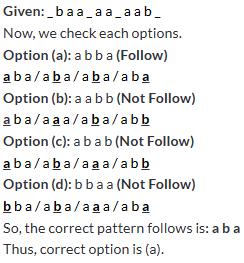
152. In a row of people all facing North, Harry is 8th from the right end. Ben is 19th from the right end. Ben is exactly between Harry and Loin. If Loin is 7th from the left end of the line, how many people are there in the row?
A. 36
B. 34
C. 37
D. 35
Solutions
Given:
In a row of people all facing North, Harry is 8th from the right end.
Ben is 19th from the right end.
Ben is exactly between Harry and Loin.
If Loin is 7th from the left end of the line.
From the given information facing and seating positions:
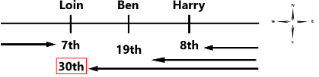
So, Loin must be 11 positions ahead of Ben (19 + 11 = 30th from the right).
Total number of people = 30 (from right) + 7 (from left) – 1
Loin is 30th from the right and 7th from the left, so total = (30 + 7) – 1 =36 people in the row.
Thus, the correct option is: (a) 36
153. Select the triad which follows the same pattern as that followed by the two triads given below. Both triads follow the same pattern.
JE-KF-LM
NI-OJ-PQ
A. OJ – PK – QS
B. QL – RM – SU
C. LG – MH – NO
D. PK – QL – RT
Solutions
Let’s analyze the given triads and identify the pattern:
First triad: JE – KF – LM
We’ll convert letters to their alphabet positions:
- J (10), E (5)
- K (11), F (6)
- L (12), M (13)
Observe the pattern:
- From J (10) → K (11) → L (12): increasing by 1 each time.
- From E (5) → F (6) → M (13): first +1, then +7 (not consistent)
So maybe we look at each pair as two-letter codes, and compare positions accordingly:
Let’s instead look at both triads together to spot a consistent rule:
First Triad:
- JE → 10, 5
- KF → 11, 6
- LM → 12, 13
→ J → K → L (+1 each)
→ E → F → M (+1, then +7)
A bit inconsistent.
Second Triad: NI – OJ – PQ
- N (14), I (9)
- O (15), J (10)
- P (16), Q (17)
→ N → O → P (+1)
→ I → J → Q (+1, then +7 again)
Looks like:
- First letters: increase by +1 each
- Second letters: +1 then +7
So pattern:
- 1st letter: +1
- 2nd letter: +1, then +7
Let’s apply this to the answer options:
Option 1: OJ – PK – QS
- O (15), J (10)
- P (16), K (11) → +1, +1
- Q (17), S (19) → +1, +8 → Not matching (+7 expected)
Option 2: QL – RM – SU
- Q (17), L (12)
- R (18), M (13) → +1, +1
- S (19), U (21) → +1, +8 →
Option 3: LG – MH – NO
- L (12), G (7)
- M (13), H (8) → +1, +1
- N (14), O (15) → +1, +7
This matches the pattern:
- First letters: L → M → N (+1 each)
- Second letters: G → H (+1), then H → O (+7)
So this triad follows the pattern.
Option 4: PK – QL – RT
- P (16), K (11)
- Q (17), L (12) → +1, +1
- R (18), T (20) → +1, +8 ❌
Correct Answer: LG – MH – NO
154. Three of the following four letter-cluster pairs are alike in a certain way and thus form agroup. Which is the letter-cluster pair that does NOT belong to that group?(Note: The odd one out is not based on the number of consonants/vowels or theirpositions in the letter-cluster.)
A. AM – KV
B. OA – YJ
C. KW – UF
D. FK – TA
Solutions
Let’s examine each letter-cluster pair and identify the relationship between the letters:
1. AM – KV
- A → K = +10 (A = 1, K = 11)
- M → V = +11 (M = 13, V = 22)
👉 Difference: +10, +9
2. OA – YJ
- O → Y = +10 (O = 15, Y = 25)
- A → J = +9 (A = 1, J = 10)
👉 Difference: +10, +9 ✅
3. KW – UF
- K → U = +10 (K = 11, U = 21)
- W → F = +11 (W = 23, F = 6, consider cyclic shift: 26+6−23 = 9 → seems inconsistent)
But normal mapping doesn’t match +10, +9
👉 K → U = +10, W → F is a reverse shift (W=23 to F=6 = -17) ❌
4. FK – TA
- F → T = +14
- K → A = -10
👉 Opposite pattern, and not matching the +10, +9 type
👉 Clearly different from others ❌
Common pattern in AM-KV, OA-YJ is:
First letter → +10
Second letter → +9
Only FK–TA does not follow any consistent pattern like the others.
Correct Answer: FK – TA
155. Three statements are given, followed by two conclusions numbered 1 and 2. Assuming the statements to be true, even if they seem to be at variance with commonly known facts, decide which of the conclusions logically follow(s) from the statements.
Statements:
I. All Mangoes are Kiwis
II. All Kiwis are Guavas
III. No Guava is an Apple
Conclusions:
1. All Apples are Mangoes
2. Some Guavas are Apples
A. Neither conclusion 1 nor 2 follows
B. Only conclusion 1 follows
C. Only conclusion 2 follows
D. Both conclusions 1 and 2 follow
Solutions
Given:
Statements:
I. All Mangoes are Kiwis
II. All Kiwis are Guavas
III. No Guava is an Apple
From the given information Venn diagram will be:
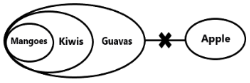
Conclusions:
1. All Apples are Mangoes (Not follow, There is no any relation between apples and mangoes.
2. Some Guavas are Apples (Not follow, There is also not any relation between guavas are apples.
Thus, the correct option is (a) Neither conclusion 1 nor 2 follows.
156. Among the following words, which one will come in the middle if they are arranged as per their order in an English dictionary?
1. Dance 2. Degree 3. Dare 4. Dear 5. Development
A. Dear
B. Dance
C. Degree
D. Dare
Solutions
Given:
1. Dance 2. Degree 3. Dare 4. Dear 5. Development
Alphabetically arranged;-
Dance (D – A – N – C – E)
Dare (D – A – R – E)
Dear (D – E – A – R)
Degree (D – E – G – R – E – E)
Development (D – E – V – E – L – O – P – M – E – N – T)
Middle word:
The middle word in this ordered list is Dear.
Thus, correct option is (a).
157. Select the figure from among the given options that can replace the question mark (?) in the following series and complete the pattern.
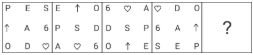
A. 
B. 
C. 
D. 
Solutions
Logic: 1. The movement of first and third are similar.
2. The movement of second and fourth are similar as shown below.
Thus, correct option is (b).
158. Select the set in which the numbers are related in the same way as are the numbers of the given sets.
(NOTE: Operations should be performed on the whole numbers, without breaking down the numbers into their constituent digits. E.g. 13 – Operations on 13 such as adding/subtracting/multiplying to 13 can be performed. Breaking down 13 into 1 and 3 and then performing mathematical operations on 1 and 3 is not allowed.)
(38, 31, 47)
(42, 35, 51)
A. (33, 24, 30)
B. (29, 21, 39)
C. (54, 47, 63)
D. (46, 40, 49)
Solutions
Given:
(38, 31, 47)
(42, 35, 51)
Logic:
2nd Number + 7 = 1st Number
2nd Number + 16 = 3rd Number
Set (38, 31, 47)
31 + 7 = 38
31 + 16 = 47
Set (42, 35, 51)
35 + 7 = 42
35 + 16 = 51
Let’s check the Options
Option (a) (33, 24, 30) (Incorrect)
24 + 7 = 31 ≠ 33
24 + 16 = 40 ≠ 30
Option (b) (29, 21, 39) (Incorrect)
21 + 7 = 28 ≠ 29
21 + 16 = 37 ≠ 39
Option (c) (54, 47, 63) (Correct)
47 + 7 = 54
47 + 16 = 63
Option (d) (46, 40, 49) (Incorrect)
40 + 7 = 47 ≠ 46
40 + 16 = 56 ≠ 49
Thus, the correct option is (c) (54, 47, 63)
159. Select the set in which the numbers are related in the same way as are the numbers of the following sets.
(NOTE: Operations should be performed on the whole numbers, without breaking down the numbers into their constituent digits. E.g. 13 – Operations on 13 such as adding/subtracting/multiplying to 13 can be performed. Breaking down 13 into 1 and 3 and then performing mathematical operations on 1 and 3 is not allowed.)
(2, 70, 82)
(26, 17, 53)
A. (36, 42, 90)
B. (79, 12, 141)
C. (71, 78, 122)
D. (54, 88, 152)
Solutions
Given:
(2, 70, 82)
(26, 17, 53)
Logic: (1st Number + 2nd Number) + 10 = 3rd Number
Set (2, 70, 82)
(2 + 70) + 10 = 72 + 10 = 82
Set (26, 17, 53)
(26 + 17) + 10 = 43 + 10 = 53
Let’s check the options:
Option (a): (36, 42, 90)
(36 + 42) + 10 = 78 + 10 = 88 ≠ 90 (Incorrect)
Option (b): (79, 12, 141)
(79 + 12) + 10 = 91 + 10 = 101 ≠ 141 (Incorrect)
Option (c): (71, 78, 122)
(71 + 78) + 10 = 149 + 10 = 159 ≠ 122 (Incorrect)
Option (d): (54, 88, 152)
(54 + 88) + 10 = 142 + 10 = 152 (Correct)
Thus, the correct option is (d) (54, 88, 152)
160. If ‘A’ stands for ‘÷÷’, ‘ B ‘ stands for ‘ × ‘, ‘ C ‘ stands for ‘ + ‘ and ‘ D ‘ stands for ‘ – ‘, then the resultant of which of the following would be 113?
A. 96C12 B2D(42 A6)D3C20
B. 96D12 A2C(42 B6)A3C20
C. 96C12 A2D(42A6)A3D20
D. 96D12 B2C(42 A6)B3C20
Solutions
We are given that:
- A = ÷ (division)
- B = × (multiplication)
- C = + (addition)
- D = – (subtraction)
We need to evaluate each expression (after replacing the letters with operations) and find which one gives a result of 113.
Let’s check the options one by one:
Option 1:
96C12 B2D(42 A6)D3C20
Replace with operations:
96 + 12 × 2 – (42 ÷ 6) – 3 + 20
Now solve step by step:
- (42 ÷ 6) = 7
- 12 × 2 = 24
- So: 96 + 24 – 7 – 3 + 20 =
= 120 – 7 – 3 + 20
= 113 + 20 = 133
Not correct
Option 2:
96D12 A2C(42 B6)A3C20
Replace with operations:
96 – 12 ÷ 2 + (42 × 6) ÷ 3 + 20
Now solve step by step:
- 12 ÷ 2 = 6
- 42 × 6 = 252, then 252 ÷ 3 = 84
Now substitute:
= 96 – 6 + 84 + 20 =
= 90 + 84 + 20 = 194
❌ Not correct
Option 3:
96C12 A2D(42 A6)A3D20
Replace with operations:
96 + 12 ÷ 2 – (42 ÷ 6) ÷ 3 – 20
Now solve step by step:
- 12 ÷ 2 = 6
- (42 ÷ 6) = 7 → then 7 ÷ 3 ≈ 2.33
So: 96 + 6 – 2.33 – 20 =
= 102 – 2.33 – 20 = 79.67
Not correct
Option 4:
96D12 B2C(42 A6)B3C20
Replace with operations:
96 – 12 × 2 + (42 ÷ 6) × 3 + 20
Now solve step by step:
- 12 × 2 = 24
- 42 ÷ 6 = 7 → 7 × 3 = 21
Now substitute:
= 96 – 24 + 21 + 20
= 72 + 21 + 20 = 113
Correct!
161. John and Jenny stood at a point facing the north. John left Jenny in the morning and walked towards the west for 3 km, taking 15 minutes. Then he moved towards the south for 4 km, taking 25 minutes. What is the shortest distance Jenny needs to travel to meet John?
A. 8 km
B. 4 km
C. 5 km
D. 7 km
Solutions
Given:
John and Jenny stood at a point facing north.
John left Jenny in the morning.
He walked 3 km west in 15 minutes.
Then he moved 4 km south in 25 minutes.
Therefore, shortest distance Jenny needs to travel to meet John is 5 Km towards South-West direction.
Thus, the correct option is (c) 5 Km
162. Seven people, A, B, D, L, X, Y and Z , are sitting in a row, facing north. Only Z sits to the right of D. Only three people sit to the left of A. Only three people sit between D and L . Y sits at some place to the left of X but at some place to the right of B. How many people sit between B and X?
A. One
B. Two
C. Three
D. Four
Solutions
Given:
Seven people, A, B, D, L, X, Y and Z , are sitting in a row, facing north.
Only Z sits to the right of D.
Only three people sit to the left of A.
Only three people sit between D and L.
Y sits at some place to the left of X but at some place to the right of B.
From the given information seating arrangement will be:

So, there are 3 people sit between B and X.
Thus, the correct option is: (c) Three.
163. In the following number-pairs, the second number is obtained by applying certain mathematical operations to the first number. Select the set in which the numbers are related in the same way as are the numbers of the following sets.
(NOTE: Operations should be performed on the whole numbers, without breaking down the numbers into their constituent digits. E.g. 13 – Operations on 13 such as adding/subtracting/multiplying to 13 can be performed. Breaking down 13 into 1 and 3 and then performing mathematical operations on 1 and 3 is not allowed.)
7, 27
11, 43
A. 15, 59
B. 15, 58
C. 14, 59
D. 14, 58
Solutions
Given:
7 → 27
11 → 43
Logic: 1st number × 4 – 1 = 2nd number.
Set 1: 7 → 27
7 × 4 = 28 → 28 – 1 = 27
Set 2: 11 → 43
11 × 4 = 44 → 44 – 1 = 43
Let’s check all the options:
Option (a): 15 → 59
15 × 4 = 60 → 60 – 1 = 59
It is following the logic.
Option (b): 15 → 58
15 × 4 = 60 → 60 – 2 = 58
It is incorrect.
Option (c): 14 → 59
14 × 4 = 56 → 56 – 1 = 55
It is incorrect.
Option (d): 14 → 58
14 × 4 = 56 → 56 – 1 = 55
It is incorrect.
Thus, the correct option is (a) 15 → 59.
164. The sequence of folding a paper and the manner in which the folded paper is cut is shown in the following figures. How would this paper look when unfolded?
A. 
B. 
C. 
D. 
Solutions
After unfolding the given figure following cuts will be shown as given below.
Thus, the correct option is: (a)
165. If yesterday was Monday, then which day of the week it will be after 89 days from today?
A. Sunday
B. Saturday
C. Monday
D. Tuesday
Solutions
Given:
Yesterday was Monday. means today is Tuesday.
We have to find the day of the week after 89 days from today.
The days of the week repeat every 7 days.
Find the remainder when 89 is divided by 7:
89 ÷ 7 = 12 remainder 5
This means after 89 days, the day will be 5 days ahead of Tuesday.
Count 5 Days Forward from Tuesday
Tuesday + 5 days = Sunday.
Thus, the correct option is (a) Sunday
166. In a certain code language, ‘FROM’ is written as ‘HSNK’, and ‘WAKE’ is written as ‘YBJC’. How will ‘JUMP’ be written in the given language?
A. LVLN
B. LTKN
C. MTKN
D. MULM
Solutions
Given:
FROM → HSNK, WAKE → YBJC
JUMP → ?
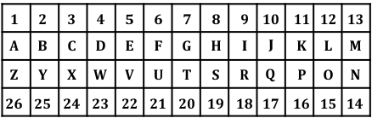
Logic: Letters are shifted by +2, +1, –1, –2 in alphabet order.
FROM → HSNK
F + 2 → H
R + 1 → S
O – 1 → N
M – 2 → K
WAKE → YBJC
W + 2 → Y
A + 1 → B
K – 1 → J
E – 2 → C
Similarly,
JUMP → ?
J + 2 → L
U + 1 → V
M – 1 → L
P – 2 → N
So, JUMP is written as LVLN.
Thus, the correct option is option: (a).
167. A statement is given below, followed by four conclusions given in the options. Find out which conclusion is true based on the given statement.
Statement : S < T ≤ G < M < K > P ≥ O
A. K > O > S
B. M ≥ P ≥ O
C. O = S = T
D. K > G > S
Solutions
Statement : S < T ≤ G < M < K > P ≥ O
Let’s analyze all the conclusions:
(a) K > O > S (False, S < T ≤ G < M < K > P ≥ O)
K > O is true but, O is not related to S
Therefore, this conclusion is false.
(b) M ≥ P ≥ O (False, M < K > P ≥ O)
P ≥ O is true but, M is not related to P
Therefore, this conclusion is false.
(c) O = S = T (False, S < T ≤ G < M < K > P ≥ O)
S and T are different and not equal to O.
Therefore, this conclusion is false.
(d) K > G > S (True, S < T ≤ G < M < K )
K > G is true and G > S is also true.
Thus, the correct option is (d) K > G > S
168. Select the option that is related to the third word in the same way as the second word is related to the first word.
(The words must be considered as meaningful English words and must not be related to each other based on the number of letters/number of consonants/vowels in the word)
Mandarin: China :: Swahili : ?
A. Peru
B. Kenya
C. Ukraine
D. France
Solutions
Given: Mandarin : China :: Swahili : ?
Mandarin is language of China
Similarly, Swahili is language of Kenya
So, Swahili is related to Kenya
Thus, correct option is (b).
169. Ajay starts from Point A and drives 6 km towards the east. He then takes a left turn, drives 7 km, turns left and drives 8 km. He then takes a left turn and drives 9 km. He takes a final left turn, drives 2 km and stops at Point P. How far (shortest distance) and towards which direction should he drive in order to reach Point A again? (All turns are 90 degree turns only unless specified.)
A. 4 km to the south
B. 3 km to the south
C. 2 km to the north
D. 1 km to the north
Solutions
Given:
Ajay starts from Point A and drives 6 km towards the east.
He then takes a left turn, drives 7 km, turns left and drives 8 km.
He then takes a left turn and drives 9 km.
He takes a final left turn, drives 2 km and stops at Point P.
From the given information direction will be:
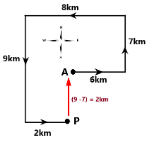
So, he (9 – 7) = 2km North drive to reach point A.
Thus, the correct option is: (c) 2 km to the north
170. UMSO is related to RJPL in a certain way based on the English alphabetical order. In the same way, QIOK is related to NFLH. To which of the following is MEKG related, following the same logic?
A. BJDH
B. BJHD
C. JBHD
D. JBDH
Solutions
Given:
UMSO → RJPL
QIOK → NFLH
MEKG → ?
Logic: Each letter is decreasing by -3 in alphabetical order.
UMSO → RJPL
U – 3 = R
M – 3 = J
S – 3 = P
O – 3 = L
QIOK → NFLH
Q – 3 = N
I – 3 = F
O – 3 = L
K – 3 = H
MEKG → ?
M – 3 = J
E – 3 = B
K – 3 = H
G – 3 = D
So, MEKG → JBHD
Thus, the correct option is (c) JBHD.
171. Select the combination of letters that when sequentially placed in the blanks of the given series will make the series logically complete. aced
_CFB D_IE GI_H JLO_MOR_
A. AFLKN
B. AELMN
C. BEJMQ.
D. BFJKQ
Solutions
The correct answer is Option A: AFLKN
Each missing letter completes the logical sequence of letter triplets. When the blanks are filled with A, F, L, K, N, the series becomes:
ACED CFB DIE GLH JLO KMOR
This pattern matches with the alphabetical progression, maintaining consistent shifts in each triplet.
172. Which of the following alternative figure will complete the pattern of the figure given below?

A. 
B. 
C. 
D. 
Solutions
The missing figure that will complete the figure is shown below.

Thus, the correct option is (c).
173. Select the Venn diagram from the given options that represents the correct relationship amongst the following classes.
Tin, Metal, Copper
A. 
B. 
C. 
D. 
Solutions
Given: Tin, Metal, Copper
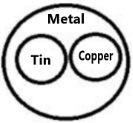
Tin and Copper are types of Metal.
Thus, correct option is (b).
174. Find the number of straight lines required to make the given figure.
A. 18
B. 15
C. 17
D. 16
Solutions
The number of straight lines required to make the given figure will be:
So, there are 17 straight line required to make the above figure.
Thus, the Correct option is (c) 17
175. Select the number from among the given options that can replace the question mark (?) in the following series.
86, 74, 62, 54, ?, 42, 38
A. 50
B. 43
C. 46
D. 44
Solutions
Given:
86, 74, 62, 54, ?, 42, 38
Logic: Difference of (12, 12, 8, 8 , 4, 4 ) follows.

Thus, correct option is (c).
176. Find the number of triangles in the given figure.
A. 5
B. 7
C. 8
D. 3
Solutions
In the given figure, the total number of triangles is 7.
Breakdown:
- In the first large triangle – 2 small triangles
- In the second large triangle – 3 triangles (2 small + 1 large formed by combining the two small ones)
- In the third large triangle – 1 triangle
- Additionally, one big triangle is formed by combining the left and middle sections
Total: 2 + 3 + 1 + 1 = 7 triangles
Correct Answer: B) 7
177. P, Q, R, S, T and U live on six different floors of the same building. The lowermost floor in the building is numbered 1 , the floor above it is numbered 2 and so on till the topmost floor is numbered 6 . Only two people live between P and S . S lives immediately below T. P lives on an even-numbered floor but not on floor number 2 . R lives on the topmost floor. Q lives immediately below R . Who lives on floor number 3?
A. T
B. Q
C. P
D. U
Solutions
Let’s break down the clues step by step:
Given:
- Floors are numbered 1 to 6 (1 is the lowest, 6 is the highest).
- People: P, Q, R, S, T, U
Clues:
- R lives on the topmost floor.
⟹ R is on floor 6 - Q lives immediately below R.
⟹ Q is on floor 5 - S lives immediately below T.
⟹ T is on one floor above S (T = S+1) - Only two people live between P and S.
⟹ There are exactly two floors between P and S. - P lives on an even-numbered floor but not on floor number 2.
⟹ P is on floor 4 or 6, but 6 is already taken by R → So P is on floor 4
Now place P on floor 4.
Let’s try placing S such that there are 2 people between P and S:
If P is on floor 4, then possibilities for S:
- S on floor 1 ⇒ Between S and P: floors 2 & 3 (✔)
- S on floor 2 ⇒ Between S and P: floors 3 & 4 (P is on 4, this is valid)
BUT P is on 4, and only one option satisfies “exactly two people between P and S”, i.e.:
- S is on floor 1
Then:
S – 1
_ – 2
_ – 3
P – 4
Q – 5
R – 6
Now, since S is immediately below T, T must be on floor 2.
Let’s place T on floor 2.
So far we have:
- Floor 6 – R
- Floor 5 – Q
- Floor 4 – P
- Floor 3 – [empty]
- Floor 2 – T
- Floor 1 – S
One person left: U
Remaining empty floor: floor 3 ⇒ U must be on floor 3
Final Floor Allocation:
| Floor | Person |
|---|---|
| 6 | R |
| 5 | Q |
| 4 | P |
| 3 | U |
| 2 | T |
| 1 | S |
Who lives on floor number 3?
Answer: U
Correct Option: D) U
178. Select the option that is related to the third word in the same way as the second word is related to the first word.
Sweater: Wool :: Chalk: ?
A. Duster
B. Oyster
C. Limestone
D. Haematite
Solutions
Given: Sweater: Wool :: Chalk: ?
The relationship between Sweater : Wool is that a sweater is made from wool.
Now, we need to find a similar relationship for Chalk : ?
Option (a) Duster → A duster is used with chalk but is not its raw material.
Option (b) Oyster → Oysters produce pearls, which are unrelated to chalk.
Option (c) Limestone → Chalk is primarily made from limestone, which is a sedimentary rock composed of calcium carbonate.
Option (d) Haematite → Haematite is an iron ore and has no connection to chalk.
Thus, the correct option is (c) Limestone
179. Read the given statements and conclusions carefully. Assuming that the information given in the statements is true, even if it appears to be at variance with commonly known facts, decide which of the given conclusion(s) logically follow(s) from the statement(s).
Statements:
I. All bags are duffles.
II. All duffles are containers.
Conclusions:
(I) Some containers are duffles.
(II) All bags are containers.
A. Both conclusions (I) and (II) follow.
B. Only conclusion (I) follows.
C. Neither conclusion (I) nor (II) follows.
D. Only conclusion (II) follows.
Solutions
Given:
Statements:
I. All bags are duffles.
II. All duffles are containers.
From the given information Venn diaram will be
Conclusions:
(I) Some containers are duffles (Follow, There are some containers are duffles that’s why it is following.
(II) All bags are containers (Follow, There are all the bags are containers because all the bags are in the container’s part.
Thus, the correct option is (a) Both conclusions (I) and (II) follow.
180. Which of the following options should come in place of the question mark (?) in the given series based on the English alphabetical order?
FRE, HTD, JVC, LXB, ?
A. NZA
B. MZA
C. OYA
D. MYA
Solutions
Given: FRE, HTD, JVC, LXB, ?
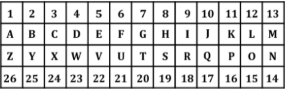
Logic: 1st letter + 2, 2nd letter + 2 and 3rd letter – 1 place.
For, 1st letter
F + 2 → H, H + 2 → J, J + 2 → L, L + 2 → N
For, 2nd letter
R + 2 → T, T + 2 → V, V + 2 → X, X + 2 → Z
For, 3rd letter
E – 1 → D, D – 1 → C, C – 1 → B, B – 1 → A
So, the missing term is NZA.
Thus, correct option is (a).
181. Read the given statements and conclusions carefully. Assuming that the information given in the statements is true, even if it appears to be at variance with commonly known facts, decide which of the given conclusions logically follow(s) from the statements.
Statements:
I. All roses are lilies.
II. No rose is a sunflower.
Conclusions:
(I) All lilies are roses.
(II) No lily is a sunflower.
A. Neither conclusion I nor II follows
B. Only conclusion II follows
C. Both conclusions I and II follow
D. Only conclusion I follows
Solutions
Let’s analyze the statements and conclusions logically:
Statements:
- All roses are lilies.
→ This means every rose is a lily, but not necessarily all lilies are roses. - No rose is a sunflower.
→ Roses and sunflowers are completely separate groups.
Conclusions:
(I) All lilies are roses.
- This is incorrect.
- The statement says all roses are lilies, but that does NOT mean all lilies are roses (i.e., it could be a bigger group of which roses are a part).
- This is the reverse of the original statement and does not logically follow.
(II) No lily is a sunflower.
- This is also incorrect.
- From the statements, no rose is a sunflower, but it is not stated whether lilies in general are or aren’t sunflowers.
- So we cannot conclude anything about lilies and sunflowers.
Final Answer:
Neither conclusion I nor II follows
Correct Option: A
182. Select the correct mirror image of the given figure when the mirror is placed at MN as shown below.

A. 
B. 
C. 
D. 
Solutions
The mirror image of the given letter/ number as shown below.

Thus, the correct option is: (c)
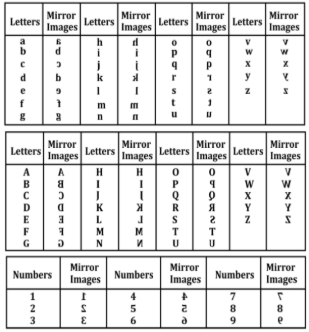
183. Select the option in which the given figure (X) is embedded as its part. (Rotation is NOT allowed.)
A. 
B. 
C. 
D. 
Solutions
The correct embedded figure is shown below.

Thus, the correct option is:(d)
184. Two different positions of the same dice are given below. Which is the number onthe face opposite to the face containing 11?
A. 8
B. 7
C. 10
D. 9
Solutions
From the two positions of the same dice, we can identify the numbers adjacent to 11.
Observations:
- In the first dice, we see:
Faces visible: 10, 11, 12 - In the second dice, we see:
Faces visible: 10, 12, 8
So, common numbers in both views: 10 and 12
Thus, the only face that disappears between the two is:
- In 1st dice: 11
- In 2nd dice: 8
So, 11 and 8 must be opposite to each other.
Final Answer: 8 (Option A)
185. In a certain code language, ‘FILE’ is coded as ‘3872’ and ‘LIVE’ is coded as ‘7286’. Whatis the code for ‘V’ in the given code language?
A. 2
B. 7
C. 8
D. 6
Solutions
186. Ramesh ranked 16th from the top and 21st from the bottom in his class in an examination. If only 21 students passed the exam, how many students in his class failed?
A. 19
B. 17
C. 15
D. 21
Solutions
Given:
Ramesh’s rank from top = 16
Rank from bottom = 21
Total students = 16 + 21 – 1 = 36
Passed students = 21
So, Failed students = 36 – 21 = 15
187. What will come in place of the question mark (?) in the given series?
120, 101, 139, 82, 158, ?
A. 58
B. 61
C. 63
D. 55
Solutions
Let’s analyze the given series:
Series: 120, 101, 139, 82, 158, ?
We will look at the pattern between the terms:
- 120 → 101 → difference = -19
- 101 → 139 → difference = +38
- 139 → 82 → difference = -57
- 82 → 158 → difference = +76
Now we observe the differences:
-19, +38, -57, +76
These differences follow a pattern of alternating sign and increasing by 19 each time:
-19, +38, -57, +76, -95 (next)
So, next difference should be -95
Thus:
158 – 95 = 63
Final Answer: 63 (Option C)
188. Shanti’s daughter Chandini is married to Abhi. Anchal is married to Sandy, the grandson of Shanti. Abhi’s grandson is Karan. Rashmi is the mother of Karan. Shaurya is Anchal’s son. How is Shaurya related to Karan?
A. Son
B. Brother
C. Nephew
D. Cousin
Solutions
Let’s break down the relationships step-by-step to determine how Shaurya is related to Karan:
Given:
- Shanti’s daughter Chandini is married to Abhi.
→ So, Chandini + Abhi are a couple. - Anchal is married to Sandy, the grandson of Shanti.
→ So, Sandy is a grandson of Shanti. - Abhi’s grandson is Karan.
→ So, Karan is Abhi’s grandson. - Rashmi is the mother of Karan.
→ So, Rashmi + Abhi’s son = parents of Karan. - Shaurya is Anchal’s son.
→ So, Shaurya is the son of Anchal and Sandy.
Let’s connect everyone:
- Shanti → has daughter Chandini (married to Abhi)
- Chandini and Abhi → have a child (say, X)
- X and Rashmi → are parents of Karan
→ So, Karan is great-grandson of Shanti - Shanti → has a grandson Sandy (married to Anchal)
- Sandy + Anchal → parents of Shaurya
Now,
- Sandy and Chandini’s child X are siblings or cousins, since both are grandchildren of Shanti.
- That means Shaurya and Karan’s parent X are cousins.
Thus, Shaurya is the cousin of Karan’s parent, making Shaurya the first cousin once removed of Karan.
But among the given options, the most suitable and commonly understood relation would be:
Cousin
(Since they are of the same generation and family line, “cousin” fits best.)
Correct Answer: Cousin
189. John, Kate, Lisa, Mary, Neil and Omar are sitting around a circular table facing the centre. John sits second to left of Kate. Lisa sits third to right of Kate. Mary sits to the immediate left of Lisa. Neil sits to the immediate right of Kate. How many people Sit between Omar and Mary when counted from the right of Omar ?
A. one
B. three
C. zero
D. two
Solutions
Let’s solve this step-by-step using the clues:
Step 1: Base reference – All are facing the centre.
Clue 1:
John sits second to the left of Kate.
Since everyone is facing the centre, left is anti-clockwise.
So if Kate is at position X, then John is two places anti-clockwise from Kate.
Clue 2:
Lisa sits third to the right of Kate.
Right = clockwise
So Lisa is three positions clockwise from Kate.
Clue 3:
Mary sits to the immediate left of Lisa.
Mary is just one place anti-clockwise from Lisa.
Clue 4:
Neil sits to the immediate right of Kate.
Neil is one place clockwise from Kate.
Now place them on the circle:
Let’s assume positions as a clock with 6 spots.
Let’s fix Kate at 12 o’clock (position 1).
- Then, John is second to her left (anti-clockwise) → position 5
- Lisa is third to her right (clockwise) → position 4
- Mary is to the left of Lisa → position 3
- Neil is to Kate’s immediate right (clockwise) → position 2
Current seating:
| Position | Person |
|---|---|
| 1 | Kate |
| 2 | Neil |
| 3 | Mary |
| 4 | Lisa |
| 5 | John |
| 6 | Omar |
Question:
How many people sit between Omar and Mary when counted from the right of Omar?
- Omar is at position 6
- From his right (clockwise):
- Position 1: Kate
- Position 2: Neil
- Position 3: Mary
So between Omar (6) and Mary (3) in clockwise direction:
- Kate (1)
- Neil (2)
👉 Two people sit between them.
Final Answer: Two
190. In a code language, ‘SERIES’ is coded as 87 and ‘DISMAY’ is coded as 91. How will ‘SPRINT’ be coded in the same language?
A. 66
B. 52
C. 57
D. 71
Solutions
Given:
SERIES → 87, DISMAY → 91
SPRINT → ?
Logic: Sum of reverse alphabetical values of the letters.
SERIES → 87
8 + 22 + 9 + 18 + 22 + 8 = 87
DISMAY → 91
23 + 18 + 8 + 14 + 26 + 2 = 91
Similarly,
SPRINT → ?
8 + 11 + 9 + 18 + 13 + 7 = 66
So, SPRINT → 66
Thus, the correct option is: (a)
191. Select the option that represents the correct order of the given words as they would appear in an English dictionary.
1. Dermatology
2. Derogation
3. Derivative
4. Derailed
5. Dermestid
6. Deregulation
A. 4, 3, 2, 1, 5, 6
B. 4, 6, 3, 2, 1, 5
C. 4, 6, 3, 1, 5, 2
D. 4, 6, 1, 5, 3, 2
Solutions
To arrange words in dictionary (alphabetical) order, we compare them letter by letter.
Given words:
- Dermatology
- Derogation
- Derivative
- Derailed
- Dermestid
- Deregulation
Step-by-step dictionary order:
- 4. Derailed → comes first (starts with “Dera”)
- 6. Deregulation → “Dereg…” comes after “Dera…”
- 3. Derivative → “Deri…” comes after “Dereg…”
- 1. Dermatology → “Derma…” comes after “Deri…”
- 5. Dermestid → “Derme…” comes after “Derma…”
- 2. Derogation → “Dero…” comes after “Derme…”
Correct order: 4, 6, 3, 1, 5, 2
Option C is the correct answer.
192. Which of the following options should come in place of the question mark (?) in the given series based on the English alphabetical order?
BEH, KNQ, TWZ, CFI, ?
A. LOR
B. KNQ
C. LNP
D. KMO
Solutions
Let’s analyze the given alphabetical series:
Series: BEH, KNQ, TWZ, CFI, ?
Break each group into its individual letters:
- B E H
Positions in alphabet: B(2), E(5), H(8)
Pattern: +3 → +3 - K N Q
K(11), N(14), Q(17)
Again: +3 → +3 - T W Z
T(20), W(23), Z(26)
Again: +3 → +3 - C F I
C(3), F(6), I(9)
Again: +3 → +3
So, every term is a group of letters with a +3 jump in alphabetical order.
Now, observe how the first letters of each group change:
- B(2) → K(11) → T(20) → C(3) → ?
This sequence is a little tricky. Let’s write down their positions:
- B → 2
- K → 11
- T → 20
- C → 3
This looks like: 2 → 11 → 20 → 3
Now observe the pattern of difference:
- 2 → 11 = +9
- 11 → 20 = +9
- 20 → 3 = (Wrap around); treating it as circular: 20 → 26 → 0 → 3
So, from 20 to 3 is +9 (in modulo 26 arithmetic)
So the first letters are +9 cyclically.
Now from C(3), next +9 → 3 + 9 = 12 → L
Now use same +3 letter pattern from L(12):
- L → 12
- L + 3 = O (15)
- O + 3 = R (18)
So next group is: L O R
Correct answer: LOR
193. In a code language, ‘PIG’ is coded as 29 and ‘COW’ is coded as 38. How will ‘CAMEL’ be coded in the same language?
A. 27
B. 29
C. 22
D. 34
Solutions
Let’s decode the pattern used in the given code language:
Step 1: Word → Letter Positions
PIG
P = 16
I = 9
G = 7
Sum = 16 + 9 + 7 = 32
But code = 29, so 32 – 3 = 29
COW
C = 3
O = 15
W = 23
Sum = 3 + 15 + 23 = 41
But code = 38, so 41 – 3 = 38
✅ Pattern: Add positions of letters → Subtract 3
Step 2: Apply same logic to CAMEL
C = 3
A = 1
M = 13
E = 5
L = 12
Sum = 3 + 1 + 13 + 5 + 12 = 34
Now, subtract 3:
34 – 3 = 31
But 31 is not in the options. So maybe the logic is different. Try another logic.
Try this pattern:
Check for alternate logic (like consonants only or position difference).
Let’s try reverse positions from Z = 1 to A = 26:
PIG:
P = 11 (Z–P+1 = 26–16+1 = 11)
I = 18
G = 20
Sum = 11 + 18 + 20 = 49 → no match
Too complicated.
Let’s try another possibility:
Try this formula:
Sum of letters – number of letters
PIG:
P = 16, I = 9, G = 7 → sum = 32
Number of letters = 3
32 – 3 = 29 ✅
COW:
C = 3, O = 15, W = 23 → sum = 41
Letters = 3
41 – 3 = 38 ✅
Same logic!
Apply to CAMEL:
C = 3
A = 1
M = 13
E = 5
L = 12
Sum = 3 + 1 + 13 + 5 + 12 = 34
Letters = 5
34 – 5 = 29
Correct answer: 29
194. Select the option figure that can replace the question mark (?) in the given figure to complete the pattern.

A. 
B. 
C. 
D. 
Solutions
Given:

Given Figure + Option (b) = Complete figure
Thus, the correct option is (b)
195. Which one of the following pairs is different from the rest three?
A. Tongue : Taste
B. Eye : Blind
C. Ear : Deaf
D. Leg : Lame
Solutions
Let’s analyze the relationship in each pair:
- Tongue : Taste
→ The tongue is the organ used for tasting. - Eye : Blind
→ If the eye is not functional, the result is blindness (a condition). - Ear : Deaf
→ If the ear doesn’t work, the result is deafness (another condition). - Leg : Lame
→ If the leg is affected, the result is being lame (again a condition).
Observation:
- In 2, 3, and 4, the first word is an organ, and the second word is a condition caused by the loss or dysfunction of that organ.
- In 1, tongue and taste describe a function, not a condition.
✅ So, the different pair is:
Tongue : Taste
196. Based on the English alphabetical order, three of the following four letter-clusters are alike in a certain way and thus form a group. Which letter-cluster DOES NOT belong to that group?
(Note: The odd man out is not based on the number of consonants/vowels or their position in the letter-cluster.)
A. TOJ
B. MHC
C. GBW
D. QJE
Solutions
Logic: 1st letters – 5 = 2nd letters, 2nd letters – 5 = 3rd letters
Let’s check all the options:
Option (a): TOJ
T – 5 = O, O – 5 = J
Option (b): MHC
M – 5 = H, H – 5 = C
Option (c): GBW
G – 5 = B, B – 5 = W
Option (d): QJE
Q – 7 = J, J – 5 = E
There are three options A, B, C which are following the same pattern.
So, the correct odd one out is QJE.
Thus, the correct option is (d) QJE.
197. E is the son of A who is the only child of her mother. D is the daughter of C who is the sibling of A’s spouse. B is the only son of C’s mother, F. How is A related to F?
A. Niece
B. Daughter
C. Cousin
D. Daughter’s-in-law
Solutions
Let’s break the question step by step and draw the family relations:
Given:
- E is the son of A,
⇒ A is E’s parent. - A is the only child of her mother,
⇒ A’s mother has only one child (A). - D is the daughter of C,
⇒ C is D’s parent. - C is the sibling of A’s spouse,
⇒ A’s spouse and C are siblings. - B is the only son of C’s mother, F,
⇒ F is C’s mother, and B is her only son.
⇒ So C must be female (since B is the only son).
Let’s deduce:
- Since C is A’s spouse’s sibling,
⇒ C and A’s spouse are siblings.
⇒ That means F is the mother of A’s spouse. - So, A is the daughter-in-law of F.
✅ Final Answer: Daughter-in-law (i.e. A is related to F as Daughter-in-law)
Correct option: Daughters-in-law
198. Select the number from among the given options that can replace the question mark (?)in the following series.
8, 18, 60, 174, 528, ?
A. 1576
B. 1574
C. 1578
D. 1577
Solutions
Given: 8, 18, 60, 174, 528, ?
Logic: (1st number 3) and alternatively – 6, + 6 = Next number.
8 × 3 – 6 = 18
18 × 3 + 6 = 60
60 × 3 – 6 = 174
174 × 3 + 6 = 528
So, the next number will be:
528 × 3 – 6 = 1578
Thus, the correct answer is (c) 1578.
199. What will be the day of the week on 08 June 2030?
A. Saturday
B. Friday
C. Sunday
D. Monday
Solutions
Odd days in 2000n years = 0
Odd days:
Each normal year = 1 odd day
Each leap year = 2 odd days
Total odd days = (22 × 1) + (7 × 2) = 22 + 14 = 36 ÷ 7 = 1 remainder (odd days)
Odd days in 2030 = 3 + 0 + 3 + 2 + 3 + 8 = 19 ÷ 7 = 5 remainder (odd days)
Total odd days = 1 + 5 = 6
So the day on 8 June will be: Saturday.
Thus, correct option is (a)
200. Select the figure from the given options, which when put in place of the question mark (?) will logically complete the series.
A. 
B. 
C. 
D. 
Solutions
Logic: Right most shapes is getting disappear and rest is shown below.
Thus, the correct option is: (d)