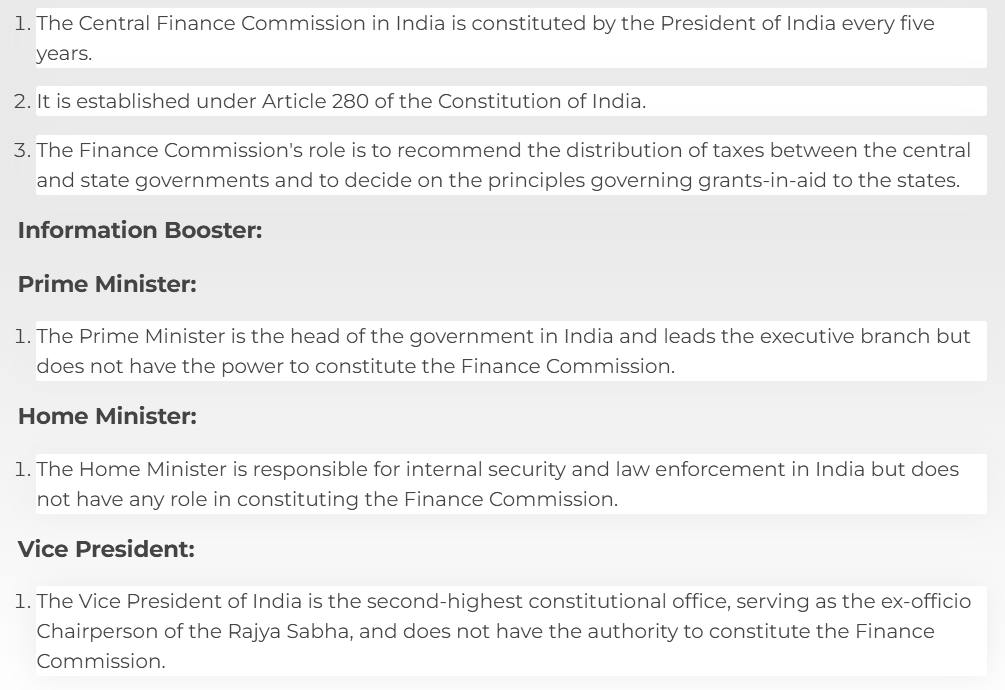
1.The Central Finance Commission is constituted every five years by whom?
A. Prime Minister
B. President
C. Home Minister
D. Vice President
Solutions
The correct answer is (b) President.
2. Bronze is an alloy of-
A. Zinc and iron
B. Copper and tin
C. Tin and zinc
D. Iron and mercury
Solutions
The correct answer is (b) Copper and tin.
· Bronze is an alloy primarily composed of copper and tin. The typical composition is about 88% copper and 12% tin, though the proportions can vary depending on the desired properties.
· Bronze is known for its hardness, durability, and resistance to corrosion, making it suitable for various applications, including sculptures, tools, and musical instruments.
· The addition of tin to copper lowers the melting point and makes the metal easier to cast, which is one of the reasons why bronze has been historically significant in tool-making and art.
Information Booster:
· Zinc and Iron: These metals are not combined to form bronze. Instead, they are components of other alloys, such as brass (copper and zinc) and galvanization coatings.
· Tin and Zinc: This combination does not form bronze. Alloys of tin and zinc are used for specific purposes but are not as common as bronze.
· Iron and Mercury: These elements are not used to make any common alloys. Mercury amalgams are typically used in dentistry and gold extraction, but not with iron.
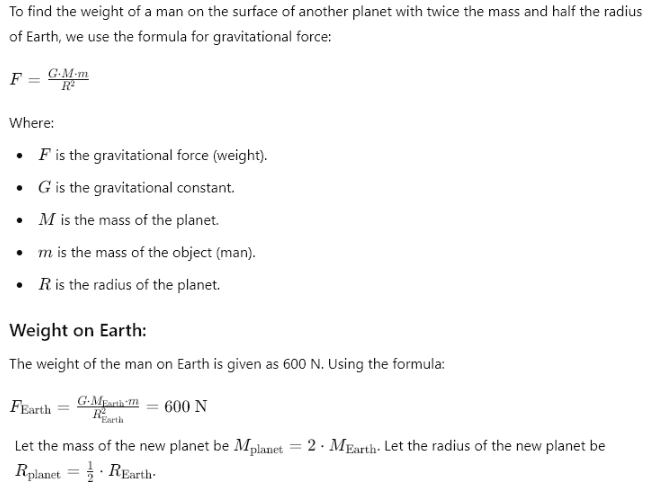
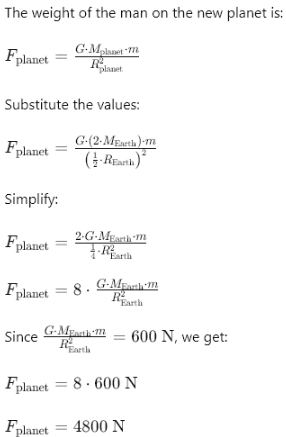
3. A man weighs 600 N on the surface of the Earth. What will be his weight on the surface of a planet with twice the mass and half the radius of the Earth?
A. 4800 N
B. 600 N
C. 300 N
D. 2400 N
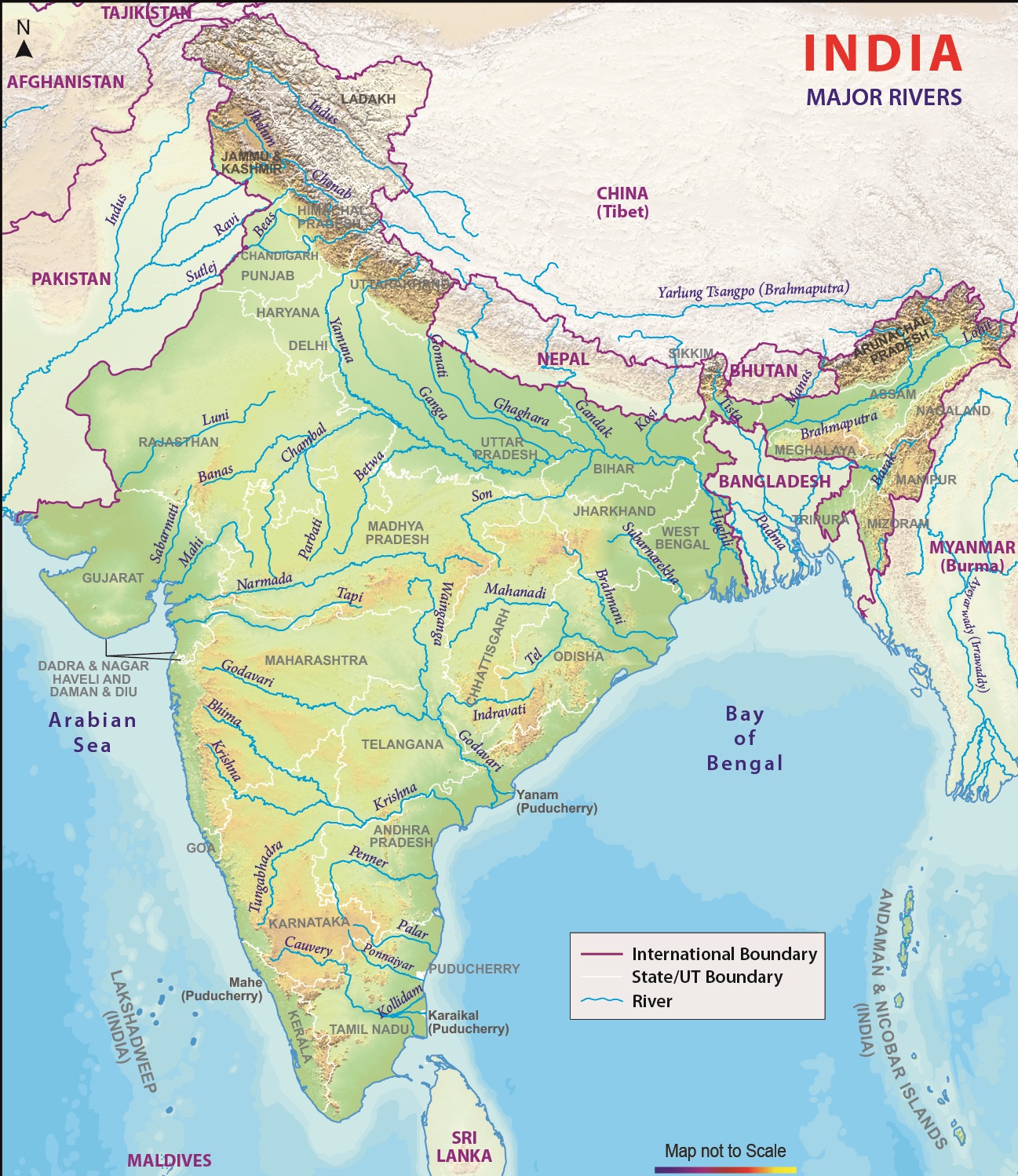
Solutions
4. Which of the following is a folk dance from the state of Maharashtra?
A. Garba
B. Dhangari Gaja
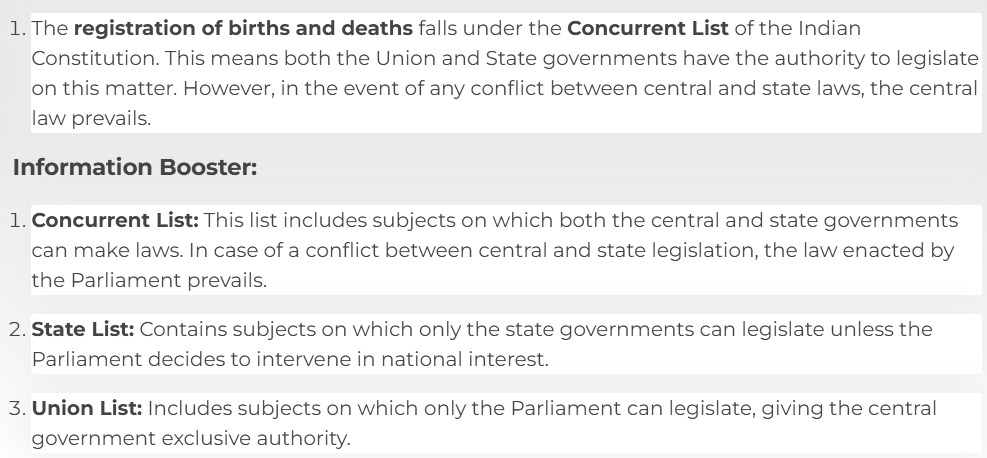
C. Ghoomar
D. Bhangra
Solutions
The correct answer is (b) Dhangari Gaja.
· Dhangari Gaja is a traditional folk dance from the state of Maharashtra.
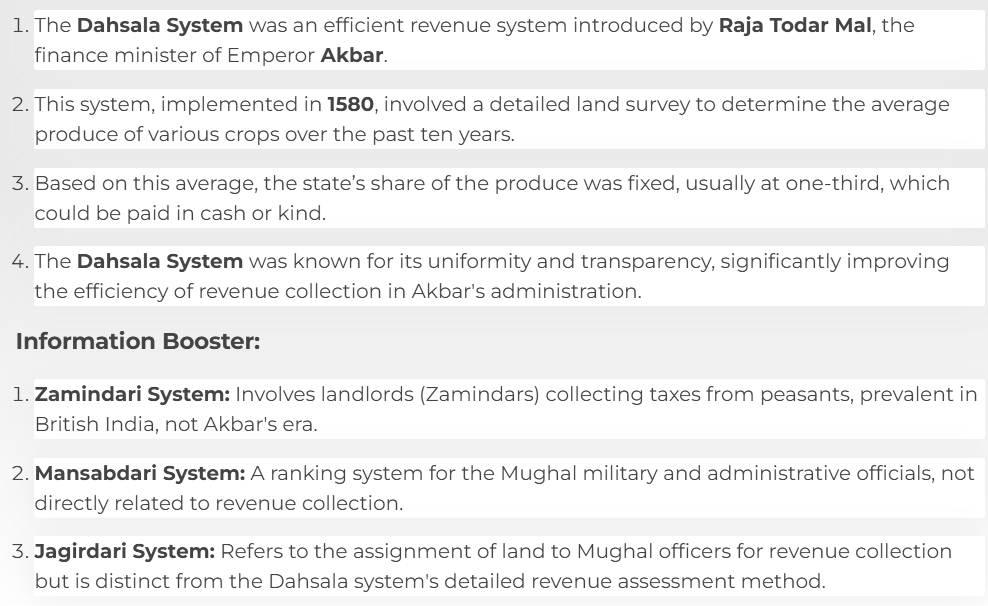
· It is performed by the Dhangar community, who are shepherds, and it is typically performed to honor their god, Biruba.
· The dance is characterized by its rhythmic movements and is accompanied by traditional instruments like the dholki and tuntune.
Information Booster:
Some important folk dances along with their respective states in India:
| Folk Dance | State |
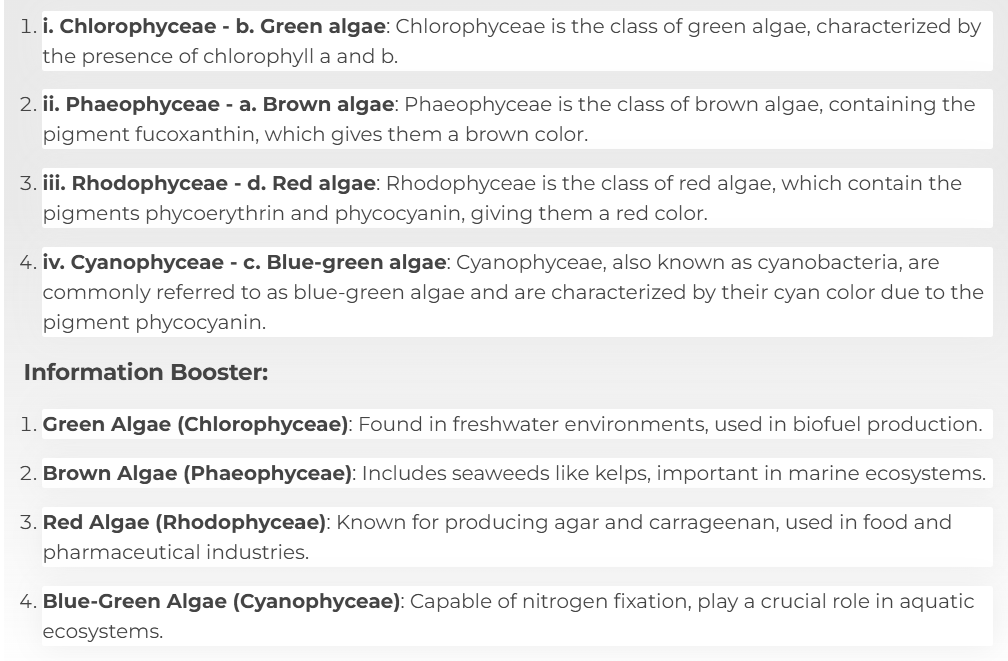
| Bihu | Assam |
| Garba | Gujarat |
| Ghoomar | Rajasthan |
| Lavani | Maharashtra |
| Bhangra | Punjab |
| Kuchipudi | Andhra Pradesh |
| Kathakali | Kerala |
| Yakshagana | Karnataka |
| Chhau | Odisha, West Bengal, Jharkhand |
| Giddha | Punjab |
| Rouf | Jammu & Kashmir |
| Dandiya Raas | Gujarat |
| Kalbelia | Rajasthan |
| Thang Ta | Manipur |
| Mohiniyattam | Kerala |
| Tamasha | Maharashtra |
| Nautanki | Uttar Pradesh |
| Ghumura Dance | Odisha |
| Dollu Kunitha | Karnataka |
| Padayani | Kerala |
5. The mineral (ions) necessary for coagulation of blood is-.
A. Sodium
B. Chlorine
C. Calcium
D. Potassium
Solutions
The correct answer is (c) Calcium.
· Calcium ions (Ca²⁺) play a crucial role in the process of blood coagulation. Calcium is required for the activation of certain clotting factors, which are essential in the cascade of events that lead to the formation of a blood clot.
· Without adequate calcium levels, the blood clotting process would be impaired, leading to prolonged bleeding.
Information Booster:
· Sodium (Na⁺) and Potassium (K⁺) are primarily involved in nerve impulses and muscle function but do not directly contribute to blood coagulation.
· Chlorine (Cl⁻), in the form of chloride ions, helps maintain fluid balance but is not directly involved in the coagulation process.
6. Which of the following diseases affects the blood cells in the human body?
A. Polio
B. Meningitis
C. Smallpox
D. Leukemia
Solutions
The correct answer is (d) Leukemia.
· Leukemia is a type of cancer that affects the blood cells, specifically the white blood cells (leukocytes). It is characterized by the rapid and uncontrolled production of abnormal white blood cells in the bone marrow, which interfere with the production and function of normal blood cells.
Information Booster:
· Polio: Affects the nervous system, leading to paralysis.
· Meningitis: Involves inflammation of the membranes (meninges) surrounding the brain and spinal cord.
· Smallpox: A viral infection that affects the skin and mucous membranes but does not affect blood cells directly.
7. What happens when a solution of an acid is mixed with a solution of a base in a test tube?
(i) The temperature of the solution increases.
(ii) The temperature of the solution decreases.
(iii) The temperature of the solution remains the same.
(iv) Salt formation takes place.
A. (i)and (iv)
B. Only (i)
C. (ii) and (iv)
D. (iii) and (iv)
Solutions
The correct answer is (i) The temperature of the solution increases and (iv) Salt formation takes place.
When an acid reacts with a base, a neutralization reaction takes place. This reaction results in the formation of salt and water, and it is an exothermic reaction, meaning it releases heat.
1. Temperature Increases :
· The reaction between an acid and a base releases energy in the form of heat, causing the temperature of the solution to increase.
· This increase in temperature can be felt by touching the test tube, which becomes warm.
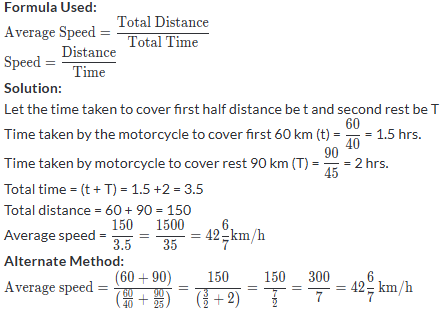
2. Salt Formation :
· The product of an acid and base reaction is a salt along with water. For example, when hydrochloric acid (HCl) reacts with sodium hydroxide (NaOH), sodium chloride (NaCl) and water (H₂O) are formed.
HCl+NaOH→NaCl+H2O
This reaction is known as neutralization because the acidic and basic properties are neutralized, resulting in a neutral salt.
Additional Knowledge : · Temperature Decreases : A decrease in temperature typically occurs in endothermic reactions where heat is absorbed. Neutralization reactions are not endothermic.
· (iii) Temperature Remains the Same : This is incorrect for neutralization reactions, as they always involve a temperature change.
8. Which of the following methods is used to separate the volatile component from its non-volatile solute?
A. Diffusion
B. Evaporation
C. Filtration
D. Condensation
Solutions
The correct answer is (b) Evaporation.
· Evaporation is used to separate a volatile component (such as water) from its non-volatile solute (like salt or sugar). During evaporation, the volatile component vaporizes, leaving behind the non-volatile solute.
Explanation:
· Diffusion : Refers to the movement of particles from an area of high concentration to low concentration, not suitable for separating volatile and non-volatile substances.
· Filtration : Used to separate solids from liquids but does not separate volatile components.
· Condensation : It is the process of converting vapor into liquid, often used in conjunction with evaporation but not for separation by itself.
9. Which of the following metals is liquid at room temperature?
A. Calcium
B. Mercury
C. Potassium
D. Sodium
Solutions
The correct answer is (b) Mercury.
· Mercury is the only metal that is in a liquid state at room temperature (around 25°C or 77°F). It is unique among metals due to its low melting point of -38.83°C, which allows it to remain in a liquid form at standard conditions.
Information Booster:
· Calcium , Potassium , and Sodium : These metals are solid at room temperature and have relatively high melting points compared to mercury.
10. Which of the following acids is mainly present in vinegar?
A. Citric acid
B. Oxalic acid
C. Tartaric acid
D. Acetic acid
Solutions
The correct answer is (d) Acetic acid.
· Acetic acid is the main acid present in vinegar. It gives vinegar its characteristic sour taste and pungent smell. The concentration of acetic acid in vinegar typically ranges from 4% to 8% by volume.
Information Booster:
· Citric Acid : Found in citrus fruits like lemons and oranges.
· Oxalic Acid : Found in leafy greens, rhubarb, and some other vegetables.
· Tartaric Acid : Found in grapes and bananas, commonly used in baking and wine production.
11. Aves, commonly known as birds, belong to which of the following kingdoms in the biological classification system?
A. Plantae
B. Fungi
C. Animalia
D. Protista
Solutions
The correct answer is Animalia.
· Aves is the class of animals that includes all birds. Birds are warm-blooded, egg-laying, feathered creatures with a beak and, in most cases, the ability to fly.
· Like all members of the kingdom Animalia, birds are multicellular, eukaryotic organisms that rely on consuming organic material for sustenance.
· Birds exhibit a range of adaptations for flight, though some species, like penguins and ostriches, have evolved to live without flying.
Information Booster:
· Animalia: This kingdom includes multicellular organisms that are heterotrophic, meaning they consume organic material for energy.
· Characteristics of Aves: Birds possess feathers, beaks without teeth, a high metabolic rate, a lightweight but strong skeleton, and a four-chambered heart.
· Vertebrates: Birds belong to the vertebrate category of the Animalia kingdom, meaning they possess a backbone.
· Diversity: There are over 10,000 species of birds, ranging from tiny hummingbirds to large ostriches.
Additional Information:
· Plantae: Includes plants, which are autotrophic and produce their food through photosynthesis.
· Fungi: Includes organisms like mushrooms, yeasts, and molds that obtain nutrients through absorption.
· Protista: A diverse group of mostly unicellular organisms, including algae and protozoa.
12. Which among the following difference between aerobic and anaerobic respiration is INCORRECT?
A. Aerobic respiration takes place in presence of oxygen – Anaerobic respiration takes place in the absence of oxygen
B. In Aerobic respiration pyruvate is broken down into ethanol and carbon dioxide- In Anaerobic respiration pyruvate is broken down into carbon dioxide and water
C. In Aerobic respiration more energy is released- In Anaerobic respiration less energy is released
D. Aerobic respiration takes place in mitochondria– Anaerobic respiration takes place in yeast
Solutions
Aerobic respiration is the process of breaking down glucose using oxygen. The cells use glucose and oxygen to produce carbon dioxide, water and energy. Anaerobic Respiration is the process of breaking down glucose without using oxygen, but rather catalysts. It produces a byproduct of energy, carbon dioxide and lactic acid. More Energy is released by Anaerobic respiration as comparison to Aerobic respiration.
13. Which is the strongest bone in the human body?
A. Shin bone
B. Ankle
C. Thigh bone
D. Spinal cord
Solutions
The correct answer is (c) Thigh bone.
· The thigh bone, or femur, is the strongest and longest bone in the human body. It supports the weight of the body and provides stability to the lower limb, playing a crucial role in activities like walking, running, and jumping.
Information Booster:
· Shin bone: Also known as the tibia, it is one of the bones in the lower leg but is not as strong as the femur.
· Ankle: Composed of several smaller bones but does not have the same strength as the femur.
· Spinal cord: Not a bone, but a bundle of nerves that runs through the vertebral column, which consists of individual vertebrae.
14. Daskathia of _________ is the tribal dance performed by two males depicting the historic and Puranic events.
A. Uttar Pradesh
B. Gujarat
C. Goa
D. Odisha
Solutions
The correct answer is (d) Odisha.
· Daskathia is a tribal dance performed by two males in Odisha.
· Daskathia is performed in Odisha, it is specifically associated with the Bonda tribe in the Malkangiri district of the state. The dance depicts historical and Puranic events through mime and storytelling.
· Other popular folk dances of Odisha are : Odissi, Gotipua, Chhau, Mayurbhanj Chhau, Karma dance, Sambalpuri Folk dance, Dhap dance, Jhoomar , Chaiti Ghoda, Danda Nata, Medha Nacha.
· Uttar Pradesh: The folk dances of Uttar Pradesh include Kajri, Nautanki, Raslila, and Chhattisgarhi.
· Gujarat: The folk dances of Gujarat include Garba, Raas, Dandiya, and Bhangra.
· Goa: The folk dances of Goa include Dekhni, Fugdi, and Mandovi Halgi.
15. Who received the Nobel Prize in 1901 for ‘recognition of the extraordinary services rendered by the discovery of the laws of chemical dynamics and osmotic pressure in solutions’?
A. Hermann Emil Fischer
B. Jacobus Henricus van ‘t Hoff
C. Svante August Arrhenius
D. Henri Moissan
Solutions
The correct answer is (b) Jacobus Henricus van ‘t Hoff.
Jacobus Henricus van ‘t Hoff received the Nobel Prize in Chemistry in 1901 for his discovery of the laws of chemical dynamics and osmotic pressure in solutions. He was the first recipient of the Nobel Prize in Chemistry, recognized for his pioneering work in chemical kinetics, chemical equilibrium, and osmotic pressure, which laid the foundation for modern physical chemistry.
Therefore, the correct answer is (b) Jacobus Henricus van ‘t Hoff.
16. The Indian Navy’s P-8I aircraft was deployed to which country for the first time to participate in Exercise VARUNA 2024?
A. United States
B. France
C. United Kingdom
D. Germany
Solutions
· The Indian Navy’s P-8I aircraft was deployed to France for the first time to participate in Exercise VARUNA 2024.
· The exercise took place at Air Base 125 Istres-Le Tube in France and was conducted in the Mediterranean Sea.
· This marks a significant milestone for India-France naval cooperation and interoperability in naval operations.
Information Booster:
· P-8I Aircraft: A long-range maritime reconnaissance and anti-submarine warfare aircraft developed by Boeing, used extensively by the Indian Navy for surveillance and intelligence-gathering missions.
· Exercise VARUNA: An annual Indo-French bilateral naval exercise that began in 1993, enhancing the operational-level interactions between the two navies.
· Strategic Importance: The deployment of the P-8I to Europe highlights the increasing global reach of the Indian Navy and its strategic partnerships.
17. Which of the following factors does NOT affect the inductance of a coil?
A. Cross-sectional area
B. Number of turns
C. Type of material
D. Current through the coil
Solutions
The current through the coil does not affect the inductance of the coil. The inductance of a coil is determined by the number of turns, the cross-sectional area, and the type of material. So the answer is (d).
Detailed explanation of each factor:
· Number of turns: The more turns in the coil, the greater the inductance. This is because the magnetic field is stronger when there are more turns of wire.
· Cross-sectional area: The greater the cross-sectional area of the coil, the greater the inductance. This is because the magnetic field can flow through a larger area, which increases the amount of flux linkage.
· Type of material: The type of material used in the core of the coil can affect the inductance. Magnetic materials, such as iron, have a higher permeability than non-magnetic materials, so they can store more magnetic flux and have a higher inductance.
· Current through the coil: The current through the coil does not affect the inductance of the coil. This is because the inductance is a property of the coil, not of the current flowing through it.
18. Who was the first defence minister of India?
A. Kailash Nath Katju
B. Swaran Singh
C. YB Chavan
D. Baldev Singh
Solutions
Sol. The correct answer is (d) Baldev Singh.
· Baldev Singh was the first Defence Minister of independent India, serving from 1947 to 1952.
· He played a crucial role in the integration of the princely states into India and in establishing the foundation of India’s defence policies and infrastructure during the early years of independence.
Information Booster:
· Kailash Nath Katju: Served as the Home Minister and the Law Minister of India.
· Swaran Singh: He served as Defence Minister later from 1966 to 1970 and again from 1974 to 1976.
· YB Chavan: Served as the Defence Minister of India from 1962 to 1966, following the Sino-Indian War.
19. The Nehru Trophy competition near Alappuzha, held on the second Saturday of August every year, is the most competitive and popular of the ______________ category.
A. badminton
B. basketball
C. boat races
D. horse races
Solutions
The correct answer is (c) boat races.
· The Nehru Trophy Boat Race is one of the most prestigious and popular boat races in Kerala, held annually near Alappuzha (also known as Alleppey) on the Punnamada Lake.
· It is conducted on the second Saturday of August every year and attracts large crowds, including tourists from around the world.
· The event is known for the competitive spirit and features the famous snake boats (chundan vallams), which are long, narrow boats rowed by a large number of oarsmen.
· The race was named after India’s first Prime Minister, Jawaharlal Nehru, who was impressed by the enthusiasm of the oarsmen during his visit to Kerala in 1952.
Information Booster:
Boat Races in Kerala:
· Snake Boat Race: Known for its unique, long snake-shaped boats that can accommodate up to 100 rowers.
· Champakulam Moolam Boat Race: One of the oldest and most traditional boat races in Kerala.
· Aranmula Uthrattathi Boat Race: Held during the Onam festival, it has a spiritual significance and is more a ceremonial event than a competition.
20. Electrons can be deflected by which of the following?
A. Only magnetic field
B. Only electric field
C. Both magnetic and electric field
D. No option is correct.
Solutions
The answer is (c). Electrons can be deflected by both magnetic and electric fields.
Electrons, being charged particles, can be influenced by both electric and magnetic fields. An electric field can exert a force on a charged particle, changing its direction of motion. Similarly, a magnetic field can also exert a force on a moving charged particle, altering its trajectory. Therefore, electrons can be deflected by both electric and magnetic fields.
So, the correct answer would be: (c) Both magnetic and electric field.
21. In which part of the body is thyroid gland situated?
A. Head
B. Abdomen
C. Throat
D. Chest
Solutions
The correct answer is (c) Throat.
· The thyroid gland is located in the throat, specifically in the front of the neck, just below the Adam’s apple. It is a butterfly-shaped gland that plays a crucial role in regulating metabolism by releasing hormones such as thyroxine (T4) and triiodothyronine (T3). These hormones control the speed of various bodily functions, including how quickly the body uses energy and makes proteins.
Information Booster:
· Head: This is not the location of the thyroid gland; however, glands like the pituitary gland are located in the head.
· Abdomen: This area contains organs such as the liver, stomach, and intestines, not the thyroid gland.
· Chest: The chest contains the heart and lungs, not the thyroid gland.
22. Which of these is the characteristic of sound which enables us to distinguish one sound from another having the same pitch and loudness?
A. Time period
B. Timber or quality of sound
C. Wave velocity
D. Frequency
Solutions
The correct answer is (b) Timber or quality of sound.
· Timbre (or quality of sound) is the characteristic that allows us to distinguish between different sounds that have the same pitch and loudness.
· It refers to the unique tone or sound color produced by different instruments or voices, even if they are playing or singing the same note at the same volume.
· The timbre of a sound depends on the waveform, harmonics, and overtones produced by the sound source.
Additional Knowledge:
· Time period – Refers to the time taken for one complete oscillation or cycle of a wave, but it does not help in distinguishing sounds of the same pitch and loudness.
· Wave velocity – This is the speed at which sound waves travel through a medium (like air, water, or solids), but it does not affect the distinction between different sounds.
· Frequency – Refers to the number of vibrations or cycles per second, determining the pitch of the sound, but not the timbre.
23. To obtain the same size image at 2F₂ after refraction by a convex lens where should the object be placed?
A. At 2F₁
B. Beyond 2F₁
C. Between focus F₁ and optic centre 0
D. At infinity
Solutions
The correct answer is (a) At 2F₁.
· To obtain an image of the same size as the object after refraction by a convex lens, the object must be placed at 2F₁ (twice the focal length from the lens on the object side). In this case, the image will be formed at 2F₂ (on the opposite side), and it will be real, inverted, and of the same size as the object.
Information Booster:
· Beyond 2F₁ : The image will be diminished and formed between F₂ and 2F₂.
· Between F₁ and O : The image will be virtual, upright, and magnified.
· At infinity : The image will be formed at the focal point F₂ and will be highly diminished.
24. In the process of rainbow formation in the sky, every raindrop in the atmosphere acts like-
A. Glass prism
B. Glass slab
C. Mirror
D. Lens
Solutions
The correct answer is (a) Glass prism.
· In the process of rainbow formation, every raindrop acts like a glass prism. When sunlight enters a raindrop, it is refracted, dispersed, and then reflected inside the drop.
· The light is split into its constituent colors (dispersion) and emerges as a spectrum of colors, creating the rainbow.
· The phenomenon involves refraction as the light enters the raindrop, reflection within the drop, and refraction again when it exits.
Additional Knowledge:
· Glass slab – A glass slab would not produce dispersion as a prism does. It refracts light but does not separate it into colors like a prism.
· Mirror – Mirrors reflect light, but they do not refract or disperse light into a spectrum like raindrops or prisms.
· Lens – A lens can refract light, but it does not cause the dispersion needed to form a rainbow.
25. What is the name given to the materials which are burnt to produce heat energy?
A. Biomaterials
B. Fuels
C. Chemicals
D. Gases
Solutions
The correct answer is (b) Fuels.
· Fuels are materials that are burnt to produce heat energy. They can be in the form of solids (like coal and wood), liquids (like petrol and diesel), or gases (like natural gas and propane).
· Fuels are used for various purposes, including generating electricity, powering vehicles, and heating homes.
Information Booster:
Biomaterials:
· Biomaterials are natural or synthetic materials used in medical devices or implants. They are not specifically used for producing heat energy.
Chemicals:
· Chemicals can be any substance with a distinct molecular composition and are used in various industries. Not all chemicals are used to produce heat energy.
Gases:
· Gases like natural gas and propane can be used as fuels, but not all gases are fuel. Some gases have other industrial or chemical applications.
26. Which of the following states is NOT a part of the Tapi Basin?
A. Rajasthan
B. Maharashtra
C. Madhya Pradesh
D. Gujarat
Solutions
The correct answer is (a) Rajasthan.
The Tapi Basin primarily covers areas in the states of Maharashtra, Madhya Pradesh, and Gujarat. The Tapi River originates in the Satpura Range of Madhya Pradesh and flows through Maharashtra and Gujarat before draining into the Arabian Sea. Rajasthan, being a northwestern state, does not lie in the Tapi Basin.
Information Booster:
- Tapi River: Originates from the Satpura Range in Madhya Pradesh and is one of the major west-flowing rivers in India.
27. Which condition, also known as icterus, causes a yellowing of your skin and the whites of your eyes?
A. Ichthyosis
B. Jaundice
C. Eczema
D. Pemphigus
Solutions
The correct answer is (b) Jaundice.
· Jaundice, also known as icterus, is a condition that causes a yellowing of the skin and the whites of the eyes.
· This occurs due to an increase in bilirubin levels in the blood, which is often a result of liver disease, gallbladder disease, or other conditions that affect the liver’s ability to process and eliminate bilirubin.
Information Booster:
· Ichthyosis : A skin condition characterized by dry, scaly skin but not associated with yellowing.
· Eczema : A skin condition causing red, inflamed skin but does not cause yellowing.
· Pemphigus : An autoimmune disorder that causes blisters on the skin but not yellowing.
28. What is the unit of calorific value of a fuel?
A. kJ/kg
B. J/kg K
C. MJ/mg K
D. kW/mg
Solutions
The correct answer is (a) kJ/kg.
· Calorific value (or heating value) of a fuel is a measure of the amount of energy released per unit mass of the fuel when it is completely burned. It indicates the energy content of the fuel and is commonly expressed in units of kilojoules per kilogram (kJ/kg). This unit quantifies how much heat energy is produced when a specific amount (per kilogram) of the fuel undergoes combustion.
Details on other options:
· J/kg K: This represents joules per kilogram per Kelvin.It is a unit used to measure specific heat capacity, which relates to the amount of heat required to raise the temperature of a substance by one degree Kelvin per unit mass.
· MJ/mg K: This represents megajoules per milligram per Kelvin.It is a highly uncommon and impractical unit for expressing calorific values, as it suggests energy per milligram (a very small mass unit) and per Kelvin (temperature unit).
· kW/mg:This represents kilowatts per milligram.Kilowatt (kW) is a unit of power, not energy content, and milligram (mg) is a unit of mass.
29. The negatively charged ion is known as-
A. Anode
B. Cathode
C. Anion
D. Cation
Solutions
The correct answer is (c) Anion.
· A negatively charged ion is known as an anion. Anions are formed when an atom or molecule gains one or more electrons, resulting in a negative charge. For example, chloride (Cl-) and sulfate (SO42−) are common anions.
Information Booster:
· Cation: A positively charged ion formed when an atom or molecule loses one or more electrons.
· Anode & Cathode: These terms refer to electrodes in an electrochemical cell where oxidation and reduction reactions occur. Anions typically move toward the anode in an electrochemical cell.
30. What does the registration of births and deaths fall under?
A. State List
B. Concurrent List
C. Union List
D. None of the above
Solutions
The correct answer is (b) Concurrent List.
31. Which of the following statements is correct?
1. The SI unit of electric field intensity is the volt per meter.
2. The SI unit of electric potential is the watt per ampere per meter square.
A. Only 1
B. Only 2
C. Both 1 and 2
D. Neither 1 nor 2
Solutions
The correct answer is (a).
Statement 1: The SI unit of electric field intensity is the volt per meter.
This is correct. Electric field intensity is defined as the force per unit charge exerted on a test charge placed in an electric field. The SI unit of force is the newton (N), and the SI unit of charge is the coulomb (C). Therefore, the SI unit of electric field intensity is N/C, which is also equal to V/m.
Statement 2: The SI unit of electric potential is the watt per ampere per meter square.
This is incorrect. Electric potential is defined as the work per unit charge required to move a test charge from a reference point to a point in an electric field. The SI unit of work is the joule (J), the SI unit of charge is the coulomb (C), and the SI unit of distance is the meter (m). Therefore, the SI unit of electric potential is J/C, which is also equal to V. The unit watt (W) is not used to measure electric potential.
Therefore, only statement 1 is correct.
32. Bohr’s orbits are called stationary, because-
A. Protons remain in the nuclei and are stationary
B. Electrons in them are stationary
C. Their orbits have fixed radii
D. Electrons in them have fixed energy
Solutions
The correct answer is (d) Electrons in them have fixed energy.
· Bohr’s orbits are called stationary because electrons in these orbits have fixed energy levels. These energy levels are quantized, meaning that electrons can only occupy specific orbits with definite energies and cannot exist in between these orbits.
· When an electron remains in one of these orbits, it does not emit or absorb energy, hence the term “stationary” is used. The electron only emits or absorbs energy when it transitions between different energy levels.
Information Booster:
· Protons remain in the nuclei and are stationary: This statement is true for protons but is not related to the concept of Bohr’s stationary orbits.
· Electrons in them are stationary: Electrons are not physically stationary in these orbits; they move around the nucleus but do not radiate energy while in a particular orbit.
· Their orbits have fixed radii: The radii of the orbits are indeed fixed, but this is a consequence of the quantized energy levels rather than the definition of stationary states.
33. Who was the Greek ambassador in the court of Chandragupta Maurya?
A. Megasthanes
B. Seleucos
C. Menander
D. Demetrias
Solutions
The Greek ambassador in the court of Chandragupta Maurya was Megasthenes. He was a Greek historian and diplomat who lived in the fourth century BCE. He was sent to India by Seleucus I Nicator, the Greek king who ruled over a part of the region that is now modern-day Afghanistan and Pakistan, to establish diplomatic relations with the Mauryan Empire. Megasthenes stayed in India for several years and wrote a book called Indica, which provided a detailed account of Indian society, culture, and governance. Option (a) is correct.
34. Which tissue is responsible for transportation of water in plants?
A. Xylem
B. Ribosome
C. Cytoplasm
D. Chloroplast
Solutions
The correct answer is (a) Xylem.
· Xylem is the tissue responsible for the transportation of water and dissolved minerals from the roots to other parts of the plant. It consists of specialized cells such as tracheids and vessel elements, which facilitate the upward movement of water through the plant.
Information Booster:
· Ribosome : A cell organelle responsible for protein synthesis, not related to water transport.
· Cytoplasm : The jelly-like substance inside cells, where various cell activities occur, but not involved in water transport.
· Chloroplast : The organelle responsible for photosynthesis in plant cells, containing the pigment chlorophyll.
35. Akbar’s governance was recognized for its effective revenue management system known as:
A. Zamindari System
B. Mansabdari System
C. Jagirdari System
D. Dahsala System
Solutions
The correct answer is (d) Dahsala System.
36. In any tennis game, if both players win three points each in a game (i.e. score is 40-40), then it’s called a
A. equal
B. deuce
C. back
D. rattle
Solutions
The correct answer is (b) deuce.
· In tennis, when both players have won three points each (i.e., the score is 40-40), it is called a deuce.
· At deuce, a player must win two consecutive points to win the game. The first point won after deuce gives the player advantage, and if the same player wins the next point, they win the game. If the opponent wins the next point, the score returns to deuce.
· Deuce ensures that a player cannot win the game by a narrow margin and must secure a two-point lead.
Information Booster:
· Scoring System: Tennis uses a unique scoring system where points are counted as 15, 30, 40, and then game. If both players reach 40-40, it’s called deuce.
· Advantage: The player who wins the next point after deuce is said to have the “advantage.” If the player with the advantage wins the following point, they win the game.
· Origins of Deuce: The word “deuce” comes from the French word “deux,” meaning “two,” indicating that a player needs two consecutive points to win from deuce.
37. What is the name of the first indigenously built Pollution Control Vessel (PCV) launched for the Indian Coast Guard (ICG) in August 2024?
A. Samudra Rakshak
B. Samudra Shakti
C. Samudra Pratap
D. Samudra Vijay
Solutions
The correct answer is Samudra Pratap, the first indigenously built Pollution Control Vessel (PCV) launched for the Indian Coast Guard (ICG) in August 2024.
Key points about Samudra Pratap:
· Built by: Goa Shipyard Limited
· Significance: Represents India’s first indigenously designed and constructed Pollution Control Vessel
· Function: To combat oil spills in the country’s Exclusive Economic Zone (EEZ)
· Samudra Pratap is the first indigenously developed Pollution Control Vessel, specifically designed to combat marine pollution, particularly oil spills, and ensure environmental safety in Indian waters.
· Built as part of the “Make in India” initiative, this vessel showcases India’s growing capabilities in the defense and maritime sectors.
Information Booster:
· Pollution Control Vessels (PCVs): These vessels are specialized in detecting, containing, and cleaning up marine pollution, especially oil spills, thus protecting marine ecosystems.
· Indian Coast Guard (ICG): The ICG is responsible for the security of India’s maritime interests and ensures the protection of the marine environment, responding to pollution incidents, particularly in the Exclusive Economic Zone (EEZ).
38. What is the other name for the unit Coulomb/second?
A. Second (S)
B. Joule (J)
C. Volt (V)
D. Ampere (A)
Solutions
The correct answer is (d) Ampere (A).
· Coulomb per second (C/s) is the unit of electric current, and it is equivalent to 1 Ampere (A). Therefore, an ampere is defined as one coulomb of charge passing through a point in an electric circuit per second.
Information Booster:
· Second (S) is a unit of time.
· Joule (J) is a unit of energy.
· Volt (V) is a unit of electric potential.
39. Who was appointed as the new Prime Minister of Tunisia in August 2024?
A. Najla Bouden
B. Ahmed Hachani
C. Malek Zahi
D. Kamel Madouri
Solutions
The correct answer is (d) Kamel Madouri.
· In August 2024, Kamel Madouri was appointed as the new Prime Minister of Tunisia. He succeeded Ahmed Hachani, who was dismissed by President Kais Saied. Madouri previously served as the Minister of Social Affairs before being named Prime Minister. His appointment comes during a period of significant political and social challenges in Tunisia, including issues related to water and electricity shortages (The Media Line) (Wikipedia).
Information Booster:
· Located on the northeastern coast, Tunis is the capital and largest city of the country, which is itself named after Tunis.
· The official language of Tunisia is Modern Standard Arabic. The vast majority of Tunisia’s population is Arab and Muslim.
· Currency: Tunisian Dinar
40. Match the columns.
| Colum-A (Class) | Column-B (Common name) |
| i. Chlorophyceae | a. Brown algae |
| ii. Phaeophyceae | b. Green algae |
| iii. Rhodophyceae | c. Blue-green algae |
| iv. Cyanophyceae | d. Red algae |
A. i-b, ii-c, iii-a, iv-d
B. i-b, ii-a, iii-d, iv-c
C. i-d, ii-c, iii-b, iv-a
D. i-a, ii-b, iii-c, iv-d
Solutions
The correct answer is (b) i-b, ii-a, iii-d, iv-c.
41. Deficiency of which of the following vitamins in the human diet causes a disease called xerophthalmia?
A. Vitamin A
B. Vitamin K
C. Vitamin C
D. Vitamin D
Solutions
The correct answer is (a) Vitamin A(retinol).
· Xerophthalmia is a medical condition characterized by dryness of the conjunctiva and cornea of the eye. It is primarily caused by a deficiency of Vitamin A in the diet.
· Vitamin A is essential for maintaining healthy vision, and its deficiency can lead to severe eye problems, including night blindness and, in advanced cases, xerophthalmia.
· If left untreated, xerophthalmia can progress to keratomalacia and lead to blindness.
Information Booster:
| Vitamin | Disease/Condition |
| Vitamin A | Night blindness, Xerophthalmia, Keratomalacia |
| Vitamin B1 (Thiamine) | Beriberi (Wet and Dry), Wernicke-Korsakoff syndrome |
| Vitamin B2 (Riboflavin) | Ariboflavinosis, Cheilosis, Angular stomatitis |
| Vitamin B3 (Niacin) | Pellagra (Dermatitis, Diarrhea, Dementia) |
| Vitamin B5 (Pantothenic Acid) | Paresthesia, Fatigue, Irritability |
| Vitamin B6 (Pyridoxine) | Anemia, Dermatitis, Depression, Confusion |
| Vitamin B7 (Biotin) | Dermatitis, Alopecia, Neurological disorders |
| Vitamin B9 (Folic Acid) | Megaloblastic anemia, Neural tube defects in fetuses |
| Vitamin B12 (Cobalamin) | Pernicious anemia, Megaloblastic anemia, Neuropathy |
| Vitamin C | Scurvy (Bleeding gums, Weakness, Anemia) |
| Vitamin D | Rickets (in children), Osteomalacia (in adults) |
| Vitamin E | Neurological problems, Hemolytic anemia in newborns |
| Vitamin K | Hemorrhagic disease of the newborn, Prolonged bleeding |
42. An atom has a mass number of 23 and atomic number 11. The number of protons is-
A. 11
B. 23
C. 12
D. 22
Solutions
The correct answer is (a) 11.
· The atomic number of an atom represents the number of protons in its nucleus. Since the atomic number of this atom is 11, it means the atom has 11 protons.
Information Booster:
· Mass number is the sum of the number of protons and neutrons in the nucleus. In this case, the mass number is 23.
· The number of neutrons can be calculated by subtracting the atomic number from the mass number:
Neutrons=23−11=12
43. Which material property determines a material’s ability to store heat energy?
A. Density
B. Thermal conductivity
C. Specific heat capacity
D. Electrical resistance
Solutions
44. The Power Finance Corporation Limited (PFC) secured a long-term loan of 25.5 billion Japanese Yen (JPY) from which institution to finance the 300.3 MW Wind Energy Project in Karnataka?
A. Asian Development Bank (ADB)
B. Japan International Cooperation Agency (JICA)
C. Japan Bank for International Cooperation (JBIC)
D. International Finance Corporation (IFC)
Solutions
The correct answer is (c) Japan Bank for International Cooperation (JBIC).
· The Power Finance Corporation Limited (PFC) secured a long-term loan of 25.5 billion Japanese Yen (JPY) from the Japan Bank for International Cooperation (JBIC).
· The loan was obtained to finance a 300.3 MW Wind Energy Project in Karnataka, India.
· This loan is part of JBIC’s Global Action for Reconciling Economic Growth and Environmental Preservation (GREEN) initiative, which supports projects that contribute to environmental sustainability.
· The funding from JBIC is also co-financed by Sumitomo Mitsui Banking Corporation and other Japanese financial institutions.
Additional Information:
· The 300.3 MW Wind Energy Project is part of India’s efforts to increase renewable energy capacity, supporting the country’s commitment to achieving its climate goals and reducing carbon emissions .
45. On heating ethanol with concentrated H2SO4 at 443 K gives-
A. Ethane
B. Ethene
C. Ethyne
D. Methane
Solutions
The correct answer is (b) Ethene.
· On heating ethanol (C2H5OH) with concentrated sulfuric acid (H2SO4) at 443 K, ethene (C2H4) is produced. This reaction is known as dehydration of ethanol, where water is removed from the ethanol molecule to form ethene.
Reaction:

Explanation of Other Options:
· Ethane : Not formed in this reaction; requires hydrogenation of ethene.
· Ethyne : Formed from calcium carbide or other reactions, not directly from ethanol dehydration.
· Methane : Not related to the dehydration of ethanol.
46. A series is given with one term missing. Select the correct alternative from the given ones that will complete the series.
MQRT, JNOQ, GKLN, DHIK, ?
A. ANRS
B. AMRQ
C. AEFH
D. ANTS
Solutions
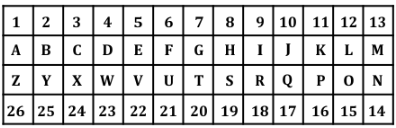
First letters: M, J, G, D → Each letter decreases by 3:
M (13) → J (10) → G (7) → D (4)
Next: D – 3 = A.
Second letters: Q, N, K, H → Each letter decreases by 3:
Q (17) → N (14) → K (11) → H (8)
Next: H – 3 = E.
Third letters: R, O, L, I → Each letter decreases by 3:
R (18) → O (15) → L (12) → I (9)
Next: I – 3 = F.
Fourth letters: T, Q, N, K → Each letter decreases by 3:
T (20) → Q (17) → N (14) → K (11)
Next: K – 3 = H.
Thus, the missing term is AEFH,
Correct answer is (c) AEFH.
47. Which of the following groups of letters when sequentially placed from left to right will complete the given series?
ee_fgghheeffgg_heeffgghheeff___hh
A. ggfh
B. eeff
C. fhgg
D. efgh
Solutions
Given: ee_fgghheeffgg_heeffgghheeff___hh
Option (a) ggfh
ee gfgghheeffgg gheeffgghheeff fhhh
Option (b) eeff
ee efgghheeffgg eheeffgghheeff ffhh
Option (c) fhgg
ee ffgghh/eeffgg hh/eeffgghh/eeff gghh
Option (d) efgh
ee efgghheeffgg fheeffgghheeff ghhh
Correct answer is (c) fhgg.
48. In the following question, select the missing number from the given series.
451, 472, 493, 514, ?, 556
A. 538
B. 535
C. 534
D. 530
Solutions
given series: 451, 472, 493, 514, ?, 556
Logic: Difference between alternate number is 21.
From 451 to 472, the difference is
472−451=21.
From 472 to 493, the difference is
493−472=21.
From 493 to 514, the difference is
514−493=21.
So, the pattern so far involves adding 21 to each number.
Continuing the pattern, we add 21 to 514:
514+21=535
Therefore, the missing number should be 535.
Correct answer is 535.
49. Arrange the given words in the sequence in which they occur in the dictionary.
1. Change
2. Chance
3. Channel
4. Chant
5. Chancellor
A. 2, 5, 1, 4, 3
B. 2, 3, 1, 4, 5
C. 2, 3, 1, 5, 4
D. 2, 5, 1, 3, 4
Solutions
Chance comes first because “n” is before “g” in “Change.”
Chancellor comes after Chance as it continues after “Chance.”
Change follows after Chancellor.
Channel comes before Change because “n” comes before “g.”
Chant comes last because “t” is after “n” in Channel.
Correct answer is (d) 2, 5, 1, 3, 4.
50. In a certain code language, ‘MARS’ is written as ‘1752223’ and ‘TIDE’ is written as ‘241389’. How will ‘BABY’ be written in that language?
A. 65216
B. 79523
C. 65629
D. 86425
Solutions
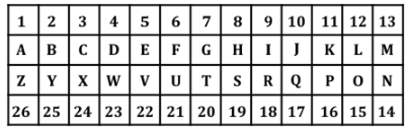
‘MARS’ is written as ‘1752223’
17 = M + 4
5 = A + 4
22 = R + 4
23 = S + 4
Logic: Coding number = 4 + respective letter in the given word.
similarly in TIDE’ is written as ‘241389’.
BABY
B + 4 = 6
A + 4 = 5
B + 4 = 6
Y + 4 = 29
Correct answer is (c) 65629.
51. In a code language, ‘CREATE’ is written as ‘DTHEYK’, ‘CRITICAL’ is written as ‘DTLXNIHT’, how will ‘SKILL’ be written in that language?
A. RMLPR
B. TMLPQ
C. TNOPQ
D. SMLQQ
Solutions
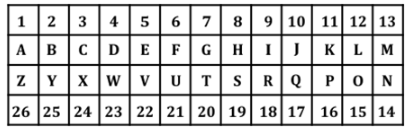
To determine the code for ‘SKILL’ based on the given examples, let’s first identify the pattern in the provided codes:
1. CREATE is written as DTHEYK
2. CRITICAL is written as DTLXNIHT
CREATE to DTHEYK
C → D: C+1=D
R → T: R+2= T
E → H: E+3= H
A → E: A+4= E
T → Y: T+5= Y
E → K: E+6=K
CRITICAL to DTLXNIHT
C → D: C+1=D
R → T: R+2=T
I → L: I+3=L
T → X: T+4=X
I → N: I+5=N
C → I: C+6=I
A → H: A+7=H
L → T: L+8=T
Applying the pattern to ‘SKILL’:
Following the established pattern:
First letter: S+1=T
Second letter: K+2=M
Third letter: I+3=L
Fourth letter: L+4=P
Fifth letter: L+5=Q
Therefore, ‘SKILL’ will be written as TMLPQ.
Correct answer is (b) TMLPQ
52. Priya is the sister of Rahul. Rahul’s father, Mohan has three children and he is the son of Sohan. Sohan has only two grandsons. What is the relationship between Priya and Sohan?
A. Granddaughter
B. Daughter
C. Sister
D. Cousin
Solutions
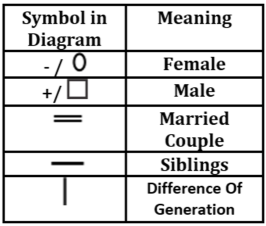
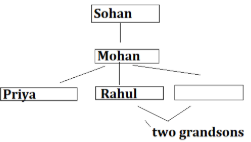
Sohan has only two grandsons, which implies Priya, being a female, cannot be his grandson but is related as his granddaughter, since Mohan is her father and Sohan is Mohan’s father.
53. Action’ is related to ‘Reaction’ in the same way as ‘Stimulus’ is related to ‘________’.
A. Reception
B. Vision
C. Response
D. Feedback
Solutions
‘Action’ and ‘Reaction’ are words that demonstrate cause and effect. Similarly, ‘Stimulus’ leads to a ‘Response.’
Hence, the correct answer is (C) Response.
54. Select the option that is related to the third letter-cluster in the same way as the second letter-cluster is related to the first letter-cluster.
BECD : YVXW : : DGEF : ?
A. VRTS
B. WTVU
C. WUTV
D. XUWV
Solutions
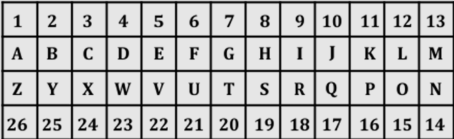
Pair of opposite letters
BECD : YVXW
B-Y, E-V, C-X, D-W
similarly,
DGEF : ?
D-W, G-T, E-V, F-U
WTVU is final answer.
55. Seema starts her daily walking routine. She walks 4 km East, then turns North and walks 2.5 km, then turns West and walks 4 km, then turns to her right and walks 4.5 kms. Where is she now with respect to the starting position?
A. 5.5 km North
B. 7 km South
C. 5.5 km South
D. 7 km North
Solutions
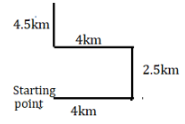
Now she = 2.5 + 4.5 = 7 km
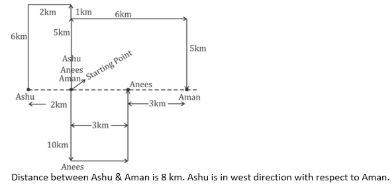
56. In this scenario, Aman, Anees, and Ashu are standing at the same place initially. Aman walks 5km towards the north direction, then turns right and walks 6km, and then takes another right turn and walks 5km. Anees walks 10km towards the south direction, then takes a left turn and walks 3km, and then takes another left turn and walks 10km. Ashu walks 6km towards the north direction, takes a left turn, walks 2km, and then takes another left turn and walks 6km. What is the distance between Aman and Ashu and in which direction is Ashu with respect to Aman?
A. 8km, West
B. 8km, East
C. 3km, East
D. 5km, West
Solutions
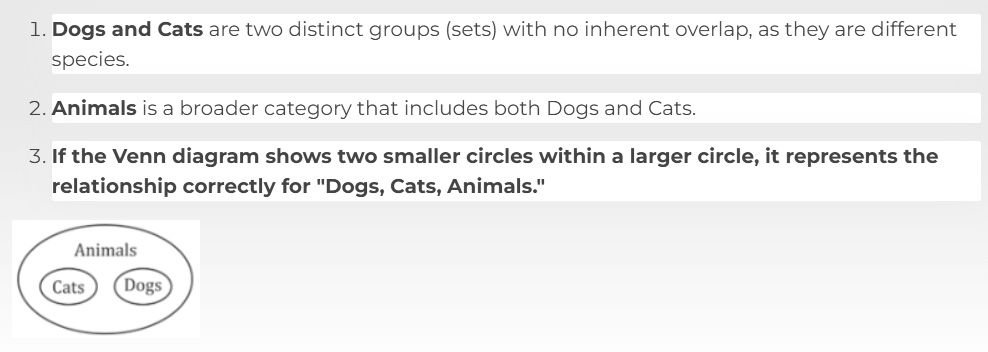
57. Which of the following can be described by the Venn diagram below?

A. Dogs, Cats, Animals
B. Spoons, Plates, Glasses
C. Planets, Galaxies, Universe
D. Economics, Accounts, Biology
Solutions
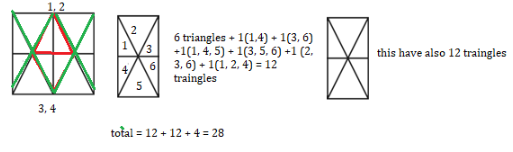
58. How many triangles are these in the given figure?

A. 26
B. 30
C. 24
D. 28
Solutions
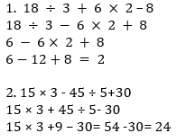
59. After interchanging the given two signs what will be the values of equation (I) and (II) respectively?
+ and –
18 ÷ 3 + 6 × 2 – 8
15 × 3 – 45 ÷ 5+30
A. 2 and 24
B. 2 and 66
C. 3and 25
D. 24 and 2
Solutions
60. After interchanging the given two signs, what will be the value of the given equation?
× and ÷,
68 × 17 + 34 ÷ 2 – 18
A. 54
B. 60
C. 46
D. 35
Solutions
68 × 17 + 34 ÷ 2 – 18
After interchanging both the equations:
68 ÷17 + 34× 2 – 18
4+ 68 – 18
72-18
54
61. Two statements are given, followed by two conclusions numbered I and II. Assuming the statements to be true, even if they seem to be at variance with commonly known facts, decide which of the conclusions logically follow(s) from the statements.
Statements:
All humans are parents.
All parents are teachers.
Conclusions:
I. Some teachers are parents.
II. Some teachers are humans.
A. Both the conclusions follow
B. Only conclusion II follows
C. Either conclusion I or II follows
D. Only conclusion I follows
Solutions
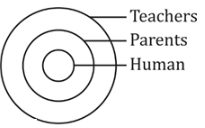
I. Some teachers are parents. (True, some part of teachers are also part of the paranets. )
II. Some teachers are humans.(True, same the above reason)
Both are correct
62. Question: In the question, which one of the given responses would be a meaningful order of the following?
1. Gold
2. Ornaments
3. Ore
4. Mine
5. Process
A. 4, 3, 5, 2, 1
B. 3, 4, 5, 1, 2
C. 2, 1, 5, 4, 3
D. 4, 3, 5, 1, 2
Solutions
To determine the meaningful order of the words based on the sequence of obtaining gold and creating ornaments, let’s analyze the process:
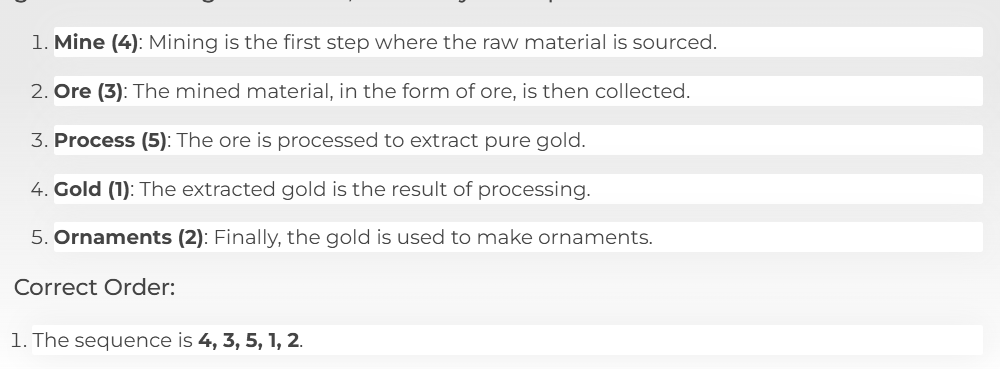
63. Select the correct option that indicates the arrangement of the given words in the order in which they appear in an English dictionary.
1. calm
2. cake
3. cage
4. candid
5. camp
A. 3, 1, 2, 5, 4
B. 3, 2, 1, 5, 4
C. 4, 2, 1, 5, 3
D. 4, 3, 5, 2, 1
Solutions
c a (g) e
c a (k) e
c a (l) m
c a (m) p
c a (n) d i d
first two alphabets are common in all 5 words so we will arrange it with the help of 3rd alphabet. Hence option (b) is correct.
64. the following questions below consists of a question and two statements numbered I and II given below it. You have to decide whether the data provided in the statements are sufficient to answer the question. Read both the statements and give answer.
Which of the following five countries A, C, E, G and J is the biggest?
I. A is smaller than C. J is not the smallest.
II. E is smaller than A. G is not the biggest
A. If the data in both the statements I and II together are necessary to answer the question.
B. .If the data in statement II alone are sufficient to answer the question, while the data in statement I alone are not sufficient to answer the question.
C. If the data in either in statement I alone or in statement II alone are sufficient to answer the question.
D. If the data in both the statements I and II together are not sufficient to answer the question.
Solutions
From I: C > A, but J is not the smallest.
From II: A > E, but G is not the biggest.
From I and II: C>A>E. And it is not clear J and G’s position so we cannot determine which is the biggest country.
65. Statements followed by some conclusions are given below.
Statements:
1. We don’t have the will to punish the guilty unless he is weak and poor.
2. The rich and well-connected get away with every wrong doing.
Conclusions:
I. The rich people are able to escape punishment for wrong doing.
II. If we will, justice will be same for all.
Find which of the given conclusions logically follows from the given statements.
A. Only conclusion I follows
B. Only conclusion II follows
C. Both I and II follow
D. Neither I nor II follows
Solutions
Conclusion 1: Wealthy individuals manage to evade consequences for their misdeeds. → Valid
· This is because the affluent and influential often avoid accountability for their actions.
Conclusion 2: With the right intention, justice could be equally applied to everyone. → Valid
· However, a genuine resolve to punish wrongdoers is lacking, especially when the individual isn’t from a disadvantaged background.
Thus, Both I and II follow.
66. A question is given, followed by two statements numbered (I) and (II). You have to decide whether the data provided in the statements is sufficient to answer the question. Read both the statements and select the appropriate answer.
Question: Six people sit in two parallel rows. In Row 1 – Arun, Atul and Gauri sit facing towards south, and in Row 2 – Jahanvee , Abhishek and Ayushi sit facing towards north.
Each person in a row faces a person in the other row. Who sits opposite to Ayushi ?
Statements
1. Arun faces Jahanvee; Abhishek faces an immediate neighbour of Gauri;
2. Atul sits at left end of the row. Jahanvee is to the left of Abhishek.
A. Data in statements I and II together is sufficient to answer the question
B. Data in either statement I alone or statement II alone is sufficient to answer the question
C. Data in statement I alone is sufficient to answer the question while data in statement II is not
D. Data in statement II alone is sufficient to answer the question while data in statement I is not
Solutions

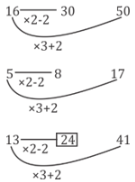
67. Study the given pattern carefully and select the number that can replace the question mark (?) in it.
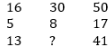
A. 22
B. 24
C. 26
D. 28
Solutions
68. Each of A, B, C, D, E, F and G has an exam on a different day of a week starting from Monday and ending on Sunday of the same week. A has an exam on Wednesday. Only one person has an exam between A and B. D has an exam on the day immediately before B. Only one person has an exam between F and B. G’s exam is on one of the days before A but on one of the days after C. On which day does G have an exam?
A. Friday
B. Tuesday
C. Monday
D. Wednesday
Solutions
Given:
A has an exam on Wednesday.
Only one person has an exam between A and B.
D has an exam the day immediately before B.
Only one person has an exam between F and B.
G’s exam is on one of the days before A but after C.
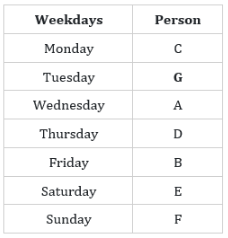
Correct answer is (B) Tuesday.
69. Akshit’s birthday on 10th March 2021 was on a Tuesday. On which day was his sister’s birthday on 25th May 2021?
A. Friday
B. Tuesday
C. Monday
D. Sunday
Solutions
No. of days from 10th March to 25th May
= 21 + 30 + 25 = 76
No. of odd days = 6
sister’s birthday → Monday
70. Three of the following four letter-clusters are alike in a certain way and one is different. Pick the odd one out.
A. BEHK
B. WYAC
C. IJKL
D. PRTU
Solutions
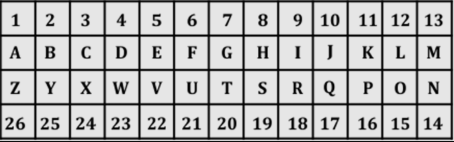
we found same difference between the letters but in PRTU there is different number of difference as shown below

so PRTU is odd from the other.
71. If the radius of sphere is decreased by 80 percent, then volume of sphere will be decreased by what percentage?
A. 98.2 percent
B. 99.2 percent
C. 94.2 percent
D. 95.2 percent
Solutions
Given:
Radius of the sphere decreases by 80%
Original radius = R, New radius = 0.2R
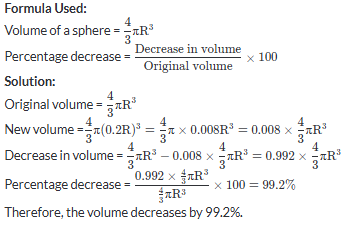
72. A student required 20% marks to pass in psychology. He/she secured 10% marks and failed by 20 marks. What is the passing marks?
A. 40
B. 60
C. 20
D. 50
Solutions
Given:
· Required marks to pass = 20%
· Marks secured = 10%
· Failed by 20 marks
Concept Used:
· The difference between the passing percentage and the percentage obtained gives the percentage that equals 20 marks.
· We can use this information to find the total marks and then calculate the passing marks.
Solution:
1. The student failed by 10% (20% – 10%), which corresponds to 20 marks.
2. Therefore, 10% of the total marks = 20 marks.
3. If 10% equals 20 marks, then: Total marks = 20 × 10 = 200.
4. The passing marks are 20% of 200: Passing marks = 20% of 200 = 0.20 × 200 = 40 marks.
Final Answer: (a) 40
73. A person sells pencil at a profit of 30 percent. If he reduces its selling price by Rs. 200, then he suffers a loss of 10 percent. What was the initial selling price of the pencil?
A. Rs. 550
B. Rs. 650
C. Rs. 600
D. Rs. 700
Solutions
Given:
Profit = 30%; Loss = 10% when SP is reduced by Rs. 200.
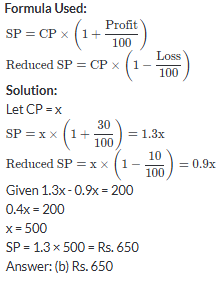
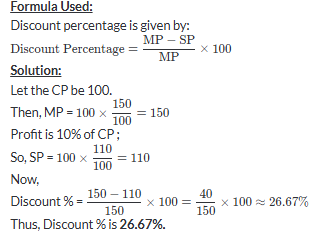
74. Deepak marks the price of his table 50 percent above the cost price. He gives some discount on it and earns profit of 10 percent. What is the discount percentage?
A. 26.67 percent
B. 20 percent
C. 16.67 percent
D. 33.33 percent
Solutions
Given
Marked Price (MP) is 50% above the Cost Price (CP)
Profit earned is 10% of CP
75. X and Y together can complete a work in 20 days. Y alone can complete the same work in 25 days. In how many days will X alone complete the same work?
A. 110 days
B. 120 days
C. 150 days
D. 100 days
Solutions
Given:
Time taken by X and Y together to complete the work = 20 days.
Time taken by Y alone to complete the work = 25 days.
Solution:
Total work = LCM of 20 an 25 = 100 unit
Efficiency of X and Y = 100/20 = 5 unit /days
Efficiency of Y = 100/25 = 4 unit
Then the efficiency of x = (5-4)unit = 1 unit
Then Y can alone complete the whole work = 100/1 = 100days
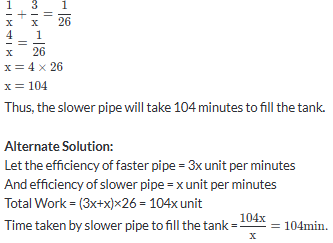
76. One pipe works three times as fast as another. The two pipes together can fill a tank in 26 minutes. By working alone, how long will the slower pipe take to fill the tank?
A. 54 minutes
B. 124 minutes
C.78 minutes
D. 104 minutes
Solutions
Given:
The faster pipe works three times as fast as the slower pipe.
Together, they can fill the tank in 26 minutes.
Solution:
Work rate of slower pipe = 1/x
Work rate of faster pipe = 3/x
Combined work rate = 1/26
According to questions,
77. Two trains one from station P to Q, the other from station Q to P start simultaneously with speeds 80 km/h and 95 km/h. If they meet after 12 hours, what is the difference between the distances covered by them?
A. 2100 km
B. 200 km
C. 15 km
D. 180 km
Solutions
Given:
Speed of train from P to Q = 80 km/h.
Speed of train from Q to P = 95 km/h.
Time taken for the trains to meet = 12 hours.
Find the difference in the distances covered by the two trains.
Formula Used:
The distance covered by an object is given by the formula:
Distance = Speed × Time.
The difference in distances covered by the two trains is:
Difference=Distance of Train 2 − Distance of Train 1.
Solution:
Calculate the distance covered by each train.
Train 1 (P to Q):
Distance = Speed × Time
textDistance = 80 × 12 = 960km.
Train 2 (Q to P):
Distance = Speed × Time
Distance = 95 × 12 = 1140km.
Calculate the difference in distances covered:
Difference = 1140 – 960 = 180 km .
The difference between the distances covered by the two trains is 180 km.
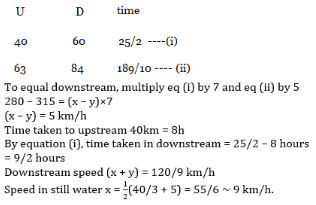
78. A boat can go 60 km downstream and 40 km upstream in 12 hours 30 minutes. It can go 84 km downstream and 63 km upstream in 18 hours 54 minutes. What is the speed (in km/h, to the nearest integer) of the boat in still water?
A. 8
B. 7
C. 10
D. 9
Solutions
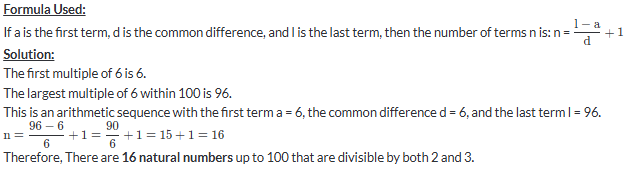
79. How many natural numbers up to 100 are divisible by both 2 and 3?
A. 16
B. 13
C. 17
D. 14
Solutions
Given:
To find: the number of natural numbers up to 100 that are divisible by both 2 and 3.
80. If a, b, c. d and e are the digits of a number beginning from the left, then the number is:
A. 100a+ 10b+ 10c +d +e
B. 1000a + 100b + 10c + 1d + e
C. edcba
D. 104a + 103b + 102c + 10d + e
Solutions
Given:
Digits of a number: a, b, c, d, e
Formula Used:
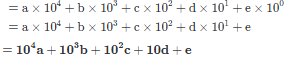
The number formed by the digits a, b, c, d, e can be expressed as:
N = a × 104 + b × 103 + c × 102 + d × 101 + e × 100
Here:
a is the digit at the ten-thousand place,
b is the digit at the thousands place,
c is the digit at the hundreds place,
d is the digit at the tens place,
e is the digit at the units place.
Solution:
Thus, the number is:
81. How many factors of the number 21600 are perfect squares?
A. 12
B. 6
C. 15
D. 10
Solutions
Given:
· We are asked to find how many factors of 21600 are perfect squares.
Concept Used:
· First, find the prime factorization of 21600.
· Then, determine how many perfect square factors exist based on the exponents of the prime factors.
Solution:
1. Find the prime factorization of 21600: 21600 = 2⁵ × 3³ × 5².
2. For a factor to be a perfect square, all exponents in its factorization must be even. So, we can select exponents for the factors from the prime factorization.
3. Consider the exponents:
· For 2⁵, we can select powers 0, 2, or 4 (even powers).
· For 3³, we can select powers 0 or 2.
· For 5², we can select powers 0 or 2.
4. The total number of perfect square factors is the product of the number of ways to select these exponents: (3 choices for 2) × (2 choices for 3) × (2 choices for 5) = 3 × 2 × 2 = 12.
Final Answer: (a) 12
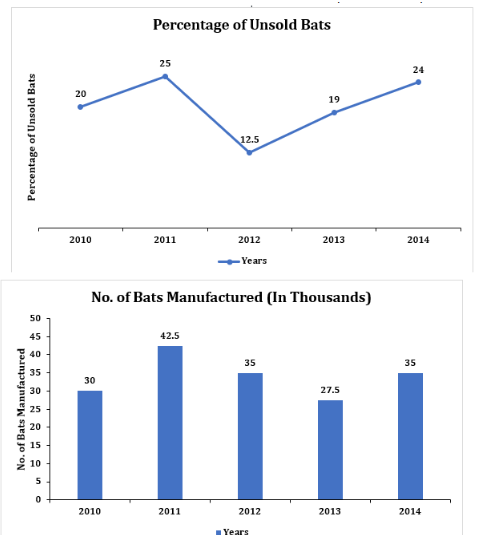
82. The given graph shows the number (in hundreds) of bats manufactured and the following line graph shows the percentage of unsold bats by a factory in Meerut over the period of 2010 to 2014.
What is the difference between the number of bats sold in the year 2010 and year 2014?
A. 240
B. 200
C. 260
D. 500
Solutions
Solution:
Number of bats manufactured in 2010 = 3000
Percentage of unsold bats in 2010 = 20%
Number of bats manufactured in 2014 = 3500
Percentage of unsold bats in 2014 = 24%
Number of sold bats in 2010 = (100 – 20)% × 3000
80/100 × 3000 =2400
Number of sold bats in 2014 = (100 – 24)% × 3500
76/100 × 3500 = 2660
The difference between the number of bats sold in 2014 and 2010
= 2660 – 2400
= 260
83. The following chart shows the production of an organization in various years from 2012 to 2016. Study the chart and answer the question.
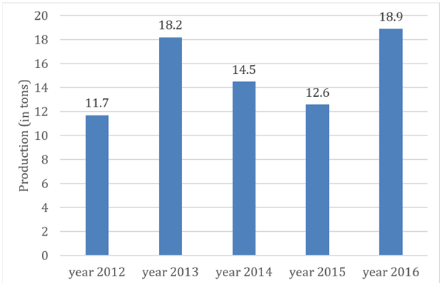
What was the percentage increase in the production from 2015 to 2016?
A. 50%
B. 21%
C. 40%
D. 25%
Solutions
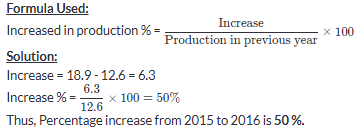
Given:
Production in 2015 = 12.6 tons
Production in 2016 = 18.9 tons
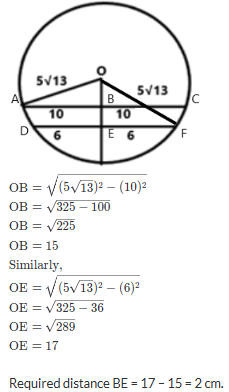
84. Two parallel chords on the same side of the centre of a circle are 12 cm and 20 cm long and the radius of the circle is 5√13 cm. What is the distance between the chords?
A. 3 cm
B. 5 cm
C. 2 cm
D. 4 cm
Solutions
Given:
Length of cord = 12 cm and 20 cm
Radius = 5√13 cm
Solution:
As per the question-
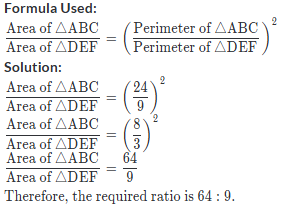
85. Given that the perimeters of two similar triangles, ∆ABC and ∆DEF, are 24 cm and 9 cm, respectively, and DE = 3 cm, what is the ratio between the area of ∆ABC and that of ∆DEF?
A. 64 : 9
B. 54 : 9
C. 64 : 7
D. 54 : 7
Solutions
Given:
Perimeters of ∆ABC = 24 cm
Perimeters of ∆DEF = 9 cm
DE = 3 cm
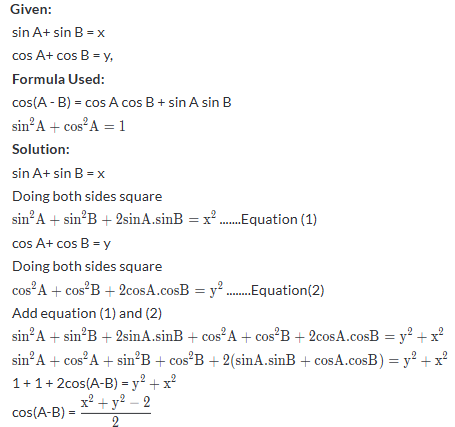
86. If sin A+ sin B = x and cos A+ cos B = y, then cos(A – B) =?
A. 
B. 
C. 
D. 
Solutions
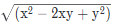
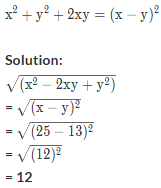
87. If x = 25 and y = 13 then find:
A. 12
B. 38
C. 13
D. 10
Solutions
Given:
x = 25 , y= 13
Formula Used:
88. If the sum of two quantities is equal to six times their difference, then find the ratio of the two quantities.
A. 7:5
B. 3:7
C. 4:9
D. 5:2
Solutions
Given:
The sum of the two quantities equals six times their difference:
x + y = 6(x – y)
Solution:
Expand and simplify the equation:
x + y = 6x – 6y
Rearranging terms:
x – 6x + y + 6y = 0
-5x + 7y = 0
Solve for the ratio:
Rewriting the equation:
5x = 7y
x / y = 7 / 5
The ratio of the two quantities is 7:5.
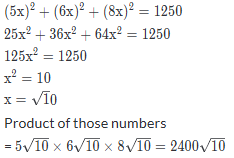
89. If three mumbers are in the ratio 5 : 6 : 8 and the sum of their squares is 1250, then the product of those numbers is:
A. 2400
B. 2400√10
C. 1200
D. 1200√10
Solutions
Given:
The ratio of three are numbers 5 : 6 : 8
– The sum of the squares of these numbers is 1250.
Solution:
The sum of the squares of the three numbers can be written as:
90. The sum of the squared deviations of a set of value is least if measured from _______.
A. Arithmetic mean
B. Mode
C. Standard deviation
D. Median
Solutions
The correct answer is (A) Arithmetic mean.
Explanation:
The sum of the squared deviations of a set of values is minimized when deviations are measured from the arithmetic mean. This property of the arithmetic mean makes it the best measure of central tendency for minimizing the total squared error
91. A tent is in the form a cylinder and is surmounted by a cone; radius and height of the cylindrical portion are 10 m and 25 m respectively. For the conical part, radius is 10 m and slant height is 15 m. Calculate the amount of canvas required to build the tent allowing 20% extra for folding, stitching etc.
A. 3783.26 m²
B. 4714.43 m²
C. 3772.14 m²
D. 2451.40 m²
Solutions
Given:
Radius of cylindrical portion r =10 m
Height of cylindrical portion h = 25 m
Radius of conical portion r = 10 m
Slant height of conical portion l =15 m
Additional canvas allowance = 20%.
Formula Used:
Curved surface area (CSA) of cylinder = 2πrh
Curved surface area (CSA) of cone = πrl
Solution:
Surface area of the cylindrical part = 2 × π × r × h = 2 × π × 10 × 25 = 500π m².
Surface area of the conical part = π × r × l = π × 10 × 15 = 150π m².
Total surface area = 500π + 150π = 650π m².
With 20% extra for folding, stitching, etc., total canvas required = 650π × 1.2 ≈ 2451.40 m².
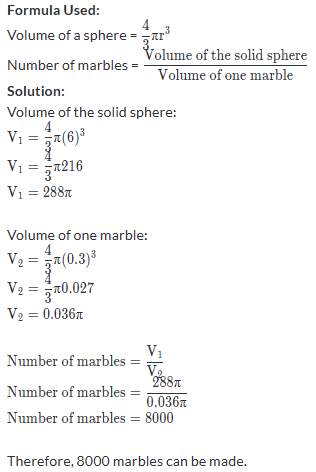
92. How many spherical solid marbles, each having a radius of 0.3 cm. can be made from a solid sphere having a radius of 6 cm?
A. 9000
B. 7500
C. 8000
D. 8500
Solutions
Given:
Radius of the solid sphere: 6 cm
Radius of each marble: 0.3 cm
Formula Used:
93. A glass cylinder with diameter 20 cm has water to a height of 9 cm. A metal cube of 8 cm edge is immersed in it completely. Calculate the height (correct to 1 decimal place) by which the water will rise in the cylinder (by taking π = 3.142).
A. 1.4 cm
B. 1.6 cm
C. 2.6 cm
D. 2 cm
Solutions
Given:
A glass cylinder with diameter 20 cm has water to a height of 9 cm. A metal cube of 8 cm edge is immersed in it completely.
Formula used:
Volume of cylinder = Πr2h
Volume of cube = a3
Solution:
Diameter of cylinder = 20 cm
=> Radius of cylinder = 10 cm
Now, Volume of water displaced (because of which water will rise in cylinder) = Volume of cube
∴ πr2h = a
=> 3.142 × 10 × 10 × h = 83
=> 3142 × 1/10 × h = 512
=> h = 5120/3142
=> h = 1.62 cm ~ 1.6 cm
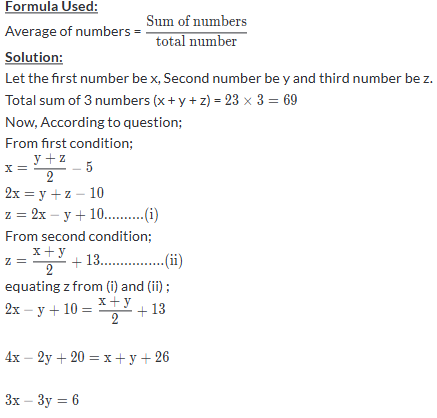
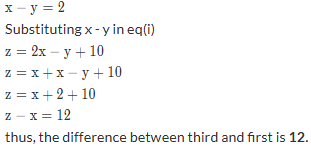
94. Average of 3 numbers is 23. First number is 5 less than the average of the other two. Third number is 13 more than the average of other two. What is the difference between first and third number?
A. 21
B. 17
C. 18
D. 12
Solutions
Given:
Average of 3 numbers = 23
First number is 5 less than the average of the other two.
Third number is 13 more than the average of the other two.
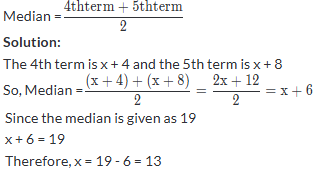
95. The following observations are arranged in ascending order. If the median of the data is 19, then find the value of x.
6, 9, 15, x + 4, x + 8, x + 12, 30, 32
A. 13
B. 10
C. 8
D. 5
Solutions
Given:
Observations (in ascending order): 6, 9, 15, x + 4, x + 8, x + 12, 30, 32
Median of the data is 19.
Formula Used:
For an even number of observations, the median is the average of the two middle terms.
96. Weight of Al is six times of A2 and A2’s weight is 50 percent more than that of A3. If the average weight of all three is 299 kgs, then what is the weight of Al?
A. 897 kg
B. 1544 kg
C. 702 kg
D. 979 kg
Solutions
Given:
A1 = 6 × A2
A2 = 1.5 × A3
Average weight of A1, A2, and A3 = 299 kgs
Solution:
Total weight = 299 × 3 = 897
Let A3’s weight be x, then A2’s weight = 1.5 × x and A1’s weight = 6 × (1.5 × x) = 9x.
Sum of weights = A1 + A2 + A3 = 9x + 1.5x + x = 11.5x
11.5x = 897
x = 78
A1’s weight = 9x = 9 × 78 = 702
Thus, A1’s weight is 702 kgs.
97. Divide Rs.20,609 between A and B, such that the amount (in Rs.) of A after 7 years is equal to the amount (in Rs.) of B after 9 years, if the interest being compounded yearly at 3% per annum.
A
A = Rs.10,609
B = Rs.10,000
B
A = Rs.10,601
B = 10,008
C
A = Rs.10,605
B = Rs.10,004
D
A = Rs.10,509
B = Rs.10,100
Solutions
Given:
Total amount to be divided = Rs. 20,609
Interest is compounded yearly at 3% per annum.
The amount (in Rs.) of A after 7 years is equal to the amount (in Rs.) of B after 9 years.
We need to determine how much A and B receive out of the total Rs. 20,609.
Solution:
Let the initial amounts for A and B be PA and PB respectively.
Since interest is compounded yearly, the amount after t years with rate r % is given by:
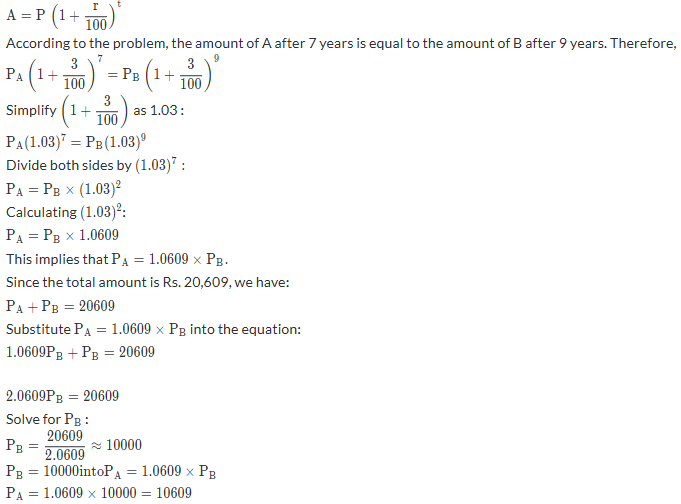
Answer: A receives Rs. 10,609 and B receives Rs. 10,000.
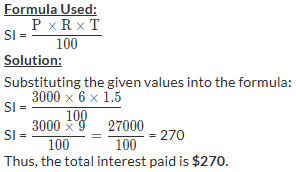
98. Mary borrowed $3000 from a friend at a simple interest rate of 6% per annum. If she repays the loan after 1.5 years, find the total interest paid.
A. $280
B. $270
C. $250
D. $290
Solutions
Given:
Principal (P) = $3000
Simple interest rate (R) = 6% per annum
Time (T) = 1.5 years
99. A motorcycle covered the first 60 km of its journey at an average speed of 40 km/h. The speed of the motorcycle for covering the rest of the journey, i.e. 90 km, was 45 km/h. During the whole journey, the overall average speed of the motorcycle was:
A. 42 km/h
B. 
C. 
D. 
Solutions
Given:
First 60 km average speed of the motorcycle is 40 km/h.
Rest 90 km average speed of the motorcycle is 45 km/h.
100. What is the value of
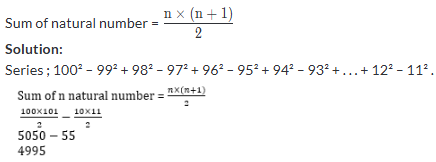
100² – 99² + 98² – 97² + 96² – 95² + 94² – 93² + . . . . . . 12² – 11² ?
A. 5050
B. 4985
C. 4995
D. 4950
Solutions
Given:
100² – 99² + 98² – 97² + 96² – 95² + 94² – 93² + . . . + 12² – 11²
Formula Used: