1. Which of the following established by Raja Rammohan Roy was a precursor in socio-religious reforms in Bengal?
A. Dharma Sabha
B. Atmiya Sabha
C. Arya Samaj
D. Prarthana Samaj
Solution
The correct answer is ‘Atmiya Sabha‘.
Key Points
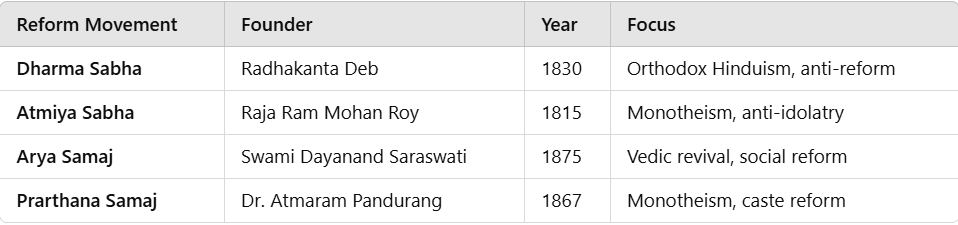
Atmiya Sabha was a philosophical discussion circle in India.
- The association was started by Ram Mohan Roy in 1815 in Kolkata (then Calcutta).
- They used to conduct debate and discussion sessions on philosophical topics, and also used to promote free and collective thinking and social reform.
- The foundation of Atmiya Sabha in 1815 is as the beginning of the modern age in Kolkata.
- In 1823, the association became defunct.
- It was not a formal organization, and there was no membership registration procedure.
- However, the association intended to promote free and collective thinking.
- They also challenged and denounced orthodox religions.
2. Swami Dayanand Saraswati founded the _______, an organisation that attempted to reform Hinduism.
A. Arya Samaj
B. Adi Hindu Samaj
C. Vedant Samaj
D. Adi Dharam Samaj
Solution
The correct answer is Arya Samaj.
Key Points
- Swami Dayanand Saraswati:-
- Dayananda Saraswati [1824-1883] was the first to give the call for Swarajya – “India for Indians” – in 1876.
- For his own inspiration, Swami Dayanand went to the Vedas which he regarded as infallible.
- He rejected all later religious thought if it conflicted with the Vedas.
- This total dependence on Vedas and their infallibility gave his teachings orthodox coloring.
- He was opposed to idolatry, ritual, and priesthood and particularly to the prevalent caste practices and popular Hinduism as preached by Brahmins
- Swami Dayanand met Keshub Chandra Sen, Vidyasagar, Justice Ranade, Gopal Hari Deshmukh, and other modern religious and social reformers.
- He took inspiration from the Vedas and considered them to be ‘India’s Rock of Ages, the infallible, and the true original seed of Hinduism.
- He gave the slogan “Back to the Vedas”.
- Dayananda’s slogan of ‘Back to the Vedas’ was a call for a revival of Vedic learning and Vedic purity of religion and not a revival of Vedic times.
- He accepted modernity and displayed a patriotic attitude to national problems.
- Arya Samaj:-
- Arya Samaj is a Hindu reform movement founded by ‘Swami Dayanand Saraswati’.
- Dayanand Saraswati had inspired the Arya Samaj from Swami Virjanand of Mathura in Bombay in 1875.
- Arya Samaji believed in pure Vedic tradition and rejected idol worship, avatars, sacrifice, false rituals, and superstitions.
- In this, untouchability and caste discrimination were opposed and women and Shudras were also given the right to wear Yagyopaveet and read the Vedas.
Additional Information
- Vedant Samaj:-
- It also known as the Vedanta Society, is a religious and philosophical organization based on the teachings of Vedanta, a school of Hindu philosophy.
- Vedanta is derived from the Upanishads, ancient texts that form the philosophical and spiritual foundation of Hinduism.
- Adi Dharma Samaj:-
- It is a religious and social organization based in Bali, Indonesia. It was founded in the early 20th century as a response to the dominant religious practices of the time, which were primarily based on Hinduism.
- Adi Dharma Samaj sought to promote a form of Hinduism that was more inclusive and accessible to the local Balinese people.
3. Who was the founder of the Satyashodhak Samaj?
A. Ghasidas
B. Haridas Thakur
C. Jyotirao Phule
D. Ishwarchandra Vidyasagar
Solution
The correct answer is Jyotirao Phule
Key Points
- Jyotirao Phule was the founder of the Satyashodhak Samaj.
- Satyashodhak Samaj, also known as the “Truth Seekers’ Society,” was established in 1873 in Maharashtra.
- The main objective of the organization was to promote social equality and fight against the caste system and other social injustices prevalent in society.
- Jyotirao Phule was a prominent social reformer and thinker who worked tirelessly for the upliftment of the oppressed and marginalized sections of society.
Additional Information
- Jyotirao Phule was also instrumental in promoting education for women and the lower castes.
- He, along with his wife Savitribai Phule, established the first school for girls in Pune in 1848.
- Phule’s writings and activism played a crucial role in the social and educational reform movements in India during the 19th century.
- His notable works include “Gulamgiri” (Slavery) and “Shetkarayacha Asud” (Cultivator’s Whipcord).
4. The word ‘Sarvodaya’ was first used by who among the following?
A. Mahatma Gandhi
B. Dr Rajendra Prasad
C. Pandit Bal Gangadhar Tilak
D. Vinoba Bhave
Solution
The correct answer is Mahatma Gandhi.
Key Points
- The word “Sarvodaya” was first used by Mahatma Gandhi in 1908 as the title of his translation of John Ruskin’s book, Unto This Last.
- Gandhi later came to use the term to refer to his own political philosophy, which emphasized social and economic equality for all.
- The Sarvodaya Movement was a social movement in India that was inspired by Gandhi’s ideals. It was founded by Vinoba Bhave in 1951 and aimed to promote social justice and economic equality through nonviolent means. The movement was particularly focused on land reform and rural development.
Additional Information
- Vinoba Bhave:-
- He was a Hindu monk, social reformer, and leader of the Bhoodan movement, a nonviolent land reform movement in India.
- He was a devout Hindu and a follower of Mahatma Gandhi.
- He joined the Indian independence movement in 1916 and was imprisoned several times by the British.
- Bal Gangadhar Tilak:-
- He was an Indian nationalist, teacher, social reformer, lawyer, and freedom fighter.
- He was one of the earliest and the most vocal proponents of complete independence or swaraj (self-rule) and a strong radical in Indian consciousness.
- He is known for his quote in Marathi: “Swaraj is my birthright and I shall have it!”.
- He formed a close alliance with many Indian National Congress leaders including Bipin Chandra Pal, Lala Lajpat Rai, Aurobindo Ghose, V. O. Chidambaram Pillai and Muhammad Ali Jinnah.
- Dr. Rajendra Prasad:-
- He was an Indian politician, lawyer, journalist, and scholar who served as the first president of India from 1950 to 1962.
- He was a close associate of Mahatma Gandhi and played a prominent role in the Indian independence movement.
5. Where was the first Dayanand Anglo Vedic (DAV) school founded?
A. Amritsar
B. Lahore
C. Bombay
D. Delhi
Solution
The correct answer is Lahore.
- The first DAV school was started at Lahore on 1st June 1886 with the self-abnegation of Mahatma Hansraj as a memorial of Swami Dayanand Saraswati, a versatile genius, social reformer.
- The aim of the DAV Schools is to inculcate in students a thirst for knowledge, devotion to duly honesty, and a patriotic fervor besides humanism.
Additional Information
- Swami Dayanand Saraswati (1824-83) was a scholar, a patriot, a social reformer, and a revivalist.
- The Arya Samaj was founded by Swami Dayanand Saraswati at Bombay in 1875.
- He believed the Vedas were the source of true knowledge. His motto was “Back to the Vedas”.
- He started the Suddhi movement to bring back those Hindus who had converted to other religions to its fold.
- He wrote the book Satyartha Prakash which contains his ideas.
6. The Prarthana Samaj was established in Bombay in the year:
A. 1889
B. 1867
C. 1898
D. 1876
Solution
The correct answer is 1867.
Key Points
- Prarthana Samaj was founded by Atmaram Pandurang in 1867.
- It was founded in Bombay.
- It was formed to carry out social and religious reforms.
- Dr Atmaram Pandurang was an Indian Physician and Social Reformer.
Additional Information
| Reform | Established On | Founder |
|---|---|---|
| Brahmo Samaj | 20 August 1828 | Raja Ram Mohan Roy |
| Arya Samaj | 10 April 1875 | Swami Dayanand Saraswati |
| Ramakrishna Mission | 1 May 1897 | Swami Vivekananda |
7. With reference to Socio and Religious Reform Movements in India, Raja Rammohan Roy formed the Brahmo Samaj in:
A. 182869% answered correctly
B. 1816
C. 1836
D. 1848
Solution
The correct answer is 1828.
Key Points
Brahmo Samaj And Raja Ram Mohan Roy: Among the great reformers of this period, Raja Rammohan Roy deserves special mention. He presented a fine combination of the East and the West. A man of great literary talent and well versed in Indian culture, he also made a special effort to study Christianity and Islam so that he could deal with them with understanding. He felt great revulsion for many practices prevailing in India that enjoyed religious approval.
- His main preoccupation was how to rid the Hindu religion of both image worship, sacrificial rites, and other meaningless rituals.
- He condemned the priestly class for encouraging these practices. He opined that all the principal ancient texts of the Hindus preached monotheism or worship of one God.
- His greatest achievement in the field of religious reform was a set up in 1828 of the Brahmo Samaj.
- The Brahmo Samaj was an important organization of religious reforms. It forbade idol-worship and discarded meaningless rites and rituals.
- The Samaj also forbade its members from attacking any religion. It believed in the basic unity of all religions.
- Raja Rammohan Roy believed that man should adopt truth and goodness and should give up things based on falsehood and superstition.
- Raja Rammohan Roy was not merely a religious reformer but a social reformer also. His greatest achievement was the abolition of Sati in 1829.
- Raja Rammohan Roy realized that the practice of Sati was due to the extremely low position of Hindu women. Therefore he started working as a stout champion of women’s rights. He worked very hard for years to stop this practice of ‘Sati’.
8. Which act, initiated by B.M. Malbari, regulated the age of consent for females?
A. Age of Consent Act
B. Female Protection Act
C. Women’s Consent Regulation
D. Social Reforms Act
Solution
The correct answer is Age of Consent Act.
Key Points
- Seva Sadan (1908)
- In 1908, (Parsi Reformer) Shri Behramji Malabari and Diwan Dayaram Gidumal, who were determined to emancipate, educate, and empower those unfortunate women who were treated as outcasts of society formed this organisation.
- They founded Seva Sadan Society in 1908 in Mumbai as a refuge where impoverished and oppressed women of all communities could find protection, care, and a home where they could live a life of peace, respect, and dignity.
- The organisation spoke vigorously against child marriage and for widow remarriage among Hindus.
- B.M. Malbari acquired and edited the Indian Spectator.
- It was Malbari’s efforts that led to the Age of Consent Act regulating the age of consent for females.
- Seva Sadan also specialised in taking care of those women who were exploited and then discarded by society.
9. Identify the social reformer who founded the Self-Respect Movement and Dravidar Kazhagam.
A. B. R. Ambedkar
B. K. Kamaraj
C. E. V. Ramasamy (Periyar)
D. C. N. Annadurai
Solution
The correct answer is E. V. Ramasamy (Periyar).
Key Points
- E. V. Ramasamy (Periyar):
- Erode Venkatappa Ramasamy, commonly known as Periyar, was an Indian social activist and politician who started the Self-Respect Movement and Dravidar Kazhagam.
- He worked against caste discrimination and advocated for equal rights for women.
- He is known as the ‘Father of the Dravidian Movement’.
Additional Information
- B. R. Ambedkar:
- Bhimrao Ramji Ambedkar, popularly known as Babasaheb Ambedkar, was an Indian jurist, economist, politician, and social reformer who campaigned against social discrimination towards the untouchables (Dalits) and supported the rights of women and labor.
- He was the chief architect of the Indian Constitution and India’s first Minister of Law and Justice.
- K. Kamaraj:
- Kumaraswami Kamaraj, better known as K. Kamaraj, was a prominent Indian politician from Tamil Nadu.
- He was the Chief Minister of Tamil Nadu for three consecutive terms.
- He was known for his simplicity and integrity.
- He was instrumental in bringing free education and the free Midday Meal Scheme to the children of Tamil Nadu.
- C. N. Annadurai:
- Conjeevaram Natarajan Annadurai, popularly called Anna (“elder brother” in Tamil), was an Indian politician who served as the first Chief Minister of Tamil Nadu for the Dravida Munnetra Kazhagam (DMK) party from 1967 until his death in 1969.
- He was a prolific writer in Tamil and an excellent orator.
- Annadurai was the first to use Tamil cinema extensively for political propaganda.
10. In 1897, Swami Vivekananda, a disciple of Ramakrishna Paramahansa, established the Ramakrishna Mission in __________
A. Solapur
B. Belur
C. Latur
D. Vijaypur
Solution
The correct answer is Belur.
Key Points
Swami Vivekananda
- Born in Kolkata on January 12, 1863, in Kolkata, Swami Vivekananda was known as Narendra Nath Datta in his pre-monastic life.
- He is known to have introduced the Hindu philosophies of Yoga and Vedanta to the West.
- Netaji Subhas Chandra Bose had called Vivekananda the “maker of modern India.”
- In 1893, he took the name ‘Vivekananda’ after Maharaja Ajit Singh of the Khetri State requested him to do so.
- He formed the Ramakrishna Mission in 1897 “to set in motion a machinery which will bring noblest ideas to the doorstep of even the poorest and the meanest.”
- In 1899, he established the Belur Math, which became his permanent abode.
- He preached ‘neo-Vedanta’, an interpretation of Hinduism through a Western lens, and believed in combining spirituality with material progress.
Important Points
- He was a true luminary, credited with enlightening the western world about Hinduism.
- He was an ardent disciple of Sri Ramakrishna Paramahansa and a major force in the revival of Hinduism in India.
- He pushed for national integration in colonial India, and his famous speech remains the one that he gave in Chicago in 1893 (Parliament of the World Religions).
- In 1984 the Government of India declared that 12 January, the birthday of Swami Vivekananda, will be celebrated as National Youth Day.