1. With reference to the Indian monsoon, consider the following statements:
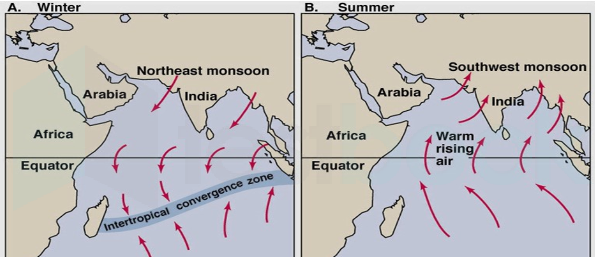
a. Monsoon winds are steady winds and pulsating in nature.
b. There are two systems causing rain in the India Arabian Sea branch and the Bay of Bengal branch.
Which of the following statement is/are correct?
A. a only
B. b only
C. Both a and b
D. Neither a nor b
Solution
The correct answer is b only.
Key PointsIndian monsoon
- The term ‘Monsoon’ has been derived from the Arabic word ‘mousim’ or the Malayan word ‘monsin’ which means season.
- The Monsoon, unlike the trades, are not steady winds but is pulsating in nature. Hence, Statement a is not correct.
- It is affected by different atmospheric conditions encountered by it, on its way over the warm tropical seas.
- There are two systems causing rain in the India Arabian Sea branch and the Bay of Bengal branch. Hence, Statement b is correct.
- The Arabian Sea branch reaches Mumbai about ten days later on approximately the 10th of June. This is a fairly rapid advance.
- The Bay of Bengal branch also advances rapidly and arrives in Assam in the first week of June.
- It is characterized by a seasonal reversal in the direction of the wind.
- They flow from sea to land during the summer and from land to sea during the winter due to differences in temperature and pressure system.
2. Which of the following seasons in India is known as the transition season?
A. Retreating Monsoon
B. Advancing Monsoon
C. Cold Weather Season
D. Hot Weather Season
Solution
Correct Answer Retreating Monsoon
Key Points:Retreating monsoons:
- During October-November, with the apparent movement of the sun towards the south, the monsoon trough or the low-pressure trough over the northern plains becomes weaker.
- This is gradually replaced by a high-pressure system.
- The south-west monsoon winds weaken and start withdrawing gradually.
- By the beginning of October, the monsoon withdraws from the Northern Plains.
- The months of October-November form a period of transition from hot rainy season to dry winter conditions.
- The retreat of the monsoon is marked by clear skies and a rise in temperature.
- While day temperatures are high, nights are cool and pleasant.
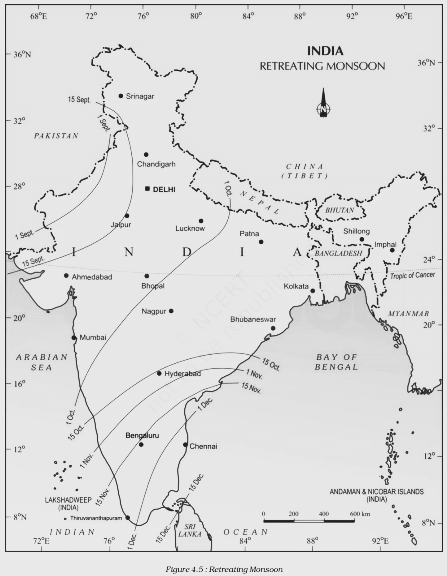
Thus, October-November months are associated with retreating monsoons/the transition season.
Additional InformationSouthwest monsoon season:
- The period June to September is referred to as the ‘Southwest Monsoon’ period.
- The Southwest Monsoon period is the principal rainy season for the Indian subcontinent.
- This is the summer monsoon period where the southwest monsoon holds away over the country.
- The whole country receives nearly 75% of its rainfall during this period.
Monsoon:
- Monsoon, a major wind system that seasonally reverses its direction, such as one that blows for approximately six months from the northeast and six months from the southwest.
- The primary cause of monsoons lies in different warming trends over land and sea, though other factors may be involved.
- There are two monsoons (or rainy seasons) in India.
- The summer monsoon season in India, otherwise known as the southwest monsoon, lasts from June to September and affects the whole of India.
- Then the northeast or winter monsoon brings seasonal rainfall to Southeast India from October to December.
3. When does the Tamil Nadu coast receive the maximum of its rainfall?
A. January-February
B. October-November
C. August-September
D. June-July
Solution
The correct answer is October-November.
Key Points
- Tamil Nadu is located on the eastern coast of India.
- South India usually receives rainfall from south west monsoons.
- But these south west monsoon arising from Arabian Sea gets obstructed by Western Ghats.
- Hence, Tamil Nadu receives most of its rain from north east and retreating monsoons during winter season.
- Moreover, many low pressure systems develop in the Bay of Bengal during this period and move towards the east coast of Tamil Nadu causing heavy rainfall.
Tamil Nadu receives rainfall from Northeast trade winds.
- From early June to mid-September, between 100- 120 days is the duration of the monsoon. Some places like Tamil Nadu receive a major portion of its rainfall during October and November, but most parts of the country receive rainfall from June to September.
- During the winter season, the winds prevailing in the country are the Northeast trade winds.
- In major parts of the country, it is a dry season, as the winds blow from land to sea.
- When the winds blow from sea to land, it picks up moisture from the sea and brings rainfall to the country.
- Due to the geographical location, the east coast receives rainfall as the north east trade winds blow from sea to land in this location. Hence the coast of Tamil Nadu receives winter rainfall.
Additional Information Monsoon
- Generally, across the world, the monsoons are experienced in the tropical area roughly between 20° N and 20° S.
- The climate of India is described as the ‘monsoon’ type. In Asia, this type of climate is found mainly in the south and the southeast.
- Out of a total of 4 seasonal divisions of India, monsoon occupies 2 divisions, namely.
- The southwest monsoon season – Rainfall received from the southwest monsoons is seasonal in character, and occurs between June and September.
- The retreating monsoon season – The months of October and November are known for retreating monsoons.
- Factors Influencing South-West Monsoon Formation
- The differential heating and cooling of land and water create a low pressure on the landmass of India while the seas around experience comparatively high pressure.
- The shift of the position of Inter Tropical Convergence Zone (ITCZ) in summer, over the Ganga plain (this is the equatorial trough normally positioned about 5°N of the equator. It is also known as the monsoon-trough during the monsoon season).
4. Summer monsoon in India has a likelihood of adversaries due to –
A. La-Nina
B. Western disturbances
C. Typhoons
D. El-Nino
Solution
The Indian Monsoon :
- The climate of India is strongly influenced by monsoon winds.
- The sailors who came to India in historic times were one of the first to have noticed the phenomenon of the monsoon.
- The Arabs, who had also come to India as traders named this seasonal reversal of the wind system ‘monsoon
Key Points
El Nino:
- El Nino (Spanish for Christ Child) is the occasional development of warm ocean surface waters along the coast of Ecuador and Peru.
- Recently this development has been used for forecasting climatic conditions in different parts of the world.
- The El Nino normally occurs around Christmas, roughly every 2 to 7 years and lasts usually for a few weeks to a few months.
- El Nino is considered to increase temperatures in India and reduce the intensity of monsoon.
Thus, the summer monsoon in India has a likelihood of adversaries due to El Nino.
Additional InformationWestern disturbances:
- Western disturbances are storms that originate in the Caspian or the Mediterranean Sea.
- It brings non-monsoonal rainfall to northwest India, according to the India Meteorological Department (IMD)
A typhoon:
- A typhoon forms when winds blow into areas of the ocean where the water is warm.
- These winds collect moisture and rise, while colder air moves in below.
- This creates pressure, which causes the winds to move very quickly.
- The winds rotate, or spin, around a centre called an eye
La Nina:
- La Nina is a climate pattern that describes the cooling of surface ocean waters along the tropical west coast of South America.
- La Nina years are known to favour the Indian summer monsoon.
- This year, India has received 740.3 mm of rainfall, quantitatively 7 per cent higher than the seasonal average till August 30.
- During a La Nina winter, a north-south pressure pattern sets up over India and normally this influences the trade winds that bring rains to India.
5. Western cyclonic disturbances are responsible for:
A. extreme heat waves in southern India during summers
B. extreme cold in coastal area during winters
C. rainfall during winters in north-western part of India
D. heavy rainfall during autumn in north-western part of India
Solution
The correct answer is rainfall during winters in north-western part of India.
Key Points
- Low-pressure systems that originate over the Mediterranean Sea are known as western cyclonic disturbances.
- These wind systems go to India under the control of subtropical westerly jet streams, where they produce precipitation.
- The plains get these winter rains, which aid in the development of Rabi crops.
- Locally, this downpour is known as mahawat. It occurs in the northern and northwest regions of India.
- Westerly winds with high speed are called jet streams. The western disturbances felt in the country’s north and north-western regions are caused by the westerly flows. Westerly jet streams flow to the Himalayan region’s north in the summer.
Additional Information
- Western cyclonic disturbances include three characteristics:
- The westerly flow from the Mediterranean region is responsible for the wintertime weather phenomenon known as the western cyclonic disturbances.
- Typically, they have an impact on India’s north and north-western areas’ weather.
- Tropical cyclones, which are a product of the easterly flow, develop throughout the monsoon season as well as in October and November.
- The coastal areas of the nation are affected by these disturbances.
6. Which type of soil covers most of the Deccan Plateau?
A. Alluvial soil
B. Red soil
C. Yellow soil
D. Black soil
Solution
The correct answer is Black soil.
- Black soil covers most of the Deccan Plateau.
Key Points
- Black soils are mineral soils that have a black surface horizon, enriched with organic carbon that is at least 25 cm deep.
- Black soils are derivatives of trap Lava.
- Black soil covers most of the Deccan Plateau which includes parts of Maharashtra, Madhya Pradesh, Gujarat, Andhra Pradesh and some parts of Tamil Nadu.
- Black soils have high clay content.
- They have an iron-rich granular structure.
- They are poor in humus but highly moisture-retentive.
Additional Information
| Name of the Soil | Classification of Soil |
| Alluvial soil | Alluvial soils are soils deposited by surface water.They are mostly spread across Indo-Gangetic-Brahmaputra plains in India. |
| Red soil | Red soil is soil that develops in warm temperatures and moist climates.Red soil develops on crystalline igneous rocks in areas of low rainfall in the eastern and southern part of the Deccan PlateauThey are mostly spread across Tamil Nadu, Karnataka, Madhya Pradesh, Andhra Pradesh. |
Important Points
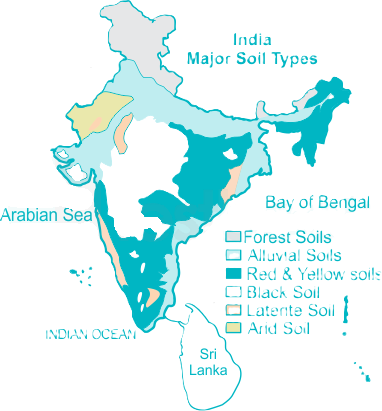
All the soil Types present in the Indian States:
7. What kind of soil is most suitable for growing cashew nuts?
A. Black soil
B. Red laterite soil
C. Red and yellow soil
D. Alluvia soil
Solution
The correct answer is Red laterite soil.
Key Points
- Red laterite soils are formed due to the weathering of laterite rocks.
- Red laterite soil is most suitable for growing cashew nuts.
- Laterite soils are rich in iron and aluminium content.
- Usually rusty-red in colour due to the high iron oxide content.
- It is suitable for building purposes.
- Red laterite soils in Tamil Nadu, Andhra Pradesh and Kerala are mor suitable for tea plantations.
Additional Information
- Black soil is well suited for the cultivation of cotton so it is also called cotton soil.
- It is also called ‘Regur Soil’ or the ‘Black Cotton Soil’
- It is formed by the disintegration of basalt.
- Alluvial soils are the most extensive soil type in India.
- Alluvial soils are formed from the sediments deposited by the rivers.
- It is rich in potash and poor in nitrogen and organic matter.
- Alluvial soils are most suitable for growing wheat, rice, maize, sugarcane, pulses, etc.
- Red and yellow soils are derived from granites, gneisses and other metamorphic rocks.
- The soil looks reddish in colour due to a wide diffusion of iron in crystalline and metamorphic rocks and it looks yellow when it occurs in a hydrated form.
- Red and yellow soils are most suitable for growing wheat, cotton, pulses, tobacco, millets, oilseeds, potato, etc.
8. Which type of soil is found maximum in India?
A. Red soil
B. Black soil
C. Laterite soil
D. Alluvial soil
Solution
Option 4 is correct, i.e. Alluvial Soil.
Key Points
- Alluvial soil is mainly found in Northern Plains.
- These soils are widespread in the Northern Plains and valleys.
- They are depositional soils, formed mainly due to silt deposited by Indo-Gangetic-Brahmaputra Rivers.
- In the Upper and Middle Ganga Plain, two types of alluvial soils have developed, namely, Khadar (New alluvium) and Bhangar (Old alluvium).
Additional Information
Black Soil:
- Black soil is also known as regur soil.
- It covers a major part of the Deccan plateau including the states of Andhra Pradesh, Gujarat, Madhya Pradesh, Maharashtra, and Tamil Nadu.
- It is also known as black cotton soil.
- These are impermeable, deep, and, clayey and are rich in alumina, magnesia, iron, and lime.
- Some of the crops grown on it include cotton, Jowar, wheat, and linseed, etc.
Red Soil:
- Red Soil in India is poor in phosphorus, nitrogen, and lime contents.
- The red soils cover a large portion of the land in India.
- It is found in Indian states such as Tamil Nadu, southern Karnataka, north-eastern Andhra Pradesh, and some parts of Madhya Pradesh, Chhattisgarh, and Odisha.
Laterite Soil:
- Laterite soil is mainly found in the Western and Eastern Ghats.
- The soil provides valuable building materials and is suitable for producing crops like coconut, tea, coffee, areca nut, rubber, etc.
9. Identify the black soil region of India from the following.
A. Coastal plains
B. Northern plains
C. Deccan trap
D. Himalayas
Solution
The correct answer is Deccan trap.
Key Points
- The Deccan trap, located in the central and western parts of India, is a major region where black soil is found.
- This soil is typically black due to the high concentration of metallic compounds and minerals, particularly iron compounds, that it contains.
- Black soil, also known as ‘Regur’ or ‘Cotton Soil’, is ideal for growing cotton and is hence named so.
- The soil has a high capacity to hold moisture and is very fertile, making it suitable for agriculture, particularly for the production of cash crops like cotton, sugarcane, and soybeans.
- Besides the Deccan trap, black soil can also be found in Gujarat, Madhya Pradesh, parts of Tamil Nadu, Andhra Pradesh, and Rajasthan.
Additional Information
- Alluvial Soil:
- Alluvial soil is the most widely spread and important soil in India, covering about 40% of the land area.
- It is highly fertile and rich in potash, phosphoric acid, and lime which are ideal for the growth of sugarcane, paddy, wheat, and other cereal and pulse crops.
- These soils are extensively found in Northern plains and river valleys.
- They are derived from the depositional work of rivers and are replenished every year by floods.
- Red Soil:
- Red soil covers about 24% of the total geographical area of the country.
- These soils are mainly found in the low rainfall regions of Rajasthan, Punjab, Haryana, Madhya Pradesh, Maharashtra, Telangana, Andhra Pradesh and some parts of Tamil Nadu.
- They are rich in iron and potash but have less phosphoric content.
- Horticultural crops like oranges, figs, olives, and grapes are grown on a large scale in areas with red soils.
- Black Soil, or Regur Soil:
- Black soils cover about 15% of India, mainly in the Deccan Plateau.
- They are rich in calcium carbonate, magnesium, potash, lime, and are ideally suited for growing cotton.
- Also known as “Cotton Soil” due to its ability to retain moisture, it’s prevalent in the states of Maharashtra, Madhya Pradesh, Gujarat, Andhra Pradesh, and Tamil Nadu.
- Laterite Soil:
- They are found in high rainfall and temperature areas of the Western Ghats, Eastern Ghats, Northeast states, and the Andaman and Nicobar Islands.
- They are characterized by heavy leaching due to high rainfall which leads to the leaching away of siliceous material and lime of the rocks and leaves behind oxides of iron and aluminum.
- Such soils are suitable for cultivating plantations of cashew, tea, coffee, rubber, and coconut.
10. Which soil is rich in calcium salts?
A. Sandy soil
B. Black soil
C. Alluvial soil
D. Red yellow soil
Solution
The correct answer is Sandy soil.
- Sandy soil:
- It is mostly found in Dry and Hot region.
- Soil particles are sandy.
- The water retention capacity is very low.
- Nitrogen and carbon particles are low but rich in Calcium.
Additional Information
- Black soil:
- Mostly found in the southeast region.
- The size of soil particles is fine hence the water retention capacity is high.
- The soil is poor in Nitrogen, Phosphorus, and Calcium but rich in Potash and Iron.
- Alluvial soil:
- Alluvial soil is the soil that is carried by the rivers.
- It is very fertile soil.
- The water retention capacity is also very high.
- It is poor in phosphate and calcium particles but rich in nitrogen.
- Red yellow soil:
- It is mostly found in the Udaipur Chittorgarh Dungarpur Banswara and Bhilwara district.
- It is poor in phosphate, nitrogen, calcium, and carbonic particles.