1. Which state has the highest population growth rate according to the 2011 census?
A. Bihar
B. Uttar Pradesh
C. Meghalaya
D. Madhya Pradesh
Solution
The correct answer is Meghalaya.
Key Points
- According to the Census 2011, Meghalaya registered the highest decadal growth rate during 2001-11 i.e. 27.80%.
- The sex ratio in Meghalaya was 986 females per 1,000 males, which was higher than the national average of 940
- 86.15% of Meghalaya’s population was tribal, with the Khasi tribe being the largest at around 48%.
- Meghalaya:-
- Capital: Shillong
- Chief Minster: Conrad Sangma
- Governor: C.H. Vijayashankar
Additional Information
- According to census 2011:-
- Uttar Pradesh is the most populous state with a 67.68% literacy rate.
- Bihar is the most densely populated state with 1106 people per square kilometer and has the lowest literacy rate at 61.80%.
- Madhya Pradesh has the highest tribal population in India.
Important Points
- According to Census 2011:-
| Aspect | Details |
| Population | 1.21 billion |
| Male Population | 623.7 million (51.54%) |
| Female Population | 586.5 million (48.46%) |
| Population Growth rate | 17.64% (2001-11) |
| Density of Population | 382 persons per sq. km |
| Literacy Rate | 74.04% |
| Male Literacy Rate | 82.14% |
| Female Literacy Rate | 65.46% |
| Urban Population | 31.16% |
| Rural Population | 68.84% |
| Sex Ratio | 943 females per 1000 males |
| Child Sex Ratio(0-6 years) | 919 females per 1000 males |
2. Highest sex ratio according to census 2011 is of which state?
A. Chhattisgarh
B. Andhra Pradesh
C. Tamil Nadu
D. Kerala
Solution
The correct answer is Kerala.
Key Points
- The highest sex ratio according to the census 2011 is in Kerala.
- Sex Ratio of Different Indian States:
- Kerala – 1084
- Puducherry – 1037
- Tamil Nadu – 996
- Andhra Pradesh – 993
- Chhattisgarh – 991
- Andaman and Nicobar Island – 876
- Delhi – 868
- Chandigarh – 818
- Dadra and Nagar Haveli – 774
- Daman and Diu – 618
Additional Information
- In the Population Census of 2011, it was revealed that the population ratio in India in 2011 is 943 females per 1000 males.
- The sex ratio is used to describe the number of females per 1000 males.
- Sex ratio is a valuable source for finding the population of women in India and what is the ratio of women to that of men in India.
- The Sex Ratio 2011 shows an upward trend from the census 2001 data.
- Census 2001 revealed that there were 933 females to that 1000 males.
- For decades India has seen a decrease in the sex ratio, but in the last two decades, there has been a slight increase in the sex ratio.
- Over the last five decades, the sex ratio has been moving from around 930 females to that of 1000 males.
3. Which Indian state is inhabited by the Atmani tribe?
A. Lakshadweep
B. Andaman Islands
C. Madhya Pradesh.
D. Jammu and Kashmir
Solution
The correct answer is Madhya Pradesh.
Key Points
- Madhya Pradesh is inhabited by the Atmani tribe.
- This region in central India is known for its rich cultural heritage and diverse tribal communities.
- The Atmani tribe is one of the lesser-known tribes, contributing to the cultural mosaic of the state.
Additional Information
- Lakshadweep: This option is incorrect because Lakshadweep is known for its own unique indigenous tribes, primarily consisting of Muslim communities.
- The islands are renowned for their beautiful coral reefs and marine life.
- Andaman Islands: The Andaman Islands are home to several indigenous tribes, such as the Great Andamanese, Onge, Jarwa, and Sentinalese.
- These tribes are vastly different from the Atmani tribe, with distinct languages and lifestyles adapted to their island environment.
- Jammu and Kashmir: Jammu and Kashmir, located in the northern part of India, is known for its diverse population consisting of Kashmiris, Dogras, Gujjars, and Bakarwals among others.
- The region’s demographic is significantly different from that of central India, where the Atmani tribe resides.
4. Which non-conventional energy source is/are available in India?
A. tidal, wind and solar energy
B. only solar energy
C. only solar and wind energy
D. only tidal energy
Solution
The correct answer is Option 1.
Key Points
- India is rich in various types of non-conventional or renewable energy sources, including solar, wind, and tidal energy.
- Solar Energy: India, being a tropical country, receives ample sunlight throughout the year, making it an ideal location for solar power generation.
- The government has also been actively promoting solar energy with initiatives like the Jawaharlal Nehru National Solar Mission.
- Wind Energy: India has a considerable potential for wind energy, particularly in regions like Tamil Nadu, Maharashtra, Gujarat, and Rajasthan.
- India is one of the top countries in the world in terms of installed wind power capacity.
- Tidal Energy: Though not as extensively developed as solar and wind energy, India also has potential for tidal energy, particularly in regions like the Gulf of Khambhat and the Gulf of Kutch in Gujarat.
5. Which Indian state has the largest offshore natural gas reserves in the country?
A. Tripura
B. Tamil Nadu
C. Maharashtra
D. Assam
Solution
The correct answer is Maharashtra.
Key Points
- Maharashtra has the largest offshore natural gas reserves in India, mainly located in the Mumbai High Basin off the coast of Mumbai.
- The Mumbai High field, discovered in 1974, is one of India’s most significant oil and natural gas fields. It is located around 160 kilometres off the coast of Mumbai, in the Arabian Sea.
- In addition to Mumbai High, the state also has natural gas reserves in other offshore fields like Heera, Bassein, and Neelam fields.
- The state’s offshore fields play a crucial role in supplying natural gas to India’s energy market, supporting both industrial and domestic needs.
- Natural gas extracted from these fields contributes significantly to India’s overall natural gas production, particularly in the form of liquefied natural gas (LNG) exports and domestic consumption.
Additional Information
- Tripura
- Tripura is known for its significant onshore natural gas fields, particularly in the Jiribam and Belonia areas. However, it does not have major offshore natural gas reserves like Maharashtra.
- Tamil Nadu
- Tamil Nadu is home to the Krishna-Godavari Basin and some offshore natural gas fields, but the state’s reserves are not as large as Maharashtra’s, which leads to it being less prominent in offshore natural gas production.
- Assam
- Assam has substantial onshore natural gas resources, especially in the Moran and Jorhat districts. However, it does not have notable offshore reserves and thus does not rank among the top states in offshore natural gas reserves.
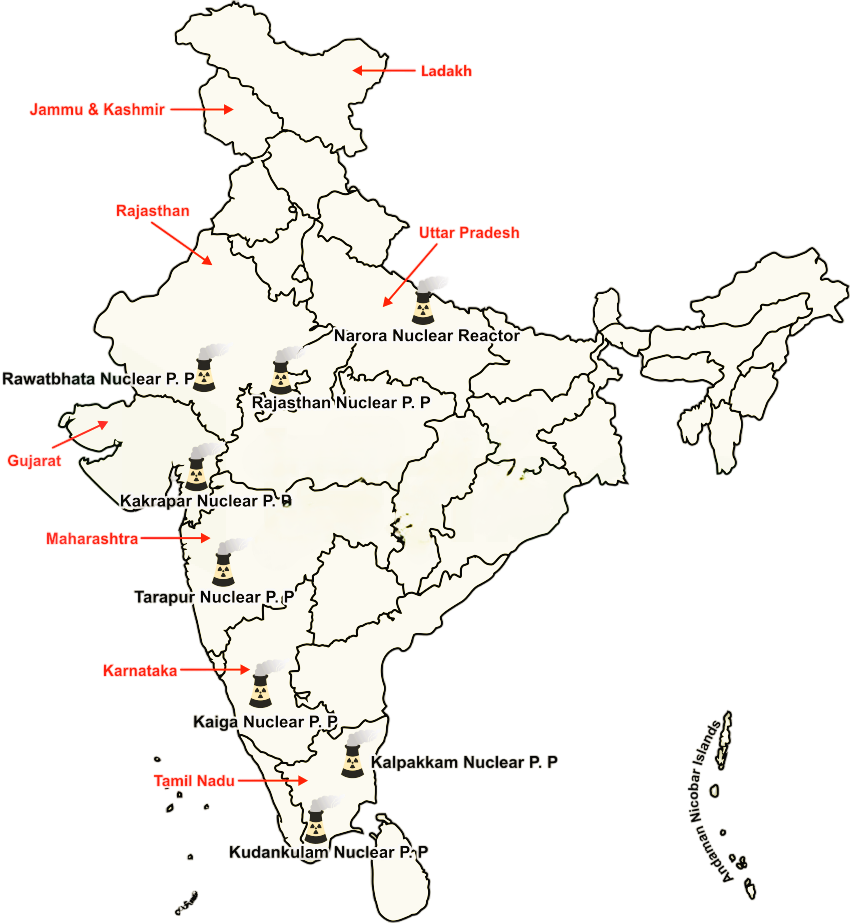
6. India’s first commercial nuclear power plant Tarapur is located in which of the following states?
A. Karnataka
B. Madhya Pradesh
C. Jharkhand
D. Maharashtra
Solution
The correct answer is Maharashtra.
Key Points
- Tarapur Atomic Power station is located in Tarapur, Maharashtra.
- It was the first commercial atomic power station of India commissioned on 28th October 1969.
- It was commissioned under 123 agreements signed between India, the United States, and International Atomic Energy Agency.
- The station is operated by the National power corporation of India.
Additional Information
Other important Atomic Power stations in India –
| Nuclear Power Plant(P.P) | Location |
| Kaiga Atomic Power plant | Karnataka |
| Kakarapar Atomic power station | Gujarat |
| Narora Nuclear power plant | Uttar Pradesh |
| Kalapakkam Nuclear plant | Tamil Nadu |
| Rawatbhata Nuclear P.P | Rajasthan |
| Tarapur Nuclear P.P | Maharashtra |
| Kudankulam Nuclear P.P | Tamil Nadu |
7. Which Indian state is the largest bauxite producing state?
A. Odisha
B. Bihar
C. Madhya Pradesh
D. Jharkhand
Solution
The correct answer is Odisha.
- Odisha is the largest bauxite producing state in India.
- Odisha consists of more than 50% of India’s resources of bauxite.
- Bauxite is an ore of aluminum.
- Bauxite deposits are formed by the decomposition of a wide variety of rocks that consists of aluminium silicates.
- Major bauxite producing areas are Odisha, Jharkhand, Chhattisgarh, Madhya Pradesh, Gujarat, Maharashtra, and Tamil Nadu
- Bauxite is mainly used to produce alumina through the Bayer process.
- Important bauxite mines in India are:
- Bilaspur & Maikal Hills.
- Singhbhum.
- Jamnagar.
- Balangir.
- Bargarh.
- Koraput.
- Kalahandi.
- Sambalpur.
- Sundergarh.
Additional Information
| State | Minerals |
| Bihar | Limestone in Kaimur (Bhabhua), Monghyr, and Rohtas districts.Mica in Nawada district.Quartz/ silica sand in Bhagalpur, Jamui, Monghyr, and Nalanda districts.Quartzite in Lakhisarai, Monghyr, and Nalanda districts.Talc/soapstone/ steatite in Monghyr district. |
| Madhya Pradesh | Diamond, Coal, limestone, manganese ore, Bauxite, Copper ore, Dolomite, fire clay, slate pyrophyllite-diaspore. |
| Jharkhand | Iron ore, Coal, Copper ore, Mica, Bauxite, Fire clay, Graphite, Kyanite, Sillimanite, Lime stone, Uranium |
8. Rajasthan is the largest producer which of the following mineral?
A. Iron Ore
B. Magnesium
C. Asbestos
D. Limestone
Solution
The Correct Answer is Option (3) i.e. Asbestos.
Key Points
- Rajasthan and Andhra Pradesh produce almost the whole of Asbestos of India.
- Asbestos is largely produced in the Udaipur, Dungarpur, Alwar, Ajmer, and Pali districts of the state of Rajasthan.
- Asbestos is a term used to refer to six naturally occurring silicate minerals.
- It is used in applications like electrical insulation and in building insulation. It is an important building, binding, and strengthening commodity.
| Mineral | Type | Largest Producer in India |
| Iron- Ore | Metallic | Odisha |
| Magnesium | Metallic | Tamil Nadu |
| Limestone | Non- Metallic | Madhya Pradesh |
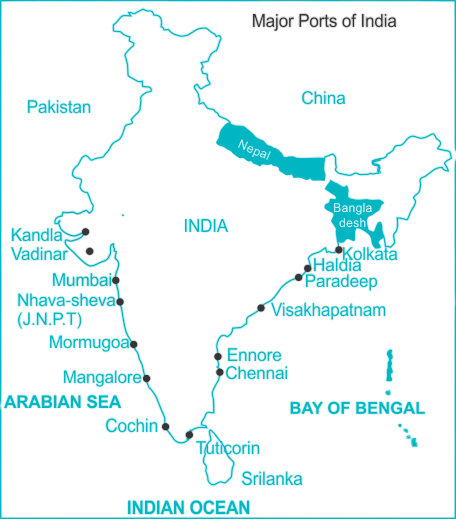
9. Which of the following statement is correct related to the Major Sea Ports of India?
A. Major ports handle 25 per cent of India’s foreign trade.
B. India has 13 major seaports and 205 notified minor and intermediate ports.
C. On the west coast, there are the ports of Mumbai, Ennore and Paradip
D. Visakhapatnam is the largest natural port in India.
Solution
The correct answer is Option 2.
Key PointsMajor Sea Ports in India
- India has 13 major seaports (12 Government-owned and one private) and 205 notified minor and intermediate ports that handle a huge volume of traffic. Hence, Statement 2 is correct.
- About 95 per cent by volume and 70 per cent by value of India’s total international trade are carried on through maritime transportation. Hence, Statement 1 is not correct.
- All ports in India are situated in the 9 coastal states of India namely:
- Kerala, Karnataka, Maharashtra, Goa, Gujarat, West Bengal, Odisha, Andhra Pradesh and Tamil Nadu.
- India’s extended coastline forms one of the major portions of land that juts out into a water body.
- Thirteen major ports in the country handle a lot of volume of container and cargo traffic.
- On the West Coast, there are the ports of:
- Mumbai, Kandla, Mangalore, JNPT, Vadhavan, Mormugao, and Cochin. Hence, Statement 3 is not correct.
- The ones on the East Coast are the ports at
- Chennai, Tuticorin, Visakhapatnam, Paradip, Kolkata, and Ennore.
- Ennore is a registered public company with the government owning a 68% stake.
- In Andaman and Nicobar Islands, there is Port Blair.
- Mumbai is the largest natural port in India. Hence, Statement 4 is not correct.
10. Which of the following is the longest national highway in India?
A. NH 44
B. NH 1
C. NH 10
D. NH 6
Solution
The longest National Highway in India is NH 44.
- It was previously known as National Highway 7.
- It is 3,745 km long and covers the North-South Corridor of National Highways Development Project(NHDP).
- It starts from Srinagar in the north and ends in Kanyakumari in the south.
- This highway passes through the 11 Indian states.
- States connected by NH 44 – Jammu & Kashmir, Punjab, Haryana, Delhi, Uttar Pradesh, Madhya Pradesh, Maharashtra, Telangana, Andhra Pradesh, Karnataka, and Tamil Nadu.
- Cities connected by NH 44 – Srinagar, Jammu, Pathankot, Jalandhar, Ludhiana, Ambala, Karnal, Panipat, Sonipat, Delhi, Mathura, Agra, Gwalior, Jhansi, Narsinghpur, Nagpur, Adilabad, Hyderabad, Jadcherla, Kurnool, Anantapur, Bengaluru, Dharmapuri, Salem, Namakkal, Karur, Dindigul, Madurai, Kovilpatti, Tirunelveli and Kanyakumari.
Additional Information – Chennai-Nashri Tunnel which was inaugurated by Prime Minister of India, Narendra Modi, on 2 April 2017, is a significant addition to this highway.