1. What is the main feature of New Economic Policy launched in the year 1991?
A. Liberalisation
B. Privatisation
C. Globalisation
D. All of the Above
Solution
The correct answer is All of the Above.
Key Points
- Economic policy refers to the actions that governments take in the economic field.
- It covers the systems for setting levels of taxation, government budgets, the money supply and interest rates as well as the labor market, national ownership, and many other areas of government interventions into the economy.
- By 1985, India had started having balance of payments problems. This is due to more expenditure by the government whereas the income generated was less. In addition, there were huge disparities between income and expenditure.
- By the end of 1990, it was in a serious economic crisis. The government was close to default, its central bank had refused new credit
- In 1991, India met with an economic crisis – relating to external debt. The government was not able to make repayments on its borrowings from abroad.
- The foreign exchange reserves, which we maintain to import petroleum and other important items, dropped to levels that were not sufficient to last even a fortnight. The crisis was further compounded by rising prices of essential goods.
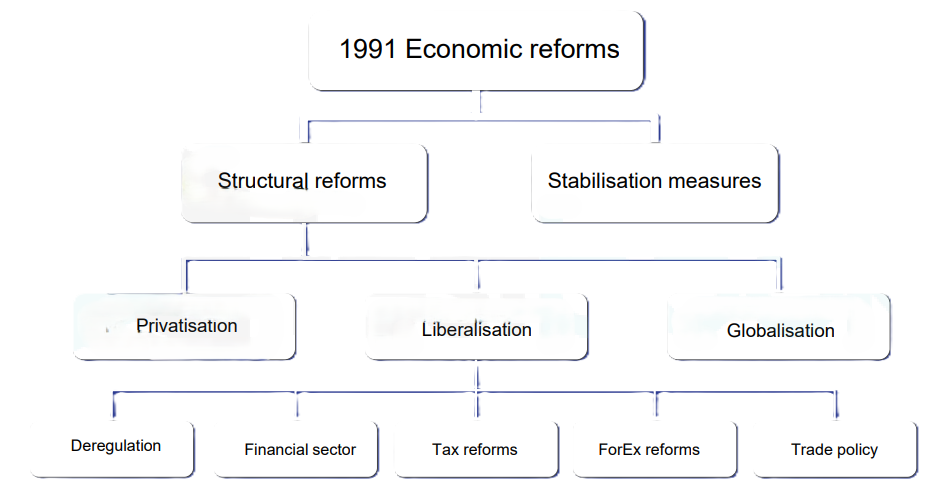
Liberalisation:
Liberalisation was done in various sectors in the following ways:
- Deregulation of industrial sectors
- Financial sector reforms
- Tax reforms
- Foreign exchange reforms
- Trade and investment policy reforms
Privatisation:
- Privatisation means the transfer of assets from public sector to private sector.
- Privatisation helps in improving financial discipline and to facilitate modernisation. It helps in strong inflow of FDIs.
Globalisation:
- Globalisation is the process of international integration arising from the interchange of world views, products, ideas and mutual sharing, and other aspects of culture.
2. Globalisation is a ___________ concept.
A. narrow
B. multidimensional
C. broad
D. wider
Solution
The correct answer is Multidimensional.
Key Points
- Globalization
- Globalization can be defined as a process of rapid economic, cultural, and institutional integration among countries.
- Globalization is driven by the liberalization of trade, investment capital flow, technological advances, and pressure for assimilation toward international standards.
- Globalization has occurred in earlier periods in history in different parts of the world.
- It increases the volume of trades in goods and services, creates new jobs, strengthens domestic economies, improves production efficiency, etc.
3. In 2015, the Planning Commission was replaced with the .
A. Monetary Policy Committee
B. Competition Commission of India
C. NaBFID
D. NITI Aayog
Solution
The correct answer is NITI Aayog.
Key Points
- NITI Aayog:
- NITI Aayog is not a constitutional body.
- It was established on January 1, 2015.
- It is formed in place of the Planning Commission.
- The ex-officio president of this is the Prime Minister.
- It is the premier policy ‘Think Tank’ of the Government of India, providing both directional and policy inputs.
- The NITI Aayog:
- Formed: 1 January 2015
- Headquarters: New Delhi
- Chairman – Narendra Modi
- Vice-Chairman – Dr. Suman Bery
- CEO – B.V.R. Subrahmanyam
Additional Information
- Monetary Policy Committee
- Monetary Policy CommitteeThe Reserve Bank of India (RBI) is vested with the responsibility of conducting monetary policy.
- This responsibility is explicitly mandated under the Reserve Bank of India Act, 1934.
- The primary objective of monetary policy is to maintain price stability while keeping in mind the objective of growth. Price stability is a necessary precondition to sustainable growth.
- In May 2016, the Reserve Bank of India (RBI) Act, 1934 was amended to provide a statutory basis for the implementation of the flexible inflation targeting framework.
- Competition Commission of India
- The Competition Commission of India is a statutory body formed by Competition Act, 2002.
- The competition commission of India was established on the recommendations of the Raghavan Committee.
- The commission is also a quasi-judicial body that gives opinions to statutory authorities and also deals with other cases.
- It was established on 14 October 2003.
- NaBFID
- NaBFID will be regulated and supervised as an All India Financial Institution by it under the RBI Act, 1934.
- The National Bank for Financing Infrastructure and Development (NaBFID) Act, 2021, received the assent of the President on March 28, 2021.
- NaBFID has been set up as a Development Financial Institution (DFI) to support the development of long-term infrastructure financing
4. Who is the Ex-officio Chairman of NITI Aayog?
A. President
B. Prime Minister
C. Home Minister
D. Finance Minister
Solution
The correct answer is Option 2.
Key Points
- The Ex-officio Chairman of NITI Aayog is the Prime Minister of India.
- As per the NITI Aayog Act of 2014, the Prime Minister is the Chairperson of NITI Aayog, and the governing council of the organization includes chief ministers of all states and union territories, as well as members appointed by the central government.
- The Vice Chairman of NITI Aayog is appointed by the central government and is responsible for overseeing the day-to-day operations of the organization.
Additional Information
- Droupadi Murmu is the 15th and current president, having taken office from 25 July 2022.
- The current Finance Minister of India is Nirmala Sitharaman.
5. After which five year plan, “the Rolling Plan” was implemented ?
A. Fifth five year plan
B. Seventh five year plan
C. Fourth five year plan
D. Ninth five year plan
Solution
The correct answer is Fifth five year plan.
Key Points
- Rolling Plan in India was started in 1978.
- The rolling plan concept was coined by Gunnar Myrdal.
- This plan was rejected again by the Indian National Congress government when it came to power in 1980 and a new sixth plan was made.
- The main advantage of the rolling plans is that they are flexible.
- The Rolling Plan is a plan in which every year the performance of the plan is assessed and a new plan is made next year based on this assessment.
- Thus, both the allocation and targets are revised during this plan.
- In India, the Janta Government terminated the fifth five-year plan in 1977-78 and launched its own sixth five-year plan for the period 1978-83 and called it a Rolling Plan.
6. Which Five year plan in India was based on P.C.Mahalanobis Model?
A. 3rd Five Year Plan
B. 1st Five Year Plan
C. 4th Five Year Plan
D. 2nd Five Year Plan
Solution
The correct answer is 2nd Five Year Plan.
Key Points
- Mahalanobis Plan was India’s second five-year plan (1956-61) proposed by Professor Prasanta Chandra Mahalanobis.
- PC Mahalanobis established the Indian Statistical Institute (ISI) in Calcutta in 1931 and for the same reason, he is known as the father of Indian Statistics.
- He was a member of the first Planning Commission of free India.
- This plan gave priority to investment goods, as they were crucial for the further economic growth of India.
- The plan explores the allocation of investment between the different sectors of the economy.
- Two sectors are considered in the model; the production goods-producing sector (K-sector) and the consumption goods-producing sector (C-sector).
Additional Information
- Basic information about the planning commission and 5- year plans:
- The planning commission was founded: in 1950.
- Planning Commission head: Prime Minister
- First five-year plan launched: 1951
- A total number of 5- year plans: 12.
- Planning Commission dissolved: 2014 (By PM Narendra Modi)
| Five Year Plan | Period | About the Plan |
| First | 1951-56 | Objective -Development of AgricultureBased on Harrod Domar ModelTarget growth rate – 2.1%Actual growth rate – 3.6% |
| Second | 1956-61 | Objective – Industrial DevelopmentBased on P.C. Mahalanobis Model, 1953Target growth rate – 4.5%Actual growth rate – 4.27% |
| Third | 1961-66 | Objective – Self-sufficiency in food, and economyAlso called Gadgil Yojana, named after Deputy Chairman of Planning Commission D.R. GadgilFailure of plan due to Sino Indian War (1962) and Indo-Pak War (1965)Target growth – 5.6%Actual growth – 2.4% |
| Fourth | 1969-74 | Objective – Self-reliance and sustained growthGreen Revolution startedNationalization of 14 major banksTarget growth – 5.7%Actual growth – 3.3% |
| Fifth | 1974-78 | Objective – Removal of povertyThe slogan of Garibi Hatao was used. Terminated by the Morarji Desai government in 1978Target growth – 4.4%Actual growth – 4.8% |
| Sixth | 1980-85 | Objective – Improvement in infrastructure, agriculture, and industry, economic liberalizationTarget growth – 5.2%Actual growth – %5.7 |
| Seventh | 1985-90 | Objective – Modernisation and increase in employmentThe private sector got priority over the public sectorTarget growth – 5%Actual growth – 6.1% |
| Eighth | 1992-97 | Objective – Human Resource developmentNew Economic Policy of India launched. Target growth – 5.6%Actual growth – 6.8% |
| Ninth | 1997-02 | Objective – Growth with social justice and equalityTarget growth – 6.5%Actual growth – 5.6% |
| Tenth | 2002-07 | Objective – Increase in investmentTarget growth – 8%Actual growth – 7.6% |
| Eleventh | 2007-12 | Objective – Rapid and inclusive growthPrepared by C. Rangarajan. Target growth – 9%Actual growth – 8% |
| Twelfth | 2012-17 | Objective – Sustainable developmentTarget growth – 8% |
7. The proportion of the population below the poverty line is called the poverty ratio or __________.
A. Income Disparity Index
B. Headcount ratio
C. Socioeconomic Quotient
D. Gini Coefficient
Solution
The correct answer is headcount ratio
Key Points
- The proportion of the population below the poverty line is called the headcount ratio.
- The headcount ratio is a measure of poverty that counts the number of people whose income falls below the poverty line, thereby indicating the percentage of the population that is impoverished.
- This ratio helps in understanding the extent of poverty in a particular region or country and is crucial for formulating policies and strategies to alleviate poverty.
- It is one of the most straightforward and commonly used methods to measure poverty levels.
Additional Information
- The poverty line is typically determined based on the minimum income required to meet basic needs such as food, clothing, and shelter.
- The headcount ratio does not take into account the depth of poverty or the distribution of income among the poor; it only provides a headcount of those below the poverty line.
- Other measures of poverty include the Poverty Gap Index and the Multidimensional Poverty Index, which consider the severity and multiple dimensions of poverty, respectively.
8. _______ is a state or condition in which an individual or community lacks the financial resources and essentials for a minimum standard of living.
A. Unemployment
B. Poverty
C. Unethical
D. Illiteracy
Solution
The correct answer is Poverty
Key Points
- Poverty is a state or condition in which an individual or community lacks the financial resources and essentials for a minimum standard of living.
- It is a multifaceted concept, which includes social, economic, and political elements.
- Poverty can be measured in terms of income level, but it also encompasses a lack of access to basic needs such as food, shelter, education, and healthcare.
- Addressing poverty often requires a combination of economic growth, social policies, and targeted interventions to support vulnerable populations.
Additional Information
- Poverty is one of the primary challenges faced by many countries and is a key focus of global development efforts.
- The United Nations has set specific goals to reduce poverty through initiatives like the Sustainable Development Goals (SDGs), particularly Goal 1: No Poverty.
- Various factors such as unemployment, lack of education, and social exclusion contribute to the perpetuation of poverty.
- Effective poverty alleviation strategies often involve improving access to education, healthcare, and employment opportunities.
9. What is the aim of the Annapurna Yojana of the Government of India?
A. To provide food grains to children
B. To provide food grains to women
C. To provide food to all
D. To provide food grains to senior citizens
Solution
The Correct Answer is To provide food grains to senior citizens.
Key Points
- Annapurna Yojana
- Annapurna Scheme was launched in the year 2000 with effect from 1st April by the Ministry of Rural Development.
- It is a Central Sector Scheme. It is one of the sub-schemes of the National Assistance Program.
- The main aim of this scheme is to fulfil the requirements of senior citizens by providing food security.
- Senior citizens above the age of 65 are eligible for an old-age pension under the National Old Age Pension Scheme (NOAPS).
- Citizens who are eligible for the National Old Age Pension will be given 10 kg of food grains free of cost every month.
- Beneficiaries who are eligible for this scheme should be 65 years or above.
- Through this scheme, 20% of the people who are eligible to receive a pension under the NOAPS scheme in State/ Union Territories will receive free of cost food grains per month.
- The state government has a tie-up with the Food Corporation of India to release the food grains district-wise directly to the regional offices of the FCI.
- Funds for this scheme are released to the State Departments of Food and Civil Supplies in a single instalment.
Important Points
- COMPONENTS OF THE NATIONAL SOCIAL ASSISTANCE PROGRAM
- Indira Gandhi National Old Age Pension Scheme: The state and central government together pay a pension amount of Rs 300/- every month for persons aged between 60 to 79 years. For people who are 80 years and above, the pension amount is Rs 500/-.
- Indira Gandhi National Widow Pension Scheme: Under this scheme, widows falling between the age of 40 to 59 who live below the poverty line are eligible for a monthly pension of Rs. 200/-. After they cross the age of 60 years, they qualify for the Indira Gandhi National Old Age Pension Scheme.
- Indira Gandhi National Disability Pension Scheme: Under the IGNDPS, persons with 80 percent disability who are 18 years and older are eligible for a monthly pension of Rs 300/-. This pension will increase to Rs 500/- per month after they attain the age of 80 years.
- National Family Benefit Scheme: The National Family Benefit Scheme, the fourth scheme that falls under the National Social Assistance Program, provides a death benefit of Rs 40,000/- to families where the sole breadwinner of the family has passed away. The criterion is that the breadwinner should have been between 18 to 64 years old.
10. Which of the following schemes is also known as ‘Ajeevika’?
A. Sampooran Gramin Rojgar mission
B. Minimum needs programme
C. Prime minister Rojgar Yojana
D. National rural livelihood mission
Solution
The correct answer is National rural livelihood mission.
Key Points
- The National Rural Livelihoods Mission (DAY-NRLM) is primarily a Central government initiative to combat poverty.
- The Ministry of Rural Development of the GOI introduced it in 2011 as “Aajeevika – National Rural Livelihoods Mission (NRLM)”.
- In 2015, it adopted the name DAY-NRLM.
- A better version of the previous Swarnjayanti Gram Swarozgar Yojana(SGSY) is the current programme.
- The World Bank provides some funding for the initiative.
Important Points
- On September 25, 2001, the Employment Assurance Scheme (EAS) and the Jawahar Gram Samridhi Yojana’s provisions were combined to become the Sampoorna Grameen Rozgar Yojana (JGSY).
- In the first year of the Fifth Five Year Plan, the Minimum Needs Programme was introduced. The Program’s goal is to create a network of essential services and facilities for social consumption in all locations up to standards recognised nationally and to do so in a predetermined amount of time.
- The Prime Minister’s Rozgar Yojana (PMRY) aims to give 1 million educated unemployed youth sustainable self-employment options