1. The square of the length of a space diagonal of a closed cube is 2175 cm2. What is the total surface area (in cm2) of the cube?
A. 4305
B. 4350
C. 4530
D. 4272
Solution
Given:
The square of the length of a space diagonal of a closed cube is 2175 cm2.
Formula used:
For a cube with side length ‘a’:
Length of the space diagonal = a√3
Square of the length of the space diagonal = (a√3)2 = 3a2
Total surface area of the cube = 6a2
Calculation:
3a2 = 2175
⇒ a2 = 2175 / 3
⇒ a2 = 725
Total surface area = 6a2
⇒ Total surface area = 6 × 725
⇒ Total surface area = 4350 cm2
∴ The correct answer is option (2).
2. Radhika requested the cashier of a bank to get her coins in lieu of her cheque worth ₹1,845. Cashier gave her a packet containing ₹5, ₹10 and ₹20 coins in the ratio of 3 : 5 : 7. What is the total worth of the smallest coin received by her?
A. ₹125
B. ₹135
C. ₹105
D. ₹145
Solution
Given:
Total worth of coins = ₹1,845
Denominations of coins = ₹5, ₹10, ₹20
Ratio of coins = 3 : 5 : 7
Formula Used:
Total worth of coins = (Number of ₹5 coins × 5) + (Number of ₹10 coins × 10) + (Number of ₹20 coins × 20)
Calculation:
Let the number of ₹5 coins be 3x, ₹10 coins be 5x, and ₹20 coins be 7x.
Total worth of coins = (3x × 5) + (5x × 10) + (7x × 20)
Total worth of coins = 15x + 50x + 140x
Total worth of coins = 205x
Given total worth of coins = ₹1,845
⇒ 205x = 1,845
⇒ x = 1,845 / 205
⇒ x = 9
Number of ₹5 coins = 3x = 3 × 9 = 27
Worth of ₹5 coins = 27 × 5 = ₹135
The total worth of the smallest coin received by her is ₹135.
3. At what rate of simple interest of rupees 4500 per annum will be 5715 rupees in 3 years?
A. 12%
B. 9%
C. 5%
D. 13%
Solution
Given:
Principal = Rs. 4500
Amount = Rs. 5715
Time = 3 years
Formula used:
si=P×R×T100si=P×R×T100
Principal + interest = Amount
Interest = Amount – Principal
Calculation:
Interest = 5715 – 4500 = 1215
Interest for 3 years = Rs. 1215
Interest for 1 year = 1215/3 = Rs. 405
Rate=Interest×100Principal×TimeRate=Interest×100Principal×Time
Rate = 405×1004500=9%
4. During the first year the population of a village increased by 5% and during the second year it diminished by 5%. At the end of the second year its population was 47,880. What was the population at the beginning of the first year?
A. 48000
B. 43500
C. 45000
D. 53000
Solution
Given:
Population at the end of the second year = 47,880
First year increase = 5%
Second year decrease = 5%
Formula Used:
Population after first year = Initial Population × (1 + 5/100)
Population after second year = Population after first year × (1 – 5/100)
Calculation:
Let the initial population be P.
Population after the first year = P × 1.05
Population after the second year = P × 1.05 × 0.95
Given that the population after the second year is 47,880:
⇒ P × 1.05 × 0.95 = 47,880
⇒ P × 0.9975 = 47,880
⇒ P = 47,880 / 0.9975
⇒ P = 48,000
The population at the beginning of the first year was 48,000.
5. The average age of the 12 players of a team is 25 years. If the captain’s age is included, the average age increases by 1 year. Find the age of the captain.
A. 20 years
B. 38 years
C. 36 years
D. 46 years
Solution
Given:
The average age of 12 players = 25 years
Formula Used:
Average = Sum of the observation/Total observation
Calculation
Total sum of age of 12 players= 12 × 25 = 300 years
After adding, the captain’s new average = 26 years
New sum = 13 × 26 = 338 years
The captain’s age is 338 – 300 = 38 years
∴ The age of the captain’s (in years) is 38 years.
6. If the selling price of a bottle is Rs. 408 and loss percentage is 32 percent, then what is the cost price of the bottle?
A. Rs. 650
B. Rs. 700
C. Rs. 720
D. Rs. 600
Solution
Given:
Selling Price (SP) = Rs. 408
Loss Percentage = 32%
Formula Used:
Cost Price (CP) = SP / (1 – Loss Percentage/100)
Calculation:
Loss Percentage = 32%
SP = Rs. 408
CP = SP / (1 – Loss Percentage/100)
CP = 408 / (1 – 32/100)
CP = 408 / (1 – 0.32)
CP = 408 / 0.68
CP = 600
The cost price of the bottle is Rs. 600.
7. Rohan can alone finish a work in 12 days and Hari can alone in 16 days. They both work for 3 days and then Rohan left. After that only Hari works and finishes the work. The total work will be completed in:
A. 9 days
B. 
C. 12 days
D. 
Solution
Given:
Rohan can finish a work in 12 days.
Hari can finish the same work in 16 days.
They both work together for 3 days.
Rohan leaves and Hari finishes the remaining work alone.
Concept:
Work done by an individual in 1 day is the reciprocal of the total days they take to complete the work.
Formula Used:
Work done by Rohan in 1 day = 1/12
Work done by Hari in 1 day = 1/16
Total Work = 1 (assuming the whole work is 1 unit)
Calculation:
Work done by Rohan and Hari together in 1 day:
⇒ (1/12) + (1/16)
⇒ (4 + 3)/48
⇒ 7/48
Work done by Rohan and Hari together in 3 days:
⇒ 3 × (7/48)
⇒ 21/48
⇒ 7/16
Remaining work after 3 days:
⇒ 1 – 7/16
⇒ 9/16
Time taken by Hari to complete the remaining work:
⇒ (9/16) × 16
⇒ 9 days
Total time taken to complete the work:
⇒ 3 days (together) + 9 days (Hari alone)
⇒ 12 days
∴ The total work will be completed in 12 days.
8. Hiten marks his pen at Rs. 15625 and after allowing discount of 20 percent, he still earns 25 percent profit. What is the cost price of the pen?
A. Rs. 10000
B. Rs. 11800
C. Rs. 10500
D. Rs. 12500
Solution
Shortcut Trick
MP / CP = (100 + profit %) / (100 – discount %)
⇒ 15625 / CP = (100 + 25) / (100 – 20)
⇒ 15625 / CP = 125 /80
⇒ 15625 / CP = 25/16
⇒ CP = 15625 × 16/25
⇒ CP = Rs. 10000
∴ The cost price of the pen is ₹10000.
Alternate Method
Given:
Marked Price (MP) = ₹15625
Discount Percentage = 20%
Profit Percentage = 25%
Formula used:
SP = MP × (1 – Discount Percentage / 100)
SP = CP × (1 + Profit Percentage / 100)
Calculations:
1. Calculate Selling Price (SP)
⇒ SP = 15625 × (1 – 0.20)
⇒ SP = 15625 × 0.80
⇒ SP = ₹12500
2. Relate SP to CP using Profit Percentage
⇒ SP = CP × (1 + 0.25)
⇒ 12500 = CP × 1.25
3. Calculate Cost Price (CP)
⇒ CP = 12500 / 1.25
⇒ CP = ₹10000
∴ The cost price of the pen is ₹10000.
9. Mithila covers 50 km by bus in 90 minutes. After deboarding the bus, she takes rest for 15 minutes and covers another 30 km by a taxi in 35 minutes. Find the average speed (in km/h) for the whole journey
A. 31273127
B. 34273427
C. 32273227
D. 33273327
Solution
Given:
Distance covered by bus = 50 km
Time taken by bus = 90 minutes
Distance covered by taxi = 30 km
Time taken by taxi = 35 minutes
Rest time = 15 minutes
Formula Used:
Average speed = Total distance traveled / Total time taken
Calculation:
Total distance = 50 km + 30 km
Total distance = 80 km
Total time = 90 minutes + 35 minutes + 15 minutes
Total time = 140 minutes
Total time = 140/ 60 hours
Average speed = Total distance / Total time
Average speed = 80km140/6080km140/60 km/h
Average speed=2407Average speed=2407 km/h
Average speedAverage speed = 34273427 km/h
The average speed for the whole journey is 34273427 km/h.
10. Average age of a teacher and three students is 25 years. If all the three boys are of same age and the difference between the age of each boy and teacher is 20 years, then the age of the teacher is equal to
A. 25 years
B. 30 years
C. 40 years
D. 45 years
Solution
Given:
The average age of a teacher and three students is 25 years.
Formula used:
Average = Total sum of all numbers/Number of values
Calculation:
Let the age of teachers be y.
And the age of Student be x.
Difference y = (x + 20)
According to the question:
Average age = (x + x + x + y)/4 = 25 years
⇒ (3x + y) = 25 × 4
⇒ 3x + y = 100
⇒ 3x + x + 20 = 100
⇒ 4x = 80
⇒ x = 20
The age of teachers, y = (x + 20) = 20 + 20 = 40 years
∴ The age of the teacher is 40 years.
11. Ramesh borrowed some money at the rate of 5.5% per annum (p.a.) for the first 2 years, 8.5% p.a. for the next 6 years, and 14% p.a. for the period beyond 8 years. If the total interest paid for 12 years is ₹10,030, then how much money (in ₹) did he borrow?
A. 8,000
B. 9,000
C. 1,000
D. 8,500
Solution
Given:
Total interest paid for 12 years = ₹ 10,030
Rate for first 2 years = 5.5%
Rate for next 6 years = 8.5%
Rate for the period beyond 8 years = Rate for remaining 4 years = 14%
Formula used:
SI = P × R × T/100
Where SI = Simple Interest; P = Initial amount;
R = Rate of interest; T = Time (in year)
Calculations:
Let, the amount of money borrowed by Ramesh = P
Now, according to the question,
⇒ (P × 5.5 × 2)/100 + (P × 8.5 × 6)/100 + (P × 14 × 4)/100 = 10030
⇒ 11P/100 + 51P/100 + 56P/100 = 10030
⇒ 118P = 10030 × 100
⇒ P = 10030 × 100/118
⇒ P = 8500
∴ Ramesh borrowed ₹ 8500.
Shortcut Trick
Let, the amount borrowed by Ramesh = P
Interest for the first 2 years = 5.5 × 2 = 11
Interest for 6 years = 8.5 × 6 = 51
Interest for 4 years = 14 × 4 = 56
Now, P = 10030 × 100/(11 + 51 + 56)
⇒ P = 10030 × 100/118
⇒ P = 8500
∴ Ramesh borrowed ₹ 8500.
12. The following table shows the number of units of a product manufactured and sold by a company in 5 years. Calculate the total number of unsold products.
| Years | Number of units manufactured (in hundred) | Sold (in hundred) |
| 2018 | 440 | 350 |
| 2019 | 500 | 450 |
| 2020 | 320 | 300 |
| 2021 | 450 | 400 |
| 2022 | 290 | 200 |
A. 30,000
B. 40,000
C. 50,000
D. 20,000
Solution
Calculation:
Number of units unsold in 2018 is 44000 – 35000 = 9000
Number of units unsold in 2019 is 50000 – 45000 = 5000
Number of units unsold in 2020 is 32000 – 30000 = 2000
Number of units unsold in 2021 is 45000 – 40000 = 5000
Number of units unsold in 2022 is 29000 – 20000 = 9000
Sum of unsold products is 9000 + 5000 + 2000 + 5000 + 9000 = 30,000.
13. A sells a bottle to B at the profit of 30 percent and B sells it to C at a loss of 20 percent. If C pays Rs. 3744 for the bottle, then what is the cost price of bottle for A?
A. Rs. 3600
B. Rs. 3000
C. Rs. 3200
D. Rs. 3500
Solution
Given:
C pays Rs. 3744 for the bottle.
A sells to B at a profit of 30%.
B sells to C at a loss of 20%.
Calculation:
Let the cost price of the bottle for A be x Rs.
Selling price for B = x + 0.30x = 1.30x
Cost price for C = Selling price for B – 20% of Selling price for B
Cost price for C = 1.30x – 0.20 × 1.30x = 1.30x × (1 – 0.20) = 1.30x × 0.80
Cost price for C = 1.04x
Given cost price for C is Rs. 3744.
Therefore, 1.04x = 3744
⇒ x = 37441.0437441.04
⇒ x = 3600
The cost price of the bottle for A is Rs. 3600.
14. A train with a speed of 60 km/hr crosses a lamppost in 2 minutes. The length of the train is:
A. 2000 m
B. 1500 m
C. 1200 m
D. 1800 m
Solution
Given:
Speed of the train = 60 km/hr
Time to cross the lamppost = 2 minutes
Formula Used:
Length of the train = Speed × Time
Calculation:
Convert time from minutes to hours:
2 minutes = 2 / 60 hours
2 minutes = 1 / 30 hours
Length of the train = Speed × Time
⇒ Length of the train = 60 km/hr × 1 / 30 hours
⇒ Length of the train = 60 / 30 km
⇒ Length of the train = 2 km
Convert length from km to meters:
⇒ Length of the train = 2 × 1000 meters
⇒ Length of the train = 2000 meters
The length of the train is 2000 meters.
Option 1 is the correct answer.
15. The ratio of the length to width of a certain rectangle is 3 ∶ 2 and the area is 150 cm2. The perimeter of the rectangle (in cm) is:
A. 20
B. 30
C. 50
D. 40
Solution
Given:
The ratio of length and breadth of a rectangle = 3 : 2
Formula used:
if A is the length and B is the breadth of the rectangle, then
Area of rectangle = A × B
Perimeter of rectangle = 2(A + B)
Calculation:
let length and breadth be 3x and 2x respectively
Now, According to the question
⇒ 3x × 2x = 150
⇒ 6x2 = 150
⇒ x2 = 25
⇒ x = 5
length = 3 × 5 = 15 cm
breadth =2 × 5 = 10 cm
perimeter of rectangle = 2(15 + 10)
perimeter of rectangle = 50 cm
∴The perimeter of the rectangle is 50 cm.
16. The length, the breadth and the height of a closed cuboidal box are 2.5 m, 2 m and 90 cm, respectively. What would be the cost of a canvas needed to cover this box completely, if the cost of the canvas is ₹70 per m2?
A. 1507
B. 1267
C. 1448
D. 1348
Solution
Given:
Length of the cuboidal box = 2.5 m
Breadth of the cuboidal box = 2 m
Height of the cuboidal box = 90 cm = 0.9 m
Cost of the canvas = ₹70 per m2
Formula Used:
Surface area of cuboid = 2(lb + bh + hl)
Cost = Surface area × Cost per m2
Calculation:
Surface area of the cuboid = 2(2.5 × 2 + 2 × 0.9 + 0.9 × 2.5)
Surface area = 2(5 + 1.8 + 2.25)
Surface area = 2(9.05)
Surface area = 18.1 m2
Cost = 18.1 × 70
Cost = 1267
The cost of the canvas needed to cover the box completely is ₹1267.
17. In which ratio a trader must mix two quantities of ₹18 per kg and ₹27 per kg, so that the price of the mixture becomes ₹25 per kg?
A. 1 ∶ 7
B. 3 ∶ 7
C. 2 ∶ 7
D. 2 ∶ 5
Solution
Given:
The cost of the first quality = Rs.18/kg
The cost of the second quality = Rs.27/kg
Calculation:
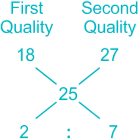
First quantity : second quantity = 2 : 7
∴ The correct option is 3.
18. The product of two numbers is 720 and their Highest Common Factor is 4. What is the Least Common Multiple of these numbers?
A. 180
B. 240
C. 480
D. 120
Solution
Concept:
The relationship between the Least Common Multiple (LCM), HCF, and the product of two numbers is given by:
HCF × LCM = Product of the numbers
Calculation:
We have,
⇒ HCF = 4
⇒ Product of the numbers = 720
Using the formula:
⇒ HCF × LCM = Product of the numbers
⇒ 4 × LCM = 720
Solving for LCM:
⇒ LCM = 720 ÷ 4
⇒ LCM = 180
∴ The Least Common Multiple of these numbers is 180.
19. What is the compound interest for 1 year on a sum of Rs.18000 at the annual rate of 20 percent per annum compounding half yearly?
A. Rs. 3780
B. Rs. 2450
C. Rs. 4500
D. Rs. 3650
Solution
Given:
Compound interest for 1 year on a sum of Rs.18000 at the rate of 20% per annum compounding half yearly
Concept used
CI for 2 years = x+y+xy100x+y+xy100
Calculation:
40% per annum compounding half yearly
Rate = 20/2
Rate = 10%
Ci for 2 years = x+y+xy100x+y+xy100
⇒ 10+10+10010010+10+100100
⇒ 21%
⇒ 21% of 18000
⇒ 21/100 × 18000
⇒ Rs. 3780
∴ Option 1 is the correct answer.
20. The following bar graph shows the amount of money spent on various sports by a school administration in a particular year. The amount spent on Hockey and Football is what percent of the amount spent on Basketball and Tennis?

A. 90%
B. 20%
C. 50%
D. 70%
Solution
Calculation:
According to the question:
The amount spent on Hockey and Football = 80 + 100 = 180
The amount spent on Basketball and Tennis = 150 + 50 = 200
Required % = 180/200 × 100 = 90%.
∴ Option 1 is the correct answer.
21. Select the correct mirror image of the given combination when the mirror is placed at ‘PQ’ as shown below.

A. 
B. 
C. 
D. 
Solution
The mirror image of the given combination is:
Now we consider the given options:
Option 1)‘7’ is missing.
Option 2)The number ‘7’ is misplaced and there is an extra ‘I’.
Option 3)There is an extra alphabet added i.e., ‘I’.
Option 4)The combination is correct.
Hence, the correct answer is “option 4″.
22. Which answer figure will complete the pattern in the following question figure?

A. 
B. 
C. 
D. 
Solution
The answer figure that will complete the pattern in the given question figure is as follows:

Hence, the figure in option 3 is the correct answer.
23. Dheeraj is the only son of Santosh and Santosh is the only daughter of my mother. What is the relationship of my mother with Dheeraj?
A. Maternal grandmother
B. Mother
C. Aunt
D. Sister
Solution
By using the symbols in the table given below, we can draw the following family tree:

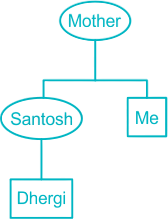
Clearly, my mother is the maternal grandmother of Dheeraj.
Hence, ‘Maternal grandmother’ is the correct answer.
24. In a certain code language, ‘he came back’ is written as ‘ni ji pa’, ‘go back now’ is written as ‘pa ja ka’ and ‘stop it now’ is written as ‘ka my uk’ . How will ‘go’ be written in the same code language?
A. ka
B. ni
C. ja
D. pa
Solution
The logic followed here is :-
‘he came back’ means ‘ni ji pa’, ‘go back now’ means ‘pa ja ka’ and ‘stop it now’ means ‘ka my uk’.
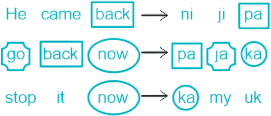
∴ Here, ‘go’ is coded as ‘ja’.
Hence, the correct answer is “ja”.
25. P, Q, R, S, T, U and V are sitting in a row on a wall facing towards the west. R is just to the left of S. Q is at one of the end points and T is his neighbour. V is sitting between T and U. S is fifth from the north end. Who among the following persons is sitting exactly in the middle of the row?
A. U
B. V
C. T
D. Q
Solution
P, Q, R, S, T, U and V are sitting in a row on a wall facing towards the west.
1) S is fifth from the north end and R is just to the left of S.
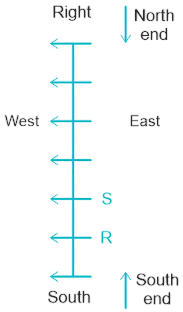
2) Q is at one of the end points and T is his neighbour and V is sitting between T and U.
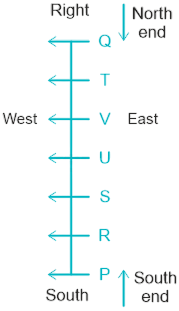
∴ Here, ‘U’ is sitting exactly in middle of the row.
Hence, the correct answer is “U”.
26. Which of the following terms will replace the question mark (?) in the given series?
BGR, CIV, ELZ, HPD, LUH, ?
A. QBL
B. QAK
C. QBK
D. QAL
Solution
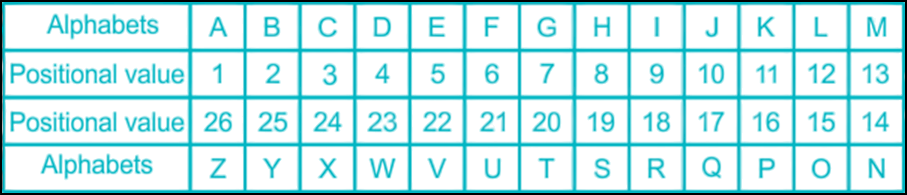
Logic :
- First letter → Number series starting with (1) is added to the position value according to English alphabetic series.
- Second letter → Number series starting with (2) is added to the position value according to English alphabetic series.
- Third letter → (4) is added to the position value according to English alphabetic series.
So,

Hence, “QAL” is the correct answer.
27. Which of the following numbers will replace the question mark (?) in the given series?
4, 24, 30, 180, 186, ?
A. 192
B. 1118
C. 1110
D. 1116
Solution
The logic followed here is:
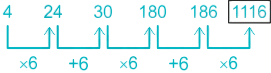
Hence, ‘1116‘ is the correct answer.
28. Identify the number that does NOT belong to the following series.
16, 17, 25, 52, 116, 243
A. 52
B. 116
C. 25
D. 243
Solution
The logic followed here is :-
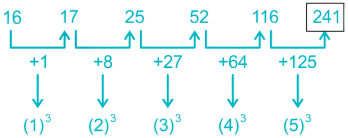
∴ Here, ‘243’ is the number given instead of ‘241’ thus 243 does not belong to the given series.
Hence, the correct answer is “243”.
29. The second number in each of the number-pairs is obtained by performing certain mathematical operations on the first number. Three of the following four number-pairs follow the same pattern and thus form a group. Select the number-pair that does NOT belong to that group.
A. 18 : 321
B. 21 : 438
C. 17 : 286
D. 19 : 357
Solution
The logic followed here is:
Logic: (first number)2 – 3 = second number
1) 18 : 321 → 182 – 3 = 324 – 3 = 321
2) 21 : 438 → 212 – 3 = 441 – 3 = 438
3) 17 : 286 → 172 – 3 = 289 – 3 = 286
4) 19 : 357 → 192 – 3 = 361 – 3 = 358 ≠ 357
Hence, ‘19 : 357’ is the odd one out.
30. In a certain code language, ‘STORK’ is written as ‘URROO’ and ‘ASHES’ is written as ‘CQKBW’. How will ‘BUNKE’ be written in that language?
A. DRPGI
B. DSPHG
C. DSQGI
D. DSQHI
Solution
The logic followed here is:
For, ‘STORK’ is written as ‘URROO’,
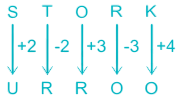
For, ‘ASHES’ is written as ‘CQKBW’,
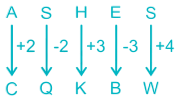
Similarly, for ‘BUNKE‘
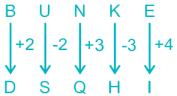
So, ‘BUNKE’ will be written as ‘DSQHI‘.
Hence, the correct answer is “Option 4”.
31. Direction: In the question generally a set, group or series of numerals is given and you are required to trace out the numerals following certain given conditions.
Manoj and Sachin are ranked 7th and 11th respectively from top in a class of 31 students. What will be their respective ranks from the bottom in the class?
A. 20th and 24th
B. 24th and 20th
C. 25th and 21at
D. 26th and 22nd
Solution
Given: Manoj and Sachin are ranked 7th and 11th respectively from top in a class of 31 students.
Students below Manoj = 31 – 7 = 24
Rank of Manoj from bottom = 24 + 1 = 25th
Students below Sachin = 31 – 11 = 20
Rank of Sachin from bottom = 20 + 1 = 21st
Hence, the correct answer is option (3).
32. Select the option that is related to the third word in the same way as the second word is related to the first word.
(The words must be considered as meaningful English words and must NOT be related to each other based on the number of letters/number of consonants/vowels in the word)
Smell : Nose :: Colours : ?
A. Ears
B. Eyes
C. Paint
D. Rainbow
Solution
The logic followed here is:
Logic: Second is used to perceive the first one.
- Smell : Nose → We smell by nose.
Similarly,
- Colours : ? → We see colours by eyes.
Hence, ‘Eyes‘ is the correct answer.
33. Which two signs and two numbers should be interchanged in the following equation to make it correct?
150 × 15 + 14 – 9 ÷ 2 = 6
A. 9, 2, -, ×
B. 9, 2, ÷, ×
C. 150, 2, ÷, –
D. 15, 9, +, ÷
Solution
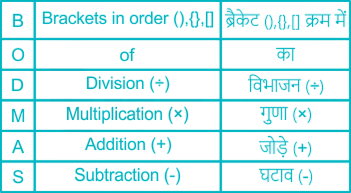
Given : 150 × 15 + 14 – 9 ÷ 2 = 6
So, after interchanging two signs and two numbers :
- Option – (1) : 9, 2, -, ×
150 – 15 + 14 × 2 ÷ 9 = 6
150 – 15 + 14 × 0.22 = 6
150 + 3.08 – 15 = 6
153.08 – 15 = 6
138.08 ≠ 6 (LHS ≠ RHS)
- Option – (2) : 9, 2, ÷, ×
150 ÷ 15 + 14 – 2 × 9 = 6
10 + 14 – 2 × 9 = 6
10 + 14 – 18 = 6
24 – 18 = 6
6 = 6 (LHS = RHS)
- Option – (3) : 150, 2, ÷, –
2 × 15 + 14 ÷ 9 – 150 = 6
2 × 15 + 1.55 – 150 = 6
30 + 1.55 – 150 = 6
31.55 – 150 = 6
118 ≠ 6 (LHS ≠ RHS)
- Option – (4) : 15, 9, +, ÷
150 × 9 ÷ 14 – 15 + 2 = 6
150 × 0.64 – 15 + 2 = 6
96 + 2 – 15 = 6
98 – 15 = 6
8 ≠ 6 (LHS ≠ RHS)
Hence, “Option – (2)” is the correct answer.
34. In the following diagram, the triangle stands for ‘women’, the square stands for ‘mothers’, and the circle stands for ‘dancers’. The numbers given in the different segments represent the number of persons of that category.

How many women are dancers but NOT mothers?
A. 55
B. 9
C. 45
D. 32
Solution
The least possible Venn diagram for the given information is as shown below :
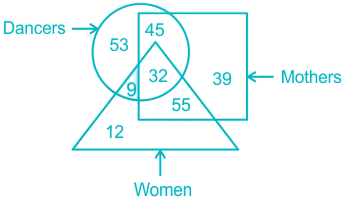
∴ Here, Number of women are dancers but NOT mothers is ‘9’.
Hence, the correct answer is “9”.
35. ‘Axe’ is related to ‘Woodcutting’ in the same way as ‘Sieve’ is related to ‘______’.
A. Flame
B. Filter
C. Grind
D. Hold
Solution
The logic followed here is:
- Axe is a tool used for woodcutting.
Similarly,
- Sieve is a utensil used to filter.
Hence, the correct answer is “Filter“.
Additional Information
- Flame – It is a hot glowing body of ignited gas that is generated by something on fire.
- Filter – It is a process or assess (Items) in order to reject or remove those that are unwanted.
- Grind – To reduce (something) to small particles or powder by crushing it.
- Hold – Keep or sustain in a specified position.
36. ‘Modest’ is related to ‘Arrogant’ in the same way as ‘Diffident’ is related to ‘_____’.
A. Humble
B. Confident
C. Reluctant
D. Suspicious
Solution
Given:
Modest is an antonym for Arrogant.
Modest → Not talking too much about his abilities and good qualities.
Arrogant → Thinking that you are better and more important than other people.
Similarly, Diffident is an antonym for Confident.
Diffident → Not having confidence in your abilities or strengths.
Confident → Feeling or showing that you are sure about your abilities and opinions.
Here, Diffident is an antonym for Confident.
Hence, the correct answer is “Confident”.
Additional InformationHumble → Not thinking that you are better and more important than other people.
Reluctant → Not wanting to do something because you are not sure it is the right thing to do.
Suspicious → Feeling that somebody has done something wrong, dishonest or illegal.
37. The position of how many letters will remain unchanged if each of the letters in the word KINGDOM is arranged in alphabetical order?
A. Three
B. None
C. One
D. Two
Solution
The position of letters which will remain unchanged if each of the letters in the word KINGDOM is arranged in alphabetical order is shown below:
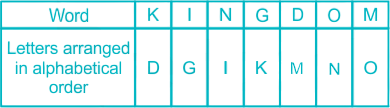
Clearly, none of the letters have their position unchanged.
Hence, ‘None’ is the correct answer.
38. How many triangles are there in the given figure?

A. 7
B. 9
C. 8
D. 10
Solution
The number of triangles in the given figure is:
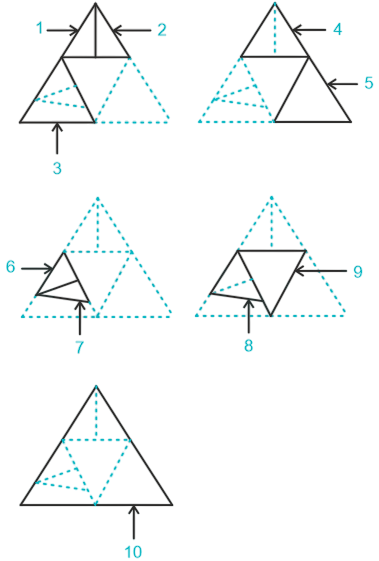
Here, the number of triangles is ’10’.
Hence, the correct answer is “Option (4)”.
39. Eight friends (A, B, C, D, E, F, G, H) sit around a circular table, all of them facing the centre. Only three people sit between F and E. E sits second to the right of G. B is immediate the neighbour of E but not D. C sits third to the left of D. A sits second, to the right of B. H and C are not immediate neighbours of each other. Who is sitting between D and H, when counted from the right of D?
A. A
B. E
C. F
D. G
Solution
Given: Eight friends – A, B, C, D, E, F, G, H, sitting around a circular table, facing centre.
E sits second to the right of G.
Only three people sit between F and E.
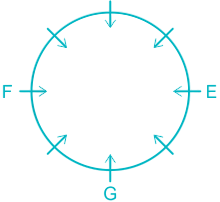
B is immediate the neighbour of E but not D.
A sits second, to the right of B.
Case I:
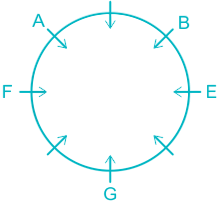
Case II:
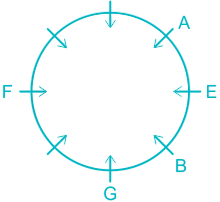
C sits third to the left of D.
H and C are not immediate neighbours of each other.
Case I:
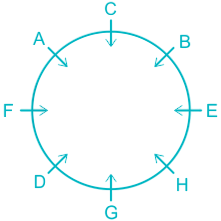
Case II:
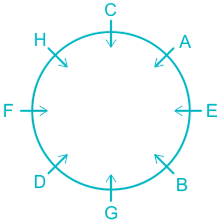
Case II, Contradicts H and C are not immediate neighbour of each other.
Hence, Case II becomes false.
So, the final arrangement is:
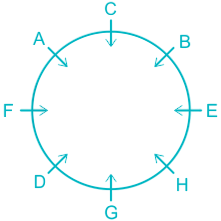
From Case I, G is sitting between D and H when counted from right of D.
Hence, the correct answer is ‘Option 4’.
40. Study the following information carefully and answer the given question:
Eight friends L, M, P, Q, R, S, T and V are sitting around a circle facing the centre. L sits third to the right of M and L sits second to the left of P. R and S sit next to each other and none of them is an immediate neighbour of L. Q sits second to the right of T. V sits second to the right of S. Who sits third to the left of V?
A. Q
B. R
C. P
D. L
Solution
According to the given information,
1. L sits third to the right of M.
2. L sits second to the left of P.
3. R and S sit next to each other and none of them is an immediate neighbour of L.

4. Q sits second to the right of T.
5. V sits second to the right of S.
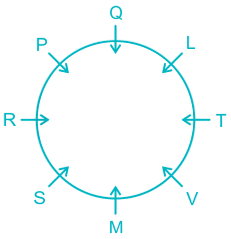
As we can see that, R sits third to the left of V.
41. Sinhala is a major language in which of the following countries?
A. Malaysia
B. Indonesia
C. Sri Lanka
D. Myanmar
Solution
The correct answer is Sri Lanka.
Key Points
Sinhala – Language in Sri Lanka
- Sinhala is the native language of the Sinhalese people.
- It constitutes approximately 70 percent of Sri Lanka’s population, which equals approximately 13 million people.
- Sinhala is also spoken among other ethnic groups on the island as a second language, making it the most widely spoken language in Sri Lanka.
- It was greatly influenced by Pali, the liturgical language of Sri Lankan Buddhists.
- Due to the centuries of colonial rule in Sri Lanka, Sinhala contains many Portuguese, Dutch and English loanwords.
- Sinhala also has a number of words borrowed from Tamil.
Additional InformationMalay – Language in Malaysia
- The national language of Malaysia is Malay.
- It is also called Malaysian Malay or Malay.
- It is spoken by over 80% of the population.
- The three main Malaysian languages are Malay, Mandarin and Tamil.
Indonesian – Language of Indonesia
- Indonesian (locally referred to as Bahasa Indonesia) is the primary lingua franca.
- Indonesian is spoken by over 94% of the population, but it is the primary language of only 20% of the population.
- Javanese (Jawa) is the most common primary language, spoken by over 30% of the population.
Burmese – Language of Myanmar
- The official language is Burmese, spoken by the people of the plains and, as a second language, by most people of the hills.
- During the colonial period, English became the official language, but Burmese continued as the primary language in all other settings.
42. Who among the following classical dancers was rewarded with the Padma Vibhushan Award in 2003?
A. Sonal Mansingh
B. Kumudini Lakhia
C. Shovana Narayan
D. Sunayana Hazarilal
Solution
The correct answer is Sonal Mansingh.
Key Points
- Sonal Mansingh is a prominent Indian classical dancer who specializes in Bharatnatyam and Odissi.
- In 2003, Sonal became the first Indian women dancer to be awarded Padma Vibhushan.
- She was the youngest recipient of Padma Bhushan in 1992.
Additional Information
- Kumudini Lakhia:
- She is an Indian Kathak dancer.
- She is a recipient of the Padma Shri, Padma Bhushan, and Sangeet Natak Akademi Awards.
- Shovana Narayan:
- She is a famous Indian Kathak dancer.
- She has been awarded the Padma Shri and Sangeet Natak Akademi Award.
- Her guru is Birju Maharaj.
- Sunayana Hazarilal:
- She is an Indian classical Kathak dancer from Janakiprasad Gharana.
- In 2011, she was awarded the fourth highest civilian award of Padma Shri.
43. Which of the following is NOT correct regarding king Harshavardhana?
A. Harshavardhana ruled nearly about 1400 years ago
B. Xuan Zang spent a lot of time at Harsha’s court
C. Harshavardhana’s court poet was Harishena
D. Harshacharita is a biography written on Harshavardhana
Solution
The correct answer is Harshavardhana’s court poet was Harishena.
Key Points
- Banabhatta was the court poet of king Harshavardhana. Banabhatta wrote Harshvardhan’s biography Harshacharita in Sanskrit.
- Harshavardhana was born in 590 AD.
- He belonged to the Vardhana dynasty.
- He ruled North India from 606 AD to 647 AD.
- Kannauj city, present-day Uttar Pradesh was his capital.
- The Chinese Traveller Xuanzang visited the king and wrote about his reign.
- Emperor Samudragupta’s court poet was Harisena.
Additional Information
- Harshavardhana was defeated by the south Indian emperor Pulkesin II of the Chalukya Dynasty in the Battle of Narmada.
- Harsha is widely believed to be the author of three Sanskrit plays “Ratnavali, Nagananda and Priyadarshika “
- The Chinese traveller Hiuen Tsang visited India during his reign.
- Harshavardhana established a large centre of knowledge which was called Bhadra Vihar at Kannauj.
- Banabhatta’s Harshacharita and an account of Hieun Tsang was the major source of information about Harsha’s period
44. Which of the following is celebrated as the “Tibetan New Year”?
A. Losang
B. Losar
C. Myoko
D. Murung
Solution
The correct answer is the Losar festival.
Key Points
- The Losar festival marks the beginning of the Tibetan New Year.
- The Losar Festival is celebrated with great zeal and fervour in Tibetian border states like Himachal Pradesh, Ladakh, Sikkim and Arunachal Pradesh.
- It is also known as a festival of happiness and prosperity.
- The celebrates the Ladakhi or Tibetan New Year.
Additional Information
- Puthandu:
- It is also known as Puthuvarusham.
- Puthandu is observed by Tamils as the traditional “Tamil/Hindu New Year.”
- It normally occurs on April 14 and this month is known as Chittirai, the first month of the Tamil solar calendar.
- Poila Boisakh:
- The first day of the first month of Baishakh in the Bengali solar calendar is known as Pohela Boishakh.
- It is also known as the Bengali New Year or Nobo Borso.
- It is widely observed in Bangladesh and West Bengal.
- Vishu:
- Due to Malyalam being the dominant language in Kerala, Vishu is sometimes referred to as the Malyalam New Year.
- For residents of Kerala and several nearby regions of Tamil Nadu, Vishu signifies the start of the new year.
- Gudi Padwa:
- Celebrated on the first day of Chaitra month, Gudi Padwa is a New Year day for Maharashtrians and Konkanis.
- On this day a gudi can be found hanging out on the right side of the main access of the houses.
- Navreh
- It is the lunar new year that is celebrated in Kashmir.
- It is the Sanskrit word ‘Nav-Varsha’ from where the word ‘Navreh’ has been derived.
- It falls on the first day of the Chaitra Navratri.
- Ugadi
- The festival of Ugadi is celebrated on the first day of Chaitra month as per the Hindu calendar
- Ugadi, also known as Yugadi, is a renowned South Indian festival mainly celebrated in Andhra Pradesh, Karnataka, and Telangana to commemorate the beginning of a new year.
- For Ugadi, doors in homes are adorned with mango leaf decorations called toranalu or Torana in Kannada
- Pana Sankranti
- Oriya New Year is also known as Pana Sankranti and it is observed as the first day of the Oriya Calendar.
- It is also known as ‘Maha Vishuba Sankranti,’ ‘Maha Sankranti,’ and ‘Mesha Sankranti’ is a festival that is widely celebrated across Odisha as the traditional New Year
- Pana Sankranti is named after ‘Pana,’ the main fruit drink which is prepared in Odisha’s traditional culture.
45. Ramappa Temple is dedicated to which God?
A. Lord Rama
B. Lord Vishnu
C. Lord Indra
D. Lord Shiva
Solution
The correct answer is Lord Shiva.
Key Points
- The Ramappa Temple, also known as the Ramalingeswara Temple, is dedicated to Lord Shiva.
- The temple is located in the village of Palampet, Venkatapur Mandal, in the Mulugu district of the Indian state of Telangana.
- The Ramappa Temple is a remarkable example of Kakatiya architectural style, named after the sculptor Ramappa who built it, as per the instructions of the general Recherla Rudra during the Kakatiya rule in 1213 AD.
- It’s known for its intricate carvings and exquisite sculpture, featuring themes from Hindu mythology, epic narratives, and folklore.
- The temple’s notable elements include its sandstone sculptures, floating bricks, intricate carvings, and a dancing hall with unique pillars.
Additional Information
- Here’s a table detailing different temples dedicated to the different deities mentioned in the options:
| Deity | Temple Name | Location |
|---|---|---|
| Lord Rama | Ram Janmabhoomi Temple | Ayodhya, Uttar Pradesh, India |
| Lord Vishnu | Badrinath Temple | Badrinath, Uttarakhand, India |
| Lord Indra | Indreshwar Temple | Indore, Madhya Pradesh, India |
| Lord Shiva | Ramappa Temple | Palampet, Mulugu district, Telangana, India |
46. What was the theme of the 7th Edition of the ASSOCHAM AI Leadership Meet 2024?
A. AI for India: Shaping India’s AI Development and Governance
B. AI for India: Advancing India’s AI Development – Innovation, Ethics, and Governance
C. AI for India: Driving Development with Innovation and Ethics
D. AI for India: Enhancing National Development through AI Governance
Solution
The correct answer is AI for India: Advancing India’s AI Development – Innovation, Ethics, and Governance.In News
- India’s first AI Data Bank was launched at the 7th Edition of ASSOCHAM AI Leadership Meet 2024.
- The initiative provides researchers, startups & developers access to diverse datasets, fostering scalable AI applications.
- It focuses on real-time analytics, disaster management & cybersecurity.
Key Points
- The theme of the 7th Edition of the ASSOCHAM AI Leadership Meet 2024 was “AI for India: Advancing India’s AI Development – Innovation, Ethics, and Governance”.
- The theme focused on India’s roadmap for harnessing AI’s transformative potential, with a particular emphasis on innovation, ethics, and governance in AI development.
- The event showcased the importance of responsible AI usage, addressing challenges like algorithmic bias, data privacy, and the need for transparent and fair AI systems.
- The AI Leadership Meet 2024 also highlighted the strategic role AI plays in reshaping sectors like governance, business, healthcare, education, and space exploration, contributing to national security and economic growth.
Additional Information
- The event focused on AI’s role in improving national security, with initiatives like the AI Data Bank for real-time analytics of satellite, drone, and IoT data.
- AI’s applications in predictive analytics for disaster management and cybersecurity were also a major point of discussion during the event.
- Jitendra Singh, the Minister of Science and Technology, emphasized AI’s potential to drive India’s future development and create a more inclusive and equitable society.
- The AI Data Bank launched at the event aims to provide access to diverse datasets for researchers, startups, and developers to create scalable AI solutions.
47. Which famous Indian Odissi dancer received the Padma Vibhushan, India’s second highest civilian award, in 2000?
A. Darshana Jhaveri
B. Sunanda Nair
C. Rukmini Devi Arundale
D. Kelucharan Mohapatra
Solution
The correct answer is Kelucharan Mohapatra.
Key Points
- Kelucharan Mohapatra:-
- He was born on 8 January 1926 – 7 April 2004.
- He was a legendary Indian classical dancer, guru, and exponent of Odissi dance, who is credited with the revival and popularizing of this classical dance form in the 20th century.
- He is the first person to receive the Padma Vibhushan from Odisha.
Additional Information
- Darshana Jhaveri:-
- She is a classical Manipuri dancer, research scholar and teacher is one of the four internationally renowned Jhaveri sisters, whose name has become synonymous with Manipuri dance.
- Sunanda Nair:-
- Indian dancer Sunanda Nair has received training in mohiniattam.
- She received her master’s degree in this dance style from the University of Mumbai-affiliated Nalanda Nritya Kala Mahavidyalaya.
- Rukmini Devi Arundale:-
- She was born on 29 February 1904 and died on 24 February 1986.
- She was an Indian theosophist, dancer and choreographer of the Indian classical dance form of Bharatanatyam, and an activist for animal rights and welfare.
48. What is the theme for National Press Day 2024?
A. Role of Press in Democracy
B. Press Freedom and Responsibility
C. Digital Transformation in Media
D. Changing Nature of Press
Solution
The correct answer is Changing Nature of Press
In News
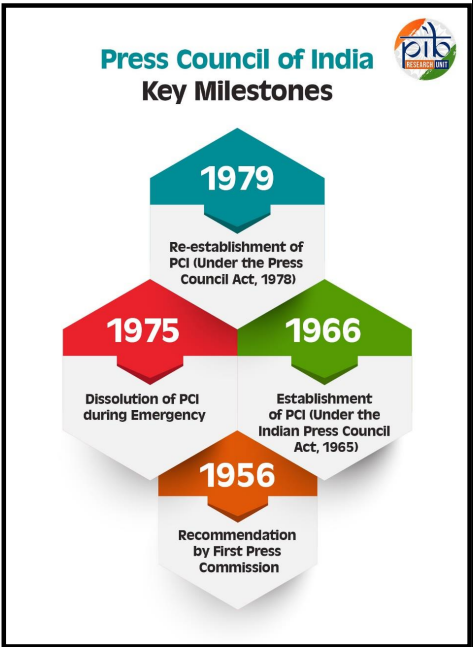
- National Press Day is celebrated on November 16 to mark the day the Press Council of India (PCI) began its operations in 1966. It was established to ensure high standards of journalism while safeguarding the freedom of the press from external influences.
Key Points
- The idea for the PCI was proposed by the First Press Commission in 1956, highlighting the need to protect press freedom and promote ethical reporting.
- The PCI plays a crucial role in protecting the independence of the press, ensuring that media outlets can operate without fear of interference, including from state actions.
- National Press Day symbolizes a free and responsible press, which is central to a functioning democracy. The day is commemorated with activities such as:
- National Award for Excellence in Journalism: Recognizes outstanding contributions to print media, with the Raja Ram Mohan Roy Award being the highest honor.
- Release of a Souvenir.
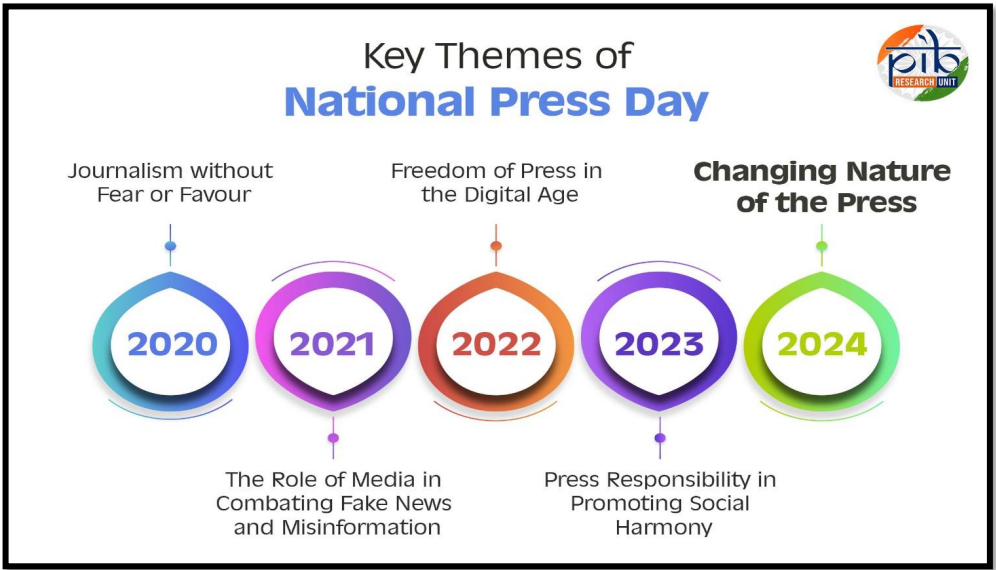
- Theme: “Changing Nature of the Press” – highlighting the evolving dynamics of the media landscape.
49. In the Rigveda, there is a hymn in the form of a dialogue between Sage Vishvamitra and two rivers that were worshipped as goddesses. Which are these rivers?
A. Ganga and Yamuna
B. Alakananda and Bhagirathi
C. Ravi and Chenab
D. Beas and Sutlej
Solution
The correct answer is Beas and Sutlej.
Key Points
- In the Rigveda, there is a hymn in the form of a dialogue between Sage Vishvamitra and two rivers Beas and Sutlej were worshipped as goddesses.
- Some of the hymns in the Rigveda are in the form of dialogues.
- This is part of one such hymn, a dialogue between a sage named Vishvamitra, and two rivers, Beas and Sutlej that were worshipped as goddesses.
Additional Information
- The Rigveda is in old or Vedic Sanskrit.
- The Rigveda was recited and heard rather than read. It was written down several centuries after it was first composed and printed less than 200 years ago.
- The oldest Veda is the Rigveda, composed about 3500 years ago.
- The Rigveda includes more than a thousand hymns, called sukta or “well-said”.
- These hymns are in praise of various gods and goddesses.
50. In which year did the Indira Gandhi Government devalue the India Rupee?
A. 1956
B. 1966
C. 1978
D. 1970
Solution
The correct answer is 1966.
Key Points
- The Indira Gandhi Government devalued the India Rupee in 1966.
- Devaluation refers to the reduction in the value of a currency in relation to other currencies.
- The decision to devalue the Rupee was made to address the balance of payments crisis in India at that time.
- The devaluation was aimed at making Indian exports cheaper and more competitive in the global market.
Additional Information
- The balance of payments crisis in India in the mid-1960s was caused by a combination of factors, including a large trade deficit, a decline in foreign aid and investment, and a rise in oil prices.
- The devaluation of the Rupee in 1966 was the first major devaluation since India gained independence in 1947.
- The devaluation in 1978 was done as a part of a broader strategy to boost exports and reduce imports.
- The devaluation in 1970 was done to address the issue of overvaluation of the Rupee.
51. Which of the following is NOT an example of Pteridophyta?
A. Funaria
B. Selaginella
C. Equisetum
D. Pteris
Solution
The correct answer is Funaria.
Key Points
- Pteridophyta:
- Pteridophyta Plants from this group have well-developed roots, stems, and leaves, and separate tissues for the conduction of food and water.
- They do not bear flowers and fruits.
- They reproduce with the help of spores formed along the back or posterior surface of their leaves.
- Examples – are ferns like Nephrolepis, Marsilea, Pteris, Adiantum, Equisetum, Selaginella, Lycopodium, etc.
- Thereby, all the correct answer is ”all of the above”
Additional Information
- Kingdom plants are divided into five groups– Thallophytes, Bryophytes, Pteridophytes, Gymnosperms, and Angiosperms.
- Thallophyta
- The plant body is not differentiated from roots, stems, and leaves.
- They are commonly called algae.
- Bryophyta
- These are small terrestrial plants.
- They show differentiation in the body design, with stem, leaf-like structures, and root-like structures.
- Pteridophyta
- The plant body is differentiated into roots, stems, and leaves, apart from having a specialized tissue for conduction.
- Gymnosperms
- Gymnosperms are plants with naked seeds.
- Angiosperms
- Angiosperms are seed-bearing plants. Seeds develop inside tissues that get modified to form the fruit of the plant.
52. Tarana Singer, Pandit Rattan Mohan Sharma belongs to the ______ gharana
A. Mewati
B. Agra
C. Indore
D. Dilli
Solution
The correct answer is Mewati.
Key Points
- Rattan Mohan Sharma is an Indian classical vocalist, belonging to the Mewati Gharana.
- He is one of the highest-selling recording artists ever in the Spiritual and Devotional categories.
- His trendsetting albums such as “Gayatri Mantra” have sold over half a million copies the world over.
- He has more than “300 BEST SELLING ALBUMS” to his credit.
- He has received several awards and the title of “Badshah-e-Taraana” for creating a breathtaking unique style of “Taraana“.
- He has trained under Pandit Jasraj and Pandit Pratap Narayan (Tabla).
- His melodious rendition of “Haveli Sangeet” and “Rajasthani Folk” has always left audiences worldwide spellbound.
- More than 5000 of his performances worldwide have been in temples, colleges, and prestigious music festivals.
- He is the Founder of Pandit Jasraj School of Music Foundation- Mumbai and also a faculty in Pandit Jasraj School of Music Foundation- Tampa, Florida, US.
Additional Information
- Indian Music Gharanas
| Gharana | Place | Founder |
| Gwalior | Gwalior | Nanthan Khan |
| Agra | Agra | Hajisujan Khan |
| Rangeela | Agra | Faiyyaz Khan |
| Jaipur Atrauli | Jaipur | Alladiya Khan |
| Kirana | Awadh | Abdul Wahid Khan |
53. Who has written the book ‘Sunny Days’?
A. David Beckham
B. Sunil Gavaskar
C. Anil Kumble
D. Sachin Tendulkar
Solution
The correct answer is Sunil Gavaskar
Key Points
- Sunny Days is an autobiography written by Sunil Gavaskar, a former Indian cricketer.
- Sunil Gavaskar is widely regarded as one of the greatest opening batsmen in cricket history.
- The book provides an insight into Gavaskar’s cricketing career, his personal life, and his experiences on and off the field.
- Sunny Days chronicles his journey from his early days in cricket to becoming a legendary figure in the sport.
Additional Information
- Sunil Gavaskar was the first player to score 10,000 runs in Test cricket.
- He held the record for the most Test centuries (34) for almost two decades before it was broken by Sachin Tendulkar.
- Gavaskar’s technique and concentration made him a formidable opponent, especially against fast bowlers.
- Besides Sunny Days, Gavaskar has also written other books, including Idols and One Day Wonders.
54. Who has been appointed as the new CEO of the Professional Golf Tour of India (PGTI) starting January 2025?
A. Uttam Singh Mundy
B. Kapil Dev
C. Amandeep Johl
D. Anirban Lahiri
Solution
The correct answer is Amandeep Johl
In News
- The Professional Golf Tour of India (PGTI) announced the appointment of Amandeep Johl as its new Chief Executive Officer (CEO) starting January 2025.
Key Points
- Johl, a prominent figure in Indian golf with extensive experience, replaces Uttam Singh Mundy, who has played a key role since the organization’s inception.
- Until his new role begins, Johl will work with Mundy through a handover process ending on December 31, 2024.
- Kapil Dev, legendary cricketer and PGTI President since June, welcomed Johl’s appointment, praising his 34 years on the Indian and Asian golf circuits.
- Dev commended Mundy for his efforts in establishing PGTI as India’s premier professional golf tour.
- Johl’s career highlights include serving as a national coach, PGTI board member, and founding member of the Asian Tour (2004), in addition to being a successful professional player.
- Johl expressed gratitude for the opportunity and acknowledged Mundy’s significant contributions, stating he has “big shoes to fill.”
55. Hari Prasad Chaurasia, an Indian flutist, is associated with which of the following music gharanas?
A. Maihar
B. Rampur-Jaipur
C. Senia
D. Prasanna
Solution
The correct answer is Senia
Key Points
- Senia Gharana
- The word Senia is related to Tansen, the father of Indian Classical Music.
- The followers of Tansen’s school of music are widely known as the followers of Senia Gharana.
- The style of this Gharana has its own specialty of having 17 frets on Sitar.
- Pandit Hari Prasad Chaurasia
- He was born in Prayagraj.
- Famous classical flutist of the Hindustani classical tradition.
- Chaurasia belonged to the maihar Senia gharana (a community of performers who share a distinctive musical style), and he developed a rich personal style after years of experimentation and dedicated practice.
- Learned under the tutelage of famous flute player Bholanath Prasanna.
- Formed a group called Shiv-Hari with Santoor player Shiv Kumar Sharma.
- Was honored with many awards
- The Sangeet Natak Academy Award 1984
- Padma Bhushan 1992,
- Kalidas Samman 1999,
- Padma Vibhushan 2000,
- Sangeet Natak Academy Fellowship Award 2012, etc.
56. Which of the following pair of Thumri singing – characteristic is correct?
I. Poorab – fairly slow and staid
II. Punjab – more mercurial
A. Only I
B. Both I and II
C. Only II
D. Neither I nor II
Solution
The correct answer is Both I and II.
Key Points
- An Indian musical style known as thumri features vocals.
- The Hindi verb thumuknaa, which means “to walk with a dance gait,” is the root of the word “thumri.”
- The art form has ties to dance, dramatic movements, light erotica, evocative love poems, and folk music.
- It is especially famous in Uttar Pradesh.
- It has a romantic or spiritual tone.
- Awadhi and Brij Bhasha, two Hindi dialects from Uttar Pradesh, are typically used for the lyrics.
- There are two styles of Thumri singing:
- the Poorab or Banaras which is fairly slow and staid and
- the Punjab style which is more mercurial.
57. Who among the following revolutionaries was associated with Swadesh Bandhav Samiti?
A. Chandrasekhar Azad
B. Bhagat Singh
C. Rajguru
D. Ashwini Kumar Dutta
Solution
The correct answer is Ashwini Kumar Dutta.
Key Points
- Ashwini Kumar Dutta founded the Swadesh Bandhab Samiti on 6th August 1905 after the partition of Bengal.
- The organisation was formed to promote the consumption of swadeshi goods.
- It was established in the Barisal district(Present day Bangladesh).
- It published its weekly paper called, ‘Barisal Hitaishi.’
- The organisation had its own shops.
- Ashwini Kumar Dutta was responsible for the creation of the Co-operative Hindusthan Bank in 1908 to help Indians start their own business.
Additional Information Bhagat Singh
- He was born on 27 September 1907 in Banga, Lyallpur District, Punjab Province, British India (present-day Faisalabad District, Punjab, Pakistan).
- In December 1928, Bhagat Singh and an associate, Shivaram Rajguru, were both members of a small revolutionary group, the Hindustan Socialist Republican Association.
- He was an Indian revolutionary.
- He participated in a massive symbolic bombing of the Central Legislative Assembly in Delhi and a hunger strike in prison.
Chandrasekhar Azad
- Chandra Shekhar Tiwari who was popularly known as Chandrashekhar Azad was an Indian Revolutionary leader and a Freedom fighter.
- Azad along with Bhagat Singh and other revolutionaries secretly restructured the Hindustan Republican Association (HRA) in 1928 and renamed it the Hindustan Socialist Republican Association (HSRA) on 8-9 September in order to achieve their primary goal of an independent India based on the idea of socialism.
- He was involved in the Kakori Train Action Case that happened in 1925. Now UP government renames Kakori kand to Kakori train action on 9 August 2021.
58. Who discovered pH scale?
A. Arrhenious
B. Sorenson
C. Lewis
D. Bronsted Lowry
Solution
The answer is Sorenson
Explanation:-
The pH scale, a critical metric in chemistry that defines the acidity or basicity of a solution, was invented by Søren Peder Lauritz Sørensen. Sørensen was a Danish chemist who worked at the Carlsberg Laboratory—associated with the Carlsberg Brewery. His work on acids and bases, especially focusing on proteins and amino acids, led him to develop the scale in 1909.
- S.P.L. Sørensen: Søren Peder Lauritz Sørensen was a Danish chemist, famous for the introduction of the concept of pH, a scale for measuring acidity and alkalinity.
- pH Scale: The pH scale measures how acidic or basic a substance is. It ranges from 0 to 14. A pH less than 7 is acidic, 7 is neutral, and a pH greater than 7 is basic.
- Hydrogen Ions in Solution: One concept behind the pH scale is that when an acid is dissolved in water, it donates hydrogen ions (H+), also known as protons. The greater the concentration of hydrogen ions an aqueous solution has, the more acidic it is, and hence, it has a lower pH.
- Tools for Measuring pH: Over the years, various tools and techniques have been developed to measure the pH of a solution, from litmus paper to modern digital pH meters.
- Applications of pH: This scale is used widely in chemistry, biology, and environmental science, among others, as the pH of a solution influences the rate of chemical reactions, the ability of plants to absorb nutrients, the taste of food, and much more.
Conclusion:-
So, Sorenson discovered pH scale.
59. Which of the following tribes of Nagaland celebrates the ‘Mimkut’ festival?
A. Changs
B. Kukis
C. Angamis
D. Kacharis
Solution
The correct answer is Kukis.
Key Points
- Mimkut Festival:-
- The origin of this festival has its ties connected to the Kuki story of “Mim”.
- The original story explores the love and bond of two brothers when they were abandoned by their mother.
- The festival is observed in the later part of December after the crop is harvested.
- Kuki Tribe:-
- They are also called by different names like Luhsai, Darlongs Rohkums etc.
- Predominantly lives in the Tripura state.
- They maintain their livelihood through Jhum cultivation and also by producing fruits.
Additional Information
- Changs:-
- This is the tribe mainly found in Nagaland.
- Their main festival is Naknyulum which is celebrated in July.
- Angamis–
- They are also found in Nagaland.
- Their main festival is ‘Sekrenyi‘, which is celebrated in February and falls 25th day of the Angami month of “Kezei“.
- Kacharis:-
- This tribe is found in Assam.
- Their main festival is Bushu and Jiba.
60. Which of the following is not a valid stroke in a swimming competition?
A. Breast stroke
B. Front stroke
C. Leg stroke
D. Back stroke
Solution
The correct answer is Leg Stroke.
Key Points
- Leg Stroke:
- This is not a recognized stroke style in competitive swimming.
- Though kicking is a fundamental part of most strokes, it is never performed alone in competitions.
Additional Information
- Breaststroke:
- In this type of stroke, the swimmer swims on his chest, and the torso does not rotate.
- The legs kick out in a kind of “froggy” style while the hands pull through the water in a circle in front of the body.
- The swimmer breathes at the end of each cycle.
- Front Stroke (or Freestyle/ Front Crawl):
- This is commonly referred to as freestyle stroke, and it is the fastest swimming stroke.
- It’s characterized by the swimmer being on his belly and alternating the arms for strokes while the legs perform a flutter kick.
- Backstroke:
- Also known as the back crawl, swimmers do this stroke on their backs.
- It involves flutter kicking in the water while rotating the arms in a windmill motion.
- It is the only regulated stroke to be swum on the back, and breathing is not restricted because the swimmer’s face stays above water.
61. Which of the following will NOT participate in the election of president?
A. Elected members of state legislative assemblies
B. Elected Rajya Sabha Members
C. Elected members of state legislative council
D. Elected Lok Sabha Members
Solution
The correct answer is Elected members of state legislative council.
Key Points
- Election of President:
- The President is elected not directly by the people but by members of the electoral college consisting of:
- The elected members of both the Houses of Parliament;
- The elected members of the legislative assemblies of the states; and
- The elected members of the legislative assemblies of the Union Territories of Delhi and Puducherry.
Additional Information
- President:
- Articles 52 to 78 in Part V of the Constitution deal with the Union executive.
- The President is the head of the Indian State.
- In the election of the President, the nominated members of both the Houses of Parliament, the nominated members of the state legislative assemblies, the members (both elected and nominated) of the state legislative councils (in the case of the bicameral legislature) and the nominated members of the Legislative Assemblies of Delhi and Puducherry do not participate in the election of the President.
- The President’s election is held in accordance with the system of proportional representation by means of the single transferable vote
and the voting is by secret ballot. - Qualification:
- A person to be eligible for election as President should fulfil the following qualifications:
He should be a citizen of India.
He should have completed 35 years of age.
He should be qualified for election as a member of the Lok Sabha.
He should not hold any office of profit under the Union government or any state government or any local authority or any other public authority.
62. The Chinese Buddhist pilgrim, Xuan Zang, came to the Indian subcontinent about years ago.
A. 1100
B. 1700
C. 2000
D. 1400
Solution
The correct answer is 1400.
Key Points
- The Chinese Buddhist pilgrim, Xuan Zang, came to the Indian subcontinent about 1400 years ago.
- A Chinese Buddhist monk, scholar, traveller, and translator who travelled to India in the seventh century.
- He described the interaction between Chinese Buddhism and Indian Buddhism during the early Tang dynasty.
- The primary aim of the visit of Hiuen Tsang to India was to gain knowledge of Buddhism and collect its religious texts.
- As he did not get the permission of the Chinese emperor to visit India, he slipped away from there in 629 A.D.
- He remained at the University of Nalanda for about five years.
- He also participated in one of the religious assemblies called by Harsha at Prayag.
- He became famous for his seventeen-year overland journey to India.
- He visited India during the reign of Harshavardhan who came to admire him for his deep devotion to Buddhism.
Additional Information
Other Foreign Travellers to India:
| Traveller | Reign of: |
| Deimachos | Bindusara |
| Megasthenes | Chandragupta Maurya |
| Fa-Hien | Chandragupta II |
| Ibn Batuta | Muhammad-Bin-Tughlaq |
63. The population of a nation in working age group is generally grouped between ____________.
A. 18 – 62 years
B. 16 – 60 years
C. 15 – 59 years
D. 14 – 58 years
Solution
The correct answer is 15 – 59 years.
Key Points
- The working population (i.e. women and men of the age group – 15 to 59).
- It is the total population in an area that is considered able and likely to work based on the number of people in a predetermined age range.
- The proportion of the working population engaged in these four sectors is a good indicator of the levels of economic development of a nation.
- In 2011, the Workforce Participation Rate at all Indian levels is 25.51% for females and 53.26% for males.
- While there is no rural-urban gap for males (53%).
- There is a considerable rural-urban gap for females (rural -30%, urban- 15.4%).
Additional Information
- As per the Census of India 2011, the population density of India was 382 per square km.
- The Indian Census is the most credible source of information on Demography (Population characteristics), Economic Activity, Literacy and Education, Housing Household Amenities, Urbanisation, Fertility and Mortality, etc.
- Census 2011 was the 15th National Census of the Country.
- Census was introduced in India during the era of Lord Mayo in the year 1872. It came into force in 1881.
- This census was conducted under the guidance of Mr. C. Chandramouli.
- The slogan of census 2011 was ‘Our Census, Our future’.
- The population of the nation as per the provisional figures of Census 2011 was 1210.19 million of which 623.7 million (51.54%) were males and 586.46 million (48.46%) were females. Uttar Pradesh is the most populous state in India its population is more than the population of Brazil.
64. Which of the following treatment is used for removal of biological impurities?
A. Sedimentation
B. Boiling
C. Sterilization
D. distillation
Solution
Explanation:
Sterilization refers to any process that removes, kills, or deactivates all forms of life (in particular referring to microorganisms such as fungi, bacteria, spores, unicellular eukaryotic organisms such as Plasmodium, etc.) and other biological agents like prions present in a specific surface, object or fluid, for example, food or biological culture media.
Additional Information
Boiling
- Boiling is the traditional method used to purify the water.
- Various microorganisms have the capability to survive only at a favourable temperature.
- So when we boil the water, It kills almost all the pathogens present in it.
- So, it is also an effective method for purifying the water.
Sedimentation:
- The process of settling or being deposited as sediment.
- Sedimentation is the process of allowing particles in suspension in water to settle out of the suspension under the effect of gravity.
65. Plant cells differ from animal cells in having an additional layer around the cell membrane termed as ________.
A. Cytoplasm
B. Vacuole
C. Cell wall
D. Chloroplast
Solution
The correct answer is Cell wall.
Key Points
- The cell wall is present in plant cells but not in animal cells and it is made up of cellulose and chitin.
- The plant is covered by an outer cell wall.
- Cellulose is one of the major components of the cell wall.
- It is a polymer of glucose joined by glycosidic linkage.
- It helps in maintaining its shape and provides rigidity to the plant.
Additional Information
Mitochondria:
- Mitochondria is a double-layered cell organelle, in which the outer layer is porous and the inner layer is folded upon itself is known to be cristae.
- The number of mitochondria in a single cell may be up to 50 to 5000.
- The inner lumen of mitochondria contains ribosome phosphate particles and DNA molecules.
- It has the potential to synthesize its own protein and the oxidation of carbohydrates and fats are taken place with the help of enzymes in mitochondria.
- This energy is stored in the form of ATP ( Adenosine Triphosphate ) so, these are known as the “Powerhouse of the cell”.
Golgi apparatus:
- This cell organelle is primarily responsible for the storage, processing, and packaging of proteins.
- Golgi Apparatus is found within the cytoplasm of a cell and are present in both plant and animal cells.
Ribosomes:
- The eukaryotic cell comprises of true nucleus and organelles in its cytoplasm.
- Mitochondria, ribosomes, Endoplasmic reticulum, and Golgi complex are organelles present in the cytoplasm.
- The sites for protein synthesis in the cells are ribosomes.
- Ribosomes are present as free ribosomes in the cytoplasm or, as membrane-bound on the rough endoplasmic reticulum.
- Ribosomes consist of small and large subunits and are 80s-type.
- It is the site where mRNA translation occurs, and protein formation takes place.
66. He was very exhausted______he did not stop working.
A. but
B. unless
C. and
D. if
Solution
The correct answer is ‘but‘.
Key Points
- To complete the sentence, we need to choose an appropriate conjunction that expresses the relationship between the two clauses.
- The conjunction “But” is the most suitable choice.
- “But” is used to introduce a contrast or contradiction between two ideas.
- In this context, it suggests that despite being exhausted, the person continued working.
- It emphasizes the unexpected or contrary nature of the second clause in relation to the first.
- The correct sentence is: “He was very exhausted but he did not stop working.”
Therefore, the correct answer is Option 1.
Additional Information
- “Unless”: This conjunction does not fit well in this context. “Unless” is used to indicate a condition that must be met for something to happen or be true. It does not convey a contrasting relationship between exhaustion and working.
- “And”: This conjunction does not provide the appropriate contrast required in the sentence. “And” is used to join similar or related ideas, indicating a continuation or addition of information. It does not convey a contradiction or contrast between exhaustion and continuing work.
- “If”: This conjunction does not convey the intended meaning in this context. “If” is used to introduce a conditional clause, indicating a hypothetical or uncertain condition that must be met for something to happen. It does not express a contrasting relationship between exhaustion and working.
67. Directions: The following sentence has been split into four segments. Identity the segment that contains a grammatical error.
Had you / not reached in time, / we will have / lost our lives.
A. Had you
B. lost our lives
C. not reached in time
D. we will have
Solution
The correct answer is ‘we will have.‘
Key Points
- The error lies in the incorrect usage of verb tense in conditionals.
- We use the ‘third conditional‘ to describe an imaginary result of something in the past.
- The structure used by the third conditional is: If + past perfect, would/wouldn’t have + past participle. It may also take Had + Subject + Past participle structure (or other inversion structures) in the conditional clause.
- For example, ‘If they hadn’t been so deep into a conspiracy theory, they would have seen the simple truth right in front of them.’
- The given sentence discusses a past event, which, if hadn’t happened, would have changed the speaker’s fate — i.e. it represents an unreal past situation.
- So, in the given sentence, the verb in the marked part will take the would + have + past perfect form (would have lost).
- Correct sentence: ‘Had you not reached in time, we would have lost our lives.‘
Hence, Option 4 is the correct answer.
68. Which term refers to making continuous twisting, squirming movements or contortions of the body?
A. Writhe
B. Whittle
C. Whisper
D. Waddle
Solution
The correct answer is ‘Option 1) Writhe’.
Key Points
- The given phrase describes writhing.
- ‘Writhe’ in English means to make continuous twisting, squirming movements or contortions of the body(मरोड़ना)
- For example- “He was writhing in pain on the ground after the fall.”
- Writhe typically refers to continual twisting or squirming movements or contortions of the body.
Therefore, the correct answer is- Correct Answer: 1) Writhe.
Additional Information
- Option 2) ‘Whittle’ refers to gradually reduce something in size or amount or slowly and carefully make something into a particular shape.(धीरे-धीरे कम करना)
- Option 3) ‘Whisper’ refers to speaking very softly using one’s breath rather than one’s throat, especially for the sake of secrecy.(सुनसानी)
- Option 4) ‘Waddle’ refers to walk with short steps and a clumsy rolling motion. (भारी चाल से चलना)
69. Find the part of the given sentence that has an error in it. If there is no error, choose ‘No error’.
Snow was falling light when everyone was leaving church.
A. No error
B. light when everyone
C. Snow was falling
D. was leaving church.
Solution
The correct answer is Option 2)
Key Points
- In the second part of the given sentence, the adjective ‘light’ is incorrect.
- The word ‘lightly’ should be used instead of ‘light’ to describe the manner in which the snow was falling.
- Therefore, the correct form is ‘lightly’.
Hence, the correct statement is “Snow was falling lightly when everyone was leaving church.”
Additional Information
- Adjectives describe nouns and pronouns, while adverbs modify verbs, adjectives, and other adverbs.
- In this sentence, ‘lightly’ is the correct adverb to describe how the snow was falling.
70. Direction: In the following questions, choose the word opposite in meaning to the given word.Condemn
A. Castigate
B. Strut
C. Command
D. Commend
Solution
The correct answer is ‘Commend‘.
Key Points
- The word ‘Condemn’ is a verb and it means to criticize something or someone strongly, usually for moral reasons.
- For example, The 26/11 terrorist attack in Mumbai was condemned as an act of barbarism and cowardice.
- The marked option ‘Commend’ means to formally praise someone or something.
- For example, The judge commended the girl for her bravery.
- So, we can say that ‘Commend‘ can function as the opposite word of ‘Condemn.’
Hence, the correct answer is Option 4.
Additional Information
- Castigate ⇒ to criticize someone or something severely.
- Strut ⇒ to walk in a proud, confident gait.
- Command ⇒ to order someone (esp in military) or control and responsibility over something.
71. Choose the correct alternative.
He will not come, _______.
A. I do not think
B. May think
C. I thought
D. I think
Solution
The correct answer is ‘Option 4‘.
Key Points
- The sentence is completed by a phrase that indicates the speaker’s current opinion or belief.
- The phrase “I think” is appropriate here as it expresses a present opinion.
- Options 1, 2, and 3 either do not fit the context or use incorrect tenses.
Therefore, the correct answer is Option 4.
Correct Sentence: “He will not come, I think.“
Additional Information
- Option 1: “He will not come, I do not think.” – Awkward and incorrect formation.
- Option 2: “He will not come, May think.” – Grammatically incorrect.
- Option 3: “He will not come, I thought.” – Incorrect tense (past tense).
72. Select the most appropriate option to fill in the blanks.
Prince Harry’s memoir became the UK’s ______ selling non-fiction book. Harry’s book garnered global attention ______ its disclosures about his personal struggles and its accusations about other royals, ______ his father King Charles, stepmother Camilla and elder brother Prince William.
A. as fast, to, counting
B. faster, for, containing
C. fastest, with, including
D. fast, from, requiring
Solution
The correct answer is Option 3.
Key Points
- The correct sentence should be: “Prince Harry’s memoir became the UK’s fastest selling non-fiction book. Harry’s book garnered global attention with its disclosures about his personal struggles and its accusations about other royals, including his father King Charles, stepmother Camilla and elder brother Prince William.”
- In the first blank, “fastest” is the superlative form of “fast” and correctly describes the book’s record.
- In the second blank, “with” is the correct preposition to indicate that the book garnered attention because of its contents.
- In the third blank, “including” correctly introduces the list of people mentioned in the memoir.
Therefore, the correct answer is Option 3.
Correct Sentence: “Prince Harry’s memoir became the UK’s fastest selling non-fiction book. Harry’s book garnered global attention with its disclosures about his personal struggles and its accusations about other royals, including his father King Charles, stepmother Camilla and elder brother Prince William.”
Additional Information
- Option 1: “as fast, to, counting” – This option is incorrect because “as fast” is not the correct superlative form, “to” is not the correct preposition, and “counting” does not fit the context.
- Option 2: “faster, for, containing” – This option is incorrect because “faster” is the comparative form, not the superlative form needed here, “for” is not the correct preposition, and “containing” does not fit the context.
- Option 4: “fast, from, requiring” – This option is incorrect because “fast” is not the correct superlative form, “from” is not the correct preposition, and “requiring” does not fit the context.
73. Select the most appropriate option to fill in the blank.
The game involved whispering some words ______ in the partner’s ears.
A. vastly
B. softly
C. largely
D. widely
Solution
The correct answer is “softly”.
Key Points
- The adverb “softly” is used to describe a low volume or gentle manner of speaking, making it the perfect fit for the context of whispering.
- Whispering is inherently a soft, quiet way of speaking, intended not to be loud or easily overheard by others.
- So, saying the game involves whispering words “softly” in the partner’s ears precisely captures the intended action and manner.
Therefore, the correct answer is “option 2”.
74. Select the most appropriate option that can substitute the underlined word in the given idiom.
She is an awful bore; she is always blowing her own saxophone.
A. flute
B. lyre
C. trumpet
D. violin
Solution
The correct answer is ‘trumpet‘.
Key Points
- The idiom “blowing her own saxophone” means that the person is constantly talking about themselves and their achievements.
- The word “saxophone” is used metaphorically to represent the person’s self-promotion.
- The most appropriate option to substitute “saxophone” in this idiom is “trumpet“, as it is another musical instrument that can be used metaphorically in the same way.
Therefore, the correct answer is Option 3.
Additional Information
- Option 1 (flute) is not a suitable substitute as it does not convey the same level of self-promotion as the saxophone.
- Option 2 (lyre) is not a suitable substitute as it is not a wind instrument, and therefore does not fit with the metaphor of “blowing”.
- Option 4 (violin) is not a suitable substitute as it is not a wind instrument, and therefore does not fit with the metaphor of “blowing”.
75. Select the alternative which best express the meaning of the idioms/phrase.
Come off
A. To come closer
B. To happen as planned
C. To recall
D. To fall down
Solution
The correct answer is: Option 2 i.e. To happen as planned.
Key Points
- The word “Come off” means to happen as planned or to succeed. (योजना के अनुसार होना या सफल होना)
- Example: Despite some initial concerns, the event came off without a hitch.
- “To happen as planned” refers to an event or action occurring as it was intended or expected. (योजना के अनुसार होना)
- Example: Our project came off exactly as we had hoped, meeting all our objectives.
Therefore, the correct answer is: Option 2.
Additional Information
Here are the other options explained along with their Hindi meanings and example sentences:
- To come closer (पास आना): To decrease the distance between two things or people.
- Example: As the train approached the station, people came closer to the platform edge.
- To recall (याद करना): To remember or bring back to mind.
- Example: She tried to recall the events of the previous night but struggled to remember.
- To fall down (गिरना): To collapse or drop to a lower position.
- Example: He slipped on the wet floor and fell down, hurting his knee.
76. Select the most appropriate ANTONYM of the given word.
Terminate
A. Begin
B. Mark
C. Conclude
D. Die
Solution
The correct answer is Option 1)
Key Points
- The word “Terminate” means to bring something to an end or halt. (समाप्त करना)
- Example: The company decided to terminate the contract due to non-compliance.
- “Begin” refers to the start of something; the opposite of ending or terminating. (आरंभ करना)
- Example: The ceremony will begin at 10 AM sharp.
Hence, we can infer that the opposite of ‘terminate’ is ‘begin’.
Additional Information
Here are the other options explained along with their Hindi meanings and example sentences:
- Mark (चिह्नित करना): To make a visible impression or trace on something.
- Example: Please mark your attendance on the sheet.
- Conclude (समाप्त करना ): To bring something to an end, similar to terminate.
- Example: The meeting will conclude at 5 PM.
- Die (मरना): To cease to live or exist.
- Example: The plant will die without water.
77. Identify the part of the sentence in which there is an error.
Two-thirds (a)/ of the city (b)/ has been damaged (c)/ by the earthquake (d)
A. (a)
B. (b)
C. (c)
D. (d)
Solution
The correct answer is ‘3’ i.e. the error is in part (c) .
Key Points
- The sentence “Two-thirds of the city has been damaged by the earthquake” is an example of a subject-verb agreement issue.
- The subject “two-thirds” is a fraction of a plural noun (“the city”), which requires a plural verb.
- The verb should be “have” instead of “has” because “two-thirds” refers to more than one part (plural subject).
Correct sentence: Two-thirds of the city have been damaged by the earthquake.
Additional Information
- Subject-Verb Agreement:
- Rule: A plural subject requires a plural verb, even when it refers to a fraction or part of a larger group.
- Example: Half of the students have completed the assignment.
78. Select the most appropriate SYNONYM of the underlined word to fill In the blank.
The weather outside the restaurant is ______, so I ordered a frigid dessert which will complement the hot weather.
A. balmy
B. warm
C. spicy
D. chocolate
Solution
The correct answer is ”warm”
Key Points
- Let’s look for the synonym for that missing word from the options available.
- “Balmy” is a term used to describe weather that is pleasantly warm. It could be a possible synonym.
- “Warm” is also used to describe mild heat, and could be another synonym.
- “Spicy” is used to describe food that has a lot of spices and gives a burning sensation in the mouth. It’s not typically used to describe weather.
- “Chocolate” is a type of food and not an adjective to describe weather.
- In this case, the words “balmy” and “warm” are synonyms that could describe pleasant to mild hot weather which is the synonym of “hot”.
- However, since the sentence suggests a hot weather condition, “warm” is a more likely fit than “balmy” (which often suggests a more mildly warm, comfortable condition).
- Thus the most appropriate word to fill in the blank would be “warm”.
- So, the final sentence will be: “The weather outside the restaurant is warm, so I ordered a frigid dessert which will complement the hot weather.”
Therefore, the correct answer is “option 2”.
Hinglish
- Balmy: थोड़ा गर्म.
- Example: It’s a balmy weather in London.
79. Select the correct alternative from the options which best expresses the meaning of the given word.
Profound
A. Boundless
B. Scarce
C. Shallow
D. Fathomless
Solution
The correct answer is: Option(4).
Key Points
- The word “profound” means having deep insight or understanding; it can also refer to something very intense or significant. (गहरा)
- Example: Her speech had a profound impact on the audience, leaving everyone in deep thought.
- “Fathomless” refers to something that is impossible to measure the depth of; it suggests something extremely deep or limitless. (अथाह)
- Example: The ocean’s fathomless depths have fascinated explorers and scientists for centuries.
- Hence, we can infer that ‘profound’ is synonymous with ‘fathomless’.
Therefore, the correct answer is: Option(4).
Additional Information
Here are the other options explained along with their Hindi meanings and example sentences:
- Boundless (अनंत): Something without boundaries or limits.
- Example: His boundless energy amazed everyone at the gym.
- Scarce (कम): Something that is insufficient in quantity or scarce.
- Example: During the drought, water became scarce in the region.
- Shallow (छोटा): Something that lacks depth, either physically or metaphorically.
- Example: Their conversation was quite shallow, focusing only on superficial topics.
80. Select the most appropriate option that can substitute the underlined segment in the given sentence. If there is no need to substitute it, select ‘No substitution required’.
He stepped on to the encrusted snow and began to slither and slide forward, stamping his foot from time to time to ascertain how it was sturdy.
A. how sturdy it was
B. what was sturdy
C. No substitution required
D. how was it sturdy
Solution
The correct answer is ‘how sturdy it was’.
Key Points
- The underlined part has a placement error.
- The underlined part state – how it was sturdy
- If sturdy was a predicate adjective, its placement would have been correct.
- But since it is not so, it should appear before the pronoun it which the word is describing.
- Thus, the underlined part should be replaced with how sturdy it was.
Correct sentence – He stepped on to the encrusted snow and began to slither and slide forward, stamping his foot from time to time to ascertain how sturdy it was.
81. Select the most appropriate synonym of the underlined word.
The foreign company is chary of investing in Africa.
A. Keen
B. Fervent
C. Confident
D. Cautious
Solution
The correct answer is ‘Cautious‘.
Key Points
- The correct meaning of the word ‘chary’ is to be cautious or hesitant about doing something, especially because of potential risks or problems. (कुछ करने के बारे में सतर्क या झिझकना, विशेष रूप से संभावित जोखिमों या समस्याओं के कारण)
- Example sentence: The company is chary of investing in new technology until they are sure it will be profitable.
- The meaning of the word ‘Cautious‘ is being careful to avoid potential risks. (सतर्क)
- Example sentence: The hiker was cautious while traversing the slippery, rocky terrain, taking care not to slip and fall.
- Hence, the correct synonym for the word ‘chary‘ is ‘cautious‘.
Additional Information
- Let’s look at the other word’s meaning:
- Keen: having or showing enthusiasm. (उत्सुक)
- Example sentence: She is keen on learning a new language.
- Fervent: having or displaying enthusiasm. (उत्साही)
- Example sentence: The fans had a fervent love for their favorite singer.
- Confident: feeling or showing confidence in oneself. (आत्मविश्वासपूर्ण)
- Example sentence: She was confident that she would get the job.
82. Select the word segment that substitutes (replaces) the bracketed word segment correctly and completes the sentence meaningfully. Select the option ‘no correction required’ if the sentence is correct as given.
Presently Rosemary (seems to have know) those people herself in some deplorable past, and then got on to them and rejected them.
A. seemed to have known
B. No correction required
C. seemed to knew
D. seem to know
Solution
The correct answer is: seemed to have known.
Key Points
- The phrase “seems to have know” is grammatically incorrect. The correct phrase should be “seemed to have known”.
- The verb “seem” should agree with the past tense context provided by “got on to them and rejected them”.
- The correct form “seemed to have known” properly conveys that Rosemary had knowledge of those people in the past.
Hence, the correct answer is option 1.
Correct sentence: Presently Rosemary seemed to have known those people herself in some deplorable past, and then got on to them and rejected them.
83. Find the part of the given sentence that has an error in it. If there is no error, choose ‘No error’.
In many ways, this is the best time in history to be alive.
A. No error
B. history to be alive
C. is the best time in
D. In many ways, this
Solution
The correct answer is Option 1.
Key Points
- The sentence is grammatically correct as it stands.
- Each part of the sentence is properly structured and does not contain any errors.
- The context and meaning are clear and coherent, making the sentence correct overall.
Therefore, the correct answer is Option 1.
Correct Sentence: “In many ways, this is the best time in history to be alive.”
Additional Information
- Option 2: “history to be alive” – This part is grammatically correct and does not need any changes.
- Option 3: “is the best time in” – This part is also correct and does not contain any errors.
- Option 4: “In many ways, this,” – This part of the sentence is grammatically correct and properly introduces the sentence.
84. Select the INCORRECTLY spelt word from the given sentence.
Manu believed that the king was the head of all justice and his chief objecitve was to protect people from invaders.
A. Believed
B. Invaders
C. Objecitve
D. Justice
Solution
The correct answer is Option 3.
Key Points
- The word “objecitve” is incorrectly spelt in the given sentence.
- The correct spelling should be “objective”.
- Correct spelling ensures clarity and understanding of the sentence.
Therefore, the correct answer is Option 3.
Correct Sentence: “Manu believed that the king was the head of all justice and his chief objective was to protect people from invaders.”
Additional Information
- Believed: This word is correctly spelt.
- Invaders: This word is correctly spelt.
- Justice: This word is correctly spelt.
- No error: This option would be correct if there were no mistakes in the sentence, but there is an error with the spelling of “objecitve”.
85. Choose the option with the correct spelling of the word:
A. Predilection
B. Prediliction
C. Predalection
D. Pridilection
Solution
The correct answer is: Option 1.
Key Points
- The word “Predilection” means a preference or special liking for something; a bias in favor of something. (झुकाव)
- Example: She has a predilection for classical music and often attends symphony concerts.
- “Predilection” refers to a strong preference or inclination towards something. (झुकाव)
- Example: His predilection for spicy food is well known among his friends.
- Hence, the correct spelling of the word is ‘Predilection’.
Therefore, the correct answer is: Option 1.
Additional Information
Here are the other options explained along with their Hindi meanings and example sentences:
- Prediliction : This is an incorrect spelling and does not carry any meaning.
- Predalection : This is an incorrect spelling and does not carry any meaning.
- Pridilection : This is an incorrect spelling and does not carry any meaning.
86. In the following passage, some words have been deleted. Read the passage carefully and select the most appropriate option to fill in each blank.
Tim Wright knows all about making companies more efficient. His firm, Check-up, sends ‘secret shoppers’ into retail and leisure companies in order to make sure that customers are receiving good service. After (1)________ visit, the secret shoppers prepare a report for the company to let them know how the service was. “Companies like to know”, says Mr Wright, “that (2)_______ customers go into a store just a few minutes before closing time, they will still get good service.”
Check-up (3)________ set up in the west of England and after two years moved to London so it could offer a nationwide service. (4)______ the last three years, Check-up’s profits have increased dramatically as companies have come to realise the great importance of good customer service. Last week, an important new contract was (5)_______ with a major supermarket chain.
Question:
Select the most appropriate option to fill in blank number 1.
A. our
B. their
C. there
D. his
Solution
The correct answer is ‘their‘.
Key Points
- The word “their” correctly refers to the secret shoppers who conduct the visits.
- The possessive pronoun “their” is appropriate because it shows ownership of the visit by the secret shoppers.
- Other options like “our,” “there,” and “his” do not fit the context properly.
Therefore, the correct answer is ‘Option 2‘.
Complete Passage: Tim Wright knows all about making companies more efficient. His firm, Check-up, sends ‘secret shoppers’ into retail and leisure companies in order to make sure that customers are receiving good service. After their visit, the secret shoppers prepare a report for the company to let them know how the service was. “Companies like to know”, says Mr Wright, “that (2)________ customers go into a store just a few minutes before closing time, they will still get good service.” Check-up (3)________ set up in the west of England and after two years moved to London so it could offer a nationwide service. (4)________ the last three years, Check-up’s profits have increased dramatically as companies have come to realise the great importance of good customer service. Last week, an important new contract was (5)________ with a major supermarket chain.
Additional Information
- “Our” refers to something belonging to the speaker or the group they are part of, which is not the context here.
- “There” refers to a place, which doesn’t fit as it doesn’t indicate possession.
- “His” refers to something belonging to a male, which is not appropriate here as it doesn’t agree with the plural “secret shoppers.”
87. In the following passage, some words have been deleted. Read the passage carefully and select the most appropriate option to fill in each blank.
Tim Wright knows all about making companies more efficient. His firm, Check-up, sends ‘secret shoppers’ into retail and leisure companies in order to make sure that customers are receiving good service. After (1)________ visit, the secret shoppers prepare a report for the company to let them know how the service was. “Companies like to know”, says Mr Wright, “that (2)_______ customers go into a store just a few minutes before closing time, they will still get good service.”
Check-up (3)________ set up in the west of England and after two years moved to London so it could offer a nationwide service. (4)______ the last three years, Check-up’s profits have increased dramatically as companies have come to realise the great importance of good customer service. Last week, an important new contract was (5)_______ with a major supermarket chain.
Question:
Select the most appropriate option to fill in blank number 2.
A. while
B. when
C. as
D. then
Solution
The correct answer is ‘when‘.
Key Points
- The word “when” correctly fits the context of describing the condition under which customers arrive at the store.
- “When” introduces a time-related condition that aligns well with the scenario of customers arriving shortly before closing time.
- Other options like “while“, “as“, and “then” do not correctly convey the timing or condition intended in the sentence.
Therefore, the correct answer is ‘Option 2‘.
Complete Passage: Tim Wright knows all about making companies more efficient. His firm, Check-up, sends ‘secret shoppers’ into retail and leisure companies in order to make sure that customers are receiving good service. After their visit, the secret shoppers prepare a report for the company to let them know how the service was. “Companies like to know”, says Mr Wright, “that when customers go into a store just a few minutes before closing time, they will still get good service.” Check-up (3)________ set up in the west of England and after two years moved to London so it could offer a nationwide service. (4)________ the last three years, Check-up’s profits have increased dramatically as companies have come to realise the great importance of good customer service. Last week, an important new contract was (5)________ with a major supermarket chain.
Additional Information
- “While” is used to indicate that two events are happening at the same time, which is not the intended meaning here.
- “As” can indicate simultaneity or causation, but does not fit as smoothly in this context.
- “Then” indicates a consequence or a point in time, but does not fit the conditional nature of the sentence.
88. Select the most appropriate option to fill in blank number 3.
A. is
B. was
C. are
D. has
Solution
The correct answer is ‘was‘.
Key Points
- The context of the sentence indicates a past event.
- “Was” is the correct past tense form to use after “Check-up” to indicate the time when the company was established in the west of England.
- Other options like “is”, “are”, and “has” do not fit the past tense context of the sentence.
Therefore, the correct answer is ‘Option 2‘.
Complete Passage: Tim Wright knows all about making companies more efficient. His firm, Check-up, sends ‘secret shoppers’ into retail and leisure companies in order to make sure that customers are receiving good service. After their visit, the secret shoppers prepare a report for the company to let them know how the service was. “Companies like to know”, says Mr Wright, “that when customers go into a store just a few minutes before closing time, they will still get good service.” Check-up was set up in the west of England and after two years moved to London so it could offer a nationwide service. (4)________ the last three years, Check-up’s profits have increased dramatically as companies have come to realise the great importance of good customer service. Last week, an important new contract was (5)________with a major supermarket chain.
Additional Information
- “Is” indicates present tense, which is not correct as the event happened in the past.
- “Are” indicates present tense and plural subject, which does not fit the context.
- “Has” indicates present perfect tense, which is also incorrect for the context provided.
89. Select the most appropriate option to fill in blank number 4.
A. For
B. During
C. Until
D. From
Solution
The correct answer is ‘During‘.
Key Points
- The word “during” correctly fits the context of indicating a period of time in which an action occurs, in this case, the last three years.
- “During” is the appropriate preposition to use when referring to something happening within a specific time frame.
- Other options like “for,” “until,” and “from” do not accurately convey the intended meaning of the sentence.
Therefore, the correct answer is ‘Option 2‘.
Complete Passage: Tim Wright knows all about making companies more efficient. His firm, Check-up, sends ‘secret shoppers’ into retail and leisure companies in order to make sure that customers are receiving good service. After their visit, the secret shoppers prepare a report for the company to let them know how the service was. “Companies like to know”, says Mr Wright, “that when customers go into a store just a few minutes before closing time, they will still get good service.” Check-up was set up in the west of England and after two years moved to London so it could offer a nationwide service. During the last three years, Check-up’s profits have increased dramatically as companies have come to realise the great importance of good customer service. Last week, an important new contract was (5)______ with a major supermarket chain.
Additional Information
- “For” is used to indicate the duration but does not fit as naturally in this context as “during”.
- “Until” indicates up to a point in time, which is not correct for referring to a continuous period.
- “From” indicates the starting point of a period, but does not cover the entire duration as intended.
90. In the following passage, some words have been deleted. Read the passage carefully and select the most appropriate option to fill in each blank.
Tim Wright knows all about making companies more efficient. His firm, Check-up, sends ‘secret shoppers’ into retail and leisure companies in order to make sure that customers are receiving good service. After (1)________ visit, the secret shoppers prepare a report for the company to let them know how the service was. “Companies like to know”, says Mr Wright, “that (2)_______ customers go into a store just a few minutes before closing time, they will still get good service.”
Check-up (3)________ set up in the west of England and after two years moved to London so it could offer a nationwide service. (4)______ the last three years, Check-up’s profits have increased dramatically as companies have come to realise the great importance of good customer service. Last week, an important new contract was (5)_______ with a major supermarket chain.
Question:
Select the most appropriate option to fill in blank number 5.
A. signing
B. sign
C. signed
D. have signed
Solution
The correct answer is ‘signed‘.
Key Points
- The context of the sentence indicates a completed action in the past.
- “Signed” is the correct past tense form to use after “contract was” to indicate the action that took place.
- Other options like “signing,” “sign,” and “have signed” do not fit the past tense context of the sentence.
Therefore, the correct answer is ‘Option 3‘.
Complete Passage: Tim Wright knows all about making companies more efficient. His firm, Check-up, sends ‘secret shoppers’ into retail and leisure companies in order to make sure that customers are receiving good service. After their visit, the secret shoppers prepare a report for the company to let them know how the service was. “Companies like to know”, says Mr Wright, “that when customers go into a store just a few minutes before closing time, they will still get good service.” Check-up was set up in the west of England and after two years moved to London so it could offer a nationwide service. During the last three years, Check-up’s profits have increased dramatically as companies have come to realise the great importance of good customer service. Last week, an important new contract was signed with a major supermarket chain.
Additional Information
- “Signing” indicates a continuous action, which does not match the context.
- “Sign” is in the present tense, which is incorrect as the action occurred in the past.
- “Have signed” indicates present perfect tense, which is also incorrect for the context provided.