1. Find the mean proportional of 36 and 100.
A. 65
B. 60
C. 55
D. 70
Solution
Given:
First number = 36
Second number = 100
Formula Used:
Mean Proportional = \(\sqrt{ab}\)
where, a = first number, b = second number
Calculation:
Mean Proportional = \(\sqrt{ab}\)
⇒ Mean Proportional = \(\sqrt{36×100}\) = 6 × 10 = 60
∴ The correct answer is option (2).
2. Two trains of equal length are running on parallel lines in the same direction at speeds of 51 km/h and 42 km/h. The faster train passes the slower train in 16 seconds. The length of each train is:
A. 33 meters
B. 20 meters
C. 19 meters
D. 30 meters
Solution
Given:
Speed of the faster train = 51 km/h.
Speed of the slower train = 42 km/h.
Time taken to pass = 16 seconds.
Formula Used:
Relative speed = Speed of faster train – Speed of slower train
Distance = Relative speed × Time
Calculation:
Relative speed = 51 km/h – 42 km/h
Relative speed = 9 km/h
Convert relative speed to m/s:
Relative speed = 9 × (1000/3600) m/s
Relative speed = 9 × (5/18) m/s
Relative speed = 2.5 m/s
Distance = Relative speed × Time
Distance = 2.5 m/s × 16 s
Distance = 40 meters
Since the distance covered is the sum of the lengths of both trains and both trains are of equal length:
Length of each train = 40 meters / 2
Length of each train = 20 meters
The length of each train is 20 meters.
3. Three numbers are in the ratio of 3 : 5 : 8. If the sum of the largest and the smallest number is 8800, then what is the difference of the largest and the smallest number?
A. 2400
B. 1600
C. 4000
D. 800
Solution
Given:
Ratio of the three numbers = 3 : 5 : 8
Let the numbers be 3x, 5x, and 8x.
Sum of the largest and the smallest number = 8800.
Calculations:
Largest number = 8x
Smallest number = 3x
⇒ 8x + 3x = 8800
⇒ 11x = 8800
⇒ x = 8800 / 11
⇒ x = 800
Largest number = 8x = 8 × 800 = 6400
Smallest number = 3x = 3 × 800 = 2400
Difference = Largest number – Smallest number
⇒ Difference = 6400 – 2400 = 4000
∴ The difference between the largest and the smallest number is 4000.
4. The curved surface area of a right circular cylinder and a sphere are equal. If the radius of the sphere and cylinder are 2 and 3, respectively, then find the total surface area of the cylinder.
A. 28π
B. 32π
C. 34π
D. 30π
Solution
Given:
Radius of the sphere, r = 2
Radius of the cylinder, R = 3
The curved surface area of a right circular cylinder = The curved surface area of a sphere
Formula used:
The curved surface area of a cylinder = 2πRh
The curved surface area of a sphere = 4πr2
Where r = radius of the sphere , R = radius of the cylinder
And, h = the height of a cylinder
Calculation:
According to question
⇒ 2πRh = 4πr2
⇒ 2π × (3) × h = 4π × (2)2
⇒ h = 8/3
The total surface area of the cylinder = 2πR(R + h)
⇒ 2π(3)(3 + 8/3) = 34π unit
∴ Correct answer is 34π unit.
5. The average weight of eleven players’ state-level cricket team is 141 kg. When the coach is added then the average weight increases to 1 kg. What is the weight of the coach? (in kg)
A. 155
B. 153
C. 151
D. 157
Solution
Given:
Average weight of 11 players = 141 kg
Average weight of (11 players + coach) = 142 kg
Total member of team = 11 + 1 = 12
Formula Used:
Average = Sum of all observations/Total number of observations
Calculation:
Average weight of 11 players = Sum of weight of 11 players/11
⇒ 141 = Sum of weight of 11 players/11
⇒ Sum of weight of 11 players = 141 × 11 = 1551 kg
Average weight of (11 players + coach) = Sum of weight of all members/12
⇒ 142 = Sum of weight of all members/12
⇒ Sum of weight of all members = 142 × 12 = 1704 kg
Weight of coach = Sum of weight of all members – Sum of weight of 11 players
⇒ Weight of coach = 1704 – 1551 = 153 kg
∴ The correct answer is 153 kg.
6. The price of fuel decreases by 60%, 30% and 20% in three successive months, but increases by 60% in the fourth month. What is the percentage increase/decrease in the price of fuel in the fourth month as compared to its original price?
A. Increases by 67.33%
B. Decreases by 67.12%
C. Increases by 61.74%
D. Decreases by 64.16%
Solution
Given:
The initial price of fuel = 100 units
Price decreases by 60% in the first month
Price decreases by 30% in the second month
Price decreases by 20% in the third month
Price increases by 60% in the fourth month
Formula Used:
Final Price = Initial Price × (1 – Decrease%)n × (1 + Increase%)
Calculation:
Initial Price = 100 units
First month: 100 × (1 – 60/100)
⇒ 100 × 0.4 = 40 units
Second month: 40 × (1 – 30/100)
⇒ 40 × 0.7 = 28 units
Third month: 28 × (1 – 20/100)
⇒ 28 × 0.8 = 22.4 units
Fourth month: 22.4 × (1 + 60/100)
⇒ 22.4 × 1.6 = 35.84 units
Percentage change = [(Final Price – Initial Price) / Initial Price] × 100
Percentage change = [(35.84 – 100) / 100] × 100
Percentage change = -64.16%
The price of fuel decreases by 64.16% in the fourth month as compared to its original price.
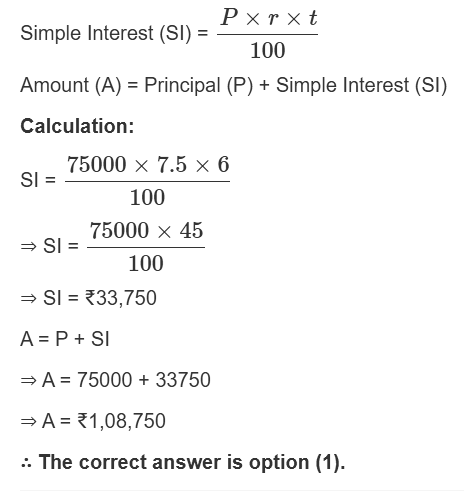
7. A man has invested Rs. 75,000 at a rate of  per annum simple interest for 6 years. Find the amount that he will receive after 6 years.
A. ₹1,08,750
B. ₹75,000
C. ₹69,600
D. ₹1,12,500
Solution
Given:
Principal (P) = ₹75,000
Rate (r) = 7.5% per annum
Time (t) = 6 years
Formula used:
8. A cylindrical hole with the radius of its base given as 3.5 cm is made in a solid cube each of whose edge is 14 cm. Find the total surface area (in cm2) of the cube with the hole. 
A. 1484
B. 1407
C. 791
D. 945
Solution
Given:
A cylindrical hole with the radius of its base given as 3.5 cm is made in a solid cube each of whose edge is 14 cm.
Formula used:
1. Total Surface Area of a Cube = 6 × (a)2
Where:
a = Edge Length is the length of one edge of the cube.
2. Lateral Surface Area of a Cylinder = 2 × π × r × h
Where,
r = Radius is the radius of the base of the cylinder.
h = Height is the height of the cylinder.
3. Area of a Circle:
Area = π × (R)^2
Where,
R = Radius is the radius of the circle.
Calculation:
According to the question:
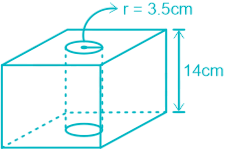
Total surface area of cube = A1 = 6a2 = 6 × 142 = 1176 cm2
Area of circular base (both top and bottom) = A2 = 2 × 22/ 7 227 × 3.52 = 77 cm
Surface area of the hollow cylinder = A3 = 2 × π × 3.5 × 14 = 308 cm2
Total surface area of required object = A1 – A2 + A3 = 1176 – 77 + 308 = 1407 cm2
Therefore, “1407 cm2” is the required answer.
9. If the cost of a product is Rs 500 and the seller marks the product at Rs 800 but gives a 10% discount on the same, what is the profit percent to the seller?
A. 44%
B. 60%
C. 34%
D. 30%
Solution
Given:
The cost of product (C.P) = Rs 500
Seller mark the product (M.P) = Rs 800
Discount on mark price = 10%
Calculation:
⇒ After discount selling price = 800 × 90/100 = 720
⇒ The profit % to the seller = 720−500/ 500 × 100 = 220 / 5 = 44%
∴The correct answer is the 44%
10. An amount is divided between two friends in the ratio 4 : 7. If the second part is ₹6 more than the first, then the difference in amount between two friends is:
A. ₹2
B. ₹6
C. ₹4
D. ₹3
Solution
Given:
The amount is divided between two friends in the ratio 4:7.
The second part is ₹6 more than the first part.
Formula used:
If two parts are in the ratio a:b, then the first part is a × k and the second part is b × k, where k is the constant of proportionality.
Calculation:
Let the first part be 4k and the second part be 7k.
According to the given condition:
7k – 4k = 6
⇒ 3k = 6
⇒ k = 2
Therefore, the difference in amount between the two friends is:
7k – 4k = 3k
⇒ 3×2 = 6
∴ The correct answer is option 2.
11. The following bar graph represents the production of three types of buses by a company over the years (in thousands).

In which of the following years was the percentage production of B type buses to C type buses, the maximum?
A. 2013
B. 2014
C. 2015
D. 2016
Solution
Given:
The bar graph shows the production of three types of buses (A, B, and C) over the years.
We are required to find the year in which the percentage production of B type buses to C type buses is the maximum.
Formula used:
Percentage = (Production of B type buses / Production of C type buses) × 100
Calculation:
For 2013:
⇒ Percentage = (30 / 25) × 100 = 120%
For 2014:
⇒ Percentage = (27.5 / 22.5) × 100 = 122.22%
For 2015:
⇒ Percentage = (35 / 22.5) × 100 = 155.56%
For 2016:
⇒ Percentage = (22.5 / 30) × 100 = 75%
The maximum percentage of B type buses to C type buses is in the year 2015, which is 155.56%.
∴ The correct answer is option (3): 2015.
12. A person drove at 39 kmph for 3.5 hours, then increased his speed by 9 kmph, and reached the destination in another hour. Find the average speed (in kmph) of the person during the entire journey.
A. 45
B. 47
C. 41
D. 43
Solution
Given:
A person drove at 39 kmph for 3.5 hours, then increased his speed by 9 kmph, and reached the destination in another hour.
Formula used:
Average Speed = Total Distance / Total Time
Calculation:
Distance1 = Speed1 × Time1
⇒ Distance1 = 39 kmph × 3.5 hours = 136.5 km
Distance2 = Speed2 × Time2
⇒ Distance2 = (39 kmph + 9 kmph) × 1 hour = 48 km
Total Distance = Distance1 + Distance2
⇒ Total Distance = 136.5 km + 48 km = 184.5 km
Total Time = Time1 + Time2
⇒ Total Time = 3.5 hours + 1 hour = 4.5 hours
Average Speed = Total Distance / Total Time
⇒ Average Speed = 184.5 km / 4.5 hours = 41 kmph
∴ The correct answer is option 3.
13. If the difference between the compound interest, compounding annually and the simple interest on a certain sum of money at 5% per annum for 3 years is Rs.183, then what is the sum of money invested?
A. Rs.20,000
B. Rs.28,000
C. Rs.24,000
D. Rs.16,000
Solution
Given
Interest rate (r) = 5%
Time (t) = 3 years
Difference between Compound Interest and Simple Interest = Rs. 183
Formula:
If the difference between Compound Interest and Simple Interest for 3 years is given,
D = P × (R/100)2 (R% + 3)
Solution:
⇒ 183 = P × (5/100)2 (R% + 3)
⇒ P = 183/(0.05)2 × (5% + 3)
⇒ P = Rs.24,000
∴ The sum of money invested is Rs.24,000.
14. Two pipes can fill a cistern in 12 and 15 hours, respectively, while a third pipe can empty it in 24 hours. If all the pipes are opened simultaneously, in how much time (in hours and to the nearest minute), will the cistern be filled?
A. 9 hours 13 minutes
B. 9 hours 12 minutes
C. 9 hours 10 minutes
D. 9 hours 14 minutes
Solution
Given:
Two pipes can fill a cistern in 12 and 15 hours, respectively, while a third pipe can empty it in 24 hours.
Concept used:
Total work = Efficiency (Work done per hour) × Total time taken
Calculation:
LCM (12, 15, 24) = 120
Let the capacity of the cistern be 120 units.
Efficiency of the first pipe = 120/12 = 10 units an hour
Efficiency of the second pipe = 120/15 = 8 units an hour
Efficiency of the third pipe = 120/24 = 5 units an hour
Now, when all pipes are open simultaneously, the cistern will be filled in
⇒ 120 ÷ (10 + 8 – 5) (Since the third pipe empties the cistern, its efficiency is taken in negative)
⇒ 120/13
⇒ 9313 hours9313 hours
⇒ 9 hours 3/13 × 60 minutes
⇒ 9 hours 13.846 minutes ≈ 9 hours 14 minutes
∴ When all pipes are open simultaneously, the cistern will be filled in 9 hours 14 minutes.
15. The shopkeeper added 40% of the cost price as mark up and then he gives a discount of same 40% on the marked price for a sale, then what will be the overall profit or loss percentage.
A. 16% loss
B. 16% profit
C. 14% loss
D. 14% profit
Solution
Given:
Mark up = 40% of cost price (CP).
Discount = 40% on marked price (MP).
Formula Used:
Marked Price (MP) = Cost Price (CP) + Mark Up
Discounted Price = Marked Price – Discount
Profit or Loss% = ((Selling Price (SP) – Cost Price (CP)) / CP) × 100
Calculation:
Let the cost price (CP) = 100 units.
⇒ Mark up = 40% of 100 = 40 units.
⇒ Marked Price (MP) = CP + Mark Up = 100 + 40 = 140 units.
⇒ Discount = 40% of 140 = 56 units.
⇒ Selling Price (SP) = MP – Discount = 140 – 56 = 84 units.
⇒ Profit or Loss = SP – CP = 84 – 100 = -16 units.
⇒ Profit or Loss% = ((-16) / 100) × 100 = -16%
∴ The overall percentage is 16% loss.
16. 80 litres of a mixture contains milk and water in the ratio of 27 ∶ 5. How much more water is to be added to get a mixture containing milk and water in the ratio of 3 ∶ 1?
A. 10 litres
B. 15 litres
C. 20 litres
D. 25 litres
Solution
Given:
80 liters of a mixture contain milk and water in the ratio of 27 ∶ 5.
Calculation:
Milk = 27/32 × 80 = 67.5 L
Water = 80 – 67.5 = 12.5 L
Let, m = water to be added to get 3 : 1
⇒67/.512.5+m = 3
⇒ 67.5 = 37.5 + 3m
⇒ m = 10
∴ The quantity of water to be added to get 3 : 1, is 10 litres.
17. Simplify the following expression.
120 ÷ 15 of 4 + [11 × 4 ÷ 4 of {4 × 2 – (8 – 11)}]
A. 
B. 
C. 3
D. -3
Solution
Given:-
120 ÷ 15 of 4 + [11 × 4 ÷ 4 of {4 × 2 – (8 – 11)}]
Concept used:-
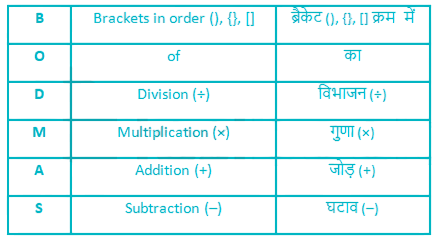
Calculation:-
120 ÷ 15 of 4 + [11 × 4 ÷ 4 of {4 × 2 – (8 – 11)}]
⇒ 120 ÷ 15 of 4 + [11 × 4 ÷ 4 of {4 × 2 – (- 3)}]
⇒ 120 ÷ 15 of 4 + [11 × 4 ÷ 4 of {8 + 3}]
⇒ 120 ÷ 60 + [11 × 4 ÷ 4 of 11]
⇒ 2 + [11 × 4 ÷ 44]
⇒ 2 + 1 = 3
∴ The required answer is 3.
18. The following table shows the number of male and female students studying in different streams (ie; Arts, Science, Commerce and Law) of a college. Study the table, and answer the question asked.
| Social class | male | Women |
| Art | 202 | 112 |
| Science | 260 | 280 |
| Commerce | 116 | 190 |
| Law | 78 | 65 |
| Total | 656 | 647 |
What is the percentage of female students of commerce out of the total students of the college?
A. 14.58%
B. 16.46%
C. 15.95%
D. 13.28%
Solution
Given:
Table below
| social class | male | Women |
| Art | 202 | 112 |
| Science | 260 | 280 |
| Commerce | 116 | 190 |
| Method | 78 | 65 |
| gross | 656 | 647 |
Calculations:
Total Number of students
= Total male + Total female
= 656 + 647
= 1303
Females in commerce
= 190
Percentage required
= 190 × 100/1303
= 14.58%
Hence, The Required value is 14.58%.
19. What is the fourth proportional of 35–√5, 58–√8 and 31–√010?
A. 105–√5
B. 402–√2
C. 30
D. 20
Solution
Given:
Let a = 3√5 ; b = 5√8 ; c = 3√10
Concept used:
If a : b :: c : d
then, d = (b × c)/a
Calculation:
3√5 : 5√8 :: 3√10 : X
X = (5√8 × 3√10)/3√5
⇒ √(200 × 90)/√45
⇒ √400 = 20
∴ The correct answer is 20.
20. Aarav can do a piece of work alone in 6 days and Babita can do it alone in 8 days. Aarav and Babita undertook to do it for ₹2,400. With the help of Chaitanya, they completed the work in 3 days. How much is to be paid to Babita?
A. ₹1,200
B. ₹900
C. ₹800
D. ₹1,400
Solution
Given:
Aarav can complete the work alone in 6 days.
Babita can complete the work alone in 8 days.
Aarav, Babita, and Chaitanya together completed the work in 3 days.
Total amount = ₹2,400
Formula used:
Efficiency = Total work / Time
Calculation:
LCM of 6, 8, and 3 days = 24
Total work = 24
Efficiency of Aarav = 24 ÷ 6 = 4
Efficiency of Babita = 24 ÷ 8 = 3
Efficiency of (Aarav + Babita + Chaitanya) = 24 ÷ 3 = 8
Efficiency of Chaitanya = 8 – 4 – 3 = 1
Total ratio of their efficiencies: Aarav : Babita : Chaitanya = 4 : 3 : 1
Total ratio = 4 + 3 + 1 = 8
Amount to be paid to Babita = 2400 × 3/8 = ₹900
∴ The amount to be paid to Babita = ₹900
21. Select the option that is related to the fifth letter – cluster in the same way as the second letter – cluster is related to the first letter – cluster and the fourth letter-cluster is related to the third letter – cluster.
FRENCH : GQFMDG :: GERMAN : HDSLBM :: ARABIC : ?
A. BQBAHD
B. BQBAJB
C. BQBCJB
D. BQZAJB
Solution
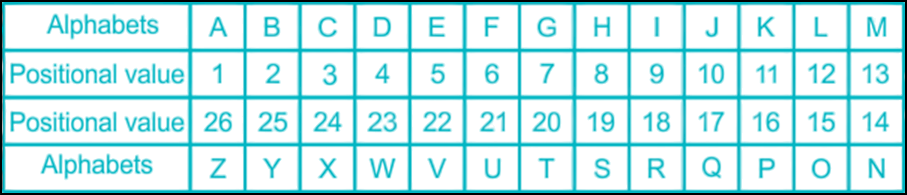
The logic followed here is :-
- FRENCH : GQFMDG
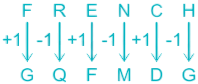
and
- GERMAN : HDSLBM

Similarly,
- ARABIC : ?

Hence, the correct answer is “BQBAJB”.
22. Select the set in which the number are related in the same way as the numbers of the given sets. (NOTE : Operations should be performed on the whole numbers, without breaking down the numbers into its constituent digits. E.g. 13 – Operations on 13 such as adding /subtracting /multiplying etc. to 13 can be performed. Breaking down 13 into 1 and 3 and then performing mathematical operations on 1 and 3 is not allowed.)
(13, 14, 54)
(11, 13, 52)
A. (15, 18, 66)
B. (15, 17, 66)
C. (13, 19, 64)
D. (12, 34, 90)
Solution
The logic followed here is: Sum of first number and second number × 2 = Third Number.
For, (13, 14, 54)
(13 + 14) × 2
27 × 2
54 = 54 (Third Number).
For, (15, 18, 66)
(15 + 18) × 2
33 × 2
66 = 66 (Third Number).
Let’s check each option one by one:
Option 1) (11, 13, 52)
(11 + 13) × 2
24 × 2
48 ≠ 52.
Option 2) (15, 17, 66)
(15 + 17) × 2
37 × 2
74 ≠ 66.
Option 3) (13, 19, 64)
(13 + 19) × 2
32 × 2
64 = 64.
Option 4) (12, 34, 90)
(12 + 34) × 2
46 × 2
92 ≠ 90.
Hence, the correct answer is ‘Option 3’.
Was the solution helpful?Yes
23. Select the set in which the numbers are related in the same way as are the numbers of the following sets.
(NOTE: Operations should be performed on the whole numbers, without breaking down the numbers into its constituent digits. E.g. 13 – Operations on 13 such as adding/ subtracting/multiplying etc. to 13 can be performed. Breaking down 13 into 1 and 3 and then performing mathematical operations on 1 and 3 is not allowed.)
13 – 15 – 7 and 9 – 11 – 5
A. 16 – 24 – 10
B. 15 – 18 – 9
C. 26 – 37 – 15
D. 22 – 45 – 21
Solution
The logic followed here is:
Logic: (1st number + 2nd number) ÷ 4 = 3rd number.
Given,
13 – 15 – 7
⇒ (13 + 15) ÷ 4
⇒ 28 ÷ 4 = 7.
And, 9 – 11 – 5
⇒ (9 + 11) ÷ 4
⇒ 20 ÷ 4 = 5.
Similarly, Option 1) 16 – 24 – 10
⇒ (16 + 24) ÷ 4
⇒ 40 ÷ 4 = 10.
Hence, the correct option is “Option 1”.
24. Select the triad in which the numbers are related in the same way as are the numbers of the following triads.
3 – 4 – 24
4 – 7- 56
(NOTE: Operations should be performed on the whole numbers, without breaking down the numbers into its constituent digits. E.g. 13 – Operations on 13 such as adding/subtracting/multiplying etc. to 13 can be performed. Breaking down 13 into 1 and 3 and then performing mathematical operations on 1 and 3 is not allowed)
A. 9 – 12 – 54
B. 8 – 7 – 53
C. 2 – 3 – 18
D. 5 – 8 – 80
Solution
Logic: Third no. = [(First no. × Second no.) × 2]
Given:
3 – 4 – 24 →
⇒ [(3 × 4) × 2]
⇒ (12 × 2) = 24
4 – 7- 56 →
⇒ [(4 × 7) × 2]
⇒ (28 × 2) = 56
Checking the given options:
(1) 9 – 12 – 54 →
⇒ [(9 × 12) × 2]
⇒ (108 × 2) = 216
(2) 8 – 7 – 53 →
⇒ [(8 × 7) × 2]
⇒ (56 × 2) = 112
(3) 2 – 3 – 18 →
⇒ [(2 × 3) × 2]
⇒ (6 × 2) = 12
(4) 5 – 8 – 80 →
⇒ [(5 × 8) × 2]
⇒ (40 × 2) = 80
Here, ‘5 – 8 – 80′ is similar to the given sets of numbers.
Hence, the correct answer is “Option (4)”.
25. In a certain code language, ‘lets do it’ is written as ‘nq pl st’ and ‘do your work’ is written as ‘st mr jn’. How is ‘do’ written in the given language?
A. pl
B. mr
C. st
D. nq
Solution
As per the given information:

Here, the code for ‘do’ is ‘st’.
Hence, the correct answer is “Option (3)”.
26. In a certain code language, ‘ARCHED’ is coded as ‘526749’ and ‘CHASED’ is coded as ‘432576’. What is the code for ‘R’ in the given code language?
A. 9
B. 7
C. 3
D. 5
Solution
The logic followed here is:
‘ARCHED’ is coded as ‘526749’
‘CHASED’ is coded as ‘432576’,

Here, ‘ACHED’ is common in both the statement, so the remaining number is the code for the remaining letter.
So, ‘R’ will be coded as ‘9’.
Hence, the correct answer is “Option 1”.
27. In a certain code language, ‘MOST’ is coded as ‘3472’ and ‘STOW’ is coded as ‘2634’. What is the code for ‘M’ in the given code language?
A. 3
B. 4
C. 2
D. 7
Solution
The logic followed here is:
‘MOST’ is coded as ‘3472’
‘STOW’ is coded as ‘2634’,

Here, OST is common in both the statement, so the remaining number is the code for the remaining letter.
So, ‘M’ will be coded as ‘7’.
Hence, the correct answer is “Option 4”.
28. In a certain code language, ‘TURNIP’ is coded as VNRUWU and ‘DAIKON’ is coded as TTOLCE. How will ‘RADISH’ be coded in the same language?
A. NXMGCS
B. NXNHCS
C. MXNHCS
D. CYMGDP
Solution
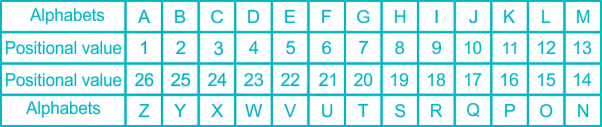
The logic followed here is :-
‘TURNIP’ is coded as VNRUWU.
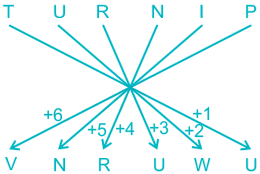
and
‘DAIKON’ is coded as TTOLCE.
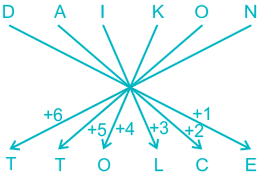
Similarly,
‘RADISH’ will be coded as :
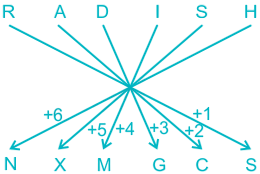
Hence, the correct answer is “NXMGCS”.
29. From the given alternative figures, select the figure in which the question figure is embedded.

A.

B.

C.

D.

Solution
The embedded part of image is:
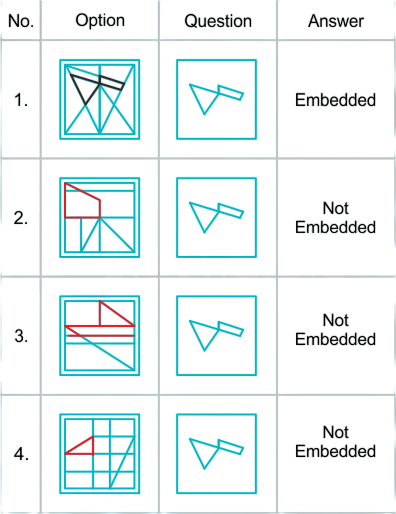
Hence, the correct answer is “Option (1)”.
30. Select the correct mirror image of the given figure when the mirror is placed at MN as shown below.

A.

B.

C.

D.

Solution
The mirror image of the given figure is:
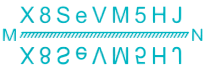
Hence, the correct answer is “Option (1)”.
31. Which two signs should be interchanged to make the given equation correct?
1664 ÷ 4 × 2 + 712 – 316 = 436
A. ÷ and +
B. ÷ and –
C. – and +
D. + and ×
Solution
Here, we use the BODMAS table given below:
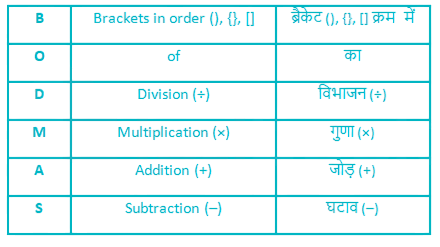
Given:
⇒ 1664 ÷ 4 × 2 + 712 – 316 = 436
(1) ÷ and +
⇒ 1664 ÷ 4 × 2 + 712 – 316 = 436
After changing the signs:
⇒ 1664 + 4 × 2 ÷ 712 – 316 = 436
Apply BODMAS rule:
⇒ 1664 + 4 × 0.0028 – 316
⇒ 1664 + 0.0112 – 316
⇒ 1664.0112 – 316 = 1348.0112
Here, the equation is not satisfied.
(2) ÷ and –
⇒ 1664 ÷ 4 × 2 + 712 – 316 = 436
After changing the signs:
⇒ 1664 – 4 × 2 + 712 ÷ 316 = 436
Apply BODMAS rule:
⇒ 1664 – 4 × 2 + 2.25
⇒ 1664 – 8 + 2.25
⇒ 1666.25 – 8 = 1658.25
Here, the equation is not satisfied.
(3) – and +
⇒ 1664 ÷ 4 × 2 + 712 – 316 = 436
After changing the signs:
⇒ 1664 ÷ 4 × 2 – 712 + 316 = 436
Apply BODMAS rule:
⇒ 416 × 2 – 712 + 316
⇒ 832 – 712 + 316
⇒ 1148 – 712 = 436
⇒ ‘1664 ÷ 4 × 2 – 712 + 316 = 436’
Here, the equation is satisfied.
(4) + and ×
⇒ 1664 ÷ 4 × 2 + 712 – 316 = 436
After changing the signs:
⇒ 1664 ÷ 4 + 2 × 712 – 316 = 436
Apply BODMAS rule:
⇒ 416 + 2 × 712 – 316
⇒ 416 + 1424 – 316
⇒ 1840 – 316 = 1524
Here, the equation is not satisfied.
Hence, the correct answer is “Option (3)”.
32. If ‘+’ means ‘–’, ‘–’ means ‘×’, ‘×’ means ‘÷’, ‘÷’ means ‘+’, then what will come in place of the question mark (?) in the following equation?
13 – 145 × 29 ÷ 52 + 11 = ?
A. 106
B. 117
C. 94
D. 83
Solution
Here, we use the BODMAS table given below:
As per the given information:
| Symbols | Means |
| + | – |
| – | × |
| × | ÷ |
| ÷ | + |
Given:
⇒ 13 – 145 × 29 ÷ 52 + 11 = ?
After replacing the sign as per the table:
⇒ 13 × 145 ÷ 29 + 52 – 11
Apply BODMAS rule:
⇒ 13 × 5 + 52 – 11
⇒ 65 + 52 – 11
⇒ 117 – 11 = 106
⇒ ’13 × 145 ÷ 29 + 52 – 11 = 106′
Hence, the correct answer is “Option (1)”.
33. Six friends are sitting in a circle. All of them are facing the centre. Samir is an immediate neighbour of Kiran. Gagan is an immediate neighbour of Pran and Vyom. Suman sits second to the right of Gagan. Kiran sits second to the right of Vyom.
Who sits third to the right of Suman?
A. Kiran
B. Vyom
C. Pran
D. Samir
Solution
As per the given information the sitting arrangement:
1. Suman sits second to the right of Gagan.

2. Gagan is an immediate neighbour of Pran and Vyom.
Case 1:
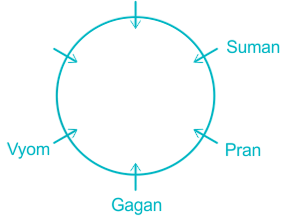
Case 2:

3. Kiran sits second to the right of Vyom and Samir is an immediate neighbour of Kiran.
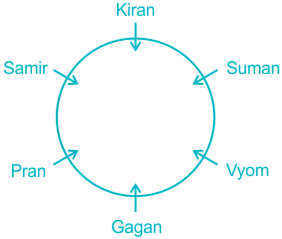
Here, Pran is sitting third to the right of Suman.
Hence, the correct answer is “Option (3)”.
34. Eight boys Virat, Rohit, Kamal, Lakshmana, Rahul, Ram, Ramesh and Sohan are sitting around a circular table facing the center (but not necessarily in the same order). Rahul is second to the left of Kamal. Kamal is third to the left of Virat. Lakshmana is second to the right of Ram. Rohit is second to the right of Kamal. Ramesh is not an immediate neighbor of Kamal. Virat is second to the left of Ram. Who is second to the right of Sohan?
A. Laxman
B. Ram
C. Ramesh
D. Virat
Solution
Eight boys Virat, Rohit, Kamal, Lakshmana, Rahul, Ram, Ramesh and Sohan are sitting around a circular table facing the center (but not necessarily in the same order).
1. Rahul is second to the left of Kamal.
2. Kamal is third to the left of Virat.
3. Rohit is second to the right of Kamal.
4. Ramesh is not an immediate neighbor of Kamal.
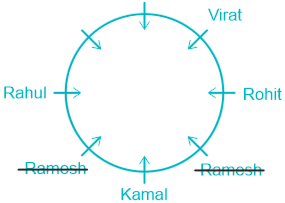
5. Virat is second to the left of Ram.
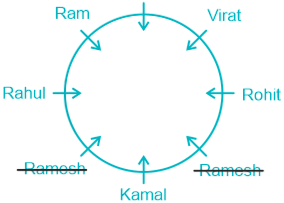
6. Lakshmana is second to the right of Ram.
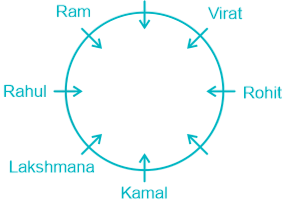
Ramesh is sitting between Ram and Virat.
Sohan is sitting between Rohit and Kamal.
The final arrangement is:
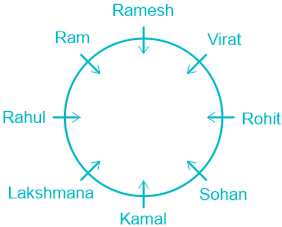
Clearly, Virat is sitting second to the right of Sohan.
Hence, ‘Virat‘ is the correct answer.
35. Which of the following terms will replace the question mark (?) in the given series?
KLJH, FGEC, ABZX, VWUS, ?
A. PQSM
B. QRPN
C. QRTV
D. QRNP
Solution
Here, we use the table given below:

Given:
KLJH, FGEC, ABZX, VWUS,?
The logic followed in the given series:
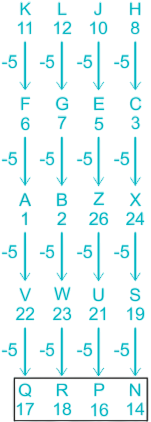
Here, the missing term is ‘QRPN’.
Hence, the correct answer is “Option (2)”.
36. If the series is to be continued, which figure will come in place of the question mark (?)?

A.

B.

C.

D.

Solution
The figure that will replace the question mark (?) in the following figure series is shown below:
Step 1) → Two pattern followed here.
- Letters ‘A’, ‘R’ and ‘T’ shifts diagonally.
- Letters ‘S’ and ‘D’ interchanges position.

Step 2) → Letters ‘A’, ‘S’, ‘T’ and ‘D’ shifts in the anti-clockwise direction.
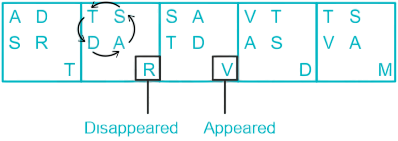
Step 3) → Same pattern as in step – (1).

Step 4) → Same pattern as in step – (2).
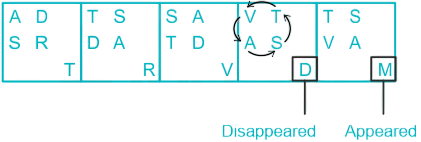
Final series is

Hence, ‘option – (2)’ is the correct answer.
37. Select the figure from the given options that can replace the question mark (?) in the following series.

A.

B.

C.

D.

Solution
The logic followed here is:
Step I: Symbol ‘Square’ has shifting two place in clockwise direction in next images, and getting Shaded in alternate image.

Step II: Symbol ‘Triangle’ has shifting two place in clockwise direction in next images, and getting Shaded in alternate image.

Step III: Symbol ‘Circle’ has subtracting one part in each next images.

So, the complete series will be:

So, ‘Option 3’ will replace the question mark.
Hence, the correct answer is “Option 3”.
Mistake PointsBoth Option 1 and 3 has the different image, please check the shaded square carefully.
38. Which number should replace the question mark (?) in the following number series?
39, 42, 48, 57, 69, ?, 102
A. 87
B. 79
C. 81
D. 84
Solution
The logic followed here is:
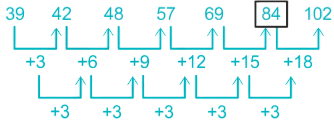
Hence, ‘84‘ is the correct answer.
39. Two statements are given followed by two conclusions numbered I and II. Assuming the statements to be true, even if they seem to be at variance with commonly known facts, decide which of the conclusions logically follow (s) from the statements,
Statements:
Some gold are silver.
All gold are platinum.
Conclusions:
I. Some silver are platinum.
II. All platinum are gold.
A. Both conclusions I and II follow
B. Only conclusion II follows
C. Neither conclusion I nor II follows
D. Only conclusion I follows
Solution
Given Statements:
Some gold are silver.
All gold are platinum.
The least possible Venn diagram for the given statement is:

Conclusions:
I. Some silver are platinum – True (Because, Those part of Silver that is Gold will also Platinum).
II. All platinum are gold – False (Because, All gold are platinum given, so All platinum are gold can be possible only).
So, Only conclusion I follows.
Hence, the correct answer is “Option 4”.
40. Three statements are given followed by two conclusions numbered I and II. Assuming the statements to be true, even if they seem to be at variance with commonly known facts, decide which of the conclusions logically follows(s) from the statements
Statements:
All goats are black
some black are white.
No black is gold.
Conclusions:
I. Some goats are white
II. Some goats being gold is a possibility.
A. Only conclusion II follows
B. Both conclusions I and II follow
C. Only conclusion I follows
D. Neither conclusion I nor II follows
Solution
Given Statements:
All goats are black
some black are white.
No black is gold.
The least possible Venn diagram for the given statement is:
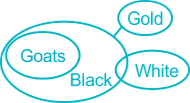
Conclusions:
I. Some goats are white – False (Because, No definite relation given between goats and white, so it can be possible only).
II. Some goats being gold is a possibility – False (Because, All goats are black and no black is gold, so no goats will be gold).
So, Neither conclusion I nor II follows.
Hence, the correct answer is “Option 4”.
41. The Natya Shastra describes stringed instruments as ‘_______ Vadya’.
A. Avanaddha
B. Sushir
C. Ghan
D. Tat
Solution
The correct answer is Tat.
Key Points
- The Natya Shastra describes stringed instruments as ‘Tat Vadya’.
- The String Instruments are known as Tat Vadya.
- They are the Plucked Stringed Instruments.
Additional Information
- The Indian Classical Musical system has two major traditions – Hindustani and Carnatic.
- Additionally, there are several other traditions such as folk, tribal, etc.
- The musical instruments of India bring along a rich heritage and form an integral part of the cultural traditions of this country.
- Natya Shastra by Bharat Muni (composed between 200 BC and 200 AD) clubbed musical instruments into four groups:
- Avanaddha Vadya (membranophones or percussion instruments)
- Ghan Vadya (idiophones or solid instruments)
- Sushir Vadya (aerophones or wind instruments)
- Tat Vadya (chordophones or stringed instruments)
42. When did the Hindu Succession Act abandon the rule of primogeniture in India?
A. 1956
B. 1950
C. 1946
D. 1960
Solution
The correct answer is 1956.
Key Points
- In 1956, the Hindu Succession Act abandon the rule of primogeniture in India.
- The principle of primogeniture or the royal mode of succession, that is the eldest getting the cake and eating it too, was abandoned after the codification of the Hindu law and coming into force of the Hindu Succession Act, 1956.
- This was pointed out by the Supreme Court in Bhaiya Ramanuj Pratap Deo vs Lalu Maheshanuj Pratap Deo & Ors [1982 SCR (1) 417].
- The Hindu Succession Act, 1956 is an Act of the Parliament of India enacted to amend and codify the law relating to intestate or unwilled succession, among Hindus, Buddhists, Jains, and Sikhs.
- The Act lays down a uniform and comprehensive system of inheritance and succession into one Act.
43. The Right to Information Act of 2005 extended to the whole of India, EXCEPT _______.
A. Nagaland
B. Jammu and Kashmir
C. Sikkim
D. Puducherry
Solution
The correct answer is Jammu and Kashmir.
Key Points
- The Right to Information Act of 2005 extended to the whole of India, EXCEPT Jammu and Kashmir.
- It shall apply to Public Authorities.
- All citizens shall have the right to information, subject to provisions of the Act.
- The Public Information Officers/Assistant Public Information Officers will be responsible to deal with the requests for information and also to assist persons seeking information.
- Certain categories of information have been exempted from disclosure under Section 8 and 9 of the Act.
- Intelligence and security agencies specified in Schedule II to the Act have been exempted from the ambit of the Act, subject to certain conditions.
Additional Information
- The Right to Information (RTI) was first introduced in the year 2005.
- The Act received Presidential assent on 15th June 2005.
- The RTI Act came into force on 12th October 2005.
- The Right to Information is a tool to find out information that can make their lives better.
- It mandates timely response to citizen requests for Government information.
- Its main objective is to empower the citizens, promote transparency and accountability.
- It aims to contain corruption and make our democracy work for the people in a real sense.
- Only individual citizens of India have the right to seek information under the provisions of the Right to Information Act, 2005.
44. Which state signed an MoU with Google to establish AI labs?
A. Maharashtra
B. Karnataka
C. Tamil Nadu
D. Gujarat
Solution
The correct answer is Tamil Nadu
In News
- Tamil Nadu Government and Google Partnership: Tamil Nadu has signed an MoU with Google to launch ‘Tamil Nadu AI Labs’ in Chennai, focusing on skilling 2 million individuals in AI, boosting startups, and attracting Rs 900 crore in investments, which will create 4,000 new jobs.
Key Points
- Key Investments and Developments:
- Nokia: New R&D centre in Siruseri.
- PayPal: Expansion of AI and ML development centre in Chennai.
- Microchip and Yield Engineering Systems: Semiconductor innovation in Coimbatore.
- Applied Materials: Advanced AI tech centre.
- Infinx: New tech centre in Madurai.
- Chief Minister’s US Visit: During MK Stalin’s visit to the US, multiple MoUs were signed, and he visited the headquarters of Apple, Google, and Microsoft, aiming to enhance Tamil Nadu’s status as a leading growth hub in Asia.
45. Which of the following hills is NOT located in Meghalaya?
A. Dafla Hills
B. Jaintia Hills
C. Khasi Hills
D. Garo Hills
Solution
The correct answer is Dafla Hills.
Key Points
- Dafla hills are located in the state of Arunachal Pradesh.
- Part of the Siwalik located in Arunachal Pradesh between the Subansiri River and the Kameng River that to the south of the Kamla River
- Tribes living here practice Jhuming cultivation.
- Covered with dense bamboo, pine and deodar trees.
Additional Information
Important hills in India
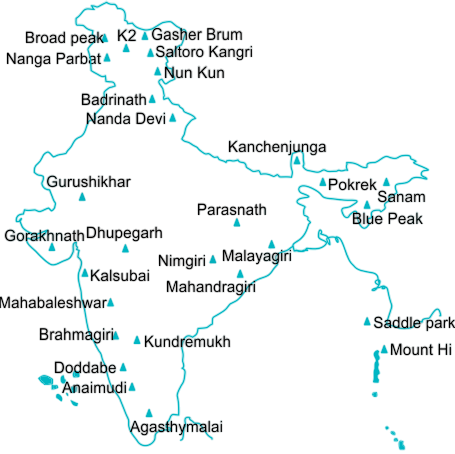
46. Consider the following statements regarding heat transfer:
1. Radiation heat transfer is not efficient in vacuum.
2. The black surface or color absorbs maximum heat from the environment.
Which of the statements given above is/are correct?
A. 1 only
B. 2 only
C. Both 1 and 2
D. Neither 1 nor 2
Solution
The correct answer is option 2.
Key Points
- Radiation does not require any medium for its occurrence, it is efficient in a vacuum.
- Radiation heat transfer can take place in the absence of a transmitting medium as it is transmitted through electromagnetic waves.
- A black object absorbs all wavelengths of heat and reflects none.
- Gamma radiations are penetrative electromagnetic radiations and have the smallest wavelengths.
47. According to census 2011, which of the following is NOT included in top ten most populous countries?
A. Pakistan
B. Japan
C. Nigeria
D. Canada
Solution
The correct answer is Canada.
Key Points
- Canada
- According to the 2011 census data, Canada is not included in the top ten most populous countries.
- Canada, despite being the second-largest country by land area, has a relatively small population due to its harsh northern climate.
- In 2011, it was not among the top ten most populous countries in the world.
- Its population density is one of the lowest in the world, with vast areas of wilderness in the north.
Additional Information
- Census 2011:-
- Arunachal Pradesh is the lowest population density.
- The highest population state is Uttar Pradesh.
- Kerala is the highest sex ratio.
- Kerala is the state with the highest literacy rate.
- 31.165 percent of the total population can be categorized under Urban.
- The least populated state in the country with a population of 6.71 lakhs is Sikkim.
- The Goa state is the most urbanized state with 62.17% of the population living in urban areas.
- Nagaland is the only state to record negative growth in population in the country.
- In India, Bengali is the second most spoken language.
- For the 2011 Indian Census, C M Chandramauli was the Registrar General and Census Commissioner of India.
48. Which two kings fought in the Battle of Hydaspes?
A. Chandragupta and Dhana Nanda
B. Ashoka and Mahapadmanabha
C. Mihirakula and Yasodharman
D. Alexander and Porus
Solution
The correct answer is Alexander and Porus.
Key Points
- In 326 BC, Alexander the Great faced King Porus in the Battle of the Hydaspes, also known as the Battle of Jhelum.
- It took place on the banks of the Jhelum River (called as Hydaspes by the ancient Greeks) in the Punjab area of India (modern-day Punjab, Pakistan).
- The conflict ended with a Greek triumph and Porus’ capitulation.
- Large swaths of Punjab were integrated into the Alexandrian Empire, and Alexander reinstalled the vanquished and dethroned Porus as a subordinate ruler.
- One of Alexander’s “masterpieces” was his choice to cross the monsoon-swollen river despite intense Indian monitoring in order to catch Porus’ army off-guard.
Important Points
- Alexander III of Macedon, also known as Alexander the Great, was the monarch of Macedon in ancient Greece.
- At the age of 20, he succeeded his father Philip II to the throne in 336 BC and spent the majority of his reign executing a lengthy military campaign across Western Asia and Northeastern Africa.
- He had built one of the biggest empires in history by the age of thirty, ranging from Greece to northwestern India.
- Porus was an ancient Indian king whose kingdom stretched between the Hydaspes (Jhelum River) and the Acesines (Chenab River) in the Punjab area of India.
49. Which among the following Vitamins is known as Niacin?
A. Vitamin B4
B. Vitamin B3
C. Vitamin B1
D. Vitamin B2
Solution
The correct answer is Option 2.
Key Points
- Vitamin B3, also known as niacin or nicotinic acid, is one of the eight B vitamins. It plays a crucial role in the proper functioning of the body and is involved in various metabolic processes.
- Here are some key points about vitaminB3:
- Function: Niacin is essential for the conversion of carbohydrates, fats, and proteins into energy.
- Sources: Niacin can be obtained from both animal and plant sources.
- Forms: Niacin exists in two forms: nicotinic acid and niacinamide (nicotinamide).
- Deficiency: Severe niacin deficiency leads to a condition known as pellagra.
- Recommended Daily Intake: The recommended daily intake of niacin varies depending on age, sex, and life stage.
Additional Information
- Vitamin B1, also known as thiamine, is one of the eight B-vitamins that play essential roles in maintaining the proper functioning of our bodies
- Vitamin B2, also known as riboflavin, is one of the water-soluble vitamins belonging to the B-complex group. It plays a crucial role in maintaining overall health and is involved in various metabolic processes in the body.
50. Who among the following was the first Gupta ruler to assume the title of Maharajadhiraja?
A. Samudragupta
B. Chandragupta I
C. Chandragupta II
D. Ramgupta
Solution
The correct answer is Chandragupta I.
Key Points
- Chandragupta I was the first Gupta ruler to assume the title of Maharajadhiraja.
- Chandragupta I was a son of the Gupta king Ghatotkacha, and a grandson of the dynasty’s founder Gupta, both of whom are called Maharaja in the Allahabad Pillar inscription.
- He was also the father of Samudragupta, his next successor.
- Chandragupta I married the Lichchhavi princess Kumaradevi.
- Lichchhavi is the name of an ancient clan that was headquartered at Vaishali in present-day Bihar during the time of Gautama Buddha.
Additional Information
- Gupta Dynasty:
- The founder of the Gupta dynasty was Sri Gupta.
- He was succeeded by Ghatotkacha. These two were called Maharajas.
- Chandragupta, I was succeeded by Samudragupta in about 330 A.D., who reigned for about fifty years.
- He was a great military genius and is said to have commanded a military campaign across the Deccan, and also subdued the forest tribes of the Vindhya region.
- Samudragupta’s successor Chandragupta II, also known as Vikramaditya, conquered the extensive territories of Malwa, Gujarat and Kathiawar.
51. Chaitanya, also known as Sri Gauranga, was a popular Vaishnava saint and reformer from _________.
A. Madurai
B. Pandharpur
C. Nadia
D. Sringeri
Solution
The correct answer is Nadia.
Key Points
- Chaitanya, also known as Sri Gauranga, was a famous Vaishnava saint and reformer from Nadia.
- The Vedic spiritual master Chaitanya Mahaprabhu is regarded by his followers as an avatar of Lord Krishna.
- He lived in the 15th century.
- Gaudiya Vaishnavism, a religious movement that encourages the veneration of Lord Vishnu as the Supreme Soul, was founded by Chaitanya.
- The practice of Bhakti yoga is encouraged by Gaudiya Vaishnavism as a means of realizing the ultimate truth.
- The “Maha Mantra” or “Hare Krishna Mantra” is credited with gaining popularity thanks to Chaitanya Mahaprabhu.
- He is also well-known for writing the eight-verse Sanskrit prayer called “Siksastakam.”
Additional Information
- Bhakti Movement of India
- The monotheistic foundation of the Bhakti movement led to widespread criticism of idolatry.
- The Bhakti reformers believed in freedom from the cycle of life and death and preached that salvation could be attained only by deep devotion and faith in God.
- They emphasised the importance of self-surrender for obtaining the bliss and grace of God and also valued the importance of Gurus who acted as guides and preceptors. They preached the principle of universal brotherhood.
- They disapproved of rituals, journeys, and fasts.
- They were adamantly opposed to the caste system, which separated people based on where they were born.
- Additionally, they emphasized the importance of singing hymns with sincere devotion, and they wrote poems in everyday language without regard for any particular language’s sacredness.
- Saguna bhakti was primarily promoted by Tulsidas, Chaitanya, Surdas, and Meera.
52. The ________ Schedule of the Constitution of India added by the Constitution (Fifty-Second Amendment) Act, 1985 deals with the disqualification of a person for being a member of either house of Parliament or the Legislative Assembly or Legislative Council of a State, on the ground of defection.
A. Tenth
B. Sixth
C. Third
D. Fifth
Solution
The correct answer is Tenth.
Key Points
- The Tenth Schedule of the Constitution of India added by the Constitution (Fifty-Second Amendment) Act, 1985 deals with the disqualification of a person for being a member of either house of Parliament or the Legislative Assembly or Legislative Council of a State, on the ground of defection.
- The Tenth Schedule popularly known as the Anti-Defection Act was included in the Constitution via the 52nd Amendment Act, 1985 and sets the provisions for disqualification of elected members on the grounds of defection to another political party.
- The anti-defection law was enacted during the Rajiv Gandhi government in 1985. Parliament added it to the constitution in the year 1985. Hence, statement 1 is incorrect.
- It was added in the Tenth Schedule.
- According to 91st CAA, 2003, at least two-thirds of the members of a party have to be in favour of a “merger” for it to have validity in the eyes of the law.
- The speaker or the chairman of the respective legislative house decide on disqualification arising out of defection.
Additional Information
- Disqualification on the ground of defection
- if he has voluntarily given up his membership of such a political party.
- if he votes or abstains from voting in such House contrary to any direction issued by the political party to which he belongs.
- Disqualification on the ground of defection is not to apply in case of a merger
- A member of a House shall not be disqualified where his original political party merges with another political party.
53. Which among the following articles of the Indian constitution deals with the right to equality of opportunity in the matters of public employment?
A. 17
B. 18
C. 15
D. 16
Solution
The correct answer is Option 4.
Key Points
- Article 16 of the Indian Constitution deals with the right to equality of opportunity in matters of public employment.
- It ensures that there is no discrimination in public employment on the grounds of religion, race, caste, sex, descent, place of birth, or residence.
- It also provides for the reservation of posts for certain categories, such as Scheduled Castes (SCs), Scheduled Tribes (STs), and Other Backward Classes (OBCs), to promote social justice and equality.
Additional Information
- Article 15 of the Indian Constitution deals with the prohibition of discrimination on grounds of religion, race, caste, sex, or place of birth.
- It ensures that the state shall not discriminate against any citizen on these grounds in matters of access to public places, use of public resources, or in providing opportunities in employment or educational institutions.
- Article 15 promotes the principles of equality and non-discrimination.
- Article 17 of the Indian Constitution deals with the abolition of untouchability.
- It declares that untouchability is abolished and that its practice in any form is forbidden.
- It is a provision aimed at eradicating the social evil of untouchability and promoting equality and dignity among all individuals.
54. Which Article of the Constitution of India describes the roles and responsibilities of the Council of Ministers in the Indian Parliament?
A. Article 74
B. Article 62
C. Article 54
D. Article 81
Solution
The correct answer is Article 74.
Key Points
- Article 74 provides for the following:
- The President, who shall act in line with such advice when performing his duties, shall be assisted and advised by a Council of Ministers, headed by the Prime Minister
- With the condition that the President may ask the Council of Ministers to reevaluate such advice, generally or otherwise, and the President must follow the advice provided upon such reevaluation.
- No court shall investigate as to whether any and if so, what, advice was provided to the President by Ministers.
Additional Information
- Article 62: Time of holding election to fill vacancy in the office of President and the term of office of person elected to fill casual vacancy. (1) An election to fill a vacancy caused by the expiration of the term of office of President shall be completed before the expiration of the term.
- The electoral college of India’s President is governed by Article 54 of the Indian Constitution.
- According to this article, the President is elected by the electoral college, which consists of the members listed below.
- Article 81 of the Indian Constitution defines the makeup of the House of The people, Lok Sabha.
55. The Kadam dam is located at the confluence of the Kadam river into ______.
A. Sharavati
B. Godavari
C. Kabini
D. Kaveri
Solution
The correct answer is Godavari.
Key Points
- The Kadam dam is located at the confluence of the Kadam river into Godavari..
- It is also known as Kadem Adi Narayan Reddy Project.
- It is located on the River Kadem.
- This river is the tributary of godavari in located in the Nirmal district.
- The kadem project is constructed over this river in Nirmal district.
- The project is linked with sriram sagar project.
Additional Information
- Important river projects:
| Project | River |
|---|---|
| Bhakra Nangal Project | The Bhakra-Nangal Dam is the second tallest dam in India after Tehri Dam.It is located on the border of Punjab and Himachal Pradesh. |
| Damodar Valley Project | On Damodar in Jharkhand. |
| Hirakud Project | On Mahanadi in Orissa.India’s longest dam: 4,801 m |
| Rihand Project | On Son in Mirzapur. The reservoir is called Govind Vallabh Pant Reservoir |
| Nizamsagar Project | On Manjra in Telangana. |
| Tungabhadra Project | On Tungabhadra in A.P. and Karnataka |
| Shivasamudram Project | On Cauvery in Karnataka |
| Thein Project | On Ravi, Punjab |
56. Which state was awarded the Geographical Indication (GI) tag for its traditional handicraft, ‘Gharchola,’ known for its intricate designs and cultural motifs?
A. Rajasthan
B. Gujarat
C. Punjab
D. Maharashtra
Solution
The correct answer is Gujarat
In News
- GI Tag: The GI tag for gharchola affirms its authenticity and uniqueness, serving as a significant marketing tool for promoting these cultural treasures globally.
Key Points
- Cultural Significance:
- Traditionally worn by the Hindu and Jain communities during weddings.
- Originally crafted in auspicious colors like red, maroon, green, and yellow, which are culturally significant in Hindu rituals.
- Modern Influence: Weavers in Gujarat have started incorporating modern designs and techniques, blending traditional craftsmanship with contemporary appeal, leading to increased demand for gharcholas.
- Economic Impact: The GI recognition helps in boosting local artisans by promoting their work and increasing visibility, which is supported by Garvi Gurjari sales centers across the state.
- Contribution to Gujarat’s Legacy: With the addition of this GI tag, Gujarat now holds 27 GI-certified items, 23 of which are from the handicraft sector, underscoring the state’s dedication to preserving and showcasing its rich artistic heritage.
57. What is the theme for World Population Day 2024?
A. Population and Sustainability
B. Future of Population Growth
C. Leave No One Behind, Count Everyone
D. Health and Population Awareness
Solution
The correct answer is Leave No One Behind, Count Everyone
In News
- World Population Day is observed annually on July 11 to raise awareness about global population growth and its impact on development and sustainability.
- The theme for World Population Day 2024 is “Leave No One Behind, Count Everyone,” focusing on the importance of counting everyone for sustainable development.
Key Points
- The UN Secretary-General’s message highlights the ICPD Programme of Action and the need to address remaining inequalities in women’s health and rights.
- The current global population, according to Worldometer, is 8,120,886,060 and rising, reflecting a rapid growth that poses significant challenges.
- The population reached the 7 billion mark in 2011, illustrating a major shift and rapid growth in recent centuries.
- World Population Day originated from the “Day of Five Billion” on July 11, 1987, when the global population reached an estimated five billion people.
- In 1989, the United Nations Development Programme (UNDP) established World Population Day to focus attention on population issues, with the first celebration in 1990 across more than 90 countries.
58. Under which Amendment was Goa accorded the status of a full-fledged state?
A. 71st
B. 56th
C. 52nd
D. 61st
Solution
The correct answer is 56th.
Key Points
- Under the Constitution 56th (Fifty-Sixth Amendment) Act, 1987 Goa was included in Schedule I of the Constitution of India.
- It became the 25th (twenty-fifth) State of India.
- Statehood to Goa was granted with effect from 30-5-1987.
- Further, under Article 315 of the Constitution of India, Goa was entitled to have its own Public Service Commission.
- Dr. J.C. Alemeida, IAS (Retired) was appointed as the first Chairman of the Goa Public Service Commission.
Additional Information
- 71st Amendment
- The Seventy-First Amendment to the Indian Constitution included Konkani, Manipuri, and Nepali languages in the Eighth Schedule.
- With this, the total number of scheduled languages increased to 18.
- 52nd Amendment
- Anti-Deflection Law: The 52nd Amendment Act of 1985 provided for the disqualification of the members of Parliament and the state legislatures on the ground of Deflection of one political party to another.
- 61st Amendment
- The 61st Amendment Act, 1988 of the Indian Constitution reduced the voting age for elections to the Lok Sabha and State Legislative Assemblies from 21 to 18 years.
59. Sehaj’s observation about a new plant is that its stem is thick with waxy layers and roots are very deep. Identify the correct habitat of the plant.
A. Desert
B. Mountain
C. Water
D. Grassland
Solution
The Correct answer is Desert.
Explanation:
- Thick Stem: A thick stem provides storage for water, which is scarce in desert environments. In many desert plants, the stem performs the function of leaves (which are often small or nonexistent to prevent water loss by transpiration).
- Waxy Layers: The waxy layer on the stem is a protective covering that helps to prevent water loss through transpiration. This is very important in a water-starved ecosystem like a desert where every drop counts.
- Deep Roots: Desert plants often have deep roots that can reach far down into the soil to access any available water. Some desert plants’ root systems can reach more than 20 feet into the ground in search of water.
- Meanwhile, the other three habitats – mountain, water, and grassland – don’t generally require these specific adaptations. In water habitats, for instance, the struggle would not be for conserving water, but rather for obtaining sunlight. Grassland and mountain habitats have their own sets of challenges that require different sets of adaptations.
60. Who was the court poet of Harshavardhana?
A. Hema Saraswati
B. Sri Ponna
C. Banabhatta
D. Parmanand
Solution
The correct answer is Banabhatta.
Key Points
- Banabhatta:
- He was a Sanskrit scholar and poet of India in the 7th century.
- He was the Asthana Kavi, meaning Court Poet, of Harshavardhana, a notable emperor in North India in the early 7th century.
- He is the author of Harshacharita, a biography of his patron king Harshavardhana, and Kadambari, a romantic novel.
Additional Information
- Sri Ponna:
- He was a Kannada poet in the court of Rashtrakuta Dynasty King Krishna III.
- He was one of the three gems of Kannada literature along with Adikavi Pampa and Ranna.
- Sri Ponna was given the title “Emperor among poets” (Kavichakravarthi) for his contributions to Kannada literature.
- Parmanand:
- In the context of Indian literature, Parmanand could refer to a 15th–16th-century saint and poet who wrote in the tradition of the Bhakti movement, devotional literature that focused on personal connection to the divine.
- His work is not associated with Harshavardhana, as he lived several centuries after the king’s reign.
61. ________ represents the high point of an eclectic art, which, in the 7th and 8th centuries under the Chalukya dynasty, achieved a harmonious blend of architectural forms from northern and southern India.
A. Kochi
B. Pattadakal
C. Konark
D. Bhimbetka
Solution
The correct answer is Pattadakal.
Key Points
- Pattadakal:
- Pattadakal represents the high point of eclectic art as designated by UNESCO.
- In the 7th and 8th centuries under the Chalukya dynasty, achieved a harmonious blend of architectural forms from northern and southern India.
- An impressive series of nine Hindu temples and a Jain sanctuary can be seen there.
- It is located on the west bank of the Mallaprabha River in Bagalkot district in Karnataka.
- The Hindu temples are generally dedicated to Shiva, but elements of Vaishnavism and Shaktism theology and legends are also featured.

Additional Information
- Three very closely located sites in the State of Karnataka provide a remarkable concentration of religious monuments dating from the great dynasty of the Chalukya (c. 543-757).
- The three capital cities are- Aihole (ancient Aryapura), Badami, and Pattadakal, the ‘City of the Crown Rubies’ (Pattada Kisuvolal).
- The Pattadakal was, moreover, for a brief time the third capital city of the Chalukya kingdom; at the time the Pallava occupied Badami (642-55).
- While Aihole is traditionally considered the ‘laboratory’ of Chalukya architecture, with such monuments as the Temple of Ladkhan (c. 450) which antedate the dynasty’s political successes during the reign of King Pulakeshin I.
62. In which of the following seasons are watermelon, muskmelon etc. produced in India?
A. Kharif
B. Zaid
C. Rainy
D. Rabi
Solution
The correct answer is Zaid.
Key Points
- Watermelon, muskmelon, Cucumber is an example of zaid crop.
- Crops that are being raised throughout the year due to artificial irrigation are Zaid crops.
- Zaid Kharif: Sown in August-September and harvested in December-January. Important crops include rice, jowar, rapeseed, cotton and oilseeds.
- Zaid Rabi: Sown in February – March and harvested in April -May. Important crops are watermelon, cucumber, leafy and other vegetables.
Additional Information
- Kharif crops
- Crops are sown at the beginning of the southwest monsoon and harvested at the end of the South -West monsoon.
- Sown in June-July when rains first begin.
- Harvested in September-October.
- Requires a lot of water and hot weather to grow.
- Important kharif crops: Jowar, bajra, rice, maize, cotton, Jute, groundnut, sugarcane, tobacco, etc.
- Rabi crops
- Crops need a relatively cool climate during the period of growth but a warm climate during the germination of their seed and maturation.
- Sown in October-November.
- Harvested in April-May.
- Important Rabi Crops: Wheat, barley, gram, linseed, mustard, Masur, peas, and potatoes.
63. Which of the following is not a unit of energy measurement?
A. Erg
B. Joule
C. Calorie
D. Pascal
Solution
The correct answer is Pascal.
Key Points
- Pascal
- The pascal (Pa) is the unit of pressure or stress in the International System of Units (SI).
- It is named after the scientist and mathematician Blaise Pascal.
- One pascal is equivalent to 1 newton (N) of force applied over an area of 1 square meter (m2).
Additional Information
- Units of Energy:
- Energy is the capacity to do work.
- It is neither created nor destroyed.
- Joule:
- Joule is the SI unit of Energy.
- Joule is the unit of work/energy in the International System of Units or (SI).
- The unit Joule is named after the English physicist James Prescott Joule.
- Erg:
- The unit of energy expressed in centimetre-gram-second (cgs) is called erg.
- 1 erg = 10-7 J
- Calorie:
- The amount of energy required to raise the temperature of 1 gram of water by 1°C or 1 Kelvin is called Calorie.
- A calorie is a unit of energy commonly used in nutrition.
- 1 calorie = 4.186 J
64. Which of the following dancer is related to Odissi dance?
A. Shovana Narayan
B. Birju Maharaj
C. Sujata Mohapatra
D. Rukmini Devi
Solution
The correct answer is Sujata Mohapatra.
Key Points
- Sujata Mohapatra is a renowned Odissi dancer and Guru who has made significant contributions to the Odissi dance form.
- She is known for her graceful movements, intricate footwork, and emotive expressions that are characteristic of Odissi dance.
- Sujata Mohapatra was honoured with the Sangeet Natak Akademi Award in 2013, one of the highest recognition given for performing arts in India.
- As a Guru, Sujata Mohapatra has trained and mentored many students, passing on the rich traditions and techniques of Odissi dance.
Additional Information
- Shovana Narayan:
- Shovana Narayan is a renowned Kathak dancer who has contributed to the field of Kathak dance.
- She is known for her expressive storytelling, intricate footwork, and graceful movements in the Lucknow Gharana style of Kathak.
- Shovana Narayan received the Padma Shri award, one of the highest civilian honours in India, in the year 1992.
- She has also been actively involved in promoting cultural exchanges and collaborations between India and other countries.
- Birju Maharaj:
- Birju Maharaj is a legendary Kathak dancer, choreographer, and Guru.
- He belongs to the Lucknow Gharana and is recognized for his mastery of intricate footwork, graceful movements, and expressive storytelling.
- Birju Maharaj has received numerous national and international awards for his contribution to Kathak dance like Padma Vibhushan in 1986, Sangeet Natak Akademi Award in 1964, Kalidas Samman etc.
- He has played a vital role in preserving and popularizing Kathak through his performances, teaching, and choreographic works.
- Rukmini Devi:
- Rukmini Devi was a renowned Bharatanatyam dancer, choreographer, and the founder of Kalakshetra.
- She is credited with reviving and reforming Bharatanatyam, bringing it into the mainstream and removing social stigmas associated with the art form.
- Rukmini Devi’s contributions include incorporating elements from other classical dance styles, introducing new themes and techniques, and establishing Kalakshetra as a leading institution for Indian classical arts.
- She was a strong advocate for animal rights and environmental conservation, and her work extended beyond dance to various social and cultural initiatives.
65. The value of the Special Drawing Right (SDR) of the International Monetary Fund is determined by a basket of currencies consisting of ______ currencies.
A. six
B. five
C. seven
D. eight
Solution
The correct answer is five.
Key Points
- The value of the Special Drawing Right (SDR) of the International Monetary Fund is determined by a basket of currencies consisting of five currencies.
- the U.S. dollar,
- the euro,
- the Chinese renminbi,
- the Japanese yen, and
- the British pound sterling.
Additional Information
- In 1969 the IMF introduced the Special Drawing Right to its member countries.
- An SDR is essentially an artificial currency instrument used by the IMF and is built from a basket of important national currencies.
- The IMF uses SDRs for internal accounting purposes. SDRs are allocated by the IMF to its member countries and are backed by the full faith and credit of the member countries’ governments
- The SDR was created as a supplementary international reserve asset in the context of the Bretton Woods fixed exchange rate system.
- The collapse of the Bretton Woods system in 1973 and the shift of major currencies to floating exchange rate regimes lessened the reliance on the SDR as a global reserve asset.
66. Select the most appropriate synonym of the word given in brackets to fill in the blank.
They had a/an ___________ (sumptuous) dinner with their friends at the Taj Palace last evening.
A. economical
B. homely
C. wanting
D. luscious
Solution
The correct answer is “Luscious”.
Key Points
- The most appropriate word to fill in the blank is “Luscious”.
- The word “luscious” is used to describe something that is richly pleasing to the senses, especially taste or smell.
- In the context of the sentence, “sumptuous” describes a lavish and delicious dinner, which aligns with the meaning of “luscious.”
- For Example – The restaurant served a sumptuous meal that included a variety of luscious dishes.
Therefore, the correct answer is “Option 4”.
Additional Information Let’s understand the meanings of the other given words:
- Economical: It refers to something that is efficient in the use of resources, especially money.
- Wanting: It means lacking or deficient in some way. It indicates that something is not up to the desired or expected standard, quality, or quantity.
- Homely: This word has multiple meanings depending on the context. It can mean simple and unpretentious, as well as warm, cozy, and comfortable, often describing a homey feeling.
67. Substitute the phrase below with one word from the options provided.
Something no longer in use
A. Obsolete
B. Primitive
C. Absolute
D. Desolate
Solution
The correct answer is ‘Obsolete‘.
Key Points
- Let’s explore the meaning of the marked word.
- Obsolete: not in use anymore, having been replaced by something newer and better or more fashionable. (अब उपयोग में नहीं है, कुछ नया और बेहतर या अधिक फैशनेबल द्वारा प्रतिस्थापित किया गया है)
- Example: Gas lamps became obsolete when electric lighting was invented.
- Obsolete: not in use anymore, having been replaced by something newer and better or more fashionable. (अब उपयोग में नहीं है, कुछ नया और बेहतर या अधिक फैशनेबल द्वारा प्रतिस्थापित किया गया है)
- Thus, from the above-given explanation, we can say that ‘Obsolete‘ is the correct substitution for the group of words that are asked.
- Therefore, the correct answer is option 1.
Additional Information
- Let’s explore the meaning of the other options:
| Word | Meaning | Example |
| Primitive | relating to human society at a very early stage of development, with people living in a simple way without machines or a writing system. (प्राचीन) | Primitive races colonized these islands 2,000 years ago. |
| Absolute | very great or to the largest degree possible. (शुद्ध) | I have absolute faith in her judgment. |
| Desolate | empty and not attractive, with no people or nothing pleasant in it. (खाली और आकर्षक नहीं, जिसमें कोई लोग या कुछ भी सुखद नहीं है) | The house stood in a bleak and desolate landscape. |
68. Select the most appropriate meaning of the underlined idiom.
Dhanishta had always worked very hard and hoped she would get a promotion but now felt that she had hit a glass ceiling.
A. A place that was transparent and open for all participants
B. A point after which you cannot go any further, usually in improving your position at work
C. A hard place to be where everything is brittle
D. A point where one has always aspired to reach
Solution
The correct answer is: Option 2 i.e. A point after which you cannot go any further, usually in improving your position at work.
Key Points
- The phrase “glass ceiling” means an unofficially acknowledged barrier to advancement in a profession, especially affecting women and members of minorities. (अवरोध)
- Example: Many women in corporate settings feel they hit a glass ceiling, preventing them from reaching top executive positions.
- “Glass ceiling” refers to a barrier that is not immediately apparent but is very real and difficult to overcome. (अदृश्य अवरोध)
- Example: Despite her qualifications, she felt the glass ceiling was holding her back from a promotion.
Therefore, the correct answer is: Option 2 i.e. A point after which you cannot go any further, usually in improving your position at work.
Additional Information
Here are the other options explained along with their Hindi meanings and example sentences:
- Option 1: A place that was transparent and open for all participants (सभी प्रतिभागियों के लिए पारदर्शी और खुला स्थान)
- Example: The new policy aimed to create a workplace that was transparent and open for all participants.
- Option 3: A hard place to be where everything is brittle (एक कठिन स्थान जहां सब कुछ भंगुर है)
- Example: Working under constant stress felt like being in a hard place where everything is brittle.
- Option 4: A point where one has always aspired to reach (एक बिंदु जहां एक हमेशा पहुंचने की आकांक्षा रखता है)
- Example: Reaching the executive level was a point where she had always aspired to reach.
69. Direction: Choose the option that best fills in to complete the given sentence:
I’m sorry about this noise you hear. She ______ for a concert since morning.
A. practices
B. has practiced
C. has been practicing
D. would practice
Solution
The correct answer is ‘has been practicing.’
Key Points
- The given sentence tells that the action is taking place since morning and is still in progress, so the sentence will be in Present Perfect Continuous tense.
- We use the Present Perfect Continuous tense to talk about action that started in the past and is continuing now.
- This is often used with for or since.
- “Since” shows an event that began in the past and continues into the present.
- Example: It has been raining since 8 a.m.
- Now, let us explore the given options:
- Practices: Simple Present Tense
- Has practiced: Present Perfect tense
- Has been practicing: Present Perfect Continuous tense
- Would practice: Past Tense of “will”
- Therefore, the correct answer is Option 3.
Correct sentence: I’m sorry about this noise you hear. She has been practicing for a concert since morning.
70. Direction: Select the segment of the sentence that contains the grammatical error. If there is no error, mark ‘No error’ as your answer.
By the time, you submit (A)/ the application, the last date (B)/ for submission had been passed. (C)/ No error (D)
A. A
B. B
C. C
D. D
Solution
The correct answer is ‘C’.
Key Points
- The use of ‘had been’ is wrong in part C of the given sentence.
- If an action will have been completed in future, the future perfect tense is used.
- E.g. I will have got my joining letter by the end of this month.
- In the given sentence, the last date of submission will have been passed in future, hence, the future perfect tense (will have + v3) will be used.
- According to the rule and example that are given above, ‘will have’ will be used instead of ‘had been’ in part C of the sentence.
Correct Sentence: By the time, you submit the application, the last date for submission will have passed.
Additional Information
- If the second form of the verb (V2) is used with ‘by the time’, the past perfect tense will be used in the latter part of the sentence.
- E.g. By the time, you submitted your application, the last date for submission had passed.

- दिए गए वाक्य के भाग C में ‘had been’ का प्रयोग गलत है।
- यदि future में कोई action पूरी हो गई है, तो future perfect tense का उपयोग किया जाएगा।
- E.g. I will have got my joining letter by the end of this month.
- दिए गए वाक्य में, sumission की अंतिम तारीख future में pass हो जाएगी, इसलिए, future perfect tense (will have + v3) का उपयोग किया जाएगा।
- ऊपर दिए गए नियम और उदाहरण के अनुसार वाक्य के भाग C में ‘had been’ के बजाय ‘will have’ का उपयोग किया जाएगा।
71. Select the most appropriate option to substitute the underlined segment in the given sentence. If there is no need to substitute it, select ‘No substitution’.
The river overflew it’s banks in the monsoon.
A. overflowed its banks
B. No substitution
C. overflows it’s banks
D. overflew its bank
Solution
The correct answer is ‘overflowed its banks’
Key Points
- The given phrase is to be replaced with ‘overflowed its banks’
- The verb forms of ‘overflow’ are- overflowed (past tense) and overflowed (past participle).
- Also, in the given sentence ‘It’s’ is incorrect we need to use the possessive case i.e. ‘Its’
- The contraction of ‘it’s’ is ‘It is’
Hence, the correct sentence is- The river overflowed its banks in the monsoon.
72. In the following question, four words are given out of which one word is correctly spelt. Find the correctly spelt word.
A. Aesthatic
B. Compliante
C. Levity
D. Commpendium
Solution
The word levity is spelled correctly making option 3 the correct answer.
The correct spellings of the words and their meanings are:
- Aesthetic – relating to study or appreciation of beauty
- Compliant – willing to obey
- Levity – the treatment of a serious problem with humour
- Compendium – a short and detailed collection of information
73. Choose the appropriate synonym for the highlighted word in the given sentence.
Jay is a very exuberant person and everyone loves him.
A. brave
B. handsome
C. cheerful
D. gloomy
Solution
The correct answer is ‘cheerful’.
Key Points
- Exuberant means being full of energy, happiness, and excitement.
- Example- There was a noisy gang of exuberant youngsters.
- Cheerful means being noticeably happy and optimistic
- Example- How can she be so cheerful at six in the morning?
- It is clear that both meanings are similar. So ‘cheerful’ is the most appropriate synonym for ‘exuberant’.
Additional Information
- Brave means being ready to face and endure danger or pain.
- Example- He is a brave soldier.
- Handsome means being good-looking.
- Example- He is quite handsome for a sixty-year-old.
- Gloomy means causing or feeling depression or despair.
74. Pick out the correctly spelt word from the given words.
A. Ettiqette
B. Etiquette
C. Attiqutte
D. Attiquatte
Solution
The correct answer is Etiquette.
Key Points
- The correctly spelled word is Etiquette.
- It means the rules of polite and correct behaviour (शिष्टाचार).
Hence, the correct choice is option 2.
75. Select the most appropriate meaning of the given idiom.
To fight shy of
A. To overcome one’s weakness
B. To try to avoid something
C. To attack without warning
D. To struggle hard
Solution
The correct answer is ‘To try to avoid something.’
Key Points
- “To fight shy of” means be unwilling to undertake or become involved with, to try to avoid something.
- Example: The discrepancy in the salary distribution between Angesh and Vignesh seemed not an important matter for the company as the company is trying to fight shy of in their salary discrepancy.
Hence, option 2) To try to avoid something is the correct answer.
76. The following sentence has been split into four segments. Identify the segment that contains a grammatical error.
What would / happen if / human beings were / govern by robots?
A. happen if
B. What would
C. govern by robots
D. human beings were
Solution
The correct answer is ‘govern by robots.’
Key Points
- In the given sentence, “were” is used which can be used to show the passive voice because the doer of the verb “govern” is not mentioned hence, we need to mention this in the passive voice. So the correct word will be “governed” instead of “govern”.
Hence, option 3) govern by robots contains a grammatical error.
Correct Sentence
What would happen if human beings were governed by robots?
77. Select the most appropriate option to substitute the underlined segment in the given sentence. If there is no need to substitute it, select No substitution required.
Thirteen miners were trapped inside a coal mine due to flooding from a nearby river yesterday
A. were trapped into a coal mine
B. trapped inside a coal mine
C. No substitution required
D. have been trapped inside a coal mine
Solution
The correct answer is option 3.
Explanation:
- If past time is given, use Simple Past Tense and not Present Perfect Tense.
- The sentence is given passive voice ‘was/were + V3‘ form of verb is used.
- ‘Into’ is used when one enters from one medium to the other.
- ‘Inside’ is used when someone is present in the inner of something.
Confusion Points
- The passive voice is used when we want to emphasize the action (the verb) and the object of a sentence rather than the subject.
- Here in this sentence, emphasis is laid on people trapped inside the coal mine, so passive is used.
Thus, the sentence is correct
78. Choose the wrongly spelt word from the following words.
A. Baricade
B. Beguile
C. Apposite
D. Sedate
Solution
The correct answer is option 1 i.e. ‘Baricade’.
Let’s find out the meanings of the given words:-
Barricade: an improvised barrier erected across a street or other thoroughfare to prevent or delay the movement of opposing forces
Beguile: charm or enchant (someone), often in a deceptive way
Apposite: apt in the circumstances or in relation to something
Sedate: calm, dignified, and unhurried
79. Direction: Choose the word which is most nearly the same in meaning as the given word.
Ancillary
A. Redundant
B. Subsidiary
C. Primary
D. Adverse
Solution
The correct answer is ‘Subsidiary‘.
Key Points
- Ancillary means ‘providing necessary support to the main work or activities of an organization, in addition to something else but not as important ( मुख्य गतिविधियों में सहायक, गौण, आनुषंगिक)’.
- Ex: Usually they will be merely ancillary to the strictly religious activities.
- Marked option ‘Subsidiary’ means ‘connected with something but less important than it ( किसी से संबंधित परंतु उससे कम महत्व का; गौण)’.
- Ex: The company where he work went global when it bought a small subsidiary in UK.
- It is clear that Ancillary and Subsidiary are similar in meaning.
Therefore, the correct answer is option 2.
Additional Information
- Redundant: (used about employees) no longer needed for a job and therefore out of work, not necessary or wanted (कर्मचारी) गै़र-ज़रूरी और इसलिए बेकार, फ़ालतू, अतिरिक्त, अनिवार्य या इच्छित नहीं).
- Primary: most important, basic, not difficult, connected with the first stages of learning something ( सबसे बड़ा मुख्य, प्रधान, शिक्षा की प्रारंभिक चरणों से संबंधित).
- Adverse: making something difficult for somebody (प्रतिकूल, विरुद्ध).
80. Select the most appropriate synonym of the given word.
Humble
A. Beautiful
B. Keen
C. Amusing
D. Modest
Solution
The correct answer is: Modest.
Key Points
- The word “humble” means having or showing a modest or low estimate of one’s importance. (विनम्र)
- Example: Despite his success, he remained a humble person who always credited his team.
- “Modest” refers to having a moderate view of one’s own value or abilities; not boastful. (मध्यम, विनम्र)
- Example: She gave a modest reply when asked about her achievements, emphasizing the team’s efforts instead.
Therefore, the correct answer is: Modest.
Additional Information
Here are the other options explained along with their Hindi meanings and example sentences:
- Beautiful (सुंदर): Pleasing the senses or mind aesthetically.
- Example: The garden is filled with beautiful flowers in the spring.
- Keen (उत्सुक): Having or showing eagerness or enthusiasm.
- Example: He is very keen to learn new languages.
- Amusing (मनोरंजक): Causing laughter or providing entertainment.
- Example: The comedian’s performance was very amusing.
81. Match the following definitions with their one-word substitutions.
| A. | One who dies without a will. | (i) | Itinerant |
| B. | Far away from other places. | (ii) | Intestate |
| C | To supply land with water by artificial means. | (iii) | Isolated |
| D. | Travelling from place to place, especially to find work. | (iv) | Irrigate |
A. A-(ii), B-(i), C-(iii), D-(iv
B. A-(ii), B-(iii), C-(iv), D-(i)
C. A-(iv), B-(i), C-(iii), D-(ii)
D. A-(iii), B-(i), C-(ii), D-(iv)
Solution
The correct answer is ” A-(ii), B-(iii), C-(iv), D-(i)”
Key Points
- In the above question, we have to choose the correct match of definitions with their one-word substitutions.
- Let’s understand the meaning of the given one words.
- Itinerant : Travelling from place to place, especially to find work
- Intestate: One who dies without a will.
- Isolated : Far away from other places.
- Irrigate : To supply land with water by artificial means.
- Thus, as per the above explanation the correct answer is Option 2.
Correct answer: A-(ii), B-(iii), C-(iv), D-(i)
82. Directions: In the following question, a sentence has been given in Active/Passive voice. Choose the correct option which best expresses the sentence in Passive/Active voice.
Help your neighbour.
A. You are requested to help your neighbour.
B. You are ordered to help your neighbour.
C. Your neighbour should be helped.
D. You are asked to help your neighbour.
Solution
The correct answer is option 3 i.e. ‘Your neighbour should be helped.’
Key Points
The sentence ‘Help your neighbour’ is in Active Voice. It contains moral suggestions.
So, sentences containing moral suggestions will take the form of ‘Obj + should + be + V3‘ in the passive voice.
Example:
- Donate the poor(Active Voice)⇒Moral suggestion
- The poor should be donated (Passive Voice)
So, the passive voice of the given sentence will be ‘Your neighbour should be helped’
83. DIRECTIONS: A sentence with an underlined word is given below. Find the word which is opposite to the highlighted word from the given options.
Tax has been deducted from the payments.
A. vanished
B. eliminated
C. subtracted
D. added
Solution
The correct answer is ‘Added’.
Key Points
- Let’s understand the meaning of the underlined word:
- Deducted: To take something such as money or points away from a total amount.
- Example: Either method results in the proportion of the expenses that may be deducted.
- Added: To put something together with something else, so that you increase the size, number, value, etc.
- Deducted: To take something such as money or points away from a total amount.
After seeing the above explanation, we can say that ‘deducted’ is the opposite of ‘added’.
Therefore, the correct answer is Option 4.
Additional Information
- Let’s understand the meanings of the other given words:
- Vanished: To disappear suddenly or in a way that you cannot explain.
- Eliminated: To remove somebody/something thta is not wanted or needed.
- Subtracted: To take one number or quantity away from another.
84. Select the most appropriate idiom that can substitute the underlined segment in the given sentence.
He made a mess of that bookcase he was supposed to be repairing.
A. made a pig’s ear
B. had a butcher hook
C. made a clean breast
D. brought a dog’s breast
Solution
The correct answer is ‘Option 1’ i.e. ‘made a pig’s ear.’
Key Points
- Made a mess: This phrase means causing disorder or creating a situation that is not tidy or neat (अव्यवस्था उत्पन्न करना).
- Example: He tried to bake a cake for the first time and made a mess in the kitchen.
- Made a pig’s ear: This is an idiom that means to do something badly or to make a complete mess of a task (एक कार्य को बुरी तरह से करना या उसमें पूरी तरह असफल होना).
- Example: I tried to fix my phone myself and made a pig’s ear of it.
Therefore, the correct answer is ‘made a pig’s ear.’
Additional Information
- Had a butcher hook (कसाई का हुक): This option is not a recognizable idiomatic expression in this context and does not match the meaning of making a mess.
- Made a clean breast (सच्चाई उजागर करना): Means to confess or to make a full disclosure, which is unrelated to messing up a task
- Brought a dog’s breast (कुत्ते की छाती लाया): This is not a correct idiomatic expression in English and does not convey the sense of mishandling a task.
85. Directions : The following sentences is given with blank space to be filled in with appropriate word(s). Four alternatives are suggested for the sentence. Choose the correct alternative.
Both of us walked ______ the roadside.
A. into
B. with
C. by
D. of
Solution
The correct answer is ‘by’.
Key Points
- Walked by: walked past something.
- For example: The bus moved by the pavement.
- In this context, both the people walked past the roadside.
- Hence, according to the given context correct option will be ‘by’.
Therefore, the correct answer is: Both of us walked by the roadside.
86. In the following passage, some words have been deleted. Read the passage carefully and select the most appropriate option to fill in each blank.
(1)______ my thirteenth birthday, my mother made chicken pizza at home. That was the (2) ______ pizza I have ever eaten. She had made (3)______ quantity for all my friends and everyone had a plateful. After the party got over, she (4)_______ me by gifting a beautiful pullover. The (5)_______ visit of my grandmother made my day.
Question:
Select the most appropriate option to fill in blank number 1.
A. At
B. On
C. In
D. From
Solution
The correct answer is ‘On’.
Key Points
- The given sentence ‘(1)______ my thirteenth birthday, my mother made chicken pizza at home. ‘ requires an appropriate preposition from the given options:
- At : At is a preposition. We use at to refer to time or place.
- On: ‘On’ is used as a preposition in time expressions for specific days and dates.
- In : We use ‘in’ for specific months, years, and periods of time such as seasons :
- From: From….to indicates a fixed time-span with the beginning and the end.
- From the above preposition usage, it is clear that ‘on’ is the most appropriate option to be filled in the blank number 1 as the sentence conveys a specific day that is a birthday.
- Thus, the correct answer is option 2.
87. In the following passage, some words have been deleted. Read the passage carefully and select the most appropriate option to fill in each blank.
(1)______ my thirteenth birthday, my mother made chicken pizza at home. That was the (2) ______ pizza I have ever eaten. She had made (3)______ quantity for all my friends and everyone had a plateful. After the party got over, she (4)_______ me by gifting a beautiful pullover. The (5)_______ visit of my grandmother made my day.
Question:
Select the most appropriate option to fill in blank number 2.
A. good
B. better
C. best
D. very better
Solution
The correct answer is ‘best’.
Key Points
- The given sentence ‘That was the (2) ______ pizza I have ever eaten. She had made’ requires an appropriate adjective from the given options to be filled in the blank number 2.
- As ‘the’ definite article is used before the blank, it reflects that the superlative adjective form is used in the blank here because the definitive article ‘the’ is used with a superlative degree.
- From the above-given options,‘ best’ is the superlative degree and hence it is the most appropriate option.
- The given sentence implies, that the pizza was the best of all other pizzas that the person has ever eaten.
- Thus, the correct answer is option 3.
88. In the following passage, some words have been deleted. Read the passage carefully and select the most appropriate option to fill in each blank.
(1)______ my thirteenth birthday, my mother made chicken pizza at home. That was the (2) ______ pizza I have ever eaten. She had made (3)______ quantity for all my friends and everyone had a plateful. After the party got over, she (4)_______ me by gifting a beautiful pullover. The (5)_______ visit of my grandmother made my day.
Question:
Select the most appropriate option to fill in blank number 3.
A. insufficient
B. sufficient
C. little
D. inadequate
Solution
The correct answer is ‘Sufficient’.
Key Points
- The given sentence ‘She had made (3)______ quantity for all my friends and everyone had a plateful. ‘ requires an appropriate word from the given options :
- The marked option ‘sufficient’ means as much as is necessary; enough.
- Example: He has a sufficient income to support his family.
- Therefore, from the above given example and the meaning of the given word ‘sufficient’ is the best fit in the blank as it conveys that she had prepared an ample quantity of food for all her friends and everyone had a plateful meal.
- Thus, the correct answer is option 2.
89. In the following passage, some words have been deleted. Read the passage carefully and select the most appropriate option to fill in each blank.
(1)______ my thirteenth birthday, my mother made chicken pizza at home. That was the (2) ______ pizza I have ever eaten. She had made (3)______ quantity for all my friends and everyone had a plateful. After the party got over, she (4)_______ me by gifting a beautiful pullover. The (5)_______ visit of my grandmother made my day.
Question:
Select the most appropriate option to fill in blank number 4.
A. surprised
B. tormented
C. blasted
D. drove
Solution
The correct answer is ‘surprised’.
Key Points
- The given sentence ‘ After the party got over, she (4)_______ me by gifting a beautiful pullover.’ requires an appropriate word from the given options.
- The marked option ‘surprised’ means feeling or showing surprise because of something unexpected.
- Example: He surprised her with a small gift.
- From the above-given meaning and the example, it is clear that ‘surprised’ is the best fit in the given blank number 4 as it brings the same sense as given in the example sentence.
- Thus, the correct answer is option 1.
Additional Information
- ‘Tormented‘ means state of being subjected to severe physical or mental suffering
- ‘Blasted‘ means the action of utterly destroy or ruin something by violent or explosive means.
- ‘Drove‘ means a group of animals moving together.
90. the following passage, some words have been deleted. Read the passage carefully and select the most appropriate option to fill in each blank.
(1)______ my thirteenth birthday, my mother made chicken pizza at home. That was the (2) ______ pizza I have ever eaten. She had made (3)______ quantity for all my friends and everyone had a plateful. After the party got over, she (4)_______ me by gifting a beautiful pullover. The (5)_______ visit of my grandmother made my day.
Question:
Select the most appropriate option to fill in blank number 5.
A. undesirable
B. uneventful
C. untoward
D. unexpected
Solution
The correct answer is ‘unexpected’.
Key Points
- The given sentence ‘ The (5)_______ visit of my grandmother made my day.’ requires an appropriate word for the blank number 5.
- The marked option ‘Unexpected’ means not expected; surprising.
- Example: His unexpected visit left us perplexed.
- From the given example and the meaning of the marked option, it is clear that ‘unexpected’ is the most appropriate word for the blank number 5 as it implies the correct sense of the given sentence.
- Thus, the correct answer is option 4.