1. Direction: Read the following information carefully and answer the questions based on given information.
Eight persons E, I, K, L, M, O, T and X use three different brands travel trolleys which are Samsonite, Aristocrat and Skybags but not necessarily in same order. The number of person uses a particular trolley are in prime number. M uses same trolley bag as of T. Only one person uses the same trolley bag as of I. K uses neither Aristocrat’s trolley bag nor same as of T. O and E use same brands trolley bag but not the Skybags brand. L uses Aristocrat’s trolley bag. M and O uses different brands trolley bag. X and I use different brands trolley bags but not the Samsonite’s brand.
Question:
Which of the following brand’s trolley bag used by most of the person?
A. Aristocrat
B. Samsonite
C. Skybags
D. Both 1 and 2
E. Both 2 and 3
Solution
Here, persons are E, I, K, L, M, O, T and X; trolley bag brands are Samsonite, Aristocrat and Skybags.
1) Only one person uses the same trolley bag as of I.
2) X and I use different brands trolley bags but not the Samsonite’s brand.
3) L uses Aristocrat’s trolley bag.
| Brands | Case – 1 | Case – 2 |
| Persons | Persons | |
| Samsonite | ||
| Aristocrat | X, L | I, L |
| Skybags | I | X |
4) O and E use same brands trolley bag but not the Skybags brand.
5) K uses neither Aristocrat’s trolley bag nor same as of T.
6) M uses same trolley bag as of T.
| Brands | Case – 1 | Case – 2(a) | Case – 2(b) |
| Persons | Persons | Persons | |
| Samsonite | O, E, M, T | K, O, E | |
| Aristocrat | X, L | I, L | I, L |
| Skybags | I, K | X, K | X, M, T |
7) M and O uses different brands trolley bag. Therefore, case 2(a) is eliminated.
8) The number of person uses a particular trolley are in prime number. Therefore, case 1 is eliminated. Hence, the final arrangement is as follows
| Brands | Persons |
| Samsonite | K, O, E |
| Aristocrat | I, L |
| Skybags | X, M, T |
Since, only two persons use Aristocrat’s trolley bag whereas three persons use Samsonite and Skybags trolley bag.
Hence, the correct answer is both 2 and 3.
2. Direction: Read the following information carefully and answer the questions based on given information.
Eight persons E, I, K, L, M, O, T and X use three different brands travel trolleys which are Samsonite, Aristocrat and Skybags but not necessarily in same order. The number of person uses a particular trolley are in prime number. M uses same trolley bag as of T. Only one person uses the same trolley bag as of I. K uses neither Aristocrat’s trolley bag nor same as of T. O and E use same brands trolley bag but not the Skybags brand. L uses Aristocrat’s trolley bag. M and O uses different brands trolley bag. X and I use different brands trolley bags but not the Samsonite’s brand.
Question:
Which of the following statement(s) is/ are incorrect?
A. M uses Skybags’ trolley bag.
B. O and L uses different brands.
C. T and X uses same brands
D. K uses Samsonite’s trolley bag.
E. None of these
Solution
Here, persons are E, I, K, L, M, O, T and X; trolley bag brands are Samsonite, Aristocrat and Skybags.
1) Only one person uses the same trolley bag as of I.
2) X and I use different brands trolley bags but not the Samsonite’s brand.
3) L uses Aristocrat’s trolley bag.
| Brands | Case – 1 | Case – 2 |
| Persons | Persons | |
| Samsonite | ||
| Aristocrat | X, L | I, L |
| Skybags | I | X |
4) O and E use same brands trolley bag but not the Skybags brand.
5) K uses neither Aristocrat’s trolley bag nor same as of T.
6) M uses same trolley bag as of T.
| Brands | Case – 1 | Case – 2(a) | Case – 2(b) |
| Persons | Persons | Persons | |
| Samsonite | O, E, M, T | K, O, E | |
| Aristocrat | X, L | I, L | I, L |
| Skybags | I, K | X, K | X, M, T |
7) M and O uses different brands trolley bag. Therefore, case 2(a) is eliminated.
8) The number of person uses a particular trolley are in prime number. Therefore, case 1 is eliminated. Hence, the final arrangement is as follows
| Brands | Persons |
| Samsonite | K, O, E |
| Aristocrat | I, L |
| Skybags | X, M, T |
Since, all the given statements are correct.
Hence, the correct answer is None of these.
3. Direction: Read the following information carefully and answer the questions based on given information.
Eight persons E, I, K, L, M, O, T and X use three different brands travel trolleys which are Samsonite, Aristocrat and Skybags but not necessarily in same order. The number of person uses a particular trolley are in prime number. M uses same trolley bag as of T. Only one person uses the same trolley bag as of I. K uses neither Aristocrat’s trolley bag nor same as of T. O and E use same brands trolley bag but not the Skybags brand. L uses Aristocrat’s trolley bag. M and O uses different brands trolley bag. X and I use different brands trolley bags but not the Samsonite’s brand.
Question:
Who among the following person uses Aristocrat’s trolley bag?
A. K
B. I
C. O
D. T
E. X
Solution
Here, persons are E, I, K, L, M, O, T and X; trolley bag brands are Samsonite, Aristocrat and Skybags.
1) Only one person uses the same trolley bag as of I.
2) X and I use different brands trolley bags but not the Samsonite’s brand.
3) L uses Aristocrat’s trolley bag.
| Brands | Case – 1 | Case – 2 |
| Persons | Persons | |
| Samsonite | ||
| Aristocrat | X, L | I, L |
| Skybags | I | X |
4) O and E use same brands trolley bag but not the Skybags brand.
5) K uses neither Aristocrat’s trolley bag nor same as of T.
6) M uses same trolley bag as of T.
| Brands | Case – 1 | Case – 2(a) | Case – 2(b) |
| Persons | Persons | Persons | |
| Samsonite | O, E, M, T | K, O, E | |
| Aristocrat | X, L | I, L | I, L |
| Skybags | I, K | X, K | X, M, T |
7) M and O uses different brands trolley bag. Therefore, case 2(a) is eliminated.
8) The number of person uses a particular trolley are in prime number. Therefore, case 1 is eliminated. Hence, the final arrangement is as follows
| Brands | Persons |
| Samsonite | K, O, E |
| Aristocrat | I, L |
| Skybags | X, M, T |
Hence, I uses Aristocrat’ trolley bag.
4. Direction: Read the following information carefully and answer the questions based on given information.
Eight persons E, I, K, L, M, O, T and X use three different brands travel trolleys which are Samsonite, Aristocrat and Skybags but not necessarily in same order. The number of person uses a particular trolley are in prime number. M uses same trolley bag as of T. Only one person uses the same trolley bag as of I. K uses neither Aristocrat’s trolley bag nor same as of T. O and E use same brands trolley bag but not the Skybags brand. L uses Aristocrat’s trolley bag. M and O uses different brands trolley bag. X and I use different brands trolley bags but not the Samsonite’s brand.
Question:
Find the odd one out.
A. X
B. T
C. L
D. K
E. O
Solution
Here, persons are E, I, K, L, M, O, T and X; trolley bag brands are Samsonite, Aristocrat and Skybags.
1) Only one person uses the same trolley bag as of I.
2) X and I use different brands trolley bags but not the Samsonite’s brand.
3) L uses Aristocrat’s trolley bag.
| Brands | Case – 1 | Case – 2 |
| Persons | Persons | |
| Samsonite | ||
| Aristocrat | X, L | I, L |
| Skybags | I | X |
4) O and E use same brands trolley bag but not the Skybags brand.
5) K uses neither Aristocrat’s trolley bag nor same as of T.
6) M uses same trolley bag as of T.
| Brands | Case – 1 | Case – 2(a) | Case – 2(b) |
| Persons | Persons | Persons | |
| Samsonite | O, E, M, T | K, O, E | |
| Aristocrat | X, L | I, L | I, L |
| Skybags | I, K | X, K | X, M, T |
7) M and O uses different brands trolley bag. Therefore, case 2(a) is eliminated.
8) The number of person uses a particular trolley are in prime number. Therefore, case 1 is eliminated. Hence, the final arrangement is as follows
| Brands | Persons |
| Samsonite | K, O, E |
| Aristocrat | I, L |
| Skybags | X, M, T |
Since, each person except L uses the brand which is used by most of the person but L uses the brand which is used by only one another person.
Hence, the odd one is L.
5. Direction: Read the following information carefully and answer the questions based on given information.
Eight persons E, I, K, L, M, O, T and X use three different brands travel trolleys which are Samsonite, Aristocrat and Skybags but not necessarily in same order. The number of person uses a particular trolley are in prime number. M uses same trolley bag as of T. Only one person uses the same trolley bag as of I. K uses neither Aristocrat’s trolley bag nor same as of T. O and E use same brands trolley bag but not the Skybags brand. L uses Aristocrat’s trolley bag. M and O uses different brands trolley bag. X and I use different brands trolley bags but not the Samsonite’s brand.
Question:
Who among the following person uses same brand’s trolley bag as of M?
A. K
B. O
C.. E
D. I
E. X
Solution
Here, persons are E, I, K, L, M, O, T and X; trolley bag brands are Samsonite, Aristocrat and Skybags.
1) Only one person uses the same trolley bag as of I.
2) X and I use different brands trolley bags but not the Samsonite’s brand.
3) L uses Aristocrat’s trolley bag.
| Brands | Case – 1 | Case – 2 |
| Persons | Persons | |
| Samsonite | ||
| Aristocrat | X, L | I, L |
| Skybags | I | X |
4) O and E use same brands trolley bag but not the Skybags brand.
5) K uses neither Aristocrat’s trolley bag nor same as of T.
6) M uses same trolley bag as of T.
| Brands | Case – 1 | Case – 2(a) | Case – 2(b) |
| Persons | Persons | Persons | |
| Samsonite | O, E, M, T | K, O, E | |
| Aristocrat | X, L | I, L | I, L |
| Skybags | I, K | X, K | X, M, T |
7) M and O uses different brands trolley bag. Therefore, case 2(a) is eliminated.
8) The number of person uses a particular trolley are in prime number. Therefore, case 1 is eliminated. Hence, the final arrangement is as follows
| Brands | Persons |
| Samsonite | K, O, E |
| Aristocrat | I, L |
| Skybags | X, M, T |
Hence, X and M uses Skybags trolley bag.
6. Direction: Read the following information carefully and answer the questions based on given information.
Point K is 4Km to the west of point L. Point O is 5 Km to the north of point M. Point K is 7 Km to the south of point P. Point N is 2 Km to the east of point M. Point Q is 6 Km to the west of point N. Point O is 3 Km to the south of point L.
Question:
What is the direction of P with respect to Q?
A. Northeast
B. Southeast
C. West
D. North
E. East
Solution
We have drawn the figure according to the information given in the question:

Hence, point P is in North direction with respect to point Q.
7. Direction: Read the following information carefully and answer the questions based on given information.
Point K is 4Km to the west of point L. Point O is 5 Km to the north of point M. Point K is 7 Km to the south of point P. Point N is 2 Km to the east of point M. Point Q is 6 Km to the west of point N. Point O is 3 Km to the south of point L.
Question:
What is the shortest distance between point K and point O?
A. 7 Km
B. 9 Km
C. 5 Km
D. 13 Km
E. 10 Km
Solution
We have drawn the figure according to the information given in the question:
By using Pythagoras’ theorem,
KO2 = LO2 + LK2 = (3)2 + (4)2
= 9 + 16 = 25
KO = 5 Km
Hence, the shortest distance between point K point O is 5 Km.
8. Direction: Read the following information carefully and answer the questions based on given information.
Point K is 4Km to the west of point L. Point O is 5 Km to the north of point M. Point K is 7 Km to the south of point P. Point N is 2 Km to the east of point M. Point Q is 6 Km to the west of point N. Point O is 3 Km to the south of point L.
Question:
Which of the following statement is incorrect?
A. Point P is in North direction to point K.
B. Point Q is in south direction to point K.
C. Point M is in south direction to point L.
D. Point K is in northwest direction to point M.
E. None of these
Solution
We have drawn the figure according to the information given in the question:
Since, all the given statements are correct.
Hence, the correct answer is none of these.
9. Direction: In the question below are given three statements followed by two conclusions numbered I, and II. You have to take the given statements to be true even if they seem to be at variance with commonly known facts. Read all the conclusions and then decide which of the given conclusions logically follows from the given statements disregarding commonly known facts.
Statements:
only a few branches are class.
Only a few classes are sea
No sea is wave.
Conclusions:
I. All classes can never be wave.
II. No sea is branch.
A. Only conclusion I follows
B. Only conclusion II follows
C. Both conclusion I and II follow
D. Either conclusion I or II follows
E. Neither conclusion I or II follows
Solution
The least possible diagram for the given statements is as follows,

Conclusions:
I. All classes are never be wave. → True (It is definite as the part of class that is sea can never be wasve)
II. No sea is branch. → False (No direct relation between them)
Hence, only conclusion I follows.
10. Directions: In the question below are given three statements followed by two conclusions I and II. You have to take the given statements to be true even if they seem to be at variance from commonly known facts. Read all the conclusions and then decide which of the given conclusions logically follows from the given statements disregarding commonly known facts.
Statements:
All states are Cities.
Some Cities are Towns.
All Towns are Capitals.
Conclusions:
I. Some Cities are Capitals.
II. Some States are Towns.
A. Only I follows
B. Either I or II follows
C. Only II follows
D. Both I and II follow
E. None follow
Solution
The least possible Venn diagram for the given statements is as follows,

Conclusions:
I. Some Cities are Capitals → True (it is definite.)
II. Some States are Towns → False (it is possible but not definite.)Hence, the only conclusion I follows.
11.Directions: In the question below are given three statements followed by two conclusions I and II. You have to take the given statements to be true even if they seem to be at variance from commonly known facts. Read all the conclusions and then decide which of the given conclusions logically follows from the given statements disregarding commonly known facts.
Statements:
Some Circles are Triangles.
No Triangle is Square.
All Squares are Cubes.
Conclusions:
I. No Triangle is a Cube
II. Some Circles are Squares.
A. Only I follows
B. Either I or II follows
C. Only II follows
D. Both I and II follow
E. None follow
Solution
The least possible Venn diagram for the given statements is as follows,
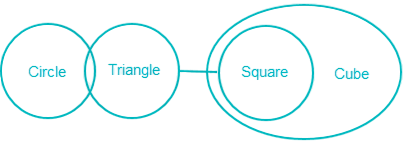
Conclusions:
I. No Triangle is a Cube → False (it is possible but not definite.)
II. Some Circles are Squares → False (it is possible but not definite.)Hence, neither conclusion I nor II follows.
12. Direction: Read the following information carefully and answer the questions based on given information.
A certain number of person sit on a horizontal row and faces towards north direction. Only two persons sit between K and S. The number of person sit between S and M is same as between M and Y. Q sits immediate left to S. M sits five places away from K. Y is the only neighbour of F. M and Q do not sit adjacent to each other. K sits at extreme end.
Question:
Who among the following sits two places away from K?
A. Q
B. S
C. M
D. Y
E. F
Solution
Given: A certain number of person sit on a horizontal row and faces towards north direction.
1) Y is the only neighbour of F.
2) K sits at extreme end.
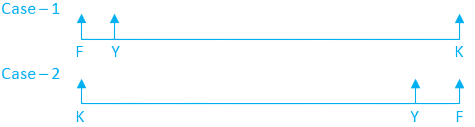
3) M sits five places away from K.
4) Only two persons sit between K and S.
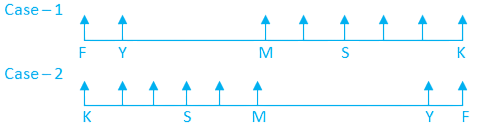
5) The number of person sit between S and M is same as between M and Y.
6) Q sits immediate left to S.
7) M and Q do not sit adjacent to each other. Therefore, case 1 is eliminated. Hence, the final arrangement is as follows

Hence, Q sits two places away from K.
13. Direction: Read the following information carefully and answer the questions based on given information.
A certain number of person sit on a horizontal row and faces towards north direction. Only two persons sit between K and S. The number of person sit between S and M is same as between M and Y. Q sits immediate left to S. M sits five places away from K. Y is the only neighbour of F. M and Q do not sit adjacent to each other. K sits at extreme end.
Question:
Who sits second to the right of the person who sits fourth to left of Y?
A. M
B. S
C. Q
D. K
E. F
Solution
Given: A certain number of person sit on a horizontal row and faces towards north direction.
1) Y is the only neighbour of F.
2) K sits at extreme end.
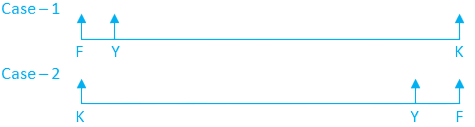
3) M sits five places away from K.
4) Only two persons sit between K and S.
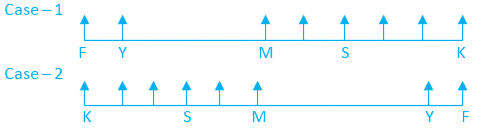
5) The number of person sit between S and M is same as between M and Y.
6) Q sits immediate left to S.
7) M and Q do not sit adjacent to each other. Therefore, case 1 is eliminated. Hence, the final arrangement is as follows

Since, S sits fourth to the left of Y and M sits second to the right of S.
Hence, the correct answer is M.
14. Direction: Read the following information carefully and answer the questions based on given information.
A certain number of person sit on a horizontal row and faces towards north direction. Only two persons sit between K and S. The number of person sit between S and M is same as between M and Y. Q sits immediate left to S. M sits five places away from K. Y is the only neighbour of F. M and Q do not sit adjacent to each other. K sits at extreme end.
Question:
Which of the following statement(s) is/ are correct?
A) Only two persons sit between Q and M.
B) One person sits between K and Q.
C) Y sits immediate right of F.
A. Only A
B. Both A and B
C. Both B and C
D. Only B
E. None of these
Solution
Given: A certain number of person sit on a horizontal row and faces towards north direction.
1) Y is the only neighbour of F.
2) K sits at extreme end.
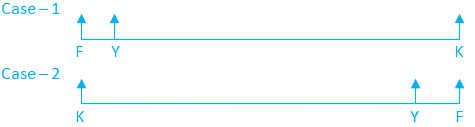
3) M sits five places away from K.
4) Only two persons sit between K and S.

5) The number of person sit between S and M is same as between M and Y.
6) Q sits immediate left to S.
7) M and Q do not sit adjacent to each other. Therefore, case 1 is eliminated. Hence, the final arrangement is as follows

Since, only two persons sit between Q and M. Therefore, statement A is correct.
One person can sit between K and Q but no one actually sat there.Therefore, statement B is correct.
Y sits immediate left of F. Therefore, statement C is incorrect.
Hence, the correct answer is only A and B.
15. Directions: Study the following information carefully and answer the questions that follow.
Eight people Z1, Z2, Z3, Z4, Z5, Z6, Z7, and Z8 are living on an eight floored building (The ground floor is numbered 1 above is number 2 and so on the topmost floor is numbered 8) but not necessarily in the same order. Z4 lives on an odd-numbered floor but above the 4th floor. Two persons live between Z4 and Z3. Z7 lives on the odd-numbered floor but not on the bottom floor. There is one person living between Z3 and Z1, who lives just below Z5. Total number of persons living between Z6 and Z2 is the same as the total number of persons living between Z6 and Z1.
Question:
Which of the following given statements is / are true?
A. All of the given statements are true
B. Z8 lives on an odd numbered floor
C. Only two persons live between Z8 and Z7
D. Z8 lives on an even numbered floor
E. Z8 live immediately above Z2
Solution
Given: Eight people Z1, Z2, Z3, Z4, Z5, Z6, Z7, and Z8 are living on an eight floored building (The ground floor is numbered 1 above is number 2 and so on topmost floor is numbered 8)
1) Z4 lives on an odd-numbered floor but above the 4th floor.
2) Two persons live between Z4 and Z3
| Floor | Case 1 | Case 1.1 | Case 2 |
| 8 | Z3 | ||
| 7 | Z4 | ||
| 6 | |||
| 5 | Z4 | Z4 | |
| 4 | Z3 | ||
| 3 | |||
| 2 | Z3 | ||
| 1 |
3) There is one person living between Z3 and Z1, who lives just below Z5 → Case 1.1 gets canceled
4) Z7 lives on the odd number floor but not on the bottom floor.
| Floor | Case 1 | Case 2 |
| 8 | Z3 | |
| 7 | Z5 | Z4 |
| 6 | Z1 | |
| 5 | Z4 | Z7 |
| 4 | Z3 | |
| 3 | Z7 | Z5 |
| 2 | Z1 | |
| 1 |
5) Total number of persons living between Z6 and Z2 is the same as the total number of persons living between Z6 and Z1 → Case 2 gets canceled
So, the final arrangement will be
| Floor | Case 1 |
| 8 | Z3 |
| 7 | Z5 |
| 6 | Z1 |
| 5 | Z4 |
| 4 | Z6 |
| 3 | Z7 |
| 2 | Z2 |
| 1 | Z8 |
Hence, Z8 lives on an odd-numbered floor.
16. Directions: Study the following information carefully and answer the questions that follow.
Eight people Z1, Z2, Z3, Z4, Z5, Z6, Z7, and Z8 are living on an eight floored building (The ground floor is numbered 1 above is number 2 and so on the topmost floor is numbered 8) but not necessarily in the same order. Z4 lives on an odd-numbered floor but above the 4th floor. Two persons live between Z4 and Z3. Z7 lives on the odd-numbered floor but not on the bottom floor. There is one person living between Z3 and Z1, who lives just below Z5. Total number of persons living between Z6 and Z2 is the same as the total number of persons living between Z6 and Z1.
Question:
Who among the following lives between Z4 and Z5?
A. Z2
B. Z3
C. Z7
D. Z8
E. None of these
Solution
Given: Eight people Z1, Z2, Z3, Z4, Z5, Z6, Z7, and Z8 are living on an eight floored building (The ground floor is numbered 1 above is number 2 and so on topmost floor is numbered 8)
1) Z4 lives on an odd-numbered floor but above the 4th floor.
2) Two persons live between Z4 and Z3
| Floor | Case 1 | Case 1.1 | Case 2 |
| 8 | Z3 | ||
| 7 | Z4 | ||
| 6 | |||
| 5 | Z4 | Z4 | |
| 4 | Z3 | ||
| 3 | |||
| 2 | Z3 | ||
| 1 |
3) There is one person living between Z3 and Z1, who lives just below Z5 → Case 1.1 gets canceled
4) Z7 lives on the odd number floor but not on the bottom floor.
| Floor | Case 1 | Case 2 |
| 8 | Z3 | |
| 7 | Z5 | Z4 |
| 6 | Z1 | |
| 5 | Z4 | Z7 |
| 4 | Z3 | |
| 3 | Z7 | Z5 |
| 2 | Z1 | |
| 1 |
5) Total number of persons living between Z6 and Z2 is the same as the total number of persons living between Z6 and Z1 → Case 2 gets canceled
So, the final arrangement will be
| Floor | Case 1 |
| 8 | Z3 |
| 7 | Z5 |
| 6 | Z1 |
| 5 | Z4 |
| 4 | Z6 |
| 3 | Z7 |
| 2 | Z2 |
| 1 | Z8 |
Z1 lives between Z4 and Z5.
Hence, the answer is none of these
17. Directions: Study the following information carefully and answer the questions that follow.
Eight people Z1, Z2, Z3, Z4, Z5, Z6, Z7, and Z8 are living on an eight floored building (The ground floor is numbered 1 above is number 2 and so on the topmost floor is numbered 8) but not necessarily in the same order. Z4 lives on an odd-numbered floor but above the 4th floor. Two persons live between Z4 and Z3. Z7 lives on the odd-numbered floor but not on the bottom floor. There is one person living between Z3 and Z1, who lives just below Z5. Total number of persons living between Z6 and Z2 is the same as the total number of persons living between Z6 and Z1.
Question:
Four of the following five are alike in a certain way and so form a group, find the one who does not belong to the group.
A. Z3
B. Z1
C. Z4
D. Z6
E. Z2
Solution
Given: Eight people Z1, Z2, Z3, Z4, Z5, Z6, Z7, and Z8 are living on an eight floored building (The ground floor is numbered 1 above is number 2 and so on topmost floor is numbered 8)
1) Z4 lives on an odd-numbered floor but above the 4th floor.
2) Two persons live between Z4 and Z3
| Floor | Case 1 | Case 1.1 | Case 2 |
| 8 | Z3 | ||
| 7 | Z4 | ||
| 6 | |||
| 5 | Z4 | Z4 | |
| 4 | Z3 | ||
| 3 | |||
| 2 | Z3 | ||
| 1 |
3) There is one person living between Z3 and Z1, who lives just below Z5 → Case 1.1 gets canceled
4) Z7 lives on the odd number floor but not on the bottom floor.
| Floor | Case 1 | Case 2 |
| 8 | Z3 | |
| 7 | Z5 | Z4 |
| 6 | Z1 | |
| 5 | Z4 | Z7 |
| 4 | Z3 | |
| 3 | Z7 | Z5 |
| 2 | Z1 | |
| 1 |
5) Total number of persons living between Z6 and Z2 is the same as the total number of persons living between Z6 and Z1 → Case 2 gets canceled
So, the final arrangement will be
| Floor | Case 1 |
| 8 | Z3 |
| 7 | Z5 |
| 6 | Z1 |
| 5 | Z4 |
| 4 | Z6 |
| 3 | Z7 |
| 2 | Z2 |
| 1 | Z8 |
Z4 lives on an odd-numbered floor, while others live on an even-numbered floor.
Hence, Z4 does not belong to the group.
18. Directions: Study the following information carefully and answer the questions that follow.
Eight people Z1, Z2, Z3, Z4, Z5, Z6, Z7, and Z8 are living on an eight floored building (The ground floor is numbered 1 above is number 2 and so on the topmost floor is numbered 8) but not necessarily in the same order. Z4 lives on an odd-numbered floor but above the 4th floor. Two persons live between Z4 and Z3. Z7 lives on the odd-numbered floor but not on the bottom floor. There is one person living between Z3 and Z1, who lives just below Z5. Total number of persons living between Z6 and Z2 is the same as the total number of persons living between Z6 and Z1.
Question:
How many persons live between Z4 and Z3?
A. Three
B. Two
C. One
D. Four
E. More than four
Solution
Given: Eight people Z1, Z2, Z3, Z4, Z5, Z6, Z7, and Z8 are living on an eight floored building (The ground floor is numbered 1 above is number 2 and so on topmost floor is numbered 8)
1) Z4 lives on an odd-numbered floor but above the 4th floor.
2) Two persons live between Z4 and Z3
| Floor | Case 1 | Case 1.1 | Case 2 |
| 8 | Z3 | ||
| 7 | Z4 | ||
| 6 | |||
| 5 | Z4 | Z4 | |
| 4 | Z3 | ||
| 3 | |||
| 2 | Z3 | ||
| 1 |
3) There is one person living between Z3 and Z1, who lives just below Z5 → Case 1.1 gets canceled
4) Z7 lives on the odd number floor but not on the bottom floor.
| Floor | Case 1 | Case 2 |
| 8 | Z3 | |
| 7 | Z5 | Z4 |
| 6 | Z1 | |
| 5 | Z4 | Z7 |
| 4 | Z3 | |
| 3 | Z7 | Z5 |
| 2 | Z1 | |
| 1 |
5) Total number of persons living between Z6 and Z2 is the same as the total number of persons living between Z6 and Z1 → Case 2 gets canceled
So, the final arrangement will be
| Floor | Case 1 |
| 8 | Z3 |
| 7 | Z5 |
| 6 | Z1 |
| 5 | Z4 |
| 4 | Z6 |
| 3 | Z7 |
| 2 | Z2 |
| 1 | Z8 |
Hence, two persons live between Z4 and Z3
19. Directions: Study the following information carefully and answer the questions that follow.
Eight people Z1, Z2, Z3, Z4, Z5, Z6, Z7, and Z8 are living on an eight floored building (The ground floor is numbered 1 above is number 2 and so on the topmost floor is numbered 8) but not necessarily in the same order. Z4 lives on an odd-numbered floor but above the 4th floor. Two persons live between Z4 and Z3. Z7 lives on the odd-numbered floor but not on the bottom floor. There is one person living between Z3 and Z1, who lives just below Z5. Total number of persons living between Z6 and Z2 is the same as the total number of persons living between Z6 and Z1.
Question:
Who among the following lives on second floor?
A. Z5
B. Z8
C. Z2
D. Z3
E. Noe of these
Solution
Given: Eight people Z1, Z2, Z3, Z4, Z5, Z6, Z7, and Z8 are living on an eight floored building (The ground floor is numbered 1 above is number 2 and so on topmost floor is numbered 8)
1) Z4 lives on an odd-numbered floor but above the 4th floor.
2) Two persons live between Z4 and Z3
| Floor | Case 1 | Case 1.1 | Case 2 |
| 8 | Z3 | ||
| 7 | Z4 | ||
| 6 | |||
| 5 | Z4 | Z4 | |
| 4 | Z3 | ||
| 3 | |||
| 2 | Z3 | ||
| 1 |
3) There is one person living between Z3 and Z1, who lives just below Z5 → Case 1.1 gets canceled
4) Z7 lives on the odd number floor but not on the bottom floor.
| Floor | Case 1 | Case 2 |
| 8 | Z3 | |
| 7 | Z5 | Z4 |
| 6 | Z1 | |
| 5 | Z4 | Z7 |
| 4 | Z3 | |
| 3 | Z7 | Z5 |
| 2 | Z1 | |
| 1 |
5) Total number of persons living between Z6 and Z2 is the same as the total number of persons living between Z6 and Z1 → Case 2 gets canceled
So, the final arrangement will be
| Floor | Case 1 |
| 8 | Z3 |
| 7 | Z5 |
| 6 | Z1 |
| 5 | Z4 |
| 4 | Z6 |
| 3 | Z7 |
| 2 | Z2 |
| 1 | Z8 |
Hence, Z2 lives on the second floor
20. If in the number “25438976”, the prime number digits of a number are added by two and rest of the digits of a number remains same, then what is the difference of the first digit from the left side and the third digit from the right side after the operation?
A. 2
B. 4
C. 1
D. 5
E. 3
Solution
Given number:- 25438976
Operation: The prime number digits are added by 2.
| Given number | 2 | 5 | 4 | 3 | 8 | 9 | 7 | 6 |
| Operation | +2 | +2 | – | +2 | – | – | +2 | – |
| Output | 4 | 7 | 4 | 5 | 8 | 9 | 9 | 6 |
Since, the first digit from left side is 4 and third digit from the right side is 9.
Therefore, their difference = 9 – 4 = 5.
Hence, the correct answer is 5.
21. Direction: Read the following information carefully and answer the questions that follow:
In a certain code language:
‘We live good life’ is written as ‘Ke Ta Pu Ja’
‘Good life is must’ is written as ‘Bn Ta Yo Pu’
‘One must live well’ is written as ‘Ke Rm Dm Yo’
‘You must try one’ is written as ‘Li Sc Yo Dm’
Question:
What is the code for the word ‘is’?
A. Bn
B. Yo
C. Sc
D. Pu
E. Ta
Solution
After identifying the words and codes that are common in sentences, we get:

The word ‘is’ appears only in the second sentence. It is the only word in the second sentence that is not used in any other sentence. Accordingly, the code ‘Bn’ appears only on the second sentence.Implies, ‘Bn’ is the code for the word ‘is’.
22. Direction: Read the following information carefully and answer the questions that follow:
In a certain code language:
‘We live good life’ is written as ‘Ke Ta Pu Ja’
‘Good life is must’ is written as ‘Bn Ta Yo Pu’
‘One must live well’ is written as ‘Ke Rm Dm Yo’
‘You must try one’ is written as ‘Li Sc Yo Dm’
Question:
What is the code for the word ‘good’?
A. Ta
B. Ke
C. Pu
D. Either Ke or Ta
E. Either Ta or Pu
Solution
After identifying the words and codes that are common in sentences, we get:

The words ‘good’ and ‘life’ are common in the first two sentences and so are the codes ‘Ta’ and ‘Pu’. Thus, either ‘Ta’ or ‘Pu’ is the code for the word ‘good’.
23. Direction: Read the following information carefully and answer the questions that follow:
In a certain code language:
‘We live good life’ is written as ‘Ke Ta Pu Ja’
‘Good life is must’ is written as ‘Bn Ta Yo Pu’
‘One must live well’ is written as ‘Ke Rm Dm Yo’
‘You must try one’ is written as ‘Li Sc Yo Dm’
Question:
What does the code ‘Rm’ represents?
A. Must
B. Well
C. Live
D. Life
E. One
Solution
After identifying the words and codes that are common in sentences, we get:
Clearly, the code ‘Rm’ represents the word ‘well’.
24. Direction: Read the following information carefully and answer the questions that follow:
In a certain code language:
‘We live good life’ is written as ‘Ke Ta Pu Ja’
‘Good life is must’ is written as ‘Bn Ta Yo Pu’
‘One must live well’ is written as ‘Ke Rm Dm Yo’
‘You must try one’ is written as ‘Li Sc Yo Dm’
Question:
What is the code for the word ‘one’?
A. Yo
B. Ke
C. Rm
D. Dm
E. Li
Solution
After identifying the words and codes that are common in sentences, we get:
Clearly, the code for the word ‘one’ is ‘Dm’.
25. Directions: In the following question assuming the given statements to be True, find which of the conclusions among given conclusions is/are definitely true and then give your answers accordingly.
Statements: L < G ≤ D > P = E > R; S > D < W = J
Conclusions:
I. R < S
II. S > E
A. Only II is True
B. Only I is True
C. Both I and II are True
D. Either I or II is true
E. None is True
Solution
Given statements: L < G ≤ D > P = E > R; S > D < W = J
On combining: S > D > P = E > R
Conclusions:
I. R < S → True (as S > P = E > R)
II. S > E → True (as S > D > P = E)Therefore, both conclusions I and II are True.
26. Directions: In the following question assuming the given statements to be True, find which of the conclusion among given conclusions is/are definitely true and then give your answers accordingly.
Statements: Z = F < V < X = O ≤ M; C = G ≥ I > X ≥ N > A
Conclusions:
I. M ≥ N
II. I > F
A. Only II is True
B. Only I is True
C. Both I and II are True
D. Either I or II is True
E. None is true
Solution
Given statements: Z = F < V < X = O ≤ M; C = G ≥ I > X ≥ N > A
On combining: Z = F < V < X = O ≥ N > A ; C = G ≥ I > X = O ≤ M
Conclusions:
I. M ≥ N → True (as X = O ≤ M and X ≥ N → M ≥ N)
II. I > F → True (as F < V < X and I > X → I > F)
Hence, both I and II is True.
27. Directions: In the following question assuming the given statements to be True, find which of the conclusion among given conclusions is/are definitely true and then give your answers accordingly.
Statements: L < Q = V = D ≥ I ≤ H; E > G < I = Z ≥ Y ≥ A
Conclusions:
I. Y < V
II. Y = V
A. Only II is True
B. Only I is True
C. Both I and II are True
D. Either I or II is True
E. None is true
Solution
Given statements: L < Q = V = D ≥ I ≤ H; E > G < I = Z ≥ Y ≥ A
On combining: L < Q = V = D ≥ I = Z ≥ Y ≥ A; E > G < I ≤ H
Conclusions:
I. Y < V → False (as V = D ≥ I and I = Z ≥ Y → Y ≤ V)
II. Y = V → False (as Z ≥ Y ≥ L ≥ Q = V = D → Y ≤ V)
Therefore, conclusion I and II forms a complementary pair.
Hence, Either I or II is True.
28. Directions: Read the following information and answer the given questions:Eight persons P, Q, R, S, T, U, V and W are seated around a circle facing outside the centre but not necessarily in the same order. One person sits between T and Q. Q is sitting either to the left of T or to the right of T. W sits third to the left of Q. R sits to the immediate right of P Neither R nor P is an immediate neighbour of W and Q. V sits second to the left of S.
Question:
Four of the following five are alike in a certain way and hence form a group. Who among the following does not belong to that group?
A. S-V
B. Q-T
C. W-R
D. U-T
E. R-S
Solution
Persons: P, Q, R, S, T, U, V and W. (Facing outside the centre)
1) One person sits between T and Q. Q is sitting either to the left of T or to the right of T.
2) W sits third to the left of Q.
3) R sits to the immediate right of P.
4) Neither R nor P is an immediate neighbour of W and Q.

5) V sits second to the left of S.

The final arrangement will be:

In all the given pairs the second person is sitting second to the left of the first person. Except for U-T, in which the second person T is sitting second to the right of U who is the first person.
Hence, ‘U-T’ does not belong to the group.
29. Directions: Read the following information and answer the given questions:Eight persons P, Q, R, S, T, U, V and W are seated around a circle facing outside the centre but not necessarily in the same order. One person sits between T and Q. Q is sitting either to the left of T or to the right of T. W sits third to the left of Q. R sits to the immediate right of P Neither R nor P is an immediate neighbour of W and Q. V sits second to the left of S.
Question:
How many persons are sitting between T and S when counted in an anti-clock wise direction from T?
A. Four
B. Two
C. Three
D. Five
E. One
Solution
Persons: P, Q, R, S, T, U, V and W. (Facing outside the centre)
1) One person sit between T and Q.Q is sitting either to the left of T or to the right of T.
2) W sits third to the left of Q.
3) R sits to the immediate right of P.
4) Neither R nor P is an immediate neighbour of W and Q.
5) V sits second to the left of S.
The final arrangement will be:
Hence, four persons are sitting between T and S when counted in an anti-clock wise direction from T.
30. Directions: Read the following information and answer the given questions:Eight persons P, Q, R, S, T, U, V and W are seated around a circle facing outside the centre but not necessarily in the same order. One person sits between T and Q. Q is sitting either to the left of T or to the right of T. W sits third to the left of Q. R sits to the immediate right of P Neither R nor P is an immediate neighbour of W and Q. V sits second to the left of S.
Question:
What is the position of P with respect to U?
A. Third to the left
B. Second to the left
C. Second to the right
D. Third to the right
E. None of these
Solution
Persons: P, Q, R, S, T, U, V and W. (Facing outside the centre)
1) One person sits between T and Q.Q is sitting either to the left of T or to the right of T.
2) W sits third to the left of Q.
3) R sits to the immediate right of P.
4) Neither R nor P is an immediate neighbour of W and Q.
5) V sits second to the left of S.
The final arrangement will be:
Hence, P is sitting second to the left of U.
31. Directions: Read the following information and answer the given questions:Eight persons P, Q, R, S, T, U, V and W are seated around a circle facing outside the centre but not necessarily in the same order. One person sits between T and Q. Q is sitting either to the left of T or to the right of T. W sits third to the left of Q. R sits to the immediate right of P Neither R nor P is an immediate neighbour of W and Q. V sits second to the left of S.
Question:
Who is sitting between W and V going clockwise from W?
A. P
B. R
C. U
D. T
E. Q
Solution
Persons: P, Q, R, S, T, U, V and W. (Facing outside the centre)
1) One person sits between T and Q. Q is sitting either to the left of T or to the right of T.
2) W sits third to the left of Q.
3) R sits to the immediate right of P.
4) Neither R nor P is an immediate neighbour of W and Q.
5) V sits second to the left of S.
The final arrangement will be:
Hence, T is sitting between W and V.
32. Direction: Read the following information carefully and answer the questions based on given information.
In a seven member family there are two married couples. V is the brother of A’s spouse. K is the father – in – law of G. S is the uncle of R who is the grandchild of A. L is the only daughter of K. Both G and R have same gender. L is not the wife of G.
Question:
How is S related to V?
A. Uncle
B. Brother
C. Niece
D. Nephew
E. Son
Solution

From the given information, persons are A, G, K, L, R, S and V.
1) S is the uncle of R who is the grandchild of A. So, A belongs to third generation.
2) V is the brother of A’s spouse.
3) K is the father – in – law of G. So, K may be husband of A and brother of V.
4) L is the only daughter of K. So, R is the child of L and S is the brother of L.
5) Since, L is not the wife of G. So G is the wife of R.
6) Both G and R have same gender. Therefore, R is the female person.
Hence, the family tree of given members is as follows

Hence, S is the nephew of V.
33. Direction: Read the following information carefully and answer the questions based on given information.
In a seven member family there are two married couples. V is the brother of A’s spouse. K is the father – in – law of G. S is the uncle of R who is the grandchild of A. L is the only daughter of K. Both G and R have same gender. L is not the wife of G.
Question:
What is relation of A with respect to G?
A. Mother
B. Father
C. Grandparent
D. Mother – in – law
E. Sister
Solution
From the given information, persons are A, G, K, L, R, S and V.
1) S is the uncle of R who is the grandchild of A. So, A belongs to third generation.
2) V is the brother of A’s spouse.
3) K is the father – in – law of G. So, K may be husband of A and brother of V.
4) L is the only daughter of K. So, R is the child of L and S is the brother of L.
5) Since, L is not the wife of G. So G is the wife of R.
6) Both G and R have same gender. Therefore, R is the female person.
Hence, the family tree of given members is as follows
Hence, A is the mother – in – law of G.
34. Direction: Read the following information carefully and answer the questions based on given information.
In a seven member family there are two married couples. V is the brother of A’s spouse. K is the father – in – law of G. S is the uncle of R who is the grandchild of A. L is the only daughter of K. Both G and R have same gender. L is not the wife of G.
Question:
Which of the following statement is correct?
A. L is the sister of G.
B. R is the daughter of S.
C. V is the uncle of A.
D. G is the aunt of R.
E. None of these
Solution
From the given information, persons are A, G, K, L, R, S and V.
1) S is the uncle of R who is the grandchild of A. So, A belongs to third generation.
2) V is the brother of A’s spouse.
3) K is the father – in – law of G. So, K may be husband of A and brother of V.
4) L is the only daughter of K. So, R is the child of L and S is the brother of L.
5) Since, L is not the wife of G. So G is the wife of R.
6) Both G and R have same gender. Therefore, R is the female person.
Hence, the family tree of given members is as follows
Since, G is the sister – in – law of L. So, statement 1 is incorrect.
R is the niece of S. So, statement 2 is incorrect.
V is the brother – in – law of A. So, statement 3 is incorrect.
G is the aunt of R. So, statement 4 is correct.
Hence, the correct statement is G is the aunt of R.
35. If it is possible to make a five letters meaningful word from the second letter, fifth letter, seventh letter, ninth letter and eleventh letter of a word “DISCONSOLATE”, then which of the following is the third letter of the word ? If more than one such word can be made, then give “R” as the answer, and if no such word can be formed then give “V” as the answer.
A. R
B. T
C. O
D. I
E. V
Solution
Given word:- DISCONSOLATE
The second letter is ‘I’, the fifth letter is ‘O’, the seventh letter is ‘S, the ninth letter is ‘L’ and the eleventh letter is ‘T’.
The only possible meaningful word formed by using these letters are Toils.
Hence, the correct answer is I.
36.In a sale, a discount of 15% was available on all the articles. If Vinit purchased an article for Rs. 4284 in the sale, what was the actual selling price of the article?
A. Rs. 5050
B. Rs. 5000
C. Rs. 5140
D. Rs. 4950
E. None of these
Solution
Given
Cost price of the object Rs. 4284
Discount = 15%
Formula used
Profit = [(SP – CP)/CP ] × 100
CP = Cost price
SP = Selling price
Calculation
Actual selling price

37. Direction: Read the following Caselet DI carefully and answer the following questions.In a shop, the shopkeeper sells 4 different brands of bulb and tube lights that is Syska, Philips, Bajaj and Havells. Total number of tube lights in shop is 500 and is 100% more than the number of bulbs in the shop. Number of tube lights of Havells is 150% of the bulbs of Syska which is equal to the bulbs of Bajaj available in the shop which is 80 in number. Number of bulbs of Philips is half of the number of bulbs of Syska. Number of tube lights of Philips is 40 more than the number of tube lights of Bajaj and number of tube lights of Syska is 20 less than the number of tube lights of Bajaj.
Question:
Find the difference between average of bulbs of Syska and Philips together to the average of tube lights of Bajaj and Havells.
A. 60
B. 50
C. 80
D. 70
E. 55
Solution
Number of tube lights is 100% more than the total bulbs in the shop
And, Number of tube lights = 500
So, Number of bulbs in the shops = (500 / 200) × 100 = 250
Bulbs of syska = Bulbs of Bajaj = 80
Tube lights of Havells = (150 / 100) × 80 = 120
Bulbs of Philips = (1 / 2) × bulbs of syska
⇒ (1 / 2) × 80 = 40
Let the tube lights of bajaj be x
So, tube light of Philips = x + 40
And, tube light of syska = x – 20
And according to Caselet
⇒ x – 20 + x + 40 + x + 120 = 500
⇒ 3x + 140 = 500
⇒ x = 120
So, the tube lights of Bajaj = 120
Tube light of Philips = 160
Tube light of syska = 100
Bulbs of Havells = 250 – (80 + 40 + 80) = 50
| Bulbs | Tube lights | |
| Syska | 80 | 100 |
| Philips | 40 | 160 |
| Bajaj | 80 | 120 |
| Havells | 50 | 120 |
According to question,
Average of bulbs of syska and Philips = (80 + 40) / 2 = 60
Average of tube lights of Bajaj and Havels = (120 + 120) / 2 = 120
⇒ Required difference = 120 – 60 = 60∴ The difference between the asked averages is 60
38. Direction: Read the following Caselet DI carefully and answer the following questions.In a shop, the shopkeeper sells 4 different brands of bulb and tube lights that is Syska, Philips, Bajaj and Havells. Total number of tube lights in shop is 500 and is 100% more than the number of bulbs in the shop. Number of tube lights of Havells is 150% of the bulbs of Syska which is equal to the bulbs of Bajaj available in the shop which is 80 in number. Number of bulbs of Philips is half of the number of bulbs of Syska. Number of tube lights of Philips is 40 more than the number of tube lights of Bajaj and number of tube lights of Syska is 20 less than the number of tube lights of Bajaj.
Question:
Find the ratio between total number of Havells items in the shop to the total number of Philips items in the shop.
A. 13 : 17
B. 17 : 20
C. 20 : 19
D. 20 : 17
E. 13 : 19
Solution
Number of tube light is 100% more than the number of bulbs in the shop
So, total bulbs in the shops = 500 / 200 × 100 = 250
Bulbs of syska = bulb of bajaj = 80
Tube lights of Havels = 150 / 100 × 80 = 120
Bulbs of Philips = (1 / 2) × bulbs of syska
= (1 / 2) × 80 = 40
Let the tube lights of bajaj be x
So, tube light of Philips = x + 40
And, tube light of syska = x – 20
And according to Caselet
⇒ x – 20 + x + 40 + x + 120 = 500
⇒ 3x + 140 = 500
⇒ x = 120
So, the tube lights of Bajaj = 120
Tube light of Philips = 160
Tube light of syska = 100
Bulbs of Havels = 250 – (80 + 40 + 80)
= 50
| Bulbs | Tube lights | |
| Syska | 80 | 100 |
| Philips | 40 | 160 |
| Bajaj | 80 | 120 |
| Havels | 50 | 120 |
According to question,
Total items of Havels in the shop = 50 + 120 = 170
Total items of Philips in the shop = 40 + 160 = 200
⇒ Required ratio = 170 : 200
⇒ 17 : 20∴ The ratio between total number of Havells items in the shop to the total number of Philips items in the shop is 17 : 20
39. Direction: Read the following Caselet DI carefully and answer the following questions.In a shop, the shopkeeper sells 4 different brands of bulb and tube lights that is Syska, Philips, Bajaj and Havells. Total number of tube lights in shop is 500 and is 100% more than the number of bulbs in the shop. Number of tube lights of Havells is 150% of the bulbs of Syska which is equal to the bulbs of Bajaj available in the shop which is 80 in number. Number of bulbs of Philips is half of the number of bulbs of Syska. Number of tube lights of Philips is 40 more than the number of tube lights of Bajaj and number of tube lights of Syska is 20 less than the number of tube lights of Bajaj.
Question:
The number of Bulbs of Philips is what percent of number of tube light of Bajaj?
A. 66.67%
B. 12.5%
C. 56%
D. 45%
E. 33.33%
Solution
According to Caselet tube light is 100% more than the total bulbs in the shop
So, total bulbs in the shops = 500 / 200 × 100 = 250
Bulbs of syska = bulb of bajaj = 80
Tube lights of Havels = 150 / 100 × 80 = 120
Bulbs of Philips = (1 / 2) × bulbs of syska
= (1 / 2) × 80 = 40
Let the number of tube lights of bajaj be x
So, tube light of Philips = x + 40
And, tube light of syska = x – 20
And according to Caselet
⇒ x – 20 + x + 40 + x + 120 = 500
⇒ 3x + 140 = 500
⇒ x = 120
So, the tube lights of Bajaj = 120
Tube light of Philips = 160
Tube light of syska = 100
Bulbs of Havels = 250 – (80 + 40 + 80) = 50
| Bulbs | Tube lights | |
| Syska | 80 | 100 |
| Philips | 40 | 160 |
| Bajaj | 80 | 120 |
| Havels | 50 | 120 |
Now, Bulb of Philips = 40
Tube light of bajaj = 120
⇒ Required percentage = (40 / 120) × 100 = 33.33%∴ The number of bulbs of Philips is 33.33% of the number of tube lights of Bajaj
40. Direction: Read the following Caselet DI carefully and answer the following questions.In a shop, the shopkeeper sells 4 different brands of bulb and tube lights that is Syska, Philips, Bajaj and Havells. Total number of tube lights in shop is 500 and is 100% more than the number of bulbs in the shop. Number of tube lights of Havells is 150% of the bulbs of Syska which is equal to the bulbs of Bajaj available in the shop which is 80 in number. Number of bulbs of Philips is half of the number of bulbs of Syska. Number of tube lights of Philips is 40 more than the number of tube lights of Bajaj and number of tube lights of Syska is 20 less than the number of tube lights of Bajaj.
Question:
If the number of bulb of bajaj is increased by 80% then, what will be the increased value of bulb in the shop?
A. 314
B. 320
C. 304
D. 300
E. 294
Solution
According to Caselet tube light is 100% more than the total bulbs in the shop
So, total bulbs in the shops = 500 / 200 × 100 = 250
Bulbs of syska = bulb of bajaj = 80
Tube lights of Havels = 150 / 100 × 80 = 120
Bulbs of Philips = (1 / 2) × bulbs of syska
= (1 / 2) × 80 = 40
Let the tube lights of bajaj be x
So, tube light of Philips = x + 40
And, tube light of syska = x – 20
And according to Caselet
x – 20 + x + 40 + x + 120 = 500
3x + 140 = 500
X = 120
So, the tube lights of Bajaj = 120
Tube light of Philips = 160
Tube light of syska = 100
Bulbs of Havels = 250 – (80 + 40 + 80)
= 50
| Bulbs | Tube lights | |
| Syska | 80 | 100 |
| Philips | 40 | 160 |
| Bajaj | 80 | 120 |
| Havels | 50 | 120 |
According to question,
Bulb of bajaj increased by 80% that is = 80 × 80 / 100 = 64
So, bulb of bajaj = 80 + 64 = 144
So, total bulbs = 80 + 40 + 144 + 50 = 314∴ The total number of bulbs is 314
41. Direction: Read the following Caselet DI carefully and answer the following questions.In a shop, the shopkeeper sells 4 different brands of bulb and tube lights that is Syska, Philips, Bajaj and Havells. Total number of tube lights in shop is 500 and is 100% more than the number of bulbs in the shop. Number of tube lights of Havells is 150% of the bulbs of Syska which is equal to the bulbs of Bajaj available in the shop which is 80 in number. Number of bulbs of Philips is half of the number of bulbs of Syska. Number of tube lights of Philips is 40 more than the number of tube lights of Bajaj and number of tube lights of Syska is 20 less than the number of tube lights of Bajaj.
Question:
Number of Tube light of Bajaj in shop is how much percent more than the bulbs of Havells in the shop.
A. 130%
B. 120%
C. 140%
D. 150%
E. 110%
Solution
Number of tube light is 100% more than the total bulbs in the shop
So, total bulbs in the shops = 500 / 200 × 100 = 250
Bulbs of syska = bulb of bajaj = 80
Tube lights of Havels = 150 / 100 × 80 = 120
Bulbs of Philips = (1 / 2) × bulbs of syska
⇒ (1 / 2) × 80 = 40
Let the tube lights of bajaj be x
So, tube light of Philips = x + 40
And, tube light of syska = x – 20
And according to Caselet
⇒ x – 20 + x + 40 + x + 120 = 500
⇒ 3x + 140 = 500
⇒ x = 120
So, the tube lights of Bajaj = 120
Tube light of Philips = 160
Tube light of syska = 100
Bulbs of Havels = 250 – (80 + 40 + 80)
= 50
| Bulbs | Tube lights | |
| Syska | 80 | 100 |
| Philips | 40 | 160 |
| Bajaj | 80 | 120 |
| Havels | 50 | 120 |
⇒ Required percentage = [(120 – 50) / 50] × 100 = 140%∴ The number of Tube light of Bajaj in shop is 140% percent more than the bulbs of Havells in the shop.
42. A and B can fill a tank in 20 and 25 hours respectively. Both are opened simultaneously and after some time B is closed and the tank is filled in 16 hours. Find time for which A works alone.
A. 8
B. 9
C. 10
D. 11
E. 12
Solution
Given:-
Time for A to fill the tank = 20 hours
Time for B to fill the tank = 25 hours
Total time taken to fill the tank = 16 hours.
Concept used:-
Considering capacity of tank equal to LCM of filling and emptying pipes/leaks.
Calculation:-
Capacity of tank = LCM of (20, 25) = 100 units
Work done by A in 1 hour = 100 / 20 = 5 units.
Work done by B in 1 hour = 100 / 25 = 4 units.
Let, B worked for x hours, then,
16 × 5 + 4 × x = 100
⇒ x = 5 hours.
A works alone for 16 – 5 = 11 hours.
∴ A works alone in 11 hours.
43. The area of the rectangle is divided equally into two squares, the perimeter of the rectangle is 36 cm. If the breadth of the rectangle is 6 cm. Find the area of the one square.
A. 18 cm2
B. 36 cm2
C. 48 cm2
D. 24 cm2
E. None of these
Solution
Solution:
Perimeter of the rectangle = 36 cm
2 × ( l + b) = 36
l + b = 18
l = 18 – 6
l = 12 cm
Area of the rectangle = 12 × 6 = 72 cm2
Area of the square = 72/2 = 36 cm2
Hence, otpion(2) is correct.
44. What approximate value should come in the place of question mark (?) in the following question?
[(1279.98)2 ÷ 32.23 × 23.94] ÷ 47.98 = ?2
A. 120
B. 96
C. 150
D. 84
E. 160
Solution
Follow BODMAS rule to solve this question, as per the order given below,
Step – 1: Parts of an equation enclosed in ‘Brackets’ must be solved first, and follow BODMAS rule in the bracket,
Step – 2: Any mathematical ‘Of’ or ‘Exponent’ must be solved next,
Step – 3: Next, the parts of the equation that contain ‘Division’ and ‘Multiplication’ are calculated,
Step – 4: Last but not least, the parts of the equation that contain ‘Addition’ and ‘Subtraction’ should be calculated.
Since, we need to find out the approximate value,
So, we can write these values to their nearest integers.
Given expression is
[(1279.98)2 ÷ 32.23 × 23.94] ÷ 47.98 = ?2
⇒ [(1280)2 ÷ 32 × 24] ÷ 48 = ?2
⇒ [(1280)2 × 24]/(32 × 48) = ?2
⇒ (1280)2/64 = ?2
⇒ ? = 1280/8 = 160
45. What approximate value should come in the place of question mark (?) in the following question?
4.99 + (1.922 + 4.95) × 3.94 – 2.98 = ?
A. 38
B. 42
C. 48
D. 52
E. 58
Solution
Follow BODMAS rule to solve this question, as per the order given below,
Step – 1: Parts of an equation enclosed in ‘Brackets’ must be solved first, and follow BODMAS rule in the bracket,
Step – 2: Any mathematical ‘Of’ or ‘Exponent’ must be solved next,
Step – 3: Next, the parts of the equation that contain ‘Division’ and ‘Multiplication’ are calculated,
Step – 4: Last but not least, the parts of the equation that contain ‘Addition’ and ‘Subtraction’ should be calculated.
Since, we need to find out the approximate value,
So, we can write these values to their nearest integers.
Given expression is
4.99 + (1.922 + 4.95) × 3.94 – 2.98 = ?
⇒ 5 + (22 + 5) × 4 – 3 = ?
⇒ 5 + 9 × 4 – 3 = ?
⇒ 5 + 36 – 3 = ?
⇒ 41 – 3 = ?
⇒ ? = 38
46.What approximate value should come in place of the question mark (?) in the following question?
(1875.96 ÷ 27.98) – (671.92 ÷ 55.96) = ?
A. 51
B. 45
C. 55
D. 32
E. 37
Solution
Concept Used:
Follow BODMAS rule to solve this question, as per the order given below,

Calculation:
(1875.96 ÷ 27.98) – (671.92 ÷ 55.96) = ?
⇒ (1876 ÷ 28) – (672 ÷ 56) = ?
⇒ 67 – 12 = ?
⇒ ? = 55
∴ The value of ? is 55
47. What approximate value should come in the of the question mark (?) in the following question?
620.99 ÷ 26.97 × 1.92 – 36.97 = √?
A. 64
B. 36
C. 144
D. 121
E. 81
Solution
Concept Used:
Follow BODMAS rule to solve this question, as per the order given below,
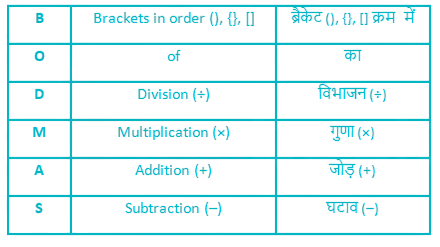
Calculation:
620.99 ÷ 26.97 × 1.92 – 36.97 = √?
⇒ 621 ÷ 27 × 2 – 37 = √?
⇒ 23 × 2 – 37 = √?
⇒ √? = 46 – 37
⇒ √? = 9
⇒ ? = 81
∴ The value of ? is 81
48. What approximate value should come in the place of question mark (?) in the following question?
325.05 – [(11.92)2 – 74.95] = (?)2 – 67.8
A. 16
B. 14
C. 22
D. 18
E. 24
Solution
Follow BODMAS rule to solve this question, as per the order given below,
Step – 1: Parts of an equation enclosed in ‘Brackets’ must be solved first, and follow BODMAS rule in the bracket,
Step – 2: Any mathematical ‘Of’ or ‘Exponent’ must be solved next,
Step – 3: Next, the parts of the equation that contain ‘Division’ and ‘Multiplication’ are calculated,
Step – 4: Last but not least, the parts of the equation that contain ‘Addition’ and ‘Subtraction’ should be calculated.
Since, we need to find out the approximate value,
So, we can write these values to their nearest integers.
Given expression is
325.05 – [(11.92)2 – 74.95] = (?)2 – 67.8
⇒ 325 – [(12)2 – 75] = (?)2 – 68
⇒ 325 – [144 – 75] + 68 = (?)2
⇒ 325 – 69 + 68 = (?)2
⇒ 324 = (?)2
⇒ 18 = ?
49. What approximate value should come in the place of question mark (?) in the following question?
673.8 – 457.2 + 518.9 = ? + (18.89)2
A. 324
B. 348
C. 382
D. 375
E. 368
Solution
Follow BODMAS rule to solve this question, as per the order given below,
Step – 1: Parts of an equation enclosed in ‘Brackets’ must be solved first, and follow BODMAS rule in the bracket,
Step – 2: Any mathematical ‘Of’ or ‘Exponent’ must be solved next,
Step – 3: Next, the parts of the equation that contain ‘Division’ and ‘Multiplication’ are calculated,
Step – 4: Last but not least, the parts of the equation that contain ‘Addition’ and ‘Subtraction’ should be calculated.
Since, we need to find out the approximate value,
So, we can write these values to their nearest integers.
Given expression is
673.8 – 457.2 + 518.9 = ? + (18.89)2
⇒ 674 – 457 + 519 = ? + (19)2
⇒ ? = 674 – 457 + 519 – (19)2
⇒ ? = 674 – 457 + 519 – 361
⇒ ? = 375
50. What approximate value should come in the place of question mark (?) in the following question?
286.97 × 56.97 + 240.91 = √624.95 × ?
A. 624
B. 616
C. 632
D. 648
E. 664
Solution
Follow BODMAS rule to solve this question, as per the order given below,
Step – 1: Parts of an equation enclosed in ‘Brackets’ must be solved first, and follow BODMAS rule in the bracket,
Step – 2: Any mathematical ‘Of’ or ‘Exponent’ must be solved next,
Step – 3: Next, the parts of the equation that contain ‘Division’ and ‘Multiplication’ are calculated,
Step – 4: Last but not least, the parts of the equation that contain ‘Addition’ and ‘Subtraction’ should be calculated.
Since, we need to find out the approximate value,
So, we can write these values to their nearest integers.
Given expression is
286.97 × 56.97 + 240.91 = √624.95 × ?
⇒ 287 × 57 + 241 = √625 × ?
⇒ 16359 + 241 = 25 × ?
⇒ 25 × ? = 16600
⇒ ? = 16600/25
⇒ ? = 664
51. What approximate value should come in the place of question mark (?) in the following question?
24.04 ÷ (19.91 – 11.97 ÷ 2.87 × 7.88) = ?
A. 2
B. 1
C. -2
D. -1
E. 9
Solution
Follow BODMAS rule to solve this question, as per the order given below,
Step – 1: Parts of an equation enclosed in ‘Brackets’ must be solved first, and follow BODMAS rule in the bracket,
Step – 2: Any mathematical ‘Of’ or ‘Exponent’ must be solved next,
Step – 3: Next, the parts of the equation that contain ‘Division’ and ‘Multiplication’ are calculated,
Step – 4: Last but not least, the parts of the equation that contain ‘Addition’ and ‘Subtraction’ should be calculated.
Since, we need to find out the approximate value,
So, we can write these values to their nearest integers.
Given expression is
24.04 ÷ (19.91 – 11.97 ÷ 2.87 × 7.88) = ?
⇒ 24 ÷ (20 – 12 ÷ 3 × 8) = ?
⇒ ? = 24 ÷ (20 – 12/3 × 8)
⇒ ? = 24 ÷ (20 – 4 × 8)
⇒ ? = 24 ÷ (20 – 4 × 8)
⇒ ? = 24 ÷ (20 – 32)
⇒ ? = 24 ÷ ( – 12)
⇒ ? = 24 ÷ -12
∴ ? = -2
52. What approximate value should come in the place of question mark (?) in the following question?
√14399.99 × √8099.99 – (59.9)2 = ? + (79.9)2
A. 800
B. 600
C. 1100
D. 900
E. 700
Solution
Follow BODMAS rule to solve this question, as per the order given below,
Step – 1: Parts of an equation enclosed in ‘Brackets’ must be solved first, and follow BODMAS rule in the bracket,
Step – 2: Any mathematical ‘Of’ or ‘Exponent’ must be solved next,
Step – 3: Next, the parts of the equation that contain ‘Division’ and ‘Multiplication’ are calculated,
Step – 4: Last but not least, the parts of the equation that contain ‘Addition’ and ‘Subtraction’ should be calculated.
Since, we need to find out the approximate value,
So, we can write these values to their nearest integers.
Given expression is
√14399.99 × √8099.99 – (59.9)2 = ? + (79.9)2
⇒ √14400 × √8100 – (60)2 = ? + (80)2
⇒ 120 × 90 – 3600 = ? + 6400
⇒10800 – 10000 = ?
⇒ ? = 800
53. What approximate value should come in the place of question mark (?) in the following question?
2% of (298.99 + 15.982 – 255.11) = ?
A. 2
B. 3
C. 4
D. 5
E. 6
Solution
2% of (298.99 + 15.982 – 255.11) = ?
Taking approximate values, we get
2% of (300 + 162 – 255) = ?
⇒ 2% of (300 + 256 – 255) = ?
⇒ 2/100 × (300 + 256 – 255) = ?
⇒ 2/100 × (300 + 256 – 255) = ?
⇒ 2/100 × (300 + 1) = ?
⇒ ? = 2/100 × (301) ≈ 6
54. If the speed of the 54 kmph train crosses the man standing on the platform in 23 seconds. if the same train is crossed by the speed of train B is 72 kmph running in the same direction in 80 seconds. Find the length of train B.
A. 70m
B. 45m
C. 55m
D. 65m
E. 75m
Formula used:
Distance = Speed × Time
Relative Speed (same direction) = Speed of Train B – Speed of Train A
Calculation:
Convert speed of Train A to m/s: 54 × (1000 ÷ 3600) = 15 m/s
Length of Train A = 15 × 23 = 345 meters
Relative Speed = 72 – 54 = 18 km/h = 18 × (1000 ÷ 3600) = 5 m/s
Let length of Train B = L meters
Total distance to cross = 345 + L meters
Using Distance = Speed × Time:
⇒ 345 + L = 5 × 80
⇒ 345 + L = 400
⇒ L = 400 – 345
⇒ L = 55 meters
∴ The length of Train B is 55 meters.
55. Directions: Read the following table carefully and answer the questions given below.
The following table shows the total number of mobile phones (iPhone + Android) sold by five stores A, B, C, D, E and it also shows the ratio between the number of iPhone sold and the number of Android phones sold by all the stores respectively.
| Shop | Total number of mobiles sold | iPhone : Android |
| A | 1200 | 1 ∶ 5 |
| B | 2000 | 3 ∶ 2 |
| C | 2400 | 5 ∶ 3 |
| D | 1700 | 1 ∶ 3 |
| E | 2300 | 3 ∶ 7 |
Question:
The number of iPhones sold by store A is what percentage more or less than the number of Android phones sold by store E?
A. 77.57%
B. 72.57%
C. 78.57%
D. 87.57%
E. 87.75%
Solution
Given:
From the given data, we can calculate the number of iPhones and Android phones sold by store A, B, C, D, E
So, the number of iPhones sold by store A = {1200 × (1/6)} = 200
The number of Android phones sold by store A = (1200 – 200) = 1000
Similarly, we can calculate other data and put those data in a table
| Shop | Total number of mobile sold | Total number of iPhones sold | Total number of Android phones sold |
| A | 1200 | 200 | 1000 |
| B | 2000 | 1200 | 800 |
| C | 2400 | 1500 | 900 |
| D | 1700 | 425 | 1275 |
| E | 2300 | 690 | 1610 |
Calculation:
The number of iPhones sold by store A = 200
The number of Android phones sold by store E = 1610
So, the difference = (1610 – 200) = 1410
So, the required percentage = {(1410/1610) × 100} = 87.57%
∴ The number of iPhones sold by store A is 87.57% less than the number of Android phones sold by store E.
56. Directions: Read the following table carefully and answer the questions given below.
The following table shows the total number of mobile phones (iPhone + Android) sold by five stores A, B, C, D, E and it also shows the ratio between the number of iPhone sold and the number of Android phones sold by all the stores respectively.
| Shop | Total number of mobiles sold | iPhone : Android |
| A | 1200 | 1 ∶ 5 |
| B | 2000 | 3 ∶ 2 |
| C | 2400 | 5 ∶ 3 |
| D | 1700 | 1 ∶ 3 |
| E | 2300 | 3 ∶ 7 |
Question:
Find the average number of iPhones sold by all the stores.
A. 1003
B. 803
C. 703
D. 403
E. 513
Solution
Given:
From the given data, we can calculate the number of iPhones and Android phones sold by store A, B, C, D, E
So, the number of iPhones sold by store A = {1200 × (1/6)} = 200
The number of Android phones sold by store A = (1200 – 200) = 1000
Similarly, we can calculate other data and put those data in a table
| Shop | Total number of mobile sold | Total number of iPhones sold | Total number of Android phones sold |
| A | 1200 | 200 | 1000 |
| B | 2000 | 1200 | 800 |
| C | 2400 | 1500 | 900 |
| D | 1700 | 425 | 1275 |
| E | 2300 | 690 | 1610 |
Calculation:
The total number of iPhones sold by all the stores = (200 + 1200 + 1500 + 425 + 690) = 4015
So, the average = (4015/5) = 803
∴ The average number of iPhones sold by all the stores is 803.
57. Directions: Read the following table carefully and answer the questions given below.
The following table shows the total number of mobile phones (iPhone + Android) sold by five stores A, B, C, D, E and it also shows the ratio between the number of iPhone sold and the number of Android phones sold by all the stores respectively.
| Shop | Total number of mobiles sold | iPhone : Android |
| A | 1200 | 1 ∶ 5 |
| B | 2000 | 3 ∶ 2 |
| C | 2400 | 5 ∶ 3 |
| D | 1700 | 1 ∶ 3 |
| E | 2300 | 3 ∶ 7 |
Question:
What is the difference between the number of Android phones sold by store A, store C and store D and the number of iPhones sold by store B and store E?
A. 1285
B. 2185
C. 1825
D. 1582
E. None of these
Solution
Given:
From the given data, we can calculate the number of iPhones and Android phones sold by store A, B, C, D, E
So, the number of iPhones sold by store A = {1200 × (1/6)} = 200
The number of Android phones sold by store A = (1200 – 200) = 1000
Similarly, we can calculate other data and put those data in a table
| Shop | Total number of mobile sold | Total number of iPhones sold | Total number of Android phones sold |
| A | 1200 | 200 | 1000 |
| B | 2000 | 1200 | 800 |
| C | 2400 | 1500 | 900 |
| D | 1700 | 425 | 1275 |
| E | 2300 | 690 | 1610 |
Calculation:
The total number of Android phones sold by store A, store C, store D = (1000 + 900 + 1275) = 3175
The total number of iPhones sold by store B and store E = (1200 + 690) = 1890
So, the required difference = (3175 – 1890) = 1285
∴ The difference between the number of Android phones sold by store A, store C and store D and the number of iPhones sold by store B and store E is 1285.
58. Directions: Read the following table carefully and answer the questions given below.
The following table shows the total number of mobile phones (iPhone + Android) sold by five stores A, B, C, D, E and it also shows the ratio between the number of iPhone sold and the number of Android phones sold by all the stores respectively.
| Shop | Total number of mobiles sold | iPhone : Android |
| A | 1200 | 1 ∶ 5 |
| B | 2000 | 3 ∶ 2 |
| C | 2400 | 5 ∶ 3 |
| D | 1700 | 1 ∶ 3 |
| E | 2300 | 3 ∶ 7 |
Question:
Among all of the stores which store sold the maximum number of iphones?
A. A
B. D
C. E
D. B
E. C
Solution
Given:
From the given data, we can calculate the number of iPhones and Android phones sold by store A, B, C, D, E
So, the number of iPhones sold by store A = {1200 × (1/6)} = 200
The number of Android phones sold by store A = (1200 – 200) = 1000
Similarly, we can calculate other data and put those data in a table
| Shop | Total number of mobile sold | Total number of iPhones sold | Total number of Android phones sold |
| A | 1200 | 200 | 1000 |
| B | 2000 | 1200 | 800 |
| C | 2400 | 1500 | 900 |
| D | 1700 | 425 | 1275 |
| E | 2300 | 690 | 1610 |
Calculation:
From the table that we made from the given data, we can easily say that store C sold the maximum number of iPhones.
∴ Among all the stores, store C sold the maximum number of iPhones.
59. Directions: Read the following table carefully and answer the questions given below.
The following table shows the total number of mobile phones (iPhone + Android) sold by five stores A, B, C, D, E and it also shows the ratio between the number of iPhone sold and the number of Android phones sold by all the stores respectively.
| Shop | Total number of mobiles sold | iPhone : Android |
| A | 1200 | 1 ∶ 5 |
| B | 2000 | 3 ∶ 2 |
| C | 2400 | 5 ∶ 3 |
| D | 1700 | 1 ∶ 3 |
| E | 2300 | 3 ∶ 7 |
Question:
Find the ratio between the total number of iPhones sold by all the stores and the total number of Android phones sold by all the stores.
A. 1117 ∶ 803
B. 2117 ∶ 803
C. 803 ∶ 1117
D. 403 ∶ 803
E. None of these
Solution
Given:
From the given data, we can calculate the number of iPhones and Android phones sold by store A, B, C, D, E
So, the number of iPhones sold by store A = {1200 × (1/6)} = 200
The number of Android phones sold by store A = (1200 – 200) = 1000
Similarly, we can calculate other data and put those data in a table
| Shop | Total number of mobile sold | Total number of iPhones sold | Total number of Android phones sold |
| A | 1200 | 200 | 1000 |
| B | 2000 | 1200 | 800 |
| C | 2400 | 1500 | 900 |
| D | 1700 | 425 | 1275 |
| E | 2300 | 690 | 1610 |
Calculation:
The total number of iPhones sold by all the stores = (200 + 1200 + 1500 + 425 + 690) = 4015
The total number of Android phones sold by all the stores = (1000 + 800 + 900 + 1275 + 1610) = 5585
So, the required ratio = 4015 ∶ 5585 = 803 ∶ 1117
∴ The ratio between the total number of iPhones sold by all the stores and the total number of Android phones sold by all the stores is 803 ∶ 1117.
60. Directions: Read the following table carefully and answer the questions given below.
The following table shows the total number of mobile phones (iPhone + Android) sold by five stores A, B, C, D, E and it also shows the ratio between the number of iPhone sold and the number of Android phones sold by all the stores respectively.
| Shop | Total number of mobiles sold | iPhone : Android |
| A | 1200 | 1 ∶ 5 |
| B | 2000 | 3 ∶ 2 |
| C | 2400 | 5 ∶ 3 |
| D | 1700 | 1 ∶ 3 |
| E | 2300 | 3 ∶ 7 |
Question:
Find the total number of iPhone sold from all the shops.
A. 3548
B. 3985
C. 4015
D. 4321
E. 4590
Solution
Given:
From the given data, we can calculate the number of iPhones and Android phones sold by store A, B, C, D, E
So, the number of iPhones sold by store A = {1200 × (1/6)} = 200
The number of Android phones sold by store A = (1200 – 200) = 1000
Similarly, we can calculate other data and put those data in a table
| Shop | Total number of mobile sold | Total number of iPhones sold | Total number of Android phones sold |
| A | 1200 | 200 | 1000 |
| B | 2000 | 1200 | 800 |
| C | 2400 | 1500 | 900 |
| D | 1700 | 425 | 1275 |
| E | 2300 | 690 | 1610 |
Calculation:
The total number of iPhones sold by all the stores = (200 + 1200 + 1500 + 425 + 690)
⇒ 4015
∴ The total number of iPhone sold from all the shops is 4015
61. The sum of money becomes Rs 15100 in 3 years and 21900 in 7 years at the same rate of interest then what is the approximate rate of simple interest for this investment?
A. 15%
B. 19%
C. 21%
D. 25%
E. 17%
Solution
Given:
Money becomes in 3 years = Rs. 15100
Money becomes in 7 years = Rs. 21,900
Formula used:
Interest is same for each year in Simple Interest
S.I. = PRN/ 100
Where, P = Principal amount,
R = Rate of interest
N = Number of years
Calculation:
Interest for 4 years = 21900-15100= Rs 6800 (∵ 7 – 3 = 4 years)
⇒ Interest for 1 year = Rs. 6800/4
⇒ Rs. 1700
⇒ Interest of 3 years = Rs 5100
⇒ Sum of money invested = 15,100 – 5,100
⇒ Rs 10,000
⇒ Rate of interest = (1700/10,000) × 100%
⇒ 17%
∴ Rate of interest is 17%
62. What should come in place of the question mark ‘?’ in the following number series?
5, 26, 106, 321, ?, 651
A. 524
B. 646
C. 396
D. 434
E. 492
Solution
The series follows the following pattern:
5 × 5 + 1 = 26
26 × 4 + 2 = 106
106 × 3 + 3 = 321
321 × 2 + 4 = 646
646 × 1 + 5 = 651
63. What should come in the place of the question mark ‘?’ in the following number series?
40, 40, 120, 600, ?, 37800
A. 3600
B. 2400
C. 4200
D. 4000
E. 1800
Solution
The pattern followed by the series is
40 × 1 = 40
40 × 3 = 120
120 × 5 = 600
600 × 7 = 4200
4200 × 9 = 37800
64. What should be come in the place of the question mark ‘?’ in the following number series ?
150, ?, 161, 176, 200, 235
A. 154
B. 158
C. 145
D. 160
E. 153
Solution
The pattern followed by the series is
150 + (22 – 1) = 153
153 + (32 – 1) = 161
161 + (42 – 1) = 176
176 + (52 – 1) = 200
200 + (62 – 1) = 235
65. what should come in the place of the question mark ‘?’ in the following number series?
123, 130, 141, ?, 171, 190
A. 150
B. 160
C. 155
D. 165
E. 154
Solution
The pattern followed by the series is
123 + 7 = 130
130 + 11 = 141
141 + 13 = 154
154 + 17 = 171
171 + 19 = 190
66. What should come in the place of the question mark ‘?’ in the following number series?
101, 102, 110, 137, ?, 326
A. 200
B. 178
C. 180
D. 153
E. 201
Solution
The pattern followed by the series is
101 + 13 = 102
102 + 23 = 110
110 + 33 = 137
137 + 43 = 201
201 + 53 = 326
∴ The required term will be 201
67. what should come in the place of the question mark ‘?’ in the following number series?
234, 238, 252, 276, ?, 354
A. 308
B. 306
C. 310
D. 312
E. 315
Solution
The pattern followed by the series is
234 + 4 = 238
238 + 14 = 252
252 + 24 = 276
276 + 34 = 310
310 + 44 = 354
68. The average expenditure of a Shankar for the first five months is Rs. 1400 and for the next seven months is Rs. 1500. Find his monthly average income if he saves Rs. 3200 during the year.
A. Rs 1725
B. Rs 1250
C. Rs 1315
D. Rs 1435
E. None of these
Solution
Given
Average expenditure for the first five months = Rs. 1400
Average expenditure for the next seven months = Rs. 1500
Formula Used
Income = Expenditure + Savings
Calculation
We know that, Income = Expenditure + Savings
Total Expenditure = 1400 × 5 + 1500 × 7 = 7000 + 10500 = Rs. 17500
Total Savings = Rs 3200
Total Income = 17500 + 3200 = Rs. 20700
Average income = 20700/12 = 1725
∴The monthly average income of Shankar is Rs. 1725.
69. Given below are two quantities named A and B. Based on the given information, you have to determine the relation between the two quantities. You should use the given data and your knowledge of Mathematics to choose between the possible answers.
Quantity A: A mixture of spirit and water measure 90 liters. It contains 20% water. How much water should be added to it so that water may be 50%?
Quantity B: 45 litres
A. Quantity A > Quantity B
B. Quantity A < Quantity B
C. Quantity A ≥ Quantity B
D. Quantity A ≤ Quantity B
E. Quantity A = Quantity B or No relation.
Solution
Quantity A:
Given that, mixture of 90 litres of the spirit and water contains 20% water.
In the first mixture
Water = (20/100) × 90 = 18 litres
∴ Spirit = 90 – 18 = 72 litres
After adding some water to the mixture, water became 50% of the new mixture
∴ 72 litres of water in new mixture = 50% of new mixture
∴ Total litres of new mixture = (100/50 × 72) = 144litres
So, water to be added = 144 – 90 = 54 litres
Quantity B:
45 litres
∴ Quantity A > Quantity B
70. Given below are two quantities named A and B. Based on the given information, you have to determine the relation between the two quantities. You should use the given data and your knowledge of Mathematics to choose between the possible answers.
Quantity A: A boat goes 8 km upstream and comes back in 6 hours. Speed of the current is 1 km/hr then find the time taken by the boat to travel the same distance in still water.
Quantity B: 2 hours
A. Quantity A > Quantity B
B. Quantity A < Quantity B
C. Quantity A ≥ Quantity B
D. Quantity A ≤ Quantity B
E. Quantity A = Quantity B or No relation.
Solution
Quantity A:
Let the speed of boat in still water be B km/hr
According to the given statement, boat goes 8 km upstream and comes back in 6 hours and speed of the current is 1 km/hr
⇒ {8/(B + 1)} + {8/(B – 1)} = 6
⇒ 16B = 6B2 – 6
⇒ 6B2 – 18B + 2B – 6 = 0
⇒ 6B(B – 3) + 2(B – 3) = 0
⇒ (B – 3)(6B + 2) = 0
⇒ B = 3 km/hr and -2/6 km/hr
⇒ Speed of boat in still water = 3 km/hr
⇒ Time taken to cover the distance in still water = 8/3 = 2 hours 40 minutes
Quantity B:
2 hours
∴ Quantity A > Quantity B
71. The given question has one blank indicating that something has been omitted. Choose the word from the given options that could fit in the blank correctly.
The editors do not wish to publish papers that describe news that are ____ of local or regional interest.
A. primitively
B. radically
C. racially
D. primarily
E. robustly
Solution
The correct answer is primarily.
Key Points
- primarily – mainly
The sentence should be read as :The editors do not wish to publish papers that describe news that are primarily of local or regional interest.
Additional Information
Let us look at the meaning of the other words:
- primitively – of or relating to an early or original stage or state
- radically – in a thorough or fundamental way; completely.
- racially – in a way that relates to race or racial difference.
- robustly – in a determined and forceful way.
Important Points
This makes primarily the correct word for the given blank.
The sentence indicates how editors are not interested in news which deal with local or regional interest.
So, the editors want to publish news but not those which deals mainly with local or regional topics.
72. The given question has one blank indicating that something has been omitted. Choose the word from the given options that could fit in the blank correctly.
Genocide is a long term problem that has _________ throughout history and continues to this day.
A. occurred
B. answered
C. provided
D. opted
E. pursued
Solution
The correct answer is occurred.
Key Points
- occurred – happened or taken place
The sentence should be read as :Genocide is a long term problem that has occurred throughout history and continues to this day.
Additional Information
Let us look at the meaning of the other words:
- answered – said or wrote something as a reaction to someone or something.
- provided – made available for use
- opted – make a choice from a range of possibilities.
- pursued – followed or chased (someone or something).
Important Points
This makes occurred the correct word for the given blank.
The sentence talks about an act that has taken place throughout history. (Genocide means the deliberate killing of a large number of people from a particular nation or ethnic group with the aim of destroying that nation or group.)
73. The given question has one blank indicating that something has been omitted. Choose the word from the given options that could fit in the blank correctly.
Household air pollution from the burning of biomass fuels is recognized as the third greatest ____ to the global burden of disease.
A. donor
B. supporter
C. benefactor
D. contributor
E. None of the above
Solution
The correct answer is contributor.
Key Points
- contributor – a person or thing that contributes something.
The sentence should be read as :Household air pollution from the burning of biomass fuels is recognized as the third greatest contributor to the global burden of disease.
Additional Information
Let us look at the meaning of the other words:
- donor – a person who donates something, especially money to charity.
- supporter – a person who approves of and encourages a public figure, political party, policy, etc.
- benefactor – a person who gives money or other help to a person or cause.
Important Points
- The sentence talks about air pollution help to cause diseases. ‘Help to cause’ is also known as contribute.
- This makes contributor the correct word for the given blank.
Confusion Points
Only ‘contributor’ can be used for the inanimate action – ‘burning of biomass fuels’.
All given options are related to the act of contribution.
But barring ‘contributor’, all the other words refer to human contributors or organizations set up by humans.
74. The given question has one blank indicating that something has been omitted. Choose the word from the given options that could fit in the blank correctly.
It was early, ____ we were all ready for bed after our long hike.
A. yet
B. so
C. and
D. or
E. for
Solution
The correct answer is yet.
Key Points
- yet – but at the same time.
The sentence should be read as :It was early, yet we were all ready for bed after our long hike.
Important Points
- The given sentence is showing a contrast.
- It implies that the subjects were ready to sleep in spite it being early.
- So, off the given options, ‘yet‘ is the best word to express this contrast.
Additional Information
express results or consequences (‘so’)
The given options are examples of coordinating conjunctions.
Coordinating conjunctions can be used to
add things together (‘and’),
contrast things (‘but’, ‘yet’),
show alternatives (‘or’, ‘nor’),
explain reasons (‘for’),
75. The given question has one blank indicating that something has been omitted. Choose the word from the given options that could fit in the blank correctly.
I want to go to a place where I can settle with my family and feel we truly _____ to the community.
A. diverged
B. detached
C. join
D. belonging
E. belong
Solution
The correct answer is belong.
Key Points
- belong – have the right personal or social qualities to be a member of a particular group.
The sentence should be read as :I want to go to a place where I can settle with my family and feel we truly belong to the community.
Additional Information
Let us look at the meaning of the other words:
- diverged – (of a road, route, or line) separate from another route and go in a different direction.
- detached – separate or disconnected.
- join – become linked or connected to.
- belonging – an affinity for a place or situation.
Confusion Points
From the meanings it is clear that belonging is inappropriate for the given blank.
Belonging is a noun meaning the things that belong to an individual.
76. Read the sentence to find out whether there is any error in it. The error, if any, will be in one part of the sentence. The number of that part is the answer. If there is no error, the answer is (5). Ignore errors of punctuation, if any.
Hopefully, things would settle down for them now(A)/, but it was comforting(B)/ to know which their love(C)/ was strong enough to survive the worst. (D)/ No error. (E)
A. C
B. D
C. A
D. B
E. E
Solution
The correct answer is “C“.
Key Points
- The error lies in part (C) of the sentence.
- The usage of the pronoun ‘which‘ is incorrect. Instead, ‘that‘ should be used.
- In a defining clause, we use that. In non-defining clauses, we use which.
- The correct sentence- “Hopefully things would settle down for them now, but it was comforting to know that their love was strong enough to survive the worst.”
- Hence, the correct answer is option 1.
Additional Information
Now you need shoes—but which ones?
Let us have a look at some examples of that and which in a sentence:
The suitcase didn’t seem that heavy at the time.
He spoke so well that everybody was pleased.
Then he looked up to find the nest from which they had fallen.
77. Read the sentence to find out whether there is any error in it. The error, if any, will be in one part of the sentence. The number of that part is the answer. If there is no error, the answer is (5). Ignore errors of punctuation, if any.
I try to be an ambivert when I can, (A)/ hanging out for other people (B)/ but still relaxing by myself (C)/ when I need to (D)/. No error. (E)
A. C
B. A
C. D
D. B
E. E
Solution
The correct answer is ‘B‘.
Key Points
Hence, the correct answer is option 4.
The error lies in the usage of the preposition ‘for‘.
The correct preposition to be used here is ‘with‘.
Hanging out ‘with‘ other people and not hanging out ‘for‘ other people.
With– in the company of somebody/something; in or to the same place as somebody/something.
Example – She came to the airport with him.
For– used to indicate purpose.
Example – I’ve waited at that station for five hours.
The correct sentence- “I try to be an ambivert when I can, hanging out with other people but still relaxing by myself when I need to.”
78. Read the sentence to find out whether there is any error in it. The error, if any, will be in one part of the sentence. The number of that part is the answer. If there is no error, the answer is (5). Ignore errors of punctuation, if any.
He was (A)/ quite preparing to (B)/ use militant rhetoric (C)/ in attacking his opponents.(D) No error. (E)
A. B
B. A
C. D
D. C
E. E
Solution
The correct answer is ‘B‘.
Key Points
Hence, the correct answer is option 1.
The error lies in part (B) of the sentence.
By the word ‘was‘ we get to know that the sentence is talking about something that has already happened.
The sentence is in past tense, and we need to use the word ‘prepared‘ instead of ‘preparing‘.
The usage of gerund (preparing) is wrong.
One might get confused regarding the parallelism structure, ‘preparing‘ and ‘attacking‘ but that would be totally incorrect.
The correct sentence is- “He was quite prepared to use militant rhetoric in attacking his opponents.”
79. In the following question a sentence is divided into four parts. Find out which part of the sentence contains an error. If there is no error in the any part of the sentence, mark option 5 i.e. ‘No error.’ Ignore the error of punctuations, if any.
It’s discourteous to (A)/ assume that we’re so (B)/ dull that we would not (C)/ make these decisions ourselves.(D)/ No error (E)
A. A
B. B
C. C
D. D
E. No error
Solution
The correct option is option 3 i.e. C – the error lies in this part.
Key Points
- In option 3, the usage of ‘would not’ is incorrect.
- Instead of ‘would not‘ we will use ‘can’t.’
- According to the rule, ‘to refer to the mental / physical abilities that are not permanent – use ‘can’t’ – NOT ‘would not.’
- Let’s see some examples:
- I can’t decide the next step. (Mental ability)
- If the driver can’t move his car, he must turn on the hazard lights, call the police and place a warning triangle on the road. (Physical ability – moving car)
Correct sentence: “It’s discourteous to assume that we’re so dull that we can’t make these decisions ourselves.“
Additional Information
“We couldn’t finish all the food.”
Wouldn’t (i.e. would not) – implies that someone (or something) in particular usually does not fulfill an activity, but is certainly capable of doing so.
Couldn’t (i.e. could not) – implies that someone (or something) in particular is unable to fulfill an activity, even if s/he/it strove to do so.
Example:
I wouldn’t jump into a fire, but I am capable of doing so.
I couldn’t jump to the moon, even if I had a running start.
In statements, we use “can’t” for present tense, and “couldn’t” for past tense.
Examples:
“I can’t help you right now.”
80. In the following question a sentence is divided into four parts. Find out which part of the sentence contains an error. If there is no error in the any part of the sentence, mark option 5 i.e. ‘No error.’ Ignore the error of punctuations, if any.
Never embark on (A)/ what comes after (B)/ without having master (C)/ what goes before.(D)/ No error (E)
A. A
B.. B
C. C
D. D
E. No error
Solution
The correct option is option 3 i.e. C – has an error.
Key Points
- The given sentence has the participle ‘having’ in it.
- Perfect participle clauses show that the action they describe was finished before the action in the main clause. The perfect participle is formed by putting the present participle having in front of the past participle.
- Example: Having got dressed, he slowly went downstairs.
- Example: Having finished their training, they will be fully qualified doctors.
- Example: Having been made redundant, she started looking for a new job.
- Hence, V3 (mastered) should be used after the participle having.
Correct sentence : ‘Never embark on what comes after without having mastered what goes before.’
81. Directions: Read the passage given below and answer the questions that follow by choosing the correct/most appropriate options:
The young human child, even as the innate and adaptive immune systems start to mature, is at risk from many pathogenic viruses, bacteria, fungi, and parasites. Nevertheless, he or she has a good chance of survival in developed countries. Before there was good nutrition, hygiene, and comprehensive vaccination, there was high mortality in infants and young children. In 1900, the UK infant mortality rate was 140 per 1000, falling to 7 per 1000 by 2000. This reduction in mortality was proportionally greater in infants and children compared with other age groups. Better prevention and control of infections account for most of this fall. However, in many countries, infant mortality rates remain above 50 per 1000, giving some indication of the evolutionary pressure that must have selected a working protective immune system. Furthermore, such pressure has selected the extreme genetic polymorphism in the MHC, which through peptide presentation to T cells and NK cells is a key regulator of almost all immune responses.
The immune system gradually matures during infancy. Critical early protection against many infectious diseases previously experienced by the mother is given by the passive IgG antibody transferred from the mother transplacentally and in milk. Once that fades away, young children become more vulnerable to infections, though by then better armed with the maturing innate and adaptive immune systems. The risks are now much reduced by vaccinations, which stimulate protective immune responses in the maturing immune system. Nevertheless, children may still acquire viral, bacterial, and parasitic infections that have to be fought off and controlled by immune responses. Besides promoting recovery, such antigen stimulation results in immunological memory. Thus, over time, protection provided by the immune response increases, and young adults suffer fewer infections. This accumulation of immunological memory is an evolving feature of the adaptive immune response. The memory persists into old age but then may fade.
Besides frank infections and vaccinations, the newborn is exposed to other antigens. He or she comes from a relatively sterile environment in utero and is then rapidly _______ to multiple microbes. The first major exposure to bacteria is during passage through the birth canal, and then as soon as he/she makes oral, skin, and respiratory contact with the exterior. From then on, exposure to microorganisms is continuous. the gut and other mucosal sites (1)/ including the digestion of food (2)/ and the acquisition of vital nutrients (3)/ are essential for a healthy life (4)/ many of the bacteria that colonize (5)/. They also impact the development of the immune system.
As the child grows, the immune repertoire is also shaped by intercurrent infections and vaccinations. Pathogenic infections can be documented by symptomatic illnesses suffered by the child or adult, but for many viruses, such as influenza, an infection may be subclinical, but still sufficient to stimulate or boost immune responses. Generally, the protection offered by the immune response, both by antibodies and T cells, is very potent. Most childhood infections happen only once and then protection is lifelong.
It is remarkable that a mother can transfer sufficient antibodies to protect her infant when she was infected 20–30 years previously. The transmission of protective antibody protection from a mother to her child is hugely important, especially in environments where 15% or more infants and children die of infection. Paradoxically, a mother who avoided a dangerous childhood infection, through herd immunity, may actually put her child at risk by being unable to transfer specific protective antibodies.
Question:
What actually is an evolving feature of the adaptive immune response?
A. The development of the immune system.
B. Many of the bacteria that colonize the gut and other mucosal sites.
C. The accumulation of immunological memory.
D. The transmission of protective antibody protection from a mother to her child.
E. Better prevention and control of infections.
Solution
The correct answer is ‘The accumulation of immunological memory.‘
Key Points
- The second-last sentence of the second paragraph says “This accumulation of immunological memory is an evolving feature of the adaptive immune response.”
- From the above sentence, we can say that the accumulation of immunological memory is an evolving feature of the adaptive immune response.
Hence, the only possible answer is option 3.
82. Directions: Read the passage given below and answer the questions that follow by choosing the correct/most appropriate options:
The young human child, even as the innate and adaptive immune systems start to mature, is at risk from many pathogenic viruses, bacteria, fungi, and parasites. Nevertheless, he or she has a good chance of survival in developed countries. Before there was good nutrition, hygiene, and comprehensive vaccination, there was high mortality in infants and young children. In 1900, the UK infant mortality rate was 140 per 1000, falling to 7 per 1000 by 2000. This reduction in mortality was proportionally greater in infants and children compared with other age groups. Better prevention and control of infections account for most of this fall. However, in many countries, infant mortality rates remain above 50 per 1000, giving some indication of the evolutionary pressure that must have selected a working protective immune system. Furthermore, such pressure has selected the extreme genetic polymorphism in the MHC, which through peptide presentation to T cells and NK cells is a key regulator of almost all immune responses.
The immune system gradually matures during infancy. Critical early protection against many infectious diseases previously experienced by the mother is given by the passive IgG antibody transferred from the mother transplacentally and in milk. Once that fades away, young children become more vulnerable to infections, though by then better armed with the maturing innate and adaptive immune systems. The risks are now much reduced by vaccinations, which stimulate protective immune responses in the maturing immune system. Nevertheless, children may still acquire viral, bacterial, and parasitic infections that have to be fought off and controlled by immune responses. Besides promoting recovery, such antigen stimulation results in immunological memory. Thus, over time, protection provided by the immune response increases, and young adults suffer fewer infections. This accumulation of immunological memory is an evolving feature of the adaptive immune response. The memory persists into old age but then may fade.
Besides frank infections and vaccinations, the newborn is exposed to other antigens. He or she comes from a relatively sterile environment in utero and is then rapidly _______ to multiple microbes. The first major exposure to bacteria is during passage through the birth canal, and then as soon as he/she makes oral, skin, and respiratory contact with the exterior. From then on, exposure to microorganisms is continuous. the gut and other mucosal sites (1)/ including the digestion of food (2)/ and the acquisition of vital nutrients (3)/ are essential for a healthy life (4)/ many of the bacteria that colonize (5)/. They also impact the development of the immune system.
As the child grows, the immune repertoire is also shaped by intercurrent infections and vaccinations. Pathogenic infections can be documented by symptomatic illnesses suffered by the child or adult, but for many viruses, such as influenza, an infection may be subclinical, but still sufficient to stimulate or boost immune responses. Generally, the protection offered by the immune response, both by antibodies and T cells, is very potent. Most childhood infections happen only once and then protection is lifelong.
It is remarkable that a mother can transfer sufficient antibodies to protect her infant when she was infected 20–30 years previously. The transmission of protective antibody protection from a mother to her child is hugely important, especially in environments where 15% or more infants and children die of infection. Paradoxically, a mother who avoided a dangerous childhood infection, through herd immunity, may actually put her child at risk by being unable to transfer specific protective antibodies.
Question:
How a mother who avoided a dangerous childhood infection may actually put her child at risk?
A. By exposing the newborn to other antigens.
B. By continuous exposure to microorganisms.
C. When she was infected 20–30 years previously.
D. By being unable to transfer specific protective antibodies.
E. The over time, protection provided by the immune response.
Solution
The correct answer is ‘By being unable to transfer specific protective antibodies.‘
Key Points
- The last sentence of the fifth paragraph says “Paradoxically, a mother who avoided a dangerous childhood infection, through herd immunity, may actually put her child at risk by being unable to transfer specific protective antibodies.”
- From the above sentence, we can say that a mother who avoided a dangerous childhood infection may actually put her child at risk by being unable to transfer specific protective antibodies.
Hence, the only possible answer is option 4.
83. Directions: Read the passage given below and answer the questions that follow by choosing the correct/most appropriate options:
The young human child, even as the innate and adaptive immune systems start to mature, is at risk from many pathogenic viruses, bacteria, fungi, and parasites. Nevertheless, he or she has a good chance of survival in developed countries. Before there was good nutrition, hygiene, and comprehensive vaccination, there was high mortality in infants and young children. In 1900, the UK infant mortality rate was 140 per 1000, falling to 7 per 1000 by 2000. This reduction in mortality was proportionally greater in infants and children compared with other age groups. Better prevention and control of infections account for most of this fall. However, in many countries, infant mortality rates remain above 50 per 1000, giving some indication of the evolutionary pressure that must have selected a working protective immune system. Furthermore, such pressure has selected the extreme genetic polymorphism in the MHC, which through peptide presentation to T cells and NK cells is a key regulator of almost all immune responses.
The immune system gradually matures during infancy. Critical early protection against many infectious diseases previously experienced by the mother is given by the passive IgG antibody transferred from the mother transplacentally and in milk. Once that fades away, young children become more vulnerable to infections, though by then better armed with the maturing innate and adaptive immune systems. The risks are now much reduced by vaccinations, which stimulate protective immune responses in the maturing immune system. Nevertheless, children may still acquire viral, bacterial, and parasitic infections that have to be fought off and controlled by immune responses. Besides promoting recovery, such antigen stimulation results in immunological memory. Thus, over time, protection provided by the immune response increases, and young adults suffer fewer infections. This accumulation of immunological memory is an evolving feature of the adaptive immune response. The memory persists into old age but then may fade.
Besides frank infections and vaccinations, the newborn is exposed to other antigens. He or she comes from a relatively sterile environment in utero and is then rapidly _______ to multiple microbes. The first major exposure to bacteria is during passage through the birth canal, and then as soon as he/she makes oral, skin, and respiratory contact with the exterior. From then on, exposure to microorganisms is continuous. the gut and other mucosal sites (1)/ including the digestion of food (2)/ and the acquisition of vital nutrients (3)/ are essential for a healthy life (4)/ many of the bacteria that colonize (5)/. They also impact the development of the immune system.
As the child grows, the immune repertoire is also shaped by intercurrent infections and vaccinations. Pathogenic infections can be documented by symptomatic illnesses suffered by the child or adult, but for many viruses, such as influenza, an infection may be subclinical, but still sufficient to stimulate or boost immune responses. Generally, the protection offered by the immune response, both by antibodies and T cells, is very potent. Most childhood infections happen only once and then protection is lifelong.
It is remarkable that a mother can transfer sufficient antibodies to protect her infant when she was infected 20–30 years previously. The transmission of protective antibody protection from a mother to her child is hugely important, especially in environments where 15% or more infants and children die of infection. Paradoxically, a mother who avoided a dangerous childhood infection, through herd immunity, may actually put her child at risk by being unable to transfer specific protective antibodies.
Question:
Which of the following can be inferred from the third paragraph?
A. The continuous vulnerability of humans to microorganisms.
B. The transmission of protective antibody protection.
C. An infection sufficient to stimulate or boost immune responses.
D. Vaccinations stimulate protective immune responses in the maturing immune system.
E. Better prevention and control of infections account for reduction in mortality.
Solution
The correct answer is ‘The continuous vulnerability of humans to microorganisms.‘
Key Points
- Let us explore the given paragraphs:
- The first paragraph is talking about better prevention and control of infections account for reduction in mortality.
- The second paragraph is talking about vaccinations that stimulate protective immune responses in the maturing immune system.
- The third paragraph is talking about the exposure of a newborn from a sterile environment to multiple microbes.
- The fourth paragraph is talking about an infection sufficient to stimulate or boost immune responses.
- The fifth paragraph is talking about the transmission of protective antibody protection.
- Therefore, from the given options, the first option can be inferred from the third paragraph.
Hence, the only possible answer is option 1.
84. Directions: Read the passage given below and answer the questions that follow by choosing the correct/most appropriate options:
The young human child, even as the innate and adaptive immune systems start to mature, is at risk from many pathogenic viruses, bacteria, fungi, and parasites. Nevertheless, he or she has a good chance of survival in developed countries. Before there was good nutrition, hygiene, and comprehensive vaccination, there was high mortality in infants and young children. In 1900, the UK infant mortality rate was 140 per 1000, falling to 7 per 1000 by 2000. This reduction in mortality was proportionally greater in infants and children compared with other age groups. Better prevention and control of infections account for most of this fall. However, in many countries, infant mortality rates remain above 50 per 1000, giving some indication of the evolutionary pressure that must have selected a working protective immune system. Furthermore, such pressure has selected the extreme genetic polymorphism in the MHC, which through peptide presentation to T cells and NK cells is a key regulator of almost all immune responses.
The immune system gradually matures during infancy. Critical early protection against many infectious diseases previously experienced by the mother is given by the passive IgG antibody transferred from the mother transplacentally and in milk. Once that fades away, young children become more vulnerable to infections, though by then better armed with the maturing innate and adaptive immune systems. The risks are now much reduced by vaccinations, which stimulate protective immune responses in the maturing immune system. Nevertheless, children may still acquire viral, bacterial, and parasitic infections that have to be fought off and controlled by immune responses. Besides promoting recovery, such antigen stimulation results in immunological memory. Thus, over time, protection provided by the immune response increases, and young adults suffer fewer infections. This accumulation of immunological memory is an evolving feature of the adaptive immune response. The memory persists into old age but then may fade.
Besides frank infections and vaccinations, the newborn is exposed to other antigens. He or she comes from a relatively sterile environment in utero and is then rapidly _______ to multiple microbes. The first major exposure to bacteria is during passage through the birth canal, and then as soon as he/she makes oral, skin, and respiratory contact with the exterior. From then on, exposure to microorganisms is continuous. the gut and other mucosal sites (1)/ including the digestion of food (2)/ and the acquisition of vital nutrients (3)/ are essential for a healthy life (4)/ many of the bacteria that colonize (5)/. They also impact the development of the immune system.
As the child grows, the immune repertoire is also shaped by intercurrent infections and vaccinations. Pathogenic infections can be documented by symptomatic illnesses suffered by the child or adult, but for many viruses, such as influenza, an infection may be subclinical, but still sufficient to stimulate or boost immune responses. Generally, the protection offered by the immune response, both by antibodies and T cells, is very potent. Most childhood infections happen only once and then protection is lifelong.
It is remarkable that a mother can transfer sufficient antibodies to protect her infant when she was infected 20–30 years previously. The transmission of protective antibody protection from a mother to her child is hugely important, especially in environments where 15% or more infants and children die of infection. Paradoxically, a mother who avoided a dangerous childhood infection, through herd immunity, may actually put her child at risk by being unable to transfer specific protective antibodies.
Question:
Rearrange the jumbled sentence to make a grammatically correct and meaningful sentence.
the gut and other mucosal sites (1)/ including the digestion of food (2)/ and the acquisition of vital nutrients (3)/ are essential for a healthy life (4)/ many of the bacteria that colonize (5)/.
A. 15342
B. 24135
C. 31254
D. 35421
E. 51423
Solution
The correct answer is ‘51423.‘
Key Points
- The correct sequence or order of the segments after rearrangement is 5-1-4-2-3.
- Sentence ‘5‘ is independent of any other sentence as it introduces the topic of ”Many of the bacteria that colonize”. Hence, ‘5‘ is the first part.
- Sentence 1 will come after 5 as it is giving information about what actually many of the bacteria colonize i.e. the gut and other mucosal sites.
- Sentence 4 will come after 1 as it is saying that many of the bacteria that colonize the gut and other mucosal sites are essential for a healthy life.
- Sentence 2 will come after 4 as it is further giving information what is included in a healthy life i.e. the digestion of food.
- The sentence ‘3‘ is the last or concluding part as it is giving information about what is further included in a healthy life i.e. the acquisition of vital nutrients.
Hence, the correct answer is option 5.
Correct sentence: Many of the bacteria that colonize the gut and other mucosal sites are essential for a healthy life, including the digestion of food and the acquisition of vital nutrients.
85. Directions: Read the passage given below and answer the questions that follow by choosing the correct/most appropriate options:
The young human child, even as the innate and adaptive immune systems start to mature, is at risk from many pathogenic viruses, bacteria, fungi, and parasites. Nevertheless, he or she has a good chance of survival in developed countries. Before there was good nutrition, hygiene, and comprehensive vaccination, there was high mortality in infants and young children. In 1900, the UK infant mortality rate was 140 per 1000, falling to 7 per 1000 by 2000. This reduction in mortality was proportionally greater in infants and children compared with other age groups. Better prevention and control of infections account for most of this fall. However, in many countries, infant mortality rates remain above 50 per 1000, giving some indication of the evolutionary pressure that must have selected a working protective immune system. Furthermore, such pressure has selected the extreme genetic polymorphism in the MHC, which through peptide presentation to T cells and NK cells is a key regulator of almost all immune responses.
The immune system gradually matures during infancy. Critical early protection against many infectious diseases previously experienced by the mother is given by the passive IgG antibody transferred from the mother transplacentally and in milk. Once that fades away, young children become more vulnerable to infections, though by then better armed with the maturing innate and adaptive immune systems. The risks are now much reduced by vaccinations, which stimulate protective immune responses in the maturing immune system. Nevertheless, children may still acquire viral, bacterial, and parasitic infections that have to be fought off and controlled by immune responses. Besides promoting recovery, such antigen stimulation results in immunological memory. Thus, over time, protection provided by the immune response increases, and young adults suffer fewer infections. This accumulation of immunological memory is an evolving feature of the adaptive immune response. The memory persists into old age but then may fade.
Besides frank infections and vaccinations, the newborn is exposed to other antigens. He or she comes from a relatively sterile environment in utero and is then rapidly _______ to multiple microbes. The first major exposure to bacteria is during passage through the birth canal, and then as soon as he/she makes oral, skin, and respiratory contact with the exterior. From then on, exposure to microorganisms is continuous. the gut and other mucosal sites (1)/ including the digestion of food (2)/ and the acquisition of vital nutrients (3)/ are essential for a healthy life (4)/ many of the bacteria that colonize (5)/. They also impact the development of the immune system.
As the child grows, the immune repertoire is also shaped by intercurrent infections and vaccinations. Pathogenic infections can be documented by symptomatic illnesses suffered by the child or adult, but for many viruses, such as influenza, an infection may be subclinical, but still sufficient to stimulate or boost immune responses. Generally, the protection offered by the immune response, both by antibodies and T cells, is very potent. Most childhood infections happen only once and then protection is lifelong.
It is remarkable that a mother can transfer sufficient antibodies to protect her infant when she was infected 20–30 years previously. The transmission of protective antibody protection from a mother to her child is hugely important, especially in environments where 15% or more infants and children die of infection. Paradoxically, a mother who avoided a dangerous childhood infection, through herd immunity, may actually put her child at risk by being unable to transfer specific protective antibodies.
Question:
What will fit in the blank taken from the passage: ”He or she comes from a relatively sterile environment in utero and is then rapidly _______ to multiple microbes.”
A. Inoculated
B. Harbored
C. Exposed
D. Hedged
E. Cushioned
Solution
The correct answer is ‘Exposed.‘
Key Points
- The given sentence is saying that from a sterile environment in utero, he or she is rapidly put at risk to multiple microbes.
- Therefore, the most appropriate word to be filled in the blank is ‘Exposed‘.
- Also, the use of the word ”sterile” in the sentence indicates the use of the word ‘exposed‘ in the blank.
- The word ‘Exposed‘ means To cause someone to be vulnerable or at risk.
- Example: About 800,000 children are exposed to poisons each year.
- Example: About 800,000 children are exposed to poisons each year.
Hence, the correct answer is option 3.
Complete Sentence: He or she comes from a relatively sterile environment in utero and is then rapidly exposed to multiple microbes.
Additional Information
- Let us explore the other options:
- Inoculated means To treat with a vaccine to produce immunity against a disease; vaccinate.
- Harbored means To hide or protect somebody or something that is bad.
- Hedged means A way of protecting oneself against financial loss or other adverse circumstances.
- Cushioned means To soften the effect of an impact on.
86. Directions: Read the passage given below and answer the questions that follow by choosing the correct/most appropriate options:
The young human child, even as the innate and adaptive immune systems start to mature, is at risk from many pathogenic viruses, bacteria, fungi, and parasites. Nevertheless, he or she has a good chance of survival in developed countries. Before there was good nutrition, hygiene, and comprehensive vaccination, there was high mortality in infants and young children. In 1900, the UK infant mortality rate was 140 per 1000, falling to 7 per 1000 by 2000. This reduction in mortality was proportionally greater in infants and children compared with other age groups. Better prevention and control of infections account for most of this fall. However, in many countries, infant mortality rates remain above 50 per 1000, giving some indication of the evolutionary pressure that must have selected a working protective immune system. Furthermore, such pressure has selected the extreme genetic polymorphism in the MHC, which through peptide presentation to T cells and NK cells is a key regulator of almost all immune responses.
The immune system gradually matures during infancy. Critical early protection against many infectious diseases previously experienced by the mother is given by the passive IgG antibody transferred from the mother transplacentally and in milk. Once that fades away, young children become more vulnerable to infections, though by then better armed with the maturing innate and adaptive immune systems. The risks are now much reduced by vaccinations, which stimulate protective immune responses in the maturing immune system. Nevertheless, children may still acquire viral, bacterial, and parasitic infections that have to be fought off and controlled by immune responses. Besides promoting recovery, such antigen stimulation results in immunological memory. Thus, over time, protection provided by the immune response increases, and young adults suffer fewer infections. This accumulation of immunological memory is an evolving feature of the adaptive immune response. The memory persists into old age but then may fade.
Besides frank infections and vaccinations, the newborn is exposed to other antigens. He or she comes from a relatively sterile environment in utero and is then rapidly _______ to multiple microbes. The first major exposure to bacteria is during passage through the birth canal, and then as soon as he/she makes oral, skin, and respiratory contact with the exterior. From then on, exposure to microorganisms is continuous. the gut and other mucosal sites (1)/ including the digestion of food (2)/ and the acquisition of vital nutrients (3)/ are essential for a healthy life (4)/ many of the bacteria that colonize (5)/. They also impact the development of the immune system.
As the child grows, the immune repertoire is also shaped by intercurrent infections and vaccinations. Pathogenic infections can be documented by symptomatic illnesses suffered by the child or adult, but for many viruses, such as influenza, an infection may be subclinical, but still sufficient to stimulate or boost immune responses. Generally, the protection offered by the immune response, both by antibodies and T cells, is very potent. Most childhood infections happen only once and then protection is lifelong.
It is remarkable that a mother can transfer sufficient antibodies to protect her infant when she was infected 20–30 years previously. The transmission of protective antibody protection from a mother to her child is hugely important, especially in environments where 15% or more infants and children die of infection. Paradoxically, a mother who avoided a dangerous childhood infection, through herd immunity, may actually put her child at risk by being unable to transfer specific protective antibodies.
Question:
Choose the antonym of the word ‘Recovery‘.
A. Convalescence
B. Relapse
C. Recuperation
D. Rehabilitation
E. Amelioration
Solution
The correct answer is ‘Relapse.‘
Key Points
- The word ‘Recovery‘ means A return to a normal state of health, mind, or strength.
- Example: He made a remarkable recovery from a shin injury.
- Let’s look at the meaning of the given options:-
- Convalescence – Time spent recovering from an illness or medical treatment; recuperation.
- Example: After convalescence, he had a relapse.
- Relapse – A deterioration in someone’s state of health after a temporary improvement.
- Example: We were afraid he might relapse into a coma.
- Recuperation – Recovery from illness or exertion.
- Example: The human body has amazing powers of recuperation.
- Rehabilitation – The action of restoring someone to health or normal life through training and therapy after imprisonment, addiction, or illness.
- Example: He underwent rehabilitation and was walking within three weeks.
- Amelioration – The act of making something better; improvement.
- Example: A definite change in dietary regimen led to amelioration in his condition.
- Example: A definite change in dietary regimen led to amelioration in his condition.
- Convalescence – Time spent recovering from an illness or medical treatment; recuperation.
Hence, the only possible answer is option 2.
Additional Information
- The antonyms of the word ‘Recovery‘ are “Relapse, Deterioration, Regression“.
- The synonyms of the word ‘Recovery‘ are “Convalescence, Recuperation, Rehabilitation”.
87. Directions: Read the passage given below and answer the questions that follow by choosing the correct/most appropriate options:
The young human child, even as the innate and adaptive immune systems start to mature, is at risk from many pathogenic viruses, bacteria, fungi, and parasites. Nevertheless, he or she has a good chance of survival in developed countries. Before there was good nutrition, hygiene, and comprehensive vaccination, there was high mortality in infants and young children. In 1900, the UK infant mortality rate was 140 per 1000, falling to 7 per 1000 by 2000. This reduction in mortality was proportionally greater in infants and children compared with other age groups. Better prevention and control of infections account for most of this fall. However, in many countries, infant mortality rates remain above 50 per 1000, giving some indication of the evolutionary pressure that must have selected a working protective immune system. Furthermore, such pressure has selected the extreme genetic polymorphism in the MHC, which through peptide presentation to T cells and NK cells is a key regulator of almost all immune responses.
The immune system gradually matures during infancy. Critical early protection against many infectious diseases previously experienced by the mother is given by the passive IgG antibody transferred from the mother transplacentally and in milk. Once that fades away, young children become more vulnerable to infections, though by then better armed with the maturing innate and adaptive immune systems. The risks are now much reduced by vaccinations, which stimulate protective immune responses in the maturing immune system. Nevertheless, children may still acquire viral, bacterial, and parasitic infections that have to be fought off and controlled by immune responses. Besides promoting recovery, such antigen stimulation results in immunological memory. Thus, over time, protection provided by the immune response increases, and young adults suffer fewer infections. This accumulation of immunological memory is an evolving feature of the adaptive immune response. The memory persists into old age but then may fade.
Besides frank infections and vaccinations, the newborn is exposed to other antigens. He or she comes from a relatively sterile environment in utero and is then rapidly _______ to multiple microbes. The first major exposure to bacteria is during passage through the birth canal, and then as soon as he/she makes oral, skin, and respiratory contact with the exterior. From then on, exposure to microorganisms is continuous. the gut and other mucosal sites (1)/ including the digestion of food (2)/ and the acquisition of vital nutrients (3)/ are essential for a healthy life (4)/ many of the bacteria that colonize (5)/. They also impact the development of the immune system.
As the child grows, the immune repertoire is also shaped by intercurrent infections and vaccinations. Pathogenic infections can be documented by symptomatic illnesses suffered by the child or adult, but for many viruses, such as influenza, an infection may be subclinical, but still sufficient to stimulate or boost immune responses. Generally, the protection offered by the immune response, both by antibodies and T cells, is very potent. Most childhood infections happen only once and then protection is lifelong.
It is remarkable that a mother can transfer sufficient antibodies to protect her infant when she was infected 20–30 years previously. The transmission of protective antibody protection from a mother to her child is hugely important, especially in environments where 15% or more infants and children die of infection. Paradoxically, a mother who avoided a dangerous childhood infection, through herd immunity, may actually put her child at risk by being unable to transfer specific protective antibodies.
Question:
Choose the synonym of the word ‘Vulnerable‘.
A. Resilient
B. Impregnable
C. Warded
D. Susceptible
E. Unsusceptible
Solution
The correct answer is ‘Susceptible.‘
Key Points
- The word ‘Vulnerable‘ means Exposed to the possibility of being attacked or harmed.
- Example: Old people are particularly vulnerable to the flu.
- Let’s look at the meaning of the given options:-
- Resilient – Able to withstand or recover quickly from difficult conditions.
- Example: Children are often very resilient.
- Impregnable – Unable to be captured or broken into; invulnerable.
- Example: The Bundesbank’s seemingly impregnable position has begun to weaken.
- Warded – Guarded, protected.
- Example: Children are often warded to the flu.
- Susceptible – Likely or liable to be influenced or harmed by a particular thing.
- Example: Patients with liver disease may be susceptible to infection.
- Unsusceptible – Not likely or liable to be influenced or harmed by a particular thing.
- Example: Infants are relatively unsusceptible to infections.
- Example: Infants are relatively unsusceptible to infections.
- Resilient – Able to withstand or recover quickly from difficult conditions.
Hence, the only possible answer is option 4.
Additional Information
- The synonyms of the word ‘Vulnerable‘ are “Susceptible, Unguarded, Unprotected“.
- The antonyms of the word ‘Vulnerable‘ are “Resilient, Impregnable, Unsusceptible“.
88. In the following sentence, four words are given in bold out of which one word is misspelled. Find the misspelled word.
These acheivements(A) are milestones in the long journey(B) to achieve our ambitious(C) goals and are our motivations(D) to move forward.
A. B
B. D
C. C
D. A
E. None of the above
Solution
The correct answer is ‘A’.
Key Points
- The correct spelling is ‘Achievements’.
- Let’s explore the meaning and context of it.
- Achievement: something that you have done successfully, especially through hard work or skill
- Ex: He enjoys climbing mountains because it gives him a sense of achievement.
- Thus the correct answer is Option 4.
Additional Information
Motivation: the process of stimulating people to action to accomplish the goals.
Let’s explore the meaning of other options as well.
Journey: the act of traveling from one place to another, usually on land
Ambitious: Having a strong desire to be successful, to have power, etc.
89. In the following sentence, four words are given in bold out of which one word is misspelled. Find the misspelled word.
Kniel (A) on the ground and place the center (B) of the band across your upper (C) back, just below your shoulder (D) blades.
A. A
B. B
C. C
D. D
E. No error
Solution
The correct answer is ‘kniel ‘.
Key Points
- The word ‘kniel’ has been incorrectly spelled in the given sentence.
- The correct spelling and its meaning has been listed below –
- kneel – be in or assume a position in which the body is supported by a knee or the knees, as when praying or showing submission.
- Example – The queen blushed, and descending from her throne, kissed them both, without allowing them to kneel.
Additional Information
The following are the meanings of the other highlighted words in the given sentence –
shoulder – the upper joint of each of a person’s arms and the part of the body between this and the neck.
center – a point or part that is equally distant from all sides, ends, or surfaces of something.
upper – situated above another part.
90. In the following sentence, four words are given in bold out of which one word is misspelled. Find the misspelled word.
From Honduras to Panama the urn burials (A), the pottery, the rude carved (B) images and, above all, the grotesque (C) jewelery, (D) absorbed the archaeologist’s attention.
A. A
B. B
C. C
D. D
E. No error
Solution
The correct answer is ‘jewelery ‘.
Key Points
- The word ‘jewelery’ has been incorrectly spelled in the given sentence.
- The correct spelling and its meaning has been listed below –
- jewellery – personal ornaments, such as necklaces, rings, or bracelets, that are typically made from or contain jewels and precious metal.
- Example – She mainly invests in gold jewellery.
Additional Information
The following are the meanings of the other highlighted words in the given sentence –
grotesque – comically or repulsively ugly or distorted.
burials – Plural form of ‘burial’ which refers to the action or practice of burying a dead body.
carved – (of a hard material) cut or engraved to produce an object, design, or inscription.
91. In the following sentence, some parts have been printed in bold. One of the bold parts is incorrectly spelt. Pick up that part and choose its number. If there is no error in the bold parts, choose option 5- no error as the answer.
The secret of being miserable is to have liesure to bother about whether you are happy or not.
A. miserable
B. bother
C. happy
D. liesure
E. No error
Solution
The correct answer is liesure.
Key Points
- In the sentence, out of all the bold parts ‘liesure‘ is the word that has no meaning.
- So, ‘liesure‘ is incorrectly spelt word.
- The correct spelling is ‘leisure‘ which means the time when one is not working or occupied; free time.
Additional Information
- Let us know the meanings of other words:
- miserable – (of a person) wretchedly unhappy or uncomfortable.
- bother – take the trouble to do something.
- happy – feeling or showing pleasure or contentment.
So, the correct sentence is – The secret of being miserable is to have the leisure to bother about whether you are happy or not.
92. In the following sentence, four words printed in bold type are given. One of these words printed in bold may either be wrongly spelt or inappropriate in the context of the sentence. Find out the word that is inappropriate or wrongly spelt, if any. If the words printed in bold are correctly spelt and appropriate in the context of the sentence then mark ‘No error’ as your answer.
Social justice as a guiding and evaluative principle is always dynamic because it takes stock of the changing situation and suggests the abolition or modification of unjust custom, tradition and social structures.
A. Guiding
B. Dynamic
C. Stock
D. Abolition
E. No error
Solution
The correct answer is option 5 i.e. No error.
Key Points
All the words printed in bold are correctly spelt and appropriate in the context of the sentence.
Their meanings are:
Abolition: the action of abolishing a system, practice, or institution
Guiding: directing or influencing the behaviour or development of
Dynamic: (of a process or system) characterized by constant change, activity, or progress
Stock: “take stock” is a phrase meaning “make an overall assessment of a particular situation, typically before making a decision”
93. A sentence/a part of the sentence is underlined. Five alternatives are given to the underlined part which may improve the meaning of the sentence. Choose the correct alternative and click the button corresponding to it. In case no improvement is needed, click the option corresponding to “No improvement”.
By who was the Mahabharata written?
A. By who is
B. By which was
C. By whom was
D. No improvement
E. None of the above
Solution
The correct answer is option 3) i.e. By whom was.
Explanation
- The given sentence starts with the preposition ‘By’ and the relative pronoun ‘who’.
- Also, we can see that the given sentence is an interrogative sentence as (?) is used.
- If a preposition is used at the start of the sentence, a relative pronoun or interrogative pronoun is used with the preposition.
- ‘Preposition+whom‘ is correct but not ‘preposition+who‘. ‘Whom’ should be used to refer to the object of a verb or preposition.
- Hence, the correct sentence is “By whom was the Mahabharata written“?
Important Point
- An interrogative pronoun is a pronoun which is used to make asking questions easy. There are just five interrogative pronouns. Each one is used to ask a very specific question or indirect question. Some, such as “who” and “whom,” refer only to people. Others can be used to refer to objects or people.
Mistake Point
If a preposition is used at the end of the sentence, ‘who‘ comes at the starting of the sentence.
For example, “Who was the Mahabharata written by?“
94. A sentence/a part of the sentence is underlined. Five alternatives are given to the underlined part which will improve the meaning of the sentence. Choose the correct alternative and click the button corresponding to it. In case no improvement is needed, click the option corresponding to “No improvement.”
The French were the first to use camouflage during World War I.
A. A French were
B. A French was
C. An French were
D. An French was
E. No improvement
Solution
The correct alternative is option 5 i.e. ‘no improvement.’
Explanation
- In the above sentence, the article in consideration is ‘the.’
- ‘The’ is used with the names of nationalities, sects and communities.
- Here, the sentence refers to ‘French people’ as ‘the French.’ Hence, there is no need for improvement.
- An example for the same is: The Indians love spices in their food.
Short Trick
Also, options beginning with ‘an’ can be eliminated, as the article ‘an’ is used before words that begin with a vowel sound(a, e, i, o, u).
Additionally, one can also eliminate options containing the singular verb ‘was’ since ‘The French’ is a plural category, referring to the entire community.
95. A sentence/a part of the sentence is underlined. Five alternatives are given to the underlined part which will improve the meaning of the sentence. Choose the correct alternative. In case no improvement is needed, click the option corresponding to “No improvement.”
I often have to attend yoga classes.
A. Have to often
B. Had often
C. Have not often
D. Had often not
E. No improvement
Solution
The correct alternative is option 5 i.e. ‘no improvement.’
Explanation
- As one of the rules for placement of adverbs, they are to be placed before auxiliaries like ‘have to’ and ‘used to.’
- In this sentence, the auxiliary word ‘have to’ has been used. Here, the adverb is ‘often’ (adverb of frequency) and precedes ‘have not’ as per the above-mentioned rule.
- Therefore, option 5 is correct and doesn’t require improvement.
- An example of the same is: I never used to visit religious places.
Mistake Point
Although the other options may seem correct, they are also grammatically flawed. Option 1 does not follow the rule of the adverb placement and hence cannot be the right answer.
96. Rearrange the following five sentences (A), (B), (C), (D) and (E) in the proper sequence to form a meaningful paragraph then answer the questions given below them.
A. Chaturanga, a version of chess, was played in the durbar as well as on the streetside.
B. Chess, in its indigenous versions, has existed for a long time in India and also finds references in the country’s epics, songs and movies.
C. After Manuel Aaron became India’s first International Master in 1961, it took another 26 years for the emergence of the first Grand Master, Viswanathan Anand.
D. As a consequence, perhaps, India’s strides in chess were more incremental than exponential.
E. But formalised Western chess took time to capture imaginations in this country.
Question:
Which of these should be FIRST sentence after rearrangement?
A. A
B. B
C. C
D. D
E. E
Solution
The correct answer is option 2 i.e. B.
Explanation-
- The first sentence should be B as it introduces the subject i.e. legacy of chess in India. B talks about the indigenous versions of chess.
- The second sentence should be A as it gives the name of an indigenous version and mentions where it was played.
- The third sentence should be E as it mentions that compared to the indigenous versions of chess(as mentioned in A), the western version took time to become popular.
- The fourth sentence is D as it starts with “as a consequence” and is clearly a continuation of the point made in E.
- The last sentence is C as it gives an instance to prove the statement mentioned previously.
- Thus, the correct sequence is BAEDC.
The first sentence is B.
Additional Information
- Indigenous: originating or occurring naturally in a particular place; native.
- Incremental: relating to or denoting an increase or addition, especially one of a series on a fixed scale.
- Exponential: (of an increase) becoming more and more rapid.
97. Rearrange the following five sentences (A), (B), (C), (D) and (E) in the proper sequence to form a meaningful paragraph then answer the questions given below them.
A. Chaturanga, a version of chess, was played in the durbar as well as on the streetside.
B. Chess, in its indigenous versions, has existed for a long time in India and also finds references in the country’s epics, songs and movies.
C. After Manuel Aaron became India’s first International Master in 1961, it took another 26 years for the emergence of the first Grand Master, Viswanathan Anand.
D. As a consequence, perhaps, India’s strides in chess were more incremental than exponential.
E. But formalised Western chess took time to capture imaginations in this country.
Question:
Which of these pairs form consecutive sentences after rearrangement?
A. B-C
B. E-C
C. A-D
D. A-C
E. A-E
Solution
The correct answer is option 5 i.e. A-E.
Explanation-
- The first sentence should be B as it introduces the subject i.e. legacy of chess in India. B talks about the indigenous versions of chess.
- The second sentence should be A as it gives the name of an indigenous version and mentions where it was played.
- The third sentence should be E as it mentions that compared to the indigenous versions of chess(as mentioned in A), the western version took time to become popular.
- The fourth sentence is D as it starts with “as a consequence” and is clearly a continuation of the point made in E.
- The last sentence is C as it gives an instance to prove the statement mentioned previously.
- Thus, the correct sequence is BAEDC.
The only pair which forms 2 consecutive sentences and is mentioned in the options is A-E i.e. the second and third sentence.
Additional Information
- Indigenous: originating or occurring naturally in a particular place; native.
- Incremental: relating to or denoting an increase or addition, especially one of a series on a fixed scale.
- Exponential: (of an increase) becoming more and more rapid.
98. Rearrange the following five sentences (A), (B), (C), (D) and (E) in the proper sequence to form a meaningful paragraph then answer the questions given below them.
A. Chaturanga, a version of chess, was played in the durbar as well as on the streetside.
B. Chess, in its indigenous versions, has existed for a long time in India and also finds references in the country’s epics, songs and movies.
C. After Manuel Aaron became India’s first International Master in 1961, it took another 26 years for the emergence of the first Grand Master, Viswanathan Anand.
D. As a consequence, perhaps, India’s strides in chess were more incremental than exponential.
E. But formalised Western chess took time to capture imaginations in this country.
Question:
Which of these should be the SECOND sentence after rearrangement?
A. A
B. B
C. C
D. D
E. E
Solution
The correct answer is option 1 i.e. A.
Explanation-
- The first sentence should be B as it introduces the subject i.e. legacy of chess in India. B talks about the indigenous versions of chess.
- The second sentence should be A as it gives the name of an indigenous version and mentions where it was played.
- The third sentence should be E as it mentions that compared to the indigenous versions of chess(as mentioned in A), the western version took time to become popular.
- The fourth sentence is D as it starts with “as a consequence” and is clearly a continuation of the point made in E.
- The last sentence is C as it gives an instance to prove the statement mentioned previously.
- Thus, the correct sequence is BAEDC.
The second sentence is A.
Additional Information
- Indigenous: originating or occurring naturally in a particular place; native.
- Incremental: relating to or denoting an increase or addition, especially one of a series on a fixed scale.
- Exponential: (of an increase) becoming more and more rapid.
99. Rearrange the following five sentences (A), (B), (C), (D) and (E) in the proper sequence to form a meaningful paragraph then answer the questions given below them.
A. Chaturanga, a version of chess, was played in the durbar as well as on the streetside.
B. Chess, in its indigenous versions, has existed for a long time in India and also finds references in the country’s epics, songs and movies.
C. After Manuel Aaron became India’s first International Master in 1961, it took another 26 years for the emergence of the first Grand Master, Viswanathan Anand.
D. As a consequence, perhaps, India’s strides in chess were more incremental than exponential.
E. But formalised Western chess took time to capture imaginations in this country.
Question:
Which of these should be the FOURTH sentence after rearrangement?
A. A
B. B
C. C
D. D
E. E
Solution
The correct answer is option 4 i.e. D.
Explanation-
- The first sentence should be B as it introduces the subject i.e. legacy of chess in India. B talks about the indigenous versions of chess.
- The second sentence should be A as it gives the name of an indigenous version and mentions where it was played.
- The third sentence should be E as it mentions that compared to the indigenous versions of chess(as mentioned in A), the western version took time to become popular.
- The fourth sentence is D as it starts with “as a consequence” and is clearly a continuation of the point made in E.
- The last sentence is C as it gives an instance to prove the statement mentioned previously.
- Thus, the correct sequence is BAEDC.
The fourth sentence is D.
Additional Information
- Indigenous: originating or occurring naturally in a particular place; native.
- Incremental: relating to or denoting an increase or addition, especially one of a series on a fixed scale.
- Exponential: (of an increase) becoming more and more rapid.
100. Rearrange the following five sentences (A), (B), (C), (D) and (E) in the proper sequence to form a meaningful paragraph then answer the questions given below them.
A. Chaturanga, a version of chess, was played in the durbar as well as on the streetside.
B. Chess, in its indigenous versions, has existed for a long time in India and also finds references in the country’s epics, songs and movies.
C. After Manuel Aaron became India’s first International Master in 1961, it took another 26 years for the emergence of the first Grand Master, Viswanathan Anand.
D. As a consequence, perhaps, India’s strides in chess were more incremental than exponential.
E. But formalised Western chess took time to capture imaginations in this country.
Question:
Which of these should be the FIFTH sentence after rearrangement?
A. A
B. B
C. C
D. D
E. E
Solution
The correct answer is option 3 i.e. C.
Explanation-
- The first sentence should be B as it introduces the subject i.e. legacy of chess in India. B talks about the indigenous versions of chess.
- The second sentence should be A as it gives the name of an indigenous version and mentions where it was played.
- The third sentence should be E as it mentions that compared to the indigenous versions of chess(as mentioned in A), the western version took time to become popular.
- The fourth sentence is D as it starts with “as a consequence” and is clearly a continuation of the point made in E.
- The last sentence is C as it gives an instance to prove the statement mentioned previously.
- Thus, the correct sequence is BAEDC.
The fifth sentence is C.
Additional Information
- Indigenous: originating or occurring naturally in a particular place; native.
- Incremental: relating to or denoting an increase or addition, especially one of a series on a fixed scale.
- Exponential: (of an increase) becoming more and more rapid.