1. Direction: Find out which part of the sentence has an error and select the appropriate option. If a sentence is free from error, select ‘No Error’.
She met the man, long in the tooth (A)/ whom is an extremely (B)/ talented artist of his era (C)/ and of all times.(D)/ No error. (E)
A. A
B. B
C. C
D. D
E. E
Solution
The correct answer is option 2 i.e. B
Key Points
- We use ‘who’ in relative clauses to refer to people, and sometimes to pet animals.
- As per the rule given above, ‘who‘ will be used instead of ‘whom‘ in the 2nd part of the sentence.
- Here “She” is in the nominative case , hence we will use who not whom .
- “Who” is used for the pronoun in nominative case i.e. I ,we , you ,he , she, it, they.
- “Whom” is used for the pronouns in objective case i.e. me ,us, you, him, her, it ,them.
Additional Information
- The pronouns that connect a clause or phrase to a noun or a pronoun, is called a relative pronoun.
- The most common relative pronouns are:
- who, whom, whose, which, that.
- Example:
- We don’t know the person who donated this money.
Correct Sentence: “She met the man, long in the tooth who is an extremely talented artist of his era and of all times.”
‘Long in the tooth’ have in views ‘to be extremely physically old’.
2. Direction: Find out which part of the sentence has an error and select the appropriate option. If a sentence is free from error, select ‘No Error’.
All the doubts related (A)/ to the career choice(B)/ are cleared (C)/ between you, Rahul and me. (D)/ No error. (E)
A. A
B. B
C. C
D. D
E. E
Solution
The correct answer is Option 4.
Key Points
- The primary issue in the sentence is the use of the word “between” instead of the correct word “among” for more than two entities.
- “Between” is used for two entities, whereas “among” is the correct preposition when referring to more than two entities.
- The correct phrase should be “among you, Rahul and me,” ensuring grammatical correctness and clarity.
- Thus, the error is located in part D of the sentence.
Therefore, the correct answer is D.
Correct Sentence: “All the doubts related to the career choice are cleared among you, Rahul and me.”
Additional Information
- A: “All the doubts related” – This part of the sentence is grammatically correct and does not require any changes.
- B: “to the career choice” – This part of the sentence is grammatically correct and does not require any changes.
- C: “are cleared” – This part of the sentence is grammatically correct and does not require any changes.
- No error – This would be the correct option if there were no mistakes in the sentence, but there is an error in part D.
3. Direction: Find out which part of the sentence has an error and select the appropriate option. If a sentence is free from error, select ‘No Error’.
Citizens of a country (A)/ should respect and care (B)/ for the fundamental rights (C)/ of each other. (D)/ No error. (E)
A. A
B. B
C. C
D. D
E. E
Solution
The correct answer is option (4) i.e. Part D.
Key Points
- The erroneous Part C should have ‘one another’ in place of ‘each other’.
- Each other and One another both are reciprocal pronoun.
- ‘Each other’ is used for two persons or things whereas ‘One another’ is used for more than two persons or things.
- Example: All the students are talking to one another.
- Example: We hardly know each other.
Additional Information
- Reciprocal Pronoun: A reciprocal pronoun is a pronoun that is used to indicate that two or more people are carrying out or have carried out an action of some type, with both receiving the benefits or consequences of that action simultaneously.
- Any time something is done or given in return, reciprocal pronouns are used.
Correct Sentence : “Citizens of a country should respect and care for the fundamental rights of one another. ”
4. Direction: Find out which part of the sentence has an error and select the appropriate option. If a sentence is free from error, select ‘No Error’.
It wasn’t me (A)/ who was responsible (B)/ for the loss of our team(C)/ in the world cup final. (D)/ No error (E)/
A. A
B. B
C. C
D. D
E. E
Solution
The correct answer is Option (1) i.e. A
Key Points
- The correct form will be “I” in place of “me”
- “It” is a subjective case so we will use the subjective case of the pronoun in 1st person singular i.e. “I”
Correct sentence: “It wasn’t I who was responsible for the loss of our team in the world cup final.”
5. Direction: Find out which part of the sentence has an error and select the appropriate option. If a sentence is free from error, select ‘No Error’.
The great thief Ali hid (A)/ himself deep (B)/ inside the cave on (C)/Indiana hills during winters.(D)/ No error. (E)/
A. A
B. B
C. C
D. D
E. E
Solution
The correct answer is option (2) i.e. B.
Key Points
- The erroneous Part B shouldn’t have ‘himself’.
- A reflexive pronoun is used when the result of the verb bounce back to the subject.
- There are certain words which are never followed by reflexive pronouns such as keep, stop, turn, qualify, rest, bathe, dress, hide, move etc.
Additional Information
- Reflexive Pronoun: Reflexive pronouns are words ending in -self or -selves that are used when the subject and the object of a sentence are the same (e.g., I believe in myself).
- They can act as either objects or indirect objects. The nine English reflexive pronouns are “myself, yourself, himself, herself, oneself, itself, ourselves, yourselves, and themselves.”
- If we use an intransitive verb in a sentence then there is no need for a Direct object/ Reflexive Pronoun/ Verbs which we usually do for themselves. Such kind of ‘Verbs’ is:
- Complain, Shave, Shower, Keep, Stop, Behave, Pit, Remember, Down, etc.
- Example: Justin always shaves on Sunday.
Correct sentence :“The great thief Ali hid deep inside the cave on Indiana hills during winters”
6. Directions: Select the most appropriate word to fill in the blank.
The methodology adopted by WHO is _______ and publicly available.
A. Deterrent
B. Indifferent
C. Adherent
D. Belligerent
E. Transparent
Solution
The correct answer is ‘Transparent.‘
Key Points
- The given sentence is saying that the methodology adopted by WHO is open to public scrutiny.
- Therefore, the most appropriate word to be filled in the blank is ‘Transparent’.
- Also, the use of the word ”publicly” in the sentence indicates the use of the word ‘transparent‘ in the blank.
- The word ‘Transparent‘ means An organization or its activities open to public scrutiny.
- Example: The company has to make its accounts and operations as transparent as possible.
- Example: The company has to make its accounts and operations as transparent as possible.
Hence, the correct answer is option 5.
Complete Sentence: The methodology adopted by WHO is transparent and publicly available.
Additional Information
- Let us explore the other options:
- Deterrent means Something that should stop you from doing something.
- Indifferent means Having no particular interest or sympathy; unconcerned.
- Adherent means Somebody who supports a particular idea.
- Belligerent means Hostile and aggressive.
7. Directions: Select the most appropriate word to fill in the blank.
We appeal to their reasoning and responsible decision-making to _______ them from purchasing dangerous foods.
A. Cascade
B. Upgrade
C. Crusade
D. Degrade
E. Dissuade
Solution
The correct answer is ‘Dissuade.‘
Key Points
- The given sentence is talking about appealing not to purchase dangerous food.
- Therefore, the most appropriate word to be filled in the blank is ‘Dissuade’.
- Also, the use of the word ”dangerous” in the sentence indicates the use of the word ‘dissuade’ in the blank.
- The word ‘Dissuade‘ means To persuade someone not to take a particular course of action.
- Example: Doctors had tried to dissuade patients from smoking.
- Example: Doctors had tried to dissuade patients from smoking.
Hence, the correct answer is option 5.
Complete Sentence: We appeal to their reasoning and responsible decision-making to dissuade them from purchasing dangerous foods.
Additional Information
- Let us explore the other options:
- Cascade means To fall or hang down, especially in large amounts or in stages.
- Upgrade means To change something so that it is of a higher standard.
- Crusade means A fight for something that you believe to be good or against something that you believe to be bad.
- Degrade means To treat or regard someone with contempt or disrespect.
8. Directions: Select the most appropriate word to fill in the blank.
Societies and economies in the world became intertwined closely in the pursuit of a shared global _______.
A. Prosperity
B. Asperity
C. Hilarity
D. Celerity
E. Disparity
Solution
The correct answer is ‘Prosperity.‘
Key Points
- The given sentence is saying that societies and economies in the world became connected or linked closely to achieve the state of being successful or prosperous.
- Therefore, the most appropriate word to be filled in the blank is ‘Prosperity’.
- Also, the use of the word ”intertwined” in the sentence indicates the use of the word ‘prosperity’ in the blank.
- The word ‘Prosperity‘ means The state of being successful, especially with money.
- Example: The growth of tourism brought prosperity to the island.
- Example: The growth of tourism brought prosperity to the island.
Hence, the correct answer is option 1.
Complete Sentence: Societies and economies in the world became intertwined closely in the pursuit of shared global prosperity.
Additional Information
- Let us explore the other options:
- Asperity means Harsh qualities or conditions.
- Hilarity means Extreme amusement, especially when expressed by laughter.
- Celerity means Swiftness of movement.
- Disparity means A great difference.
9. Directions: Select the most appropriate word to fill in the blank.
The _______ of Hindi is far greater across India today than it was half a century ago.
A. Ambivalence
B. Equivalence
C. Benevolence
D. Prevalence
E. Indolence
Solution
The correct answer is ‘Prevalence.‘
Key Points
- The given sentence is talking about the widespread of Hindi across India.
- Therefore, the most appropriate word to be filled in the blank is ‘Prevalence’.
- Also, the use of the phrase ”greater across India” in the sentence indicates the use of the word ‘prevalence’ in the blank.
- The word ‘Prevalence‘ means The state or condition of being widespread or in general use or acceptance.
- Example: The prevalence of diabetes and obesity in adults continues to rise as junk food portion sizes get bigger and bigger.
- Example: The prevalence of diabetes and obesity in adults continues to rise as junk food portion sizes get bigger and bigger.
Hence, the correct answer is option 4.
Complete Sentence: The prevalence of Hindi is far greater across India today than it was half a century ago.
Additional Information
- Let us explore the other options:
- Ambivalence means The state of having mixed feelings or contradictory ideas about something or someone.
- Equivalence means The condition of being equal or equivalent in value, worth, function, etc.
- Benevolence means The quality of being well-meaning; kindness.
- Indolence means Avoidance of activity or exertion; laziness.
10. Directions: Select the most appropriate word to fill in the blank.
Over the years, a number of _______ have emerged between India and Nepal that need attention.
A. Preferences
B. Fluorescence
C. References
D. Differences
E. None of the above
Solution
The correct answer is ‘Differences.‘
Key Points
- The given sentence is talking about a number of disagreements between India and Nepal over the years.
- Therefore, the most appropriate word to be filled in the blank is ‘Differences’.
- Also, the use of the word ”emerged” in the sentence indicates the use of the word ‘differences‘ in the blank.
- The word ‘Differences‘ means A disagreement, quarrel, or dispute.
- Example: The two parties managed to overcome their differences on the issue.
- Example: The two parties managed to overcome their differences on the issue.
Hence, the correct answer is option 4.
Complete Sentence: Over the years, a number of differences have emerged between India and Nepal that need attention.
Additional Information
- Let us explore the other options:
- Preferences mean Greater liking for one alternative over another or others.
- Fluorescence means The property of absorbing light of short wavelength and emitting light of longer wavelength.
- References mean The action of mentioning or alluding to something.
11. Directions: In the following sentence, a phrase is given in bold. Select the appropriate phrase from the options given below that can replace the phrase in bold to make the sentence grammatically and contextually correct and mark it as your answer. If the sentence is correct as it is, mark ‘No correction required’, as the answer.
If the temperature is dropping below freezing, water solidifies into ice, creating slippery surfaces on roads and sidewalks.
A. If the temperature drops
B. If drops the temperature
C. If the temperature dropped
D. If the temperature had droped
E. No correction required
Solution
The correct answer is option 1.
Key Points
- The correct phrase is “If the temperature drops.”
- The phrase given in bold, “If the temperature is dropping,” is grammatically incorrect in this context because the sentence is expressing a type zero conditional, which requires the simple present tense for both clauses.
- Therefore, “If the temperature drops” is the correct replacement, maintaining grammatical consistency in the context of the sentence.
- The correct sentence after the phrase replacement would be: “If the temperature drops below freezing, water solidifies into ice, creating slippery surfaces on roads and sidewalks.”
Additional Information
Let’s understand different types of conditional sentences:
- The Zero Conditional – General truth
- Sentence structure – If + present simple, present simple
- For Example –
- If I get a cup of coffee in the morning, I feel energetic all day.
- The First Conditional – Future event
- Sentence structure – If + present simple, will + infinitive
- For Example –
- If I have a test tomorrow, you will study all night.
- The Second Conditional – Hypothetical outcome
- Sentence structure – If + past simple, would + infinitive
- For Example –
- If I had a million dollars, I would buy an island.
- The Third Conditional – Hypothetical outcome
- Sentence structure – If + past perfect, would + have + past participle
- For Example –
- I wouldn’t have gotten sick if I had taken my medicine on time.
12. Directions: In the following sentence, a phrase is given in bold. Select the appropriate phrase from the options given below that can replace the phrase in bold to make the sentence grammatically and contextually correct and mark it as your answer. If the sentence is correct as it is, mark ‘No correction required’, as the answer.
The groundbreaking research conducting by the team will be presented at the international conference next month.
A. conducted by team
B. conducts from the team
C. conducted by the team
D. conducting by team
E. No correction required
Solution
The correct answer is option 3.
Key Points
- The correct phrase is “conducted by the team.”
- The phrase given in bold, “conducting by the team,” is grammatically incorrect because it violates proper verb tense agreement. In this context, the research has already been conducted by the team, so the past tense “conducted” is appropriate.
- “Conducting” implies ongoing or future action, which is inconsistent with the intended meaning of presenting completed research at the conference, so it should be replaced with its past form “conducted.”
- The correct sentence after the phrase replacement would be: “The groundbreaking research conducted by the team will be presented at the international conference next month.”
Additional Information
- The tense used in the given sentence is the future passive tense. The sentence structure is formed by combining the modal auxiliary “will” with the auxiliary “be” and the past participle of the main verb.
- For Example:
- The new product will be launched next week by the marketing team.
- In this structure, “will be launched” indicates a future event, and the passive construction emphasizes the action being done by someone (the marketing team).
13. Directions: Given below is a word, followed by three sentences that consist of that word. Identify the sentence(s) that express(es) the meaning of that word.
DISSECT
A. He dissected the statements of the accused and declared him guilty of having inconsistencies.
B. The harsh criticism of her new book left her utterly dissected.
C. The student dissected the book and was well versed on the topic by the time examinations occurred.
A. Only A
B. Only B
C. Only C
D. Both A and B
E. Both A and C
Solution
The correct answer is ‘Both A and C‘.
Key Points
- The word ‘DISSECT‘ as a verb means to analyse (a text or idea) in minute detail.
- In sentence A, the word ‘dissect‘ is correctly used as a verb, as the statements given by the accused were minutely studied to find out whether the accused was guilty or not.
- In sentence B, the word ‘dissect‘ is incorrectly used as a verb as the sentence talks about a woman receiving harsh criticism on her latest book, and the use of dissecting as analysing an idea minutely will be in appropriate here.
- In sentence C, the word ‘dissect‘ is correctly used as a verb as the sentence talks about a student being well versed with a topic because he had studied a book minutely.
Hence, the only possible answer is Option 5.
14. Directions: Given below is a word, followed by three sentences that consist of that word. Identify the sentence(s) that express(es) the meaning of the word.
CLUB
A. They beat him with a wooden club.
B. Our chess club really needs new members.
C. My camera needs a new flash club.
A. Only A
B. Both A and B
C. Only B
D. Both B and C
E. Only C
Solution
The correct answer is ‘Both A and B.’
Key Points
- The word ‘Club‘ as a noun means A heavy stick with a thick end, used as a weapon.
- The word ‘Club‘ as a noun means An association dedicated to a particular interest or activity.
- In sentence A, the word ‘Club‘ has been correctly used as a noun as the sentence is talking about beating someone with a heavy stick.
- In sentence B, the word ‘Club‘ has been correctly used as a noun as the sentence is talking about the need for new members in the chess association.
- In sentence C, the word ‘Club‘ is inappropriately used and doesn’t fit the context of the sentence.
Hence, the only possible answer is option 2.
15. Directions: In the following sentence, five words are given in bold, out of which one word is misspelled. Find the misspelled word.
Similarily(A), the Kingdom asked the faithful(B) not to use loudspeakers(C) when they recite(D) the Koran in the masjid as it was disrespectful(E) to the book.
A. A
B. B
C. C
D. D
E. E
Solution
The correct answer is ‘A.‘
Key Points
- Let usexplore the options:-
- ‘Similarily’: There is no such word in English or we can say that there is some spelling mistake in this word.
- The correct spelling is ‘Similarly‘ means In a similar way.
- ‘Faithful‘ means Those who are loyal to a particular religion or political party.
- ‘Loudspeakers‘ means Apparatuses that convert electrical impulses into sound, typically as part of a public address system.
- ‘Recite‘ means To repeat aloud or declaim a poem or passage from memory before an audience.
- ‘Disrespectful‘ means Showing a lack of respect or courtesy; impolite.
- ‘Similarily’: There is no such word in English or we can say that there is some spelling mistake in this word.
Hence, the correct answer is option 1.
Correct Sentence: Similarly, the Kingdom asked the faithful not to use loudspeakers when they recite the Koran in the masjid as it was disrespectful to the book.
Additional Information
- The synonyms of the word ‘Similarly‘ are “Likewise, Comparably, Correspondingly“.
- Example of ‘Similarly’ in a sentence:
- The children were similarly dressed.
16. Directions: In the following sentence, five words are given in bold, out of which one word is misspelled. Find the misspelled word.
The left continues its assault(A) on the Supreme Court with an unpresedented(B) breach(C) of confidentiality(D), clearly meant to intimidate(E).
A. A
B. B
C. C
D. D
E. E
Solution
The correct answer is ‘B.‘
Key Points
- Let usexplore the options:-
- ‘Assault‘ means A sudden attack on somebody or something.
- ‘Unpresedented’: There is no such word in English or we can say that there is some spelling mistake in this word.
- The correct spelling is ‘Unprecedented‘ means Never done or known before.
- ‘Breach‘ means An act that breaks an agreement, a law, etc.
- ‘Confidentiality‘ means The state of keeping or being kept secret or private.
- ‘Intimidate‘ means To frighten or threaten somebody, often in order to make him/her do something.
Hence, the correct answer is option 2.
Correct Sentence: The left continues its assault on the Supreme Court with an unprecedented breach of confidentiality, clearly meant to intimidate.
Additional Information
- The synonyms of the word ‘Unprecedented‘ are “Unparalleled, Unequalled, Unmatched“.
- Example of ‘Unprecedented’ in a sentence:
- Unprecedented change has been the keynote of the electronic revolution.
17. Directions: In the following sentence, five words are given in bold, out of which one word is misspelled. Find the misspelled word.
As a result(A), even the value of a genuine(B) offer coming directly from an adversary(C) is automatically(D) reduced in the eyes of the reciever(E).
A. A
B. B
C. C
D. D
E. E
Solution
The correct answer is ‘E.‘
Key Points
- Let us explore the options:-
- ‘Result’ means A thing that is caused or produced by something else; a consequence or outcome.
- ‘Genuine’ means Truly what something is said to be; authentic.
- ‘Adversary’ means One’s opponent in a contest, conflict, or dispute.
- ‘Automatically’ means By itself with little or no direct human control.
- ‘Reciever’: There is no such word in English or we can say that there is some spelling mistake in this word.
- The correct spelling is ‘Receiver’ means A person who gets or accepts something that has been sent or given to them.
- The correct spelling is ‘Receiver’ means A person who gets or accepts something that has been sent or given to them.
Hence, the correct answer is option 5.
Correct Sentence: As a result, even the value of a genuine offer coming directly from an adversary is automatically reduced in the eyes of the receiver.
Additional Information
- The synonyms of the word ‘Receiver’ are “Recipient, Beneficiary, Donee”.
- Example of ‘Receiver’ in a sentence:
- A receiver was appointed by the court to handle the company’s affairs.
18. Directions: In the following sentence, five words are given in bold, out of which one word is misspelled. Find the misspelled word.
The responsibility(A) to protect(B) it falls to each organ of the government(C), including the legeslature(D) and the union executive(E).
A. A
B. B
C. C
D. D
E. E
Solution
The correct answer is ‘D.‘
Key Points
- Let usexplore the options:-
- ‘Responsibility‘ means A duty to deal with something so that it is your fault if something goes wrong.
- ‘Protect‘ means To keep safe from harm or injury.
- ‘Government‘ means The group of people with the authority to govern a country or state; a particular ministry in office.
- ‘Legeslature’: There is no such word in English or we can say that there is some spelling mistake in this word.
- The correct spelling is ‘Legislature‘ means A group of people who have the power to make and change laws.
- ‘Executive‘ means A person with senior managerial responsibility in a business.
Hence, the correct answer is option 4.
Correct Sentence: The responsibility to protect it falls to each organ of the government, including the legislature and the union executive.
Additional Information
- The synonyms of the word ‘Legislature‘ are “Assembly, Chamber, Council“.
- Example of ‘Legislature’ in a sentence:
- The state legislature passed an act banning the sale of automatic weapons.
19. Directions: Read the passage given below and then answer the given questions. Some words may be highlighted for your attention. Read carefully.
At 10 a.m. on October 21, the Indian Space Research Organisation (ISRO) commenced the first uncrewed developmental flight of its ‘Gaganyaan’ human spaceflight mission from Sriharikota, designated TV-D1. The launch vehicle, a single-stage rocket, carried a crew module fit with a crew escape system (CES) to an altitude of 12 km. There, the CES detached itself with the crew module from the rocket and climbed up to 17 km. In response to a command, the CES separated from the crew module, leaving the module to reorient itself before dropping over the Bay of Bengal. Its descent was slowed first by drogue parachutes and then by the main parachutes. Finally, the module splashed into the Bay a short distance from Sriharikota, where the Indian Navy hauled it out. The CES also splashed down farther down the range. The flight tested the CES’s ability to protect the crew in case the rocket malfunctioned and collected data via sensors to inform future tests. The test’s value will be based on this data. According to ISRO chairman S. Somanath, ISRO has many tests planned to develop confidence that the organization can safely launch humans into orbit. Even the parachutes used for TV-D1 underwent 16 tests. Such fastidiousness is non-negotiable. TV-D1 was supposed to have been conducted at 8 a.m. when unfavourable weather pushed it to 8.45 a.m. Then, however, the automatic launch sequence held back the launch with a few seconds on the clock. Mr. Somanath subsequently announced that TV-D1 would be postponed, however, ISRO personnel were able to quickly identify and resolve the problem, and the launch was rescheduled for 10 a.m.
These checks and balances are expensive but are in place to prevent greater costs later. Plans for the program were first readied in 2009 at an estimated ₹12,400 crore. The Union Cabinet granted its approval in December 2018 at ₹9,023 crore assuming the first flight by 2022. However, the COVID-19 pandemic and other commitments have caused delays such that the earliest the first crewed flight can happen is currently 2025. Last week, Prime Minister Narendra Modi called on ISRO to launch humans to the moon by 2040. Even with the requisite financial support, this would be a very tight deadline, but as with fastidiousness, contemporary geopolitics has also rendered returning to the moon non-negotiable. Fortunately, with ‘Gaganyaan’, ISRO has indicated how a balance can be struck: plan, boost local manufacturing, test exhaustively, and launch when ready. The deadline may be missed, but the mission can be undertaken with confidence while also improving local capabilities.
Question:
Select the most appropriate meaning of the given phrase in the passage.
Hold back
A. To take the weight of somebody or something.
B. To contain or have space for a particular amount.
C. To wait until the person you are calling is ready.
D. To take somebody or something and keep him/her/it in your hand, etc.
E. To impede the progress of someone or something.
Solution
The correct answer is ‘To impede the progress of someone or something.‘
Key Points
- The phrase ”Hold back” means to impede the progress of someone or something. (किसी व्यक्ति या वस्तु की प्रगति में बाधा डालना)
- Example: The manager’s incompetence held back the staff from meeting their sales quota.
- The second-last sentence of the first paragraph says ”Then, however, the automatic launch sequence held back the launch with a few seconds on the clock”, which means the automatic launch sequence impedes or delays the progress of the launch with a few seconds on the clock.
Hence, the only possible answer is option 5.
Mistake Points
- We may think from the phrase “hold back“ that it is all about taking the weight of somebody or something.
20. Directions: Read the passage given below and then answer the given questions. Some words may be highlighted for your attention. Read carefully.
At 10 a.m. on October 21, the Indian Space Research Organisation (ISRO) commenced the first uncrewed developmental flight of its ‘Gaganyaan’ human spaceflight mission from Sriharikota, designated TV-D1. The launch vehicle, a single-stage rocket, carried a crew module fit with a crew escape system (CES) to an altitude of 12 km. There, the CES detached itself with the crew module from the rocket and climbed up to 17 km. In response to a command, the CES separated from the crew module, leaving the module to reorient itself before dropping over the Bay of Bengal. Its descent was slowed first by drogue parachutes and then by the main parachutes. Finally, the module splashed into the Bay a short distance from Sriharikota, where the Indian Navy hauled it out. The CES also splashed down farther down the range. The flight tested the CES’s ability to protect the crew in case the rocket malfunctioned and collected data via sensors to inform future tests. The test’s value will be based on this data. According to ISRO chairman S. Somanath, ISRO has many tests planned to develop confidence that the organization can safely launch humans into orbit. Even the parachutes used for TV-D1 underwent 16 tests. Such fastidiousness is non-negotiable. TV-D1 was supposed to have been conducted at 8 a.m. when unfavourable weather pushed it to 8.45 a.m. Then, however, the automatic launch sequence held back the launch with a few seconds on the clock. Mr. Somanath subsequently announced that TV-D1 would be postponed, however, ISRO personnel were able to quickly identify and resolve the problem, and the launch was rescheduled for 10 a.m.
These checks and balances are expensive but are in place to prevent greater costs later. Plans for the program were first readied in 2009 at an estimated ₹12,400 crore. The Union Cabinet granted its approval in December 2018 at ₹9,023 crore assuming the first flight by 2022. However, the COVID-19 pandemic and other commitments have caused delays such that the earliest the first crewed flight can happen is currently 2025. Last week, Prime Minister Narendra Modi called on ISRO to launch humans to the moon by 2040. Even with the requisite financial support, this would be a very tight deadline, but as with fastidiousness, contemporary geopolitics has also rendered returning to the moon non-negotiable. Fortunately, with ‘Gaganyaan’, ISRO has indicated how a balance can be struck: plan, boost local manufacturing, test exhaustively, and launch when ready. The deadline may be missed, but the mission can be undertaken with confidence while also improving local capabilities.
Question:
Why TV-D1 was conducted 45 minutes after the scheduled time?
A. Due to adverse weather issues.
B. Because of a very tight deadline.
C. Because the CES separated from the crew module.
D. In response to a command.
E. Beacuse the CES splashed down farther down the range.
Solution
The correct answer is ‘Due to adverse weather issues.‘
Key Points
- The thirteenth sentence of the first paragraph says, “TV-D1 was supposed to have been conducted at 8 a.m. when unfavourable weather pushed it to 8.45 a.m”.
- From the above sentence, we can say that TV-D1 was conducted 45 minutes after the scheduled time due to adverse weather issues.
Hence, the only possible answer is option 1.
21. Directions: Read the passage given below and then answer the given questions. Some words may be highlighted for your attention. Read carefully.
At 10 a.m. on October 21, the Indian Space Research Organisation (ISRO) commenced the first uncrewed developmental flight of its ‘Gaganyaan’ human spaceflight mission from Sriharikota, designated TV-D1. The launch vehicle, a single-stage rocket, carried a crew module fit with a crew escape system (CES) to an altitude of 12 km. There, the CES detached itself with the crew module from the rocket and climbed up to 17 km. In response to a command, the CES separated from the crew module, leaving the module to reorient itself before dropping over the Bay of Bengal. Its descent was slowed first by drogue parachutes and then by the main parachutes. Finally, the module splashed into the Bay a short distance from Sriharikota, where the Indian Navy hauled it out. The CES also splashed down farther down the range. The flight tested the CES’s ability to protect the crew in case the rocket malfunctioned and collected data via sensors to inform future tests. The test’s value will be based on this data. According to ISRO chairman S. Somanath, ISRO has many tests planned to develop confidence that the organization can safely launch humans into orbit. Even the parachutes used for TV-D1 underwent 16 tests. Such fastidiousness is non-negotiable. TV-D1 was supposed to have been conducted at 8 a.m. when unfavourable weather pushed it to 8.45 a.m. Then, however, the automatic launch sequence held back the launch with a few seconds on the clock. Mr. Somanath subsequently announced that TV-D1 would be postponed, however, ISRO personnel were able to quickly identify and resolve the problem, and the launch was rescheduled for 10 a.m.
These checks and balances are expensive but are in place to prevent greater costs later. Plans for the program were first readied in 2009 at an estimated ₹12,400 crore. The Union Cabinet granted its approval in December 2018 at ₹9,023 crore assuming the first flight by 2022. However, the COVID-19 pandemic and other commitments have caused delays such that the earliest the first crewed flight can happen is currently 2025. Last week, Prime Minister Narendra Modi called on ISRO to launch humans to the moon by 2040. Even with the requisite financial support, this would be a very tight deadline, but as with fastidiousness, contemporary geopolitics has also rendered returning to the moon non-negotiable. Fortunately, with ‘Gaganyaan’, ISRO has indicated how a balance can be struck: plan, boost local manufacturing, test exhaustively, and launch when ready. The deadline may be missed, but the mission can be undertaken with confidence while also improving local capabilities.
Question:
According to the passage, who is the chairman of ISRO?
A. Prime Minister Narendra Modi
B. Sriharikota
C. K. Sivan
D. S. Somanath
E. Satish Dhawan
Solution
The correct answer is ‘S. Somanath.‘
Key Points
- The tenth sentence of the first paragraph says “According to ISRO chairman S. Somanath, ISRO has many tests planned to develop confidence that the organization can safely launch humans into orbit”.
- From the above sentence, we can say that according to the passage, S. Somanath is the chairman of ISRO.
Hence, the only possible answer is option 4.
22. Directions: Read the passage given below and then answer the given questions. Some words may be highlighted for your attention. Read carefully.
At 10 a.m. on October 21, the Indian Space Research Organisation (ISRO) commenced the first uncrewed developmental flight of its ‘Gaganyaan’ human spaceflight mission from Sriharikota, designated TV-D1. The launch vehicle, a single-stage rocket, carried a crew module fit with a crew escape system (CES) to an altitude of 12 km. There, the CES detached itself with the crew module from the rocket and climbed up to 17 km. In response to a command, the CES separated from the crew module, leaving the module to reorient itself before dropping over the Bay of Bengal. Its descent was slowed first by drogue parachutes and then by the main parachutes. Finally, the module splashed into the Bay a short distance from Sriharikota, where the Indian Navy hauled it out. The CES also splashed down farther down the range. The flight tested the CES’s ability to protect the crew in case the rocket malfunctioned and collected data via sensors to inform future tests. The test’s value will be based on this data. According to ISRO chairman S. Somanath, ISRO has many tests planned to develop confidence that the organization can safely launch humans into orbit. Even the parachutes used for TV-D1 underwent 16 tests. Such fastidiousness is non-negotiable. TV-D1 was supposed to have been conducted at 8 a.m. when unfavourable weather pushed it to 8.45 a.m. Then, however, the automatic launch sequence held back the launch with a few seconds on the clock. Mr. Somanath subsequently announced that TV-D1 would be postponed, however, ISRO personnel were able to quickly identify and resolve the problem, and the launch was rescheduled for 10 a.m.
These checks and balances are expensive but are in place to prevent greater costs later. Plans for the program were first readied in 2009 at an estimated ₹12,400 crore. The Union Cabinet granted its approval in December 2018 at ₹9,023 crore assuming the first flight by 2022. However, the COVID-19 pandemic and other commitments have caused delays such that the earliest the first crewed flight can happen is currently 2025. Last week, Prime Minister Narendra Modi called on ISRO to launch humans to the moon by 2040. Even with the requisite financial support, this would be a very tight deadline, but as with fastidiousness, contemporary geopolitics has also rendered returning to the moon non-negotiable. Fortunately, with ‘Gaganyaan’, ISRO has indicated how a balance can be struck: plan, boost local manufacturing, test exhaustively, and launch when ready. The deadline may be missed, but the mission can be undertaken with confidence while also improving local capabilities.
Question:
What is TV-D1 test flight?
A. The first successful orbital launch.
B. The first development flight from the Gaganyaan program.
C. The first artificial satellite into space.
D. The first artificial Earth satellite from the Gaganyaan program.
E. The first spacecraft to reach the Moon, and the first of a series of automatic interplanetary station successfully launched in the direction of the Moon.
Solution
The correct answer is ‘The first development flight from the Gaganyaan program.‘
Key Points
- The first sentence of the first paragraph says, “At 10 a.m. on October 21, the Indian Space Research Organisation (ISRO) commenced the first uncrewed developmental flight of its ‘Gaganyaan’ human spaceflight mission from Sriharikota, designated TV-D1”.
- From the above sentence, we can say that the TV-D1 test flight is the first development flight from the Gaganyaan program.
Hence, the only possible answer is ‘option 2′.
Important Points
- Given below are the points, we should keep in mind while solving questions of reading comprehension:-
- Identify the purpose of reading.
- Try to go through the question first, then the passage, so that you can just focus on the things you need to look at in the passage.
- Anticipate what may lie ahead.
- Look out for specific information in the passage.
- Read the passage quickly to get a general idea of the meaning or to find specific information, e.g., figures or names.
23. Directions: Read the passage given below and then answer the given questions. Some words may be highlighted for your attention. Read carefully.
At 10 a.m. on October 21, the Indian Space Research Organisation (ISRO) commenced the first uncrewed developmental flight of its ‘Gaganyaan’ human spaceflight mission from Sriharikota, designated TV-D1. The launch vehicle, a single-stage rocket, carried a crew module fit with a crew escape system (CES) to an altitude of 12 km. There, the CES detached itself with the crew module from the rocket and climbed up to 17 km. In response to a command, the CES separated from the crew module, leaving the module to reorient itself before dropping over the Bay of Bengal. Its descent was slowed first by drogue parachutes and then by the main parachutes. Finally, the module splashed into the Bay a short distance from Sriharikota, where the Indian Navy hauled it out. The CES also splashed down farther down the range. The flight tested the CES’s ability to protect the crew in case the rocket malfunctioned and collected data via sensors to inform future tests. The test’s value will be based on this data. According to ISRO chairman S. Somanath, ISRO has many tests planned to develop confidence that the organization can safely launch humans into orbit. Even the parachutes used for TV-D1 underwent 16 tests. Such fastidiousness is non-negotiable. TV-D1 was supposed to have been conducted at 8 a.m. when unfavourable weather pushed it to 8.45 a.m. Then, however, the automatic launch sequence held back the launch with a few seconds on the clock. Mr. Somanath subsequently announced that TV-D1 would be postponed, however, ISRO personnel were able to quickly identify and resolve the problem, and the launch was rescheduled for 10 a.m.
These checks and balances are expensive but are in place to prevent greater costs later. Plans for the program were first readied in 2009 at an estimated ₹12,400 crore. The Union Cabinet granted its approval in December 2018 at ₹9,023 crore assuming the first flight by 2022. However, the COVID-19 pandemic and other commitments have caused delays such that the earliest the first crewed flight can happen is currently 2025. Last week, Prime Minister Narendra Modi called on ISRO to launch humans to the moon by 2040. Even with the requisite financial support, this would be a very tight deadline, but as with fastidiousness, contemporary geopolitics has also rendered returning to the moon non-negotiable. Fortunately, with ‘Gaganyaan’, ISRO has indicated how a balance can be struck: plan, boost local manufacturing, test exhaustively, and launch when ready. The deadline may be missed, but the mission can be undertaken with confidence while also improving local capabilities.
Question:
Which word is the most similar in meaning to the word ‘requisite’ used in the passage?
A. Optional
B. Gratuitous
C. Inessential
D. Unnecessary
E. Indispensable
Solution
The correct answer is ‘Indispensable.‘
Key Points
- The word ‘Requisite‘ means Necessary for a particular purpose. (विशेष प्रयोजन के लिए आवश्यक या अपेक्षित)
- Example: He lacked the requisite skills for the job.
- Let’s look at the meaning of the given options:
- Optional – Available to be chosen but not obligatory. (वैकल्पिक जिसे आप चुन या छोड़ सकते हैं)
- Example: Music is an optional extra at our school.
- Gratuitous – Not needed; unnecessary. (अनावश्यक; अनुचित)
- Example: The gratuitous killing of dolphins must be stopped.
- Inessential – Not necessary. (अनावश्यक)
- Example: We have omitted footnotes which we judged inessential to the text.
- Unnecessary – Not necessary or essential. (अनावश्यक)
- Example: There’s no point in taking unnecessary risks.
- Indispensable – Absolutely necessary. (बहुत आवश्यक, जिसके बिना काम न चल सके; अपरिहार्य; अनिवार्य)
- Example: Air, food, and water are indispensable to life.
- Example: Air, food, and water are indispensable to life.
- Optional – Available to be chosen but not obligatory. (वैकल्पिक जिसे आप चुन या छोड़ सकते हैं)
Hence, the only possible answer is ‘option 5′.
Additional Information
- The synonyms of the word ‘Requisite‘ are “Indispensable, Necessary, Required“.
- The antonyms of the word ‘Requisite‘ are “Optional, Gratuitous, Unnecessary“.
24. Directions: Read the passage given below and then answer the given questions. Some words may be highlighted for your attention. Read carefully.
At 10 a.m. on October 21, the Indian Space Research Organisation (ISRO) commenced the first uncrewed developmental flight of its ‘Gaganyaan’ human spaceflight mission from Sriharikota, designated TV-D1. The launch vehicle, a single-stage rocket, carried a crew module fit with a crew escape system (CES) to an altitude of 12 km. There, the CES detached itself with the crew module from the rocket and climbed up to 17 km. In response to a command, the CES separated from the crew module, leaving the module to reorient itself before dropping over the Bay of Bengal. Its descent was slowed first by drogue parachutes and then by the main parachutes. Finally, the module splashed into the Bay a short distance from Sriharikota, where the Indian Navy hauled it out. The CES also splashed down farther down the range. The flight tested the CES’s ability to protect the crew in case the rocket malfunctioned and collected data via sensors to inform future tests. The test’s value will be based on this data. According to ISRO chairman S. Somanath, ISRO has many tests planned to develop confidence that the organization can safely launch humans into orbit. Even the parachutes used for TV-D1 underwent 16 tests. Such fastidiousness is non-negotiable. TV-D1 was supposed to have been conducted at 8 a.m. when unfavourable weather pushed it to 8.45 a.m. Then, however, the automatic launch sequence held back the launch with a few seconds on the clock. Mr. Somanath subsequently announced that TV-D1 would be postponed, however, ISRO personnel were able to quickly identify and resolve the problem, and the launch was rescheduled for 10 a.m.
These checks and balances are expensive but are in place to prevent greater costs later. Plans for the program were first readied in 2009 at an estimated ₹12,400 crore. The Union Cabinet granted its approval in December 2018 at ₹9,023 crore assuming the first flight by 2022. However, the COVID-19 pandemic and other commitments have caused delays such that the earliest the first crewed flight can happen is currently 2025. Last week, Prime Minister Narendra Modi called on ISRO to launch humans to the moon by 2040. Even with the requisite financial support, this would be a very tight deadline, but as with fastidiousness, contemporary geopolitics has also rendered returning to the moon non-negotiable. Fortunately, with ‘Gaganyaan’, ISRO has indicated how a balance can be struck: plan, boost local manufacturing, test exhaustively, and launch when ready. The deadline may be missed, but the mission can be undertaken with confidence while also improving local capabilities.
Question:
Which word is the most opposite in meaning to the word ‘unfavourable’ used in the passage?
A. Advantageous
B. Adverse
C. Inauspicious
D. Unpropitious
E. Detrimental
Solution
The correct answer is ‘Advantageous.‘
Key Points
- The word ‘Unfavourable‘ means Likely to lead to an adverse outcome. (प्रतिकूल, नकारात्मक)
- Example: Despite the unfavourable weather, the grain output of the farm kept up.
- Let’s look at the meaning of the given options:-
- Advantageous – Involving or creating favourable circumstances. (सहायक, उपयोगी, लाभदायक)
- Example: The lower tax rate is particularly advantageous to poorer families.
- Adverse – Harmful; unfavourable. (प्रतिकूल, विरुद्घ)
- Example: The match has been canceled due to adverse weather conditions.
- Inauspicious – Not conducive to success; unpromising. (जिसमें भविष्य के अनुकूल या सफल न होने के संकेत हों; अशुभ)
- Example: The purchase comes at an inauspicious time in commercial real estate.
- Unpropitious – Not giving or indicating a good chance of success; unfavourable. (प्रतिकूल)
- Example: Passepartout was enraged beyond expression by the unpropitious weather.
- Detrimental – Harmful; damaging. (हानिकारक)
- Example: Poor eating habits are detrimental to health.
- Example: Poor eating habits are detrimental to health.
- Advantageous – Involving or creating favourable circumstances. (सहायक, उपयोगी, लाभदायक)
Hence, the only possible answer is ‘option 1′.
Additional Information
- The antonyms of the word ‘Unfavourable‘ are “Advantageous, Favourable, Beneficial“.
- The synonyms of the word ‘Unfavourable‘ are “Adverse, Inauspicious, Unpropitious“.
25. Directions: Read the passage given below and then answer the given questions. Some words may be highlighted for your attention. Read carefully.
At 10 a.m. on October 21, the Indian Space Research Organisation (ISRO) commenced the first uncrewed developmental flight of its ‘Gaganyaan’ human spaceflight mission from Sriharikota, designated TV-D1. The launch vehicle, a single-stage rocket, carried a crew module fit with a crew escape system (CES) to an altitude of 12 km. There, the CES detached itself with the crew module from the rocket and climbed up to 17 km. In response to a command, the CES separated from the crew module, leaving the module to reorient itself before dropping over the Bay of Bengal. Its descent was slowed first by drogue parachutes and then by the main parachutes. Finally, the module splashed into the Bay a short distance from Sriharikota, where the Indian Navy hauled it out. The CES also splashed down farther down the range. The flight tested the CES’s ability to protect the crew in case the rocket malfunctioned and collected data via sensors to inform future tests. The test’s value will be based on this data. According to ISRO chairman S. Somanath, ISRO has many tests planned to develop confidence that the organization can safely launch humans into orbit. Even the parachutes used for TV-D1 underwent 16 tests. Such fastidiousness is non-negotiable. TV-D1 was supposed to have been conducted at 8 a.m. when unfavourable weather pushed it to 8.45 a.m. Then, however, the automatic launch sequence held back the launch with a few seconds on the clock. Mr. Somanath subsequently announced that TV-D1 would be postponed, however, ISRO personnel were able to quickly identify and resolve the problem, and the launch was rescheduled for 10 a.m.
These checks and balances are expensive but are in place to prevent greater costs later. Plans for the program were first readied in 2009 at an estimated ₹12,400 crore. The Union Cabinet granted its approval in December 2018 at ₹9,023 crore assuming the first flight by 2022. However, the COVID-19 pandemic and other commitments have caused delays such that the earliest the first crewed flight can happen is currently 2025. Last week, Prime Minister Narendra Modi called on ISRO to launch humans to the moon by 2040. Even with the requisite financial support, this would be a very tight deadline, but as with fastidiousness, contemporary geopolitics has also rendered returning to the moon non-negotiable. Fortunately, with ‘Gaganyaan’, ISRO has indicated how a balance can be struck: plan, boost local manufacturing, test exhaustively, and launch when ready. The deadline may be missed, but the mission can be undertaken with confidence while also improving local capabilities.
Question:
What is the most suitable title for the passage?
A. Vacuum, extreme temperatures, and radiation make space a brutal workplace.
B. Bad weather, error canceled Gaganyaan test launch.
C. The progress of India’s human spaceflight mission.
D. Tech important to increase food production.
E. The ISRO is a very costly organization.
Solution
The correct answer is ‘The progress of India’s human spaceflight mission.‘
Key Points
- The first sentence of the first paragraph says “At 10 a.m. on October 21, the Indian Space Research Organisation (ISRO) commenced the first uncrewed developmental flight of its ‘Gaganyaan’ human spaceflight mission from Sriharikota, designated TV-D1”, the second-last sentence of the second paragraph says “Fortunately, with ‘Gaganyaan’, ISRO has indicated how a balance can be struck: plan, boost local manufacturing, test exhaustively, and launch when ready” and the last sentence of the second paragraph concludes “The deadline may be missed, but the mission can be undertaken with confidence while also improving local capabilities”.
- From the above sentences, we can say that the most suitable title for the passage is ”The progress of India’s human spaceflight mission”.
Hence, the only possible answer is option 3.
26. The question below contains five scattered segments of a sentence. Indicate the sequence which correctly assembles the segments and completes the sentence.
A. dance – as a ritual,
B. known for
C. leisure activity, has been
D. therapy, and
E. thousands of years
A. BCDEA
B. ACDEB
C. CABDE
D. ADCBE
E. CDEBA
Solution
The correct answer is option 4 i.e. ADCBE.
Key Points
- First is A as it establishes the subject i.e. dance. A should be used as the opening segment to form a meaningful sentence.
- Next is D as it goes on to tell what all dance is considered as.
- C follows D as D ends with ‘and‘ and C logically follows it by saying that dance is a leisure activity too.
- Next is B as it contextually follows C.
- Last is E as it mentions for how long dance has been considered as a ritual, therapy and a leisure activity.
Correct Sentence: Dance – as a ritual, therapy, and leisure activity, has been known for thousands of years.
27. The question below contains five scattered segments of a sentence. Indicate the sequence which correctly assembles the segments and completes the sentence.
A. greenhouse gases in
B. the atmosphere warm
C. trapping heat from
D. the Earth by
E. the sun
A. BADCE
B. CDEAB
C. BCDEA
D. ABDCE
E. DEACB
Solution
The correct answer is option 4 i.e. ABDCE.
Explanation
- First is A as it establishes the subject i.e. greenhouse gases. A is the only opening segment that can form a meaningful and grammatically correct sentence.
- Next is B as it tells where these gases are present i.e. they are present in the atmosphere.
- D follows B as it tells ‘what‘ gets warmed by the sun i.e. the earth.
- Next is C as it tells how the Earth gets warmed.
- Last is E as it tells where the heat comes from i.e. sun.
Correct sentence- Greenhouse gases in the atmosphere warm the Earth by trapping heat from the sun.
28. The question below contains five scattered segments of a sentence. Indicate the sequence which correctly assembles the segments and completes the sentence.
A. Leonardo’s advocacy of
B. his notebook writings under
C. best displayed in
D. the general heading “On Painting”
E. science of painting is
A. AECBD
B. BACDE
C. BADEC
D. ADECB
E. DCEAB
Solution
The correct answer is option 1 i.e. AECBD.
Key Points
- First is A as it establishes the subject i.e. Leonardo. A should be used as the opening segment to form a meaningful sentence.
- Next is E as it tells the topic which Leonardo advocated i.e. science of painting.
- C contextually follows E.
- Next is B as it tells ‘where‘ he has advocated the previously mentioned topic i.e. in his notebook.
- Last is D as it tells under which heading he has advocated this topic.
Correct sentence- Leonardo’s advocacy of science of painting is best displayed in his notebook writings under the general heading “On Painting.”
29. The question below contains five scattered segments of a sentence. Indicate the sequence which correctly assembles the segments and completes the sentence.
A. Dole was defeated in
B. second term
C. election to a
D. Pres. Bill Clinton won
E. November when
A. DEACB
B. CBAED
C. DBCEA
D. ABDCE
E. AEDCB
Solution
The correct answer is option 5 i.e. AEDCB.
Key Points
- First is A as it establishes the subject i.e. Dole. A should be used as the opening segment to form a meaningful sentence.
- Next is E as it tells when Dole was defeated i.e. in November.
- D follows E as it tells who won the election.
- Next is C as it contextually follows D.
- Last is B as it states that Clinton was going to be president for another term.
Correct Sentence: Dole was defeated in November when Pres. Bill Clinton won election to a second term.
30. The question below contains five scattered segments of a sentence. Indicate the sequence which correctly assembles the segments and completes the sentence.
A. with a law degree from
B. Topeka, Kansas
C. he returned to
D. Washburn Municipal University in
E. school and graduated
A. CEADB
B. ABCDE
C. CDEBA
D. BCDEA
E. CDAEB
Solution
The correct answer is option 1 i.e. CEADB.
Key Points
- First is C as it establishes the subject i.e. he. C should be used as the opening segment to form a meaningful sentence.
- Next is E as it mentions where the person returned to returned.
- A follows E as it tells in which field he became a graduate.
- Next is D as it tells where he graduated from i.e. Washburn Municipal University
- Last is B as it contextually follows D by stating where this university is located.
Correct sentence- He returned to school and graduated with a law degree from Washburn Municipal University in Topeka, Kansas.
31. 10 men can complete a work in 24 days. If 1 woman takes 20% more time than 1 man to complete the work, then in how many days 18 women can complete the whole work?
A. 15 days
B. 18 days
C. 20 days
D. 16 days
E. 12 days
Solution
Given:
Time taken by 10 men to complete a work = 24 days
Time taken by 1 woman = 20% more than the time taken by 1 man
Concept used:
Efficiency is inversely proportional to the Time taken
Calculation:
Let time taken by 1 man be 5 days
So, time taken by 1 woman = 5 × 120% = 6 days
Efficiency of 1 woman and 1 man will be inverse = 5 : 6
Total work done by 10 men = 10M × 24
⇒ 10 × 6 × 24 = 1440
Time taken by 18 women to complete the work = 1440 ÷ 18W
⇒ 1440 ÷ (18 × 5)
⇒ (1440/90) days
⇒ 16 days
∴ 18 women can complete the whole work in 16 days
32. Directions: Study the following data and answer the following questions:
Following Bar graph shows the number of events organized in three months.

Question:
Find the average number of events organized in January.
A. 65
B. 60
C. 80
D. 70
E. 85
Solution
Given:
| Month | Drama | Comic | Historic | Romantic |
| January | 50 | 40 | 70 | 100 |
| February | 40 | 70 | 60 | 110 |
| March | 90 | 60 | 50 | 90 |
Calculation:
Total number of events in January = 50 + 40 + 70 + 100 = 260
Required average = 260/4 = 65
∴ Average number of events in January is 65.
33. Directions: Study the following data and answer the following questions:
Following Bar graph shows the number of events organized in three months.
Question:
Find the difference between the number of Drama and Comic events organized in three months.
A. 20
B. 10
C. 30
D. 15
E. 25
Solution
Given:
| Month | Drama | Comic | Historic | Romantic |
| January | 50 | 40 | 70 | 100 |
| February | 40 | 70 | 60 | 110 |
| March | 90 | 60 | 50 | 90 |
Calculation:
Total number of Comic events in three months = 40 + 70 + 60 = 170
Total number of Drama events in three months = 50 + 40 + 80 = 180
Required difference = 180 – 170 = 10
∴ Required difference is 10
34. Directions: Study the following data and answer the following questions:
Following Bar graph shows the number of events organized in three months.
Question:
The number of Romantic events organized in March is approximately what percent of the total number of events organized in March?
A. 15%
B. 25%
C. 31%
D. 35%
E. 20%
Solution
Given:
| Month | Drama | Comic | Historic | Romantic |
| January | 50 | 40 | 70 | 100 |
| February | 40 | 70 | 60 | 110 |
| March | 90 | 60 | 50 | 90 |
Calculation:
Total number of Romantic events in March = 90
Total number of events in March = 90 + 60 + 50 + 90 = 290
Required percentage = 90/290 × 100 = 31.03%
∴ Required percent is 31.03%
35. Directions: Study the following data and answer the following questions:
Following Bar graph shows the number of events organized in three months.
Question:
The number of Historic Events organized in February is what percent more than the number of Historic events organized in March?
A. 25%
B. 15%
C. 10%
D. 30%
E. 20%
Solution
Given:
| Month | Drama | Comic | Historic | Romantic |
| January | 50 | 40 | 70 | 100 |
| February | 40 | 70 | 60 | 110 |
| March | 90 | 60 | 50 | 90 |
Calculation:
Total number of Historic events in February = 60
Total number of Historic events in March = 50
Required percentage =
⇒ 60 = 50 + 50 × ?/100
⇒ ? = 20%
36. Directions: Study the following data and answer the following questions:
Following Bar graph shows the number of events organized in three months.
Question:
Find the ratio between the number of Romantic events and number of Historic events organized in three months.
A. 11 : 15
B. 9 : 11
C. 7 : 9
D. 5 : 3
E. 9 : 8
Solution
Given:
| Month | Drama | Comic | Historic | Romantic |
| January | 50 | 40 | 70 | 100 |
| February | 40 | 70 | 60 | 110 |
| March | 90 | 60 | 50 | 90 |
Calculation:
Total number of Romantic events in three months = 100 + 110 + 90 = 300
Total number of Historic events in three months = 70 + 60 + 50 = 180
Required ratio = 300 : 180 = 5 : 3
∴ Required ratio is 5 : 3.
37. In a state 30% of the total population is female. And 50% of the total number of female and 70% of the male voted for same party. Find the percentage of votes party got.
A. 57%
B. 55%
C. 64%
D. 15%
E. 50%
Solution
Given
Percentage of Female in state = 30%
Percentage of male and female vote for same party respectively = 70% and 50%
Formula used
Percentage = (Value/ total value) × 100
Calculation
Let the total population of state = 100
So the female voters will be = 30
And Male voters will be = 100 – 30 = 70
Total votes given to the party by females = (50/100) × 30 = 15
Total votes given by males = (70/100) × 70 = 49
Total votes party got = 15 + 49 = 64
Total percentage of votes given to the party (males + females)
⇒ (64/100) × 100 = 64
∴ Percentage of vote’s party got is 64%.
38. What should come in place of the question mark ‘?’ in the following number series?
8, 9, 20, ?, 256, 1285
A. 63
B. 65
C. 67
D. 72
E. 74
Solution
The series follows the following pattern:
8 × 1 + 1 = 9
9 × 2 + 2 = 20
20 × 3 + 3 = 63
63 × 4 + 4 = 256
256 × 5 + 5 = 1285∴ The required term in the series will be 63
39. What should come in place of the question mark ‘?’ in the following number series?
154, 150, 166, ?, 194, 94
A. 120
B. 130
C. 140
D. 150
E. 160
Solution
The series follows the following pattern:
154 – 22 = 150
150 + 42 = 166
166 – 62 = 130
130 + 82 = 194
194 – 102 = 94 ∴ The required term in the series will be 130
40. What should come in place of the question mark ‘?’ in the following number series?
94, 98, 106, ?, 154, 218
A. 108
B. 114
C. 128
D. 122
E. 132
Solution
The series follows the following pattern:
94 + 4 = 98
98 + 8 = 106
106 + 16 = 122
122 + 32 = 154
154 + 64 = 218∴ The required term in the series will be 122
41. What should come in place of the question mark ‘?’ in the following number series?
10, 49, 195, 584, 1167, ?
A. 1096
B. 1048
C. 1108
D. 1166
E. 1196
Solution
The series follows the following pattern:
10 × 5 – 1 = 49
49 × 4 – 1 = 195
195 × 3 – 1 = 584
584 × 2 – 1 = 1167
1167 × 1 – 1 = 1166∴ The required term in the series will be 1166
42. What should come in place of the question mark ‘?’ in the following number series?
1458, 486, 162, 54, 18, ?
A. 12
B. 9
C. 6
D. 3
E. 1
Solution
The series follows the following pattern:
1458 ÷ 3 = 486
486 ÷ 3 = 162
162 ÷ 3 = 54
54 ÷ 3 = 18
18 ÷ 3 = 6∴ The required term in the series will be 6
43. Pure milk costs Rs. 3.60 per litre. A milkman adds water to 25 litres of pure milk and sells the mixture at Rs. 3 per litre with no loss or gain. How much water does he add?
A. 5 L
B. 3 L
C. 2 L
D. 7 L
E. None
Solution
Given:
Cost of pure milk = Rs. 3.60/L
Selling price 1L milk mixed with water = Rs. 3
Concept used:
(Quantity of pure milk)/(Quantity of water) = (SP of mixture – 0)/(CP of milk – SP of mixture)
Calculation:
⇒ (Quantity of pure milk)/(Quantity of water)
⇒ (3 – 0)/(3.6 – 3)
⇒ 3/0.6
⇒ 5/1
⇒ Since in every 5 litres of milk, he adds 1 litre of water.
⇒ In every 25 litres of milk, he adds 5 litres of water.
∴ The required answer is 5 litres.
44. Direction: The following table shows the number of vacancies of sub-inspector in different states. Study the table carefully and answer the following question.
| Year | Haryana | Uttarakhand | Uttar Pradesh | Bihar | Himachal |
| 2018 | 3500 | 1200 | 6000 | 2500 | 1800 |
| 2019 | 3000 | 1500 | 4500 | 3000 | 2200 |
| 2020 | 3200 | 1800 | 5000 | 3200 | 3000 |
| 2021 | 2300 | 1500 | 4200 | 2300 | 1600 |
Question:
What is difference between average vacancy of uttarakhand and average vacancy of bihar in all the four year.
A. 1250
B. 1500
C. 1350
D. 1400
E. 1275
Solution
Calculation:
Total vacancy of uttarakhand in all four years = 1200 + 1500 + 1800 + 1500 = 6000
Average vacancy of uttarakhand = 6000/4 = 1500
Total vacancy of bihar in all four years = 2500 + 3000 + 3200 + 2300 = 11000
Average vacancy of bihar = 11000/4 = 2750
Difference between average vacancy = 2750 – 1500
⇒ 1250
∴ The required difference is 1250
45. Direction: The following table shows the number of vacancies of sub-inspector in different states. Study the table carefully and answer the following question.
| Year | Haryana | Uttarakhand | Uttar Pradesh | Bihar | Himachal |
| 2018 | 3500 | 1200 | 6000 | 2500 | 1800 |
| 2019 | 3000 | 1500 | 4500 | 3000 | 2200 |
| 2020 | 3200 | 1800 | 5000 | 3200 | 3000 |
| 2021 | 2300 | 1500 | 4200 | 2300 | 1600 |
Question:
What is ratio of total vacancy in 2019 and total vacancy in 2020?
A. 71 : 81
B. 22 : 23
C. 17 : 31
D. 29 : 13
E. 3 : 5
Solution
Calculation:
Total vacancy in 2019 = 3000 + 1500 + 4500 + 3000 + 2200 = 14200
Total vacancy in 2020 = 3200 + 1800 + 5000 + 3200 + 3000 = 16200
⇒ Required ratio = 14200 : 16200
⇒ 71 : 81
∴ The required ratio is 71 : 81
46. Direction: The following table shows the number of vacancies of sub-inspector in different states. Study the table carefully and answer the following question.
| Year | Haryana | Uttarakhand | Uttar Pradesh | Bihar | Himachal |
| 2018 | 3500 | 1200 | 6000 | 2500 | 1800 |
| 2019 | 3000 | 1500 | 4500 | 3000 | 2200 |
| 2020 | 3200 | 1800 | 5000 | 3200 | 3000 |
| 2021 | 2300 | 1500 | 4200 | 2300 | 1600 |
Question:
Vacancies of Uttar pardesh in 2020 is how much percent less that the vacancies of both Uttarakhand and Uttar pardesh in year 2019?
A. 30/7%
B. 40%
C. 25%
D. 50/3%
E. 50%
Solution
Calculation:
Vacancy in Uttar Pradesh in the year 2020 = 5000
Combined vacancies of Uttar Pradesh and Uttarakhand in the year 2019 = 4500 + 1500 = 6000
Required percentage = [(6000 – 5000)/6000] × 100
⇒ (1000/6000) × 100%
⇒ 50/3%
∴ The required percentage is 50/3%
47. Direction: The following table shows the number of vacancies of sub-inspector in different states. Study the table carefully and answer the following question.
| Year | Haryana | Uttarakhand | Uttar Pradesh | Bihar | Himachal |
| 2018 | 3500 | 1200 | 6000 | 2500 | 1800 |
| 2019 | 3000 | 1500 | 4500 | 3000 | 2200 |
| 2020 | 3200 | 1800 | 5000 | 3200 | 3000 |
| 2021 | 2300 | 1500 | 4200 | 2300 | 1600 |
Question:
Which state has the least number of vacancies in all the given years.
A. Uttar pardesh
B. Uttarakhand
C. Himachal
D. Bihar
E. Haryana
Solution
Calculation:
Total vacancy in Haryana = 3500 + 3000 + 3200 + 2300 = 12000
Total vacancy in Uttarakhand = 1200 + 1500 + 1800 + 1500 = 6000
Total vacancy in Uttar pardesh = 6000 + 4500 + 5000 + 4200 = 19700
Total vacancy in Bihar = 2500 + 3000 + 3200 + 2300 = 11000
Total vacancy in Himachal = 1800 + 2200 + 3000 + 1600 = 8600
∴ State which has least number of vacancy is Uttarakhand
48. Direction: The following table shows the number of vacancies of sub-inspector in different states. Study the table carefully and answer the following question.
| Year | Haryana | Uttarakhand | Uttar Pradesh | Bihar | Himachal |
| 2018 | 3500 | 1200 | 6000 | 2500 | 1800 |
| 2019 | 3000 | 1500 | 4500 | 3000 | 2200 |
| 2020 | 3200 | 1800 | 5000 | 3200 | 3000 |
| 2021 | 2300 | 1500 | 4200 | 2300 | 1600 |
Question:
If in west bengal the total vacancies in all the year is 20% more than the total vacancies in bihar in all the years. Find the total number of vacancies in West bengal in all the years.
A. 12000
B. 13000
C. 15000
D. 14500
E. 13200
Solution
Calculation:
Total vacancy in Bihar = 2500 + 3000 + 3200 + 2300 = 11000
Total vacancy in west bengal is 20% more than that of Bihar
Vacancy in West bengal = 11000 × (120/100)
⇒ 11000 × (6/5)
⇒ 13200
∴ The total number of vacancies in West bengal in all the years is 13200
49. The sum of weight of 6 friends is 301 kg and the weight of the heaviest and the lightest is 58 kg and 39 kg respectively. Find the average weight of remaining friends.
A. 52 kg
B. 53 kg
C. 54 kg
D. 51 kg
E. 55 kg
Solution
Given:
Sum of weight of 6 friends = 301 kg
Weight of the Heaviest = 58 kg
Weight of the lightest = 39 kg
Formula used:
Average = Total sum of Terms/Number of Terms
Calculation:
Total weight of 6 friends = 301 kg
Sum of weight of heaviest and lightest = (58 + 39) kg
⇒ 97 kg
Weight of 4 friends = (301 – 97) kg
⇒ 204 kg
Number of friends = 4
Average weight = (204/4) kg
⇒ 51 kg∴ The average weight of remaining friends is 51 kg
50. Rajeev borrowed Rs 1200 from the SBI bank then In what time it would amount to Rs.1323 at 5% compound interest?
A. 2 years
B. 3 years
C. 4 years
D. 5 years
E. None of these
Solution
Given
Principal = Rs 1200
Rate of interest = 5%
Formula used
A = P (1 + r/100)t
Calculation
A = P (1 + r/100)t
⇒ 1323 = 1200 (1 + 5/100)t
⇒1323/1200 = (21/20)t
⇒ 441/400 = (21/20)t
⇒ (21/20)t = (21/20)2
⇒ t = 2 years.
∴ The time is 2 years
51. What will come in place of the question mark (?) in the following question?
√196 × 12 ÷ 8 = ?
A. 34
B. 21
C. 53
D. 45
E. 51
Solution
Concept Used:
Follow BODMAS rule to solve this question, as per the order given below,

Calculation:
√196 × 12 ÷ 8 = ?
14 × 12 ÷ 8 = ?
168 ÷ 8 = ?
∴ 21 will come in place of the question mark
52. What will come in the place of ‘?’ in the following question?
(75)2 + 300 – (?)2 = 4700
A. 25
B. 35
C. 45
D. 55
E. 65
Solution
Concept used: Follow the BODMAS rule to solve this question, as per the order given below,
Calculation:
(75)2 + 300 – (?)2 = 4700
⇒ 5625 + 300 – 4700 = (?)2
⇒ (?)2 = 1225
⇒ ? = 35
∴ The answer is 35
53. What will come in the place of ‘?’ in the following question?
212 + 262 + 123 – 133 = ?
A. 548
B. 448
C. 648
D. 748
E. 848
Solution
Concept used:
Follow the BODMAS rule to solve this question, as per the order given below,
Calculation:
212 + 262 + 123 – 133
⇒ 441 + 676 + 1728 – 2197
⇒ 2845 – 2197
⇒ 648
∴ The correct answer is 648
54. What will come in the place of ‘?’ in the following question?
20 (25 + 18 – 3) – 172 = ?
A. 510
B. 511
C. 611
D. 711
E. 610
Solution
Concept Used:
Follow the BODMAS rule to solve this question, as per the order given below,
Calculation:
20 (25 + 18 – 3) – 172
⇒ 20 ( 25 + 15) – 289
⇒ 20 × 40 – 289
⇒ 800 – 289 = 511
∴ The answer is 511
55. What will come in the place of the question mark ‘?’ in the following question?
14.28% of 343 + (7)2 = √? – √4
A. 100
B. 1000
C. 10000
D. 1010
E. 10001
Solution
Given:
14.28% of 343 + (7)2 = √? – √4
Concept Used:
The value of 14.28% = 1/7
Follow the BODMAS rule according to the table given below:
Calculation:
14.28% of 343 + (7)2 = √? – √4
⇒ (1/7) × 343 + 49 = √? – 2
⇒ 49 + 49 + 2 = √?
⇒ 100 = √?
⇒ ? = (100)2
⇒ ? = 10000
∴ 10000 will come in place of the question mark (‘?’).
56. What will come in the place of the question mark ‘?’ in the following question?
36 ÷ 18 = 297 ÷ 33 + ? + 1
A. – 8
B- 6
C. 3
D. – 1
E. None of these.
Solution
Given:
36 ÷ 18 = 297 ÷ 33 + ? + 1
Concept used:
Follow the BODMAS rule according to the table given below:
Calculation:
36 ÷ 18 = 297 ÷ 33 + ? + 1
⇒ 2 = 9 + ? + 1
⇒ 2 = 10 + ?
⇒ ? = 2 – 10 = – 8
∴ The value of ? is – 8
57. What will come in the place of the question mark ‘?’ in the following question?600 ÷ 12 + 51 ÷ 3 × 4 = ? + 1
A. 81
B. 117
C. 99
D. 126
E. None of these.
Solution
Given:
600 ÷ 12 + 51 ÷ 3 × 4 = ? + 1
Concept used:
Follow the BODMAS rule according to the table given below:
Calculation:
600 ÷ 12 + 51 ÷ 3 × 4 = ? + 1
⇒ 50 + 17 × 4 = ? + 1
⇒ 50 + 68 = ? + 1
⇒ ? = 118 – 1 = 117
∴ The value of ? is 117.
58. What approximate value will come in the place of the question mark ‘?’ in the following question?
√400 ÷ 3.87 + (4.96)2 = ?
A. 50
B. 81
C. 35
D. 30
E. None of these.
Solution
Given:
√400 ÷ 3.87 + (4.96)2 = ?
Concept used:
Follow the BODMAS rule according to the table given below:
Calculation:
√400 ÷ 3.87 + (4.96)2 = ?
⇒ 20 ÷ 4 + 52 = ?
⇒ 20/4 + 25 = ?
⇒ 5 + 25 = ?
⇒ ? = 30
∴ The value of ? is 30.
59. What will come in the place of the question mark ‘?’ in the following question?
404 ÷ 4 × 5 + 30 – 135 = ?
A. 405
B. 410
C. 400
D. 480
E. 470
Solution
Concept used:
Follow BODMAS rule to solve this question, as per the order given below,
Calculation:
404 ÷ 4 × 5 + 30 – 135 = ?
⇒ 101 × 5 + 30 – 135 = ?
⇒ 505 + 30 – 135 = ?
⇒ 535 – 135 = ?
⇒ 400 = ?
∴ The value of ? is 400
60. What will come in the place of the question mark ‘?’ in the following question?
12.5 × 14 ÷ 8.75 + 12 = 20 + ?
A. 14
B. 11
C. 12
D. 18
E. 15
Solution
Concept used:
Follow BODMAS rule to solve this question, as per the order given below,
Calculation:
12.5 × 14 ÷ 8.75 + 12 = 20 + ?
⇒ 12.5 × (1400/875) + 12 = 20 + ?
⇒ (125/10) × (1400/875) + 12 = 20 + ?
⇒ (25/2) × (8/5) + 12 = 20 + ?
⇒ 20 + 12 = 20 + ?
⇒ 12 = ?
∴ The value of ? is 12
61. Two trains length 70 m and 90 m are moving in opposite directions at 10 m/s and 6 m/s respectively. Find the time taken by trains to cross each other.
A. 10 sec
B. 6 sec
C. 8 sec
D. 5 sec
E. None of these
Solution
Given:
Length of first train = 70 m
Length of second train = 90 m
Speed of first train = 10 m/s
Speed of second train = 6 m/s
Formula Used:
Speed = Distance/Time
Concept Used:
When two trains are moving in opposite direction their length and speed be added.
Calculation:
Total length of both train = 70 + 90 =160 m
Total speed of both train = 10 + 6 = 16 m/s
∴ Time taken by trains to cross each other = 160/16 = 10 sec.
62. Lakshman is dealing in curtains allows 4% discount on the marked price. What price must be marked on curtains that cost Rs. 4800 to make a profit of 10%?
A. Rs. 5200
B. Rs. 5000
C. Rs. 5400
D. Rs. 5500
E. Rs. 5600
Solution
Calculation:
Cost price = Rs. 4800
Profit = 4800 × 10%
⇒ 480
S.P. = 4800 + 480 = 5280 Rs.
∴ Discount% = 4%
Discount is always given on the marked price, So
∴ x × 96% = 5280
⇒ x = 5500
Price marked on curtains is Rs. 5500.
63. The ratio of length and breadth of a rectangle is 7 : 4 , also the ratio of the perimeter of the field to its area is 11 : 28. Find the length of the field.
A. 14 m
B. 28 m
C. 22 m
D. 16 m
E. 42 m
Solution
Given:
Ratio of length and breadth of a rectangle = 7 : 4
Ratio of the perimeter of the field to its area = 11 : 28
Formulae Used:
Perimeter of a rectangle = 2 × (length + breadth)
Area of a rectangle = length × breadth
Solution:
Let the length of the field be 7x and breadth be 4x.
So, perimeter of the field = 2 × (7x + 4x) = 22x
Also, area of the field = 7x × 4x = 28x2
Ratio of perimeter to the area is 11 : 28
⇒ 22x/28x2 = 11 : 28
⇒ x = 2
Hence, length of the field = 7× 2 = 14 m
∴ The length of the field is 14 m
64. P, Q and R started a business each investing Rs. 12000, Rs. 13000 and Rs. 15000 respectively. After 1 year the profit recorded by the business was Rs. 20000, then find the share of P in the profit.
A. Rs. 6500
B. Rs. 6000
C. Rs. 7000
D. Rs. 60000
E. Rs. 7500
Solution
Given:
Amount Invested by P = Rs. 12000
Amount Invested by Q = Rs. 13000
Amount Invested by R = Rs. 15000
After 1 year total profit = Rs. 20000
Formula used:
Profit = Invested amount × Time
Calculation:
Ratio of profit P, Q and R
⇒ (12000 × 12) : (13000 × 12) : (15000 × 12)
⇒ 12 : 13 : 15
Ratio of profit P, Q and R = 12 : 13 : 15
Total profit = (12 + 13 + 15) units
⇒ 40 units
According to the question,
40 units = Rs. 20000
⇒ 1 unit = Rs. 500
⇒ 12 units = Rs. 6000
Share of P in profit = 12 units
⇒ Rs. 6000
∴ The share of P in the profit will be Rs. 6000.
65. A boat man goes 6 km against the stream in 2 hours and returns to the same spot in 1.5 hours. What is the speed of the boat in still water?
A. 3 km/h
B. 3.5 km/h
C. 4 km/h
D. 4.5 km/h
E. 5 km/hr
Solution
Given:
D = 6 km
Time upstream = 2 hrs
Time downstream = 1.5 hrs
Concept:
Speed upstream is boat’s speed – stream’s speed
Speed downstream is boat’s speed + stream’s speed
Formula used:
Speed = distance/time
speed in still water = (speed upstream + speed downstream)/2
Calculation:
Speed downstream = 6/1.5 = 4 km/h
Speed upstream = 6/2 = 3 km/h
Speed in still water = (4 + 3)/2 = 3.5 km/h
∴ The speed in still water is 3.5 km/h
66. Direction: Read the following information carefully and answer the questions based on given information.
Seven persons B, M, Q, S, W, X and Y sitting around a circular table faces towards the center attended a seminar but not necessarily in same order. Only two persons sit between S and W. M sits second to the right of B. Y and Q sits adjacent to each other. X and S sit adjacent to each other. Q sits three places away from B. S does not sit to the immediate right of Y.
Question:
Who among the following sits third to the left of the person who sits second to the right of X?
A. W
B. S
C. Q
D. Y
E. M
Solution
Since, persons are B, M, Q, S, W, X and Y.
1) M sits second to the right of B.
2) Q sits three places away from B.
3) Y and Q sits adjacent to each other.
4) Only two persons sit between S and W.
5) X and S sit adjacent to each other.
6) S does not sit to the immediate right of Y. Therefore, case 1 is eliminated. Hence, the final arrangement is as follows

Since, W sits second to the right of X and S sits third to the left of W.
Hence, the correct answer is S.
67. Direction: Read the following information carefully and answer the questions based on given information.
Seven persons B, M, Q, S, W, X and Y sitting around a circular table faces towards the center attended a seminar but not necessarily in same order. Only two persons sit between S and W. M sits second to the right of B. Y and Q sits adjacent to each other. X and S sit adjacent to each other. Q sits three places away from B. S does not sit to the immediate right of Y.
Question:
Find the odd one out.
A. YQ
B. SX
C. WM
D. BX
E. BW
Solution
Since, persons are B, M, Q, S, W, X and Y.
1) M sits second to the right of B.
2) Q sits three places away from B.

3) Y and Q sits adjacent to each other.
4) Only two persons sit between S and W.
5) X and S sit adjacent to each other.

6) S does not sit to the immediate right of Y. Therefore, case 1 is eliminated. Hence, the final arrangement is as follows

Since, each pair except BX represents second person sits to the right of first person whereas in BX second person sits to the left of first person.
Hence, the odd one is BX.
68. Direction: Read the following information carefully and answer the questions based on given information.
Seven persons B, M, Q, S, W, X and Y sitting around a circular table faces towards the center attended a seminar but not necessarily in same order. Only two persons sit between S and W. M sits second to the right of B. Y and Q sits adjacent to each other. X and S sit adjacent to each other. Q sits three places away from B. S does not sit to the immediate right of Y.
Question:
How many persons sit between Q and W, when counted from the left of Q?
A. One persons
B. Two persons
C. Three persons
D. Four persons
E. None
Solution
Since, persons are B, M, Q, S, W, X and Y.
1) M sits second to the right of B.
2) Q sits three places away from B.
3) Y and Q sits adjacent to each other.
4) Only two persons sit between S and W.
5) X and S sit adjacent to each other.

6) S does not sit to the immediate right of Y. Therefore, case 1 is eliminated. Hence, the final arrangement is as follows

Hence, two persons sit between Q and W when counted to the left of Q.
69. Direction: Read the following information carefully and answer the questions based on given information.
Seven persons B, M, Q, S, W, X and Y sitting around a circular table faces towards the center attended a seminar but not necessarily in same order. Only two persons sit between S and W. M sits second to the right of B. Y and Q sits adjacent to each other. X and S sit adjacent to each other. Q sits three places away from B. S does not sit to the immediate right of Y.
Question:
Who sits just right of the person who sits fourth to the left of M?
A. S
B. X
C. B
D. Q
E. Y
Solution
Since, persons are B, M, Q, S, W, X and Y.
1) M sits second to the right of B.
2) Q sits three places away from B.

3) Y and Q sits adjacent to each other.
4) Only two persons sit between S and W.
5) X and S sit adjacent to each other.
6) S does not sit to the immediate right of Y. Therefore, case 1 is eliminated. Hence, the final arrangement is as follows
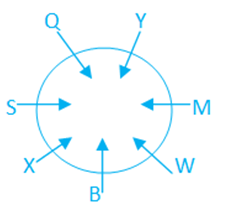
Since, S sits fourth to the left of M and X sits just to the right of S.
Hence, the correct answer is X.
70. Direction: Read the following information carefully and answer the questions based on given information.
Seven persons B, M, Q, S, W, X and Y sitting around a circular table faces towards the center attended a seminar but not necessarily in same order. Only two persons sit between S and W. M sits second to the right of B. Y and Q sits adjacent to each other. X and S sit adjacent to each other. Q sits three places away from B. S does not sit to the immediate right of Y.
Question:
Which of the following statement(s) is/ are correct?
A) Y sits immediate right to M.
B) Only one person sits between Y and B.
C) Q sits adjacent to W.
A. Only A
B. Only C
C. Both B and C
D. Only B
E. Both 1 and 4
Solution
Since, persons are B, M, Q, S, W, X and Y.
1) M sits second to the right of B.
2) Q sits three places away from B.
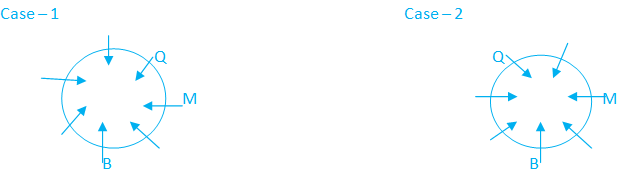
3) Y and Q sits adjacent to each other.
4) Only two persons sit between S and W.
5) X and S sit adjacent to each other.

6) S does not sit to the immediate right of Y. Therefore, case 1 is eliminated. Hence, the final arrangement is as follows

Since, Y sits immediate right to M. Therefore, statement A is correct.
Two persons sits between Y and B when counted to the right of B and three persons when counted to the left of B. Therefore, statement B is incorrect.
Q sits third to the right of W. Therefore, statement C is incorrect.
Hence, the correct answer is Only A.
71. Direction: Read the following information carefully and answer the questions based on given information.
A person starts walking from his home and walks for 5 Km towards North direction reaches at the bus stop. From here, he takes a left turn and walks for 8 Km reaches at the Coffee Shop. Then, he takes a right turn and after walking for 6 Km he reaches at the Gym. From here, he takes another right turn and walks for 4 Km reaches at Antique Store. Then he takes a right turn and walks for 9 Km to reach at his office.
Question:
What is the direction of Antique Store with respect to his office?
A. Northwest
B. Southeast
C. South
D. East
E. North
Solution
Let’s consider His Home is point A, Bus Stop is point B, Coffee Shop is point C, Gym is point D, Antique Store is point E and His office is point F.
1) A person starts walking from his home (point A) and walks for 5 Km towards North direction reaches at the bus stop (point B).
2) He takes a left turn and walks for 8 Km reaches at the Coffee Shop (point C).
3) He takes a right turn and after walking for 6 Km he reaches at the Gym (point D).

4) He takes another right turn and walks for 4 Km reaches at Antique Store (point E).
5) He takes a right turn and walks for 9 Km to reach at his office (point F).
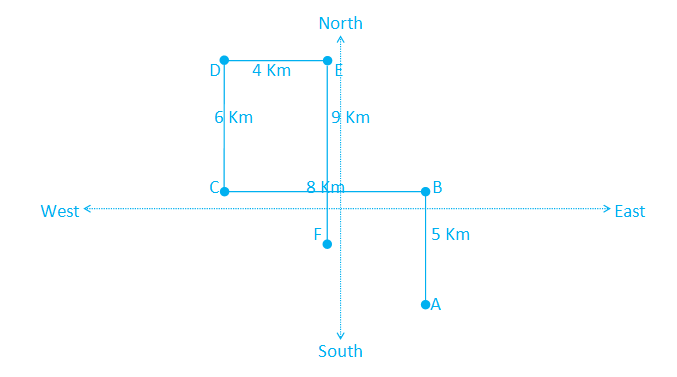
Since, point F is the location of his office and point E is the location of Antique store therefore, point E is in North direction with respect to point F.
Hence, the Antique Store is in North direction with respect to his office.
72. Direction: Read the following information carefully and answer the questions based on given information.
A person starts walking from his home and walks for 5 Km towards North direction reaches at the bus stop. From here, he takes a left turn and walks for 8 Km reaches at the Coffee Shop. Then, he takes a right turn and after walking for 6 Km he reaches at the Gym. From here, he takes another right turn and walks for 4 Km reaches at Antique Store. Then he takes a right turn and walks for 9 Km to reach at his office.
Question:
Which of the following statement is incorrect?
A. The gym is in west direction with respect to the Antique Store.
B. His Home is in southeast direction with respect to the Coffee Shop.
C. The Bus Stop is in east direction with respect to the coffee shop.
D. The Coffee Shop is in southeast direction with respect to the Antique Store.
E. All are correct.
Solution
Let’s consider His Home is point A, Bus Stop is point B, Coffee Shop is point C, Gym is point D, Antique Store is point E and His office is point F.
1) A person starts walking from his home (point A) and walks for 5 Km towards North direction reaches at the bus stop (point B).
2) He takes a left turn and walks for 8 Km reaches at the Coffee Shop (point C).
3) He takes a right turn and after walking for 6 Km he reaches at the Gym (point D).
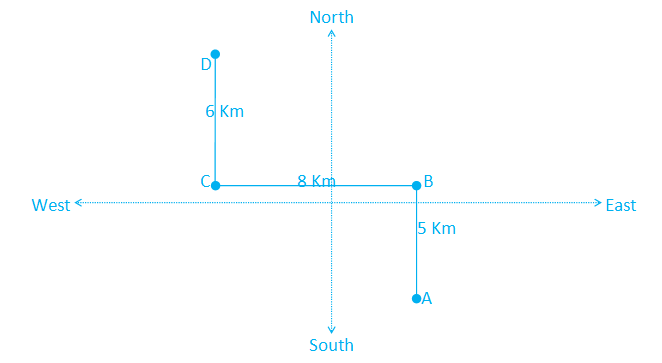
4) He takes another right turn and walks for 4 Km reaches at Antique Store (point E).
5) He takes a right turn and walks for 9 Km to reach at his office (point F).

Since, The Coffee Shop that is point C is in southwest direction with respect to the Antique Store that is point E. Therefore, statement fourth is incorrect rest all the given statements are correct.
Hence, the incorrect statement is The Coffee Shop is in southeast direction with respect to the Antique Store.
73. Direction: Read the following information carefully and answer the questions based on given information.
A person starts walking from his home and walks for 5 Km towards North direction reaches at the bus stop. From here, he takes a left turn and walks for 8 Km reaches at the Coffee Shop. Then, he takes a right turn and after walking for 6 Km he reaches at the Gym. From here, he takes another right turn and walks for 4 Km reaches at Antique Store. Then he takes a right turn and walks for 9 Km to reach at his office.
Question:
What is the total distance travelled by the man from Coffee Shop to his Office?
A. 15
B. 25
C. 19
D. 17
E. 23
Solution
Let’s consider His Home is point A, Bus Stop is point B, Coffee Shop is point C, Gym is point D, Antique Store is point E and His office is point F.
1) A person starts walking from his home (point A) and walks for 5 Km towards North direction reaches at the bus stop (point B).
2) He takes a left turn and walks for 8 Km reaches at the Coffee Shop (point C).
3) He takes a right turn and after walking for 6 Km he reaches at the Gym (point D).

4) He takes another right turn and walks for 4 Km reaches at Antique Store (point E).
5) He takes a right turn and walks for 9 Km to reach at his office (point F).
Since, total distance travelled by the man from the Coffee Shop i.e. point C to his office i.e. point F = distance between from Coffee Shop to Gym + distance between Gym to Antique Store + distance between Antique Store to his office
Therefore, Total = 6 Km + 4 Km + 9 Km = 19 Km
Hence, the total distance travelled by the man from Coffee shop to his office is 19 Km.
74. Direction: In the question below are given four statements followed by conclusions. You have to take the given statements to be true even if they seem to be at variance with commonly known facts. Read all the conclusions and then decide which of the given conclusions logically follows from the given statements disregarding commonly known facts.
Statements:
I. Some Alpha is Beta.
II. No Gamma is Delta.
III. Some Beta are Gamma.
Conclusions:
I. All Alpha being Gamma is a possibility.
II. No Beta are Delta.
III. Some Beta are not Delta.
A. All except I follows
B. All except II follows 70% answered correctly
C. All except III follows
D. None follows
E. None of these
Solution
The least possible Venn diagram for the given statements is as follows,

Conclusions:
I. All Alpha being Gamma is a possibility → True (All Alpha being Gamma is a possibility as shown in the diagram below.)

II. No Beta are Delta → False (No Beta being delta is a possibility but it’s not definite as no direct relation is given between Beta and Delta.)
III. Some Beta are not Delta → True (Beta which are Gamma can never be Delta as shown in the least possible diagram.)
Hence, All except II follows is the correct answer.
Additional Information:
Case of possibility:
1. If conclusion is 100% right or 100% wrong and possibility is written with it, then it is consider as wrong conclusion or False.
Definitely True + Possibility= False
Definitely False + Possibility = False
2. If conclusion is CND and possibility is written with it, then it is consider as right conclusion or True.
CND + Possibility = True
75. Direction: In the question below are given three statements followed by two conclusions numbered I, and II .You have to take the given statements to be true even if they seem to be at variance with commonly known facts. Read all the conclusions and then decide which of the given conclusions logically follows from the given statements disregarding commonly known facts.
Statements
All Ball are Football
No Football is Hockey
All Hockey are Tennis
Conclusions
I. All Ball being Tennis is a possibility
II. Some Tennis are Football
A. Only I follows
B. Only II follows
C. Both I and II follows
D. Either I or II follows
E. Neither I nor II follows
Solution
Venn diagram for the given statements are follows.

Conclusions
I. All Ball being Tennis is a possibility – True (Because the definite relation is not given between Ball and Tennis thus All Ball being Tennis is a possibility follows)
II. Some Tennis are Football – False (Because the definite relation is not given between Tennis and Football thus Some Tennis are Football not follows)
Hence, Only I follows.
76. Direction: In the question below are given three statements followed by two conclusions numbered I and II. You have to take the given statements to be true even if they seem to be at variance with commonly known facts. Read all the conclusions and then decide which of the given conclusions logically follows from the given statements disregarding commonly known facts.
Statements:
Some 10 are not 30.
Only a few 30 are 20.
Some 20 is 40.
Conclusions:
I.All 20 are 30.
II. All 10 are 20.
A. Only I follows
B. Only II follows
C. Both I and II follows
D. Neither I nor II follows
E. Either I or II follows
Solution
The least possible Venn diagram for the given statements is as follows:

Conclusions:
I. All 20 are 30 → False (as it is possible but not definite).
II. All 10 are 20 → False (as it is possible but not definite).
Hence, Neither I Nor II follows.
77. Directions: Read the information carefully and answer the following questions.
Eight boxes labeled K, Z, W, D, Y, T, B, and X are arranged one above the other. The bottom box is numbered as 1, and the topmost as 8. The positions of the boxes are not necessarily in the order given below.
Box Y is above Box X, but it is not the topmost box. Box K is kept five boxes above Box X. There are exactly three boxes between Box Z and Box T. There are exactly two boxes between Box X and Box Z. Between Box T and Box W, there are two boxes. Between Box Y and Box B, there are exactly two other boxes. Box W is placed in such a way that there is one box between it and Box D. Box D is not placed immediately next to Box T.
Question:
Which of the following box-position pairings is correct as per the final arrangement?
A. Box X – Position 3
B. Box K – Position 7
C. Box Y – Position 5
D. Box T – Position 4
E. Box D – Position 2
Solution
Given: Eight boxes labeled K, Z, W, D, Y, T, B, and X are arranged one above the other. The bottom box is numbered as 1, and the topmost as 8. The positions of the boxes are not necessarily in the order given below.
1. Box K is kept five boxes above Box X. (i.e., Four boxes are between Box K and Box X)
Here we have three possibilities, i.e., Case 1, Case 2, and Case 3.
| Number | Boxes | ||
| Case 1 | Case 2 | Case 3 | |
| 8 | K | ||
| 7 | K | ||
| 6 | K | ||
| 5 | |||
| 4 | |||
| 3 | X | ||
| 2 | X | ||
| 1 | X | ||
2. Box X is separated from Box Z by exactly two boxes.
| Number | Boxes | ||
| Case 1 | Case 2 | Case 3 | |
| 8 | K | ||
| 7 | K | ||
| 6 | Z | K | |
| 5 | Z | ||
| 4 | Z | ||
| 3 | X | ||
| 2 | X | ||
| 1 | X | ||
3. There are exactly three boxes between Box Z and Box T.
| Number | Boxes | ||
| Case 1 | Case 2 | Case 3 | |
| 8 | K | T | |
| 7 | K | ||
| 6 | Z | K | |
| 5 | Z | ||
| 4 | Z | ||
| 3 | X | ||
| 2 | T | X | |
| 1 | T | X | |
4. Between Box T and Box W, there are two boxes.
| Number | Boxes | ||
| Case 1 | Case 2 | Case 3 | |
| 8 | K | T | |
| 7 | K | ||
| 6 | Z | K | |
| 5 | W | Z | W |
| 4 | W | Z | |
| 3 | X | ||
| 2 | T | X | |
| 1 | T | X | |
5. Box W is placed in such a way that there is one box between it and Box D.
| Number | Boxes | ||
| Case 1 | Case 2 | Case 3 | |
| 8 | K | T | |
| 7 | D | K | D/ |
| 6 | Z | D | K |
| 5 | W | Z | W |
| 4 | W | Z | |
| 3 | X | D/ | |
| 2 | T | X | |
| 1 | T | X | |
6. Box D is not placed immediately next to Box T. (i.e., it is neither just above nor just below it)
| Number | Boxes | ||
| Case 1 | Case 2 | Case 3 | |
| 8 | K | T | |
| 7 | D | K | |
| 6 | Z | D | K |
| 5 | W | Z | W |
| 4 | W | Z | |
| 3 | X | D | |
| 2 | T | X | |
| 1 | T | X | |
7. Between Box Y and Box B, there are exactly two other boxes.
Now, we can eliminate Case 2 and Case 3. (Because there is no vacant place for Y and B)
| Number | Boxes |
| Case 1 | |
| 8 | K |
| 7 | D |
| 6 | Z |
| 5 | W |
| 4 | Y/B |
| 3 | X |
| 2 | T |
| 1 | B/Y |
8. Box Y is above Box X, but it is not the topmost box.
This is our final arrangement,
| Number | Boxes |
| Case 1 | |
| 8 | K |
| 7 | D |
| 6 | Z |
| 5 | W |
| 4 | Y |
| 3 | X |
| 2 | T |
| 1 | B |
Hence, the correct answer is Box X – Position 3.
78. Directions: Read the information carefully and answer the following questions.
Eight boxes labeled K, Z, W, D, Y, T, B, and X are arranged one above the other. The bottom box is numbered as 1, and the topmost as 8. The positions of the boxes are not necessarily in the order given below.
Box Y is above Box X, but it is not the topmost box. Box K is kept five boxes above Box X. There are exactly three boxes between Box Z and Box T. There are exactly two boxes between Box X and Box Z. Between Box T and Box W, there are two boxes. Between Box Y and Box B, there are exactly two other boxes. Box W is placed in such a way that there is one box between it and Box D. Box D is not placed immediately next to Box T.
Question:
How many boxes are there between Box Y and Box K?
A. One
B. Two
C. Three
D. Four
E. None
Solution
Given: Eight boxes labeled K, Z, W, D, Y, T, B, and X are arranged one above the other. The bottom box is numbered as 1, and the topmost as 8. The positions of the boxes are not necessarily in the order given below.
1. Box K is kept five boxes above Box X. (i.e., Four boxes are between Box K and Box X)
Here we have three possibilities, i.e., Case 1, Case 2, and Case 3.
| Number | Boxes | ||
| Case 1 | Case 2 | Case 3 | |
| 8 | K | ||
| 7 | K | ||
| 6 | K | ||
| 5 | |||
| 4 | |||
| 3 | X | ||
| 2 | X | ||
| 1 | X | ||
2. Box X is separated from Box Z by exactly two boxes.
| Number | Boxes | ||
| Case 1 | Case 2 | Case 3 | |
| 8 | K | ||
| 7 | K | ||
| 6 | Z | K | |
| 5 | Z | ||
| 4 | Z | ||
| 3 | X | ||
| 2 | X | ||
| 1 | X | ||
3. There are exactly three boxes between Box Z and Box T.
| Number | Boxes | ||
| Case 1 | Case 2 | Case 3 | |
| 8 | K | T | |
| 7 | K | ||
| 6 | Z | K | |
| 5 | Z | ||
| 4 | Z | ||
| 3 | X | ||
| 2 | T | X | |
| 1 | T | X | |
4. Between Box T and Box W, there are two boxes.
| Number | Boxes | ||
| Case 1 | Case 2 | Case 3 | |
| 8 | K | T | |
| 7 | K | ||
| 6 | Z | K | |
| 5 | W | Z | W |
| 4 | W | Z | |
| 3 | X | ||
| 2 | T | X | |
| 1 | T | X | |
5. Box W is placed in such a way that there is one box between it and Box D.
| Number | Boxes | ||
| Case 1 | Case 2 | Case 3 | |
| 8 | K | T | |
| 7 | D | K | D/ |
| 6 | Z | D | K |
| 5 | W | Z | W |
| 4 | W | Z | |
| 3 | X | D/ | |
| 2 | T | X | |
| 1 | T | X | |
6. Box D is not placed immediately next to Box T. (i.e., it is neither just above nor just below it)
| Number | Boxes | ||
| Case 1 | Case 2 | Case 3 | |
| 8 | K | T | |
| 7 | D | K | |
| 6 | Z | D | K |
| 5 | W | Z | W |
| 4 | W | Z | |
| 3 | X | D | |
| 2 | T | X | |
| 1 | T | X | |
7. Between Box Y and Box B, there are exactly two other boxes.
Now, we can eliminate Case 2 and Case 3. (Because there is no vacant place for Y and B)
| Number | Boxes |
| Case 1 | |
| 8 | K |
| 7 | D |
| 6 | Z |
| 5 | W |
| 4 | Y/B |
| 3 | X |
| 2 | T |
| 1 | B/Y |
8. Box Y is above Box X, but it is not the topmost box.
This is our final arrangement,
| Number | Boxes |
| Case 1 | |
| 8 | K |
| 7 | D |
| 6 | Z |
| 5 | W |
| 4 | Y |
| 3 | X |
| 2 | T |
| 1 | B |
Hence, the correct answer is Three.
79. Directions: Read the information carefully and answer the following questions.
Eight boxes labeled K, Z, W, D, Y, T, B, and X are arranged one above the other. The bottom box is numbered as 1, and the topmost as 8. The positions of the boxes are not necessarily in the order given below.
Box Y is above Box X, but it is not the topmost box. Box K is kept five boxes above Box X. There are exactly three boxes between Box Z and Box T. There are exactly two boxes between Box X and Box Z. Between Box T and Box W, there are two boxes. Between Box Y and Box B, there are exactly two other boxes. Box W is placed in such a way that there is one box between it and Box D. Box D is not placed immediately next to Box T.
Question:
Which box is placed immediately below Box Z?
A. Box T
B. Box X
C. Box W
D. Box D
E. Box Y
Solution
Given: Eight boxes labeled K, Z, W, D, Y, T, B, and X are arranged one above the other. The bottom box is numbered as 1, and the topmost as 8. The positions of the boxes are not necessarily in the order given below.
1. Box K is kept five boxes above Box X. (i.e., Four boxes are between Box K and Box X)
Here we have three possibilities, i.e., Case 1, Case 2, and Case 3.
| Number | Boxes | ||
| Case 1 | Case 2 | Case 3 | |
| 8 | K | ||
| 7 | K | ||
| 6 | K | ||
| 5 | |||
| 4 | |||
| 3 | X | ||
| 2 | X | ||
| 1 | X | ||
2. Box X is separated from Box Z by exactly two boxes.
| Number | Boxes | ||
| Case 1 | Case 2 | Case 3 | |
| 8 | K | ||
| 7 | K | ||
| 6 | Z | K | |
| 5 | Z | ||
| 4 | Z | ||
| 3 | X | ||
| 2 | X | ||
| 1 | X | ||
3. There are exactly three boxes between Box Z and Box T.
| Number | Boxes | ||
| Case 1 | Case 2 | Case 3 | |
| 8 | K | T | |
| 7 | K | ||
| 6 | Z | K | |
| 5 | Z | ||
| 4 | Z | ||
| 3 | X | ||
| 2 | T | X | |
| 1 | T | X | |
4. Between Box T and Box W, there are two boxes.
| Number | Boxes | ||
| Case 1 | Case 2 | Case 3 | |
| 8 | K | T | |
| 7 | K | ||
| 6 | Z | K | |
| 5 | W | Z | W |
| 4 | W | Z | |
| 3 | X | ||
| 2 | T | X | |
| 1 | T | X | |
5. Box W is placed in such a way that there is one box between it and Box D.
| Number | Boxes | ||
| Case 1 | Case 2 | Case 3 | |
| 8 | K | T | |
| 7 | D | K | D/ |
| 6 | Z | D | K |
| 5 | W | Z | W |
| 4 | W | Z | |
| 3 | X | D/ | |
| 2 | T | X | |
| 1 | T | X | |
6. Box D is not placed immediately next to Box T. (i.e., it is neither just above nor just below it)
| Number | Boxes | ||
| Case 1 | Case 2 | Case 3 | |
| 8 | K | T | |
| 7 | D | K | |
| 6 | Z | D | K |
| 5 | W | Z | W |
| 4 | W | Z | |
| 3 | X | D | |
| 2 | T | X | |
| 1 | T | X | |
7. Between Box Y and Box B, there are exactly two other boxes.
Now, we can eliminate Case 2 and Case 3. (Because there is no vacant place for Y and B)
| Number | Boxes |
| Case 1 | |
| 8 | K |
| 7 | D |
| 6 | Z |
| 5 | W |
| 4 | Y/B |
| 3 | X |
| 2 | T |
| 1 | B/Y |
8. Box Y is above Box X, but it is not the topmost box.
This is our final arrangement,
| Number | Boxes |
| Case 1 | |
| 8 | K |
| 7 | D |
| 6 | Z |
| 5 | W |
| 4 | Y |
| 3 | X |
| 2 | T |
| 1 | B |
Hence, the correct answer is Box W.
80. Directions: Read the information carefully and answer the following questions.
Eight boxes labeled K, Z, W, D, Y, T, B, and X are arranged one above the other. The bottom box is numbered as 1, and the topmost as 8. The positions of the boxes are not necessarily in the order given below.
Box Y is above Box X, but it is not the topmost box. Box K is kept five boxes above Box X. There are exactly three boxes between Box Z and Box T. There are exactly two boxes between Box X and Box Z. Between Box T and Box W, there are two boxes. Between Box Y and Box B, there are exactly two other boxes. Box W is placed in such a way that there is one box between it and Box D. Box D is not placed immediately next to Box T.
Question:
Which of the following statements is definitely true based on the arrangement?
A. Box Y is placed exactly two positions above Box X
B. Box K is placed immediately below Box W
C. There is one box between Box Z and Box Y
D. Box X is placed at the topmost position
E. Box D is immediately above Box T
Solution
Given: Eight boxes labeled K, Z, W, D, Y, T, B, and X are arranged one above the other. The bottom box is numbered as 1, and the topmost as 8. The positions of the boxes are not necessarily in the order given below.
1. Box K is kept five boxes above Box X. (i.e., Four boxes are between Box K and Box X)
Here we have three possibilities, i.e., Case 1, Case 2, and Case 3.
| Number | Boxes | ||
| Case 1 | Case 2 | Case 3 | |
| 8 | K | ||
| 7 | K | ||
| 6 | K | ||
| 5 | |||
| 4 | |||
| 3 | X | ||
| 2 | X | ||
| 1 | X | ||
2. Box X is separated from Box Z by exactly two boxes.
| Number | Boxes | ||
| Case 1 | Case 2 | Case 3 | |
| 8 | K | ||
| 7 | K | ||
| 6 | Z | K | |
| 5 | Z | ||
| 4 | Z | ||
| 3 | X | ||
| 2 | X | ||
| 1 | X | ||
3. There are exactly three boxes between Box Z and Box T.
| Number | Boxes | ||
| Case 1 | Case 2 | Case 3 | |
| 8 | K | T | |
| 7 | K | ||
| 6 | Z | K | |
| 5 | Z | ||
| 4 | Z | ||
| 3 | X | ||
| 2 | T | X | |
| 1 | T | X | |
4. Between Box T and Box W, there are two boxes.
| Number | Boxes | ||
| Case 1 | Case 2 | Case 3 | |
| 8 | K | T | |
| 7 | K | ||
| 6 | Z | K | |
| 5 | W | Z | W |
| 4 | W | Z | |
| 3 | X | ||
| 2 | T | X | |
| 1 | T | X | |
5. Box W is placed in such a way that there is one box between it and Box D.
| Number | Boxes | ||
| Case 1 | Case 2 | Case 3 | |
| 8 | K | T | |
| 7 | D | K | D/ |
| 6 | Z | D | K |
| 5 | W | Z | W |
| 4 | W | Z | |
| 3 | X | D/ | |
| 2 | T | X | |
| 1 | T | X | |
6. Box D is not placed immediately next to Box T. (i.e., it is neither just above nor just below it)
| Number | Boxes | ||
| Case 1 | Case 2 | Case 3 | |
| 8 | K | T | |
| 7 | D | K | |
| 6 | Z | D | K |
| 5 | W | Z | W |
| 4 | W | Z | |
| 3 | X | D | |
| 2 | T | X | |
| 1 | T | X | |
7. Between Box Y and Box B, there are exactly two other boxes.
Now, we can eliminate Case 2 and Case 3. (Because there is no vacant place for Y and B)
| Number | Boxes |
| Case 1 | |
| 8 | K |
| 7 | D |
| 6 | Z |
| 5 | W |
| 4 | Y/B |
| 3 | X |
| 2 | T |
| 1 | B/Y |
8. Box Y is above Box X, but it is not the topmost box.
This is our final arrangement,
| Number | Boxes |
| Case 1 | |
| 8 | K |
| 7 | D |
| 6 | Z |
| 5 | W |
| 4 | Y |
| 3 | X |
| 2 | T |
| 1 | B |
Hence, the correct answer is There is one box between Box Z and Box Y.
81. Directions: Read the information carefully and answer the following questions.
Eight boxes labeled K, Z, W, D, Y, T, B, and X are arranged one above the other. The bottom box is numbered as 1, and the topmost as 8. The positions of the boxes are not necessarily in the order given below.
Box Y is above Box X, but it is not the topmost box. Box K is kept five boxes above Box X. There are exactly three boxes between Box Z and Box T. There are exactly two boxes between Box X and Box Z. Between Box T and Box W, there are two boxes. Between Box Y and Box B, there are exactly two other boxes. Box W is placed in such a way that there is one box between it and Box D. Box D is not placed immediately next to Box T.
Question:
Which of the following statement is not true?
A. Box K is above Box Z
B. Two boxes are between Box D and Box Y
C. Box T is immediately next to Box B
D. Box W is placed adjacent to Box D
E. Box D is not the topmost box
Solution
Given: Eight boxes labeled K, Z, W, D, Y, T, B, and X are arranged one above the other. The bottom box is numbered as 1, and the topmost as 8. The positions of the boxes are not necessarily in the order given below.
1. Box K is kept five boxes above Box X. (i.e., Four boxes are between Box K and Box X)
Here we have three possibilities, i.e., Case 1, Case 2, and Case 3.
| Number | Boxes | ||
| Case 1 | Case 2 | Case 3 | |
| 8 | K | ||
| 7 | K | ||
| 6 | K | ||
| 5 | |||
| 4 | |||
| 3 | X | ||
| 2 | X | ||
| 1 | X | ||
2. Box X is separated from Box Z by exactly two boxes.
| Number | Boxes | ||
| Case 1 | Case 2 | Case 3 | |
| 8 | K | ||
| 7 | K | ||
| 6 | Z | K | |
| 5 | Z | ||
| 4 | Z | ||
| 3 | X | ||
| 2 | X | ||
| 1 | X | ||
3. There are exactly three boxes between Box Z and Box T.
| Number | Boxes | ||
| Case 1 | Case 2 | Case 3 | |
| 8 | K | T | |
| 7 | K | ||
| 6 | Z | K | |
| 5 | Z | ||
| 4 | Z | ||
| 3 | X | ||
| 2 | T | X | |
| 1 | T | X | |
4. Between Box T and Box W, there are two boxes.
| Number | Boxes | ||
| Case 1 | Case 2 | Case 3 | |
| 8 | K | T | |
| 7 | K | ||
| 6 | Z | K | |
| 5 | W | Z | W |
| 4 | W | Z | |
| 3 | X | ||
| 2 | T | X | |
| 1 | T | X | |
5. Box W is placed in such a way that there is one box between it and Box D.
| Number | Boxes | ||
| Case 1 | Case 2 | Case 3 | |
| 8 | K | T | |
| 7 | D | K | D/ |
| 6 | Z | D | K |
| 5 | W | Z | W |
| 4 | W | Z | |
| 3 | X | D/ | |
| 2 | T | X | |
| 1 | T | X | |
6. Box D is not placed immediately next to Box T. (i.e., it is neither just above nor just below it)
| Number | Boxes | ||
| Case 1 | Case 2 | Case 3 | |
| 8 | K | T | |
| 7 | D | K | |
| 6 | Z | D | K |
| 5 | W | Z | W |
| 4 | W | Z | |
| 3 | X | D | |
| 2 | T | X | |
| 1 | T | X | |
7. Between Box Y and Box B, there are exactly two other boxes.
Now, we can eliminate Case 2 and Case 3. (Because there is no vacant place for Y and B)
| Number | Boxes |
| Case 1 | |
| 8 | K |
| 7 | D |
| 6 | Z |
| 5 | W |
| 4 | Y/B |
| 3 | X |
| 2 | T |
| 1 | B/Y |
8. Box Y is above Box X, but it is not the topmost box.
This is our final arrangement,
| Number | Boxes |
| Case 1 | |
| 8 | K |
| 7 | D |
| 6 | Z |
| 5 | W |
| 4 | Y |
| 3 | X |
| 2 | T |
| 1 | B |
Hence, the correct answer is Box W is placed adjacent to Box D.
82. In the number 35672941, if all even digits are increased by 2, and all odd digits are decreased by 1, how many digits repeat in the final number?
A. One
B. Two
C. Three
D. Four
E. Five
Solution
Given number: 35872941
Add +2 for even digits and -1 for odd digits
According to the condition, all even digits are increased by 2, and all odd digits are decreased by 1.
| Digits | 3 | 5 | 6 | 7 | 2 | 9 | 4 | 1 |
| Add 2/Subtract 1 | -1 | -1 | +2 | -1 | +2 | -1 | +2 | -1 |
| Resultant | 2 | 4 | 8 | 6 | 4 | 8 | 6 | 0 |
Hence, three digits are repeated in the final number i.e., 4, 6, and 8.
83. Direction: Study the following information carefully and answer the given questions.
In a certain code language,
“kite night right might” means “ sap tap map cap”,
“might weight sight eight” means “zap cap wap yap”,
“moon eight boat light” means “yup xap nap zap”,
“plant not weight night” means “wap sap dap lap”.
Question:
What is the code for boat?
A. yup
B. xap
C. either yup or xap
D. either xap or yup or nap
E. either nap or yup
Solution

| Word | Kite | night | Plant/not | might | weight | sight | eight | moon/boat/light | right |
| Code | tap | sap | dap/lap | cap | wap | yap | zap | yup/xap/nap | map |
Hence, the boat is coded as either yup or xap or nap
84. Direction: Study the following information carefully and answer the given questions.
In a certain code language,
“kite night right might” means “ sap tap map cap”,
“might weight sight eight” means “zap cap wap yap”,
“moon eight boat light” means “yup xap nap zap”,
“plant not weight night” means “wap sap dap lap”.
Question:
Which word is coded as “cap”?
A. weight
B. might
C. night
D. not
E. boat
Solution
| Word | kite/right | night | Plant/not | might | weight | sight | eight | moon/boat/light |
| Code | tap/map | sap | dap/lap | cap | wap | yap | zap | yup/xap/nap |
Hence, “might” is coded as “cap”.
85. Direction: Study the following information carefully and answer the given questions.
In a certain code language,
“kite night right might” means “ sap tap map cap”,
“might weight sight eight” means “zap cap wap yap”,
“moon eight boat light” means “yup xap nap zap”,
“plant not weight night” means “wap sap dap lap”.
Question:
What is the code for the word “sight”?
A. lap
B. map
C. nap
D. yap
E. cannot be determined
Solution
| Word | kite/right | night | Plant/not | might | weight | sight | eight | moon/boat/light |
| Code | tap/map | sap | dap/lap | cap | wap | yap | zap | yup/xap/nap |
Hence, the code for “sight” is “yap”
86. Directions: Read the information and answer the given questions.
Seven departments, namely, A, B, C, D, E, F, and G, are purchasing different brands of products: Nike, Adidas, and Puma. At least two departments purchase the same brand. Not more than three persons purchase the same brand.
Neither F nor E purchases the Nike brand. Department B purchases the Puma brand. Department D purchases the Adidas brand. Department C purchases the Nike brand along with only one other department. Department E purchases the same brand as G. G does not purchase the same brand that is purchased by D.
Question:
Which of the following brand is purchased by Department F?
A. Puma
B. Nike
C. Adidas
D. Either A or B
E. Either A or C
Solution
1. Department D purchases the Adidas brand.
2. Department B purchases the Puma brand.
3. Department C purchases the Nike brand along with only one other department.
| Brands | Departments |
| Nike | C, _ |
| Adidas | D |
| Puma | B |
4. Department E purchases the same brand as G.
Here, we have 2 Cases, i.e., Case 1 and Case 2.
| Brands | Departments | |
| Case 1 | Case 2 | |
| Nike | C, _ | C, _ |
| Adidas | D | D, E, G |
| Puma | B, E, G | B |
5. G does not purchase the same brand that is purchased by D.
Now, we can eliminate Case 2.
| Brands | Departments |
| Case 1 | |
| Nike | C, _ |
| Adidas | D |
| Puma | B, E, G |
6. Neither F nor E purchases the Nike brand.
| Brands | Departments |
| Case 1 | |
| Nike | C, _ |
| Adidas | D, F |
| Puma | B, E, G |
This is our final arrangement.
| Brands | Departments |
| Case 1 | |
| Nike | C, A |
| Adidas | D, F |
| Puma | B, E, G |
Hence, the correct answer is Adidas.
87. Directions: Read the information and answer the given questions.
Seven departments, namely, A, B, C, D, E, F, and G, are purchasing different brands of products: Nike, Adidas, and Puma. At least two departments purchase the same brand. Not more than three persons purchase the same brand.
Neither F nor E purchases the Nike brand. Department B purchases the Puma brand. Department D purchases the Adidas brand. Department C purchases the Nike brand along with only one other department. Department E purchases the same brand as G. G does not purchase the same brand that is purchased by D.
Question:
Which of the following brand is purchased by most of the departments?
A. Nike
B. Adidas
C. Puma
D. Both A and B
E. Both A and C
Solution
1. Department D purchases the Adidas brand.
2. Department B purchases the Puma brand.
3. Department C purchases the Nike brand along with only one other department.
| Brands | Departments |
| Nike | C, _ |
| Adidas | D |
| Puma | B |
4. Department E purchases the same brand as G.
Here, we have 2 Cases, i.e., Case 1 and Case 2.
| Brands | Departments | |
| Case 1 | Case 2 | |
| Nike | C, _ | C, _ |
| Adidas | D | D, E, G |
| Puma | B, E, G | B |
5. G does not purchase the same brand that is purchased by D.
Now, we can eliminate Case 2.
| Brands | Departments |
| Case 1 | |
| Nike | C, _ |
| Adidas | D |
| Puma | B, E, G |
6. Neither F nor E purchases the Nike brand.
| Brands | Departments |
| Case 1 | |
| Nike | C, _ |
| Adidas | D, F |
| Puma | B, E, G |
This is our final arrangement.
| Brands | Departments |
| Case 1 | |
| Nike | C, A |
| Adidas | D, F |
| Puma | B, E, G |
Hence, the correct answer is Puma.
88. Directions: Read the information and answer the given questions.
Seven departments, namely, A, B, C, D, E, F, and G, are purchasing different brands of products: Nike, Adidas, and Puma. At least two departments purchase the same brand. Not more than three persons purchase the same brand.
Neither F nor E purchases the Nike brand. Department B purchases the Puma brand. Department D purchases the Adidas brand. Department C purchases the Nike brand along with only one other department. Department E purchases the same brand as G. G does not purchase the same brand that is purchased by D
Question:
Four of the following five are alike in a certain way and hence form a group. Which one does not belong to the group?
A. DB
B. FC
C. AE
D. BG
E. GA
Solution
1. Department D purchases the Adidas brand.
2. Department B purchases the Puma brand.
3. Department C purchases the Nike brand along with only one other department.
| Brands | Departments |
| Nike | C, _ |
| Adidas | D |
| Puma | B |
4. Department E purchases the same brand as G.
Here, we have 2 Cases, i.e., Case 1 and Case 2.
| Brands | Departments | |
| Case 1 | Case 2 | |
| Nike | C, _ | C, _ |
| Adidas | D | D, E, G |
| Puma | B, E, G | B |
5. G does not purchase the same brand that is purchased by D.
Now, we can eliminate Case 2.
| Brands | Departments |
| Case 1 | |
| Nike | C, _ |
| Adidas | D |
| Puma | B, E, G |
6. Neither F nor E purchases the Nike brand.
| Brands | Departments |
| Case 1 | |
| Nike | C, _ |
| Adidas | D, F |
| Puma | B, E, G |
This is our final arrangement.
| Brands | Departments |
| Case 1 | |
| Nike | C, A |
| Adidas | D, F |
| Puma | B, E, G |
Except for BG, in all other pairs, they purchase different brands.
Hence, the correct answer is BG.
89. Directions: Read the information and answer the given questions.
Seven departments, namely, A, B, C, D, E, F, and G, are purchasing different brands of products: Nike, Adidas, and Puma. At least two departments purchase the same brand. Not more than three persons purchase the same brand.
Neither F nor E purchases the Nike brand. Department B purchases the Puma brand. Department D purchases the Adidas brand. Department C purchases the Nike brand along with only one other department. Department E purchases the same brand as G. G does not purchase the same brand that is purchased by D.
Question:
Which among the following departments purchases the Nike brand?
A. G
B. The department which purchases the same brand as D
C. The department which purchases the same brand as F
D. B
E. A
Solution
1. Department D purchases the Adidas brand.
2. Department B purchases the Puma brand.
3. Department C purchases the Nike brand along with only one other department.
| Brands | Departments |
| Nike | C, _ |
| Adidas | D |
| Puma | B |
4. Department E purchases the same brand as G.
Here, we have 2 Cases, i.e., Case 1 and Case 2.
| Brands | Departments | |
| Case 1 | Case 2 | |
| Nike | C, _ | C, _ |
| Adidas | D | D, E, G |
| Puma | B, E, G | B |
5. G does not purchase the same brand that is purchased by D.
Now, we can eliminate Case 2.
| Brands | Departments |
| Case 1 | |
| Nike | C, _ |
| Adidas | D |
| Puma | B, E, G |
6. Neither F nor E purchases the Nike brand.
| Brands | Departments |
| Case 1 | |
| Nike | C, _ |
| Adidas | D, F |
| Puma | B, E, G |
This is our final arrangement.
| Brands | Departments |
| Case 1 | |
| Nike | C, A |
| Adidas | D, F |
| Puma | B, E, G |
Hence, the correct answer is A.
90. Directions: Read the information and answer the given questions.
Seven departments, namely, A, B, C, D, E, F, and G, are purchasing different brands of products: Nike, Adidas, and Puma. At least two departments purchase the same brand. Not more than three persons purchase the same brand.
Neither F nor E purchases the Nike brand. Department B purchases the Puma brand. Department D purchases the Adidas brand. Department C purchases the Nike brand along with only one other department. Department E purchases the same brand as G. G does not purchase the same brand that is purchased by D.
Question:
How many departments purchase the Puma brand?
A. Three
B. Two
C. Four
D. Either A or B
E. Either A or C
Solution
1. Department D purchases the Adidas brand.
2. Department B purchases the Puma brand.
3. Department C purchases the Nike brand along with only one other department.
| Brands | Departments |
| Nike | C, _ |
| Adidas | D |
| Puma | B |
4. Department E purchases the same brand as G.
Here, we have 2 Cases, i.e., Case 1 and Case 2.
| Brands | Departments | |
| Case 1 | Case 2 | |
| Nike | C, _ | C, _ |
| Adidas | D | D, E, G |
| Puma | B, E, G | B |
5. G does not purchase the same brand that is purchased by D.
Now, we can eliminate Case 2.
| Brands | Departments |
| Case 1 | |
| Nike | C, _ |
| Adidas | D |
| Puma | B, E, G |
6. Neither F nor E purchases the Nike brand.
| Brands | Departments |
| Case 1 | |
| Nike | C, _ |
| Adidas | D, F |
| Puma | B, E, G |
This is our final arrangement.
| Brands | Departments |
| Case 1 | |
| Nike | C, A |
| Adidas | D, F |
| Puma | B, E, G |
Hence, the correct answer is Three.
91. Direction: In the following question assuming the given statements to be true, find which of the conclusion among given conclusions is/are definitely true and then give your answers accordingly.
Statements: L ≥ K ≥ B = O > P ≤ R ≤ N = S
Conclusions:
I. L > P
II. S > O
A. Only II follow
B. Both I and II follow
C. Only I follow
D. Either I or II follows
E. Neither I nor II follows
Solution
Given Statements: L ≥ K ≥ B = O > P ≤ R ≤ N = S
Conclusions:
I. L > P → True (As L ≥ K ≥ B = O > P, it gives L > P)
II. S > O → False (As O > P ≤ R ≤ N = S, so definite relation between S and O cannot be determined )
So, only conclusion I follows.
Hence, the correct answer is “Option 3”.
92. Direction: In the following question assuming the given statements to be true, find which of the conclusion among given conclusions is/are definitely true and then give your answers accordingly.
Statements: H = M ≥ A ≥ P; Y < B < V = P
Conclusions:
I. H = P
II. V < M
A. Only I follow
B. Only II follow
C. Either I or II follows
D. Both I and II follow
E. Neither I nor II follows
Solution
Given Statements: H = M ≥ A ≥ P; Y < B < V = P
On Combining: H = M ≥ A ≥ P = V > B > Y
Conclusions:
I. H = P → False (As H = M ≥ A ≥ P, it gives H ≥ P)
II. V < M → False (As M ≥ A ≥ P = V, it gives M ≥ V)
Here, both the conclusions are false but it forms the complementary pair for Either Or because ‘H = M’ and ‘P = V’.
So, either conclusion I or II follows.
Hence, the correct answer is “Option 3”.
Additional Information Conditions of Either – or cases:
1. The elements should be the same in both the statements.
2. Both the conclusions should be false individually.
3. One conclusion should be positive and one conclusion should be negative (Complementary pair).
93. Direction: In the following question assuming the given statement to be true, find which of the conclusion among given conclusions is/are definitely true and then give your answers accordingly.
Statement: D ≤ T< M = P ≥ S ≥ Q = L > R
Conclusions:
I. P > L
II. P = L
A. Only I follow
B. Only II follow
C. Either I or II follows
D. Both I and II follow
E. Neither I nor II follows
Solution
Given Statement: D ≤ T< M = P ≥ S ≥ Q = L > R
Conclusions:
I. P > L → False (As P ≥ S ≥ Q = L, this gives P ≥ L)
II. P = L → False (As P ≥ S ≥ Q = L, this gives P ≥ L)
Here, both the conclusions are false but it forms the complementary pair for Either Or.
So, either conclusion I or II follows.
Hence, the correct answer is “Option 3”.
Additional Information
Conditions of Either – or case:
1. The elements should be the same in both the statements.
2. Both the conclusions should be false individually.
3. One conclusion should be positive and one conclusion should be negative (Complementary pair)
94. Directions: The following questions are based on the five three letter words given below.
TUB HUB MUG PAR FOR
Question:
If the first letter of all the words is changed to its next letter (succeeding) of the English alphabetical series, then how many words will have more than one vowel?
A. None
B. Three
C. Two
D. More than three
E. One
Solution
Given Series: – TUB HUB MUG PAR FOR
If the first letter of every word is changed to its succeeding letter, we get
UUB IUB NUB QAR GOR
Two words have more than one vowel i.e. “UUB and IUB”.
Hence, the correct Answer is Two.
95. Directions: The following questions are based on the five three letter words given below.
TUB HUB MUG PAR FOR
Question:
If all the letters in each of the words are arranged alphabetically (within the word), how many words will remain unchanged?
A. Two
B. Three
C. One
D. None
E.More than three
Solution
Given Series:- TUB HUB MUG PAR FOR
All the words are arranged alphabetically within the word, we get
BTU BHU GMU APR FOR
Only one word remains unchanged i.e. “FOR”.Hence, the correct answer is one.
96. Directions: The following questions are based on the five three letter words given below.
TUB HUB MUG PAR FOR
Question:
If the positions of the first and second letters of all the words are interchanged, how many words will form meaningful in english words?
A. None
B. Three
C. One
D. Two
E. More than Three
Solution
Given Series: – TUB HUB MUG PAR FOR
Interchanging the 1st and 2nd letter of each word we get,
UTB UHB UMG APR OFR
No meaningful words are formed.Hence, the correct answer is none.
97. Directions: These questions are based on the following information.There are eight members in the family A, B, C, D, E, F, G and H with four generations. F is father of A and B is grandson of E. C is daughter-in-law of E, who is grandmother of B. A is father of B and D which are of different gender. G is the son of H, who is the wife of B.
Question:
How D is related to C?
A. Son
B. Sister
C. Daughter
D. Brother
E. Cannot be determined
Solution
From the given information,
1. F is father of A and B is grandson of E.
2. C is daughter-in-law of E, who is grandmother of B.
3. A is father of B and D which are of different gender.
4. G is the son of H, who is the wife of B.

Hence, D is the daughter of C.
98. Direction: Study the following information carefully and answer the question given below.
There are eight members in the family A, B, C, D, E, F, G and H with three generations. A is the only son of B and brother of C. D is the father-in-law of C. E is the only son of C. F is the maternal grandfather of E. G is the son of D and father of H.
Question:
How A is related to G?
A. Sister-in-law
B. Brother-in-law
C. Niece
D. Sister
E. Can’t be determined
Solution
From the given information,
1. A is the only son of B and brother of C.
2. D is the father in law of C.
3. E is the only son of C.
4. F is the maternal grandfather is E.
5. G is the son of D and father of H.

Hence, A is the brother-in-law of G.
99. Direction: Study the following information carefully and answer the question given below.
There are eight members in the family A, B, C, D, E, F, G and H with three generations. A is the only son of B and brother of C. D is the father-in-law of C. E is the only son of C. F is the maternal grandfather of E. G is the son of D and father of H.
Question:
Who among the following is one of the couples?
A. A and D
B. E and B
C. G and C
D. D and F
E. Cannot be determined
Solution
From the given information,
1. A is the only son of B and brother of C.
2. D is the father in law of C.
3. E is the only son of C.
4. F is the maternal grandfather is E.
5. G is the son of D and father of H.
Hence, in the family G and C is one of the couples.
100. There are four words given in each option that follows a certain logic, if the third letter from the left of each word is taken then a meaningful word can be formed, find the odd one which does not follow the same pattern.
A. FGNT, GRDE, TIHS, ERAS
B. FECR, SIBR, DSAQ, RFRE
C. HILL, GILD, RUIS, DQXD
D. LKAI, FGMR, QWLR, DEPS
E. GSCE, FTER, GFFE, SFAS
Solution
Third letter from left from each word is-
In option-1 – N, D, H, A – Meaningful word is HAND
In option-2 – C, B, A, R – Meaningful word is CRAB
In option-3 – L, L, I, X – No meaningful wordHence, option-3 is odd.