1. Directions: In the following question, some parts of the sentence may have an error. The error, if any, will be in one part of the sentence. Find out which part of the sentence has an error and select the appropriate option. If a sentence is free from errors, select ‘No error’ as your answer.
Quite a few /(A) employees were also present /(B) during farewell ceremony /(C) of their vice president. /(D) No Error. /(E)
A. A
B. B
C. C
D. D
E. E
Solution
The correct answer is ‘C’ i.e. the error lies in part C of the sentence.
Key Points
Let us note the following:
- Farewell in this sentence is organized for the outgoing vice president.
- So it is particularized in the sentence.
- Hence, we need to use the article ‘the’ before ‘farewell’.
Hence, the correct sentence is Quite a few employees were also present during the farewell ceremony of their vice president.
Additional Information
Articles:
The quick brown fox jumps over the lazy dog.
Articles are words that define a noun as specific or unspecific.
In English, there are three articles: a, an, and the.
Articles are used before nouns or noun equivalents.
They are a type of adjective.
The indefinite article (a, an) is used before a noun that is general or when its identity is not known.
Examples:
An apple a day keeps the doctor away.
2. Directions: In the following question, some parts of the sentence may have an error. The error, if any, will be in one part of the sentence. Find out which part of the sentence has an error and select the appropriate option. If a sentence is free from errors, select ‘No error’ as your answer.
The main advantage China has (A) / over other countries is (B) / its large human capital which (C) / make it a perfect base. (D) / No error (E)
A. A
B. B
C. C
D. D
E. E
Solution
The correct answer is ‘D’ i.e. the error lies in part D of the sentence.
Key Points
Let us note the following:
- The subject ‘large human capital‘ is singular in number.
- Hence, the verb makes before it must also be singular in number.
- Hence, the verb ‘make’ must be replaced with ‘makes’.
Hence, the correct sentence is The main advantage China has over other countries is its large human capital which makes it a perfect base.
Additional Information
Singular and Plural:
polish: polishes
Singular means only one.
Plural means more than one.
In order to make a noun plural, it is usually only necessary to add s.
The rules for spelling plural nouns are based on the letters at the end of the word.
To make regular nouns plural, add ‑s to the end.
If the singular noun ends in ‑s, -ss, -sh, -ch, -x, or -z, add ‑es to the end to make it plural.
Examples:
loss: losses
match: matches
3. Read the sentence to find out whether there is any error in it or not. The error, if any, will be in one part of the sentence. The number of that part is the answer. If there is no error, the answer is (5). Ignore errors of punctuation, if any.
Put you in his role and you will realize the importance/(A) of his position and the responsibilities that he had./(B) He had gone through a period of hardships and struggles,/(C) he learned to survive in this modern warfare and that’s what made him a fighter and a winner at last./(D) No error. /(E)
A. A
B. B
C. C
D. D
E. E
Solution
The correct answer is option (1) i.e. A.
Key Points
- The erroneous Part A should have ‘yourself’.
- A reflexive pronoun is used when the result of the verb bounce back to the subject.
- There are certain words which are followed by reflexive pronouns such as put, enjoy, acquit, avail, reconcile, absent, amuse, pride, apply, exert, introduce, resign etc.
Additional Information
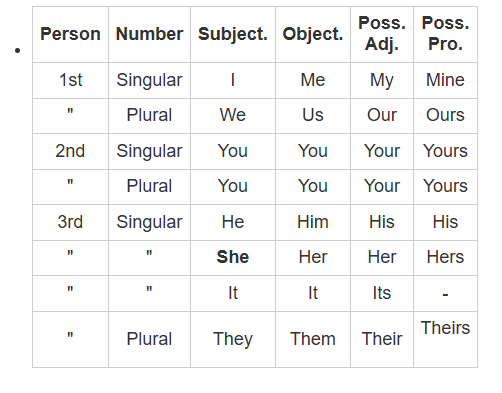
- Reflexive Pronoun: Reflexive pronouns are words ending in -self or -selves that are used when the subject and the object of a sentence are the same (e.g., I believe in myself).
- They can act as either objects or indirect objects. The nine English reflexive pronouns are “myself, yourself, himself, herself, oneself, itself, ourselves, yourselves, and themselves.“
Correct sentence:“Put yourself in his role and you will realize the importance of his position and the responsibilities that he had. He had gone through a period of hardships and struggles, he learned to survive in this modern warfare and that’s what made him a fighter and a winner at last.”
4. Read the sentence to find out whether there is any error in it or not. The error, if any, will be in one part of the sentence. The number of that part is the answer. If there is no error, the answer is (5). Ignore errors of punctuation, if any.
Everyone acknowledges her in the town but her/(A) is very mischievous, stubborn and arrogant./(B) She has been alone and all by herself her whole life/(C) so that is the reason everyone respects her and that’s what made her a survivor, a fighter and a living legend. /(D) No error. (E)
A. A
B. B
C. C
D. D
E. E
Solution
The correct answer is option (1) i.e. A
Key Points
- The error lies in the wrong usage of the pronoun ‘her’ in Part A.
- “her” will be replaced with “she”, a subjective case of the pronoun.
- But is used as a conjunction as well as a preposition.
- But when used as a conjunction gives the sense of connecting two sentences with reasoning.
- But when used as a preposition gives the sense of except, excluding something.
- In this sentence ‘but’ is used as a conjunction.
- Whenever any conjunction is used in a sentence, we will always use a subjective case after it.
- Correct Sentence: “Everyone acknowledges her in the town but she is very mischievous, stubborn and arrogant. She has been alone and all by herself her whole life so that the reason everyone respects her and that’s what made her a survivor, a fighter and a living legend.“
Additional Information
5. In the following question, a word has been given. Choose the sentence(s) in which it is used correctly and if all the sentences are correct then choose Option 5.
PALATIAL
A. The palatial entry hall features grand marble staircases, Renaissance-style ceiling frescoes, and gilded chandeliers.
B. Benavidez was hired fresh out of school to work as a masseuse at Epstein’s palatial New Mexico ranch.
C. That number makes for a more palatial bet as the two teams could easily combine for seven or eight goals.
A. A and B
B. B and C
C. Only B
D. Only C
E. All of these
Solution
The correct answer is option 1.
Key Points
- To answer this question, let’s first understand the meaning of the word given in the question:
- Palatial: resembling a palace in being spacious and splendid; grand or luxurious. (महल जैसा, आलीशान, भव्य)
- Now, let’s examine the given sentences:
- Sentence A: The palatial entry hall features grand marble staircases, Renaissance-style ceiling frescoes, and gilded chandeliers.
- This sentence correctly uses the word “palatial” to describe the entry hall as spacious and luxurious, resembling a palace.
- Sentence B: Benavidez was hired fresh out of school to work as a masseuse at Epstein’s palatial New Mexico ranch.
- This sentence correctly uses the word “palatial” to describe the ranch as grand and luxurious, much like a palace.
- Sentence C: That number makes for a more palatial bet as the two teams could easily combine for seven or eight goals.
- This sentence incorrectly uses the word “palatial.” Here, “palatial” is not appropriate as it does not align with the context of making a bet. A bet cannot be described as resembling a palace.
- So, only sentences A and B use the word “palatial” correctly.
Therefore, the correct answer is “Option 1.”
6. Below a word is given followed by three sentences that consist of that word. Identify the sentence/s which best expresses
the meaning of the word. Choose option 5 (None of these) if the word is not suitable in any of the sentences.
Squabble
A. The biggest hole in public coffers is not money squabbled or stolen, but that which is never collected in the first place.
B. Socialites are still squabbling and are thus capable of murder.
C. The company and state agencies squabbled for months over how to limit the pollution.
A. A and B
B. B and C
C. A and C
D. All A, B and C
E. None of these
Solution
The correct answer is option 2.
Key Points
- To answer this question, let’s first understand the meaning of the word given in the question:
- Squabble: a noisy quarrel about something trivial or petty. (झगड़ना, तकरार करना)
- Now, let’s examine the given sentences:
- Sentence A: The biggest hole in public coffers is not money squabbled or stolen, but that which is never collected in the first place.
- This sentence incorrectly uses the word “squabbled” because “squabble” refers to trivial disputes, not the misuse of money.
- Sentence B: Socialites are still squabbling and are thus capable of murder.
- This sentence correctly uses the word “squabbling” to describe petty arguments among socialites.
- Sentence C: The company and state agencies squabbled for months over how to limit the pollution.
- This sentence correctly uses the word “squabbled” to describe a petty dispute over pollution control measures.
- So, sentences B and C correctly use the word “squabble“, while sentence A does not.
Therefore, the correct answer is “B and C.”
7. Below a word is given followed by three sentences that consist of that word. Identify the sentence/s which best expresses
the meaning of the word. Choose option 5 (None of these) if the word is not suitable in any of the sentences.
Tacit
A. While they got a frosty public response, officials say the private message was a tacit green light.
B. While this tacit might put the most vulnerable members of the Senate Republican caucus in an electoral bind, the rest of the party has greeted the opening of the trial with a yawn.
C. The protesters had tacit approval from the city to camp for one night, but were told to vacate the parks by the following morning.
A. A and B
B. B and C
C. A and C
D. All A,B and C
E. None of these
Solution
The correct answer is option 3.
Key Points
- To answer this question, let’s first understand the meaning of the word given in the question:
- Tacit: understood or implied without being stated openly; silent agreement or approval. (अघोषित, मौन स्वीकृति)
- Now, let’s examine the given sentences:
- Sentence A: While they got a frosty public response, officials say the private message was a tacit green light.
- This sentence correctly uses the word “tacit” to describe an implied or unspoken approval (a green light).
- Sentence B: While this tacit might put the most vulnerable members of the Senate Republican caucus in an electoral bind, the rest of the party has greeted the opening of the trial with a yawn.
- This sentence incorrectly uses the word “tacit” as it does not fit the context or make sense grammatically.
- Sentence C: The protesters had tacit approval from the city to camp for one night, but were told to vacate the parks by the following morning.
- This sentence correctly uses the word “tacit” to describe unspoken or implied approval by the city for the protesters to camp.
- So, only Sentences A and C correctly use the word “tacit” in appropriate contexts.
Therefore, the correct answer is “A and C.” (Option 3)
8. In the following sentence, four words or phrases have been printed in bold. One bold part in the sentence is not acceptable in Standard English. Pick up that part and mark its number. If there are no errors in the bold parts, mark (5) i.e. No error as the answer.
My sister is my confident, as I tell her all my secrets.
A. Sister
B. Confident
C. Tell
D. Secrets
E. No Error
Solution
The correct answer is option 2.
Key Points
The incorrect word in the sentence is ‘confident’.
- ‘Confident’ is a misspelling in this context. The correct word should be ‘confidant‘.
- The word ‘confidant‘ refers to ‘a person with whom one shares a secret or private matter, trusting them not to repeat it to others’. (विश्वासपात्र)
- ‘Confident’, on the other hand, is an adjective that means ‘feeling or showing confidence in oneself or one’s abilities’.
Correct Sentence: My sister is my confidant, as I tell her all my secrets.
Additional Information
Meanings of the other bold words –
Secrets: Things that are kept or meant to be kept unknown or unseen by others. (गुप्त बातें)
Sister: A female sibling. (बहन)
Tell: To communicate information, facts, or news to someone. (कहना)
9. In the following sentence, four words or phrases have been printed in bold. One bold part in the sentence is not acceptable in Standard English. Pick up that part and mark its number. If there are no errors in the bold parts, mark (5) i.e. No error as the answer.To everyone’s relief, using the defibrillator, the coach was able to resusscitatethe unconscious player.
A. Relief
B. Defibrillator
C. Resusscitate
D. Unconscious
E. No error
Solution
The correct answer is option 3.
Key Points
The misspelled word is ‘resusscitate’.
- The correct spelling would be ‘resuscitate’.
- The word ‘resuscitate‘ is a verb which means ‘to revive someone from unconsciousness or apparent death’. (पुनर्जीवित करना)
- For Example –
- The doctor managed to resuscitate the patient who had stopped breathing.
Therefore, the correct answer would be ‘resusscitate’.
Additional Information
Let’s understand the meanings of the other marked words –
Unconscious – not awake and aware of and responding to one’s environment (अचेत)
Relief – a feeling of reassurance and relaxation following release from anxiety or distress (राहत)
Defibrillator – a device used to restore a normal heartbeat by sending an electric pulse or shock to the heart (डिफिब्रिलेटर)
10. In the following sentence, four words or phrases have been printed in bold. One bold part in the sentence is not acceptable in Standard English. Pick up that part and mark its number. If there are no errors in the bold parts, mark (5) i.e. No error as the answer.The main problem of education is that it is not excessible to all the people conveniently.
A. problem
B. education
C. excessible
D. conveniently
E. No error
Solution
The correct answer is option 3.
Key Points
The misspelled word is ‘excessible’.
- The correct spelling would be ‘accessible’.
- The word ‘accessible‘ is an adjective which means ‘able to be reached or entered’ or ‘easy to obtain or use’. (सुगम या सुलभ)
- For Example –
- The library is accessible to all students.
Therefore, the correct answer would be ‘excessible’.
Additional Information
Let’s understand the meanings of the other marked words –
Conveniently – in a way that fits well with particular needs, activities, and plans (सुविधाजनक ढंग से)
Problem – a matter or situation regarded as unwelcome or harmful and needing to be dealt with (समस्या)
Education – the process of receiving or giving systematic instruction, especially at a school or university (शिक्षा)
11. In the following sentence, four words or phrases have been printed in bold. One bold part in the sentence is not acceptable in Standard English. Pick up that part and mark its number. If there are no errors in the bold parts, mark (5) i.e. No error as the answer.The climbers were forced to abandon their attempted assent of Everest due to fierce storms which threatened to cover them with several inches of snow.
A. Abandon
B. Assent
C. Fierce
D. Threatened
E. No error
Solution
The correct answer is option 2.
Key Points
The incorrect word in the sentence is ‘assent’.
- ‘Assent’ means agreement or approval. However, the context of the sentence refers to the act of climbing a mountain, which requires the word ‘ascent‘.
- ‘Ascent’ is a noun that means the act of climbing or moving upwards (चढ़ाई/ आरोहण).
- This is a case of homophones, where two words sound similar but have different meanings and spellings.
Therefore, the correct sentence would be:
“The climbers were forced to abandon their attempted ascent of Everest due to fierce storms which threatened to cover them with several inches of snow.”
Additional Information
Meanings of other marked words in the sentence:
Threatened – to be in danger of being harmed or destroyed (धमकी देना/ खतरा होना).
Abandon – to give up completely (त्याग देना).
Fierce – having or displaying a violent or intense aggressiveness (उग्र/ प्रचंड).
12. In the following sentence, four words or phrases have been printed in bold. One bold part in the sentence is not acceptable in Standard English. Pick up that part and mark its number. If there are no errors in the bold parts, mark (5) i.e. No error as the answer.They failed to adhear to the terms of the agreement on which they had agreed upon earlier.
A. adhear
B. terms
C. agreement
D. agreed
E. No error.
Solution
The correct answer is option 1.
Key Points
The incorrect word in the sentence is ‘adhear’.
- The correct spelling would be ‘adhere’.
- The word ‘adhere‘ means to stick to a surface or substance, or to follow a practice or rule. (पालन करना)
- For Example – You must adhere to the rules of the organization.
Therefore, the correct spelling for the sentence is ‘adhere’.
Additional Information
Let’s understand the meanings of the other marked words in the sentence:
Agreed – consented to or came to a mutual decision (सहमति जताई)
Terms – conditions or stipulations agreed upon in a contract or agreement (शर्तें)
Agreement – a negotiated and legally binding arrangement (समझौता)
13. Read the passage and answer the following questions.
Critical thinking is not a matter of accumulating information. A person with a good memory and who knows a lot of facts is not necessarily good at critical thinking. A critical thinker is able to deduce consequences from what he knows, and he knows how to make use of information to solve problems, and to seek relevant sources of information to inform himself.
Critical thinking should not be confused with being argumentative or being critical of other people. Although critical thinking skills can be used in exposing fallacies and bad reasoning, critical thinking can also play an important role in cooperative reasoning and constructive tasks. Critical thinking can help us acquire knowledge, improve our theories, and strengthen arguments. We can use critical thinking to enhance work processes and improve social institutions.
Some people believe that critical thinking hinders creativity because it requires following the rules of logic and rationality, but creativity might require breaking rules. This is a misconception. Critical thinking is quite compatible with thinking “out-of-the-box”, challenging consensus and pursuing less popular approaches. If anything, critical thinking is an essential part of creativity because we need critical thinking to evaluate and improve our creative ideas.
To come up with a creative solution to a problem involves not just having new ideas. It must also be the case that the new ideas being generated are useful and relevant to the task at hand. Critical thinking plays a crucial role in evaluating new ideas, selecting the best ones and modifying them if necessary.
Science requires the critical use of reason in experimentation and theory confirmation. The proper functioning of a liberal democracy requires citizens who can think critically about social issues to inform their judgments about proper governance and to overcome biases and prejudice.
Question:
Which of the following is the most suitable title for the passage?
A. Creativity versus critical thinking
B. Creativity and Critical Thinking
C. Importance of critical thinking
D. Science and Critical Thinking
E. Need of critical thinking
Solution
The correct answer is option 3 i.e. Importance of critical thinking.
The passage states the importance of critical thinking and how it is needed in various fields of life. The passage talks about what critical thinking is and how creativity is a part of it. It also mentions the importance of it in our lives.
Thus option 3 is the correct answer.
14. Read the passage and answer the following questions.
Critical thinking is not a matter of accumulating information. A person with a good memory and who knows a lot of facts is not necessarily good at critical thinking. A critical thinker is able to deduce consequences from what he knows, and he knows how to make use of information to solve problems, and to seek relevant sources of information to inform himself.
Critical thinking should not be confused with being argumentative or being critical of other people. Although critical thinking skills can be used in exposing fallacies and bad reasoning, critical thinking can also play an important role in cooperative reasoning and constructive tasks. Critical thinking can help us acquire knowledge, improve our theories, and strengthen arguments. We can use critical thinking to enhance work processes and improve social institutions.
Some people believe that critical thinking hinders creativity because it requires following the rules of logic and rationality, but creativity might require breaking rules. This is a misconception. Critical thinking is quite compatible with thinking “out-of-the-box”, challenging consensus and pursuing less popular approaches. If anything, critical thinking is an essential part of creativity because we need critical thinking to evaluate and improve our creative ideas.
To come up with a creative solution to a problem involves not just having new ideas. It must also be the case that the new ideas being generated are useful and relevant to the task at hand. Critical thinking plays a crucial role in evaluating new ideas, selecting the best ones and modifying them if necessary.
Science requires the critical use of reason in experimentation and theory confirmation. The proper functioning of a liberal democracy requires citizens who can think critically about social issues to inform their judgments about proper governance and to overcome biases and prejudice.
Question:
Which of the following is critical thinking about?
A. A matter of accumulating information
B. To seek the reason behind everything
C. To deduce consequences from one’s knowledge
D. To infer the problem statement
E. All the above
Solution
The correct answer is option 3 i.e. To deduce consequences from one’s knowledge.
As mentioned in the passage, ‘A critical thinker is able to deduce consequences from what he knows, and he knows how to make use of information to solve problems, and to seek relevant sources of information to inform himself.‘
Option 3 is thus the correct answer.
The other options are incorrect as per the passage.
15. Read the passage and answer the following questions.
Critical thinking is not a matter of accumulating information. A person with a good memory and who knows a lot of facts is not necessarily good at critical thinking. A critical thinker is able to deduce consequences from what he knows, and he knows how to make use of information to solve problems, and to seek relevant sources of information to inform himself.
Critical thinking should not be confused with being argumentative or being critical of other people. Although critical thinking skills can be used in exposing fallacies and bad reasoning, critical thinking can also play an important role in cooperative reasoning and constructive tasks. Critical thinking can help us acquire knowledge, improve our theories, and strengthen arguments. We can use critical thinking to enhance work processes and improve social institutions.
Some people believe that critical thinking hinders creativity because it requires following the rules of logic and rationality, but creativity might require breaking rules. This is a misconception. Critical thinking is quite compatible with thinking “out-of-the-box”, challenging consensus and pursuing less popular approaches. If anything, critical thinking is an essential part of creativity because we need critical thinking to evaluate and improve our creative ideas.
To come up with a creative solution to a problem involves not just having new ideas. It must also be the case that the new ideas being generated are useful and relevant to the task at hand. Critical thinking plays a crucial role in evaluating new ideas, selecting the best ones and modifying them if necessary.
Science requires the critical use of reason in experimentation and theory confirmation. The proper functioning of a liberal democracy requires citizens who can think critically about social issues to inform their judgments about proper governance and to overcome biases and prejudice.
Question:
Which of the following is MOST SIMILAR in meaning to the word ‘FALLACIES’?
A. Obstructions
B. Thoughts
C. Problems
D. Mistaken Beliefs
E. Comparison
Solution
The correct answer is option 4 i.e. Mistaken Beliefs.
The word ‘fallacy‘ means ‘a mistaken belief, especially one based on unsound arguments.’
Hence, option 4 is the correct answer.
16. Read the passage and answer the following questions.
Critical thinking is not a matter of accumulating information. A person with a good memory and who knows a lot of facts is not necessarily good at critical thinking. A critical thinker is able to deduce consequences from what he knows, and he knows how to make use of information to solve problems, and to seek relevant sources of information to inform himself.
Critical thinking should not be confused with being argumentative or being critical of other people. Although critical thinking skills can be used in exposing fallacies and bad reasoning, critical thinking can also play an important role in cooperative reasoning and constructive tasks. Critical thinking can help us acquire knowledge, improve our theories, and strengthen arguments. We can use critical thinking to enhance work processes and improve social institutions.
Some people believe that critical thinking hinders creativity because it requires following the rules of logic and rationality, but creativity might require breaking rules. This is a misconception. Critical thinking is quite compatible with thinking “out-of-the-box”, challenging consensus and pursuing less popular approaches. If anything, critical thinking is an essential part of creativity because we need critical thinking to evaluate and improve our creative ideas.
To come up with a creative solution to a problem involves not just having new ideas. It must also be the case that the new ideas being generated are useful and relevant to the task at hand. Critical thinking plays a crucial role in evaluating new ideas, selecting the best ones and modifying them if necessary.
Science requires the critical use of reason in experimentation and theory confirmation. The proper functioning of a liberal democracy requires citizens who can think critically about social issues to inform their judgments about proper governance and to overcome biases and prejudice.
Question:
Which of the following is MOST OPPOSITE in meaning to the word ‘bias’?
A. Encouragement
B. Objectivity
C. Propulsion
D. Retention
E. Fear
Solution
The correct answer is option 2 i.e. Objectivity.
The word ‘bias‘ means ‘inclination or prejudice for or against one person or group, especially in a way considered to be unfair.’
Thus the word ‘objectivity‘ which means ‘impartiality‘ is the word opposite in meaning.
propulsion=>the action of driving or pushing forwards.
retention=> the continued possession, use, or control of something.
Option 2 is the correct answer.
17. Read the passage and answer the following questions.
Critical thinking is not a matter of accumulating information. A person with a good memory and who knows a lot of facts is not necessarily good at critical thinking. A critical thinker is able to deduce consequences from what he knows, and he knows how to make use of information to solve problems, and to seek relevant sources of information to inform himself.
Critical thinking should not be confused with being argumentative or being critical of other people. Although critical thinking skills can be used in exposing fallacies and bad reasoning, critical thinking can also play an important role in cooperative reasoning and constructive tasks. Critical thinking can help us acquire knowledge, improve our theories, and strengthen arguments. We can use critical thinking to enhance work processes and improve social institutions.
Some people believe that critical thinking hinders creativity because it requires following the rules of logic and rationality, but creativity might require breaking rules. This is a misconception. Critical thinking is quite compatible with thinking “out-of-the-box”, challenging consensus and pursuing less popular approaches. If anything, critical thinking is an essential part of creativity because we need critical thinking to evaluate and improve our creative ideas.
To come up with a creative solution to a problem involves not just having new ideas. It must also be the case that the new ideas being generated are useful and relevant to the task at hand. Critical thinking plays a crucial role in evaluating new ideas, selecting the best ones and modifying them if necessary.
Science requires the critical use of reason in experimentation and theory confirmation. The proper functioning of a liberal democracy requires citizens who can think critically about social issues to inform their judgments about proper governance and to overcome biases and prejudice.
Question:
What do you mean by the phrase ‘the task at hand’?
A. The task someone is doing currently
B. The most important task
C. The most critical task
D. The most appreciated task
E. The task which needs to be done
Solution
The correct answer is option 1 i.e. The task someone is doing currently.
The phrase ‘task at hand’ means ‘the current task that someone is doing or that they are currently working on.’
18. Read the passage and answer the following questions.
Critical thinking is not a matter of accumulating information. A person with a good memory and who knows a lot of facts is not necessarily good at critical thinking. A critical thinker is able to deduce consequences from what he knows, and he knows how to make use of information to solve problems, and to seek relevant sources of information to inform himself.
Critical thinking should not be confused with being argumentative or being critical of other people. Although critical thinking skills can be used in exposing fallacies and bad reasoning, critical thinking can also play an important role in cooperative reasoning and constructive tasks. Critical thinking can help us acquire knowledge, improve our theories, and strengthen arguments. We can use critical thinking to enhance work processes and improve social institutions.
Some people believe that critical thinking hinders creativity because it requires following the rules of logic and rationality, but creativity might require breaking rules. This is a misconception. Critical thinking is quite compatible with thinking “out-of-the-box”, challenging consensus and pursuing less popular approaches. If anything, critical thinking is an essential part of creativity because we need critical thinking to evaluate and improve our creative ideas.
To come up with a creative solution to a problem involves not just having new ideas. It must also be the case that the new ideas being generated are useful and relevant to the task at hand. Critical thinking plays a crucial role in evaluating new ideas, selecting the best ones and modifying them if necessary.
Science requires the critical use of reason in experimentation and theory confirmation. The proper functioning of a liberal democracy requires citizens who can think critically about social issues to inform their judgments about proper governance and to overcome biases and prejudice.
Question:
Which of the following is referred to as ‘out-of-the-box’ ?
A. Creative thinking
B. Common thinking
C. Beneficial thinking
D. Logical thinking
E. Spiritual thinking
Solution
The correct answer is option 1 i.e. Critical thinking.
The phrase ‘out of the box‘ thinking means ‘creative thinking.’
Thus, option 5 is correct.
19. Read the passage and answer the following questions.
Critical thinking is not a matter of accumulating information. A person with a good memory and who knows a lot of facts is not necessarily good at critical thinking. A critical thinker is able to deduce consequences from what he knows, and he knows how to make use of information to solve problems, and to seek relevant sources of information to inform himself.
Critical thinking should not be confused with being argumentative or being critical of other people. Although critical thinking skills can be used in exposing fallacies and bad reasoning, critical thinking can also play an important role in cooperative reasoning and constructive tasks. Critical thinking can help us acquire knowledge, improve our theories, and strengthen arguments. We can use critical thinking to enhance work processes and improve social institutions.
Some people believe that critical thinking hinders creativity because it requires following the rules of logic and rationality, but creativity might require breaking rules. This is a misconception. Critical thinking is quite compatible with thinking “out-of-the-box”, challenging consensus and pursuing less popular approaches. If anything, critical thinking is an essential part of creativity because we need critical thinking to evaluate and improve our creative ideas.
To come up with a creative solution to a problem involves not just having new ideas. It must also be the case that the new ideas being generated are useful and relevant to the task at hand. Critical thinking plays a crucial role in evaluating new ideas, selecting the best ones and modifying them if necessary.
Science requires the critical use of reason in experimentation and theory confirmation. The proper functioning of a liberal democracy requires citizens who can think critically about social issues to inform their judgments about proper governance and to overcome biases and prejudice.
Question:
Which of the following is true according to the passage?
A. We use critical thinking to enhance work processes but it degrades social institutions.
B. Critical thinking requires both logical thinking and creativity.
C. We need critical thinking to evaluate and improve our illogical ideas.
D. To come up with a creative solution to a problem involves just having one new idea
E. Critical thinking is not about thinking out of the box but about finding the correct ideas.
Solution
The correct answer is option 2 i.e. Critical thinking requires both logical thinking and creativity.
All the options except option 2 are incorrect according to the passage.
It is mentioned in the passage ‘Some people believe that critical thinking hinders creativity because it requires following the rules of logic and rationality, but creativity might require breaking rules. This is a misconception. Critical thinking is quite compatible with thinking “out-of-the-box”, challenging consensus and pursuing less popular approaches.’
Option 2 is the correct answer.
20. Read the passage and answer the following questions.
Critical thinking is not a matter of accumulating information. A person with a good memory and who knows a lot of facts is not necessarily good at critical thinking. A critical thinker is able to deduce consequences from what he knows, and he knows how to make use of information to solve problems, and to seek relevant sources of information to inform himself.
Critical thinking should not be confused with being argumentative or being critical of other people. Although critical thinking skills can be used in exposing fallacies and bad reasoning, critical thinking can also play an important role in cooperative reasoning and constructive tasks. Critical thinking can help us acquire knowledge, improve our theories, and strengthen arguments. We can use critical thinking to enhance work processes and improve social institutions.
Some people believe that critical thinking hinders creativity because it requires following the rules of logic and rationality, but creativity might require breaking rules. This is a misconception. Critical thinking is quite compatible with thinking “out-of-the-box”, challenging consensus and pursuing less popular approaches. If anything, critical thinking is an essential part of creativity because we need critical thinking to evaluate and improve our creative ideas.
To come up with a creative solution to a problem involves not just having new ideas. It must also be the case that the new ideas being generated are useful and relevant to the task at hand. Critical thinking plays a crucial role in evaluating new ideas, selecting the best ones and modifying them if necessary.
Science requires the critical use of reason in experimentation and theory confirmation. The proper functioning of a liberal democracy requires citizens who can think critically about social issues to inform their judgments about proper governance and to overcome biases and prejudice.
Question:
Which of the following can be inferred from the last lines of the passage?
A. Critical thinking is a crucial part of science and technology.
B. A democracy is successful only when the people are highly critical of one another.
C. To overcome biases of any sort one must avoid critical thinking.
D. Social issues should be thought of more critically than those of scientific issues.
E. Creativity and critical thinking cannot go hand in hand.
Solution
The correct answer is option 1 i.e. Critical thinking is a crucial part of science and technology.
The last paragraph talks about critical thinking and its relevance in the field of science and technology.
Thus, option 1 is the correct answer.
The other options are incorrect.
21. The following question has two blanks, each blank indicating that something has been omitted. Choose the set of words for each blank that best fits in the context of the sentence.
The general role of commercial banks is to provide financial ________ to the general public and business, ensuring economic and social ________ and sustainable growth of the economy.
A. kindness, searching
B. suggestions, activity
C. services, stability
D. repair , opportunity
E. renovation, scope
Solution
The correct answer is ‘services, stability‘.
Key Points
- The given sentence discusses the general role of commercial banks.
- Option 1) is not appropriate.
- The meaning of the word ‘kindness‘ is ‘the quality of being friendly or generous’.
- The word ‘kindness‘ is not appropriate because ‘financial kindness’ is not meaningful.
- Option 2) is not the correct answer.
- The meaning of the word ‘suggestion’ is ‘piece of advice’.
- The word ‘suggestions‘ is not suitable for the first blank because suggestions do not ensure ‘sustainable growth of the economy.’
- Option 3) is the best fit.
- The meaning of the word ‘services’ is ‘the act of helping’.
- The word ‘services‘ is appropriate for the first blank because it is the duty of the commercial banks to provide financial services.
- The meaning of the word ‘stability‘ is ‘firmness’.
- The word ‘stability‘ is appropriate for the second blank because commercial banks should ensure social stability or firmness.
- Option 4) is the correct answer.
- The meaning of the word ‘repair‘ is ‘to mend’.
- The word ‘repair‘ is not suitable for the first blank.
- Option 5) should not be chosen.
- The meaning of the word ‘renovation‘ is ‘the action of restoring’.
- The word ‘renovation’ is not an appropriate word to describe the role of a commercial bank.
Additional Information
The meaning of the other given words:
- Searching: to find something
- Activity: action or movement
- Opportunity: chance
- Scope: opportunity to do something
Correct sentence: The general role of commercial banks is to provide financial services to the general public and business, ensuring economic and social stability and sustainable growth of the economy.
22. The following question has two blanks, each blank indicating that something has been omitted. Choose the set of words for each blank that best fits in the context of the sentence.
Over the last seven decades, India has made distinct progress, but many core development challenges________ and we are yet to fulfill our constitutional ________.
A. continuity, rights
B. involved, concepts
C. cease, obligations
D. persist, promise
E. persisted, right
Solution
The correct answer is ‘persist, promise‘.
Key Points
- The given sentence discusses the situation of India.
- Option 1) is not the answer.
- The meaning of the word ‘continuity‘ is ‘the maintenance of continuous action’.
- We need a verb for the first blank and the word ‘continuity‘ is a noun. Hence, it is not appropriate for the given sentence.
- Option 2) is not the correct answer.
- The meaning of the word ‘involved‘ is ‘included’.
- The word ‘involved‘ is not making any meaningful sentence. So, we cannot choose this word for the first blank.
- Option 3) is not the answer.
- The meaning of the word ‘cease‘ is ‘to come to an end’.
- ‘But‘ is used in the sentence. Therefore, the clauses are contrasting with each other.
- So, ‘cease‘ cannot be chosen for the first blank.
- Option 4) is the best fit.
- The meaning of the word ‘persist‘ is ‘to continue’.
- The word ‘persist‘ is suitable because India is still facing many difficulties. So, it is appropriate for the first blank.
- The meaning of the word ‘promise‘ is ‘to give one’s words’.
- The word ‘promise‘ is appropriate for the second blank as it is making the sentence contextually meaningful.
- Option 5) is not the answer.
- The word ‘persisted‘ is inappropriate as we should use the present indefinite tense. So, ‘persist‘ is the correct word.
Additional Information
The meaning of the other given words:
- Rights: authority or power
- Concepts: idea or notion
- Obligations: duty or commitment
Correct sentence: Over the last seven decades, India has made distinct progress, but many core development challenges persist and we are yet to fulfill our constitutional promise.
23. The following question has two blanks, each blank indicating that something has been omitted. Choose the set of words for each blank that best fits in the context of the sentence.
The ________of floating a bad bank to tackle the worsening asset quality of the banking system in India has ________ once again.
A. develop, impoverished
B. assign, found
C. help, praised
D. manipulate, surfaced
E. idea, surfaced
Solution
The correct answer is ‘idea, surfaced‘.
Key Points
- The given sentence is about the plan of floating a bad bank.
- We should choose a noun for the first blank because the definite article ‘the’ is used before the blank.
- Therefore, we can eliminate option 1), option 2), option 3) and option 4) as these options have verbs.
- Option 4) is the best fit.
- The meaning of the word ‘idea‘ is ‘concept or plan‘.
- The word ‘idea‘ is a noun and it is relevant to the context.
- The meaning of the word ‘surfaced‘ is ‘to arise or become apparent‘.
- The word ‘surfaced‘ is also appropriate for the second blank.
Additional Information
The meaning of the other given words:
- develop: to grow
- impoverished: poor or poverty-stricken
- assign: allocate or allot
- praised: expressed admiration of
- manipulate: control
Correct sentence: “The idea of floating a bad bank to tackle the worsening asset quality of the banking system in India has surfaced once again.”
24. The following question has two blanks, each blank indicating that something has been omitted. Choose the set of words for each blank that best fits in the context of the sentence.
Besides ushering in greater transparency, the GeM portal has ________ increased participation of the MSMEs even in ________ areas in Government procurement.
A. facilitating, remote
B. imported, rotated
C. facilitated, remote
D. performed, reserved
E. performing, remove
Solution
The correct answer is ‘facilitated, remote‘.
Key Points
- The given sentence informs us about the activity of GeM.
- ‘Verb3‘ should be chosen as the word ‘has‘ is used before the first blank. Hence, option 1) and option 5) should be eliminated.
- Option 3) is the best fit.
- The meaning of the word ‘facilitated‘ is ‘to make easier’.
- The portal has made a process easier, so we can choose the word ‘facilitated‘ for the first blank.
- The meaning of the word ‘remote‘ is ‘far or distant’ and we can use this word before the word ‘areas’.
- So, the word ‘remote‘ is suitable for the second blank.
- Option 2) is not appropriate.
- The meaning of the word ‘imported‘ is ‘buy from abroad’ and it is not relevant to the context.
- Option 4) is not the answer.
- The meaning of the word ‘performed‘ is ‘to carry out’ and it is not appropriate for the first blank.
Additional Information
The meaning of other given words:
- Rotated: to move round
- Reserved: retained for future use
- Remove: to detach or take away
Correct sentence: Besides ushering in greater transparency, the GeM portal has facilitated increased participation of the MSMEs even in remote areas in Government procurement.
25. The following question has two blanks, each blank indicating that something has been omitted. Choose the set of words for each blank that best fits in the context of the sentence.
The talks between the government and 41 protesting farm unions have ________ inconclusive even after 11 rounds of ________ .
A. pretended,rationale
B. remained, discussions
C. forwarded, uncontroversial
D. thanked, empathetic
E. requested, conclude
Solution
The correct answer is ‘remained, discussions‘.
Key Points
- The given sentence describes the situation after the discussions between the government and the farm unions.
- Option 1) is not the correct answer.
- The meaning of the word ‘pretended‘ is ‘to put on a false front’.
- The word ‘pretended‘ is not making the sentence contextually correct. So, we cannot choose the word ‘remained‘ for the first blank.
- Option 2) is the best fit.
- The meaning of the word ‘remained‘ is ‘stayed or continued to exist’.
- According to the sentence, the issue could not be solved. Therefore, the word ‘remained‘ is appropriate for the first blank.
- The meaning of the word ‘discussions‘ is ‘a conversation or debate’.
- It is also clear that they have tried to solve the problem through conversations. So, the word ‘discussions‘ is appropriate for the second blank.
- Option 3) is not the correct answer.
- The meaning of the word ‘forwarded‘ is ‘to send on or promote’.
- The word ‘forwarded’ is not relevant to the context. So, it is not suitable for the first blank.
- Option 4) is not appropriate.
- The meaning of the word ‘thanked’ is ‘expressed gratitude’.
- The word ‘thanked‘ is not appropriate for the first blank.
- Option 5) is not the answer.
- The meaning of the word ‘requested‘ is ‘asked politely or appealed’.
- The word ‘requested‘ is not an appropriate verb for the first blank.
Additional Information
The meaning of the other given words:
- Rationale: a set of reasons
- Uncontroversial: not disputed
- Empathetic: showing the ability to understand
- Conclude: to come to an end
Correct sentence: The talks between the government and 41 protesting farm unions have remained inconclusive even after 11 rounds of discussions.
26. In the following question, the 3rd statement is fixed. Rearrange the remaining statements and answer the question which follows:
A. It has also led to a decrease in the employment opportunities particularly for the labour class.
B. Excessive use of technology has also contributed to problems such as obesity and visual impairment.
C. The continual use of technologically advanced equipment, as well as the process of their production, has led to a drastic rise in all types of pollution.
D. Technology has helped in the growth and development of the mankind as a whole and technological inventions have made living convenient.
E. Technology certainly has given way to an improved lifestyle and contributed towards the growth of economies; however, the amount of damage it has done to the environment, as well as the mankind, is a cause of serious concern.
F. Connecting with people in different parts of the world, travelling a long distance, having constant sources of entertainment and ease of cooking and storing food are some of the best things technology has offered us
Question:
What is the first sentence after rearrangement?
A. D
B. A
C. B
D. E
E. F
Solution
The correct answer is 1.
Since the third sentence is fixed, therefore, in order to derive the first sentence of the correct arrangement, it is imperative to know the subject dealt in the third sentence arrangement. The third sentence discusses the fact that the constant use of technological devices has led to different types of pollution. From here we can understand that the first sentence should introduce us to the fact that how technology is important in today’s world. This idea is expressed by the sentence D which therefore is the first sentence after rearrangement.
27. In the following question, the 3rd statement is fixed. Rearrange the remaining statements and answer the question which follows:
A. It has also led to a decrease in the employment opportunities particularly for the labour class.
B. Excessive use of technology has also contributed to problems such as obesity and visual impairment.
C. The continual use of technologically advanced equipment, as well as the process of their production, has led to a drastic rise in all types of pollution.
D. Technology has helped in the growth and development of the mankind as a whole and technological inventions have made living convenient.
E. Technology certainly has given way to an improved lifestyle and contributed towards the growth of economies; however, the amount of damage it has done to the environment, as well as the mankind, is a cause of serious concern.
F. Connecting with people in different parts of the world, travelling a long distance, having constant sources of entertainment and ease of cooking and storing food are some of the best things technology has offered us
Question:
What is the second sentence after rearrangement?
A. A
B. B
C. F
D. D
E. E
Solution
The correct answer is 3.
Since the third sentence is fixed therefore in order to derive the second sentence of the correct arrangement, it is imperative to know the subject dealt in the first sentence arrangement. The third sentence discusses the fact that the constant use of technological devices has led to different types of pollution. From here we can understand that the first sentence should introduce us to the fact that how technology is important in today’s world. This idea is expressed by the sentence D which therefore is the first sentence after rearrangement.
Taking the subject further we come to the fact where technology has made life easier and more comfortable in different ways. This idea is expressed by the sentence F which, therefore, is the second sentence after rearrangement.
28. In the following question, the 3rd statement is fixed. Rearrange the remaining statements and answer the question which follows:
A. It has also led to a decrease in the employment opportunities particularly for the labour class.
B. Excessive use of technology has also contributed to problems such as obesity and visual impairment.
C. The continual use of technologically advanced equipment, as well as the process of their production, has led to a drastic rise in all types of pollution.
D. Technology has helped in the growth and development of the mankind as a whole and technological inventions have made living convenient.
E. Technology certainly has given way to an improved lifestyle and contributed towards the growth of economies; however, the amount of damage it has done to the environment, as well as the mankind, is a cause of serious concern.
F. Connecting with people in different parts of the world, travelling a long distance, having constant sources of entertainment and ease of cooking and storing food are some of the best things technology has offered us
Question:
What is the fourth sentence after rearrangement?
A. F
B. B
C. A
D. E
E. D
Solution
The correct answer is 2.
Since the third sentence is fixed therefore in order to derive the fourth sentence of the correct arrangement, it is imperative to know the subject dealt in the first three sentences. The third sentence discusses the fact that the constant use of technological devices has led to different types of pollution. From here we can understand that the first sentence should introduce us to the fact that how technology is important in today’s world. This idea is expressed by the sentence D which therefore is the first sentence after rearrangement.
Taking the subject further we come to the fact where technology has made life easier and more comfortable in different ways. This idea is expressed by the sentence F which therefore is the second sentence after rearrangement.
The passage further goes into the depth that discusses the issue that technology has caused obesity and other diseases. This idea is expressed by the sentence B which therefore is the fourth sentence after rearrangement.
At this point, we know that the pattern of the sentences after rearrangement as of now is DFCB.
29. In the following question, the 3rd statement is fixed. Rearrange the remaining statements and answer the question which follows:
A. It has also led to a decrease in the employment opportunities particularly for the labour class.
B. Excessive use of technology has also contributed to problems such as obesity and visual impairment.
C. The continual use of technologically advanced equipment, as well as the process of their production, has led to a drastic rise in all types of pollution.
D. Technology has helped in the growth and development of the mankind as a whole and technological inventions have made living convenient.
E. Technology certainly has given way to an improved lifestyle and contributed towards the growth of economies; however, the amount of damage it has done to the environment, as well as the mankind, is a cause of serious concern.
F. Connecting with people in different parts of the world, travelling a long distance, having constant sources of entertainment and ease of cooking and storing food are some of the best things technology has offered us
Question:
What is the fifth sentence after rearrangement?
A. C
B. B
C. D
D. F
E. A
Solution
The correct answer is 5.
Since the third sentence is fixed therefore in order to derive the fifth sentence of the correct arrangement, it is imperative to know the subject dealt in the first four sentences. The third sentence discusses the fact that the constant use of technological devices has led to different types of pollution. From here we can understand that the first sentence should introduce us to the fact that how technology is important in today’s world. This idea is expressed by the sentence D which therefore is the first sentence after rearrangement.
Taking the subject further we come to the fact where technology has made life easier and more comfortable in different ways. This idea is expressed by the sentence F which therefore is the second sentence after rearrangement.
The passage further goes into the depth that discusses the issue that technology has caused obesity and other diseases. This idea is expressed by the sentence B which therefore is the fourth sentence after rearrangement.
The next part of the passage goes into expressing more problems created as a result of the increased use of technology such as the problems in employment opportunities. This idea is expressed by the sentence A which therefore is the fifth sentence after rearrangement.
30. In the following question, the 3rd statement is fixed. Rearrange the remaining statements and answer the question which follows:
A. It has also led to a decrease in the employment opportunities particularly for the labour class.
B. Excessive use of technology has also contributed to problems such as obesity and visual impairment.
C. The continual use of technologically advanced equipment, as well as the process of their production, has led to a drastic rise in all types of pollution.
D. Technology has helped in the growth and development of the mankind as a whole and technological inventions have made living convenient.
E. Technology certainly has given way to an improved lifestyle and contributed towards the growth of economies; however, the amount of damage it has done to the environment, as well as the mankind, is a cause of serious concern.
F. Connecting with people in different parts of the world, travelling a long distance, having constant sources of entertainment and ease of cooking and storing food are some of the best things technology has offered us
Question:
What is the sixth sentence after rearrangement?
A. A
B. B
C. E
D. D
E. F
Solution
The correct answer is 3.
Since the third sentence is fixed therefore in order to derive the sixth sentence of the correct arrangement, it is imperative to know the subject dealt in the first five sentences. The third sentence discusses the fact that the constant use of technological devices has led to different types of pollution. From here we can understand that the first sentence should introduce us to the fact that how technology is important in today’s world. This idea is expressed by the sentence D which therefore is the first sentence after rearrangement.
Taking the subject further we come to the fact where technology has made life easier and more comfortable in different ways. This idea is expressed by the sentence F which therefore is the second sentence after rearrangement.
The passage further goes into the depth that discusses the issue that technology has caused obesity and other diseases. This idea is expressed by the sentence B which therefore is the fourth sentence after rearrangement. The next part of the passage goes into expressing more problems created as a result of the increased use of technology such as the problems in employment opportunities. This idea is expressed by the sentence A which therefore is the fifth sentence after rearrangement.
This is the concluding part of the passage which summarizes the entire passage that although there are several advantages of technology, it also brings many serious concerns. This idea is expressed by the sentence E which therefore is the sixth sentence after rearrangement.
Thus the correct rearrangement of the sentences is DFCBAE.
31. I) x² – 42x + 437 = 0
II) y² – 52y + 667 = 0
A. x > y
B. x ≥ y
C. x = y (or) relationship can’t be determined
D. x < y
E. x ≤ y
Solution
Calculation:
Equation I (x² – 42x + 437 = 0)
x² – 19x – 23x + 437 = 0
(x² – 19x) – (23x – 437) = 0
x(x – 19) – 23(x – 19) = 0
(x – 19)(x – 23) = 0
Roots:
x = 19 or x = 23
Equation II (y² – 52y + 667 = 0)
y² – 23y – 29y + 667 = 0
(y² – 23y) – (29y – 667) = 0
y(y – 23) – 29(y – 23) = 0
(y – 23)(y – 29) = 0
Roots:
y = 23 or y = 29
Comparison Roots:
| Value of X | Value of Y | Relation |
| 23 | 23 | x = y |
| 23 | 29 | x < y |
| 19 | 23 | x < y |
| 19 | 29 | x < y |
Therefore, the correct answer is x ≤ y
32. I) (X-3)² = 64
II) Y3/16 = 32
A. x > y
B. x ≥ y
C. x = y (or the relationship cannot be determined)
D. x < y
E. x ≤ y
Solution
Calculation:
Equation I: (X – 3)² = 64
⇒ Take square root on both sides:
X – 3 = ± 8
⇒ X = 3 + 8 = 11 or X = 3 – 8 = -5
⇒ X values: -5 and 11
Equation II: Y316=32Y316=32
⇒ Multiply both sides by 16:
Y3 = 32 × 16 = 512
⇒ Take cube root:
Y=512−−−√3=8Y=5123=8
⇒ Y value: 8
Now compare values:
X values: -5 and 11
Y value: 8
Comparing each X with Y:
11 > 8
-5 < 8
⇒ One X is greater than Y, the other is less.
Thus, the correct answer is C. x = y or the relationship cannot be determined
33. I) x2 − 52x + 672 = 0
II) y2 − 45y + 506 = 0
A. x > y
B. x ≤ y
C. x ≥ y
D. x < y
E. x = y or relationship between x and y can’t be established
Solution
Calculation:
Equation I:
x2 − 52x + 672 = 0
(x – 28)(x – 24) = 0
So, x = 28 or x = 24.
Equation II:
y2 − 45y + 506 = 0
(y – 23)(y – 22) = 0
So, y = 23 or y = 22.
Comparison of the Roots:
Case 1: x = 24 vs y = 22 → x > y
Case 2: x = 24 vs y = 23 → x > y
Case 3: x = 28 vs y = 22 → x > y
Case 4: x = 28 vs y = 23 → x > y
In all cases, x > y.
Thus, the correct answer is x > y.
34. Solve the equation and compare the value of x and y.
I. 2x2 + 7x – 30 = 0
II. 3y2 + 6y – 24 = 0
A. x < y
B. x > y
C. x ≤ y
D. x ≥ y
E. x = y or relationship cannot be established
Solution
Calculation
So, 2×2 + 7x – 30 = 0
⇒ 2×2 + 12x − 5x – 30 = 0
⇒ 2x(x + 6) − 5(x + 6) =0
⇒ (x + 6)(2x − 5) = 0
So, x = – 6 and 5/2
3y2 – 6y – 24 = 0
3y2 + 12y − 6y − 24=0
⇒ 3y (y + 4) − 6(y + 4) =0
⇒ (y + 4) (3y − 6) =0
So, y = −4 and 2
So, the relationship cannot be established between x and y
Option (5) is the correct Option.
35. In the given question, two equations numbered l and II are given. Solve both the equations and mark the appropriate answer.
I. 3x2 + 14x + 16 = 0
II. 3y2 + 22y + 24 = 0
A. x < y
B. x > y
C. x ≤ y
D. x ≥ y
E. x = y or the relation between x and y can’t be established.
Solution
Calculation:
I. 3x2 + 14x + 16 = 0
⇒ 3x2 + 6x + 8x + 16 = 0
⇒ 3x(x + 2) + 8(x + 2) = 0
⇒ (3x + 8) (x + 2) = 0
⇒ x = – 8/3, -2
II. 3y2 + 22y + 24 = 0
⇒ 3y2 + 18y + 4y + 24 = 0
⇒ 3y(y + 6) + 4(y + 6) = 0
⇒ (3y + 4) (y + 6) = 0
⇒ y = – 4/3, – 6
Comparison between X and Y (via tabulation):
| Value of x | Value of y | Relation |
| -8/3 | -4/3 | x < y |
| -8/3 | -6 | x > y |
| -2 | -4/3 | x < y |
| -2 | -6 | x > y |
∴ x = y or the relation between x and y can’t be established.
36. In a college exam, 60% of the total students passed with distinction, and the remaining students passed normally, failed, or were absent in the ratio 3 : 4 : 2. The number of students who passed with distinction was 207 more than the number of absent students. How many students failed the exam?
A. 51
B. 69
C. 72
D. 85
E. 94
Solution
Calculation:
60% of students passed with distinction.
Remaining 40% students passed normally, failed, or were absent in the ratio 3 : 4 : 2.
Number of students who passed with distinction is 207 more than the number of absent students.
Find the number of students who failed.
Let the total number of students = T.
Number passed with distinction = 0.60T.
Remaining students = 0.40T.
These 0.40T students are divided into three groups in ratio 3 : 4 : 2, which corresponds to:
Passed normally = 3x,
Failed = 4x,
Absent = 2x.
Since the total of these three groups is 0.40T,
3x + 4x + 2x = 9x = 0.40T ⟹ x = 0.40T / 9
Distinction = Absent + 207
0.60T = 2x + 207
Substitute x = 0.40T / 9,
0.60T = 2 × 0.40T / 9 + 207
0.60T = 0.80T / 9 + 207
9 × 0.60T = 0.80T + 9 × 207
5.4T = 0.80T + 1863
5.4T – 0.80T = 1863
4.6T = 1863
T = 1863 / 4.6 = 405
x = 0.40 × 405 / 9 = 162 / 9 = 18
Failed students = 4x = 4 × 18 = 72.
Thus, 72 students failed the exam.
37. A microfinance institution offers a loan under the pretense of simple interest at a rate of 24% per annum. However, they calculate the interest and add it to the loan principal every 3 months. If a borrower takes a loan of Rs. 15,000, what will be the total interest paid at the end of 6 months?
A. Rs. 1,762
B. Rs. 1,233
C. Rs. 1,656
D. Rs. 1,854
E. Rs. 1,419
Solution
Given:
Principal (P) = ₹15,000
Annual interest rate (R) = 24%
Time = 6 months = 2 quarters
Compounded quarterly every 3 months
Formula Used:
The formula for compound interest is:
A = P (1 + r / 100)n
Calculation:
P = ₹15,000
r = 24 / 4 = 6% per quarter
n = 2 (2 quarters in 6 months)
A = 15000 (1 + 6 / 100)2 = 15000 × 1.062 = 15000 × 1.1236 = ₹16,854
Interest paid = A − P
16854 − 15000 = ₹1854
Thus, the total interest paid at the end of 6 months under quarterly compounding is ₹1854.
38. There are five different shops [A, B, C, D and E]. In each shop sold sandwich (veg and non veg) and burger (veg and non veg). The given table shows the percentage sandwich sold, Difference between veg and non veg sandwich sold, ratio between veg and non veg burger sold.
| Shop | Percentage sandwich sold | Difference between veg and non veg sandwich sold | Ratio between veg and non veg burger sold. |
| A | 40% | 8 | 29:25 |
| B | 60% | 16 | 1:5 |
| C | 50% | 40 | 7:25 |
| D | 40% | 16 | 11:5 |
| E | 55% | 10 | 1:5 |
Note – The total number of items sold in shops A, B, C, D, and E is 180, 240, 320, 160, and 200, respectively. In shops B and D, the number of veg sandwiches sold is more than the number of non-veg sandwiches sold in the same shop.
Question:
Number of burgers sold in shop F is three times of number of non veg item sold in shop E. If total item sold in shop F is 529 find the difference between number of sandwiches sold in shop E and F?
A. 23
B. 14
C. 27
D. 32
E. 22
Solution
Common Calculation –
Total number of items sold in shop A is 180.
Number of sandwiches sold in shop A is 180 x 40/100 = 72.
Number of burgers sold in shop A is 180 – 72 = 108
Difference between number of veg and non veg sandwich sold in shop A is 8. Number of non veg sandwich sold in shop A is more than the number of veg sandwich sold in shop A.
So, Number of veg sandwich sold in shop A is [72 – 8] /2 = 64 /2 = 32
Number of non – veg sandwich sold in shop A is [72 + 8] /2 = 80 /2 = 40
Number of veg burger sold in shop A is 108 x 29 / 54 = 58
Number of non-veg burger sold in shop A is 108 – 58 = 50
Similarly, we can calculate the data of shop C and E also.
Total number of items sold in shop B is 240.
Number of sandwiches sold in shop B is 240 x 60/100 = 144.
Number of burgers sold in shop B is 240 – 144 = 96
Difference between number of veg and non veg sandwich sold in shop B is 16. Number of non veg sandwich sold in shop B is less than the number of veg sandwich sold in shop B.
So, Number of veg sandwich sold in shop B is [144 + 16] /2 = 160 /2 = 80
Number of non – veg sandwich sold in shop B is [144 – 16] /2 = 128/2 = 64
Number of veg burger sold in shop B is 96 x 1 / 6 = 16
Number of non-veg burger sold in shop B is 96 – 16 = 80
Similarly, we can calculate the data of shop D also.
| Sandwich | Burger | |||||
| SHOP | Number of sandwiches sold | Number of veg sandwiches sold | Number of non veg sandwiches sold | Number of Burger sold | Number of veg Burger sold | Number of non veg Burger sold |
| A | 72 | 32 | 40 | 108 | 58 | 50 |
| B | 144 | 80 | 64 | 96 | 16 | 80 |
| C | 160 | 60 | 100 | 160 | 35 | 125 |
| D | 64 | 40 | 24 | 96 | 66 | 30 |
| E | 110 | 50 | 60 | 90 | 15 | 75 |
calculation
Number of non veg items sold in shop E is 60 + 75 = 135
Number of burgers sold in shop F is 135 x 3 = 405
Number of sandwiches sold in shop F is 529 – 405 = 124
Number of sandwiches sold in shop E is 110
So, Required 124 – 110 = 14
39. There are five different shops [A, B, C, D and E]. In each shop sold sandwich (veg and non veg) and burger (veg and non veg). The given table shows the percentage sandwich sold, Difference between veg and non veg sandwich sold, ratio between veg and non veg burger sold.
| Shop | Percentage sandwich sold | Difference between veg and non veg sandwich sold | Ratio between veg and non veg burger sold. |
| A | 40% | 8 | 29:25 |
| B | 60% | 16 | 1:5 |
| C | 50% | 40 | 7:25 |
| D | 40% | 16 | 11:5 |
| E | 55% | 10 | 1:5 |
Note – The total number of items sold in shops A, B, C, D, and E is 180, 240, 320, 160, and 200, respectively. In shops B and D, the number of veg sandwiches sold is more than the number of non-veg sandwiches sold in the same shop.
Question:
Find which of the following is true?
- Difference between number of veg and number of non veg item sold in shop D is 20.
- Sum of veg item sold in shop B is 106.
- Ratio of number of veg sandwich and veg burger sold in shop C is 12:7.
A. Only III
B. Only II
C. Only I and II
D. Only I and III
E. All false
Solution
Common Calculation –
Total number of items sold in shop A is 180.
Number of sandwiches sold in shop A is 180 x 40/100 = 72.
Number of burgers sold in shop A is 180 – 72 = 108
Difference between number of veg and non veg sandwich sold in shop A is 8. Number of non veg sandwich sold in shop A is more than the number of veg sandwich sold in shop A.
So, Number of veg sandwich sold in shop A is [72 – 8] /2 = 64 /2 = 32
Number of non – veg sandwich sold in shop A is [72 + 8] /2 = 80 /2 = 40
Number of veg burger sold in shop A is 108 x 29 / 54 = 58
Number of non-veg burger sold in shop A is 108 – 58 = 50
Similarly, we can calculate the data of shop C and E also.
Total number of items sold in shop B is 240.
Number of sandwiches sold in shop B is 240 x 60/100 = 144.
Number of burgers sold in shop B is 240 – 144 = 96
Difference between number of veg and non veg sandwich sold in shop B is 16. Number of non veg sandwich sold in shop B is less than the number of veg sandwich sold in shop B.
So, Number of veg sandwich sold in shop B is [144 + 16] /2 = 160 /2 = 80
Number of non – veg sandwich sold in shop B is [144 – 16] /2 = 128/2 = 64
Number of veg burger sold in shop B is 96 x 1 / 6 = 16
Number of non-veg burger sold in shop B is 96 – 16 = 80
Similarly, we can calculate the data of shop D also.
| Sandwich | Burger | |||||
| SHOP | Number of sandwiches sold | Number of veg sandwiches sold | Number of non veg sandwiches sold | Number of Burger sold | Number of veg Burger sold | Number of non veg Burger sold |
| A | 72 | 32 | 40 | 108 | 58 | 50 |
| B | 144 | 80 | 64 | 96 | 16 | 80 |
| C | 160 | 60 | 100 | 160 | 35 | 125 |
| D | 64 | 40 | 24 | 96 | 66 | 30 |
| E | 110 | 50 | 60 | 90 | 15 | 75 |
calculation
I. Difference between number of veg and number of non veg item sold in shop D is 20.
Number of veg item sold in shop D is [40 + 66] = 106
Number of non – veg item sold in shop D is [24 + 30] =54
So, difference is 106 – 54 = 52
So, it is false.
II.Sum of veg item sold in shop B is 106.
Total veg item sold in shop B is 80 + 16 = 96
So, it is false.
III.Ratio of number of veg sandwich and veg burger sold in shop C is 12:7.
Number of veg sandwich sold in shop C is 60
Number of veg burger sold in shop C is 35
So, required ratio 60 : 35 = 12 : 7
So its true
40. There are five different shops [A, B, C, D and E]. In each shop sold sandwich (veg and non veg) and burger (veg and non veg). The given table shows the percentage sandwich sold, Difference between veg and non veg sandwich sold, ratio between veg and non veg burger sold.
| Shop | Percentage sandwich sold | Difference between veg and non veg sandwich sold | Ratio between veg and non veg burger sold. |
| A | 40% | 8 | 29:25 |
| B | 60% | 16 | 1:5 |
| C | 50% | 40 | 7:25 |
| D | 40% | 16 | 11:5 |
| E | 55% | 10 | 1:5 |
Note – The total number of items sold in shops A, B, C, D, and E is 180, 240, 320, 160, and 200, respectively. In shops B and D, the number of veg sandwiches sold is more than the number of non-veg sandwiches sold in the same shop.
Question:
Find the difference between total sandwiches sold in shop C and D together and total burger sold in shop A and E together?
A. 22
B. 28
C. 27
D. 20
E. 26
Solution
Common Calculation –
Total number of items sold in shop A is 180.
Number of sandwiches sold in shop A is 180 x 40/100 = 72.
Number of burgers sold in shop A is 180 – 72 = 108
Difference between number of veg and non veg sandwich sold in shop A is 8. Number of non veg sandwich sold in shop A is more than the number of veg sandwich sold in shop A.
So, Number of veg sandwich sold in shop A is [72 – 8] /2 = 64 /2 = 32
Number of non – veg sandwich sold in shop A is [72 + 8] /2 = 80 /2 = 40
Number of veg burger sold in shop A is 108 x 29 / 54 = 58
Number of non-veg burger sold in shop A is 108 – 58 = 50
Similarly, we can calculate the data of shop C and E also.
Total number of items sold in shop B is 240.
Number of sandwiches sold in shop B is 240 x 60/100 = 144.
Number of burgers sold in shop B is 240 – 144 = 96
Difference between number of veg and non veg sandwich sold in shop B is 16. Number of non veg sandwich sold in shop B is less than the number of veg sandwich sold in shop B.
So, Number of veg sandwich sold in shop B is [144 + 16] /2 = 160 /2 = 80
Number of non – veg sandwich sold in shop B is [144 – 16] /2 = 128/2 = 64
Number of veg burger sold in shop B is 96 x 1 / 6 = 16
Number of non-veg burger sold in shop B is 96 – 16 = 80
Similarly, we can calculate the data of shop D also.
| Sandwich | Burger | |||||
| SHOP | Number of sandwiches sold | Number of veg sandwiches sold | Number of non veg sandwiches sold | Number of Burger sold | Number of veg Burger sold | Number of non veg Burger sold |
| A | 72 | 32 | 40 | 108 | 58 | 50 |
| B | 144 | 80 | 64 | 96 | 16 | 80 |
| C | 160 | 60 | 100 | 160 | 35 | 125 |
| D | 64 | 40 | 24 | 96 | 66 | 30 |
| E | 110 | 50 | 60 | 90 | 15 | 75 |
calculation
Total sandwiches sold in shop C and D together is
= 160 + 64 = 224
Total burger sold in shop A and E together is
= 108 +90 = 198
Required difference is 224 – 198 = 26
41. There are five different shops [A, B, C, D and E]. In each shop sold sandwich (veg and non veg) and burger (veg and non veg). The given table shows the percentage sandwich sold, Difference between veg and non veg sandwich sold, ratio between veg and non veg burger sold.
| Shop | Percentage sandwich sold | Difference between veg and non veg sandwich sold | Ratio between veg and non veg burger sold. |
| A | 40% | 8 | 29:25 |
| B | 60% | 16 | 1:5 |
| C | 50% | 40 | 7:25 |
| D | 40% | 16 | 11:5 |
| E | 55% | 10 | 1:5 |
Note – The total number of items sold in shops A, B, C, D, and E is 180, 240, 320, 160, and 200, respectively. In shops B and D, the number of veg sandwiches sold is more than the number of non-veg sandwiches sold in the same shop.
Question:
Number of pizza sold in shop A is 25% more than the number of burger sold in same shop. Number of veg pizza sold in shop A is 3/2 of number of veg burger sold in same shop. Find the number of non – veg pizza sold in shop A?
A. 74
B. 55
C. 48
D. 42
E. 96
Solution
Common Calculation –
Total number of items sold in shop A is 180.
Number of sandwiches sold in shop A is 180 x 40/100 = 72.
Number of burgers sold in shop A is 180 – 72 = 108
Difference between number of veg and non veg sandwich sold in shop A is 8. Number of non veg sandwich sold in shop A is more than the number of veg sandwich sold in shop A.
So, Number of veg sandwich sold in shop A is [72 – 8] /2 = 64 /2 = 32
Number of non – veg sandwich sold in shop A is [72 + 8] /2 = 80 /2 = 40
Number of veg burger sold in shop A is 108 x 29 / 54 = 58
Number of non-veg burger sold in shop A is 108 – 58 = 50
Similarly, we can calculate the data of shop C and E also.
Total number of items sold in shop B is 240.
Number of sandwiches sold in shop B is 240 x 60/100 = 144.
Number of burgers sold in shop B is 240 – 144 = 96
Difference between number of veg and non veg sandwich sold in shop B is 16. Number of non veg sandwich sold in shop B is less than the number of veg sandwich sold in shop B.
So, Number of veg sandwich sold in shop B is [144 + 16] /2 = 160 /2 = 80
Number of non – veg sandwich sold in shop B is [144 – 16] /2 = 128/2 = 64
Number of veg burger sold in shop B is 96 x 1 / 6 = 16
Number of non-veg burger sold in shop B is 96 – 16 = 80
Similarly, we can calculate the data of shop D also.
| Sandwich | Burger | |||||
| SHOP | Number of sandwiches sold | Number of veg sandwiches sold | Number of non veg sandwiches sold | Number of Burger sold | Number of veg Burger sold | Number of non veg Burger sold |
| A | 72 | 32 | 40 | 108 | 58 | 50 |
| B | 144 | 80 | 64 | 96 | 16 | 80 |
| C | 160 | 60 | 100 | 160 | 35 | 125 |
| D | 64 | 40 | 24 | 96 | 66 | 30 |
| E | 110 | 50 | 60 | 90 | 15 | 75 |
calculation
Number of pizza sold in shop A is 108 x [100 +25] /100 = 108 x125/100 =135
Number of veg pizza sold in shop A is 58 x 3 /2 = 87
Number of non veg pizza sold in shop A is 135 – 87 = 48
42. There are five different shops [A, B, C, D and E]. In each shop sold sandwich (veg and non veg) and burger (veg and non veg). The given table shows the percentage sandwich sold, Difference between veg and non veg sandwich sold, ratio between veg and non veg burger sold.
| Shop | Percentage sandwich sold | Difference between veg and non veg sandwich sold | Ratio between veg and non veg burger sold. |
| A | 40% | 8 | 29:25 |
| B | 60% | 16 | 1:5 |
| C | 50% | 40 | 7:25 |
| D | 40% | 16 | 11:5 |
| E | 55% | 10 | 1:5 |
Note – The total number of items sold in shops A, B, C, D, and E is 180, 240, 320, 160, and 200, respectively. In shops B and D, the number of veg sandwiches sold is more than the number of non-veg sandwiches sold in the same shop.
Question:
Difference between number non – veg sandwiches sold in shop A and C is x and sum of veg burger sold in shop B and C is y. Find which of the following is true?
- x + 3y = 125
- II. 5x – 2y = 188
- III. x + y = 121
A. All false
B. All true
C. Only I true
D. Only II true
E. Only I and III true
Solution
Common Calculation –
Total number of items sold in shop A is 180.
Number of sandwiches sold in shop A is 180 x 40/100 = 72.
Number of burgers sold in shop A is 180 – 72 = 108
Difference between number of veg and non veg sandwich sold in shop A is 8. Number of non veg sandwich sold in shop A is more than the number of veg sandwich sold in shop A.
So, Number of veg sandwich sold in shop A is [72 – 8] /2 = 64 /2 = 32
Number of non – veg sandwich sold in shop A is [72 + 8] /2 = 80 /2 = 40
Number of veg burger sold in shop A is 108 x 29 / 54 = 58
Number of non-veg burger sold in shop A is 108 – 58 = 50
Similarly, we can calculate the data of shop C and E also.
Total number of items sold in shop B is 240.
Number of sandwiches sold in shop B is 240 x 60/100 = 144.
Number of burgers sold in shop B is 240 – 144 = 96
Difference between number of veg and non veg sandwich sold in shop B is 16. Number of non veg sandwich sold in shop B is less than the number of veg sandwich sold in shop B.
So, Number of veg sandwich sold in shop B is [144 + 16] /2 = 160 /2 = 80
Number of non – veg sandwich sold in shop B is [144 – 16] /2 = 128/2 = 64
Number of veg burger sold in shop B is 96 x 1 / 6 = 16
Number of non-veg burger sold in shop B is 96 – 16 = 80
Similarly, we can calculate the data of shop D also.
| Sandwich | Burger | |||||
| SHOP | Number of sandwiches sold | Number of veg sandwiches sold | Number of non veg sandwiches sold | Number of Burger sold | Number of veg Burger sold | Number of non veg Burger sold |
| A | 72 | 32 | 40 | 108 | 58 | 50 |
| B | 144 | 80 | 64 | 96 | 16 | 80 |
| C | 160 | 60 | 100 | 160 | 35 | 125 |
| D | 64 | 40 | 24 | 96 | 66 | 30 |
| E | 110 | 50 | 60 | 90 | 15 | 75 |
calculation Difference between number non – veg sandwiches sold in shop A and C is x.
So, x = 100 – 40 = 60
Sum of veg burger sold in shop B and C is y.
So, y = 16 + 35 = 51
I.x + 3y = 125
So, x + 3y = 60 + 51 x 3 = 60 +153 = 213
So, its false.
II.5x – 2y = 188
5x – 2y = 5 x 60 – 2 x 51 = 300 – 102 = 198
So, its false.
III. x + y = 252
So, x + y = 60 + 51 = 111
So, its false.
43. Present ages of A and B are in the ratio 3: 4 and the age of C is P. The present average age of A and B is 70% of the present age of C. Twice the present age of A is 14 years more than the age of B after 4 years. Find the difference between the age of A two years before and age of C, 6 years after.
A. 21
B. 26
C. 23
D. 25
E. 29
Solution
Solution:
Present age of A = 3x
Present age of B = 4x
Average age of A and B = (7x)/2 = 3.5x
So, Present age of C = 3.5x × (100/70) = 5x
Now,
2 × 3x – (4x + 4) = 14
⇒ 6x – 4x – 4 = 14
⇒ 2x = 14 + 4
⇒ x = 18/2 = 9
Now,
Present age of A = 3x = 3 × 9 = 27 years
Present age of C = 5x = 45
⇒ Age of A two years before = (27 – 2) = 25
⇒ Age of C 6 years after = 45 + 6 = 51
Thus, the required difference = 51 – 25 = 26 years
∴ The correct answer is option (2).
44. Pipe A and Pipe B alone can fill the tank in 20 mins and 30 mins respectively. Pipe A and B opened together for 6 min and then Pipe A is closed and the remaining tank is filled by Pipe B and Pipe C can fill alternatively Starting with B for 1 min each in 20 min. Find the time taken by C alone to fill the 75% of the tank.
A. 25 minutes
B. 50 minutes
C. 45 minutes
D. 35 minutes
E. 55 minutes
Solution
Solution:
Pipe A alone can fill the tank = 20 min
Pipe B alone can fill the tank = 30 min
Total capacity of the tank = 60 units
Efficiency of A = 3
Efficiency of B = 2
Pipe A and B opened the pipe for 6 minutes
In 6 min = (3 + 2) × 6 = 5 × 6 = 30 units
Remaining tank = 60 – 30 = 30 units
Pipe B and Pipe C opened alternatively for each 1 min
If B opened for 10 minutes and C opened for 10 minutes
B filled 10 × 2 = 20 units
C filled 10 × 1= 10 units
So the total time taken to fill the tank by C = 60 min
75% of the time taken by C to fill the tank is 60 × (75/100) = 45 minutes.
45. Find the value of x in the following questions.
(24 × 5) % of 600 + √225 % of 320 + (17 × 19) – (15% of 280) = x
A. 1229
B. 1029
C. 1049
D. 1239
E. 1129
Solution
Solution:
(24 × 5) % of 600 + √225 % of 320 + (17 × 19) – (15% of 280) = x
(120 % of 600) + (15 % of 320) + (17 × 19) – (42) = x
720 + 48 + (323 – 42) = x
x = 1049
46. Find the value of x in the following questions.
40% of 400/2 + (13 × 15) – (15% of 140) – 182 + 12 × 15 = x
A. 140
B. 145
C. 130
D. 110
E. 120
Solution
Solution:
40% of 400/2 + (13 × 15) – (15% of 140) – 182 + 12 × 15 = x
40/100 × 400/2 + (13 × 15) – (15/100 × 140) – (18 × 18) + 12 × 15 = x
40/100 × 200 + (195) – (21) – (324) + 12 × 15 = x
80 + 195 – 21 – 324 + 180 = x
x = 110
47. Find the value of x in the following questions.
(14 × 19) – (2/3 of 420 + 24% of 150) + 152 × 22 + (16/4)2 = x
A. 863
B. 876
C. 866
D. 854
E. 916
Solution
Solution:
(14 × 19) – (2/3 of 420 + 24% of 150) + 152 × 22 + (16/4)2 = x
(266) – (280 + 24/100 × 150) + 225 × 4 + 4^2 = x
266 – (280 + 36) + 900 + 16 = x
266 – 316 + 900 + 16 = x
x = 866
48. Find the value of x in the following question.
193 + 3√ (46606 + √2500) ÷ (35 ÷ 27) = (1/x) × 20589
A. 6
B. 5
C. 3
D. 4
E. 2
Solution
Solution:
193 + 3√ (46606 + √2500) ÷ (35 ÷ 27) = (1/x) × 20589
6859 + 3√46656 ÷ 32 = (1/x) × 20589
6859 + 4 = (1/x) × 20589
6863 = (1/x) × 20589
x = 20589/6863
x = 3
49. Find the value of x in the following question.
(30 × 27) –( 3003 / 91) – (1504 /16) = 10% of 580 + 125x
A. 2/5
B. 5/4
C. 4/3
D. 1/2
E. 2/3
Solution
Solution:
(30 × 27) – (3003 / 91) – (1504 / 16) = 10% of 580 + 125x
810 – 33 – 94 = 58 + 125x
683 = 58 + 125x
125x= 625
125x= 125 (4/3)
x = 4/3
50. Find the value of x in the following question.
x% of 250 + 45% of 320 – 35% of 280 = 30% of 570
A. 45
B. 40
C. 60
D. 50
E. 35
Solution
Solution:
x% of 250 + 45% of 320 – 35% of 280 = 30% of 570
(x/100) × 250 + (45/100) × 320 – (35/100) × 280 = (30/100) × 570
2.5x + 144 – 98 = 171
2.5x + 46 = 171
2.5x = 125
x = 50
51. Two trains A and B are of the same length. Train A can cross a bridge of length 150 meters in 30 seconds, and train B can cross the same bridge in 15 seconds. If train A can cross a pole in 15 seconds, then find the time taken by both trains to cross each other while running in opposite directions.
A. 8 seconds
B. 10 seconds
C. 12 seconds
D. 15 seconds
E. 19 seconds
Solution
Given:
Length of bridge = 150 meters
Train A takes 30 seconds to cross the bridge
Train B takes 15 seconds to cross the same bridge
Train A takes 15 seconds to cross a signal post
Both trains are of equal length
Calculation:
Let length of each train = L meters
Train A:
Time to cross bridge = 30 sec ⇒ Distance = L + 150
⇒ Speed of Train A = (L + 150) ÷ 30
Also, Train A crosses a signal post (length L) in 15 sec
⇒ Speed of Train A = L ÷ 15
Equating the two speeds:
(L + 150) ÷ 30 = L ÷ 15
⇒ (L + 150) = 2L
⇒ 150 = 2L – L = L
So, Length of each train = 150 meters
Speed of Train A:
⇒ Speed = L ÷ 15 = 150 ÷ 15 = 10 m/s
Speed of Train B:
Total distance Train B covers = L + 150 = 150 + 150 = 300 meters
Time = 15 seconds
⇒ Speed = 300 ÷ 15 = 20 m/s
When two trains cross each other in opposite directions:
Total distance = Sum of lengths = 150 + 150 = 300 meters
Relative speed = 10 + 20 = 30 m/s
Time = Distance ÷ Relative speed = 300 ÷ 30 = 10 seconds
Thus, teh correct answer is 10 seconds.
52. Sum of the CP of two articles A and B are Rs. 7000. If article A is sold at 10% loss and article B is sold at 20% profit the selling price of article A and B will be the same. If article B is sold at the y% profit and article A is sold at (y/2)% loss their selling price will be equal. Then find the value of y.
A. 24
B. 20
C. 25
D. 30
E. 28
Solution
Solution:
Cost price of article B = x
Cost price of article A = (7000 – x)
If article A is sold at 10% loss and article B is sold at 20% profit
(7000 – x) × 90/100 = x × (120/100)
(6300 – 0.9x) = 1.2x
6300 = 2.1x
x = Rs. 3000
Cost price of article A = (7000 – 3000) = Rs. 4000
4000 × (100 – y/2)/100 = 3000 × (100 + y)/100
40 × (100 – 0.5y) = 30 × (100 + y)
(4000 – 20y) = (3000 + 30y)
1000 = 50y
y = 20
53. Directions: Study the graph carefully to answer the following question.
The bar graph provides information about the total number of blog subscribers of five different blogging platforms, the total number of articles published by each platform, and the average number of reads per article till 31st December 2024.
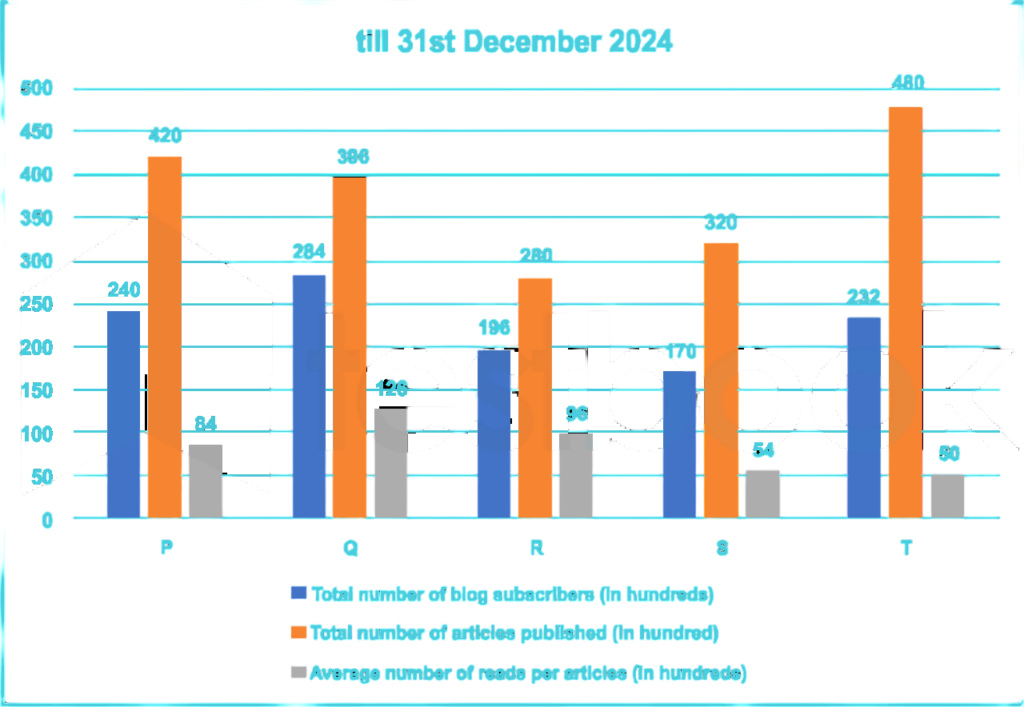
Question:
The amount earned per 100 blog subscribers is ₹7 and per 10,000 reads is ₹17. Find the difference in total earnings of platform P and platform Q till 31st December 2024.
A. ₹2,48,780
B. ₹3,79,040
C. ₹1,31,983
D. ₹2,55,488
E. ₹4,84,212
Solution
Platform P:
Total number of blog subscribers: 240 in hundreds → 240 × 100 = 24,000 subscribers
Total number of articles published: 420 in hundreds → 420 × 100 = 42,000 articles
Average number of reads per article: 84 in hundreds → 84 × 100 = 8,400 reads per article
Platform Q:
Total number of blog subscribers: 284 in hundreds → 284 × 100 = 28,400 subscribers
Total number of articles published: 396 in hundreds → 396 × 100 = 39,600 articles
Average number of reads per article: 126 in hundreds → 126 × 100 = 12,600 reads per article
The earnings are calculated as follows:
For every 100 blog subscribers, the platform earns ₹7.
For every 10,000 reads, the platform earns ₹17.
For platform P:
Subscribers = 24,000
Number of groups of 100 = 24,000 / 100 = 240
Earnings = 240 × ₹7 = ₹1,680
For platform Q:
Subscribers = 28,400
Number of groups of 100 = 28,400 / 100 = 284
Earnings = 284 × ₹7 = ₹1,988
Platform P:
Total number of articles = 42,000
Average reads per article = 8,400
Total reads = 42,000 × 8,400
42,000 × 8,400 = 352,800,000 reads
Number of groups of 10,000 reads = 352,800,000 / 10,000 = 35,280
Earnings from reads = 35,280 × ₹17
35,280 × 17 = ₹599,760
Platform Q:
Total number of articles = 39,600
Average reads per article = 12,600
Total reads = 39,600 × 12,600
39,600 × 12,600 = 498,960,000 reads
Number of groups of 10,000 reads = 498,960,000 / 10,000 = 49,896
Earnings from reads = 49,896 × ₹17
49,896 × 17 = ₹848,232
Platform P:
Earnings from subscribers = ₹1,680
Earnings from reads = ₹599,760
Total earnings for P = 1,680 + 599,760 = ₹601,440
Platform Q:
Earnings from subscribers = ₹1,988
Earnings from reads = ₹848,232
Total earnings for Q = 1,988 + 848,232 = ₹850,220
Difference = Earnings for Q − Earnings for P
= ₹850,220 − ₹601,440
= ₹248,780
Thus, the difference in total earnings between platform P and platform Q is ₹248,780.
54. Directions: Study the graph carefully to answer the following question.
The bar graph provides information about the total number of blog subscribers of five different blogging platforms, the total number of articles published by each platform, and the average number of reads per article till 31st December 2024.
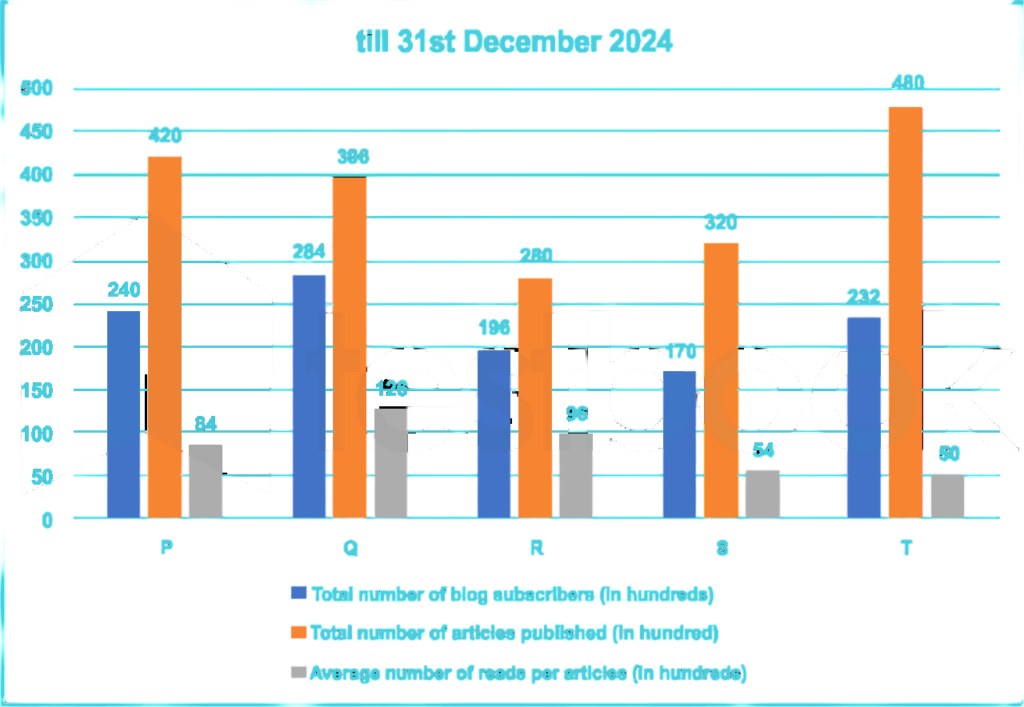
Question:
The ratio of the number of male subscribers to female subscribers of platform S and platform T is 27:23 and 19:21 respectively. If 35% and 25% of male subscribers of platform S and platform T are below 20 years of age, then find the total number of male subscribers below 20 years of age for both platforms combined.
A. 6,086
B. 4,120
C. 2,452
D. 5,968
E. 8,128
Solution
For Platform S:
Total subscribers = 17000 since given in hundreds
Male:Female ratio = 27:23
Total parts = 27 + 23 = 50
Male subscribers = 27 / 50 × 17000 = 9180
Female subscribers = 23 / 50 × 17000 = 7820
For Platform T:
Total subscribers = 23200
Male:Female ratio = 19:21
Total parts = 19 + 21 = 40
Male subscribers = 19 / 40 × 23200 = 11020
Female subscribers = 21 / 40 × 23200 = 12180
For Platform S:
35% of male subscribers = 35 / 100 × 9180 = 3213
For Platform T:
25% of male subscribers = 25 / 100 × 11020 = 2755
3213 + 2755 = 5968
Thus, the total number of male subscribers below 20 years of age for both platforms combined is 5,968.
55. Directions: Study the graph carefully to answer the following question.
The bar graph provides information about the total number of blog subscribers of five different blogging platforms, the total number of articles published by each platform, and the average number of reads per article till 31st December 2024.
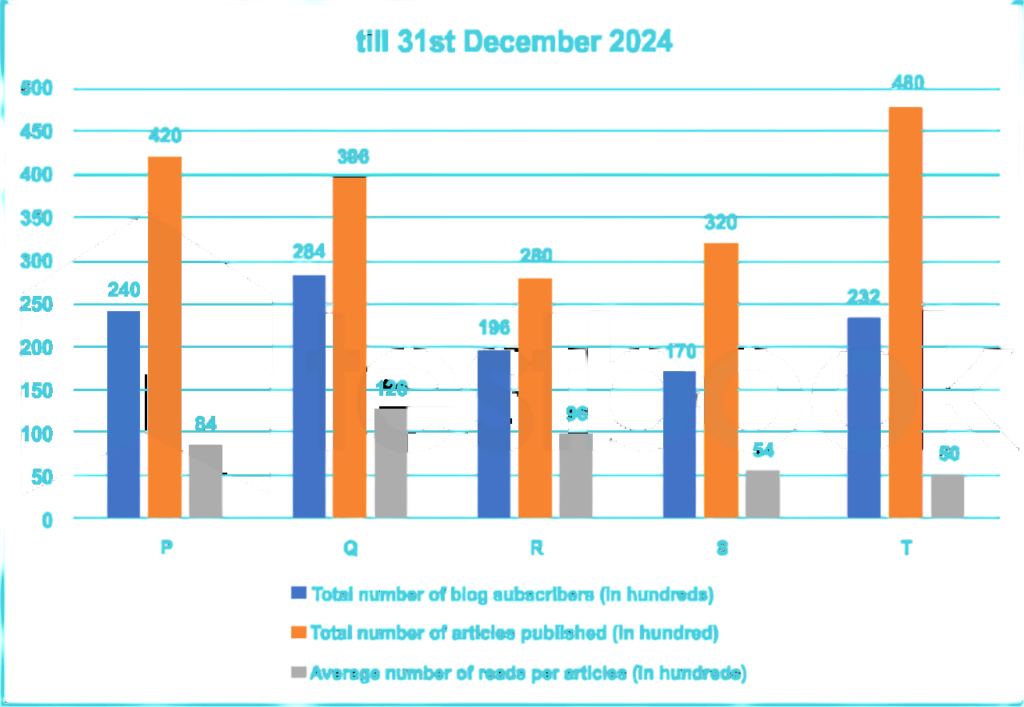
Question:
Find the ratio of the total reads of all articles of platform S and platform T combined to the total reads of all articles of platform Q and platform R combined.
A. 1720 : 3199
B. 170 : 199
C. 1522 : 2179
D. 20 : 79
E. None of these
Solution
The total reads for a platform can be calculated as:
Total Reads = Total Articles Published × Average Reads per Article
Total Reads for Platform S
= 320 × 54 =17280
Total Reads for Platform T
= 480 × 50 = 24000
Total Reads for Platform Q
= 396 × 126 = 49896
Total Reads for Platform R
= 280 × 96 = 26880
Total Reads for Platform S and T Combined
17280 + 24000 = 41280
Total Reads for Platform Q and R Combined
49896 + 26880 = 76776
Total Reads of S and T / Total Reads of Q and R = 41280 / 76776
Reducing to the simplest form:
1720 / 3199
Thus, the correct answer is 1720 : 3199.
56. Directions: Study the graph carefully to answer the following question.
The bar graph provides information about the total number of blog subscribers of five different blogging platforms, the total number of articles published by each platform, and the average number of reads per article till 31st December 2024.
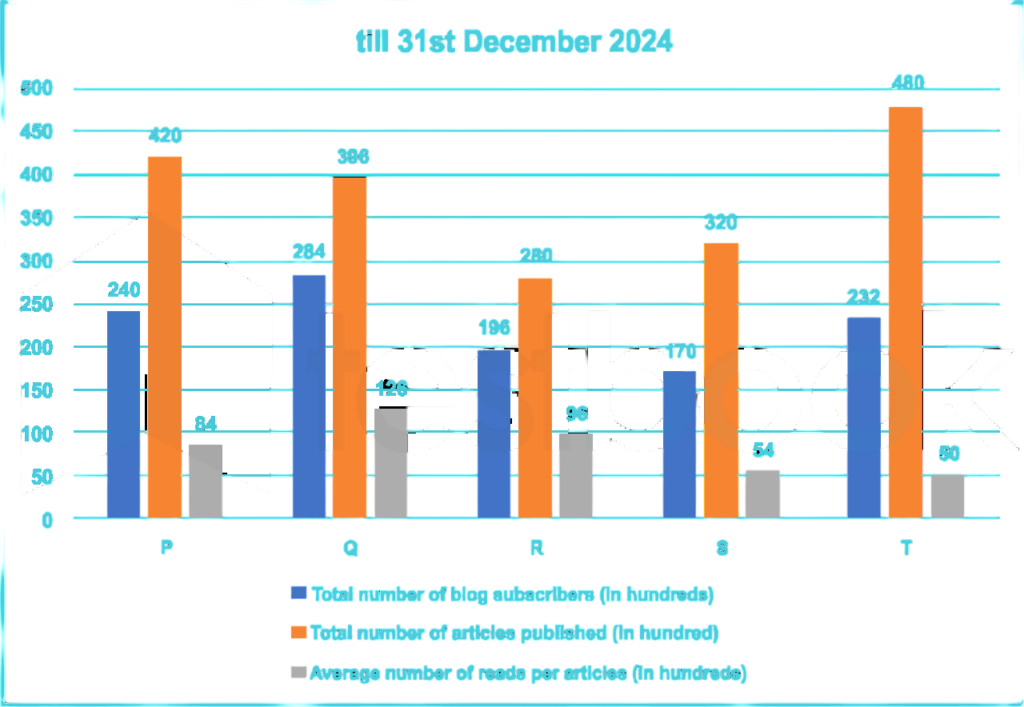
Question:
It is found that the total number of subscribers of platform Q and platform T in January 2025 was 36,000 and 32,000, respectively. The number of male subscribers of platform Q and platform T combined increases by 20% in January 2025 as compared to the total number of male subscribers of both platforms from 1st June 2024 to 31st December 2024. If the total number of female subscribers of platform Q and platform T combined till 31st December 2024 was 11,500, then find the increase in the number of female subscribers of both platforms combined in January 2025 as compared to till 31st December.
A. 6,670
B. 9,260
C. 8,380
D. 7,790
E. 6,120
Solution
From the table, we have the total number of blog subscribers in hundreds as of 31st December 2024:
Platform Q: 28400 subscribers since 284 × 100 = 28400
Platform T: 23200 subscribers since 232 × 100 = 23200
Thus, the total subscribers of Q and T combined till 31st December 2024:
28400 + 23200 = 51600
In January 2025, the total number of subscribers of Q and T increased to:
Platform Q: 36,000 subscribers
Platform T: 32,000 subscribers
Thus, the new total number of subscribers of Q and T combined:
36000 + 32000 = 68000
Increase in total subscribers:
68000 − 51600 = 16400
Let’s assume that the total number of male and female subscribers till 31st December 2024 were M and F, respectively.
From the question:
F = 11500
Thus, the number of male subscribers till 31st December 2024:
M = 51600 – 11500 = 40100
The total number of male subscribers of both platforms combined increased by 20% in January 2025.
So, the new number of male subscribers:
Mnew = 40100 + 20% of 40100
Mnew = 40100 + 20 / 100 × 40100
Mnew = 40100 + 8020 = 48120
We already know that the total subscribers in January 2025 is 68000, and the new number of male subscribers is 48120.
Thus, the new number of female subscribers:
Fnew = 68000 − 48120
Fnew = 19880
Increase in female subscribers = 19880 − 11500 = 8380
Thus, the increase in the number of female subscribers of both platforms combined in January 2025 is 8,380.
57. Directions: Study the graph carefully to answer the following question.
The bar graph provides information about the total number of blog subscribers of five different blogging platforms, the total number of articles published by each platform, and the average number of reads per article till 31st December 2024.
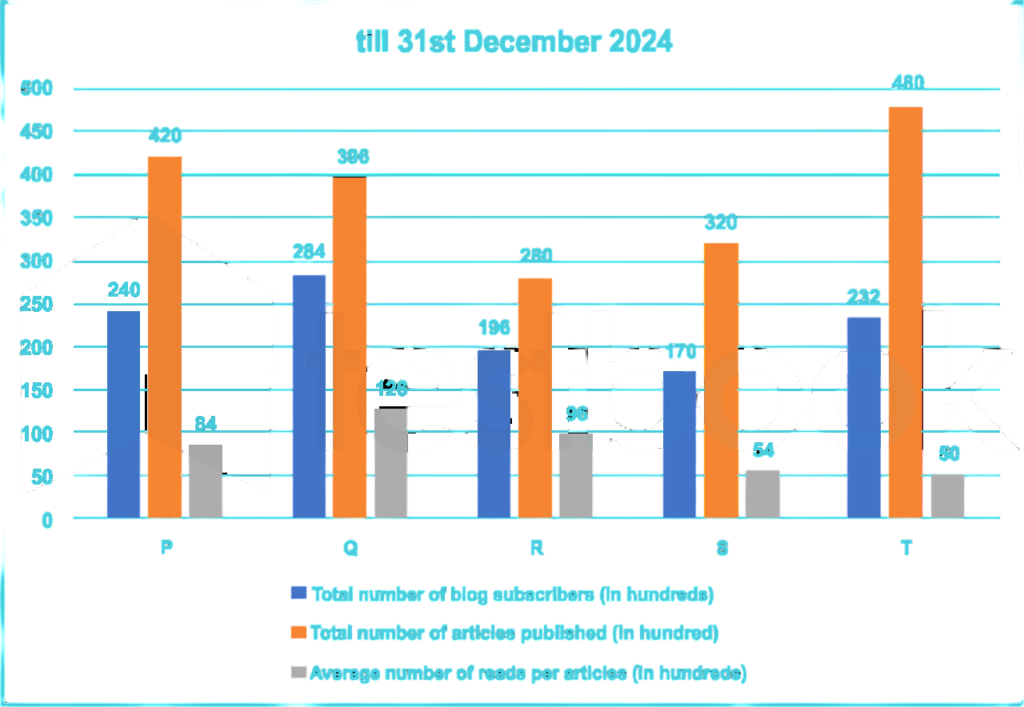
Question:
Another blogging platform V has subscribers equal to the average number of subscribers of all the given five blogging platforms. If 35% of subscribers of platform V are male, then find the difference between the number of male subscribers and the number of female subscribers of platform V.
A. 5462
B. 6732
C. 4416
D. 11471
E. 8569
Solution
The total number of blog subscribers for platforms P, Q, R, S, and T in hundreds is:
240 + 284 + 196 + 170 + 232 = 1122 (in hundreds) = 112200 subscribers
Since platform V has subscribers equal to the average of these five platforms:
Subscribers of V = 112200 / 5 = 22440
Male subscribers: 35% of 22,440
35 / 100 × 22440 = 7854
Female subscribers: Remaining 65% of 22,440
65 / 100 × 22440 = 145866
Difference = 14586 − 7854 = 6732
Thus, the difference between the number of male and female subscribers of platform V is 6732 subscribers.
58. Find the distance of A to B?
Statement I: A car travels from point A to B, then from B to C, and finally returns from C back to A, all at a speed of 60 km/h, taking a total of 8 hours for the entire journey. Meanwhile, a bus covers the distance from B to C in 4 hours.
Statement II: Speed of bus is 30 km/hr and bus goes to A to D in 12 hr. A is situated in the middle of B and D.
A. Statement I alone Sufficient
B. Statement II alone Sufficient
C. Either I or II is Sufficient
D. Both I and II is together Sufficient
E. Neither I nor II is Sufficient
Solution
Calculation
Statement I:
A car goes: A → B → C → A at a constant speed of 60 km/h.
Total time for the journey: 8 hours.
A bus covers B to C in 4 hours.
Let’s analyse:
Let distances be:
AB = x km
BC = y km
CA = z km
Then the car travels:
Total distance = x + y + z
Speed = 60 km/h
Time = 8 hours
So, x +y + z = 60 × 8 = 480 — (1)
Also, we are told: bus covers BC in 4 hours. But we are not told the speed of the bus, so this only gives y = 4 × (bus speed), which is unknown.
So, from Statement I alone, we cannot find x (distance AB).
Statement I alone is not sufficient.
Statement II:
Speed of bus = 30 km/h
The bus goes from A to D in 12 hours
So, distance between A and D = AD = 30 × 12 = 360 km
Since A is situated in the middle of B and D,
So, BA = AD = 360 km
i..e. Distance from A to B = AB = 360 km
So, Statement II alone is sufficient to find AB.
59. Find the total age of A and B?
Statement I: Ratio of age of A and B is 2:3. Ratio of age of B and C is 6:5. Age of D is 20% more than age of C. The Age of F is 26 years.
Statement II: The age of E double of age of C. E is 4 years older than F.
A. Only I alone is sufficient
B. Only II alone is sufficient
C. Either I or II alone is sufficient
D. Neither I nor II is sufficient
E. Both I and II together is sufficient
Solution
Calculation
Statement I:
Ratio of age of A and B is 2:3 → Let A = 2x, B = 3x
Ratio of age of B and C is 6:5
Let’s use the B values to reconcile both ratios.
From A:B = 2:3
→ B = 3x
From B:C = 6:5
→ B = 6y
So equate 3x = 6y
→ x = 2y
⇒ A = 2x = 4y
⇒ B = 3x = 6y
⇒ C = 5y
Next,
Age of D is 20% more than age of C
⇒ D = C × 1.2 = 5y × 1.2 = 6y
Age of F = 26 years
So, in terms of y, we know:
A = 4y
B = 6y
C = 5y
D = 6y
F = 26
But we do not yet know the value of y (or x), so we cannot compute actual ages.
→ Statement I alone is insufficient.
Statement II:
Age of E = double of C → E = 2C
E is 4 years older than F.
So, Statement II is not sufficient
Now from both I and II,
E is 4 years older than F
→ E = F + 4 = 26 + 4 = 30
So:
E = 2C = 30
So, C = 15
This gives us the exact age of C = 15.
C = 5y ⇒ 5y = 15 ⇒ y = 3
So, B = 6y = 18
A = 4y = 12
So total age of A and B:
So, A + B = 12 + 18 = 30
Both statements I and II together are sufficient to answer the question.
60. DIRECTIONS for the question: The question below consist of a question and two statements numbered I and II given below it. You have to decide whether the data provided in the statements are sufficient to answer the question. Read both the statements and mark.
If the given solid metallic right circular cone is melted and recast into a right circular cylinder having the same radius, what would be the height of this cylinder?
I. The sum and product of the radius and height of the cone are 28 cm and 147 cm2 respectively.II. Total surface area of the cone is 550 cm2.
A. The data in both the statements I and II together are necessary to answer the question.
B. The data either in statement I alone or in statement II alone are sufficient to answer the question.
C. The data in statement I alone are sufficient to answer the question, while the data in statement II alone are not sufficient to answer the question.
D. The data in statement II alone are sufficient to answer the question, while the data in statement I alone are not sufficient to answer the question.
E. The data in both the statements I and II together are not sufficient to answer the question
Solution
Calculation:
⇒ The right circular cone is melted in the right circular cylinder having the same radius
From statement l
⇒ Let be assume the height of the cone h and the radius of the cone is R
⇒ h + R = 28 cm —(1)
⇒ h × R = 147 cm2 —(2)
⇒ by solving both equations
⇒ h = 21, 7
⇒ The height of the cylinder can be = h/3= 21/3 = 7 cm or 7/3 cm.
Since there are two values of height and no information is given to get the exact value.
⇒
Hence, statement l alone not sufficient to answer the question
From statement ll
⇒ The total surface area of the cone is 550 cm2
⇒ Hence, statement ll alone not sufficient to answer the question
⇒ Both the statement also not sufficient to answer the question
∴ The required result will be “The data in both the statements I and II together are not sufficient to answer the question.”
61. Directions: Study the information carefully and answer the questions.
A student went to a stationery shop with Rs. 1000. She purchased y pens, 10 notebooks, and 5 geometry boxes. After all purchases, she had Rs. 75 left. Upon reviewing her expenses, she noted that the amount spent on pens was equal to the amount spent on notebooks, the amount spent on geometry boxes was half the amount spent on pens, and the total quantity of pens purchased was one-third of the total quantity of notebooks and geometry boxes combined. Find the total number of items (pens, notebooks, and geometry boxes) she purchased.
Question:
If she purchases fewer geometry boxes while keeping the number of pens and notebooks the same, and ends up with 11.2% of the total amount left, how many total stationery items did she purchase?
A. 4
B. 19
C. 10
D. 2
E. 5
Solution
General Solution:
Given:
Total money = Rs. 1000
Rs. 75 left ⇒ Amount spent = 1000 – 75 = Rs. 925
She bought:
- y pens
- 10 notebooks
- 5 geometry boxes
Amount spent on pens = amount spent on notebooks
Amount spent on geometry boxes = half of amount spent on pens
Number of pens = one-third of total quantity of notebooks + geometry boxes
Let cost per pen = p
⇒ Amount spent on pens = y × p
Let cost per notebook = n ⇒ Amount on notebooks = 10 × n
Given: y × p = 10 × n … (1)
Let cost per geometry box = g ⇒ Amount on boxes = 5 × g
Also given: 5g = 0.5 × (y × p) ⇒ 5g = (1/2) × y × p … (2)
Total amount spent:
y × p + 10n + 5g = 925
From (1): 10n = y × p
From (2): 5g = 0.5 × y × p
Now substitute into total:
⇒ y × p + y × p + 0.5 × y × p = 925
⇒ (1 + 1 + 0.5) × y × p = 925
⇒ 2.5 × y × p = 925
⇒ y × p = 925 ÷ 2.5 = 370
So: y × p = 370
⇒ Also, 10n = 370 ⇒ n = 37
⇒ 5g = 0.5 × 370 = 185 ⇒ g = 37
Find the number of pens using the condition:
Number of pens = y
Total of notebooks + boxes = 10 + 5 = 15
Given: y = 1/3 × (10 + 5) = 1/3 × 15 = 5
So total items = pens + notebooks + boxes = 5 + 10 + 5 = 20
Calculations:
Given:
Total money = Rs. 1000
Leftover money = 11.2% of 1000 = (11.2 ÷ 100) × 1000 = Rs. 112
⇒ Total spent = 1000 − 112 = Rs. 888
Number of pens = 5, Number of notebooks = 10
Let number of geometry boxes now = g (fewer than 5)
From the previous solution:
- Cost per pen = 370 ÷ 5 = Rs. 74
- Cost per notebook = Rs. 37
- Cost per geometry box = Rs. 37
Total cost with an unknown number of geometry boxes:
⇒ Cost of pens = 5 × 74 = Rs. 370
⇒ Cost of notebooks = 10 × 37 = Rs. 370
⇒ Cost of geometry boxes = g × 37
Total spent = 370 + 370 + 37g = Rs. 888
⇒ 740 + 37g = 888
⇒ 37g = 888 − 740 = 148
⇒ g = 148 ÷ 37 = 4
Total stationery items
⇒ Pens = 5, Notebooks = 10, Geometry boxes = 4
Total items = 5 + 10 + 4 = 19 items
Thus, the correct answer is 19.
62. Directions: Study the information carefully and answer the questions.
A student went to a stationery shop with Rs. 1000. She purchased y pens, 10 notebooks, and 5 geometry boxes. After all purchases, she had Rs. 75 left. Upon reviewing her expenses, she noted that the amount spent on pens was equal to the amount spent on notebooks, the amount spent on geometry boxes was half the amount spent on pens, and the total quantity of pens purchased was one-third of the total quantity of notebooks and geometry boxes combined. Find the total number of items (pens, notebooks, and geometry boxes) she purchased.
Question:
How many pens did she purchase?
A. 4
B. 3
C. 6
D. 2
E. 5
Solution
General Solution:
Given:
Total money = Rs. 1000
Rs. 75 left ⇒ Amount spent = 1000 – 75 = Rs. 925
She bought:
- y pens
- 10 notebooks
- 5 geometry boxes
Amount spent on pens = amount spent on notebooks
Amount spent on geometry boxes = half of amount spent on pens
Number of pens = one-third of total quantity of notebooks + geometry boxes
Let cost per pen = p
⇒ Amount spent on pens = y × p
Let cost per notebook = n ⇒ Amount on notebooks = 10 × n
Given: y × p = 10 × n … (1)
Let cost per geometry box = g ⇒ Amount on boxes = 5 × g
Also given: 5g = 0.5 × (y × p) ⇒ 5g = (1/2) × y × p … (2)
Total amount spent:
y × p + 10n + 5g = 925
From (1): 10n = y × p
From (2): 5g = 0.5 × y × p
Now substitute into total:
⇒ y × p + y × p + 0.5 × y × p = 925
⇒ (1 + 1 + 0.5) × y × p = 925
⇒ 2.5 × y × p = 925
⇒ y × p = 925 ÷ 2.5 = 370
So: y × p = 370
⇒ Also, 10n = 370 ⇒ n = 37
⇒ 5g = 0.5 × 370 = 185 ⇒ g = 37
Find the number of pens using the condition:
Number of pens = y
Total of notebooks + boxes = 10 + 5 = 15
Given: y = 1/3 × (10 + 5) = 1/3 × 15 = 5
So total items = pens + notebooks + boxes = 5 + 10 + 5 = 20
Calculations:
The correct answer is 5.
63. Directions: Study the information carefully and answer the questions.
A student went to a stationery shop with Rs. 1000. She purchased y pens, 10 notebooks, and 5 geometry boxes. After all purchases, she had Rs. 75 left. Upon reviewing her expenses, she noted that the amount spent on pens was equal to the amount spent on notebooks, the amount spent on geometry boxes was half the amount spent on pens, and the total quantity of pens purchased was one-third of the total quantity of notebooks and geometry boxes combined. Find the total number of items (pens, notebooks, and geometry boxes) she purchased.
Question:
If she purchases 2 pens, 1 notebook, and 2 geometry boxes, how much money will she be left with in her pocket?
A. Rs. 217
B. Rs. 583
C. Rs. 489
D. Rs.741
E. None fo these
Solution
General Solution:
Given:
Total money = Rs. 1000
Rs. 75 left ⇒ Amount spent = 1000 – 75 = Rs. 925
She bought:
- y pens
- 10 notebooks
- 5 geometry boxes
Amount spent on pens = amount spent on notebooks
Amount spent on geometry boxes = half of amount spent on pens
Number of pens = one-third of total quantity of notebooks + geometry boxes
Let cost per pen = p
⇒ Amount spent on pens = y × p
Let cost per notebook = n ⇒ Amount on notebooks = 10 × n
Given: y × p = 10 × n … (1)
Let cost per geometry box = g ⇒ Amount on boxes = 5 × g
Also given: 5g = 0.5 × (y × p) ⇒ 5g = (1/2) × y × p … (2)
Total amount spent:
y × p + 10n + 5g = 925
From (1): 10n = y × p
From (2): 5g = 0.5 × y × p
Now substitute into total:
⇒ y × p + y × p + 0.5 × y × p = 925
⇒ (1 + 1 + 0.5) × y × p = 925
⇒ 2.5 × y × p = 925
⇒ y × p = 925 ÷ 2.5 = 370
So: y × p = 370
⇒ Also, 10n = 370 ⇒ n = 37
⇒ 5g = 0.5 × 370 = 185 ⇒ g = 37
Find the number of pens using the condition:
Number of pens = y
Total of notebooks + boxes = 10 + 5 = 15
Given: y = 1/3 × (10 + 5) = 1/3 × 15 = 5
So total items = pens + notebooks + boxes = 5 + 10 + 5 = 20
Calculations:
From the general solution, we know:
Cost per pen = Rs. p = 370 ÷ 5 = 74
Cost per notebook = Rs. 37
Cost per geometry box = Rs. 37
She now buys:
2 pens ⇒ 2 × 74 = Rs. 148
1 notebook ⇒ 1 × 37 = Rs. 37
2 geometry boxes ⇒ 2 × 37 = Rs. 74
Total spent = 148 + 37 + 74 = Rs. 259
Total money she had = Rs. 1000
Money left = 1000 − 259 = Rs. 741
Thus, the correct answer is Rs. 741.
64. Directions: Study the information carefully and answer the questions.
A student went to a stationery shop with Rs. 1000. She purchased y pens, 10 notebooks, and 5 geometry boxes. After all purchases, she had Rs. 75 left. Upon reviewing her expenses, she noted that the amount spent on pens was equal to the amount spent on notebooks, the amount spent on geometry boxes was half the amount spent on pens, and the total quantity of pens purchased was one-third of the total quantity of notebooks and geometry boxes combined. Find the total number of items (pens, notebooks, and geometry boxes) she purchased.
Question:
How much money did she spend to purchase geometry boxes?
A. Rs. 240
B. Rs. 185
C. Rs. 324
D. Rs. 106
E. None of these
Solution
General Solution:
Given:
Total money = Rs. 1000
Rs. 75 left ⇒ Amount spent = 1000 – 75 = Rs. 925
She bought:
- y pens
- 10 notebooks
- 5 geometry boxes
Amount spent on pens = amount spent on notebooks
Amount spent on geometry boxes = half of amount spent on pens
Number of pens = one-third of total quantity of notebooks + geometry boxes
Let cost per pen = p
⇒ Amount spent on pens = y × p
Let cost per notebook = n ⇒ Amount on notebooks = 10 × n
Given: y × p = 10 × n … (1)
Let cost per geometry box = g ⇒ Amount on boxes = 5 × g
Also given: 5g = 0.5 × (y × p) ⇒ 5g = (1/2) × y × p … (2)
Total amount spent:
y × p + 10n + 5g = 925
From (1): 10n = y × p
From (2): 5g = 0.5 × y × p
Now substitute into total:
⇒ y × p + y × p + 0.5 × y × p = 925
⇒ (1 + 1 + 0.5) × y × p = 925
⇒ 2.5 × y × p = 925
⇒ y × p = 925 ÷ 2.5 = 370
So: y × p = 370
⇒ Also, 10n = 370 ⇒ n = 37
⇒ 5g = 0.5 × 370 = 185 ⇒ g = 37
Find the number of pens using the condition:
Number of pens = y
Total of notebooks + boxes = 10 + 5 = 15
Given: y = 1/3 × (10 + 5) = 1/3 × 15 = 5
So total items = pens + notebooks + boxes = 5 + 10 + 5 = 20
Calculations:
From the general solution:
Number of pens (y) = 5
Cost of each pen = p
Total spent on pens = y × p = 5 × p = Rs. 370 ⇒ So p = 74
So cost per pen = 370 ÷ 5 = Rs. 74
From earlier: Amount spent on geometry boxes = half of the amount spent on pens
⇒ Amount on pens = Rs. 370 ⇒ Geometry boxes = 370 ÷ 2 = Rs. 185
Thus, the correct answer is Rs. 185
65. Directions: Study the information carefully and answer the questions.
A student went to a stationery shop with Rs. 1000. She purchased y pens, 10 notebooks, and 5 geometry boxes. After all purchases, she had Rs. 75 left. Upon reviewing her expenses, she noted that the amount spent on pens was equal to the amount spent on notebooks, the amount spent on geometry boxes was half the amount spent on pens, and the total quantity of pens purchased was one-third of the total quantity of notebooks and geometry boxes combined. Find the total number of items (pens, notebooks, and geometry boxes) she purchased.
Question:
What is the ratio of price per pen to price per notebook?
A. 4:1
B. 5:3
C. 2:1
D. 12:5
E. 24:13
Solution
General Solution:
Given:
Total money = Rs. 1000
Rs. 75 left ⇒ Amount spent = 1000 – 75 = Rs. 925
She bought:
- y pens
- 10 notebooks
- 5 geometry boxes
Amount spent on pens = amount spent on notebooks
Amount spent on geometry boxes = half of amount spent on pens
Number of pens = one-third of total quantity of notebooks + geometry boxes
Let cost per pen = p
⇒ Amount spent on pens = y × p
Let cost per notebook = n ⇒ Amount on notebooks = 10 × n
Given: y × p = 10 × n … (1)
Let cost per geometry box = g ⇒ Amount on boxes = 5 × g
Also given: 5g = 0.5 × (y × p) ⇒ 5g = (1/2) × y × p … (2)
Total amount spent:
y × p + 10n + 5g = 925
From (1): 10n = y × p
From (2): 5g = 0.5 × y × p
Now substitute into total:
⇒ y × p + y × p + 0.5 × y × p = 925
⇒ (1 + 1 + 0.5) × y × p = 925
⇒ 2.5 × y × p = 925
⇒ y × p = 925 ÷ 2.5 = 370
So: y × p = 370
⇒ Also, 10n = 370 ⇒ n = 37
⇒ 5g = 0.5 × 370 = 185 ⇒ g = 37
Find the number of pens using the condition:
Number of pens = y
Total of notebooks + boxes = 10 + 5 = 15
Given: y = 1/3 × (10 + 5) = 1/3 × 15 = 5
So total items = pens + notebooks + boxes = 5 + 10 + 5 = 20
Calculations:
From earlier calculation:
Total cost of pens = y × p = 370
Number of pens y = 5
⇒ Price per pen = p = 370 ÷ 5 = 74
Total cost of 10 notebooks = 370 (from earlier)
⇒ Price per notebook = 370 ÷ 10 = 37
Now, the Ratio of price per pen to price per notebook = 74 : 37
⇒ Simplified ratio = 2 : 1
Thus, the correct answer is 2:1.
66. Direction: Read the given information carefully and answer the following questions.
Eight persons A, B, C, D, P, Q, R, and S are working in a bank in eight different designations i.e. Chairman, General Manager(GM), Deputy General Manager(DGM), Assistant General Manager(AGM), Senior Manager(SM), Bank Manager(BM), Assistant Manager(AM), and Clerk but not necessarily in the same order. The Chairman is the senior most and Clerk in the junior person.
Two designations are between A and Q. Either A or Q is clerk. One designation is between S and R where S is senior to R. There is the same number of designations between D and P as between P and B. C is the Assistant Manager. D is senior to B. S is not the Chairman of the bank. Q and S are not just senior or junior to each other.
Question:
Who is designated just senior to S?
A. A
B. P
C. Q
D. R
E. B
Solution
Eight designations Chairman, General Manager(GM), Deputy General Manager(DGM), Assistant General Manager(AGM), Senior Manager(SM), Bank Manager(BM), Assistant Manager(AM), and Clerk need to be allotted to eight persons. The persons are A, B, C, D, P, Q. R, and S. No two persons have the same designations.
Two designations are between A and Q. Either A or Q is clerk. C is the Assistant Manager.
| Case 1 | Case 2 | |
| Designations | Persons | Persons |
| Chairman | ||
| GM | ||
| DGM | ||
| AGM | ||
| SM | A | Q |
| BM | ||
| AM | C | C |
| Clerk | Q | A |
One designation is between S and R where S is senior to R. S is not the Chairman of the bank. Q and S are not just senior or junior to each other.
| Case 1(i) | Case1(ii) | Case 2 | |
| Designations | Persons | Persons | Persons |
| Chairman | |||
| GM | S | S | |
| DGM | |||
| AGM | R | S | R |
| SM | A | A | Q |
| BM | R | ||
| AM | C | C | C |
| Clerk | Q | Q | A |
There is the same number of designations between D and P as between P and B. D is senior to B.
According to the given information, D is senior to both P and B. P is senior to B. In Case 1(i) and Case 2, we could not follow the statement that the same number of designations should be between D and P as between P and B. So, the Case 1(i) and Case 2 is eliminated.
The final arrangement is:
| Designations | Persons |
| Chairman | D |
| GM | P |
| DGM | B |
| AGM | S |
| SM | A |
| BM | R |
| AM | C |
| Clerk | Q |
Hence, B is designated just senior to S.
67. Direction: Read the given information carefully and answer the following questions.
Eight persons A, B, C, D, P, Q, R, and S are working in a bank in eight different designations i.e. Chairman, General Manager(GM), Deputy General Manager(DGM), Assistant General Manager(AGM), Senior Manager(SM), Bank Manager(BM), Assistant Manager(AM), and Clerk but not necessarily in the same order. The Chairman is the senior most and Clerk in the junior person.
Two designations are between A and Q. Either A or Q is clerk. One designation is between S and R where S is senior to R. There is the same number of designations between D and P as between P and B. C is the Assistant Manager. D is senior to B. S is not the Chairman of the bank. Q and S are not just senior or junior to each other.
Question:
If we arrange all the people according to the alphabetical order from top to bottom then many persons are at the same position?
A. None
B. One
C. Two
D. Four
E. Three
Solution
Eight designations Chairman, General Manager(GM), Deputy General Manager(DGM), Assistant General Manager(AGM), Senior Manager(SM), Bank Manager(BM), Assistant Manager(AM), and Clerk need to be allotted to eight persons. The persons are A, B, C, D, P, Q. R, and S. No two persons have the same designations.
Two designations are between A and Q. Either A or Q is clerk. C is the Assistant Manager.
| Case 1 | Case 2 | |
| Designations | Persons | Persons |
| Chairman | ||
| GM | ||
| DGM | ||
| AGM | ||
| SM | A | Q |
| BM | ||
| AM | C | C |
| Clerk | Q | A |
One designation is between S and R where S is senior to R. S is not the Chairman of the bank. Q and S are not just senior or junior to each other.
| Case 1(i) | Case1(ii) | Case 2 | |
| Designations | Persons | Persons | Persons |
| Chairman | |||
| GM | S | S | |
| DGM | |||
| AGM | R | S | R |
| SM | A | A | Q |
| BM | R | ||
| AM | C | C | C |
| Clerk | Q | Q | A |
There is the same number of designations between D and P as between P and B. D is senior to B.
According to the given information, D is senior to both P and B. P is senior to B. In Case 1(i) and Case 2, we could not follow the statement that the same number of designations should be between D and P as between P and B. So, the Case 1(i) and Case 2 is eliminated.
The final arrangement is:
| Designations | Persons |
| Chairman | D |
| GM | P |
| DGM | B |
| AGM | S |
| SM | A |
| BM | R |
| AM | C |
| Clerk | Q |
After the rearrangement, we get
| Designations | Persons |
| Chairman | A |
| GM | B |
| DGM | C |
| AGM | D |
| SM | P |
| BM | Q |
| AM | R |
| Clerk | S |
After comparing the final arrangement and the rearrangement table we observed that none of the persons is at the same position.
Hence, No person is in the same position after the rearrangement.
68. Direction: Read the given information carefully and answer the following questions.
Eight persons A, B, C, D, P, Q, R, and S are working in a bank in eight different designations i.e. Chairman, General Manager(GM), Deputy General Manager(DGM), Assistant General Manager(AGM), Senior Manager(SM), Bank Manager(BM), Assistant Manager(AM), and Clerk but not necessarily in the same order. The Chairman is the senior most and Clerk in the junior person.
Two designations are between A and Q. Either A or Q is clerk. One designation is between S and R where S is senior to R. There is the same number of designations between D and P as between P and B. C is the Assistant Manager. D is senior to B. S is not the Chairman of the bank. Q and S are not just senior or junior to each other.
Question:
How many persons are designated in between P and the one immediate junior to C?
A. Two
B. Five
C. One
D. Three
E. Four
Solution
Eight designations Chairman, General Manager(GM), Deputy General Manager(DGM), Assistant General Manager(AGM), Senior Manager(SM), Bank Manager(BM), Assistant Manager(AM), and Clerk need to be allotted to eight persons. The persons are A, B, C, D, P, Q. R, and S. No two persons have the same designations.
Two designations are between A and Q. Either A or Q is clerk. C is the Assistant Manager.
| Case 1 | Case 2 | |
| Designations | Persons | Persons |
| Chairman | ||
| GM | ||
| DGM | ||
| AGM | ||
| SM | A | Q |
| BM | ||
| AM | C | C |
| Clerk | Q | A |
One designation is between S and R where S is senior to A. S is not the Chairman of the bank. Q and S are not just senior or junior to each other.
| Case 1(i) | Case1(ii) | Case 2 | |
| Designations | Persons | Persons | Persons |
| Chairman | |||
| GM | S | S | |
| DGM | |||
| AGM | R | S | R |
| SM | A | A | Q |
| BM | R | ||
| AM | C | C | C |
| Clerk | Q | Q | A |
There is the same number of designations between D and P as between P and B. D is senior to B.
According to the given information, D is senior to both P and B. P is senior to B. In Case 1(i) and Case 2, we could not follow the statement that the same number of designations should be between D and P as between P and B. So, the Case 1(i) and Case 2 is eliminated.
The final arrangement is:
| Designations | Persons |
| Chairman | D |
| GM | P |
| DGM | B |
| AGM | S |
| SM | A |
| BM | R |
| AM | C |
| Clerk | Q |
Hence, Five persons are designated in between P and Q, who is immediately junior to C.
69. Direction: Read the given information carefully and answer the following questions.
Eight persons A, B, C, D, P, Q, R, and S are working in a bank in eight different designations i.e. Chairman, General Manager(GM), Deputy General Manager(DGM), Assistant General Manager(AGM), Senior Manager(SM), Bank Manager(BM), Assistant Manager(AM), and Clerk but not necessarily in the same order. The Chairman is the senior most and Clerk in the junior person.
Two designations are between A and Q. Either A or Q is clerk. One designation is between S and R where S is senior to R. There is the same number of designations between D and P as between P and B. C is the Assistant Manager. D is senior to B. S is not the Chairman of the bank. Q and S are not just senior or junior to each other.
Question:
Who is immediate senior and junior to R respectively?
A. D, B
B. D, Q
C. S, Q
D. A,C
E. P, S
Solution
Eight designations Chairman, General Manager(GM), Deputy General Manager(DGM), Assistant General Manager(AGM), Senior Manager(SM), Bank Manager(BM), Assistant Manager(AM), and Clerk need to be allotted to eight persons. The persons are A, B, C, D, P, Q. R, and S. No two persons have the same designations.
Two designations are between A and Q. Either A or Q is clerk. C is the Assistant Manager.
| Case 1 | Case 2 | |
| Designations | Persons | Persons |
| Chairman | ||
| GM | ||
| DGM | ||
| AGM | ||
| SM | A | Q |
| BM | ||
| AM | C | C |
| Clerk | Q | A |
One designation is between S and R where S is senior to R. S is not the Chairman of the bank. Q and S are not just senior or junior to each other.
| Case 1(i) | Case1(ii) | Case 2 | |
| Designations | Persons | Persons | Persons |
| Chairman | |||
| GM | S | S | |
| DGM | |||
| AGM | R | S | R |
| SM | A | A | Q |
| BM | R | ||
| AM | C | C | C |
| Clerk | Q | Q | A |
There is the same number of designations between D and P as between P and B. D is senior to B.
According to the given information, D is senior to both P and B. P is senior to B. In Case 1(i) and Case 2, we could not follow the statement that the same number of designations should be between D and P as between P and B. So, the Case 1(i) and Case 2 is eliminated.
The final arrangement is:
| Designations | Persons |
| Chairman | D |
| GM | P |
| DGM | B |
| AGM | S |
| SM | A |
| BM | R |
| AM | C |
| Clerk | Q |
Hence, A is the immediate senior to R and C is the immediate junior to R.
70. Direction: Read the given information carefully and answer the following questions.
Eight persons A, B, C, D, P, Q, R, and S are working in a bank in eight different designations i.e. Chairman, General Manager(GM), Deputy General Manager(DGM), Assistant General Manager(AGM), Senior Manager(SM), Bank Manager(BM), Assistant Manager(AM), and Clerk but not necessarily in the same order. The Chairman is the senior most and Clerk in the junior person.
Two designations are between A and Q. Either A or Q is clerk. One designation is between S and R where S is senior to R. There is the same number of designations between D and P as between P and B. C is the Assistant Manager. D is senior to B. S is not the Chairman of the bank. Q and S are not just senior or junior to each other.
Question:
Who among the following person is the GM?
A. The person who is just junior to C.
B. R
C. The person just senior to B.
D. A
E. Q
Solution
Eight designations Chairman, General Manager(GM), Deputy General Manager(DGM), Assistant General Manager(AGM), Senior Manager(SM), Bank Manager(BM), Assistant Manager(AM), and Clerk need to be allotted to eight persons. The persons are A, B, C, D, P, Q. R, and S. No two persons have the same designations.
Two designations are between A and Q. Either A or Q is clerk. C is the Assistant Manager.
| Case 1 | Case 2 | |
| Designations | Persons | Persons |
| Chairman | ||
| GM | ||
| DGM | ||
| AGM | ||
| SM | A | Q |
| BM | ||
| AM | C | C |
| Clerk | Q | A |
One designation is between S and R where S is senior to R. S is not the Chairman of the bank. Q and S are not just senior or junior to each other.
| Case 1(i) | Case1(ii) | Case 2 | |
| Designations | Persons | Persons | Persons |
| Chairman | |||
| GM | S | S | |
| DGM | |||
| AGM | R | S | R |
| SM | A | A | Q |
| BM | R | ||
| AM | C | C | C |
| Clerk | Q | Q | A |
There is the same number of designations between D and P as between P and B. D is senior to B.
According to the given information, D is senior to both P and B. P is senior to B. In Case 1(i) and Case 2, we could not follow the statement that the same number of designations should be between D and P as between P and B. So, the Case 1(i) and Case 2 is eliminated.
The final arrangement is:
| Designations | Persons |
| Chairman | D |
| GM | P |
| DGM | B |
| AGM | S |
| SM | A |
| BM | R |
| AM | C |
| Clerk | Q |
Hence, P who is just senior to B is the GM of bank.
71. Directions: – Relationship between different elements is shown in the statements below. These Statements are followed by 2 Conclusions. Mark your answer on the basis of given statements and conclusions.

Conclusions:
I) D < I
II) A > C
A. Both follow
B. Only I) follow
C. Only II follows
D. None follow
E. Either I) or II) follows
Solution
I) D < I: True (D = C < H ≤ I : Here, it is clearly visible that D is less than I)
II) A > C: False ( No exact relationship can be drawn from the given statement, hence, false)
Hence, only I) follows.
72. Directions: In the following question assuming the given statements to be True, find which conclusion among given conclusions is/ are definitely true and then give your answers accordingly.

Conclusions:
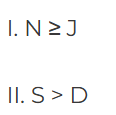
A. Only II is true
B. Both I and II are true
C. Only I is true
D. Neither I nor II is true
E. Either I or II is true
Solution
Given statements: M ≥ J > K; S > P = K; N ≥ M ≤ D
On combining: D ≥ M ≥ J > K = P < S; N ≥ M ≤ D
I. N ≥ J → True ( N ≥ M ≥ J) → N ≥ J.
II. S > D → False (S > P = K ≤ J ≤ M ≤ D) → thus clear relation between S and D cannot be determined
Therefore, Only I is true
73. Direction: Study the following information carefully and answer the questions given below:
Ten boxes are kept on ten shelves such that the lowermost shelf is numbered 1 and the topmost shelf is numbered 10.
M is kept on an even number shelf above the 6th shelf. Only two boxes are kept between M and A. Only three shelves are there between A and J which is not kept on the 9th shelf. More than four boxes are there between J and B which is kept below M. Only three boxes are kept between B and H. The number of shelves between M and H same as the number of shelves between J and F. G is kept on the prime numbered shelf. C is not kept on the 6th shelf. G is kept below D and above E.
Question:
Which among the following box is placed at the bottommost shelf?
A. Box G
B. Box J
C. Box C
D. Box E
E. None of these
Solution
Given:
Ten boxes
Ten shelves
The lowermost shelf is numbered 1 and the topmost shelf is numbered 10.
Now,
1) M is kept on an even number shelf above the 6th shelf. It means M is kept either on shelf 8th or 10th.
2) Only two boxes are kept between M and A.
3) Only three shelves are there between A and J which is not kept on the 9th shelf.
| Shelves | Case I | Case II |
| 10 | M | |
| 9 | ||
| 8 | M | |
| 7 | A | |
| 6 | ||
| 5 | A | |
| 4 | ||
| 3 | J | |
| 2 | ||
| 1 | J |
4) More than four boxes are there between J and B which is kept below M. It means there are at least five boxes between J and B.
5) Only three boxes are kept between B and H.
6) The number of shelves between M and H same as the number of shelves between J and F.
| Shelves | Case I | Case II |
| 10 | M | |
| 9 | B | |
| 8 | M | F |
| 7 | B | A |
| 6 | F | |
| 5 | A | H |
| 4 | ||
| 3 | H | J |
| 2 | ||
| 1 | J |
7) G is kept on the prime numbered shelf. It means G is kept on the 2nd shelf.
8) G is kept below D and above E. E cannot be placed in Case I so it gets eliminated.
9) C is not kept on the 6th shelf. It means C is kept on the 4th shelf and D is kept on the 6th shelf.
Thus, the final arrangement is –
| Shelves | Case II |
| 10 | M |
| 9 | B |
| 8 | F |
| 7 | A |
| 6 | D |
| 5 | H |
| 4 | C |
| 3 | J |
| 2 | G |
| 1 | E |
Box E is placed at the bottommost shelf.
Hence, the correct answer is Box E.
74. Direction: Study the following information carefully and answer the questions given below:
Ten boxes are kept on ten shelves such that the lowermost shelf is numbered 1 and the topmost shelf is numbered 10.
M is kept on an even number shelf above the 6th shelf. Only two boxes are kept between M and A. Only three shelves are there between A and J which is not kept on the 9th shelf. More than four boxes are there between J and B which is kept below M. Only three boxes are kept between B and H. The number of shelves between M and H same as the number of shelves between J and F. G is kept on the prime numbered shelf. C is not kept on the 6th shelf. G is kept below D and above E.
Question:
Which among the following box is placed immediately above the box C?
A. Box A
B. Box H
C. Box G
D. Box D
E. Cannot be determined
Solution
Given:
Ten boxes
Ten shelves
The lowermost shelf is numbered 1 and the topmost shelf is numbered 10.
Now,
1) M is kept on an even number shelf above the 6th shelf. It means M is kept either on shelf 8th or 10th.
2) Only two boxes are kept between M and A.
3) Only three shelves are there between A and J which is not kept on the 9th shelf.
| Shelves | Case I | Case II |
| 10 | M | |
| 9 | ||
| 8 | M | |
| 7 | A | |
| 6 | ||
| 5 | A | |
| 4 | ||
| 3 | J | |
| 2 | ||
| 1 | J |
4) More than four boxes are there between J and B which is kept below M. It means there are at least five boxes between J and B.
5) Only three boxes are kept between B and H.
6) The number of shelves between M and H same as the number of shelves between J and F.
| Shelves | Case I | Case II |
| 10 | M | |
| 9 | B | |
| 8 | M | F |
| 7 | B | A |
| 6 | F | |
| 5 | A | H |
| 4 | ||
| 3 | H | J |
| 2 | ||
| 1 | J |
7) G is kept on the prime numbered shelf. It means G is kept on the 2nd shelf.
8) G is kept below D and above E. E cannot be placed in Case I so it gets eliminated.
9) C is not kept on the 6th shelf. It means C is kept on the 4th shelf and D is kept on the 6th shelf.
Thus, the final arrangement is –
| Shelves | Case II |
| 10 | M |
| 9 | B |
| 8 | F |
| 7 | A |
| 6 | D |
| 5 | H |
| 4 | C |
| 3 | J |
| 2 | G |
| 1 | E |
Box H is placed immediately above the box C.
Hence, the correct answer is Box H.
75. Direction: Study the following information carefully and answer the questions given below:
Ten boxes are kept on ten shelves such that the lowermost shelf is numbered 1 and the topmost shelf is numbered 10.
M is kept on an even number shelf above the 6th shelf. Only two boxes are kept between M and A. Only three shelves are there between A and J which is not kept on the 9th shelf. More than four boxes are there between J and B which is kept below M. Only three boxes are kept between B and H. The number of shelves between M and H same as the number of shelves between J and F. G is kept on the prime numbered shelf. C is not kept on the 6th shelf. G is kept below D and above E.
Question:
How many boxes are placed between box E and box F?
A. Three
B. Four
C. Five
D. Two
E. Six
Solution
Given:
Ten boxes
Ten shelves
The lowermost shelf is numbered 1 and the topmost shelf is numbered 10.
Now,
1) M is kept on an even number shelf above the 6th shelf. It means M is kept either on shelf 8th or 10th.
2) Only two boxes are kept between M and A.
3) Only three shelves are there between A and J which is not kept on the 9th shelf.
| Shelves | Case I | Case II |
| 10 | M | |
| 9 | ||
| 8 | M | |
| 7 | A | |
| 6 | ||
| 5 | A | |
| 4 | ||
| 3 | J | |
| 2 | ||
| 1 | J |
4) More than four boxes are there between J and B which is kept below M. It means there are at least five boxes between J and B.
5) Only three boxes are kept between B and H.
6) The number of shelves between M and H same as the number of shelves between J and F.
| Shelves | Case I | Case II |
| 10 | M | |
| 9 | B | |
| 8 | M | F |
| 7 | B | A |
| 6 | F | |
| 5 | A | H |
| 4 | ||
| 3 | H | J |
| 2 | ||
| 1 | J |
7) G is kept on the prime numbered shelf. It means G is kept on the 2nd shelf.
8) G is kept below D and above E. E cannot be placed in Case I so it gets eliminated.
9) C is not kept on the 6th shelf. It means C is kept on the 4th shelf and D is kept on the 6th shelf.
Thus, the final arrangement is –
| Shelves | Case II |
| 10 | M |
| 9 | B |
| 8 | F |
| 7 | A |
| 6 | D |
| 5 | H |
| 4 | C |
| 3 | J |
| 2 | G |
| 1 | E |
Six boxes are placed between box E and box F.
Hence, the correct answer is Six.
76. Direction: Study the following information carefully and answer the questions given below:
Ten boxes are kept on ten shelves such that the lowermost shelf is numbered 1 and the topmost shelf is numbered 10.
M is kept on an even number shelf above the 6th shelf. Only two boxes are kept between M and A. Only three shelves are there between A and J which is not kept on the 9th shelf. More than four boxes are there between J and B which is kept below M. Only three boxes are kept between B and H. The number of shelves between M and H same as the number of shelves between J and F. G is kept on the prime numbered shelf. C is not kept on the 6th shelf. G is kept below D and above E.
Question:
On which shelf, is the box just above D kept?
A. 5th
B. 3rd
C. 7th
D. 2nd
E. 4th
Solution
Given:
Ten boxes
Ten shelves
The lowermost shelf is numbered 1 and the topmost shelf is numbered 10.
Now,
1) M is kept on an even number shelf above the 6th shelf. It means M is kept either on shelf 8th or 10th.
2) Only two boxes are kept between M and A.
3) Only three shelves are there between A and J which is not kept on the 9th shelf.
| Shelves | Case I | Case II |
| 10 | M | |
| 9 | ||
| 8 | M | |
| 7 | A | |
| 6 | ||
| 5 | A | |
| 4 | ||
| 3 | J | |
| 2 | ||
| 1 | J |
4) More than four boxes are there between J and B which is kept below M. It means there are at least five boxes between J and B.
5) Only three boxes are kept between B and H.
6) The number of shelves between M and H same as the number of shelves between J and F.
| Shelves | Case I | Case II |
| 10 | M | |
| 9 | B | |
| 8 | M | F |
| 7 | B | A |
| 6 | F | |
| 5 | A | H |
| 4 | ||
| 3 | H | J |
| 2 | ||
| 1 | J |
7) G is kept on the prime numbered shelf. It means G is kept on the 2nd shelf.
8) G is kept below D and above E. E cannot be placed in Case I so it gets eliminated.
9) C is not kept on the 6th shelf. It means C is kept on the 4th shelf and D is kept on the 6th shelf.
Thus, the final arrangement is –
| Shelves | Case II |
| 10 | M |
| 9 | B |
| 8 | F |
| 7 | A |
| 6 | D |
| 5 | H |
| 4 | C |
| 3 | J |
| 2 | G |
| 1 | E |
The box just above D is kept on the 7th shelf.
Hence, the correct answer is 7th.
77. Direction: Study the following information carefully and answer the questions given below:
Ten boxes are kept on ten shelves such that the lowermost shelf is numbered 1 and the topmost shelf is numbered 10.
M is kept on an even number shelf above the 6th shelf. Only two boxes are kept between M and A. Only three shelves are there between A and J which is not kept on the 9th shelf. More than four boxes are there between J and B which is kept below M. Only three boxes are kept between B and H. The number of shelves between M and H same as the number of shelves between J and F. G is kept on the prime numbered shelf. C is not kept on the 6th shelf. G is kept below D and above E.
Question:
Which of the following statements is true?
A. Only two boxes are placed above Box M.
B. Number of boxes placed between Box J and Box H is the same as the boxes kept between the 9th and 7th Shelves.
C. Box D and Box C are placed adjacent to the box which is kept on shelf 6.
D. Box H is placed two boxes above the box kept on the 2nd shelf.
E. None of these
Solution
Given:
Ten boxes
Ten shelves
The lowermost shelf is numbered 1 and the topmost shelf is numbered 10.
Now,
1) M is kept on an even number shelf above the 6th shelf. It means M is kept either on shelf 8th or 10th.
2) Only two boxes are kept between M and A.
3) Only three shelves are there between A and J which is not kept on the 9th shelf.
| Shelves | Case I | Case II |
| 10 | M | |
| 9 | ||
| 8 | M | |
| 7 | A | |
| 6 | ||
| 5 | A | |
| 4 | ||
| 3 | J | |
| 2 | ||
| 1 | J |
4) More than four boxes are there between J and B which is kept below M. It means there are at least five boxes between J and B.
5) Only three boxes are kept between B and H.
6) The number of shelves between M and H same as the number of shelves between J and F.
| Shelves | Case I | Case II |
| 10 | M | |
| 9 | B | |
| 8 | M | F |
| 7 | B | A |
| 6 | F | |
| 5 | A | H |
| 4 | ||
| 3 | H | J |
| 2 | ||
| 1 | J |
7) G is kept on the prime numbered shelf. It means G is kept on the 2nd shelf.
8) G is kept below D and above E. E cannot be placed in Case I so it gets eliminated.
9) C is not kept on the 6th shelf. It means C is kept on the 4th shelf and D is kept on the 6th shelf.
Thus, the final arrangement is –
| Shelves | Case II |
| 10 | M |
| 9 | B |
| 8 | F |
| 7 | A |
| 6 | D |
| 5 | H |
| 4 | C |
| 3 | J |
| 2 | G |
| 1 | E |
Hence, the correct answer is Number of boxes placed between Box J and Box H is the same as the boxes kept between the 9th and 7th Shelves.
78. If the letters at odd position in the word “PARAMETER” starting from left are changed to their next letter according to the English alphabet, Then how many vowels are there after rearrangement?
A. One
B. Two
C. Three
D. Four
E. Five
Solution
Given Word: PARAMETER
| Given word | P | A | R | A | M | E | T | E | R |
| Letters at the odd positions are changed to their next letter | Q | A | S | A | N | E | U | E | S |
Vowels: A, A, E, U, E.
Hence, there are five vowels.
79. Direction: Study the following information carefully to answer the given questions.
Eight people – P, Q, R, S, T, U, W, and X sit around a circular table. Some of them sit facing the center and some of them sit facing away from the center. Q and R face the same direction but do not sit beside each other. P sits exactly between S and T, but faces the opposite direction as S and T. X faces inside, to the immediate right of W, who faces the opposite direction as X. U sits to the immediate right of R, who sits opposite T. W sits second to the left of R. P faces the opposite direction as that of X. U faces outside.
Question:
How many people sit facing inside?
A. 5 people – P, Q, R, U, and W
B. 3 people – S, T, and X
C. 1 person – X
D. 3 people – P, R, and W
E. 5 people – X, T, S, P, and W
Solution
Given:
Eight people – P, Q, R, S, T, U, W, and X
Some of them sit facing the center and some of them sit facing away from the center.
1. P sits between S and T, but faces the opposite direction as S and T.
2. P faces the opposite direction as that of X.
3. X faces inside, to the immediate right of W, who faces the opposite direction as X.
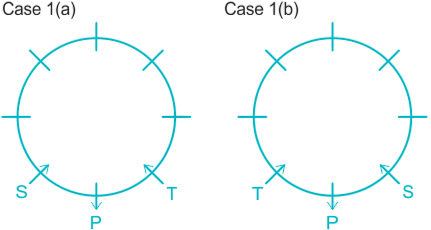
4. W sits second to the left of R.
5. U sits to the immediate right of R, who sits opposite T.
6. U faces outside.
7. Q and R face the same direction but do not sit beside each other.
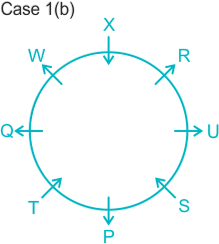
(Case 1a will not be possible as it will contradict point 3)
Final Arrangement:
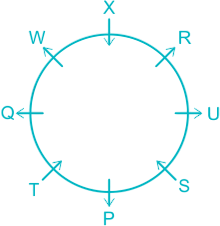
Hence, 3 people – S, T, and X, sit facing inside.
80. Direction: Study the following information carefully to answer the given questions.
Eight people – P, Q, R, S, T, U, W, and X sit around a circular table. Some of them sit facing the center and some of them sit facing away from the center. Q and R face the same direction but do not sit beside each other. P sits exactly between S and T, but faces the opposite direction as S and T. X faces inside, to the immediate right of W, who faces the opposite direction as X. U sits to the immediate right of R, who sits opposite T. W sits second to the left of R. P faces the opposite direction as that of X. U faces outside.
Question:
Four of the five options given below are alike in a certain way and form a group, identify the odd one out.
A. T
B. W
C. R
D. Q
E. U
Solution
Given:
Eight people – P, Q, R, S, T, U, W, and X
Some of them sit facing the center and some of them sit facing away from the center.
1. P sits between S and T, but faces the opposite direction as S and T.
2. P faces the opposite direction as that of X.
3. X faces inside, to the immediate right of W, who faces the opposite direction as X.
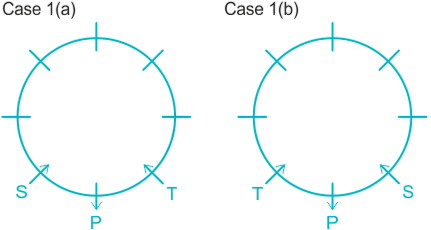
4. W sits second to the left of R.
5. U sits to the immediate right of R, who sits opposite T.
6. U faces outside.
7. Q and R face the same direction but do not sit beside each other.
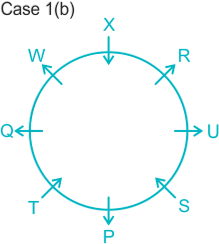
(Case 1a will not be possible as it will contradict point 3)
Final Arrangement:
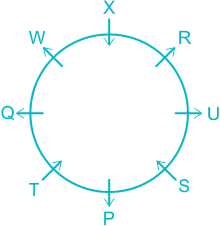
The logic followed here is that all the given options are people who sit facing outside, except T.
Hence, T is the odd one out.
81. Direction: Study the following information carefully to answer the given questions.
Eight people – P, Q, R, S, T, U, W, and X sit around a circular table. Some of them sit facing the center and some of them sit facing away from the center. Q and R face the same direction but do not sit beside each other. P sits exactly between S and T, but faces the opposite direction as S and T. X faces inside, to the immediate right of W, who faces the opposite direction as X. U sits to the immediate right of R, who sits opposite T. W sits second to the left of R. P faces the opposite direction as that of X. U faces outside.
Question:
Which among the following is true?
A. W faces inside
B. 2 people sit between W and S
C. P sits to the immediate right of T
D. U sits opposite T
E. X and T face different directions
Solution
Given:
Eight people – P, Q, R, S, T, U, W, and X
Some of them sit facing the center and some of them sit facing away from the center.
1. P sits between S and T, but faces the opposite direction as S and T.
2. P faces the opposite direction as that of X.
3. X faces inside, to the immediate right of W, who faces the opposite direction as X.
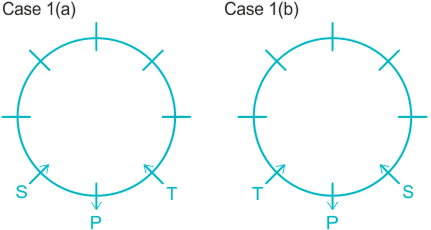
4. W sits second to the left of R.
5. U sits to the immediate right of R, who sits opposite T.
6. U faces outside.
7. Q and R face the same direction but do not sit beside each other.
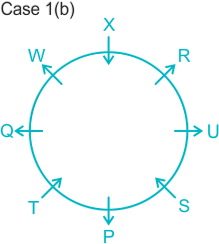
(Case 1a will not be possible as it will contradict point 3)
Final Arrangement:
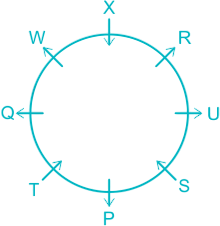
Hence, the correct option is Option 3.
82. Direction: Study the following information carefully to answer the given questions.
Eight people – P, Q, R, S, T, U, W, and X sit around a circular table. Some of them sit facing the center and some of them sit facing away from the center. Q and R face the same direction but do not sit beside each other. P sits exactly between S and T, but faces the opposite direction as S and T. X faces inside, to the immediate right of W, who faces the opposite direction as X. U sits to the immediate right of R, who sits opposite T. W sits second to the left of R. P faces the opposite direction as that of X. U faces outside.
Question:
Who sits third to the right of the one sitting opposite the one sitting immediate left of the one sitting opposite of X?
A. P
B. S
C. W
D. U
E. Q
Solution
Given:
Eight people – P, Q, R, S, T, U, W, and X
Some of them sit facing the center and some of them sit facing away from the center.
1. P sits between S and T, but faces the opposite direction as S and T.
2. P faces the opposite direction as that of X.
3. X faces inside, to the immediate right of W, who faces the opposite direction as X.
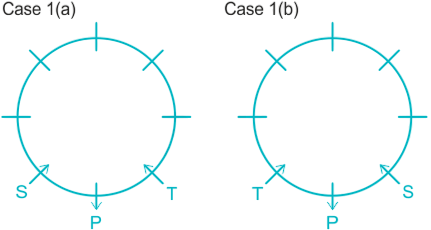
4. W sits second to the left of R.
5. U sits to the immediate right of R, who sits opposite T.
6. U faces outside.
7. Q and R face the same direction but do not sit beside each other.
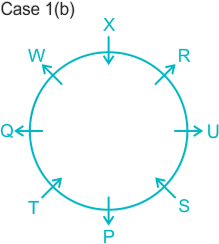
(Case 1a will not be possible as it will contradict point 3)
Final Arrangement:
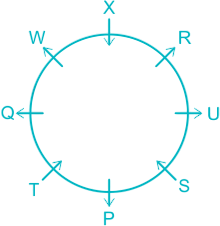
P sits opposite X.
S sits to the immediate left of P.
W sits opposite S.
Hence, U sits third to the right of W.
83. Direction: Study the following information carefully to answer the given questions.
Eight people – P, Q, R, S, T, U, W, and X sit around a circular table. Some of them sit facing the center and some of them sit facing away from the center. Q and R face the same direction but do not sit beside each other. P sits exactly between S and T, but faces the opposite direction as S and T. X faces inside, to the immediate right of W, who faces the opposite direction as X. U sits to the immediate right of R, who sits opposite T. W sits second to the left of R. P faces the opposite direction as that of X. U faces outside.
Question:
Which of the following statements is/are correct?
I. Three people sit between T and S
II. S and Q face the same direction
III. S sits third to the right of U
IV. P sits between X and R
A. All of the statements are correct
B. Only Statement I is correct
C. Only Statements I and III are correct
D. Only Statements I, II and IV are correct
E. None of the statements are correct
Solution
Given:
Eight people – P, Q, R, S, T, U, W, and X
Some of them sit facing the center and some of them sit facing away from the center.
1. P sits between S and T, but faces the opposite direction as S and T.
2. P faces the opposite direction as that of X.
3. X faces inside, to the immediate right of W, who faces the opposite direction as X.
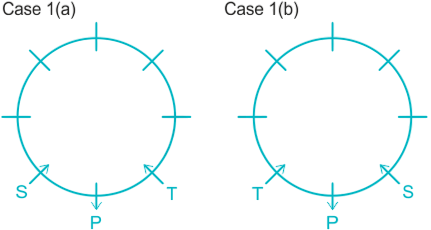
4. W sits second to the left of R.
5. U sits to the immediate right of R, who sits opposite T.
6. U faces outside.
7. Q and R face the same direction but do not sit beside each other.
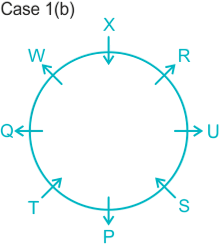
(Case 1a will not be possible as it will contradict point 3)
Final Arrangement:
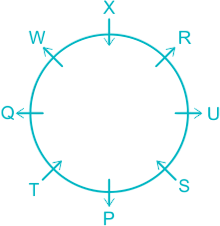
Hence, none of the given statements are correct.
84. Direction: Study the following information carefully and answer the given questions.
In a certain code language,
‘ti ta gi ha’ means ‘Tom is going home’,
‘ti la te’ means ‘Tom lives there’,
‘ha ta te’ means ‘home is there’,‘mi la ae ha’ means ‘Meena lives at home’.
Question:
What does ‘gi’ mean in that code language?
A. Meena
B. at
C. going
D. lives
E. there
Solution

Therefore, in the given code language,
‘ti’ means ‘Tom’
‘ta’ means ‘is’
‘gi’ means ‘going’
‘ha’ means ‘home’
‘la’ means ‘lives’
‘te’ means ‘there’
Either ‘mi’ or ‘ae’ means ‘Meena’ or ‘at’
Hence, ‘gi’ means ‘going’ in that code language.
85. Direction: Study the following information carefully and answer the given questions.
In a certain code language,
‘ti ta gi ha’ means ‘Tom is going home’,
‘ti la te’ means ‘Tom lives there’,
‘ha ta te’ means ‘home is there’,‘mi la ae ha’ means ‘Meena lives at home’.
Question:
What does ‘te ta ti gi ha’ mean in that code language?
A. ‘there is Tom going home’
B. there is Meena and home
C. Tom and Meena lives there
D. Tom and Meena is going
E. None of the above
Solution

Therefore, in the given code language,
‘ti’ means ‘Tom’
‘ta’ means ‘is’
‘gi’ means ‘going’
‘ha’ means ‘home’
‘la’ means ‘lives’
‘te’ means ‘there’
Either ‘mi’ or ‘ae’ means ‘Meena’ or ‘at’
Hence, ‘te ta ti gi ha’ means ‘there is Tom going home’.
86. Direction: Study the following information carefully and answer the given questions.
In a certain code language,
‘ti ta gi ha’ means ‘Tom is going home’,
‘ti la te’ means ‘Tom lives there’,
‘ha ta te’ means ‘home is there’,‘mi la ae ha’ means ‘Meena lives at home’.
Question:
How will ‘Tom is Meena’ be written in that language?
A. ti ta ha
B. ti ta mi
C. ti ta ae
D. Either 1 or 2
E. Either 2 or 3
Solution

Therefore, in the given code language,
‘ti’ means ‘Tom’
‘ta’ means ‘is’
‘gi’ means ‘going’
‘ha’ means ‘home’
‘la’ means ‘lives’
‘te’ means ‘there’
Either ‘mi’ or ‘ae’ means ‘Meena’ or ‘at’
Hence, ‘Tom is Meena’ will be written as either ‘ti ta mi’ or ti ta ae’.
87. Direction: Study the following information carefully to answer the given questions.
8 people – P, Q, R, S, T, U, X, and Z, sit in a row who work in different companies. Some of them sit facing North, while the others face South. The one who works at Honda sits 2nd from the left end of the row, facing South. The ones who works at BMW and the one who works at Tesla sit in the middle of the row, facing opposite directions. The ones who sit at the ends of the row both sit facing North. Q and T face the same direction. 3 people sit between Z and S, one of whom sits at the right end of the row. T, the one who works at Isuzu, faces North but does not sit at the end of the row. X does not work at Honda. Z does not work at BMW. 3 people sit between Q and the one who works at Honda. P, who works at Ford, sits to the immediate left of the one who works at BMW. 2 people sit between X and U. The one who works at Renault does not sit at the end of the row and faces the opposite direction as the one who works at Ford. The one who works at Audi sits to the left of the one who works at Kia.
Question:
How many people sit between the one who works at Isuzu and the one who sits at the right end of the row?
A. 4 people
B. 3 people
C. 2 people
D. 1 person
E. Nobody
Solution
Given:
8 people – P, Q, R, S, T, U, X, and Z
8 companies – Kia, Renault, Isuzu, BMW, Audi, Ford, Honda, and Tesla
The ones who sit at the ends of the row both sit facing North.
1. The one who works at Honda sits 2nd from the left end of the row, facing South.
2. 3 people sit between Q and the one who works at Honda.
3. 3 people sit between Z and S, one of whom sits at the right end of the row.
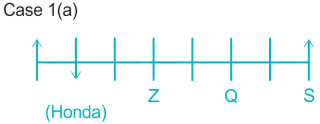
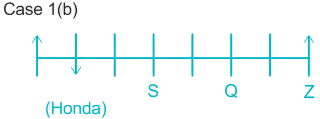
4. The ones who works at BMW and the one who works at Tesla sit in the middle of the row, facing opposite directions.
5. P, who works at Ford, sits to the immediate left of the one who works at BMW.
6. T, the one who works at Isuzu, faces North but does not sit at the end of the row.
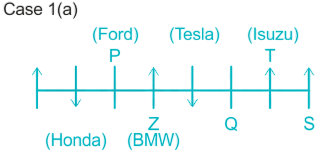
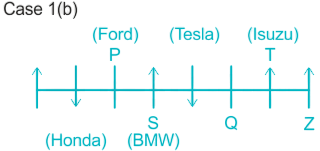
7. Q and T face the same direction.
8. The one who works at Renault does not sit at the end of the row and faces the opposite direction as the one who works at Ford.
9. The one who works at Audi sits to the left of the one who works at Kia.
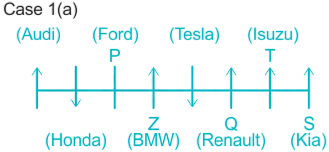
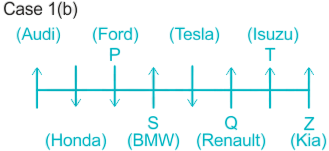
10. 2 people sit between X and U.
11. X does not work at Honda.
12. Z does not work at BMW.
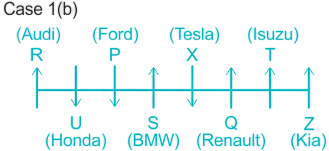
(Case 1a will not be possible as it will not satisfy point 12.)
Final Arrangement:
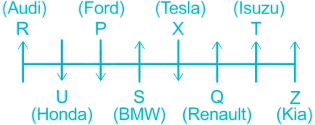
T works at Isuzu.
Z sits at the right end of the row.
Hence, nobody sits between T and Z.
88. Direction: Study the following information carefully to answer the given questions.
8 people – P, Q, R, S, T, U, X, and Z, sit in a row who work in different companies. Some of them sit facing North, while the others face South. The one who works at Honda sits 2nd from the left end of the row, facing South. The ones who works at BMW and the one who works at Tesla sit in the middle of the row, facing opposite directions. The ones who sit at the ends of the row both sit facing North. Q and T face the same direction. 3 people sit between Z and S, one of whom sits at the right end of the row. T, the one who works at Isuzu, faces North but does not sit at the end of the row. X does not work at Honda. Z does not work at BMW. 3 people sit between Q and the one who works at Honda. P, who works at Ford, sits to the immediate left of the one who works at BMW. 2 people sit between X and U. The one who works at Renault does not sit at the end of the row and faces the opposite direction as the one who works at Ford. The one who works at Audi sits to the left of the one who works at Kia.
Question:
Who works at Tesla?
A. R
B. U
C. X
D. P
E. S
Solution
Given:
8 people – P, Q, R, S, T, U, X, and Z
8 companies – Kia, Renault, Isuzu, BMW, Audi, Ford, Honda, and Tesla
The ones who sit at the ends of the row both sit facing North.
1. The one who works at Honda sits 2nd from the left end of the row, facing South.
2. 3 people sit between Q and the one who works at Honda.
3. 3 people sit between Z and S, one of whom sits at the right end of the row.
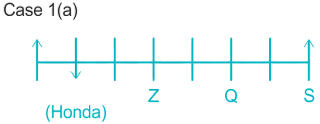
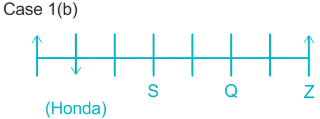
4. The ones who works at BMW and the one who works at Tesla sit in the middle of the row, facing opposite directions.
5. P, who works at Ford, sits to the immediate left of the one who works at BMW.
6. T, the one who works at Isuzu, faces North but does not sit at the end of the row.
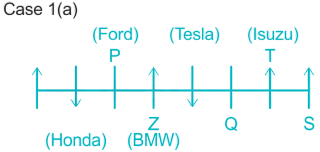
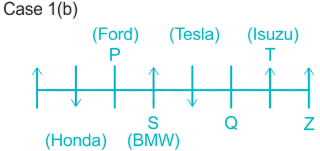
7. Q and T face the same direction.
8. The one who works at Renault does not sit at the end of the row and faces the opposite direction as the one who works at Ford.
9. The one who works at Audi sits to the left of the one who works at Kia.
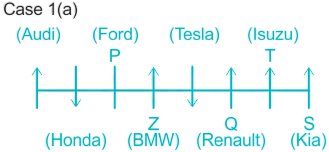
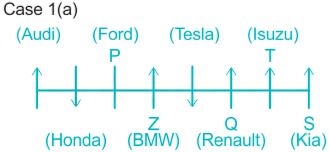
10. 2 people sit between X and U.
11. X does not work at Honda.
12. Z does not work at BMW.
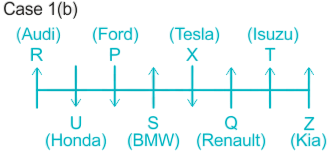
(Case 1a will not be possible as it will not satisfy point 12.)
Final Arrangement:
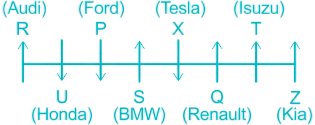
Hence, X works at Tesla.
89. Direction: Study the following information carefully to answer the given questions.
8 people – P, Q, R, S, T, U, X, and Z, sit in a row who work in different companies. Some of them sit facing North, while the others face South. The one who works at Honda sits 2nd from the left end of the row, facing South. The ones who works at BMW and the one who works at Tesla sit in the middle of the row, facing opposite directions. The ones who sit at the ends of the row both sit facing North. Q and T face the same direction. 3 people sit between Z and S, one of whom sits at the right end of the row. T, the one who works at Isuzu, faces North but does not sit at the end of the row. X does not work at Honda. Z does not work at BMW. 3 people sit between Q and the one who works at Honda. P, who works at Ford, sits to the immediate left of the one who works at BMW. 2 people sit between X and U. The one who works at Renault does not sit at the end of the row and faces the opposite direction as the one who works at Ford. The one who works at Audi sits to the left of the one who works at Kia.
Question:
Who sits at the ends of the row?
A. Z and U
B. The ones who work at Audi and Isuzu
C. R and T
D. The ones who work at Kia and Audi
E. P and Q
Solution
Given:
8 people – P, Q, R, S, T, U, X, and Z
8 companies – Kia, Renault, Isuzu, BMW, Audi, Ford, Honda, and Tesla
The ones who sit at the ends of the row both sit facing North.
1. The one who works at Honda sits 2nd from the left end of the row, facing South.
2. 3 people sit between Q and the one who works at Honda.
3. 3 people sit between Z and S, one of whom sits at the right end of the row.
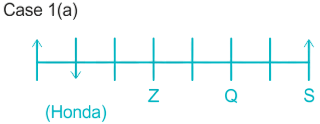
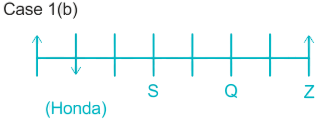
4. The ones who works at BMW and the one who works at Tesla sit in the middle of the row, facing opposite directions.
5. P, who works at Ford, sits to the immediate left of the one who works at BMW.
6. T, the one who works at Isuzu, faces North but does not sit at the end of the row.
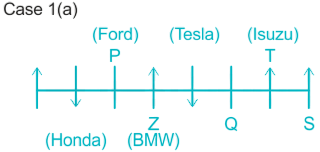
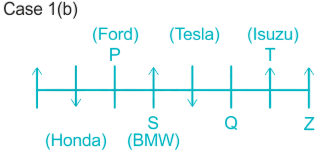
7. Q and T face the same direction.
8. The one who works at Renault does not sit at the end of the row and faces the opposite direction as the one who works at Ford.
9. The one who works at Audi sits to the left of the one who works at Kia.
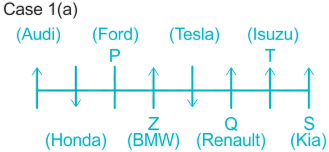
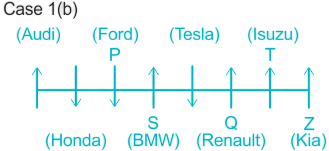
10. 2 people sit between X and U.
11. X does not work at Honda.
12. Z does not work at BMW.
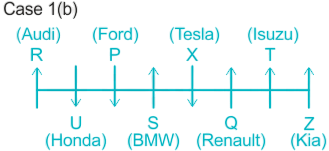
(Case 1a will not be possible as it will not satisfy point 12.)
Final Arrangement:
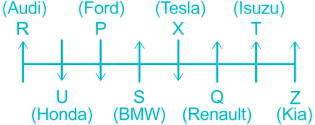
Hence, Z – who works at Kia, and R – who works at Audi, sit at the ends of the row.
90. Direction: Study the following information carefully to answer the given questions.
8 people – P, Q, R, S, T, U, X, and Z, sit in a row who work in different companies. Some of them sit facing North, while the others face South. The one who works at Honda sits 2nd from the left end of the row, facing South. The ones who works at BMW and the one who works at Tesla sit in the middle of the row, facing opposite directions. The ones who sit at the ends of the row both sit facing North. Q and T face the same direction. 3 people sit between Z and S, one of whom sits at the right end of the row. T, the one who works at Isuzu, faces North but does not sit at the end of the row. X does not work at Honda. Z does not work at BMW. 3 people sit between Q and the one who works at Honda. P, who works at Ford, sits to the immediate left of the one who works at BMW. 2 people sit between X and U. The one who works at Renault does not sit at the end of the row and faces the opposite direction as the one who works at Ford. The one who works at Audi sits to the left of the one who works at Kia.
Question:
Who sits 3rd to the left of the one who sits 4 places away from the one who works at Renault?
A. S
B. The one who works at BMW
C. X
D. The one who works at Audi
E. R
Solution
Given:
8 people – P, Q, R, S, T, U, X, and Z
8 companies – Kia, Renault, Isuzu, BMW, Audi, Ford, Honda, and Tesla
The ones who sit at the ends of the row both sit facing North.
1. The one who works at Honda sits 2nd from the left end of the row, facing South.
2. 3 people sit between Q and the one who works at Honda.
3. 3 people sit between Z and S, one of whom sits at the right end of the row.
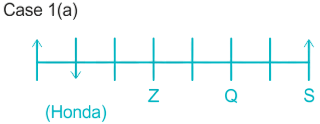
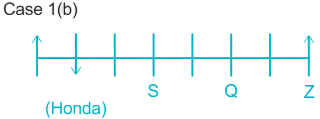
4. The ones who works at BMW and the one who works at Tesla sit in the middle of the row, facing opposite directions.
5. P, who works at Ford, sits to the immediate left of the one who works at BMW.
6. T, the one who works at Isuzu, faces North but does not sit at the end of the row.
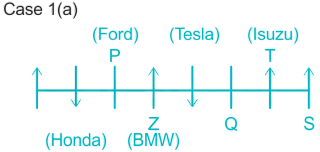
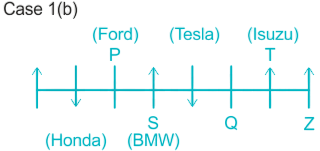
7. Q and T face the same direction.
8. The one who works at Renault does not sit at the end of the row and faces the opposite direction as the one who works at Ford.
9. The one who works at Audi sits to the left of the one who works at Kia.
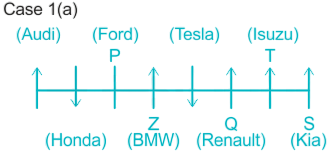
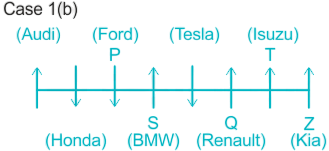
10. 2 people sit between X and U.
11. X does not work at Honda.
12. Z does not work at BMW.
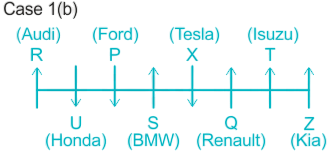
(Case 1a will not be possible as it will not satisfy point 12.)
Final Arrangement:
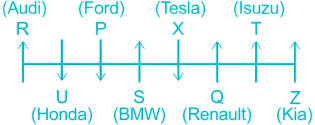
Q works at Renault.
U sits 4 places away from Q.
Hence, X sits 3rd to the left of U.
91. Direction: Study the following information carefully to answer the given questions.
8 people – P, Q, R, S, T, U, X, and Z, sit in a row who work in different companies. Some of them sit facing North, while the others face South. The one who works at Honda sits 2nd from the left end of the row, facing South. The ones who works at BMW and the one who works at Tesla sit in the middle of the row, facing opposite directions. The ones who sit at the ends of the row both sit facing North. Q and T face the same direction. 3 people sit between Z and S, one of whom sits at the right end of the row. T, the one who works at Isuzu, faces North but does not sit at the end of the row. X does not work at Honda. Z does not work at BMW. 3 people sit between Q and the one who works at Honda. P, who works at Ford, sits to the immediate left of the one who works at BMW. 2 people sit between X and U. The one who works at Renault does not sit at the end of the row and faces the opposite direction as the one who works at Ford. The one who works at Audi sits to the left of the one who works at Kia.
Question:
How many people sit between the one who works at Audi and the one who works at Ford?
A. 3 people – Q, T, and Z
B. 1 person – T
C. 2 people – U and Z
D. 1 person – U
E. 3 people – R, U, and P
Solution
Given:
8 people – P, Q, R, S, T, U, X, and Z
8 companies – Kia, Renault, Isuzu, BMW, Audi, Ford, Honda, and Tesla
The ones who sit at the ends of the row both sit facing North.
1. The one who works at Honda sits 2nd from the left end of the row, facing South.
2. 3 people sit between Q and the one who works at Honda.
3. 3 people sit between Z and S, one of whom sits at the right end of the row.
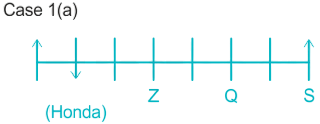
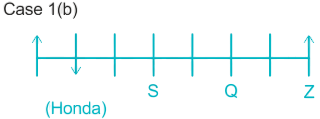
4. The ones who works at BMW and the one who works at Tesla sit in the middle of the row, facing opposite directions.
5. P, who works at Ford, sits to the immediate left of the one who works at BMW.
6. T, the one who works at Isuzu, faces North but does not sit at the end of the row.
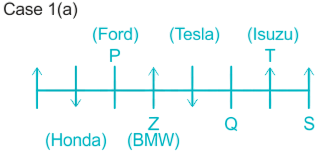
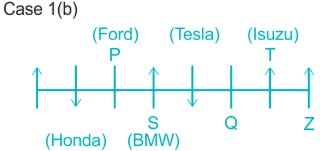
7. Q and T face the same direction.
8. The one who works at Renault does not sit at the end of the row and faces the opposite direction as the one who works at Ford.
9. The one who works at Audi sits to the left of the one who works at Kia.
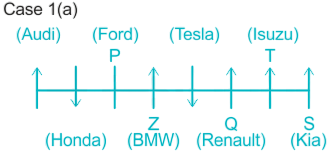
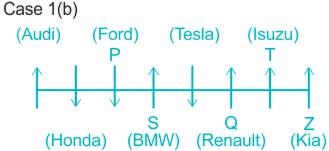
10. 2 people sit between X and U.
11. X does not work at Honda.
12. Z does not work at BMW.
(Case 1a will not be possible as it will not satisfy point 12.)
Final Arrangement:
R works at Audi.
P works at Ford.
Hence, 1 person – U, sits between R and P.
92. Direction: Read the following information carefully and answer the questions based on given information. Nine persons D, G, L, M, O, Q, R, V and X established a pharmaceuticals company on same date but in different years 1975, 1978, 1983, 1985, 1990, 1993, 1997, 2004 and 2009 but not necessarily in same order. R established his company in the year which is divisible by 5. O established his company in the leap year. The difference between establishment year of V and X is half to that of between G and L. As many companies established between D and R as many between D and Q. L established his company after G. X and M did not establish their companies immediately next to each other. V or X doesn’t establish in 1978.
Question:
Which of the following statement(s) is/ are correct?
A. G established his company before V.
B. More than two persons established their companies between D and X.
C. Q was the last person to establish his company.
D. M established his company in even number years.
E. More than one option
Solution
Given, persons are D, G, L, M, O, Q, R, V and X and the years are 1975, 1978, 1983, 1985, 1990, 1993, 1997, 2004 and 2009.
1) R established his company in the year which is divisible by 5.
2) O established his company in the leap year.
| Years | Case – 1 | Case – 2 | Case – 3 |
| Persons | Persons | Persons | |
| 1975 | R | ||
| 1978 | |||
| 1983 | |||
| 1985 | R | ||
| 1990 | R | ||
| 1993 | |||
| 1997 | |||
| 2004 | O | O | O |
| 2009 |
3) The difference between establishment year of V and X is half to that of between G and L. So, case 2 is eliminated.
5) L established his company after G.
| Years | Case – 1(a) | Case – 1(b) | Case – 3(a) | Case – 3(b) |
| Persons | Persons | Persons | Persons | |
| 1975 | R | R | ||
| 1978 | ||||
| 1983 | V | X | V | X |
| 1985 | X | V | X | V |
| 1990 | R | R | ||
| 1993 | G | G | G | G |
| 1997 | L | L | L | L |
| 2004 | O | O | O | O |
| 2009 |
6) As many companies established between D and R as many between D and Q. Therefore, case 3(a) and 3(b) are eliminated.
7) X and M did not establish their companies immediately next to each other. Therefore, case 1(b) is eliminated. Hence, the final arrangement is as follows
| Years | Persons |
| 1975 | R |
| 1978 | M |
| 1983 | V |
| 1985 | X |
| 1990 | D |
| 1993 | G |
| 1997 | L |
| 2004 | O |
| 2009 | Q |
Since, G established his company after V. Therefore, statement first is incorrect.
D established his company just after X. Therefore, statement second is also incorrect.
Q was the last person to establish his company. Therefore, statement third is correct.
M established his company in 1978 which is even number. Therefore, statement fourth is also correct.
Hence, the correct answer is more than one option
93. Direction: Read the following information carefully and answer the questions based on given information. Nine persons D, G, L, M, O, Q, R, V and X established a pharmaceuticals company on same date but in different years 1975, 1978, 1983, 1985, 1990, 1993, 1997, 2004 and 2009 but not necessarily in same order. R established his company in the year which is divisible by 5. O established his company in the leap year. The difference between establishment year of V and X is half to that of between G and L. As many companies established between D and R as many between D and Q. L established his company after G. X and M did not establish their companies immediately next to each other. V or X doesn’t establish in 1978.
Question:
Which of the following statement(s) is/ are true regarding O?
A) O established his company just after L.
B) Only two persons established their companies between D and O.
C) Q established his company before O.
A. Neither A nor C
B. Both B and C
C. Only A
D. All of these
E. Both A and B
Solution
Given, persons are D, G, L, M, O, Q, R, V and X and the years are 1975, 1978, 1983, 1985, 1990, 1993, 1997, 2004 and 2009.
1) R established his company in the year which is divisible by 5.
2) O established his company in the leap year.
| Years | Case – 1 | Case – 2 | Case – 3 |
| Persons | Persons | Persons | |
| 1975 | R | ||
| 1978 | |||
| 1983 | |||
| 1985 | R | ||
| 1990 | R | ||
| 1993 | |||
| 1997 | |||
| 2004 | O | O | O |
| 2009 |
3) The difference between establishment year of V and X is half to that of between G and L. So, case 2 is eliminated.
5) L established his company after G.
| Years | Case – 1(a) | Case – 1(b) | Case – 3(a) | Case – 3(b) |
| Persons | Persons | Persons | Persons | |
| 1975 | R | R | ||
| 1978 | ||||
| 1983 | V | X | V | X |
| 1985 | X | V | X | V |
| 1990 | R | R | ||
| 1993 | G | G | G | G |
| 1997 | L | L | L | L |
| 2004 | O | O | O | O |
| 2009 |
6) As many companies established between D and R as many between D and Q. Therefore, case 3(a) and 3(b) are eliminated.
7) X and M did not establish their companies immediately next to each other. Therefore, case 1(b) is eliminated. Hence, the final arrangement is as follows
| Years | Persons |
| 1975 | R |
| 1978 | M |
| 1983 | V |
| 1985 | X |
| 1990 | D |
| 1993 | G |
| 1997 | L |
| 2004 | O |
| 2009 | Q |
Since, O established his company just after L. Therefore, statement A is correct.
Only two companies established between O and D. Therefore, statement B is correct.
Q established his company just after O. Therefore, statement C is incorrect.
Hence, the correct answer is Both A and B.
94. Direction: Read the following information carefully and answer the questions based on given information. Nine persons D, G, L, M, O, Q, R, V and X established a pharmaceuticals company on same date but in different years 1975, 1978, 1983, 1985, 1990, 1993, 1997, 2004 and 2009 but not necessarily in same order. R established his company in the year which is divisible by 5. O established his company in the leap year. The difference between establishment year of V and X is half to that of between G and L. As many companies established between D and R as many between D and Q. L established his company after G. X and M did not establish their companies immediately next to each other. V or X doesn’t establish in 1978.
Question:
How many persons established their company between M and O?
A. Two
B. Three
C. None
D. One
E. More than three
Solution
Given, persons are D, G, L, M, O, Q, R, V and X and the years are 1975, 1978, 1983, 1985, 1990, 1993, 1997, 2004 and 2009.
1) R established his company in the year which is divisible by 5.
2) O established his company in the leap year.
| Years | Case – 1 | Case – 2 | Case – 3 |
| Persons | Persons | Persons | |
| 1975 | R | ||
| 1978 | |||
| 1983 | |||
| 1985 | R | ||
| 1990 | R | ||
| 1993 | |||
| 1997 | |||
| 2004 | O | O | O |
| 2009 |
3) The difference between establishment year of V and X is half to that of between G and L. So, case 2 is eliminated.
5) L established his company after G.
| Years | Case – 1(a) | Case – 1(b) | Case – 3(a) | Case – 3(b) |
| Persons | Persons | Persons | Persons | |
| 1975 | R | R | ||
| 1978 | ||||
| 1983 | V | X | V | X |
| 1985 | X | V | X | V |
| 1990 | R | R | ||
| 1993 | G | G | G | G |
| 1997 | L | L | L | L |
| 2004 | O | O | O | O |
| 2009 |
6) As many companies established between D and R as many between D and Q. Therefore, case 3(a) and 3(b) are eliminated.
7) X and M did not establish their companies immediately next to each other. Therefore, case 1(b) is eliminated. Hence, the final arrangement is as follows
| Years | Persons |
| 1975 | R |
| 1978 | M |
| 1983 | V |
| 1985 | X |
| 1990 | D |
| 1993 | G |
| 1997 | L |
| 2004 | O |
| 2009 | Q |
Hence, more than three companies established between M and O.
95. Direction: Read the following information carefully and answer the questions based on given information. Nine persons D, G, L, M, O, Q, R, V and X established a pharmaceuticals company on same date but in different years 1975, 1978, 1983, 1985, 1990, 1993, 1997, 2004 and 2009 but not necessarily in same order. R established his company in the year which is divisible by 5. O established his company in the leap year. The difference between establishment year of V and X is half to that of between G and L. As many companies established between D and R as many between D and Q. L established his company after G. X and M did not establish their companies immediately next to each other. V or X doesn’t establish in 1978.
Question:
Find the odd one out.
A. V
B. X
C. L
D. G
E. D
Solution
Given, persons are D, G, L, M, O, Q, R, V and X and the years are 1975, 1978, 1983, 1985, 1990, 1993, 1997, 2004 and 2009.
1) R established his company in the year which is divisible by 5.
2) O established his company in the leap year.
| Years | Case – 1 | Case – 2 | Case – 3 |
| Persons | Persons | Persons | |
| 1975 | R | ||
| 1978 | |||
| 1983 | |||
| 1985 | R | ||
| 1990 | R | ||
| 1993 | |||
| 1997 | |||
| 2004 | O | O | O |
| 2009 |
3) The difference between establishment year of V and X is half to that of between G and L. So, case 2 is eliminated.
5) L established his company after G.
| Years | Case – 1(a) | Case – 1(b) | Case – 3(a) | Case – 3(b) |
| Persons | Persons | Persons | Persons | |
| 1975 | R | R | ||
| 1978 | ||||
| 1983 | V | X | V | X |
| 1985 | X | V | X | V |
| 1990 | R | R | ||
| 1993 | G | G | G | G |
| 1997 | L | L | L | L |
| 2004 | O | O | O | O |
| 2009 |
6) As many companies established between D and R as many between D and Q. Therefore, case 3(a) and 3(b) are eliminated.
7) X and M did not establish their companies immediately next to each other. Therefore, case 1(b) is eliminated. Hence, the final arrangement is as follows
| Years | Persons |
| 1975 | R |
| 1978 | M |
| 1983 | V |
| 1985 | X |
| 1990 | D |
| 1993 | G |
| 1997 | L |
| 2004 | O |
| 2009 | Q |
Since, each person except D established his company in the odd number year but D established his company in even number year.
Hence, the odd one is D.
96. Direction: Read the following information carefully and answer the questions based on given information. Nine persons D, G, L, M, O, Q, R, V and X established a pharmaceuticals company on same date but in different years 1975, 1978, 1983, 1985, 1990, 1993, 1997, 2004 and 2009 but not necessarily in same order. R established his company in the year which is divisible by 5. O established his company in the leap year. The difference between establishment year of V and X is half to that of between G and L. As many companies established between D and R as many between D and Q. L established his company after G. X and M did not establish their companies immediately next to each other. V or X doesn’t establish in 1978.
Question:
Who among them established his company in the year which is divisible by 3?
A. R
B. M
C. V
D. X
E. D
Solution
Given, persons are D, G, L, M, O, Q, R, V and X and the years are 1975, 1978, 1983, 1985, 1990, 1993, 1997, 2004 and 2009.
1) R established his company in the year which is divisible by 5.
2) O established his company in the leap year.
| Years | Case – 1 | Case – 2 | Case – 3 |
| Persons | Persons | Persons | |
| 1975 | R | ||
| 1978 | |||
| 1983 | |||
| 1985 | R | ||
| 1990 | R | ||
| 1993 | |||
| 1997 | |||
| 2004 | O | O | O |
| 2009 |
3) The difference between establishment year of V and X is half to that of between G and L. So, case 2 is eliminated.
5) L established his company after G.
| Years | Case – 1(a) | Case – 1(b) | Case – 3(a) | Case – 3(b) |
| Persons | Persons | Persons | Persons | |
| 1975 | R | R | ||
| 1978 | ||||
| 1983 | V | X | V | X |
| 1985 | X | V | X | V |
| 1990 | R | R | ||
| 1993 | G | G | G | G |
| 1997 | L | L | L | L |
| 2004 | O | O | O | O |
| 2009 |
6) As many companies established between D and R as many between D and Q. Therefore, case 3(a) and 3(b) are eliminated.
7) X and M did not establish their companies immediately next to each other. Therefore, case 1(b) is eliminated. Hence, the final arrangement is as follows
| Years | Persons |
| 1975 | R |
| 1978 | M |
| 1983 | V |
| 1985 | X |
| 1990 | D |
| 1993 | G |
| 1997 | L |
| 2004 | O |
| 2009 | Q |
Since, only year 1983 and 2004 is divisible by 3.
Hence, the correct answer is V.
97. How many pairs of letters (Both forward and backward side) are there in the word “DICTIONARY” each of which have as many letters between them in the word as they have between them in the English alphabetical series?
A. Four
B. Five
C. Three
D. Two
E. More than five
Solution

Hence, there are Three pairs.
98. Directions: Read the instructions carefully and answer the question below. A person starts from his home and goes 5 km to the north to reach the Chemist shop and then he turns right and goes 7 km to reach the bakery shop to get some food for him. From bakery shop, he again turns right and goes 10 km to the coffee shop for his morning routine coffee and then he turns left and goes 4 km to the Petrol pump for fuel. After refilling his tank he turns left and goes 5 km to reach his office.
Question:
What is the distance between the Office and the gift shop if the gift shop is 4 km to the east of the Bakery?
A. 4 km
B. 7 km
C. 10 km
D. 5 km
E. 8 km
Solution
The least possible diagram based on the given information,
Clearly, the gift shop will be 5 km away from the Office in the north direction.
99. Directions: Read the instructions carefully and answer the question below. A person starts from his home and goes 5 km to the north to reach the Chemist shop and then he turns right and goes 7 km to reach the bakery shop to get some food for him. From bakery shop, he again turns right and goes 10 km to the coffee shop for his morning routine coffee and then he turns left and goes 4 km to the Petrol pump for fuel. After refilling his tank he turns left and goes 5 km to reach his office.
Question:
What is the direction of the coffee shop from the Chemist shop?
A. South-East
B. North-East
C. North-West
D. South-West
E. West
Solution
The least possible diagram based on the given information,
Clearly, the Coffee shop is to the south-east of the Chemist shop.
100. Directions: Read the instructions carefully and answer the question below. A person starts from his home and goes 5 km to the north to reach the Chemist shop and then he turns right and goes 7 km to reach the bakery shop to get some food for him. From bakery shop, he again turns right and goes 10 km to the coffee shop for his morning routine coffee and then he turns left and goes 4 km to the Petrol pump for fuel. After refilling his tank he turns left and goes 5 km to reach his office.
Question:
The office is in which direction and is at what distance from the home?
A. 10 km North-East
B. 10 km South-East
C. 11 km East
D. 15 km North-West
E. 12 km West
Solution
The least possible diagram based on the given information,
Clearly, the office is 11 km to the East of the Home.