1. Directions: Study the following information carefully and answer the question that follows:
There are eight people, M, N, O, P, Q, R, S, and T, sitting in a circular manner not necessarily in the same order and all are facing away from the center. S is sitting second to the left of O, and to the immediate right of M. T is sitting exactly opposite to R and third to the right of O.N is sitting to the immediate right of P.
Question:
Who is sitting exactly opposite to O?
A. N
B. O
C. P
D. Q
E. T
Solution
Eight people: M, N, O, P, Q, R, S, and T
1) S is sitting second to the left of O, and to the immediate right of M
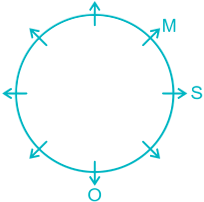
2) T is sitting exactly opposite to R and third to the right of O
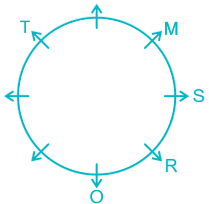
3) N is sitting to the immediate right of P
This is only possible if N is sitting to the immediate left of T
Thus, the final arrangement is:
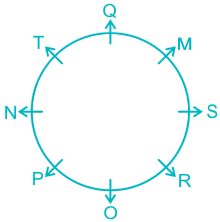
Hence, Q is sitting exactly opposite to O
2. Directions: Study the following information carefully and answer the question that follows:
There are eight people, M, N, O, P, Q, R, S, and T, sitting in a circular manner not necessarily in the same order and all are facing away from the center. S is sitting second to the left of O, and to the immediate right of M. T is sitting exactly opposite to R and third to the right of O.N is sitting to the immediate right of P.
2. Which of the following are sitting opposite to each other?
A. M, N
B. P, S
C. Q, P
D. O, M
E. S, N
Solution
Eight people: M, N, O, P, Q, R, S, and T
1) S is sitting second to the left of O, and to the immediate right of M
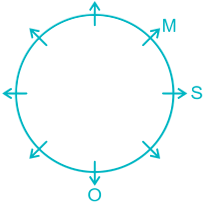
2) T is sitting exactly opposite to R and third to the right of O
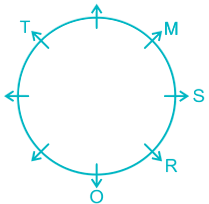
3) N is sitting to the immediate right of P
This is only possible if N is sitting to the immediate left of T
Thus, the final arrangement is:
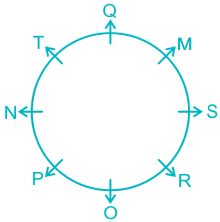
Hence, S and N are sitting opposite to each other.
3.Directions: Study the following information carefully and answer the question that follows:
There are eight people, M, N, O, P, Q, R, S, and T, sitting in a circular manner not necessarily in the same order and all are facing away from the center. S is sitting second to the left of O, and to the immediate right of M. T is sitting exactly opposite to R and third to the right of O.N is sitting to the immediate right of P.
Question:
3. How many people are sitting between P and S, counting from the right of P?
A. 1
B. 2
C. 3
D. 4
E. 5
Solution
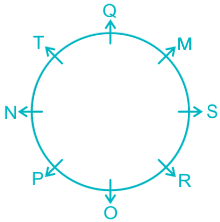
Eight people: M, N, O, P, Q, R, S, and T
1) S is sitting second to the left of O, and to the immediate right of M
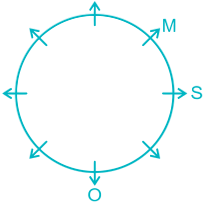
2) T is sitting exactly opposite to R and third to the right of O
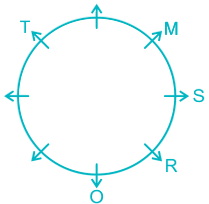
3) N is sitting to the immediate right of P
This is only possible if N is sitting to the immediate left of T
Thus, the final arrangement is:
4.Directions: Study the following information carefully and answer the question that follows:
There are eight people, M, N, O, P, Q, R, S, and T, sitting in a circular manner not necessarily in the same order and all are facing away from the center. S is sitting second to the left of O, and to the immediate right of M. T is sitting exactly opposite to R and third to the right of O.N is sitting to the immediate right of P.
Question:
4. Which of the following statement is incorrect with respect to the position of T?
A. To the immediate right of N
B. To the immediate left of M
C. Second to the right of P
D. Third to the left of S
E. Opposite to R.
Solution
Eight people: M, N, O, P, Q, R, S, and T
1) S is sitting second to the left of O, and to the immediate right of M
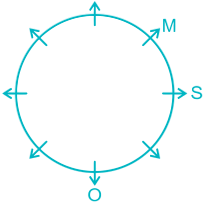
2) T is sitting exactly opposite to R and third to the right of O
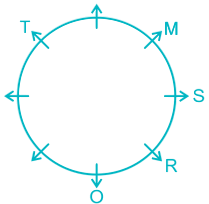
3) N is sitting to the immediate right of P
This is only possible if N is sitting to the immediate left of T
Thus, the final arrangement is:
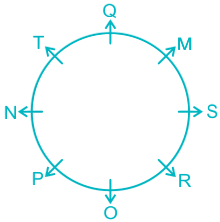
∵ T is sitting to the immediate left of Q
Hence, the statement ‘To the immediate left of M’ is incorrect with respect to the position of T
5.Directions: Study the following information carefully and answer the question that follows:
There are eight people, M, N, O, P, Q, R, S, and T, sitting in a circular manner not necessarily in the same order and all are facing away from the center. S is sitting second to the left of O, and to the immediate right of M. T is sitting exactly opposite to R and third to the right of O.N is sitting to the immediate right of P.
Question:
5. If R and S interchange their positions, then who will be sitting second to the left of R?
A. M
B. N
C. O
D. P
E. Q80% answered correctly
Solution
Eight people: M, N, O, P, Q, R, S, and T
1) S is sitting second to the left of O, and to the immediate right of M

2) T is sitting exactly opposite to R and third to the right of O

3) N is sitting to the immediate right of P
This is only possible if N is sitting to the immediate left of T
Thus, the final arrangement is:

Hence, if R and S interchanges their positions, then Q will be sitting second to the left of R
Direction: Study the following information to answer the given questions.
A man starts walking from point K, he walks 10 m in the east direction and reached at point L, after that he takes right turn and walks 8 m to reach at point M. From the point M, he takes left turn and walks 9 m to reach at point N and again takes left turn and walks 12 m to reach at point O. Finally he takes left turn and walks 19 m to reach at point P.
6. What is the distance between initial point and final point?
A. 8 m
B. 4 m
C. 12 m
D. 10 m
E. 9 m
Solution
We have drawn the figure according to the information given in the question,
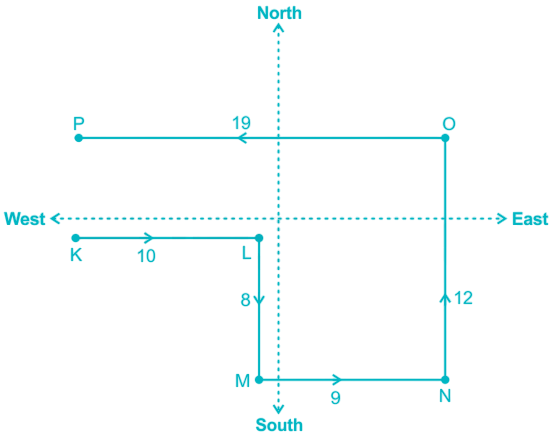
From the figure, the distance ON = 12 and LM = 8
It is clear that the distance between initial point and final point = ON – LM = 12 – 8 = 4 m.
Hence, ‘4 m’ is the correct answer.
Direction: Study the following information to answer the given questions.
A man starts walking from point K, he walks 10 m in the east direction and reached at point L, after that he takes right turn and walks 8 m to reach at point M. From the point M, he takes left turn and walks 9 m to reach at point N and again takes left turn and walks 12 m to reach at point O. Finally he takes left turn and walks 19 m to reach at point P.
7. What is the direction of P with respect to K?
A. North
B. East
C. West
D. South
E. None of these
Solution
We have drawn the figure according to the information given in the question,
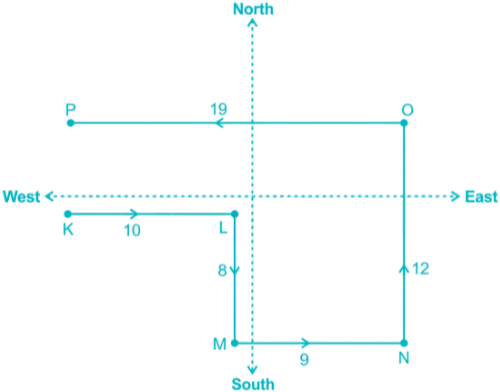
Thus, the point P is at the North direction with respect to point K.
Hence, ‘North’ is the correct answer.
Direction: Study the following information to answer the given questions.
A man starts walking from point K, he walks 10 m in the east direction and reached at point L, after that he takes right turn and walks 8 m to reach at point M. From the point M, he takes left turn and walks 9 m to reach at point N and again takes left turn and walks 12 m to reach at point O. Finally he takes left turn and walks 19 m to reach at point P.
Question:
8. If a man walks 12 m towards the south from point P and he takes a left turn and walks for another 19 m, which of the following point would he reach?
A. M
B. L
C. N
D. O
E. None of these
Solution
We have drawn the figure according to the information given in the question,
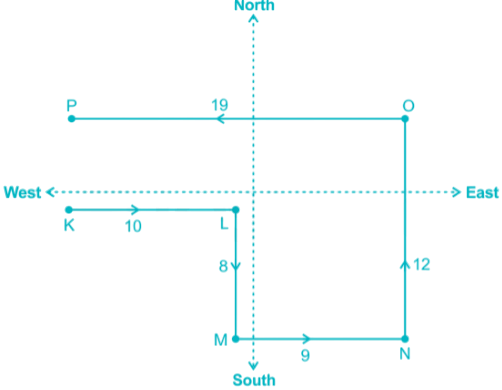
From the above diagram, the person will reach point N.
Hence, ‘N’ is the correct answer.
Direction: Study the following information to answer the given questions.
A man starts walking from point K, he walks 10 m in the east direction and reached at point L, after that he takes right turn and walks 8 m to reach at point M. From the point M, he takes left turn and walks 9 m to reach at point N and again takes left turn and walks 12 m to reach at point O. Finally he takes left turn and walks 19 m to reach at point P.
Question:
9. What is the shortest distance between M and O?
A. 21 m
B. 16 m
C. 17 m
D. 19 m
E. 15 m
Solution
We have drawn the figure according to the information given in the question,
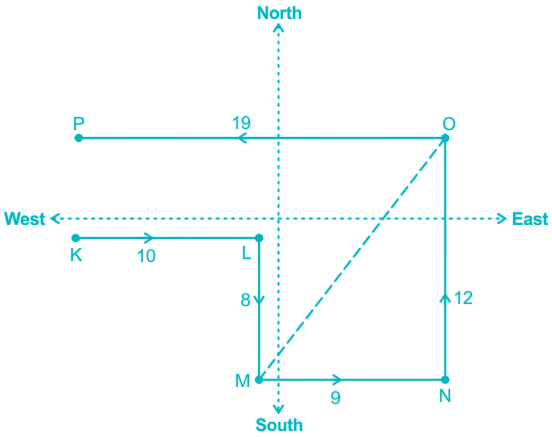
From the above diagram,
Distance between M and N = 9 m
Distance between N and O = 12 m
By Pythagoras’ theorem,
MO2 = MN2 + NO2 = 92 +122
= 81 + 144 = 225
Hence, the shortest between M and O = 15 m.
10. If it is possible to make only one meaningful English word with the third, the fourth, the seventh, and the eighth letters of the word SAILBOAT, which of the following will be the third letter of that word from left? If no such word can be made give ‘X’ as the answer and if more than one such word can be made give ‘Y’ as the answer.
A. A
B. L
C. I
D. X
E. Y
Solution
| Given Word | S A I L B O A T |
| Chosen Letters | I L A T |
| Only possible word | T A I L |
| The third letter of the possible word | I |
Hence, the third letter is I.
Direction: Study the following information carefully to answer the given questions.
Nine people – P, Q, R, S, T, V, W, X, and Z, work in a school at different posts. Each person occupies exactly one post among Director, Principal, HOD, Professor, Teacher, Counselor, Coach, Assistant, and Clerk, with the respective level of seniority, i.e. director being the most senior and the clerk being the most junior designation. X is the HOD. V is senior to only two people. Only three people are senior to P. Either R or T is the Teacher. Q is not the most senior person in the school. Neither Q nor W is the Counselor or the Assistant. T is senior to only Z.
Question:
11. Who is the most senior in the school?
A. R
B. S
C. T
D. V
E. W
Solution
Given:
Nine people – P, Q, R, S, T, V, W,X, and Z
Nine designations – Director, Principal, HOD, Professor, Teacher, Counselor, Coach, Assistant, and Clerk
The designations are in the order of seniority, i.e. the director is the most senior and the clerk is the most junior designation.
1. X is the HOD.
2. V is senior to only two people.
3. Only three people are senior to P.
| Designation | Person |
| Director | |
| Principal | |
| HOD | X |
| Professor | P |
| Teacher | |
| Counselor | |
| Coach | V |
| Assistant | |
| Clerk |
4. T is senior to only Z.
5. Either R or T is the Teacher.
6. Q is not the most senior person in the school.
7. Neither Q nor W is the Counselor or the Assistant.
Since W is the director.
Hence, W is the most senior in the school.
Direction: Study the following information carefully to answer the given questions.
Nine people – P, Q, R, S, T, V, W, X, and Z, work in a school at different posts. Each person occupies exactly one post among Director, Principal, HOD, Professor, Teacher, Counselor, Coach, Assistant, and Clerk, with the respective level of seniority, i.e. director being the most senior and the clerk being the most junior designation. X is the HOD. V is senior to only two people. Only three people are senior to P. Either R or T is the Teacher. Q is not the most senior person in the school. Neither Q nor W is the Counselor or the Assistant. T is senior to only Z.
Question:
12. Who is the Counselor?
A. T
B. P
C. Q
D. R
E. S
Solution
Given:
Nine people – P, Q, R, S, T, V, W,X, and Z
Nine designations – Director, Principal, HOD, Professor, Teacher, Counselor, Coach, Assistant, and Clerk
The designations are in the order of seniority, i.e. the director is the most senior and the clerk is the most junior designation.
1. X is the HOD.
2. V is senior to only two people.
3. Only three people are senior to P.
| Designation | Person |
| Director | |
| Principal | |
| HOD | X |
| Professor | P |
| Teacher | |
| Counselor | |
| Coach | V |
| Assistant | |
| Clerk |
4. T is senior to only Z.
5. Either R or T is the Teacher.
6. Q is not the most senior person in the school.
7. Neither Q nor W is the Counselor or the Assistant.
Hence, S is the Counselor.
Direction: Study the following information carefully to answer the given questions.
Nine people – P, Q, R, S, T, V, W, X, and Z, work in a school at different posts. Each person occupies exactly one post among Director, Principal, HOD, Professor, Teacher, Counselor, Coach, Assistant, and Clerk, with the respective level of seniority, i.e. director being the most senior and the clerk being the most junior designation. X is the HOD. V is senior to only two people. Only three people are senior to P. Either R or T is the Teacher. Q is not the most senior person in the school. Neither Q nor W is the Counselor or the Assistant. T is senior to only Z.
Question:
13. What is the designation of Q?
A. Counselor
B. Director
C. Assistant
D. Principal
E. Clerk
Solution
Given:
Nine people – P, Q, R, S, T, V, W,X, and Z
Nine designations – Director, Principal, HOD, Professor, Teacher, Counselor, Coach, Assistant, and Clerk
The designations are in the order of seniority, i.e. the director is the most senior and the clerk is the most junior designation.
1. X is the HOD.
2. V is senior to only two people.
3. Only three people are senior to P.
| Designation | Person |
| Director | |
| Principal | |
| HOD | X |
| Professor | P |
| Teacher | |
| Counselor | |
| Coach | V |
| Assistant | |
| Clerk |
4. T is senior to only Z.
5. Either R or T is the Teacher.
6. Q is not the most senior person in the school.
7. Neither Q nor W is the Counselor or the Assistant.
Hence, Q is the Principal.
Direction: Study the following information carefully to answer the given questions.
Nine people – P, Q, R, S, T, V, W, X, and Z, work in a school at different posts. Each person occupies exactly one post among Director, Principal, HOD, Professor, Teacher, Counselor, Coach, Assistant, and Clerk, with the respective level of seniority, i.e. director being the most senior and the clerk being the most junior designation. X is the HOD. V is senior to only two people. Only three people are senior to P. Either R or T is the Teacher. Q is not the most senior person in the school. Neither Q nor W is the Counselor or the Assistant. T is senior to only Z.
Question:
14. How many people are junior to R?
A. Five people
B. Four people
C. Three people
D. Two people
E. One person
Solution
Given:
Nine people – P, Q, R, S, T, V, W,X, and Z
Nine designations – Director, Principal, HOD, Professor, Teacher, Counselor, Coach, Assistant, and Clerk
The designations are in the order of seniority, i.e. the director is the most senior and the clerk is the most junior designation.
1. X is the HOD.
2. V is senior to only two people.
3. Only three people are senior to P.
| Designation | Person |
| Director | |
| Principal | |
| HOD | X |
| Professor | P |
| Teacher | |
| Counselor | |
| Coach | V |
| Assistant | |
| Clerk |
4. T is senior to only Z.
5. Either R or T is the Teacher.
6. Q is not the most senior person in the school.
7. Neither Q nor W is the Counselor or the Assistant.
R is the Teacher.
Hence, four people are junior to R.
Direction: Study the following information carefully to answer the given questions.
Nine people – P, Q, R, S, T, V, W, X, and Z, work in a school at different posts. Each person occupies exactly one post among Director, Principal, HOD, Professor, Teacher, Counselor, Coach, Assistant, and Clerk, with the respective level of seniority, i.e. director being the most senior and the clerk being the most junior designation. X is the HOD. V is senior to only two people. Only three people are senior to P. Either R or T is the Teacher. Q is not the most senior person in the school. Neither Q nor W is the Counselor or the Assistant. T is senior to only Z.
Question:
15. Who is the Clerk?
A. Z
B. X
C. Q
D. W
E. T
Solution
Given:
Nine people – P, Q, R, S, T, V, W,X, and Z
Nine designations – Director, Principal, HOD, Professor, Teacher, Counselor, Coach, Assistant, and Clerk
The designations are in the order of seniority, i.e. the director is the most senior and the clerk is the most junior designation.
1. X is the HOD.
2. V is senior to only two people.
3. Only three people are senior to P.
| Designation | Person |
| Director | |
| Principal | |
| HOD | X |
| Professor | P |
| Teacher | |
| Counselor | |
| Coach | V |
| Assistant | |
| Clerk |
4. T is senior to only Z.
5. Either R or T is the Teacher.
6. Q is not the most senior person in the school.
7. Neither Q nor W is the Counselor or the Assistant.
Hence, Z is the Clerk.
16. Directions: In the following question assuming the given statements to be true, find which of the conclusion among given conclusions is/are definitely true and then give your answers accordingly.
Statements:
S = T = R; T = W = U < G
Conclusions:
I. S < G
II. G > R
A. Only Conclusion I is true.
B. Only Conclusion II is true.
C. Both Conclusions I and II are true.
D. Either Conclusion I or II is true.
E. Neither Conclusion I nor II is true.
Solution
Given statements: S = T = R; T = W = U < G
On combining we get: S = R = T = W = U < G
Conclusions:
I. S < G → True (as S = R = T = W = U < G → therefore S < G)
II. G > R → True (as R = T = W = U < G → therefore R < G → G > R )
Hence, both conclusions I and II are true.
17.Directions: In the following question assuming the given statements to be true, find which of the conclusion among given conclusions is/are definitely true and then give your answers accordingly.
Statements:
F ≤ D; A < B = C; D ≤ E < C
Conclusions:
I. E > F
II. E = F
A. Either Conclusion I or II is true.
B. Both Conclusions I and II are true.
C. Neither Conclusion I nor II is true.
D. Only Conclusion I is true.
E. Only Conclusion II is true.
Solution
Given statements:
F ≤ D; A < B = C; D ≤ E < C
On combining we get: A < B = C > E ≥ D ≥ F
Conclusions:
I. E > F → False (as E ≥ D ≥ F → E ≥ F)
II. E = F → False (as E ≥ D ≥ F → E ≥ F)
Note: Conclusion I and II are complementary pairs.
Hence, either conclusion I or II is true.
18.Directions: In the following question assuming the given statements to be true, find which conclusion among the given conclusions is/are definitely true and then give your answers accordingly.
Statements: Y < O = R > T; A > X = T
Conclusions:
I. X < Y
II. R > A
A. Only Conclusion I is true.
B. Only Conclusion II is true.
C. Both Conclusions I and II are true.
D. Either Conclusion I or II is true.
E. Neither Conclusion I nor II is true.
Solution
Given statements: Y < O = R > T; A > X = T
On combining we get: A > X = T < R = O > Y
Conclusions:
I. X < Y → False (as X = T < R = O > Y → thus a clear relation between X and Y cannot be determined)
II. R > A → False (as A > X = T < R → thus a clear relation between R and A cannot be determined)
Hence, neither conclusion I nor II is true.
Directions: Study the following information carefully to answer the given questions:S N 4 = Q £ α Y R A Δ 7 $ B Z 9 E G β @ C F 1 3 # I L ©
Question:
19. Four of the following five are alike in a certain way based on the positions of the elements in the above arrangement and hence form a group. Which one does not belong to the group?
A. 4NIL
B. £Q13
C. SQ©3
D. £Y1C
E. =#4I
Solution
Given series:
Left Side S N 4 = Q £ α Y R A Δ 7 $ B Z 9 E G β @ C F 1 3 # I L © Right Side
Here In all groups of elements except ‘=#4I’, the third and fourth elements occupies the same positions from the right end in the given arrangement as the first and second elements occupies from the left end respectively.Hence, ‘=#4I’ does not belong to the group.
Directions:Study the following information carefully to answer the given questions: S N 4 = Q £ α Y R A Δ 7 $ B Z 9 E G β @ C F 1 3 # I L ©
Question:
20. How many such numbers are there in the given series, each of which is either immediately followed by a symbol or immediately preceded by a letter, but not both?
A. Two
B. Three
C. Four
D. Five
E. None of these
Solution
Given series:
Left Side S N 4 = Q £ α Y R A Δ 7 $ B Z 9 E G β @ C F 1 3 # I L © Right Side
Numbers which are either immediately followed by a symbol or immediately preceded by a letter, but not both:
S N 4 = Q £ α Y R A Δ 7 $ B Z 9 E G β @ C F 1 3 # I L ©
Hence, there are 4 Numbers that are either immediately followed by a symbol or immediately preceded by a letter, but not both: 7 9 1 3
Hence, four is the correct answer.
 Mistake Points
Either precede or followed by means that one of the conditions must be followed. For example: In the question need to find the number which is either followed by a symbol or immediately preceded by a letter but not both.
Directions:Study the following information carefully to answer the given questions: S N 4 = Q £ α Y R A Δ 7 $ B Z 9 E G β @ C F 1 3 # I L ©
Question:
21. If 4 N Q is related to Y R £ in the same way as Z B E is related to?
A. C F β
B. @ C G
C. @ β F
D. @ C E
E. None of these
Solution
Given Series
Left Side S N 4 = Q £ α Y R A Δ 7 $ B Z 9 E G β @ C F 1 3 # I L © Right Side
The pattern followed here is,
4 + 5 = Y;
N + 7 = R;
Q + 1 = £
Similarly,
Z + 5 = @;
B + 7 = C;
E + 1 = GHence, @CG is the correct answer.
Directions:Study the following information carefully to answer the given questions: S N 4 = Q £ α Y R A Δ 7 $ B Z 9 E G β @ C F 1 3 # I L ©
Question:
22. How many such alphabets are there in the given series, each of which are immediately preceded by an alphabet and followed by a number?
A. One
B. Three
C. More than three
D. Two
E. None of these
Solution
Given series:
Left Side S N 4 = Q £ α Y R A Δ 7 $ B Z 9 E G β @ C F 1 3 # I L © Right Side
1) Alphabets which are immediately preceded by an alphabet and followed by a number:
S N 4 = Q £ α Y R A Δ 7 $ B Z 9 E G β @ C F 1 3 # I L ©Hence, there are 3 symbols which are immediately preceded by a number and followed by an alphabet: SN4, BZ9, and CF1.
Directions:Study the following information carefully to answer the given questions: S N 4 = Q £ α Y R A Δ 7 $ B Z 9 E G β @ C F 1 3 # I L ©
Question:
23. If all the numbers in the above arrangement are dropped, then which of the following will be the seventeen from the right end?
A. R
B. α
C. @
D. Y
E. £
Solution
Given series:
Left Side S N 4 = Q £ α Y R A Δ 7 $ B Z 9 E G β @ C F 1 3 # I L © Right Side
1) If all the numbers are dropped:
S N = Q £ α Y R A Δ $ B Z E G β @ C F # I L ©
2) 17th letter from the right end is YHence, the element which is seventeen from right end is ‘Y’.
Direction: Study the information given below carefully and answer the question that follow.There are seven members in a family, in which two married couples. F is mother of R. B is aunt of P. C is father- in law of Q who is not wife of R. C is brother of B. Q is mother of G. B is sister – in – law of F. B is not married. P and R are brothers. C has only two children.
Question:
24. How G is related to B?
A. Sister
B. Grandfather
C. Father
D. Grandmother
E. Can’t be determined60% answered correctly
Solution
Preparing the family tree using the following symbols:
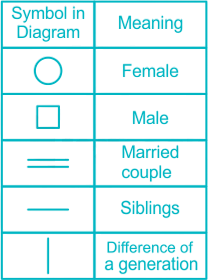
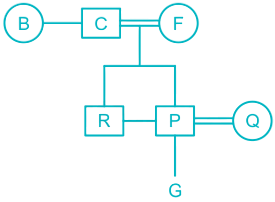
The gender of G cannot be determined.
So, G is either granddaughter or grandson.
Hence, cannot be determined is the answer.
Direction: Study the information given below carefully and answer the question that follow. There are seven members in a family, in which two married couples. F is mother of R. B is aunt of P. C is father- in law of Q who is not wife of R. C is brother of B. Q is mother of G. B is sister – in – law of F. B is not married. P and R are brothers. C has only two children.
Question:
25. Who among the following is the sister-in-law of R?
A. B
B. P
C. Q
D. G
E. None of these
Solution
Preparing the family tree using the following symbols:
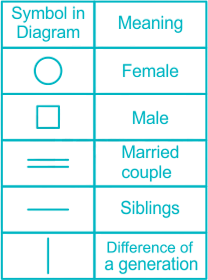
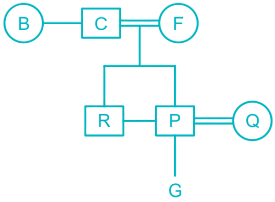
Hence, Q is the sister-in-law of R.
Direction: Study the information given below carefully and answer the question that follow. There are seven members in a family, in which two married couples. F is mother of R. B is aunt of P. C is father- in law of Q who is not wife of R. C is brother of B. Q is mother of G. B is sister – in – law of F. B is not married. P and R are brothers. C has only two children.
Question:
26. Who is the husband of Q?
A. R
B. P
C. B
D. C
E. G
Solution
Preparing the family tree using the following symbols:
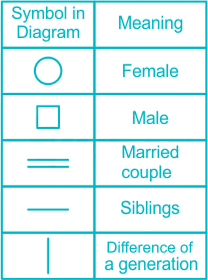
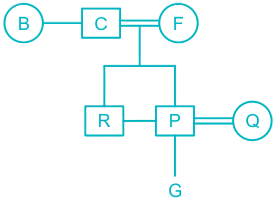
Hence, P is the husband of Q.
27. How many pairs of letters are there in the word “JURISDICTION” that have the same number of letters between them in the word (in both forward and backward directions), as they have in the English alphabetical series?
A. One
B. Five
C. Four
D. Two
E. Three
Solution
Given word: JURISDICTION
The given word can be represented as follows:
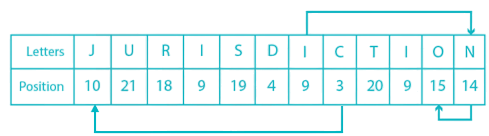
Thus, there is three pairs → Forward: IN, Backward: NO, CJ
Hence, three is the correct answer.
Direction: Study the following information carefully to answer the given questions:
Eight persons A, B, C, D, E, F, G, and H live on different floors of a building. The bottom-most floor is numbered as 1, the floor above it as 2, and so on. Only two persons live on the floors below G. Only one person lives between G and A. A does not live on the lowermost floor. Only two persons live between H and B. H lives on an odd-numbered floor but not the 7th floor. Only two persons live between A and E. F lives on a floor below B. C does not live on the 7th floor.
Question:
28. Who lives on the topmost floor?
A. D
B. H
C. C
D. F
E. E
Solution
Persons: A, B, C, D, E, F, G, and H
1. Only two persons live on the floors below G and only one person lives between G and A. Also, A does not live on the lowermost floor.
2. Only two persons live between H and B. Also.
3. H lives on an odd-numbered floor but not the 7th floor.
According to condition number 2, H can be placed on the 1st, 7th, or 8th floor but according to condition number 3, H must be placed on the 1st floor.
| Floor | Person |
| 8 | |
| 7 | |
| 6 | |
| 5 | A |
| 4 | B |
| 3 | G |
| 2 | |
| 1 | H |
4. Only two persons live between A and E.
5. F lives on a floor below B.
| Floor | Person |
| 8 | E |
| 7 | |
| 6 | |
| 5 | A |
| 4 | B |
| 3 | G |
| 2 | F |
| 1 | H |
6. C does not live on the 7th floor.
The only place left for C is the 6th floor. Accordingly, the only place left for D is the 7th floor.
| Floor | Person |
| 8 | E |
| 7 | D |
| 6 | C |
| 5 | A |
| 4 | B |
| 3 | G |
| 2 | F |
| 1 | H |
Hence, E lives on the topmost floor.
Direction: Study the following information carefully to answer the given questions:
Eight persons A, B, C, D, E, F, G, and H live on different floors of a building. The bottom-most floor is numbered as 1, the floor above it as 2, and so on. Only two persons live on the floors below G. Only one person lives between G and A. A does not live on the lowermost floor. Only two persons live between H and B. H lives on an odd-numbered floor but not the 7th floor. Only two persons live between A and E. F lives on a floor below B. C does not live on the 7th floor.
Question:
29. Four of the following five are alike in a certain way based on their arrangement. Find the one which does not belong to that group?
A. G
B. C
C. A
D. D
E. H
Solution
Persons: A, B, C, D, E, F, G, and H
1. Only two persons live on the floors below G and only one person lives between G and A. Also, A does not live on the lowermost floor.
2. Only two persons live between H and B. Also.
3. H lives on an odd-numbered floor but not the 7th floor.
According to condition number 2, H can be placed on the 1st, 7th, or 8th floor but according to condition number 3, H must be placed on the 1st floor.
| Floor | Person |
| 8 | |
| 7 | |
| 6 | |
| 5 | A |
| 4 | B |
| 3 | G |
| 2 | |
| 1 | H |
4. Only two persons live between A and E.
5. F lives on a floor below B.
| Floor | Person |
| 8 | E |
| 7 | |
| 6 | |
| 5 | A |
| 4 | B |
| 3 | G |
| 2 | F |
| 1 | H |
6. C does not live on the 7th floor.
The only place left for C is the 6th floor. Accordingly, the only place left for D is the 7th floor.
| Floor | Person |
| 8 | E |
| 7 | D |
| 6 | C |
| 5 | A |
| 4 | B |
| 3 | G |
| 2 | F |
| 1 | H |
G, A, D, and H, all live on odd-numbered floors, whereas, C lives on an even-numbered floor.
Hence, the correct option is 2.
Direction: Study the following information carefully to answer the given questions:
Eight persons A, B, C, D, E, F, G, and H live on different floors of a building. The bottom-most floor is numbered as 1, the floor above it as 2, and so on. Only two persons live on the floors below G. Only one person lives between G and A. A does not live on the lowermost floor. Only two persons live between H and B. H lives on an odd-numbered floor but not the 7th floor. Only two persons live between A and E. F lives on a floor below B. C does not live on the 7th floor.
Question:
30. Who lives four floors above G?
A. D
B. E
C. C
D. A
E. F
Solution
Persons: A, B, C, D, E, F, G, and H
1. Only two persons live on the floors below G and only one person lives between G and A. Also, A does not live on the lowermost floor.
2. Only two persons live between H and B. Also.
3. H lives on an odd-numbered floor but not the 7th floor.
According to condition number 2, H can be placed on the 1st, 7th, or 8th floor but according to condition number 3, H must be placed on the 1st floor.
| Floor | Person |
| 8 | |
| 7 | |
| 6 | |
| 5 | A |
| 4 | B |
| 3 | G |
| 2 | |
| 1 | H |
4. Only two persons live between A and E.
5. F lives on a floor below B.
| Floor | Person |
| 8 | E |
| 7 | |
| 6 | |
| 5 | A |
| 4 | B |
| 3 | G |
| 2 | F |
| 1 | H |
6. C does not live on the 7th floor.
The only place left for C is the 6th floor. Accordingly, the only place left for D is the 7th floor.
| Floor | Person |
| 8 | E |
| 7 | D |
| 6 | C |
| 5 | A |
| 4 | B |
| 3 | G |
| 2 | F |
| 1 | H |
Hence, D lives four floors above G.
Direction: Study the following information carefully to answer the given questions:
Eight persons A, B, C, D, E, F, G, and H live on different floors of a building. The bottom-most floor is numbered as 1, the floor above it as 2, and so on. Only two persons live on the floors below G. Only one person lives between G and A. A does not live on the lowermost floor. Only two persons live between H and B. H lives on an odd-numbered floor but not the 7th floor. Only two persons live between A and E. F lives on a floor below B. C does not live on the 7th floor.
Question:
31. Who lives on second floor?
A. A
B. E
C. F
D. G
E. None of these
Solution
Persons: A, B, C, D, E, F, G, and H
1. Only two persons live on the floors below G and only one person lives between G and A. Also, A does not live on the lowermost floor.
2. Only two persons live between H and B. Also.
3. H lives on an odd-numbered floor but not the 7th floor.
According to condition number 2, H can be placed on the 1st, 7th, or 8th floor but according to condition number 3, H must be placed on the 1st floor.
| Floor | Person |
| 8 | |
| 7 | |
| 6 | |
| 5 | A |
| 4 | B |
| 3 | G |
| 2 | |
| 1 | H |
4. Only two persons live between A and E.
5. F lives on a floor below B.
| Floor | Person |
| 8 | E |
| 7 | |
| 6 | |
| 5 | A |
| 4 | B |
| 3 | G |
| 2 | F |
| 1 | H |
6. C does not live on the 7th floor.
The only place left for C is the 6th floor. Accordingly, the only place left for D is the 7th floor.
| Floor | Person |
| 8 | E |
| 7 | D |
| 6 | C |
| 5 | A |
| 4 | B |
| 3 | G |
| 2 | F |
| 1 | H |
Hence, F lives on 2nd floor.
Direction: Study the following information carefully to answer the given questions:
Eight persons A, B, C, D, E, F, G, and H live on different floors of a building. The bottom-most floor is numbered as 1, the floor above it as 2, and so on. Only two persons live on the floors below G. Only one person lives between G and A. A does not live on the lowermost floor. Only two persons live between H and B. H lives on an odd-numbered floor but not the 7th floor. Only two persons live between A and E. F lives on a floor below B. C does not live on the 7th floor.
Question:
32. How many persons live above B?
A. 4
B. 5
c. 6
D. 2
E. 1
Solution
Persons: A, B, C, D, E, F, G, and H
1. Only two persons live on the floors below G and only one person lives between G and A. Also, A does not live on the lowermost floor.
2. Only two persons live between H and B. Also.
3. H lives on an odd-numbered floor but not the 7th floor.
According to condition number 2, H can be placed on the 1st, 7th, or 8th floor but according to condition number 3, H must be placed on the 1st floor.
| Floor | Person |
| 8 | |
| 7 | |
| 6 | |
| 5 | A |
| 4 | B |
| 3 | G |
| 2 | |
| 1 | H |
4. Only two persons live between A and E.
5. F lives on a floor below B.
| Floor | Person |
| 8 | E |
| 7 | |
| 6 | |
| 5 | A |
| 4 | B |
| 3 | G |
| 2 | F |
| 1 | H |
6. C does not live on the 7th floor.
The only place left for C is the 6th floor. Accordingly, the only place left for D is the 7th floor.
| Floor | Person |
| 8 | E |
| 7 | D |
| 6 | C |
| 5 | A |
| 4 | B |
| 3 | G |
| 2 | F |
| 1 | H |
Hence, 4 persons live above B.
Directions: Study the following information to answer the given questions.
In a certain code language,
‘She loves dog’ is coded as ‘ rst abc ptr’,
‘She likes travelling’ is coded as ‘bca ptr efg’,
‘Dog likes bone’ is coded as ‘mno rst bca’,
‘Ravi has dog’ is coded as ‘xyz jkl rst’.
Question:
33. What is the code for ‘loves travelling’?
A. abc etg
B. cba etg
C. efg cba
D. cfg abc
E.abc efg
Solution
According to the information given,
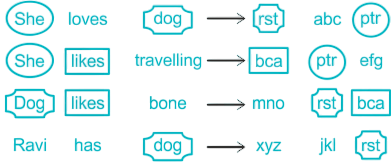
Word for the code ‘ptr’: she.
Word for the code ‘rst’: dog.
Word for the code ‘bca’: likes.
From the first line we can say that the code for ‘loves’ is ‘abc’.
From the second line we can say that the code for ‘travelling’ is ‘efg’.
Hence, the code for ‘loves travelling’ is ‘abc efg’.
Directions: Study the following information to answer the given questions.
In a certain code language,
‘She loves dog’ is coded as ‘ rst abc ptr’,
‘She likes travelling’ is coded as ‘bca ptr efg’,
‘Dog likes bone’ is coded as ‘mno rst bca’,
‘Ravi has dog’ is coded as ‘xyz jkl rst’.
Question:
34. What is the code for ‘Ravi loves cat’, if the code for cat is opq?
A. xyz abc opq
B. xyz jkl opq
C. jkl abc opq
D. Either 1 or 3
E. Either 2 or 3
Solution
According to the information given,
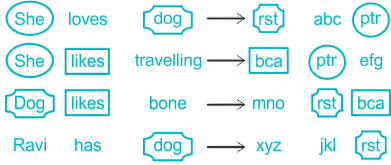
Word for the code ‘ptr’: she.
Word for the code ‘rst’: dog.
Word for the code ‘bca’: likes.
Word for the code ‘abc’: loves.
Word for the code ‘efg’: travelling.
Word for the code ‘mno’: bone.
‘Ravi’ is coded as either ‘xyz’ or ‘jkl’.
Hence, the code is either ‘xyz abc opq’ or ‘jkl abc opq’.
Directions: Study the following information to answer the given questions.
In a certain code language,
‘She loves dog’ is coded as ‘ rst abc ptr’,
‘She likes travelling’ is coded as ‘bca ptr efg’,
‘Dog likes bone’ is coded as ‘mno rst bca’,
‘Ravi has dog’ is coded as ‘xyz jkl rst’.
Question:
35. If ‘Ravi’ is coded as ‘xyz’, then ‘ptr jkl ant act’ can be written as_________________.
A. He has a cat
B. She has a dog
C. Ravi has a cat
D. She has a pen
E. He has a pen
Solution
According to the information given,
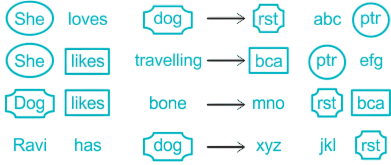
Word for the code ‘ptr’: she.
Word for the code ‘rst’: dog.
Word for the code ‘bca’: likes.
Word for the code ‘abc’: loves.
Word for the code ‘efg’: traveling.
Word for the code ‘mno’: bone.
Here ‘has’ is coded as ‘jkl’.
Hence, the possible code is ‘She has a pen’.Question:
Directions: Read the following comprehension carefully and answer the questions given below.
A certain number of people are sitting in a linear row facing North. Two people are sitting between X and T. Only one person is sitting between T and M, who is not sitting to the left of T. M is sitting third to the right of S. Two people are sitting between M and Q, who is sitting third to the left of Y. P is sitting second to the left of S. P is sitting at the end of the row.
Question:
36. How many people are sitting in the row?
A. Eleven
B. Fourteen
C. Eighteen
D. Twelve
E. Fifteen
Solution
All are facing North.
1- Two people are sitting between X and T.
2- Only one person is sitting between T and M, who is not sitting to the left of T.
Case-1

Case-2

3- M is sitting third to the right of S.
4- Two people are sitting between M and Q, who is sitting third to the left of Y.
Case-1

Case-2


5- P is sitting second to the left of S. So case-1 gets eliminated.
So, Final arrangement is;

Twelve people are sitting in the row.
Directions: Read the following comprehension carefully and answer the questions given below.
A certain number of people are sitting in a linear row facing North. Two people are sitting between X and T. Only one person is sitting between T and M, who is not sitting to the left of T. M is sitting third to the right of S. Two people are sitting between M and Q, who is sitting third to the left of Y. P is sitting second to the left of S. P is sitting at the end of the row.
Question:
37. What is the position of X with respect to Q?
A. Second to the right
B. Second to the left
C. Immediate left
D. Immediate right
E. Third to the left
Solution
All are facing North.
1- Two people are sitting between X and T.
2- Only one person is sitting between T and M, who is not sitting to the left of T.
Case-1

Case-2

3- M is sitting third to the right of S.
4- Two people are sitting between M and Q, who is sitting third to the left of Y.
Case-1

Case-2

5- P is sitting second to the left of S. So case-1 gets eliminated.
So, Final arrangement is;

X is second to the left of Q.
Directions: Read the following comprehension carefully and answer the questions given below.
A certain number of people are sitting in a linear row facing North. Two people are sitting between X and T. Only one person is sitting between T and M, who is not sitting to the left of T. M is sitting third to the right of S. Two people are sitting between M and Q, who is sitting third to the left of Y. P is sitting second to the left of S. P is sitting at the end of the row.
Question:
38. If A is sitting in between T and M then who is sitting Fourth to the right of A?
A. P
B. Y
C. Q
D. X
E. S
Solution
All are facing North.
1- Two people are sitting between X and T.
2- Only one person is sitting between T and M, who is not sitting to the left of T.
Case-1

Case-2

3- M is sitting third to the right of S.
4- Two people are sitting between M and Q, who is sitting third to the left of Y.
Case-1

Case-2


5- P is sitting second to the left of S. So case-1 gets eliminated.
So, Final arrangement is;

If A is sitting in between T and M then Q is sitting Fourth to the right of A.
Directions: Read the following comprehension carefully and answer the questions given below.
A certain number of people are sitting in a linear row facing North. Two people are sitting between X and T. Only one person is sitting between T and M, who is not sitting to the left of T. M is sitting third to the right of S. Two people are sitting between M and Q, who is sitting third to the left of Y. P is sitting second to the left of S. P is sitting at the end of the row.
Question:
39. Which of the following pair is sitting at extreme ends of the row?
A. Q,D
B. P,Y
C. M,X
D. X,Q
E. S,P
Solution
All are facing North.
1- Two people are sitting between X and T.
2- Only one person is sitting between T and M, who is not sitting to the left of T.
Case-1

Case-2

3- M is sitting third to the right of S.
4- Two people are sitting between M and Q, who is sitting third to the left of Y.
Case-1

Case-2

5- P is sitting second to the left of S. So case-1 gets eliminated.
So, Final arrangement is;

P,Y are sitting at extreme ends of the row.
Directions: Read the following comprehension carefully and answer the questions given below.
A certain number of people are sitting in a linear row facing North. Two people are sitting between X and T. Only one person is sitting between T and M, who is not sitting to the left of T. M is sitting third to the right of S. Two people are sitting between M and Q, who is sitting third to the left of Y. P is sitting second to the left of S. P is sitting at the end of the row.
Question:
40. Who is sitting Immediate left of X?
A. P
B. Q
C. M
D. R
E. S
Solution
All are facing North.
1- Two people are sitting between X and T.
2- Only one person is sitting between T and M, who is not sitting to the left of T.
Case-1

Case-2

3- M is sitting third to the right of S.
4- Two people are sitting between M and Q, who is sitting third to the left of Y.
Case-1

Case-2

5- P is sitting second to the left of S. So case-1 gets eliminated.
So, Final arrangement is;

M is sitting Immediate left of X.
Numerical Ability
41.In the given question, two equations numbered I and II are given. Solve both the equations and mark the appropriate answer.
I. 5x + 536 = 576
II. 7y2 – 239 = 104
A. x < y
B. x > y
C. x ≤ y
D. x ≥ y
E. x = y or the relation between x and y can’t be established.
Solution
Given:
I. 5x + 536 = 576
II. 7y2 – 239 = 104
Calculation:
I. 5x + 536 = 576
⇒ 5x + 536 = 576
⇒ 5x = 576 – 536
⇒ 5x = 40
⇒ x = 40/5
⇒ x = 8
II. 7y2 – 239 = 104
⇒ 7y2 = 104 + 239
⇒ 7y2 = 343
⇒ y2 = 343/7
⇒ y2 = 49
⇒ y = 7, (-7)
| Value of ‘x’ | Relation | Value of ‘y’ |
| 8 | > | 7 |
| 8 | > | -7 |
When we compared the values of ‘x’ and ‘y’ in the table above, we found that there is only ONE relation between X and Y i.e. >. So, a relation between x and y is “x > y”.
∴ After comparison, all the values of x and y the relation is “x > y”.
42. In the given question, two equations numbered l and II are given. Solve both the equations and mark the appropriate answer.
I. x2 – 2x – 15 = 0
II. y2 – 8y + 15 = 0
A. x > y
B. x < y
C. x ≥ y
D. x ≤ y
E. x = y or relation between x and y can not be established.
Solution
Calculation:
From I,
x2 – 2x – 15 = 0
⇒ x2 – 5x + 3x – 15 = 0
⇒ x(x – 5) + 3(x – 5) = 0
⇒ (x – 5)(x + 3) = 0
Taking,
⇒ (x – 5) = 0 or (x + 3) = 0
⇒ x = 5 or -3
From II,
y2 – 8y + 15 = 0
⇒ y2 – 3y – 5y + 15 = 0
⇒ y(y – 3) – 5(y – 3) = 0
⇒ (y – 3)(y – 5) = 0
Taking,
⇒ (y – 3) = 0 or (y – 5) = 0
⇒ y = 3 or 5
Comparison between x and y (via Tabulation):
| Value of x | Value of y | Relation |
| 5 | 3 | x > y |
| 5 | 5 | x = y |
| -3 | 3 | x < y |
| -3 | 5 | x < y |
∴ x = y or the relation between x and y can not be established.
43. In the given question, two equations numbered l and II are given. Solve both the equations and mark the appropriate answer.
I. x2 + 2x – 48 = 0
II. y2 = 196
A. x > y
B. x < y
C. x ≥ y
D. x ≤ y
E. No relation in x and y or x = y
Solution
Given:
I. x2 + 2x – 48 = 0
II. y2 = 196
Calculation:
From I
x2 + 2x – 48 = 0
⇒ x2 + 8x – 6x – 48 = 0
⇒ x(x + 8) – 6(x + 8) = 0
⇒ (x + 8)(x – 6) = 0
⇒ x = -8, 6
From II
y2 = 196
⇒ y = ±14
Comparison between x and y (via Tabulation)
| Value of x | Value of y | Relation between x & y |
| -8 | 14 | x < y |
| -8 | -14 | x > y |
| 6 | 14 | x < y |
| 6 | -14 | x > y |
∴ No relation in x and y or x = y
| Sign Method | ||
| Equation | Sign | Remark |
| ax2 + bx + c = 0 | -Ve, -Ve | Same signs |
| ax2 – bx + c = 0 | +Ve, +Ve | Same signs |
| ax2 + bx – c = 0 | -Ve, +Ve | Larger root is negative smaller root is positive |
| ax2 – bx – c = 0 | -Ve, +Ve | Larger root is positive smaller root is negative |
44. In the given question, two equations numbered l and II are given. Solve both the equations and mark the appropriate answer.
I. x = √36
II. y3 = 216
A. x > y
B. x < y
C. x ≥ y
D. x ≤ y
E. No relation in x and y or x = y
Solution
Given:
I. x = √36
II. y3 = 216
Calculation:
From I
x = √36
⇒ x = 6
From II
y3 = 216
⇒ y = 6
Comparison between x and y (via Tabulation)
| Value of x | Value of y | Relation between x & y |
| 6 | 6 | x = y |
| 6 | 6 | x = y |
| 6 | 6 | x = y |
| 6 | 6 | x = y |
∴ No relation in x and y or x = y

| Sign Method | ||
| Equation | Sign | Remark |
| ax2 + bx + c = 0 | -Ve, -Ve | Same signs |
| ax2 – bx + c = 0 | +Ve, +Ve | Same signs |
| ax2 + bx – c = 0 | -Ve, +Ve | Larger root is negative smaller root is positive |
| ax2 – bx – c = 0 | -Ve, +Ve | Larger root is positive smaller root is negative |
Mistake Points
All confuse between x = √36 and x2 = 36
x = √36, x = 6 always as positive values
x2 = 36, x = +6, -6
45. In the given question, two equations numbered I and II are given. Solve both the equations and mark the appropriate answer.
I. x2 + x – 182 = 0
II. y2 – 29y + 210 = 0
A. x > y
B. x < y
C. x ≥ y
D. x ≤ y
E. x = y or relationship between x and y cannot be established
Solution
Given:
x2 + x – 182 = 0
y2 – 29y + 210 = 0
Calculation:
From I:
x2 + x – 182 = 0
⇒ x2 + 14x – 13x – 182 = 0
⇒ x(x + 14) – 13(x + 14) = 0
⇒ (x + 14)(x – 13) = 0
⇒ x = -14, 13
From II:
y2 – 29y + 210 = 0
⇒ y2 – 14y – 15y + 210 = 0
⇒ y(y – 14) – 15(y – 14) = 0
⇒ (y – 14)(y – 15) = 0
⇒ y = 14, 15
Comparison between x and y (via Tabulation):
| Value of x | Value of y | Relation |
| -14 | 14 | x < y |
| -14 | 15 | x < y |
| 13 | 14 | x < y |
| 13 | 15 | x < y |
∴ x < y.
46. The four numbers are in ratio 8 : 7 : 5 : 13. The difference between the largest and smallest number is 4800. What is the value of the smallest number?
A. 2000
B. 3000
C. 5000
D. 6000
E. 7000
Solution
Given:
The ratio of the four numbers is 8 : 7 : 5 : 13
Calculation:
Let the numbers be 8x, 7x, 5x and 13x
13x – 5x = 4800
⇒ 8x = 4800
⇒ x = 600
⇒ Smallest number = 5x
⇒ 5 × 600 = 3000
∴ The smallest number is 3000.
47. A person buys wine at the rate of Rs. 55 per litre. In what ratio the water should be mixed with wine so that he gains 20% on selling the mixture at Rs. 48 per litre?
A. 8 : 3
B. 3 : 8
C. 5 : 7
D. 7 : 5
E. 3 : 7
Solution
Formula Used:
Profit% = (SP – CP)/CP × 100
where, CP → Cost Price, SP → Selling Price
Calculations:
Let the quantity of wine and water added in final mixture be x and y respectively.
Cost price of wine = Rs. 55/litre
Cost price of water = Rs. 0/litre
Selling price after profit of 20% = Rs. 48/litre
⇒ Cost price of wine mixture = Rs. 48/(120/100) = Rs. 40
Now, 55 × x + 0y = (x + y) × 40
⇒ (55 – 40)x = 40y
⇒ 15x = 40y
⇒ x : y = 8 : 3
∴ The ratio in which water and wine should be mixed is 3 : 8.
Alternate Method
Cost price of wine = Rs. 55/litre
Cost price of water = Rs. 0/litre
Selling price after profit of 20% = Rs. 48/litre
⇒ Cost price of wine mixture = Rs. 48/(120/100) = Rs. 40
Using alligation,
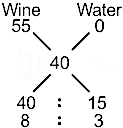
Ratio of wine and water = 8 : 3
∴ The ratio in which water and wine should be mixed is 3 : 8.
Answer the questions from tabular chart shown below
The table mentioned below shows number of Christmas toys sold by company A, B, C and D.
| Company | % of toys sold | % of toys returned as faulty (From total sold by that particular company) |
| A | 30 | 10% |
| B | 20 | 50% |
| C | 25 | 25% |
| D | 25 | 40% |
Total number of toys sold considering all 4 companies is 6000.
48. Calculate total number of toys returned as faulty for company C
A. 500
B. 375
C. 425
D. 505
E. None of the above
Solution
Calculation:
Total number of toys = 6000
⇒ Toys sold by company C = 6000 × 0.25
⇒ Toys sold by company C = 1500
⇒ Toys returned as faulty = 25%
⇒ Toys returned as faulty = 1500 × 0.25
⇒ Toys returned as faulty = 375
∴ 375 toys were returned as faulty to company C
Answer the questions from tabular chart shown below
The table mentioned below shows number of Christmas toys sold by company A, B, C and D.
| Company | % of toys sold | % of toys returned as faulty (From total sold by that particular company) |
| A | 30 | 10% |
| B | 20 | 50% |
| C | 25 | 25% |
| D | 25 | 40% |
Total number of toys sold considering all 4 companies is 6000.
49. Calculate difference between number of toys returned as faulty to company B and Company C
A. 250
B. 375
C. 225
D. 300
E. None of the above
Solution
Calculation:
Total number of toys = 6000
⇒ Toys sold by company C = 6000 × 0.25
⇒ Toys sold by company C = 1500
⇒ Toys returned as faulty = 25%
⇒ Toys returned as faulty = 1500 × 0.25
⇒ Toys returned as faulty = 375
Toys sold by company B = 6000 × 0.20
⇒ Toys sold by company B = 1200
⇒ Toys returned to company B as faulty = 1200 × 0.5
⇒ Toys returned as faulty (Company B) = 600
⇒ required difference = 600 – 375
⇒ required difference = 225
∴ required difference is 225
Answer the questions from tabular chart shown below
The table mentioned below shows number of Christmas toys sold by company A, B, C and D.
| Company | % of toys sold | % of toys returned as faulty (From total sold by that particular company) |
| A | 30 | 10% |
| B | 20 | 50% |
| C | 25 | 25% |
| D | 25 | 40% |
Total number of toys sold considering all 4 companies is 6000.
50. Find the ratio of toys sold by company A to company D
A. 5 : 3
B. 5 : 6
C. 3 : 5
D. 3 : 7
E. 6 : 5
Solution
Calculation:
Total number of toys = 6000
⇒ Toys sold by company A = 6000 × 0.30
⇒ Toys sold by company A = 1800
Toys sold by company D = 6000 × 0.25
⇒ Toys sold by company D = 1500
⇒ required ratio = 1800: 1500
∴ required ratio is 6: 5
Answer the questions from tabular chart shown below
The table mentioned below shows number of Christmas toys sold by company A, B, C and D.
| Company | % of toys sold | % of toys returned as faulty (From total sold by that particular company) |
| A | 30 | 10% |
| B | 20 | 50% |
| C | 25 | 25% |
| D | 25 | 40% |
Total number of toys sold considering all 4 companies is 6000.
51. What is the average number of toys sold by company A, B and C?
A. 2500
B. 3750
C. 2250
D. 1500
E. None of the above
Solution
Calculation:
Total number of toys = 6000
⇒ Toys sold by company C = 6000 × 0.25
⇒ Toys sold by company C = 1500
⇒ Toys sold by company B = 6000 × 0.20
⇒ Toys sold by company B = 1200
⇒ Toys sold by company A = 6000 × 0.30
⇒ Toys sold by company A = 1800
⇒ Total of All 3 companies = 1500 + 1200 + 1800
⇒ Total = 4500
⇒ Average of all 3 companies = 4500 / 3
⇒ Average of all 3 companies = 1500
∴ required average is 1500
Answer the questions from tabular chart shown below
The table mentioned below shows number of Christmas toys sold by company A, B, C and D.
| Company | % of toys sold | % of toys returned as faulty (From total sold by that particular company) |
| A | 30 | 10% |
| B | 20 | 50% |
| C | 25 | 25% |
| D | 25 | 40% |
Total number of toys sold considering all 4 companies is 6000.
52. Which company observes least amount of faulty returns?
A. Company A
B. Company B
C. Company C
D. Company D
E. None of the above
Solution
Calculation:
Total number of toys = 6000
Toys sold by company C = 6000 × 0.25
⇒ Toys sold by company C = 1500
⇒ Toys returned as faulty = 25%
⇒ Toys returned as faulty = 1500 × 0.25
⇒ Toys returned as faulty (Company C) = 375
Toys sold by company B = 6000 × 0.20
⇒ Toys sold by company B = 1200
⇒ Toys returned to company B as faulty = 1200 × 0.5
⇒ Toys returned as faulty (Company B) = 600
Toys sold by company A = 6000 × 0.30
⇒ Toys sold by company A = 1800
⇒ Toys returned as faulty = 1800 × 0.10
⇒ Toys returned as faulty (Company A) = 180
Toys sold by company D = 6000 × 0.25
⇒ Toys sold by company D = 1500
⇒ Toys returned as faulty = 1500 × 0.40
⇒ Toys returned as faulty (Company D) = 600
∴ Company A observes least faulty returns
Note: This problem can be solved by just observing the values and computing it i.e., Company A and Company C has least % of faulty returns.
53. A man borrows a certain sum of money at simple interest for 8 years at 16% per annum. If the interest paid by him is Rs. 8000, then find the sum of money he borrows?
A. Rs. 6530
B. Rs. 6250
C. Rs. 6000
D. Rs. 7800
E. Rs. 6450
Solution
Given:
S.I. = Rs. 8000
Rate of interest, R = 16% per annum
Time, T = 8 years
Formula used:
S.I. = P × R% × T
Calculation:
Let the sum of money he borrows be Rs. P.
S.I. = P × R% × T
⇒ 8000 = P × 16/100 × 8
⇒ P = Rs. 6250
∴ The sum of money he borrows is Rs. 6250.
Was the solution helpful?Yes
54. A man travels first 288 km at a speed 64 km/hr, next 220 km at speed of 40 km/hr and rest of the 288 km at a speed of 48 km/hr. Find the average speed of man in the whole journey.
A. 49.75 km/hr
B. 40 km/hr
C. 55 km/hr
D. 42.25 km/hr
E. 45.5 km/hr
Solution
Given:
288 km distance travel by man with the speed of 64 km/hr.
220 km distance travel by man with the speed of 40 km/hr.
Rest 288 km distance travel by man with the speed of 48 km/hr.
Formula Used:
Time taken = Distance/ Speed
Average Speed = Total Distance Travelled/Total time taken
Calculation:
Time taken to cover 288 km with the speed of 64 km/hr = 288/64 = 4.5 hours
Time taken to cover 220 km with the speed of 40 km/hr = 220/40 = 5.5 hours
Time taken to cover 288 km with the speed of 48 km/hr = 288/48 = 6 hours
Total time taken = 4.5 + 5.5 + 6 = 16 hours
Total distance cover = 288 + 220 + 288 = 796 km
Average Speed = 796/16 = 49.75 km/hr
∴ Average speed of man in the whole journey is 49.75 km/hr.
55. P, Q and R are engaged to complete a task and earned Rs. 60,000. P and Q completes (5/8)th of the work together. Find the amount received by R.
A. Rs. 21,000
B. Rs. 21,500
C. Rs. 22,000
D. Rs. 22,500
E. Rs. 23,000
Solution
Given:
Total earnings = Rs. 60,000
Calculation:
Let the total work be 1
Then, share of R = [1 – (5/8)] × Rs. 60,000
⇒ [(8 – 5)/8] × Rs. 60,000
⇒ (3/8) × Rs. 60,000
⇒ Rs. 22,500
∴ Rs. 22,500 amount is received by R.
56. The number of visitors to Wankhede stadium increased by 30% during IPL. The price of ticket per match also increased by 20% then find the percentage of increase in revenue collection is:
A. 56%
B. 60%
C. 44%
D. 50%
E. None of these
Solution
Given
Increased the no. of visitors = 30%
Price of ticket increased by = 20%
Formula used
Successive Percentage = {x + y + (x × y)/100}
Calculation
Increased in the revenue = {30 + 20 + (20 × 30)/100}
⇒ 56%
∴ The increased in the revenue collection is 56%
57. What will come in the place of the question mark ‘?’ in the following question?
{(6/7) × 343} + {(5/8) × 512} = 500 + ?
A. 214
B. 114
C. 314
D. 414
E. None of these
Solution
Given:
{(6/7) × 343} + {(5/8) × 512} = 500 + ?
Concept used:
Follow the BODMAS rule according to the table given below:
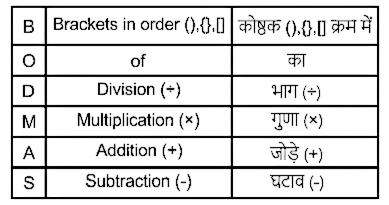
Calculation:
{(6/7) × 343} + {(5/8) × 512} = 500 + ?
⇒ {6 × 49} + {5 × 64} = 500 + ?
⇒ 294 + 320 = 500 + ?
⇒ 614 = 500 + ?
⇒ ? = 614 – 500 = 114
∴ The value of ? will be 114.
58. What will come in the place of the question mark ‘?’ in the following question?
{∛(216) × 25} ÷ 30 – 40 = ? – 59
A. 14
B. 20
C. 34
D. 15
E. 24
Solution
Given:
{∛(216) × 25} ÷ 30 – 40 = ? – 59
Concept Used:
Follow the BODMAS rule according to the table given below:
Calculation:
{∛(216) × 25} ÷ 30 – 40 = ? – 59
⇒ {6 × 25} ÷ 30 – 40 + 59 = ?
⇒ 150 ÷ 30 – 40 + 59 = ?
⇒ 5 – 40 + 59 = ?
⇒ ? = 64 – 40 = 24
∴ 24 will come in place of the question mark (‘?’).
59. What will come in the place of the question mark ‘?’ in the following question?
(212 ÷ 27) × 5 + 180 = ?% of 680
A. 50
B. 30
C. 60
D. 20
E. 40
Solution
Concept Used:
Follow BODMAS rule to solve this question, as per the order given below,
Calculation:
⇒ (212 ÷ 27) × 5 + 180 = ?% of 680
⇒ (212 – 7) × 5 + 180 = (?/100) × 680
⇒ 25 × 5 + 180 = (?/10) × 68
⇒ 32 × 5 + 180 = (?/10) × 68
⇒ 160 + 180 = (?/10) × 68
⇒ 340 × (10/68) = ?
⇒ ? = 50
∴ The value of ? is 50
60. What will come in the place of the question mark ‘?’ in the following question?8.33% of 360 + 9.09% of 1331 = 102 + ?
A. 51
B. 41
C. 61
D. 31
E. 71
Solution
Given:
8.33% of 360 + 9.09% of 1331 = 102 + ?
Concept used:
Follow the BODMAS rule according to the table given below:
Calculation:
8.33% of 360 + 9.09% of 1331 = 102 + ?
⇒ (1/12) of 360 + (1/11) of 1331 = 102 + ?
⇒ 30 + 121 – 100 = ?
⇒ 151 – 100 = ?
⇒ ? = 51
∴ The value of ? will be 51.
Hint
| Percentage to Fraction | |||
| 100% = 1 | 25% = 1/4 | 14.28% = 1/7 | 10% = 1/10 |
| 50% = 1/2 | 20% = 1/5 | 12.50% = 1/8 | 9.09% = 1/11 |
| 33.33% = 1/3 | 16.66% = 1/6 | 11.11% = 1/9 | 8.33% = 1/12 |
| 7.69% =1/13 | 7.14% = 1/14 | 6.67% = 1/15 | 6.25% = 1/16 |
| 5.88% = 1/17 | 5.56% = 1/18 | 5.26% = 1/19 | 5% = 1/20 |
61. What will come in the place of the question mark ‘?’ in the following question?
62.5 × 16 + 1000 – (27)2 + (31)2 = ?
A. 1232
B. 1032
C. 2132
D. 2232
E. None of these
Solution
Given:
62.5 × 16 + 1000 – (27)2 + (31)2 = ?
Concept used:
Follow the BODMAS rule according to the table given below:
Calculation:
62.5 × 16 + 1000 – (27)2 + (31)2 = ?
⇒ 1000 + 1000 – 729 + 961 = ?
⇒ 2000 + 961 – 729 = ?
⇒ 2961 – 729 = ?
⇒ 2232 = ?
∴ The value of ? is 2232.
62. If the length of a rectangle increases by 20% and the breadth of the rectangle reduces by 15%. What is the net percentage change in its area.
A. 1% increase
B. 1% decrease
C. 2% decrease
D. 2% increase
E. No percentage changed
Solution
Net percentage change in area of rectangle = 20 – 15 – [(20 × 15)/100]
⇒ 20 – 15 – 3
⇒ 2%
∴ The area of the rectangle increases by 2%.
Traditional Method:
Given:
Length of rectangle increases by 20%
Breadth of rectangle reduces by 15%
Formula used:
Area of a rectangle = Length × Breadth
and Percentage = (Favourable Value/Base value) × 100
Calculation:
Let the original length and breadth of the rectangle be x cmand y cm respectively.
Then, Area of the rectangle = x × y = xy cm2
New length = [1 + (20/100)] × x
⇒ (120/100) × x
⇒ 1.2x cm
and new breadth = [1 – (15/100)] × y
⇒ (85/100) × y
⇒ 0.85 y cm
So, New area of the rectangle = 1.2x × 0.85y
⇒ 1.02xy cm2
Difference in area = 1.02xy cm2 – xy cm2 = 0.02xy cm2
⇒ Net percentage change = [(0.02xy)/xy] × 100
⇒ 0.02 × 100
⇒ 2%
∴ The area of the rectangle increases by 2%.
63. A person marks his goods 30% above the cost price and gives a discount of 25% to the buyer on cash payment. Find the percentage of his profit or loss.
A. 1% loss
B. 2.5% loss
C. 3% loss
D. 2.5% profit
E. 3% profit
Solution
Given:
The price marked at = 30% higher
The discount = 25%
Formula used:
P = SP – CP
Where, P = Profit, SP = Selling price, and CP = Cost price
Calculation:
Let the cost price of goods be X
According to the question
The marked price = 1.3X

∴ The required result will be 2.5% loss.
Direction: Study the graph and answer the following questions.
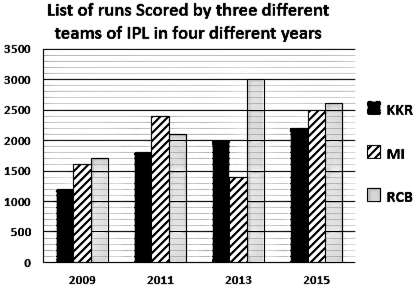
64. What is the average run made by KKR in the year of 2009 and 2013 together?
A. 1250
B. 1400
C. 1650
D. 1090
E. 1600
Solution
Given:
The amount of run made by KKR in 2009 = 1200
The amount of run made by KKR in 2013 = 2000
Calculation:
Total run made by KKR in 2009 and 2013 together = (1200 + 2000) = 3200
∴ Required average = (3200 / 2) = 1600
Direction: Study the graph and answer the following questions.
65. What is the ratio between the total run made by MI and RCB together in 2011 and the total run made by KKR and RCB together in 2013?
A. 9 ∶ 8
B. 7 ∶ 9
C. 5 ∶ 7
D. 9 ∶ 10
E. None of the above
Solution
Given:
The amount of run made by MI in 2011 = 2400
The amount of run made by RCB in 2011 = 2100
The amount of run made by KKR in 2013 = 2000
The amount of run made by RCB in 2013 = 3000
Calculation:
Total run made MI and RCB in 2011 together = (2400 + 2100) = 4500
Total run made by KKR and RCB in 2013 together = (2000 + 3000) = 5000
∴ Required ratio = 4500 ∶ 5000 = 9 ∶ 10
Direction: Study the graph and answer the following questions.
66. What is the difference between the total runs made by three teams in 2015 and the total runs made by three teams in 2011?
A. 1250
B. 1000
C. 1100
D. 1300
E. 860
Solution
Given:
The amount of run made by KKR in 2015 = 2200
The amount of run made by MI in 2015 = 2500
The amount of run made by RCB in 2015 = 2600
The amount of run made by KKR in 2011 = 1800
The amount of run made by MI in 2011 = 2400
The amount of run made by RCB in 2011 = 2100
Calculation:
Total run made by three teams in 2015 = (2200 + 2500 + 2600) = 7300
Total run made by three teams in 2011 = (1800 + 2400 + 2100) = 6300
∴ Difference = (7300 − 6300) = 1000
Direction: Study the graph and answer the following questions.
67. If two-seventh part of the total run of RCB is scored by Kohli in 2011, how many run did Kohli scored in 2011?
A. 1000
B. 750
C. 600
D. 350
E. 500
Solution
Given:
The amount of run made by RCB in 2011 = 2100
The part of total run made by RCB from there Kohli scored = 2 / 7
Calculation:∴ Kohli scored = (2100 × 2 / 7) = 600
Direction: Study the graph and answer the following questions.
68. What is the total number of run scored by KKR and RCB in four years together?
A. 11250
B. 12500
C. 18400
D. 16600
E. 20000
Solution
Given:
Run made by KKR in 2009 = 1200
Run made by KKR in 2011 = 1800
Run made by KKR in 2013 = 2000
Run made by KKR in 2015 = 2200
Run made by RCB in 2009 = 1700
Run made by RCB in 2011 =2100
Run made by RCB in 2013 = 3000
Run made by RCB in 2015 = 2600
Calculation:
Total run made by KKR and RCB in four years together = (1200 + 1800 + 2000 + 2200 + 1700 + 2100 + 3000 + 2600) = 16600
69. A thief runs a certain distance with a speed of 12 km/h in 16 min. If he wants to cover the same distance in 12 min, what should be his speed?
A. 14 km/hr
B. 16 km/hr
C. 10 km/hr
D. 12 km/hr
E. None of these
Solution
Given:
Speed of the thief (s1) = 12 km/h
Time to take cover the distance (t1) = 16 min = 16/60 hr
Time to take cover the distance (t2) = 12 min = 12/60 hr
Concept used:
Speed = Distance/Time
Time = 1/speed —-(When distance is equal)
Calculation:
Let, the speed of the thief to cover the same distance in 12 min be s2
According to the question,
⇒ s1 × t1 = s2 × t2
⇒ 12 × (16/60) = s2 × (12/60)
⇒ s2 = 16
∴ The speed of the thief to cover the same distance in 12 min is 16 km/hr
70. 7 boys and 10 girls can do a piece of work in 12 days. 5 boys and 8 girls can do the same work in 16 days. In how many days can 3 boys and 6 girls complete the work?
A. 28
B. 30
C. 24
D. 32
E. None of these
Solution
Given:
7B + 10G complete the work in 12 days
5B + 8G complete the work in 16 days
Formula:
Person1 × Days1 = Person2 × D2
Calculations:
Let efficiency of one Boy and Girls be B and G respectively
We know that, P1 D1 = P2 D2
Given that, (7B + 10G)12 = (5B + 8G)16
⇒ 21B + 30G = 20B + 32G
⇒ 1B = 2G …… sub in P1D1 (or) P2D2
⇒ 7B + 10G = 7 × 2G + 10G = 24 girls will complete the work in 12 days.
Now, 3B + 6G = 3 × 2G + 6G = 12 girls
⇒ P1 D1 = P2 D2
⇒ 24 × 12 = 12 × D2
⇒ D2 = 24
∴ 3 boys and 6 girls can complete the work in 24 days.
71. What should come in place of the question mark (?) in the following number series?
113, 225, 449, ?, 1793
A. 789
B. 786
C. 897
D. 987
E. None of these
Solution
113 × 2 – 1 = 225
225 × 2 – 1 = 449
449 × 2 – 1 = 897
897 × 2 – 1 = 1793
72. What should come in place of the question mark ‘?’ in the following number series?1, 3, 7, ?, 31, 63, 127
A. 3
B. 15
C. 11
D. 20
E. 6
Solution
1 × 2 + 1 = 3
3 × 2 + 1 = 7
7 × 2 + 1 = 15
15 × 2 + 1 = 31
31 × 2 + 1 = 63
63 × 2 + 1 = 127
∴ ? = 15
Was the solution helpful?
73. What should come in place of the question mark ‘?’ in the following number series?
180, 174, 162, 144, 120, ?
A. 50
B. 60
C. 70
D. 80
E. 90
Solution
Considering the above series,
180, 174, 162, 144, 120, ?
The logic of the series can be explained as,
180 – (6 × 1) = 174
174 – (6 × 2) = 162
162 – (6 × 3) = 144
144 – (6 × 4) = 120
By observing the pattern, we can write
120 – (6 × 5) = 90
⇒ ? = 90
∴ The value of ? is 90.
74. What should come in place of question mark ‘?’ in the following number series?
8, 9, 11, 13, 14, 17, 17, ?
A. 20
B. 21
C. 22
D. 23
E. 24
Solution
Considering the above series,
8, 9, 11, 13, 14, 17, 17, ?
The logic of the series can be explained as,
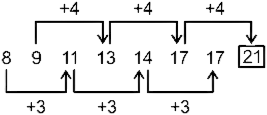
11 – 8 = 3
14 – 11 = 3
17 – 14 = 3
13 – 9 = 4
17 – 13 = 4
By observing the pattern, we can write
? – 17 = 4
⇒ ? = 21
∴ The value of ? is 21.
75. What should come in place of the question mark ‘?’ in the following number series?
200, 190, ?, 140, 100, 50, -10
A. 170
B. 180
C. 185
D. 175
E. 150
Solution
Calculation:
The series follows following pattern:
⇒ 200
⇒ 200 – 10 = 190
⇒ 190 – 20 = 170
⇒ 170 – 30 = 140
⇒ 140 – 40 = 100
⇒ 100 – 50 = 50
⇒ 50 – 60 = -10
∴ The value of ? is 170
Comprehension:(Que No. 36 – 40)
Directions: Study the following data and answer the following questions.Total of 900 customers visited the shop. 520 customers bought Blue pens and 270 customers bought both red and blue pens. 490 customers bought Red pens. Some customers didn’t buy any pens.
76. Find the average number of customers who bought only Red and only Blue pens.
A. 235
B. 260
C. 290
D. 220
E. 240
Solution
Given:
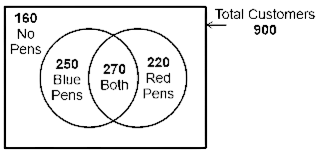
Total number of customers of a shop = 900
Total number of customers who bought both pens = 270
Total number of customers who bought only Blue pens = 520 – 270 = 250
Total number of customers who bought only Red pens = 490 – 270 = 220
Required average =
= (250 + 220)/2
= 235
Comprehension:(Que No. 36 – 40)
Directions: Study the following data and answer the following questions.Total of 900 customers visited the shop. 520 customers bought Blue pens and 270 customers bought both red and blue pens. 490 customers bought Red pens. Some customers didn’t buy any pens.
77. The number of customers who didn’t buy any pen is approx. what percent of the total number of customers of the shop?
A. 18%
B. 20%
C. 11%
D. 12%
E. 14%
Solution
Given:
Total number of customers of a shop = 900
Total number of customers who bought both pens = 270
⇒ Total number of customers who bought only Blue pens = 520 – 270 = 250
⇒ Total number of customers who bought only Red pens = 490 – 270 = 220
⇒ Total number of customers who didn’t bought any pen = 900 – 270 – 250 – 220 = 160
⇒ Required percentage = 160/900 × 100
⇒ Required percentage = 17.77% ~ 17% as approx
Directions: Study the following data and answer the following questions.Total of 900 customers visited the shop. 520 customers bought Blue pens and 270 customers bought both red and blue pens. 490 customers bought Red pens. Some customers didn’t buy any pens.
78. Find the ratio between the number of customers who bought both pens and who didn’t buy any pen.
A. 16 : 27
B. 27 : 19
C. 19 : 16
D. 27 : 16
E. 16 : 19
Solution
Given:
Total number of customers of a shop = 900
Total number of customers who bought both pens = 270
⇒ Total number of customers who bought only Blue pens = 520 – 270 = 250
⇒ Total number of customers who bought only Red pens = 490 – 270 = 220
⇒ Total number of customers who didn’t bought any pen = 900 – 270 – 250 – 220 = 160
⇒ Required ratio = 270 : 160
= 27 : 16
Directions: Study the following data and answer the following questions.Total of 900 customers visited the shop. 520 customers bought Blue pens and 270 customers bought both red and blue pens. 490 customers bought Red pens. Some customers didn’t buy any pens.
79. Find the difference between the number of customers who bought at least one pen and a number of customers who bought at most one pen.
A. 120
B. 160
C. 80
D. 135
E. 110
Solution
Given:
Total number of customers of a shop = 900
Total number of customers who bought both pens = 270
⇒ Total number of customers who bought only Blue pens = 520 – 270 = 250
⇒ Total number of customers who bought only Red pens = 490 – 270 = 220
⇒ Total number of customers who didn’t bought any pen = 900 – 270 – 250 – 220 = 160
⇒ Number of customers who bought at least one pen = 250 + 220 + 270 = 740
⇒ Number of customers who bought at most one pen = 250 + 220 + 160 = 630
⇒ Required difference = 740 – 630 = 110
Directions: Study the following data and answer the following questions.Total of 900 customers visited the shop. 520 customers bought Blue pens and 270 customers bought both red and blue pens. 490 customers bought Red pens. Some customers didn’t buy any pens.
80. The number of customers who bought only one pen is approximately what percent more than the number of customers who bought both pens?
A. 83%
B. 74%
C. 82%
D. 90%
E. 88%
Solution
Given:
Total number of customers of a shop = 900
Total number of customers who bought both pens = 270
⇒ Total number of customers who bought only Blue pens = 520 – 270 = 250
⇒ Total number of customers who bought only Red pens = 490 – 270 = 220
⇒ Total number of customers who bought only one pen = 250 + 220 = 470
⇒ Required percentage = (470-270)/270× 100%
⇒ Required percentage = (200)/270 × 100%
⇒ Required percentage = 74%