Direction: Study the following information carefully and answer the question given below.
Seven friends P, Q, R, S, T, U, and V live on the separate floors of a building but not necessarily in the same order. The bottommost floor is numbered 1 and so on until the topmost floor which is numbered 7.
Three people live between P and R who do not live on the topmost floor. T lives three floors above P. Only two people live between S and U. U lives above S who does not live on the lowermost floor. Not more than one person lives between V and Q. S does not live immediately above Q.
1.Who lives on the topmost floor.
A. P
B. Q
C. U
D. S
E. T
Solution
7 Person : P, Q, R, S, T, U and V
Floor : 7 (Ground floor numbered 1 and Topmost floor numbered 7 )
(1) Three people live between P and R who do not live on the topmost floor.
(2) T lives three floors above P.
| Case I | Case II | |
| Floor | Person | Person |
| 7 | ||
| 6 | R | |
| 5 | R | T |
| 4 | T | |
| 3 | ||
| 2 | P | |
| 1 | P |
(3) Only two people live between S and U.
(4) U lives above S who does not live on the lowermost floor.
| Case I | Case II | |
| Floor | Person | Person |
| 7 | U | |
| 6 | U | R |
| 5 | R | T |
| 4 | T | S |
| 3 | S | |
| 2 | P | |
| 1 | P |
(5) Not more than one person lives between V and Q. Therefore Case I eliminates here.
(6) S does not live immediately above Q.
Thus the final arrangement is as follows:
| Case II | |
| Floor | Person |
| 7 | U |
| 6 | R |
| 5 | T |
| 4 | S |
| 3 | V |
| 2 | P |
| 1 | Q |
Hence, U lives on the topmost floor.
Direction: Study the following information carefully and answer the question given below.
Seven friends P, Q, R, S, T, U, and V live on the separate floors of a building but not necessarily in the same order. The bottommost floor is numbered 1 and so on until the topmost floor which is numbered 7.
Three people live between P and R who do not live on the topmost floor. T lives three floors above P. Only two people live between S and U. U lives above S who does not live on the lowermost floor. Not more than one person lives between V and Q. S does not live immediately above Q.
2. Four among the given five are similar in a certain way, who among the following does not belong to that group?
A. R,T
B. S,T
C. P,Q
D. S,V
E. V, P
Solution
7 Person : P, Q, R, S, T, U and V
Floor : 7 (Ground floor numbered 1 and Topmost floor numbered 7 )
(1) Three people live between P and R who do not live on the topmost floor.
(2) T lives three floors above P.
| Case I | Case II | |
| Floor | Person | Person |
| 7 | ||
| 6 | R | |
| 5 | R | T |
| 4 | T | |
| 3 | ||
| 2 | P | |
| 1 | P |
(3) Only two people live between S and U.
(4) U lives above S who does not live on the lowermost floor.
| Case I | Case II | |
| Floor | Person | Person |
| 7 | U | |
| 6 | U | R |
| 5 | R | T |
| 4 | T | S |
| 3 | S | |
| 2 | P | |
| 1 | P |
(5) Not more than one person lives between V and Q. Therefore Case I eliminates here.
(6) S does not live immediately above Q.
Thus the final arrangement is as follows:
| Case II | |
| Floor | Person |
| 7 | U |
| 6 | R |
| 5 | T |
| 4 | S |
| 3 | V |
| 2 | P |
| 1 | Q |
We can see that, in all the options first-person lives immediately above the second person and thus forms a group whereas, in option 2 (S, T), S lives immediately below T.
Hence, S, T does not belong to that group.
Direction: Study the following information carefully and answer the question given below.
Seven friends P, Q, R, S, T, U, and V live on the separate floors of a building but not necessarily in the same order. The bottommost floor is numbered 1 and so on until the topmost floor which is numbered 7.
Three people live between P and R who do not live on the topmost floor. T lives three floors above P. Only two people live between S and U. U lives above S who does not live on the lowermost floor. Not more than one person lives between V and Q. S does not live immediately above Q.
3. How many person live between R and U?
A. One
B. Two
C. Three
D. None
E. More than three
Solution
7 Person : P, Q, R, S, T, U and V
Floor : 7 (Ground floor numbered 1 and Topmost floor numbered 7 )
(1) Three people live between P and R who do not live on the topmost floor.
(2) T lives three floors above P.
| Case I | Case II | |
| Floor | Person | Person |
| 7 | ||
| 6 | R | |
| 5 | R | T |
| 4 | T | |
| 3 | ||
| 2 | P | |
| 1 | P |
(3) Only two people live between S and U.
(4) U lives above S who does not live on the lowermost floor.
| Case I | Case II | |
| Floor | Person | Person |
| 7 | U | |
| 6 | U | R |
| 5 | R | T |
| 4 | T | S |
| 3 | S | |
| 2 | P | |
| 1 | P |
(5) Not more than one person lives between V and Q. Therefore Case I eliminates here.
(6) S does not live immediately above Q.
Thus the final arrangement is as follows:
| Case II | |
| Floor | Person |
| 7 | U |
| 6 | R |
| 5 | T |
| 4 | S |
| 3 | V |
| 2 | P |
| 1 | Q |
Hence, none is the correct answer.
Direction: Study the following information carefully and answer the question given below.
Seven friends P, Q, R, S, T, U, and V live on the separate floors of a building but not necessarily in the same order. The bottommost floor is numbered 1 and so on until the topmost floor which is numbered 7.
Three people live between P and R who do not live on the topmost floor. T lives three floors above P. Only two people live between S and U. U lives above S who does not live on the lowermost floor. Not more than one person lives between V and Q. S does not live immediately above Q.
4. Who among the following lives on the Fifth floor?
A. P
B. Q
C. S
D. T
E. R
Solution
7 Person : P, Q, R, S, T, U and V
Floor : 7 (Ground floor numbered 1 and Topmost floor numbered 7 )
(1) Three people live between P and R who do not live on the topmost floor.
(2) T lives three floors above P.
| Case I | Case II | |
| Floor | Person | Person |
| 7 | ||
| 6 | R | |
| 5 | R | T |
| 4 | T | |
| 3 | ||
| 2 | P | |
| 1 | P |
(3) Only two people live between S and U.
(4) U lives above S who does not live on the lowermost floor.
| Case I | Case II | |
| Floor | Person | Person |
| 7 | U | |
| 6 | U | R |
| 5 | R | T |
| 4 | T | S |
| 3 | S | |
| 2 | P | |
| 1 | P |
(5) Not more than one person lives between V and Q. Therefore Case I eliminates here.
(6) S does not live immediately above Q.
Thus the final arrangement is as follows:
| Case II | |
| Floor | Person |
| 7 | U |
| 6 | R |
| 5 | T |
| 4 | S |
| 3 | V |
| 2 | P |
| 1 | Q |
Hence, T lives on the Fifth floor.
Direction: Study the following information carefully and answer the question given below.
Seven friends P, Q, R, S, T, U, and V live on the separate floors of a building but not necessarily in the same order. The bottommost floor is numbered 1 and so on until the topmost floor which is numbered 7.
Three people live between P and R who do not live on the topmost floor. T lives three floors above P. Only two people live between S and U. U lives above S who does not live on the lowermost floor. Not more than one person lives between V and Q. S does not live immediately above Q.
5. Who lives two floors below T?
A. S
B. V
C. U
D. Q
E. R
Solution
7 Person : P, Q, R, S, T, U and V
Floor : 7 (Ground floor numbered 1 and Topmost floor numbered 7 )
(1) Three people live between P and R who do not live on the topmost floor.
(2) T lives three floors above P.
| Case I | Case II | |
| Floor | Person | Person |
| 7 | ||
| 6 | R | |
| 5 | R | T |
| 4 | T | |
| 3 | ||
| 2 | P | |
| 1 | P |
(3) Only two people live between S and U.
(4) U lives above S who does not live on the lowermost floor.
| Case I | Case II | |
| Floor | Person | Person |
| 7 | U | |
| 6 | U | R |
| 5 | R | T |
| 4 | T | S |
| 3 | S | |
| 2 | P | |
| 1 | P |
(5) Not more than one person lives between V and Q. Therefore Case I eliminates here.
(6) S does not live immediately above Q.
Thus the final arrangement is as follows:
| Case II | |
| Floor | Person |
| 7 | U |
| 6 | R |
| 5 | T |
| 4 | S |
| 3 | V |
| 2 | P |
| 1 | Q |
Hence, V lives two floors below T.
Directions: Read the following information carefully and answer the questions which follow:
Point P is 3m to the north of point Q. Point R is 4m to the east of point Q. Point S is 3m to the south of point R and 6m south of point T. Point U is 4m to the west of point S and 3m to the east of point V.
6. What is the direction of point T with respect to point P?
A. South East
B. South
C. East
D. North East
E. Cannot be determined
Solution
According to the information given,
1. Point P is 3m to the north of point Q.
2. Point R is 4m to the east of point Q.
3. Point S is 3m to the south of point R.
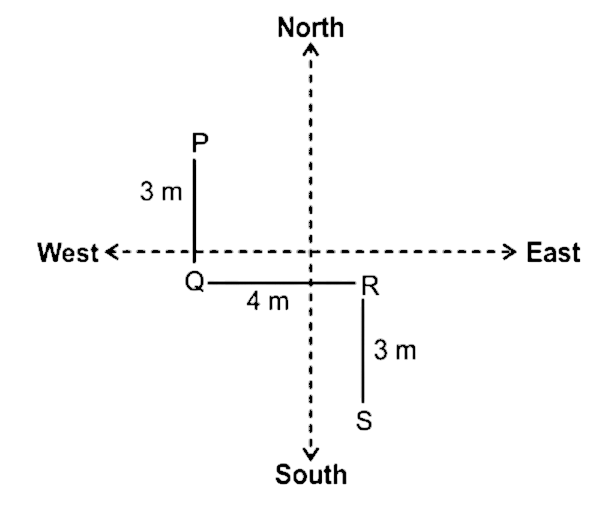
4. Point S is 6m to the south of point T.
5. Point U is 4m to the west of point S.
6. Point U 3m to the east of point V.
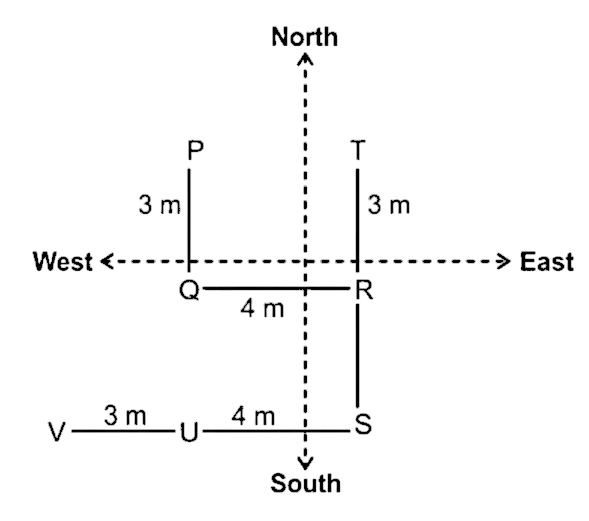
From the above diagram, point T is in East direction of point P.
Hence, the answer is East.
Directions: Read the following information carefully and answer the questions which follow:
Point P is 3m to the north of point Q. Point R is 4m to the east of point Q. Point S is 3m to the south of point R and 6m south of point T. Point U is 4m to the west of point S and 3m to the east of point V.
7. Point V is in which direction from point Q?
A. South
B. South-West
C. South-East
D. North
E. North-East
Solution
According to the information given,
1. Point P is 3m to the north of point Q.
2. Point R is 4m to the east of point Q.
3. Point S is 3m to the south of point R.
4. Point S is 6m to the south of point T.
5. Point U is 4m to the west of point S.
6. Point U 3m to the east of point V.
From the above diagram, point V is in South-West direction of point Q.
Hence, the answer is South-West.
Directions: Read the following information carefully and answer the questions which follow:
Point P is 3m to the north of point Q. Point R is 4m to the east of point Q. Point S is 3m to the south of point R and 6m south of point T. Point U is 4m to the west of point S and 3m to the east of point V.
8. What is the shortest distance between point P and point R?
A. 5m
B. 6m
C. 4m
D. 7m
E. 3m
Solution
According to the information given,
1. Point P is 3m to the north of point Q.
2. Point R is 4m to the east of point Q.
3. Point S is 3m to the south of point R.
4. Point S is 6m to the south of point T.
5. Point U is 4m to the west of point S.
6. Point U 3m to the east of point V.
From the above diagram,
PR2 = PQ2 + QR2
PR2 = (32 + 42)m
PR = √ 25m
PR = 5m
Hence, the distance between point P and point R is 5m.
Direction: Study the following information to answer the given questions:
There are eight persons A, B, C, D, E, F, G, and H who have an exam on two different dates, 12th and 23rd of four different months, February, March, April, and August.
B has an exam on the odd date but not in the first or last month. D has an exam on 12th April. Three persons have exams between B and G. Two persons have exams before H. E have exam on an even numbered date in the month having less than 30 days. C has an exam before F. A have exam in the month having 31 days but not in the same month in which H and F have exams.
9. Who has exam on 23 February?
A. E
B. A
C. C
D. F
E. G
Solution
Given: There are eight persons A, B, C, D, E, F, G, and H who have an exam on two different dates, 12th and 23rd of four different months, February, March, April, and August.
1) D has an exam on 12th April.
2) Two persons have exams before H.
3) E has an exam on an even date in the month having less than 30 days.
| MONTHS | DATE | PERSON |
| FEBRUARY | 12 | E |
| 23 | ||
| MARCH | 12 | H |
| 23 | ||
| APRIL | 12 | D |
| 23 | ||
| AUGUST | 12 | |
| 23 |
4) B has an exam on the odd date but not in the first or last month.
5) Three persons have exams between B and G.
Case I:
| MONTHS | DATE | PERSON |
| FEBRUARY | 12 | E |
| 23 | ||
| MARCH | 12 | H |
| 23 | B | |
| APRIL | 12 | D |
| 23 | ||
| AUGUST | 12 | |
| 23 |
Case II:
| MONTHS | DATE | PERSON |
| FEBRUARY | 12 | E |
| 23 | ||
| MARCH | 12 | H |
| 23 | ||
| APRIL | 12 | D |
| 23 | B | |
| AUGUST | 12 | |
| 23 |
6) A has an exam in the month having 31 days but not in the same month in which H and F have exams.
7) C has an exam before F.
| MONTHS | DATE | PERSON |
| FEBRUARY | 12 | E |
| 23 | C | |
| MARCH | 12 | H |
| 23 | B | |
| APRIL | 12 | D |
| 23 | F | |
| AUGUST | 12 | A |
| 23 | G |
Hence, C has an exam on 23rd February.
Direction: Study the following information to answer the given questions:
There are eight persons A, B, C, D, E, F, G, and H who have an exam on two different dates, 12th and 23rd of four different months, February, March, April, and August.
B has an exam on the odd date but not in the first or last month. D has an exam on 12th April. Three persons have exams between B and G. Two persons have exams before H. E have exam on an even numbered date in the month having less than 30 days. C has an exam before F. A have exam in the month having 31 days but not in the same month in which H and F have exams.
10. Who has exam on the last date?
A. C
B. H
C. B
D. G
E. A
Solution
Given: There are eight persons A, B, C, D, E, F, G, and H who have an exam on two different dates, 12th and 23rd of four different months, February, March, April, and August.
1) D has an exam on 12th April.
2) Two persons have exams before H.
3) E has an exam on an even date in the month having less than 30 days.
| MONTHS | DATE | PERSON |
| FEBRUARY | 12 | E |
| 23 | ||
| MARCH | 12 | H |
| 23 | ||
| APRIL | 12 | D |
| 23 | ||
| AUGUST | 12 | |
| 23 |
4) B has an exam on the odd date but not in the first or last month.
5) Three persons have exams between B and G.
Case I:
| MONTHS | DATE | PERSON |
| FEBRUARY | 12 | E |
| 23 | ||
| MARCH | 12 | H |
| 23 | B | |
| APRIL | 12 | D |
| 23 | ||
| AUGUST | 12 | |
| 23 |
Case II:
| MONTHS | DATE | PERSON |
| FEBRUARY | 12 | E |
| 23 | ||
| MARCH | 12 | H |
| 23 | ||
| APRIL | 12 | D |
| 23 | B | |
| AUGUST | 12 | |
| 23 |
6) A has an exam in the month having 31 days but not in the same month in which H and F have exams.
7) C has an exam before F.
| MONTHS | DATE | PERSON |
| FEBRUARY | 12 | E |
| 23 | C | |
| MARCH | 12 | H |
| 23 | B | |
| APRIL | 12 | D |
| 23 | F | |
| AUGUST | 12 | A |
| 23 | G |
Hence, G has the exam on the last date.
Direction: Study the following information to answer the given questions:
There are eight persons A, B, C, D, E, F, G, and H who have an exam on two different dates, 12th and 23rd of four different months, February, March, April, and August.
B has an exam on the odd date but not in the first or last month. D has an exam on 12th April. Three persons have exams between B and G. Two persons have exams before H. E have exam on an even numbered date in the month having less than 30 days. C has an exam before F. A have exam in the month having 31 days but not in the same month in which H and F have exams.
11. Who has exam just after C?
A. E
B. H
C. G
D. B
E. D
Solution
Given: There are eight persons A, B, C, D, E, F, G, and H who have an exam on two different dates, 12th and 23rd of four different months, February, March, April, and August.
1) D has an exam on 12th April.
2) Two persons have exams before H.
3) E has an exam on an even date in the month having less than 30 days.
| MONTHS | DATE | PERSON |
| FEBRUARY | 12 | E |
| 23 | ||
| MARCH | 12 | H |
| 23 | ||
| APRIL | 12 | D |
| 23 | ||
| AUGUST | 12 | |
| 23 |
4) B has an exam on the odd date but not in the first or last month.
5) Three persons have exams between B and G.
Case I:
| MONTHS | DATE | PERSON |
| FEBRUARY | 12 | E |
| 23 | ||
| MARCH | 12 | H |
| 23 | B | |
| APRIL | 12 | D |
| 23 | ||
| AUGUST | 12 | |
| 23 |
Case II:
| MONTHS | DATE | PERSON |
| FEBRUARY | 12 | E |
| 23 | ||
| MARCH | 12 | H |
| 23 | ||
| APRIL | 12 | D |
| 23 | B | |
| AUGUST | 12 | |
| 23 |
6) A has an exam in the month having 31 days but not in the same month in which H and F have exams.
7) C has an exam before F.
| MONTHS | DATE | PERSON |
| FEBRUARY | 12 | E |
| 23 | C | |
| MARCH | 12 | H |
| 23 | B | |
| APRIL | 12 | D |
| 23 | F | |
| AUGUST | 12 | A |
| 23 | G |
Hence, H has the exam just after C.
Direction: Study the following information to answer the given questions:
There are eight persons A, B, C, D, E, F, G, and H who have an exam on two different dates, 12th and 23rd of four different months, February, March, April, and August.
B has an exam on the odd date but not in the first or last month. D has an exam on 12th April. Three persons have exams between B and G. Two persons have exams before H. E have exam on an even numbered date in the month having less than 30 days. C has an exam before F. A have exam in the month having 31 days but not in the same month in which H and F have exams.
12. How many persons have exam between E and A?
A. 3
B. 1
C. 7
D. 5
E. 4
Solution
Given: There are eight persons A, B, C, D, E, F, G, and H who have an exam on two different dates, 12th and 23rd of four different months, February, March, April, and August.
1) D has an exam on 12th April.
2) Two persons have exams before H.
3) E has an exam on an even date in the month having less than 30 days.
| MONTHS | DATE | PERSON |
| FEBRUARY | 12 | E |
| 23 | ||
| MARCH | 12 | H |
| 23 | ||
| APRIL | 12 | D |
| 23 | ||
| AUGUST | 12 | |
| 23 |
4) B has an exam on the odd date but not in the first or last month.
5) Three persons have exams between B and G.
Case I:
| MONTHS | DATE | PERSON |
| FEBRUARY | 12 | E |
| 23 | ||
| MARCH | 12 | H |
| 23 | B | |
| APRIL | 12 | D |
| 23 | ||
| AUGUST | 12 | |
| 23 |
Case II:
| MONTHS | DATE | PERSON |
| FEBRUARY | 12 | E |
| 23 | ||
| MARCH | 12 | H |
| 23 | ||
| APRIL | 12 | D |
| 23 | B | |
| AUGUST | 12 | |
| 23 |
6) A has an exam in the month having 31 days but not in the same month in which H and F have exams.
7) C has an exam before F.
| MONTHS | DATE | PERSON |
| FEBRUARY | 12 | E |
| 23 | C | |
| MARCH | 12 | H |
| 23 | B | |
| APRIL | 12 | D |
| 23 | F | |
| AUGUST | 12 | A |
| 23 | G |
Hence, Five persons have exams between E and A.
Direction: Study the following information to answer the given questions:
There are eight persons A, B, C, D, E, F, G, and H who have an exam on two different dates, 12th and 23rd of four different months, February, March, April, and August.
B has an exam on the odd date but not in the first or last month. D has an exam on 12th April. Three persons have exams between B and G. Two persons have exams before H. E have exam on an even numbered date in the month having less than 30 days. C has an exam before F. A have exam in the month having 31 days but not in the same month in which H and F have exams.
13. Who among the following have exam in August?
A. H and B
B. A and F
C. C and E
D. G and D
E. A and G
Solution
Given: There are eight persons A, B, C, D, E, F, G, and H who have an exam on two different dates, 12th and 23rd of four different months, February, March, April, and August.
1) D has an exam on 12th April.
2) Two persons have exams before H.
3) E has an exam on an even date in the month having less than 30 days.
| MONTHS | DATE | PERSON |
| FEBRUARY | 12 | E |
| 23 | ||
| MARCH | 12 | H |
| 23 | ||
| APRIL | 12 | D |
| 23 | ||
| AUGUST | 12 | |
| 23 |
4) B has an exam on the odd date but not in the first or last month.
5) Three persons have exams between B and G.
Case I:
| MONTHS | DATE | PERSON |
| FEBRUARY | 12 | E |
| 23 | ||
| MARCH | 12 | H |
| 23 | B | |
| APRIL | 12 | D |
| 23 | ||
| AUGUST | 12 | |
| 23 |
Case II:
| MONTHS | DATE | PERSON |
| FEBRUARY | 12 | E |
| 23 | ||
| MARCH | 12 | H |
| 23 | ||
| APRIL | 12 | D |
| 23 | B | |
| AUGUST | 12 | |
| 23 |
6) A has an exam in the month having 31 days but not in the same month in which H and F have exams.
7) C has an exam before F.
| MONTHS | DATE | PERSON |
| FEBRUARY | 12 | E |
| 23 | C | |
| MARCH | 12 | H |
| 23 | B | |
| APRIL | 12 | D |
| 23 | F | |
| AUGUST | 12 | A |
| 23 | G |
Hence, A and G have the exams in August.
14. Direction: In the following question assuming the given statements to be true, find which of the conclusion(s) among given conclusions is/are definitely true and then give your answers accordingly.
Statements:
L = K > M ≥ N; S ≤ C = L
Conclusions:
I. C = M
II. L > M
A. Only I follows
B. Only II follows
C. Either I or II follows
D. None follow
E. Both I and II follow
Solution
Given statements: L = K > M ≥ N; S ≤ C = L
By combining: S ≤ C = L = K > M ≥ N
Conclusions:
I. C = M → False (as C = L = K > M, implies C > M)
II. L > M → True (as L = K > M, implies L > M)
Hence, only II follows.
15. Direction: In the following question assuming the given statements to be true, find which of the conclusion(s) among given conclusions is/are definitely true and then give your answers accordingly.
Statements:
A > B = C; B < E = H < P
Conclusions:
I. C < H
II. A > P
A. Only I follows
B. Only II follows
C. Either I or II follows
D. Both Follow
E. Neither I nor II follows
Solution
Given statements: A > B = C; B < E = H < P
By combining: A > B < E = H < P; B = C
Conclusions:
I. C < H → True (as B < E = H and B = C, C = B < E = H implies C < H)
II. A > P → False (as A > B < E = H < P, implies no direct relation of A with P)
Hence, only I follows.
16. Directions: In the following question assuming the given statements to be True, find which of the conclusion among given conclusions is/are definitely true and then give your answers accordingly.
Statements:
F ≥ H > J ≤ K; N < M < E = F
Conclusions:
I. E = J
II. J < E
A. Only Conclusion I is True.
B. Only Conclusions II is True.
C. Either Conclusion I or II is True.
D. Both Conclusions I and II are True.
E. Neither Conclusion I nor II is True.
Solution
Given statements: F ≥ H > J ≤ K; N < M < E = F
On combining: N < M < E = F ≥ H > J ≤ K
Conclusions:
I. E = J → False (as E = F ≥ H > J → therefore E > J)
II. J < E → True (as E = F ≥ H > J → therefore E > J)Hence, only conclusion II is True
Directions: Study the following information carefully to answer the given questions:
! * @ A 6 µ J S 1 3 $ # Q M W 8 ß L O U 2 ø P G & 9 3 © S B £
17. If all the elements after the middle element in the arrangement are written in the reverse order, which of the following will be seventh towards right of the twelfth element from the left?
A. 6
B. O
C. S
D. 2
E. None of these
Solution
The middle element of the given arrangement is 8. Writing all the elements after 8 in reverse order, we get the following sequence:
! * @ A 6 µ J S 1 3 $ # Q M W 8 £ B S © 3 9 & G P ø 2 U O L ß
Counting from the left in the above sequence the twelfth element is #. The seventh element to the right of # is S.
Hence, S is the correct answer.
Directions: Study the following information carefully to answer the given questions:
! * @ A 6 µ J S 1 3 $ # Q M W 8 ß L O U 2 ø P G & 9 3 © S B £
18. How many such consonants are there in the given arrangement each of which is immediately followed by a consonant but not immediately preceded by a symbol?
A. None
B. One
C. Two
D. Three
E. More than three
Solution
We know that out of 26 letters of English alphabet, five letters namely A, E, I, O, U are vowels, while remaining are consonants.
The consonants satisfying the given conditions are:
! * @ A 6 µ J S 1 3 $ # Q M W 8 ß L O U 2 ø P G & 9 3 © S B £
Clearly, there is only one such consonant.
Hence, One is the correct answer.
Directions: Study the following information carefully to answer the given questions:
! * @ A 6 µ J S 1 3 $ # Q M W 8 ß L O U 2 ø P G & 9 3 © S B £
19. Which of the following is exactly in the middle of the ninth from the left end and the fifteenth from the right end in the given arrangement?
A. Q
B. O
C. U
D. M
E. None of these
Solution
The given arrangement is
! * @ A 6 µ J S 1 3 $ # Q M W 8 ß L O U 2 ø P G & 9 3 © S B £
Clearly, counting from the left, the ninth element is 1. Counting from the right, the fifteenth element is ß. The character midway between 1 and ß is Q.
Hence, Q is the correct answer.
Directions: Study the following information carefully to answer the given questions:
! * @ A 6 µ J S 1 3 $ # Q M W 8 ß L O U 2 ø P G & 9 3 © S B £
20. How many such letters are there in the given arrangement each of which is either immediately preceded by a symbol or immediately followed by a number, but not both?
A. Four
B. Five
C. Six
D. Seven
E. None of these
Solution
The letters satisfying given conditions are shown as under :
! * @ A 6 µ J S 1 3 $ # Q M W 8 ß L O U 2 ø P G & 9 3 © S B £
Clearly, there are 8 such letters.
Hence, None of these is the correct answer.
Directions: Study the following information carefully to answer the given questions:
! * @ A 6 µ J S 1 3 $ # Q M W 8 ß L O U 2 ø P G & 9 3 © S B £
21. What should come in place of the question mark in the following series based on the given arrangement?
@ 6 S 3 # W ß O ø ?
A. P & ©
B. G 9 S
C. P 9 2
D. 9 S £
E. None of these
Solution
The given arrangement is
! * @ A 6 µ J S 1 3 $ # Q M W 8 ß L O U 2 ø P G & 9 3 © S B £
Observing the elements of the series in the given arrangement, we find that all the three letters of each term move seven steps forward to give the corresponding letters of the next term.
The elements 7 steps ahead of
(i) ø is G; (ii) O is 9; (iii) ø is S.
Thus, the missing term is G 9 S.
Hence, G 9 S is the correct answer.
22. How many pairs of letters are there in the word “SCHEDULE” that have the same number of letters between them in the word (in both forward and backward directions), as they have in the English alphabetical series?
A. Three
B. Four
C. One
D. Five
E. Two
Solution
Given word: SCHEDULE
The given word can be represented as follows:

Thus, there are three pair → Forward: CE, HL; Backward: DE.
Hence, three is the correct answer.
Eight friends J, K, L, M, N, O, P and Q are sitting around a circular table facing inwards with equal distance between them but not necessarily in the same order.
There is an equal number of people between M and L as that of between L and K. Q sits second to the right of K. Two people are sitting between Q and L. O does not sit opposite to P. Two people sit between P and J. J is not an immediate neighbour of Q and M.
23. Who sits second to the right of O?
A. P
B. Q
C. J
D. N
E. M
Solution
(1) Q sits second to the right of K.
(2) Two people are sitting between Q and L.
(3) There is an equal number of people between M and L as that of between L and K.
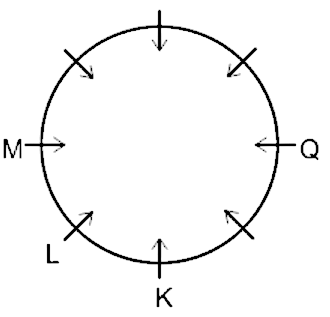
(4) Two people sit between P and J.
(5) J is not an immediate neighbour of Q and M.
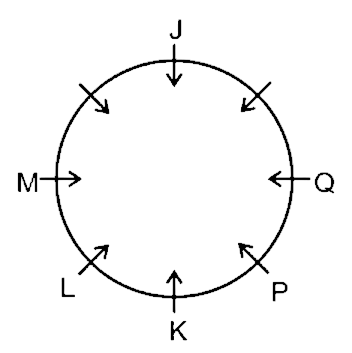
(6) O does not sit opposite to P. Thus, only one place left for N.
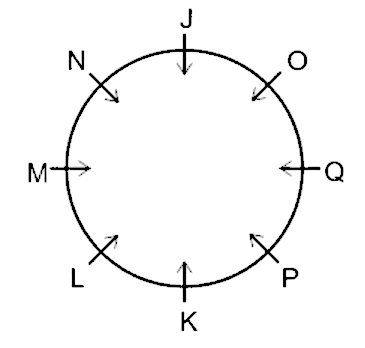
Hence, N sits second to the right of O.
Eight friends J, K, L, M, N, O, P and Q are sitting around a circular table facing inwards with equal distance between them but not necessarily in the same order.
There is an equal number of people between M and L as that of between L and K. Q sits second to the right of K. Two people are sitting between Q and L. O does not sit opposite to P. Two people sit between P and J. J is not an immediate neighbour of Q and M.
24. Who is sitting to the immediate left of L?
A. K
B. M
C. O
D. Q
E. J
Solution
(1) Q sits second to the right of K.
(2) Two people are sitting between Q and L.
(3) There is an equal number of people between M and L as that of between L and K.
(4) Two people sit between P and J.
(5) J is not an immediate neighbour of Q and M.
(6) O does not sit opposite to P. Thus, only one place left for N.
Hence, M is sitting to the immediate left of L.
Eight friends J, K, L, M, N, O, P and Q are sitting around a circular table facing inwards with equal distance between them but not necessarily in the same order.
There is an equal number of people between M and L as that of between L and K. Q sits second to the right of K. Two people are sitting between Q and L. O does not sit opposite to P. Two people sit between P and J. J is not an immediate neighbour of Q and M.
25. If all the persons are made to sit in the alphabetical order from J in the clockwise direction, then the position of how many persons will remain unchanged in the new arrangement, excluding J?
A. One
B. Two
C. Three
D. Four
E. None
Solution
(1) Q sits second to the right of K.
(2) Two people are sitting between Q and L.
(3) There is an equal number of people between M and L as that of between L and K.
(4) Two people sit between P and J.
(5) J is not an immediate neighbour of Q and M.
(6) O does not sit opposite to P. Thus, only one place left for N.
If all the persons are made to sit in the alphabetical order from J in the clockwise direction, then:
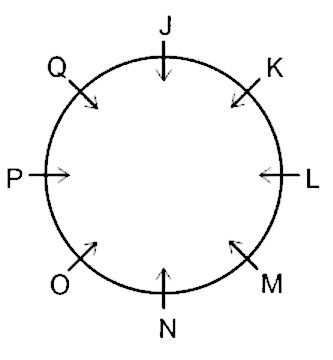
Thus no one remains unchanged in the new arrangement.
Hence, none is the correct answer.
Eight friends J, K, L, M, N, O, P and Q are sitting around a circular table facing inwards with equal distance between them but not necessarily in the same order.
There is an equal number of people between M and L as that of between L and K. Q sits second to the right of K. Two people are sitting between Q and L. O does not sit opposite to P. Two people sit between P and J. J is not an immediate neighbour of Q and M.
26. Who is sitting opposite to K?
A. J
B. O
C. M
D. N
E. Q
Solution
(1) Q sits second to the right of K.
(2) Two people are sitting between Q and L.
(3) There is an equal number of people between M and L as that of between L and K.
(4) Two people sit between P and J.
(5) J is not an immediate neighbour of Q and M.
(6) O does not sit opposite to P. Thus, only one place left for N.
Hence, J is the correct answer.
Eight friends J, K, L, M, N, O, P and Q are sitting around a circular table facing inwards with equal distance between them but not necessarily in the same order.
There is an equal number of people between M and L as that of between L and K. Q sits second to the right of K. Two people are sitting between Q and L. O does not sit opposite to P. Two people sit between P and J. J is not an immediate neighbour of Q and M.
27. Four of the five are alike in a certain way and thus form a group. Find the one who does not belong to that group.
A. QO
B. LK
C. JO
D. JN
E. ML
Solution
(1) Q sits second to the right of K.
(2) Two people are sitting between Q and L.
(3) There is an equal number of people between M and L as that of between L and K.
(4) Two people sit between P and J.
(5) J is not an immediate neighbour of Q and M.
(6) O does not sit opposite to P. Thus, only one place left for N.
We can see that in all the pairs second person is to the immediate right of the first person, except JO where O (second person) is to the immediate left of J (first person).
Hence, JO does not belong to the group.
28. If it is possible to make only one four-letter meaningful word with the second, fourth, seventh, and eighth letter of the word ‘SIGNATURE’, which could be the second letter of the word from the right end? If more than one such word can be formed, give ‘X’ as the answer. If no such word can be formed, give ‘Z’ as your answer.
A. I
B. U
C. X
D. Z
E. N
Solution
Word: SIGNATURE
The second, fourth, seventh, and eighth letters are I, N, U, and R respectively.
There is only one word that can be formed using these letters i.e. RUIN.Thus, ‘I’ is the second letter from the right end.
Direction: Study the following information carefully and answer the given questions.
In a certain code language,
‘he is my nephew’ is coded as ‘one two four five’
‘she is my wife’ is coded as ‘one six three five’
‘I like my mobile’ is coded as ‘twelve nine ten one’
‘she doesn’t use mobile’ is coded as ‘six seven ten zero’
29. Which among the following is coded as ‘one three’?
A. my mobile
B. my wife
C. mobile wife
D. wife like
E. she like
Solution
According to the coded language and their meaning:

my is in circle as same the code one also.
Similarly, wife is the only term in second line without any outline same as code three.Hence, ‘my wife’ is coded as ‘one three’.
Direction: Study the following information carefully and answer the given questions.
In a certain code language,
‘he is my nephew’ is coded as ‘one two four five’
‘she is my wife’ is coded as ‘one six three five’
‘I like my mobile’ is coded as ‘twelve nine ten one’
‘she doesn’t use mobile’ is coded as ‘six seven ten zero’
30. If ‘my nephew is painter’ is coded as ‘don one four five’, then what would be the code for ‘he’?
A. nine
B. zero
C. done
D. two
E. three
Solution
According to the coded language and their meaning:
my is in circle as same the code one also.
According to the coded language and their meaning:
Code for ‘he is my nephew’ is ‘one two four five’
Code for ‘my nephew is painter’ is ‘don one four five’
Hence, possible code for ‘he’ is ‘two’.
Direction: Study the following information carefully and answer the given questions.
In a certain code language,
‘he is my nephew’ is coded as ‘one two four five’
‘she is my wife’ is coded as ‘one six three five’
‘I like my mobile’ is coded as ‘twelve nine ten one’
‘she doesn’t use mobile’ is coded as ‘six seven ten zero’
31. Code for ‘mobile’ is ___.
A. ten
B. done
C. one
D. two
E. nine
Solution
According to the coded language and their meaning:
my is in circle as same the code one also.According to the coded language and their meaning:
mobile is in same boundary as ten
Hence, Code for ‘mobile’ is ‘ten’.
Direction: Study the following information carefully and answer the given questions.
In a certain code language,
‘he is my nephew’ is coded as ‘one two four five’
‘she is my wife’ is coded as ‘one six three five’
‘I like my mobile’ is coded as ‘twelve nine ten one’
‘she doesn’t use mobile’ is coded as ‘six seven ten zero’
32. Which of the following is coded as ‘one six five’?
A. she is nephew
B. my like mobile
C. he like mobile
D. my is mobile
E. she is my
Solution
According to the coded language and their meaning:
my is in circle as same the code one also.According to the coded language and their meaning:
‘she is my’ is coded as ‘one six five’.
Directions: Study the following information carefully and answer the given questions:
There are eight employees i.e., A, B, C, D, E, F, G and H of a company and all of them are working on eight different designations of a company viz. CEO, CFO, CTO, Managing Director, General Manager, Assistant Manager, PO and Clerk where CEO is the highest post and Clerk is the lowest post. Only three people junior to G. C is either immediate senior or junior to G. Same number of people are senior to D as the number of people are junior to F. E neither work as PO nor Clerk. A is three post senior to C. There is only one designation between A and H. D is senior to both E and B. E is senior to B but junior to C.
33. Who is working as a Clerk in the company?
A. A
B. C
C. B
D. F
E. D
Solution
Eight employees i.e., A, B, C, D, E, F, G and H
Eight different designations of a company viz. CEO, CFO, CTO, Managing Director, General Manager, Assistant Manager, PO and Clerk
1- Only three people junior to G.
2- C is either immediate senior or junior to G.
| Case-1 | Case-2 | |
| Designation | Person | Person |
| CEO | ||
| CFO | ||
| CTO | ||
| Managing Director | C | |
| General Manager | G | G |
| Assistant Manager | C | |
| PO | ||
| Clerk |
3- A is three posts senior to C.
4- There is only one designation between A and H.
| Case-1 | Case-2 | |
| Designation | Person | Person |
| CEO | A | H |
| CFO | ||
| CTO | H | A |
| Managing Director | C | |
| General Manager | G | G |
| Assistant Manager | C | |
| PO | ||
| Clerk |
5- D is senior to both E and B.
6- Same number of people are senior to D as the number of people are junior to F.
| Case-1 | Case-2 | |
| Designation | Person | Person |
| CEO | A | H |
| CFO | D | D |
| CTO | H | A |
| Managing Director | C | |
| General Manager | G | G |
| Assistant Manager | C | |
| PO | F | F |
| Clerk |
7- E neither work as PO nor Clerk.
8- E is senior to B but junior to C. So case 2 gets eliminated.
| Designation | Person |
| CEO | A |
| CFO | D |
| CTO | H |
| Managing Director | C |
| General Manager | G |
| Assistant Manager | E |
| PO | F |
| Clerk | B |
Hence, B is working as a Clerk in the company.
Directions: Study the following information carefully and answer the given questions:
There are eight employees i.e., A, B, C, D, E, F, G and H of a company and all of them are working on eight different designations of a company viz. CEO, CFO, CTO, Managing Director, General Manager, Assistant Manager, PO and Clerk where CEO is the highest post and Clerk is the lowest post. Only three people junior to G. C is either immediate senior or junior to G. Same number of people are senior to D as the number of people are junior to F. E neither work as PO nor Clerk. A is three post senior to C. There is only one designation between A and H. D is senior to both E and B. E is senior to B but junior to C.
34. Which of the following statement is True about G?
i) G is an immediate senior to F.
ii) G is working as Managing Director.
iii) G is an immediate junior to C.
A. All i, ii, iii
B. Only i
C. Only ii and iii
D. Only iii
E. None of the given statement is True
Solution
Eight employees i.e., A, B, C, D, E, F, G and H
Eight different designations of a company viz. CEO, CFO, CTO, Managing Director, General Manager, Assistant Manager, PO and Clerk
1- Only three people junior to G.
2- C is either immediate senior or junior to G.
| Case-1 | Case-2 | |
| Designation | Person | Person |
| CEO | ||
| CFO | ||
| CTO | ||
| Managing Director | C | |
| General Manager | G | G |
| Assistant Manager | C | |
| PO | ||
| Clerk |
3- A is three posts senior to C.
4- There is only one designation between A and H.
| Case-1 | Case-2 | |
| Designation | Person | Person |
| CEO | A | H |
| CFO | ||
| CTO | H | A |
| Managing Director | C | |
| General Manager | G | G |
| Assistant Manager | C | |
| PO | ||
| Clerk |
5- D is senior to both E and B.
6- Same number of people are senior to D as the number of people are junior to F.
| Case-1 | Case-2 | |
| Designation | Person | Person |
| CEO | A | H |
| CFO | D | D |
| CTO | H | A |
| Managing Director | C | |
| General Manager | G | G |
| Assistant Manager | C | |
| PO | F | F |
| Clerk |
7- E neither work as PO nor Clerk.
8- E is senior to B but junior to C. So case 2 gets eliminated.
| Designation | Person |
| CEO | A |
| CFO | D |
| CTO | H |
| Managing Director | C |
| General Manager | G |
| Assistant Manager | E |
| PO | F |
| Clerk | B |
Hence, Only iii statement is correct.
Directions: Study the following information carefully and answer the given questions:
There are eight employees i.e., A, B, C, D, E, F, G and H of a company and all of them are working on eight different designations of a company viz. CEO, CFO, CTO, Managing Director, General Manager, Assistant Manager, PO and Clerk where CEO is the highest post and Clerk is the lowest post. Only three people junior to G. C is either immediate senior or junior to G. Same number of people are senior to D as the number of people are junior to F. E neither work as PO nor Clerk. A is three post senior to C. There is only one designation between A and H. D is senior to both E and B. E is senior to B but junior to C.
35. Which of the following option True regarding E?
A. E working as a PO.
B. E is an immediate junior to the one who works as General Manager.
C. E works as a CTO.
D. E is an immediate Senior to F.
E. Both ii and iv
Solution
Eight employees i.e., A, B, C, D, E, F, G and H
Eight different designations of a company viz. CEO, CFO, CTO, Managing Director, General Manager, Assistant Manager, PO and Clerk
1- Only three people junior to G.
2- C is either immediate senior or junior to G.
| Case-1 | Case-2 | |
| Designation | Person | Person |
| CEO | ||
| CFO | ||
| CTO | ||
| Managing Director | C | |
| General Manager | G | G |
| Assistant Manager | C | |
| PO | ||
| Clerk |
3- A is three posts senior to C.
4- There is only one designation between A and H.
| Case-1 | Case-2 | |
| Designation | Person | Person |
| CEO | A | H |
| CFO | ||
| CTO | H | A |
| Managing Director | C | |
| General Manager | G | G |
| Assistant Manager | C | |
| PO | ||
| Clerk |
5- D is senior to both E and B.
6- Same number of people are senior to D as the number of people are junior to F.
| Case-1 | Case-2 | |
| Designation | Person | Person |
| CEO | A | H |
| CFO | D | D |
| CTO | H | A |
| Managing Director | C | |
| General Manager | G | G |
| Assistant Manager | C | |
| PO | F | F |
| Clerk |
7- E neither work as PO nor Clerk.
8- E is senior to B but junior to C. So case 2 gets eliminated.
| Designation | Person |
| CEO | A |
| CFO | D |
| CTO | H |
| Managing Director | C |
| General Manager | G |
| Assistant Manager | E |
| PO | F |
| Clerk | B |
Hence, Both ii and iv are correct.
Directions: Study the following information carefully and answer the given questions:
There are eight employees i.e., A, B, C, D, E, F, G and H of a company and all of them are working on eight different designations of a company viz. CEO, CFO, CTO, Managing Director, General Manager, Assistant Manager, PO and Clerk where CEO is the highest post and Clerk is the lowest post. Only three people junior to G. C is either immediate senior or junior to G. Same number of people are senior to D as the number of people are junior to F. E neither work as PO nor Clerk. A is three post senior to C. There is only one designation between A and H. D is senior to both E and B. E is senior to B but junior to C.
36. Who works as a CFO in the company?
A. A
B. The one who is an immediate senior to C
C. H
D. D
E. G
Solution
Eight employees i.e., A, B, C, D, E, F, G and H
Eight different designations of a company viz. CEO, CFO, CTO, Managing Director, General Manager, Assistant Manager, PO and Clerk
1- Only three people junior to G.
2- C is either immediate senior or junior to G.
| Case-1 | Case-2 | |
| Designation | Person | Person |
| CEO | ||
| CFO | ||
| CTO | ||
| Managing Director | C | |
| General Manager | G | G |
| Assistant Manager | C | |
| PO | ||
| Clerk |
3- A is three posts senior to C.
4- There is only one designation between A and H.
| Case-1 | Case-2 | |
| Designation | Person | Person |
| CEO | A | H |
| CFO | ||
| CTO | H | A |
| Managing Director | C | |
| General Manager | G | G |
| Assistant Manager | C | |
| PO | ||
| Clerk |
5- D is senior to both E and B.
6- Same number of people are senior to D as the number of people are junior to F.
| Case-1 | Case-2 | |
| Designation | Person | Person |
| CEO | A | H |
| CFO | D | D |
| CTO | H | A |
| Managing Director | C | |
| General Manager | G | G |
| Assistant Manager | C | |
| PO | F | F |
| Clerk |
7- E neither work as PO nor Clerk.
8- E is senior to B but junior to C. So case 2 gets eliminated.
| Designation | Person |
| CEO | A |
| CFO | D |
| CTO | H |
| Managing Director | C |
| General Manager | G |
| Assistant Manager | E |
| PO | F |
| Clerk | B |
Hence, D works as a CFO in the company.
Directions: Study the following information carefully and answer the given questions:
There are eight employees i.e., A, B, C, D, E, F, G and H of a company and all of them are working on eight different designations of a company viz. CEO, CFO, CTO, Managing Director, General Manager, Assistant Manager, PO and Clerk where CEO is the highest post and Clerk is the lowest post. Only three people junior to G. C is either immediate senior or junior to G. Same number of people are senior to D as the number of people are junior to F. E neither work as PO nor Clerk. A is three post senior to C. There is only one designation between A and H. D is senior to both E and B. E is senior to B but junior to C.
37. Who is the senior most employee in the company?
A. D
B. A
C. H
D. E
E. F
Solution
Eight employees i.e., A, B, C, D, E, F, G and H
Eight different designations of a company viz. CEO, CFO, CTO, Managing Director, General Manager, Assistant Manager, PO and Clerk
1- Only three people junior to G.
2- C is either immediate senior or junior to G.
| Case-1 | Case-2 | |
| Designation | Person | Person |
| CEO | ||
| CFO | ||
| CTO | ||
| Managing Director | C | |
| General Manager | G | G |
| Assistant Manager | C | |
| PO | ||
| Clerk |
3- A is three posts senior to C.
4- There is only one designation between A and H.
| Case-1 | Case-2 | |
| Designation | Person | Person |
| CEO | A | H |
| CFO | ||
| CTO | H | A |
| Managing Director | C | |
| General Manager | G | G |
| Assistant Manager | C | |
| PO | ||
| Clerk |
5- D is senior to both E and B.
6- Same number of people are senior to D as the number of people are junior to F.
| Case-1 | Case-2 | |
| Designation | Person | Person |
| CEO | A | H |
| CFO | D | D |
| CTO | H | A |
| Managing Director | C | |
| General Manager | G | G |
| Assistant Manager | C | |
| PO | F | F |
| Clerk |
7- E neither work as PO nor Clerk.
8- E is senior to B but junior to C. So case 2 gets eliminated.
| Designation | Person |
| CEO | A |
| CFO | D |
| CTO | H |
| Managing Director | C |
| General Manager | G |
| Assistant Manager | E |
| PO | F |
| Clerk | B |
Hence, A is the senior most employee in the company.
Directions: These questions are based on the following information.
At a party, there are 7 members present G, H, I, J, K, Land M. G is the father of K.J is the father-in-law of I, who is the wife of G.M is the spouse of J. Lis the son of I. G has only one son. There are 2 couples present at the party. I is the daughter of H.
38. Who is the daughter of I?
A. J
B. K
C. L
D. G
E. Cannot be determined
Solution
From the given information,

1) I is the wife of G
2) G has only one son.
3) Lis the son of I.
4) G is the father of K.
5) G is married to I and G is the father of K and G has only one son and K is the daughter of I. L is the son of I and G is the father of L.
6) M is the spouse of J and J is the father of G and M is the mother of G.
7) I is the daughter of H.
So G is married to I and G is the father of K and G has only one son, K is the daughter of I.
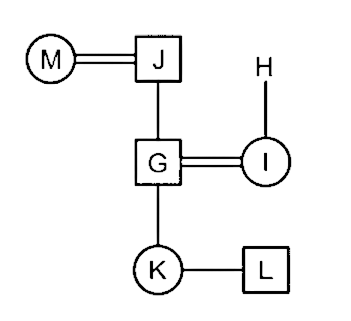
Hence, K is the daughter of I.
Directions: These questions are based on the following information.
At a party, there are 7 members present G, H, I, J, K, Land M. G is the father of K.J is the father-in-law of I, who is the wife of G.M is the spouse of J. Lis the son of I. G has only one son. There are 2 couples present at the party. I is the daughter of H.
39. How is M related to L ?
A. Grandmother
B. Mother
C. Cousin
D. Sister
E. Cannot be determined
Solution
From the given information,

1) I is the wife of G
2) G has only one son.
3) Lis the son of I.
4) G is the father of K.
5) G is married to I and G is the father of K and G has only one son and K is the daughter of I. L is the son of I and G is the father of L.
6) M is the spouse of J and J is the father of G and M is the mother of G.
7) I is the daughter of H.
So M is the grandmother of L.
Hence, M is the grandmother of L.
Directions: These questions are based on the following information.
At a party, there are 7 members present G, H, I, J, K, Land M. G is the father of K.J is the father-in-law of I, who is the wife of G.M is the spouse of J. Lis the son of I. G has only one son. There are 2 couples present at the party. I is the daughter of H.
40. How is H related to G?
A. Aunt
B. Mother
C. Father-in-law
D. Mother-in-law
E. Either 3 or 4
Solution
From the given information,
1) I is the wife of G
2) G has only one son.
3) Lis the son of I.
4) G is the father of K.
5) G is married to I and G is the father of K and G has only one son and K is the daughter of I. L is the son of I and G is the father of L.
6) M is the spouse of J and J is the father of G and M is the mother of G.
7) I is the daughter of H.
Here, the Gender of H is not defined so we cannot say H is male or female either H is a mother in law of G or father in law of G.
Hence, we cannot say H is male or female either H is a mother-in-law of G or father-in-law of G.
Numerical Ability
Direction: Study the following information carefully and answer based on it.
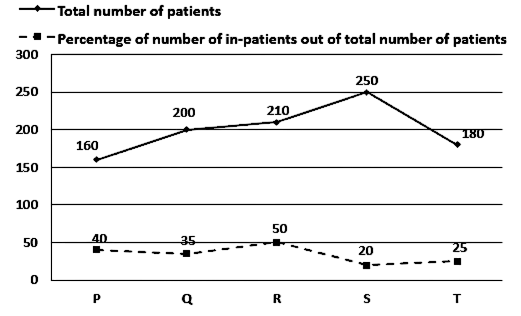
The line graph given below shows the total number of patients in 5 different hospitals and percentage of number of in – patients in a hospital out of total number of patients in that hospitals..
Note: In each of the given hospitals, total number of patients = number of in – patients + number of out – patients.
41.What is the number of in – patients in hospital T?
A. 55
B. 65
C. 58
D. 46
E. 45
Solution
Total number of patients in hospital P = 160
Number of in – patients in hospital P = 160 × 0.4 = 64
Number of out – patients in hospital P = 160 – 64 = 96
| Hospitals | Total number of patients | Number of in – patients | Number of out – patients |
| P | 160 | 64 | 96 |
| Q | 200 | 70 | 130 |
| R | 210 | 105 | 105 |
| S | 250 | 50 | 200 |
| T | 180 | 45 | 135 |
Number of in – patients in hospital T = 45
Hence, correct answer is option 5.
Direction: Study the following information carefully and answer based on it.
The line graph given below shows the total number of patients in 5 different hospitals and percentage of number of in – patients in a hospital out of total number of patients in that hospitals..
Note: In each of the given hospitals, total number of patients = number of in – patients + number of out – patients.
42. In hospital P what is the difference between the number of out – patients and in – patients?
A. 40
B. 38
C. 32
D. 42
E. 50
Solution
Total number of patients in hospital P = 160
Number of in – patients in hospital P = 160 × 0.4 = 64
Number of out – patients in hospital P = 160 – 64 = 96
| Hospitals | Total number of patients | Number of in – patients | Number of out – patients |
| P | 160 | 64 | 96 |
| Q | 200 | 70 | 130 |
| R | 210 | 105 | 105 |
| S | 250 | 50 | 200 |
| T | 180 | 45 | 135 |
Required difference = 96 – 64 = 32
Hence, correct answer is option 3.
Direction: Study the following information carefully and answer based on it.
The line graph given below shows the total number of patients in 5 different hospitals and percentage of number of in – patients in a hospital out of total number of patients in that hospitals..
Note: In each of the given hospitals, total number of patients = number of in – patients + number of out – patients.
43. In hospital Q, if 40% of the number of in – patients and 50% of the number of out – patients are male then, find the total number of male patients in hospital Q?
A. 79
B. 93
C. 88
D. 63
E. 97
Solution
Total number of patients in hospital P = 160
Number of in – patients in hospital P = 160 × 0.4 = 64
Number of out – patients in hospital P = 160 – 64 = 96
| Hospitals | Total number of patients | Number of in – patients | Number of out – patients |
| P | 160 | 64 | 96 |
| Q | 200 | 70 | 130 |
| R | 210 | 105 | 105 |
| S | 250 | 50 | 200 |
| T | 180 | 45 | 135 |
Number of male in – patients in hospital Q = 70 × 0.4 = 28
Number of male out – patients in hospital Q = 130 × 0.5 = 65
Therefore, required sum = 28 + 65 = 93
Hence, correct answer is option 2.
Direction: Study the following information carefully and answer based on it.
The line graph given below shows the total number of patients in 5 different hospitals and percentage of number of in – patients in a hospital out of total number of patients in that hospitals..
Note: In each of the given hospitals, total number of patients = number of in – patients + number of out – patients.
44. In hospital M, number of in- patients is 15 more than that in hospital S. Find the number of in – patients in hospital M.
A. 59
B. 65
C. 62
D. 70
E. 55
Solution
Total number of patients in hospital P = 160
Number of in – patients in hospital P = 160 × 0.4 = 64
Number of out – patients in hospital P = 160 – 64 = 96
| Hospitals | Total number of patients | Number of in – patients | Number of out – patients |
| P | 160 | 64 | 96 |
| Q | 200 | 70 | 130 |
| R | 210 | 105 | 105 |
| S | 250 | 50 | 200 |
| T | 180 | 45 | 135 |
Number of in – patients in hospital M = 50 + 15 = 65
Hence, correct answer is option 2.
Direction: Study the following information carefully and answer based on it.
The line graph given below shows the total number of patients in 5 different hospitals and percentage of number of in – patients in a hospital out of total number of patients in that hospitals..
Note: In each of the given hospitals, total number of patients = number of in – patients + number of out – patients.
45.What is the average number of out – patients in hospital R and hospital T?
A. 115
B. 125
C. 110
D. 120
E. 130
Solution
Total number of patients in hospital P = 160
Number of in – patients in hospital P = 160 × 0.4 = 64
Number of out – patients in hospital P = 160 – 64 = 96
| Hospitals | Total number of patients | Number of in – patients | Number of out – patients |
| P | 160 | 64 | 96 |
| Q | 200 | 70 | 130 |
| R | 210 | 105 | 105 |
| S | 250 | 50 | 200 |
| T | 180 | 45 | 135 |
Required average =(105 + 135)/2 = 120
Hence, correct answer is option 4.
46. The average weight of a class of 30 students is 42 kg. If the weight of the teacher be included, the average weight increases by 500 g. Find the weight of the teacher.
A. 55 kg
B. 60.5 kg
C. 57.5 kg
D. 62 kg
E. None of these
Solution
Given:
Average weight of 30 students is 42 kg.
The weight the teacher be included, the average weight increases by 500 g.
Calculation:
Total weight of 30 students = 30 × 42 = 1260 kg
Average weight of 30 students and teacher = (42 + 0.5) kg = 42.5 kg
So, total weight of 30 students and the teacher = (42.5 × 31) = 1317.5 kg
Weight of teacher = (1317.5 – 1260) kg = 57.5 kg
∴ The weight of teacher is 57.5 kg.
Alternate Method
Given:
Average weight of 30 students is 42 kg.
The weight the teacher be included, the average weight increases by 500 g.
Calculation:
Weight of teacher = 42 + (31 × 0.5) = 57.5 kg
∴ The weight of teacher is 57.5 kg.
47. Two students appeared for an examination. One of them secured 9 marks more than the other and his marks were 56 % of the sum of their marks. The marks obtained by them are-
A. 30 and 39
B. 36 and 45
C. 33 and 42
D. 35 and 44
E. None of these
Solution
Formula Used
Percentage = Actual/Total × 100
Calculation
Let the marks obtained by first student = a
Then marks obtained by second student = a + 9
According to the question,
⇒ a + 9 = ( a + a + 9 ) × 56 %
⇒ 12a = 396
⇒ a = 33
Marks of the first student = 33
Marks of second student = 33 + 9 = 42
∴ The Required answer is 33 and 42
48. Find the wrong term in the given series.
29, 50, 102, 155, 239, 344
A. 239
B. 50
C. 29
D. 102
E. 344
Solution
Solution :
The series follows the following pattern :
⇒29 + 21 = 50
⇒50 + 42 = 92
⇒92 + 63 = 155
⇒155 + 84 = 239
⇒239 + 105 = 344
⇒ The wrong term in the series will be 102.
Hence, 102 is the correct answer.
49. Find the wrong term in the given series.
445, 444, 440, 431, 417, 390
A. 431
B. 417
C. 445
D. 390
E. 444
Solution
Solution :
The series follows the following pattern :
⇒445 – 12 = 444
⇒444 – 22 = 440
⇒440 – 32 = 431
⇒431 – 42 = 415
⇒415 – 52 = 390
⇒ The wrong term in the series will be 417.
Hence 417 is the correct answer.
50. Find the wrong term in the given series.
8, 16, 216, 64, 1000, 146
A. 146
B. 216
C. 1000
D. 64
E. 8
Solution
Solution :
The series follows the following pattern :
⇒23 = 8
⇒42 = 16
⇒63 = 216
⇒82 = 64
⇒103 = 1000
⇒122 = 144
⇒ The wrong term in the series will be 146 .
Hence 146 is the correct answer.
51. Find the wrong term in the given series.
7, 15, 31, 63, 127, 265
A., 127
B. 63
C. 15
D. 31
E. 265
Solution
Solution :
The series follows the following pattern :
⇒7×2+1 = 15
⇒15×2+1 = 31
⇒31×2+1 = 63
⇒63×2+1 = 127
⇒127×2+1 = 255
⇒ The wrong term in the series will be 265 .
Hence 265 is the correct answer.
52. Find the wrong term in the given series.
4000, 2000, 400, 200, 50, 20, 4
A. 50
B. 4000
C. 400
D. 4
E. 200
Solution
Solution :
The series follows the following pattern :
⇒4000÷2 = 2000
⇒2000÷5 = 400
⇒400÷2 = 200
⇒200÷5 = 40
⇒40÷2 = 20
⇒20÷5 = 4
⇒ The wrong term in the series will be 50 .
Hence 50 is the correct answer.
53. A cup costing Rs 350 is marked to be sold at a price which gives a profit of 20%. What will be its selling price in a sale when discount of 30% is given on marked price?
A. Rs. 294
B. Rs.285
C. Rs. 282
D. Rs. 270
E. None of these
Solution
Given:
Cost of cup = Rs. 350
Marked price = 20% more than cost price
Discount = 30%
Formula used:
Marked Price = CP × [(100 + Profit%)/100]
Selling price = Marked Price × [(100 – Discount%)/100]
Calculation:
Marked Price = Rs. 350 × (120/100)
⇒ Rs. 420
Now, Selling price = Rs. 420 × (70/100)
⇒ Rs. 294
∴ The selling price is Rs. 294
54. Aakash is 34 years older than Bijoy. Ten years ago, the total of their ages was 48. Their respective present ages (in years) are:
A. 54 and 20
B. 60 and 26
C. 51 and 17
D. 64 and 30
E. none of these
Solution
Given:
Aakash’s age = Bijoy;s age + 34 years
Sum of their ages 10 years ago = 48
Concept used:
After n years means there will be addition of n
Before n years means there will be subtraction of n.
Calculation:
Let the age of Aakash = x years
& the age of Bijoy = y years
∴ x = y + 34 —-(1)
Now, Aakash’s age 10 years ago = x-10
and Bijoy;s age 10 years ago = y-10
∴ (x-10) + (y-10) = 48
⇒ x + y = 68 —-(2)
by adding equations (1) and (2)
⇒ 2x = 102
⇒ x = 51
y = 68 – 51 = 17
∴ Their respective ages are 51 and 17 years.
55. Ravi invested Rs. 6500 in a business, after few months Vipin joined him with Rs. 7000. At the end of the year, the total profit was divided between them in the ratio of 26 : 21, after how many months did Vipin join?
A. 3 months
B. 9 months
C. 4 months
D. 8 months
E. None of these
Solution
Given:
Amount invested by Ravi = Rs. 6500
Amount invested by Vipin = Rs. 7000
At the end of the year profit ratio = 26 : 21
Formula used:
Profit = Invested amount × Time
Calculation:
Let Vipin joined after x months.
Then, Vipin’s money was invested for (12 – x) months
Ratio of profit Ravi and Vipin = (6500 × 12) : {7000 × (12 – x)}
⇒ 78 : 7(12 – x)
Now, ratio of profit Ravi and Vipin = 78 : 7(12 – x)
According to the question,
78/{7(12 – x)} = 26/21
⇒ 78 × (21/26) = 7(12 – x)
⇒ 63 = 7(12 – x)
⇒ 9 = 12 – x
⇒ x = 3
∴ Vipin will join after 3 months starting of the business.
56.Direction: Study the following information carefully and answer based on it.
The pie chart given below shows the percentage distribution of the number of pottery built by a group of students at five different locations but the total number of pottery built by them at all the five locations together which is 1200.
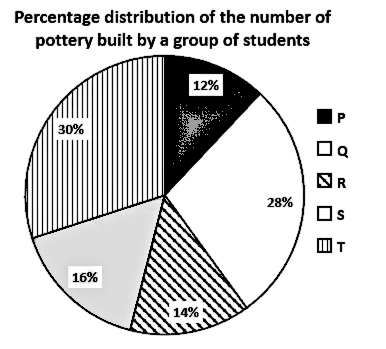
Number of pottery built at location P is how much less than the number of pottery built at location S?
A. 48
B. 52
C. 44
D. 66
E. 54
Solution
Number of pottery built by the students at location P = 12/100 ×1200 = 144
Similarly,
| Location | Number of Pottery built by the group |
| P | 144 |
| Q | 336 |
| R | 168 |
| S | 192 |
| T | 360 |
| Total | 1200 |
Required difference = 192 – 144 = 48
Hence, correct answer is option 1.
57.Direction: Study the following information carefully and answer based on it.
The pie chart given below shows the percentage distribution of the number of pottery built by a group of students at five different locations but the total number of pottery built by them at all the five locations together which is 1200.
Find the average number of pottery built by the students at locations Q, R and S together.
A. 220
B. 110
C. 180
D. 280
E. 232
Solution
Number of pottery built by the students at location P = 12/100 ×1200 = 144
Similarly,
| Location | Number of Pottery built by the group |
| P | 144 |
| Q | 336 |
| R | 168 |
| S | 192 |
| T | 360 |
| Total | 1200 |
Required average = (336 + 168 + 192)/3 = 232
Hence, correct answer is option 5.
58.Direction: Study the following information carefully and answer based on it.
The pie chart given below shows the percentage distribution of the number of pottery built by a group of students at five different locations but the total number of pottery built by them at all the five locations together which is 1200.
Number of pottery built at location T is how much percent of the number of pottery built at location P?
A. 220%
B. 100%
C. 250%
D. 180%
E. 320%
Solution
Number of pottery built by the students at location P = 12/100 ×1200 = 144
Similarly,
| Location | Number of Pottery built by the group |
| P | 144 |
| Q | 336 |
| R | 168 |
| S | 192 |
| T | 360 |
| Total | 1200 |
Required percentage = 360/144 × 100 = 250%
Hence, correct answer is option 3.
59.Direction: Study the following information carefully and answer based on it.
The pie chart given below shows the percentage distribution of the number of pottery built by a group of students at five different locations but the total number of pottery built by them at all the five locations together which is 1200.
If the number pottery built at location X is 25% more than that built at location R, then find the number of pottery built at location X.
A. 250
B. 210
C. 320
D. 270
E. 200
Solution
Number of pottery built by the students at location P = 12/100 ×1200 = 144
Similarly,
| Location | Number of Pottery built by the group |
| P | 144 |
| Q | 336 |
| R | 168 |
| S | 192 |
| T | 360 |
| Total | 1200 |
Number of pottery built at location X = 168 × 1.25 = 210
Hence, correct answer is option 2.
60.Direction: Study the following information carefully and answer based on it.
The pie chart given below shows the percentage distribution of the number of pottery built by a group of students at five different locations but the total number of pottery built by them at all the five locations together which is 1200.
If the number of pottery built at locations Q and S were interchanged, then find the total number of pottery built at locations S and T together?
A. 700
B. 558
C. 650
D. 696
E. 560
Solution
Number of pottery built by the students at location P = 12/100 ×1200 = 144
Similarly,
| Location | Number of Pottery built by the group |
| P | 144 |
| Q | 336 |
| R | 168 |
| S | 192 |
| T | 360 |
| Total | 1200 |
Number of pottery built at location S = 336 + 360 = 696
Hence, correct answer is option 4.
61. By selling 39 dozens of mangoes, a vendor earns a profit equal to the sale proceeds of 13 dozens of mangoes. What is the percentage of his profit ?
A. 33%
B. 50%
C. 26%
D. More than one of the above
E. None of the above
Solution
Concept:
Profit Percentage = (Profit / Cost Price) × 100
Calculation:
Let the selling price of 1 dozen mangoes be S.
Let the cost price of 1 dozen mangoes be C.
The total selling price for 39 dozens = 39S
The profit earned = Selling price of 13 dozens = 13S
⇒ Profit = 13S
⇒ Selling Price – Cost Price = Profit
⇒ 39S – Cost Price = 13S
⇒ Cost Price = 39S – 13S
⇒ Cost Price = 26S
Profit Percentage = (Profit / Cost Price) × 100
⇒ Profit Percentage = (13S / 26S) × 100
⇒ Profit Percentage = 0.5 × 100
⇒ Profit Percentage = 50%
∴ The correct answer is option 2.
62. If the ratio of the difference between compound interest and Simple Interest for 3 years and 2 years is 31 ∶ 10, then find the Rate of Interest.
A. 11.11%
B. 10%
C. 20%
D. 25%
E. None of these
Solution
Given:
Difference between C.I. and S.I. for 3 years : Difference between C.I. and S.I. for 2 years = 31 : 10
Formula used:
Difference between C.I. and S.I. for 3 years = P(R/100)2(300 + R)/100
Difference between C.I. and S.I. for 2 years = P(R/100)2
Calculations:
Difference between C.I. and S.I. for 3 years : Difference between C.I. and S.I. for 2 years = 31 : 10
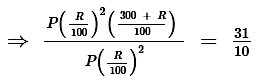
⇒ (300 + R)/100 = 31/10
⇒ 3000 + 10R = 3100
⇒ 10R = 100
⇒ R = 10%
∴ The required rate is 10%
63. A train of length 250m crosses a man on a platform in 10s and crosses the platform in 25s. Find the length of the platform.
A. 350m
B. 625m
C. 275m
D. 375m
E. 675m
Solution
Given:
Length of the train = 250m
Time is taken to cross a man =10s
Time is taken to cross the platform = 25s
Formula Used:
Speed(S) = Distance(D)/Time(T).
Calculation:
First, we need to find the speed of the train
S = D/T
⇒ S = 250/10 = 25 m/s
Now, the total distance covered in 25s.
⇒ S = D/T
⇒ D = S × T
⇒ D = 25 × 25 =625m
Length of platform = total distance covered – length of the train.
Length of platform = 625m – 250m =375 m
∴ Length of the platform is 375 meter.
Mistake Points
Student mark 625m as the answer in hurry. But that is the total distance including the length of the train and the platform. So, subtract the length of the train from the total distance in the given time.
Shortcut Trick
Time is taken to cover platform = 25 – 10 = 15s
⇒ 10 = 250
⇒ 15 = (250/10) × 15 = 375m
∴ Length of the platform is 375m.
64. A garland is to be made using 10 beads. Find the number of ways of making the garland.
A. 9!
B. 9!/2
C. 8! × 2
D. 8!
E. None of these
Solution
Number of ways in circular arrangement when anticlockwise and clockwise are same.
Formula:-
(n – 1)!/2
Calculation:-
Number of ways = (10 – 1)!/2 = 9!/2
65. One Pipe can fill a reservoir thrice fast as another pipe. If together the two pipes can fill the tank in 28 min, then slower pipe alone will be able to fill the reservoir in how much time?
A. 121 minutes
B. 112 minutes
C. 114 minutes
D. 144 minutes
E. None of these
Solution
Given:
Two pipes both together fill the tank in 28 minutes
Concept:
Time 1/∝ Efficiency
Calculation:
The efficiency of first pipe = 3 × Efficiency of second pipe
The efficiency of first pipe = 3
The efficiency of second pipe = 1
⇒ Total work or capacity of the reservoir = (3 + 1) × 28 = 112
⇒ Time slower pipe takes to fill the reservoir = 112/1 = 112
∴ The slower pipe can fill the tank in 112 minutes
66. What approximate value should come in the place of question mark (?) in the following question?
249.99 ÷ 15.03 × 45.04 – 15.98 × 7.03 = ?
A. 658
B. 648
C. 628
D. 638
E. 618
Solution
Concept Used:
Follow BODMAS rule to solve this question, as per the order given below,
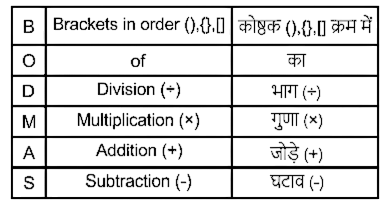
Calculation:
249.99 ÷ 15.03 × 45.04 – 15.98 × 7.03 = ?
⇒ 250 ÷ 15 × 45 – 16 × 7 = ?
⇒ 750 – 112 = ?
⇒ ? = 638
∴ The value of (?) is 638
67. What approximate value should come in the place of question mark (?) in the following question?
{44.98 – (66.06 – 53.98 ÷ 9.09 × 7.98)} = ?3
A. 4
B. 2
C. 7
D. 3
E. 5
Solution
Follow BODMAS rule to solve this question, as per the order given below.
Step – 1: Parts of an equation enclosed in ‘Brackets’ must be solved first, and following BODMAS rule in the bracket –
Step – 2: Any mathematical ‘Of’ or ‘Exponent’ must be solved next.
Step – 3: Next, the parts of the equation that contain ‘Division’ and ‘Multiplication’ are calculated.
Step – 4: Last but not the least, the parts of the equation that contain ‘Addition’ and ‘Subtraction’ should be calculated.
Since, we need to find out the approximate value, we can write these values to their nearest integers.
Given expression is
{44.98 – (66.06 – 53.98 ÷ 9.09 × 7.98)} = ?3
⇒ {45 – (66 – 54 ÷ 9 × 8)} = ?3
⇒ {45 – (66 – 6 × 8)} = ?3
⇒ {45 – (66 – 48)} = ?3
⇒ {45 – 18} = ?3
⇒ ?3 = 27
∴ ? = 3
68. What approximate value should come in the place of question mark (?) in the following question?
11.98 × 84.98 ÷ 4.95 + 39.99% of 349.99 = ?
A. 314
B. 334
C. 344
D. 324
E. 354
Solution
Follow BODMAS rule to solve this question, as per the order given below.
Step – 1: Parts of an equation enclosed in ‘Brackets’ must be solved first, and following BODMAS rule in the bracket –
Step – 2: Any mathematical ‘Of’ or ‘Exponent’ must be solved next.
Step – 3: Next, the parts of the equation that contain ‘Division’ and ‘Multiplication’ are calculated.
Step – 4: Last but not the least, the parts of the equation that contain ‘Addition’ and ‘Subtraction’ should be calculated.
Since, we need to find out the approximate value, we can write these values to their nearest integers.
Given expression is
11.98 × 84.98 ÷ 4.95 + 39.99% of 349.99 = ?
⇒ 12 × 85 ÷ 5 + 40% of 350 = ?
⇒ 12 × 85 ÷ 5 + 140 = ?
⇒ 12 × 17 + 140 = ?
⇒ 204 + 140 = ?
∴ ? = 344
69. What approximate value should come in the place of question mark (?) in the following question?
{74.95 – (118.99 – 128.08 ÷ 8.08 × 6.98)} = ?
A. 56
B. 74
C. 68
D. 92
E. 86
Solution
Follow BODMAS rule to solve this question, as per the order given below.
Step – 1: Parts of an equation enclosed in ‘Brackets’ must be solved first, and following BODMAS rule in the bracket –
Step – 2: Any mathematical ‘Of’ or ‘Exponent’ must be solved next.
Step – 3: Next, the parts of the equation that contain ‘Division’ and ‘Multiplication’ are calculated.
Step – 4: Last but not the least, the parts of the equation that contain ‘Addition’ and ‘Subtraction’ should be calculated.
Since, we need to find out the approximate value, we can write these values to their nearest integers.
Given expression is
{74.95 – (118.99 – 128.08 ÷ 8.08 × 6.98)} = ?
⇒ {75 – (119 – 128 ÷ 8 × 7)} = ?
⇒ {75 – (119 – 16 × 7)} = ?
⇒ {75 – (119 – 112)} = ?
⇒ {75 – 7} = ?
∴ ? = 68
70. What approximate value should come in the place of question mark (?) in the following question?
64.99% of 399.99 + ∛1727.99 – 15.992 = ?2
A. 2
B. 8
C. 5
D. 3
E. 4
Solution
Follow BODMAS rule to solve this question, as per the order given below.
Step – 1: Parts of an equation enclosed in ‘Brackets’ must be solved first, and following BODMAS rule in the bracket –
Step – 2: Any mathematical ‘Of’ or ‘Exponent’ must be solved next.
Step – 3: Next, the parts of the equation that contain ‘Division’ and ‘Multiplication’ are calculated.
Step – 4: Last but not the least, the parts of the equation that contain ‘Addition’ and ‘Subtraction’ should be calculated.
Since, we need to find out the approximate value, we can write these values to their nearest integers.
Given expression is
64.99% of 399.99 + ∛1727.99 – 15.992 = ?2
⇒ 65% of 400 + ∛1728 – 162 = ?2
⇒ 260 + 12 – 256 = ?2
⇒ 272 – 256 = ?2
⇒ ?2 = 16
∴ ? = 4
71. What approximate value should come in the place of question mark (?) in the following question?
(7.072 – 30.98) × 2.98 ÷ (7.982 – 45.96) = ?
A. 5
B. 8
C. 11
D. 15
E. 3
Solution
Follow BODMAS rule to solve this question, as per the order given below.
Step – 1: Parts of an equation enclosed in ‘Brackets’ must be solved first, and following BODMAS rule in the bracket –
Step – 2: Any mathematical ‘Of’ or ‘Exponent’ must be solved next.
Step – 3: Next, the parts of the equation that contain ‘Division’ and ‘Multiplication’ are calculated.
Step – 4: Last but not the least, the parts of the equation that contain ‘Addition’ and ‘Subtraction’ should be calculated.
Since, we need to find out the approximate value, we can write these values to their nearest integers.
Given expression is
(7.072 – 30.98) × 2.98 ÷ (7.982 – 45.96) = ?
⇒ (72 – 31) × 3 ÷ (82 – 46) = ?
⇒ (49 – 31) × 3 ÷ (64 – 46) = ?
⇒ (18 × 3)/18 = ?
⇒ ? = 3
72. What approximate value should come in the place of question mark (?) in the following question?
153.94 + 2.933 – 4.953 = 6.992 + 37.98 – ?
A. 25
B. 19
C. 31
D. 37
E. 41
Solution
Follow BODMAS rule to solve this question, as per the order given below.
Step – 1: Parts of an equation enclosed in ‘Brackets’ must be solved first, and following BODMAS rule in the bracket –
Step – 2: Any mathematical ‘Of’ or ‘Exponent’ must be solved next.
Step – 3: Next, the parts of the equation that contain ‘Division’ and ‘Multiplication’ are calculated.
Step – 4: Last but not the least, the parts of the equation that contain ‘Addition’ and ‘Subtraction’ should be calculated.
Since, we need to find out the approximate value, we can write these values to their nearest integers.
Given expression is
153.94 + 2.933 – 4.953 = 6.992 + 37.98 – ?
⇒ 154 + 33 – 53 = 72 + 38 – ?
⇒ 154 + 27 – 125 = 49 + 38 – ?
⇒ 56 = 87 – ?
∴ ? = 31
73. What approximate value will come in place of the question mark (?) in the following questions? (You are not expected to calculate the exact value)
∛342.78 + √195.9/6.97 + 4.092 = x2
A. 2
B. 3
C. 4
D. 5
E. 6
Solution
Follow BODMAS rule to solve this expression, as per the order given below,
Step-1-Parts of an equation enclosed in ‘Brackets’ must be solved first,
Step-2-Any mathematical ‘Of’ or ‘Exponent’ must be solved next,
Step-3-Next, the parts of the equation that contain ‘Division’ and ‘Multiplication’ are calculated,
Step-4-Last but not least, the parts of the equation that contain ‘Addition’ and ‘Subtraction’ should be calculated.
∛342.78 + √195.9/6.97 + 4.092 = x2
⇒ ∛343 + √196/7 + 42 = x2
⇒ 7 + 14/7 + 16 = x2
⇒ 23 + 2 = x2
⇒ x = √25 = 5
74. What approximate value should come in the place of question mark (?) in the following question?
12.972 × (13.03/2.98) = (12.98)? ÷ 3.03
A. 1
B. 5
C. 3
D. 7
E. 4
Solution
Follow BODMAS rule to solve this question, as per the order given below.
Step – 1: Parts of an equation enclosed in ‘Brackets’ must be solved first, and following BODMAS rule in the bracket –
Step – 2: Any mathematical ‘Of’ or ‘Exponent’ must be solved next.
Step – 3: Next, the parts of the equation that contain ‘Division’ and ‘Multiplication’ are calculated.
Step – 4: Last but not the least, the parts of the equation that contain ‘Addition’ and ‘Subtraction’ should be calculated.
Since, we need to find out the approximate value, we can write these values to their nearest integers.
Given expression is
12.972 × (13.03/2.98) = (12.98)? ÷ 3.03
⇒ 132 × 13/3 = (13)? ÷ 3
⇒ 133/3 = (13)? ÷ 3
∴ ? = 3
75.What approximate value should come in the place of question mark (?) in the following question?
{44.98 – (10.99 × 5.96 – 5.98 × 2.023)} = ?3
A. 3
B. 2
C. 4
D. 6
E. 5
Solution
Follow BODMAS rule to solve this question, as per the order given below.
Step – 1: Parts of an equation enclosed in ‘Brackets’ must be solved first, and following BODMAS rule in the bracket –
Step – 2: Any mathematical ‘Of’ or ‘Exponent’ must be solved next.
Step – 3: Next, the parts of the equation that contain ‘Division’ and ‘Multiplication’ are calculated.
Step – 4: Last but not the least, the parts of the equation that contain ‘Addition’ and ‘Subtraction’ should be calculated.
Since, we need to find out the approximate value, we can write these values to their nearest integers.
Given expression is
{44.98 – (10.99 × 5.96 – 5.98 × 2.023)} = ?3
⇒ {45 – (11 × 6 – 6 × 23)} = ?3
⇒ {45 – (66 – 6 × 8)} = ?3
⇒ {45 – (66 – 48)} = ?3
⇒ {45 – 18} = ?3
∴ ? = 3
76. A boat covers 66 km in upstream in 6 hours. The speed of stream is 3 kmph Find the distance covered by the boat in 5 hours along the stream ?
A. 88 km
B. 66 km
C. 85 km
D. 92 km
E. 77 km
Solution
Upstream of boat = x- y
Boat cover 66 km upstream distance in 6 hours
⇒ x – y = 66/6
⇒ x- y = 11 kmph
Then speed of the current is 3kmph
⇒ x-3 = 11 kmph
⇒ x = 14 kmph
Down stream of boat is x + y
⇒ 14 + 3 = 17kmph
Distance travelled by boat along the stream in 5 hours
⇒ 17kmph × 5hours
⇒ 85 km
Hence 85 km is the correct answer.
77. If the side of a square is equal to the radius of a circle, then find the ratio of the area of the circle to the area of the square.
A. π:1
B. 1:π
C. π:2
D. 2:π
E. Data insufficient
Solution
Let the side of the square = radius of the circle = r
Area of Square = side2 = r2
Area of Circle = π×r2
Ratio = Area of Circle / Area of Square = πr2 / r2 = π:1
Thus, the correct answer is π:1.
78. The ratio of the speeds of two trains is 3 : 4. If second train runs 200 km in 2h, then what would be the speed of the first train.
A. 20 km/hr
B. 25 km/hr
C. 75 km/hr
D. 100 km/hr
E. 50 km/hr
Solution
Given:
Ratio of the speeds of two trains = 3 : 4
Formula:
Speed = distance/time
Calculations:
Speed of the second train = 200/2
⇒ 100 km/h
Speed of 1st train : speed of 2nd train = 3 : 4
Speed of 1st train : 100 = 3: 4
Speed of 1st train = 25 × 3
⇒ 75 km/h
∴ Speed of 1st train is 75 km/h.
79. A milkman buys milk at Rs. 15 per litre. He mixed the water with it and sell the mixture at cost price. In what proportion is water mixed with milk if his profits were 25/4%.
A. 1 : 8
B. 1 : 4
C. 1 : 16
D. 2: 17
E. None of these
Solution
Given
Milkman buys milk = Rs 15/litre
Calculation
25/4% = 1/16
In above expression , profit = 1 and cost price = 16
So, milk = 16 and water = 1
∴ Ratio of water to milk = 1 : 16
80. A father and his son can build a tree house in 6 days. Son can build the same tree house in 12 days. Find how many days father will take to build 3/4 of the house.
A. 11 days
B. 7 days
C. 5 days
D. 9 days
E. None of these
Solution
Given
A father and his son can build a tree house in = 6 days
Son can build the same tree house in = 12 days
Calculation
Let Father can build the tree house in = x days
So according to question
⇒ 1/x + 1/12 = 1/6
⇒ 1/x = 1/6 – 1/12
⇒ 1/x = 1/12
⇒ x = 12
Father can build the tree house in = 12 days
So Father can build ¾ of the tree house in = (¾) × 12 days = 9 days
∴ Time taken by the father to build the ¾ of the house is 9 days.