1.Who was the eighth Secretary-General of UN?
A. Antonio Guterres
B. Kofi Annan
C. U Thant
D. Ban Ki-Moon
Solutions
The correct answer is Ban Ki-Moon.
Key Points
- Ban Ki-moon was the United Nations eighth Secretary-General.
- His first priority has been to rally world leaders behind a series of emerging global concerns, ranging from climate change and economic turmoil to pandemics and rising food, energy, and water pressures.
- He has worked to develop bridges and strengthen the Organization by giving voice to the world’s poorest and most vulnerable people.
- Mr. Ban was in office from January 1, 2007, to December 31, 2016.
- The General Assembly unanimously re-elected him for a second term on June 21, 2011.
Important Points
- António Manuel de Oliveira Guterres is a Portuguese politician who has served as the United Nations’ ninth Secretary-General since 2017.
- From January 1997 to December 2006, Kofi Atta Annan, a Ghanaian diplomat, served as the United Nations’ seventh Secretary-General.
- Maha Thray Sithu U Thant, sometimes known as U Thant, was a Burmese diplomat who served as the UN’s third Secretary-General from 1961 to 1971, making him the first non-Scandinavian to hold the position.
2. Which of the following Indian mines is one of the world’s largest uranium mine?
A. Tummalapalle mine
B. Jaduguda mine
C. Narwapahar mine
D. Bhatin mine
Solutions
The correct answer is Tummalapalle mine.
Key Points
- The Tummalapalle Mine is a uranium mine found in Tumalapalli hamlet in Kadapa, Andhra Pradesh, India.
- The results of studies undertaken by India’s Atomic Energy Commission in 2011 led analysts to believe that this mine may hold one of the world’s greatest uranium reserves.
- On July 19, 2011, Dr. S. Banerjee, Secretary of the Department of Atomic Energy and Chairman of the Atomic Energy Commission of India, confirmed 49,000 tonnes of uranium reserves and speculated that there could be three times that amount, making Tummalapalle the world’s largest uranium mine.
Important Points
- The Jaduguda Mine is a uranium mine located in Jaduguda village, Purbi Singhbhum district, Jharkhand, India.
- Since April 1995, the Narwapahar Mine has been the first completely mechanized mine in operation.
- The Bhatin Mine is a tiny underground mine 3 kilometers from Jaduguda. It uses Jaduguda Mine’s infrastructure for the most part.
3. The ratio of two weights, 27 kg and 108 g, is:
A. 300 : 1
B. 240 : 1
C. 270 : 1
D. 250 : 1
Solutions
Given:
The ratio of two weights = 27 kg = 27 × 1000 = 27000 g and 108 g
Calculation:
Required ratio = 27000 : 108
⇒ 250 : 1
∴ Required ratio is 250 : 1
4. Which temple in Thanjavur has chola architecture and was built by Emperor Rajaraja?
A. Brihadisvara Temple
B. Naganathaswamy Temple
C. Thirumananjeri Temple
D. Lord Murugan Temple
Solutions
The correct answer is Brihadisvara Temple.
Key Points
- Thanjavur’s Brihadisvara Temple is a Hindu shrine dedicated to Shiva. It is one of the largest temples in South India and a model of fully realised Tamil architecture.
- Built between 1003 and 1010 AD by Raja Raja Chola I. This 11th-century temple’s initial monuments were built around a moat.
- It contained the gopura, the main temple, its high tower, as well as inscriptions, frescoes, and sculptures primarily associated with Shaivism, but also Vaishnavism and Shaktism Hindu traditions.
- The temple has been damaged during its history, and some artwork has been lost. In the centuries that followed, more mandapams and monuments were built.
Important Points
- The Naganatha Swamy Temple, also known as Kethu Sthalam, is a Hindu temple located 2 kilometres from Poompuhar in the village of Keezhaperumpallam.
- Thirumanancheri is a renowned Shiva temple in Tamil Nadu, located 6 kilometres from Kutthalam and 26 kilometres from Kumbakonam.
- The Six Abodes of Murugan are a group of six temples in Tamil Nadu, South India.
5. How many D’s are there in the following series which are immediately followed by W but NOT immediately preceded by K?
KDCWKDWNKGDWDHKVDWZDW
A. 1
B. 2
C. 3
D. 4
Solutions
Mistake Points
Immediately preceded by means immediately before or to come just before.
Immediately followed by means immediately after or to come just after.
The logic followed is:
Given series-
KDCWKDWNKGDWDHKVDWZDW
Condition to be checked:
D which are immediately followed by W but NOT immediately preceded by K.
Not K → D → W
The series are given below
KDCWKDWNKGDWDHKVDWZDW
There are three pair of word which is GDW, VDW and ZDW.
Hence, “3” is the correct answer.
6. Four letter clusters have given out of which three are alike in some manner and one is different, Select the odd one
A. PSRQ
B. VYXW
C. CGEF
D. JMLK
Solutions

From option 1:
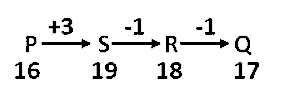
We add three in first letter we get second letter, we subtract one in second letter we get third letter and again we subtract one in third letter we get fourth letter.
From option 2:
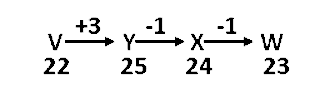
We add three in first letter we get second letter, we subtract one in second letter we get third letter and again we subtract one in third letter we get fourth letter.
From option 3:
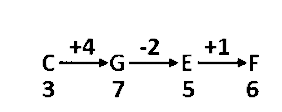
We add four in first letter we get second letter, we subtract two in second letter we get third letter and we add one in third letter we get fourth letter.
This is different from others.
From option 4:
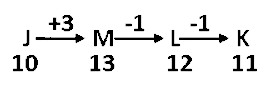
We add three in first letter we get second letter, we subtract one in second letter we get third letter and again we subtract one in third letter we get fourth letter.
Hence, “option 3” is the correct answer.
7. Which of the following cities has emerged as the most important centre with nearly half the cotton mills of the state located there?
A. Bengaluru
B. Madurai
C. Coimbatore
D. Chennai
Solutions
The correct answer is Coimbatore.
Key Points
- The state of Tamil Nadu has the most mills, with the majority of them producing yarn rather than cloth.
- With over half of the mills located there, Coimbatore has emerged as the most important center.
- Other prominent cities include Chennai, Madurai, Tirunelveli, Tuticorin, Thanjavur, Ramanathapuram, and Salem.
- Cotton textiles have grown in Karnataka’s cotton-producing industry.
- The cotton textile sector is based on the cotton-producing Telangana region, with the majority of mills spinning yarn.
- Telangana’s Hyderabad, Secunderabad, and Warangal, as well as Andhra Pradesh’s Guntur, are key centers.
8. Total cost per unit of output is known as:
A. Average fixed cost
B. Average cost
C. Average variable cost
D. Average product
Solutions
The correct answer is average cost.
Key Points
- The average cost per unit of production (AC) is also known as the average total cost (ATC). Divide the total cost (TC) by the quantity produced by the company to find it (Q). The average cost has a significant impact on how companies price their goods.
- Firms’ sales of specific commodities are directly proportional to the size of the market and how their competitors choose to operate.
- With cost on the vertical axis and quantity on the horizontal axis, an average cost curve can be shown.
- The average fixed cost (AFC) is calculated by dividing the fixed costs of production (FC) by the quantity (Q) of output generated.
- The variable cost per unit is the average variable cost in economics. The entire variable cost is divided by the output to get the average variable cost.
- The average product, also known as the output per unit of factor inputs or the average of the total product per unit of input, is determined by dividing the Total Product by the inputs (variable factors).
9. Who was the Raja of Burdwan when Permanent Settlement was imposed?
A. Tejchand
B. Mehtab Chand
C. Sangam Rai
D. Abu Ray
Solutions
The correct answer is Tejchand.
Key Points
- Tejchand was the Raja of Burdwan at the time the Permanent Settlement was implemented.
- Following that, the estate prospered under Mehtab Chand. During the Santhal insurrection and the 1857 revolution, Mehtab Chand assisted the British.
- A number of the Raja of Burdwan’s mahals (estates) were up for sale. In 1793, the Permanent Settlement was established.
- The revenue that each zamindar was required to pay was set by the East India Company.
Important Points
- Maharaja Tej Chand had a son named Pratap Chand Rai, who vanished during his father’s lifetime and was never seen or heard from again.
10. A bus passes two persons moving in the direction of the moving bus at a speed of 3 km/h and 5 km/h, respectively. The bus passes the first person in 10s and the second person in 11s. The speed of the bus is :
A. 25 km/h
B. 24 km/h
C. 27 km/h
D. 28 km/h
Solutions
Given:
Speed of first person = 3 km/h
Speed of second person = 5 km/h
Bus passes the first person = 10 sec
Bus passes the second person = 11 sec
Formula used:
Speed = Distance/Time
Calculation:
Distance covered by the first person in 10 sec = [(3 × 5/18) × 10] m
⇒ 25/3 m
Distance covered by the second person in 11 sec = [(5 × 5/18) × 11] m
⇒ 275/18 m
Bus travels a distance = (275/18 – 25/3) m
⇒ 125/18 m
Speed of the Bus = (125/18 × 18/5) km/hr
⇒ 25 km/h
∴ The speed of the bus is 25 km/h
11. Select the option that is related to the third word in the same way as the second word is related to the first word,.
Bihar : Jharkhand :: Chhattisgarh:
A. Maharashtra
B. Rajpur
C. Ranchi
D. Madya Pradesh
Solutions
The logic followed here is:
In this question,
Jharkhand is the part of Bihar before year 2000 but from year 2000 Jharkhand separated from Bihar.
Similarly,
Chhattisgarh is related to Madya Pradesh because in the year 2000 Chhattisgarh separated from Madya Pradesh.
Hence, “Madya Pradesh” is the correct answer.
Additional Information Following Indian independence in 1947, the region was divided between the new states of Madhya Pradesh, Orissa, and Bihar. In 2000 a campaign led by the BJP for a separate state
culminated with the passage of the Bihar Reorganization Act, creating Jharkhand as a new Indian state.
Jharkhand, one of India’s newest states, was carved out of the southern portion of Bihar in 2000.
Ranchi, in its modern form, is the capital city of the Indian state of Jharkhand.
Chhattisgarh is a heavily forested state in central India known for its temples and waterfalls. The state was formed by the partition of ten Chhattisgarhi and six Gondi-speaking districts in the southeast of Madhya Pradesh. The capital city of Chhattisgarh is Raipur.
12. Select the option that is best represented by the given Venn diagram.

A. Doctor, Man, Student
B. table, Chair, Furniture
C. Gild, silver, ornaments
D. Family, Parents, Children
Solutions
Given figure are –
From option 1 – Doctor, Man, Student
Some doctor are man, some man are student, some doctor are student, some doctor are student as we as man.
So It is the best representation of the venn diagram.
Let A = Doctor, B = Man, C = Student
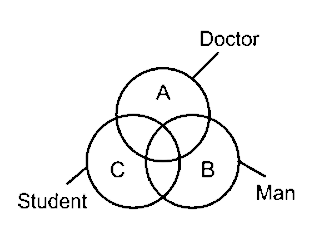
From option 2 – table, Chair, Furniture
No table is chair, some furniture are table as we as chair. It is not correct representation of the venn diagram.
From option 3 – Gild, silver, ornaments
It is not correct representation of the venn diagram.
From option 4 – Family, Parents, Children
It is not correct representation of the venn diagram.
Hence, “option 1” is the correct answer.
13. A Shopkeeper incurs a loss of 20% after selling a machine for Rs 4800. In order to gain a profit of 20% at what price should the shopkeeper sell the same machine?
A. Rs 7500
B. Rs 7200
C. Rs 6600
D. Rs 6000
Solutions
Given:
Loss % = 20
Selling price of machine = Rs. 4800
Calculation:
Cost price = selling price + 0.80 cost price
⇒ 0.80 cost price = 4800
⇒ CP = 4800/0.80
⇒ 6000
To earn a 20% profit selling price = 1.2 cost price
⇒ SP = 1.2 × 6000
⇒ Rs. 7200
∴ SP of the machine is Rs. 7200
Alternate MethodCalculation:
Let the CP be 100%
According to the question
⇒ 80% = 4800
then, 120% = (4800 × 120)/80
⇒ Rs. 7200
∴ SP of the machine is Rs. 7200
14. In a certain code language CRUDE is written as BSTED. How is MOIST written that language?
A. LNHRS
B. LPHTS
C. NPJTU
D. NNJRU
Solutions
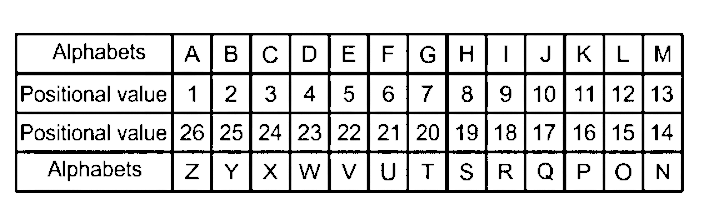
The logic followed here is:
In a certain code language CRUDE is written as BSTED. The logic are given below –
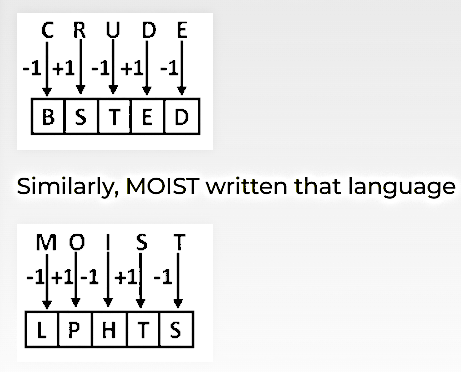
Hence, “LPHTS” is the correct answer.
15. Where was the First experimental satellite telecommunication earth station set up in 1967 in India?
A. Ahmednagar
B. Allahabad
C. Ahmedabad
D. Aurangabad
Solutions
The correct answer is Ahmedabad.
Key Points
- The first ‘Experimental Satellite Communication Earth Station (ESCES)’ was operationalized in Ahmedabad in 1967, and it also served as a training facility for Indian and international scientists and engineers.
- ISRO was clear that it did not need to wait for its own satellites to begin application development, and that foreign satellites may be utilized in the early phases to demonstrate that a satellite system can contribute to national development.
- The Satellite Telecommunication Experiments Project (STEP), a cooperative project of ISRO and the Post and Telegraphs Department (P&T) in 1977-79, used the Franco-German Symphonie satellite.
Important Points
- The ‘Kheda Communications Project (KCP)’ followed SITE, which served as a field laboratory for need-based and locale-specific programme transmission in Gujarat’s Kheda area.
- In 1984, KCP received the UNESCO-IPDC (International Programme for the Development of Communication) award for efficiency in rural communication.
- The first Indian spacecraft, ‘Aryabhata,’ was developed during this time and launched using a Soviet Launcher.
- Another significant milestone was the creation of the SLV-3, the first launch vehicle capable of placing 40 kg in Low Earth Orbit (LEO), which flew for the first time in 1980.
16. Which of the following statements is true?
A. Every complex number can be expressed in the form of a real number
B. Every integer is natural number
C. Every real number can be written in the complex form
D. Every real number is an integer
Solutions
From option 1 – Every complex number is the combination of real and imaginary number. But in the option say every complex number can be expressed in the form of a real number which is wrong.
From option 2 – Every natural number is integer but every integer is not natural number. So from option 2 every integer is natural number is not correct.
From option 3 – Every complex number is the combination of real and imaginary number. So, every real number can be written in the complex form, which is correct.
From option 4 – Every integer is real number but every real number is not an integer. from this option every real number is an integer is not correct.
Hence, “option 3” is the correct answer.
Additional Information Complex numbers are numbers that consist of two parts — a real number and an imaginary number.
The standard format for complex numbers is a + bi, with the real number first and the imaginary number last. Because either part could be 0, technically any real number or imaginary number can be considered a complex number.
Natural numbers: The counting numbers {1, 2, 3, …} are commonly called natural numbers; however, other definitions include 0, so that the non-negative integers {0, 1, 2, 3, …} are also
called natural numbers. Natural numbers including 0 are also called whole numbers.
Integers are the collection of whole numbers and negative numbers. Similar to whole numbers, integers also does not include the fractional part.
Thus, we can say, integers are numbers that can be positive, negative or zero, but cannot be a fraction.
17. Land which is left without cultivation for one or less than one agricultural year is known as:
A. culturable waste land
B. waste land
C. net sown area
D. current fallow
Solutions
The correct answer is current fallow.
Key Points
- The ‘Kheda Communications Project (KCP)’ followed SITE, which served as a field laboratory for need-based and locale-specific programme transmission in Gujarat’s Kheda area.
- In 1984, KCP received the UNESCO-IPDC (International Programme for the Development of Communication) award for efficiency in rural communication.
- The first Indian spacecraft, ‘Aryabhata,’ was developed during this time and launched using a Soviet Launcher.
- Another significant milestone was the creation of the SLV-3, the first launch vehicle capable of placing 40 kg in Low Earth Orbit (LEO), which flew for the first time in 1980.
Important Points
- Culturable Waste Land is land that has been available for cultivation but has not been harvested more than once in the last five years, including the present year.
- T. S. Eliot’s poem The Waste Land is largely considered to be one of the most important poems of the twentieth century and a fundamental work of modernist poetry.
- The total area seeded with crops and orchards is known as the net sown area. It denotes a location where entire crops are only grown once a year.
18. Select the option that would come next in the given series.

A. 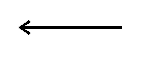
B. 
C. 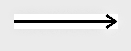
D. 
Solutions
In this question arrow moves 90 degree clock wise direction get next arrow and so on.
The figure are given below –
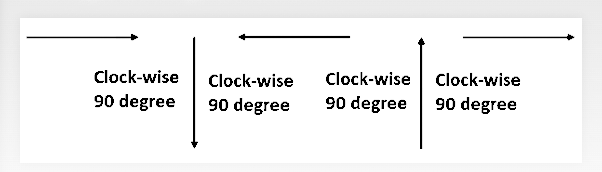
Hence, “option 3” is the correct answer.
19. Colonial rule was first established in:
A. Bengal
B. Surat
C. Delhi
D. Bombay
Solutions
The correct answer is Bengal.
Key Points
- The English East India Company (E.I.C.) built its raj in the countryside, applied its revenue policies, and saw how these policies affected diverse groups of people.
- The Bengal was the first place where colonial rule was established.
- The first attempts to reorder rural culture and establish a new regime of land rights and a new income system were made in the beginning.
- During the Age of Discovery, the region of the Indian subcontinent that was under the jurisdiction of European colonial powers was known as Colonial India.
- Conquest and trade, particularly in spices, were used to exert European authority.
20. When was the State Reorganisation Commission formed in India?
A. 1952
B. 1950
C. 1953
D. 1951
Solutions
The correct answer is 1953.
Key Points
On December 22, 1953, the Central Government of India established the States Reorganisation Commission (SRC) to suggest the reorganisation of state boundaries.
The Commission suggested in 1955, after nearly two years of research, that India’s state boundaries be reorganized into 14 states and six territories.
Fazal Ali, K. M. Panikkar, and H. N. Kunzru were members of the States Reorganisation Commission.
The States Reorganization Act of 1956 implemented some of its proposals.
On December 14, 1955, the report was presented to the Lok Sabha.
Some of the SRC’s proposals were enacted by the States Reorganization Act of 1956. It also established Laccadive, Minicoy, and Amindivi Islands, Himachal Pradesh, and Tripura as UTs, in addition to the three proposed by the SRC. In addition to these UTs, it established a total of 14 states.
21. The value so obtained on adding the sum and the difference of the numbers 3.03 and 2.05, is:
A. 0.606
B. 60.06
C. 6.06
D. 600.6
Solutions
Calculation:
Sum of the given value = (3.03 + 2.05)
⇒ 5.08
Difference of the given value = (3.03 – 2.05)
⇒ 0.98
Required value obtained on adding = (5.08 + 0.98)
⇒ 6.06
∴ The value so obtained on adding the sum and the difference is 6.06
22. If x = 2 and y = 5, evaluate 5xy – y2
A. 25
B. 40
C. 20
D. 0
Solutions
Calculation:
5xy – y2
⇒ (5 × 2 × 5) – 52
⇒ 50 – 25
⇒ 25
∴ Required value is 25
23. In which part of a neuron is information acquired?
A. Axon
B. Dendrite
C. Cell body
D. Nerve ending
Solutions
The correct answer is Dendrite.
Key Points
- The dendrite is the part of the neuron that receives information, while the axon is the component of the neuron that transmits information as an electrical impulse.
- The discharge of chemical compounds into the gap between the axon and the dendrites is how information is transferred from neuron to neuron.
- Neurotransmitters are the substances involved, and neurotransmission is the mechanism.
Important Points
- In invertebrates, an axon is a long, slender projection of a nerve cell, or neuron, that transports electrical impulses called action potentials away from the nerve cell body.
- The cell body (also known as the soma) is the spherical portion of the neuron that houses the nucleus.
- The musculotendinous junction and the loose connective tissue layers surrounding the tendon, such as the paratenon, epitenon, and endotenon, contain nerve endings.
24. The value of sin(450 + A) – cos (450 – A) is:
A. 0
B. 1
C. 2 cosA
D. 2 sinA
Solutions
Calculation:
sin(45° + A) – cos(45° – A)
⇒ sin(45° + A) – sin(90- (45° – A))
⇒ sin(45° + A) – sin(45° + A)
⇒ 0
∴ Required value is 0
25. Which of these is NOT a computer characteristic?
A. Speed
B. Accuracy
C. Data storage
D. Intelligence quotient
Solutions
The correct answer is Intelligence quotient.
Key Points
- A total score resulting from a set of standardized tests or subtests designed to estimate human intelligence is known as an intelligence quotient (IQ).
- The psychologist William Stern invented the abbreviation “IQ” for the German term Intelligenzquotient, which he used to describe a scoring procedure for intelligence tests at the University of Breslau that he promoted in a 1912 book.
- IQ was traditionally calculated by dividing a person’s mental age, as determined by an intelligence test, by the person’s chronological age, both given in years and months.
- Intelligence test results are assessments of intelligence.
- Computers’ speed, precision, diligence, versatility, and storage capacity are features that have made them so powerful and generally useful.
26. Anil and Balbeer can finish a task in 3 days. They started working together, but after 2 days Anil got injured. Balbeer took 2 more days to finish the task. In how many days can Balbeer alone finish the same task?
A. 5
B. 9
C. 10
D. 6
Solutions
Given:
Anil and Balbeer can finish a task = 3 days
They worked together = 2 days
Balbeer took more days to finish the task = 2
Calculation:
LCM of 2 and 3 is 6
Anil and Balbeer do work = 6/3
⇒ 2 units/day
Anil and Balbeer 2 days work = 2 × 2 = 4 units
Work left = 6 – 4 = 2 units
Remaining work is done by Anil in 2 days
Anil’s per day work = 2/2 = 1 unit/day
Balbeer’s per unit work = (Anil + Balbeer)’s work – Anil’s work
⇒ 2 – 1 = 1 unit/day
Balbeer alone can finish the same task = 6/1
⇒ 6 days
∴ Balbeer alone can finish the same task is 6 days
27. The difference between the compound interest and the simple interest on a sum of money at 10% for 2 years (compound annually) is Rs 50. The sum of money is:
A. Rs 4,000
B. Rs 5,000
C. Rs 4500
D. Rs 2.500
Solutions
Given:
Difference between CI and SI = Rs. 50
Rate = 10%
Time = 2 years
Formula used:
CI – SI = P × (R/100)2 for 2 years
where, P = Principal
R = Rate
Calculation:
According to question
We know that,
CI – SI = P × (R/100)2
⇒ P × (10/100)2 = Rs. 50
⇒ P × (1/10)2 = Rs. 50
⇒ P × (1/100) = Rs. 50
⇒ P = Rs. 5000
∴ The sum of money is Rs. 5000
28. When is International Dance Day celebrated?
A. 29th April
B. 28th April
C. 27th April
D. 30th April
Solutions
The correct answer is 29th April.
Key Points
- The Dance Committee of the International Theatre Institute (ITI), UNESCO’s major partner for the performing arts, developed International Dance Day as a global celebration of dance.
- Every year on the 29th of April, the event commemorates the birth of Jean-Georges Noverre (1727–1810), the father of modern ballet.
- Through events and festivals organized on the date all across the world, the day aims to stimulate involvement and education in dance. ITI is officially recognized by UNESCO as the event’s originator and organizers.
- Every year on April 29, the International Theatre Institute invites its members, as well as dancers, choreographers, dance students, and lovers, to a Gala Celebration to commemorate International Dance Day.
- The Gala Celebration is hosted in a host city chosen by the International Theatre Institute’s Executive Council – for example, in 2017 it was held in Shanghai, China, and in 2018 it was held in Havana, Cuba.
29. Which of these is NOT a part of capital receipt?
A. Recovery of loan
B. Disinvestment
C. Borrowing
D. Tax
Solutions
The correct answer is Tax.
Key Points
- Capital receipts are the cash received from the sale of fixed assets, cash received from the sale of company shares, and cash received through the issue of a debt instrument, such as loans and bonds.
- Capital receipts are government revenues that either (i) generate liabilities (e.g. borrowing) or (ii) reduce assets (e.g. disinvestment).
- A capital receipt occurs when the government raises funds by incurring liability or selling its assets.
- Revenue receipts are government receipts that do not (i) increase obligations or (ii) deplete assets.
- These are tax revenues, interest, and dividends on government investments, cess, and other government receipts for services given.
30. In which year was India’s first nuclear reactor formally inaugurated by Prime minister JL Nehru?
A. 1955
B. 1967
C. 1965
D. 1957
Solutions
The correct answer is 1957.
Key Points
- Apsara, India’s and Asia’s first nuclear reactor, went into operation on August 4, 1956, at 3:45 p.m., and was inaugurated by Prime Minister Nehru on January 20, 1957.
- Homi Jehangir Bhabha founded the Atomic Energy Establishment Trombay (AEET) in January 1954.
- Dr. Homi Bhabha intended to develop atomic energy research in India. Engineers and scientists from throughout the country who were working on the design and development of nuclear reactors were summoned to this facility.
- On March 15, 1955, the decision was made to construct India’s first nuclear research reactor.
- Dr. Homi Bhabha was in charge of the entire programme. This reactor was designed to look like a swimming pool and have a thermal capacity of 1 MW (MWt).
- The construction of the research reactor began on the grounds of the Bhabha Atomic Research Center (BARC).
31. Who led the Khilafat movement?
A. Mahatma Gandhi
B. Ali Brothers
C. Muhammad Ali Jinnah
D. None of these
Solutions
The correct answer is Ali Brothers.
Key Points
- The Khilafat movement is a pan-Islamic force in India that began in 1919 with the goal of resurrecting the Ottoman caliph as a symbol of unification among India’s Muslim community during the British Raj.
- The movement was supported at first by Gandhi’s non-cooperation movement, but it disintegrated once the caliphate was abolished in 1924.
- The decline of the Ottoman Empire, the greatest Islamic power whose ruler, as caliph, was seen by pan-Islamists as the leader of the global Muslim community, sparked fears of Muslim fragmentation.
- Italian invasions (1911) and the Balkan Wars (1912–13) put the caliphate in jeopardy, followed by the empire’s collapse in World War I (1914–18).
- In Indian history, the term “Ali brothers” refers to two brothers:
- Shaukat Ali (politician) (1873–1938)
- Mohammad Ali Jauhar (1878–1931)
32. Select the option that is related to the third word in the same way as the second word is related to the first word.
Shirt : Apparel :: Necklace : ?
A. Jewellery
B. Neck
C. Chain
D. Gold
Solutions
The logic followed here is:
Apparel is related to shirt.
Similarly,
Jewellery is related to Necklace.
Hence, “Jewellery” is the correct answer.
Important Points Apparel is a general name for various types of clothing. They are an apparel retailer that offers clothing, shoes, and accessories for men, women, and children. Apparel is a general name for various types of clothing.
“Apparel” can also include things like nametags, jewelry or other stuff you wear. “Clothing” tends to refer to stuff traditionally made from cloth (but still includes synthetic variants.)
The specific dividing line between the two terms is subjective and will differ from person to person.
33. Identify the principal organ of the UN which got suspended in 1994?
A. International Court of Justice
B. General Assembly
C. Security Council
D. Trusteeship Council
Solutions
The correct answer is Trusteeship Council.
Key Points
- The Trusteeship Council ceased operations on November 1, 1994, a month after Palau, the final remaining United Nations trust territory, gained independence.
- The Council revised its rules of procedure on May 25, 1994, to remove the requirement to convene annually and instead agreed to meet as needed — by its decision or the decision of its President, or at the request of a majority of its members, the General Assembly, or the Security Council.
- The Trusteeship Council was formed as one of the United Nations’ primary organizations by the UN Charter, with the duty of supervising the administration of Trust Territories put under the International Trusteeship System.
- The Trusteeship Council is authorized by the Charter to examine and discuss reports from the Administering Authority on the political, economic, social, and educational advancement of the peoples of Trust Territories, as well as to examine petitions from and undertake periodic and other special missions to Trust Territories in consultation with the Administering Authority.
34. If the price of a grocery item consumed by a family increases by 25%, then by what percentage should its consumption reduce, so as to keep the expenditure on this item unchanged?
A. 20%
B. 25%
C. 67%
D. 50%
Solutions
Calculation:
Let the original price of grocery be Rs. 100
Then,
Increased price = Rs. 25
Reduction in consumption = [(25/125) × 100]%
⇒ 20%
∴ The family will have to reduce the consumption of grocery by 20%
35. The balance of exports and imports of goods is referred to as:
A. current account
B. Current account balance
C. current account deficit
D. trade balance
Solutions
The correct answer is trade balance.
Key Points
- The difference between the value of a country’s exports and the value of its imports for a certain period is known as the balance of trade (BOT).
- The main component of a country’s balance of payments is the balance of trade (BOP).
- The balance of trade between a country’s goods and the balance of trade between its services are sometimes reported separately. The trade balance, also known as the international trade balance, commercial balance, or net exports, is a term used to describe the balance of commerce.
- The total value of exports minus the total value of imports is a simple method for determining the BOT. The BOT is a metric used by economists to assess a country’s economic strength.
- A trade deficit or a negative trade balance is when a country buys more products and services in terms of value than it exports. A trade surplus or positive trade balance occurs when a country exports more products and services than it imports.
36. Find the value of 7 + 5 – 2 × (7 + 89) – 94 ÷ 2 + (33 ÷ 3 + 9 × 2 – 7) ÷ 11.
A. -235
B. -225
C. 245
D. -245
Solutions
Concept Used:
Follow the BODMAS rule according to the table given below:

Calculation:
7 + 5 – 2 × (7 + 89) – 94 ÷ 2 + (33 ÷ 3 + 9 × 2 – 7) ÷ 11.
⇒ 7 + 5 – 2 × 96 – 94 ÷ 2 + (33 ÷ 3 + 9 × 2 – 7) ÷ 11
⇒ 7 + 5 – 2 × 96 – 94 ÷ 2 + (11 + 18 – 7) ÷ 11
⇒ 7 + 5 – 2 × 96 – 94 ÷ 2 + 22 ÷ 11
⇒ 7 + 5 – 2 × 96 – 47 + 2
⇒ 12 – 2 × 96 – 47 + 2
⇒ 12 – 192 – 47 + 2
⇒ – 180 – 47 + 2
⇒ – 227 + 2
⇒ – 225
∴ The value is -225
37. The value of 2/5×350+30% of 250 is:
A. 115
B. 125
C. 215
D. 225
Solutions
Calculation:
2/5 × 350 + 30% of 250
⇒ 2/5 × 350 + 30/100 × 250
⇒ 140 + 75
⇒ 215
∴ Required value is 215
38. The value of  is:
is:
A. 6.1/34
B. 19/34
C. 19/32
D. 19/31
Solutions
Calculation:
⇒ 19/32
∴ Required value is 19/32
39. Which of the following countries is a permanent member of the United Nations Security Council?
A. India
B. japan
C. Chanda
D. China
Solutions
The correct answer is China.
Key Points
- The Permanent Members of the United Nations Security Council (also known as the Permanent Five, Big Five, or P5) are the five sovereign states granted a permanent seat on the UN Security Council by the United Nations Charter of 1945: China, France, Russia, the United Kingdom, and the United States.
- The permanent members were all allies in World War II (and the war’s winners), and they are all nuclear weapons powers.
- The General Assembly elects the remaining ten members of the council, bringing the total number of UN member states to 15.
- Each of the five permanent members has a veto power, allowing them to block the passage of any “substantive” draught Council resolution, regardless of worldwide support.
- The French Republic, the Republic of China, the Soviet Union, the United Kingdom, and the United States were the five permanent members of the Security Council at the time of the UN’s formation in 1945.
40. The value of sin 150 is:
A. 
B. 
C. 
D. 
Solutions
Formula used:
Sin(A – B) = Sin A Cos B – Cos A Sin B
Calculation:
⇒ Sin (45° – 30°) = Sin 45° Cos 30° – Cos 45° Sin 30°
⇒ 1/√2 × √3/2 – 1/√2 × 1/2
⇒ √3/2√2 – 1/2√2
⇒ (√3 – 1)/2√2 × 2√2
⇒ (√6 – √2)/4
⇒ √3 – 1/2√2
∴ The value of sin 15° is
41. What is the total surface area of the visible faces in the given figure?

A. 384 cm2
B. 905 cm2
C. 1325 cm2
D. 580 cm2
Solutions
Concept Used:
To find the area of visible faces, we have to take the area of 2 sides
Area of rectangle = Length × Breadth
Calculation:

Area of ABJI = (15 × 7) cm2
⇒ 105 cm2
Area of IJGH = (7 × 5) cm2
⇒ 35 cm2
Area of BCLK = (13 × 8) cm2
⇒ 104 cm2
Area of KLEF = (13 × 5) cm2
⇒ 65 cm2
Area of KFGJ = (5 × 7) cm2
⇒ 35 cm2
Area of CDEL = (8 × 5) cm2
⇒ 40 cm2
Total area of visible faces = (105 + 35 + 104 + 65 + 35 + 40) cm2
⇒ 384 cm2
∴ Total area of visible faces is 384 cm2
42. An airplane is carrying 500 passengers, of which 45% are men and 20% are children. The ratio of the number of men women and children in the lowest terms is
A. 7 : 4 : 9
B. 4 :74 : 9
C. 9 : 4 : 7
D. 9 :7 : 4
Solutions
Given:
Total passengers in airplane = 500
No. of men = 45%
No. of children = 20%
Calculation:
Number of men = 45/100 × 500
⇒ 225
Number of children = 20/100 × 500
⇒ 100
Total number of men and children = (225 + 100)
⇒ 325
Number of women = 500 – 325
⇒ 175
Required ratio of men, women and children = 225 : 175 : 100
⇒ 9 : 7 : 4
∴ Required ratio of men, women and children is 9 : 7 : 4
43. Who is the author of the book ‘Shades of Saffron’?
A. Chidanand Rajghatta
B. Kamla Bhasin
C. Saba Naqvi
D. Arundhati Roy
Solutions
The correct answer is Saba Naqvi.
Key Points
- Shades of Saffron: From Vajpayee to Modi, by Saba Naqvi, provides a ringside view of the Bharatiya Janata Party’s (BJP) history from its foundation in 1980 to its emergence as India’s main political party.
When it comes to the Vajpayee years, Naqvi, who has covered the BJP for two decades, is at her best. - The book exposes fascinating facts about the Vajpayee administration’s inner workings. When she writes about the inter-personal relationships of key actors like Vajpayee, L K Advani, Govindacharya, Pramod Mahajan, and other BJP leaders, it is self-evident that the author had direct access to everyone who mattered at the time.
- The chapters on the nuclear tests of 1998 and Govindacharya’s “Vajpayee as mask remark” are particularly noteworthy. When it comes to the Modi years, though, the book isn’t as revelatory as one might want.
44. Who won the Spanish ‘La Liga’ title, 2019-20?
A. Real Madrid C.F
B. SD Huesca
C. Rayo Vallecano
D. FC Barcelona
Solutions
The correct answer is Real Madrid C.F.
Key Points
- Real Madrid was crowned the La Liga 2019-20 champions after they bear Villarreal 2-1 at the empty Alfredo Di Stefano Stadium.
- Their cause was strengthened further by the unexpected 1-2 defeat of Barcelona at the hands of Osasuna.
- Karim Benzema was the star of the night for Los Blancos as he scored a brace to help them win their 34th Spanish league title.
- The French striker scored his first of the match in the 17th minute and followed it up with a controversial penalty at the fag end of the contest.
Additional Information
- The Campeonato Nacional de Liga de Primera División, also known as La Liga, came into existence in 1929 with only 10 participating teams.
- It is one of the most popular football leagues in the world and some of the best players in history like Lionel Messi and Cristiano Ronaldo have plied their trades in the Spanish top-flight over the years.
- Before La Liga’s inception, the ‘Copa Del Rey’ was Spain’s national championship.
- The basic structure of La Liga imbibes the double round-robin system with 20 participating teams.
- Each team has 38 matches every season where they play two games each against the rest of the teams.
45. Anil alone can complete a task in 6 days and Bhushan alone can complete it in 8 days Anil and Bhushan undertook the task for Rs 3,200 with the help of chaman, they completed the task 3 days. What is Chaman’s share in this earining?
A. Rs 600
B. Rs 400
C. Rs 375
D. Rs 800
Solutions
Given:
Anil can complete a task = 6 days
Bhushan can complete a task = 8 days
Anil, Bhushan and Chaman can complete a task = 3 days
Work undertook the task = Rs. 3200
Formula used:
Work = Time × Efficiency
Calculation:
Anil one days work = 1/6 days
Bhushan one days work = 1/8 days
Chaman one days work = 1/3
⇒ 1/3 – (1/6 + 1/8)
⇒ 1/3 – 7/24
⇒ 1/24
Ratio of Anil, Bhushan and Chaman = 1/6 : 1/8 : 1/24
⇒ 4 : 3 : 1
Chaman’s share = Rs. (1/8 × 3200)
⇒ Rs. 400
∴ Chaman’s share in the earning is Rs. 400
46. Shakila incurs a loss of 10% after selling a machine part for Rs 540. In order to gain a profit of 10%. at what price should Shakila sell the same part?
A. Rs 550
B. Rs 60
C. Rs 660
D. Rs 600
Solutions
Given:
Loss% = 10
Selling price of machine = Rs. 540
Calculation:
Cost price = selling price + 0.90 cost price
⇒ 0.90 cost price = 540
⇒ CP = 540/0.90
⇒ 600
To earn a 10% profit selling price = 1.1 cost price
⇒ SP = 1.1 × 600
⇒ Rs. 660
∴ SP of the machine is Rs. 660
Alternate Method Calculation:
Let the CP of machine be 100
Then,
According to question
90% = 540
110% = (540 × 110)/90
⇒ 660
∴ SP of the machine is Rs. 660
47. What is Tamil New Year also known as?
A. Vishu
B. Bestu Varas
C. Varusha Pirappu
D. Ugadi
Solutions
The correct answer is Varusha Pirappu.
Key Points
- Tamil people across the world are celebrating New year today, which is the first day of the Chithirai month.
- This special day is also referred to as Puthandu or Varusha Pirappu.
- The most interesting part about Tamil New Year is that the Puthandu falls almost on the same day every year in the Gregorian calendar.
- People greet each other saying, ‘Puthandu Nalvazthukal’ to each on this day, which translates to Happy New Year.
Additional Information
- Ugadi
- Ugadi or Yugadi, also known as Samvatsarādi, is the New Year’s Day for the states of Andhra Pradesh, Telangana, and Karnataka in India.
- It is festively observed in these regions on the first day of the Hindu lunisolar calendar month of Chaitra.
- Vishu
- Vishu is a Hindu festival celebrated in the Indian state of Kerala, Tulu Nadu region in Karnataka, Mahé district of Union Territory of Pondicherry, neighbouring areas of Tamil Nadu and their diaspora communities.
- The festival marks the first day of Medam, the ninth month in the solar calendar followed in Kerala.
- Bestu Varas
- Gujarati New Year or Bestu Varas is celebrated a day after Diwali, which falls on Shukla Paksha Pratipada of the Kartik month.
- It is also called Varsha-Pratipada or Padwa.
- The day is celebrated with great fervor across the state of Gujarat.
48. In Computer field, What does LIFO stand for?
A. Lost – In – First -Out
B. Lost – In – Finish -Out
C. Last – In – First -Out
D. Left – In – First -Out
Solutions
The correct answer is Last – In – First -Out.
Key Points
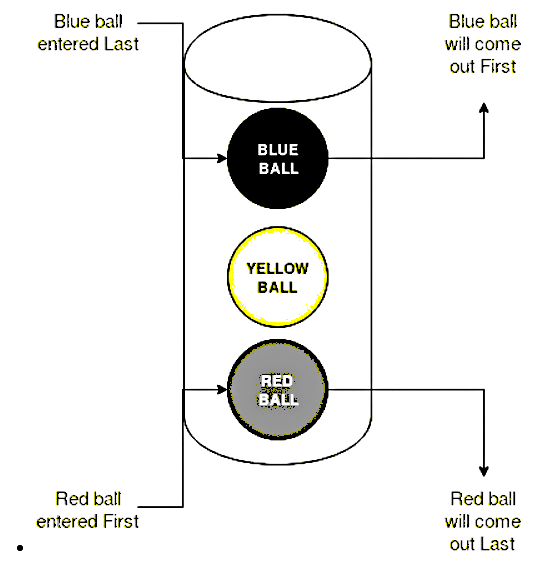
- LIFO is an abbreviation for Last in, first out is same as first in, last out (FILO).
- It is a method for handling data structures where the last element is processed first and the first element is processed last.
- LIFO is an abbreviation for Last in, first out is same as first in, last out (FILO). It is a method for handling data structures where the last element is processed first and the first element is processed last.
- In computing, the LIFO approach is used as a queuing theory that refers to the way items are stored in types of data structures.
- The data structure that implements LIFO is Stack.
Additional Information
FIFO
It stands for the First-In-First-Out approach in programming.
In this, the new element is inserted below the existing element, So that the oldest element can be at the top and taken out first.
In computing, the FIFO approach is used as an operating system algorithm, which gives every process CPU time in the order they arrive.
The data structure that implements FIFO is Queue.

49. The movement for a separate Andhra was called:
A. Visalandhra movement
B. Telugu Andhra movement
C. Hamara Andhra movement
D. Azad Andhra movement
Solutions
The correct answer is Visalandhra movement.
Key Points
- Vishalandhra Movement
- The Vishalandhra, Vishal Andhra, or Visalandhra Movement was a movement in post-independence India for a united state for all Telugu speakers, a Greater Andhra.
- This movement was led by the Communist Party of India under the banner of Andhra Mahasabha with a demand to merge all the Telugu-speaking areas into one state.
- The movement succeeded and a separate state of Andhra Pradesh was formed by merging Telugu-speaking areas of Hyderabad State (Telangana) with Andhra State on 1 November 1956 as part of the States Reorganisation Act.
- However, on 2 June 2014, Telangana State was separated back out of Andhra Pradesh and the Vishalandhra experiment came to an end.
- The residual Andhra Pradesh now has approximately the same borders as the old Andhra State of 1956.
Additional Information
- Andhra movement
- The Andhra movement or Andhrodyamam was a campaign for recognition of the Telugu-speaking part of the Madras Presidency as a separate political unit in British India.
- The Andhra movement leaders alleged that the Telugu people were being suppressed by the Tamils, who dominated politics and government jobs.
- A similar movement was started by the Telugu people living in the Hyderabad State under Nizam’s rule.
- It achieved success by the formation of the Andhra state in 1953.
- 1972 Jai Andhra movement
- Jai Andhra movement is a 1972 political movement in support of the creation of the Andhra state in the light of injustices felt by the people of the Coastal Andhra and Rayalaseema Regions.
- This was after the HC and SC upheld the Mulki rules in existence at the time.
- This disenfranchised a vast majority of the population of the state from obtaining jobs in their own state capital.
50. Which essential element is used in the synthesis of proteins and other compounds in plants?
A. Magnesium
B. Phosphorous
C. Nitrogen
D. Potasium
Solutions
The correct answer is Nitrogen.
Key Points
- Nitrogen is a major essential element for all organisms, and a constituent of proteins, nucleic acids, and other indispensable organic compounds.
- Although highly abundant (about 78% by volume) in the air, its concentrations in soil, crust rocks, and seawater are relatively low, and the availability of N is often a limiting factor for plant growth in natural habitats as well as agricultural crop production.
- Major forms of inorganic N in soil are nitrate and ammonium, which plants absorb from roots.
- In addition, some plants like leguminous plants can fix atmospheric N2 symbiotically in association with nitrogen-fixing soil bacteria, rhizobia.
Additional Information
- Nitrogen Cycle (Gaseous Cycle)
- Apart from carbon, hydrogen, and oxygen, nitrogen is the most prevalent element in living organisms.
- Nitrogen is a constituent of amino acids, proteins, hormones, chlorophyll, and many vitamins.
- Plants compete with microbes for the limited nitrogen that is available in the soil. Thus, nitrogen is a limiting nutrient for both natural and agricultural ecosystems.
- Nitrogen exists as two nitrogen atoms (N2) joined by a very strong triple covalent bond (N ≡ N).
- In nature, lightning and ultraviolet radiation provide enough energy to convert nitrogen to nitrogen oxides (NO, NO2, N2O).
- Industrial combustions, forest fires, automobile exhausts, and power-generating stations are also sources of atmospheric nitrogen oxides.
51. Some organisms use simple food material obtained from inorganic sources in the form of carbon dioxide and water. what are these organisms known as?
A. Saprophytes
B. Holozoic
C. Heterotrophs
D. Autotrophs
Solutions
The correct answer is Autotrophs.
Key Points
- Autotrophs
- An autotroph or primary producer is an organism that produces complex organic compounds (such as carbohydrates, fats, and proteins) using carbon from simple substances such as carbon dioxide, generally using energy from light (photosynthesis) or inorganic chemical reactions (chemosynthesis).
- They convert an abiotic source of energy (e.g. light) into energy stored in organic compounds, which can be used by other organisms (e.g. heterotrophs).
- Autotrophs do not need a living source of carbon or energy and are the producers in a food chain, such as plants on land or algae in water (in contrast to heterotrophs as consumers of autotrophs or other heterotrophs).
- Autotrophs can reduce carbon dioxide to make organic compounds for biosynthesis and as stored chemical fuel.
- Most autotrophs use water as the reducing agent, but some can use other hydrogen compounds such as hydrogen sulfide.
Additional Information
- Heterotroph
- A heterotroph is an organism that cannot produce its own food, instead of taking nutrition from other sources of organic carbon, mainly plant or animal matter.
- In the food chain, heterotrophs are primary, secondary, and tertiary consumers, but not producers.
- Saprotrophic nutrition
- Saprotrophic nutrition is a process of chemoheterotrophic extracellular digestion involved in the processing of decayed (dead or waste) organic matter.
- It occurs in saprotrophs and is most often associated with fungi (for example Mucor) and soil bacteria.
- Saprotrophic microscopic fungi are sometimes called saprobes; saprotrophic plants or bacterial flora are called saprophytes (sapro- ‘rotten material’ + -phyte ‘plant’), although it is now believed that all plants previously thought to be saprotrophic are in fact parasites of microscopic fungi or other plants.
- Holozoic nutrition
- Holozoic nutrition is a type of heterotrophic nutrition that is characterized by the internalization and internal processing of liquids or solid food particles.
52. which of the following is NOT a rational number?

A. 
B. 
C. 
D. 
Solutions
Calculation:
Rational number – A number which is in the form of p/q
According to the given option
⇒ 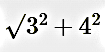 = √25 = 5 is a rational number
⇒ √12.96 = 3.6 is a rational number
⇒ √125 = 5√5 is not a rational number
⇒ √900 = 30 is a rational number
∴ √125 is not a rational number
53. If the dimensions of a room are 2 m, 3 m and 4 m, then many cubes of size 1/2m×1/3m×1/4m can be placed in the same room?
A. 576
B. 672
C. 676
D. 760
Solutions
Given:
Dimensions of a room = 2 m, 3 m, and 4 m
Dimensions of cubes = 1/2 m, 1/3 m and 1/4 m
Formula used:
Volume of cuboid = l × b × h
Calculation:
Number of cubes placed in the room = Capacity of the room/Volume of a cube
⇒ (2 × 3 × 4)/(1/2 × 1/3 × 1/4)
⇒ 24/1/24
⇒ 24 × 24 cubes
⇒ 576 cubes
∴ The number of cubes placed in the room is 576
54. A students required 20% marks to pass in psychology. He/ She secured 10% marks and failed by 20 marks. what is the passing marks?
A. 50
B. 20
C. 40
D. 60
Solutions
Given:
Marks obtained by students to pass in psychology = 20%
Students secured marks = 10%
Students failed by 20 marks
Calculation:
According to question
⇒ 10% + 20 = 20%
⇒ 10% = 20
⇒ 100% = 200
Now,
Students marks to pass in psychology = 20% of 200
⇒ 20/100 × 200
⇒ 40
∴ The passing marks is 40
55. The value of

A. 5/12
B. 1
C. 1/12
D. 30/37
Solutions
Concept Used:
Follow the BODMAS rule according to the table given below:
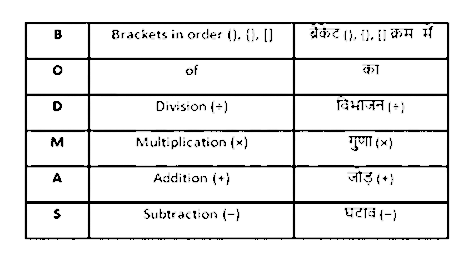
Calculation:
⇒ 1 ÷ {1/2 + 1/3 + 1/6 ÷ (9 – 4)/12}
⇒ 1 ÷ {1/2 + 1/3 + 1/6 ÷ 5/12}
⇒ 1 ÷ {1/2 + 1/3 + 1/6 × 12/5}
⇒ 1 ÷ {1/2 + 1/3 + 2/5}
⇒ 1 ÷ {(15 + 10 + 12)/30}
⇒ 1 ÷ {37/30}
⇒ 1 × 30/37
⇒ 30/37
∴ Required value of ? is 30/37
56. The Rourkela Steel Plant started with the inauguration of first blast furnace by the then Preside of India in:
A. 1958
B. 1969
C. 1968
D. 1959
Solutions
The correct answer is 1959.
Key Points
- Rourkela Steel Plant (RSP), in Rourkela, Odisha is the first integrated steel plant in the public sector in India.
- It was set up with West Germany collaboration with an installed capacity of 1 million tonnes in the 1960s.
- It is operated by the Steel Authority of India.
- German metallurgical firms Mannesmann, Krupp, Demag, Siemens, and Austrian company Voestalpine provided machinery and consultancy to the plant among others.
- Rourkela Steel Plant was the first steel plant in Asia to use the LD (Linz-Donawitz) process of steel-making.
- Rourkela Steel Plant has an associated fertilizer plant that produces nitrogenous fertilizers using ammonia feedstock (from its coke oven plant).
- On 3 February 1959, then president Rajendra Prasad inaugurated RSP’s first blast furnace named ‘Parvati‘ when the company was known as Hindustan Steel Limited (HSL).
- Subsequently, the RSP became a unit of the (SAIL).
Additional Information
- At the global level in 2018, the world crude steel production reached 1789 million tonnes and showed a growth of 4.94% over 2017.
- India is the largest producer of sponge iron in the world and the 3rd largest finished steel consumer in the world after China & the USA.
- The growth in the Indian steel sector has been driven by the domestic availability of raw materials such as iron ore and cost-effective labour.
- Consequently, the steel sector has been a major contributor to India’s manufacturing output.
- Price regulation of iron & steel was abolished on January 16, 1992.
- Since then steel prices are determined by the interplay of market forces.
- Domestic steel prices are influenced by trends in raw material prices, demand-supply, conditions in the market, and international price trends among others.
- A Steel Price Monitoring Committee has been constituted by the Government with the aim to monitor price rationalization, analyze price fluctuations and advise all concerned regarding any irrational price behaviour of steel commodity.
57. If the denominator of a rational number is of the form 2n5m, where n and m are non-negative integers, then what will be the decimal expansion of the number?
A. Non-terminating but recurring
B. Cain’t be deternined
C. Terminating
D. Non-terninating and non-recurring
Solutions
Calculation:
A rational number is terminating if it can be expressed in the form: p/(2n×5m). The rational number whose denominator is a number that has no other factor than 2 or 5,
will terminate the result sooner or later after the decimal point.
∴ The decimal expansion of the number is Terminating
58. Select the number from among the given options that can replace the quesion mark? in the following series.
7, 12,19, ?, 39
A. 24
B. 28
C. 29
D. 26
Solutions
In this series, we subtract first number from second number we get the number, subtract second number from third number we get the number and so on. After that we get new number again first number subtract from second number and second number subtract from third number and so on.
The series are given below –
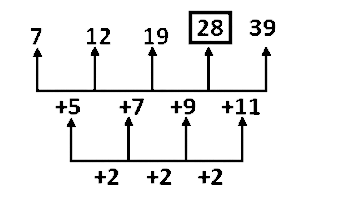
Hence, “28” is the correct answer.
59. How many factors of the number 21600 are perfect squares?
A. 15
B. 12
C. 10
D. 6
Solutions
Concept used:
Factorize the given number and then make pairs of same numbers to get the possible square factors
Calculation:
⇒ 21600 = 22 × 22 × 2 × 32 × 3 × 52
Factors of 21600 that are perfect squares is
⇒ 1
⇒ 22 = 4,
⇒ 32 = 9,
⇒ 22 × 22 = 16
⇒ 52 = 25
⇒ 22 × 32 = 36
⇒ 22 × 52 = 100
⇒ 22 × 22 × 32 = 144
⇒ 32 × 52 = 225
⇒ 22 × 22 × 52 = 400
⇒ 32 × 52 × 22 = 900
⇒ 22 × 22 × 2 × 32 × 3 × 52 = 21600
Number of factors of 21600 whose perfect square = 12
∴ Factors of the number 21600 perfect squares is 12
60. In a frequency distribution, the mid value of a class is 12 and its width is 6. The lower limit of the class is:
A. `1
B. 18
C. 6
D. 9
Solutions
Given:
The mid value of a class = 12
Width = 6
Formula used:
Lower limit = Mid value – width/2
Calculation:
Lower limit = 12 – 6/2
⇒ 12 – 3
⇒ 9
∴ The lower limit of the class is 9
61. The exterior angles of any polygon sum up to:
A. 270°
B. 360°
C. 90°
D. 180°
Solutions
Calculation:
Exterior angle – An exterior angles of polygon is the angle between a side and its adjacent extended side
The exterior angles of any polygon sum up to 360°
∴ Required sum of exterior angles is 360°
62. What is the least number, which when divided by 12, 12 and 35, leaves the same remainder 6?
A. 576
B. 420
C. 426
D. 414
Solutions
Given:
Numbers = 12, 12 and 35
Remainder = 6
Calculation:
LCM of numbers 12,12 and 35 is 420
Remainder = 6
Number = 420 + 6
⇒ 426
∴ The least number which when divided by 12,12 and 35 leaves the same remainder 6 is 426
63. Among various electrical safety devices, one based on the heating effect of electric current is called a:
A. Surge protector
B. fuse
C. protecitve replay
D. circuit breaker
Solutions
The correct answer is Fuse.
Key Points
- Fuse is based on the heating effect of electric current.
- The fuse breaks the circuit if a fault in an appliance causes too much current to flow.
- This protects the wiring and the appliance if something goes wrong.
- The fuse contains a piece of wire that melts easily.
- If the current going through the fuse is too great, the wire heats up until it melts and breaks the circuit.
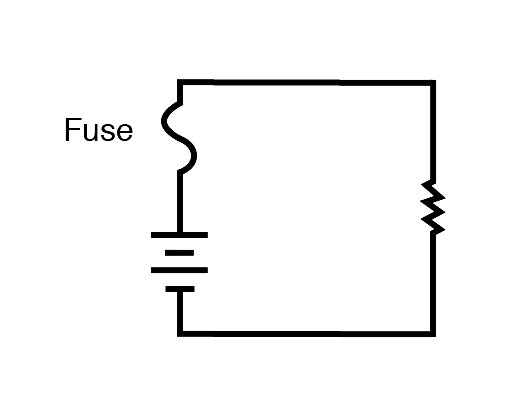
Additional Information
Ohms are named after Georg Simon Ohm (1784-1854), a German physicist who studied the relationship between voltage, current, and resistance.
| Physical quantity | Symbol | Unit | Symbol | Measure device |
| Current | I | Ampere | A | Amperemeter |
| Voltage | U | Volt | V | Voltmeter |
| Power | P | Watt | W | Powermeter |
| Resistance | R | Ohm | Ω | Ohmmeter |
| Capacitance | C | Farad | F | Capacitance meter |
| Inductance | L | Henry | H | Inductance meter |
| Frequency | f | Hertz | Hz | Oscilloscope |
| Period | T | Second | s | Oscilloscope |
| Charge | Q | Coulomb | C | Charge meter |
| Conductance | G | Siemens | S | Conductivity meter |
64. If in a certain code language, REWARI is coded as TGYCTK, then how is DELHI coded in the same code language?
A. FGNJK
B. FGLJK
C. FGOJK
D. FGMJK
Solutions
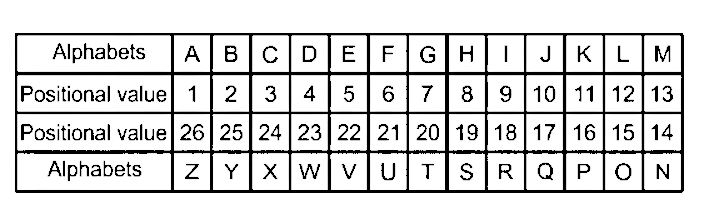
The pattern followed is:
If in a certain code language, REWARI is coded as TGYCTK. Which are given below –
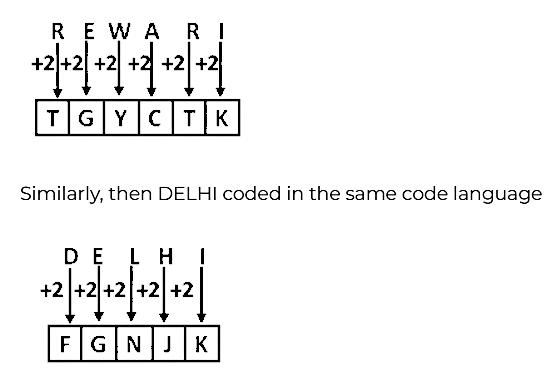
Hence, “FGNJK” is the correct answer.
65. The sum of the deviations about the mean is always:
A. the total standard deviation
B. positive
C. zero
D. the range
Solutions
Concept:
The sum of the deviations of a given set of data about their mean is always zero i.e. sum of positive deviation from mean is equal to the sum of negative deviations.
For example: 2, 4, 5, 8, 11
Mean ( x̅ ) = (2 + 4 + 5 + 8 + 11)/5 = 30/5 = 6
xi xi – x̅
2 – 4
4 – 2
5 – 1
8 2
11 5
∑( xi – x̅ ) = – 4 – 2 – 1 + 2 + 5 = 0
∴ The sum of the deviations about the mean is always zero.
66. The expression ‘Aaya Ram,, Gaya Ram’ become popular in political vocabulary in India to describe:
A. Bipin Lal
B. Durgesh Lal
C. Gaya Lal
D. Jaya Lal
Solutions
The correct answer is Gaya Lal.
Key Points
- The story dates back to 1967 when the first-ever Assembly Elections were held in Haryana.
- An independent politician named Gaya Lal was elected MLA in the elections.
- Haryana had an 81-member legislative assembly then.
- Gaya Lal was elected from the Hassanpur assembly seat.
- Within hours of being elected, Gaya Lal joined the Indian National Congress.
- A few hours later Gaya Lal joined the United Front coalition but it did not end there.
- By the evening Gaya Lal had rejoined the Congress Party. In 9 hours, Gaya Lal had switched parties thrice.
- In the evening, Congress leader Rao Birender Singh addressed a press conference in Chandigarh with Gaya Lal by his side.
- Birender Singh told media, “Gaya Ram ab Aaya Ram hai.”
- The phrase “Gaya Ram Aaya Ram” was picked by the media after Rao Birender Singh’s famous one-liner.
- Till date, it is used in Indian politics for leaders who jump ship frequently.
Additional Information
- Anti-Defection Act:
- The Tenth Schedule — popularly known as the Anti-Defection Act — was included in the Constitution via the 52nd Amendment Act, 1985 and sets the provisions for disqualification of elected members on the grounds of defection to another political party.
- The grounds for disqualification under the Anti-Defection Law are as follows:
- If an elected member voluntarily gives up his membership of a political party.
- If he votes or abstains from voting in such House contrary to any direction issued by his political party or anyone authorized to do so, without obtaining prior permission.
- As a pre-condition for his disqualification, his abstention from voting should not be condoned by his party or the authorized person within 15 days of such an incident.
- If any independently elected member joins any political party.
- If any nominated member joins any political party after the expiry of six months.
67. Select the number from the given options that can replace the question mark(?) below:
If 243 (222) 317, then 548 (?) 621
A. 210
B. 209
C. 211
D. 219
Solutions
Given: 243 (222) 317
The logic follows here is:
317 – 243 = 74,
74 × 3 = 222
Similarly, to solve 548 (?) 621:
621 – 548 = 73,
73 × 3 = 219
Hence, 219 is the correct answer.
68. What was considered as a symbol of human society that would NOT glorify machines and technology during the Indian National Movement?
A. Potter’s wheel
B. Handloom
C. Charkha
D. Spinning jenny
Solutions
The correct answer is Charkha.
Key Points
- Charkha was considered a symbol of human society that would not glorify machines and technology during the Indian National Movement.
- The Spinning Wheel or Charkha became not only a symbol of the revolution, but it now is a symbol synonymous with the power of self-reliance, perseverance, and determination.
- From then to now the Charkha has initiated an upheaval and marked the path of progress for the Indian Spinning can Industry.
- Indian National Movement
- Romesh Chunder Dutt, a retired ICS officer, published ‘The Economic History of India’ at the beginning of the 20th Century.
- In this book, he examined in minute detail the entire economic record of colonial rule since 1757.
- The focal point of the nationalist critique was the drain theory.
- Romesh Chunder Dutt, a retired ICS officer, published ‘The Economic History of India’ at the beginning of the 20th Century.
Additional Information
- On 8th August 1942, Mahatma Gandhi gave a clarion call to end British rule and launched the Quit India Movement at the session of the All-India Congress Committee in Mumbai.
- Gandhiji gave the call “Do or Die” in his speech delivered at the Gowalia Tank Maidan, now popularly known as August Kranti Maidan.
- Aruna Asaf Ali popularly known as the ‘Grand Old Lady’ of the Independence Movement is known for hoisting the Indian flag at the Gowalia Tank Maidan in Mumbai during the Quit India Movement.
- The slogan ‘Quit India’ was coined by Yusuf Meherally, a socialist and trade unionist who also served as Mayor of Mumbai.
- Meherally had also coined the slogan “Simon Go Back”.
69. Dena bank and Vijaya Bank have recently merged with:
A. Bank of Baroda
B. State Bank of India
C. Punjab National Bank
D. Bank of India
Solutions
The correct answer is Bank of Baroda.
Key Points
- Bank of Baroda
- Vijaya Bank and Dena Bank were merged with Bank of Baroda with effect from 1 April 2019.
- The bank said all customers will now have access to a total of 8,248 domestic branches and 10,318 ATMs across the country.
- According to the Scheme of Amalgamation, shareholders of Vijaya Bank will get 402 equity shares of BoB for every 1,000 shares held.
- In the case of Dena Bank, its shareholders will get 110 shares of BoB for every 1,000 shares.
Additional Information
- Punjab National Bank anchor banks were Oriental Bank of Commerce and United Bank of India merged.
- PNB is anchoring its merger with Oriental Bank of Commerce and United Bank of India to create the country’s second-largest lender in terms of business size.
- Similarly, the Union Bank of India is anchoring its merger with Andhra Bank and Corporation Bank.
- while Canara Bank is the anchor bank for its amalgamation with Syndicate Bank.
- Indian Bank will become the country’s seventh-largest bank with a total business of Rs 8.5 lakh crore.
- Consultant Ernst & Young (E&Y), which has been appointed by the anchor bank PNB, will supervise the process of harmonization and standardization.
- It includes issues relating to HR, software, products and services.
70. Which of the following is NOT an input device?
A. Light pen
B. Plotter
C. Track ball
D. Touch screen
Solutions
The correct answer is Plotter.
Key Points
- An output device is any piece of computer hardware equipment that converts information into human-readable form.
- It can be text, graphics, tactile, audio, and video.
- Some of the output devices are Visual Display Units i.e. a Monitor, Printer graphic Output devices, Plotters, Speakers.
- An output device is any hardware device used to send data from a computer to another device or user.
Additional Information
- An input device is a piece of equipment used to provide data and control signals to an information processing system such as a computer or information appliance.
- Examples of input devices include keyboards, mouse, trackballs, lightpen, scanners, cameras, touch screen joysticks, and microphones.
- Language and memory, Data and instructions, Text and graphics, Storage and commandsFeedbackCorrect.
- These are the two categories of input.
- Data can be unprocessed text or numbers, images, etc.
71. When was India’s hundredth space mission lauched?
A. September,2010
B. September,2012
C. September,2014
D. September,2009
Solutions
The correct answer is September,2012.
Key Points
- India successfully launched its 100th space mission on 9th September 2012 using its Polar Satellite Launch Vehicle to send two new satellites into orbit.
- The PSLV rocket carried the Astrium Services’ Spot 6 commercial Earth observation satellite into low Earth orbit in a launch that represented a milestone in the gradual privatization of commercial remote sensing.
- Operating from the Satish Dhawan Space Centre, the PSLV also carried the 15-kilogram Proiteres amateur radio satellite, built by the Osaka I.
- The 1,569-pound (712-kilogram) Spot 6 satellite will be joined in its 435-mile (700-kilometer) polar low-Earth orbit by the identical Spot 7 in 2014.
- Astrium Services financed the Spot 6 and Spot 7 project without government support, and with no guarantee from French authorities of imagery purchases.
Additional Information
- Chandrayaan-II:
- Chandrayaan-2 is India’s 2nd moon mission which was successfully launched by GSLV-MkIII-M1 from Second Launch Pad at Satish Dhawan Space Centre, Sriharikota in Andhra Pradesh.
- In 2019, Chandrayaan-2 was launched with an orbiter and a lander named Vikram, and a six-wheeled rover named Pragyaan by ISRO. The orbiter is still functional and the lander crashed before its induction in any research operation.
- Lander- Vikram:
- It is named after the father of the Indian space research program, Dr. Vikram A. Sarabhai.
- Rover- Pragyan:
- Pragyan in Sanskrit means wisdom.
- It is a 6-wheeled robotic vehicle, weighing 27-kg. It will set out on its job of collecting information on the lunar surface.
72. In a row of students, one student is tenth from either end of the row. How many students are there in the row?
A. 22
B. 19
C. 20
D. 16
Solutions
Total number of student = No of student from left + No of student from right – 1
In a row of students, one student is tenth from either end of the row.
Then total number of student = 10 + 10 – 1
= 20 – 1
Then total number of student = 19
Hence, “19” is the correct answer.
73. A statement is given followed by two arguments. Decide which of the arguments is/are strong with respect to the statement.
Statement:
Life expectancy of Indians is increasing
Arguments:
I. Yes, People are getting better medical facilities.
Ii. Yes, People are doing more physical exercises now.
A. Only argument II is strong
B. Both arguments I and II are strong
C. Neither I nor II is strong
D. Only argument I i s Strong.
Solutions
The logic followed is:
Arguments:
I. Yes People are getting better medical facilities. True (According to statement Life expectancy of Indians increasing. This is fit for this statement.)
Ii. Yes, People are doing more physical exercises now. True (According to statement Life expectancy of Indians increasing. This is fit for this statement.)
Thus, both arguments are strong.
Hence, the correct answer is “Both arguments I and II are strong”.
Additional Information
- The agreement which is the reconstruing part of the statement is a strong agreement.
- The argument should not be imagined.
- The relationship of the agreement should be direct from the statement.
- The argument should be simple and clear.
- The agreement should be based on scientific facts.
- The statement in the argument should receive a logical answer.
74. Which is Satyajit Ray’s famous film about the decline of the aristocratic zamindari style of living?
A. Pather Panchali
B. Jalsaghar
C. Charulata
D. Apur Sansar
Solutions
The correct answer is Jalsaghar.
Key Points
- Jalsaghar (aka “The Music Room”) is a 1958 drama film directed by master Indian filmmaker Satyajit Ray.
- Based on a short story of the same name by Bangla writer Tarashankar Bandopadhyay, Jalsaghar presents the tale of the decline of a feudal lord in pre-independence India.
- Film series: The Apu Series
- Actor: Chhabi Biswas
- Story by: Tarasankar Bandyopadhyay
Additional Information
- Padmashri Award in the year 2020
| Recipient | Field | State |
| Kangana Ranaut | Arts | Maharashtra |
| Rani Rampal | Sports | Haryana |
| S. Ramakrishnan | Social Work | Tamil Nadu |
| Jitu Rai | Sports | Uttar Pradesh |
75. Who was the first Indian to win the Nobel Prize for literature in 1913?
A. Rabindranath Tagore
B. Annnadashankar Roy
C. Humayun Kabir
D. Bishnu Dey
Solutions
The correct answer is Rabindranath Tagore.
Key Points
- The Nobel Prize in Literature 1913 was awarded to Rabindranath Tagore “because of his profoundly sensitive, fresh and beautiful verse, by which, with consummate skill, he has made his poetic thought, expressed in his own English words, a part of the literature of the West.”
- Rabindranath Tagore FRAS was a Bengali polymath – poet, writer, playwright, composer, philosopher, social reformer, and painter.
- He was a fellow of the Royal Asiatic Society.
- He reshaped Bengali literature and music as well as Indian art with Contextual Modernism in the late 19th and early 20th centuries.
Additional Information
- Nobel Prize:
- It is a prestigious prize awarded separately in six different fields “to those who, during the preceding year, have conferred the greatest benefit to humankind”.
- The prize was awarded in the fields of Physics, Chemistry, Physiology or Medicine, Literature, and Peace.
- It is a prestigious prize awarded separately in six different fields “to those who, during the preceding year, have conferred the greatest benefit to humankind”.
- Amartya Sen:
- Economist Amartya Sen was the winner of the 1998 Sveriges Riksbank Prize in Economic Sciences.
- The award was introduced by the Nobel Prize Committee in memory of Alfred Nobel, “for his contributions to welfare economics”.
- Sen has made contributions to welfare economics, social choice theory, economic and social justice, economic theories of famines, decision theory, development economics, public health, and measures of well-being of countries.
- He was best known for his work on the causes of famine, which led to the development of practical solutions for preventing or limiting the effects of real or perceived shortages of food.
- Hargovind Khorana:
- Har Gobind Khorana )was an Indian American biochemist.
- The Nobel Prize in Physiology or Medicine 1968 was awarded to Har Gobind Khorana “for their interpretation of the genetic code and its function in protein synthesis.”
- In 2009, Khorana was hosted by the Khorana Program and honored at the 33rd Steenbock Symposium in Madison, Wisconsin.
- On 9 January 2018, a Google Doodle celebrated the achievements of Har Gobind Khorana on what would have been his 96th birthday.
- Subramanian Chandrashekhar :
- He was awarded the 1983 Nobel Prize for Physics with William A. Fowler for ” theoretical studies of the physical processes of importance to the structure and evolution of the stars”.
- In 1930, 19-year-old Subrahmanyan Chandrasekhar discovered that stars were destined to collapse into nothingness and become black holes
76. Which point on the given number line represents 6/5?

A. K
B. R
C. S
D. W
Solutions
Calculation:
Point R is at 1.2 on the number line
And 6/5 corresponds to 1.2
∴ The given number line represents 6/5 is R
77. Which port is one of the oldest artificial ports on the eastern coast?
A. Chennai port
B. Kandla port
C. Visakhapatnam Port
D. Paradip Port
Solutions
The correct answer is Chennai Port.
Key Points
- Chennai Port, formerly known as Madras Port, is the second-largest container port of India, behind Mumbai’s Nhava Sheva.
- It is one of the oldest artificial ports on the eastern coast.
- The port is the largest one in the Bay of Bengal.
- It is the third-oldest port among the 13 major ports of India with official port operations beginning in 1881, although maritime trade started much earlier in 1639 on the undeveloped shore.
- It is an artificial and all-weather port with wet docks.
- Once a major travel port, it became a major container port in the post-Independence era.
Additional Information
- Nhava Sheva Port Trust was renamed Jawaharlal Nehru Port Trust by the Government in the year 1989.
- It is Located east of Mumbai in Navi Mumbai’s Raigad district, this port on the Arabian Sea is accessed via Thane Creek.
- This port is also the terminal of the Western Dedicated Freight Corridor
- Paradip Port is a natural, deep-water port on the East coast of India in the Jagatsinghpur district of Odisha.
- It is situated at the confluence of the Mahanadi river and the Bay of Bengal.
- It is situated 210 nautical miles south of Kolkata and 260 nautical miles north of Visakhapatnam.
- The government of India declared Paradip Port as the Eighth Major Port of India on 18 April 1966
- Visakhapatnam Port is one of 13 major ports in India and the only major port of Andhra Pradesh.
- It is India’s third-largest state-owned port by volume of cargo handled and largest on the Eastern Coast.
- It is located midway between the Chennai and Kolkata Ports on the Bay of Bengal.
Important Points
- The Tuticorin Port Trust was renamed as V.O. Chidambaranar Port Trust in the year 2011.
- The Ennore Port Limited has been re-named as Kamarajar Port Limited in honour of Shri K Kamarajar, eminent freedom fighter and former Chief Minister of Tamil Nadu.
- Recently, in 2017 Kandla Port was re-named as Deendayal Port. Besides, many airports have also been named after the great national leaders in India.
78. The given pie diagram shows the number of students admitted in different faculties of a college. What part of the total students is admitted in the arts faculty?

A. 5/8
B. 1/12
C. 1/3
D. 1/8
Solutions
Calculation:
Students admitted in the arts faculty = 1200
Total students admitted in the college = (300 + 1200 + 1000 + 650 + 450)
⇒ 3600
Total students admitted in the arts faculty = 1200/3600
⇒ 1/3
∴ Required part of the total students is admitted in the arts faculty is 1/3
79. Four options have been given, out of which there are alike in some manner and one is different. Select the odd one.
A. (51, 24)
B. (71, 44)
C. (42, 15)
D. (32, 13)
Solutions
The pattern followed here is –
The sum of the digit of the number on both the side are equal.
From option 1-
(51, 24)
5 + 1 = 2 + 4
6 = 6
From option 2-
(71, 44)
7 + 1 = 4 + 4
8 = 8
From option 3-
(42, 15)
4 + 2 = 1 + 5
6 = 6
From option 4-
(32, 13)
3 + 2 = 1 + 3
5 ≈ 4 (odd among all)
Hence, “(32, 13)” is the correct answer.
80. In the given figure, ∠ABD = 550 and ∠ACD = 300, If ∠BAC = y0 and non-relax ∠BDC = x0, then what is the value of x-y?
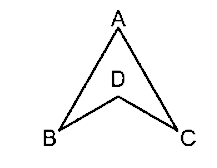
A. 85
B. 15
C. 95
D. 105
Solutions
Given:
∠ABD = 55° and ∠ACD = 30°
Calculation:
In ΔABD and ΔACD
AB = AC (Side angle side)
AD = AD (Common)
∠ABD + ∠ACD = ∠BDC – ∠BAC
⇒ 55° + 30° = x° – y°
⇒ 85° = x° – y°
∴ The value of x-y is 85
81. Select the Venn diagram that best represents the relationship between the given set of classes.
Apple, Mango, Fruits
A. 
B. 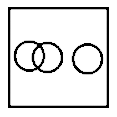
C. 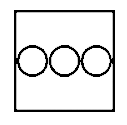
D. 
Solutions
The venn diagram of Apple, Mango, Fruits are given below –
All apple and mango are fruits but no mango is an apple.
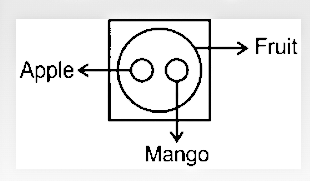
Hence, “option 4” is the correct answer.
82. The given shows the number of students in a hostel speaking different languages:
| Languages | Hindi | English | Marathi | Tamil | Bengali | Total |
| Number of Students | 25 | 22 | 12 | 9 | 4 | 72 |
Which language is spoken by atleast 1 out of 3 students residing in the hostel?
A. Tamil
B. Marahi
C. Hindi
D. English
Solutions
Calculation:
Total number of students = 72
1 out of 3 students = 1/3 = 33.33% (Approx)
We have to Calculate 1/3rd Part of 72 Students
Language which is spoken at least 1 out of 3 students = 72/3
⇒ 24
∴ Language is spoken by atleast 1 out of 3 students residing in the hostel is Hindi
83. Small bead-like structures inside the ovary of flowers is called?
A. sepals
B. petals
C. stamen
D. ovules
Solutions
The correct answer is Ovules.
Key Points
- Small bead-like structures inside the ovary of flowers is called ovules.
- In seed plants, the ovule is the structure that gives rise to and contains the female reproductive cells.
- It consists of three parts: the integument, forming its outer layer, the nucellus, and the female gametophyte in its center.
- A floral style is a stalk that supports the stigma and connects it to the ovary
- Ovary – It is the enlarged basal portion of the pistil, where ovules are produced.
- Pistil – It is the female reproductive part of the flower.
- Stigma – It is the part of the pistil where pollen germinates.

Additional Information
- The male reproductive organ of the flower is known as the stamen.
- This produces pollen. Pollen is a powder produced from pollen grains, containing seed plant sperm cells.
- It is having two parts:
- Anthers – The part of the stamen where pollen is produced.
- Filaments – It is a stalk-like structure that connects the base of the flower with anther.
- The anther is composed of microsporangia.
- The Pistil is the female reproductive part of a flower.
84. Who represented the Congress in the second round table conference held in London?
A. Mahatma Gandhi
B. Lal Bahadur Shastri
C. Vallabhbhai Patel
D. Jawaharlal Nehru
Solutions
The correct answer is Mahatma Gandhi.
Key Points
- Second Round Table Conference (September 1931- December 1931)
- The Second Round Table Conference was held in London from 7 September 1931 to 1 December 1931 with the participation of Gandhi and the Indian National Congress.
- Participants of the Second Round table conference
- British delegates belonging to various political parties including the British Prime
- Minister, James Ramsay Macdonald.
- Indian princely states are represented by Maharajas, princes, and divans.
- British Indians represented by:
- Indian National Congress (INC) – Mahatma Gandhi, Rangaswami Iyengar, Madan
- Mohan Malaviya
- Muslims – Md. Ali Jinnah, Aga Khan III, Muhammad Iqbal, etc.
- Hindus – M R Jayakar, etc.
- Depressed classes – Dr B R Ambedkar
- Women – Sarojini Naidu, etc.
- Liberals, Justice Party, Sikhs, Indian Christians, Parsis, Europeans, Anglo-Indians,
- industry, labour, landlords, Burma, Sindh, and other provinces
Additional Information
- The first Session by presided by W.C. Bannerjee in December 1885 at Bombay.
- The Second Session by presided by Dadabhai Naoroji was held at Calcutta in 1886.
- Mahatma Gandhi presided over the 39th Session in 1924 In Belgaum, Karnataka.
- 1925: Kanpur. President: Sarojini Naidu, First Indian Woman President.
- 1927: Madras. President: Dr. M.A. Ansari.
- 1931: Karachi. President: Vallabhbhai Patel.
- The early leadership – Dadabhai Naoroji, Pherozeshah Mehta, Badruddin Tyabji, W.C. Bonnerji, Surendranath Banerji, Romesh Chandra Dutt, S. Subramania Iyer, among others was largely from Bombay and Calcutta.
- The formation of the Indian National Congress was an effort in the direction of promoting the process of nation-building.
85. If x2 – 4x + 1 = 0, then what is the value of  ?
?
A. 18
B. 14
C. 15
D. 16
Solutions
Given:
x2 – 4x + 1 = 0
Formula used:
(a + b)2 = a2 + b2 + 2ab
Calculation:
x2 + 1 = 4x
Dividing both sides by x
⇒ x + 1/x = 4
Squaring both sides
(x + 1/x)2 = (4)2
⇒ x2 + 1/x2 + (2 × 1/x × x) = 16
⇒ x2 + 1/x2 + 2 = 16
⇒ x2 + 1/x2 = 16 – 2
⇒ x2 + 1/x2 = 14
∴ The value of is 14
86. The addition to capital stock in an economy is measured by net investment or new capital formation, which is expressed as:
A. Net investment = Gross investment + depreciation
B. Net investment = Gross investment – depreciation
C. Depreciation = Net investment + Gross investment
D. Gross investment = Net investment -depreciation
Solutions
The correct answer is Net investment = Gross investment – depreciation.
Key Points
- The addition to the capital stock in an economy is measured by net investment or new capital formation, which is expressed as Net investment = Gross investment – depreciation.
- Gross Investment is referred to as the total expenditure that is made for buying capital goods over a time period, without accounting for depreciation.
- In other words, gross investment is the amount that a company has invested in particular assets or the business as a whole without considering depreciation for the same.
- Net Investment, on other hand, is the actual addition that is made to the capital stock in a given period.
- Net Investment takes into account the depreciation and is calculated by subtracting the depreciation from the gross investment.
Additional Information
- Estimates of National Income for 2020-21
- Real GDP:
- Real GDP at Constant (2011-12) Prices in the year 2020-21 is now estimated to be at Rs. 135 lakh crores in comparison to Rs. 145 lakh crores in 2019-20.
- The GDP growth rate is -7.3% in the year 2020-21 in comparison to the 4% growth rate registered in the year 2019-20.
- Nominal GDP:
- GDP at Current Prices in the year 2020-21 is now estimated to be at Rs. 197 lakh crores in comparison to Rs. 203 lakh crores in 2019-20.
- The GDP growth rate is -3% in the year 2020-21 in comparison to the 7.8% growth rate registered in the year 2019-20.
- Real GDP:
- The Gross Domestic Product (GDP) refers to the market value of all final goods and services produced within an economy.
- It can be calculated into two ways:
- Nominal GDP:
- It refers to the GDP at the current market prices i.e., the GDP is calculated as per the market prices for the year for which the GDP is calculated.
- Real GDP:
- It refers to the GDP at base year prices i.e., the GDP is calculated as per the market prices in the base year. Thus, the Real GDP negates the inflation in goods and services.
- In case of a high rate of inflation, the nominal GDP would be higher than the real GDP.
- However, in the case of deflation, the real GDP would be higher than the nominal GDP.
- Nominal GDP:
- It can be calculated into two ways:
87. Read the given statements and conclusions carefully. Assuming that the information given in the statements is true, even if it appears to be at variance with commonly known facts, decide which of the given conclusions logically follows(s) from the statements.
Statements:
1. All the case are four-wheelers.
2. All the four-wheelers are vehicles.
Conclusions:
I. All the vehicle are four-wheelers
II. All the case are vehicles.
A. Only II
B. Either I or II
C. Only I
D. Both I and II
Solutions
The diagram are given below –
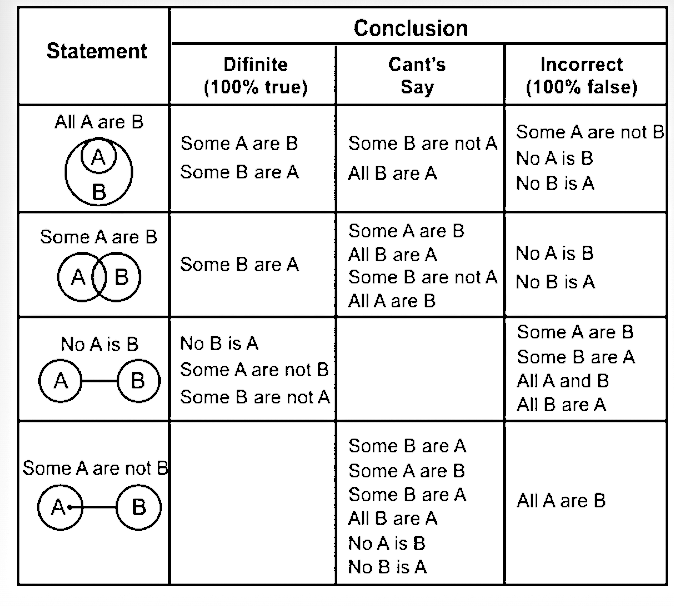
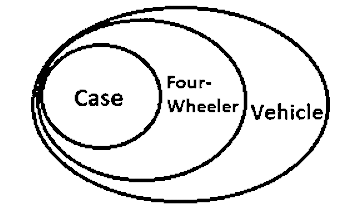
Conclusions:
I. All the vehicle are four-wheelers. False (All the four-wheelers are vehicles but all the vehicles are not four-wheelers.)
II. All the case are vehicles. True (All the case are four-wheelers. All the four-wheelers are vehicles. So all the case are vehicles.)
Hence, “option 1” is the correct answer.
88. What protects the inner of the stomach from the action of acid normal conditions?
A. Villi
B. Gastric Glands
C. Mucus
D. Enzymes
Solutions
The correct answer is Mucus.
Key Points
- A layer of mucus along the inner walls of the stomach is vital to protect the cell linings of that organ from the highly acidic environment within it.
- Gastric mucus is a gel-mucous barrier secreted by epithelial cells and glandular cells in the stomach wall.
- It acts as part of a barrier that protects the stomach wall from the acid and digestive enzymes within the stomach lumen.
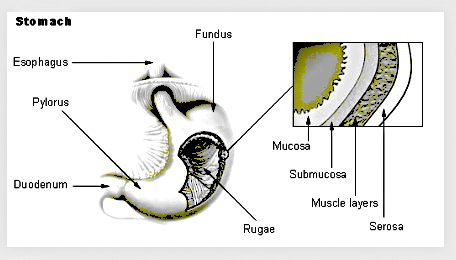
Additional Information
- Villi
- Villi increase the internal surface area of the intestinal walls making available a greater surface area for absorption.
- An increased absorptive area is useful because digested nutrients (including monosaccharides and amino acids) pass into the semipermeable villi through diffusion, which is effective only at short distances.
- In other words, increased surface area (in contact with the fluid in the lumen) decreases the average distance traveled by nutrient molecules, so the effectiveness of diffusion increases.
- The villi are connected to the blood vessels so the circulating blood then carries these nutrients away.
- Gastric glands
- The gastric glands are located in different regions of the stomach.
- These are the fundic glands, the cardiac glands, and the pyloric glands.
- The glands and gastric pits are located in the stomach lining.
- Enzymes
- Enzymes are proteins that help speed up metabolism, or the chemical reactions in our bodies.
- They build some substances and break others down. All living things have enzymes.
- Our bodies naturally produce enzymes.
- But enzymes are also in manufactured products and food.
89. Indicating to a women, a man said, “Her father is the only son my father, “How is the related to the women?
A. Father
B. Grandfather
C. Brother
D. Son
Solutions
Indicating to a women, a man said, “Her father is the only son my father,
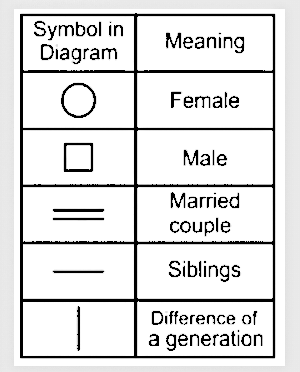
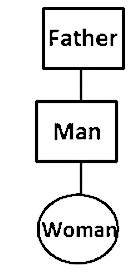
Man is the father of woman.
Hence, “Father” is the correct answer.
90. The given table shows the height (in cm) of 90 plants in a garden:
| Height (in cm) | 58 | 61 | 62 | 64 | 65 | 70 |
| Number of plants | 20 | 25 | 14 | 9 | 12 | 10 |
How many plants have heights 61 cm or more, but less than 70 cm?
A. 62
B. 65
C. 59
D. 60
Solutions
Calculation:
Plants whose height are 61 cm = 25
Plants whose height are 62 cm = 14
Plants whose height are 64 cm = 9
Plants whose height are 65 cm = 12
Total number of plants whose heights are 61 cm or more = (25 + 14 + 9 + 12)
⇒ 60
∴ Plants have heights 61 cm or more, but less than 70 cm is 60
91. Five persons A,B,C,D and E are sitting one above the other on a ladder (not necessarily in the same order) B is sitting above A with one person between them. Only two persons are sitting between A and C. If C is not sitting top, then who is sitting in the middle?
A. C
B. D
C. E
D. B
Solutions
Five persons A,B,C,D and E are sitting one above the other on a ladder (not necessarily in the same order).
1) B is sitting above A with one person between them.
2) Only two persons are sitting between A and C. If C is not sitting top, the figure are given below –
In which there is two case in which first one is –
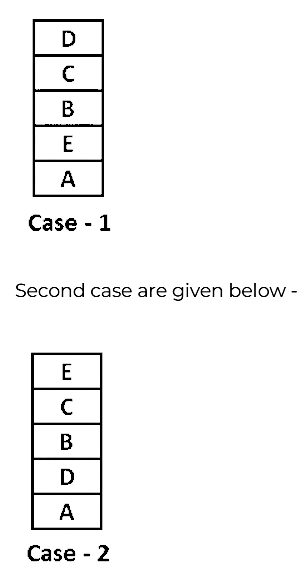
After observation of both cases, B is the sitting in the middle.
Hence, “B” is the correct answer.
92. A team is to be selected from 13 players P1, P2, P3, P4, P5, P6, P7, P8, P9, P10, P11, P12 and P13. There will be seven players in the team. P2 cannot be selected with P1, P6 or P4. P7 cannot be selected with P2, P10, P11 or P13. If P8 and P13 both are selected, then P5 must be selected. P4 cannot be selected with P2, P10, P12 or P11. Which of the following is a correct selection of the team?
A. P1, P3, P4, P5, P6, P8, P9
B. P1, P6, P11, P12, P13, P3, P4
C. P1, P3, P4, P5, P8, P9, P13
D. P2, P3, P5, P7, P8, P9, P13
Solutions
A team is to be selected from 13 players P1, P2, P3, P4, P5, P6, P7, P8, P9, P10, P11, P12 and P13.
1) P2 cannot be selected with P1, P6 or P4.
2) P7 cannot be selected with P2, P10, P11 or P13.
3) If P8 and P13 both are selected, then P5 must be selected.
4) P4 cannot be selected with P2, P10, PI2 or P11.
Option 1 – P1, P3, P4, P5, P6, P8, P9 in which P8 and P13 always with P5, So P13 not present with P8 and P5. So it is incorrect combination.
Option 2 – P1, P6, P11, P12, P13, P3, P4 in which P8 and P13 always with P5, so P5 and P8 not present and P4 cannot be selected with P11 and P12. So it is incorrect combination.
Option 3 – P1, P3, P4, P5, P8, P9, P13. follow all the condition. So it is correct combination.
Option 4 – P2, P3, P5, P7, P8, P9, P13 in which P2 and P7 both together but in condition P2 and P7 never with same combination. So it is incorrect combination.
Hence, “option 3” is the correct answer.
93. If × stands for addition, ÷ stands for subtraction, + stands for multiplication and – stands for division, then 10 × 4 ÷ 4 – 2 + 1 = ?
A. 12
B. 1.5
C. 40
D. 5
Solutions
10 × 4 ÷ 4 – 2 + 1 = ?
If × stands for addition, ÷ stands for subtraction, + stands for multiplication and – stands for division,
Then-
10 + 4 – 4 ÷ 2 × 1 = ?
Applying BODMAS rule –
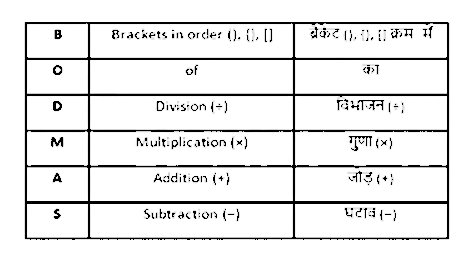
10 + 4 – 2 × 1 = ?
10 + 4 – 2 = ?
14 – 2 = ?
12 = ?
Hence, “12” is the correct answer.
94. Select the number from among the given options that can replace the question mark ? in the following series.
22, 23, 26, 27, 30, 31, ?
A. 35
B. 31
C. 34
D. 33
Solutions
In this series first number is subtracted from second number we get 1, second number is subtracted from third number we get 3, third number is subtracted from fourth number we get 1 and fourth number is subtracted from fifth number we get 3 and so on –
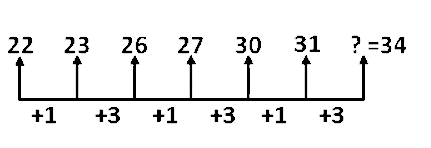
Hence, “34” is the correct answer.
95. Arrange the given words in alphabetical order:
A) mild, B) moderate, C) severe, D) profound
A. A, B, C, D
B. A, C, B, D
C. A, B, D, C
D. A, D, B, C
Solutions

The pattern followed is:
In this question we arrange alphabetical order of the word:
First word come Mild before moderate, profound and severe because Mi come before Mo in alphabetical order, then Moderate come before profound and severe because M come before P in alphabetical order, then Profound come before severe because P come before S in alphabetical order then at last severe.
We shown below –
Frist come Mild then moderate then profound and then severe.
A) mild,
B) moderate,
D) profound
C) severe,
Hence, “option 3” is the correct answer.
Additional Information Mild – gentle in nature or behavior, not sharp, spicy, or bitter.
Moderate – being, having, using, etc. neither too much nor too little of something.
Profound – having intellectual depth and insight., needing or showing a lot of knowledge or thought.
Severe – causing somebody to suffer, be upset or have difficulties, extremely bad or serious.
96. The given table shows the number of electric bulbs sold in a shop during a week:
| Days | Monday | Tuesday | Wednesday | Thursday | Friday | Saturday |
| Number of bulbs sold | 25 | 100 | 150 | 200 | 75 | 90 |
on which day was the daily sale closest to the average sale for the week?
A. Friday
B. Saturday
C. Thursday
D. Tuesday
Solutions
Calculation:
Number of electric bulbs sold on Monday = 25
Number of electric bulbs sold on Tuesday = 100
Number of electric bulbs sold on Wednesday = 150
Number of electric bulbs sold on Thursday = 200
Number of electric bulbs sold on Friday = 75
Number of electric bulbs sold on Saturday = 90
Total number of electric bulbs sold in a shop during a week = (25 + 100 + 150 + 200 + 75 + 90)
⇒ 640
Average sale of the week = 640/6
⇒ 106.66 ≈ 100
∴ The daily sale closest to the average sale for the week is Tuesday
97. Select the most appropriate option to fill in the blank.
W S O K____
A. L
B. G
C. T
D. H
Solutions
The logic followed here is:
In this word series in the first letter we subtract 4 we get second letter, in second letter we subtract 4 we get third letter and so on. The series are given below –
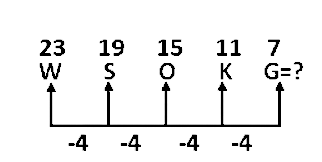
Hence, “G” is the correct answer.
98. Cariappa, Kargil, Katari, Manekshaw and subrto are five different sadans in sanik school. Kargil is to the right of Subrto and Katari is the left of Cariappa and right of Kargil. Subrto is to the right of Manekshaw. Which sadan is in the middle?
A. Subrto
B. Kargil
C. katari
D. Cariappa
Solutions
Carippa, Kargil, Katari, Manekshaw and subrto are five sadans in sanik school.
1) Kargil is to the right of Subrto and Katari is the left of Cariappa and right of Kargil.
2) Subrto is to the right of Manekshaw,
The arrangement are given below-
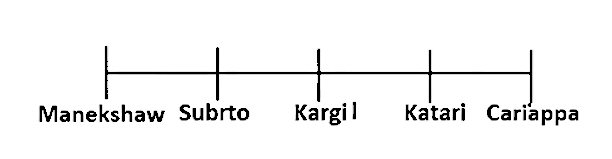
Kargil sadan is in the middle.
Hence, “Kargil” is the correct answer.
99. D has a brother A. D is the son of C. B is C’s father. In terms of relationship, what is A of B?
A. Son
B. Grandson
C. Grandfather
D. Brother
Solutions
D has a brother A. D is the son of C. B is C’s father.
Family tree are given below –
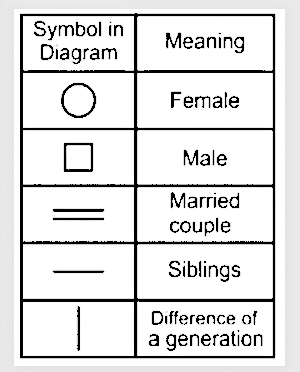
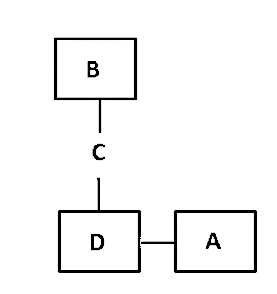
A is the grandson of B.
Hence, “Grandson” is the correct answer.
100. Select the word from the options, which is similar to the given words in a certain manner:
Stable, Burrow, Nest
A. Slim
B. Herd
C. City
D. Den
Solutions
The logic follows here is:
The similar to the given words which are:
Stable means unlikely to change,
Burrow means a hole in the ground made by certain animals,
Nest means the home of certain animals or insects.
Similarly,
Den means the place where certain wild animals live.
Slim (thin in an attractive way), Herd (a large number of animals that live and feed together), City (a large and important town) which is not similar.
Hence, “Den” is the correct answer.