1. Direction: Study the following information carefully to answer the given questions.
A certain number of people sit in a row, facing South. H sits sixteenth from the left end. A sits seventh to the left of D, who sits eleventh to the left of B. Fourteen people sit between C and A. Seven people sit between G and F. B sits third to the right of C. G is not immediate neighbour of C. E sits at an end of the row. C sits eight from the right end. A sits third to the right of F, who sits at an end of the row.
Question:
Four of the five options given below follow a certain logic and form a group, identify the odd one out.
A. BC
B. AF
C. CH
D. HD
E. DG
Solution
Given:
A certain number of people sit in a row, facing South.
1. C sits eight from the right end.
2. Fourteen people sit between C and A.
3. A sits third to the right of F, who sits at an end of the row.

4. A sits seventh to the left of D, who sits eleventh to the left of B.
5. B sits third to the right of C.
6. Seven people sit between G and F.

7. H sits sixteenth from the left end.
8. E sits at an end of the row.
9. G is not immediate neighbour of C

The logic followed here all the provided options have an even number of persons between them except for DG.
BC – 2 persons are between B and C.
AF – 2 persons are between A and F.
CH – 2 persons are between C and H.
HD – 4 persons are between H and D.
DG – 1 person is between D and G.
Hence, DG is the odd one out.
2. Direction: Study the following information carefully to answer the given questions.
A certain number of people sit in a row, facing South. H sits sixteenth from the left end. A sits seventh to the left of D, who sits eleventh to the left of B. Fourteen people sit between C and A. Seven people sit between G and F. B sits third to the right of C. G is not immediate neighbour of C. E sits at an end of the row. C sits eight from the right end. A sits third to the right of F, who sits at an end of the row.
Question:
Who sits between between G and H?
A. A
B. B
C. C
D. D
E. E
Solution
Given:
A certain number of people sit in a row, facing South.
1. C sits eight from the right end.
2. Fourteen people sit between C and A.
3. A sits third to the right of F, who sits at an end of the row.

4. A sits seventh to the left of D, who sits eleventh to the left of B.
5. B sits third to the right of C.
6. Seven people sit between G and F.

7. H sits sixteenth from the left end.
8. E sits at an end of the row.
9.G is not immediate neighbour of C

Hence, D sits between G and H.
3. Direction: Study the following information carefully to answer the given questions.
A certain number of people sit in a row, facing South. H sits sixteenth from the left end. A sits seventh to the left of D, who sits eleventh to the left of B. Fourteen people sit between C and A. Seven people sit between G and F. B sits third to the right of C. G is not immediate neighbour of C. E sits at an end of the row. C sits eight from the right end. A sits third to the right of F, who sits at an end of the row.
Question:
Which of the following statements is/are correct?
I. Four people sit between B and C
II. The number of persons sitting left of D is odd.
III. G sits third to the right of A
A. Only Statement II is true
B. All of the given statements are correct
C. None of the statements are correct
D. Only Statements II and III are true
E. Only Statements I and III are true
Solution
Given:
A certain number of people sit in a row, facing South.
1. C sits eight from the right end.
2. Fourteen people sit between C and A.
3. A sits third to the right of F, who sits at an end of the row.

4. A sits seventh to the left of D, who sits eleventh to the left of B.
5. B sits third to the right of C.
6. Seven people sit between G and F.

7. H sits sixteenth from the left end.
8. E sits at an end of the row.
9. G is not immediate neighbour of C

Hence, the correct answer is Option 3.
4. Directions: Study the following information carefully and answer the questions given below.
In an office of CBDT department, there are eight designations. These designations in the decreasing order of their rank are Director, Commissioner, Assistant Commissioner, Superintendent, Inspector, Assistant, Clerk, and Peon. A, B, C, D, E, F, G, and H are the eight people currently working on these positions but not necessarily in the same order.
Both E and B are superior to C. Neither D nor F is the Assistant. C is superior to at least five people. Neither G nor H is the Assistant. Neither B nor C is the Commissioner. At least five people are on a higher post than F. G is superior to H. The designation of D is lower than that of F.
Question:
What is the designation of H?
A. Inspector
B. Peon
C. Commissioner
D. Director
E. Superintendent
Solution
Designation = Director, Commissioner, Assistant Commissioner, Superintendent, Inspector, Assistant, Clerk, and Peon
People = A, B, C, D, E, F, G, and H
1) At least five people are on a higher post than F.
2) Neither D nor F is the Assistant.
(Implies, F is either the Clerk or the Peon.)
3) The designation of D is lower than that of F.
(Implies, D is the Peon and F is the Clerk.)
| Designation | Person |
| Director | |
| Commissioner | |
| Asst. Commissioner | |
| Superintendent | |
| Inspector | |
| Assistant | |
| Clerk | F |
| Peon | D |
4) C is superior to at least five people.
5) Neither B nor C is the Commissioner.
(Implies, B is either the Director or Assistant Commissioner.)
6) Both E and B are superior to C.
(As B is no the Commissioner, implies, E is the Commissioner and B is the Director. Also, C is the Assistant Commissioner.)
| Designation | Person |
| Director | B |
| Commissioner | E |
| Asst. Commissioner | C |
| Superintendent | |
| Inspector | |
| Assistant | |
| Clerk | F |
| Peon | D |
7) Neither G nor H is the Assistant.
(Implies, A is the Assistant as only he is left to be placed in the table apart from G and H.)
8) G is superior to H.
(Implies, G is the Superintendent and H is the Inspector.)
| Designation | Person |
| Director | B |
| Commissioner | E |
| Asst. Commissioner | C |
| Superintendent | G |
| Inspector | H |
| Assistant | A |
| Clerk | F |
| Peon | D |
Clearly, H is the Inspector.
5. Directions: Study the following information carefully and answer the questions given below.
In an office of CBDT department, there are eight designations. These designations in the decreasing order of their rank are Director, Commissioner, Assistant Commissioner, Superintendent, Inspector, Assistant, Clerk, and Peon. A, B, C, D, E, F, G, and H are the eight people currently working on these positions but not necessarily in the same order.
Both E and B are superior to C. Neither D nor F is the Assistant. C is superior to at least five people. Neither G nor H is the Assistant. Neither B nor C is the Commissioner. At least five people are on a higher post than F. G is superior to H. The designation of D is lower than that of F.
Question:
Who is the Clerk?
A. A
B. C
C. H
D. F
E. D
Solution
Designation = Director, Commissioner, Assistant Commissioner, Superintendent, Inspector, Assistant, Clerk, and Peon
People = A, B, C, D, E, F, G, and H
1) At least five people are on a higher post than F.
2) Neither D nor F is the Assistant.
(Implies, F is either the Clerk or the Peon.)
3) The designation of D is lower than that of F.
(Implies, D is the Peon and F is the Clerk.)
| Designation | Person |
| Director | |
| Commissioner | |
| Asst. Commissioner | |
| Superintendent | |
| Inspector | |
| Assistant | |
| Clerk | F |
| Peon | D |
4) C is superior to at least five people.
5) Neither B nor C is the Commissioner.
(Implies, B is either the Director or Assistant Commissioner.)
6) Both E and B are superior to C.
(As B is no the Commissioner, implies, E is the Commissioner and B is the Director. Also, C is the Assistant Commissioner.)
| Designation | Person |
| Director | B |
| Commissioner | E |
| Asst. Commissioner | C |
| Superintendent | |
| Inspector | |
| Assistant | |
| Clerk | F |
| Peon | D |
7) Neither G nor H is the Assistant.
(Implies, A is the Assistant as only he is left to be placed in the table apart from G and H.)
8) G is superior to H.
(Implies, G is the Superintendent and H is the Inspector.)
| Designation | Person |
| Director | B |
| Commissioner | E |
| Asst. Commissioner | C |
| Superintendent | G |
| Inspector | H |
| Assistant | A |
| Clerk | F |
| Peon | D |
Clearly, F is the Clerk.
6. Directions: Study the following information carefully and answer the questions given below.
In an office of CBDT department, there are eight designations. These designations in the decreasing order of their rank are Director, Commissioner, Assistant Commissioner, Superintendent, Inspector, Assistant, Clerk, and Peon. A, B, C, D, E, F, G, and H are the eight people currently working on these positions but not necessarily in the same order.
Both E and B are superior to C. Neither D nor F is the Assistant. C is superior to at least five people. Neither G nor H is the Assistant. Neither B nor C is the Commissioner. At least five people are on a higher post than F. G is superior to H. The designation of D is lower than that of F.
Question:
Who is B ?
A. Assistant
B. Director
C. Assistant Commissioner
D. Superintendent
E. Peon
Solution
Designation = Director, Commissioner, Assistant Commissioner, Superintendent, Inspector, Assistant, Clerk, and Peon
People = A, B, C, D, E, F, G, and H
1) At least five people are on a higher post than F.
2) Neither D nor F is the Assistant.
(Implies, F is either the Clerk or the Peon.)
3) The designation of D is lower than that of F.
(Implies, D is the Peon and F is the Clerk.)
| Designation | Person |
| Director | |
| Commissioner | |
| Asst. Commissioner | |
| Superintendent | |
| Inspector | |
| Assistant | |
| Clerk | F |
| Peon | D |
4) C is superior to at least five people.
5) Neither B nor C is the Commissioner.
(Implies, B is either the Director or Assistant Commissioner.)
6) Both E and B are superior to C.
(As B is no the Commissioner, implies, E is the Commissioner and B is the Director. Also, C is the Assistant Commissioner.)
| Designation | Person |
| Director | B |
| Commissioner | E |
| Asst. Commissioner | C |
| Superintendent | |
| Inspector | |
| Assistant | |
| Clerk | F |
| Peon | D |
7) Neither G nor H is the Assistant.
(Implies, A is the Assistant as only he is left to be placed in the table apart from G and H.)
8) G is superior to H.
(Implies, G is the Superintendent and H is the Inspector.)
| Designation | Person |
| Director | B |
| Commissioner | E |
| Asst. Commissioner | C |
| Superintendent | G |
| Inspector | H |
| Assistant | A |
| Clerk | F |
| Peon | D |
Clearly, B is the Director.
7. Directions: Study the following information carefully and answer the questions given below.
In an office of CBDT department, there are eight designations. These designations in the decreasing order of their rank are Director, Commissioner, Assistant Commissioner, Superintendent, Inspector, Assistant, Clerk, and Peon. A, B, C, D, E, F, G, and H are the eight people currently working on these positions but not necessarily in the same order.
Both E and B are superior to C. Neither D nor F is the Assistant. C is superior to at least five people. Neither G nor H is the Assistant. Neither B nor C is the Commissioner. At least five people are on a higher post than F. G is superior to H. The designation of D is lower than that of F.
Question:
Who among the following is not superior to H?
A. C
B. A
C. B
D. E
E. G
Solution
Designation = Director, Commissioner, Assistant Commissioner, Superintendent, Inspector, Assistant, Clerk, and Peon
People = A, B, C, D, E, F, G, and H
1) At least five people are on a higher post than F.
2) Neither D nor F is the Assistant.
(Implies, F is either the Clerk or the Peon.)
3) The designation of D is lower than that of F.
(Implies, D is the Peon and F is the Clerk.)
| Designation | Person |
| Director | |
| Commissioner | |
| Asst. Commissioner | |
| Superintendent | |
| Inspector | |
| Assistant | |
| Clerk | F |
| Peon | D |
4) C is superior to at least five people.
5) Neither B nor C is the Commissioner.
(Implies, B is either the Director or Assistant Commissioner.)
6) Both E and B are superior to C.
(As B is no the Commissioner, implies, E is the Commissioner and B is the Director. Also, C is the Assistant Commissioner.)
| Designation | Person |
| Director | B |
| Commissioner | E |
| Asst. Commissioner | C |
| Superintendent | |
| Inspector | |
| Assistant | |
| Clerk | F |
| Peon | D |
7) Neither G nor H is the Assistant.
(Implies, A is the Assistant as only he is left to be placed in the table apart from G and H.)
8) G is superior to H.
(Implies, G is the Superintendent and H is the Inspector.)
| Designation | Person |
| Director | B |
| Commissioner | E |
| Asst. Commissioner | C |
| Superintendent | G |
| Inspector | H |
| Assistant | A |
| Clerk | F |
| Peon | D |
Clearly, A is not superior to H.
8. Directions: Study the following information carefully and answer the questions given below.
In an office of CBDT department, there are eight designations. These designations in the decreasing order of their rank are Director, Commissioner, Assistant Commissioner, Superintendent, Inspector, Assistant, Clerk, and Peon. A, B, C, D, E, F, G, and H are the eight people currently working on these positions but not necessarily in the same order.
Both E and B are superior to C. Neither D nor F is the Assistant. C is superior to at least five people. Neither G nor H is the Assistant. Neither B nor C is the Commissioner. At least five people are on a higher post than F. G is superior to H. The designation of D is lower than that of F.
Question:
Who is the Superintendent?
A. A
B. H
C. G
D. E
E. C
Solution
Designation = Director, Commissioner, Assistant Commissioner, Superintendent, Inspector, Assistant, Clerk, and Peon
People = A, B, C, D, E, F, G, and H
1) At least five people are on a higher post than F.
2) Neither D nor F is the Assistant.
(Implies, F is either the Clerk or the Peon.)
3) The designation of D is lower than that of F.
(Implies, D is the Peon and F is the Clerk.)
| Designation | Person |
| Director | |
| Commissioner | |
| Asst. Commissioner | |
| Superintendent | |
| Inspector | |
| Assistant | |
| Clerk | F |
| Peon | D |
4) C is superior to at least five people.
5) Neither B nor C is the Commissioner.
(Implies, B is either the Director or Assistant Commissioner.)
6) Both E and B are superior to C.
(As B is no the Commissioner, implies, E is the Commissioner and B is the Director. Also, C is the Assistant Commissioner.)
| Designation | Person |
| Director | B |
| Commissioner | E |
| Asst. Commissioner | C |
| Superintendent | |
| Inspector | |
| Assistant | |
| Clerk | F |
| Peon | D |
7) Neither G nor H is the Assistant.
(Implies, A is the Assistant as only he is left to be placed in the table apart from G and H.)
8) G is superior to H.
(Implies, G is the Superintendent and H is the Inspector.)
| Designation | Person |
| Director | B |
| Commissioner | E |
| Asst. Commissioner | C |
| Superintendent | G |
| Inspector | H |
| Assistant | A |
| Clerk | F |
| Peon | D |
Clearly, G is the Superintendent.
9. Directions: In the question below are given three statements followed by three conclusions I, II, and III. You have to take the given statements to be true even if they seem to be at variance from commonly known facts. Read all the conclusions and then decide which of the given conclusions logically follows from the given statements disregarding commonly known facts.
Statements:
Some days are weeks.
All weeks are months.
All months are year.
Conclusions:
I. Some months are days.
II. Some years are weeks.
A. Only I follows
B. Either I or II follows
C. Only II follows
D. Both I and II follow
E. None follow
Solution
The least possible Venn diagram for the given statements is as follows,

Conclusions:
I. Some months are days → true (it is definite.)
II. Some years are weeks → true (it is definite.)
Hence, both conclusions follow.
10. Direction: In the question below are given three statements followed by two conclusions numbered I and II. You have to take the given statements to be true even if they seem to be at variance with commonly known facts. Read all the conclusions and then decide which of the given conclusions logically follows from the given statements disregarding commonly known facts.
Statements:
Some Chairs are Windows.
All Windows are Benches.
Some Benches are Trees.
Conclusions:
I. Some Chairs are Benches.
II. Some Trees are Benches.
A. Only I follow
B. Both I and II follow
C. Either I or II follows
D. Neither I nor II follows
E. Only II follow
Solution
The least possible Venn diagram for the given statements is as follows

Conclusions:
I. Some Chairs are Benches → True (Some part of the Chair which is Window is Bench then it is possible to be definite. So, it is true).
II. Some Trees are Benches → True (Some part of the Bench which is Tree is also a Bench then it is possible to be definite. So, it is true).
Hence, Both I and II follow.
11. Direction: In the question below are given three statements followed by conclusions numbered I and II. You have to take the given statements to be true even if they seem to be at variance with commonly known facts. Read all the conclusions and then decide which of the given conclusions logically follows from the given statements disregarding commonly known facts.
Statements:
All questions are problems.
All problems are solution.
All solution are puzzle.
Conclusions:
I. Some solution are not questions.
II. All puzzle are solution.
A. None follows
B. Either I or II follows
C. Only I follows
D. Only II follows
E. Both I and II follow
Solution
The least possible venn diagram for the given statements is as follows:

Conclusions:
I. Some solution are not questions → False (It is definite false)
II. All puzzle are solution → False (It is possible but not definite)
Hence, none follows.
12. Direction: Study the following information carefully to answer the given questions:
4 9 % 6 I $ 2 8 A * J K 7 1 + & P 3 U ≤ 5 > V @ ¥ W X =
Question:
How many such numbers are there in the above arrangement which is immediately followed by a vowel and preceded by a symbol.
A. 3
B. 1
C. 2
D. 4
E. None of these
Solution
Given series:
Left Side 4 9 % 6 I $ 2 8 A * J K 7 1 + & P 3 U ≤ 5 > V @ ¥ W X = Right Side
Numbers which is immediately followed by a vowel and preceded by symbol:
4 9 % 6 I $ 2 8 A * J K 7 1 + & P 3 U ≤ 5 > V @ ¥ W X =
Hence, there is only one number which is immediately followed by a vowel and preceded by symbol: % 6 I
13. Direction: Study the following information carefully to answer the given questions:
4 9 % 6 I $ 2 8 A * J K 7 1 + & P 3 U ≤ 5 > V @ ¥ W X =
Question:
Four of the five are alike in a certain way based on their positions in the above arrangement and so form a group. Which is the one that does not belong to that group.
A. 8 I K
B. V ≤ X
C. 1 J 3
D. 2 6 K
E. U & V
Solution
Given Series:
Left Side 4 9 % 6 I $ 2 8 A * J K 7 1 + & P 3 U ≤ 5 > V @ ¥ W X = Right Side
Here the group is formed in which there is a gap of 2 elements between the first and the second elements and the gap of 3 element between the first and third element.
8 I K – I $ 2 8 A * J K (2 elements between 8 and I, 3 elements between 8 and K)
V ≤ X – ≤ 5 > V @ ¥ W X (2 elements between V and ≤, 3 elements between V and X)
1 J 3 – J K 7 1 + & P 3 (2 elements between 1 and J, 3 elements between 1 and 3)
2 6 K – 6 I $ 2 8 A * J K (2 elements between 2 and 6, 4 elements between 2 and K)
U & V – & P 3 U ≤ 5 > V (2 elements between U and &, 3 elements between U and V)
Hence, 2 6 K does not belong to the group.
14. Direction: Study the following information carefully to answer the given questions:
4 9 % 6 I $ 2 8 A * J K 7 1 + & P 3 U ≤ 5 > V @ ¥ W X =
Question:
Which of the following is the thirteenth to the left of the tenth element from the right end of the above arrangement?
A. A
B. $
C. 6
D. =
E. None of these
Solution
Given Series:
Left Side 4 9 % 6 I $ 2 8 A * J K 7 1 + & P 3 U ≤ 5 > V @ ¥ W X = Right Side
10th element from the right end is: 4 9 % 6 I $ 2 8 A * J K 7 1 + & P 3 U ≤ 5 > V @ ¥ W X =
13th element from the left of the 10th element is: 4 9 % 6 I $ 2 8 A * J K 7 1 + & P 3 U ≤ 5 > V @ ¥ W X =
Trick:
When the element from the right/left side and from the left/right side is given we will add them.
When the element from the right/right side or from the left/left side is given we will subtract them.
Hence, 23rd element is $.
15. Directions: Read the following information carefully and answer the questions.
Nine passengers, U, L, X, T, A, J, M, G and N belonging to three different countries, South Africa, New Zealand and Australia, board a chartered airplane together. Not more than four persons belong to the same country. All the information given are not necessarily in the same order.M and N belong to the same country. T, who belongs to Australia, doesn’t come from the same country as G. U and J belong to the same country. X doesn’t belong to New Zealand or South Africa. L belongs to the same country as M. A belongs to either Australia or South Africa. G belongs to South Africa. X belongs to the same country as U, who belongs to Australia. N belongs to New Zealand. A and G belong to the same country
Question:
What is the difference between the number of persons belonging to New Zealand and South Africa respectively?
A. 2
B. 1
C. 3
D. 0
E. 4
Solution
Given: Nine persons belonging to three different countries board a chartered airplane together.
Based on the given conditions, we get the following possibilities-
1. X doesn’t belong to New Zealand or South Africa. T, who belongs to Australia, doesn’t come from the same country as G. From these, we get-
| COUNTRY | PERSONS |
| New Zealand | |
| Australia | X ,T |
| South Africa |
2. A belongs to either Australia or South Africa. G belongs to South Africa. A and G belong to the same country. From these, we get-
| COUNTRY | PERSONS |
| New Zealand | |
| Australia | X ,T |
| South Africa | A, G |
3. X belongs to the same country as U, who belongs to Australia. L belongs to the same country as M. N belongs to New Zealand. M and N belong to the same country. U and J belong to the same country. From these, we get the final table as follows-
| COUNTRY | PERSONS |
| New Zealand | L, M, N |
| Australia | X ,T, J, U |
| South Africa | A, G |
From the final table, we see that three persons belong to New Zealand and two persons belong to South Africa.
Hence, the required difference is 1.
16. Directions: Read the following information carefully and answer the questions.
Nine passengers, U, L, X, T, A, J, M, G and N belonging to three different countries, South Africa, New Zealand and Australia, board a chartered airplane together. Not more than four persons belong to the same country. All the information given are not necessarily in the same order.M and N belong to the same country. T, who belongs to Australia, doesn’t come from the same country as G. U and J belong to the same country. X doesn’t belong to New Zealand or South Africa. L belongs to the same country as M. A belongs to either Australia or South Africa. G belongs to South Africa. X belongs to the same country as U, who belongs to Australia. N belongs to New Zealand. A and G belong to the same country.
Question:
What is the total number of persons belonging to Australia and South Africa together?
A. 7
B. 4
C. 5
D. 6
E. 8
Solution
Given: Nine persons belonging to three different countries board a chartered airplane together.
Based on the given conditions, we get the following possibilities-
1. X doesn’t belong to New Zealand or South Africa. T, who belongs to Australia, doesn’t come from the same country as G. From these, we get-
| COUNTRY | PERSONS |
| New Zealand | |
| Australia | X ,T |
| South Africa |
2. A belongs to either Australia or South Africa. G belongs to South Africa. A and G belong to the same country. From these, we get-
| COUNTRY | PERSONS |
| New Zealand | |
| Australia | X ,T |
| South Africa | A, G |
3. X belongs to the same country as U, who belongs to Australia. L belongs to the same country as M. N belongs to New Zealand. M and N belong to the same country. U and J belong to the same country. From these, we get the final table as follows-
| COUNTRY | PERSONS |
| New Zealand | L, M, N |
| Australia | X ,T, J, U |
| South Africa | A, G |
From the final table, we see that four persons belong to Australia and two persons belong to South Africa.
Hence, the total number of persons belonging to those two countries is 6.
17. Directions: Read the following information carefully and answer the questions.
Nine passengers, U, L, X, T, A, J, M, G and N belonging to three different countries, South Africa, New Zealand and Australia, board a chartered airplane together. Not more than four persons belong to the same country. All the information given are not necessarily in the same order.M and N belong to the same country. T, who belongs to Australia, doesn’t come from the same country as G. U and J belong to the same country. X doesn’t belong to New Zealand or South Africa. L belongs to the same country as M. A belongs to either Australia or South Africa. G belongs to South Africa. X belongs to the same country as U, who belongs to Australia. N belongs to New Zealand. A and G belong to the same country.
Question:
Who among the following doesn’t belong to Australia?
A. U
B. X
C. T
D. J
E. G
Solution
Given: Nine persons belonging to three different countries board a chartered airplane together.
Based on the given conditions, we get the following possibilities-
1. X doesn’t belong to New Zealand or South Africa. T, who belongs to Australia, doesn’t come from the same country as G. From these, we get-
| COUNTRY | PERSONS |
| New Zealand | |
| Australia | X ,T |
| South Africa |
2. A belongs to either Australia or South Africa. G belongs to South Africa. A and G belong to the same country. From these, we get-
| COUNTRY | PERSONS |
| New Zealand | |
| Australia | X ,T |
| South Africa | A, G |
3. X belongs to the same country as U, who belongs to Australia. L belongs to the same country as M. N belongs to New Zealand. M and N belong to the same country. U and J belong to the same country. From these, we get the final table as follows-
| COUNTRY | PERSONS |
| New Zealand | L, M, N |
| Australia | X ,T, J, U |
| South Africa | A, G |
From the final table, we see that G belongs to South Africa.
Hence, G doesn’t belong to Australia.
18. Directions: Read the following information carefully and answer the questions.
Nine passengers, U, L, X, T, A, J, M, G and N belonging to three different countries, South Africa, New Zealand and Australia, board a chartered airplane together. Not more than four persons belong to the same country. All the information given are not necessarily in the same order.M and N belong to the same country. T, who belongs to Australia, doesn’t come from the same country as G. U and J belong to the same country. X doesn’t belong to New Zealand or South Africa. L belongs to the same country as M. A belongs to either Australia or South Africa. G belongs to South Africa. X belongs to the same country as U, who belongs to Australia. N belongs to New Zealand. A and G belong to the same country.
Question:
Who among the following belongs to Australia?
A. M
B. G
C. J
D. L
E. A
Solution
Given: Nine persons belonging to three different countries board a chartered airplane together.
Based on the given conditions, we get the following possibilities-
1. X doesn’t belong to New Zealand or South Africa. T, who belongs to Australia, doesn’t come from the same country as G. From these, we get-
| COUNTRY | PERSONS |
| New Zealand | |
| Australia | X ,T |
| South Africa |
2. A belongs to either Australia or South Africa. G belongs to South Africa. A and G belong to the same country. From these, we get-
| COUNTRY | PERSONS |
| New Zealand | |
| Australia | X ,T |
| South Africa | A, G |
3. X belongs to the same country as U, who belongs to Australia. L belongs to the same country as M. N belongs to New Zealand. M and N belong to the same country. U and J belong to the same country. From these, we get the final table as follows-
| COUNTRY | PERSONS |
| New Zealand | L, M, N |
| Australia | X ,T, J, U |
| South Africa | A, G |
From the final table, we see that J belongs to Australia.
Hence, J is the person who belongs to Australia.
19. Directions: Read the following information carefully and answer the questions.
Nine passengers, U, L, X, T, A, J, M, G and N belonging to three different countries, South Africa, New Zealand and Australia, board a chartered airplane together. Not more than four persons belong to the same country. All the information given are not necessarily in the same order.M and N belong to the same country. T, who belongs to Australia, doesn’t come from the same country as G. U and J belong to the same country. X doesn’t belong to New Zealand or South Africa. L belongs to the same country as M. A belongs to either Australia or South Africa. G belongs to South Africa. X belongs to the same country as U, who belongs to Australia. N belongs to New Zealand. A and G belong to the same country.
Question:
Who belongs to the same country as L?
A. T
B. U
C. A
D. N
E. X
Solution
Given: Nine persons belonging to three different countries board a chartered airplane together.
Based on the given conditions, we get the following possibilities-
1. X doesn’t belong to New Zealand or South Africa. T, who belongs to Australia, doesn’t come from the same country as G. From these, we get-
| COUNTRY | PERSONS |
| New Zealand | |
| Australia | X ,T |
| South Africa |
2. A belongs to either Australia or South Africa. G belongs to South Africa. A and G belong to the same country. From these, we get-
| COUNTRY | PERSONS |
| New Zealand | |
| Australia | X ,T |
| South Africa | A, G |
3. X belongs to the same country as U, who belongs to Australia. L belongs to the same country as M. N belongs to New Zealand. M and N belong to the same country. U and J belong to the same country. From these, we get the final table as follows-
| COUNTRY | PERSONS |
| New Zealand | L, M, N |
| Australia | X ,T, J, U |
| South Africa | A, G |
From the final table, we see that N belongs to the same country as L.Hence, L and N belong to the same country.
20. Directions: Study the following information carefully and answer the questions given below:
There is a three-generation family of seven members. No single person is a parent.
K has only one daughter. M is the sister-in-law of X. K is the father of R. W is the daughter-in-law of Z, who is the grandfather of X. P is the spouse of Z and they have only one child.
Question:
If A is the daughter of R then how A is related to X?
A. Cousin
B. Niece
C. Son
D. Nephew
E. Daughter
Solution

Given:-
There is three generations having seven members and no single person is parent.
Now,
1) P is the spouse of Z and they have only one child.
2) W is the daughter-in-law of Z, who is the grandfather of X. It means P and Z have a son and Z is a male and P is a female and X is the daughter of the son of P and W.

3) M is the sister-in-law of X. M can be the wife of the brother of X or M can be the sister of the husband of X.
4) K is the father of R. K can be the father of X as there are only three generations.
5) K has only one daughter. It means R is the son of K. Also, M is the wife of R.
Thus, the following family tree can be drawn:

If A is the daughter of R then A will be the niece of X.
Hence, the correct answer is Niece.
21. Directions: Study the following information carefully and answer the questions given below:
There is a three-generation family of seven members. No single person is a parent.
K has only one daughter. M is the sister-in-law of X. K is the father of R. W is the daughter-in-law of Z, who is the grandfather of X. P is the spouse of Z and they have only one child.
Question:
Who is the mother of X?
A. K
B. W
C. M
D. P
E. Can’t be determined
Solution

Given:-
There is three generations having seven members and no single person is parent.
Now,
1) P is the spouse of Z and they have only one child.
2) W is the daughter-in-law of Z, who is the grandfather of X. It means P and Z have a son and Z is a male and P is a female and X is the daughter of the son of P and W.

3) M is the sister-in-law of X. M can be the wife of the brother of X or M can be the sister of the husband of X.
4) K is the father of R. K can be the father of X as there are only three generations.
5) K has only one daughter. It means R is the son of K. Also, M is the wife of R.
Thus, the following family tree can be drawn:

W is the mother of X.
Hence, the correct answer is W.
22. Directions: Study the following information carefully and answer the questions given below:
There is a three-generation family of seven members. No single person is a parent.
K has only one daughter. M is the sister-in-law of X. K is the father of R. W is the daughter-in-law of Z, who is the grandfather of X. P is the spouse of Z and they have only one child.
Question:
How is R related to Z?
A. Daughter
B. Grandson
C. Granddaughter
D. Son
E. Son-in-law
Solution
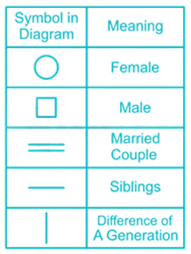
Given:-
There is three generations having seven members and no single person is parent.
Now,
1) P is the spouse of Z and they have only one child.
2) W is the daughter-in-law of Z, who is the grandfather of X. It means P and Z have a son and Z is a male and P is a female and X is the daughter of the son of P and W.

3) M is the sister-in-law of X. M can be the wife of the brother of X or M can be the sister of the husband of X.
4) K is the father of R. K can be the father of X as there are only three generations.
5) K has only one daughter. It means R is the son of K. Also, M is the wife of R.
Thus, the following family tree can be drawn:

R is the grandson of Z.
Hence, the correct answer is Grandson.
23. Direction: Study the information given below carefully and answer the questions that follow.How many pairs of letters are there in the word “VASELINE” that have the same number of letters between them in the word (in both forward and backward directions), as they have in the English alphabetical series?
A. One
B. Three
C. Five
D. Four
E. Six
Solution
Given word: VASELINE
The given word can be represented as follows:

Thus, there is one pair → Forward: LNHence, One is the correct answer.
24. Direction: Study the following information carefully and answer the given questions.Eight people P, Q, R, S, T, U, V, and W are seated around a circular table facing the center but not necessarily in the same order. P is second to the right of R, who is the neighbor of W, and V. Q is the neighbor of T. W is not the neighbor of P and U. Q is third to the right of U.
Question:
How many persons are between R and T when counted left of R?
A. One
B. none
C. three
D. four
E. two
Solution
1) P is second to the right of R, who is the neighbor of W and V.
2) W is not the neighbor of P and U.

3) Q is the neighbor of T.
4) Q is third to the right of U.

Hence, two persons are between R and T when counted left of R.
25. Direction: Study the following information carefully and answer the given questions.Eight people P, Q, R, S, T, U, V, and W are seated around a circular table facing the center but not necessarily in the same order. P is second to the right of R, who is the neighbor of W, and V. Q is the neighbor of T. W is not the neighbor of P and U. Q is third to the right of U.
Question:
Four among the five are same in a certain way and thus form a group. Which among the following does not belong to the group?
A. PQ
B. VT
C. RS
D. WU
E. VU
Solution
1) P is second to the right of R, who is the neighbor of W and V.
2) W is not the neighbor of P and U.
3) Q is the neighbor of T.
4) Q is third to the right of U.
The First-person faces the second person in all except VU.Hence, VU does not belong to the group.
26. Direction: Study the following information carefully and answer the given questions.Eight people P, Q, R, S, T, U, V, and W are seated around a circular table facing the center but not necessarily in the same order. P is second to the right of R, who is the neighbor of W, and V. Q is the neighbor of T. W is not the neighbor of P and U. Q is third to the right of U.
Question:
Who are the immediate neighbors of P?
A. V and R
B. Q and S
C. U and V
D. U and S
E. V and S
Solution
1) P is second to the right of R, who is the neighbor of W and V.
2) W is not the neighbor of P and U.
3) Q is the neighbor of T.
4) Q is third to the right of U.
Hence, U and V are immediate neighbors of P.
27. Direction: Study the following information carefully and answer the given questions.Eight people P, Q, R, S, T, U, V, and W are seated around a circular table facing the center but not necessarily in the same order. P is second to the right of R, who is the neighbor of W, and V. Q is the neighbor of T. W is not the neighbor of P and U. Q is third to the right of U.
Question:
What is the position of U?
A. immediate left of P
B. immediate right of S
C. immediate left of S
D. third to the left of P
E. None of the above
Solution
1) P is second to the right of R, who is the neighbor of W and V.
2) W is not the neighbor of P and U.
3) Q is the neighbor of T.
4) Q is third to the right of U.
Hence, U is immediate left of S.
28. Direction: Study the following information carefully and answer the given questions.Eight people P, Q, R, S, T, U, V, and W are seated around a circular table facing the center but not necessarily in the same order. P is second to the right of R, who is the neighbor of W, and V. Q is the neighbor of T. W is not the neighbor of P and U. Q is third to the right of U.
Question:
Who is sitting third to the left of W?
A. S
B. P
C. U
D. Q
E. R
Solution
1) P is second to the right of R, who is the neighbor of W and V.
2) W is not the neighbor of P and U.
3) Q is the neighbor of T.
4) Q is third to the right of U.
Hence, S is sitting third to the left of W.
29. Directions: In the following question assuming the given statements to be True, find which of the conclusion among given conclusions is/are definitely true and then give your answers accordingly.
Statements:
P ≤ V > M; F > Z < D = P
Conclusions:
I. Z > M II. F < V
A. Only Conclusion I is True.
B. Only Conclusions II is True.
C. Either Conclusion I or II is True.
D. Both Conclusions I and II are True.
E. Neither Conclusion I nor II is True.
Solution
Given statements: P ≤ V > M; F > Z < D = P
On combining: F > Z < D = P ≤ V > M
Conclusions:
I. Z > M → False (as Z < D = P ≤ V > M → relation can’t be determined)
II. F < V → False (as F > Z < D = P ≤ V → relation can’t be determined)Hence, neither conclusion I nor II is True.
30. Directions: In the following question assuming the given statements to be True, find which of the conclusion among given conclusions is/are definitely true and then give your answers accordingly.
Statements:
F ≤ O < T; T = Z = D > R
Conclusions:
I. D > O II. O < Z
A. Only Conclusion I is True.
B. Only Conclusions II is True.
C. Either Conclusion I or II is True.
D. Both Conclusions I and II are True.
E. Neither Conclusion I nor II is True.
Solution
Given statements: F ≤ O < T; T = Z = D > R
On combining: F ≤ O < T = Z = D > R
Conclusions:
I. D > O → True (O < T = Z = D → therefore O < D)
II. O < Z → True (as O < T = Z → therefore O < Z)Hence, both conclusions I and II are True.
31. Directions: In the following question assuming the given statements to be True, find which of the conclusion among given conclusions is/are definitely true and then give your answers accordingly.
Statements:
H = S ≤ V > N; J = X < M = H
Conclusions:
I. M = VII. V > M
A. Only Conclusion I is True.
B. Only Conclusions II is True.
C. Either Conclusion I or II is True.
D. Both Conclusions I and II are True.
E. Neither Conclusion I nor II is True.
Solution
Given statements: H = S ≤ V > N; J = X < M = H
On combining: J = X < M = H = S ≤ V > N
Conclusions:
I. M = V → False (as M = H = S ≤ V → therefore V ≥ M)
II. V > M → False (as M = H = S ≤ V → therefore V ≥ M)
Note: Conclusion I and II are complementary pair.Hence, either conclusion I or II is True.
32. Directions: In the following question assuming the given statements to be True, find which of the conclusion among given conclusions is/are definitely true and then give your answers accordingly.
Statements:
S < L ≤ M; Q = E ≤ X < M
Conclusions:
I. Q ≥ S II. E < L
A. Only Conclusion I is True.
B. Only Conclusions II is True.
C. Either Conclusion I or II is True.
D. Both Conclusions I and II are True.
E. Neither Conclusion I nor II is True.
Solution
Given statements: S < L ≤ M; Q = E ≤ X < M
On combining: Q = E ≤ X < M ≥ L > S
Conclusions:
I. Q ≥ S → False (as Q = E ≤ X < M ≥ L > S → relation can’t be determined)
II. E < L → False (as E ≤ X < M ≥ L → relation can’t be determined)Hence, neither conclusion I nor II is True
33. Directions: Study the information given below carefully and answer the questions that follow.
Sana walks 10 m in the north from his club and reaches to point M. Now, she taker her left turn and goes 15 m to reach point R. After that she takes her right turn and goes 20 m to reach point Y. From point Y, Sana takes her left turn and goes 12 m to reach her farm house.
Question:
If point D is 5 m south of Sana’s farm house, then point M is in which direction with respect to point D?
A. North east
B. North west
C. North
D. South west
E. South east
Solution
We have drawn the figure according to the information given in the question,

If point D is 5 m south of Sana’s farm house:
Then, the figure is:
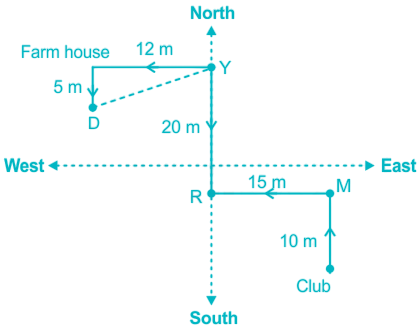
Hence, point M is in south east direction with respect to point D.
34. Directions: Study the information given below carefully and answer the questions that follow.
Sana walks 10 m in the north from his club and reaches to point M. Now, she taker her left turn and goes 15 m to reach point R. After that she takes her right turn and goes 20 m to reach point Y. From point Y, Sana takes her left turn and goes 12 m to reach her farm house.
Question:
If point D is 5 m south of Sana’s farm house, then what is the shortest distance between point D and point Y?
A. 12 m
B. 5 m
C. 7 m
D. 15 m
E. 13 m
Solution
We have drawn the figure according to the information given in the question,

If point D is 5 m south of Sana’s farm house:
Then, the figure is:
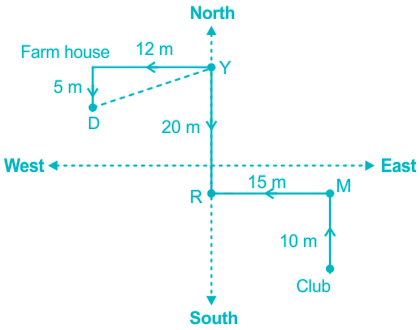
So, the shortest between point Y and point D is:
⇒ 122 + 52 = √144 + 25 = √169 = 13
Hence, the shortest distance between point D and point Y is 13 m.
35. Directions: Study the information given below carefully and answer the questions that follow.
Sana walks 10 m in the north from his club and reaches to point M. Now, she taker her left turn and goes 15 m to reach point R. After that she takes her right turn and goes 20 m to reach point Y. From point Y, Sana takes her left turn and goes 12 m to reach her farm house.
Question:
Sana’s club is in which direction with respect to her Farm house?
A. South west
B. North east
C. North west
D. South east
E. East
Solution
We have drawn the figure according to the information given in the question,
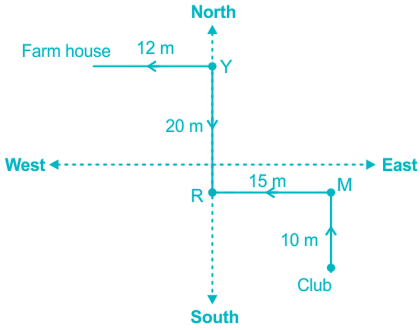
Hence, Sana’s club is in south east direction with respect to her Farm house.
36. What should come in place of the question mark ‘?’ in the following number series?
5, 10, 20, 40, 80, ?
A. 140
B. 160
C. 150
D. 120
E. 110
Solution
Given Series:
5, 10, 20, 40, 80, ?
The logic followed here is as follows:
⇒ 5 × 2 = 10
⇒ 10 × 2 = 20
⇒ 20 × 2 = 40
⇒ 40 × 2 = 80
⇒ 80 × 2 = 160
Hence, 160 will come in the place of (?).
37. What should come in place of the question mark ‘?’ in the following number series?
2, 3, 7, 22, 89, ?
A. 410
B. 419
C. 429
D. 446
E. 467
Solution
Given Series:
2, 3, 7, 22, 89, ?
The logic followed here is as follows:
⇒ 2 × 1 + 1 = 3
⇒ 3 × 2 + 1 = 7
⇒ 7 × 3 + 1 = 22
⇒ 22 × 4 + 1 = 89
⇒ 89 × 5 + 1 = 446
Hence, 446 will come in the place of (?).
38. Find the missing number in the series
12, 26, 50, 102, ?, 406
A. 204
B. 206
C. 202
D. 200
E. 208
Solution
Calculation:
The series follows the following pattern
⇒ 12 × 2 + 2 =26
⇒ 26 × 2 – 2 = 50
⇒ 50 × 2 + 2 = 102
⇒ 102 × 2 – 2 = 202
⇒ 202 × 2 + 2 = 406
∴ The missing number is 202
39. What should come in the place of (?) in the given series ?
43, 54, 67, 84, 103, ?
A. 119
B. 135
C. 125
D. 143
E. 126
Solution
Solution :
The series follows the following pattern :
Consecutive prime number
⇒43+11 = 54
⇒54+13 = 67
⇒67+17 = 84
⇒84+19 = 103
⇒103+23 = 126
⇒ The next term in the series will be 126 .
Hence 126 is the correct answer.
40. What should come in the place of (?) in the given series?
3983, 3694, 3525, 3404, 3355, 3330, ?
A. 3321
B. 3304
C. 3298
D. 3297
E. 3306
Solution
Solution :
The series follows the following pattern :
Consecutive prime number
⇒3983-172 = 3694
⇒3694-132 = 3525
⇒3525-112 = 3404
⇒3404-72 = 3355
⇒3355-52 = 3330
⇒3330-32 = 3321
⇒ The next term in the series will be 3321.
Hence 3321 is the correct answer.
41. if the average score of X and Y is 41.5 , the average score of Y and Z is 62.5 and the average score of Z and X is 54.95, then find the score of W who got 19.45 marks more than Y.
A. 49.05
B. 75.95
C. 53.4
D. 49.5
E. 68.5
Solution
Given:
The average score of X and Y is 41.5
The average score of Y and Z is 62.5
The average score of Z and X is 54.95
Formula used:
Total Sum = Average × No of terms
Calculation:
Total score of X and Y = 41.5 × 2
X + Y = 83 ——-(1)
Total score of Y and Z = 62.5 × 2
Y + Z = 125 ——-(2)
Total score of Z and X = 54.95 × 2
Z + X = 109.9 ——–(3)
By adding equations (1), (2) and (3)
2 (X + Y + Z) = 83 + 125 + 109.9
X + Y + Z = 317.9/2
X + Y + Z = 158.95 ———(4)
Subtracting equation (3) from (4),
X + Y + Z – (Z + X) = 158.95 – 109.9
Y = 49.05
Score of W = Y + 19.45 marks
= 68.5
∴∴ The correct answer is 68.5.
42. Pipe X, Y, and Z can fill a reservoir in 8 hrs. After working at it together for 2 hrs, Z is closed but X and Y can fill the remaining part in 12 hrs. How much time will taken by Z to fill the reservoir?
A. 21 hrs
B. 10 hrs
C. 16 hrs
D. 25 hrs
E. None of these
Solution
Given:
Pipe X, Y and Z can fill the reservoir in 8 hrs
Three pipes together work for 2 hrs
The remaining part X and Y can fill in 12 hrs
Concept used:
Let, Pipe A can fill a tank in x hrs
⇒ Pipe A can fill a tank in 1 hr = 1/x
Calculation:
Pipe X, Y and Z can fill a reservoir in 8 hrs
⇒ Pipe X, Y and Z fill the reservoir in 1 hr = 1/8
⇒ Pipe X, Y and Z fill the reservoir in 2 hr = 2/8 = 1/4
⇒ Remaining part to be filled = (1 – 1/4) = 3/4
(X + Y) can fill the reservoir in 12 hrs = 3/4
⇒ (X + Y) can fill the reservoir in 1 hr = 1/16
⇒ Z alone can fill the cistern in (1/8) – (1/16) = (1/16) = 16 hrs
∴ The time in which Z will fill the reservoir is 16 hrs.
43. In a company, three persons A, B, and C share their profit in the ratio 4 : 7 : 3 respectively. B retired from the company and, A & C decided to share the profit in the ratio 4 : 3. Calculate the ratio of their gain.
A. 3 : 4
B. 4 : 3
C. 3 : 5
D. 5 : 3
E. 4 : 5
Solution
Given:
A, B, and C share their profit in the ratio 4 : 7 : 3 respectively
B retired from the company and, A & C decided to share the profit in the ratio 4 : 3
Calculation:
The initial profit share of A = 4/(4 + 7 + 3) = 4/14 unit
The initial profit share of C = 3/(4 + 7 + 3) = 3/14 unit
After B retired,
The profit share of A = 4/(4 + 3) = 4/7
The profit share of C = 3/(4 + 3) = 3/7
Gain of A = (4/7) – (4/14) = 28/98
Gain of C = (3/7) – (3/14) = 21/98
The respective ratio of gain of A and C = (28/98) : (21/98) = 4 : 3
∴ The correct answer is option 2
44. A 180 lit mixture (curd + water) contains curd and water in the ratio 7:5 respectively. If 15 lit of curd and 5 lit of water are added, then what will be the ratio of quantity of curd to that of water in the resultant mixture?
A. 3:2
B. 2:5
C. 5:3
D. 7:2
E. 2:7
Solution
Solution:
The original mixture is 180 liters, composed of curd and water in the ratio 7:5.
The quantity of curd in the original mixture = (7/12) × 180 liters = 105 liters
The quantity of water in the original mixture = (5/12) × 180 liters = 75 liters
Now, 15 liters of curd and 5 liters of water are added to the mixture.
New quantity of curd = 105 liters + 15 liters = 120 liters
New quantity of water = 75 liters + 5 liters = 80 liters
The ratio of curd to water in the new mixture = 120 : 80 = 3 : 2
Therefore, in the resultant mixture, the ratio of the quantity of curd to that of water is 3:2.
45. Directions: Pie chart given below show the investment of a government entity (in crore) in different sectors. Study the pie chart and answer the following.

Question:
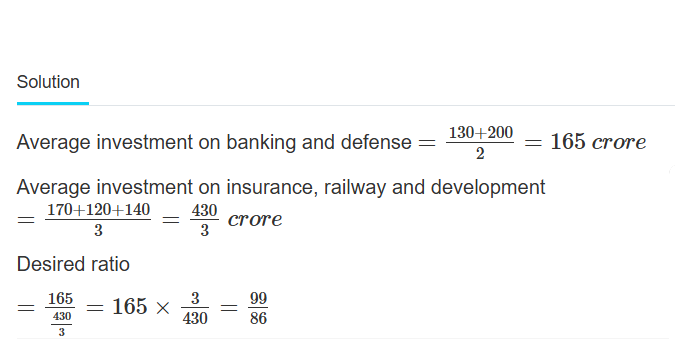
What is the ratio of average investment on banking and defense sector to the average investment on insurance, railway and development sector?
A. 72 : 101
B. 99 : 86
C. 67 : 86
D. 86 : 67
E. 65 : 86
46. Directions: Pie chart given below show the investment of a government entity (in crore) in different sectors. Study the pie chart and answer the following.
Question:
What is the percentage of investment in banking sector to the investment in railway sector?
A. 110%
B. 114%
C. 112%
D. 116%
E. None of these

47. Directions: Pie chart given below show the investment of a government entity (in crore) in different sectors. Study the pie chart and answer the following.
Question:
What is the central angle for food and grain sectors?
A. 84°
B. 84.2°
C. 84.4°
D. 86.4°
E. 84.8°
Solution
Given:-
Food and grains% = 24
Total investment = 1000 crore
Calculation:-
Total investment in food and grains = (24/100) × 1000 = 240 crore
For 1000 crore, central angle = 360o
∴ for 240 crore = 240 × (360/1000)
= 240 × 0.360
= 86.4o
∴ the central angle for food and grains is 86.4o.
48. Directions: Pie chart given below show the investment of a government entity (in crore) in different sectors. Study the pie chart and answer the following.
Question:
If the investment in railway and defense sector is increased by 15% and 25% respectively the how much percentage increase is there in the total investments (in percentage)?
A. 6.8%
B. 7%
C. 7.2%
D. 6.6%
E. 6.4%

49. Directions: Pie chart given below show the investment of a government entity (in crore) in different sectors. Study the pie chart and answer the following.
Question:
If the government reduces the investment on defense sector by 20% and distribution this money on railway and insurance sector in the ratio 5 : 3 than investment in insurance sector changed by what percentage? (Approximately)
A. 8% decrease
B. 8.8% increase
C. 10.2% increase
D. 11% increase
E. 10.5% decrease

50. Sachin has Rs 2 coins, 50 paise coins, Rs 5 coins only in the ratio of 6 : 7 : 8 respectively, the total amount with him is Rs 333. Find the number of Rs 2 coins has Sachin?
A. 36
B. 24
C. 72
D. 32
E. 40
Solution
Sachin have 3 type denominations of coins Rs 2 and 50 paise and Rs 5 coins
| Types | Rs 2 coins | 50paise coins | Rs 5 coins |
| Ratio of coin | 6 | 7 | 8 |
| value of coin | 6× 2 | 7× 1/2 | 8× 5 |
Total amount that sachin has is Rs 333
Total value of three types of coins is 12 + 7/ 2 +40
⇒(24 + 7 + 80) / 2
⇒111 / 2 = Rs 333
⇒Rs 666
⇒1unit = Rs 6
Then the no of Rs 2 coins has Sachin
6× 6 = 36
Hence 36 is the correct answer.
51. A sum of Rs.8000 is invested in a bank offering 20% annual interest rate, compounded half-yearly for one year. Find the total amount accumulated by the end of the year.
A. Rs.9800
B. Rs.9968
C. Rs.9600
D. Rs.10200
E. None of these
Solution
Given:
Principal = Rs.8000, Rate = 20%, compounded half-yearly, Time = 1 year
Formula Used:
Amount = Principal × (1 + R200)Time×2
Calculation:
⇒ Amount = 8000 × (1 + 20/200)2
⇒ (1 + 20/200)2 = 1.12
⇒ Amount = 8000 × 1.21
⇒ Amount = 9680
∴ The total amount accumulated by the end of the year is Rs.9680.
52. wo runners A and B start running at 22 kmph and 8 kmph towards each other. They meet after 1 hour and 30 minutes. How far (in km) were they from each other when they started?
A. 42 km
B. 40 km
C. 45 km
D. 48 km
E. 52 km
Solution
Given:
Speed of A = 22 kmph
Speed of B = 8 kmph
Time taken by them to meet, when running towards each other = 1hr 30min or 1.5 hrs
Formula used:
When two bodies A and B are moving with speed ‘a’ kmph and ‘b’ kmph respectively, then the relative speed of two bodies is
(i) (a + b) kmph if they are moving in opposite direction
(ii) (a – b) kmph if they are moving in same direction
Distance = Relative speed × time taken
Calculation:
Relative speed of A and B = 22 + 8 = 30 kmph
Distance between them, when they started = 30 × 1.5 = 45 kmHence, distance between them before starting is 45 km
53. What should come in place of ‘?’ in the following question?
91 ÷ 7 × 4 + √784 – 103 + 2 × 42 = ? × 3
A. 3
B. 7
C. 5
D. -2
E. 1
Solution
Correct answer is: 1
Concept used:
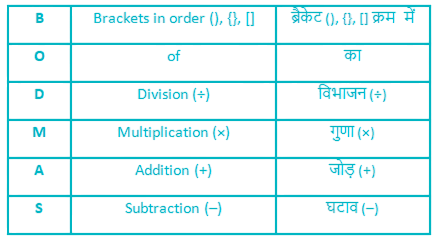
The BODMAS rule should be followed to solve the question as per the given table:

Calculation:
91 ÷ 7 × 4 + √784 – 103 + 2 × 42 = ? × 3
⇒ 13 × 4 + 28 – 103 + 2 × 16 = ? × 3
⇒ 52 + 28 – 103 + 32 = ? × 3
⇒ 112 – 103 = ? × 3
⇒ 9 = ? × 3
⇒ ? = 3
∴The value of ? is 3
54. What will come in the place of the question mark ‘?’ in the following question?
36 × 8 – 4 × 3 – 71 × 4 + 24 ÷ 2 = ? ÷ 48
A. 196
B. 197
C. 198
D. 192
E. 201
Solution
Concept used:
Follow BODMAS rule to solve this question, as per the order given below,
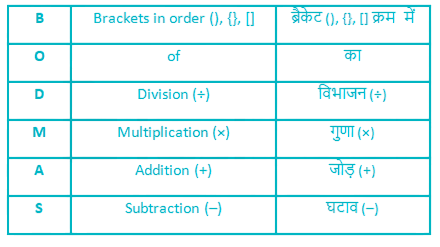
Calculation:
36 × 8 – 4 × 3 – 71 × 4 + 24 ÷ 2 = ? ÷ 48
⇒ 288 – 12 – 284 + 12 = ? ÷ 48
⇒ 288 + 12 – 12 – 284 = ? ÷ 48
⇒ 300 – 296 = ? ÷ 48
⇒ 4 = ? ÷ 48
⇒ 4 × 48 = ?
⇒ 192 = ?
∴ Value of ? is 192
55. Find the value of ‘?’ in the given question:-
5265 ÷ 117 + 67 × 85 – 1172 + 289 = (?)
A. 5197
B. 4878
C. 4529
D. 4798
E. None of these
Solution
Concept used:
Follow BODMAS rule to solve this question, as per the order given below,
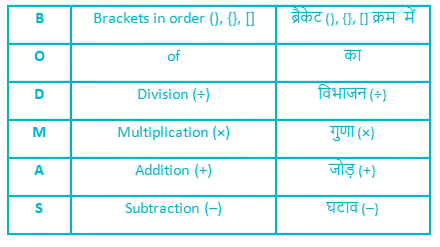
Calculation:
5265 ÷ 117 + 67 × 85 – 1172 + 289 = (?)
45 + 5695 – 1172 + 289 = (?)(?) = 4857
56. Find the value of ‘?’ in the given question:-
3/5 of (5/12 ÷ 3/4 × 1/6 + 3/8 – 2/5) = ? /900
A. 32.5
B. 36.5
C. 39.5
D. 29.5
E. 42.5
Solution
Concept used:
Follow BODMAS rule to solve this question, as per the order given below,

Calculation:
3/5 of (5/12 ÷ 3/4 × 1/6 + 3/8 – 2/5) = ? /900
⇒ 3/5 × (5/12 × 4/3 × 1/6 + 3/8 – 2/5) = ? /900
⇒ 3/5 × (5/54 + 3/8 – 2/5) = ? /900
⇒ 3/5 × (5/54 + 3/8 – 2/5) = ? /900
⇒ 3/5 × (101/216 – 2/5) = ? /900
⇒ 3/5 × (5/54 – 1/40) = ? /900
⇒ 3/5 × 73/1080 = ? /900
⇒73/1800 = ? /900⇒ ? = 36.5
57. Find the value of ‘?’ in the given question:-
(150.88 ÷ 16.4) × (17.1 ÷ 3.8) = 165.6 ÷ (?)
A. 2
B. 3
C. 4
D. 5
E. 6
Solution
Concept used:
Follow BODMAS rule to solve this question, as per the order given below,

Calculation:
(150.88 ÷ 16.4) × (17.1 ÷ 3.8) = 165.6 ÷ (?)
9.2 × 4.5 = 165.6 ÷ (?)
(?) = 165.6 / 41.4
(?) = 4
58. Find the value of ‘?’ in the given question:-
✓[1331(1 / 3) + 1728(1 / 3) + 2] = ?
A. 5
B. 6
C. 7
D. 8
E. 9
Solution
Concept used:
Follow BODMAS rule to solve this question, as per the order given below,

Calculation:
✓[1331(1 / 3) + 1728(1 / 3) + 2] = ?
= ✓(11 + 12 + 2)= ✓25 = 5
59. What approximate value will come in the place of question mark ‘?’ in the following question?
23% of 4678 + 58% of 5814 = ?
A. 4448
B. 4558
C. 4589
D. 4517
E. 4548
Solution
Given:
23% of 4678 + 58% of 5814
Concept used:
We have to follow the BODMAS rule

Calculation:
(23/100) of 4678 + (58/100) of 5814 = ?
⇒ 1075.94 + 3372.12 = ?
⇒ 4448.06 = ?
⇒ ? ≈ 4448
∴ The value of ? is 4448.
60. What will come in the place of the question mark ‘?’ in the following question?
784 ÷ 14 + 598 ÷ 13 + ? = 80% of 1200
A. 758
B. 958
C. 848
D. 858
E. None of these
Solution
Concept used:

Calculation:
784 ÷ 14 + 598 ÷ 13 + ? = 80% of 1200
⇒ 784 ÷ 14 + 598 ÷ 13 + ? = (80/100) × 1200
⇒ 784 ÷ 14 + 598 ÷ 13 + ? = 80 × 12
⇒ 56 + 46 + ? = 80 × 12
⇒ 56 + 46 + ? = 960
⇒ 102 + ? = 960
⇒ ? = 960 – 102
⇒ ? = 858
∴ The value of ? is 858
61. What will come in the place of the question mark ‘?’ in the following question?
420 ÷ 7 + 6 × 7 + ? = 534
A. 432
B. 462
C. 472
D. 392
E. None of these.
Solution
Given:
420 ÷ 7 + 6 × 7 + ? = 534
Concept used:
Follow the BODMAS rule according to the table given below:

Calculation:
420 ÷ 7 + 6 × 7 + ? = 534
⇒ 60 + 42 + ? = 534
⇒ 102 + ? = 534
⇒ ? = 534 – 102 = 432
∴ The value of ? is 432.
62. What will come in the place of the question mark ‘?’ in the following question?
45% × 200 + 10 × 30% + √144 × 2 = ?
A. 105
B. 117
C. 119
D. 120
E. None
Solution
Concept used:
This type of question can be solved by the help of BODMAS
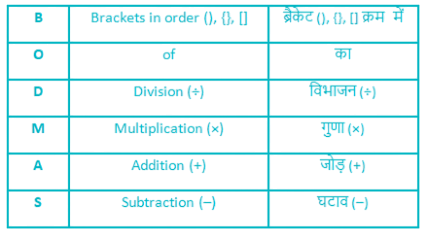
Calculation:
45% × 200 + 10 × 30% + √144 × 2 = ?
⇒ (45/100) × 200 + 10 × (30/100) + 12 × 2 = ?
⇒ 90 + 3 + 24 = ?
⇒ x = 117
∴ The value of ? is 117
63. What will come in the place of the question mark ‘?’ in the following question?
24% × 300 + √144 + 12% × 500 + √64 = ?
A. 120
B. 152
C. 202
D. 220
E. None of the above
Solution
Given:
24% × 300 + √144 + 12% × 500 + √64 = ?
Concept Used:
This type of question can be solved by the help of BODMAS

Calculation:
24% × 300 + √144 + 12% × 500 + √64 = ?
⇒ (24/100) × 300 + 12 + (12/100) × 500 + 8 = ?
⇒ 72 + 12 + 60 + 8 = ?
⇒ ? = 152
∴ 152 will come in place of the question mark (‘?’).
64. What will come in the place of the question mark ‘?’ in the following question?
20% of √25 – 25% of 120 + 70% of 1000 = ?
A. 145
B. 540
C. 780
D. 671
E. 840
Solution
Concept used:
Follow BODMAS rule to solve this question, as per the order given below,

Calculations:
20% of √25 – 25% of 120 + 70% of 1000 = ?
⇒ (20/100) × √25 – (25/100) × 120 + (70/100) × 1000 = ?
⇒ (20/100) × 5 – 30 + 700 = ?
⇒ 1 – 30 + 700 = ?
⇒ ? = 701 – 30 = 671
∴ The value of ? is 671
65. What will come in the place of the question mark ‘?’ in the following question?
48% of 800 – 52% of 800 + 50% of 1000 = ?
A. 1300
B. 300
C. 46.8
D. 4680
E. 468
Solution
Concept used:

Calculation:
48% of 800 – 52% of 800 + 50% of 1000 = ?
⇒ 384 – 416 + 500 = ?
⇒ 884 – 416 = ?
⇒ 468 = ?
∴ The value of ? is 468
66. What should come in the place of the question mark ‘?’.
(1.331 – 2.197)/(1.12 + 1.43 + 2.1972/3) = ?
A. 0.2
B. -0.2
C. 0.02
D. -0.02
E. 0.1
Solution
Concept used:

Let’s use the identity: a3 – b3 = (a – b)(a2 + ab + b2)
Calculation:
(1.331 – 2.197)/(1.12 + 1.43 + 2.1972/3) = ?
⇒ (1.13 – 1.33)/[1.12 + 1.1 × 1.3 + (1.3)3 × 2/3 ] = ?
⇒ (1.13 – 1.33)/(1.12 + 1.1 × 1.3 + 1.32) = ?
⇒ [(1.1 – 1.3)(1.12 + 1.1 × 1.3 + 1.32)]/(1.12 + 1.1 × 1.3 + 1.32) = ?
⇒ 1.1 – 1.3 = (-0.2) = ?
∴ The value of ‘?’ is (-0.2).
67. What should come in place of the question mark ‘?’.
5% of 2% of 500 of 200 of 52 + 22 of 25 = ?
A. 2600
B. 2040
C. 3000
D. 3040
E. 2050
Solution
Concept used:
Follow BODMAS rule to solve this question, as per the order given below,
Calculation:
5% of 2% of 500 of 200 of 52 + 22 of 25 = ?
⇒ (5/100) × (2/100) × 500 × 200 × 25 + 4 × 25 = ?
⇒ 2500 + 100 = ?
⇒ 2600 = ?
∴ The value of ‘?’ is 2600.
68. School A has eight players. A five-member team will be selected out of these eight players. How many different selections can be made?
A. 66
B. 56
C. 46
D. 36
E. 86
Solution
Formula used:

Calculation:
In this case, n = 8 and r = 5. Substituting these values in the formula, we get:
⇒ 8C5 = 8! / (5! × (8-5)!)
= (8 x 7 x 6 x 5 x 4) / (5 x 4 x 3 x 2 x 1)
= 56
Hence, the correct answer is option 2.
69. NIkhil bought a painting at a certain price and sold it at Rs. 462000 which was 10% more than the cost price. What was the price at which NIkhil bought the painting?
A. Rs. 420000
B. Rs. 440000
C. Rs. 402000
D. Cannot be determined
E. none of these
Solution
Given
SP = Rs.4,62,000
Formula used
SP = Profit + CP
Calculation
Let CP be 100%
According to question
⇒ 110% = 462000
⇒ 1% = =4200
⇒ 100% = Rs.420000
∴ The price at which NIkhil bought the painting is Rs.420000
70. The area of a square is 144 cm². The base of the triangle is 2/3 of the side of the square and the area of the triangle is 60 cm². Find the height of the triangle.
A. 27 cm
B. 18 cm
C. 12 cm
D. 15 cm
E. 21 cm
Solution
Solution:
Area of the square = 144 cm²
Side of the square = √144 = 12 cm
Base of the triangle = 12 × 2/3 = 8 cm
Area of the triangle= 60 cm²
(1/2) × b × h = 60
(1/2) × 8 × h = 60
h = 60/4
h = 15 cm
Height of the triangle = 15 cm
71. Read the following sentence and determine whether there is an error in it. The error, if any, will be in one part of the sentence. If the sentence is error-free, then select ‘No Error’ as your answer.
The wards of the hostel are (A)/ allowed to do (B)/ anything except to go out (C)/ on their own at night. (D) No error (E)
A. A
B. B
C. C
D. D
E. E
Solution
The correct answer is anything except to go out – the error lies in this part only.
Key Points
In the given sentence, the error is in part C, where to should be removed because when ‘except’ links two clauses, the second clause usually begins with a bare infinitive.
- Therefore the correct usage must be ‘anything except go out on their own’to rectify the erroneous part.
Thus, the correct sentence is: The wards of the hostel are allowed to do anything except go out on their own at night.
Additional Information
Bare Infinitive: The bare infinitive is a type of complement with an infinitive verb form that’s not preceded by the word ‘to’.
The bare infinitive is used after verbs of perception (see, feel, hear), many auxiliary verbs (may, should, must), the verbs make and let, and the expressions had better and would rather.
72. Read the sentence below to find out if there is any error in it. The error, if any, will be in one part of the sentence. The letter of that part is the answer. If there is no error the answer is (5). (Ignore errors in punctuation if any).
Darshana, the most eminent (A)/ dancer in our class can not(B)/ dance because she(C)/ has leg injury.(D)/No error(E)
A. A
B. B
C. C
D. D
E. E
Solution
The correct answer is option 2.
KEY POINTS:
- In the given sentence error is in part B, The error is in the use of Can not.
- The thing to remember is when you use “not” with “can” to express a negative statement, you always put them together.
- They actually become one word: “cannot”, and not “can not”.
- This is the only time you join a modal verb with “not” into one.
- But with the other models, “not” is always a separate word.
Correct answer – Darshana the most eminent dancer in our class cannot dance because she has a leg injury.
Additional Information:
SHOULD is used for giving advice: You should revise the book before the exam.
A modal verb is a type of verb that is used to indicate modality
Eg. likelihood, ability, permission, request, capacity, suggestions, order, obligation, or advice. …
In English, the modal verbs commonly used are can, could, may, might, shall, should, will, would, and must.
CAN show possibility: Driving on slippery roads can cause an accident.
COULD express the possibility: The building could collapse if they don’t do repairs.
MAY express permission: May I borrow your cake?
MIGHT convey the possibility: I might move to Kurla next year.
73. Read the sentence below to find out if there is any error in it. The error, if any, will be in one part of the sentence. The letter of that part is the answer. If there is no error the answer is (5). (Ignore errors in punctuation, if any).
Sachin Patra cannot (A)/ buy a newly available chocolate (B)/ in market because he (C)/ doesn’t have enough money. (D)/No error (E)
A. A
B. B
C. C
D. D
E. E
Solution
The correct answer is Option 3.
Key Points
- The primary issue in the sentence is the omission of the article “the” before the term “market.”
- Definite articles such as “the” are necessary before specific singular nouns.
- The correct phrase should be “in the market,” ensuring grammatical correctness and clarity.
- Thus, the error is located in part C of the sentence.
Therefore, the correct answer is C.
Correct Sentence: “Sachin Patra cannot buy a newly available chocolate in the market because he doesn’t have enough money.”
Additional Information
No error – This would be the correct option if there were no mistakes in the sentence, but there is an error in part C.
A: “Sachin Patra cannot” – This part of the sentence is grammatically correct and does not require any changes.
B: “buy a newly available chocolate” – This part of the sentence is grammatically correct and does not require any changes.
D: “doesn’t have enough money.” – This part of the sentence is grammatically correct and does not require any changes.
74. Read the sentence below to find out if there is any error in it. The error, if any, will be in one part of the sentence. The letter of that part is the answer. If there is no error the answer is (5). (Ignore errors in punctuation if any).
Activities under various (A)/categories might now be (B)/allowed or restricted based(C)/ on the cumulative positivity rate(D)/No error(E)
A. A
B. B
C. C
D. D
E. E
Solution
The correct answer is option 2.
Key Points:
- In the given sentence error is in part B, The error is in the use of might
- MIGHT convey the possibility
- Eg. I might move to Kurla next year
- Hence in the given sentence Might be replaced with will
- WILL is used to state a promise
- Eg. I will stop playing football.
Correct sentence – Activities under various categories will now be allowed or restricted based on the cumulative positivity rate.
Additional Information:
SHOULD is used for giving advice: You should revise the book before the exam.
A modal verb is a type of verb that is used to indicate modality
Eg. likelihood, ability, permission, request, capacity, suggestions, order, obligation, or advice. …
In English, the modal verbs commonly used are can, could, may, might, shall, should, will, would, and must.
CAN show possibility: Driving on slippery roads can cause an accident.
COULD express the possibility: The building could collapse if they don’t do repairs.
MAY express permission: May I borrow your cake?
MIGHT convey the possibility: I might move to Kurla next year.
75. Direction: Evaluate the following word, accompanied by three sentences containing it. Determine the sentence(s) that accurately convey the meaning of the given word.
Infirmity
A. The old man’s infirmity made it difficult for him to walk without assistance.
B. The project suffered from an infirmity of clear planning and organisation.
C. Due to the car’s infirmity, it couldn’t compete in the race.
A. Only A
B. Both A & B
C. Only C
D. All A, B & C
E. None of these
Solution
The correct answer is option 2.
Key Points
- To answer this question, let’s first understand the meaning of the word given in the question:
- Infirmity: physical or mental weakness. (दुर्बलता, कमजोरी)
- Now, let’s examine the given sentences:
- Sentence A: The old man’s infirmity made it difficult for him to walk without assistance.
- This sentence correctly uses the word “infirmity” to describe physical weakness that makes walking difficult.
- Sentence B: The project suffered from an infirmity of clear planning and organisation.
- This sentence also correctly uses the word “infirmity” to describe a weakness or flaw in the planning and organisation of the project.
- Sentence C: Due to the car’s infirmity, it couldn’t compete in the race.
- This sentence incorrectly uses the word “infirmity” because “infirmity” does not apply to objects like cars; a car cannot have a physical or mental weakness in the way living beings can.
Therefore, the correct answer is “Both A & B.“
76. Directions: Below is a word/phrasal verb/idiom, followed by three sentences incorporating the word/phrasal verb/idiom. Identify the sentence(s) that best illustrate(s) the meaning of the word/phrasal verb/idiom. Choose option 5: “None of the above” if the word/phrasal verb/idiom is not used correctly in any of the sentences.
ECLECTIC
A. The team leader’s eclectic demeanour created a toxic work environment, stifling creativity and collaboration.
B. The restaurant’s menu offered an eclectic array of dishes, blending Asian, Mediterranean, and South American cuisines.
C. The eclectic group of friends brought diverse perspectives and opinions to every conversation they had.
A. Only C
B. Only B
C. Both B and C
D. Both A and B
E. None of the above
Solution
The correct answer is option 3.
Key Points
Therefore, the correct answer is “Both B and C.”
To answer this question, let’s first understand the meaning of the word given in the question:
Eclectic – deriving ideas, style, or taste from a broad and diverse range of sources (विविध)
For Example –
Her eclectic taste in music ranged from classical symphonies to modern pop and indie rock.
Now, let’s examine the given sentences:
Sentence A: The team leader’s eclectic demeanour created a toxic work environment, stifling creativity and collaboration.
The word “eclectic” typically refers to a varied, diverse taste or style, not necessarily contributing to a toxic work environment. Here, the word “arrogant” better denotes the domineering, stifling behaviour of the team leader in this context.
The correct sentence would be: “The team leader’s arrogant demeanour created a toxic work environment, stifling creativity and collaboration.”
Sentence B: The restaurant’s menu offered an eclectic array of dishes, blending Asian, Mediterranean, and South American cuisines.
This sentence fits perfectly with the meaning of “eclectic.” It describes a menu with a diverse range of dishes from different culinary backgrounds, fitting the definition of “eclectic.”
Sentence C: The eclectic group of friends brought diverse perspectives and opinions to every conversation they had.
This sentence also aligns well with the meaning of “eclectic.” It describes a group of friends with varied backgrounds, bringing diverse perspectives to their conversations.
So, after understanding the meaning of the given word, we can conclude that out of the three given sentences, both sentences B and C use the word “eclectic” correctly, while sentence A don’t use it correctly.
77. A sentence/ a part of the sentence is underlined. Five alternatives are given to the underlined part which will improve the meaning of the sentence. Choose the correct alternative. In case no improvement is needed. Click the option corresponding to “No improvement”.
Until the train will not get the signal, it will not leave the platform.
A. will get
B. not gets
C. gets
D. would not get
E. No improvement
Solution
The correct answer is ‘gets’.
Key Points
- Here in the given sentence, ‘will not get’ is used which is wrong.
- If two actions take place one after the other in the future, and if the second action depends on the first action, the first action is in simple present tense and the second action is in the simple future tense.
- Example– She will come to meet you as soon as you reach Delhi.
- ‘Until/ unless’ is not followed by ‘not’.
- So, here we have to omit ‘not’ in the sentence
- Here in the given sentence, first the train will get a signal then only it will leave the platform. It is the first action, so it will in the simple present tense.
The correct sentence: Until the train gets the signal, it will not leave the platform.
78. A sentence/ a part of the sentence is underlined. Five alternatives are given to the underlined part which will improve the meaning of the sentence. Choose the correct alternative. In case no improvement is needed, click the option corresponding to ‘No improvement’.
The morning light was too bright for his eyes, and he turned to face shelves of big old brown antique books.
A. brown old big antique
B. No improvement
C. old big brown antique
D. antique brown big old
E. brown antique old big
Solution
The correct answer is ‘No improvement’.
Key Points
- We need to first identify if the underlined part of the sentence has an error which would lead to its replacement by an appropriate phrase.
- The highlighted phrase is a list of adjectives describing the books on shelves.
- Adjectives occur in a particular order which is : Quantity or number- Quality or opinion – Size- Age -Shape – Color – Proper adjective (often nationality, other place of origin, or material) – Purpose or qualifier.
- In the highlighted phrase, ‘big’ which is an adjective of size occurs before ‘old’ is an adjective of Age.
This makes option 2 the correct answer.
Hence, ‘big old brown antique’ is the correct phrase.
79. A sentence/ a part of the sentence is underlined. Five alternatives are given to the underlined part which will improve the meaning of the sentence. Choose the correct alternative. In case no improvement is needed, click the option corresponding to ‘No improvement’.
The government did not come forward with any programme of universally cash assisting for the workers.
A. university cash assist
B. universally cash assistance
C. universal cash assistance
D. universal cash assisting
E. No improvement
Solution
The correct answer is ‘universal cash assistance’.
Key Points
- We need to first identify if the underlined part of the sentence has an error which would lead to its replacement by an appropriate phrase.
- The underlined part of the sentence has two errors.
- ‘universally’ is an adverb. It cannot be used to modify the noun ‘cash’. It should be replaced by the adjective ‘universal’ which means applicable to all cases.
- ‘assisting’ is the gerund form of the verb ‘assist’. It cannot follow a noun. It can be replaced by the noun ‘assistance’ which means the provision of money, resources, or information to help someone and fits the context of the sentence.
This makes option 3 the correct answer.
Hence, ‘universal cash assistance’ is the correct replacement for the underlined phrase.
80. Direction: Read the passage given below carefully and then answer the following questions that follow.
The name Asia is ancient, and its origin has been variously explained. The Greeks used it to designate the lands situated to the east of their homeland. It is _______ (1) that the name may be derived from the Assyrian word asu, meaning “east.” Another possible explanation is that it was _______ (2) a local name given to the plains of Ephesus, which ancient Greeks and Romans extended to refer first to Anatolia (contemporary Asia Minor, which is the western extreme of mainland Asia), and then to the known world east of the Mediterranean Sea. When Western explorers reached South and East Asia in early modern times, they _______ (3) that label to the whole of the immense landmass.
Asia is bounded by the Arctic Ocean to the north, the Pacific Ocean to the east, the Indian Ocean to the south, the Red Sea (as well as the inland seas of the Atlantic Ocean—the Mediterranean and the Black) to the southwest, and Europe to the west. Asia is separated from North America to the northeast by the Bering Strait and from Australia to the southeast by the seas and straits _______ (4) the Indian and Pacific oceans. The Isthmus of Suez unites Asia with Africa, and it is generally agreed that the Suez Canal forms the border between them. Two narrow straits, the Bosporus and the Dardanelles, _______ (5) Anatolia from the Balkan Peninsula.
Question:
What will come in blank 1?
A. suspected
B. mistrusted
C. believed
D. concluded
E. none of these
Solution
The correct answer is ‘believed‘.
Key Points
- Believed means to accept that (something) is true, especially without proof.
- Example- Many have believed that Walden reached quite through to the other side of the globe.
- The synonyms of ‘believe‘ are- accepted, took, trusted, etc.
- Antonyms of ‘believe‘ are- disbelieved, discredited, rejected,etc.
- Hence, the correct answer is option 3.
Let us look at the meanings of the other options:
| WORD | MEANING | HINDI MEANING |
| Suspected | doubt the genuineness or truth of. | शक किया |
| Mistrusted | be suspicious of; have no confidence in. | संदिग्ध |
| Concluded | bring or come to an end. | समापन करना |
81. Direction: Read the passage given below carefully and then answer the following questions that follow.
The name Asia is ancient, and its origin has been variously explained. The Greeks used it to designate the lands situated to the east of their homeland. It is _______ (1) that the name may be derived from the Assyrian word asu, meaning “east.” Another possible explanation is that it was _______ (2) a local name given to the plains of Ephesus, which ancient Greeks and Romans extended to refer first to Anatolia (contemporary Asia Minor, which is the western extreme of mainland Asia), and then to the known world east of the Mediterranean Sea. When Western explorers reached South and East Asia in early modern times, they _______ (3) that label to the whole of the immense landmass.
Asia is bounded by the Arctic Ocean to the north, the Pacific Ocean to the east, the Indian Ocean to the south, the Red Sea (as well as the inland seas of the Atlantic Ocean—the Mediterranean and the Black) to the southwest, and Europe to the west. Asia is separated from North America to the northeast by the Bering Strait and from Australia to the southeast by the seas and straits _______ (4) the Indian and Pacific oceans. The Isthmus of Suez unites Asia with Africa, and it is generally agreed that the Suez Canal forms the border between them. Two narrow straits, the Bosporus and the Dardanelles, _______ (5) Anatolia from the Balkan Peninsula.
Question:
What will come in blank 2?
A. generously
B. originally
C. secondarily
D. submissively
E. none of the above
Solution
The correct answer is ‘originally‘.
Key Points
- Originally is an adverb for ‘a local name’.
- Original means from or in the beginning; at first.
- The correct sentence – Another possible explanation is that it was originally a local name given to the plains of Ephesus, which ancient Greeks and Romans extended to refer first to Anatolia (contemporary Asia Minor, which is the western extreme of mainland Asia), and then to the known world east of the Mediterranean Sea.
- Hence, the correct answer is option 2.
Additional Information
- Generously (adverb) means in a way that shows a readiness to give more of something, especially money, than is necessary or expected; more than enough.
- Secondarily (adverb) means a secondary or less important factor.
- Submissively (adverb) means ready to conform to the authority or will of others; meekly obedient or passive.
82. Direction: Read the passage given below carefully and then answer the following questions that follow.
The name Asia is ancient, and its origin has been variously explained. The Greeks used it to designate the lands situated to the east of their homeland. It is _______ (1) that the name may be derived from the Assyrian word asu, meaning “east.” Another possible explanation is that it was _______ (2) a local name given to the plains of Ephesus, which ancient Greeks and Romans extended to refer first to Anatolia (contemporary Asia Minor, which is the western extreme of mainland Asia), and then to the known world east of the Mediterranean Sea. When Western explorers reached South and East Asia in early modern times, they _______ (3) that label to the whole of the immense landmass.
Asia is bounded by the Arctic Ocean to the north, the Pacific Ocean to the east, the Indian Ocean to the south, the Red Sea (as well as the inland seas of the Atlantic Ocean—the Mediterranean and the Black) to the southwest, and Europe to the west. Asia is separated from North America to the northeast by the Bering Strait and from Australia to the southeast by the seas and straits _______ (4) the Indian and Pacific oceans. The Isthmus of Suez unites Asia with Africa, and it is generally agreed that the Suez Canal forms the border between them. Two narrow straits, the Bosporus and the Dardanelles, _______ (5) Anatolia from the Balkan Peninsula.
Question:
What will come in blank 3?
A. restricted
B. blocked
C. comprehend
D. extended
E. none of these
Solution
The correct answer is ‘extended‘.
Key Points
- The sentence is talking about the extension of the label to the whole of landmass, “label to the whole of the immense landmass.”
- Extended is the most appropriate answer as it best suits the blank.
- Extended means made larger; enlarged.
- Example- “He is trying to extend his influence in the workplace.”
- Antonyms of ‘extended‘ are- reduce, shrink, narrow.
- Synonyms of ‘extended‘ are- expand, enlarge, increase, lengthen, offer, etc.
- Hence. the correct answer is option 4.
Additional Information
- Let us look at the meanings of the other words in the options:
| WORD | MEANING | HINDI MEANING |
| Restricted | limited in extent, number, scope, or action. | सीमित |
| Blocked | obstructed or congested, so as to make movement or flow difficult or impossible; prevented from being accessed or used. | अवरोधित, अवस्र्द्ध |
| Comprehend | grasp mentally; understand. | समझ |
83. Direction: Read the passage given below carefully and then answer the following questions that follow.
The name Asia is ancient, and its origin has been variously explained. The Greeks used it to designate the lands situated to the east of their homeland. It is _______ (1) that the name may be derived from the Assyrian word asu, meaning “east.” Another possible explanation is that it was _______ (2) a local name given to the plains of Ephesus, which ancient Greeks and Romans extended to refer first to Anatolia (contemporary Asia Minor, which is the western extreme of mainland Asia), and then to the known world east of the Mediterranean Sea. When Western explorers reached South and East Asia in early modern times, they _______ (3) that label to the whole of the immense landmass.
Asia is bounded by the Arctic Ocean to the north, the Pacific Ocean to the east, the Indian Ocean to the south, the Red Sea (as well as the inland seas of the Atlantic Ocean—the Mediterranean and the Black) to the southwest, and Europe to the west. Asia is separated from North America to the northeast by the Bering Strait and from Australia to the southeast by the seas and straits _______ (4) the Indian and Pacific oceans. The Isthmus of Suez unites Asia with Africa, and it is generally agreed that the Suez Canal forms the border between them. Two narrow straits, the Bosporus and the Dardanelles, _______ (5) Anatolia from the Balkan Peninsula.
Question:
What will come in blank 4?
A. connecting
B. optimizing
C. severing
D. disagreeing
E. none of the above
Solution
The correct answer is ‘connecting‘.
Key Points
- Connecting means joining two things; bring together, attach.
- Example– The two rooms are connected.
- Connecting synonyms– attach, join, fasten.
- Connecting antonyms– disconnect, dissociate.
- Here it is talking about the seas and straits that are joining the two oceans. So, the correct answer is ‘connecting‘.
- Hence, the correct answer is option 1.
- Let us look at the meanings of the other options:
| WORD | MEANING | HINDI MEANING |
| Optimizing | make the best or most effective use of | अनुकूलन |
| Severing | divide by cutting or slicing, especially suddenly and forcibly. | अलग करना |
| Disagreeing | have or express a different opinion; differ; vary. | असहमति |
84. Direction: Read the passage given below carefully and then answer the following questions that follow.
The name Asia is ancient, and its origin has been variously explained. The Greeks used it to designate the lands situated to the east of their homeland. It is _______ (1) that the name may be derived from the Assyrian word asu, meaning “east.” Another possible explanation is that it was _______ (2) a local name given to the plains of Ephesus, which ancient Greeks and Romans extended to refer first to Anatolia (contemporary Asia Minor, which is the western extreme of mainland Asia), and then to the known world east of the Mediterranean Sea. When Western explorers reached South and East Asia in early modern times, they _______ (3) that label to the whole of the immense landmass.
Asia is bounded by the Arctic Ocean to the north, the Pacific Ocean to the east, the Indian Ocean to the south, the Red Sea (as well as the inland seas of the Atlantic Ocean—the Mediterranean and the Black) to the southwest, and Europe to the west. Asia is separated from North America to the northeast by the Bering Strait and from Australia to the southeast by the seas and straits _______ (4) the Indian and Pacific oceans. The Isthmus of Suez unites Asia with Africa, and it is generally agreed that the Suez Canal forms the border between them. Two narrow straits, the Bosporus and the Dardanelles, _______ (5) Anatolia from the Balkan Peninsula.
Question:
What will come in blank 5?
A. joins
B. separate
C. differentiate
D. attach
E. none of these
Solution
The correct answer is ‘separate‘.
Key Points
- Two narrow straits, the Bosporus and the Dardanelles, separate Anatolia from the Balkan Peninsula.
- We cannot use ‘joins, differentiate, attach‘ here, as it will change the meaning of the sentence.
- Separate means cause to move or be apart.
- Example– “both owners were trying to separate the dogs”
- Hence, the correct answer is option 2.
85. In the following question, a sentence is given with four words marked as (A), (B), (C) and (D). These words may or may not be placed in the correct order. Four options with different arrangements of these words have been provided. Mark the option with the correct arrangement as the answer. If no rearrangement is required, mark option (5) as your answer.
Although(A) Jack is a his(B) dog lover, he does not allow(C) his pets to sleep on zealous(D) bed.
A. A-D
B. B-C
C. C-D
D. D-B
E. No rearrangement
Solution
The correct answer is D-B.
Key Points
Let us look at the given sentence in the following manner:
- _________ (A) Jack is a _________ (B) dog lover, he does not _________ (C) his pets to sleep on _________ (D) bed.
- From the below-given table, we get to know the meanings of the words in bold.
- In (D) on zealous bed and in (B) his dog lover both are incorrect phrases.
- The sentence tells us that jack is an enthusiastic dog lover but he does not allow his pet to sleep with him on his bed.
- So, D and B should be interchanged to make the sentence correct.
Therefore the correct sentence is, Although Jack is a zealous dog lover, he does not allow his pets to sleep on his bed.
Additional Information
To understand which word belongs to which blank we need to know their meanings as enlisted below:
| Words | Meanings |
| although | in spite of the fact that; even though. |
| zealous | great energy or enthusiasm in pursuit of a cause or an objective. |
| allow | let (someone) have or do something. |
| his | belonging to or associated with a male person or animal previously mentioned or easily identified. |
86. In the following question, a sentence is given with four words marked as (A), (B), (C) and (D). These words may or may not be placed in their correct order. Four options with different arrangements of these words have been provided. Mark the option with the correct arrangement as the answer. If no rearrangement is required, mark option (5) as your answer.
Before you do something (A) you’ll time, (B) why don’t you (C) take some regret (D) off and relax?
A. A-B
B. B-C
C. C-D
D. D-B
E. No rearrangement
Solution
The correct answer is D-B.
Key Points
- Let us look at the given sentence in the following manner –
Before you do ____ (A) you’ll ____, (B) why don’t ____ (C) take some ____ (D) off and relax?
- To understand which word belongs in which blank we need to know its meaning as enlisted below –
| Word | Meaning |
|---|---|
| something | a thing that is unspecified or unknown. |
| time | an indefinite period. |
| you | used to refer to the person or people that the speaker is addressing. |
| regret | feel sad, repentant, or disappointed over (something that one has done or failed to do). |
- From the above meanings it is clear that
- you’ll time is an incorrect phrase.
- take some regret is also incorrect.
- So, B and D should be interchanged to make the sentence correct.
Therefore the correct sentence is – Before you do something you’ll regret, why don’t you take some time off and relax?
Was the solution helpful?Yes
87. Directions: In the following question, a sentence is given with four words marked as (A), (B), (C) and (D). These words may or may not be placed in their correct order. Four options with different arrangements of these words have been provided. Mark the option with the correct arrangement as the answer. If no rearrangement is required, mark option (5) as your answer.
When the Father(A) had finished their work and gone home, brickmasons(B) Gipsy hurried(C) to the tent in the woods(D)
A. A-B
B. A-C
C. B-C
D. C-D
E. No rearrangement
Solution
The correct option is 1 i.e. A-B
Key Points
Let’s look at the given sentence in the following way:
When the _________ (A) had finished their work and gone home, _________ (B)Gipsy _________(C) to the tent in the _________ (D)
- ‘the father had finished their work’ is grammatically wrong because ‘their’ is used here which is used for plural noun and father is a singular noun
- Brickmasons: A brick mason uses bricks, concrete blocks, structural tiles, and natural and man-made stones to build walkways, fences, walls, patios, buildings, and other structures
- From the context of the sentence and understanding the meanings of the above word we can say that A and B can be interchanged
- hurried: done in a hurry; rushed.
- woods: an area of land, smaller than a forest, that is covered with growing trees.
Therefore, the correct sentence is,
When the Brickmasons had finished their work and gone home, Father Gipsy hurried to the tent in the woods.
88. Directions: In the following question, a sentence is given with four words marked as (A), (B), (C) and (D). These words may or may not be placed in their correct order. Four options with different arrangements of these words have been provided. Mark the option with the correct arrangement as the answer. If no rearrangement is required, mark option (5) as your answer.
It was a bright, beautiful, warm day(A) when our ship spread her south(B) to the breeze, and sailed(C) for the regions of the canvas(D).
A. B-C
B. C-D
C. A-C
D. B-D
E. No rearrangement
Solution
The correct option is 4 i.e. B-D
Key Points
We can look at the given sentence in the following way:
It was a bright, beautiful, warm _________ (A)when our ship spread her _________ (B) to the breeze, and _________(C) for the regions of the _________ (D)
- south: it is one of the four directions.
- her south is a wrong phrase
- Because her is a pronoun used for a ship that is previously mentioned in the sentence
- canvas: here, a ship canvas, means a large piece of fabric (usually canvas fabric) by means of which wind is used to propel a sailing vessel
- the canvas is part of the ship structure
- Therefore her(Ship’s) canvas is contextually correct.
- Therefore, B and D should be interchanged
- sailed: to travel across the water in a boat or ship
Therefore the correct sentence is,
It was a bright, beautiful, warm day when our ship spread her canvas to the breeze, and sailed for the regions of the south.
89. Directions: Read the given passage carefully to answer the following questions. Each question will have five alternatives as its answer. Choose the correct option as your answer.
Creating a sustainable human presence beyond Earth is fraught with challenges because of harsh environmental conditions, limited resources, and the need for advanced technologies. Despite these obstacles, the Analog Astronaut Conference 2024 in Reykjavik, Iceland, showcased global efforts to tackle these issues. This event gathered leading experts, analog astronauts, and space enthusiasts to discuss innovative solutions for human space exploration. Analog astronauts participate in simulated space missions on Earth, mirroring the challenges of space through environments like deserts and underwater habitats. These simulations help researchers study the effects of isolation, confinement, and remote operations, critical for long-term space missions. Keynote speaker Dr. Eliza Martinez, a renowned planetary scientist, emphasized the importance of international collaboration. She highlighted successful missions in the Atacama Desert and underwater habitats in Florida, which provided valuable data on human adaptability and resource management. The conference featured interactive workshops and panel discussions on life support systems, habitat construction, and renewable energy sources. Experts demonstrated how innovations like 3D printing and sustainable agriculture could be used to build and maintain colonies on the Moon and Mars. These sessions underscored the importance of ongoing research and development to ensure that humans can live independently and sustainably beyond Earth. Presentations by young researchers and students highlighted the growing interest and ___________ of the next generation in space exploration. Their hands-on experiences and fresh perspectives are seen as crucial for the future of analog missions and space colonization. The presence of a diverse group of professionals, from engineers and biologists to psychologists and artists, fostered interdisciplinary dialogue and innovative approaches to dealing with extraterrestrial challenges. In conclusion, the Analog Astronaut Conference 2024 highlighted the significant progress made so far and the collaborative efforts required to achieve a sustainable human presence beyond Earth. Despite the challenges, the conference reinforced the belief that the dream of expanding human civilization into the cosmos is within reach.
Question:
According to the passage, where was the Analog Astronaut Conference 2024 held?
A. Florida, USA
B. Atacama Desert, Chile
C. Reykjavik, Iceland
D. Geneva, Switzerland
E. Tokyo, Japan
Solution
The correct answer is Option 3.
Key Points
- The passage explicitly states the location of the Analog Astronaut Conference 2024.
- The correct location mentioned in the passage is Reykjavik, Iceland.
- ‘Reykjavik, Iceland‘ is cited as the site where global efforts to tackle the challenges of space exploration were showcased.
- The passage provides additional context about the significance and outcomes of the conference held in Reykjavik, making it clear this is the correct location.
Therefore, the correct answer is: Reykjavik, Iceland.
Additional Information
- Florida, USA: The passage mentions that missions were conducted in underwater habitats in Florida, but it does not state that the conference was held there.
- Atacama Desert, Chile: Similarly, the Atacama Desert is mentioned as a location of successful missions, not as the venue for the conference.
- Geneva, Switzerland: Geneva is not mentioned at all in the passage.
- Tokyo, Japan: Tokyo is also not mentioned within the context of this passage.
90. Directions: Read the given passage carefully to answer the following questions. Each question will have five alternatives as its answer. Choose the correct option as your answer.
Creating a sustainable human presence beyond Earth is fraught with challenges because of harsh environmental conditions, limited resources, and the need for advanced technologies. Despite these obstacles, the Analog Astronaut Conference 2024 in Reykjavik, Iceland, showcased global efforts to tackle these issues. This event gathered leading experts, analog astronauts, and space enthusiasts to discuss innovative solutions for human space exploration. Analog astronauts participate in simulated space missions on Earth, mirroring the challenges of space through environments like deserts and underwater habitats. These simulations help researchers study the effects of isolation, confinement, and remote operations, critical for long-term space missions. Keynote speaker Dr. Eliza Martinez, a renowned planetary scientist, emphasized the importance of international collaboration. She highlighted successful missions in the Atacama Desert and underwater habitats in Florida, which provided valuable data on human adaptability and resource management. The conference featured interactive workshops and panel discussions on life support systems, habitat construction, and renewable energy sources. Experts demonstrated how innovations like 3D printing and sustainable agriculture could be used to build and maintain colonies on the Moon and Mars. These sessions underscored the importance of ongoing research and development to ensure that humans can live independently and sustainably beyond Earth. Presentations by young researchers and students highlighted the growing interest and ___________ of the next generation in space exploration. Their hands-on experiences and fresh perspectives are seen as crucial for the future of analog missions and space colonization. The presence of a diverse group of professionals, from engineers and biologists to psychologists and artists, fostered interdisciplinary dialogue and innovative approaches to dealing with extraterrestrial challenges. In conclusion, the Analog Astronaut Conference 2024 highlighted the significant progress made so far and the collaborative efforts required to achieve a sustainable human presence beyond Earth. Despite the challenges, the conference reinforced the belief that the dream of expanding human civilization into the cosmos is within reach.
Question:
Which of the following environments are used for analog astronaut simulations to study human adaptability and resource management?
A. Arctic tundras and savannas
B. Deserts and underwater habitats
C. Mountain ranges and forests
D. Highly populated cities
E. Outer space
Solution
The correct answer is Option 2.
Key Points
- The passage mentions that analog astronauts participate in simulated space missions on Earth to mirror the challenges of space.
- Specifically, the environments used for these simulations include deserts and underwater habitats.
- Dr. Eliza Martinez highlights successful missions conducted in the Atacama Desert and underwater habitats in Florida.
- These environments are chosen to study the effects of isolation, confinement, and remote operations, which are critical for long-term space missions.
Therefore, the correct answer is: Deserts and underwater habitats.
Additional Information
- Arctic tundras and savannas: These environments are not mentioned in the passage as being used for analog astronaut simulations.
- Mountain ranges and forests: The passage does not reference mountain ranges and forests in the context of simulations for space missions.
- Highly populated cities: Urban areas are not mentioned or considered suitable for simulating the isolation and conditions of space missions.
- Outer space: While simulations aim to mirror outer space conditions, the methods described involve specific Earth environments (deserts and underwater habitats), not actual outer space.
91. Directions: Read the given passage carefully to answer the following questions. Each question will have five alternatives as its answer. Choose the correct option as your answer.
Creating a sustainable human presence beyond Earth is fraught with challenges because of harsh environmental conditions, limited resources, and the need for advanced technologies. Despite these obstacles, the Analog Astronaut Conference 2024 in Reykjavik, Iceland, showcased global efforts to tackle these issues. This event gathered leading experts, analog astronauts, and space enthusiasts to discuss innovative solutions for human space exploration. Analog astronauts participate in simulated space missions on Earth, mirroring the challenges of space through environments like deserts and underwater habitats. These simulations help researchers study the effects of isolation, confinement, and remote operations, critical for long-term space missions. Keynote speaker Dr. Eliza Martinez, a renowned planetary scientist, emphasized the importance of international collaboration. She highlighted successful missions in the Atacama Desert and underwater habitats in Florida, which provided valuable data on human adaptability and resource management. The conference featured interactive workshops and panel discussions on life support systems, habitat construction, and renewable energy sources. Experts demonstrated how innovations like 3D printing and sustainable agriculture could be used to build and maintain colonies on the Moon and Mars. These sessions underscored the importance of ongoing research and development to ensure that humans can live independently and sustainably beyond Earth. Presentations by young researchers and students highlighted the growing interest and ___________ of the next generation in space exploration. Their hands-on experiences and fresh perspectives are seen as crucial for the future of analog missions and space colonization. The presence of a diverse group of professionals, from engineers and biologists to psychologists and artists, fostered interdisciplinary dialogue and innovative approaches to dealing with extraterrestrial challenges. In conclusion, the Analog Astronaut Conference 2024 highlighted the significant progress made so far and the collaborative efforts required to achieve a sustainable human presence beyond Earth. Despite the challenges, the conference reinforced the belief that the dream of expanding human civilization into the cosmos is within reach.
Question:
The passage states that Dr. Eliza Martinez is known for her work in which field?
A. Space engineering
B. Planetary science
C. Astrobiology
D. Aerospace medicine
E. Space architecture
Solution
The correct answer is Option 2.
- Key Points
- The passage directly identifies Dr. Eliza Martinez as a “renowned planetary scientist.”
- Dr. Martinez emphasized the importance of international collaboration in her keynote speech.
- She highlighted successful missions in specific environments and the valuable data gathered regarding human adaptability and resource management.
- Her expertise and contribution to the conference align with the theme of planetary science, focusing on conditions and adaptability needed for space exploration.
Therefore, the correct answer is: Planetary science.
Additional Information
- Space engineering: The passage does not mention Dr. Martinez being associated with space engineering.
- Astrobiology: Astrobiology is not mentioned in relation to Dr. Martinez in the passage.
- Aerospace medicine: There is no reference to Dr. Martinez’s involvement in aerospace medicine.
- Space architecture: The passage does not associate Dr. Martinez with space architecture.
92. Directions: Read the given passage carefully to answer the following questions. Each question will have five alternatives as its answer. Choose the correct option as your answer.
Creating a sustainable human presence beyond Earth is fraught with challenges because of harsh environmental conditions, limited resources, and the need for advanced technologies. Despite these obstacles, the Analog Astronaut Conference 2024 in Reykjavik, Iceland, showcased global efforts to tackle these issues. This event gathered leading experts, analog astronauts, and space enthusiasts to discuss innovative solutions for human space exploration. Analog astronauts participate in simulated space missions on Earth, mirroring the challenges of space through environments like deserts and underwater habitats. These simulations help researchers study the effects of isolation, confinement, and remote operations, critical for long-term space missions. Keynote speaker Dr. Eliza Martinez, a renowned planetary scientist, emphasized the importance of international collaboration. She highlighted successful missions in the Atacama Desert and underwater habitats in Florida, which provided valuable data on human adaptability and resource management. The conference featured interactive workshops and panel discussions on life support systems, habitat construction, and renewable energy sources. Experts demonstrated how innovations like 3D printing and sustainable agriculture could be used to build and maintain colonies on the Moon and Mars. These sessions underscored the importance of ongoing research and development to ensure that humans can live independently and sustainably beyond Earth. Presentations by young researchers and students highlighted the growing interest and ___________ of the next generation in space exploration. Their hands-on experiences and fresh perspectives are seen as crucial for the future of analog missions and space colonization. The presence of a diverse group of professionals, from engineers and biologists to psychologists and artists, fostered interdisciplinary dialogue and innovative approaches to dealing with extraterrestrial challenges. In conclusion, the Analog Astronaut Conference 2024 highlighted the significant progress made so far and the collaborative efforts required to achieve a sustainable human presence beyond Earth. Despite the challenges, the conference reinforced the belief that the dream of expanding human civilization into the cosmos is within reach.
Question:
Which of the following innovations was highlighted at the conference as a means to build and maintain colonies on the Moon and Mars?
A. Traditional farming
B. Fossil fuels
C. 3D printing and sustainable agriculture
D. Nuclear energy
E. Conventional construction methods
Solution
The correct answer is Option 3.
Key Points
- The passage specifically mentions that experts at the Analog Astronaut Conference demonstrated how innovations like 3D printing and sustainable agriculture could be used to build and maintain colonies on the Moon and Mars.
- The focus was on utilizing advanced technologies that can support life in space environments.
- These innovations are highlighted as crucial for establishing and sustaining human colonies beyond Earth.
Therefore, the correct answer is: 3D printing and sustainable agriculture.
Additional Information
- Traditional farming: This method is not mentioned in the passage as an innovation discussed at the conference.
- Fossil fuels: The passage does not refer to fossil fuels; instead, it focuses on more sustainable and advanced technologies.
- Nuclear energy: Nuclear energy is not mentioned anywhere in the passage as a solution presented at the conference.
- Conventional construction methods: The passage emphasizes innovative and advanced methods rather than conventional ones, specifically mentioning 3D printing and sustainable agriculture.
93. Directions: Read the given passage carefully to answer the following questions. Each question will have five alternatives as its answer. Choose the correct option as your answer.
Creating a sustainable human presence beyond Earth is fraught with challenges because of harsh environmental conditions, limited resources, and the need for advanced technologies. Despite these obstacles, the Analog Astronaut Conference 2024 in Reykjavik, Iceland, showcased global efforts to tackle these issues. This event gathered leading experts, analog astronauts, and space enthusiasts to discuss innovative solutions for human space exploration. Analog astronauts participate in simulated space missions on Earth, mirroring the challenges of space through environments like deserts and underwater habitats. These simulations help researchers study the effects of isolation, confinement, and remote operations, critical for long-term space missions. Keynote speaker Dr. Eliza Martinez, a renowned planetary scientist, emphasized the importance of international collaboration. She highlighted successful missions in the Atacama Desert and underwater habitats in Florida, which provided valuable data on human adaptability and resource management. The conference featured interactive workshops and panel discussions on life support systems, habitat construction, and renewable energy sources. Experts demonstrated how innovations like 3D printing and sustainable agriculture could be used to build and maintain colonies on the Moon and Mars. These sessions underscored the importance of ongoing research and development to ensure that humans can live independently and sustainably beyond Earth. Presentations by young researchers and students highlighted the growing interest and ___________ of the next generation in space exploration. Their hands-on experiences and fresh perspectives are seen as crucial for the future of analog missions and space colonization. The presence of a diverse group of professionals, from engineers and biologists to psychologists and artists, fostered interdisciplinary dialogue and innovative approaches to dealing with extraterrestrial challenges. In conclusion, the Analog Astronaut Conference 2024 highlighted the significant progress made so far and the collaborative efforts required to achieve a sustainable human presence beyond Earth. Despite the challenges, the conference reinforced the belief that the dream of expanding human civilization into the cosmos is within reach.
Question:
Which of the following sentences can be inferred from the passage?
A. The Analog Astronaut Conference emphasized the need for international collaboration in space exploration.
B. Dr. Eliza Martinez suggested that isolation and confinement studies are unnecessary for space missions.
C. Interdisciplinary dialogue is considered important in finding solutions to extraterrestrial challenges.
A. Only A
B. Only B
C. Only C
D. A and C
E. B and C
Solution
The correct answer is ‘Option 4‘.
Key Points
- A) The Analog Astronaut Conference emphasized the need for international collaboration in space exploration.
- This can be inferred from the passage. The passage explicitly mentions that Dr. Eliza Martinez emphasized the importance of international collaboration.
- B) Dr. Eliza Martinez suggested that isolation and confinement studies are unnecessary for space missions.
- This cannot be inferred from the passage. The passage explicitly states that studying isolation, confinement, and remote operations is critical for long-term space missions.
- C) Interdisciplinary dialogue is considered important in finding solutions to extraterrestrial challenges.
- This can be inferred from the passage. The passage mentions the presence of a diverse group of professionals fostering interdisciplinary dialogue and innovative approaches to dealing with extraterrestrial challenges.
Therefore, the correct answer is Both A and C.
94. Directions: Read the given passage carefully to answer the following questions. Each question will have five alternatives as its answer. Choose the correct option as your answer.
Creating a sustainable human presence beyond Earth is fraught with challenges because of harsh environmental conditions, limited resources, and the need for advanced technologies. Despite these obstacles, the Analog Astronaut Conference 2024 in Reykjavik, Iceland, showcased global efforts to tackle these issues. This event gathered leading experts, analog astronauts, and space enthusiasts to discuss innovative solutions for human space exploration. Analog astronauts participate in simulated space missions on Earth, mirroring the challenges of space through environments like deserts and underwater habitats. These simulations help researchers study the effects of isolation, confinement, and remote operations, critical for long-term space missions. Keynote speaker Dr. Eliza Martinez, a renowned planetary scientist, emphasized the importance of international collaboration. She highlighted successful missions in the Atacama Desert and underwater habitats in Florida, which provided valuable data on human adaptability and resource management. The conference featured interactive workshops and panel discussions on life support systems, habitat construction, and renewable energy sources. Experts demonstrated how innovations like 3D printing and sustainable agriculture could be used to build and maintain colonies on the Moon and Mars. These sessions underscored the importance of ongoing research and development to ensure that humans can live independently and sustainably beyond Earth. Presentations by young researchers and students highlighted the growing interest and ___________ of the next generation in space exploration. Their hands-on experiences and fresh perspectives are seen as crucial for the future of analog missions and space colonization. The presence of a diverse group of professionals, from engineers and biologists to psychologists and artists, fostered interdisciplinary dialogue and innovative approaches to dealing with extraterrestrial challenges. In conclusion, the Analog Astronaut Conference 2024 highlighted the significant progress made so far and the collaborative efforts required to achieve a sustainable human presence beyond Earth. Despite the challenges, the conference reinforced the belief that the dream of expanding human civilization into the cosmos is within reach.
Question:
According to the passage, which of the following statements is/are incorrect?
A) The conference in Reykjavik featured discussions only on space travel technologies.
B) Analog astronaut missions can take place in underwater habitats.
C) Advances like 3D printing are demonstrated as crucial for space habitat construction.
A. Only A
B. Only B
C. Only C
D. A and C
E. B and C
Solution
The correct answer is Option 1.
Key Points
- Statement A: The conference in Reykjavik featured discussions only on space travel technologies.
- This statement is incorrect as the passage mentions discussions on diverse topics including life support systems, habitat construction, and renewable energy sources.
- Statement B: Analog astronaut missions can take place in underwater habitats.
- This statement is correct as per the passage, which explicitly mentions analog astronaut missions occurring in environments such as underwater habitats in Florida.
- Statement C: Advances like 3D printing are demonstrated as crucial for space habitat construction.
- This statement is correct as the passage states that innovations like 3D printing are essential for building and maintaining space colonies.
- Hence, the statement A is identified as incorrect in the context of the passage.
Therefore, the correct answer is: ‘Only A’.
95. Directions: Read the given passage carefully to answer the following questions. Each question will have five alternatives as its answer. Choose the correct option as your answer.
Creating a sustainable human presence beyond Earth is fraught with challenges because of harsh environmental conditions, limited resources, and the need for advanced technologies. Despite these obstacles, the Analog Astronaut Conference 2024 in Reykjavik, Iceland, showcased global efforts to tackle these issues. This event gathered leading experts, analog astronauts, and space enthusiasts to discuss innovative solutions for human space exploration. Analog astronauts participate in simulated space missions on Earth, mirroring the challenges of space through environments like deserts and underwater habitats. These simulations help researchers study the effects of isolation, confinement, and remote operations, critical for long-term space missions. Keynote speaker Dr. Eliza Martinez, a renowned planetary scientist, emphasized the importance of international collaboration. She highlighted successful missions in the Atacama Desert and underwater habitats in Florida, which provided valuable data on human adaptability and resource management. The conference featured interactive workshops and panel discussions on life support systems, habitat construction, and renewable energy sources. Experts demonstrated how innovations like 3D printing and sustainable agriculture could be used to build and maintain colonies on the Moon and Mars. These sessions underscored the importance of ongoing research and development to ensure that humans can live independently and sustainably beyond Earth. Presentations by young researchers and students highlighted the growing interest and ___________ of the next generation in space exploration. Their hands-on experiences and fresh perspectives are seen as crucial for the future of analog missions and space colonization. The presence of a diverse group of professionals, from engineers and biologists to psychologists and artists, fostered interdisciplinary dialogue and innovative approaches to dealing with extraterrestrial challenges. In conclusion, the Analog Astronaut Conference 2024 highlighted the significant progress made so far and the collaborative efforts required to achieve a sustainable human presence beyond Earth. Despite the challenges, the conference reinforced the belief that the dream of expanding human civilization into the cosmos is within reach.
Question:
Which of the following phrases should come in the blank given in the paragraph?
“Presentations by young researchers and students highlighted the growing interest and ___________ of the next generation in space exploration.”
A. skepticism
B. enthusiasm
C. caution
D. indifference
E. uncertainty
Solution
The correct answer is ‘Option 2‘.
Key Points
- The passage emphasizes the positive engagement of young researchers and students in space exploration.
- The word “enthusiasm” (उत्साह) aligns with the growing interest and optimistic involvement of the next generation.
- Other options like “skepticism,” “caution,” “indifference,” or “uncertainty” do not capture the positive and active sentiment described.
Therefore, the correct answer is ‘enthusiasm’.
Complete Sentence: “Presentations by young researchers and students highlighted the growing interest and enthusiasm of the next generation in space exploration.“
Additional Information
- Skepticism (संदेह): Indicates doubt, which is contrary to the positive engagement shown.
- Caution (सावधानी): Implies carefulness, which doesn’t align with the excitement and active interest.
- Indifference (उदासीनता): Suggests a lack of interest, which is opposite to the context of growing engagement.
- Uncertainty (अनिश्चितता): Implies doubt or hesitation, not fitting with the enthusiastic involvement.
96. The following sentences form a paragraph. The sentences are numbered as P, Q, R, S and T. These five parts are not given in proper order. Read the sentences and choose the alternative that arranges them in correct order.
P. What they saw was a great ape that had lived in splendid isolation for 700,000 years
Q. In 2017, the Tapanuli orangutan was recognized as a new species
R. One day 23 years ago, scientists were exploring a lost world called Batang Toru
S. With its kindly black face, orange fur and vast proto-artisanal beard, it looked like the familiar Sumatran or Borneo orangutans but was neither
T. Suddenlythey glimpsed something moving in the forest canopy
Question:
Which of the following is the FIRST sentence of the paragraph?
A. T
B. Q
C. P
D. R
E. S
Solution
The correct answer is option 4), i.e. R.
- The given passage is about what scientists found while exploring a lost world.
- We should go through the sentences in the following way:
- The passage should begin with R. In this sentence, the topic is introduced by mentioning when the exploration began and what the scientists were looking for.
- The second sentence should be T. It is the continuation of the previous sentence, R.It mentions the reason behind the exploration.
- The third sentence is P. Here, what the scientists saw in the forest is mentioned.
- The fourth sentence should be S. In this sentence, the features of the ape are discussed.
- The Fifth sentence is Q. It mentions when the discovered creature was recognized.
Therefore, the correct chronological order of the passage is: RTPSQ
97. The following sentences form a paragraph. The sentences are numbered as P, Q, R, S and T. These five parts are not given in proper order. Read the sentences and choose the alternative that arranges them in correct order.
P. What they saw was a great ape that had lived in splendid isolation for 700,000 years
Q. In 2017, the Tapanuli orangutan was recognized as a new species
R. One day 23 years ago, scientists were exploring a lost world called Batang Toru
S. With its kindly black face, orange fur and vast proto-artisanal beard, it looked like the familiar Sumatran or Borneo orangutans but was neither
T. Suddenlythey glimpsed something moving in the forest canopy
Question:
Which of the following is the SECOND sentence of the paragraph?
A. T
B. P
C. R
D. S
E. Q
Solution
The correct answer is option 1), i.e. T.
- The given passage is about what scientists found while exploring a lost world.
- We should go through the sentences in the following way:
- The passage should begin with R. In this sentence, the topic is introduced by mentioning when the exploration began and what the scientists were looking for.
- The second sentence should be T. It is the continuation of the previous sentence, R.It mentions the reason behind the exploration.
- The third sentence is P.Here, what the scientists saw in the forest is mentioned.
- The fourth sentence should be S. In this sentence, the features of the ape are discussed.
- The Fifth sentence is Q.It mentions when the discovered creature was recognized.
Therefore, the correct chronological order of the passage is: RTPSQ
98. The following sentences form a paragraph. The sentences are numbered as P, Q, R, S and T. These five parts are not given in proper order. Read the sentences and choose the alternative that arranges them in correct order.
P. What they saw was a great ape that had lived in splendid isolation for 700,000 years
Q. In 2017, the Tapanuli orangutan was recognized as a new species
R. One day 23 years ago, scientists were exploring a lost world called Batang Toru
S. With its kindly black face, orange fur and vast proto-artisanal beard, it looked like the familiar Sumatran or Borneo orangutans but was neither
T. Suddenlythey glimpsed something moving in the forest canopy
Question:
Which of the following is the THIRD sentence of the paragraph?
A. Q
B. R
C. S
D. P
E. T
Solution
The correct answer is option 4), i.e. P.
- The given passage is about what scientists found while exploring a lost world.
- We should go through the sentences in the following way:
- The passage should begin with R.In this sentence the topic is introduced by mentioning when the exploration began and what the scientists were looking for.
- The second sentence should be T. It is the continuation of the previous sentence, R.It mentions the reason behind the exploration.
- The third sentence is P. Here, what the scientists saw in the forest is mentioned.
- The fourth sentence should be S. In this sentence, the features of the ape are discussed.
- The Fifth sentence is Q. It mentions when the discovered creature was recognized.
Therefore, the correct chronological order of the passage is: RTPSQ
99. The following sentences form a paragraph. The sentences are numbered as P, Q, R, S and T. These five parts are not given in proper order. Read the sentences and choose the alternative that arranges them in correct order.
P. What they saw was a great ape that had lived in splendid isolation for 700,000 years
Q. In 2017, the Tapanuli orangutan was recognized as a new species
R. One day 23 years ago, scientists were exploring a lost world called Batang Toru
S. With its kindly black face, orange fur and vast proto-artisanal beard, it looked like the familiar Sumatran or Borneo orangutans but was neither
T. Suddenlythey glimpsed something moving in the forest canopy
Question:
Which of the following is the FOURTH sentence of the paragraph?
A. R
B. T
C. S
D. P
E. Q
Solution
The correct answer is option 3), i.e. S.
- The given passage is about what scientists found while exploring a lost world.
- We should go through the sentences in the following way:
- The passage should begin with R. In this sentence, the topic is introduced by mentioning when the exploration began and what the scientists were looking for.
- The second sentence should be T. It is the continuation of the previous sentence, R.It mentions the reason behind the exploration.
- The third sentence is P. Here, what the scientists saw in the forest is mentioned.
- The fourth sentence should be S. In this sentence, the features of the ape are discussed.
- The Fifth sentence is Q. It mentions when the discovered creature was recognized.
Therefore, the correct chronological order of the passage is: RTPSQ
100. The following sentences form a paragraph. The sentences are numbered as P, Q, R, S and T. These five parts are not given in proper order. Read the sentences and choose the alternative that arranges them in correct order.
P. What they saw was a great ape that had lived in splendid isolation for 700,000 years
Q. In 2017, the Tapanuli orangutan was recognized as a new species
R. One day 23 years ago, scientists were exploring a lost world called Batang Toru
S. With its kindly black face, orange fur and vast proto-artisanal beard, it looked like the familiar Sumatran or Borneo orangutans but was neither
T. Suddenlythey glimpsed something moving in the forest canopy
Question:
Which of the following is the FIFTH sentence of the paragraph?
A. P
B. Q
C. R
D. S
E. T
Solution
The correct answer is option 2), i.e. Q.
- The given passage is about what the scientists found while exploring a lost world.
- We should go through the sentences in the following way:
- The passage should begin with R. In this sentence, the topic is introduced by mentioning when the exploration began and what the scientists were looking for.
- The second sentence should be T. It is the continuation of the previous sentence, R.It mentions the reason behind the exploration.
- The third sentence is P. Here, what the scientists saw in the forest is mentioned.
- The fourth sentence should be S. In this sentence, the features of the ape are discussed.
- The Fifth sentence is Q. It mentions when the discovered creature was recognized.
Therefore, the correct chronological order of the passage is: RTPSQ