1. Direction: Study the following information to answer the given questions:
Eight persons P, Q, R, S, T, U, V and W live on different floors of a building. The bottommost floor is numbered as 1, floor above it as 2 and so on. One person lives on each floor.R lives above T’s floor but not on topmost floor. S lives just above W, who does not live adjacent to V’s floor. P lives two floors above U, who lives on odd numbered floor. Three persons live between U’s and V’s floor. Q does not live adjacent to P’s floor. At least three floors are between V’s and S’s floor.
Question:
Which of the following statement is correct?
A. U lives on 4th floor
B. Q lives on bottommost floor
C. T lives just below U’s floor
D. There are two floors between V and T
E. W lives on even numbered floor
Solution
Persons: P, Q, R, S, T, U, V and W.
1) P lives two floors above U, who lives on odd numbered floor.
2) Three persons live between U’s and V’s floor.
| Case 1 | Case 2 | Case 3 | |
| Floor | Person | Person | Person |
| 8 | |||
| 7 | V | P | |
| 6 | |||
| 5 | V | P | U |
| 4 | |||
| 3 | P | U | |
| 2 | |||
| 1 | U | V |
3) S lives just above W, who does not live adjacent to V’s floor.
4) Q does not live adjacent to P’s floor.
| Case 1 | Case 2 | Case 3 | |
| Floor | Person | Person | Person |
| 8 | S | Q | |
| 7 | W | V | P |
| 6 | Q | ||
| 5 | V | P | U |
| 4 | S | ||
| 3 | P | U | W |
| 2 | S | Q | |
| 1 | U | W | V |
5) R lives above T’s floor but not on topmost floor. So, case 3 would be invalid as R will be living on topmost floor in case 3.
6) At least three floors are between V’s and S’s floor. So, case 1 would be invalid as there are two floors between V and S in case 1.
| Case 2 | |
| Floor | Person |
| 8 | Q |
| 7 | V |
| 6 | R |
| 5 | P |
| 4 | T |
| 3 | U |
| 2 | S |
| 1 | W |
Hence, statement 4) is correct.
2. Direction: Study the following information to answer the given questions:
Eight persons P, Q, R, S, T, U, V and W live on different floors of a building. The bottommost floor is numbered as 1, floor above it as 2 and so on. One person lives on each floor.R lives above T’s floor but not on topmost floor. S lives just above W, who does not live adjacent to V’s floor. P lives two floors above U, who lives on odd numbered floor. Three persons live between U’s and V’s floor. Q does not live adjacent to P’s floor. At least three floors are between V’s and S’s floor.
Question:
Four are the same in a certain way thus forms a group. Which among the following does not belong to the group?
A. QR
B. PU
C. SW
D. VP
E. TS
Solution
Persons: P, Q, R, S, T, U, V and W.
1) P lives two floors above U, who lives on odd numbered floor.
2) Three persons live between U’s and V’s floor.
| Case 1 | Case 2 | Case 3 | |
| Floor | Person | Person | Person |
| 8 | |||
| 7 | V | P | |
| 6 | |||
| 5 | V | P | U |
| 4 | |||
| 3 | P | U | |
| 2 | |||
| 1 | U | V |
3) S lives just above W, who does not live adjacent to V’s floor.
4) Q does not live adjacent to P’s floor.
| Case 1 | Case 2 | Case 3 | |
| Floor | Person | Person | Person |
| 8 | S | Q | |
| 7 | W | V | P |
| 6 | Q | ||
| 5 | V | P | U |
| 4 | S | ||
| 3 | P | U | W |
| 2 | S | Q | |
| 1 | U | W | V |
5) R lives above T’s floor but not on topmost floor. So, case 3 would be invalid as R will be living on topmost floor in case 3.
6) At least three floors are between V’s and S’s floor. So, case 1 would be invalid as there are two floors between V and S in case 1.
| Case 2 | |
| Floor | Person |
| 8 | Q |
| 7 | V |
| 6 | R |
| 5 | P |
| 4 | T |
| 3 | U |
| 2 | S |
| 1 | W |
First person is two floors above second except in SW.
Hence, SW does not belong to the group.
3. Direction: Study the following information to answer the given questions:
Eight persons P, Q, R, S, T, U, V and W live on different floors of a building. The bottommost floor is numbered as 1, floor above it as 2 and so on. One person lives on each floor.R lives above T’s floor but not on topmost floor. S lives just above W, who does not live adjacent to V’s floor. P lives two floors above U, who lives on odd numbered floor. Three persons live between U’s and V’s floor. Q does not live adjacent to P’s floor. At least three floors are between V’s and S’s floor.
Question:
How many persons live above R’s floor?
A. Three
B. Four
C. Two
D. One
E. Six
Solution
Persons: P, Q, R, S, T, U, V and W.
1) P lives two floors above U, who lives on odd numbered floor.
2) Three persons live between U’s and V’s floor.
| Case 1 | Case 2 | Case 3 | |
| Floor | Person | Person | Person |
| 8 | |||
| 7 | V | P | |
| 6 | |||
| 5 | V | P | U |
| 4 | |||
| 3 | P | U | |
| 2 | |||
| 1 | U | V |
3) S lives just above W, who does not live adjacent to V’s floor.
4) Q does not live adjacent to P’s floor.
| Case 1 | Case 2 | Case 3 | |
| Floor | Person | Person | Person |
| 8 | S | Q | |
| 7 | W | V | P |
| 6 | Q | ||
| 5 | V | P | U |
| 4 | S | ||
| 3 | P | U | W |
| 2 | S | Q | |
| 1 | U | W | V |
5) R lives above T’s floor but not on topmost floor. So, case 3 would be invalid as R will be living on topmost floor in case 3.
6) At least three floors are between V’s and S’s floor. So, case 1 would be invalid as there are two floors between V and S in case 1.
| Case 2 | |
| Floor | Person |
| 8 | Q |
| 7 | V |
| 6 | R |
| 5 | P |
| 4 | T |
| 3 | U |
| 2 | S |
| 1 | W |
Hence, two persons live above R’s floor.
4. Direction: Study the following information to answer the given questions:
Eight persons P, Q, R, S, T, U, V and W live on different floors of a building. The bottommost floor is numbered as 1, floor above it as 2 and so on. One person lives on each floor.R lives above T’s floor but not on topmost floor. S lives just above W, who does not live adjacent to V’s floor. P lives two floors above U, who lives on odd numbered floor. Three persons live between U’s and V’s floor. Q does not live adjacent to P’s floor. At least three floors are between V’s and S’s floor.
Question:
On which of the floor does T lives?
A. 3rd
B. 8th
C. 1st
D. 4th
E. 7th
Solution
Persons: P, Q, R, S, T, U, V and W.
1) P lives two floors above U, who lives on odd numbered floor.
2) Three persons live between U’s and V’s floor.
| Case 1 | Case 2 | Case 3 | |
| Floor | Person | Person | Person |
| 8 | |||
| 7 | V | P | |
| 6 | |||
| 5 | V | P | U |
| 4 | |||
| 3 | P | U | |
| 2 | |||
| 1 | U | V |
3) S lives just above W, who does not live adjacent to V’s floor.
4) Q does not live adjacent to P’s floor.
| Case 1 | Case 2 | Case 3 | |
| Floor | Person | Person | Person |
| 8 | S | Q | |
| 7 | W | V | P |
| 6 | Q | ||
| 5 | V | P | U |
| 4 | S | ||
| 3 | P | U | W |
| 2 | S | Q | |
| 1 | U | W | V |
5) R lives above T’s floor but not on topmost floor. So, case 3 would be invalid as R will be living on topmost floor in case 3.
6) At least three floors are between V’s and S’s floor. So, case 1 would be invalid as there are two floors between V and S in case 1.
| Case 2 | |
| Floor | Person |
| 8 | Q |
| 7 | V |
| 6 | R |
| 5 | P |
| 4 | T |
| 3 | U |
| 2 | S |
| 1 | W |
Hence, T lives on 4th floor.
5. Direction: Study the following information to answer the given questions:
Eight persons P, Q, R, S, T, U, V and W live on different floors of a building. The bottommost floor is numbered as 1, floor above it as 2 and so on. One person lives on each floor.R lives above T’s floor but not on topmost floor. S lives just above W, who does not live adjacent to V’s floor. P lives two floors above U, who lives on odd numbered floor. Three persons live between U’s and V’s floor. Q does not live adjacent to P’s floor. At least three floors are between V’s and S’s floor.
Question:
Who lives on bottommost floor?
A. V
B. W
C. P
D. T
E. Q
Solution
Persons: P, Q, R, S, T, U, V and W.
1) P lives two floors above U, who lives on odd numbered floor.
2) Three persons live between U’s and V’s floor.
| Case 1 | Case 2 | Case 3 | |
| Floor | Person | Person | Person |
| 8 | |||
| 7 | V | P | |
| 6 | |||
| 5 | V | P | U |
| 4 | |||
| 3 | P | U | |
| 2 | |||
| 1 | U | V |
3) S lives just above W, who does not live adjacent to V’s floor.
4) Q does not live adjacent to P’s floor.
| Case 1 | Case 2 | Case 3 | |
| Floor | Person | Person | Person |
| 8 | S | Q | |
| 7 | W | V | P |
| 6 | Q | ||
| 5 | V | P | U |
| 4 | S | ||
| 3 | P | U | W |
| 2 | S | Q | |
| 1 | U | W | V |
5) R lives above T’s floor but not on topmost floor. So, case 3 would be invalid as R will be living on topmost floor in case 3.
6) At least three floors are between V’s and S’s floor. So, case 1 would be invalid as there are two floors between V and S in case 1.
| Case 2 | |
| Floor | Person |
| 8 | Q |
| 7 | V |
| 6 | R |
| 5 | P |
| 4 | T |
| 3 | U |
| 2 | S |
| 1 | W |
Hence, W lives on bottommost floor.
6. Directions: In the question below are given two statements followed by two conclusions numbered I and II. You have to take the given statements to be true even if they seem to be at variance from commonly known facts. Read both the conclusions and then decide which of the given conclusions logically follows from the given statements disregarding commonly known facts.
Statements:
Some bottles are cans.
Some cans are cups.
Conclusions:
I. All cups being cans is a possibility.
II. All cans being bottles is a possibility.
A. None follows
B. Both follows
C. Either I or II follows
D. Only II follows
E. Only I follows
Solution
The least possible Venn diagram for the given statements is as follows-

Conclusions:
I. All cups being cans is a possibility. → True (Possibility is True as nothing specific is given about all cups.)
II. All cans being bottles is a possibility. → True (Possibility is True as nothing specific is given about all cans.)
Hence, both follow.
*Note: Every case which is not definitely false is always considered as a possibility.
7. Direction: In the question below are given two statements followed by two conclusions numbered I and II. You have to take the given statements to be true even if they seem to be at variance with commonly known facts. Read all the conclusions and then decide which of the given conclusions logically follows from the given statements disregarding commonly known facts.
Statement:
No Stones are Sand.
Only a few Rocks are Sand.
Conclusion:
I. At least some Stones are Rocks.
II. All Rocks being Sand is a possibility.
A. Only I follows
B. Only II follows
C. Either I or II follows
D. Neither I nor II follows
E. Both I and II follow
Solution
The least possible diagram for the given statements is as follows

Conclusions:
I. At least some Stones are Rocks → False (It is possible but not definite)
II. All Rocks being Sand is a possibility → False (It is not possible as it is given as only a few Rocks are Sand)
Hence, neither I nor II follows.
8. Direction: In the question below are given two statements followed by two conclusions numbered I and II. You have to take the given statements to be true even if they seem to be at variance with commonly known facts. Read all the conclusions and then decide which of the given conclusions logically follows from the given statements disregarding commonly known facts.
Statement:
All Cart are Keys.
No key is a Car.
Conclusion:
I. A few Keys are Carts.
II. All Carts can be Car is a possibility.
A. Only I follows
B. Only II follows
C. Either I or II follows
D. Neither I nor II follows
E. Both I and II follow
Solution
The least possible diagram for the given statements is as follows

Conclusions:
I. A few Keys are Carts → True (It is definite)
II. All Carts can be Car is a possibility → False (It is not possible as it is given that no key is a Car and all carts are keys)
Hence, only I follows.
9. Direction: Study the information given below carefully and answer the questions that follow.There are six members A, B, C, D, E and F in the family of three generations. There are two members in each generation. B is the father-in-law of F. C is the father of D. E is not married to F or C. E is not in the 3rd generation. D is not married to A. There is no single parent in the family.
Question:
How many male members are there in the family if D is the only daughter of C?
A. One
B. Two
C. Three
D. Four
E. Five
Solution
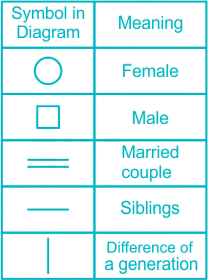
Below table represents symbols used to draw a family tree,

1. B is the father-in-law of F.
2. C is the father of D.
3. E is not married to F or C.
4. E is not in the 3rd generation.
5. D is not married to A.
6. There is no single parent in the family.

Hence, there are three male members in the family if D is the only daughter of C.
10. Direction: Study the information given below carefully and answer the questions that follow.There are six members A, B, C, D, E and F in the family of three generations. There are two members in each generation. B is the father-in-law of F. C is the father of D. E is not married to F or C. E is not in the 3rd generation. D is not married to A. There is no single parent in the family.
Question:
How is D related to F if the gender of D and B is the same?
A. Son
B. Father
C. Daughter
D. Wife
E. Mother
Solution
Below table represents symbols used to draw a family tree,

1. B is the father-in-law of F.
2. C is the father of D.
3. E is not married to F or C.
4. E is not in the 3rd generation.
5. D is not married to A.
6. There is no single parent in the family.

Gender of B is male. So, the gender of D is also male.
Hence, D is the son of F.
11. Direction: Study the information given below carefully and answer the questions that follow.There are six members A, B, C, D, E and F in the family of three generations. There are two members in each generation. B is the father-in-law of F. C is the father of D. E is not married to F or C. E is not in the 3rd generation. D is not married to A. There is no single parent in the family.
Question:
How is A related to B?
A. Grandson
B. Father
C. Son
D. Granddaughter
E. Cannot be determined
Solution
Below table represents symbols used to draw a family tree,
1. B is the father-in-law of F.
2. C is the father of D.
3. E is not married to F or C.
4. E is not in the 3rd generation.
5. D is not married to A.
6. There is no single parent in the family.

Gender of A is unknown.
So, A is either grandson or granddaughter of B.
Hence, the correct answer is cannot be determined.
12. Eight employees, P, Q, R, S, T, U, V, and W work in a bank at eight different positions, namely, Manager (M), Assistant Manager (AM), Loan Officer (LO), Cashier (C), Teller (T), Accountant (AC), Analyst (AN), and Clerk (CL). The order of seniority is the same as given above, with the Manager being the senior most employee and the Clerk being the junior most employee.
There are five positions between Q and V, and neither of them works as the Manager. R is immediate senior to Q. W is immediately senior to U. S works as the Cashier. There are at most two positions between S and U. There is no position between V and T. Q is junior to the employee working as the Accountant. P is senior to W, but not the Manager.
Question:
How many positions are there between P and T?
A. Five
B. Two
C. One
D. Four
E. Three
Solution
There are five positions between Q and V, and neither of them works as the Manager. R is senior to Q. S works as the Cashier. There is no position between V and T. Q is junior to the employee working as the Accountant.
| Position | Case1(a) | Case1(b) |
| Manager (M) | T | |
| Assistant Manager (AM) | V | V |
| Loan Officer (LO) | T | |
| Cashier (C) | S | S |
| Teller (T) | ||
| Accountant (AC) | ||
| Analyst (AN) | R | R |
| Clerk (CL) | Q | Q |
W is immediately senior to U. Remaining position is taken by P.
| Position | Case1(a) | Case1(b) |
| Manager (M) | T | P |
| Assistant Manager (AM) | V | V |
| Loan Officer (LO) | P | T |
| Cashier (C) | S | S |
| Teller (T) | W | W |
| Accountant (AC) | U | U |
| Analyst (AN) | R | R |
| Clerk (CL) | Q | Q |
P is senior to W, but not the Manager. Hence Case 1(b) gets invalid.
Final arrangement
| Position | Case1(a) |
| Manager (M) | T |
| Assistant Manager (AM) | V |
| Loan Officer (LO) | P |
| Cashier (C) | S |
| Teller (T) | W |
| Accountant (AC) | U |
| Analyst (AN) | R |
| Clerk (CL) | Q |
There is one position in between P and T that is Assistant manager.
13. Eight employees, P, Q, R, S, T, U, V, and W work in a bank at eight different positions, namely, Manager (M), Assistant Manager (AM), Loan Officer (LO), Cashier (C), Teller (T), Accountant (AC), Analyst (AN), and Clerk (CL). The order of seniority is the same as given above, with the Manager being the senior most employee and the Clerk being the junior most employee.
There are five positions between Q and V, and neither of them works as the Manager. R is immediate senior to Q. W is immediately senior to U. S works as the Cashier. There are at most two positions between S and U. There is no position between V and T. Q is junior to the employee working as the Accountant. P is senior to W, but not the Manager.
Question:
Which of the following statement is Correct?
A. V is junior to Q
B. T is senior to W
C. S is junior to U
D. Q is senior to V
E. None of the given statement is correct.
Solution
There are five positions between Q and V, and neither of them works as the Manager. R is senior to Q. S works as the Cashier. There is no position between V and T. Q is junior to the employee working as the Accountant.
| Position | Case1(a) | Case1(b) |
| Manager (M) | T | |
| Assistant Manager (AM) | V | V |
| Loan Officer (LO) | T | |
| Cashier (C) | S | S |
| Teller (T) | ||
| Accountant (AC) | ||
| Analyst (AN) | R | R |
| Clerk (CL) | Q | Q |
W is immediately senior to U. Remaining position is taken by P.
| Position | Case1(a) | Case1(b) |
| Manager (M) | T | P |
| Assistant Manager (AM) | V | V |
| Loan Officer (LO) | P | T |
| Cashier (C) | S | S |
| Teller (T) | W | W |
| Accountant (AC) | U | U |
| Analyst (AN) | R | R |
| Clerk (CL) | Q | Q |
P is senior to W, but not the Manager. Hence Case 1(b) gets invalid.
Final arrangement
| Position | Case1(a) |
| Manager (M) | T |
| Assistant Manager (AM) | V |
| Loan Officer (LO) | P |
| Cashier (C) | S |
| Teller (T) | W |
| Accountant (AC) | U |
| Analyst (AN) | R |
| Clerk (CL) | Q |
T is senior to W is the correct statement.
14. Eight employees, P, Q, R, S, T, U, V, and W work in a bank at eight different positions, namely, Manager (M), Assistant Manager (AM), Loan Officer (LO), Cashier (C), Teller (T), Accountant (AC), Analyst (AN), and Clerk (CL). The order of seniority is the same as given above, with the Manager being the senior most employee and the Clerk being the junior most employee.
There are five positions between Q and V, and neither of them works as the Manager. R is immediate senior to Q. W is immediately senior to U. S works as the Cashier. There are at most two positions between S and U. There is no position between V and T. Q is junior to the employee working as the Accountant. P is senior to W, but not the Manager.
Question:
Which employee holds the position of Assistant Manager?
A. P
B. Q
C. R
D. T
E. V
Solution
There are five positions between Q and V, and neither of them works as the Manager. R is senior to Q. S works as the Cashier. There is no position between V and T. Q is junior to the employee working as the Accountant.
| Position | Case1(a) | Case1(b) |
| Manager (M) | T | |
| Assistant Manager (AM) | V | V |
| Loan Officer (LO) | T | |
| Cashier (C) | S | S |
| Teller (T) | ||
| Accountant (AC) | ||
| Analyst (AN) | R | R |
| Clerk (CL) | Q | Q |
W is immediately senior to U. Remaining position is taken by P.
| Position | Case1(a) | Case1(b) |
| Manager (M) | T | P |
| Assistant Manager (AM) | V | V |
| Loan Officer (LO) | P | T |
| Cashier (C) | S | S |
| Teller (T) | W | W |
| Accountant (AC) | U | U |
| Analyst (AN) | R | R |
| Clerk (CL) | Q | Q |
P is senior to W, but not the Manager. Hence Case 1(b) gets invalid.
Final arrangement
| Position | Case1(a) |
| Manager (M) | T |
| Assistant Manager (AM) | V |
| Loan Officer (LO) | P |
| Cashier (C) | S |
| Teller (T) | W |
| Accountant (AC) | U |
| Analyst (AN) | R |
| Clerk (CL) | Q |
V hold the position of Assistant manager.
15. Eight employees, P, Q, R, S, T, U, V, and W work in a bank at eight different positions, namely, Manager (M), Assistant Manager (AM), Loan Officer (LO), Cashier (C), Teller (T), Accountant (AC), Analyst (AN), and Clerk (CL). The order of seniority is the same as given above, with the Manager being the senior most employee and the Clerk being the junior most employee.
There are five positions between Q and V, and neither of them works as the Manager. R is immediate senior to Q. W is immediately senior to U. S works as the Cashier. There are at most two positions between S and U. There is no position between V and T. Q is junior to the employee working as the Accountant. P is senior to W, but not the Manager.
Question:
How many employees are senior to U?
A. 3
B. 2
C. 5
D. 4
E. 1
Solution
There are five positions between Q and V, and neither of them works as the Manager. R is senior to Q. S works as the Cashier. There is no position between V and T. Q is junior to the employee working as the Accountant.
| Position | Case1(a) | Case1(b) |
| Manager (M) | T | |
| Assistant Manager (AM) | V | V |
| Loan Officer (LO) | T | |
| Cashier (C) | S | S |
| Teller (T) | ||
| Accountant (AC) | ||
| Analyst (AN) | R | R |
| Clerk (CL) | Q | Q |
W is immediately senior to U. Remaining position is taken by P.
| Position | Case1(a) | Case1(b) |
| Manager (M) | T | P |
| Assistant Manager (AM) | V | V |
| Loan Officer (LO) | P | T |
| Cashier (C) | S | S |
| Teller (T) | W | W |
| Accountant (AC) | U | U |
| Analyst (AN) | R | R |
| Clerk (CL) | Q | Q |
P is senior to W, but not the Manager. Hence Case 1(b) gets invalid.
Final arrangement
| Position | Case1(a) |
| Manager (M) | T |
| Assistant Manager (AM) | V |
| Loan Officer (LO) | P |
| Cashier (C) | S |
| Teller (T) | W |
| Accountant (AC) | U |
| Analyst (AN) | R |
| Clerk (CL) | Q |
Five employee are senior to U.
16. Eight employees, P, Q, R, S, T, U, V, and W work in a bank at eight different positions, namely, Manager (M), Assistant Manager (AM), Loan Officer (LO), Cashier (C), Teller (T), Accountant (AC), Analyst (AN), and Clerk (CL). The order of seniority is the same as given above, with the Manager being the senior most employee and the Clerk being the junior most employee.
There are five positions between Q and V, and neither of them works as the Manager. R is immediate senior to Q. W is immediately senior to U. S works as the Cashier. There are at most two positions between S and U. There is no position between V and T. Q is junior to the employee working as the Accountant. P is senior to W, but not the Manager.
Question:
Who is immediate senior to V?
A. P
B. T
C. Q
D. S
E. U
Solution
There are five positions between Q and V, and neither of them works as the Manager. R is senior to Q. S works as the Cashier. There is no position between V and T. Q is junior to the employee working as the Accountant.
| Position | Case1(a) | Case1(b) |
| Manager (M) | T | |
| Assistant Manager (AM) | V | V |
| Loan Officer (LO) | T | |
| Cashier (C) | S | S |
| Teller (T) | ||
| Accountant (AC) | ||
| Analyst (AN) | R | R |
| Clerk (CL) | Q | Q |
W is immediately senior to U. Remaining position is taken by P.
| Position | Case1(a) | Case1(b) |
| Manager (M) | T | P |
| Assistant Manager (AM) | V | V |
| Loan Officer (LO) | P | T |
| Cashier (C) | S | S |
| Teller (T) | W | W |
| Accountant (AC) | U | U |
| Analyst (AN) | R | R |
| Clerk (CL) | Q | Q |
P is senior to W, but not the Manager. Hence Case 1(b) gets invalid.
Final arrangement
| Position | Case1(a) |
| Manager (M) | T |
| Assistant Manager (AM) | V |
| Loan Officer (LO) | P |
| Cashier (C) | S |
| Teller (T) | W |
| Accountant (AC) | U |
| Analyst (AN) | R |
| Clerk (CL) | Q |
T is immediate senior to V.
17. Directions: Study the following information carefully to answer the given questions:
6 F X % H I * G Y ? $ O & W + @ 5 4 ! P B = 7 T E A © 8 < 3
Question:
If it is possible to make a meaningful word with the third, twelfth and twenty-first element, then which of the following will be the first letter of that word? If no such word can be made, give Y as you answer and if more than one such words can be made, give M as you answer.
A. X
B. M
C. B
D. O
E. Y
Solution
Given series:
Left Side 6 F X % H I * G Y ? $ O & W + @ 5 4 ! P B = 7 T E A © 8 < 3 Right Side
The third, twelfth and twenty-first element are X, O & B respectively. The word formed by three letters is: BOX. We can make only one meaningful word.
Hence, the first letter of that word is B.
18. Directions: Study the following information carefully to answer the given questions:
6 F X % H I * G Y ? $ O & W + @ 5 4 ! P B = 7 T E A © 8 < 3
Question:
If the first fifteen elements in the above sequence are written in reverse order then which of the following will be twenty third element from the right end?
A. I
B. M
C. O
D. G
E. 7
Solution
Given series:
Left Side 6 F X % H I * G Y ? $ O & W + @ 5 4 ! P B = 7 T E A © 8 < 3 Right Side
First 15 elements are written in the reverse order:
Left Side + W & O $ ? Y G * I H % X F 6 @ 5 4 ! P B = 7 T E A © 8 < 3 Right Side
Hence, 23rd element from the right end is G.
19. Directions: Study the following information carefully to answer the given questions:
6 F X % H I * G Y ? $ O & W + @ 5 4 ! P B = 7 T E A © 8 < 3
Question:
If each symbol is first converted into a numeral and then all the numerals are converted into English letters, how many converted English letters will be there in the above arrangement of elements?
A. 8
B. 11
C. 14
D. 17
E. 22
Solution
Given series is:
Left Side 6 F X % H I * G Y ? $ O & W + @ 5 4 ! P B = 7 T E A © 8 < 3 Right Side
The number of converted letters = Number of symbols + Number of numerals
= 11 + 6 = 17
Hence, there are 17 converted English letters.
20. Directions: Study the following information carefully to answer the given questions:
6 F X % H I * G Y ? $ O & W + @ 5 4 ! P B = 7 T E A © 8 < 3
Question:
If all the vowels are dropped from the above series, which of the following would be the eighth element to the right of the thirteenth element from the left end?
A. +
B. @
C. 7
D. T
E. =
Solution
Given series is
Left Side 6 F X % H I * G Y ? $ O & W + @ 5 4 ! P B = 7 T E A © 8 < 3 Right Side
After dropping all the vowels
Left Side 6 F X % H * G Y ? $ & W + @ 5 4 ! P B = 7 T © 8 < 3 Right Side
As Right/Left + Left/Right = Position mentioned at the end of statement.
⇒ 8th from Right + 13th to left = 21st from left
Hence, the 21st element from the left end is 7.
21. Directions: Study the following information carefully to answer the given questions:
6 F X % H I * G Y ? $ O & W + @ 5 4 ! P B = 7 T E A © 8 < 3
Question:
Which of the following element is exactly in the middle of I and 8?
A. @
B. !
C. 4
D. 5
E. +
Solution
Given series is:
Left Side 6 F X % H I * G Y ? $ O & W + @ 5 4 ! P B = 7 T E A © 8 < 3 Right Side
Arrangement required: I → Exactly middle → 8
Left Side 6 F X % H I * G Y ? $ O & W + @ 5 4 ! P B = 7 T E A © 8 < 3 Right Side
There are 21 elements in between I and 8.
Hence, the middle letter between I and 8 is 5.
22. Direction: Study the following information carefully and answer the given questions.
In a certain code language,
‘mo ko fo’ means ‘iphone is good’,
‘po so no’ means ‘mobile are useful’,
‘ko mo jo’ means ‘android is good’,
‘fo ko no’ means ‘iphone good mobile’.
Question:
Code ‘so’ is for which word in the given language?
A. good
B. useful
C. android
D. are
E. Either 2 or 4
Solution
According to the given information-
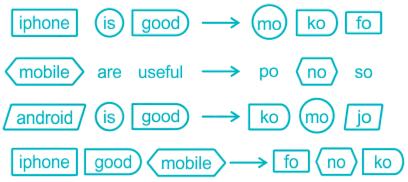
Hence ‘so’ is coded as either ‘useful or are’.
23. Direction: Study the following information carefully and answer the given questions.
In a certain code language,
‘mo ko fo’ means ‘iphone is good’,
‘po so no’ means ‘mobile are useful’,
‘ko mo jo’ means ‘android is good’,
‘fo ko no’ means ‘iphone good mobile’.
Question:
Code ‘ko jo no mo ’ is for which of the following sentence in given language?
A. iphone mobile is good
B. iphone mobile is useful
C. mobile android is good
D. android mobile is useful
E. iphone android mobile good
Solution
According to the given information-

Code ‘ko’ corresponds to ‘good’,
Code ‘jo’ corresponds to ‘android’,
Code ‘no’ corresponds to ‘mobile’,
Code ‘mo’ corresponds to ‘is’.
Hence, the only possible answer is ‘mobile android is good’.
24. Direction: Study the following information carefully and answer the given questions.
In a certain code language,
‘mo ko fo’ means ‘iphone is good’,
‘po so no’ means ‘mobile are useful’,
‘ko mo jo’ means ‘android is good’,
‘fo ko no’ means ‘iphone good mobile’.
Question:
Which of the following means ‘android’ in that code language?
A. no
B. jo
C. ko
D. fo
E. mo
Solution
According to the given information-
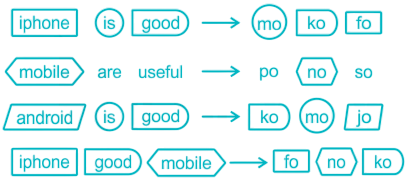
Hence, ‘android’ is coded as ‘jo’.
25. Direction: Study the following information carefully and answer the given questions.
In a certain code language,
‘mo ko fo’ means ‘iphone is good’,
‘po so no’ means ‘mobile are useful’,
‘ko mo jo’ means ‘android is good’,
‘fo ko no’ means ‘iphone good mobile’.
Question:
Code ‘no’ is for which word in the given language?
A. good
B. iphone
C. android
D. are
E. mobile
Solution
According to the given information-
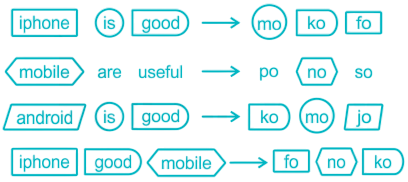
Hence, ‘no’ is coded for ‘mobile’.
26. How many pairs of digits in the number 547361 have as many numbers between them as in the series of natural numbers both in backward and forward directions?
A. Four
B. One
C. More than four
D. Two
E. Three
Solution
Given number: 547361
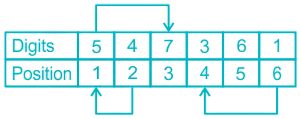
Thus, we get 3 pairs:
Forward: (5, 7)
Backward: (3, 1), (5, 4)Hence, the correct answer is three.
27. Directions: Study the given information carefully and answer the following questions below.Nine persons A, B, C, D, E, F, G, H and I are sitting in a straight line facing north, but not necessarily in the same order.
B is fourth to the left of G and B sits on the extreme left end. F is fourth to the right of C and second to the left of I, who is fifth to the right of A. D is not an immediate neighbor of neither I nor B. There are only three persons between E and A. G is second to the right of C.
Question:
Which of the following statement is correct?
A. F sits second to the left of G
B. H sits third to the left of A
C. A sits second to the left of D
D. D sits third to the right of B
E. E sits at extreme right end
Solution
Nine persons – A, B, C, D, E, F, G, H and I.
1. B is fourth to the left of G and B sits on the extreme left end.
2. G is second to the right of C.

3. F is fourth to the right of C and second to the left of I, who is fifth to the right of A.

4. There are only three persons between E and A.
5. D is not an immediate neighbor of either I or B.

Hence, only statement 3 is correct.
28. Directions: Study the given information carefully and answer the following questions below.Nine persons A, B, C, D, E, F, G, H and I are sitting in a straight line facing north, but not necessarily in the same order.
B is fourth to the left of G and B sits on the extreme left end. F is fourth to the right of C and second to the left of I, who is fifth to the right of A. D is not an immediate neighbor of neither I nor B. There are only three persons between E and A. G is second to the right of C.
Question:
Who sits second to the left of E?
A. A
B. F
C. C
D. D
E. I
Solution
Nine persons – A, B, C, D, E, F, G, H and I.
1. B is fourth to the left of G and B sits on the extreme left end.
2. G is second to the right of C.

3. F is fourth to the right of C and second to the left of I, who is fifth to the right of A.

4. There are only three persons between E and A.
5. D is not an immediate neighbor of either I or B.

Hence, D sits second to the left of E.
29. Directions: Study the given information carefully and answer the following questions below.Nine persons A, B, C, D, E, F, G, H and I are sitting in a straight line facing north, but not necessarily in the same order.
B is fourth to the left of G and B sits on the extreme left end. F is fourth to the right of C and second to the left of I, who is fifth to the right of A. D is not an immediate neighbor of neither I nor B. There are only three persons between E and A. G is second to the right of C.
Question:
How many persons sit between H and E?
A. Three
B. Four
C. Five
D. Two
E. Six
Solution
Nine persons – A, B, C, D, E, F, G, H and I.
1. B is fourth to the left of G and B sits on the extreme left end.
2. G is second to the right of C.

3. F is fourth to the right of C and second to the left of I, who is fifth to the right of A.

4. There are only three persons between E and A.
5. D is not an immediate neighbor of either I or B.

Hence, there are five persons sit between H and E.
30. Directions: Study the given information carefully and answer the following questions below.Nine persons A, B, C, D, E, F, G, H and I are sitting in a straight line facing north, but not necessarily in the same order.
B is fourth to the left of G and B sits on the extreme left end. F is fourth to the right of C and second to the left of I, who is fifth to the right of A. D is not an immediate neighbor of neither I nor B. There are only three persons between E and A. G is second to the right of C.
Question:
Who sits exactly in the middle of the line?
A. C
B. A
C. G
D. F
E. D
Solution
Nine persons – A, B, C, D, E, F, G, H and I.
1. B is fourth to the left of G and B sits on the extreme left end.
2. G is second to the right of C.

3. F is fourth to the right of C and second to the left of I, who is fifth to the right of A.

4. There are only three persons between E and A.
5. D is not an immediate neighbor of either I or B.

Hence, G sits exactly in the middle of the line.
31. Directions: Study the given information carefully and answer the following questions below.Nine persons A, B, C, D, E, F, G, H and I are sitting in a straight line facing north, but not necessarily in the same order.
B is fourth to the left of G and B sits on the extreme left end. F is fourth to the right of C and second to the left of I, who is fifth to the right of A. D is not an immediate neighbor of neither I nor B. There are only three persons between E and A. G is second to the right of C.
Question:
Who among the following sit at the extreme ends of the line?
A. B and C
B. I and B
C. A and G
D. F and D
E. None of these
Solution
Nine persons – A, B, C, D, E, F, G, H and I.
1. B is fourth to the left of G and B sits on the extreme left end.
2. G is second to the right of C.

3. F is fourth to the right of C and second to the left of I, who is fifth to the right of A.

4. There are only three persons between E and A.
5. D is not an immediate neighbor of either I or B.

Hence, it is clear that I and B sit at the extreme ends of the line.
32. Directions: In the following question assuming the given statements to be true, find which of the conclusion among the given conclusions is/are definitely true and then give your answers accordingly.
Statements:
H < I ≤ J = K > L ≥ M; N < K
Conclusions:
I. N < J
II. L = H
A. Only I follow
B. Only II follow
C. Both I and II follow
D. Neither I nor II follow
E. Either I or II follow
Solution
Given statements:
H < I ≤ J = K > L ≥ M; N < K
On combining:
H < I ≤ J = N > L ≥ M
Conclusions:
1. N < J → True (As H < I ≤ J = N > L ≥ M à N < J. So, it is true)
2. L = H → False (As H < I ≤ J = N > L ≥ M, there is no relation between L and H because of the opposite sign between L and H)Hence, only I follow.
33. Directions: In the following question assuming the given statements to be true, find which of the conclusion among the given conclusions is/are definitely true and then give your answers accordingly.
Statements:
T < R = U ≤ B > G ≥ D = S
Conclusions:
I. G > T
II. U ≤ S
A. Only I follow
B. Only II follow
C. Both I and II follow
D. Neither I nor II follow
E. Either I or II follow
Solution
Given statements:
T < R = U ≤ B > G ≥ D = S
Conclusions:
1. G > T → False (There is no relation between G and T because of the opposite sign between G and T)
2. U ≤ S → False (There is no relation between U and S because of the opposite sign between U and S)Hence, neither I nor II follow.
34. Directions: In the following question assuming the given statements to be true, find which of the conclusion among the given conclusions is/are definitely true and then give your answers accordingly.
Statements:
H < I ≤ E > N; O ≤ N > R
Conclusions:
I. O < E
II. E = O
A. Only I follow
B. Only II follow
C. Both I and II follow
D. Neither I nor II follow
E. Either I or II follow
Solution
Given statements:
H < I ≤ E > N
O ≤ N > R
From the statements, we can combine the two inequalities to get:
H < I ≤ E > N ≥ O
H < I ≤ E > N > R
Conclusions:
1. O < E → True (as H < I ≤ E > N ≥ O)
2. E = O → False (as H < I ≤ E > N ≥ O)
Thus, only conclusion (1) follows
Hence, option (1) is the correct answer.
35. If in the word ‘SCRUTINY’, all the vowels are first arranged alphabetically and then all the consonants are arranged alphabetically and then all the vowels are replaced by the previous letters and the consonants are replaced by the next letters from English alphabet. Which letter will be fifth from the right end?
A. O
B. S
C. Z
D. D
E. T
Solution
Word is- S C R U T I N Y
Vowels and then consonants arranged alphabetically- I U C N R S T Y
Vowels replaced by the previous letter and consonants replaced by the next letter- H T D O S T U ZFifth letter from the right end here is O.
36. What should come in place of the question mark ‘?’ in the following number series?
111, 100, 110, 101, 109, (?)
A. 102
B. 100
C. 101
D. 105
E. 99
Solution
Given Series:
111, 100, 110, 101, 109, (?)
The logic followed here is as follows:
⇒ 111 – 11 = 100
⇒ 100 + 10 = 110
⇒ 110 – 9 = 101
⇒ 101 + 8 = 109
⇒ 109 – 7 = 102
Hence, 102 will come in the place of (?).
37. What should come in place of question mark (?) in the following number series?
14, 7, ?, 14, 56, 448
A. 14
B. 7
C. 10.5
D. 1
E. None of these
Solution
Given:
14, 7, ?, 14, 56, 448
Calculation:
⇒ 14 × 0.5 = 7
⇒ 7 × 1 = 7
⇒ 7 × 2 = 14
⇒ 14 × 4 = 56
⇒ 56 × 8 = 448
∴ The value of ? is 7.
38. What will come in the place of question mark (?) in the following number series?
60, 70, 83, 102, 130, 170, ?
A. 220
B. 325
C. 225
D. 125
E. None of these
Solution
Given:
60, 70, 83, 102, 130, 170, ?
Calculation:
From the above series, the logic can be explained as
70 – 60 = 10
83 – 70 = 13
102 – 83 = 19
130 – 102 = 28
170 – 130 = 40
? – 170 = let’s say x
Taking the double difference
13 – 10 = 3
19 – 13 = 6
28 – 19 = 9
40 – 28 = 12
By observing the pattern of double difference we can say
x – 40 = 15
⇒ x = 55
So, ? – 170 = 55
⇒ ? = 225
∴ The value of ? will be 225.
39. What should come in place of the question mark ‘?’ in the following number series?
25, ?, 150, 750, 5250, 57750
A. 25
B. 35
C. 40
D. 50
E. 65
Solution
Calculation:
Multiplying each term with continuous prime numbers to get the next term
The number series follows the pattern:
25
25 × 2 = 50
50 × 3 = 150
150 × 5 = 750
750 × 7 = 5250
5250 × 11 = 57750
∴ The value of ‘?’ is 50
40. What should come in place of the question mark (?) in the following number series?6 12 48 264 1560 ?
A. 9636
B. 9864
C. 9432
D. 9336
E. 9268
Solution
6 + 61 = 12
12 + 62 = 48
48 + 63 = 264
264 + 64 = 1560
1560 + 65 = 9336
41. 12 men and 15 women can complete a work in 24 days. If the efficiency of a woman is 75% of a man, then to complete the work in 12 days how many men are required?
A. 105/2
B. 89/2
C. 57/2
D. 79/2
E. 93/2
Solution
Given:
12 men and 15 women can complete a work in 24 days
The efficiency of a woman is 75% of a man
Concept Used:
Work done = efficiency × time
Calculation:
Let, the efficiency of a man = 4
The efficiency of a woman = 4 × 3/4 = 3
Total work = [(12 × 4) + (15 × 3)] × 24 = (93 × 24) unit
To complete the work in 12 days number of men required are
⇒ (93 × 24)/(12 × 4)
⇒ 93/2
∴ The correct answer is option 5
42. The give bar graph shows the total number of Sim user [ Jio + Airtel + BSNL], total number of Airtel and BSNL user and total number of BSNL user in five different village [ A, B, C, D and E].

Question:
Ratio Male and female JIO, Airtel and BSNL user of A is 5:3, 3:2 and 4:3 respectively. Find the difference between male and female sim user in village A?
A. 92
B. 76
C. 84
D. 55
E. 78
Solution
Common Calculation –
Total number of BSNL user in A is 70.
Total number of AIRTEL user in A is 250 -70 = 180
Total number of JIO user in A is 370 – 250 = 120
Similarly, we can calculate others values also.
| Village | JIO user | Airtel User | BSNL user |
| A | 120 | 180 | 70 |
| B | 130 | 140 | 110 |
| C | 150 | 160 | 60 |
| D | 100 | 120 | 140 |
| E | 150 | 130 | 160 |
Calculation
JIO: Total = 120, M:F = 5:3
→ Total parts = 8
→ Male = 120 × (5/8) = 75,
Female = 120 × (3/8) = 45
Airtel: 180, M:F = 3:2
→ Total parts = 5
→ Male = 180 × (3/5) = 108,
Female = 180 × (2/5) = 72
BSNL: 70, M:F = 4:3
→ Total parts = 7
→ Male = 70 × (4/7) = 40,
Female = 70 × (3/7) = 30
Total male and female SIM users in A
Male = 75 + 108 + 40 = 223
Female = 45 + 72 + 30 = 147
So, difference is 223 – 147 = 76
The correct answer is Option (2).
43. The give bar graph shows the total number of Sim user [ Jio + Airtel + BSNL], total number of Airtel and BSNL user and total number of BSNL user in five different village [ A, B, C, D and E].
Question:
75% of total population in village D use sim. Ratio of male and female in total population of village D is 3:2. Find the difference between number of male and female in village D? [[ Only three company sim used in village]
A. 98
B. 92
C. 55
D. 56
E. 96
Solution
Common Calculation –
Total number of BSNL user in A is 70.
Total number of AIRTEL user in A is 250 -70 = 180
Total number of JIO user in A is 370 – 250 = 120
Similarly, we can calculate others values also.
| Village | JIO user | Airtel User | BSNL user |
| A | 120 | 180 | 70 |
| B | 130 | 140 | 110 |
| C | 150 | 160 | 60 |
| D | 100 | 120 | 140 |
| E | 150 | 130 | 160 |
Calculation
75% of total population in village D use SIM.
Male : Female in total population = 3:2
Total SIM users in village D
= 100 (JIO) + 120 (Airtel) + 140 (BSNL) = 360
Let,
Total population = P
So, 75% of P = 360
⇒ P = 360 × 0.75 = 480
Male : Female = 3:2 ⇒ Total parts = 5
Male = 480 × (3/5) = 288
Female = 480 × (2/5) = 192
So, difference is = 288 – 192 = 96
The correct answer is Option (5).
44. The give bar graph shows the total number of Sim user [ Jio + Airtel + BSNL], total number of Airtel and BSNL user and total number of BSNL user in five different village [ A, B, C, D and E].
Question:
Average number of JIO user in all village together is 5x. Find the value of 8x + 2568?
A. 2776
B. 2426
C. 2226
D. 2336
E. 2496
Solution
Common Calculation –
Total number of BSNL user in A is 70.
Total number of AIRTEL user in A is 250 -70 = 180
Total number of JIO user in A is 370 – 250 = 120
Similarly, we can calculate others values also.
| Village | JIO user | Airtel User | BSNL user |
| A | 120 | 180 | 70 |
| B | 130 | 140 | 110 |
| C | 150 | 160 | 60 |
| D | 100 | 120 | 140 |
| E | 150 | 130 | 160 |
Calculation
Average number of JIO users in all villages = 5x
Total JIO users
= 120 + 130 + 150 + 100 + 150 = 650
Number of villages = 5
Average = 650 / 5 = 130
So, 5x = 130
⇒x = 26
So, 8x + 2568 = 8 × 26 + 2568 = 208 + 2568 = 2776
The correct answer is Option (1).
45. The give bar graph shows the total number of Sim user [ Jio + Airtel + BSNL], total number of Airtel and BSNL user and total number of BSNL user in five different village [ A, B, C, D and E].
Question:
20% of JIO user port their number to BSNL in village E. Find the unit digit of sum of digit of new number of BSNL user in village E?
A. 1
B. 2
C. 3
D. 0
E. 4
Solution
Common Calculation –
Total number of BSNL user in A is 70.
Total number of AIRTEL user in A is 250 -70 = 180
Total number of JIO user in A is 370 – 250 = 120
Similarly, we can calculate others values also.
| Village | JIO user | Airtel User | BSNL user |
| A | 120 | 180 | 70 |
| B | 130 | 140 | 110 |
| C | 150 | 160 | 60 |
| D | 100 | 120 | 140 |
| E | 150 | 130 | 160 |
Calculation
JIO in E = 150
→ 20% of 150 = 30 ported to BSNL
Original BSNL in E = 160
→ New BSNL = 160 + 30 = 190
Now, sum of digits of 190 = 1 + 9 + 0 = 10
Unit digit = 0
Answer 0
The correct answer is Option (4).
46. The give bar graph shows the total number of Sim user [ Jio + Airtel + BSNL], total number of Airtel and BSNL user and total number of BSNL user in five different village [ A, B, C, D and E].
Question:
Number of JIO, AIRTEL and BSNL user in village F is 20%, 30% and 40% more than the same in village B. Find the total number of SIM user in village F? [ Only three company sim used in village]
A. 332
B. 362
C. 492
D. 384
E. 552
Solution
Common Calculation –
Total number of BSNL user in A is 70.
Total number of AIRTEL user in A is 250 -70 = 180
Total number of JIO user in A is 370 – 250 = 120
Similarly, we can calculate others values also.
| Village | JIO user | Airtel User | BSNL user |
| A | 120 | 180 | 70 |
| B | 130 | 140 | 110 |
| C | 150 | 160 | 60 |
| D | 100 | 120 | 140 |
| E | 150 | 130 | 160 |
Calculation
In village F, JIO, AIRTEL, BSNL are 20%, 30%, 40% more than in village B
From village B:
JIO = 130 → 20% more = 130 × 1.2 = 156
Airtel = 140 → 30% more = 140 × 1.3 = 182
BSNL = 110 → 40% more = 110 × 1.4 = 154
Total SIM users in F = 156 + 182 + 154 = 492
Answer: 492
The correct answer is Option (3).
47. A train traveling at a speed of 90 km/h overtakes another train twice its length and traveling at 60 km/h in 45 sec. how long will the longer train take to cross a bridge 300 m long?
A. 29 sec
B. 32 sec
C. 33 sec
D. 31 sec
E. 30 sec
Solution


48. A boat can row upstream a distance of 8.4 km in 36 minutes, while it can cover the same distance downstream in just 25.2 minutes. Find the speed of stream (in km/hr).
A. 3
B. 2.5
C. 2
D. 4
E. 3.5
Solution
Given:-
Time for 8.4 km upstream = 36 minutes = 36/60 = 0.6 hours.
Time for 8.4 km downstream = 25.2 minutes = 25.2/60 = 0.42 hours.
Formula:-
Speed = Distance/Time
Stream speed = ½ (D – U)
D and U downstream and upstream speeds.
Calculation:-
D = 8.4/0.42 = 20 km/hr
U = 8.4/0.6 = 14 km/hr
Stream speed = ½ (20 – 14) = 3 km/hr
49. What approximate will come in the place of the question mark ‘?’ in the following question?85.01 + 4.95 – 60.05 ÷ 11.98 × 13.90 = ?
A. 80
B. 20
C. 45
D. 32
E. None of them
Solution
Rules of Approximation:
1. If a number has digits to the right of the decimal less than 5, then just drop the digits to the right of the decimal. The number so obtained will be the approximated value.
2. If a number has digits to the right of the decimal more than 5, then just drop the digits to the right of the decimal and raise the remaining number by ‘1’.The number so obtained will be the approximated value.
Concept:
In this type of question, we are expected to calculate approximate value (not exact value), so we can replace the given numbers by their nearest perfect places which makes the calculation easy.
85.01 + 4.95 – 60.05 ÷ 11.98 × 13.90 = ?
taking approximate value, we get
85 + 5 – 60 ÷ 12 × 14 = ?
Follow BODMAS rule to solve this question, as per the order given below,
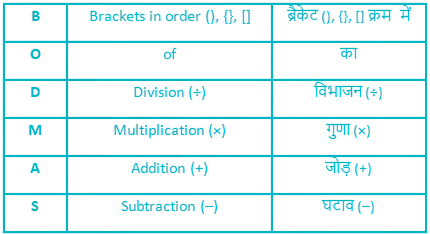
⇒ 85 + 5 – 5 × 14 = ?
⇒ 85 + 5 – 70 = ?
⇒ 90 – 70 = ?
⇒ ? = 20
∴ The value of ? is 20
50. What approximate will come in the place of the question mark ‘?’ in the following question?16.95 × 2.98 + 8 ÷ 1.96 – 6.1 = (?)2
A. 15.2
B. 21.1
C. 7
D. 11
E. None of them
Solution
Rules of Approximation:
1. If a number has digits to the right of the decimal less than 5, then just drop the digits to the right of the decimal. The number so obtained will be the approximated value.
2. If a number has digits to the right of the decimal more than 5, then just drop the digits to the right of the decimal and raise the remaining number by ‘1’.The number so obtained will be the approximated value.
Concept:
In this type of question, we are expected to calculate approximate value (not exact value), so we can replace the given numbers by their nearest perfect places which makes the calculation easy.
16.95 × 2.98 + 8 ÷ 1.96 – 6.1 = (?)2
taking approximate value, we get
⇒ 17 × 3 + 8 ÷ 2 – 6 = (?)2
Follow BODMAS rule to solve this question, as per the order given below,
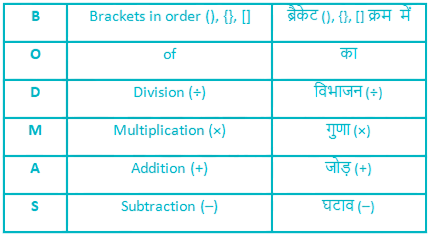
⇒ 17 × 3 + 4 – 6 = (?)2
⇒ 51 + 4 – 6 = (?)2
⇒ 55 – 6 = (?)2
⇒ 49 = (?)2
∴ ? = 7
51. What approximate value will come in the place of the question mark ‘?’ in the following question?24.97 × √15.99 + 400.04 = √? + 475
A. 2.5
B. 625
C. 25
D. 15
E. 5
Solution
Rules of Approximation:
1. If a number has digits to the right of the decimal less than 5, then just drop the digits to the right of the decimal. The number so obtained will be the approximated value.
2. If a number has digits to the right of the decimal more than 5, then just drop the digits to the right of the decimal and raise the remaining number by ‘1’.The number so obtained will be the approximated value.
Concept:
In this type of question, we are expected to calculate approximate value (not exact value), so we can replace the given numbers by their nearest perfect places which makes the calculation easy.
24.97 × √15.99 + 400.04 = √? + 475
Taking approximate value, we get
25 × √16 + 400 = √? + 475
Follow BODMAS rule to solve this question, as per the order given below,

Since, we need to find out the approximate value, we can write these values to their nearest integers.
Taking approximate value, we get
25 × √16 + 400 = √? + 475
⇒ 25 × 4 + 400 = √? + 475
⇒ 100 + 400 = √? + 475
⇒ √? = 500 – 475
⇒ √? = 25
⇒ ? = 625
∴ the approximate value of question mark (?) in the following question is 625.
52. what approximate value should come in the place of question mark (?) in the following question? (You are not expected to calculate the exact value)√145 + √168 – (4.96)2 = √? × 7856.83
A. 0
B. 1
C. -1
D. 2
E. -2
Solution
Rules of Approximation:
1. If a number has digits to the right of the decimal less than 5, then just drop the digits to the right of the decimal. The number so obtained will be the approximated value.
2. If a number has digits to the right of the decimal more than 5, then just drop the digits to the right of the decimal and raise the remaining number by ‘1’.The number so obtained will be the approximated value.
Concept:
In this type of question, we are expected to calculate approximate value (not exact value), so we can replace the given numbers by their nearest perfect places which makes the calculation easy.
√145 + √168 – (4.96)2 = √? × 7856.83
Taking approximate value, we get
√144 + √169 – (5)2 = √? × 78567
Follow BODMAS rule to solve this question, as per the order given below,

Since, we need to find out the approximate value, we can write these values to their nearest integers.
Taking approximate value, we get
√144 + √169 – (5)2 = √? × 7857
⇒ 12 + 13 – 25 = √? × 7857
⇒ 25 – 25 = √? × 7857
⇒ 0 = √? × 7857
⇒ √? = (0 ÷ 7857)
⇒ √? = 0
∴ ? = 0
∴ the approximate value of question mark (?) in the following question is 0.
53. What approximate value should come in place of ‘?’ in the following equation:
172 + (18 – 42) × 5.5 + (52 × 22) = ?2
A. 441
B. 400
C. 21
D. 20
E. None of these
Solution
Solution:
Rules of Approximation:
1. If a number has digits to the right of the decimal less than 5, then just drop the digits to the right of the decimal. The number so obtained will be the approximated value.
2. If a number has digits to the right of the decimal more than 5, then just drop the digits to the right of the decimal and raise the remaining number by ‘1’.The number so obtained will be the approximated value.
Concept Used:
Follow BODMAS rule to solve this question, as per the order given below,

Calculation:
172 + (18 – 42) × 5.5 + (52 × 22) = ?2
⇒ 172 + (18 – 16) × 5.5 + (25 × 4) = ?2
⇒ 172 + 2 × 5.5 + 100 = ?2
⇒ 172 + 11 + 100 = ?2
⇒ 289 + 11 + 100 = ?2
⇒ 400 = ?2
∴ ? = 20
54. What approximate will come in the place of the question mark ‘?’ in the following question?
11.97 × 9.04 + ? – 12.06 ÷ 6.03 = 152.98
A. 41
B. 52
C. 60
D. 49
E. 47
Solution
Rules of Approximation:
1. If a number has digits to the right of the decimal less than 5, then just drop the digits to the right of the decimal. The number so obtained will be the approximated value.
2. If a number has digits to the right of the decimal more than 5, then just drop the digits to the right of the decimal and raise the remaining number by ‘1’.The number so obtained will be the approximated value.
Concept Used:
Follow BODMAS rule to solve this question, as per the order given below,
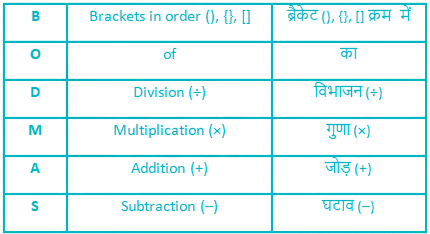
Calculation:
11.97 × 9.04 + ? – 12.06 ÷ 6.03 = 152.98
⇒ 12 × 9 + ? – 12 ÷ 6 = 153
⇒ 108 + ? – 2 = 153
⇒ ? = 153 – 108 + 2
⇒ ? = 155 – 108
⇒ ? = 47
∴ The value of ? is 47
55. What approximate value will come in the place of the question mark ‘?’ in the following question?
20.991 × 40.003 – 210.002 = 125.919 × ?
A. 4
B. 9
C. 2
D. 5
E. 10
Solution
Solution:
We have to follow the BODMAS rule
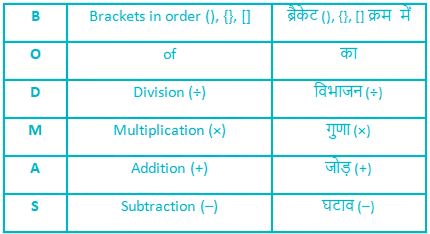
Calculation:
20.991 × 40.003 – 210.002 = 125.919 × ?
21 × 40 – 210 = 126 × ?
840 – 210 = 126 × ?
630 = 126 × ?
? = 630/126
? = 5
∴ 5 will come in place of the question mark
56. What approximate value should come in place of “?” in the following equation:
45.03 × ? + 38.91 ÷ 2.99 – 7.04 = 275.95
A. 4
B. 9
C. 2
D. 10
E. 6
Solution
Rules of Approximation:
1. If a number has digits to the right of the decimal less than 5, then just drop the digits to the right of the decimal. The number so obtained will be the approximated value.
2. If a number has digits to the right of the decimal more than 5, then just drop the digits to the right of the decimal and raise the remaining number by ‘1’.The number so obtained will be the approximated value.
Concept Used:
Follow BODMAS rule to solve this question, as per the order given below,
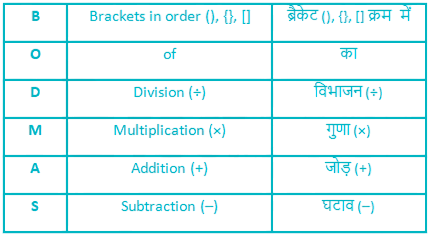
Calculation:
45.03 × ? + 38.91 ÷ 2.99 – 7.04 = 275.95
⇒ 45 × ? + 39 ÷ 3 – 7 = 276
⇒ 45 × ? + 13 – 7 = 276
⇒ 45 × ? = 283 – 13
⇒ 45 × ? = 270
⇒ ? = 270/45
⇒ ? = 6
∴ The required approximate value of “?” in the given equation is 6
57. What approximate will come in the place of the question mark ‘?’ in the following question?
? + 8.95 × 6.06 – 11.92 ÷ 5.97 + 12.98 = 67.03
A. 4
B. 6
C. 2
D. 5
E. 7
Solution
Rules of Approximation:
1. If a number has digits to the right of the decimal less than 5, then just drop the digits to the right of the decimal. The number so obtained will be the approximated value.
2. If a number has digits to the right of the decimal more than 5, then just drop the digits to the right of the decimal and raise the remaining number by ‘1’.The number so obtained will be the approximated value.
Concept Used:
Follow BODMAS rule to solve this question, as per the order given below,

Calculation:
? + 8.95 × 6.06 – 11.92 ÷ 5.97 + 12.98 = 67.03
⇒ ? + 9 × 6 – 12 ÷ 6 + 13 = 67
⇒ ? + 54 – 2 + 13 = 67
⇒ ? + 67 – 2 = 67
⇒ ? = 67 – 67 + 2
⇒ ? = 69 – 67
⇒ ? = 2
∴ The value of ? is 2
58. What approximate will come in the place of the question mark ‘?’ in the following question?
17.012 + √? + 3.992.99 = 8.032 + 19.092
A. 5960
B. 6781
C. 5234
D. 5184
E. 4900
Solution
Rules of Approximation:
1. If a number has digits to the right of the decimal less than 5, then just drop the digits to the right of the decimal. The number so obtained will be the approximated value.
2. If a number has digits to the right of the decimal more than 5, then just drop the digits to the right of the decimal and raise the remaining number by ‘1’.The number so obtained will be the approximated value.
Concept Used:
Follow BODMAS rule to solve this question, as per the order given below,
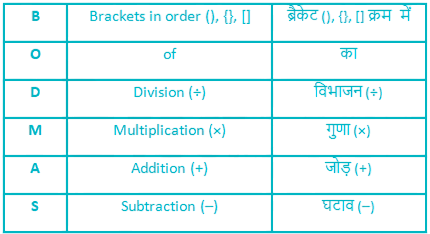
Calculation:
17.012 + √? + 3.992.99 = 8.032 + 19.092
⇒ 172 + √? + 43 = 82 + 192
⇒ √? + 289 + 64 = 64 + 361
⇒ √? = 64 + 361 – 289 – 64
⇒ √? = 72
⇒ ? = 722
⇒ ? = 5184
∴ The value of ? is 5184
59. What approximate value should come in place of “?” in the following equation:
98.97 ÷ 2.99 + 29.04 – 9.01 × 3.01 = ?
A. 32
B. 35
C. 37
D. 33
E. 31
Solution
Rules of Approximation:
1. If a number has digits to the right of the decimal less than 5. Then just drop the digits to the right of the decimals. The number so obtained will be the approximated value.
2. If a number has digits to the right of the decimal more than 5. Then just drop the digits to the right of the decimals and raise the remaining number by ‘1’.The number so obtained will be the approximated value.
Concept Used:
Follow BODMAS rule to solve this question, as per the order given below

Calculation;
98.97 ÷ 2.99 + 29.04 – 9.01 × 3.01 = ?
⇒ 33 + 29.04 – 9.01 × 3.01 = ?
⇒ 33.1 + 29.04 – 27 = ?
⇒ 62 – 27 = ?
⇒ ? = 35
∴ The required approximate value of “?” in the given equation is 35
60. What approximate value should come in place of “?” in the following equation:
495.04 + ? ÷ 9.01 – 10.99 × 3.01 = 467.11
A. 25
B. 50
C. 35
D. 45
E. 55
Solution
Given:
The given equation is:
495.04 + ? ÷ 9.01 – 10.99 × 3.01 = 467.11
Concept Used:
Follow BODMAS rule to solve this question, as per the order given below

Calculation;
495.04 + ? ÷ 9.01 – 10.99 × 3.01 = 467.11
⇒ 495.04 + ? ÷ 9.01 – 33 = 467.11
⇒ ? ÷ 9.01 = 467.11 – 495.04 + 33
⇒ ? ÷ 9.01 = 500 – 495.04
⇒ ? ÷ 9.01 = 5
⇒ ? = 5 × 9
⇒ ? = 45
∴ The required approximate value of “?” in the given equation is 45
61. What approximate value should come in place of “?” in the following equation:
? + 2.99 ÷ 11.96 + 0.75 × 4.99 = 16.02
A. 12
B. 11
C. 13
D. 14
E. 10
Solution
Rules of Approximation:
1. If a number has digits to the right of the decimal less than 5. Then just drop the digits to the right of the decimals. The number so obtained will be the approximated value.
2. If a number has digits to the right of the decimal more than 5. Then just drop the digits to the right of the decimals and raise the remaining number by ‘1’.The number so obtained will be the approximated value.
Concept Used:
Follow BODMAS rule to solve this question, as per the order given below

Calculation;
? + 2.99 ÷ 11.96 + 0.75 × 4.99 = 16.02
? + 2.99 ÷ 11.96 + 0.75 × 5 = 16
⇒ ? + 3 ÷ 12 + 3.75 = 16
⇒ ? + 0.25 + 3.75 = 16
⇒ ? + 4 = 16
⇒ ? = 16 – 4
⇒ ? = 12
∴ The required approximate value of “?” in the given equation is 12.
62. What approximate value should come in place of ‘?’ in the following equation:
350.97 ÷ 27.02 + (13.99)2 ÷ 28.04 = ?
A. 13
B. 20
C. 7
D. 15
E. None of these
Solution
Solution:
Rules of Approximation:
1. If a number has digits to the right of the decimal less than 5, then just drop the digits to the right of the decimal. The number so obtained will be the approximated value.
2. If a number has digits to the right of the decimal more than 5, then just drop the digits to the right of the decimal and raise the remaining number by ‘1’.The number so obtained will be the approximated value.
Concept Used:
Follow BODMAS rule to solve this question, as per the order given below,

Calculation:
351 ÷ 27 + (14)2 ÷ 28 = ?
⇒ 351 ÷ 27 + 196 ÷ 28 = ?
⇒ 13 + 7 = ?
∴ ? = 20
63. What approximate will come in the place of the question mark ‘?’ in the following question?
440.831/2 + 16.99 × 28 – 196831/3 = ? × 4
A. 445
B. 460
C. 470
D. 118
E. 500
Solution
Concept Used:
Follow BODMAS rule to solve this question, as per the order given below,

Calculation:
440.831/2 + 16.99 × 28 – 196831/3 = ? × 4
4411/2 + 17 × 28 -196831/3 =? × 4
⇒ 21 + 476 – 27 = ? × 4
⇒ 470 = ? × 4
⇒ ? = 470 ÷ 4
⇒ ? = 117.5
Hence, 117.5 ≈ 118
∴ The required value is 118
64. Madhu saves 20% of his monthly income. But due to price hike in the market, he can save only Rs. 2000, which is 40% of his previous saving. Find his monthly expenditure after the price hike.
A. Rs. 25000
B. Rs. 20000
C. Rs. 23000
D. Rs. 22000
E. Rs. 15000
Solution
Given:
Madhu saves 20% of his monthly income
Due to price hike in the market, he can save only Rs. 2000, which is 40% of his previous saving
Calculation:
Let, Madhu’s income = 100a
Initial saving = 100a × 20/100 = 20a
Initial expenditure = 100a – 20a = 80a
After the price hike his saving = 20a × 40/100 = 8a
So, his new expenditure = 100 – 8a = 92a
According to the question,
⇒ 8a = 2000
⇒ a = 250
So, Madhu’s expenditure after the price hike = 92 × 250 = Rs. 23000
∴ The correct answer is option 3
65. Two bikes Hero and TVS, which have the same cost price sold at an overall profit of 25%. If Hero is sold at 20% profit and TVS sold at Rs 250 more than Hero, then find the cost price of Hero.
A. 2600
B. 1800
C. 2000
D. 2100
E. 2500
Solution
Overall profit is 25 %
When we use alligation method on profit % we get the ratio of cp of an articles
Apply this ,
Hero TVS
20% x%
25%
( x -25) % 5%
Cost price of both bikes is same so ratio of cp is 1 : 1
So , ( x- 25 ) / 5 = 1 : 1
⇒ x- 25 = 5
⇒ x = 30%
Now, 30% – 20% = Rs 250
⇒ 10% = Rs 250
⇒ 100 % = Rs 2500
And 100% is called cost price of hero bikes
Hence Rs 2500 is the correct answer.
66. Directions: Study the following caselet shows the information about the number of shirts and sarees sold in three different shops A, B and C.
Total sarees sold in all the three shops is 2000. Number of sarees sold in shop B is 25% more than that in shop A.Number of sarees sold in shop C is 50 more than that in shop A. Ratio between the number of sarees to shirts sold in shop A is 3: 2. Number of shirts sold in shop B is 100 more than that in shop A. Average number of shirts sold in all the three shops is 450.
Question:
Find the difference between the number of sarees sold in shop A and the number of shirts sold in shop C.
A. 170
B. 180
C. 150
D. 120
E. 160
Solution
General solution:
Total number of sarees sold in all the shops A, B and C = 2000
Number of sarees sold in shop A = x
Number of sarees sold in shop B = x × (125/100) = 1.25x
Number of sarees sold in shop C = (x + 50)
(x + 1.25x + x + 50) = 2000
3.25x = 1950
x = 600
Number of sarees sold in shop A = 600
Number of sarees sold in shop B = 1.25 × 600 = 750
Number of sarees sol in shop C = (600 + 50) = 650
Number of shirts sold in shop A = 600/3 × 2 = 400
Number of shirts sold in shop B = (400 + 100) = 500
Total shirts sold in all the shops = 450 × 3 = 1350
Number of shirts sold in shop C = (1350 – (400 + 500)) = 450
| Name of the shop | Number of sarees sold | Number of shirts sold |
| A | 600 | 400 |
| B | 750 | 500 |
| C | 650 | 450 |
Solution:
Number of sarees sold in shop A = 600
Number of shirts sold in shop C = 450
Required difference = (600 – 450) = 150
67. Directions: Study the following caselet shows the information about the number of shirts and sarees sold in three different shops A, B and C.
Total sarees sold in all the three shops is 2000. Number of sarees sold in shop B is 25% more than that in shop A.Number of sarees sold in shop C is 50 more than that in shop A. Ratio between the number of sarees to shirts sold in shop A is 3: 2. Number of shirts sold in shop B is 100 more than that in shop A. Average number of shirts sold in all the three shops is 450.
Question:
Find the sum of the total number of sarees sold in shop B and C and the total number of shirts sold in shop B and C.
A. 2250
B. 2450
C. 2350
D. 2150
E. 2550
Solution
General solution:
Total number of sarees sold in all the shops A, B and C = 2000
Number of sarees sold in shop A = x
Number of sarees sold in shop B = x × (125/100) = 1.25x
Number of sarees sold in shop C = (x + 50)
(x + 1.25x + x + 50) = 2000
3.25x = 1950
x = 600
Number of sarees sold in shop A = 600
Number of sarees sold in shop B = 1.25 × 600 = 750
Number of sarees sol in shop C = (600 + 50) = 650
Number of shirts sold in shop A = 600/3 × 2 = 400
Number of shirts sold in shop B = (400 + 100) = 500
Total shirts sold in all the shops = 450 × 3 = 1350
Number of shirts sold in shop C = (1350 – (400 + 500)) = 450
| Name of the shop | Number of sarees sold | Number of shirts sold |
| A | 600 | 400 |
| B | 750 | 500 |
| C | 650 | 450 |
Solution:
Number of sarees sold in shop B = 750
Number of sarees sold in shop C = 650
Number of shirts sold in shop B = 500
Number of shirts sold in shop C = 450
Required sum = (750 + 650 + 500 + 450) = 2350
68. Directions: Study the following caselet shows the information about the number of shirts and sarees sold in three different shops A, B and C.
Total sarees sold in all the three shops is 2000. Number of sarees sold in shop B is 25% more than that in shop A.Number of sarees sold in shop C is 50 more than that in shop A. Ratio between the number of sarees to shirts sold in shop A is 3: 2. Number of shirts sold in shop B is 100 more than that in shop A. Average number of shirts sold in all the three shops is 450.
Question:
If 20% and 40% of the sarees sold in shop B and C is at discounted price respectively and remaining are at the marked price.Find total sarees sold at the marked price in shop B and C.
A. 1050
B. 1010
C. 1030
D. 990
E. 970
Solution
General solution:
Total number of sarees sold in all the shops A, B and C = 2000
Number of sarees sold in shop A = x
Number of sarees sold in shop B = x × (125/100) = 1.25x
Number of sarees sold in shop C = (x + 50)
(x + 1.25x + x + 50) = 2000
3.25x = 1950
x = 600
Number of sarees sold in shop A = 600
Number of sarees sold in shop B = 1.25 × 600 = 750
Number of sarees sol in shop C = (600 + 50) = 650
Number of shirts sold in shop A = 600/3 × 2 = 400
Number of shirts sold in shop B = (400 + 100) = 500
Total shirts sold in all the shops = 450 × 3 = 1350
Number of shirts sold in shop C = (1350 – (400 + 500)) = 450
| Name of the shop | Number of sarees sold | Number of shirts sold |
| A | 600 | 400 |
| B | 750 | 500 |
| C | 650 | 450 |
Solution:
Number of sarees from shop B sold at discounted price = 750 × (20/100) = 150
Number of sarees from shop C sold at discounted price = 650 × (40/100) = 260
Number of sarees sold at marked price in shop B and C = (750 + 650) – (150 + 260) = 990
69. Simple interest earned on an amount of Rs. 15000 at the end of 4 years is Rs. 12000. What will be the compound interest earned on the same amount, at same rate for 3 years.
A. Rs. 11000
B. Rs. 10920
C. Rs. 10800
D. Rs. 10290
E. Rs. 10500
Solution
Given:
Simple interest earned on an amount of Rs. 15000 at the end of 4 years is Rs. 12000
Concept Used:
Simple Interest (SI) = (P × R × T)/100
Compound Interest (CI) = P × (1 + R/100)T – P
Where, P = principal amount, R = rate of interest, and T = time duration
Calculation:
According to the question,
P = Rs. 15000, SI = Rs. 12000, and T = 4 years
The rate (R) for SI = (12000 × 100)/(15000 × 4) = 20%
Now, the CI earned on the same amount at the same rate for 3 years is
⇒ 15000 × [(1 + 20/100)3 – 1]
⇒ 15000 × [(216/125) – 1]
⇒ 15000 × 91/125
⇒ Rs. 10920
∴ The correct answer is option 2
70. Total surface area of sphere A is 972 cm2.The sphere A is recast into sphere B whose radius is 33.33% of sphere A. Find the how many spheres that can be recasted.
(use π = 3)
A. 27
B. 8
C. 64
D. 216
E. None of these
Solution
Solution:
Total surface area of the sphere = 4πr2
To find the radius of the sphere A = 4 × 3 × r2 = 972
r2 = 972/12 = 81 cm
r = 9cm
Radius of the sphere B = 9 × 1/3 = 3
To find the number of spheres that can be recast
N = (4/3 × 3 × 9 × 9 × 9)/(4/3 × 3 × 3 × 3 × 3) = 27
Hence, option(1) is correct.
71. Read the following sentence and determine whether there is any error in it. The error, if any, will be in one part of the sentence. If the sentence is error-free, select ‘No error’ as your answer.
More candidates (A)/ than one has (B)/ been disqualified (C)/ in the final year examination.(D)/ No error (E)/
A. A
B. B
C. C
D. D
E. No error
Solution
The correct answer is option 2 i.e. B.
Key Points
- The error lies in the part B of the sentence.
- In a sentence, the verb is used according to person and number.
- According to the rule: after “more + plural noun + than one“, plural verb is used.
- Example:
- More employees than one is late.
- More employees than one are late.
- As the main subject in the given sentence is ‘More candidates than one‘, the verb will also be plural i.e. have.
- Thus, according to the rule, the 2nd option i.e. B will be the correct choice.
Correct Sentence: More candidates than one have been disqualified in the final year examination.
Additional Information
- In the case of the following words, the verbs used will be singular:
- Each, every/everyone, someone/somebody, none/ nobody, one, no one, any, many a, more than one, etc.
- Example:
- Everyone are addicted to smartphones nowadays.
- Everyone is addicted to smartphones nowadays.
Confusion Points
- The verbs used will be singular in case of: Each, every/everyone, many a, more than one, etc.
- The verbs used will be plural in case of: more + plural noun + than one
Hint
The determiner ‘more + plural noun + than one‘ will decide the verb – singular or plural. In the case of more + plural noun + than one, the verbs used will be plural.
72. Read the sentence to find out whether there is any error in it. The error, if any, will be in one part of the sentence. The number of that part is the answer. If there is no error, the answer is (E- No Error). Ignore errors of punctuation, if any.
Either of (A)/ these five students (B)/ is responsible for (C)/ the bad behaviour in our group (D)/. No error. (E)
A. A
B. B
C. C
D. D
E. No error
Solution
The correct option is option 1 i.e. A.
Key Points
- ‘Either of…’ means any one of the two.
- But here in the sentence, it is mentioned “these five persons”.
- ‘Either of should be replaced by “One of” as ‘one of’ is used in the case of referring to one person or thing in a group of more than two.
Correct sentence is: One of these five persons is responsible for the mismanagement in our organization.
Additional Information
- The word ‘either‘ is used to express a choice between two alternatives. So, if you are referring to two options, say ‘either of the two’. When more than two options are available, use ‘any one of them’.
- With ‘either” it is clear the choice is between two only .
Confusion Points
- In the given sentence we can’t use ‘any of‘ as it makes the sentence contextually incorrect. Because according to the sentence we need to choose the ‘one person‘ out of the five persons.
- Hence the usage of ‘one of‘ is correct.
Mistake Points
You might think that you can change part B and replace ‘these five students’ with ‘these two students’. Such a change would be unacceptable as you are only supposed to make grammatical changes. You cannot change the context.
73. Read the sentence given below to find out if it contains any error. The error, if any, will be in one part of the sentence. If the sentence is error-free, select No error or option 5. Ignore error of punctuation if any.
This was not a mangy (A)/ or vicious creature standing in front of him, (B)/ but a breathtaking beautiful,(C)/ gigantic wolf. (D) No error. (E)
A. A
B. B
C. C
D. D
E. E
Solution
The correct answer is ‘C‘.
Key Points
Hence, the correct answer is option 3.
The error lies in part (C) of the sentence.
‘Breathtaking’ is an adjective that means extremely surprising, beautiful, etc.
We already have ‘beautiful‘ and ‘gigantic‘ as adjectives, so we need to use an adverb.
‘Breathtakingly‘ is the correct form of adverb to be used here.
An adverb is a word that modifies (describes) a verb (he sings loudly), an adjective (very tall), another adverb (ended too quickly), or even a whole sentence (Fortunately, I had brought an umbrella).
Adverbs can also modify adjectives and other adverbs. Often, the purpose of the adverb is to add a degree of intensity to the adjective.
Examples–
My cat is incredibly happy to have his dinner.
We will be slightly late to the meeting.
Thus, the correct sentence- “This was not a mangy or vicious creature standing in front of him, but a breathtakingly beautiful, gigantic wolf.”
74. Read the sentence given below to find out if it contains any error. The error, if any, will be in one part of the sentence. If the sentence is error-free, select No error or option 5. Ignore errors of punctuation if any.
Dean wasn’t sure whether it was her (A)/ natural aversion to anything (B)/ involving law enforcement (C)/ or concern to her boss’ future (D)/. No error (E)
A. A
B. B
C. C
D. D
E. E
Solution
The correct answer is D- the error lies in part D of the sentence.
Key Points
- The error lies in part (D) of the question.
- Instead of the preposition ‘to‘, ‘for‘ will be used.
- ‘Concern for her boss’ future’ – is the correct usage of the preposition ‘to‘.
- Example–
- She has a genuine concern for her friends.
- Example–
- The correct sentence- “Dean wasn’t sure if it was her natural aversion to anything involving law enforcement or concern for her boss’ future.”
- Hence, the correct answer is option 4.
Additional Information
It was the main concern of the national agency on alcohol misuse.
Let us look at some example sentences with concern-
He has great concerns about his future.
I didn’t mention his blossoming love life but expressed concern over his serious problem of nightmares.
75. In the following question, some of the words have been left out. Read the passage carefully and select the correct answer for the given blank out of the five alternatives given in the questions that follow:
Public system includes _____________ (A) and it is an inclusive representation of society. Those citizens who are not able to access public transport, both physically and monetarily, are excluded from participation in the economic and social activities of a society. In public transport, there could be two scenarios which lead to social exclusion. First, it might be due to poor ________________ (B), that is, it does not cover the areas where the urban poor live and work. Second, even if the system is accessible, it might be __________________ (C) in terms of the generalised cost which includes _______________ (D) cost (including fuel or fare, parking, and operations and maintenance [O&M]) and value of time. Thus the analysis marks key problems that are prevailing and needs attention and an ____________ (E).
Question:
Which of the following words most appropriately fits the blank labelled (A)?
A. Rejunevation
B. Restoration
C. Enforcement
D. Speculation
E. Transport
Solution
The correct answer is ‘Transport’
Key Points
- Here, one must understand the context by reading the paragraph thoroughly and then go through the words in the options.
- Rejunevation means a process of making someone or something look or feel better,
- Restoring means to repair or renovate (a building, work of art, vehicle, etc.) so as to return it to its original condition.
- Enforcement means to make a situation happen forcefully so as to get the desired results
- Speculation means the act of forming a theory without firm evidence.
- Transport here is referred to as public transport which is an important aspect of living in a society.
- The paragraph tells about the importance of the transport system and the problem that is being faced in this sector.
Hence the correct answer is option 5.
76. In the following question, some of the words have been left out. Read the passage carefully and select the correct answer for the given blank out of the five alternatives given in the questions that follow:
Public system includes _____________ (A) and it is an inclusive representation of society. Those citizens who are not able to access public transport, both physically and monetarily, are excluded from participation in the economic and social activities of a society. In public transport, there could be two scenarios which lead to social exclusion. First, it might be due to poor ________________ (B), that is, it does not cover the areas where the urban poor live and work. Second, even if the system is accessible, it might be __________________ (C) in terms of the generalised cost which includes _______________ (D) cost (including fuel or fare, parking, and operations and maintenance [O&M]) and value of time. Thus the analysis marks key problems that are prevailing and needs attention and an ____________ (E).
Question:
Which of the following words most appropriately fits the blank labelled (B)?
A. Requisites
B. Reverberations
C. Structure
D. Accessibility
E. Sustainability
Solution
The correct answer is ‘Accessibility’
Key Points
- Here, reading the paragraph thoroughly can fetch you the right answer. Understand the context of the statement and then decide which word should be the correct answer.
- Requisites refer to something that is necessary.
- Reverberations mean a continuing effect.
- Accessibility means that is in reach of someone.
- Structure means the way something is built.
- Sustainability means the ability to maintain something at a certain rate.
- The phrase does not cover indicates an outreach problem i.e. it tells you that transport facilities have a problem of accessibility because of which it leads to exclusion in the society.
77. In the following question, some of the words have been left out. Read the passage carefully and select the correct answer for the given blank out of the five alternatives given in the questions that follow:
Public system includes _____________ (A) and it is an inclusive representation of society. Those citizens who are not able to access public transport, both physically and monetarily, are excluded from participation in the economic and social activities of a society. In public transport, there could be two scenarios which lead to social exclusion. First, it might be due to poor ________________ (B), that is, it does not cover the areas where the urban poor live and work. Second, even if the system is accessible, it might be __________________ (C) in terms of the generalised cost which includes _______________ (D) cost (including fuel or fare, parking, and operations and maintenance [O&M]) and value of time. Thus the analysis marks key problems that are prevailing and needs attention and an ____________ (E).
Question:
Which of the following words most appropriately fits the blank labelled (C)?
A. Unexceptional
B. Peculiar
C. Unconditional
D. Derogatory
E. Unaffordable
Solution
The correct answer is ‘Unaffordable’
Key Points
- One can easily find out the problems prevailing in the transport sector of society. Here, the first problem has been found out and the second problem is being told about the cost factor. This can be understood from the phrase in terms of the generalized cost which indicates issues of cost.
- Unexceptional refers to ordinary or usual.
- Peculiar means something strange or not normal.
- Unconditional means something that is not subject to anything.
- Derogatory means showing a disrespectful attitude
- Unaffordable means something we cannot buy or afford.
So unaffordable is the correct word that would make the sentence meaningful and correct.
78. In the following question, some of the words have been left out. Read the passage carefully and select the correct answer for the given blank out of the five alternatives given in the questions that follow:
Public system includes _____________ (A) and it is an inclusive representation of society. Those citizens who are not able to access public transport, both physically and monetarily, are excluded from participation in the economic and social activities of a society. In public transport, there could be two scenarios which lead to social exclusion. First, it might be due to poor ________________ (B), that is, it does not cover the areas where the urban poor live and work. Second, even if the system is accessible, it might be __________________ (C) in terms of the generalised cost which includes _______________ (D) cost (including fuel or fare, parking, and operations and maintenance [O&M]) and value of time. Thus the analysis marks key problems that are prevailing and needs attention and an ____________ (E).
Question:
Which of the following words most appropriately fits the blank labelled (D)?
A. Monetary
B. Transitory
C. Emacity
D. Obligatory
E. Persistent
Solution
The correct answer is ‘Monetary’
Key Points
- Here, knowing the context is important. If you read the lines proceeding it, you’ll be able to understand that it is telling about the costs involved.
- Monetary means in terms of money.
- Transitory means something that is not permanent.
- Emacity means fondness of buying something.
- Obligatory means that has to be done as compulsory.
- Persistent means to continue for a long time
79. In the following question, some of the words have been left out. Read the passage carefully and select the correct answer for the given blank out of the five alternatives given in the questions that follow:
Public system includes _____________ (A) and it is an inclusive representation of society. Those citizens who are not able to access public transport, both physically and monetarily, are excluded from participation in the economic and social activities of a society. In public transport, there could be two scenarios which lead to social exclusion. First, it might be due to poor ________________ (B), that is, it does not cover the areas where the urban poor live and work. Second, even if the system is accessible, it might be __________________ (C) in terms of the generalised cost which includes _______________ (D) cost (including fuel or fare, parking, and operations and maintenance [O&M]) and value of time. Thus the analysis marks key problems that are prevailing and needs attention and an ____________ (E).
Question:
Which of the following words most appropriately fits the blank labelled (E)?
A. Interrogate
B. Opinion
C. Answer
D. Reply
E. Retort
Solution
The correct answer is ‘Answer’
Key Points
- Let’s see the meanings of the given words:-
- Interrogate means to ask question aggressively or formally.
- Opinion means to have a view on something or someone
- Answer means to reply or give a statement in return to something asked or enquired.
- Reply is similar to answer and indicates some reaction to something said or done.
- Retort means to answer in a sharp and angry manner.
- In this question, the phrase needs attention and an tells that the answer should start with a vowel. Thus making Answer correct.
80. Directions: Which of the following phrases given below in the options should replace the phrase that is underlined in the sentence to make it grammatically correct? If the sentence is correct and does not require any correction mark ‘No correction required’ as your answer.
It’s been six months since she last saw her family so when she saw her father she ran towards him.
A. ran within
B. sprinted beside
C. ran forward
D. sprinted from
E. No correction required
Solution
The correct answer is option 5.
Key Points
The underlined phrase ‘ran towards’ is correct.
Let’s understand the meanings and usage of the prepositions given in the options –
Even though the colour is somewhat similar, my dress is very different from yours.
Towards –
As a preposition ‘towards’ means in the direction of, or closer to someone or something.
For Example –
She walked down the aisle towards her fiance.
Within –
In reference to space or time, ‘within’ means ‘inside or not further than a particular area or space or time’.
For Example –
I live within ten miles of my college campus.
Beside –
It means next to or at the side of.
For Example –
The book is placed on the table beside the lamp.
Forward –
It is used to show that something moves in the direction of its front, not its back. It also means that something is getting better or it is moving into the future
For Example –
We should not sit in sorrow for long and keep moving forward with our lives.
From –
It is used to refer to the place where someone or something starts or originates.
For Example –
She picked the flowers from her garden.
It is used to show who sent or gave something to somebody and It is also used to show somebody’s position or point of view.
For Example –
The view from my room is spectacular.
I received a bouquet of flowers from my boss.
‘From’ is used when making or recognizing a difference between two people or things.
For Example –
81. Directions: Which of the following phrases given below in the options should replace the phrase that is underlined in the sentence to make it grammatically correct? If the sentence is correct and does not require any correction mark ‘No correction required’ as your answer.
Never make the mistake of buying a home on the sake of saving taxes.
A. for the sake
B. with the sake
C. from the sake
D. by the sake
E. No correction required
Solution
The correct answer is option 1.
Key Points
The underlined phrase ‘on the sake‘ is incorrect.
- There is no phrase in the English language like ‘on the sake’.
- ‘For the sake’: If you do something for the sake of something, you do it for that purpose or in order to achieve that result. You can also say that you do it for something’s sake.
- Example:- Let’s assume for the sake of argument that we manage to build a satisfactory database.
- Hence, the phrase ‘on the sake’ will be replaced by ‘for the sake’ to make the sentence grammatically correct.
- Correct Sentence :
- Never make the mistake of buying a home for the sake of saving taxes.
Hence, option 1 is the correct answer.
Additional Information
“malaria can be controlled by attacking the parasite”
For –
It is used to indicate the use of something.
For Example –
You can use detergent for washing your dirty clothes.
It is used to mean ‘because of’.
For Example –
I feel very sorry for your loss.
It is also used to indicate time or duration.
For Example –
I’ve been studying at this college for a year.
With –
It means ‘accompanied by’ something or someone.
For Example –
Rahul is coming with his friend.
The preposition ‘with’ often follows adjectives that refer to reactions and feelings.
For Example –
Are you not happy with your performance in the test?
It can also be used to refer to what we use to do something.
For Example –
Open the door with the key.
From –
It is used to refer to the place where someone or something starts or originates.
For Example –
She picked the flowers from her garden.
It is used to show who sent or gave something to somebody and also used to show somebody’s position or point of view.
For Example –
The view from my room is spectacular.
‘From’ is used when making or recognizing a difference between two people or things.
For Example –
Even though the colour is somewhat similar, my dress is very different from yours.
By–
Indicating the means of achieving something.
For Example –
82. Directions: Read the passage given below and answer the questions that follow by choosing the correct/most appropriate options:
When a 17-year-old beats the five-time World champion and strongest chess player of all time in three games in a row, it is bound to attract attention. R. Praggnanandhaa did that at Miami on Sunday, the final day of the FTX Crypto Cup. His stunning victory _______ Magnus Carlsen, however, was not enough to win the tournament; he had to settle for the runner-up spot behind the Norwegian. But this is more than creditable, as all his seven rivals in the round-robin event had higher Fide ratings. And it was not the first time that he was beating Carlsen, having scored wins in online tournaments earlier this year. The great show at Miami should no doubt be a huge morale-booster for the Chennai lad. He had flown to Miami soon after helping India to win the bronze medal at the Chennai Chess Olympiad. He was not the biggest star at Mamallapuram, though. His teammate, D. Gukesh, also from Chennai and also a teenager, had created a sensation at the Olympiad, posting eight wins on the trot. A few month earlier, it was yet another Indian teenager, Arjun Erigaisi, who was hitting the headlines.
Apart from Praggnanandhaa, Gukesh, and Erigaisi, two other young Indians — Nihal Sarin and Raunak Sadhwani — had also come up with excellent performances at the Olympiad. Sadhwani then won the blitz title at the Abu Dhabi International Chess Festival, a few hours before Praggnanandhaa’s victory against Carlsen. At the Masters section of the tournament, Sadhwani shared the second spot after five rounds with Erigaisi and Sarin, among others. As for Gukesh, he is busy improving his rating at the Turkish Chess Super League in Ankara. That all these hugely talented youngsters are making their Grand-masterly moves at the same time augurs well for Indian chess. And there are a few more youngsters waiting in the wings, such as V. Pranav and Bharath Subramaniyam. Rarely has India threatened to take the world on, in any sport, with a group of promising teenagers. Viswanathan Anand, the man who began it all, may have been the lone Indian at the top, but his successors are likely to have company. He is now mentoring the young Indians, who have acknowledged how much they have gained from working with him. These days, quality coaches, some of them Grandmasters, are available across the country. A strong domestic base, made possible by, among other things, parental support and the rise in the popularity of the game, promises even brighter days ahead for Indian chess.
Question:
Which of the following is/are incorrect according to the given passage?
A. Magnus Carlsen is a German chess player.
B. R. Praggnanandhaa won the FTX Crypto Cup.
C. D. Gukesh posted back-to-back eight wins at the Olympiad.
A. Only A
B. Both A and B
C. Only B
D. Both B and C
E. Only C
Solution
The correct answer is ‘Both A and B.‘
Key Points
- The third sentence of the first paragraph says “His stunning victory over Magnus Carlsen, however, was not enough to win the tournament; he had to settle for the runner-up spot behind the Norwegian”.
- From the above sentences, we can say that statements A and B are incorrect according to the given passage.
- The second-last sentence of the first paragraph says “His teammate, D. Gukesh, also from Chennai and also a teenager, had created a sensation at the Olympiad, posting eight wins on the trot.”
- From the above sentence, we can say that statement C is correct according to the given passage.
- From the above sentence, we can say that statement C is correct according to the given passage.
Hence, the only possible answer is option 2.
83. Directions: Read the passage given below and answer the questions that follow by choosing the correct/most appropriate options:
When a 17-year-old beats the five-time World champion and strongest chess player of all time in three games in a row, it is bound to attract attention. R. Praggnanandhaa did that at Miami on Sunday, the final day of the FTX Crypto Cup. His stunning victory _______ Magnus Carlsen, however, was not enough to win the tournament; he had to settle for the runner-up spot behind the Norwegian. But this is more than creditable, as all his seven rivals in the round-robin event had higher Fide ratings. And it was not the first time that he was beating Carlsen, having scored wins in online tournaments earlier this year. The great show at Miami should no doubt be a huge morale-booster for the Chennai lad. He had flown to Miami soon after helping India to win the bronze medal at the Chennai Chess Olympiad. He was not the biggest star at Mamallapuram, though. His teammate, D. Gukesh, also from Chennai and also a teenager, had created a sensation at the Olympiad, posting eight wins on the trot. A few month earlier, it was yet another Indian teenager, Arjun Erigaisi, who was hitting the headlines.
Apart from Praggnanandhaa, Gukesh, and Erigaisi, two other young Indians — Nihal Sarin and Raunak Sadhwani — had also come up with excellent performances at the Olympiad. Sadhwani then won the blitz title at the Abu Dhabi International Chess Festival, a few hours before Praggnanandhaa’s victory against Carlsen. At the Masters section of the tournament, Sadhwani shared the second spot after five rounds with Erigaisi and Sarin, among others. As for Gukesh, he is busy improving his rating at the Turkish Chess Super League in Ankara. That all these hugely talented youngsters are making their Grand-masterly moves at the same time augurs well for Indian chess. And there are a few more youngsters waiting in the wings, such as V. Pranav and Bharath Subramaniyam. Rarely has India threatened to take the world on, in any sport, with a group of promising teenagers. Viswanathan Anand, the man who began it all, may have been the lone Indian at the top, but his successors are likely to have company. He is now mentoring the young Indians, who have acknowledged how much they have gained from working with him. These days, quality coaches, some of them Grandmasters, are available across the country. A strong domestic base, made possible by, among other things, parental support and the rise in the popularity of the game, promises even brighter days ahead for Indian chess.
Question:
According to the passage, who won the bronze medal at the Chennai Chess Olympiad?
A. D. Gukesh
B. Arjun Erigaisi
C. R. Praggnanandhaa
D. Nihal Sarin
E. Raunak Sadhwani
Solution
The correct answer is ‘R. Praggnanandhaa.‘
Key Points
- The seventh sentence of the first paragraph says “He had flown to Miami soon after helping India to win the bronze medal at the Chennai Chess Olympiad.”
- From the above sentence, we can say that according to the passage, R. Praggnanandhaa won the bronze medal at the Chennai Chess Olympiad.
Hence, the only possible answer is option 3.
84. Directions: Read the passage given below and answer the questions that follow by choosing the correct/most appropriate options:
When a 17-year-old beats the five-time World champion and strongest chess player of all time in three games in a row, it is bound to attract attention. R. Praggnanandhaa did that at Miami on Sunday, the final day of the FTX Crypto Cup. His stunning victory _______ Magnus Carlsen, however, was not enough to win the tournament; he had to settle for the runner-up spot behind the Norwegian. But this is more than creditable, as all his seven rivals in the round-robin event had higher Fide ratings. And it was not the first time that he was beating Carlsen, having scored wins in online tournaments earlier this year. The great show at Miami should no doubt be a huge morale-booster for the Chennai lad. He had flown to Miami soon after helping India to win the bronze medal at the Chennai Chess Olympiad. He was not the biggest star at Mamallapuram, though. His teammate, D. Gukesh, also from Chennai and also a teenager, had created a sensation at the Olympiad, posting eight wins on the trot. A few month earlier, it was yet another Indian teenager, Arjun Erigaisi, who was hitting the headlines.
Apart from Praggnanandhaa, Gukesh, and Erigaisi, two other young Indians — Nihal Sarin and Raunak Sadhwani — had also come up with excellent performances at the Olympiad. Sadhwani then won the blitz title at the Abu Dhabi International Chess Festival, a few hours before Praggnanandhaa’s victory against Carlsen. At the Masters section of the tournament, Sadhwani shared the second spot after five rounds with Erigaisi and Sarin, among others. As for Gukesh, he is busy improving his rating at the Turkish Chess Super League in Ankara. That all these hugely talented youngsters are making their Grand-masterly moves at the same time augurs well for Indian chess. And there are a few more youngsters waiting in the wings, such as V. Pranav and Bharath Subramaniyam. Rarely has India threatened to take the world on, in any sport, with a group of promising teenagers. Viswanathan Anand, the man who began it all, may have been the lone Indian at the top, but his successors are likely to have company. He is now mentoring the young Indians, who have acknowledged how much they have gained from working with him. These days, quality coaches, some of them Grandmasters, are available across the country. A strong domestic base, made possible by, among other things, parental support and the rise in the popularity of the game, promises even brighter days ahead for Indian chess.
Question:
What will fit in the blank taken from the passage: ”His stunning victory _______ Magnus Carlsen, however, was not enough to win the tournament; he had to settle for the runner-up spot behind the Norwegian.”
A. Above
B. Below
C. Between
D. Over
E. About
Solution
The correct answer is ‘Over.‘
Key Points
- The given sentence is talking about Praggnanandhaa’s stunning authority or control against Magnus Carlsen.
- Let us explore the given options:
- The preposition ‘Above‘ means In a higher place.
- The preposition ‘Below’ means At or to a lower position or level than somebody or something.
- The preposition ‘Between‘ means In the space in the middle of two things, people, places, etc.
- The preposition ‘Over’ is used For expressing authority or control.
- The preposition ‘About‘ means On the subject of; concerning.
Hence, the correct answer is option 4.
Complete Sentence: His stunning victory over Magnus Carlsen, however, was not enough to win the tournament; he had to settle for the runner-up spot behind the Norwegian.
85. Directions: Read the passage given below and answer the questions that follow by choosing the correct/most appropriate options:
When a 17-year-old beats the five-time World champion and strongest chess player of all time in three games in a row, it is bound to attract attention. R. Praggnanandhaa did that at Miami on Sunday, the final day of the FTX Crypto Cup. His stunning victory _______ Magnus Carlsen, however, was not enough to win the tournament; he had to settle for the runner-up spot behind the Norwegian. But this is more than creditable, as all his seven rivals in the round-robin event had higher Fide ratings. And it was not the first time that he was beating Carlsen, having scored wins in online tournaments earlier this year. The great show at Miami should no doubt be a huge morale-booster for the Chennai lad. He had flown to Miami soon after helping India to win the bronze medal at the Chennai Chess Olympiad. He was not the biggest star at Mamallapuram, though. His teammate, D. Gukesh, also from Chennai and also a teenager, had created a sensation at the Olympiad, posting eight wins on the trot. A few month earlier, it was yet another Indian teenager, Arjun Erigaisi, who was hitting the headlines.
Apart from Praggnanandhaa, Gukesh, and Erigaisi, two other young Indians — Nihal Sarin and Raunak Sadhwani — had also come up with excellent performances at the Olympiad. Sadhwani then won the blitz title at the Abu Dhabi International Chess Festival, a few hours before Praggnanandhaa’s victory against Carlsen. At the Masters section of the tournament, Sadhwani shared the second spot after five rounds with Erigaisi and Sarin, among others. As for Gukesh, he is busy improving his rating at the Turkish Chess Super League in Ankara. That all these hugely talented youngsters are making their Grand-masterly moves at the same time augurs well for Indian chess. And there are a few more youngsters waiting in the wings, such as V. Pranav and Bharath Subramaniyam. Rarely has India threatened to take the world on, in any sport, with a group of promising teenagers. Viswanathan Anand, the man who began it all, may have been the lone Indian at the top, but his successors are likely to have company. He is now mentoring the young Indians, who have acknowledged how much they have gained from working with him. These days, quality coaches, some of them Grandmasters, are available across the country. A strong domestic base, made possible by, among other things, parental support and the rise in the popularity of the game, promises even brighter days ahead for Indian chess.
Question:
Select the word from the passage that can be used as a one-word substitute for the given group of words.
To accept or agree to something that one considers to be less than satisfactory
A. Attention
B. Stunning
C. Settle
D. Sensation
E. Augurs
Solution
The correct answer is ‘Settle.‘
Key Points
- Let’s see the meanings of the given words:-
- Attention –Notice taken of someone or something.
- Example: An article in the newspaper caught my attention.
- Stunning – Extremely impressive or attractive.
- Example: His performance was simply stunning.
- Settle – To accept or agree to something that one considers to be less than satisfactory.
- Example: I’m not going to settle for second best.
- Sensation –A widespread reaction of interest and excitement.
- Example: News of his arrest caused a sensation.
- Augurs –An event or circumstance portends a good or bad outcome.
- Example: The movement of troops augurs ill for the peace of the area.
- Attention –Notice taken of someone or something.
Hence, the correct answer is option 3.
86. Directions: Read the passage given below and answer the questions that follow by choosing the correct/most appropriate options:
When a 17-year-old beats the five-time World champion and strongest chess player of all time in three games in a row, it is bound to attract attention. R. Praggnanandhaa did that at Miami on Sunday, the final day of the FTX Crypto Cup. His stunning victory _______ Magnus Carlsen, however, was not enough to win the tournament; he had to settle for the runner-up spot behind the Norwegian. But this is more than creditable, as all his seven rivals in the round-robin event had higher Fide ratings. And it was not the first time that he was beating Carlsen, having scored wins in online tournaments earlier this year. The great show at Miami should no doubt be a huge morale-booster for the Chennai lad. He had flown to Miami soon after helping India to win the bronze medal at the Chennai Chess Olympiad. He was not the biggest star at Mamallapuram, though. His teammate, D. Gukesh, also from Chennai and also a teenager, had created a sensation at the Olympiad, posting eight wins on the trot. A few month earlier, it was yet another Indian teenager, Arjun Erigaisi, who was hitting the headlines.
Apart from Praggnanandhaa, Gukesh, and Erigaisi, two other young Indians — Nihal Sarin and Raunak Sadhwani — had also come up with excellent performances at the Olympiad. Sadhwani then won the blitz title at the Abu Dhabi International Chess Festival, a few hours before Praggnanandhaa’s victory against Carlsen. At the Masters section of the tournament, Sadhwani shared the second spot after five rounds with Erigaisi and Sarin, among others. As for Gukesh, he is busy improving his rating at the Turkish Chess Super League in Ankara. That all these hugely talented youngsters are making their Grand-masterly moves at the same time augurs well for Indian chess. And there are a few more youngsters waiting in the wings, such as V. Pranav and Bharath Subramaniyam. Rarely has India threatened to take the world on, in any sport, with a group of promising teenagers. Viswanathan Anand, the man who began it all, may have been the lone Indian at the top, but his successors are likely to have company. He is now mentoring the young Indians, who have acknowledged how much they have gained from working with him. These days, quality coaches, some of them Grandmasters, are available across the country. A strong domestic base, made possible by, among other things, parental support and the rise in the popularity of the game, promises even brighter days ahead for Indian chess.
Question:
Choose the synonym of the word ‘Improving‘.
A. Ameliorating
B. Impairing
C. Blemishing
D. Deteriorating
E. Vitiating
Solution
The correct answer is ‘Ameliorating.‘
Key Points
- The word ‘Improving‘ means To make or become better.
- Example: The gloomy weather shows no sign of improving.
- Let’s look at the meaning of the given options:-
- Ameliorating – To make something better.
- Example: Government has assumed the responsibility for ameliorating income inequality in our society.
- Impairing – To damage something or make it weaker.
- Example: Carbon monoxide is definitely capable of impairing cardiovascular function.
- Blemishing – To spoil or destroy something.
- Example: He opened the back of the skull and extracted the brain without blemishing the upper skull.
- Deteriorating – To become progressively worse.
- Example: Air quality is rapidly deteriorating in our cities.
- Vitiating – To make something less effective; to spoil something.
- Example: Development programs are vitiating by the rise in population.
- Example: Development programs are vitiating by the rise in population.
- Ameliorating – To make something better.
Hence, the only possible answer is option 1.
Additional Information
- The synonyms of the word ‘Improving‘ are “Ameliorating, Enhancing, Boosting“.
- The antonyms of the word ‘Improving‘ are “Impairing, Blemishing, Deteriorating“.
87. Directions: Read the passage given below and answer the questions that follow by choosing the correct/most appropriate options:
When a 17-year-old beats the five-time World champion and strongest chess player of all time in three games in a row, it is bound to attract attention. R. Praggnanandhaa did that at Miami on Sunday, the final day of the FTX Crypto Cup. His stunning victory _______ Magnus Carlsen, however, was not enough to win the tournament; he had to settle for the runner-up spot behind the Norwegian. But this is more than creditable, as all his seven rivals in the round-robin event had higher Fide ratings. And it was not the first time that he was beating Carlsen, having scored wins in online tournaments earlier this year. The great show at Miami should no doubt be a huge morale-booster for the Chennai lad. He had flown to Miami soon after helping India to win the bronze medal at the Chennai Chess Olympiad. He was not the biggest star at Mamallapuram, though. His teammate, D. Gukesh, also from Chennai and also a teenager, had created a sensation at the Olympiad, posting eight wins on the trot. A few month earlier, it was yet another Indian teenager, Arjun Erigaisi, who was hitting the headlines.
Apart from Praggnanandhaa, Gukesh, and Erigaisi, two other young Indians — Nihal Sarin and Raunak Sadhwani — had also come up with excellent performances at the Olympiad. Sadhwani then won the blitz title at the Abu Dhabi International Chess Festival, a few hours before Praggnanandhaa’s victory against Carlsen. At the Masters section of the tournament, Sadhwani shared the second spot after five rounds with Erigaisi and Sarin, among others. As for Gukesh, he is busy improving his rating at the Turkish Chess Super League in Ankara. That all these hugely talented youngsters are making their Grand-masterly moves at the same time augurs well for Indian chess. And there are a few more youngsters waiting in the wings, such as V. Pranav and Bharath Subramaniyam. Rarely has India threatened to take the world on, in any sport, with a group of promising teenagers. Viswanathan Anand, the man who began it all, may have been the lone Indian at the top, but his successors are likely to have company. He is now mentoring the young Indians, who have acknowledged how much they have gained from working with him. These days, quality coaches, some of them Grandmasters, are available across the country. A strong domestic base, made possible by, among other things, parental support and the rise in the popularity of the game, promises even brighter days ahead for Indian chess.
Question:
Choose the antonym of the word ‘Creditable‘.
A. Commendable
B. Admirable
C. Laudable
D. Estimable
E. Deplorable
Solution
The correct answer is ‘Deplorable.‘
Key Points
- The word ‘Creditable‘ means Deserving of high regard or great approval.
- Example: The team produced a creditable performance.
- Let’s look at the meaning of the given options:-
- Commendable – Deserving praise.
- Example: Your enthusiasm is highly commendable.
- Admirable – Arousing or deserving respect and approval.
- Example: The soldiers showed admirable bravery.
- Laudable – Deserving praise and commendation.
- Example: Her work for charity is highly laudable.
- Estimable – Worthy of great respect.
- Example: Her performance under such stressful conditions was estimable.
- Deplorable – Deserving strong condemnation; completely unacceptable.
- Example: The inactivity of the government was deplorable.
- Example: The inactivity of the government was deplorable.
- Commendable – Deserving praise.
Hence, the only possible answer is option 5.
Additional Information
- The antonyms of the word ‘Creditable‘ are “Deplorable, Disreputable, Discreditable“.
- The synonyms of the word ‘Creditable‘ are “Commendable, Admirable, Laudable“.
88. Directions: Read the passage given below and answer the questions that follow by choosing the correct/most appropriate options:
When a 17-year-old beats the five-time World champion and strongest chess player of all time in three games in a row, it is bound to attract attention. R. Praggnanandhaa did that at Miami on Sunday, the final day of the FTX Crypto Cup. His stunning victory _______ Magnus Carlsen, however, was not enough to win the tournament; he had to settle for the runner-up spot behind the Norwegian. But this is more than creditable, as all his seven rivals in the round-robin event had higher Fide ratings. And it was not the first time that he was beating Carlsen, having scored wins in online tournaments earlier this year. The great show at Miami should no doubt be a huge morale-booster for the Chennai lad. He had flown to Miami soon after helping India to win the bronze medal at the Chennai Chess Olympiad. He was not the biggest star at Mamallapuram, though. His teammate, D. Gukesh, also from Chennai and also a teenager, had created a sensation at the Olympiad, posting eight wins on the trot. A few month earlier, it was yet another Indian teenager, Arjun Erigaisi, who was hitting the headlines.
Apart from Praggnanandhaa, Gukesh, and Erigaisi, two other young Indians — Nihal Sarin and Raunak Sadhwani — had also come up with excellent performances at the Olympiad. Sadhwani then won the blitz title at the Abu Dhabi International Chess Festival, a few hours before Praggnanandhaa’s victory against Carlsen. At the Masters section of the tournament, Sadhwani shared the second spot after five rounds with Erigaisi and Sarin, among others. As for Gukesh, he is busy improving his rating at the Turkish Chess Super League in Ankara. That all these hugely talented youngsters are making their Grand-masterly moves at the same time augurs well for Indian chess. And there are a few more youngsters waiting in the wings, such as V. Pranav and Bharath Subramaniyam. Rarely has India threatened to take the world on, in any sport, with a group of promising teenagers. Viswanathan Anand, the man who began it all, may have been the lone Indian at the top, but his successors are likely to have company. He is now mentoring the young Indians, who have acknowledged how much they have gained from working with him. These days, quality coaches, some of them Grandmasters, are available across the country. A strong domestic base, made possible by, among other things, parental support and the rise in the popularity of the game, promises even brighter days ahead for Indian chess.
Question:
Choose the most appropriate meaning of the given idiom from the passage:
Waiting in the wings
A. A group within a political party or other organization having particular views or a particular function.
B. To be ready and available to help or replace someone.
C. To stay where one is or delay action until a particular time or event.
D. The action or occupation of working as a waiter or waitress.
E. Official attendance at court.
Solution
The correct answer is ‘To be ready and available to help or replace someone.‘
Key Points
- Given Idiom: Waiting in the wings means To be ready and available to help or replace someone.
- Example:My assistant is waiting in the wings to take my job once I retire.
- From the given options, the second option is the most appropriate meaning of the given idiom.
Hence, the correct answer is option 2.
Mistake Points
- We may think from the phrase “Waiting in the wings” that it is all about staying where one is or delaying action until a particular time or event.
Additional Information
- The idiom waiting in the wings is derived from the world of theater. The wings of a theater are the areas on each side of the stage where one may observe the activity on the stage without being seen by the audience. Actors stand in the wings before it is their time to go on the stage. Understudy actors often stand in the wings watching the performance in anticipation of taking over a role from the main actor. The expression waiting in the wings came into use before the twentieth century.
89. Directions: Read the passage given below and answer the questions that follow by choosing the correct/most appropriate options:
When a 17-year-old beats the five-time World champion and strongest chess player of all time in three games in a row, it is bound to attract attention. R. Praggnanandhaa did that at Miami on Sunday, the final day of the FTX Crypto Cup. His stunning victory _______ Magnus Carlsen, however, was not enough to win the tournament; he had to settle for the runner-up spot behind the Norwegian. But this is more than creditable, as all his seven rivals in the round-robin event had higher Fide ratings. And it was not the first time that he was beating Carlsen, having scored wins in online tournaments earlier this year. The great show at Miami should no doubt be a huge morale-booster for the Chennai lad. He had flown to Miami soon after helping India to win the bronze medal at the Chennai Chess Olympiad. He was not the biggest star at Mamallapuram, though. His teammate, D. Gukesh, also from Chennai and also a teenager, had created a sensation at the Olympiad, posting eight wins on the trot. A few month earlier, it was yet another Indian teenager, Arjun Erigaisi, who was hitting the headlines.
Apart from Praggnanandhaa, Gukesh, and Erigaisi, two other young Indians — Nihal Sarin and Raunak Sadhwani — had also come up with excellent performances at the Olympiad. Sadhwani then won the blitz title at the Abu Dhabi International Chess Festival, a few hours before Praggnanandhaa’s victory against Carlsen. At the Masters section of the tournament, Sadhwani shared the second spot after five rounds with Erigaisi and Sarin, among others. As for Gukesh, he is busy improving his rating at the Turkish Chess Super League in Ankara. That all these hugely talented youngsters are making their Grand-masterly moves at the same time augurs well for Indian chess. And there are a few more youngsters waiting in the wings, such as V. Pranav and Bharath Subramaniyam. Rarely has India threatened to take the world on, in any sport, with a group of promising teenagers. Viswanathan Anand, the man who began it all, may have been the lone Indian at the top, but his successors are likely to have company. He is now mentoring the young Indians, who have acknowledged how much they have gained from working with him. These days, quality coaches, some of them Grandmasters, are available across the country. A strong domestic base, made possible by, among other things, parental support and the rise in the popularity of the game, promises even brighter days ahead for Indian chess.
Question:
Choose the most appropriate meaning of the given idiom from the passage:
On the trot
A. To move forward at a speed that is faster than a walk.
B. To run at a moderate pace with short steps.
C. A period of luck of a specified kind.
D. In quick succession, one after another.
E. A speed that is faster than a walk.
Solution
The correct answer is ‘In quick succession, one after another.‘
Key Points
- Given Idiom: On the trot means In quick succession, one after another.
- Example:He has won three world championship titles on the trot since 2016.
- From the given options, the fourth option is the most appropriate meaning of the given idiom.
Hence, the correct answer is option 4.
Mistake Points
- We may think from the phrase “On the trot” that it is all about running at a moderate pace with short steps.
Additional Information
- This expression from trot as in running can mean either ‘on the go’ which dates from the late 19th century or ”in quick succession” which dates from the mid-20th century.
90. Directions: Given below is a word, followed by three sentences that consist of that word. Identify the sentence(s) that best express(es) the meaning of the word. Choose option 5 ‘None of the above’ if the word is not suitable in any of the sentences.
IMPERATIVE
A. The school district’s new policy makes it imperative for every child to be familiar with the escape routes on school buses.
B. I became angry when the customer service agent kept giving me imperative solutions to my computer problems.
C. Although she thought she was just being funny, her teacher didn’t agree and sent her to the principal’s office for being imperative.
A. Only C
B. Both B and C
C. OnlyB
D. Only A
E. None of the above
Solution
The correct answer is ‘Only A.‘
Key Points
- The given word ‘Imperative’ means very important or urgent. (बहुत महत्वपूर्ण या आवश्यक; अत्यावश्यक)
- Let us explore the given sentences:
- The word ‘imperative’ is used correctly in the first sentence as it talks about a policy that makes it very important for every child to be familiar with the escape routes on school buses.
- Example: It’s imperative that you see a doctor immediately.
- The word ‘irrelevant’ should be used in the second sentence as it talks about the customer service agent who kept giving unimportant or insignificant solutions to the computer problems.
- The word ‘irrelevant’ means not connected with something or important to it. (किसी वस्तु से असंबद्घ या उसके लिए महत्वहीन, अप्रासंगिक, असंबद्घ)
- The word ‘impertinent’ should be used in the third sentence as it talks about a teacher sending a student to the principal’s office for being disrespectful.
- The word ‘impertinent’ means not showing respect to somebody who is older and more important; rude. (स्वयं से अधिक महत्वपूर्ण एवं ज्येष्ठ व्यक्ति का सम्मान न करते हुए)
- The word ‘imperative’ is used correctly in the first sentence as it talks about a policy that makes it very important for every child to be familiar with the escape routes on school buses.
- Therefore, only sentence A best expresses the meaning of the given word.
Hence, the correct answer is option 4.
Sentence A: The school district’s new policy makes it imperative for every child to be familiar with the escape routes on school buses.
Sentence B: I became angry when the customer service agent kept giving me irrelevant solutions to my computer problems.
Sentence C: Although she thought she was just being funny, her teacher didn’t agree and sent her to the principal’s office for being impertinent.
91. Directions: Given below is a word, followed by three sentences that consist of that word. Identify the sentence(s) that best express(es) the meaning of the word. Choose option 5 ‘None of the above’ if the word is not suitable in any of the sentences.
FLOUT
A. When the nurse failed to flout the procedures for issuing medication, patients became ill and threatened to sue the hospital.
B. People find themselves in trouble because they think they’re clever enough to flout the law without getting caught.
C. Safety guidelines exist for a reason, and if you flout them, there could be serious consequences.
A. Both B and C
B. Both A and C
C. Both A and B
D. Only B
E. None of the above
Solution
The correct answer is ‘Both B and C.‘
Key Points
- The given word ‘Flout‘ means to openly disregard a rule, law, or convention. (क़ानून, नियम आदि अवहेलना करना, न मानना, उल्लंघन करना)
- Let us explore the given sentences:
- The word ‘obey’ should be used in the first sentence as it talks about the patients who became ill as the nurse failed to carry out or follow the procedures for issuing medication.
- The word ‘obey’ means to do what you are told to do. (आज्ञा का पालन करना)
- The word ‘flout‘ is used correctly in the second sentence as it talks about those people who think they’re clever enough to break the law without getting caught.
- Example: Many motorcyclists flout the law by not wearing helmets.
- The word ‘flout‘ is used correctly in the third sentence as it talks about the serious consequences of refusing to obey safety guidelines.
- Example: No one can flout the law with impunity.
- The word ‘obey’ should be used in the first sentence as it talks about the patients who became ill as the nurse failed to carry out or follow the procedures for issuing medication.
- Therefore, both B and C best express the meaning of the given word.
Hence, the correct answer is option 1.
Sentence A: When the nurse failed to obey the procedures for issuing medication, patients became ill and threatened to sue the hospital.
Sentence B: People find themselves in trouble because they think they’re clever enough to flout the law without getting caught.
Sentence C: Safety guidelines exist for a reason, and if you flout them, there could be serious consequences.
92. In the following sentence, some parts of the sentence have been printed in bold. One of the bold parts is incorrectly spelled. Pick up that part and mark its number. If there is no error in the bold parts, mark (5), i.e. ‘No Error’ as the answer.
The soldier was reprimanded for destroying his immaculete uniform and serious steps were taken against him.
A. Soldier
B. Reprimanded
C. Immaculete
D. Serious
E. No error
Solution
The correct answer is option 3.
Key Points
The misspelt word is ‘immaculete’.
- The correct spelling would be ‘immaculate’.
- The word ‘immaculate‘ is an adjective which means ‘perfectly clean, neat, or tidy’. (निर्मल या स्वच्छ)
- For Example –
- Her house was immaculate, with not a speck of dust to be found.
Therefore, the correct answer is ‘immaculete’.
Additional Information
Let’s understand the meanings of the other marked words –
Serious – demanding careful consideration or application (गंभीर)
Soldier – a person who serves in an army (सैनिक)
Reprimanded – to express sharp disapproval or criticism of (someone) because of their behavior (फटकारना)
93. In the following sentence four words are given in bold. One of these words may be incorrectly spelt or inappropriate in the context. Find out that word. If all the words are correct choose option 5 as your answer.The doctor analyzed the patient, only to conclude that he suffered from severe brain hemmoraging.
A. Analyzed
B. Conclude
C. Suffered
D. hemorraging
E. All are correct.
Solution
The correct answer is: Option 4.
Key Points
- The word “hemorraging” is incorrectly spelled and should be “hemorrhaging“. (रक्तस्राव होना)
- ”Hemorrhaging” refers to the escape of blood from a ruptured blood vessel, especially when profuse. (रक्तस्राव)
- Example: The doctor managed to stop the hemorrhaging just in time.
Therefore, the correct answer is: Option 4.
Additional Information
Here are the other options explained along with their Hindi meanings and example sentences:
Example: She suffered from severe headaches for years before finding a treatment that worked.
Analyzed (विश्लेषण किया): To examine methodically by separating into parts and studying their interrelations.
Example: The scientist analyzed the data thoroughly before drawing any conclusions.
Conclude (निष्कर्ष निकालना): To bring to an end; finish or complete.
Example: After reviewing all the evidence, the jury concluded that the defendant was guilty.
Suffered (पीड़ित): To experience or be subjected to (something bad or unpleasant).
94. In the following sentence, some parts of the sentence have been printed in bold. One of the bold parts is incorrectly spelt. Pick up that part and mark its number. If there is no error in the bold parts, mark (5), i.e. ‘No Error’ as the answer.
Being condemned to death, the scafold was erected for his execution.
A. Condemned
B. Scafold
C. Erected
D. Execution
E. No error
Solution
The correct answer is option 2.
Key Points
The misspelt word is ‘Scafold’.
- The correct spelling would be ‘Scaffold’.
- The word ‘Scaffold‘ is a noun which refers to a raised wooden platform used formerly for public execution of criminals or other purposes. (मंच)
- For Example –
- The scaffold was erected in the town square for the public event.
Therefore, the correct answer would be ‘Scafold’.
Additional Information
Let’s understand the meanings of the other marked words –
Execution – the carrying out of a sentence of death on a condemned person (मृत्युदंड)
Condemned –sentenced to a particular punishment, especially death (दोषी ठहराया)
Erected – to construct or raise something (निर्मित करना)
95. In the following sentence, four words or phrases have been printed in bold. One bold part in the sentence is not acceptable in Standard English. Pick up that part and mark its number. If there are no errors in the bold parts, mark (5) i.e. No error as the answer.Allan’s mother was ecstatic when he told her he was in the front to become the lead in the play.
A. Ecstatic
B. Front
C. Lead
D. Play
E. No error
Solution
The correct answer is option 2.
Key Points
The incorrect word in the sentence is ‘front’.
- Explanation – The word ‘front’ does not convey the intended meaning in Standard English.
- The correct phrase should be ‘in line to’ or ‘in contention to’ to express that Allan was about to become the lead in the play.
- Using ‘front’ in this context is not acceptable in Standard English.
Therefore, the correct answer is option 2.
Additional Information
Let’s understand the meanings of the other marked words –
Play – a dramatic work performed by actors on a stage.
Ecstatic – feeling or expressing overwhelming happiness or joyful excitement.
Lead – the main role or character in a play or performance.
96. The question below consists of a set of labeled parts of a sentence. Out of the five options given, select the most logical order to form a coherent sentence.
The internet has been
P: almost like the printing press,
Q: likened to a revolutionary introduction
R: hands of the masses
S: giving power into the
A. RQSP
B. QSPR
C. RQPS
D. QPSR
E. PQSR
Solution
The correct answer is Option (4) i.e., QPSR.
Key Points
- The sentence begins with “The internet has been likened to a revolutionary introduction”, which is correctly indicated by part (Q).
- Following the subject, “almost like the printing press” (P) continues the logical sequence, drawing a comparison between the internet and the printing press.
- The next part, “giving power into the hands of the masses” (S) explains the impact of the internet.
- Ending with “R” (“hands of the masses”) completes the sentence by reiterating the empowerment brought by the internet.
Therefore, the correct answer is QPSR.
Additional Information
Option 5 (PQSR): This option starts with “almost like the printing press likened to a revolutionary introduction”, which is grammatically incorrect and lacks coherence.
Option 1 (RQSP): This option starts with “hands of the masses almost like the printing press”, which does not make logical sense at the beginning of the sentence.
Option 2 (QSPR): This option starts with “almost like the printing press giving power into the hands of the masses”, which creates a fragmented and illogical structure.
Option 3 (RQPS): This option starts with “hands of the masses likened to a revolutionary introduction”, which disrupts the flow and meaning of the sentence.
97. The question below consists of a set of labeled parts of a sentence. Out of the five options given, select the most logical order to form a coherent sentence.
In today’s time, media has
P: been accused of
Q: obscurantism and selective portrayal
R: of an event leading
S: to dishonest reporting
A. RQSP
B. PQRS
C. RQPS
D. QRSP
E. PQSR
Solution
The correct answer is Option (2) i.e., PQRS.
Key Points
- The sentence starts with “In today’s time, media has been accused of,” correctly indicated by part (P).
- Following this, “obscurantism and selective portrayal” (Q) logically continues the accusation.
- “of an event leading” (R) makes the sentence coherent by adding context to the accusation.
- Finally, “to dishonest reporting” (S) completes the thought by describing the result of the accusation.
Therefore, the correct answer is PQRS.
Additional Information
Option 5 (PQSR): This option starts correctly but ends with “to dishonest reporting obscurantism and selective portrayal,” which disrupts the logical sequence.
Option 1 (RQSP): This option starts with “obscurantism and selective portrayal of an event leading,” which is an incomplete start and lacks proper context.
Option 3 (RQPS): This option starts with “obscurantism and selective portrayal dishonest reporting,” which disrupts the logical flow.
Option 4 (QRSP): This option starts with “obscurantism and selective portrayal leading to dishonest reporting,” which creates an incoherent structure.
98. The question below consists of a set of labeled parts of a sentence. Out of the five options given, select the most logical order to form a coherent sentence.
Evaluation of a society
P: always tends to marginalize
Q: certain groups leading
R: and the distribution of wrong information
S: to the obfuscation of the entire situation
A. RQSP
B. PQRS
C. RQPS
D. PQSR
E. None of the above
Solution
The correct answer is Option (4) i.e., PQSR.
Key Points
- The sentence begins with the main subject “Evaluation of a society,” which is followed logically by part (P), “always tends to marginalize.”
- Next, part (Q), “certain groups leading,” continues the logical flow, explaining the consequence of marginalization.
- Following this, part (S), “to the obfuscation of the entire situation,” completes the idea of the consequences of marginalization.
- Finally, part (R), “and the distribution of wrong information,” provides additional information to support the sentence.
Therefore, the correct logical sequence is PQSR.
Additional Information
Option 5 (None of the above): This is incorrect as Option (4) provides the correct logical order.
Option 1 (RQSP): This option starts with “and the distribution of wrong information,” which disrupts the logical flow and makes the sentence grammatically incorrect.
Option 2 (PQRS): This option ends with “and the distribution of wrong information,” which is incomplete and does not form a coherent sentence.
Option 3 (RQPS): This option starts with “and the distribution of wrong information,” which makes the sentence disjointed and lacks proper structure.
99. The question below consists of a set of labeled parts of a sentence. Out of the five options given, select the most logical order to form a coherent sentence.
As we enter the
P: a move towards paper-less
Q: digital world, there could be
R: the curbing of rampant deforestation
S: communication leading to
A. RQSP
B. SQPR
C. RPQS
D. QPSR
E. PQRS
Solution
The correct answer is Option (4) i.e., QPSR.
Key Points
- The sentence begins with “As we enter the digital world,” which is correctly indicated by part (Q).
- Following the subject, “there could be a move towards paper-less communication,” (QPS) logically continues the idea, explaining the possible change in communication methods.
- The next part, “leading to the curbing of rampant deforestation,” (QPSR) completes the sentence by showing the resulting benefit of this shift.
Therefore, the correct answer is QPSR.
Additional Information
Option 5 (PQRS): This option starts with “a move towards paper-less the curbing of rampant deforestation,” which does not form a logical or meaningful sentence.
Option 1 (RQSP): This option starts with “the curbing of rampant deforestation a move towards paper-less communication,” which is not a coherent sentence and lacks logical flow.
Option 2 (SQPR): This option starts with “communication leading to a move towards paper-less,” which creates a fragmented and unclear structure.
Option 3 (RPQS): This option starts with “the curbing of rampant deforestation digital world,” which is grammatically and contextually incorrect.
100. The question below consists of a set of labelled sentences. Out of the five options given, select the most logical order of the sentences to form a coherent paragraph.
Several attempts are being
P: of the UN and the government
Q: to limit toxic industrial waste
R: put together by the joint efforts
S: from being disposed of in water
A. RQSP
B. SPQR
C. RPQS
D. QPRS
E. PQRS
Solution
The correct answer is Option (3) i.e., RPQS.
Key Points
- The sentence begins with “Several attempts are being,” which is correctly indicated by part (R).
- Following the subject, “put together by the joint efforts” (RP) continues the logical sequence, making it clear that these efforts are collaborative.
- The next part, “of the UN and the government” (P), explains who is involved in the joint efforts.
- Ending with “to limit toxic industrial waste from being disposed of in water” (QS) completes the sentence by stating the purpose of the efforts.
Therefore, the correct answer is RPQS.
Additional Information
Option 5 (PQRS): This option starts with “of the UN and the government to limit toxic industrial waste from being disposed of in water,” which is out of order and grammatically incorrect.
Option 1 (RQSP): This option starts with “Several attempts are being put together by the joint efforts to limit toxic industrial waste of the UN and the government,” which creates a grammatically awkward and unclear sentence structure.
Option 2 (SPQR): This option starts with “from being disposed of in water to limit toxic industrial waste of the UN and the government,” which is illogical and breaks the flow of the sentence.
Option 4 (QPRS): This option starts with “to limit toxic industrial waste of the UN and the government put together by the joint efforts,” which is incomplete and lacks coherence.