1. Direction: Study the following information to answer the given questions:Nine persons A, B, C, D, E, F, G, H and I sit in a straight line. All are facing north with equal distance between each other. D sits immediate left of C but not adjacent to I. I is second person from one of the end. H sits third to the left of F. Neither I nor H sit adjacent to G. Both A and B sit to the left of H. E sits immediate right of F. Neither H nor F sits adjacent to I.
Question:
Who sits immediate left of G?
A. F
B. E
C. B
D. H
E. D
Solution
Persons: A, B, C, D, E, F, G, H and I.
1) I is second person from one of the end.
2) H sits third to the left of F.
3) Neither H nor F sits adjacent to I.
4) Both A and B sit to the left of H.
5) E sits immediate right of F.
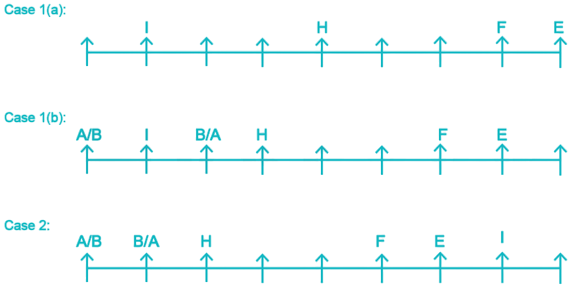
6) D sits immediate left of C but not adjacent to I.
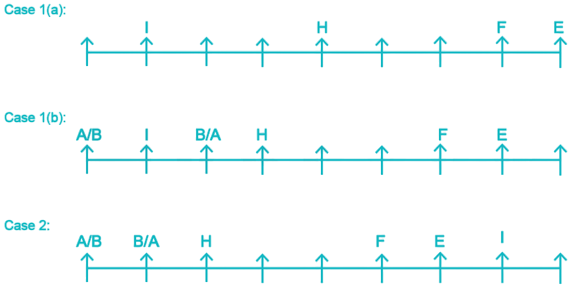
7) Neither I nor H sit adjacent to G. So, case 1(a) and case 2 are not possible.

Hence, E sits immediate left of G.
2. Direction: Study the following information to answer the given questions:Nine persons A, B, C, D, E, F, G, H and I sit in a straight line. All are facing north with equal distance between each other. D sits immediate left of C but not adjacent to I. I is second person from one of the end. H sits third to the left of F. Neither I nor H sit adjacent to G. Both A and B sit to the left of H. E sits immediate right of F. Neither H nor F sits adjacent to I.
Question:
Who sits third to the right of C?
A. G
B. E
C. F
D. H
E. B
Solution
Persons: A, B, C, D, E, F, G, H and I.
1) I is second person from one of the end.
2) H sits third to the left of F.
3) Neither H nor F sits adjacent to I.
4) Both A and B sit to the left of H.
5) E sits immediate right of F.
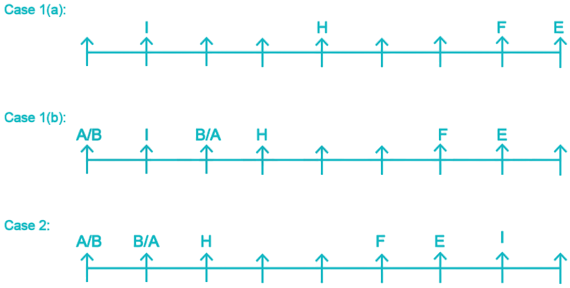
6) D sits immediate left of C but not adjacent to I.
7) Neither I nor H sit adjacent to G. So, case 1(a) and case 2 are not possible.

Hence, G sits third to the right of C.
3. Direction: Study the following information to answer the given questions:Nine persons A, B, C, D, E, F, G, H and I sit in a straight line. All are facing north with equal distance between each other. D sits immediate left of C but not adjacent to I. I is second person from one of the end. H sits third to the left of F. Neither I nor H sit adjacent to G. Both A and B sit to the left of H. E sits immediate right of F. Neither H nor F sits adjacent to I.
Question:
If two persons sit between A and C then who sits at extreme left end?
A. H
B. C
C. G
D. B
E. E
Solution
Persons: A, B, C, D, E, F, G, H and I.
1) I is second person from one of the end.
2) H sits third to the left of F.
3) Neither H nor F sits adjacent to I.
4) Both A and B sit to the left of H.
5) E sits immediate right of F.
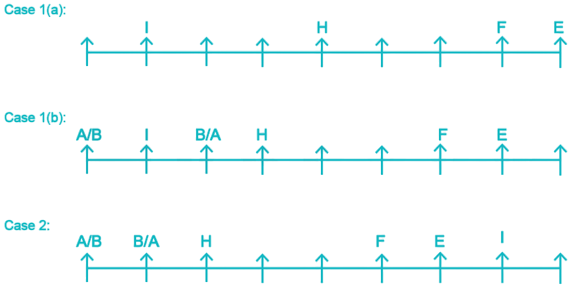
6) D sits immediate left of C but not adjacent to I.
7) Neither I nor H sit adjacent to G. So, case 1(a) and case 2 are not possible.

If two persons sit between A and C then the arrangement would be,

Hence, B sits at extreme left end.
4. Direction: Study the following information to answer the given questions:Nine persons A, B, C, D, E, F, G, H and I sit in a straight line. All are facing north with equal distance between each other. D sits immediate left of C but not adjacent to I. I is second person from one of the end. H sits third to the left of F. Neither I nor H sit adjacent to G. Both A and B sit to the left of H. E sits immediate right of F. Neither H nor F sits adjacent to I.
Question:
How many persons sit between I and E?
A. Three
B. Four
C. Five
D. Six
E. Two
Solution
Persons: A, B, C, D, E, F, G, H and I.
1) I is second person from one of the end.
2) H sits third to the left of F.
3) Neither H nor F sits adjacent to I.
4) Both A and B sit to the left of H.
5) E sits immediate right of F.
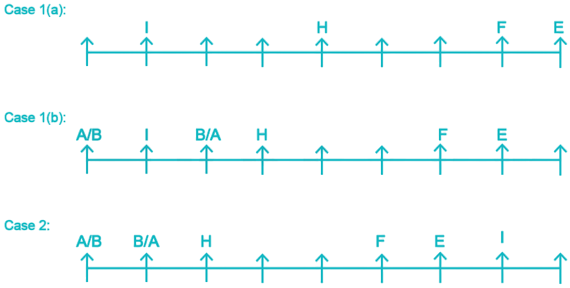
6) D sits immediate left of C but not adjacent to I.
7) Neither I nor H sit adjacent to G. So, case 1(a) and case 2 are not possible.

Hence, five persons sit between I and E.
5. Direction: Study the following information to answer the given questions:Nine persons A, B, C, D, E, F, G, H and I sit in a straight line. All are facing north with equal distance between each other. D sits immediate left of C but not adjacent to I. I is second person from one of the end. H sits third to the left of F. Neither I nor H sit adjacent to G. Both A and B sit to the left of H. E sits immediate right of F. Neither H nor F sits adjacent to I.
Question:
Who sits immediate left of F?
A. E
B. I
C. G
D. C
E. D
Solution
Persons: A, B, C, D, E, F, G, H and I.
1) I is second person from one of the end.
2) H sits third to the left of F.
3) Neither H nor F sits adjacent to I.
4) Both A and B sit to the left of H.
5) E sits immediate right of F.
6) D sits immediate left of C but not adjacent to I.
7) Neither I nor H sit adjacent to G. So, case 1(a) and case 2 are not possible.

Hence, C sits immediate left of F.
6. Direction: Read the following information carefully and answer the questions given below:
There are seven shops S1, S2, S3, S4, S5, S6, and S7 in a locality within a certain distance. Shop S1 is 8km to the east of shop S2, which is 9km north of shop S4. The shop S3 is 5km to the south of shop S6, which is 6km to the west of shop S7. The shop S7 is 4km to the north of shop S1. The shop S5 is 8km to the west of shop S3.
Question:
The shop S5 is in which direction with respect to the shop S7?
A. Southwest
B. Northwest
C. North
D. South
E. Southeast
Solution
We have drawn the figure according to the information given in the question:

Hence, Shop S5 is southwest of shop S7.
7. Direction: Read the following information carefully and answer the questions given below:
There are seven shops S1, S2, S3, S4, S5, S6, and S7 in a locality within a certain distance. Shop S1 is 8km to the east of shop S2, which is 9km north of shop S4. The shop S3 is 5km to the south of shop S6, which is 6km to the west of shop S7. The shop S7 is 4km to the north of shop S1. The shop S5 is 8km to the west of shop S3.
Question:
If a man starts walking from shop S4 then, find the minimum distance covered by him to reach the shop S3? (Follow the path only)
A. 21km
B. 12km
C. 28
D. 10km
E. None of these
Solution
We have drawn the figure according to the information given in the question:

Distance covered → 8 + 2 = 10km
Hence, The distance covered by the man from shop S4 to S3 is 10km.
Note: There is difference between shortest and total distance. If in the question it was asked shortest distance at that time we will be using Pythagorean theorem to find the distance, else distance is added to find the total distance.
8. Direction: Read the following information carefully and answer the questions given below:
There are seven shops S1, S2, S3, S4, S5, S6, and S7 in a locality within a certain distance. Shop S1 is 8km to the east of shop S2, which is 9km north of shop S4. The shop S3 is 5km to the south of shop S6, which is 6km to the west of shop S7. The shop S7 is 4km to the north of shop S1. The shop S5 is 8km to the west of shop S3.
Question:
The shortest distance between shop S4 and shop S5?
A. √155km
B. √113km
C. 10km
D. 9km
E. None of these
Solution
We have drawn the figure according to the information given in the question:
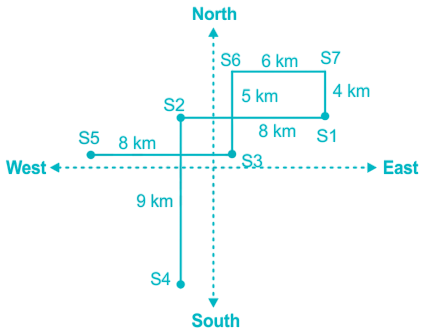
For finding the shortest distance we have to apply the Pythagoras theorem:
(Base)2 + (Perdendicular)2 = (Hypotenuse)2
62 + 82 = (Hypotenuse)2
36 + 64 = (Hypotenuse)2
√100km = Hypotenuse
Hypotenuse = 10km
Hence, The shortest distance between shop S4 and shop S5 is 10km.
9. Statements:
M < Q > N ≤ Z < T, R > L < Y > M;
Conclusions:
I. Q > L
II. N > Y
A. Only conclusion (I) follows
B. Only conclusion (II) follows
C. Both conclusion (I) and (II) follows
D. Either conclusion (I) or (II) follows
E. Neither conclusion (I) nor (II) follows
Solution
Answer: Option (5)
Given Statements: M < Q > N ≤ Z < T, R > L < Y > M;
On combining,
R > L < Y > M < Q > N ≤ Z < T;
Conclusions:
I) Q > L → False (As per R > L < Y > M < Q > N ≤ Z < T → Relationship between Q and L can’t be determined)
II) N > Y → False (As per R > L < Y > M < Q > N ≤ Z < T → Relationship between N and Y can’t be determined)
Hence, neither conclusion (I) nor (II) follows.
10. Directions: – In these questions, relationship between different elements is shown in the statements. These statements are followed by 2 conclusions. Marks answer as option given.
Statements:
C > D > E ≤ F > G, H > L ≤ I ≤ G;
Conclusions:
I. F > L
II. E < I
A. Only conclusion (I) follows
B. Only conclusion (II) follows
C. Both conclusion (I) and (II) follows
D. Either conclusion (I) or (II) follows
E. Neither conclusion (I) nor (II) follows
Solution
Answer: Option (1)
Given Statements: C > D > E ≤ F > G, H > L ≤ I ≤ G;
On combining,
C > D > E ≤ F > G ≥ I ≥ L < H;
Conclusions:
I) F > L → True (As per C > D > E ≤ F > G ≥ I ≥ L < H → F > L)
II) E < I → False (As per C > D > E ≤ F > G ≥ I ≤ L < H → Relationship between E and I can’t be determined)
Hence, only conclusion (I) follows.
11. Directions: – In these questions, relationship between different elements is shown in the statements. These statements are followed by 2 conclusions. Marks answer as option given.
Statements:
X ≤ Y < P > Z < O; P = Q > R > Z;
Conclusions:
I. Y < R
II. Y < O
A. Only conclusion (I) follows
B. Only conclusion (II) follows
C. Both conclusion (I) and (II) follows
D. Either conclusion (I) or (II) follows
E. None of these
Solution
Given Statements: X ≤ Y < P > Z < O, P = Q > R > Z;
On combining,
X ≤ Y < P = Q > R > Z < O;
Conclusions:
I) Y < R → False (As per X ≤ Y < P = Q > R > Z < O → Relationship between Y and R can’t be determined)
II) Y < O → False (As per X ≤ Y < P = Q > R > Z < O → Relationship between Y and O can’t be determined)
Hence, the correct answer is none of these.
12. Direction: Study the following information to answer the given questions:
Eight persons are living on eight different floors of the building in such a way ground floor is numbered as 1 and the top floor is numbered as 8.
Y lives on an even number floor. Two persons live between Y and K. T live on one of the above floor of H and both of them live at even number floor. O lives just above L floor. Two persons live between Y and X. M does not live above Y. X lives on one of the floors below K.
Question:
Who among the following live at topmost floor?
A. Y
B. K
C. O
D. T
E. L
Solution
Eight persons eight floors.
1. Y lives on an even number floor.
2. Two persons are between Y and K.
3. Two persons live between Y and X.
There are two cases of these statements.
| Floor | Persons | |
| Case – 1 | Case – 2 | |
| 8 | ||
| 7 | K | X |
| 6 | ||
| 5 | ||
| 4 | Y | Y |
| 3 | ||
| 2 | ||
| 1 | X | K |
3. X lives on one of the floors below K.
So, case – 2 eliminated.
| Floor | Persons |
| Case – 1 | |
| 8 | |
| 7 | K |
| 6 | |
| 5 | |
| 4 | Y |
| 3 | |
| 2 | |
| 1 | X |
4. M does not live above Y.
So, there are two cases.
| Floor | Persons | |
| Case – 1 (a) | Case – 1 (b) | |
| 8 | ||
| 7 | K | K |
| 6 | ||
| 5 | ||
| 4 | Y | Y |
| 3 | M | |
| 2 | M | |
| 1 | X | X |
5. O lives just above L floor.
| Floor | Persons | |
| Case – 1 (a) | Case – 1 (b) | |
| 8 | ||
| 7 | K | K |
| 6 | O | O |
| 5 | L | L |
| 4 | Y | Y |
| 3 | M | |
| 2 | M | |
| 1 | X | X |
6. T lives on one of the above floor of H and both of them live on an even number floor.
Case – 1 (b) eliminated.
| Floor | Persons |
| Case – 1 (a) | |
| 8 | T |
| 7 | K |
| 6 | O |
| 5 | L |
| 4 | Y |
| 3 | M |
| 2 | H |
| 1 | X |
Hence, T lives on the topmost floor.
13. Direction: Study the following information to answer the given questions:
Eight persons are living on eight different floors of the building in such a way ground floor is numbered as 1 and the top floor is numbered as 8.
Y lives on an even number floor. Two persons live between Y and K. T live on one of the above floor of H and both of them live at even number floor. O lives just above L floor. Two persons live between Y and X. M does not live above Y. X lives on one of the floors below K.
Question:
How many persons live above O’s floor?
A. Five
B. One
C. Three
D. Four
E. Two
Solution
Eight persons eight floors.
1. Y lives on an even number floor.
2. Two persons are between Y and K.
3. Two persons live between Y and X.
There are two cases of these statements.
| Floor | Persons | |
| Case – 1 | Case – 2 | |
| 8 | ||
| 7 | K | X |
| 6 | ||
| 5 | ||
| 4 | Y | Y |
| 3 | ||
| 2 | ||
| 1 | X | K |
3. X lives on one of the floors below K.
So, case – 2 eliminated.
| Floor | Persons |
| Case – 1 | |
| 8 | |
| 7 | K |
| 6 | |
| 5 | |
| 4 | Y |
| 3 | |
| 2 | |
| 1 | X |
4. M does not live above Y.
So, there are two cases.
| Floor | Persons | |
| Case – 1 (a) | Case – 1 (b) | |
| 8 | ||
| 7 | K | K |
| 6 | ||
| 5 | ||
| 4 | Y | Y |
| 3 | M | |
| 2 | M | |
| 1 | X | X |
5. O lives just above L floor.
| Floor | Persons | |
| Case – 1 (a) | Case – 1 (b) | |
| 8 | ||
| 7 | K | K |
| 6 | O | O |
| 5 | L | L |
| 4 | Y | Y |
| 3 | M | |
| 2 | M | |
| 1 | X | X |
6. T lives on one of the above floors of H and both of them live on an even number floor.
Case – 1 (b) eliminated.
| Floor | Persons |
| Case – 1 (a) | |
| 8 | T |
| 7 | K |
| 6 | O |
| 5 | L |
| 4 | Y |
| 3 | M |
| 2 | H |
| 1 | X |
Hence, Two persons live above O.
14. Direction: Study the following information to answer the given questions:
Eight persons are living on eight different floors of the building in such a way ground floor is numbered as 1 and the top floor is numbered as 8.
Y lives on an even number floor. Two persons live between Y and K. T live on one of the above floor of H and both of them live at even number floor. O lives just above L floor. Two persons live between Y and X. M does not live above Y. X lives on one of the floors below K.
Question:
Four of the following five are alike in certain way based from a group, find the one that does not belong to that group?
A. K
B. L
C. Y
D. M
E. X
Solution
Eight persons eight floors.
1. Y lives on an even number floor.
2. Two persons are between Y and K.
3. Two persons live between Y and X.
There are two cases of these statements.
| Floor | Persons | |
| Case – 1 | Case – 2 | |
| 8 | ||
| 7 | K | X |
| 6 | ||
| 5 | ||
| 4 | Y | Y |
| 3 | ||
| 2 | ||
| 1 | X | K |
3. X lives on one of the floors below K.
So, case – 2 eliminated.
| Floor | Persons |
| Case – 1 | |
| 8 | |
| 7 | K |
| 6 | |
| 5 | |
| 4 | Y |
| 3 | |
| 2 | |
| 1 | X |
4. M does not live above Y.
So, there are two cases.
| Floor | Persons | |
| Case – 1 (a) | Case – 1 (b) | |
| 8 | ||
| 7 | K | K |
| 6 | ||
| 5 | ||
| 4 | Y | Y |
| 3 | M | |
| 2 | M | |
| 1 | X | X |
5. O lives just above L floor.
| Floor | Persons | |
| Case – 1 (a) | Case – 1 (b) | |
| 8 | ||
| 7 | K | K |
| 6 | O | O |
| 5 | L | L |
| 4 | Y | Y |
| 3 | M | |
| 2 | M | |
| 1 | X | X |
6. T lives on one of the above floor of H and both of them live on even number floor.
Case – 1 (b) eliminated.
| Floor | Persons |
| Case – 1 (a) | |
| 8 | T |
| 7 | K |
| 6 | O |
| 5 | L |
| 4 | Y |
| 3 | M |
| 2 | H |
| 1 | X |
K, L, X, and M live on odd number floor and Y lives on an even-numbered floor.
Hence, Y is different from that group.
15. Direction: Study the following information to answer the given questions:
Eight persons are living on eight different floors of the building in such a way ground floor is numbered as 1 and the top floor is numbered as 8.
Y lives on an even number floor. Two persons live between Y and K. T live on one of the above floor of H and both of them live at even number floor. O lives just above L floor. Two persons live between Y and X. M does not live above Y. X lives on one of the floors below K.
Question:
How many floors are there in between M and X?
A. Three
B. One
C. Two
D. Four
E. None
Solution
Eight persons eight floors.
1. Y lives on an even number floor.
2. Two persons are between Y and K.
3. Two persons live between Y and X.
There are two cases of these statements.
| Floor | Persons | |
| Case – 1 | Case – 2 | |
| 8 | ||
| 7 | K | X |
| 6 | ||
| 5 | ||
| 4 | Y | Y |
| 3 | ||
| 2 | ||
| 1 | X | K |
3. X lives on one of the floors below K.
So, case – 2 eliminated.
| Floor | Persons |
| Case – 1 | |
| 8 | |
| 7 | K |
| 6 | |
| 5 | |
| 4 | Y |
| 3 | |
| 2 | |
| 1 | X |
4. M does not live above Y.
So, there are two cases.
| Floor | Persons | |
| Case – 1 (a) | Case – 1 (b) | |
| 8 | ||
| 7 | K | K |
| 6 | ||
| 5 | ||
| 4 | Y | Y |
| 3 | M | |
| 2 | M | |
| 1 | X | X |
5. O lives just above L floor.
| Floor | Persons | |
| Case – 1 (a) | Case – 1 (b) | |
| 8 | ||
| 7 | K | K |
| 6 | O | O |
| 5 | L | L |
| 4 | Y | Y |
| 3 | M | |
| 2 | M | |
| 1 | X | X |
6. T lives on one of the above floor of H and both of them live on even number floor.
Case – 1 (b) eliminated.
| Floor | Persons |
| Case – 1 (a) | |
| 8 | T |
| 7 | K |
| 6 | O |
| 5 | L |
| 4 | Y |
| 3 | M |
| 2 | H |
| 1 | X |
Hence, there is one floor between M and X.
16. Direction: Study the following information to answer the given questions:
Eight persons are living on eight different floors of the building in such a way ground floor is numbered as 1 and the top floor is numbered as 8.
Y lives on an even number floor. Two persons live between Y and K. T live on one of the above floor of H and both of them live at even number floor. O lives just above L floor. Two persons live between Y and X. M does not live above Y. X lives on one of the floors below K.
Question:
Who among the following live at 2nd floor?
A. L
B. H
C. M
D. K
E. Y
Solution
Eight persons eight floors.
1. Y lives on an even number floor.
2. Two persons are between Y and K.
3. Two persons live between Y and X.
There are two cases of these statements.
| Floor | Persons | |
| Case – 1 | Case – 2 | |
| 8 | ||
| 7 | K | X |
| 6 | ||
| 5 | ||
| 4 | Y | Y |
| 3 | ||
| 2 | ||
| 1 | X | K |
3. X lives on one of the floors below K.
So, case – 2 eliminated.
| Floor | Persons |
| Case – 1 | |
| 8 | |
| 7 | K |
| 6 | |
| 5 | |
| 4 | Y |
| 3 | |
| 2 | |
| 1 | X |
4. M does not live above Y.
So, there are two cases.
| Floor | Persons | |
| Case – 1 (a) | Case – 1 (b) | |
| 8 | ||
| 7 | K | K |
| 6 | ||
| 5 | ||
| 4 | Y | Y |
| 3 | M | |
| 2 | M | |
| 1 | X | X |
5. O lives just above L floor.
| Floor | Persons | |
| Case – 1 (a) | Case – 1 (b) | |
| 8 | ||
| 7 | K | K |
| 6 | O | O |
| 5 | L | L |
| 4 | Y | Y |
| 3 | M | |
| 2 | M | |
| 1 | X | X |
6. T lives on one of the above floor of H and both of them live on even number floor.
Case – 1 (b) eliminated.
| Floor | Persons |
| Case – 1 (a) | |
| 8 | T |
| 7 | K |
| 6 | O |
| 5 | L |
| 4 | Y |
| 3 | M |
| 2 | H |
| 1 | X |
Hence, H lives on the 2nd floor.
17. Study the given information carefully and answer the questions given below.
In a certain code language,
‘His family is great’ is written as ‘ rum num sum kum’.
‘Family should be supportive’ is written as ‘bum kum lum tum’.
‘His parents are supportive’ is written as ‘sum zum hum tum’.
‘He should be with his family’ is written as ‘lum yum gum bum sum kum’.
Question:
What does the code ‘zum’ means?
A. His
B. Family
C. Are or Parents
D. Parents or is
E. None of these
Solution
According to the given information, we get the following codes:

So, the code for ‘zum’ means ‘Are or Parents’.
Hence, option 3 is correct.
18. Study the given information carefully and answer the questions given below.
In a certain code language,
‘His family is great’ is written as ‘ rum num sum kum’.
‘Family should be supportive’ is written as ‘bum kum lum tum’.
‘His parents are supportive’ is written as ‘sum zum hum tum’.
‘He should be with his family’ is written as ‘lum yum gum bum sum kum’..
Question:
What does the code ‘rum’ mean?
A. Is
B. His
C. Family
D. Great
E. Cannot be determined
Solution
According to the given information, we get the following codes:

Hence, option 5 is correct.
19. Study the given information carefully and answer the questions given below.
In a certain code language,
‘His family is great’ is written as ‘ rum num sum kum’.
‘Family should be supportive’ is written as ‘bum kum lum tum’.
‘His parents are supportive’ is written as ‘sum zum hum tum’.
‘He should be with his family’ is written as ‘lum yum gum bum sum kum’.
Question:
What does the code ‘yum’ mean?
A. He
B. His
C. With
D. Either ‘he’ or ‘with’
E. None of these
Solution
According to the given information, we get the following codes:

So, the code for ‘yum’ means either ‘he’ of ‘with’.
Hence, option 4 is correct.
20. How many pairs of letters are there in the word “CHRONICLE” each of which has as many letters between them as in the English alphabetical series in both forward and backward directions?
A. Three
B. Four
C. Five
D. Two
E. One
Solution
Given word: CHRONICLE
The alphabets are positioned as in the following order,

The given word can be represented as follows,
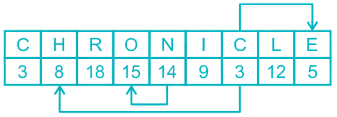
In forward direction: CE.
In backward direction: CH, NO.Hence, there are 3 pairs of letters.
21. Directions: Read the following comprehension and answer the following questions given below.
Eight people P, Q, R, S, T, U, V and W are visiting Mumbai in four different months March, April, May and June. In each month, the visit is scheduled either on 2nd or 11th of the month. P visited on an even numbered date in the month having 30 days. S visited before P. Only one person visited between P and S. Number of people visited before Q is two more than the number of people visited after P. Two people visited between R and Q. The number of people visited before V is the same as the number of people visited after R. W visited immediately before Q. T visited after Q.
Question:
Who visited immediately after W?
A. R
B. S
C. Q
D. T
E. P
Solution
Eight people P, Q, R, S, T, U, V and W
1- P visited on an even numbered date in the month having 30 days.
2- S visited before P. Only one person visited between P and S.
3- Number of people visited before Q is two more than the number of people visited after P.
| Case1 | Case2 | ||
| Month | Date | Person | Person |
| March(31) | 2 | S | |
| 11 | |||
| April(30) | 2 | P | |
| 11 | Q | ||
| May(31) | 2 | S | |
| 11 | |||
| June(30) | 2 | P | |
| 11 | Q |
4- Two people visited between R and Q.
5- The number of people visited before V is the same as the number of people visited after R.
6- W visited immediately before Q.
| Case1 | Case2 | ||
| Month | Date | Person | Person |
| March(31) | 2 | S | R |
| 11 | |||
| April(30) | 2 | P | W |
| 11 | V | Q | |
| May(31) | 2 | R | S |
| 11 | |||
| June(30) | 2 | W | P |
| 11 | Q | V |
7- T visited after Q. So case 1 gets eliminated.
So, Final arrangement is;
| Month | Date | Person |
| March(31) | 2 | R |
| 11 | U | |
| April(30) | 2 | W |
| 11 | Q | |
| May(31) | 2 | S |
| 11 | T | |
| June(30) | 2 | P |
| 11 | V |
Hence, Q visited immediately after W.
22. Directions: Read the following comprehension and answer the following questions given below.
Eight people P, Q, R, S, T, U, V and W are visiting Mumbai in four different months March, April, May and June. In each month, the visit is scheduled either on 2nd or 11th of the month. P visited on an even numbered date in the month having 30 days. S visited before P. Only one person visited between P and S. Number of people visited before Q is two more than the number of people visited after P. Two people visited between R and Q. The number of people visited before V is the same as the number of people visited after R. W visited immediately before Q. T visited after Q.
Question:
Four out of five are same in a certain way find the odd one out
A. Q
B. U
C. W
D. V
E. T
Solution
Eight people P, Q, R, S, T, U, V and W
1- P visited on an even numbered date in the month having 30 days.
2- S visited before P. Only one person visited between P and S.
3- Number of people visited before Q is two more than the number of people visited after P.
| Case1 | Case2 | ||
| Month | Date | Person | Person |
| March(31) | 2 | S | |
| 11 | |||
| April(30) | 2 | P | |
| 11 | Q | ||
| May(31) | 2 | S | |
| 11 | |||
| June(30) | 2 | P | |
| 11 | Q |
4- Two people visited between R and Q.
5- The number of people visited before V is the same as the number of people visited after R.
6- W visited immediately before Q.
| Case1 | Case2 | ||
| Month | Date | Person | Person |
| March(31) | 2 | S | R |
| 11 | |||
| April(30) | 2 | P | W |
| 11 | V | Q | |
| May(31) | 2 | R | S |
| 11 | |||
| June(30) | 2 | W | P |
| 11 | Q | V |
7- T visited after Q. So case 1 gets eliminated.
So, Final arrangement is;
| Month | Date | Person |
| March(31) | 2 | R |
| 11 | U | |
| April(30) | 2 | W |
| 11 | Q | |
| May(31) | 2 | S |
| 11 | T | |
| June(30) | 2 | P |
| 11 | V |
Hence, except W all other visited on odd numbered date.
23. Directions: Read the following comprehension and answer the following questions given below.
Eight people P, Q, R, S, T, U, V and W are visiting Mumbai in four different months March, April, May and June. In each month, the visit is scheduled either on 2nd or 11th of the month. P visited on an even numbered date in the month having 30 days. S visited before P. Only one person visited between P and S. Number of people visited before Q is two more than the number of people visited after P. Two people visited between R and Q. The number of people visited before V is the same as the number of people visited after R. W visited immediately before Q. T visited after Q.
Question:
How many people visited between P and W?
A. Three
B. None
C. Two
D. Six
E. Four
Solution
Eight people P, Q, R, S, T, U, V and W
1- P visited on an even numbered date in the month having 30 days.
2- S visited before P. Only one person visited between P and S.
3- Number of people visited before Q is two more than the number of people visited after P.
| Case1 | Case2 | ||
| Month | Date | Person | Person |
| March(31) | 2 | S | |
| 11 | |||
| April(30) | 2 | P | |
| 11 | Q | ||
| May(31) | 2 | S | |
| 11 | |||
| June(30) | 2 | P | |
| 11 | Q |
4- Two people visited between R and Q.
5- The number of people visited before V is the same as the number of people visited after R.
6- W visited immediately before Q.
| Case1 | Case2 | ||
| Month | Date | Person | Person |
| March(31) | 2 | S | R |
| 11 | |||
| April(30) | 2 | P | W |
| 11 | V | Q | |
| May(31) | 2 | R | S |
| 11 | |||
| June(30) | 2 | W | P |
| 11 | Q | V |
7- T visited after Q. So case 1 gets eliminated.
So, Final arrangement is;
| Month | Date | Person |
| March(31) | 2 | R |
| 11 | U | |
| April(30) | 2 | W |
| 11 | Q | |
| May(31) | 2 | S |
| 11 | T | |
| June(30) | 2 | P |
| 11 | V |
Hence, three person visited between P and W
24. Directions: Read the following comprehension and answer the following questions given below.
Eight people P, Q, R, S, T, U, V and W are visiting Mumbai in four different months March, April, May and June. In each month, the visit is scheduled either on 2nd or 11th of the month. P visited on an even numbered date in the month having 30 days. S visited before P. Only one person visited between P and S. Number of people visited before Q is two more than the number of people visited after P. Two people visited between R and Q. The number of people visited before V is the same as the number of people visited after R. W visited immediately before Q. T visited after Q.
Question:
Who visited on 11th May?
A. R
B. One who visited just after Q
C. One who visited just before P
D. V
E. One who visited one day after R
Solution
Eight people P, Q, R, S, T, U, V and W
1- P visited on an even numbered date in the month having 30 days.
2- S visited before P. Only one person visited between P and S.
3- Number of people visited before Q is two more than the number of people visited after P.
| Case1 | Case2 | ||
| Month | Date | Person | Person |
| March(31) | 2 | S | |
| 11 | |||
| April(30) | 2 | P | |
| 11 | Q | ||
| May(31) | 2 | S | |
| 11 | |||
| June(30) | 2 | P | |
| 11 | Q |
4- Two people visited between R and Q.
5- The number of people visited before V is the same as the number of people visited after R.
6- W visited immediately before Q.
| Case1 | Case2 | ||
| Month | Date | Person | Person |
| March(31) | 2 | S | R |
| 11 | |||
| April(30) | 2 | P | W |
| 11 | V | Q | |
| May(31) | 2 | R | S |
| 11 | |||
| June(30) | 2 | W | P |
| 11 | Q | V |
7- T visited after Q. So case 1 gets eliminated.
So, Final arrangement is;
| Month | Date | Person |
| March(31) | 2 | R |
| 11 | U | |
| April(30) | 2 | W |
| 11 | Q | |
| May(31) | 2 | S |
| 11 | T | |
| June(30) | 2 | P |
| 11 | V |
Hence, One who visited just before P that is T visited on 11th May.
25. Directions: Read the following comprehension and answer the following questions given below.
Eight people P, Q, R, S, T, U, V and W are visiting Mumbai in four different months March, April, May and June. In each month, the visit is scheduled either on 2nd or 11th of the month. P visited on an even numbered date in the month having 30 days. S visited before P. Only one person visited between P and S. Number of people visited before Q is two more than the number of people visited after P. Two people visited between R and Q. The number of people visited before V is the same as the number of people visited after R. W visited immediately before Q. T visited after Q.
Question:
On which date U’s visit is schedule?
A. 11th May
B. 2nd June
C. 11th March
D. 2nd April
E. 2nd March
Solution
Eight people P, Q, R, S, T, U, V and W
1- P visited on an even numbered date in the month having 30 days.
2- S visited before P. Only one person visited between P and S.
3- Number of people visited before Q is two more than the number of people visited after P.
| Case1 | Case2 | ||
| Month | Date | Person | Person |
| March(31) | 2 | S | |
| 11 | |||
| April(30) | 2 | P | |
| 11 | Q | ||
| May(31) | 2 | S | |
| 11 | |||
| June(30) | 2 | P | |
| 11 | Q |
4- Two people visited between R and Q.
5- The number of people visited before V is the same as the number of people visited after R.
6- W visited immediately before Q.
| Case1 | Case2 | ||
| Month | Date | Person | Person |
| March(31) | 2 | S | R |
| 11 | |||
| April(30) | 2 | P | W |
| 11 | V | Q | |
| May(31) | 2 | R | S |
| 11 | |||
| June(30) | 2 | W | P |
| 11 | Q | V |
7- T visited after Q. So case 1 gets eliminated.
So, Final arrangement is;
| Month | Date | Person |
| March(31) | 2 | R |
| 11 | U | |
| April(30) | 2 | W |
| 11 | Q | |
| May(31) | 2 | S |
| 11 | T | |
| June(30) | 2 | P |
| 11 | V |
Hence, U visited on 11th march
26. Directions: Read the instructions carefully and answer the question below.
L, M, N, O, P, Q, R, and S are the eight members of a family. S is the daughter-in-law of L who is the brother of P. M is the only daughter of R who is the only son of N. N is the daughter-in-law of O who is the mother of P. P is the son of Q. Either both or none of the parents of a person are alive.
Question:
How is L related to N?
A. Daughter
B. Daughter-in-law
C. Son-in-law
D. Husband
E. Brother-in-law
Solution
According to the given information,

1) S is the daughter-in-law of L who is the brother of P.
(Implies, L has a son who is married to S.)
2) N is the daughter-in-law of O who is the mother of P.
3) P is the son of Q.
(Implies, Q is the father of P and O is the mother of P. Also, O has a son who is married to N.)
4) M is the only daughter of R who is the only son of N.
5) Either both or none of the parents of a person are alive.
(As L has a son and both the parents of a person are alive, implies, N must be married to L and R is the son of L.)

Clearly, L is the husband of N.
27. Directions: Read the instructions carefully and answer the question below.
L, M, N, O, P, Q, R, and S are the eight members of a family. S is the daughter-in-law of L who is the brother of P. M is the only daughter of R who is the only son of N. N is the daughter-in-law of O who is the mother of P. P is the son of Q. Either both or none of the parents of a person are alive.
Question:
How is S related to M?
A. Mother
B. Sister
C. Grandmother
D. Maternal Aunt
E. Paternal Aunt
Solution
According to the given information,

1) S is the daughter-in-law of L who is the brother of P.
(Implies, L has a son who is married to S.)
2) N is the daughter-in-law of O who is the mother of P.
3) P is the son of Q.
(Implies, Q is the father of P and O is the mother of P. Also, O has a son who is married to N.)
4) M is the only daughter of R who is the only son of N.
5) Either both or none of the parents of a person are alive.
(As L has a son and both the parents of a person are alive, implies, N must be married to L and R is the son of L.)

Clearly, S is the mother of M.
28. Directions: Read the instructions carefully and answer the question below.
L, M, N, O, P, Q, R, and S are the eight members of a family. S is the daughter-in-law of L who is the brother of P. M is the only daughter of R who is the only son of N. N is the daughter-in-law of O who is the mother of P. P is the son of Q. Either both or none of the parents of a person are alive.
Question:
How is P related to R?
A. Father
B. Son
C. Husband
D. Paternal Uncle
E. Son-in-law
Solution
According to the given information,
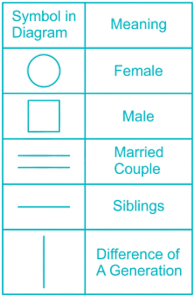
1) S is the daughter-in-law of L who is the brother of P.
(Implies, L has a son who is married to S.)
2) N is the daughter-in-law of O who is the mother of P.
3) P is the son of Q.
(Implies, Q is the father of P and O is the mother of P. Also, O has a son who is married to N.)
4) M is the only daughter of R who is the only son of N.
5) Either both or none of the parents of a person are alive.
(As L has a son and both the parents of a person are alive, implies, N must be married to L and R is the son of L.)
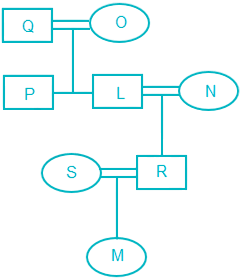
Clearly, P is the paternal uncle of R.
29. Directions: In the question below are given three statements followed by two conclusions I and II. You have to take the given statements to be true even if they seem to be at variance from commonly known facts. Read all the conclusions and then decide which of the given conclusions logically follows from the given statements disregarding commonly known facts.
Statement:
Some buildings are forests.
All forests are houses.
No houses are huts
Conclusion:
I. No forests are huts.
II. No buildings are huts
A. Only I follows
B. Only II follows
C. Both I and II follows
D. Either I or II follows
E. Neither I nor II follows
Solution
The least possible Venn diagram for the given statements is as follows:

Conclusion:
I. No forests are huts → True (As all forests are houses and no house is huts, So no forests will be huts)
II. No buildings are huts → False (There no relation given between buildings and huts, So cannot given a definite answer)
Hence, Only I follows.
30. Directions: In the question below are given three statements followed by two conclusions numbered I, and II.You have to take the given statements to be true even if they seem to be at variance with commonly known facts. Read all the conclusions and then decide which of the given conclusions logically follows from the given statements disregarding commonly known facts.
Statements
Some elephant are not horse.
Only horse are cat.
Only a few lions are elephant.
Conclusions
I. All lion being elephant is a possibility
II. Some lion being horse is a possibility
A. Only I follows
B. Only II follows
C. Both I and II follows
D. Either I or II follows
E. Neither I nor II follows
Solution
The least possible diagram is as follow.

Conclusions:
I. All lion being elephant is a possibility – False (given only few lion are elephants means some lions are not elephant so all lion being elephant is not follow).
II. Some lion being horse is a possibility – True (there is no define relation is given, so Lion can go inside the remaining part of Horse, so the possibility is true).
Hence, Only II follows.
31. Direction: Some statements are given followed by some conclusions. You have to consider the statements to be true even if they seem to be at variance from commonly known facts. You have to decide which of the given conclusions if any, follow from the given statements.
Statements:
Some Watch are Mug.
All Bottle are Watch.
All Mouse are Bottle.
Conclusions:
I. Some Mouse being Watch is a possibility.
II. No Mug are Bottle.
A. If only conclusion I follows.
B. If only conclusion II follows.
C. If either conclusion I or II follows.
D. If neither conclusion I nor II follows.
E. If both conclusions I and II follow.
Solution
The least possible Venn diagram for the given statements is as follows-

Conclusions:
I. Some Mouse being Watch is a possibility → False (From the diagram it is clear that ‘Some Mouse are Watch’ is a definite conclusion and if the possibility is added with a definite conclusion then the conclusion does not follow)
II. No Mug are Bottle → False (As there are no direct relation between Mug and Bottle. So, ‘no Mug is Bottle’ is possible but not definitely true.)
Hence, neither conclusion I nor II follow.
32. Directions: Study the following information carefully to answer the given questions:
B ! O M 3 @ D 2 Q G 9 $ F # N I T 4 1 K L © H 8 % V J 5 Y 6 ¥ 7 A
Question:
How many such symbols are there in the above arrangement each of which are immediately preceded by a number and followed by an alphabet?
A. One
B. Five
C. Four
D. Three
E. Two
Solution
Answer: (4)
Given Series: B ! O M 3 @ D 2 Q G 9 $ F # N I T 4 1 K L © H 8 % V J 5 Y 6 ¥ 7 A
1) Symbols which are immediately preceded by a number and followed by an alphabet:
B ! O M 3 @ D 2 Q G 9 $ F # N I T 4 1 K L © H 8 % V J 5 Y 6 ¥ 7 A
Hence, there are 3 symbols which are immediately preceded by a number and followed by an alphabet
33. Directions: Study the following information carefully to answer the given questions:
B ! O M 3 @ D 2 Q G 9 $ F # N I T 4 1 K L © H 8 % V J 5 Y 6 ¥ 7 A
Question:
If all the symbols in the above arrangement are dropped, then which of the following will be the ninth from the right end?
A. K
B. 8
C. Y
D. N
E. H
Solution
Answer: (5)
Given series: Left Side B ! O M 3 @ D 2 Q G 9 $ F # N I T 4 1 K L © H 8 % V J 5 Y 6 ¥ 7 A Right Side
1) If all the symbols are dropped:
B O M 3 D 2 Q G 9 F N I T 4 1 K L H 8 V J 5 Y 6 7 A
Hence, the 9th element from the right end is H
34. Directions: Study the following information carefully to answer the given questions:
B ! O M 3 @ D 2 Q G 9 $ F # N I T 4 1 K L © H 8 % V J 5 Y 6 ¥ 7 A
Question:
Which of the following is the sixth to the right of the twenty-first element from the right end of the above arrangement?
A. @
B. T
C. 1
D. $
E. None of these
Solution
Answer: (3)
Given series: B ! O M 3 @ D 2 Q G 9 $ F # N I T 4 1 K L © H 8 % V J 5 Y 6 ¥ 7 A
As, Right – Right = Right
21st from the right – 6th from the right = 15th from the right
Clearly, 15th from the right is 1
35. If it is possible to make only one meaningful English word with the 1st, 6th, 7th, and 9th letters of the word RETIREMENT, which of the following will be the fourth letter of that word? If no such word can be made give ‘X’ as the answer and if more than one such word can be made give ‘Y’ as the answer.
A. M
B. R
C. N
D. X
E. Y
Solution
| Given Word | R E T I R E M E N T |
| Chosen letters | R, E, M, N |
| possible word | No words can be made |
Hence, as no word can be made from the chosen letters, the answer will be ‘X’.
36. Two mixture P and Q contain water and alcohol in the ratio of 3 : 1 and 5 : 3 respectively. In what ratio of two mixture should be added to get new mixture R having water and alcohol in the ratio of 2 : 1?
A. 1 : 3
B. 2 : 5
C. 3 : 8
D. 1 : 2
E. 1 : 4
Solution
Shortcut Trick
The mixture P contains water and alcohol in the ratio is 3 : 1.
The quantity of water in mixture P = 3/4
The mixture Q contains water and spirit in the ratio is 5 : 3.
The quantity of water in mixture Q = 5/8
The ratio of water and spirit in the new mixture R is 2 : 1.
The quantity of water in mixture R = 2/3
Using Allegation Principle,

The ratio of mixture = 1/24 : 1/12 = 1 : 2
∴ The ratio of two mixture is 1 : 2.
Alternate Method
Given:
The mixture P contains water and alcoholin the ratio is 3 : 1.
The mixture Q contains water and alcohol in the ratio is 5 : 3.
The ratio of water and alcohol in the new mixture R is 2 : 1.
Calculation:
The mixture P contains water and alcohol in the ratio is 3 : 1.
Let the total quantity of mixture P be x.
The quantity of water in mixture P = 3x/4
The quantity of alcohol in mixture P = 1x/4
The mixture Q contains water and alcohol in the ratio is 5 : 3.
Let the total quantity of mixture P be y.
The quantity of water in mixture Q = 5y/8
The quantity of alcohol in mixture Q = 3y/8
The ratio of water and alcohol in the new mixture R is 2 : 1.
⇒ [(3x/4) + (5y/8)]/[(x/4) + (3y/8)] = 2/1
⇒ (3x/4) + (5y/8) = (x/2) + (3y/4)
⇒ x/4 = y/8
⇒ x/y = 1/2
The ratio of two mixture = 1 : 2
∴ The ratio of two mixture is 1 : 2.
37. In each of the following number series, a wrong number is given. Find out that number.
49, 35, 24, 15, 8, 3
A. 49
B. 35
C. 24
D. 15
E. 3
Solution
Calculation:
The series follows the following pattern
⇒ 7 × 7 – 1 = 48
⇒ 6 × 6 – 1 = 35
⇒ 5 × 5 – 1 = 24
⇒ 4 × 4 – 1 = 15
⇒ 3 × 3 – 1 = 8
⇒ 2 × 2 – 1 = 3
∴ The wrong number in the given series is 49
38. In each of the following number series, a wrong number is given, find out that number.
16, 256, 2304, 8192, 16384, 16384
A. 16
B. 256
C. 2304
D. 16384
E. 8192
Solution
The series follows the following pattern
16
⇒ 16 × 16 = 256
⇒ 256 × 8 = 2048
⇒ 2048 × 4 = 8192
⇒ 8192 × 2 = 16384
⇒ 16384 × 1 = 16384
∴ 2304 is the wrong number in the series
39. Find out the wrong term in the given number series.12, 19, 30, 43, 60, 79, 110
A. 110
B. 43
C. 19
D. 12
E. 79
Solution
19 – 12 = 7
30 – 19 = 11
43 – 30 = 13
60 – 43 = 17
79 – 60 = 19
102 – 79 = 23
Here, the difference is of prime numbers.
∴ 7th term of the series should be 102 not 110
40. Find out the wrong term in the given number series.1, 5, 19, 32, 45, 62, 79
A. 5
B. 19
C. 45
D. 32
E. 79
Solution
10 – 1 = 9
19 – 10 = 9
32 – 19 = 13
45 – 32 = 13
62 – 45 = 17
79 – 62 = 17
The common difference is repeating twice and the difference is also increasing by 4
∴ 2nd term of the series should be 10, not 5
41. Find out the wrong term in the following series.
74, 99, 50, 125, 10, 179
A. 74
B. 125
C. 10
D. 179
E. 50
Solution
Calculation:
The series is
74 + 25= 99
99 – 49 = 50
50 + 81 = 131
131 – 121 = 10
10 + 169 = 179
∴ 125 is the wrong number in the series.
42. Difference between age of A and B is x + 3 years. The ages of A and B are in the ratio of 3:4. After 12 years, the ratio of their ages will be 9:11. Find the age of A after 2x years?
A. 56
B. 29
C. 34
D. 32
E. 24
Solution
Given:
Age difference = x + 3
Age ratio A : B = 3 : 4
After 12 years, ratio = 9 : 11
Calculations:
Let A = 3k, B = 4k
⇒ B – A = x + 3 ⇒ 4k – 3k = x + 3
After 12 years: (3k + 12)/(4k + 12) = 9/11
⇒ k = x + 3
(3k + 12)/(4k + 12) = 9/11
⇒ 11(3k + 12) = 9(4k + 12)
⇒ 33k + 132 = 36k + 108
⇒ 132 – 108 = 36k – 33k = 3k
⇒ 24 = 3k ⇒ k = 8
⇒ x + 3 = 8 ⇒ x = 5
A = 3k = 24
2x = 10
A after 2x years = 24 + 10 = 34
∴ The age of A after 2x years is 34 years.
43. Directions: Read the following information carefully and answer the questions based on it.
There are five sheds A, B, C, D, and E in which three different animals (cows, goats, and buffaloes) live. The table below shows the average number of animals, the number of cows, and the ratio of the number of buffaloes to the number of goats in the respective sheds.
| Sheds | The average number of animals | Total number of cows | Buffaloes: Goat |
| A | 800 | 800 | 5:3 |
| B | 300 | 200 | 4:3 |
| C | 600 | 700 | 5:6 |
| D | 200 | 200 | 1:1 |
| E | 400 | 500 | 3:4 |
Question:
The total number of buffaloes in shed C is
A. 450
B. 500
C. 550
D. 600
E. 750
Solution
Given:
For shed C:
The average number of animals = 600
So total animals = 600 × 3 = 1800
Total cows = 700
Total buffaloes and goats = 1800 – 700 = 1100
The ratio of buffaloes to goats = 5:6
So,
Total buffaloes = 1100/(5+6) × 5
⇒ 500
Hence, the correct answer is option 2.
44. Directions: Read the following information carefully and answer the questions based on it.
There are five sheds A, B, C, D, and E in which three different animals (cows, goats, and buffaloes) live. The table below shows the average number of animals, the number of cows, and the ratio of the number of buffaloes to the number of goats in the respective sheds.
| Sheds | The average number of animals | Total number of cows | Buffaloes: Goat |
| A | 800 | 800 | 5:3 |
| B | 300 | 200 | 4:3 |
| C | 600 | 700 | 5:6 |
| D | 200 | 200 | 1:1 |
| E | 400 | 500 | 3:4 |
Question:
The ratio of the number of buffaloes in shed A to the number of goats in shed C is
A. 3:5
B. 5:6
C. 5:3
D. 6:5
E. 5:7
Solution
Given:For shed A:
The average number of animals = 800
So total animals = 800 × 3 = 2400
Total cows = 800
Total buffaloes and goats = 2400 – 800 = 1600
The ratio of buffaloes to goats = 5:3
So,
Total buffaloes = 1600/(5+3) × 5
⇒ 1000
Total goats = 1600 – 1000
⇒ 600
For shed C:
The average number of animals = 600
So total animals = 600 × 3 = 1800
Total cows = 700
Total buffaloes and goats = 1800 – 700 = 1100
The ratio of buffaloes to goats = 5:6
So,
Total buffaloes = 1100/(5+6) × 5
⇒ 500
Total goats = 1100 – 500
⇒ 600
Calculation:
Required ratio = 1000/600
⇒ 5:3
Hence, the correct answer is option 3.
45. Directions: Read the following information carefully and answer the questions based on it.
There are five sheds A, B, C, D, and E in which three different animals (cows, goats, and buffaloes) live. The table below shows the average number of animals, the number of cows, and the ratio of the number of buffaloes to the number of goats in the respective sheds.
| Sheds | The average number of animals | Total number of cows | Buffaloes: Goat |
| A | 800 | 800 | 5:3 |
| B | 300 | 200 | 4:3 |
| C | 600 | 700 | 5:6 |
| D | 200 | 200 | 1:1 |
| E | 400 | 500 | 3:4 |
Question:
The total number of buffaloes in all five sheds together is
A. 1800
B. 2400
C. 2200
D. 2300
E. 2500
Solution
Given:
For shed A:
The average number of animals = 800
So total animals = 800 × 3 = 2400
Total cows = 800
Total buffaloes and goats = 2400 – 800 = 1600
The ratio of buffaloes to goats = 5:3
So,
Total buffaloes = 1600/(5+3) × 5
⇒ 1000
Total goats = 1600 – 1000
⇒ 600
For shed B:
The average number of animals = 300
So total animals = 300 × 3 = 900
Total cows = 200
Total buffaloes and goats = 900 – 200 = 700
The ratio of buffaloes to goats = 4:3
So,
Total buffaloes = 700/(4+3) × 4
⇒ 400
Total goats = 700 – 400
⇒ 300
For shed C:
The average number of animals = 600
So total animals = 600 × 3 = 1800
Total cows = 700
Total buffaloes and goats = 1800 – 700 = 1100
The ratio of buffaloes to goats = 5:6
So,
Total buffaloes = 1100/(5+6) × 5
⇒ 500
Total goats = 1100 – 500
⇒ 600
For shed D:
The average number of animals = 200
So total animals = 200 × 3 = 600
Total cows = 200
Total buffaloes and goats = 600 – 200 = 400
The ratio of buffaloes to goats = 1:1
So,
Total buffaloes = 400/(1+1) × 1
⇒ 200
Total goats = 400 – 200
⇒ 200
For shed E:
The average number of animals = 400
So total animals = 400 × 3 = 1200
Total cows = 500
Total buffaloes and goats = 1200 – 500 = 700
The ratio of buffaloes to goats = 3:4
So,
Total buffaloes = 700/(3+4) × 3
⇒ 300
Total goats = 700 – 300
⇒ 400
Calculation:
Total buffaloes in all five sheds together is = 1000 + 400 + 500 + 200 + 300
⇒ 2400
Hence, the correct answer is option 2.
46. Directions: Read the following information carefully and answer the questions based on it.
There are five sheds A, B, C, D, and E in which three different animals (cows, goats, and buffaloes) live. The table below shows the average number of animals, the number of cows, and the ratio of the number of buffaloes to the number of goats in the respective sheds.
| Sheds | The average number of animals | Total number of cows | Buffaloes: Goat |
| A | 800 | 800 | 5:3 |
| B | 300 | 200 | 4:3 |
| C | 600 | 700 | 5:6 |
| D | 200 | 200 | 1:1 |
| E | 400 | 500 | 3:4 |
Question:
Find the ratio of the total number of cows in sheds B, C, and D together to the total number of goats in sheds A, C, and E together.
A. 16:11
B. 11:15
C. 17:16
D. 11:16
E. 12:19
Solution
Given:
For shed A:
The average number of animals = 800
So total animals = 800 × 3 = 2400
Total cows = 800
Total buffaloes and goats = 2400 – 800 = 1600
The ratio of buffaloes to goats = 5:3
So,
Total buffaloes = 1600/(5+3) × 5
⇒ 1000
Total goats = 1600 – 1000
⇒ 600
For shed B:
The average number of animals = 300
So total animals = 300 × 3 = 900
Total cows = 200
Total buffaloes and goats = 900 – 200 = 700
The ratio of buffaloes to goats = 4:3
So,
Total buffaloes = 700/(4+3) × 4
⇒ 400
Total goats = 700 – 400
⇒ 300
For shed C:
The average number of animals = 600
So total animals = 600 × 3 = 1800
Total cows = 700
Total buffaloes and goats = 1800 – 700 = 1100
The ratio of buffaloes to goats = 5:6
So,
Total buffaloes = 1100/(5+6) × 5
⇒ 500
Total goats = 1100 – 500
⇒ 600
For shed D:
The average number of animals = 200
So total animals = 200 × 3 = 600
Total cows = 200
Total buffaloes and goats = 600 – 200 = 400
The ratio of buffaloes to goats = 1:1
So,
Total buffaloes = 400/(1+1) × 1
⇒ 200
Total goats = 400 – 200
⇒ 200
Calculation:
Total cows in sheds B, C, and D together is = 200 + 700 + 200
⇒ 1100
Total goats in sheds A, C, and E together is = 600 + 600 + 400
⇒ 1600
Required ratio = 1100/1600
⇒ 11:16
Hence, the correct answer is option 4.
47. Directions: Read the following information carefully and answer the questions based on it.
There are five sheds A, B, C, D, and E in which three different animals (cows, goats, and buffaloes) live. The table below shows the average number of animals, the number of cows, and the ratio of the number of buffaloes to the number of goats in the respective sheds.
| Sheds | The average number of animals | Total number of cows | Buffaloes: Goat |
| A | 800 | 800 | 5:3 |
| B | 300 | 200 | 4:3 |
| C | 600 | 700 | 5:6 |
| D | 200 | 200 | 1:1 |
| E | 400 | 500 | 3:4 |
Question:
Total number of buffaloes in sheds D and E together is
A. 200
B. 500
C. 600
D. 400
E. 700
Solution
Given:
For shed D:
The average number of animals = 200
So total animals = 200 × 3 = 600
Total cows = 200
Total buffaloes and goats = 600 – 200 = 400
The ratio of buffaloes to goats = 1:1
So,
Total buffaloes = 400/(1+1) × 1
⇒ 200
Total goats = 400 – 200
⇒ 200
For shed E:
The average number of animals = 400
So total animals = 400 × 3 = 1200
Total cows = 500
Total buffaloes and goats = 1200 – 500 = 700
The ratio of buffaloes to goats = 3:4
So,
Total buffaloes = 700/(3+4) × 3
⇒ 300
Total goats = 700 – 300
⇒ 400
Calculation:
Total buffaloes in sheds D and E together is = 200 + 300
⇒ 500
Hence, the correct answer is option 2.
48. Two numbers A and B are such that the sum of 8% of A and 7% of B is two-third of the sum of 9% and 14% of A and B respectively . Find the ratio of A : B
A. 7 : 8
B. 6 : 5
C. 7 : 6
D. 6 : 7
E. 5 : 6
Solution
Given:
8% of A + 7% of B = (2/3) (9% of A + 14% of B)
Concept used:
Here a% of b = (ab)/100
Calculation:
8% of A + 7% of B = (2/3) (9% of A + 14% of B)
[(8A/100) + (7B/100)] = (2/3) [(9A/100) + (14B/100)]
(8A + 7B) = (2/3) (9A + 14B)
(8A + 7B) × 3 = 2 × (9A +14B)
24A + 21B = 18A + 28B
24A – 18A = 28B – 21B
6A = 7B
A : B = 7 : 6
∴ The ration of A : B is 7 : 6.
49. A train can cross a platform of length 250 m in 23 seconds and a bridge which is 8 / 10 of length of platform in 22 seconds. Find the speed of the train?
A. 30 m/s
B. 45 m/s
C. 35 m/s
D. 50 m/s
E. 60 m/s
Solution
Solution:
A train can cross a platform of length 250 m in 23 seconds and a bridge which is 8 / 10 of length of platform in 22 seconds.
let the speed of the train be x and the length of the train be y.
(y + 250) / 23 = x
length of bridge = 8 / 10 × 250 = 200m.
hence (y + 200) / 22 = x.
hence (y + 250) / 23 = (y + 200) / 22
22 (y + 250) = 23 (y + 200)
22y + 5500 = 23y + 4600
y = 900.
hence the speed of the train = (900 + 250) / 23 = 1150 / 23 = 50 m/s.
50. In the following questions, two equations numbered I and II are given. You have to solve both the equations and then give the answer.
I. (x – 18)2 = 0
II. y2 = 324
A. x > y
B. x < y
C. x ≥ y
D. x ≤ y
E. x = y or no relation can be obtained
Solution
I. (x – 18)2 = 0
⇒ (x – 18) (x – 18) = 0
⇒ x = 18, 18
II. y2 = 324
⇒ y = -18, 18∴ x ≥ y
51. Directions: In the following questions two equations numbered I and II are given. You have to solve both the equations and Give answer:
I. x2 – 5x + 6 = 0
II. y2 – 5y – 6 = 0
A. if x > y
B. if x ≥ y
C. if x < y
D. if x ≤ y
E. if x = y or the relationship cannot be established
Solution
I. x2 – 5x + 6 = 0
⇒ x2 – 3x – 2x + 6 = 0
⇒ x(x – 3) – 2(x – 3) = 0
⇒ (x – 3) (x – 2) = 0
⇒ x = 3 or x = 2
II. y2 – 5y – 6 = 0
⇒ y2 – 6y + y – 6 = 0
⇒ y(y – 6) + (y – 6) = 0
⇒ (y – 6) (y + 1) = 0
⇒ y = 6 or y = -1
When x = 3, x < y for y = 6 and x > y for y = -1
And when x = 2, x < y for y = 6 and x > y for y = -1∴ The relationship cannot be established.
52. In the question, two equations I and II are given. You have to solve both the equations to establish the correct relation between x and y and choose the correct option.
I. y2 – 21y + 38 = 0
II. x2 – 4x – 45 = 0
A. x > y
B. x < y
C. x ≥ y
D. x ≤ y
E. x = y or relation between x and y cannot be established.
Solution
Calculations:
From I,
y2 – 21y + 38 = 0
⇒ y2 – 19y – 2y + 38 = 0
⇒ y(y – 19) – 2(y – 19) = 0
⇒ (y – 19)(y – 2) = 0
Taking,
⇒ y – 19 = 0 or y – 2 = 0
⇒ y = 19 or y = 2
From II,
x2 – 4x – 45 = 0
⇒ x2 – 9x + 5x – 45 = 0
⇒ x(x – 9) + 5(x – 9) = 0
⇒ (x – 9)(x + 5) = 0
Taking,
⇒ x – 9 = 0 or x + 5 = 0
⇒ x = 9 or x = -5
Comparison between x and y (via Tabulation):
| y | x | Relation |
| 19 | 9 | x < y |
| 19 | -5 | x < y |
| 2 | 9 | x > y |
| 2 | -5 | x < y |
∴ The relation can’t be established.
53. Rohit took certain loan amount from a bank at 7% SI and lends the same money to rahul at 13% SI. If at the end of 3 years he made profit of Rs. 3240. Find the loan amount.
A. Rs. 18,000
B. Rs. 20,000
C. Rs. 15,000
D. Rs. 25,000
E. Rs. 12,000
Solution
Given:
Loan interest of bank = 7%
Lending interest = 13%
Profit = Rs. 3240
Formula used:
SI = (P × R × T)/100
Calculation:
Let the loan amount be Rs. x
Rohit made profit on amount ‘x’ because he lends all the amount
Profit earned by rohit = (13% – 7%) × 3 × x
⇒ (6 × 3 × x)/100 = Rs. 3240
⇒ x = Rs. (3240 × 100)/18
⇒ x = Rs. 18,000
∴ The loan amount is Rs. 18,000
54.. Direction: Read the following information and answer the question accordingly.
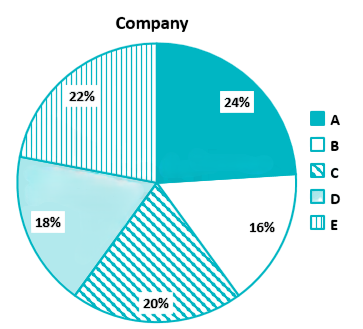
The given Pie chart shows the percentage distribution of total number of Employees in five different Company A,B,C,D,E. respectively. Total number of employees in five different Company is 3000.(Note: Ratio of Male to Female Employees is 3:2 in each company)
Question:
What is the difference between the total number of Male and Female Employees in Company D?
A. 104
B. 106
C. 108
D. 110
E. 112
Solution
From the Pie chart data,
Total number of employees in company D = 18%*3000 = 540
Number of Male in Company D = (3/5)*540 = 324
Number of Female in Company D = (2/5)*540 = 216
Similarly,
| Company | Total Employees | Male Employees | Female Employees |
| A | 720 | 432 | 288 |
| B | 480 | 288 | 192 |
| C | 600 | 360 | 240 |
| D | 540 | 324 | 216 |
| E | 660 | 396 | 264 |
Therefore, difference between number of Male and Female in Company D = 324 – 216 = 108.
55. Direction: Read the following information and answer the question accordingly.
The given Pie chart shows the percentage distribution of total number of Employees in five different Company A,B,C,D,E. respectively. Total number of employees in five different Company is 3000.(Note: Ratio of Male to Female Employees is 3:2 in each company)
Question:
The number of Female employees in Company C is what percentage more than the number of Female Employees in Company D?
A. 9.09%
B. 11.11%
C. 18.18%
D. 22.22%
E. 33.33%
Solution
From the Pie chart data,
Total number of employees in company D = 18%*3000 = 540
Number of Male in Company D = (3/5)*540 = 324
Number of Female in Company D = (2/5)*540 = 215
Similarly,
| Company | Total Employees | Male Employees | Female Employees |
| A | 720 | 432 | 288 |
| B | 480 | 288 | 192 |
| C | 600 | 360 | 240 |
| D | 540 | 324 | 216 |
| E | 660 | 396 | 264 |
Therefore, Required % = (240-216)/216 = 1/9 = 11.11%
56. Direction: Read the following information and answer the question accordingly.
The given Pie chart shows the percentage distribution of total number of Employees in five different Company A,B,C,D,E. respectively. Total number of employees in five different Company is 3000.(Note: Ratio of Male to Female Employees is 3:2 in each company)
Question:
What is the average number of Males Employees in company B and E?
A. 340
B. 342
C. 344
D. 346
E. 348
Solution
From the Piechart data,
| Company | Total Employees | Male Employees | Female Employees |
| A | 720 | 432 | 288 |
| B | 480 | 288 | 192 |
| C | 600 | 360 | 240 |
| D | 540 | 324 | 216 |
| E | 660 | 396 | 264 |
Total number of Employees in company B = 16%*3000 = 480
number of males in company B = (3/5)*480 = 288
Total number of Employees in Company E = 22%*300 = 660
number of Male Employees in copmany E = (3/5)*660 = 396
Average number of Male Employees in company B and E = (288 + 396)/2 = 342
57. Direction: Read the following information and answer the question accordingly.
The given Pie chart shows the percentage distribution of total number of Employees in five different Company A,B,C,D,E. respectively. Total number of employees in five different Company is 3000.(Note: Ratio of Male to Female Employees is 3:2 in each company)
Question:
Find the Central Angle (in degrees) of total number of Employees in company D.
A. 62.8
B. 68.6
C. 54.6
D. 64.8
E. 58.2
Solution
From the Pie chart data,
Total number of employees in company D = 18%*3000 = 540
Number of Male in Company D = (3/5)*540 = 324
Number of Female in Company D = (2/5)*540 = 216
Similarly,
| Company | Total Employees | Male Employees | Female Employees |
| A | 720 | 432 | 288 |
| B | 480 | 288 | 192 |
| C | 600 | 360 | 240 |
| D | 540 | 324 | 216 |
| E | 660 | 396 | 264 |
The total % distribution of Company D is 18% out of total number of Employees in all the company.
Total angle formed at the center of the pie chart is 360o
Hence, Central Angle of Company D = (18/100)*360o = 64.8
58. Direction: Read the following information and answer the question accordingly.
The given Pie chart shows the percentage distribution of total number of Employees in five different Company A,B,C,D,E. respectively. Total number of employees in five different Company is 3000.(Note: Ratio of Male to Female Employees is 3:2 in each company)
Question:
If another Company F has 10% more employees than company C and the ratio of male to female employees remain same. Then find the number of female employees in company F?
A. 260
B. 264
C. 266
D. 268
E. 270
Solution
From the Pie chart data,
Total number of employees in company D = 18%*3000 = 540
Number of Male in Company D = (3/5)*540 = 324
Number of Female in Company D = (2/5)*540 = 215
Similarly,
| Company | Total Employees | Male Employees | Female Employees |
| A | 720 | 432 | 288 |
| B | 480 | 288 | 192 |
| C | 600 | 360 | 240 |
| D | 540 | 324 | 216 |
| E | 660 | 396 | 264 |
Solution:
Total number of Employees in company C = 600
Total number of Employees in company F is 110% of Employees in company C
Therefore, total number of Employees in company F = 110%*600 = 660
Hence, number of Female Employees in company F = (2/5)*660 = 264
59. A cistern has a leak at 7 / 12th height of tank. Pipe can fill the cistern in 30 hours, while if the leak was at bottom, it can empty the cistern in 36 hours. The time (in hours) to fill the cistern is?
A. 87.5
B. 92.5
C. 90
D. 86.5
E. None of these
Solution
Given:-
Time for pipe to fill the cistern = 30 hours
Time for leak to empty the tank = 36 hours
Concept used:-
Considering capacity of tank equal to LCM of filling and emptying pipes/leaks.
Calculation:-
Capacity of tank = LCM of (30 and 36) = 360 units
Work done by pipe in 1 hour = 360 / 30 = 12 units.
Work done by leak in 1 hour = 360 / 36 = 10 units.
Leak will only become active when cistern is 7 / 12 filled.
Time required to fill after cistern below leak = 7 / 12 × 360 / 12 = 210 / 12 = 35 / 2 hours
Time required above leak = 5 / 12 × 360 / (12 – 10) = 75 hoursTotal time = 75 + 17.5 = 92.5 hours.
60. What will come in the place of ‘?’ in the following question?
∛1728 ÷ 6 × 7 + √25 × √100 = ?2
A. 12
B. 8
C. 4
D. 64
E. 36
Solution
Concept used:
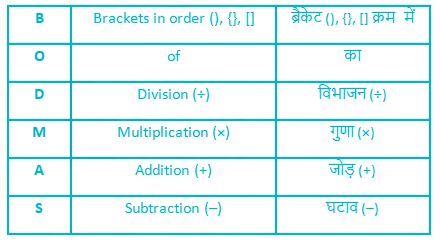
Follow BODMAS rule to solve this question, as per the order given below,
Calculation:
∛1728 ÷ 6 × 7 + √25 × √100 = ?2
⇒ 12 ÷ 6 × 7 + 5 × 10 = ?2
⇒ 2 × 7 + 50 = ?2
⇒ ?2 = 64
⇒ ? = 8
∴ The value of ‘?” is 8.
61. What value should come in place of questions (?) in the following equations?
88% of 1850 + 35% of 2400 = ? + 758
A. 1710
B. 1850
C. 1620
D. 1580
E. None of these
Solution
Concept used:
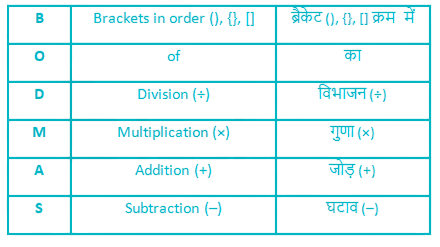
Follow BODMAS rule to solve this question, as per the order given below.
Calculation:
88% of 1850 + 35% of 2400 = ? + 758
⇒ 1628 + 840 = ? + 758
⇒ 1710 = ?
62. What will come in the place of the question mark ‘?’ in the following question?
24% of 375 + ?% of 150 = 150
A. 60
B. 82
C. 40
D. 24
E. None of the above
Solution
Given:
24% of 375 + ?% of 150 = 150
Concept used:
Follow the BODMAS rule according to the table given below:

Calculation:
24% of 375 + ?% of 150 = 150
⇒ 24/100 of 375 + ?% × 150 = 150
⇒ 24/100 × 375 + ?% × 150 = 150
⇒ 90 + ?% × 150 = 150
⇒ ? % of 150 = 150 – 90
⇒ ? % of 150 = 60
⇒ ?/100 × 150 = 60
⇒ ? = 60/150 × 100
⇒ ? = 40
∴ The value of ? is 40
63. What will come in the place of the question mark ‘?’ in the following question?
8% of 5% of 200% of 250 = 2?
A. 0
B. 1
C. 1/2
D. 2
E. 3
Solution
Given:
8% of 5% of 200% of 250 = 2?
Concept used:
Follow the BODMAS rule to solve this question, as per the order given below,

Calculation:
Let us solve step by step
⇒ 8% of 5% of 200% of 250 = 2?
⇒ 8% of 5% of (200/100) of 250 = 2?
⇒ 8% of (5/100) of 500 = 2?
⇒ (8/100) of 25 = 2?
⇒ 21 = 2?
⇒ ? = 1
∴ The value of ? is 1.
64. What will come in the place of the question mark ‘?’ in the following question?
(8375 ÷ 67)1/3 + (7.84 × 25)1/2 = (?)1/2
A. 456
B. 361
C. 324
D. 338
E. 432
Solution
Given:
(8375 ÷ 67)1/3 + (7.84 × 25)1/2 = (?)1/2
Concept used:
Follow the BODMAS rule according to the table given below:
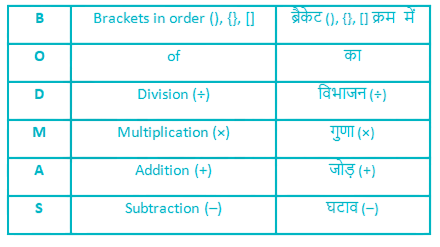
Calculation:
Using the BODMAS rule
⇒ (8375 ÷ 67)1/3 + (7.84 × 25)1/2 = (?)1/2
⇒ (125)1/3 + (7.84 × 25)1/2 = (?)1/2
⇒ (125)1/3 + (196)1/2 = (?)1/2
⇒ 5 + 14 = (?)1/2
⇒ (?)1/2 = 19
Squaring both sides,
⇒ ? = 192
⇒ ? = 361
∴ 361 will come in place of ‘?’
65. What will come in place of question mark (?) in the following question?
120% of 60 + ?2?2 = 70 ÷ 14 × 36 + 13
A. 14
B. 11
C. 18
D. 21
E. 28
Solution
Concept:
Follow the BODMAS rule according to the table given below:
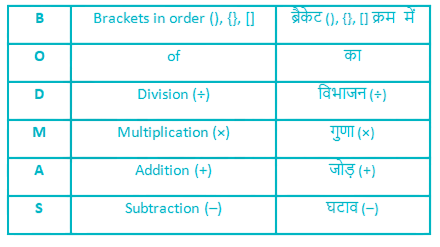
Calculation:
The given expression is
120% of 60 + ?2?2 = 70 ÷ 14 × 36 + 13
(120/100) × 60 + ?2?2 = (70/5) × 36 + 13
⇒ 1.2×60+?2=5×36+131.2×60+?2=5×36+13
⇒ 72+?2=180+1372+?2=180+13
⇒ ?2=193−72?2=193−72
⇒ ?2=121?2=121
⇒ ?=121−−−√2?=1212
⇒ ? = 11
∴ Option 2 is correct
66. What will come in place of the question mark?
[72 – {(12/3) ÷ 2}] + [(18 – 6)/4] = ?
A. 70
B. 90
C. 73
D. 85
E. 65
Solution
Given:
[72 – {(12/3) ÷ 2}] + [(18 – 6)/4] = ?
Concept used:
We have to follow the BODMAS rule
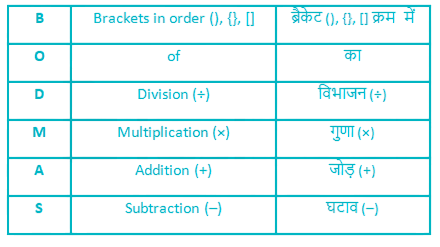
Calculation:
[72 – {(12/3) ÷ 2}] + [(18 – 6)/4] = ?
⇒ [72 – {4 ÷ 2}] + [12/4] = ?
⇒ [72 – 2] + 3 = ?
⇒ 70 + 3 = ?
⇒ 73 = ?
∴ The value of ‘?’ is 73
67. What will come in place of question mark (?) in the following equation?
23 × (17 + 16) ÷ 11 + 2/5 of 125 – √361 = ?
A. 121
B. 100
C. 361
D. 103
E. None
Solution
Concept Used:
Follow BODMAS rule to solve this question, as per the order given below

Calculation:
23 × (17 + 16) ÷ 11 + 2/5 of 125 – √361 = ?
⇒ 23 × (33) ÷ 11 + 2/5 of 125 – 19
⇒ 23 × 3 + 50 – 19
⇒ 69 + 50 – 19
⇒ 119 – 19
⇒ 100
∴ The value of ? is 100.
68. What should come in place of question mark (?) in the following questions?
(38/3) × √324 – 35 % of 1500 = 64 – ?2
A. 29
B. 15
C. 21
D. 19
E. None of these
Solution
Concept used:
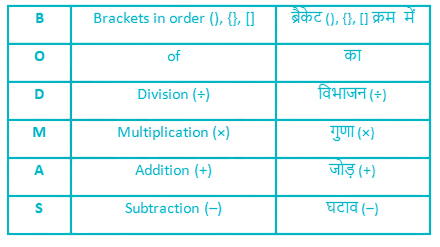
Calculation:
Considering the following given question
(38/3) × √324 – 35 % of 1500 = 64 – ?2
⇒ 38/3 × √324 – 35 % of 1500 = 64 – ?2
⇒ 38/3 × √324 – 35/100 × 1500 = 64 – ?2
⇒ 38/3 × √324 – 35 × 15 = 64 – ?2
⇒ 38/3 × 18 – 35 × 15 = 64 – ?2
⇒ 38 × 6 – 35 × 15 = 64 – ?2
⇒ 228 – 525 = 64 – ?2
⇒ – 297 = 64 – ?2
⇒ – 297 – 64 = – ?2
⇒ – 361 = – ?2
⇒ ?2 = 361
⇒ ? = 19
∴ ? = 19
69. What should come in place of question mark (?) in the following questions?
1728 ÷ 6 of 2 × [5 ÷ {(26 ÷ 2) – 4 × 2}] = ?
A. 244
B. 154
C. 264
D. 144
E. None of these
Solution
Concept used:

Calculation:
⇒ 1728 ÷ 6 of 2 × [5 ÷ {13 – 4 × 2}] = ?
⇒ 1728 ÷ 6 of 2 × [5 ÷ {13 – 8}] = ?
⇒ 1728 ÷ 6 of 2 × [5 ÷ 5] = ?
⇒ 1728 ÷ 6 of 2 × 1 = ?
⇒ 1728 ÷ 12 × 1 = ?
⇒ 144 × 1 = ?
⇒ 144 = ?
∴ ? = 144
70. A discount on the marked price of a pair of shoes is 10% for that shopkeeper incurred a loss of 1% on cost price. Find that the marked price is what percent more than the cost price of shoes.
A. 12%
B. 10%
C. 15%
D. 13%
E. 18%
Solution
Given
Discount on pair of shoes = 10%
Loss after discount = 1%
Formula used
Marked price × (100 – percentage discount) = Cost price × (100 – percentage loss)
Calculation
According to question
⇒ Marked price × (100 – 10) = Cost price × (100 – 1)
⇒ Marked price / Cost price = 99 / 90
Required Percentage = [(99 – 90) / 90] × 100
⇒ (9 / 90) × 100
⇒ 10%
∴ The required percentage difference is 10%.
71. In the following sentence, four words printed in bold are given. One of these words printed in bold might either be wrongly spelt or inappropriate to the context of the sentence. Find out the word that is inappropriate or wrongly spelt, if any. If the words printed in bold are correctly spelt and appropriate to the context of the sentence then mark ‘No error’ as your answer.
The bejewelled crown sat on top of the princess’s head, as her bethrothed looked at her with callous animosity.
A. bejeweled
B. bethrothed
C. callous
D. animosity
E. no error
Solution
The correct answer is bethrothed.
Key Points
Betrothed: the person to whom one is engaged. It has been misspelt as ‘bethrothed’.
Additional Information
Meaning of the other words:
Animosity is hatred towards someone.
Bejewelled means to be covered or adorned with jewels
Callous means to be insensitive or showing a cruel disregard for others
72. In the following sentence, four words printed in bold are given. One of these words printed in bold might either be wrongly spelt or inappropriate in the context of the sentence. Find out which word that is inappropriate or wrongly spelt, if any. If all of the words in bold are correct, then mark ‘No error’ as your answer.
Susceptibility to chronic diseases, such as artheritis, diabetes, and hypertension increases during middle adulthood.
A. Susceptibility
B. Chronic
C. Artheritis
D. Hypertension
E. No error
Solution
The correct answer is option 3, i.e. Artheritis.
Key Points
Arthritis which means a disease-causing painful inflammation and stiffness of the joints has been incorrectly spelt as Artheritis.
Remaining words:
Hypertension: abnormally high blood pressure
Susceptibility: the state or fact of being likely or liable to be influenced or harmed by a particular thing
Chronic: (of an illness) persisting for a long time or constantly recurring
73. In the following sentence, four words printed in bold are given. One of these words printed in bold might either be wrongly spelt or inappropriate to the context of the sentence. Find out that word that is inappropriate or wrongly spelt, if any. If all of the words in bold are correct, then mark ‘No error’ as your answer.
Treatments such as this were a way of ridding women of rebelliousness and forcing them to confirm to expected social roles.
A. Ridding
B. Rebelliousness
C. Confirm
D. Social
E. No error
Solution
The correct answer is Confirm- this word is inappropriate in the given context.
Key Points
Social: relating to society or its organization
Confirm, which means establishing the truth or correctness of (something previously believed or suspected to be the case) has been wrongly used in this context in place of Conform which means comply with rules, standards, or laws.
Example: The contract requires that managers conform to high standards of personal conduct.
The meanings of other words are:
Ridding: making someone or something free of (an unwanted person or thing).
Rebelliousness: the act of opposing the ideas of the people in authority and planning to change the system, often using force
74. In the following sentence, four words printed in bold are given. One of these words printed in bold might either be wrongly spelt or inappropriate to the context of the sentence. Find out which word that is inappropriate or wrongly spelt, if any. If all of the words in bold are correct, then mark ‘No error’ as your answer.
‘The Yellow Wallpaper’ rises to a classic level in subtly delinating the madness which crawls over a woman dwelling in the hideously papered room where a madwoman was once confined.
A. Delinating
B. Dwelling
C. Hideously
D. Confined
E. No error
Solution
The correct answer is option 1, i.e. Delinating.
Key Points
Delineating which means describe or portray (something) precisely has been incorrectly spelt as Delinating.
Additional Information
The meaning of the other words:
Confined: kept or restricted someone or something within certain limits of (space, scope, or time)
Dwelling: living in or at a specified place
Hideously: in an extremely unpleasant manner
75. In the following sentence, four words printed in bold are given. One of these words printed in bold might either be wrongly spelt or inappropriate to the context of the sentence. Find out that word that is inappropriate or wrongly spelled, if any. If all of the words in bold are correct, then mark ‘No error’ as your answer.
Early in the movement’s history, the term “Transcendentalists” was used as a pedantic term by critics, who were suggesting their position was beyond sanity and reason.
A. Transcendentalists
B. Pedantic
C. Suggesting
D. Sanity
E. No error
Solution
The correct answer is option 2, i.e. Pedantic.
Key Points
Sanity: reasonable and rational behaviour
Pedantic, which means excessively concerned with minor details or rules; overscrupulous has been wrongly used in this context in place of Pejorative which means expressing contempt or disapproval.
The meanings of other words are:
Transcendentalists: a term used for followers of Transcendentalism
Suggesting: putting forward for consideration
76. Directions: In the following question, some parts of the sentence may have an error. The error, if any, will be in one part of the sentence. Find out which part of the sentence has an error and select the appropriate option. If a sentence is free from errors, select ‘No error’ as your answer.
The Hollywood culture will /(A) sooner or later, /(B) become international norm /(C) for the entertainment industry. /(D) No Error. /(E)
A. A
B. B
C. C
D. D
E. E
Solution
The correct answer is ‘C’ i.e. the error lies in part C of the sentence.
Key Points
Let us note the following:
- The word ‘norm’ is a countable noun.
- It signifies an entity (singularity) in the context.
- Hence, the indefinite article ‘an’ must be used before the phrase ‘international norm’.
- The adjective ‘international’ starts with a vowel sound that of ‘e’.
- The article ‘an’ must be used before it and not ‘a’.
Hence, the correct sentence is The Hollywood culture will sooner or later, become an international norm for the entertainment industry.
Additional Information
Articles:
Example: I’m going to the supermarket.
In English, there are three articles: a, an, and the.
Articles are used before nouns or noun equivalents.
Articles are a type of adjective.
The indefinite article (a, an) is used before a noun that is general or when its identity is not known.
Example:
A man is known by the company he keeps.
An apple a day keeps the doctor away.
The definite article is the.
It refers to a specified thing or person.
77. Directions: In the following question, some parts of the sentence may have an error. The error, if any, will be in one part of the sentence. Find out which part of the sentence has an error and select the appropriate option. If a sentence is free from errors, select ‘No error’ as your answer.
Employees express their opinions (A) that their president should not (B) resorting to (C) unethical practices and corruption. (D) No Error. /(E)
A. A
B. B
C. C
D. D
E. E
Solution
The correct answer is ‘C’ i.e. the error lies in part C of the sentence.
Key Points
Let us note the following:
- The word resorting is a gerund.
- The base form is resort.
- The base form of a verb is used after a modal (can, may, should) and not a gerund.
- Hence, ‘resorting’ must be replaced with ‘resort’ as in the active voice.
Hence, the correct sentence is Employees express their opinions that their president should not resort to unethical practices and corruption.
Additional Information
Modal:
Shall, should.
A modal is a type of auxiliary (helping) verb.
It is used to express: ability, possibility, permission or obligation.
The modals and semi-modals in English are:
Can, could, be able to.
May, might.
78. Directions: In the following question, some parts of the sentence may have an error. The error, if any, will be in one part of the sentence. Find out which part of the sentence has an error and select the appropriate option. If a sentence is free from errors, select ‘No error’ as your answer.
The workers’ union wanted (A)/ she to take over (B)/ as the new chairman (C)/ of its coveted board. (D)/ No Error. /(E)
A. A
B. B
C. C
D. D
E. E
Solution
The correct answer is ‘B’ i.e. the error lies in part B of the sentence.
Key Points
Let us note the following:
- The word she is a pronoun.
- The word wanted is a verb.
- The pronoun she is also used here as an object of the verb wanted.
- Hence, she must be replaced with her as it is an accusative case.
- Hence, the correct sentence is The workers’ union wanted her to take over as the new chairman of its coveted board.
Additional Information
Accusative case:
I will take care of this issue.
The accusative case is a grammatical case for nouns and pronouns.
It shows the relationship of a direct object to a verb.
A direct object is the recipient of a verb.
The subject of the sentence does something to the direct object.
The direct object is placed after the verb in a sentence.
Examples:
The poet is writing a poem.
The lyricist is writing a song.
The singer is singing a song.
They are traveling to the mountains.
The photographer is taking pictures.
The auditor is auditing the files.
79. Directions: In the following question, some parts of the sentence may have an error. The error, if any, will be in one part of the sentence. Find out which part of the sentence has an error and select the appropriate option. If a sentence is free from errors, select ‘No error’ as your answer.
The sound was (A)/ so faintly that (B)/ they had to strain (C)/ their ears to hear it.(D)/ No Error. (E)
A. A
B. B
C. C
D. D
E. E
Solution
The correct answer is ‘B’ i.e. the error lies in part B of the sentence.
Let us note the following:
- The word faintly is an adverb.
- The word faint is an adjective.
- The word sound is a noun.
- The word faintly is modifying the noun ‘sound’.
- Hence, the adverb ‘faintly’ must be replaced with the adjective ‘faint’.
Hence, the correct sentence is The sound was so faint that they had to strain their ears to hear it.
Additional Information
The Eight Parts of Speech:
Example: hurray, bravo, kudos, yay, wow, etc.
A noun is the name of a person, place, thing, or idea.
Example: India, Rabbit, Cardamom, Lily, etc
A pronoun is a word used in place of a noun.
Example: I, me, he, she, herself, you, it, that, they, each, few, many, who, whoever, whose, someone, everybody, etc.
A verb expresses action or being.
Example: read, write, talk, walk, eat, drink, etc.
An adjective modifies or describes a noun or pronoun.
Example: small, large, square, round, poor, wealthy, slow, etc.
An adverb modifies or describes a verb, an adjective, or another adverb.
Example: quickly, loudly, softly, carelessly, etc.
A preposition is a word placed before a noun or pronoun to form a phrase modifying another word in the sentence.
Example: by, with, about, until, etc.
A conjunctionjoins words, phrases, or clauses.
Example: and, but, or, while, because, etc.
An interjection is a word used to express emotion.
80. Directions: In the following question, some parts of the sentence may have an error. The error, if any, will be in one part of the sentence. Find out which part of the sentence has an error and select the appropriate option. If a sentence is free from errors, select ‘No error’ as your answer.
When Mahim and Savita (A)/ reached the office, (B)/ they find that (C)/ it was closed. (D)/ No Error. (E)
A. A
B. B
C. C
D. D
E. E
Solution
The correct answer is ‘C’ i.e. the error lies in part C of the sentence.
Key Points
Let us note the following:
- The word find in the given sentence is a verb.
- Its tense does not match with the tense of the sentence.
- Found is the past tense of the verb find.
- Hence, the verb ‘find’ must be replaced with its past form ‘found’.
- This will make the sentence grammatically correct.
Hence, the correct sentence is When Mahim and Savita reached the office, they found that it was closed.
Additional Information
Past Tense:
- The past tense is verb tense.
- It is used for a past activity or a past state of being.
- Example: Savita jumped in the lake.
Present Tense:
Example: Aparna swims in the pool every day.
The present tense is verb tense.
It is used to describe a current activity or state of being.
81. Read the passage and answer the following questions.
Today I want to tell you three stories from my life. That’s it. Just three stories. The first story is about connecting the dots. I dropped out of Reed College after the first 6 months, but then stayed around as a drop-in for another 18 months before I really quit. Looking back, it was one of the best decisions I ever made. I could stop taking the required classes that didn’t interest me, and begin dropping in on the ones that looked interesting. I didn’t have a dorm room, so I slept on the floor in friends’ rooms. And much of what I stumbled into by following my curiosity and intuition turned out to be priceless later on.
Ten years later, when we were designing the first Macintosh computer, it all came back to me. And we designed it all into the Mac. If I had never dropped in on that course in college the Mac would have never had multiple typefaces or for that matter even proportionally spaced fonts. And since Windows just copied Mac, it’s likely no personal computer would have them. But it was very clear looking backwards 10 years later.
My second story is about love and loss. I found what I loved to do early in life. Woz (Steve Wozniak) and I started Apple when I was 20. In 10 years Apple had grown from just the two of us in a garage into a $2 billion company. And then I got fired. It was devastating. But something slowly began to dawn on me- I still loved what I did. And so I decided to start over. The heaviness of being successful was replaced by the lightness of being a beginner again. It freed me to enter one of the most creative periods of my life.
My third story is about death. About a year ago I was diagnosed with cancer. My doctor advised me to go home and get my affairs in order, which is doctor’s code for ‘prepare to die’. I lived with that diagnosis all day. Later that evening I had a biopsy. It turned out to be a very rare form of pancreatic cancer that is curable with surgery. I had the surgery and I’m fine now. This was the closest I’ve been to facing death, and I hope its the closest I get for a few more decades. Having lived through it, I can now say this to you: Your time is limited, so don’t waste it living someone else’s life.- Steve Jobs
Question:
What are the stories Steve Jobs speaks of?
1. connecting the dots
2. love and loss
3. death
A. only 1
B. only 2
C. only 3
D. all except 1
E. all of the above
Solution
The correct answer is option 5 i.e. all of the above.
Explanation
The passage is about the lessons Steve Job’s learnt during his lifetime through various important incidents.
- Each paragraph in the passage contains a story- “The first story is about connecting the dots.”, “My second story is about love and loss” and lastly, “My third story is about death.”
- These are the three stories he narrates.
Therefore, option 5 is the correct answer.
82. Read the passage and answer the following questions.
Today I want to tell you three stories from my life. That’s it. Just three stories. The first story is about connecting the dots. I dropped out of Reed College after the first 6 months, but then stayed around as a drop-in for another 18 months before I really quit. Looking back, it was one of the best decisions I ever made. I could stop taking the required classes that didn’t interest me, and begin dropping in on the ones that looked interesting. I didn’t have a dorm room, so I slept on the floor in friends’ rooms. And much of what I stumbled into by following my curiosity and intuition turned out to be priceless later on.
Ten years later, when we were designing the first Macintosh computer, it all came back to me. And we designed it all into the Mac. If I had never dropped in on that course in college the Mac would have never had multiple typefaces or for that matter even proportionally spaced fonts. And since Windows just copied Mac, it’s likely no personal computer would have them. But it was very clear looking backwards 10 years later.
My second story is about love and loss. I found what I loved to do early in life. Woz (Steve Wozniak) and I started Apple when I was 20. In 10 years Apple had grown from just the two of us in a garage into a $2 billion company. And then I got fired. It was devastating. But something slowly began to dawn on me- I still loved what I did. And so I decided to start over. The heaviness of being successful was replaced by the lightness of being a beginner again. It freed me to enter one of the most creative periods of my life.
My third story is about death. About a year ago I was diagnosed with cancer. My doctor advised me to go home and get my affairs in order, which is doctor’s code for ‘prepare to die’. I lived with that diagnosis all day. Later that evening I had a biopsy. It turned out to be a very rare form of pancreatic cancer that is curable with surgery. I had the surgery and I’m fine now. This was the closest I’ve been to facing death, and I hope its the closest I get for a few more decades. Having lived through it, I can now say this to you: Your time is limited, so don’t waste it living someone else’s life.- Steve Jobs
Question:
At what age did Jobs start Apple?
A. 20
B. 30
C. 22
D. 41
E. 29
Solution
The correct answer is option 1 i.e. 20.
Explanation
The passage is about the lessons Steve Job’s learnt during his lifetime through various important incidents.
- The following is stated in the passage: “Woz (Steve Wozniak) and I started Apple when I was 20.”
- Here, ‘I’ is Steve Jobs.
Therefore, option 1 is the correct answer.
83. Read the passage and answer the following questions.
Today I want to tell you three stories from my life. That’s it. Just three stories. The first story is about connecting the dots. I dropped out of Reed College after the first 6 months, but then stayed around as a drop-in for another 18 months before I really quit. Looking back, it was one of the best decisions I ever made. I could stop taking the required classes that didn’t interest me, and begin dropping in on the ones that looked interesting. I didn’t have a dorm room, so I slept on the floor in friends’ rooms. And much of what I stumbled into by following my curiosity and intuition turned out to be priceless later on.
Ten years later, when we were designing the first Macintosh computer, it all came back to me. And we designed it all into the Mac. If I had never dropped in on that course in college the Mac would have never had multiple typefaces or for that matter even proportionally spaced fonts. And since Windows just copied Mac, it’s likely no personal computer would have them. But it was very clear looking backwards 10 years later.
My second story is about love and loss. I found what I loved to do early in life. Woz (Steve Wozniak) and I started Apple when I was 20. In 10 years Apple had grown from just the two of us in a garage into a $2 billion company. And then I got fired. It was devastating. But something slowly began to dawn on me- I still loved what I did. And so I decided to start over. The heaviness of being successful was replaced by the lightness of being a beginner again. It freed me to enter one of the most creative periods of my life.
My third story is about death. About a year ago I was diagnosed with cancer. My doctor advised me to go home and get my affairs in order, which is doctor’s code for ‘prepare to die’. I lived with that diagnosis all day. Later that evening I had a biopsy. It turned out to be a very rare form of pancreatic cancer that is curable with surgery. I had the surgery and I’m fine now. This was the closest I’ve been to facing death, and I hope its the closest I get for a few more decades. Having lived through it, I can now say this to you: Your time is limited, so don’t waste it living someone else’s life.- Steve Jobs
Question:
What was the worth of Apple 10 years after it was established?
A. 2 billion dollars
B. A million dollars
C. 2 million dollars
D. 3 billion dollars
E. 20 billion dollars
Solution
The correct answer is option 1 i.e. 2 billion dollars.
Explanation
The passage is about the lessons Steve Job’s learnt during his lifetime through various important incidents.
- The following is stated in the passage: “In 10 years Apple had grown from just the two of us in a garage into a $2 billion company.”
Therefore, option 1 is the correct answer.
84. Read the passage and answer the following questions.
Today I want to tell you three stories from my life. That’s it. Just three stories. The first story is about connecting the dots. I dropped out of Reed College after the first 6 months, but then stayed around as a drop-in for another 18 months before I really quit. Looking back, it was one of the best decisions I ever made. I could stop taking the required classes that didn’t interest me, and begin dropping in on the ones that looked interesting. I didn’t have a dorm room, so I slept on the floor in friends’ rooms. And much of what I stumbled into by following my curiosity and intuition turned out to be priceless later on.
Ten years later, when we were designing the first Macintosh computer, it all came back to me. And we designed it all into the Mac. If I had never dropped in on that course in college the Mac would have never had multiple typefaces or for that matter even proportionally spaced fonts. And since Windows just copied Mac, it’s likely no personal computer would have them. But it was very clear looking backwards 10 years later.
My second story is about love and loss. I found what I loved to do early in life. Woz (Steve Wozniak) and I started Apple when I was 20. In 10 years Apple had grown from just the two of us in a garage into a $2 billion company. And then I got fired. It was devastating. But something slowly began to dawn on me- I still loved what I did. And so I decided to start over. The heaviness of being successful was replaced by the lightness of being a beginner again. It freed me to enter one of the most creative periods of my life.
My third story is about death. About a year ago I was diagnosed with cancer. My doctor advised me to go home and get my affairs in order, which is doctor’s code for ‘prepare to die’. I lived with that diagnosis all day. Later that evening I had a biopsy. It turned out to be a very rare form of pancreatic cancer that is curable with surgery. I had the surgery and I’m fine now. This was the closest I’ve been to facing death, and I hope its the closest I get for a few more decades. Having lived through it, I can now say this to you: Your time is limited, so don’t waste it living someone else’s life.- Steve Jobs
Question:
Which company copied Mac?
A. Apple
B. Windows
C. Instagram
D. Facebook
E. Android
Solution
The correct answer is option 2 i.e. Windows.
Explanation
The passage is about the lessons Steve Job’s learnt during his lifetime through various important incidents.
- The following is stated in the passage: “…And since Windows just copied Mac, it’s likely no personal computer would have them.”
Therefore, option 2 is the correct answer.
85. Read the passage and answer the following questions.
Today I want to tell you three stories from my life. That’s it. Just three stories. The first story is about connecting the dots. I dropped out of Reed College after the first 6 months, but then stayed around as a drop-in for another 18 months before I really quit. Looking back, it was one of the best decisions I ever made. I could stop taking the required classes that didn’t interest me, and begin dropping in on the ones that looked interesting. I didn’t have a dorm room, so I slept on the floor in friends’ rooms. And much of what I stumbled into by following my curiosity and intuition turned out to be priceless later on.
Ten years later, when we were designing the first Macintosh computer, it all came back to me. And we designed it all into the Mac. If I had never dropped in on that course in college the Mac would have never had multiple typefaces or for that matter even proportionally spaced fonts. And since Windows just copied Mac, it’s likely no personal computer would have them. But it was very clear looking backwards 10 years later.
My second story is about love and loss. I found what I loved to do early in life. Woz (Steve Wozniak) and I started Apple when I was 20. In 10 years Apple had grown from just the two of us in a garage into a $2 billion company. And then I got fired. It was devastating. But something slowly began to dawn on me- I still loved what I did. And so I decided to start over. The heaviness of being successful was replaced by the lightness of being a beginner again. It freed me to enter one of the most creative periods of my life.
My third story is about death. About a year ago I was diagnosed with cancer. My doctor advised me to go home and get my affairs in order, which is doctor’s code for ‘prepare to die’. I lived with that diagnosis all day. Later that evening I had a biopsy. It turned out to be a very rare form of pancreatic cancer that is curable with surgery. I had the surgery and I’m fine now. This was the closest I’ve been to facing death, and I hope its the closest I get for a few more decades. Having lived through it, I can now say this to you: Your time is limited, so don’t waste it living someone else’s life.- Steve Jobs
Question:
What does ‘stumbled‘ mean in the context of the given passage?
A. discovered something either by chance or intention
B. put (an object) in the wrong place and so lose it temporarily
C. fell
D. caused (someone) to fail to gain or retain
E. failed to remember.
Solution
The correct answer is option 1 i.e. discovered something either by chance or intention.
Explanation
The passage is about the lessons Steve Job’s learnt during his lifetime through various important incidents.
- The sentence that contains the word ‘stumbled’ is as follows: “And much of what I stumbled into by following my curiosity and intuition turned out to be priceless later on.”
- Here, it means that Jobs discovered something by chance /stumbled upon it, which later became a priceless thing.
- An example of the same is: “In a newspaper archive, she stumbled upon the picture of the boy.”
Therefore, option 1 is the correct answer.
Important Point
- Although ‘fell’ (option 3) may seem like the right answer as well, in this context, it is not the correct meaning.
86. Read the passage and answer the following questions.
Today I want to tell you three stories from my life. That’s it. Just three stories. The first story is about connecting the dots. I dropped out of Reed College after the first 6 months, but then stayed around as a drop-in for another 18 months before I really quit. Looking back, it was one of the best decisions I ever made. I could stop taking the required classes that didn’t interest me, and begin dropping in on the ones that looked interesting. I didn’t have a dorm room, so I slept on the floor in friends’ rooms. And much of what I stumbled into by following my curiosity and intuition turned out to be priceless later on.
Ten years later, when we were designing the first Macintosh computer, it all came back to me. And we designed it all into the Mac. If I had never dropped in on that course in college the Mac would have never had multiple typefaces or for that matter even proportionally spaced fonts. And since Windows just copied Mac, it’s likely no personal computer would have them. But it was very clear looking backwards 10 years later.
My second story is about love and loss. I found what I loved to do early in life. Woz (Steve Wozniak) and I started Apple when I was 20. In 10 years Apple had grown from just the two of us in a garage into a $2 billion company. And then I got fired. It was devastating. But something slowly began to dawn on me- I still loved what I did. And so I decided to start over. The heaviness of being successful was replaced by the lightness of being a beginner again. It freed me to enter one of the most creative periods of my life.
My third story is about death. About a year ago I was diagnosed with cancer. My doctor advised me to go home and get my affairs in order, which is doctor’s code for ‘prepare to die’. I lived with that diagnosis all day. Later that evening I had a biopsy. It turned out to be a very rare form of pancreatic cancer that is curable with surgery. I had the surgery and I’m fine now. This was the closest I’ve been to facing death, and I hope its the closest I get for a few more decades. Having lived through it, I can now say this to you: Your time is limited, so don’t waste it living someone else’s life.- Steve Jobs
Question:
What does ‘dawn‘ mean in the context of the given passage?
A. become evident to the mind; be perceived or understood.
B. deform, pulverize, or force inwards by compressing forcefully.
C. a final part of something, especially a period of time
D. prevent the development, action, or expression of (a feeling, impulse, idea, etc.); restrain.
E. the achievement of something desired, promised, or predicted.
Solution
The correct answer is option 1 i.e. became evident to the mind; was perceived or understood.
Explanation
The passage is about the lessons Steve Job’s learnt during his lifetime through various important incidents.
- The sentence that contains the word ‘dawn’ is as follows: “But something slowly began to dawn on me- I still loved what I did.”
- Here, it means that Jobs began to perceive or understandthat he loved what he was doing.
- An example of the same is: “It was only then that it dawned on both of them that he was serious.”
Therefore, option 1 is the correct answer.
87. Read the passage and answer the following questions.
Today I want to tell you three stories from my life. That’s it. Just three stories. The first story is about connecting the dots. I dropped out of Reed College after the first 6 months, but then stayed around as a drop-in for another 18 months before I really quit. Looking back, it was one of the best decisions I ever made. I could stop taking the required classes that didn’t interest me, and begin dropping in on the ones that looked interesting. I didn’t have a dorm room, so I slept on the floor in friends’ rooms. And much of what I stumbled into by following my curiosity and intuition turned out to be priceless later on.
Ten years later, when we were designing the first Macintosh computer, it all came back to me. And we designed it all into the Mac. If I had never dropped in on that course in college the Mac would have never had multiple typefaces or for that matter even proportionally spaced fonts. And since Windows just copied Mac, it’s likely no personal computer would have them. But it was very clear looking backwards 10 years later.
My second story is about love and loss. I found what I loved to do early in life. Woz (Steve Wozniak) and I started Apple when I was 20. In 10 years Apple had grown from just the two of us in a garage into a $2 billion company. And then I got fired. It was devastating. But something slowly began to dawn on me- I still loved what I did. And so I decided to start over. The heaviness of being successful was replaced by the lightness of being a beginner again. It freed me to enter one of the most creative periods of my life.
My third story is about death. About a year ago I was diagnosed with cancer. My doctor advised me to go home and get my affairs in order, which is doctor’s code for ‘prepare to die’. I lived with that diagnosis all day. Later that evening I had a biopsy. It turned out to be a very rare form of pancreatic cancer that is curable with surgery. I had the surgery and I’m fine now. This was the closest I’ve been to facing death, and I hope its the closest I get for a few more decades. Having lived through it, I can now say this to you: Your time is limited, so don’t waste it living someone else’s life.- Steve Jobs
Question:
What does ‘diagnosis‘ mean?
A. a sentence worded or expressed so as to elicit information.
B. an estimate or forecast of a future situation based on a study of present trends.
C. process of establishing something exactly by calculation or research
D. the identification of the nature of an illness or other problem by examination of the symptoms.
E. the inability to make a decision quickly.
Solution
The correct answer is option 4 i.e. the identification of the nature of an illness or other problem by examination of the symptoms.
Explanation
The passage is about the lessons Steve Job’s learnt during his lifetime through various important incidents.
- One of the sentence that contains the word ‘diagnosis/diagnosed’ is as follows: “About a year ago I was diagnosed with cancer. I lived with that diagnosis all day.”
- Here, it means identification/detection.
- An example of the same is: “She is an expert in the diagnosis and treatment of eye diseases.“
Therefore, option 4 is the correct answer.
88. Fill in the blank with an appropriate word
There is a huge ______ related to changing climate patterns all around the world and people need to stem deforestation globally.
A. Imprudent
B. Temerity
C. Profligacy
D. Debauchery
E. Caveat
Solution
The correct answer is ‘caveat‘.
Key Points
- The word “caveat” means a warning or caution. (चेतावनी)
- In the context of the sentence, it refers to a serious warning related to changing climate patterns.
- The other options: “imprudent,” “temerity,” “profligacy,” and “debauchery” do not fit the context as appropriately.
Therefore, the correct answer is ‘Option 5‘.
Complete Sentence: There is a huge caveat related to changing climate patterns all around the world, and people need to stem deforestation globally.
Additional Information
Debauchery (भ्रष्टाचार): means excessive indulgence in sensual pleasures.
Imprudent (अविवेकपूर्ण): means not showing care for the consequences of an action.
Temerity (दुस्साहस): means excessive confidence or boldness.
Profligacy (अपव्यय): means reckless extravagance or wastefulness.
89. Fill in the blank with an appropriate word
There are a lot of _______ through which the wealthy pay less in taxes than those far poorer than them.
A. Miscreants
B. Dissipation
C. Prodigality
D. Promiscuity
E. Loopholes
Solution
The correct answer is ‘loopholes‘.
Key Points
- The word “loopholes” refers to gaps or ambiguities in laws or regulations that can be exploited. (चालाकी से बच निकलने के तरीके)
- In the given context, loopholes are the methods or gaps in tax regulations that allow the wealthy to pay less taxes compared to the poor.
- The other options: “miscreants,” “dissipation,” “prodigality,” and “promiscuity” do not fit the context as appropriately.
Therefore, the correct answer is ‘Option 5‘.
Complete Sentence: There are a lot of loopholes through which the wealthy pay less in taxes than those far poorer than them.
Additional Information
Promiscuity (अव्यवस्थितता): means having casual or indiscriminate relationships or behavior.
Miscreants (अपराधी): refers to people who behave badly or unlawfully.
Dissipation (अपव्यय): refers to wasteful expenditure or scattering.
Prodigality (फिजूलखर्ची): means excessive or wasteful spending.
90. Fill in the blank with an appropriate word.
Pakistan has worked on a multi-generation project to ______ 1971 attacks which destroyed its economy, society, and polity.
A. Avenge
B. Plunge
C. Conflict
D. Aggresive
E. Resonate
Solution
The correct answer is ‘Avenge‘.
Key Points
- The word “Avenge” means to inflict harm in return for an injury or wrong done to oneself or others. (प्रतिशोध लेना)
- The sentence implies that Pakistan has been working on a project to retaliate against the 1971 attacks that caused severe damage to its economy, society, and polity.
- The other options such as “Plunge,” “Conflict,” “Aggressive,” and “Resonate” do not fit the context of the sentence as appropriately as “Avenge” does.
Therefore, the correct answer is ‘Option 1‘.
Complete Sentence: Pakistan has worked on a multi-generation project to avenge 1971 attacks which destroyed its economy, society, and polity.
Additional Information
Resonate (गूंजना): means to evoke or suggest images, memories, and emotions.
Plunge (झोंकना): means to jump or dive quickly and energetically or to fall suddenly and uncontrollably.
Conflict (संघर्ष): means a serious disagreement or argument, typically a protracted one.
Aggressive (आक्रामक): means ready or likely to attack or confront; characterized by aggression.
91. Fill in the blank with an appropriate word
A black-list would mean enhanced financial ______of its government, possible sanctions against its central bank, and a downgrade of its financial and credit institutions.
A. Scrutiny
B. Observing
C. Failure
D. Statement
E. Inclusion
Solution
The correct answer is ‘Scrutiny‘.
Key Points
- The word “Scrutiny” means close and critical examination. (सावधानीपूर्वक जांच)
- In the context, “enhanced financial scrutiny” refers to rigorous monitoring or investigation of the financial activities of the government.
- The other options: “Observing,” “Failure,” “Statement,” and “Inclusion” do not fit the context as appropriately.
Therefore, the correct answer is ‘Option 1‘.
Complete Sentence: A black-list would mean enhanced financial scrutiny of its government, possible sanctions against its central bank, and a downgrade of its financial and credit institutions.
Additional Information
Inclusion (समावेश): means being part of something, which is not relevant here.
Observing (अवलोकन): means watching carefully but does not imply rigorous examination.
Failure (विफलता): means lack of success, which is irrelevant to the context.
Statement (वक्तव्य): means a declaration, which does not fit the context.
92. Fill in the blank with an appropriate word.
The colonial ___________ of forests being treated as a resource has replaced precious old-growth trees with monocultures such as teak.
A. Contradiction
B. Paradigm
C. Antipode
D. Protege
E. Adherent
Solution
The correct answer is ‘paradigm‘.
Key Points
- The word “paradigm” refers to a typical example, model, or framework of a concept or belief system. (आदर्श दृष्टांत या उदाहरण)
- The sentence emphasizes the colonial approach to forests as a resource, which aligns with the concept of a “paradigm.”
- Other options such as “contradiction,” “antipode,” “protege,” and “adherent” do not fit the context as appropriately.
Therefore, the correct answer is ‘Option 2‘.
Complete Sentence: The colonial paradigm of forests being treated as a resource has replaced precious old-growth trees with monocultures such as teak.
Additional Information
Adherent (अनुयायी): Refers to someone who supports or follows a particular idea or person.
Contradiction (विरोधाभास): A statement or position that is contrary to another.
Antipode (विपरीत): Refers to something that is the direct opposite of something else.
Protege (संरक्षित): Refers to a person under the guidance or protection of someone.
93. Directions: Given below is a word, followed by three sentences that consist of that word. Identify the sentence(s) that best express(es) the meaning of the word. Choose option 5 ‘None of the above’ if the word is not suitable in any of the sentences.
HAVOC
A. The protestors created havoc when they started to break store windows.
B. Love will havoc anyone’s life by filling in the hole in their heart.
C. Suzanne did her best to havoc herself before dating Paul because she was really interested in him.
A. Only A
B. Only B
C. Only C
D. Both A and B
E. None of the above
Solution
The correct answer is ‘Only A.‘
Key Points
- The given word ‘Havoc’ means widespread destruction. (अत्यधिक विनाश या अव्यवस्था की स्थिति; विनाश)
- Let us explore the given sentences:
- The word ‘havoc’ is used correctly in the first sentence as it talks about the protestors who created damage or destruction.
- Example: The hurricane has caused havoc along the coast.
- The word ‘enrich’ should be used in the second sentence as it talks about how love enhances or improves anyone’s life.
- The word ‘enrich’ means to improve or enhance the quality or value of someone or something. (किसी व्यक्ति या वस्तु की गुणवत्ता या मूल्य में सुधार या वृद्धि करना)
- The word ‘adorn‘ should be used in the third sentence as it talks about Suzanne who did her best to beautify herself before dating.
- The word ‘adorn’ means to add something in order to make a thing or person more attractive or beautiful. (अधिक आकर्षक या मोहक बनाने के लिए सजाना)
- The word ‘havoc’ is used correctly in the first sentence as it talks about the protestors who created damage or destruction.
- Therefore, only sentence A best expresses the meaning of the given word.
Hence, the correct answer is option 1.
Sentence A: The protestors created havoc when they started to break store windows.
Sentence B: Love will enrich anyone’s life by filling in the hole in their heart.
Sentence C: Suzanne did her best to adorn herself before dating Paul because she was really interested in him.
94. Directions: Given below is a word, followed by three sentences that consist of that word. Identify the sentence(s) that express(es) the meaning of the word.
CONTOUR
A. The artist carefully drew the contour of the mountain.
B. She put contour on her cheeks to add definition.
C. I’m going for a long walk to improve my contour.
A. Only A
B. Both A and B
C. Only B
D. Both A and C
E. Only C
Solution
The correct answer is ‘Both A and B.’
Key Points
- ‘Contour‘ can refer to an outline representing or bounding the shape or form of something and in the context of makeup, it implies a product used for contouring or reshaping face features with makeup.
- In sentences A and B, ‘Contour‘ has been correctly used to indicate drawing outlines and applying makeup respectively.
- Sentence C inappropriately uses ‘Contour‘ as it doesn’t fit into the context of going for a walk.
Hence, the only possible answer is option 2.
95. Below a word is given followed by three sentences which consist of that word. Identify the sentence/s which best expresses the meaning of the word. Choose option 5 (None of the these) if the word is not suitable in any of the sentences.
BOUT
A. The first crisis came in the form of a bout of illness.
B. Many adults suffer weekly anxiety bouts over running out of battery for phones and gadgets.
C. He had a bout for fast cars and drove a Jaguar.
A. Both A and C
B. A
C. B
D. Both A and B
E. None of these
Solution
The correct answer is option 4.
Key Points
- To answer this question, let’s first understand the meaning of the word given in the question:
- Bout: a short period of intense activity of a specified kind; a short period of illness or struggle. (अल्पकालिक अवधि, लड़ाई, संघर्ष)
- Now, let’s examine the given sentences:
- Sentence A: The first crisis came in the form of a bout of illness.
- This sentence correctly uses the word “bout” to describe a short period of illness.
- Sentence B: Many adults suffer weekly anxiety bouts over running out of battery for phones and gadgets.
- This sentence also correctly uses the word “bout” to describe short periods of anxiety.
- Sentence C: He had a bout for fast cars and drove a Jaguar.
- This sentence incorrectly uses the word “bout” because “bout” does not describe a liking or preference for something.
- So, both Sentence A and Sentence B correctly use the word “bout” in their respective contexts, while Sentence C does not.
Therefore, the correct answer is “Both A and B.”
96. Arrange the sentences in the correct order and answer the following questions.
A.There’s a clear need for increased visibility to drastically improve sales.
B.When that well runs dry, what are you supposed to do?
C.There is no obvious and clear answer to that question that covers all situations.
D.But in order to get more visibility, businesses have to spend more money.
E.Most businesses are faced with a conundrum.
Question:
Which of the following is the FIRST statement?
A. A
B. B
C. C
D. D
E. E
Solution
The correct answer is Option 5.
Key Points
- The paragraph begins by introducing the problem that most businesses face, setting the stage for the discussion about visibility and sales.
- Sentence E is the first sentence as it introduces the conundrum that businesses face:
- “Most businesses are faced with a conundrum.”
- Sentence A follows as it specifies the conundrum directly:
- “There’s a clear need for increased visibility to drastically improve sales.”
- Sentence D is the third sentence since it explains the challenge associated with gaining more visibility:
- “But in order to get more visibility, businesses have to spend more money.”
- Sentence B is the fourth as it asks a rhetorical question about what to do when the initial strategy fails:
- “When that well runs dry, what are you supposed to do?”
- Sentence C is the last as it reflects on the lack of a universal answer to the conundrum:
- “There is no obvious and clear answer to that question that covers all situations.”
- The correct sequence is EADBC.
Coherent paragraph after rearrangement:
“Most businesses are faced with a conundrum. There’s a clear need for increased visibility to drastically improve sales. But in order to get more visibility, businesses have to spend more money. When that well runs dry, what are you supposed to do? There is no obvious and clear answer to that question that covers all situations.”
97. Arrange the sentences in the correct order and answer the following questions.
A.There’s a clear need for increased visibility to drastically improve sales.
B.When that well runs dry, what are you supposed to do?
C.There is no obvious and clear answer to that question that covers all situations.
D.But in order to get more visibility, businesses have to spend more money.
E.Most businesses are faced with a conundrum.
Question:
Which of the following is the SECOND statement?
A. A
B. B
C. C
D. D
E. E
Solution
The correct answer is Option 1.
Key Points
- The paragraph begins by introducing the problem that most businesses face, setting the stage for the discussion about visibility and sales.
- Sentence E is the first sentence as it introduces the conundrum that businesses face:
- “Most businesses are faced with a conundrum.”
- Sentence A follows as it specifies the conundrum directly:
- “There’s a clear need for increased visibility to drastically improve sales.”
- Sentence D is the third sentence since it explains the challenge associated with gaining more visibility:
- “But in order to get more visibility, businesses have to spend more money.”
- Sentence B is the fourth as it asks a rhetorical question about what to do when the initial strategy fails:
- “When that well runs dry, what are you supposed to do?”
- Sentence C is the last as it reflects on the lack of a universal answer to the conundrum:
- “There is no obvious and clear answer to that question that covers all situations.”
- The correct sequence is EADBC.
Coherent paragraph after rearrangement:
“Most businesses are faced with a conundrum. There’s a clear need for increased visibility to drastically improve sales. But in order to get more visibility, businesses have to spend more money. When that well runs dry, what are you supposed to do? There is no obvious and clear answer to that question that covers all situations.”
98. Arrange the sentences in the correct order and answer the following questions.
A.There’s a clear need for increased visibility to drastically improve sales.
B.When that well runs dry, what are you supposed to do?
C.There is no obvious and clear answer to that question that covers all situations.
D.But in order to get more visibility, businesses have to spend more money.
E.Most businesses are faced with a conundrum.
Question:
Which of the following is the THIRD statement?
A. A
B. B
C. C
D. D
E. E
Solution
The correct answer is Option 4.
Key Points
- The paragraph begins by introducing the problem that most businesses face, setting the stage for the discussion about visibility and sales.
- Sentence E is the first sentence as it introduces the conundrum that businesses face:
- “Most businesses are faced with a conundrum.”
- Sentence A follows as it specifies the conundrum directly:
- “There’s a clear need for increased visibility to drastically improve sales.”
- Sentence D is the third sentence since it explains the challenge associated with gaining more visibility:
- “But in order to get more visibility, businesses have to spend more money.”
- Sentence B is the fourth as it asks a rhetorical question about what to do when the initial strategy fails:
- “When that well runs dry, what are you supposed to do?”
- Sentence C is the last as it reflects on the lack of a universal answer to the conundrum:
- “There is no obvious and clear answer to that question that covers all situations.”
- The correct sequence is EADBC.
Coherent paragraph after rearrangement:
“Most businesses are faced with a conundrum. There’s a clear need for increased visibility to drastically improve sales. But in order to get more visibility, businesses have to spend more money. When that well runs dry, what are you supposed to do? There is no obvious and clear answer to that question that covers all situations.”
99. Arrange the sentences in the correct order and answer the following questions.
A.There’s a clear need for increased visibility to drastically improve sales.
B.When that well runs dry, what are you supposed to do?
C.There is no obvious and clear answer to that question that covers all situations.
D.But in order to get more visibility, businesses have to spend more money.
E.Most businesses are faced with a conundrum.
Question:
Which of the following is the FOURTH statement?
A. A
B. B
C. C
D. D
E. E
Solution
The correct answer is Option 2.
Key Points
- The paragraph begins by introducing the problem that most businesses face, setting the stage for the discussion about visibility and sales.
- Sentence E is the first sentence as it introduces the conundrum that businesses face:
- “Most businesses are faced with a conundrum.”
- Sentence A follows as it specifies the conundrum directly:
- “There’s a clear need for increased visibility to drastically improve sales.”
- Sentence D is the third sentence since it explains the challenge associated with gaining more visibility:
- “But in order to get more visibility, businesses have to spend more money.”
- Sentence B is the fourth as it asks a rhetorical question about what to do when the initial strategy fails:
- “When that well runs dry, what are you supposed to do?”
- Sentence C is the last as it reflects on the lack of a universal answer to the conundrum:
- “There is no obvious and clear answer to that question that covers all situations.”
- The correct sequence is EADBC.
Coherent paragraph after rearrangement:
“Most businesses are faced with a conundrum. There’s a clear need for increased visibility to drastically improve sales. But in order to get more visibility, businesses have to spend more money. When that well runs dry, what are you supposed to do? There is no obvious and clear answer to that question that covers all situations.”
100. Arrange the sentences in the correct order and answer the following questions.
A.There’s a clear need for increased visibility to drastically improve sales.
B.When that well runs dry, what are you supposed to do?
C.There is no obvious and clear answer to that question that covers all situations.
D.But in order to get more visibility, businesses have to spend more money.
E.Most businesses are faced with a conundrum.
Question:
Which of the following is the FIFTH statement?
A. A
B. B
C. C
D. D
E. E
Solution
The correct answer is Option 3.
Key Points
- The paragraph begins by introducing the problem that most businesses face, setting the stage for the discussion about visibility and sales.
- Sentence E is the first sentence as it introduces the conundrum that businesses face:
- “Most businesses are faced with a conundrum.”
- Sentence A follows as it specifies the conundrum directly:
- “There’s a clear need for increased visibility to drastically improve sales.”
- Sentence D is the third sentence since it explains the challenge associated with gaining more visibility:
- “But in order to get more visibility, businesses have to spend more money.”
- Sentence B is the fourth as it asks a rhetorical question about what to do when the initial strategy fails:
- “When that well runs dry, what are you supposed to do?”
- Sentence C is the last as it reflects on the lack of a universal answer to the conundrum:
- “There is no obvious and clear answer to that question that covers all situations.”
- The correct sequence is EADBC.
Coherent paragraph after rearrangement:
“Most businesses are faced with a conundrum. There’s a clear need for increased visibility to drastically improve sales. But in order to get more visibility, businesses have to spend more money. When that well runs dry, what are you supposed to do? There is no obvious and clear answer to that question that covers all situations.”