1. Direction: Study the following information carefully and answer the questions mentioned below.
Among six persons- A, B, M, D, E and F each lives on a six different floor, where top floor will be numbered as sixth and bottom floor will be numbered as one. B lives on an even numbered floor. B lives on a floor immediately below the floor in which A lives and immediately above the floor on which M lives. F live immediately above the floor in which D lives. F lives on an even numbered floor. E does not live on floor number four.
Question:
Who among the following lives in floor number five?
A. B
B. D
C. A
D. M
E. F
Solution
B lives on an even numbered floor.
B lives on a floor immediately below the floor in which A lives and immediately above the floor on which M lives.
Case1:
| Floor | Person |
| 6 | |
| 5 | A |
| 4 | B |
| 3 | M |
| 2 | |
| 1 |
Case2:
| Floor | Person |
| 6 | |
| 5 | |
| 4 | |
| 3 | A |
| 2 | B |
| 1 | M |
F live immediately above the floor in which D lives.
F lives on an even numbered floor.
E does not live on floor number four.
Case1:
| Floor | Person |
| 6 | E |
| 5 | A |
| 4 | B |
| 3 | M |
| 2 | F |
| 1 | D |
Case2:
| Floor | Person |
| 6 | F |
| 5 | D |
| 4 | E |
| 3 | A |
| 2 | B |
| 1 | M |
Case 2 gets invalid.
Final arrangement:
Case1:
| Floor | Person |
| 6 | E |
| 5 | A |
| 4 | B |
| 3 | M |
| 2 | F |
| 1 | D |
A lives in floor number five.
2. Direction: Study the following information carefully and answer the questions mentioned below.
Among six persons- A, B, M, D, E and F each lives on a six different floor, where top floor will be numbered as sixth and bottom floor will be numbered as one. B lives on an even numbered floor. B lives on a floor immediately below the floor in which A lives and immediately above the floor on which M lives. F live immediately above the floor in which D lives. F lives on an even numbered floor. E does not live on floor number four.
Question:
Which of the following statement is Incorrect?
A. E lives in odd floor
B. B lives in even number floor
C. Two person live in between M and D
D. All the given statement is correct
E. Both a and c are incorrect
Solution
B lives on an even numbered floor.
B lives on a floor immediately below the floor in which A lives and immediately above the floor on which M lives.
Case1:
| Floor | Person |
| 6 | |
| 5 | A |
| 4 | B |
| 3 | M |
| 2 | |
| 1 |
Case2:
| Floor | Person |
| 6 | |
| 5 | |
| 4 | |
| 3 | A |
| 2 | B |
| 1 | M |
F live immediately above the floor in which D lives.
F lives on an even numbered floor.
E does not live on floor number four.
Case1:
| Floor | Person |
| 6 | E |
| 5 | A |
| 4 | B |
| 3 | M |
| 2 | F |
| 1 | D |
Case2:
| Floor | Person |
| 6 | F |
| 5 | D |
| 4 | E |
| 3 | A |
| 2 | B |
| 1 | M |
Case 2 gets invalid.
Final arrangement:
Case1:
| Floor | Person |
| 6 | E |
| 5 | A |
| 4 | B |
| 3 | M |
| 2 | F |
| 1 | D |
Hence, Both a and c statement are incorrect.
3. Direction: Study the following information carefully and answer the questions mentioned below.
Among six persons- A, B, M, D, E and F each lives on a six different floor, where top floor will be numbered as sixth and bottom floor will be numbered as one. B lives on an even numbered floor. B lives on a floor immediately below the floor in which A lives and immediately above the floor on which M lives. F live immediately above the floor in which D lives. F lives on an even numbered floor. E does not live on floor number four.
Question:
Who lives two floors below A?
A. F
B. M
C. D
D. B
E. E
Solution
B lives on an even numbered floor.
B lives on a floor immediately below the floor in which A lives and immediately above the floor on which M lives.
Case1:
| Floor | Person |
| 6 | |
| 5 | A |
| 4 | B |
| 3 | M |
| 2 | |
| 1 |
Case2:
| Floor | Person |
| 6 | |
| 5 | |
| 4 | |
| 3 | A |
| 2 | B |
| 1 | M |
F live immediately above the floor in which D lives.
F lives on an even numbered floor.
E does not live on floor number four.
Case1:
| Floor | Person |
| 6 | E |
| 5 | A |
| 4 | B |
| 3 | M |
| 2 | F |
| 1 | D |
Case2:
| Floor | Person |
| 6 | F |
| 5 | D |
| 4 | E |
| 3 | A |
| 2 | B |
| 1 | M |
Case 2 gets invalid.
Final arrangement:
Case1:
| Floor | Person |
| 6 | E |
| 5 | A |
| 4 | B |
| 3 | M |
| 2 | F |
| 1 | D |
Hence, M live two floor below A.
4. Direction: Study the following information carefully and answer the questions mentioned below.
Among six persons- A, B, M, D, E and F each lives on a six different floor, where top floor will be numbered as sixth and bottom floor will be numbered as one. B lives on an even numbered floor. B lives on a floor immediately below the floor in which A lives and immediately above the floor on which M lives. F live immediately above the floor in which D lives. F lives on an even numbered floor. E does not live on floor number four.
Question:
Who lives immediately below F?
A. B
B. M
C. D
D. F
E. A
Solution
B lives on an even numbered floor.
B lives on a floor immediately below the floor in which A lives and immediately above the floor on which M lives.
Case1:
| Floor | Person |
| 6 | |
| 5 | A |
| 4 | B |
| 3 | M |
| 2 | |
| 1 |
Case2:
| Floor | Person |
| 6 | |
| 5 | |
| 4 | |
| 3 | A |
| 2 | B |
| 1 | M |
F live immediately above the floor in which D lives.
F lives on an even numbered floor.
E does not live on floor number four.
Case1:
| Floor | Person |
| 6 | E |
| 5 | A |
| 4 | B |
| 3 | M |
| 2 | F |
| 1 | D |
Case2:
| Floor | Person |
| 6 | F |
| 5 | D |
| 4 | E |
| 3 | A |
| 2 | B |
| 1 | M |
Case 2 gets invalid.
Final arrangement:
Case1:
| Floor | Person |
| 6 | E |
| 5 | A |
| 4 | B |
| 3 | M |
| 2 | F |
| 1 | D |
Hence, D lives immediately below F.
5. Direction: Study the following information carefully and answer the questions mentioned below.
Among six persons- A, B, M, D, E and F each lives on a six different floor, where top floor will be numbered as sixth and bottom floor will be numbered as one. B lives on an even numbered floor. B lives on a floor immediately below the floor in which A lives and immediately above the floor on which M lives. F live immediately above the floor in which D lives. F lives on an even numbered floor. E does not live on floor number four.
Question:
Which person lives on the top floor?
A. F
B. B
C. D
D. A
E. E
Solution
B lives on an even numbered floor.
B lives on a floor immediately below the floor in which A lives and immediately above the floor on which M lives.
Case1:
| Floor | Person |
| 6 | |
| 5 | A |
| 4 | B |
| 3 | M |
| 2 | |
| 1 |
Case2:
| Floor | Person |
| 6 | |
| 5 | |
| 4 | |
| 3 | A |
| 2 | B |
| 1 | M |
F live immediately above the floor in which D lives.
F lives on an even numbered floor.
E does not live on floor number four.
Case1:
| Floor | Person |
| 6 | E |
| 5 | A |
| 4 | B |
| 3 | M |
| 2 | F |
| 1 | D |
Case2:
| Floor | Person |
| 6 | F |
| 5 | D |
| 4 | E |
| 3 | A |
| 2 | B |
| 1 | M |
Case 2 gets invalid.
Final arrangement:
Case1:
| Floor | Person |
| 6 | E |
| 5 | A |
| 4 | B |
| 3 | M |
| 2 | F |
| 1 | D |
Hence, E lives on top floor.
6. In the word “DISTANCE”, how many pairs of letters exist where the letters have the same number of letters between them as they have in the English alphabetical order (forward or backward)?
A. One
B. Two
C. Three
D. Four
E. More than four
Solution
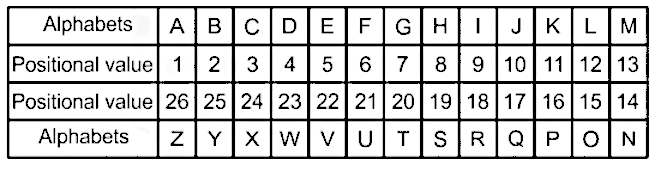
Given Word: DISTANCE
| Letters | D | I | S | T | A | N | C | E |
| Positional Value | 4 | 9 | 19 | 20 | 1 | 14 | 3 | 5 |

Hence, the correct answer is Two.
7. Directions: Read the information and answer the given questions.
Two friends, Kabir and Ishaan, begin walking from the same location. Kabir walks 7 km west, takes a right turn, walks 6 km, then turns left and walks 4 km. Ishaan walks 5 km east, turns right and walks 8 km, then turns right again and walks 3 km.
Question:
If Kabir walks 14 km after taking a left turn from his final position, how far will he be from Ishaan?
A. 14 km
B. 13 km
C. 12 km
D. 11 km
E. Cannot be determined
Solution
Given: Two friends, Kabir and Ishaan, begin walking from the same location. Kabir walks 7 km west, takes a right turn, walks 6 km, then turns left and walks 4 km.
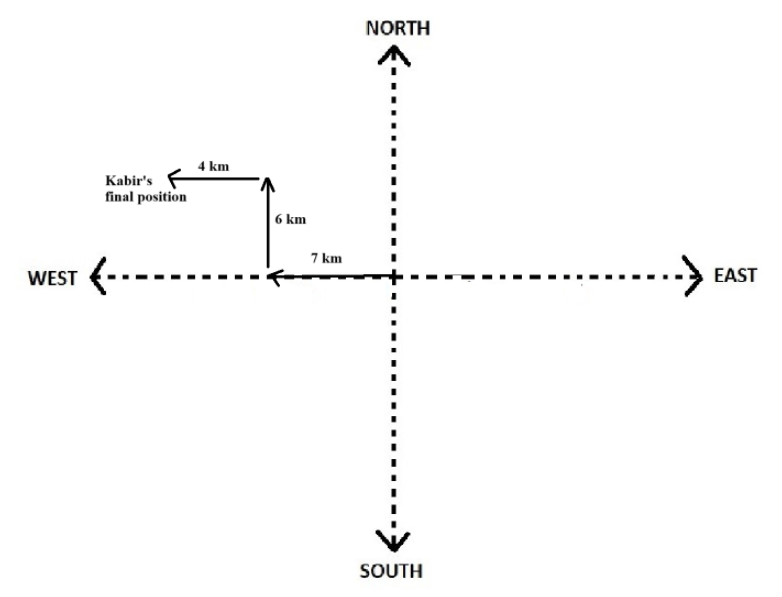
Ishaan walks 5 km east, turns right and walks 8 km, then turns right again and walks 3 km.
The possible final diagram is,
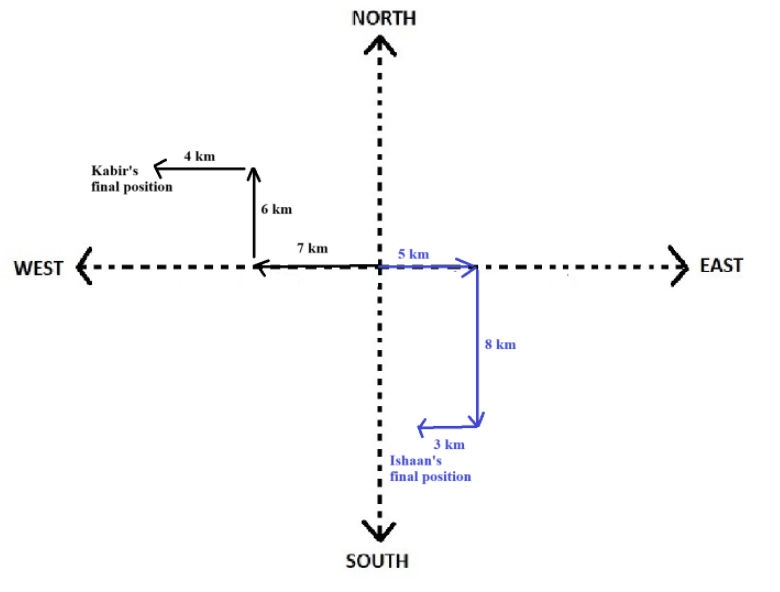
If Kabir walks 14 km in the same direction as his last move, i.e., left, then Ishaan is (4 + 7 + 2 = 13 km) away from Kabir.

Hence, the correct answer is 13 km.
8. Directions: Read the information and answer the given questions.
Two friends, Kabir and Ishaan, begin walking from the same location. Kabir walks 7 km west, takes a right turn, walks 6 km, then turns left and walks 4 km. Ishaan walks 5 km east, turns right and walks 8 km, then turns right again and walks 3 km.
Question:
In which direction is Ishaan’s final position from Kabir’s final position?
A. South-East
B. North-East
C. South-West
D. East
E. North-West
Solution
Given: Two friends, Kabir and Ishaan, begin walking from the same location. Kabir walks 7 km west, takes a right turn, walks 6 km, then turns left and walks 4 km.

Ishaan walks 5 km east, turns right and walks 8 km, then turns right again and walks 3 km.
The possible final diagram is,

Hence, the correct answer is South-East.
9. Directions: Read the information and answer the given questions.
Two friends, Kabir and Ishaan, begin walking from the same location. Kabir walks 7 km west, takes a right turn, walks 6 km, then turns left and walks 4 km. Ishaan walks 5 km east, turns right and walks 8 km, then turns right again and walks 3 km.
Question:
What is the total distance between Ishaan final positions and Kabir’s first turn?
A. 18 km
B. 14 km
C. 15 km
D. 20 km
E. 23 km
Solution
Given: Two friends, Kabir and Ishaan, begin walking from the same location. Kabir walks 7 km west, takes a right turn, walks 6 km, then turns left and walks 4 km.
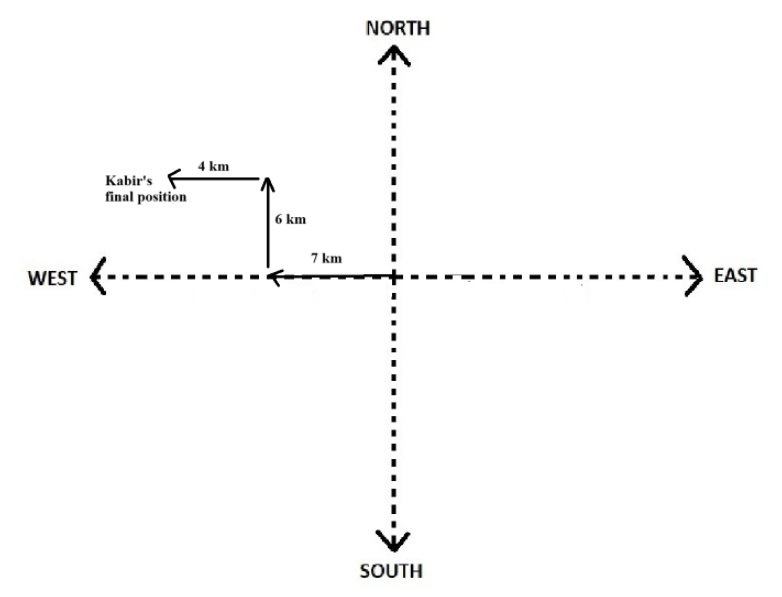
Ishaan walks 5 km east, turns right and walks 8 km, then turns right again and walks 3 km.
The possible final diagram is,
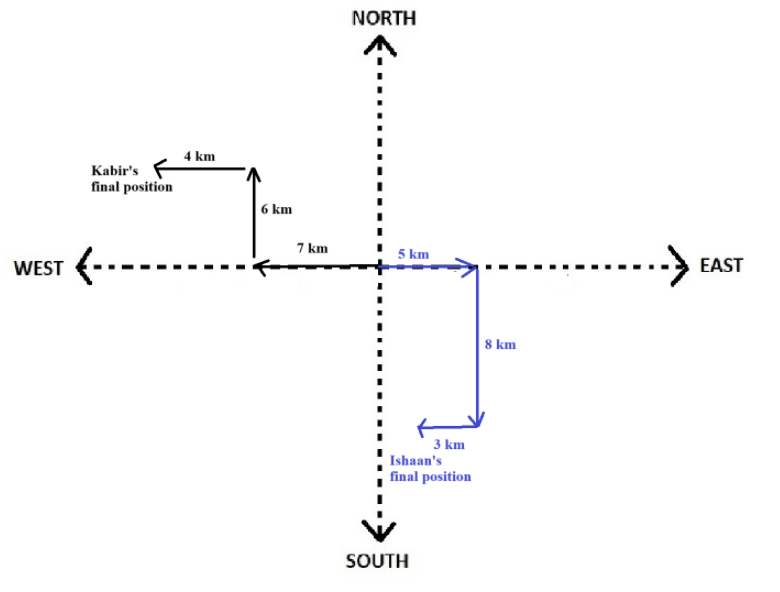
Hence, the correct answer is 3 + 8 + 5 + 7 = 23 km.
10. Direction: Study the following information carefully and answer the given questions.
In a certain code language,
‘ha ga la’ means ‘Suresh watch movies’,
‘bo ni to’ means ‘They are audience’,
‘gu ga bo’ means ‘Suresh entertaining audience’,‘ni gu la’ means ‘movies are entertaining’.
Question:
Which of the following means ‘watch’ in that code language?
A. to
B. ga
C. gu
D. ha
E. la
Solution
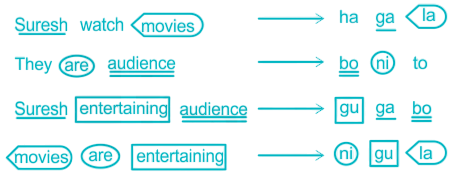
‘ga’ means ‘Suresh’
‘ha’ means ‘watch’
‘la’ means ‘movies’
‘to’ means ‘They’
‘ni’ means ‘are’
‘bo’ means ‘audience’
‘gu’ means ‘entertaining’
Hence, ‘watch’ is coded as ‘ha’.
11. Direction: Study the following information carefully and answer the given questions.
In a certain code language,
‘ha ga la’ means ‘Suresh watch movies’,
‘bo ni to’ means ‘They are audience’,
‘gu ga bo’ means ‘Suresh entertaining audience’,‘ni gu la’ means ‘movies are entertaining’.
Question:
If ‘Suresh is movies actor’ is coded as ‘la bu za ga’, what would be the code for ‘actor is entertaining’?
A. la za ga
B. ga bo la
C. bu gu za
D. ni ga la
E. ha gu la
Solution

‘ga’ means ‘Suresh’
‘ha’ means ‘watch’
‘la’ means ‘movies’
‘to’ means ‘They’
‘ni’ means ‘are’
‘bo’ means ‘audience’
‘gu’ means ‘entertaining’
If ‘Suresh is movies actor’ is coded as ‘la bu za ga’, then ‘bu za’ means ‘actor is’
Hence, ‘actor is entertaining’ is coded as ‘bu gu za’.
12. Direction: Study the following information carefully and answer the given questions.
In a certain code language,
‘ha ga la’ means ‘Suresh watch movies’,
‘bo ni to’ means ‘They are audience’,
‘gu ga bo’ means ‘Suresh entertaining audience’,‘ni gu la’ means ‘movies are entertaining’.
Question:
What does ‘bo la ha’ mean in that code language?
A. Suresh watch audience
B. audience watch movies
C. They watch audience
D. They are movies
E. Suresh entertaining movies
Solution
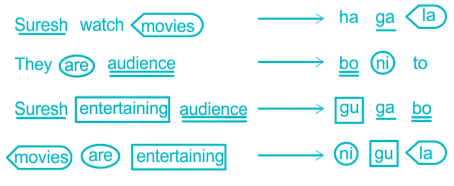
‘ga’ means ‘Suresh’
‘ha’ means ‘watch’
‘la’ means ‘movies’
‘to’ means ‘They’
‘ni’ means ‘are’
‘bo’ means ‘audience’
‘gu’ means ‘entertaining’
Hence, ‘audience watch movies’ is the meaning of ‘bo la ha’.
13. Direction: Study the following information carefully and answer the given questions.
In a certain code language,
‘ha ga la’ means ‘Suresh watch movies’,
‘bo ni to’ means ‘They are audience’,
‘gu ga bo’ means ‘Suresh entertaining audience’,‘ni gu la’ means ‘movies are entertaining’.
Question:
Which word is coded as ‘ga’ in the given language?
A. movies
B. Suresh
C. audience
D. entertaining
E. are
Solution
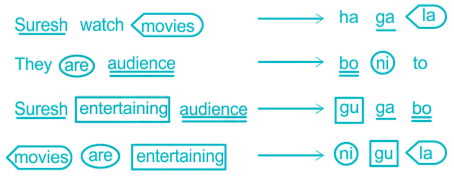
‘ga’ means ‘Suresh’
‘ha’ means ‘watch’
‘la’ means ‘movies’
‘to’ means ‘They’
‘ni’ means ‘are’
‘bo’ means ‘audience’
‘gu’ means ‘entertaining’
Hence, ‘Suresh’ is coded as ‘ga’.
14. Direction: In the question below are given three statements followed by conclusions numbered I and II. You have to take the given statements to be true even if they seem to be at variance with commonly known facts. Read all the conclusions and then decide which of the given conclusions logically follows from the given statements disregarding commonly known facts.
Statements:
Only sports are games.
No sports is a car.
All bike are car.
Conclusions:
I. All games can never be bike.
II. Some car are not games.
A. None follows
B. Either I or II follows
C. Only I follows
D. Only II follows
E. Both I and II follow
Solution
The least possible venn diagram for the given statements is as follows:

Conclusion:
I. All games can never be car → True (It is definitely true)
II. Some car are not games → True (It is definitely true)
Hence, Both I and II follow
15. Direction: In the question below are given three statements followed by two conclusions numbered I and II. You have to take the given statements to be true even if they seem to be at variance with commonly known facts. Read all the conclusions and then decide which of the given conclusions logically follows from the given statements disregarding commonly known facts.
Statements:
All icon are image.
Some icon are file.
All file are folder.
Conclusions:
I. Some image are folder.
II. Some file are image.
A. None follows
B. Either I or II follows
C. Only I follows
D. Only II follows
E. Both I and II follow
Solution
The least possible venn diagram for the given statements is as follows:

Conclusions:
I. Some image are folder → True (It is definitely true)
II. Some file are image → True (It is definitely true)
Hence, both I and II follow.
16. Direction: In the question below are given three statements followed by two conclusions numbered I and II. You have to take the given statements to be true even if they seem to be at variance with commonly known facts. Read all the conclusions and then decide which of the given conclusions logically follows from the given statements disregarding commonly known facts.
Statements:
No past is a present.
All future is present.
Some bright are future.
Conclusions:
I. All bright are future.
II. Some future are not past.
A. None follows
B. Either I or II follows
C. Only I follows
D. Only II follows
E. Both I and II follow
Solution
The least possible Venn diagram for the given statements is as follows:
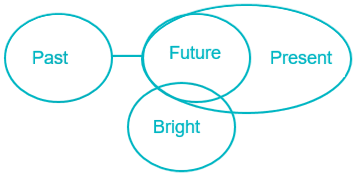
Conclusions:
I. All bright are future → False (it is possible but not definite.)
II. Some future are not past → True ( As “No past is a present” and “All future is present” so “No future is Past” So that “some future are not past”.)
Hence, Only II follows.
17. Directions: Read the information and answer the given questions.
Seven different electronic items, namely, TV, Laptop, Mobile, Camera, Printer, Tablet, and Speaker, were sold on seven different days of the same week, starting from Monday to Sunday, but not necessarily in the same order.
The TV was sold three days before the Tablet. Neither TV nor Tablet was sold on Thursday. The number of items sold before the Tablet is the same as the number of items sold after the Laptop. Exactly two items were sold between Laptop and Mobile. The camera was sold on one of the days after Mobile. The Printer is sold before the speaker. The TV was not sold immediately after the Printer.
Question:
Which item was sold on the last day of the week?
A. Speaker
B. Camera
C. Mobile
D. Laptop
E. Printer
Solution
Given: Seven different electronic items, namely, TV, Laptop, Mobile, Camera, Printer, Tablet, and Speaker, were sold on seven different days of the same week, starting from Monday to Sunday, but not necessarily in the same order.
1. The TV was sold three days before the Tablet.
2. Neither TV nor Tablet was sold on Thursday.
Here, we have 2 Cases, i.e., Case 1 and Case 2.
| Days | Electronic Items | |
| Case 1 | Case 2 | |
| Monday | ||
| Tuesday | TV | |
| Wednesday | TV | |
| Thursday | ||
| Friday | Tablet | |
| Saturday | Tablet | |
| Sunday | ||
3. The number of items sold before the Tablet is the same as the number of items sold after the Laptop.
| Days | Electronic Items | |
| Case 1 | Case 2 | |
| Monday | ||
| Tuesday | TV | Laptop |
| Wednesday | Laptop | TV |
| Thursday | ||
| Friday | Tablet | |
| Saturday | Tablet | |
| Sunday | ||
4. Exactly two items were sold between Laptop and Mobile.
| Days | Electronic Items | |
| Case 1 | Case 2 | |
| Monday | ||
| Tuesday | TV | Laptop |
| Wednesday | Laptop | TV |
| Thursday | ||
| Friday | Tablet | Mobile |
| Saturday | Mobile | Tablet |
| Sunday | ||
5. The camera was sold on one of the days after Mobile.
| Days | Electronic Items | |
| Case 1 | Case 2 | |
| Monday | ||
| Tuesday | TV | Laptop |
| Wednesday | Laptop | TV |
| Thursday | ||
| Friday | Tablet | Mobile |
| Saturday | Mobile | Tablet |
| Sunday | Camera | Camera |
6. The Printer was sold on the day before the Speaker.
| Days | Electronic Items | |
| Case 1 | Case 2 | |
| Monday | Printer | Printer |
| Tuesday | TV | Laptop |
| Wednesday | Laptop | TV |
| Thursday | Speaker | Speaker |
| Friday | Tablet | Mobile |
| Saturday | Mobile | Tablet |
| Sunday | Camera | Camera |
7. The TV was not sold immediately after the Printer.
Now, we can eliminate Case 1.
This is our final arrangement,
| Days | Electronic Items |
| Case 2 | |
| Monday | Printer |
| Tuesday | Laptop |
| Wednesday | TV |
| Thursday | Speaker |
| Friday | Mobile |
| Saturday | Tablet |
| Sunday | Camera |
Hence, the correct answer is Camera.
18. Directions: Read the information and answer the given questions.
Seven different electronic items, namely, TV, Laptop, Mobile, Camera, Printer, Tablet, and Speaker, were sold on seven different days of the same week, starting from Monday to Sunday, but not necessarily in the same order.
The TV was sold three days before the Tablet. Neither TV nor Tablet was sold on Thursday. The number of items sold before the Tablet is the same as the number of items sold after the Laptop. Exactly two items were sold between Laptop and Mobile. The camera was sold on one of the days after Mobile. The Printer is sold before the speaker. The TV was not sold immediately after the Printer.
Question:
The number of items sold between Printer and Speaker is the same as between Mobile and _____.
A. Speaker
B. Tablet
C. Camera
D. TV
E. Laptop
Solution
Given: Seven different electronic items, namely, TV, Laptop, Mobile, Camera, Printer, Tablet, and Speaker, were sold on seven different days of the same week, starting from Monday to Sunday, but not necessarily in the same order.
1. The TV was sold three days before the Tablet.
2. Neither TV nor Tablet was sold on Thursday.
Here, we have 2 Cases, i.e., Case 1 and Case 2.
| Days | Electronic Items | |
| Case 1 | Case 2 | |
| Monday | ||
| Tuesday | TV | |
| Wednesday | TV | |
| Thursday | ||
| Friday | Tablet | |
| Saturday | Tablet | |
| Sunday | ||
3. The number of items sold before the Tablet is the same as the number of items sold after the Laptop.
| Days | Electronic Items | |
| Case 1 | Case 2 | |
| Monday | ||
| Tuesday | TV | Laptop |
| Wednesday | Laptop | TV |
| Thursday | ||
| Friday | Tablet | |
| Saturday | Tablet | |
| Sunday | ||
4. Exactly two items were sold between Laptop and Mobile.
| Days | Electronic Items | |
| Case 1 | Case 2 | |
| Monday | ||
| Tuesday | TV | Laptop |
| Wednesday | Laptop | TV |
| Thursday | ||
| Friday | Tablet | Mobile |
| Saturday | Mobile | Tablet |
| Sunday | ||
5. The camera was sold on one of the days after Mobile.
| Days | Electronic Items | |
| Case 1 | Case 2 | |
| Monday | ||
| Tuesday | TV | Laptop |
| Wednesday | Laptop | TV |
| Thursday | ||
| Friday | Tablet | Mobile |
| Saturday | Mobile | Tablet |
| Sunday | Camera | Camera |
6. The Printer was sold on the day before the Speaker.
| Days | Electronic Items | |
| Case 1 | Case 2 | |
| Monday | Printer | Printer |
| Tuesday | TV | Laptop |
| Wednesday | Laptop | TV |
| Thursday | Speaker | Speaker |
| Friday | Tablet | Mobile |
| Saturday | Mobile | Tablet |
| Sunday | Camera | Camera |
7. The TV was not sold immediately after the Printer.
Now, we can eliminate Case 1.
This is our final arrangement,
| Days | Electronic Items |
| Case 2 | |
| Monday | Printer |
| Tuesday | Laptop |
| Wednesday | TV |
| Thursday | Speaker |
| Friday | Mobile |
| Saturday | Tablet |
| Sunday | Camera |
Hence, the correct answer is Laptop.
19. Directions: Read the information and answer the given questions.
Seven different electronic items, namely, TV, Laptop, Mobile, Camera, Printer, Tablet, and Speaker, were sold on seven different days of the same week, starting from Monday to Sunday, but not necessarily in the same order.
The TV was sold three days before the Tablet. Neither TV nor Tablet was sold on Thursday. The number of items sold before the Tablet is the same as the number of items sold after the Laptop. Exactly two items were sold between Laptop and Mobile. The camera was sold on one of the days after Mobile. The Printer is sold before the speaker. The TV was not sold immediately after the Printer.
Question:
How many items were sold between TV and Speaker?
A. One
B. Two
C. Three
D. None
E. More than four
Solution
Given: Seven different electronic items, namely, TV, Laptop, Mobile, Camera, Printer, Tablet, and Speaker, were sold on seven different days of the same week, starting from Monday to Sunday, but not necessarily in the same order.
1. The TV was sold three days before the Tablet.
2. Neither TV nor Tablet was sold on Thursday.
Here, we have 2 Cases, i.e., Case 1 and Case 2.
| Days | Electronic Items | |
| Case 1 | Case 2 | |
| Monday | ||
| Tuesday | TV | |
| Wednesday | TV | |
| Thursday | ||
| Friday | Tablet | |
| Saturday | Tablet | |
| Sunday | ||
3. The number of items sold before the Tablet is the same as the number of items sold after the Laptop.
| Days | Electronic Items | |
| Case 1 | Case 2 | |
| Monday | ||
| Tuesday | TV | Laptop |
| Wednesday | Laptop | TV |
| Thursday | ||
| Friday | Tablet | |
| Saturday | Tablet | |
| Sunday | ||
4. Exactly two items were sold between Laptop and Mobile.
| Days | Electronic Items | |
| Case 1 | Case 2 | |
| Monday | ||
| Tuesday | TV | Laptop |
| Wednesday | Laptop | TV |
| Thursday | ||
| Friday | Tablet | Mobile |
| Saturday | Mobile | Tablet |
| Sunday | ||
5. The camera was sold on one of the days after Mobile.
| Days | Electronic Items | |
| Case 1 | Case 2 | |
| Monday | ||
| Tuesday | TV | Laptop |
| Wednesday | Laptop | TV |
| Thursday | ||
| Friday | Tablet | Mobile |
| Saturday | Mobile | Tablet |
| Sunday | Camera | Camera |
6. The Printer was sold on the day before the Speaker.
| Days | Electronic Items | |
| Case 1 | Case 2 | |
| Monday | Printer | Printer |
| Tuesday | TV | Laptop |
| Wednesday | Laptop | TV |
| Thursday | Speaker | Speaker |
| Friday | Tablet | Mobile |
| Saturday | Mobile | Tablet |
| Sunday | Camera | Camera |
7. The TV was not sold immediately after the Printer.
Now, we can eliminate Case 1.
This is our final arrangement,
| Days | Electronic Items |
| Case 2 | |
| Monday | Printer |
| Tuesday | Laptop |
| Wednesday | TV |
| Thursday | Speaker |
| Friday | Mobile |
| Saturday | Tablet |
| Sunday | Camera |
Hence, the correct answer is None.
20. Directions: Read the information and answer the given questions.
Seven different electronic items, namely, TV, Laptop, Mobile, Camera, Printer, Tablet, and Speaker, were sold on seven different days of the same week, starting from Monday to Sunday, but not necessarily in the same order.
The TV was sold three days before the Tablet. Neither TV nor Tablet was sold on Thursday. The number of items sold before the Tablet is the same as the number of items sold after the Laptop. Exactly two items were sold between Laptop and Mobile. The camera was sold on one of the days after Mobile. The Printer is sold before the speaker. The TV was not sold immediately after the Printer.
Question:
Which among the following pairs were sold on days adjacent to Tablet?
A. Speaker and Mobile
B. Laptop and Speaker
C. Camera and Mobile
D. Mobile and Laptop
E. Speaker and Camera
Solution
Given: Seven different electronic items, namely, TV, Laptop, Mobile, Camera, Printer, Tablet, and Speaker, were sold on seven different days of the same week, starting from Monday to Sunday, but not necessarily in the same order.
1. The TV was sold three days before the Tablet.
2. Neither TV nor Tablet was sold on Thursday.
Here, we have 2 Cases, i.e., Case 1 and Case 2.
| Days | Electronic Items | |
| Case 1 | Case 2 | |
| Monday | ||
| Tuesday | TV | |
| Wednesday | TV | |
| Thursday | ||
| Friday | Tablet | |
| Saturday | Tablet | |
| Sunday | ||
3. The number of items sold before the Tablet is the same as the number of items sold after the Laptop.
| Days | Electronic Items | |
| Case 1 | Case 2 | |
| Monday | ||
| Tuesday | TV | Laptop |
| Wednesday | Laptop | TV |
| Thursday | ||
| Friday | Tablet | |
| Saturday | Tablet | |
| Sunday | ||
4. Exactly two items were sold between Laptop and Mobile.
| Days | Electronic Items | |
| Case 1 | Case 2 | |
| Monday | ||
| Tuesday | TV | Laptop |
| Wednesday | Laptop | TV |
| Thursday | ||
| Friday | Tablet | Mobile |
| Saturday | Mobile | Tablet |
| Sunday | ||
5. The camera was sold on one of the days after Mobile.
| Days | Electronic Items | |
| Case 1 | Case 2 | |
| Monday | ||
| Tuesday | TV | Laptop |
| Wednesday | Laptop | TV |
| Thursday | ||
| Friday | Tablet | Mobile |
| Saturday | Mobile | Tablet |
| Sunday | Camera | Camera |
6. The Printer was sold on the day before the Speaker.
| Days | Electronic Items | |
| Case 1 | Case 2 | |
| Monday | Printer | Printer |
| Tuesday | TV | Laptop |
| Wednesday | Laptop | TV |
| Thursday | Speaker | Speaker |
| Friday | Tablet | Mobile |
| Saturday | Mobile | Tablet |
| Sunday | Camera | Camera |
7. The TV was not sold immediately after the Printer.
Now, we can eliminate Case 1.
This is our final arrangement,
| Days | Electronic Items |
| Case 2 | |
| Monday | Printer |
| Tuesday | Laptop |
| Wednesday | TV |
| Thursday | Speaker |
| Friday | Mobile |
| Saturday | Tablet |
| Sunday | Camera |
Hence, the correct answer is Mobile and Camera.
21. Directions: Read the information and answer the given questions.
Seven different electronic items, namely, TV, Laptop, Mobile, Camera, Printer, Tablet, and Speaker, were sold on seven different days of the same week, starting from Monday to Sunday, but not necessarily in the same order.
The TV was sold three days before the Tablet. Neither TV nor Tablet was sold on Thursday. The number of items sold before the Tablet is the same as the number of items sold after the Laptop. Exactly two items were sold between Laptop and Mobile. The camera was sold on one of the days after Mobile. The Printer is sold before the speaker. The TV was not sold immediately after the Printer.
Question:
Which of the following items was sold immediately before Laptop?
A. Printer
B.. TV
C. Tablet
D. Speaker
E. Camera
Solution
Given: Seven different electronic items, namely, TV, Laptop, Mobile, Camera, Printer, Tablet, and Speaker, were sold on seven different days of the same week, starting from Monday to Sunday, but not necessarily in the same order.
1. The TV was sold three days before the Tablet.
2. Neither TV nor Tablet was sold on Thursday.
Here, we have 2 Cases, i.e., Case 1 and Case 2.
| Days | Electronic Items | |
| Case 1 | Case 2 | |
| Monday | ||
| Tuesday | TV | |
| Wednesday | TV | |
| Thursday | ||
| Friday | Tablet | |
| Saturday | Tablet | |
| Sunday | ||
3. The number of items sold before the Tablet is the same as the number of items sold after the Laptop.
| Days | Electronic Items | |
| Case 1 | Case 2 | |
| Monday | ||
| Tuesday | TV | Laptop |
| Wednesday | Laptop | TV |
| Thursday | ||
| Friday | Tablet | |
| Saturday | Tablet | |
| Sunday | ||
4. Exactly two items were sold between Laptop and Mobile.
| Days | Electronic Items | |
| Case 1 | Case 2 | |
| Monday | ||
| Tuesday | TV | Laptop |
| Wednesday | Laptop | TV |
| Thursday | ||
| Friday | Tablet | Mobile |
| Saturday | Mobile | Tablet |
| Sunday | ||
5. The camera was sold on one of the days after Mobile.
| Days | Electronic Items | |
| Case 1 | Case 2 | |
| Monday | ||
| Tuesday | TV | Laptop |
| Wednesday | Laptop | TV |
| Thursday | ||
| Friday | Tablet | Mobile |
| Saturday | Mobile | Tablet |
| Sunday | Camera | Camera |
6. The Printer was sold on the day before the Speaker.
| Days | Electronic Items | |
| Case 1 | Case 2 | |
| Monday | Printer | Printer |
| Tuesday | TV | Laptop |
| Wednesday | Laptop | TV |
| Thursday | Speaker | Speaker |
| Friday | Tablet | Mobile |
| Saturday | Mobile | Tablet |
| Sunday | Camera | Camera |
7. The TV was not sold immediately after the Printer.
Now, we can eliminate Case 1.
This is our final arrangement,
| Days | Electronic Items |
| Case 2 | |
| Monday | Printer |
| Tuesday | Laptop |
| Wednesday | TV |
| Thursday | Speaker |
| Friday | Mobile |
| Saturday | Tablet |
| Sunday | Camera |
Hence, the correct answer is Printer.
22. Direction: Following questions are based on five words given below.
EAQ TEX AGD WUY INJ
(The new words formed after performing the mentioned operations may or may not necessarily be meaningful English words)
Question:
When second and last letter of each word is interchanged, then how many words end with a consonant?
A. None
B. Three
C. Two
D. One
E. Four
Solution
Given words are: EAQ TEX AGD WUY INJ
1) Interchanging second and last letter of each word:
EQA TXE ADG WYU IJN
2) Clearly, 2 words ADG, IJN end with a consonant.
Note: In English alphabetical series there are 5 vowels i.e. A, E, I, O, U else all are consonants.
Hence, two words end with a consonant.
23. Direction: Following questions are based on five words given below.
EAQ TEX AGD WUY INJ
(The new words formed after performing the mentioned operations may or may not necessarily be meaningful English words)
Question:
If the second alphabet in each of the words is changed to the next alphabet in the English alphabetical order, how many words having vowel will be formed?
A. One
B. Two
C. Three
D. Four
E. None of these
Solution
Given words are: EAQ TEX AGD WUY INJ
1) Changing second alphabet to next alphabet as per English alphabetical series:
EBQ TFX AHD WVY IOJ
2) Clearly, 3 words EBQ, AHD, IOJ have vowel.
Note: In English alphabetical series there are 5 vowels i.e. A, E, I, O, U else all are consonants.
Hence, three words having vowels will be formed.
24. Direction: Following questions are based on five words given below.
EAQ TEX AGD WUY INJ
(The new words formed after performing the mentioned operations may or may not necessarily be meaningful English words)
Question:
If the given words are arranged in the order as they would appear in a dictionary from left to right, which of the following will be third from right?
A. EAQ
B. TEX
C. AGD
D. WUY
E. INJ
Solution
Given words are: EAQ TEX AGD WUY INJ
1) Arranging words in the order as they appear in a dictionary from left to right :
Left side AGD EAQ INJ TEX WUY Right side
Hence, INJ will be third from right.
25. Direction: Following questions are based on five words given below.
EAQ TEX AGD WUY INJ
(The new words formed after performing the mentioned operations may or may not necessarily be meaningful English words)
Question:
If in each of the words, all the alphabets are arranged in English alphabetical order within the word, how many words will begin with a vowel?
A. One
B. Three
C. Four
D. All
E. Two
Solution
Given words are: EAQ TEX AGD WUY INJ
1) Arranging alphabets within the word in English alphabetical order:
AEQ ETX ADG UWY IJN
2) Clearly, all words begin with a vowel.
Note: In English alphabetical series there are 5 vowels i.e. A, E, I, O, U else all are consonants.
Hence, all words begin with a vowel.
26. Direction: Following questions are based on five words given below.
EAQ TEX AGD WUY INJ
(The new words formed after performing the mentioned operations may or may not necessarily be meaningful English words)
Question:
If the last letter of each word is replaced by immediate succeeding letter as per alphabetical series, how many English meaningful words are formed?
A. Two
B. Three
C. All
D. One
E. Four
Solution
Given words are: EAQ TEX AGD WUY INJ
1) Replacing last letter of each word to immediate succeeding letter as per alphabetical series:
EAR TEY AGE WUZ INK
2) Clearly, three English meaningful words EAR, AGE, INK are formed.
Hence, three meaningful words are formed.
27. Directions: In the following questions assuming the given statements to be True, find which of the among conclusions from the given conclusion is / are definitely true and then give your answer accordingly.
Statement: Z ≥ X > Y ≥ P < O, Y ≥ M > A < N = Q
Conclusions:
I. Y > A
II. X ≥ O
A. Only conclusion I True
B. Only conclusion II True
C. Both I and II are True
D. Neither conclusion I and II True
E. None of the above
Solution
Given Statement: Z ≥ X > Y ≥ P < O, Y ≥ M > A < N = Q
Combined Statement: Z ≥ X > Y ≥ P < O, Y ≥ M > A < N = Q
I. Y > A – True (Y ≥ M > A; Y > A)
II. X ≥ O – False (X > Y ≥ P < O, we don’t get a definite relation between X and O)
Hence, only conclusion (I) follows.
28. Directions :- In these questions, relationship between different elements is shown in the statements. These statements are followed by 2 conclusions. Mark answer as option given.
Statement: P ≥ Q > R ; S < R ; P = N
Conclusions:
I. Q > S
II. N ≥ Q
A. Only conclusion I follows
B. Only conclusion II follows
C. Both conclusion I and II follows
D. Either conclusion I or II follows
E. None follows
Solution
Given statement: P ≥ Q > R ; S < R ; P = N
On Combining: N = P ≥ Q > R > S
Conclusions:
I. Q > S – True ( Q > R > S )
II. N ≥ Q – True ( as, N = P ≥ Q so N ≥ Q )
Hence, both conclusion I and II follows
29. Direction: In the following question assuming the given statements to be True, find which of the conclusion among given conclusions is/are definitely true and then give your answers accordingly.
Statements: U ≤ D; S ≤ I ≤ U; Y = S; Y > P
Conclusions:
I. D > YII. Y = D
A. Both I and II are True
B. Only II is True
C. Either I or II is True
D. Only I is True
E. Neither I nor II is true
Solution
Given statements: U ≤ D; S ≤ I ≤ U; Y = S; Y > P
On combining: P < Y = S ≤ I ≤ U ≤ D
Conclusions:
I. D > Y → False (as Y = S ≤ I ≤ U ≤ D → D ≥ Y)
II. Y = D → False (as Y = S ≤ I ≤ U ≤ D → D ≥ Y)
Hence, either I or II is True.
30. Direction: Study the following information to answer the given questions:Eight persons M, N, O, P, Q, R, S and T sit in a straight line. All are facing north. The distance between adjacent persons is same. S is immediate left of R, who is not adjacent to Q. M sits second to the left of P, who is 3rd person from one of the ends. Two persons sit between P and Q. At least three persons sit between N and T, who does not sit at extreme end.
Question:
Which of the following statement is not correct?
A. O sits second to the left of M
B. R sits at extreme right end
C. M sits immediate left of P
D. N sits immediate left of O
E. None of the above
Solution
Persons: M, N, O, P, Q, R, S and T.
1) M sits second to the left of P, who is 3rd person from one of the ends.
2) Two persons sit between P and Q.
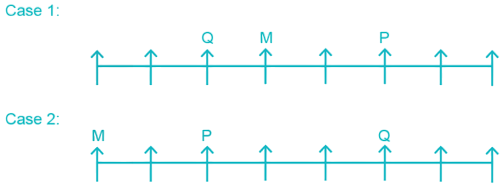
3) S is immediate left of R, who is not adjacent to Q.

4) At least three persons sit between N and T, who does not sit at extreme end. So, case 2 would be invalid as there would be only two persons possible between N and T in case 2. Also, O would sit immediate left of Q in case 1.

Hence, statement 3) is not correct.
31. Direction: Study the following information to answer the given questions:Eight persons M, N, O, P, Q, R, S and T sit in a straight line. All are facing north. The distance between adjacent persons is same. S is immediate left of R, who is not adjacent to Q. M sits second to the left of P, who is 3rd person from one of the ends. Two persons sit between P and Q. At least three persons sit between N and T, who does not sit at extreme end.
Question:
Who sits exactly between M and R?
A. S
B. T
C. P
D. O
E. Q
Solution
Persons: M, N, O, P, Q, R, S and T.
1) M sits second to the left of P, who is 3rd person from one of the ends.
2) Two persons sit between P and Q.

3) S is immediate left of R, who is not adjacent to Q.

4) At least three persons sit between N and T, who does not sit at extreme end. So, case 2 would be invalid as there would be only two persons possible between N and T in case 2. Also, O would sit immediate left of Q in case 1.

Hence, P sits exactly between M and R.
32. Direction: Study the following information to answer the given questions:Eight persons M, N, O, P, Q, R, S and T sit in a straight line. All are facing north. The distance between adjacent persons is same. S is immediate left of R, who is not adjacent to Q. M sits second to the left of P, who is 3rd person from one of the ends. Two persons sit between P and Q. At least three persons sit between N and T, who does not sit at extreme end.
Question:
_______ sits second to the left of S.
A. T
B. P
C. M
D. N
E. R
Solution
Persons: M, N, O, P, Q, R, S and T.
1) M sits second to the left of P, who is 3rd person from one of the ends.
2) Two persons sit between P and Q.

3) S is immediate left of R, who is not adjacent to Q.
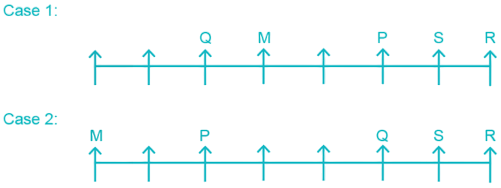
4) At least three persons sit between N and T, who does not sit at extreme end. So, case 2 would be invalid as there would be only two persons possible between N and T in case 2. Also, O would sit immediate left of Q in case 1.

Hence, T sits second to the left of S.
33. Direction: Study the following information to answer the given questions:Eight persons M, N, O, P, Q, R, S and T sit in a straight line. All are facing north. The distance between adjacent persons is same. S is immediate left of R, who is not adjacent to Q. M sits second to the left of P, who is 3rd person from one of the ends. Two persons sit between P and Q. At least three persons sit between N and T, who does not sit at extreme end.
Question:
How many persons sit between O and P?
A. Four
B. Three
C. Two
D. One
E. Six
Solution
Persons: M, N, O, P, Q, R, S and T.
1) M sits second to the left of P, who is 3rd person from one of the ends.
2) Two persons sit between P and Q.

3) S is immediate left of R, who is not adjacent to Q.

4) At least three persons sit between N and T, who does not sit at extreme end. So, case 2 would be invalid as there would be only two persons possible between N and T in case 2. Also, O would sit immediate left of Q in case 1.

Hence, three persons sit between O and P.
34. Direction: Study the following information to answer the given questions:Eight persons M, N, O, P, Q, R, S and T sit in a straight line. All are facing north. The distance between adjacent persons is same. S is immediate left of R, who is not adjacent to Q. M sits second to the left of P, who is 3rd person from one of the ends. Two persons sit between P and Q. At least three persons sit between N and T, who does not sit at extreme end.
Question:
Who sits at extreme left end?
A. O
B. M
C. N
D. S
E. R
Solution
Persons: M, N, O, P, Q, R, S and T.
1) M sits second to the left of P, who is 3rd person from one of the ends.
2) Two persons sit between P and Q.

3) S is immediate left of R, who is not adjacent to Q.

4) At least three persons sit between N and T, who does not sit at extreme end. So, case 2 would be invalid as there would be only two persons possible between N and T in case 2. Also, O would sit immediate left of Q in case 1.

Hence, N sits at extreme left end.
35. From the word “HEADQUARTERS”, form a four-letter meaningful English word using the 2nd, 4th, 6th, and 9th letters from the left end, using each letter only once. What would be the third letter of that word? If no meaningful word can be formed, mark the answer as M. If more than one meaningful word is possible, mark the answer as N.
A. E
B. D
C. T
D. M
E. N
Solution
Given Word – HEADQUARTERS
2nd, 4th, 6th, and 9th letter from the left end of the word – E, D, U, and T
Thus, one meaningful word is formed – DUET
Hence, the correct answer is E.
36. A train running at 1/3 rd of its normal speed covers the 120 km distance in x hours. If the train travels 4/3 rd of its normal speed then the train covers the same distance in (x – 3.75) hours. Find the value of x.
A. 4
B. 5
C. 6
D. 7
E. 8
Solution
Solution:
Let the speed of the train be y kmph
120/(y/3) = x …………1
360/y = x
Same train covers
120/(4y/3) = (x – 3.75) ……….. 2
360/4y = (x – 3.75)
360/(4 × 360/x) = (x – 3.75)
x/4 = (x – 3.75)
x = 4x – 15
-3x = – 15
x = 5
Hence, option(2) is correct.
37. A company earns a profit of 5 lac. Out of the total profit earned 10% is paid as GST and the rest is divided among three shareholders of the company A, B, and C in the ratio of 1/10 : 1/15 : 1/12 respectively. The profit share of A is how much more than B?
A. Rs. 30000
B. Rs. 40000
C. Rs. 60000
D. Rs. 50000
E. Rs. 55000
Solution
Given:
A company earns a profit of 5 lac
Out of the total profit earned 10% is paid as GST
A, B, and C in the ratio of 1/10 : 1/15 : 1/12 respectively
Calculation:
The remaining amount after paying GST = 5 lac × 90/100 = 4.5 lac
The ratio of shared profit of A, B, and C is
⇒ 1/10 : 1/15 : 1/12
⇒ 6 : 4 : 5
The profit share of A = 4.5 lac × 6/15 = 1.8 lac
The profit share of B = 4.5 lac × 4/15 = 1.2 lac
The profit share of A is = (1.8 – 1.2) = 0.6 lac = Rs. 60000 more than B
∴ The correct answer is option 3
38. 30 men and 10 women can complete the work in 5 days. If the efficiency of a woman is 5/2 of a man. In how many days 5 men and 3 women complete the same work?
A. 25 days
B. 20 days
C. 550/21 days
D. 22 days
E. None of these
Solution
Given:
Time taken by 30 men and 10 women = 5 days
The efficiency of a woman is 5/2 of a man
Formula used:
Efficiency = (Total work)/(Total time)
Calculation:
Total work = (Efficiency × Total time)
⇒ (30M + 10W) × 5
The efficiency of a woman and man is 5x and 2x respectively, then total work:
⇒ (30M + 10W) × 5
⇒ {(30 × 2x) + (10 × 5x)} × 5
⇒ (60x + 50x) × 5
⇒ 110x × 5
⇒ 550x
Time taken by 5 Men and 3 women:
Total work = (Efficiency × Total time)
⇒ 550x = (5M + 3W)
⇒ 550x = (2x × 5) + (5x × 3)
⇒ 550x = 10x + 15x
⇒ 550x/25x
⇒ 22
∴ 5 men and 3 women complete the same work in 22 days.
39. Find the wrong term in the following number series.
55, 56, 52, 65, 45, 70
A. 65
B. 70
C. 45
D. 52
E. 56
Solution
Given:
55, 56, 52, 65, 45, 70
Calculation:
The series follows the following pattern:
55 + 12 = 56
56 – 22 = 52
52 + 32 = 61
61 – 42 = 45
45 + 52 = 70
∴ The wrong term in the series is 65.
40. In each of the following number series, the wrong number is given, find out that number.
8, 14, 26, 50, 108, 194
A. 26
B. 194
C. 50
D. 14
E. 108
Solution
The series follows the following pattern:
8 × 2 – 2 = 14
14 × 2 – 2 = 26
26 × 2 – 2 = 50
50 × 2 – 2 = 98
98 × 2 – 2 = 194
∴ The wrong term in the series is 108.
41. In the following number series, a wrong number is given, find out that number.
2, 6, 14, 30, 62, 136
A. 14
B. 6
C. 62
D. 30
E. 136
Solution
The series follows the following pattern:
2 + 4 = 6
6 + 8 = 14
14 + 16 = 30
30 + 32 = 62
62 + 64 = 126
∴ The wrong term in the series is 136.
42. In each of the following number series, the wrong number is given, find out that number.
1.5, 2.5, 7, 24, 110, 505
A. 2.5
B. 505
C. 7
D. 110
E. 24
Solution
The series follows the following pattern:
1.5 × 1 + 1 = 2.5
2.5 × 2 + 2 = 7
7 × 3 + 3 = 24
24 × 4 + 4 = 100
100 × 5 + 5 = 505
∴ The wrong term in the series is 110.
43. In each of the following number series, the wrong number is given, find out that number.
13, 15.5, 20, 25.5, 35, 45.5
A. 15.5
B. 25.5
C. 35
D. 45.5
E. 20
Solution
GIVEN :
13, 15.5, 20, 25.5, 35, 45.5
CALCULATION :
The series follows the following pattern:
13 + 2.5 = 15.5
15.5 + 4.5 = 20
20 + 6.5 = 26.5
26.5 + 8.5 = 35
35 + 10.5 = 45.5
∴ The wrong term in the series is 25.5.
44. An amount is to be distributed among P, Q and R in ratio 3 : 7 : 5 respectively. If Amount received by R is Rs. 6000 more than P. So, find out the total amount that is to be distributed.
A. Rs. 40000
B. Rs. 50000
C. Rs. 60000
D. Rs. 45000
E. Rs. 30000
Solution
Given:
Amount is to be distributed in ratio = 3 : 7 : 5
R receive 6000 Rs more than P
Calculation:
Let the amount received by P, Q and R be 3x, 7x and 5x respectively
So, according to question we know that R receive Rs. 6000 more than P
⇒ 5x – 3x = 6000
2x = 6000
X = 3000
Total amount to be distributed = 3x + 7x + 5x = 15x
⇒ 15 × 3000 = Rs. 45000
45. Directions: Study the following table carefully to answer the following questions.
The table shows that the percentage of marks obtained by 5 students P, Q, R, S and T in 5 different subjects.
| Subject | Mathematics | English | Hindi | Physics | Chemistry |
| Total Marks/Student’s Name | 100 | 100 | 100 | 75 | 75 |
| P | 75 | 90 | 60 | 63 | 90 |
| Q | 80 | 95 | 78 | 90 | 80 |
| R | 85 | 80 | 75 | 80 | 75 |
| S | 70 | 72 | 70 | 65 | 60 |
| T | 90 | 65 | 90 | 70 | 85 |
Question:
What is the average percentage of marks obtained in Chemistry by all the students?
A. 80%
B. 57.5%
C. 78%
D. 76%
E. 60%
Solution
Given:
| Subject | Chemistry |
| Total Marks | 75 |
| Student’s Name | |
| P | 90 |
| Q | 80 |
| R | 75 |
| S | 60 |
| T | 85 |
Calculation:
Student P’s marks in Chemistry = 90% of 75
⇒ (90/100) × 75
Student Q’s marks in Chemistry = 80% of 75
⇒ (80/100) × 75
Student R’s marks in Chemistry = 75% of 75
⇒ (75/100) × 75
Student S’s marks in Chemistry = 60% of 75
⇒ (60/100) × 75
Student T’s marks in Chemistry = 85% of 75
⇒ (85/100) × 75
The total marks obtained in chemistry by all students = 75 × {(90/100) + (80/100) + (75/100) + (60/100) + (85/100)}
⇒ 75 × (390/100)
⇒ 1170/4
And total marks in chemistry = 75 × 5
⇒ 375
The average percentage of marks obtained in Chemistry by all the students = {(1170/4)/375} × 100
⇒ 78%
∴ The average percentage of marks obtained in Chemistry by all the students will be 78%.
46. Directions: Study the following table carefully to answer the following questions.
The table shows that the percentage of marks obtained by 5 students P, Q, R, S and T in 5 different subjects.
| Subject | Mathematics | English | Hindi | Physics | Chemistry |
| Total Marks/Student’s Name | 100 | 100 | 100 | 75 | 75 |
| P | 75 | 90 | 60 | 63 | 90 |
| Q | 80 | 95 | 78 | 90 | 80 |
| R | 85 | 80 | 75 | 80 | 75 |
| S | 70 | 72 | 70 | 65 | 60 |
| T | 90 | 65 | 90 | 70 | 85 |
Question:
If the total passing marks in Mathematics and Physics together is 130, then how many students will not pass in both these subjects?
A. 1
B. 2
C. 3
D. 4
E. 0
Solution
Given:
| Subject | Mathematics | Physics |
| Total Marks | 100 | 75 |
| Student’s Name | ||
| P | 75 | 63 |
| Q | 80 | 90 |
| R | 85 | 80 |
| S | 70 | 65 |
| T | 90 | 70 |
The total passing marks in Mathematics and Physics together = 130
Calculation:
Student P’s marks in Mathematics and Physics together = 75 + 63% of 75
⇒ 75 + (63/100) × 75
⇒ 122.25
Student Q’s marks in Mathematics and Physics together = 80 + 90% of 75
⇒ 80 + (90/100) × 75
⇒ 147.5
Student R’s marks in Mathematics and Physics together = 85 + 80% of 75
⇒ 85 + (80/100) × 75
⇒ 145
Student S’s marks in Mathematics and Physics together = 70 + 65% of 75
⇒ 70 + (65/100) × 75
⇒ 118.75
Student T’s marks in Mathematics and Physics together = 90 + 70% of 75
⇒ 90 + (70/100) × 75
⇒ 142.5
Now we can say that,
Students P and S both will not pass in both these subjects.
∴ Only 2 students will not pass in both these subjects.
47. Directions: Study the following table carefully to answer the following questions.
The table shows that the percentage of marks obtained by 5 students P, Q, R, S and T in 5 different subjects.
| Subject | Mathematics | English | Hindi | Physics | Chemistry |
| Total Marks/Student’s Name | 100 | 100 | 100 | 75 | 75 |
| P | 75 | 90 | 60 | 63 | 90 |
| Q | 80 | 95 | 78 | 90 | 80 |
| R | 85 | 80 | 75 | 80 | 75 |
| S | 70 | 72 | 70 | 65 | 60 |
| T | 90 | 65 | 90 | 70 | 85 |
Question:
Which student got the highest marks in Mathematics, Hindi and Chemistry subjects together?
A. P
B. Q
C. R
D. S
E. T
Solution
Given:
| Subject | Mathematics | Hindi | Chemistry |
| Total Marks | 100 | 100 | 75 |
| Student’s Name | |||
| P | 75 | 60 | 90 |
| Q | 80 | 78 | 80 |
| R | 85 | 75 | 75 |
| S | 70 | 70 | 60 |
| T | 90 | 90 | 85 |
Calculation:
Student P’s marks in Mathematics, Hindi and Chemistry together = 75 + 60 + 90% of 75
⇒ 75 + 60 + (90/100) × 75
⇒ 202.5
Student Q’s marks in Mathematics, Hindi and Chemistry together = 80 + 78 + 80% of 75
⇒ 80 + 78 + (80/100) × 75
⇒ 218
Student R’s marks in Mathematics, Hindi and Chemistry together = 85 + 75 + 75% of 75
⇒ 85 + 75 + (75/100) × 75
⇒ 216.25
Student S’s marks in Mathematics, Hindi and Chemistry together = 70 + 70 + 60% of 75
⇒ 70 + 70 + (60/100) × 75
⇒ 185
Student T’s marks in Mathematics, Hindi and Chemistry together = 90 + 90 + 85% of 75
⇒ 90 + 90 + (85/100) × 75
⇒ 243.75
Now we can say that,
Student T got the highest marks.
∴ Student T got the highest marks in Mathematics, Hindi and Chemistry subjects together.
48. Directions: Study the following table carefully to answer the following questions.
The table shows that the percentage of marks obtained by 5 students P, Q, R, S and T in 5 different subjects.
| Subject | Mathematics | English | Hindi | Physics | Chemistry |
| Total Marks/Student’s Name | 100 | 100 | 100 | 75 | 75 |
| P | 75 | 90 | 60 | 63 | 90 |
| Q | 80 | 95 | 78 | 90 | 80 |
| R | 85 | 80 | 75 | 80 | 75 |
| S | 70 | 72 | 70 | 65 | 60 |
| T | 90 | 65 | 90 | 70 | 85 |
Question:
What will be the difference between the total marks of students P, R and T in Hindi and Chemistry subject together and that of English and Physics subject together?
A. 20
B. 17.75
C. 17.50
D. 18
E. 19
Solution
Given:
| Subject | Mathematics | English | Hindi | Physics | Chemistry |
| Total Marks | 100 | 100 | 100 | 75 | 75 |
| Student’s Name | |||||
| P | 75 | 90 | 60 | 63 | 90 |
| Q | 80 | 95 | 78 | 90 | 80 |
| R | 85 | 80 | 75 | 80 | 75 |
| S | 70 | 72 | 70 | 65 | 60 |
| T | 90 | 65 | 90 | 70 | 85 |
Calculation:
Student P’s marks in English and Physics together = 90 + 63% of 75
⇒ 90 + (63/100) × 75
Student R’s marks in English and Physics together = 80 + 80% of 75
⇒ 80 + (80/100) × 75
Student T’s marks in English and Physics together = 65 + 70% of 75
⇒ 65 + (70/100) × 75
The total marks of students P, R and T in English and Physics together = 90 + 80 + 65 + [75 × {(63/100) + (80/100) + (70/100)}]
⇒ 235 + 75 × (213/100)
⇒ 394.75
Student P’s marks in Hindi and Chemistry together = 60 + 90% of 75
⇒ 60 + (90/100) × 75
Student R’s marks in Hindi and Chemistry together = 75 + 75% of 75
⇒ 75 + (75/100) × 75
Student T’s marks in Hindi and Chemistry together = 90 + 85% of 75
⇒ 90 + (85/100) × 75
The total marks of students P, R and T in Hindi and Chemistry together = 60 + 75 + 90 + [75 × {(90/100) + (75/100) + (85/100)}]
⇒ 225 + 75 × (250/100)
⇒ 412.5
The required difference = 412.5 – 394.75
⇒ 17.75
∴ The difference between the total marks of students P, R and T in Hindi and Chemistry subject together and that of English and Physics subject together will be 17.75.
49. Directions: Study the following table carefully to answer the following questions.
The table shows that the percentage of marks obtained by 5 students P, Q, R, S and T in 5 different subjects.
| Subject | Mathematics | English | Hindi | Physics | Chemistry |
| Total Marks/Student’s Name | 100 | 100 | 100 | 75 | 75 |
| P | 75 | 90 | 60 | 63 | 90 |
| Q | 80 | 95 | 78 | 90 | 80 |
| R | 85 | 80 | 75 | 80 | 75 |
| S | 70 | 72 | 70 | 65 | 60 |
| T | 90 | 65 | 90 | 70 | 85 |
Question:
What is the percentage score of student S in all the subjects (Approximately)?
A. 67.94%
B. 77.94%
C. 86%
D. 70%
E. 60%
Solution
Given:
| Subject | Mathematics | English | Hindi | Physics | Chemistry |
| Total Marks | 100 | 100 | 100 | 75 | 75 |
| Student’s Name | |||||
| S | 70 | 72 | 70 | 65 | 60 |
Calculation:
The score of S in Mathematics = 70
The score of S in English = 72
The score of S in Hindi = 70
The score of S in Physics = 65% of 75
The score of S in Chemistry = 60% of 75
The total score of S in all all subjects together = 70 + 72 + 70 + 75 × (60 + 65)%
⇒ 212 + 125 × (3/4)
⇒ 305.75
Total marks in all subjects together = 100 + 100 + 100 + 75 + 75
⇒ 450
The percentage score of student S in all the subjects = {(305.75)/450} × 100
⇒ 67.94%
∴ The percentage score of student S in all the subjects will be 67.94%.
50. In a college exam Ishani scored 80 marks out of 150 in Economics and 95 marks out of 120 in Statistics. Find the minimum marks she should score in Accountancy out of 100 to score 70% marks in 3 subjects.
A. 87
B. 86
C. 88
D. 84
E. 85
Solution
Given:
Ishani’s scores in Economics = 80 out of 150
Ishani’s scores in Statistics = 95 out of 120
Total percentage in 3 subjects = 70%
Calculation:
Total maximum marks = 100 + 120 + 150
⇒ 370
Total marks in Statistics and Economics = 95 + 80
⇒ 175
Total marks required by her to get 70% = 370 × 70%
⇒ 370 × (70/100)
⇒ 37 × 7
⇒ 259
∴ she needs = 259 – 175
⇒ 84 marks
∴ The minimum marks she should score in Accountancy out of 100 to score 70% marks in 3 subjects is 84 marks.
51. A man’s present age is 140% of what it was 12 years ago. And his wife’s present age is 83.33% of the man’s age after 6 years from now. Find their total present age.
A.. 72 years
B. 75 years
C. 82 years
D. 85 years
E. 78 years
Solution
Given:
A man’s present age is 140% of what it was 12 years ago
His wife’s present age is 83.33% of the man’s age after 6 years from now
Calculation:
Let the man’s present age = a
According to the question,
a = (a – 12) × 140/100
⇒ 5a = 7a – 84
⇒ a = 84/2 = 42
The man’s present age after 6 years = 42 + 6 = 48 years
His wife’s present age = 48 × 5/6 = 40 years [as, 83.33% = 5/6]
The total present age of the man and his wife = 42 + 40 = 82 years
∴ The correct answer is option 3
52. What will come in the place of the question mark ‘?’ in the following question?
72% of 650 – 28% of 475 = 77% of 600 – ?
A. 127
B. 107
C. 189
D. 98
E. 86
Solution
⇒ 72% of 650 – 28% of 475 = 77% of 600 – ?
⇒ (72/100) × 650 – (28/100) × 475 = (77/100) × 600 – ?
⇒ 18 × 26 – 7 × 19 = 77 × 6 – ?
⇒ 468 – 133 = 462 – ?
⇒ 335 = 462 – ?
⇒ ? = 462 – 335
⇒ ? = 127
53. What should come in place of question mark (?) in the following questions? (You do not have to calculate the exact value.)
9.897% of 4331 + 29.779% of 2501 = ?
A. 2680
B. 2180
C. 1880
D. 1180
E. 1580
Solution
9.897% of 4331 + 29.779% of 2501 = ?
Approximating the values to the nearest integer:
⇒ 10% of 4330 + 30% of 2500 = ?
⇒10×4330100+30×2500100=?⇒10×4330100+30×2500100=?
⇒ ? = 433 + 750 = 1183 ≈ 1180
54. What should come in place of question mark (?)
9840 – 50 × 3864 ÷ 84 = ? × 58
A. 125
B. 130
C. 145
D. 140
E. 120
Solution
Suppose x will come in place of question mark;
9840 – 50 × 3864 ÷ 84 = ? × 58
Applying BODMAS Rule;
⇒ 9840 – 50 × 46 = 58x
⇒ 9840 – 2300 = 58x
⇒ 7540 = 58x
⇒ x = 130
55. What will come in place of question mark ‘?’ in the following number question?
344 + 92 × 161 ÷ ? – 72 = 322 – 108
A. 23
B. 24
C. 21
D. 22
E. 25
Solution
Suppose x will come in place of question mark;
344 + 92 × 161 ÷ x – 72 = 322 – 108
⇒ 344 + 92 × 161 ÷ x – 72 = 1024 – 108
Applying BODMAS Rule;
⇒ 92 × 161 ÷ x = 1024 – 108 + 72 – 344
⇒ 92 × 161 ÷ x = 644
⇒ x = (92 × 161) ÷ 644
⇒ x = 161 ÷ 7
⇒ x = 23
56. What should come in place of question mark ‘?’ in the following question?
√2 × 23/4 ÷ 2 = [4 × 21/2 ÷ 23/2] × 2?
A. (-2/3)
B. 3/5
C. (-3/4)
D. 1/4
E. 1/6
Solution
Using laws of Indices:
- (a)m × (a)n = a(m + n)
- (a)m ÷ (a)n = a(m – n)
- (am)n = (a)mn
- (a)(-m) = 1/am
- (a)0 = 1
- (a)1/m = m√a
Given expression is,
⇒ √2 × 23/4 ÷ 2 = [4 × 21/2 ÷ 23/2] × 2?
⇒ 21/2 × 23/4 ÷ 2 = [4 × 21/2 ÷ 23/2] × 2?
⇒ 2(1/2 + ¾) ÷ 2 = [22 × 21/2 ÷ 23/2] × 2?
⇒ 25/4 ÷ 2 = [21/2 + 2 ÷ 23/2] × 2?
⇒ 2(5/4 – 1) = [25/2 ÷ 23/2] × 2?
⇒ 21/4 = 21 × 2?
⇒ 21/4 = 2(1 + ?)
⇒ 1/4 = ? + 1
⇒ ? = (1/4) – 1⇒ ? = (-3/4)
57. What should come in place of question mark ‘?’ in the following question?
(74 × 35 ÷ 49) × 32 = (21 × 63) ÷ ?
A. 3
B. 27
C. 1/81
D. 4
E. 33
Solution
Using laws of Indices:
(a)m × (a)n = a(m + n)
(a)m ÷ (a)n = a(m – n)
(am)n = (a)mn
(a)(-m) = 1/am
(a)0 = 1
(a)1/m = m√a
⇒ (74 × 35 ÷ 49) × 32 = (21 × 63) ÷ ?
⇒ (74 × 35 ÷ 72) × 32 = (3 × 7 × 7 × 9) ÷ ?
⇒ (72 × 35) × 32 = 72 × 33 ÷ ?
⇒ 72 × 3(5 +2) = 72 × 33 ÷ ?
⇒ 37 = 33 ÷ ?
⇒ ? = 3(3 – 7)
⇒ ? = 3(-4) = 1/34⇒ ? = 1/81
58. What should come in place of question mark ‘?’ in the following question?
25 × 625 ÷ 125 = 500 × 22 ÷ ?
A. 1
B. 23
C. 16
D. 4
E. 8
Solution
Follow these BODMAS rules to solve the question
Step-1∶ The part of the equation containing ‘Brackets’ must be solved first, and in the bracket,
Step-2∶ Any mathematical ‘Of’ or ‘Exponent’ must be solved next,
Step-3∶ Next, the parts of the equation that contain ‘Division’ and ‘Multiplication’ are solved
Step-4∶ At last, the part of the equation that contains ‘Addition’ and ‘Subtraction’ should be solved.
⇒ 25 × 625 ÷ 125 = 500 × 22 ÷ ?
⇒ 52 × 54 ÷ 53 = 5 × 100 × 22 ÷ ?
⇒ 52 × 54 ÷ 53 = 5 × 25 × 4 × 22 ÷ ?
⇒ 52 × 54 ÷ 53 = 5 × 52 × 22 × 22 ÷ ?
⇒ 5(2 + 4 – 3) = 5(1 + 2) × 24 ÷ ?
⇒ 53 = 53 × 24 ÷ ?
⇒ ? = 24⇒ ? = 16
59. What should come in place of question mark ‘?’ in the following question?
14 × 50 ÷ 70 × 24 = 5 × 28 ÷ ?
A. 3
B. 21
C. 22
D. 16
E. 8
Solution
Using laws of Indices:
- (a)m × (a)n = a(m + n)
- (a)m ÷ (a)n = a(m – n)
- (am)n = (a)mn
- (a)(-m) = 1/am
- (a)0 = 1
- (a)1/m = m√a
Given expression is,
⇒ 14 × 50 ÷ 70 × 24 = 5 × 28 ÷ ?
⇒ 50 ÷ 5 × 24 = 5 × 28 ÷ ?
⇒ 10 × 24 = 5 × 28 ÷ ?
⇒ 5 × 2 × 24 = 5 × 28 ÷ ?
⇒ 25 = 28 ÷ ?
⇒ ? = 28 ÷ 25
⇒ ? = 28 – 5
⇒ ? = 23⇒ ? = 8
60. What will come in place of question mark ‘?’ in the following question?
(√529 ÷ 69 × 8.4 + (8)3 – 351) × √676 = ?
A. 4258.8
B. 8345.5
C. 4653.6
D. 8645.9
E. None of these
Solution
Concept Used:
Follow BODMAS rules to solve the equation
Step-1: The part of the equation containing ‘Brackets’ must be solved first, and in the bracket,
Step-2: Any mathematical ‘Of’ or ‘Exponent’ must be solved next,
Step-3: Next, the parts of the equation that contain ‘Division’ and ‘Multiplication’ are solved
Step-4: At last, the part of the equation that contains ‘Addition’ and ‘Subtraction’ should be solved.
Calculation:
⇒ (√529 ÷ 69 × 8.4 + (8)3 – 351) × √676 = ?
The square root of √529 is = 23 and √676 is = 26.
⇒ (23/69 × 8.4 + 83 – 351) × 26 = ?
⇒ (2.8 + 512 – 351) × 26 = ?
⇒ (161 + 2.8) × 26 = ?
⇒ 163.8 × 26 = ? = 4258.8
∴ ? = 4258.8
61. What will come in place of question mark ‘?’ in the following question?
50% of 600 + 60% of 500 – 50% of 800 = ?
A. 180
B. 200
C. 190
D. 220
E. 250
Solution
Follow these BODMAS rules to solve the question
Step-1∶ The part of the equation containing ‘Brackets’ must be solved first and in the bracket,
Step-2∶ Any mathematical ‘Of’ or ‘Exponent’ must be solved next,
Step-3∶ Next, the parts of the equation that contains ‘Division’ and ‘Multiplication’ is solved
Step-4∶ At last, the part of the equation that contains ‘Addition’ and ‘Subtraction’ should be solved.
Given expression is,
50% of 600 + 60% of 500 – 50% of 800 = ?
⇒ 300 + 300 – 400 = ?
∴ ? = 200
62. What will come in place of question mark ‘?’ in the following question?
√324 – √225 + √289 = ? + √100
A. 10
B. 15
C. 20
D. 25
E. 5
Solution
By using the law of indices∶
Laws of Indices∶–
1-∶ am × an = a{m + n}
2-∶ am ÷ an = a{m – n}
3-∶ [(am)n] = amn
4-∶ (a)(1/m) = m√a
5-∶ (a)(-m) = 1/am
6-∶ (a)(m/n) = n√am
7-∶ (a)0 = 1
Given expression is,
√324 – √225 + √289 = ? + √100
⇒ 18 – 15 + 17 = ? + 10
⇒ 20 = ? + 10
∴ ? = 10
63. What will come in place of the question mark ‘?’ in the following question?
83.33% of 90 + 78 – 168 × 8 ÷ 14 = ? + 34
A. 23
B. 32
C. 34
D. 52
E. None of these
Solution
GIVEN :
83.33% of 90 + 78 – 168 × 8 ÷ 14 = ? + 34
CONCEPT :
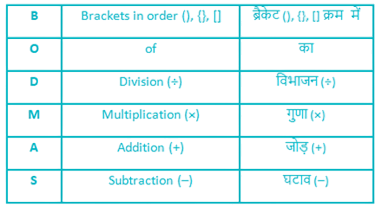
CALCULATION :
83.33% of 90 + 78 – 168 × 8 ÷ 14 = ? + 34
⇒ 5/6 × 90 + 78 – 168 × 8 ÷ 14 = ? + 34
⇒ 75 + 78 – 96 = ? + 34
⇒ ? = 57 – 34
∴ ? = 23
64. What will come in the place of ‘?’ in the following question?
√324 ÷ (3 × 6) – √196 ÷ √49 + 5 = ?2
A. 2
B. 3
C. 4
D. 1
E. 0
Solution
Concept used:

Calculation:
√324 ÷ (3 × 6) – √196 ÷ √49 + 5 = ?2
⇒ 18 ÷ (3 × 6) – 14 ÷ 7 + 5 = ?2
⇒ 18 ÷ 18 – 2 + 5 = ?2
⇒ 1– 2 + 5 = ?2
⇒ ? = √4 = 2
∴ The value of ‘?’ is 2.
65. What will come in the place of the question mark ‘?’ in the following question?
11 × 66 – 21 × 22 + 91 × 19 = ?
A. 1993
B. 1994
C. 1995
D. 1996
E. None of these
Solution
Concept used:
Follow BODMAS rule to solve this question, as per the order given below:

Calculations:
11 × 66 – 21 × 22 + 91 × 19
⇒ 726 – 462 + 1729 = ?
⇒ ? = 1993
∴ The value of ? is 1993
66. What will come in the place of the question mark ‘?’ in the following question?

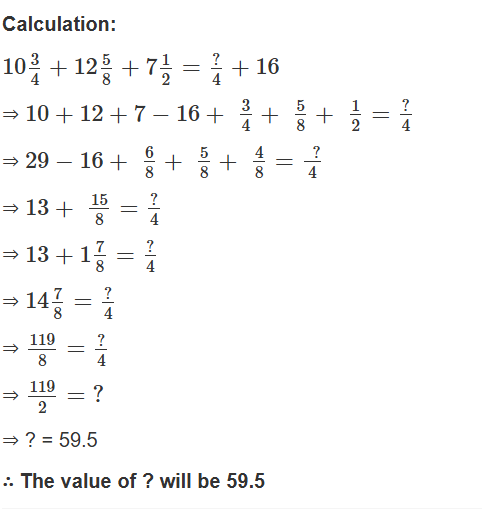
A. 59.5
B. 60.5
C. 58.5
D. 56.5
E. None of these
Solution
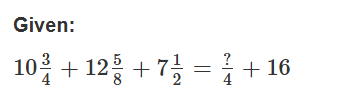
Concept used:
Follow the BODMAS rule according to the table given below:

67. The Simple interest on a certain sum of money for 4 years at 5% per annum is half the Compound interest on Rs. 5000 for 2 years at 20% per annum. The sum placed on simple interest is:
A. 1150
B. 5500
C. 6300
D. 5200
E. 4500
Solution
Solution:
Formula used:
Amount = P(1 + R/100)n
CI = Amount – Principal
SI = P × T × R /100
Calculations:
CI = [5000(1+20/100)2] – 5000
CI = (5000 × 1.2 × 1.2) – 5000
⇒ 7200 – 5000
⇒ Rs. 2200
It is given that SI = ½ CI
⇒ SI = 2200/2 = 1100
⇒ SI = P × T × R/100 = P × 4 × 5/100
⇒ P × 4 × 5/100 = 1100
⇒ P = Rs. 5500
Hence the sum placed on simple interest is Rs. 5500
68. A mixture of alcohol and water weighing 121 liters contains 9.09% alcohol. How much alcohol should be added to make the quantity of alcohol and water in the ratio 1 : 2 ?
A. 33 liters
B. 44 liters
C. 55 liters
D. 30 liters
E. None of these
Solution
Given:
Alcohol is 9.09% in 121 liters mixture.
Calculation:
Alcohol and water weighing 121 liters contain 9.09% alcohol.
Alcohol : water = 121 × (1/11) : 121 × (10/11)
Alcohol : water = 11 : 110
Let the alcohol added in the mixture be x litres.
Alcohol : Water = (11 + x)/110 = 1/2
⇒ 22 + 2x = 110
⇒ 2x = 110 – 22
⇒ 2x = 88
⇒ x = 44
∴ Alcohol should be added 44 litres.
Important Point
9.09% → 1/11
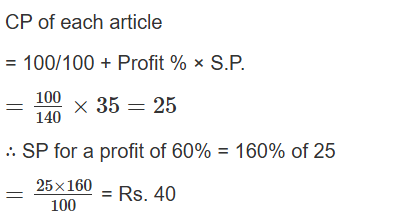
69.A shopkeeper sold some articles at the rate of Rs. 35 per article and earned a profit of 40%. At what price each article should have been sold so that 60% profit was earned?
A. Rs. 45
B. Rs. 42
C. Rs. 39
D. Rs. 40
E. None of these
Solution
Given
A shopkeeper article sold rate = Rs. 35
Profit = 40%
Calculation
Let the cost price of the article = 100x
The selling price of the article = 100x + 40x
⇒ 140x
The cost price of the article = (35/140x) × 100x
⇒ Rs. 25
The selling price of the article at 60% profit = 100x + 60x
⇒ 160x
The selling price of the article = (25/100x) × 160x
⇒ Rs. 40
Short Cut
70. The perimeter of a rectangle of length 3(k+1) cm and breadth 2(k−1) cm is equal to the perimeter of a square of area 324 cm2. Find the area of the rectangle.
A. 384 cm2
B. 288 cm2
C. 420 cm2
D. 368 cm2
E. 250 cm2
Solution
Length of rectangle = 3(k + 1) cm
Breadth of rectangle = 2(k − 1) cm
Area of square = 324 cm²
Side of square = √324 = 18 cm
Perimeter of square = 4 × 18 = 72 cm
Perimeter of rectangle = 2 × [Length + Breadth]
⇒ 2 × [3(k + 1) + 2(k − 1)] = 72
⇒ 2 × [3k + 3 + 2k − 2] = 72
⇒ 2 × (5k + 1) = 72
⇒ 10k + 2 = 72
⇒ 10k = 70
⇒ k = 7
Length = 3(k + 1) = 3 × (7 + 1) = 3 × 8 = 24 cm
Breadth = 2(k − 1) = 2 × (7 − 1) = 2 × 6 = 12 cm
Area of Rectangle = Length × Breadth = 24 × 12 = 288 cm²
The area of the rectangle is 288 cm².
71. Directions: Select the segment of the sentence that contains the grammatical error. If there is no error, mark ‘no error’ as your answer. Ignore errors of punctuation if any.
A substantial proportion(A)/ of JNU’s students comes(B)/ from social and economical(C)/ underprivileged families.(D)/ No error(E)
A. E
B. A
C. C
D. B
E. D
Solution
The correct answer is C.
Key Points
- Here, ‘families’ is a noun, and underprivileged is an adjective for the noun.(यहाँ, ‘परिवार’ एक संज्ञा है, और underprivileged संज्ञा के लिए एक विशेषण है).
- The adjective is a word that qualifies a noun or pronoun.(विशेषण वह शब्द है जो संज्ञा या सर्वनाम का बोध कराता है।)
- Eg- The condition of poor people who live in an underprivileged society is very poor.
- The adjective is a word that qualifies a noun or pronoun.(विशेषण वह शब्द है जो संज्ञा या सर्वनाम का बोध कराता है।)
- Before an adjective, we need to use an adverb.(विशेषण से पहले, हमें क्रिया विशेषण का उपयोग करने की आवश्यकता होती है।)
- An adverb is a word that modifies an adjective, a verb, and an adverb too.(क्रिया विशेषण एक ऐसा शब्द है जो विशेषण, क्रिया और क्रिया विशेषण को भी संशोधित करता है।)
- The use of ‘social and economical is incorrect, here we will use adverb form of them.(‘सामाजिक और आर्थिक’ का प्रयोग गलत है, यहाँ हम उनके क्रिया विशेषण रूप का प्रयोग करेंगे।)
Hence, the correct sentence is “A substantial proportion of JNU’s students comes from socially and economically underprivileged families.”
72. Directions: Select the segment of the sentence that contains the grammatical error. If there is no error, mark ‘no error’ as your answer. Ignore error of punctuation if any.
All the students of the university(A)/ have elected(B)/ Raman a chairman(C) of their union.(D)/ No error(E)
A. B
B. C
C. A
D. E
E.D
Solution
The correct answer is C.
Key Points
- Here, elect is an objective complement. And the complement is chairman for Raman.
- We don’t use an article before a complement.
- So, in the part C, a chairman is incorrect. we need to remove article ‘a’ from it.
Additional Information
- Complement- It is a word that complete the sense of a sentence even if the subject and a verb present in the sentence.
- There are 2 types of complement-
- Subjective complement- It completes the sense for the subject.
- Eg- The officer is a hypocrite.
- Objective complement- It completes the sense for the object.
- Eg- The teacher made him monitor.
- Subjective complement- It completes the sense for the subject.
Hence, the correct sentence is ‘All the students of the university have elected Raman chairman of their union.’
73. Read the sentence given below to find out if it contains any error. The error, if any, will be in one part of the sentence. If the sentence is error free, select No error or option 5. Ignore error of punctuation if any.
The scientists were found (A)/ the direction of polar (B)/ drift shifted from southward (C)/ to eastward in 1995. (D)/ No error (E)
A. A
B. B
C. C
D. D
E. E
Solution
The erroneous part is A i.e. this part of the sentence has an error.
Key Points
- The first part(A) of the sentence is erroneous because the auxiliary verb ‘were‘ is not grammatically correct.
- The subject of the verb ‘found‘ is ‘the scientists‘ and it is clear that the subject is not acted upon by the verb.
- Therefore, it should be written in active voice.
- Hence, the word ‘were‘ should be removed.
- So, option 1) is the answer.
Correct sentence: The scientists found the direction of polar drift shifted from southward to eastward in 1995.
Important Points
The construction of a sentence in passive voice(Simple past tense):
| The letter | was | written | by | Rohan. |
| subject | was/were | past participle | by | agent |
74. Directions: Select the segment of the sentence that contains the grammatical error. If there is no error, mark ‘no error’ as your answer. Ignore error of punctuation if any.
If I would have been (A)/ there, I would (B) have(C)/ helped you. (D)/ No error(E)
A. E
B. C
C. D
D. A
E. B
Solution
The correct answer is A i.e. If I would have been
Key Points
- The sentence is about a past incident that has happened and it is a conditional sentence.
- The sentence belongs to the thirdConditional sentence.
- Structure- If + (Had + v3) , (Would have + v3)
Important Points
- First Conditional sentence- If + (simple present tense) , (simple future tense)
- Eg- If more people come with us, they will agree to help all.
- Second Conditional sentence- If + (Subject + were) , (would + v1)
- Eg- If I were PM, I would provide free wifi everywhere.
So, the correct sentence is ‘If I had been there, I would have helped you.’
75. In the following question a sentence is divided into four parts. Find out which part of the sentence contains an error. If there is no error in the any part of the sentence, mark option 5 i.e. ‘No error.’ Ignore the error of punctuations, if any.
My colleagues in (A)/ India are excited (B)/ about to vote in the (C)/ next presidential election. (D)/ No error (E)
A. A
B. B
C. C
D. D
E. No Error
Solution
The correct option is option 3 i.e. C – the error lies in this part.
Key Points
- In sentence 1 the error lies in ‘about to vote.’
- The sentence is an example of ‘gerund after Adjective + Preposition’
- In the sentence, part C ‘excited about to vote in the next’, the adjective is ‘excited’ followed by a preposition ‘about’.
- So, it must be followed by a gerund (voting), instead of to-infinitive (to vote).
- Example:
- They are afraid of losing the match.
- Pat is angry about walking in the rain.
Correct sentence: “My colleagues in India are excited about voting in the next presidential election.”
Additional Information
- An infinitive is to + the base form of the verb. The infinitive functions as a noun, adjective, or adverb.
- A gerund is a verbal that ends in -ing and acts like a noun.
- When following a verb, a gerund or gerund phrase is the object of the verb or a subject complement.
Confusion Points
I remember to go to the doctor. (to not forget to do an action that happens after the thought)
Some verbs can take both a gerund as well as an infinitive.
However, the meanings of the sentence will be different.
I remember going to the doctor. (to recall an action that happened before the thought)
76. Fill in the blanks with appropriate words.
Education is the most significant tool in eliminating poverty and unemployment. Moreover, it enhances the ___(1)____ scenario and benefits the country overall. So, the higher the level of education in a country, the better the ____(2)____ of development are. In addition, this education also benefits an individual in various ways. It helps a person take a better and informed decision with the use of their ____(3)___. This increases the success rate of a person in life. Subsequently, education is also responsible for providing an ___(4)___ lifestyle. It gives you career opportunities that can increase your ___(5)___ of life.
Question:
Select the most appropriate option to fill in blank No. 1.
A. Reverence
B. Promising
C. Precedent
D. Commercial
E. Opportunist
Solution
The correct answer is ‘Commercial’.
Key Points
- The passage is about ‘Education’.
- Let us refer to this line from the passage, “Education is the most significant tool in eliminating poverty and unemployment. Moreover, it enhances the ___(1)____ scenario and benefits the country overall”.
- From the above sentence, we get to know that education removes poverty and unemployment which will affect the commerce, trade, or economics of the country in a positive manner.
- In option 4, ‘Commercial’ means concerned with or engaged in commerce or trade.
- So, ‘Commercial’ is the correct word for blank No. 1.
Additional Information
- Let us look into the meanings of other words:
- Reverence – deep respect for someone or something.
- Promising – showing signs of future success.
- Precedent – an earlier event or action that is regarded as an example or guide to be considered in subsequent similar circumstances.
- Opportunist – a person who takes advantage of opportunities as and when they arise, regardless of planning or principle.
So the correct sentence is – Education is the most significant tool in eliminating poverty and unemployment. Moreover, it enhances the commercial scenario and benefits the country overall.
77. Fill in the blanks with appropriate words.
Education is the most significant tool in eliminating poverty and unemployment. Moreover, it enhances the ___(1)____ scenario and benefits the country overall. So, the higher the level of education in a country, the better the ____(2)____ of development are. In addition, this education also benefits an individual in various ways. It helps a person take a better and informed decision with the use of their ____(3)___. This increases the success rate of a person in life. Subsequently, education is also responsible for providing an ___(4)___ lifestyle. It gives you career opportunities that can increase your ___(5)___ of life.
Question:
Select the most appropriate option to fill in blank No. 2.
A. Chances
B. Latent
C. Impulse
D. Hurdle
E. Honorary
Solution
The correct answer is ‘Chances’.
Key Points
- The passage is about ‘Education’.
- Let us refer to this line from the passage, “So, the higher the level of education in a country, the better the ____(2)____ of development are”.
- From the above sentence, we get to know that as the level of education in a country increases, it leads to a greater possibility for development.
- In option 1, ‘Chances’ means possibilities of something happening.
- So, ‘Chances’ is the correct word for blank No. 2.
Additional Information
- Let us look into the meanings of other words:
- Latent – existing but not yet developed or manifest; hidden or concealed.
- Impulse – Sudden urge to do something.
- Hurdle – a problem, difficulty, or part of a process that may prevent you from achieving something.
- Honorary – conferred as an honour, without the usual requirements or functions.
So the correct sentence is – So, the higher the level of education in a country, the better the chances of development are.
78. Fill in the blanks with appropriate words.
Education is the most significant tool in eliminating poverty and unemployment. Moreover, it enhances the ___(1)____ scenario and benefits the country overall. So, the higher the level of education in a country, the better the ____(2)____ of development are. In addition, this education also benefits an individual in various ways. It helps a person take a better and informed decision with the use of their ____(3)___. This increases the success rate of a person in life. Subsequently, education is also responsible for providing an ___(4)___ lifestyle. It gives you career opportunities that can increase your ___(5)___ of life.
Question:
Select the most appropriate option to fill in blank No. 3.
A. Implicate
B. Ideal
C. Fragile
D. Feasible
E. Knowledge
Solution
The correct answer is ‘Knowledge’.
Key Points
- The passage is about ‘Education’.
- Let us refer to this line from the passage, “It helps a person take a better and informed decision with the use of their ____(3)___”.
- From the above sentence, we get to know that education helps people to make an informed decision because of the information and skills they acquired through it.
- In option 5, ‘Knowledge’ means facts, information, and skills acquired through experience or education; the theoretical or practical understanding of a subject.
- So, ‘Knowledge’ is the correct word for blank No. 3.
Additional Information
- Let us look into the meanings of other words:
- Implicate – convey (a meaning) indirectly through what one says, rather than stating it explicitly.
- Ideal – satisfying one’s conception of what is perfect; most suitable.
- Fragile – (of an object) easily broken or damaged.
- Feasible – possible to do easily or conveniently.
So the correct sentence is – It helps a person take a better and informed decision with the use of their knowledge.
79. Fill in the blanks with appropriate words.
Education is the most significant tool in eliminating poverty and unemployment. Moreover, it enhances the ___(1)____ scenario and benefits the country overall. So, the higher the level of education in a country, the better the ____(2)____ of development are. In addition, this education also benefits an individual in various ways. It helps a person take a better and informed decision with the use of their ____(3)___. This increases the success rate of a person in life. Subsequently, education is also responsible for providing an ___(4)___ lifestyle. It gives you career opportunities that can increase your ___(5)___ of life.
Question:
Select the most appropriate option to fill in blank No. 4.
A. Exceptional
B. Eerie
C. Defuse
D. Blunder
E. Enhanced
Solution
The correct answer is ‘Enhanced’.
Key Points
- The passage is about ‘Education’.
- Let us refer to this line from the passage, “This increases the success rate of a person in life. Subsequently, education is also responsible for providing an ___(4)___ lifestyle”.
- From the above sentence, we get to know that education increases the success rate of a person which in turn improves the quality of their life.
- In option 5, ‘Enhanced’ means intensify, increase, or further improve the quality, value, or extent of.
- So, ‘Enhanced’ is the correct word for blank No. 4.
Additional Information
- Let us look into the meanings of other words:
- Exceptional – unusual; not typical.
- Eerie – strange and frightening.
- Defuse – make (a situation) less tense or dangerous.
- Blunder – a stupid or careless mistake.
So the correct sentence is – This increases the success rate of a person in life. Subsequently, education is also responsible for providing an enhanced lifestyle.
80. Fill in the blanks with appropriate words.
Education is the most significant tool in eliminating poverty and unemployment. Moreover, it enhances the ___(1)____ scenario and benefits the country overall. So, the higher the level of education in a country, the better the ____(2)____ of development are. In addition, this education also benefits an individual in various ways. It helps a person take a better and informed decision with the use of their ____(3)___. This increases the success rate of a person in life. Subsequently, education is also responsible for providing an ___(4)___ lifestyle. It gives you career opportunities that can increase your ___(5)___ of life.
Question:
Select the most appropriate option to fill in blank No. 5.
A. Bait
B. Quality
C. Archives
D. Abase
E. Calibre
Solution
The correct answer is ‘Quality’.
Key Points
- The passage is about ‘Education’.
- Let us refer to this line from the passage, “It gives you career opportunities that can increase your ___(5)___ of life”.
- From the above sentence, we get to know that education provides many career opportunities which in turn increases the standard of a person’s life.
- In option 2, ‘Quality’ means the standard of something as measured against other things of a similar kind; the degree of excellence of something.
- So, ‘Quality’ is the correct word for blank No. 5.
Additional Information
- Let us look into the meanings of other words:
- Bait – deliberately annoy or taunt (someone).
- Archives – a collection of historical documents or records providing information about a place, institution, or group of people.
- Abase – behave in a way that belittles or degrades (someone).
- Caliber – the quality of someone’s character or the level of their ability.
So the correct sentence is – It gives you career opportunities that can increase your quality of life.
81. Direction: Evaluate the following word, accompanied by three sentences containing it. Determine the sentence(s) that accurately convey the meaning of the given word.
Edition
A. The second edition of the fantasy novel included exclusive illustrations.
B. The chef prepared a special edition of the dessert, using a recipe from his grandmother.C. Due to heavy traffic, she took an edition route to work this morning
A. Only A
B. Both A & B
C. Only C
D. All A, B & C
E. None of these
Solution
The correct answer is ‘Option 2’.
Key Points
- The word “edition” refers to a particular form or version of a published text. (संस्करण)
- Sentence A states, “The second edition of the fantasy novel included exclusive illustrations,” which correctly signifies a specific version or form of the book. This is an appropriate use of the word “edition” because it indicates an updated or revised version of the novel, including new content such as exclusive illustrations. (संस्करण)
- Sentence B remarks, “The chef prepared a special edition of the dessert, using a recipe from his grandmother.” Just like publishing, culinary arts can also see ‘editions’ in the form of variations of recipes or presentations, which can be considered special or limited versions. This metaphorical use aligns with the meaning of creating a unique version of something, in this case, a dessert. (संस्करण)
- Therefore, sentences A and B correctly employ “edition” to indicate a specific form or version, which directly relates to the correct answer.
- Sentence C, “Due to heavy traffic, she took an edition route to work this morning.” This misuse of “edition” is evident as the word does not apply to choosing routes or paths, marking its exclusion from the correct answer. The intended word might have been “alternative” or “different.”
Therefore, the correct answer is “Both A & B”.
82. Direction: Evaluate the following word, accompanied by three sentences containing it. Determine the sentence(s) that accurately convey the meaning of the given word.
Victory
A. After months of negotiations, the union declared a significant victory following the increase in wages.
B. Her latest painting was a true victory of modern art, captivating everyone who saw it.
C. He took a victory of prescription medication that finally eased his chronic pain.
A. Only A
B. Both A & B
C. Only C
D. All A, B & C
E. None of these
Solution
The correct answer is: Option 2.
Key Points
- The word “Victory” means a success or triumph over an enemy in battle or war, or a significant achievement or win in any competition or struggle. (विजय)
- Example: The team celebrated their victory in the championship game with great enthusiasm.
- Sentence A correctly uses “Victory” to describe a significant achievement following negotiations, implying a successful outcome.
- Example: After a long dispute, the workers’ victory came in the form of better working conditions and pay.
- Sentence B metaphorically uses “Victory” to describe a significant achievement in the realm of modern art, which is a valid usage of the word.
- Example: Her exhibition was hailed as a victory for contemporary sculpture.
- However, Sentence C incorrectly uses “Victory” as it does not fit the context of taking medication. The correct term might be ‘dose‘ or ‘course‘.
- Therefore, sentences A and B correctly convey the meaning of “Victory” making Option 2 the correct choice.
Therefore, the correct answer is: Both A & B.
Additional Information
Here are the other options explained along with their Hindi meanings and example sentences:
Example: Choosing this option would ignore the correct applications of “Victory” in sentences A and B.
Only A: This option would not be correct as it excludes the valid metaphorical use of “Victory” in sentence B.
Example: The environmentalist’s efforts were a victory for the preservation of the wetlands.
Only C: This option is incorrect as sentence C does not appropriately convey the meaning of “Victory”. “Victory” is not typically used to describe the act of taking medication.
Example: Incorrect usage, therefore no example is provided.
All A, B & C: This option is incorrect because, as explained, sentence C does not fit the correct usage of “Victory”.
Example: Incorrect option, as explained above.
None of these: This option would also be incorrect as sentences A and B correctly use the word “Victory”.
83. Direction: Evaluate the following word, accompanied by three sentences containing it. Determine the sentence(s) that accurately convey the meaning of the given word.
Remit
A. The new policy extends its remit to include several emerging industries.
B. After the meeting, he was assigned the remit of revising the draft policy.
C. She reminisced about her holiday by looking at the remit of the ocean.
A. Only A
B. Both A & B
C. Only C
D. All A, B & C
E. None of these
Solution
The correct answer is: Option 2.
Key Points
- The word “remit” refers to the task or area of activity officially assigned to an individual or organization. It can also mean to send money as payment or gift. (विशेष कार्य क्षेत्र या धन भेजना)
- Example: The committee has widened its remit to consider all forms of discrimination.
- Sentence A uses “remit” correctly to describe the extension of an official scope of activity to include new industries. (विशेष कार्य क्षेत्र)
- Example: The agency’s remit now includes environmental issues.
- Sentence B also uses “remit” accurately to indicate the assignment of a specific task or responsibility. (विशेष कार्य क्षेत्र)
- Example: Her remit was to improve the company’s communication strategy.
- Sentence C: Misuses “remit” by implying a visual or contemplative scope, which is incorrect.
- Example: Incorrect: She admired the remit of the landscape. (Incorrect because “remit” does not refer to a view or scope in this context.)
- Hence, sentences A and B correctly use the word “remit,” making Option 2 the correct answer.
Therefore, the correct answer is: Both A & B.
84. In the following question, four words are given in bold. One of these words may be wrongly spelled or inappropriate in the context. Find out the word. If all words are correct then choose Option 5 as the answer.
A peace treaty is different from an armistise (1), which is an agreement to stop hostilities, or a surrender, in which an army agrees to give up arms (2), or a ceasefire or truce in which the parties may agree (3) to temporarily or permanently stop fighting. (4) All correct (5)
A. 1
B. 2
C. 3
D. 4
E. All correct
Solution
The correct answer is option 1.
Key Points
Temporarily: for a limited period of time; not permanently
The error is in the first part of the sentence, the spelling of the bold word is wrong.
Armistice is the correct word and it means “an agreement made by opposing sides in a war to stop fighting for a certain time; a truce.”
The meanings of the words given in bold are:
Hostilities: acts of warfare
Ceasefire: a temporary suspension of fighting; a truce
85. In the following question, four words are given in bold. One of these words may be wrongly spelt or inappropriate in the context. Find out the word. If all words are correct then choose Option 5 as the answer.
As there is no recognition of an innate (1) spiritual nature of individuals in Marxism (2), human beings are reduced to behave like either (3) of the two pre-conceived (4) entities: the oppressor or the oppressed. All correct (5)
A. 1
B. 2
C. 3
D. 4
E. All correct
Solution
There is no error in the above sentence, hence the correct answer is option 5.
The meanings of the words given in bold are:
Innate: inborn; natural
Marxism: the political and economic theories of Karl Marx and Friedrich Engels, later developed by their followers to form the basis of communism
Either: one or the other of two people or things
Pre-conceived: formed before having the evidence for its truth or usefulness
86. In the following question, four words are given in bold. One of these words may be wrongly spelled or inappropriate in the context. Find out the word. If all words are correct then choose Option 5 as the answer.
The daunting (1) task of lifting so many people out of destituteness (2) made us train our population, as diverse (3) as they were, to be homogenous.(4) money-making machines. All correct (5)
A. 1
B. 2
C. 3
D. 4
E. All are correct
Solution
The correct answer is option 4.
Key Points
Diverse: showing a great deal of variety; very different
Homogeneous is the correct word and means “of the same kind; alike.”
The meanings of the words given in bold are:
Daunting: seeming difficult to deal with in prospect; intimidating
Destituteness: a condition of being poor or lacking other necessities of life
87. In the following question, four words are given in bold. One of these words may be wrongly spelt or inappropriate in the context. Find out the word. If all words are correct then choose Option 5 as the answer.
On 30 November 1786, after having de facto blocked executions (1), Leopold promilgated (2) the reform of the penal code that abolished (3) the death penalty and ordered the destruction (4) of all the instruments for capital execution in his land. All correct (5)
A. 1
B. 2
C. 3
D. 4
E. All correct
Solution
the correct answer is option 2.
Key Points
Destruction: the action or process of causing so much damage to something that it no longer exists or cannot be repaired
The error is in the second part of the sentence, the spelling of the bold word is wrong.
Promulgated is the correct word and means “promoted or made widely known (an idea or cause).”
The meanings of the words given in bold are:
Executions: the carrying out of a plan, order, or course of action
Abolished: formally put an end to (a system, practice, or institution)
88. In the following question, four words are given in bold. One of these words may be wrongly spelt or inappropriate in the context. Find out the word. If all words are correct then choose Option 5 as the answer.
Children exposed to radiation in their mother’s womb (1) were more likely to have intellectual (2) disabilities and impaired (3) growth, as well as increased risk of developing (4) cancer. All correct (5)
A. 1
B. 2
C. 3
D. 4
E. All are correct
Solution
There are no errors in the above sentence, hence the correct answer is option 5.
The meanings of the words given in bold are:
Womb: the organ in the lower body of a woman or female mammal where offspring are conceived.
Intellectual: relating to the intellect.
Impaired: weakened or damaged.
Developing: growing and becoming more mature, advanced, or elaborate.
89. Directions: Read the passage given below and then answer the given questions. Some words may be highlighted for your attention. Read carefully.
Severe Cyclonic Storm Michaung was a strong tropical cyclone that formed over the Bay of Bengal off the southeastern coast of India. It originated as a low-pressure area in the Gulf of Thailand and crossed into the Bay of Bengal which became a deep depression on December 2. It developed into a cyclonic storm thereafter and was named Michaung. The cyclone gradually moved northwest over the next few days towards the east coast of India. The storm sustained winds of up to 110 kilometers per hour (68 mph) and caused heavy rainfall in north-eastern Tamil Nadu, including the city of Chennai, and south-eastern Andhra Pradesh. It then made landfall near Bapatla in Andhra Pradesh on December 5. As the storm approached the east coast of India, India’s meteorological department issued a red alert for the region. In Tamil Nadu, over 500 personnel of the National Disaster Response Force (NDRF) and Tamil Nadu Disaster Response Force (TNDRF) were deployed. 121 multi-purpose centers and 4,967 relief centers were set up in the eight coastal districts of Tamil Nadu to help in the aftermath of the cyclone. In Andhra Pradesh, 181 relief camps were set up across the eight districts, with the National Disaster Response Force (NDRF) and AP State Disaster Response Force (APSDRF) deploying five teams each to assist in the affected areas. Southern districts of Odisha were also to receive heavy rainfall due to the cyclone, and the Odisha Disaster Rapid Action Force was deployed to assist local authorities.
Heavy rain and strong winds battered the coastal areas. Persistent rains caused widespread flooding and inundation in Chennai, the capital of Tamil Nadu. Rivers including Cooum and major lakes overflowed in Chennai causing further water logging in the low-lying areas along the banks. At least 17 people were killed, and more than 41,000 people were evacuated and temporarily relocated, including 32,158 in Tamil Nadu and 9,500 in Andhra Pradesh. Power supply was cut off by the government in flooded areas in Chennai as a preventive measure to avert electrocution. Chennai International Airport closed its operations on December 4 due to flooding in the apron and runways, with flights being diverted or canceled and operations resuming the next day. Schools and offices were closed due to heavy rains and flooding. Southern Railways and East Coast Railways re-directed and canceled several trains. Several businesses and industries in Chennai were impacted adversely as operations were ceased due to power shortage, flooding, and damage to equipment. In Andhra Pradesh, crop damage and losses were reported due to the flooding of fields. The Indian Air Force airdropped more than 2,300 kilograms (5,100 lb) of food packets and relief supplies in affected areas of Chennai, while the Indian Navy, in collaboration with the Indian Army and National Disaster Response Force, was tasked with rescuing people and providing supplies using inflatable boats. Greater Chennai Corporation pressed more workers for flood recovery and aiding stranded people while citing staff crunch for delays in clearing fallen trees and garbage. Volunteers engaged in distributing food packets, milk, and water bottles and rescuing stranded people through boats in the inundated areas.
Question:
Select the most appropriate meaning of the given phrase in the passage.
Set up
A. To give someone the financial capital needed to start or maintain a business.
B. A contest, especially a sporting event, arranged beforehand to have a particular outcome.
C. To assemble, erect, or organize something.
D. A situation that is contrived or manipulated to ensnare or deceive someone.
E. To elect someone to or establish someone in a position of power, authority, or influence.
Solution
The correct answer is ‘To assemble, erect, or organize something.‘
Key Points
- The phrase ”Set up” means To assemble, erect, or organize something. (किसी चीज़ को इकट्ठा करना, खड़ा करना या व्यवस्थित करना)
- Example: The kids set up a tent in the backyard.
- The second-last sentence of the first paragraph says ”In Andhra Pradesh, 181 relief camps were set up across the eight districts, with the National Disaster Response Force (NDRF) and AP State Disaster Response Force (APSDRF) deploying five teams each to assist in the affected areas” which means relief camps were assembled, erected, or organized across the eight districts in Andhra Pradesh.
Hence, the only possible answer is option 3.
Mistake Points
- We may think from the phrase “set up“ that it is all about a situation that is contrived or manipulated to ensnare or deceive someone.
Additional Information
- The phrase ”set up” was first used approximately in the year 1200.
90. Directions: Read the passage given below and then answer the given questions. Some words may be highlighted for your attention. Read carefully.
Severe Cyclonic Storm Michaung was a strong tropical cyclone that formed over the Bay of Bengal off the southeastern coast of India. It originated as a low-pressure area in the Gulf of Thailand and crossed into the Bay of Bengal which became a deep depression on December 2. It developed into a cyclonic storm thereafter and was named Michaung. The cyclone gradually moved northwest over the next few days towards the east coast of India. The storm sustained winds of up to 110 kilometers per hour (68 mph) and caused heavy rainfall in north-eastern Tamil Nadu, including the city of Chennai, and south-eastern Andhra Pradesh. It then made landfall near Bapatla in Andhra Pradesh on December 5. As the storm approached the east coast of India, India’s meteorological department issued a red alert for the region. In Tamil Nadu, over 500 personnel of the National Disaster Response Force (NDRF) and Tamil Nadu Disaster Response Force (TNDRF) were deployed. 121 multi-purpose centers and 4,967 relief centers were set up in the eight coastal districts of Tamil Nadu to help in the aftermath of the cyclone. In Andhra Pradesh, 181 relief camps were set up across the eight districts, with the National Disaster Response Force (NDRF) and AP State Disaster Response Force (APSDRF) deploying five teams each to assist in the affected areas. Southern districts of Odisha were also to receive heavy rainfall due to the cyclone, and the Odisha Disaster Rapid Action Force was deployed to assist local authorities.
Heavy rain and strong winds battered the coastal areas. Persistent rains caused widespread flooding and inundation in Chennai, the capital of Tamil Nadu. Rivers including Cooum and major lakes overflowed in Chennai causing further water logging in the low-lying areas along the banks. At least 17 people were killed, and more than 41,000 people were evacuated and temporarily relocated, including 32,158 in Tamil Nadu and 9,500 in Andhra Pradesh. Power supply was cut off by the government in flooded areas in Chennai as a preventive measure to avert electrocution. Chennai International Airport closed its operations on December 4 due to flooding in the apron and runways, with flights being diverted or canceled and operations resuming the next day. Schools and offices were closed due to heavy rains and flooding. Southern Railways and East Coast Railways re-directed and canceled several trains. Several businesses and industries in Chennai were impacted adversely as operations were ceased due to power shortage, flooding, and damage to equipment. In Andhra Pradesh, crop damage and losses were reported due to the flooding of fields. The Indian Air Force airdropped more than 2,300 kilograms (5,100 lb) of food packets and relief supplies in affected areas of Chennai, while the Indian Navy, in collaboration with the Indian Army and National Disaster Response Force, was tasked with rescuing people and providing supplies using inflatable boats. Greater Chennai Corporation pressed more workers for flood recovery and aiding stranded people while citing staff crunch for delays in clearing fallen trees and garbage. Volunteers engaged in distributing food packets, milk, and water bottles and rescuing stranded people through boats in the inundated areas.
Question:
Why power supply was cut off by the government in flooded areas in Chennai?
A. To ensure the city’s long-term energy infrastructure remains robust and efficient.
B. Due to unforeseen issues like cable faults or tripping of transformers.
C. Due to lack of professionalism and corruption.
D. As a preventive measure to avert electrocution.
E. To focus on essential maintenance and repair tasks.
Solution
The correct answer is ‘As a preventive measure to avert electrocution.‘
Key Points
- The fifth sentence of the second paragraph says “Power supply was cut off by the government in flooded areas in Chennai as a preventive measure to avert electrocution”.
- From the above sentence, we can say that power supply was cut off by the government in flooded areas in Chennai as a preventive measure to avert electrocution.
Hence, the only possible answer is option 4.
91. Directions: Read the passage given below and then answer the given questions. Some words may be highlighted for your attention. Read carefully.
Severe Cyclonic Storm Michaung was a strong tropical cyclone that formed over the Bay of Bengal off the southeastern coast of India. It originated as a low-pressure area in the Gulf of Thailand and crossed into the Bay of Bengal which became a deep depression on December 2. It developed into a cyclonic storm thereafter and was named Michaung. The cyclone gradually moved northwest over the next few days towards the east coast of India. The storm sustained winds of up to 110 kilometers per hour (68 mph) and caused heavy rainfall in north-eastern Tamil Nadu, including the city of Chennai, and south-eastern Andhra Pradesh. It then made landfall near Bapatla in Andhra Pradesh on December 5. As the storm approached the east coast of India, India’s meteorological department issued a red alert for the region. In Tamil Nadu, over 500 personnel of the National Disaster Response Force (NDRF) and Tamil Nadu Disaster Response Force (TNDRF) were deployed. 121 multi-purpose centers and 4,967 relief centers were set up in the eight coastal districts of Tamil Nadu to help in the aftermath of the cyclone. In Andhra Pradesh, 181 relief camps were set up across the eight districts, with the National Disaster Response Force (NDRF) and AP State Disaster Response Force (APSDRF) deploying five teams each to assist in the affected areas. Southern districts of Odisha were also to receive heavy rainfall due to the cyclone, and the Odisha Disaster Rapid Action Force was deployed to assist local authorities.
Heavy rain and strong winds battered the coastal areas. Persistent rains caused widespread flooding and inundation in Chennai, the capital of Tamil Nadu. Rivers including Cooum and major lakes overflowed in Chennai causing further water logging in the low-lying areas along the banks. At least 17 people were killed, and more than 41,000 people were evacuated and temporarily relocated, including 32,158 in Tamil Nadu and 9,500 in Andhra Pradesh. Power supply was cut off by the government in flooded areas in Chennai as a preventive measure to avert electrocution. Chennai International Airport closed its operations on December 4 due to flooding in the apron and runways, with flights being diverted or canceled and operations resuming the next day. Schools and offices were closed due to heavy rains and flooding. Southern Railways and East Coast Railways re-directed and canceled several trains. Several businesses and industries in Chennai were impacted adversely as operations were ceased due to power shortage, flooding, and damage to equipment. In Andhra Pradesh, crop damage and losses were reported due to the flooding of fields. The Indian Air Force airdropped more than 2,300 kilograms (5,100 lb) of food packets and relief supplies in affected areas of Chennai, while the Indian Navy, in collaboration with the Indian Army and National Disaster Response Force, was tasked with rescuing people and providing supplies using inflatable boats. Greater Chennai Corporation pressed more workers for flood recovery and aiding stranded people while citing staff crunch for delays in clearing fallen trees and garbage. Volunteers engaged in distributing food packets, milk, and water bottles and rescuing stranded people through boats in the inundated areas.
Question:
Why several businesses and industries in Chennai were impacted adversely?
A. As many businesses experience the effects of major economic shifts.
B. As operations were ceased due to power shortage, flooding, and damage to equipment.
C. As the public’s social and political interests change over time.
D. Due to an increase in remote opportunities.
E. Due to public health events like epidemics, pandemics, local health initiatives.
Solution
The correct answer is ‘As operations were ceased due to power shortage, flooding, and damage to equipment.‘
Key Points
- The ninth sentence of the second paragraph says “Several businesses and industries in Chennai were impacted adversely as operations were ceased due to power shortage, flooding, and damage to equipment”.
- From the above sentence, we can say that several businesses and industries in Chennai were impacted adversely as operations were ceased due to power shortage, flooding, and damage to equipment.
Hence, the only possible answer is option 2.
92. Directions: Read the passage given below and then answer the given questions. Some words may be highlighted for your attention. Read carefully.
Severe Cyclonic Storm Michaung was a strong tropical cyclone that formed over the Bay of Bengal off the southeastern coast of India. It originated as a low-pressure area in the Gulf of Thailand and crossed into the Bay of Bengal which became a deep depression on December 2. It developed into a cyclonic storm thereafter and was named Michaung. The cyclone gradually moved northwest over the next few days towards the east coast of India. The storm sustained winds of up to 110 kilometers per hour (68 mph) and caused heavy rainfall in north-eastern Tamil Nadu, including the city of Chennai, and south-eastern Andhra Pradesh. It then made landfall near Bapatla in Andhra Pradesh on December 5. As the storm approached the east coast of India, India’s meteorological department issued a red alert for the region. In Tamil Nadu, over 500 personnel of the National Disaster Response Force (NDRF) and Tamil Nadu Disaster Response Force (TNDRF) were deployed. 121 multi-purpose centers and 4,967 relief centers were set up in the eight coastal districts of Tamil Nadu to help in the aftermath of the cyclone. In Andhra Pradesh, 181 relief camps were set up across the eight districts, with the National Disaster Response Force (NDRF) and AP State Disaster Response Force (APSDRF) deploying five teams each to assist in the affected areas. Southern districts of Odisha were also to receive heavy rainfall due to the cyclone, and the Odisha Disaster Rapid Action Force was deployed to assist local authorities.
Heavy rain and strong winds battered the coastal areas. Persistent rains caused widespread flooding and inundation in Chennai, the capital of Tamil Nadu. Rivers including Cooum and major lakes overflowed in Chennai causing further water logging in the low-lying areas along the banks. At least 17 people were killed, and more than 41,000 people were evacuated and temporarily relocated, including 32,158 in Tamil Nadu and 9,500 in Andhra Pradesh. Power supply was cut off by the government in flooded areas in Chennai as a preventive measure to avert electrocution. Chennai International Airport closed its operations on December 4 due to flooding in the apron and runways, with flights being diverted or canceled and operations resuming the next day. Schools and offices were closed due to heavy rains and flooding. Southern Railways and East Coast Railways re-directed and canceled several trains. Several businesses and industries in Chennai were impacted adversely as operations were ceased due to power shortage, flooding, and damage to equipment. In Andhra Pradesh, crop damage and losses were reported due to the flooding of fields. The Indian Air Force airdropped more than 2,300 kilograms (5,100 lb) of food packets and relief supplies in affected areas of Chennai, while the Indian Navy, in collaboration with the Indian Army and National Disaster Response Force, was tasked with rescuing people and providing supplies using inflatable boats. Greater Chennai Corporation pressed more workers for flood recovery and aiding stranded people while citing staff crunch for delays in clearing fallen trees and garbage. Volunteers engaged in distributing food packets, milk, and water bottles and rescuing stranded people through boats in the inundated areas.
Question:
Why multi-purpose centers and relief centers were set up in the eight coastal districts of Tamil Nadu?
A. To help in the aftermath of the cyclone.
B. To involve important people and groups who have a strong interest in election.
C. To check and update database or member list in advance.
D. To facilitate access to affordable housing for the low and moderate-income residents of the country.
E. To prepare comprehensive information about the eligible candidates so voters can make an informed choice.
Solution
The correct answer is ‘To help in the aftermath of the cyclone.‘
Key Points
- The ninth sentence of the first paragraph says “121 multi-purpose centers and 4,967 relief centers were set up in the eight coastal districts of Tamil Nadu to help in the aftermath of the cyclone”.
- From the above sentence, we can say that multi-purpose centers and relief centers were set up in the eight coastal districts of Tamil Nadu to help in the aftermath of the cyclone.
Hence, the only possible answer is option 1.
Important Points
- Given below are the points, we should keep in mind while solving questions of reading comprehension:-
- Identify the purpose of reading.
- Try to go through the question first then the passage so that you can just focus on the things you need to look at in the passage.
- Anticipate what may lie ahead.
- Look out for specific information in the passage.
- Read the passage quickly to get a general idea of meaning or to find specific information, e.g. figures or names.
93. Directions: Read the passage given below and then answer the given questions. Some words may be highlighted for your attention. Read carefully.
Severe Cyclonic Storm Michaung was a strong tropical cyclone that formed over the Bay of Bengal off the southeastern coast of India. It originated as a low-pressure area in the Gulf of Thailand and crossed into the Bay of Bengal which became a deep depression on December 2. It developed into a cyclonic storm thereafter and was named Michaung. The cyclone gradually moved northwest over the next few days towards the east coast of India. The storm sustained winds of up to 110 kilometers per hour (68 mph) and caused heavy rainfall in north-eastern Tamil Nadu, including the city of Chennai, and south-eastern Andhra Pradesh. It then made landfall near Bapatla in Andhra Pradesh on December 5. As the storm approached the east coast of India, India’s meteorological department issued a red alert for the region. In Tamil Nadu, over 500 personnel of the National Disaster Response Force (NDRF) and Tamil Nadu Disaster Response Force (TNDRF) were deployed. 121 multi-purpose centers and 4,967 relief centers were set up in the eight coastal districts of Tamil Nadu to help in the aftermath of the cyclone. In Andhra Pradesh, 181 relief camps were set up across the eight districts, with the National Disaster Response Force (NDRF) and AP State Disaster Response Force (APSDRF) deploying five teams each to assist in the affected areas. Southern districts of Odisha were also to receive heavy rainfall due to the cyclone, and the Odisha Disaster Rapid Action Force was deployed to assist local authorities.
Heavy rain and strong winds battered the coastal areas. Persistent rains caused widespread flooding and inundation in Chennai, the capital of Tamil Nadu. Rivers including Cooum and major lakes overflowed in Chennai causing further water logging in the low-lying areas along the banks. At least 17 people were killed, and more than 41,000 people were evacuated and temporarily relocated, including 32,158 in Tamil Nadu and 9,500 in Andhra Pradesh. Power supply was cut off by the government in flooded areas in Chennai as a preventive measure to avert electrocution. Chennai International Airport closed its operations on December 4 due to flooding in the apron and runways, with flights being diverted or canceled and operations resuming the next day. Schools and offices were closed due to heavy rains and flooding. Southern Railways and East Coast Railways re-directed and canceled several trains. Several businesses and industries in Chennai were impacted adversely as operations were ceased due to power shortage, flooding, and damage to equipment. In Andhra Pradesh, crop damage and losses were reported due to the flooding of fields. The Indian Air Force airdropped more than 2,300 kilograms (5,100 lb) of food packets and relief supplies in affected areas of Chennai, while the Indian Navy, in collaboration with the Indian Army and National Disaster Response Force, was tasked with rescuing people and providing supplies using inflatable boats. Greater Chennai Corporation pressed more workers for flood recovery and aiding stranded people while citing staff crunch for delays in clearing fallen trees and garbage. Volunteers engaged in distributing food packets, milk, and water bottles and rescuing stranded people through boats in the inundated areas.
Question:
Which word is the most opposite in meaning to the word ‘persistent’ used in the passage?
A. Constant
B. Lasting
C. Intermittent
D. Interminable
E. Incessant
Solution
The correct answer is ‘Intermittent.‘
Key Points
- The word ‘Persistent’ means Existing for a long or longer than usual time or continuously. (सामान्य समय से अधिक समय तक या लगातार विद्यमान रहना)
- Example: A persistent ringing roused Tina from a pleasant dream.
- Let’s look at the meaning of the given options:-
- Constant – Happening or existing all the time or again and again. (निरंतर, लगातार)
- Example: Constant rain forced the abandonment of the next day’s competitions.
- Lasting – Continuing for a long time. (देर तक रहने वाला; स्थायी)
- Example: Prospects for a lasting peace remain doubtful.
- Intermittent – Occurring at irregular intervals; not continuous or steady. (रुक-रुक कर होने वाला, रह-रहकर होने वाला; सविराम, आंतरापिक)
- Example: There were clouds and intermittent rain during the festival.
- Interminable – Lasting for a very long time. (अंतहीन, असीम)
- Example: We had to listen to another of his interminable stories of his days as a soldier.
- Incessant – Never stopping; continuing without pause or interruption. (अविराम, निरंतर)
- Example: We have had incessant snowfall since yesterday afternoon.
- Example: We have had incessant snowfall since yesterday afternoon.
- Constant – Happening or existing all the time or again and again. (निरंतर, लगातार)
Hence, the only possible answer is option 3.
Additional Information
- The antonyms of the word ‘Persistent’ are “Intermittent, Occasional, Irregular“.
- The synonyms of the word ‘Persistent’ are “Constant, Lasting, Interminable“.
94. Directions: Read the passage given below and then answer the given questions. Some words may be highlighted for your attention. Read carefully.
Severe Cyclonic Storm Michaung was a strong tropical cyclone that formed over the Bay of Bengal off the southeastern coast of India. It originated as a low-pressure area in the Gulf of Thailand and crossed into the Bay of Bengal which became a deep depression on December 2. It developed into a cyclonic storm thereafter and was named Michaung. The cyclone gradually moved northwest over the next few days towards the east coast of India. The storm sustained winds of up to 110 kilometers per hour (68 mph) and caused heavy rainfall in north-eastern Tamil Nadu, including the city of Chennai, and south-eastern Andhra Pradesh. It then made landfall near Bapatla in Andhra Pradesh on December 5. As the storm approached the east coast of India, India’s meteorological department issued a red alert for the region. In Tamil Nadu, over 500 personnel of the National Disaster Response Force (NDRF) and Tamil Nadu Disaster Response Force (TNDRF) were deployed. 121 multi-purpose centers and 4,967 relief centers were set up in the eight coastal districts of Tamil Nadu to help in the aftermath of the cyclone. In Andhra Pradesh, 181 relief camps were set up across the eight districts, with the National Disaster Response Force (NDRF) and AP State Disaster Response Force (APSDRF) deploying five teams each to assist in the affected areas. Southern districts of Odisha were also to receive heavy rainfall due to the cyclone, and the Odisha Disaster Rapid Action Force was deployed to assist local authorities.
Heavy rain and strong winds battered the coastal areas. Persistent rains caused widespread flooding and inundation in Chennai, the capital of Tamil Nadu. Rivers including Cooum and major lakes overflowed in Chennai causing further water logging in the low-lying areas along the banks. At least 17 people were killed, and more than 41,000 people were evacuated and temporarily relocated, including 32,158 in Tamil Nadu and 9,500 in Andhra Pradesh. Power supply was cut off by the government in flooded areas in Chennai as a preventive measure to avert electrocution. Chennai International Airport closed its operations on December 4 due to flooding in the apron and runways, with flights being diverted or canceled and operations resuming the next day. Schools and offices were closed due to heavy rains and flooding. Southern Railways and East Coast Railways re-directed and canceled several trains. Several businesses and industries in Chennai were impacted adversely as operations were ceased due to power shortage, flooding, and damage to equipment. In Andhra Pradesh, crop damage and losses were reported due to the flooding of fields. The Indian Air Force airdropped more than 2,300 kilograms (5,100 lb) of food packets and relief supplies in affected areas of Chennai, while the Indian Navy, in collaboration with the Indian Army and National Disaster Response Force, was tasked with rescuing people and providing supplies using inflatable boats. Greater Chennai Corporation pressed more workers for flood recovery and aiding stranded people while citing staff crunch for delays in clearing fallen trees and garbage. Volunteers engaged in distributing food packets, milk, and water bottles and rescuing stranded people through boats in the inundated areas.
Question:
Which word is the most similar in meaning to the word ‘assist’ used in the passage?
A. Hinder
B. Impede
C. Hamper
D. Inhibit
E. Aid
Solution
The correct answer is ‘Aid.‘
Key Points
- The word ‘Assist‘ means To help someone, typically by doing a share of the work. (सहायता करना)
- Example: Their presence would assist in keeping the peace.
- Let’s look at the meaning of the given options:-
- Hinder – To make it more difficult for somebody or something to do something. (व्यक्ति या वस्तु के लिए कठिनाई पैदा करना, किसी के काम में बाधा डालना)
- Example: At least the latter should not hinder him anymore.
- Impede – To prevent someone or something by obstructing them; hinder. (बाधा या अड़चन डालना)
- Example: One shouldn’t impede another’s progress.
- Hamper – To hinder or impede the movement or progress of someone or something. (बाधा डालना)
- Example: They tend to hamper every search for factual reality, including science research.
- Inhibit – To prevent or prohibit someone from doing something. (किसी को कुछ करने से रोकना)
- Example: An unhappy family life may inhibit children’s learning.
- Aid – To help somebody or something. (सहायता करना, मदद पहुँचाना)
- Example: Some governments are inhospitable to aid workers.
- Example: Some governments are inhospitable to aid workers.
- Hinder – To make it more difficult for somebody or something to do something. (व्यक्ति या वस्तु के लिए कठिनाई पैदा करना, किसी के काम में बाधा डालना)
Hence, the only possible answer is option 5.
Additional Information
- The synonyms of the word ‘Assist‘ are “Aid, Help, Support“.
- The antonyms of the word ‘Assist‘ are “Hinder, Impede, Inhibit“.
95. Directions: Read the passage given below and then answer the given questions. Some words may be highlighted for your attention. Read carefully.
Severe Cyclonic Storm Michaung was a strong tropical cyclone that formed over the Bay of Bengal off the southeastern coast of India. It originated as a low-pressure area in the Gulf of Thailand and crossed into the Bay of Bengal which became a deep depression on December 2. It developed into a cyclonic storm thereafter and was named Michaung. The cyclone gradually moved northwest over the next few days towards the east coast of India. The storm sustained winds of up to 110 kilometers per hour (68 mph) and caused heavy rainfall in north-eastern Tamil Nadu, including the city of Chennai, and south-eastern Andhra Pradesh. It then made landfall near Bapatla in Andhra Pradesh on December 5. As the storm approached the east coast of India, India’s meteorological department issued a red alert for the region. In Tamil Nadu, over 500 personnel of the National Disaster Response Force (NDRF) and Tamil Nadu Disaster Response Force (TNDRF) were deployed. 121 multi-purpose centers and 4,967 relief centers were set up in the eight coastal districts of Tamil Nadu to help in the aftermath of the cyclone. In Andhra Pradesh, 181 relief camps were set up across the eight districts, with the National Disaster Response Force (NDRF) and AP State Disaster Response Force (APSDRF) deploying five teams each to assist in the affected areas. Southern districts of Odisha were also to receive heavy rainfall due to the cyclone, and the Odisha Disaster Rapid Action Force was deployed to assist local authorities.
Heavy rain and strong winds battered the coastal areas. Persistent rains caused widespread flooding and inundation in Chennai, the capital of Tamil Nadu. Rivers including Cooum and major lakes overflowed in Chennai causing further water logging in the low-lying areas along the banks. At least 17 people were killed, and more than 41,000 people were evacuated and temporarily relocated, including 32,158 in Tamil Nadu and 9,500 in Andhra Pradesh. Power supply was cut off by the government in flooded areas in Chennai as a preventive measure to avert electrocution. Chennai International Airport closed its operations on December 4 due to flooding in the apron and runways, with flights being diverted or canceled and operations resuming the next day. Schools and offices were closed due to heavy rains and flooding. Southern Railways and East Coast Railways re-directed and canceled several trains. Several businesses and industries in Chennai were impacted adversely as operations were ceased due to power shortage, flooding, and damage to equipment. In Andhra Pradesh, crop damage and losses were reported due to the flooding of fields. The Indian Air Force airdropped more than 2,300 kilograms (5,100 lb) of food packets and relief supplies in affected areas of Chennai, while the Indian Navy, in collaboration with the Indian Army and National Disaster Response Force, was tasked with rescuing people and providing supplies using inflatable boats. Greater Chennai Corporation pressed more workers for flood recovery and aiding stranded people while citing staff crunch for delays in clearing fallen trees and garbage. Volunteers engaged in distributing food packets, milk, and water bottles and rescuing stranded people through boats in the inundated areas.
Question:
What is the most suitable title for the passage?
A. Heavy rain and strong winds battered the inland areas.
B. No force was deployed to assist local authorities.
C. Businesses and industries in Chennai weren’t impacted adversely.
D. Cyclone Michaung makes landfall in India.
E. No effect of Cyclone Michaung in India.
Solution
The correct answer is ‘Cyclone Michaung makes landfall in India.‘
Key Points
- The first sentence of the first paragraph says “Severe Cyclonic Storm Michaung was a strong tropical cyclone that formed over the Bay of Bengal off the southeastern coast of India”, the fourth sentence of the first paragraph says “The cyclone gradually moved northwest over the next few days towards the east coast of India” and the sixth sentence of the first paragraph concludes “It then made landfall near Bapatla in Andhra Pradesh on December 5”.
- From the above sentences, we can say that the most suitable title for the passage is ”Cyclone Michaung makes landfall in India”.
Hence, the only possible answer is option 4.
96. Rearrange the following five sentences (A), (B), (C), (D) and (E) in the proper sequence to form a meaningful paragraph then answer the questions given below them.
A. The government is reportedly contemplating imposing similar licensing requirements on imports of products such as furniture, toys and sports goods.
B. Ostensibly, these measures — in line with the government’s stated policy of “atma nirbharta” or self reliance — are meant to reduce the country’s import dependence
C. Importers will now require a licence from the government to import fully built television sets into the country.
D. The option of raising duties on imports of certain products is, reportedly, also under consideration.
E. Last week, the Union government imposed restrictions on television imports, much of which are sourced from Vietnam and China, by placing them in the restricted category.
Question:
Which of these is FIRST sentence after rearrangement?
A. A
B. B
C. C
D. D
E. E
Solution
The correct answer is option 5 i.e. E.
Explanation-
- The first sentence is E as it introduces the subject i.e. restrictions placed by the government on television imports.
- The second sentence is C as it states the result of these restrictions. Importers will now require a licence to import television sets.
- The third sentence is A as it further elaborates on the subject by mentioning in which other areas the government is thinking of imposing licensing requirements i.e. which other products will require a licence in order to be imported.
- The fourth sentence is D as it mentions what else the government is thinking of doing i.e. it is also thinking of raising duties on imports of certain products.
- The last sentence is B as it mentions the reasons behind placing these restrictions.
- Thus, the correct sequence is ECADB.
The first sentence is E.
97. Rearrange the following five sentences (A), (B), (C), (D) and (E) in the proper sequence to form a meaningful paragraph then answer the questions given below them.
A. The government is reportedly contemplating imposing similar licensing requirements on imports of products such as furniture, toys and sports goods.
B. Ostensibly, these measures — in line with the government’s stated policy of “atma nirbharta” or self reliance — are meant to reduce the country’s import dependence
C. Importers will now require a licence from the government to import fully built television sets into the country.
D. The option of raising duties on imports of certain products is, reportedly, also under consideration.
E. Last week, the Union government imposed restrictions on television imports, much of which are sourced from Vietnam and China, by placing them in the restricted category.
Question:
Which of these is SECOND sentence after rearrangement?
A. A
B. B
C. C
D. D
E. E
Solution
The correct answer is option 3 i.e. C.
Explanation-
- The first sentence is E as it introduces the subject i.e. restrictions placed by the government on television imports.
- The second sentence is C as it states the result of these restrictions. Importers will now require a licence to import television sets.
- The third sentence is A as it further elaborates on the subject by mentioning in which other areas the government is thinking of imposing licensing requirements i.e. which other products will require a licence in order to be imported.
- The fourth sentence is D as it mentions what else the government is thinking of doing i.e. it is also thinking of raising duties on imports of certain products.
- The last sentence is B as it mentions the reasons behind placing these restrictions.
- Thus, the correct sequence is ECADB.
The second sentence is C.
98. Rearrange the following five sentences (A), (B), (C), (D) and (E) in the proper sequence to form a meaningful paragraph then answer the questions given below them.
A. The government is reportedly contemplating imposing similar licensing requirements on imports of products such as furniture, toys and sports goods.
B. Ostensibly, these measures — in line with the government’s stated policy of “atma nirbharta” or self reliance — are meant to reduce the country’s import dependence
C. Importers will now require a licence from the government to import fully built television sets into the country.
D. The option of raising duties on imports of certain products is, reportedly, also under consideration.
E. Last week, the Union government imposed restrictions on television imports, much of which are sourced from Vietnam and China, by placing them in the restricted category.
Question:
Which of these pairs form consecutive sentences after rearrangement?
A. A-D
B. A-B
C. C-B
D. E-A
E. C-D
Solution
The correct answer is option 1 i.e. A-D.
Explanation-
- The first sentence is E as it introduces the subject i.e. restrictions placed by the government on television imports.
- The second sentence is C as it states the result of these restrictions. Importers will now require a licence to import television sets.
- The third sentence is A as it further elaborates on the subject by mentioning in which other areas the government is thinking of imposing licensing requirements i.e. which other products will require a licence in order to be imported.
- The fourth sentence is D as it mentions what else the government is thinking of doing i.e. it is also thinking of raising duties on imports of certain products.
- The last sentence is B as it mentions the reasons behind placing these restrictions.
- Thus, the correct sequence is ECADB.
The only pair which forms 2 consecutive sentences and is mentioned in the options is A-D i.e. the third and fourth sentence.
99. Rearrange the following five sentences (A), (B), (C), (D) and (E) in the proper sequence to form a meaningful paragraph then answer the questions given below them.
A. The government is reportedly contemplating imposing similar licensing requirements on imports of products such as furniture, toys and sports goods.
B. Ostensibly, these measures — in line with the government’s stated policy of “atma nirbharta” or self reliance — are meant to reduce the country’s import dependence
C. Importers will now require a licence from the government to import fully built television sets into the country.
D. The option of raising duties on imports of certain products is, reportedly, also under consideration.
E. Last week, the Union government imposed restrictions on television imports, much of which are sourced from Vietnam and China, by placing them in the restricted category.
Question:
Which of these is FOURTH sentence after rearrangement?
A. A
B. B
C. C
D. D
E. E
Solution
The correct answer is option 4 i.e. D.
Explanation-
- The first sentence is E as it introduces the subject i.e. restrictions placed by the government on television imports.
- The second sentence is C as it states the result of these restrictions. Importers will now require a licence to import television sets.
- The third sentence is A as it further elaborates on the subject by mentioning in which other areas the government is thinking of imposing licensing requirements i.e. which other products will require a licence in order to be imported.
- The fourth sentence is D as it mentions what else the government is thinking of doing i.e. it is also thinking of raising duties on imports of certain products.
- The last sentence is B as it mentions the reasons behind placing these restrictions.
- Thus, the correct sequence is ECADB.
The fourth sentence is D.
100. Rearrange the following five sentences (A), (B), (C), (D) and (E) in the proper sequence to form a meaningful paragraph then answer the questions given below them.
A. The government is reportedly contemplating imposing similar licensing requirements on imports of products such as furniture, toys and sports goods.
B. Ostensibly, these measures — in line with the government’s stated policy of “atma nirbharta” or self reliance — are meant to reduce the country’s import dependence
C. Importers will now require a licence from the government to import fully built television sets into the country.
D. The option of raising duties on imports of certain products is, reportedly, also under consideration.
E. Last week, the Union government imposed restrictions on television imports, much of which are sourced from Vietnam and China, by placing them in the restricted category.
Question:
Which of these is FIFTH sentence after rearrangement?
A. A
B. B
C. C
D. D
E. E
Solution
The correct answer is option 2 i.e. B.
Explanation-
- The first sentence is E as it introduces the subject i.e. restrictions placed by the government on television imports.
- The second sentence is C as it states the result of these restrictions. Importers will now require a licence to import television sets.
- The third sentence is A as it further elaborates on the subject by mentioning in which other areas the government is thinking of imposing licensing requirements i.e. which other products will require a licence in order to be imported.
- The fourth sentence is D as it mentions what else the government is thinking of doing i.e. it is also thinking of raising duties on imports of certain products.
- The last sentence is B as it mentions the reasons behind placing these restrictions.
- Thus, the correct sequence is ECADB.
- The fifth sentence is B.