Directions: Study the following information carefully and answer the questions based on it.
In a store, eight boxes of pens A, B, C, D, E, F, G and H are kept in the form of a stack. The boxes are numbered in ascending order from 1 to 8 such that the topmost box is numbered as 1 while the bottom most box is numbered as 8.
Box C and D is not at the bottom. Box G is just above box H. Box B is below box F. Box E is above box D. There are more than three boxes between box D and box E. There are two boxes between Box B and box F. Box E is just below box A.
1.Which of the following box is just above box G?
A. A
B. B
C. C
D. D
E. E
Solution
Eight boxes: A, B, C, D, E, F, G and H
1) The boxes are numbered in ascending order from 1 to 8 such that the topmost box is numbered as 1 while the bottom-most box is numbered as 8.
2) Box C and D are not at the bottom.
3) Box E is above box D.
4) There are more than three boxes between box D and box E.
| Case I | Case II | ||
| Box No. | Items | Box No. | Items |
| 1 | 1 | E | |
| 2 | E | 2 | |
| 3 | 3 | ||
| 4 | 4 | ||
| 5 | 5 | ||
| 6 | 6 | ||
| 7 | D | 7 | D |
| 8 | 8 | ||
5) Box E is just below box A. Therefore, case II is rejected.
| Box No. | Items |
| 1 | A |
| 2 | E |
| 3 | |
| 4 | |
| 5 | |
| 6 | |
| 7 | D |
| 8 |
6) There are two boxes between box B and box F.
7) Box B is below box F.
8) Box G is just above box H.
9) Box C is not at the bottom
| Box No. | Items |
| 1 | A |
| 2 | E |
| 3 | G |
| 4 | H |
| 5 | F |
| 6 | C |
| 7 | D |
| 8 | B |
Hence, box E is just above box G.
Directions: Study the following information carefully and answer the questions based on it.
In a store, eight boxes of pens A, B, C, D, E, F, G and H are kept in the form of a stack. The boxes are numbered in ascending order from 1 to 8 such that the topmost box is numbered as 1 while the bottom most box is numbered as 8.
Box C and D is not at the bottom. Box G is just above box H. Box B is below box F. Box E is above box D. There are more than three boxes between box D and box E. There are two boxes between Box B and box F. Box E is just below box A.
2. Which one of the following box is at the bottom?
A. A
B. B
C. C
D. D
E. E
Solution
Eight boxes: A, B, C, D, E, F, G and H
1) The boxes are numbered in ascending order from 1 to 8 such that the topmost box is numbered as 1 while the bottom-most box is numbered as 8.
2) Box C and D are not at the bottom.
3) Box E is above box D.
4) There are more than three boxes between box D and box E.
| Case I | Case II | ||
| Box No. | Items | Box No. | Items |
| 1 | 1 | E | |
| 2 | E | 2 | |
| 3 | 3 | ||
| 4 | 4 | ||
| 5 | 5 | ||
| 6 | 6 | ||
| 7 | D | 7 | D |
| 8 | 8 | ||
5) Box E is just below box A. Therefore, case II is rejected.
| Box No. | Items |
| 1 | A |
| 2 | E |
| 3 | |
| 4 | |
| 5 | |
| 6 | |
| 7 | D |
| 8 |
6) There are two boxes between box B and box F.
7) Box B is below box F.
8) Box G is just above box H.
9) Box C is not at the bottom
| Box No. | Items |
| 1 | A |
| 2 | E |
| 3 | G |
| 4 | H |
| 5 | F |
| 6 | C |
| 7 | D |
| 8 | B |
Hence, box B is at the bottom.
Directions: Study the following information carefully and answer the questions based on it.
In a store, eight boxes of pens A, B, C, D, E, F, G and H are kept in the form of a stack. The boxes are numbered in ascending order from 1 to 8 such that the topmost box is numbered as 1 while the bottom most box is numbered as 8.
Box C and D is not at the bottom. Box G is just above box H. Box B is below box F. Box E is above box D. There are more than three boxes between box D and box E. There are two boxes between Box B and box F. Box E is just below box A.
3. How many boxes are above box F?
A. 4
B. 6
C. 3
D. 5
E. 0
Solution
Eight boxes: A, B, C, D, E, F, G and H
1) The boxes are numbered in ascending order from 1 to 8 such that the topmost box is numbered as 1 while the bottom-most box is numbered as 8.
2) Box C and D are not at the bottom.
3) Box E is above box D.
4) There are more than three boxes between box D and box E.
| Case I | Case II | ||
| Box No. | Items | Box No. | Items |
| 1 | 1 | E | |
| 2 | E | 2 | |
| 3 | 3 | ||
| 4 | 4 | ||
| 5 | 5 | ||
| 6 | 6 | ||
| 7 | D | 7 | D |
| 8 | 8 | ||
5) Box E is just below box A. Therefore, case II is rejected.
| Box No. | Items |
| 1 | A |
| 2 | E |
| 3 | |
| 4 | |
| 5 | |
| 6 | |
| 7 | D |
| 8 |
6) There are two boxes between box B and box F.
7) Box B is below box F.
8) Box G is just above box H.
9) Box C is not at the bottom
| Box No. | Items |
| 1 | A |
| 2 | E |
| 3 | G |
| 4 | H |
| 5 | F |
| 6 | C |
| 7 | D |
| 8 | B |
Hence, there are 4 boxes above box F.
Directions: Study the following information carefully and answer the questions based on it.
In a store, eight boxes of pens A, B, C, D, E, F, G and H are kept in the form of a stack. The boxes are numbered in ascending order from 1 to 8 such that the topmost box is numbered as 1 while the bottom most box is numbered as 8.
Box C and D is not at the bottom. Box G is just above box H. Box B is below box F. Box E is above box D. There are more than three boxes between box D and box E. There are two boxes between Box B and box F. Box E is just below box A.
4. How many boxes are in between box B and box E?
A. 4
B. 6
C. 3
D. 5
E. 0
Solution
Eight boxes: A, B, C, D, E, F, G and H
1) The boxes are numbered in ascending order from 1 to 8 such that the topmost box is numbered as 1 while the bottom-most box is numbered as 8.
2) Box C and D are not at the bottom.
3) Box E is above box D.
4) There are more than three boxes between box D and box E.
| Case I | Case II | ||
| Box No. | Items | Box No. | Items |
| 1 | 1 | E | |
| 2 | E | 2 | |
| 3 | 3 | ||
| 4 | 4 | ||
| 5 | 5 | ||
| 6 | 6 | ||
| 7 | D | 7 | D |
| 8 | 8 | ||
5) Box E is just below box A. Therefore, case II is rejected.
| Box No. | Items |
| 1 | A |
| 2 | E |
| 3 | |
| 4 | |
| 5 | |
| 6 | |
| 7 | D |
| 8 |
6) There are two boxes between box B and box F.
7) Box B is below box F.
8) Box G is just above box H.
9) Box C is not at the bottom
| Box No. | Items |
| 1 | A |
| 2 | E |
| 3 | G |
| 4 | H |
| 5 | F |
| 6 | C |
| 7 | D |
| 8 | B |
Hence, there are 5 boxes between box B and box E.
Directions: Study the following information carefully and answer the questions based on it.
In a store, eight boxes of pens A, B, C, D, E, F, G and H are kept in the form of a stack. The boxes are numbered in ascending order from 1 to 8 such that the topmost box is numbered as 1 while the bottom most box is numbered as 8.
Box C and D is not at the bottom. Box G is just above box H. Box B is below box F. Box E is above box D. There are more than three boxes between box D and box E. There are two boxes between Box B and box F. Box E is just below box A.
5. Which of the following box is in between the box F and the box C?
A. G
B. H
C. C
D. D
E. None
Solution
Eight boxes: A, B, C, D, E, F, G and H
1) The boxes are numbered in ascending order from 1 to 8 such that the topmost box is numbered as 1 while the bottom-most box is numbered as 8.
2) Box C and D are not at the bottom.
3) Box E is above box D.
4) There are more than three boxes between box D and box E.
| Case I | Case II | ||
| Box No. | Items | Box No. | Items |
| 1 | 1 | E | |
| 2 | E | 2 | |
| 3 | 3 | ||
| 4 | 4 | ||
| 5 | 5 | ||
| 6 | 6 | ||
| 7 | D | 7 | D |
| 8 | 8 | ||
5) Box E is just below box A. Therefore, case II is rejected.
| Box No. | Items |
| 1 | A |
| 2 | E |
| 3 | |
| 4 | |
| 5 | |
| 6 | |
| 7 | D |
| 8 |
6) There are two boxes between box B and box F.
7) Box B is below box F.
8) Box G is just above box H.
9) Box C is not at the bottom
| Box No. | Items |
| 1 | A |
| 2 | E |
| 3 | G |
| 4 | H |
| 5 | F |
| 6 | C |
| 7 | D |
| 8 | B |
Hence, none of these.
Directions: Study the following information carefully and answer the questions that follow:
P is 4m south of Q. S is 7m north of U, which is 5m west of Q. T is 8m east of R, which is 10m north of P.
6. What is the direction of S with respect to Q?
A. East
B. North – west
C. South – east
D. North
E. None of these
Solution
The diagram according to given conditions

Hence, S is in North – west with respect to Q.
Directions: Study the following information carefully and answer the questions that follow:
P is 4m south of Q. S is 7m north of U, which is 5m west of Q. T is 8m east of R, which is 10m north of P.
7. What is the shortest distance between T and P?
A. 100 m
B. √164 m
C. √167 m
D. 81 m
E. None of these
Solution
The diagram according to given conditions

By Pythagoras theorem
√(10)2 + √(8)2 = √100 + 64 = √164m
Hence, the shortest distance between and P is √164 m.
Directions: Study the following information carefully and answer the questions that follow:
P is 4m south of Q. S is 7m north of U, which is 5m west of Q. T is 8m east of R, which is 10m north of P.
8. What is the direction of U with respect to R?
A. South
B. North East
C. North
D. South East
E. None of these
Solution
The diagram according to given conditions

Hence, U is in South west direction with respect to R.
9. Direction: In the question below are given three statements followed by two conclusions numbered I and II. You have to take the given statements to be true even if they seem to be at variance with commonly known facts. Read all the conclusions and then decide which of the given conclusions logically follows from the given statements disregarding the commonly known facts.
Statement:
Some Cars are Houses.
No Houses are Tea.
Some Tea are Cows.
Conclusion:
I. Some Cows are not Houses.
II. Some Cars are Cows.
A. Only conclusion I follow
B. Only conclusion II follow
C. Either conclusion I or II follows
D. Neither conclusion I nor II follows
E. Both conclusion I and II follow
Solution
The least possible Venn diagram;

Conclusion:
I. Some Cows are not Houses → True (No Houses are Tea and Some Tea are Cows. Imply that part of the Cows those are Tea definitely not Houses).
II. Some Cars are Cows → False (it is possible but not definite because there is a definite relation between Cars and Cows).
Hence, only conclusion I follow.
10. Direction: In the following questions three statements are given below followed by two conclusions numbered I and II. You have to take the given statements to be true even if they follows the seem to be at variance from commonly known facts. Read both the conclusions and decide which of the given conclusions logically follows the given statements.
Statements:
All mobiles are waste.
All waste are useful.
Some useful are nothing.
Conclusion:
I. Some waste are nothing is a possibility.
II. No mobile is nothing.
A. Only I follows
B. Only II follows
C. Either I or II follows
D. Neither I or II follows
E. Both follows
Solution
The least possible diagram for the given statements is a s follows:

conclusions:
I. Some waste are nothing is a possibility → True (Possibility is true)
II. No mobile is nothing → False (It is possible but not definite)
Hence, option I is correct.
11. Direction: In the question below three statements are given, followed by two conclusions numbered I and II. You have to take the given statements to be true even if they seem to be at variance with commonly known facts. Read all the conclusions and then decide which of the given conclusions logically follows from the given statements disregarding commonly known facts.
Statements:
Some brushes are socks.
Only a few socks are belts.
All belts are shirts.
Conclusions:
I. Some shirts are socks.
II. Some socks are not shirts.
A. Only conclusion I follows
B. Only conclusion II follows
C. Either conclusion I or conclusion II follows
D. Both conclusions I and II follow
E. Neither conclusion I nor conclusion II follows
Solution
The least possible Venn diagram for the given statements is as follows-

Only a few socks are belts means some socks are belts and some socks are not belts.
Conclusions:
I. Some shirts are socks.→ True(As all belts are shirts and some socks are belts hence some shirts are socks)
II. Some socks are not shirts. → False (There is no direct negative relation between Socks and Shirts. So we can’t determine that “Some Socks are not Shirts”. It may be possible. )

Thus, only conclusion I follows.
Direction: Study the following information carefully and answer the question given below.
There are eight people – F, G, H, I, J, K, L, and M who will attend the seminar on either the 7th or 17th of July, August, September, and October in the same year but not necessarily in the same order. No two persons will attend a seminar on the same day. Three people will attend a seminar between F and M. M will attend a seminar in a month having 30 days. Only one person will attend a seminar between H and K. K will attend a seminar before F. G will not attend a seminar in October. M and G will not attend a seminar in the same month. J will not be the last person to attend a seminar but will attend a seminar after L.
12. Who will be the last person to attend a seminar?
A. F
B. G
C. H
D. I
E. M
Solution
8 people – F, G, H, I, J, K, L, and M
Dates – 7th or 17th
Months – July, August, September, and October
1) Three people will attend a seminar between F and M.
2) M will attend a seminar in a month having 30 days, here two cases will be for F.
| Month | Date | People(Case I) | People(Case II) |
| July | 7 | F | |
| 17 | F | ||
| August | 7 | ||
| 17 | |||
| September | 7 | M | |
| 17 | M | ||
| October | 7 | ||
| 17 |
4) K will attend a seminar before F.
3) Only one person will attend a seminar between H and K.
We cannot place K before F in case II. Thus, case II gets eliminated.
| Month | Date | People(Case I) |
| July | 7 | K |
| 17 | F | |
| August | 7 | H |
| 17 | ||
| September | 7 | |
| 17 | M | |
| October | 7 | |
| 17 |
5) G will not attend a seminar in October.
6) M and G will not attend a seminar in the same month.
| Month | Date | People(Case I) |
| July | 7 | K |
| 17 | F | |
| August | 7 | H |
| 17 | G | |
| September | 7 | |
| 17 | M | |
| October | 7 | |
| 17 |
7) J will not be the last person to attend a seminar but will attend a seminar after L.
| Month | Date | People(Case I) |
| July | 7 | K |
| 17 | F | |
| August | 7 | H |
| 17 | G | |
| September | 7 | L |
| 17 | M | |
| October | 7 | J |
| 17 | I |
Hence, I will be the last person to attend a seminar.
Direction: Study the following information carefully and answer the question given below.
There are eight people – F, G, H, I, J, K, L, and M who will attend the seminar on either the 7th or 17th of July, August, September, and October in the same year but not necessarily in the same order. No two persons will attend a seminar on the same day. Three people will attend a seminar between F and M. M will attend a seminar in a month having 30 days. Only one person will attend a seminar between H and K. K will attend a seminar before F. G will not attend a seminar in October. M and G will not attend a seminar in the same month. J will not be the last person to attend a seminar but will attend a seminar after L.
13. How many people will attend a seminar between F and J?
A. One
B. Two
C. Three
D. Four
E. Five
Solution
8 people – F, G, H, I, J, K, L, and M
Dates – 7th or 17th
Months – July, August, September, and October
1) Three people will attend a seminar between F and M.
2) M will attend a seminar in a month having 30 days, here two cases will be for F.
| Month | Date | People(Case I) | People(Case II) |
| July | 7 | F | |
| 17 | F | ||
| August | 7 | ||
| 17 | |||
| September | 7 | M | |
| 17 | M | ||
| October | 7 | ||
| 17 |
4) K will attend a seminar before F.
3) Only one person will attend a seminar between H and K.
We cannot place K before F in case II. Thus, case II gets eliminated.
| Month | Date | People(Case I) |
| July | 7 | K |
| 17 | F | |
| August | 7 | H |
| 17 | ||
| September | 7 | |
| 17 | M | |
| October | 7 | |
| 17 |
5) G will not attend a seminar in October.
6) M and G will not attend a seminar in the same month.
| Month | Date | People(Case I) |
| July | 7 | K |
| 17 | F | |
| August | 7 | H |
| 17 | G | |
| September | 7 | |
| 17 | M | |
| October | 7 | |
| 17 |
7) J will not be the last person to attend a seminar but will attend a seminar after L.
| Month | Date | People(Case I) |
| July | 7 | K |
| 17 | F | |
| August | 7 | H |
| 17 | G | |
| September | 7 | L |
| 17 | M | |
| October | 7 | J |
| 17 | I |
Hence, four people will attend a seminar between F and J.
Direction: Study the following information carefully and answer the question given below.
There are eight people – F, G, H, I, J, K, L, and M who will attend the seminar on either the 7th or 17th of July, August, September, and October in the same year but not necessarily in the same order. No two persons will attend a seminar on the same day. Three people will attend a seminar between F and M. M will attend a seminar in a month having 30 days. Only one person will attend a seminar between H and K. K will attend a seminar before F. G will not attend a seminar in October. M and G will not attend a seminar in the same month. J will not be the last person to attend a seminar but will attend a seminar after L.
14. Who among the following will not attend a seminar on the 7th of the month?
A. H
B. J
C. K
D. G
E. L
Solution
8 people – F, G, H, I, J, K, L, and M
Dates – 7th or 17th
Months – July, August, September, and October
1) Three people will attend a seminar between F and M.
2) M will attend a seminar in a month having 30 days, here two cases will be for F.
| Month | Date | People(Case I) | People(Case II) |
| July | 7 | F | |
| 17 | F | ||
| August | 7 | ||
| 17 | |||
| September | 7 | M | |
| 17 | M | ||
| October | 7 | ||
| 17 |
4) K will attend a seminar before F.
3) Only one person will attend a seminar between H and K.
We cannot place K before F in case II. Thus, case II gets eliminated.
| Month | Date | People(Case I) |
| July | 7 | K |
| 17 | F | |
| August | 7 | H |
| 17 | ||
| September | 7 | |
| 17 | M | |
| October | 7 | |
| 17 |
5) G will not attend a seminar in October.
6) M and G will not attend a seminar in the same month.
| Month | Date | People(Case I) |
| July | 7 | K |
| 17 | F | |
| August | 7 | H |
| 17 | G | |
| September | 7 | |
| 17 | M | |
| October | 7 | |
| 17 |
7) J will not be the last person to attend a seminar but will attend a seminar after L.
| Month | Date | People(Case I) |
| July | 7 | K |
| 17 | F | |
| August | 7 | H |
| 17 | G | |
| September | 7 | L |
| 17 | M | |
| October | 7 | J |
| 17 | I |
Hence, G will not attend a seminar on the 7th of the month.
Direction: Study the following information carefully and answer the question given below.
There are eight people – F, G, H, I, J, K, L, and M who will attend the seminar on either the 7th or 17th of July, August, September, and October in the same year but not necessarily in the same order. No two persons will attend a seminar on the same day. Three people will attend a seminar between F and M. M will attend a seminar in a month having 30 days. Only one person will attend a seminar between H and K. K will attend a seminar before F. G will not attend a seminar in October. M and G will not attend a seminar in the same month. J will not be the last person to attend a seminar but will attend a seminar after L.
15. Who will attend a seminar immediately before G?
A. F
B. K
C. H
D. L
E. M
Solution
8 people – F, G, H, I, J, K, L, and M
Dates – 7th or 17th
Months – July, August, September, and October
1) Three people will attend a seminar between F and M.
2) M will attend a seminar in a month having 30 days, here two cases will be for F.
| Month | Date | People(Case I) | People(Case II) |
| July | 7 | F | |
| 17 | F | ||
| August | 7 | ||
| 17 | |||
| September | 7 | M | |
| 17 | M | ||
| October | 7 | ||
| 17 |
4) K will attend a seminar before F.
3) Only one person will attend a seminar between H and K.
We cannot place K before F in case II. Thus, case II gets eliminated.
| Month | Date | People(Case I) |
| July | 7 | K |
| 17 | F | |
| August | 7 | H |
| 17 | ||
| September | 7 | |
| 17 | M | |
| October | 7 | |
| 17 |
5) G will not attend a seminar in October.
6) M and G will not attend a seminar in the same month.
| Month | Date | People(Case I) |
| July | 7 | K |
| 17 | F | |
| August | 7 | H |
| 17 | G | |
| September | 7 | |
| 17 | M | |
| October | 7 | |
| 17 |
7) J will not be the last person to attend a seminar but will attend a seminar after L.
| Month | Date | People(Case I) |
| July | 7 | K |
| 17 | F | |
| August | 7 | H |
| 17 | G | |
| September | 7 | L |
| 17 | M | |
| October | 7 | J |
| 17 | I |
Hence, H will attend a seminar immediately before G.
Direction: Study the following information carefully and answer the question given below.
There are eight people – F, G, H, I, J, K, L, and M who will attend the seminar on either the 7th or 17th of July, August, September, and October in the same year but not necessarily in the same order. No two persons will attend a seminar on the same day. Three people will attend a seminar between F and M. M will attend a seminar in a month having 30 days. Only one person will attend a seminar between H and K. K will attend a seminar before F. G will not attend a seminar in October. M and G will not attend a seminar in the same month. J will not be the last person to attend a seminar but will attend a seminar after L.
16. Which of the following combination is correct?
A. F – 17th – July
B. H – 7th – July
C. I – 7th – October
D. J – 17th – September
E. M – 7th – September
Solution
8 people – F, G, H, I, J, K, L, and M
Dates – 7th or 17th
Months – July, August, September, and October
1) Three people will attend a seminar between F and M.
2) M will attend a seminar in a month having 30 days, here two cases will be for F.
| Month | Date | People(Case I) | People(Case II) |
| July | 7 | F | |
| 17 | F | ||
| August | 7 | ||
| 17 | |||
| September | 7 | M | |
| 17 | M | ||
| October | 7 | ||
| 17 |
4) K will attend a seminar before F.
3) Only one person will attend a seminar between H and K.
We cannot place K before F in case II. Thus, case II gets eliminated.
| Month | Date | People(Case I) |
| July | 7 | K |
| 17 | F | |
| August | 7 | H |
| 17 | ||
| September | 7 | |
| 17 | M | |
| October | 7 | |
| 17 |
5) G will not attend a seminar in October.
6) M and G will not attend a seminar in the same month.
| Month | Date | People(Case I) |
| July | 7 | K |
| 17 | F | |
| August | 7 | H |
| 17 | G | |
| September | 7 | |
| 17 | M | |
| October | 7 | |
| 17 |
7) J will not be the last person to attend a seminar but will attend a seminar after L.
| Month | Date | People(Case I) |
| July | 7 | K |
| 17 | F | |
| August | 7 | H |
| 17 | G | |
| September | 7 | L |
| 17 | M | |
| October | 7 | J |
| 17 | I |
Hence, the combination “F – 17th – July” is correct.
17. If it is possible to make only one meaningful English word with the 3rd, 5th, 8th and 9th letters of the word VOCABULARY, which of the following will be the third letter of that word? If no such word can be made give ‘X’ as the answer and if more than one such word can be made give ‘Y’ as the answer.
A. B
B. A
C. C
D. X
E. Y
Solution
| Given Word | V O C A B U L A R Y |
| Chosen Letters | C, B, A R |
| Only Possible word | CRAB |
| Third letter of word | A |
Confusion Points Please note that ‘Carb’ is not a valid English word, it is just a short form of the word ‘carbohydrate’.
Direction: Study the following arrangement and answer the question:
B > 5 S & 4 V 6 F # 8 2 M @ T J 1 > Q 3 ! R 7 Z
18. In the given arrangement, how many such symbols are there which are immediately followed by a letter and immediately preceded by a number?
A. Three
B. One
C. Four
D. Two
E. None
Solution
Given Series: B > 5 S & 4 V 6 F # 8 2 M @ T J 1 > Q 3 ! R 7 Z
1) Symbols which are immediately followed by a letter and immediately preceded by a number
B > 5 S & 4 V 6 F # 8 2 M @ T J 1 > Q 3 ! R 7 ZHence, two symbols are there which are immediately followed by a letter and immediately preceded by a number- 1>Q and 3!R
Direction: Study the following arrangement and answer the question:
B > 5 S & 4 V 6 F # 8 2 M @ T J 1 > Q 3 ! R 7 Z
19. In the given arrangement, how many such numbers are there which are immediately followed by a letter and immediately preceded by a symbol?
A. None
B. One
C. Two
D. Three
E. Four
Solution
Given Series: B > 5 S & 4 V 6 F # 8 2 M @ T J 1 > Q 3 ! R 7 Z
1) Numbers which are immediately followed by a letter and immediately preceded by a symbol
B > 5 S & 4 V 6 F # 8 2 M @ T J 1 > Q 3 ! R 7 ZHence, two numbers are there which are immediately followed by a letter and immediately preceded by a symbol- >5S and &4V
Direction: Study the following arrangement and answer the question:
B > 5 S & 4 V 6 F # 8 2 M @ T J 1 > Q 3 ! R 7 Z
20. What is the sum of all the numbers between ‘&’ and ‘T’?
A. 16
B. 20
C. 18
D. 24
E. 26
Solution
Given Series: B > 5 S & 4 V 6 F # 8 2 M @ T J 1 > Q 3 ! R 7 Z
1) Numbers between ‘&’ and ‘T’
B > 5 S &4 V 6 F # 8 2 M @ T J 1 > Q 3 ! R 7 Z
Hence, the sum of the numbers = 4 + 6 + 8 + 2 =20
Hence, 20 is the correct answer.
Direction: Study the following arrangement and answer the question:
B > 5 S & 4 V 6 F # 8 2 M @ T J 1 > Q 3 ! R 7 Z
21. If all the letters are dropped from the given arrangement which element is 6th to the left of 5th element from the right end?
A. 4
B. 6
C. #
D. 5
E. &
Solution
Given Series: B > 5 S & 4 V 6 F # 8 2 M @ T J 1 > Q 3 ! R 7 Z
1) On dropping all the letters, the arrangement is
> 5 & 4 6 # 8 2 @ 1 >3 ! 7
2) Element which is 6th to the left of 5th element from the right end
Left Side + Right Side = Right Side
6th to the left + 5th to the right = 11th to the right
> 5 & 4 6 # 8 2 @ 1 >3 ! 7Hence, 4 is the element which is 6th to the left of 5th from the right.
Direction: Study the following arrangement and answer the question:
B > 5 S & 4 V 6 F # 8 2 M @ T J 1 > Q 3 ! R 7 Z
22. In the given arrangement, how many odd numbers are there between ‘5’ and ‘R’?
A. None
B. Three
C. One
D. Four
E. Two
Solution
Given Series: B > 5 S & 4 V 6 F # 8 2 M @ T J 1 > Q 3 ! R 7 Z
1)Odd numbers between ‘5’ and ‘R’
B > 5 S &4 V 6 F # 8 2 M @ T J 1 > Q 3 ! R 7 ZHence, two odd numbers are there between ‘5’ and ‘R’- 1 and 3
23. Direction: In the following question assuming the given statements to be True, find which of the conclusion among given conclusions is/are definitely true and then give your answers accordingly.
Statements: P > R ≥ S < M; U > S > Q = T
Conclusions:
I. U ≥ M
II. Q < P
A. Only I is True
B. Neither I nor II is True
C. Both I and II are True
D. Either I or II is True
E. Only II is True
Solution
Given statements: P > R ≥ S < M; U > S > Q = T
On combining: P > R ≥ S > Q = T; M > S < U
Conclusions:
I. U ≥ M → False (as M > S < U thus, clear relation between M and U cannot be determined)
II. Q < P → True (as P > R ≥ S > Q → P > Q)
Hence, Only II is True is the correct answer.
24. Directions:- Relationship between different elements is shown in the statements below. These statements are followed by 2 Conclusions. Mark your answer on the basis of the given statements and conclusions.
Statements : A ≥ C ≥ B ; C = D > E
Conclusions:
I. C ≥ D
II. A > E
A. Only conclusion (I) follows.
B. Only conclusion (II) follows.
C. Both conclusions (I) and (II) follows.
D. Either conclusion (I) or conclusion (II) follows.
E. None follows.
Solution
Concept and Basics:
- If in a question, P > Q ≥ R is given, the greater-than sign (>) will be of the highest order and P > R and not P ≥ R.
- If in a question, P ≥ R = Q is given, in that case, P > Q or P = Q.
- If in a question, P < Q < R is given, then P < R.
Answer: 2
Given statements are A ≥ C ≥ B ; C = D > E
On combining: A ≥ C = D > E;
I. C ≥ D → False (as given C = D)
II. A > E → True (as given A ≥ C = D > E makes A > E)
Hence, the correct answer is Only conclusion (II) follows.
25. Directions: In these Questions Relationship among different elements is Shown. These elements are followed by 2 Conclusion. Mark your answer as Options given.
Statements : Z = C < E > D; B ≥ C > F
Conclusions:
I. B > D
II. Z > E
A. Only conclusion (I) follows.
B. Only conclusion (II) follows.
C. Either conclusion (I) or conclusion (II) follows.
D. Both conclusions (I) and (II) follows.
E. None follows.
Solution
Answer: 5
Given statements: Z = C < E > D; B ≥ C > F
On combining:B ≥ C = Z > F; E > C > D
I. B > D → False (as given B ≥ C < E > D Opposite signs are there so this Conclusion Holds false)
II. Z > E → False (as given E > C = Z here Z > E)
Hence, the correct answer is none follows.
Directions: Read the following information carefully and answer the question that follows:
Amongst five friends A, B, C, D, and E each bought a bike for a different price. A paid more than B but less than C . D paid less than only E and A bought the bike for Rs 20,000, The one who paid the maximum price is Rs50,000.
26. Who paid minimum price for bike?
A. A
B. C
C. B
D. D
E. E
Solution
A paid more than B but less than C. A > B , C > A
D paid less than only E. E > D > _ > _ > _
A paid more than B but less than C . D paid less than only E and A bought the bike for Rs 20,000, The one who paid the maximum price is Rs50,000.
E > D > C > A > B . A paid price Rs 20,000 for bike and E paid maximum price fro bike Rs 50,000
Hence, E > D > C > A > B (B piad minimum price for bike).
Directions: Read the following information carefully and answer the question that follows:
Amongst five friends A, B, C, D, and E each bought a bike for a different price. A paid more than B but less than C . D paid less than only E and A bought the bike for Rs 20,000, The one who paid the maximum price is Rs50,000
27. Who among the following paid for bike which is more than A but less than D?
A. B
B. D
C. A
D. C
E. E
Solution
A paid more than B but less than C.
A > B , C > A
D paid less than only E
E > D > _ > _ > _
A paid more than B but less than C . D paid less than only E and A bought the bike for Rs 20,000, The one who paid the maximum price is Rs50,000.
E > D > C > A > B . A paid price Rs 20,000 for bike and E paid maximum price fro bike Rs 50,000.
Hence, E > D > C > A > B (C more than A but less than D).
Directions: Read the following information carefully and answer the question that follows:
Amongst five friends A, B, C, D, and E each bought a bike for a different price. A paid more than B but less than C . D paid less than only E and A bought the bike for Rs 20,000, The one who paid the maximum price is Rs50,000.
28. Who among the following paid maximum price for bike?
A. C
B. B
C. D
D. A
E. E
Solution
A paid more than B but less than C.
A > B , C > A
D paid less than only E
E > D > _ > _ > _
A paid more than B but less than C . D paid less than only E and A bought the bike for Rs 20,000, The one who paid the maximum price is Rs50,000.
E > D > C > A > B . A paid price Rs 20,000 for bike and E paid maximum price fro bike Rs 50,000.
Hence, E paid the maximum price for the bike.
29. How many such pairs of letters are there in the word ‘SECOND’, each of which has as many letters between them in the word (both forward and backward direction) as they have between them in the English Alphabet?
A. None
B. One
C. Two
D. Three
E. Four
Solution

Hence, there is ‘one’ pair in the word ‘SECOND’, each of which has as many letters between them in the word (both forward and backward direction) as they have between them in the English Alphabet.
Direction: Study the given information carefully and answer the following questions.Eight persons A, B, C, D, E, F, G and H are sitting in a row facing north but not necessarily in the same order. Three persons sit between D and F. G sits immediate left of D. E does not sit at any of the extreme end. More than three persons sit between H and A. A sits left of H. Either H or A sits at one of the end. Neither D nor F sits at any of the extreme end. E and B is not an immediate neighbour of G and D. E sits second to the right of B. F doesn’t sit to the left of D.
31. How many persons sits between A and F?
A. Two
B. One
C. Three
D. Five
E. Four
Solution
1) Three persons sit between D and F.
2) Neither D nor F sits at any of the extreme end.
3) G sits immediate left of D.

4) E sits second to the right of B.
5) E and B is not an immediate neighbour of G and D.
6) E does not sit at any of the extreme end.
7) More than three persons sit between H and A.
8) A sits left of H.
9) Either H or A sits at one of the end. ( This eliminates the case 2)

Hence, Two persons sits between A and F.
Direction: Study the given information carefully and answer the following questions. Eight persons A, B, C, D, E, F, G and H are sitting in a row facing north but not necessarily in the same order. Three persons sit between D and F. G sits immediate left of D. E does not sit at any of the extreme end. More than three persons sit between H and A. A sits left of H. Either H or A sits at one of the end. Neither D nor F sits at any of the extreme end. E and B is not an immediate neighbour of G and D. E sits second to the right of B. F doesn’t sit to the left of D.
31. Which of the following person sits second to the right of C?
A. D
B. E
C. F
D. G
E. A
Solution
1) Three persons sit between D and F.
2) Neither D nor F sits at any of the extreme end.
3) G sits immediate left of D.
4) E sits second to the right of B.
5) E and B is not an immediate neighbour of G and D.
6) E does not sit at any of the extreme end.
7) More than three persons sit between H and A.
8) A sits left of H.
9) Either H or A sits at one of the end. ( This eliminates the case 2)
Hence, F sits second to the right of C.
Direction: Study the given information carefully and answer the following questions.Eight persons A, B, C, D, E, F, G and H are sitting in a row facing north but not necessarily in the same order. Three persons sit between D and F. G sits immediate left of D. E does not sit at any of the extreme end. More than three persons sit between H and A. A sits left of H. Either H or A sits at one of the end. Neither D nor F sits at any of the extreme end. E and B is not an immediate neighbour of G and D. E sits second to the right of B. F doesn’t sit to the left of D.
32. Which of the following persons sits third from the left end?
A. F
B. G
C. H
D. A
E. C
Solution
1) Three persons sit between D and F.
2) Neither D nor F sits at any of the extreme end.
3) G sits immediate left of D.
4) E sits second to the right of B.
5) E and B is not an immediate neighbour of G and D.
6) E does not sit at any of the extreme end.
7) More than three persons sit between H and A.
8) A sits left of H.
9) Either H or A sits at one of the end. ( This eliminates the case 2)
Hence, A sits third from the left end.
Direction: Study the given information carefully and answer the following questions.Eight persons A, B, C, D, E, F, G and H are sitting in a row facing north but not necessarily in the same order. Three persons sit between D and F. G sits immediate left of D. E does not sit at any of the extreme end. More than three persons sit between H and A. A sits left of H. Either H or A sits at one of the end. Neither D nor F sits at any of the extreme end. E and B is not an immediate neighbour of G and D. E sits second to the right of B. F doesn’t sit to the left of D.
33. Which of the following persons sits immediate left of E?
A. A
B. D
C. G
D. H
E. F
Solution
1) Three persons sit between D and F.
2) Neither D nor F sits at any of the extreme end.
3) G sits immediate left of D.
4) E sits second to the right of B.
5) E and B is not an immediate neighbour of G and D.
6) E does not sit at any of the extreme end.
7) More than three persons sit between H and A.
8) A sits left of H.
9) Either H or A sits at one of the end. ( This eliminates the case 2)
Hence, F sits immediate left of E.
Direction: Study the given information carefully and answer the following questions.Eight persons A, B, C, D, E, F, G and H are sitting in a row facing north but not necessarily in the same order. Three persons sit between D and F. G sits immediate left of D. E does not sit at any of the extreme end. More than three persons sit between H and A. A sits left of H. Either H or A sits at one of the end. Neither D nor F sits at any of the extreme end. E and B is not an immediate neighbour of G and D. E sits second to the right of B. F doesn’t sit to the left of D.
34. Who is sitting between F and H?
A. E
B. D
C. G
D. B
E. C
Solution
1) Three persons sit between D and F.
2) Neither D nor F sits at any of the extreme end.
3) G sits immediate left of D.
4) E sits second to the right of B.
5) E and B is not an immediate neighbour of G and D.
6) E does not sit at any of the extreme end.
7) More than three persons sit between H and A.
8) A sits left of H.
9) Either H or A sits at one of the end. ( This eliminates the case 2)
Hence, E is sitting between F and H.
Direction: Study the following information carefully and answer the given questions:
In a certain code language:
‘bees are making honey’ is written as ‘tu lu du su’
‘honey is very sweet’ is written as ‘pu lu bu fu’
‘children are sweet enough’ is written as ‘bu tu zu yu’
‘bees are chasing children’ is written as ‘tu yu su mu’
35. What is the code for ‘chasing’ in that language?
A. yu
B. tu
C. mu
D. su
E. bu
Solution

| Word | Code |
| bees | su |
| are | tu |
| making | du |
| honey | lu |
| Is | pu/fu |
| very | pu/fu |
| sweet | bu |
| children | yu |
| enough | zu |
| chasing | mu |
Hence, the code for chasing is ‘mu’
Direction: Study the following information carefully and answer the given questions:
In a certain code language:
‘bees are making honey’ is written as ‘tu lu du su’
‘honey is very sweet’ is written as ‘pu lu bu fu’
‘children are sweet enough’ is written as ‘bu tu zu yu’
‘bees are chasing children’ is written as ‘tu yu su mu’
36. Code ‘yu’ is for which word in that given code language?
A. making
B. bees
C. honey
D. children
E. sweet
Solution
| Word | Code |
| bees | su |
| are | tu |
| making | du |
| honey | lu |
| Is | pu/fu |
| very | pu/fu |
| sweet | bu |
| children | yu |
| enough | zu |
| chasing | mu |
Hence, the code ‘yu’ is for the word ‘children’.
Direction: Study the following information carefully and answer the given questions:
In a certain code language:
‘bees are making honey’ is written as ‘tu lu du su’
‘honey is very sweet’ is written as ‘pu lu bu fu’
‘children are sweet enough’ is written as ‘bu tu zu yu’
‘bees are chasing children’ is written as ‘tu yu su mu’
37. What would be the code for ‘children chasing sweet honey’ in that code language?
A. su bu tu lu
B. zu tu yu mu
C. bu tu yu su
D. tu lu bu mu
E. yu mu bu lu
Solution
| Word | Code |
| bees | su |
| are | tu |
| making | du |
| honey | lu |
| Is | pu/fu |
| very | pu/fu |
| sweet | bu |
| children | yu |
| enough | zu |
| chasing | mu |
Code ‘yu’ represents ‘children’
Code ‘mu’ represents ‘chasing’
Code ‘bu’ represents ‘sweet’
Code ‘lu’ represents ‘honey’Hence, the code for ‘children chasing sweet honey’ is ‘yu mu bu lu’.
Directions: These questions are based on the following information.
In a family of six members X, Y, Z, A, B and C with three generations. There are two couples in the family. Z is the grandfather of C and father of X. B is the grandson of Y. A is the father of C.
38. How X is related to A?
A. Aunt
B. Uncle
C. Husband
D. Wife
E. Cannot be determined
Solution
From the given information

1. Z is the grandfather of C and father of X.
2. B is the grandson of Y.
3. A is the father of C.

Hence, X is the wife of A.
Directions: These questions are based on the following information.
In a family of six members X, Y, Z, A, B and C with three generations. There are two couples in the family. Z is the grandfather of C and father of X. B is the grandson of Y. A is the father of C.
39. How C is related to Y?
A. Grandson
B. Granddaughter
C. Son
D. Daughter
E. Cannot be determined
Solution
From the given information,
1. Z is the grandfather of C and father of X.
2. B is the grandson of Y.
3. A is the father of C.
C can either be male or female.
Hence, the gender of C is cannot be determined.
Directions: These questions are based on the following information.
In a family of six members X, Y, Z, A, B and C with three generations. There are two couples in the family. Z is the grandfather of C and father of X. B is the grandson of Y. A is the father of C.40.
40. How C is related to A, If gender of Y and C is same?
A. Grandson
B. Granddaughter
C. Son
D. Daughter
E. Cannot be determined
Solution
From the given information,
1. Z is the grandfather of C and father of X.
2. B is the grandson of Y.
3. A is the father of C.
As Y is a female member so C will also be female.
Hence, C is the daughter of A.
Numerical Ability
41. What should come in place of the question mark ‘?’ in the following number series?
45, 54, 70, 95, 131, ?
A. 170
B. 180
C. 190
D. 210
E. 200
Solution
The series follows the following pattern:
45 + 32 = 54
54 + 42 = 70
70 + 52 = 95
95 + 62 = 131
131 + 72 = 180
42. What should come in place of the question mark ‘?’ in the following number series?
2, 6, 14, 23, ?, 66, 130
A. 42
B. 38
C. 50
D. 46
E. 54
Solution
The series follows the following pattern:
2 + 22 = 6
6 + 23 = 14
14 + 32 = 23
23 + 33 = 50
50 + 42 = 66
66 + 43 = 130
43. What should come in place of the question mark ‘?’ in the following number series?
2, 7, 14, ?, 34, 47
A. 21
B. 22
C. 23
D. 24
E. 25
Solution
The series follows the following pattern:
2 + 5 = 7
7 + 7 = 14
14 + 9 = 23
23 + 11 = 34
34 + 13 = 47
∴ The missing term in the series is 23.
44. What should come in place of the question mark ‘?’ in the following number series?
23, 24, 50, 153, ?, 3085
A. 616
B. 632
C. 515
D. 596
E. 666
Solution
The series follows the following pattern:
23 × 1 + 1 = 24
24 × 2 + 2 = 50
50 × 3 + 3 = 153
153 × 4 + 4 = 616
616 × 5 + 5 = 3085
∴ The missing term in the series is 616.
45. What should come in place of the question mark ‘?’ in the following number series?
753, 769, ?, 765, 763, 764
A. 768
B. 765
C. 764
D. 763
E. 761
Solution
The series follows the following pattern:
753 + 16 = 769
769 – 8 = 761
761 + 4 = 765
765 – 2 = 763
763 + 1 = 764
∴ The missing term in the series is 761.
46. Sudhakar can finish a piece of work in 15 days and Bina can finish the 1/5th of the same work in 6 days. In how many days together they can finish the 3/5th part of the total work?
A. 6 days
B. 4 days
C. 3 days
D. 2 days
E. None of these
Solution
Given
Sudhakar can finish a piece of work in = 15 days
Bina can finish the 1/5th of the same work in = 6 days
Formula used
Time Taken = 1/Rate of Work
Calculation
Sudhakar can finish work in 1 day = 1/15th
As Bina can do 1/5th of the same work in 6 days
So she can complete the same work in days = 5 × 6 days = 30 days
And Bina can finish the work in 1 day = 1/30th
Work done by Sudhakar and bina together in 1 day = 1/15th + 1/30th
⇒ 3/30
⇒ 1/10th
1/10th Work done by Sudhakar and bina together in 1 day
3/5th work done by Sudhakar and bina together in days = 10/1 × 3/5 days
⇒ 6 days
∴ Sudhakar and bina together can complete the 3/5th of the work in 6 days.
47. The distance between 2 stations is 1000 km. One train starts at 5 am from A with 72 km/h another train starts at 7 am from B at 69 km/h. When they will meet?
A. 12:08 pm
B. 3:05 pm
C. 1:04 pm
D. 2:04 pm
E. 5:04 pm
Solution
Given:
The distance between the 2 stations is 1000 km. One train starts at 5 am from A with 72 km/h another train starts at 7 am from B at 69 km/h
Calculation
The difference of time 7 – 5 = 2h
2× 72 = 144
Remaining distance to cover by train from A = 1000 – 144 = 856
72+69 = 856/T
T = 856/141 = 6.07 = 6 hrs and (0.07/100)*60 = 0.042 minutes
The total time 7+ 6.042 = 1: 04 pm
Direction: Read the table carefully and answer the following questions:
The table below shows the salary (in Rs.) and savings as a percent of salary of five employees of a company.
| Employee | Savings (in % of salary) | Salary (in Rs.) |
| Ram | 40% | 20,000 |
| Ratan | 35% | 25,000 |
| Rakesh | 30% | 18,000 |
| Raju | 50% | 21,000 |
| Rajat | 45% | 30,000 |
Note: Salary = Expenditure + Savings
48. Find the average savings of the five employees together.
A. Rs. 9,030
B. Rs. 9,130
C. Rs. 9,230
D. Rs. 9,330
E. Rs. 9,320
Solution
Given:
| Employee | Savings (in % of salary) | Salary (in Rs.) |
| Ram | 40% | 20,000 |
| Ratan | 35% | 25,000 |
| Rakesh | 30% | 18,000 |
| Raju | 50% | 21,000 |
| Rajat | 45% | 30,000 |
Salary = Expenditure + Savings
Formula used:
Average = (Sum of values)/(Number of values)
Calculation:
The following table can be prepared:
| Employee | Expenditure (in Rs.) | Savings (in Rs.) | Salary (in Rs.) |
| Ram | 12,000 | 8,000 | 20,000 |
| Ratan | 16,250 | 8,750 | 25,000 |
| Rakesh | 12,600 | 5,400 | 18,000 |
| Raju | 10,500 | 10,500 | 21,000 |
| Rajat | 16,500 | 13,500 | 30,000 |
Total savings of the five employees together = Rs. 8,000 + Rs. 8,750 + Rs. 5,400 + Rs. 10,500 + Rs. 13,500
⇒ Rs. 46,150
Now, required average = Rs. 46,150/5
⇒ Rs. 9,230
∴ The average savings of the five employees together is Rs. 9,230.
Direction: Read the table carefully and answer the following questions:
The table below shows the salary (in Rs.) and savings as a percent of salary of five employees of a company.
| Employee | Savings (in % of salary) | Salary (in Rs.) |
| Ram | 40% | 20,000 |
| Ratan | 35% | 25,000 |
| Rakesh | 30% | 18,000 |
| Raju | 50% | 21,000 |
| Rajat | 45% | 30,000 |
Note: Salary = Expenditure + Savings
49. Find the difference between the expenditure of Ram and Ratan together to that of Raju and Rajat together.
A. Rs. 250
B. Rs. 1,250
C. Rs. 2,150
D. Rs. 1,150
E. Rs. 1,550
Solution
Given:
| Employee | Savings (in % of salary) | Salary (in Rs.) |
| Ram | 40% | 20,000 |
| Ratan | 35% | 25,000 |
| Rakesh | 30% | 18,000 |
| Raju | 50% | 21,000 |
| Rajat | 45% | 30,000 |
Salary = Expenditure + Savings
Calculation:
The following table can be prepared:
| Employee | Expenditure (in Rs.) | Savings (in Rs.) | Salary (in Rs.) |
| Ram | 12,000 | 8,000 | 20,000 |
| Ratan | 16,250 | 8,750 | 25,000 |
| Rakesh | 12,600 | 5,400 | 18,000 |
| Raju | 10,500 | 10,500 | 21,000 |
| Rajat | 16,500 | 13,500 | 30,000 |
Total expenditure of Ram and Ratan = Rs. 12,000 + Rs. 16,250
⇒ Rs. 28,250
and the total expenditure of Raju and Rajat = Rs. 10,500 + Rs. 16,500
⇒ Rs. 27,000
Now, required difference = Rs. 28,250 – Rs. 27,000
⇒ Rs. 1,250
∴ The difference between the expenditure of Ram and Ratan together to that of Raju and Rajat together is Rs. 1,250.
Direction: Read the table carefully and answer the following questions:
The table below shows the salary (in Rs.) and savings as a percent of salary of five employees of a company.
| Employee | Savings (in % of salary) | Salary (in Rs.) |
| Ram | 40% | 20,000 |
| Ratan | 35% | 25,000 |
| Rakesh | 30% | 18,000 |
| Raju | 50% | 21,000 |
| Rajat | 45% | 30,000 |
Note: Salary = Expenditure + Savings
50. The savings of Rajat is what percent of the total expenditure of Ram and Raju?
A. 25%
B. 40%
C. 50%
D. 60%
E. 70%
Solution
Given:
| Employee | Savings (in % of salary) | Salary (in Rs.) |
| Ram | 40% | 20,000 |
| Ratan | 35% | 25,000 |
| Rakesh | 30% | 18,000 |
| Raju | 50% | 21,000 |
| Rajat | 45% | 30,000 |
Salary = Expenditure + Savings
Formula used:
Percentage = (Favourable value/Base value) × 100
Calculation:
The following table can be prepared:
| Employee | Expenditure (in Rs.) | Savings (in Rs.) | Salary (in Rs.) |
| Ram | 12,000 | 8,000 | 20,000 |
| Ratan | 16,250 | 8,750 | 25,000 |
| Rakesh | 12,600 | 5,400 | 18,000 |
| Raju | 10,500 | 10,500 | 21,000 |
| Rajat | 16,500 | 13,500 | 30,000 |
Savings of Rajat = Rs. 13,500
and the total expenditure of Ram and Raju = Rs. 12,000 + Rs. 10,500
⇒ Rs. 22,500
Now, required percent = (Rs. 13,500/Rs. 22,500) × 100
⇒ 60%
∴ The savings of Rajat is what percent of the total expenditure of Ram and Raju is 60%.
Direction: Read the table carefully and answer the following questions:
The table below shows the salary (in Rs.) and savings as a percent of salary of five employees of a company.
| Employee | Savings (in % of salary) | Salary (in Rs.) |
| Ram | 40% | 20,000 |
| Ratan | 35% | 25,000 |
| Rakesh | 30% | 18,000 |
| Raju | 50% | 21,000 |
| Rajat | 45% | 30,000 |
Note: Salary = Expenditure + Savings
51. Find the ratio of the total expenditure of Ram and Rakesh together to the total savings of Rakesh, Raju and Rajat together.
A. 42 ∶ 49
B. 40 ∶ 49
C. 41 ∶ 48
D. 49 ∶ 41
E. 41 ∶ 49
Solution
Given:
| Employee | Savings (in % of salary) | Salary (in Rs.) |
| Ram | 40% | 20,000 |
| Ratan | 35% | 25,000 |
| Rakesh | 30% | 18,000 |
| Raju | 50% | 21,000 |
| Rajat | 45% | 30,000 |
Salary = Expenditure + Savings
Calculation:
The following table can be prepared:
| Employee | Expenditure (in Rs.) | Savings (in Rs.) | Salary (in Rs.) |
| Ram | 12,000 | 8,000 | 20,000 |
| Ratan | 16,250 | 8,750 | 25,000 |
| Rakesh | 12,600 | 5,400 | 18,000 |
| Raju | 10,500 | 10,500 | 21,000 |
| Rajat | 16,500 | 13,500 | 30,000 |
Total expenditure of the Ram and Rakesh together = Rs. 12,000 + Rs. 12,600
⇒ Rs. 24,600
and the total savings of Rakesh, Raju and Rajat together = Rs. 5,400 + Rs. 10,500 + Rs. 13,500
⇒ Rs. 29,400
Now, required ratio = 24,600 ∶ 29,400
⇒ 41 ∶ 49
∴ The ratio of the total expenditure of Ram and Rakesh together to the total savings of Rakesh, Raju and Rajat together is 41 : 49.
Direction: Read the table carefully and answer the following questions:
The table below shows the salary (in Rs.) and savings as a percent of salary of five employees of a company.
| Employee | Savings (in % of salary) | Salary (in Rs.) |
| Ram | 40% | 20,000 |
| Ratan | 35% | 25,000 |
| Rakesh | 30% | 18,000 |
| Raju | 50% | 21,000 |
| Rajat | 45% | 30,000 |
Note: Salary = Expenditure + Savings
52. The total expenditure of Ratan, Rakesh and Raju is approximately what percent less than the totals salary of the five employees together?
A. 65.5%
B. 66.5%
C. 64.5%
D. 60.5%
E. None of these
Solution
Given:
| Employee | Savings (in % of salary) | Salary (in Rs.) |
| Ram | 40% | 20,000 |
| Ratan | 35% | 25,000 |
| Rakesh | 30% | 18,000 |
| Raju | 50% | 21,000 |
| Rajat | 45% | 30,000 |
Salary = Expenditure + Savings
Formula used:
Percentage = (Favourable value/Base value) × 100
Calculation:
The following table can be prepared:
| Employee | Expenditure (in Rs.) | Savings (in Rs.) | Salary (in Rs.) |
| Ram | 12,000 | 8,000 | 20,000 |
| Ratan | 16,250 | 8,750 | 25,000 |
| Rakesh | 12,600 | 5,400 | 18,000 |
| Raju | 10,500 | 10,500 | 21,000 |
| Rajat | 16,500 | 13,500 | 30,000 |
Total salary of the five employees together = Rs. 20,000 + Rs. 25,000 + Rs. 18,000 + Rs. 21,000 + Rs. 30,000
⇒ Rs. 1,14,000
and the total expenditure of Ratan, Rakesh and Raju together = Rs. 16,250 + Rs. 12,600 + Rs. 10,500
⇒ Rs. 39,350
Now, required difference = Rs. 1,14,000 – Rs. 39,350
⇒ Rs. 74,650
Required percent = (Rs. 74,650/Rs. 1,14,000) × 100
⇒ 65.48%
⇒ 65.5% (approx)
∴ The total expenditure of Ratan, Rakesh and Raju is approximately 65.5% less than the totals salary of the five employees together.
53. A mixture of 80 litres of alcohol and water contains 15% water. How much water should be added to the mixture to increase the percentage of water to 30%?
A. 110/7 litres
B. 130/7 litres
C. 125/7 litres
D. 120/7 litres
E. 115/7 litres
Solution
Given:
Initial quantity of Mixture = 80 litre
Alcohol : Water = 85 : 15 = 17 : 3
Formula Used:
If ratio = a : b
Then Quantity of one element = (a/a + b) × Initial quantity of mixture
Calculation:
Quantity of Alcohol and water = 17 : 3
Alcohol = (17/20) × 80 = 68 litres
Water = (3/20) × 80 = 12 litres
Now water in the new mixture is added
Let the volume of water added be x litres to make 30% water
(12 + x)/(80 + x) = 3/10
⇒ x = 120/7
∴, 120/7 litres of water is added.
54. Directions: In the following questions two equations numbered I and II are given. You have to solve both the equations and give the answer:
I. 25x2 – 30x + 8 = 0
II. y2 – 2y + 1 = 0
A. x > y
B. x ≥ y
C. x < y
D. x ≤ y
E. x = y or the relationship cannot be established
Solution
I. 25x2 -30x + 8 = 0
⇒ 25x2 – 20x – 10x + 8 = 0
⇒ 5x(5x – 4) – 2(5x – 4) = 0
⇒ (5x – 4) (5x – 2) = 0
⇒ x = 4/5 or x = 2/5
II. y2 – 2y + 1 = 0
⇒ y2 – y – y + 1 = 0
⇒ y(y – 1) – 1(y – 1) = 0
⇒ (y – 1) (y – 1) = 0
⇒ y = 1
When x = 4/5, x < y for y = 1
And when x = 2/5, x < y for y = 1
∴ x < y.
55. Directions: In the following questions two equations numbered I and II are given. You have to solve both the equations and give the answer:
I. √x = 2
II. y2 – 16 = 0
A. if x > y
B. if x ≥ y
C. if x < y
D. if x ≤ y
E. if x = y or the relationship cannot be established
Solution
I. √x = 2
⇒ x = 4
II. y2 – 16 = 0
⇒ y2 – (4)2 = 0
⇒ (y + 4) (y – 4) = 0
⇒ y = -4 or y = 4
When x = 4, x > y for y = -4 and x = y for y = 4
∴ x ≥ y.
56. Directions: In the following questions two equations numbered I and II are given. You have to solve both the equations and give the answer:
I. x3 + 5x2 = 6x
II. y3 = 5y2 – 6y
A. x > y
B. x ≥ y
C. x < y
D. x ≤ y
E. x = y or the relationship cannot be established
Solution
I. x3 + 5x2 = 6x
⇒ x(x2 + 5x – 6) = 0
⇒ x2 + 6x – x – 6 = 0
⇒ x(x + 6) – (x + 6) = 0
⇒ (x + 6) (x – 1) = 0
⇒ x = -6, 1 and 0
II. y3 = 5y2 – 6y
⇒ y(y2 – 5y + 6) = 0
⇒ y2 – 3y – 2y + 6 = 0
⇒ y(y – 3) – 2(y – 3) = 0
⇒ (y – 3) (y –2) = 0
⇒ y = 3, 2 and 0
When x = -6, x < y for y = 3, x < y for y = 2 and x < y for y = 0
When x = 1, x < y for y = 3, x < y for y = 2 and x > y for y = 0
When x = 0, x < y for y = 3, x < y for y = 2 and x = y for y = 0
∴ The relationship cannot be established
57. Directions: In the following questions two equations numbered I and II are given. You have to solve both the equations and give the answer:
I. 6x2 – 5x + 1 = 0
II. y2 – 5y + 6 = 0
A. if x > y
B. if x ≥ y
C. if x < y
D. if x ≤ y
E. if x = y or the relationship cannot be established
Solution
I. 6x2 – 5x + 1 = 0
⇒ 6x2 – 3x – 2x + 1 = 0
⇒ 3x(2x – 1) – (2x – 1) = 0
⇒ (2x – 1)(3x – 1) = 0
∴ x = ½ or x = 1/3
II. y2 – 5y + 6 = 0
⇒ y2 – 3y – 2y + 6 = 0
⇒ y(y – 3) – 2 (y – 3) = 0
⇒ (y – 3)(y – 2) = 0
∴ y = 3 or y = 2
When x = 1/2, x < y for y = 3 and x < y for y = 2
And when x = 1/3, x < y for y = 3 and x < y for y = 2
| Comparison between x and y (via Tabulation): | ||
| Value of x | Value of y | Relation |
| 1/2 | 3 | x < y |
| 1/2 | 2 | x < y |
| 1/3 | 3 | x < y |
| 1/3 | 2 | x < y |
∴ x < y
58. In the given question, two equations numbered l and II are given. Solve both the equations and mark the appropriate answer.
I. x2 – 8x + 15 = 0
II. y2 + 9y +18 = 0
A. x < y
B. x > y
C. x ≤ y
D. x ≥ y
E. x = y or the relationship cannot be determined
Solution
I. x2 – 8x + 15 = 0
⇒ x2 – 3x – 5x + 15 = 0
⇒ x(x – 3) – 5(x – 3) = 0
⇒ (x – 3)(x – 5) = 0
Then, x = 3, 5
II. y2 + 9y +18 = 0
⇒ y2 + 6y + 3y + 18 = 0
⇒ y(y + 6) + 3(y + 6) = 0
⇒ (y + 3)(y + 6) = 0
Then, y = – 3, -6
| Value of x | Value of y | Relation |
| 3 | -3 | x > y |
| 3 | -6 | x > y |
| 5 | -3 | x > y |
| 5 | -6 | x > y |
∴ We can observe that x > y.
59. Price of a pen is reduced by 20%. Now, Kamal can purchase 1 more pen for Rs. 400. Find the reduced price of a pen and how many pens he could have purchase earlier.
A. Rs. 70, 2 pens
B. Rs. 60, 3 pens
C. Rs. 80, 4 pens
D. Rs. 90, 5 pens
E. Rs. 100, 6 pens
Solution
Given:
Price of a pen reduced = 20%
Number of more pen purchased due to reduction in price = 1
Calculation:
⇒ Saving due to reduction in price = 20% of 400
= Rs. 80
It means each pen cost after reduction in price is Rs. 80.
Let the original price of a pen is Rs. x.
⇒ x – 20% of x = 80
⇒ 80x/100 = 80
⇒ x = Rs. 100
∴ Earlier each pen cost Rs. 100, so he could purchase 4 pens for Rs. 400 (i.e. 400/100)
Directions: Following line graph shows the number of vehicles (in thousands) produced by two companies named Tata and Mahindra in six years.

60. The number of vehicles produced by Mahindra in 2014 is what percentage more/less than the number of vehicles produced by Tata in 2017?
A. 30%
B. 75%
C. 25%
D. 50%
E. None of these
Solution
Number of vehicles produced by Mahindra in 2014 = 60,000
Number of vehicles produced by Tata in 2017 = 80,000∴ Required percentage = (80,000 – 60,000)/80,000 × 100 = 25%
Directions: Following line graph shows the number of vehicles (in thousands) produced by two companies named Tata and Mahindra in six years.
61. If 5% of vehicles of Tata are found faulty during quality check, then find the number of OK vehicles produced throughout the years.
A. 4,32,000
B. 5,32,000
C. 5,30,000
D. 4,32,500
E. 5,32,500
Solution
Total number of vehicles produced by Tata = 90 + 85 + 95 + 80 + 110 + 100 = 5,60,000
Now, percentage of OK vehicles = 100 – 5 = 95%∴ Number of OK vehicles = 5,60,000 × 95% = 5,32,000
Directions: Following line graph shows the number of vehicles (in thousands) produced by two companies named Tata and Mahindra in six years.
62. Find the approx difference between average vehicles produced by both companies.
A. 28,200
B. 31,670
C. 34,900
D. 24,100
E. None of these
Solution
Total number of vehicles produced by Tata = 90 + 85 + 95 + 80 + 110 + 100 = 5,60,000
Hence, average = 5,60,000/6 = 93,333.33
Total number of vehicles produced by Mahindra = 60 + 70 + 55 + 65 + 70 + 50 = 3,70,000
Hence, average = 3,70,000/6 = 61,666.67
∴ Difference = 93,333.33 – 61,666.67 = 31,666.66 ≈ 31670
Smart Approach
Instead of finding average of both companies we can find difference of vehicles produced first and then find average of that number. In this case, our calculation part will be minimized.
Hence, difference in number of vehicles produced by both companies = 5,60,000 – 3,70,000 = 1,90,000
∴ Average difference = 1,90,000/6 = 31,666.66 ≈ 31670
Directions: Following line graph shows the number of vehicles (in thousands) produced by two companies named Tata and Mahindra in six years.
63. If Tata is planning to increase its production by 20% every year, then find the number of targeted vehicle production in year 2021.
A. 1,40,000
B. 1,50,000
C.. 1,41,000
D. 1,44,000
E. None of these
Solution
Production of vehicles in 2020 = (100 + 100 × 20/100) × 1000 = 1,20,000
Production of vehicle in 2021 = (120 + 120 × 20/100) × 1000 = 1,44,000
Better approach:
Total percentage increase in production = 20 + 20 + (20 × 20)/100 = 44%Hence, production of 2021 = 1,00,000 × 144% = 1,44,000.
Directions: Following line graph shows the number of vehicles (in thousands) produced by two companies named Tata and Mahindra in six years.
64. If vehicle production for Mahindra increases by 10% in 2020 while for Tata decreases by 15%, then find the ratio of the number of vehicles produced by Tata and Mahindra in 2020.
A. 11 : 17
B. 15 : 11
C. 17 : 11
D. 11 : 15
E. 13 : 17
Solution
Number of vehicles produced by Tata in 2019 = 1,00,000
Number of vehicles produced by Tata in 2020 = 1,00,000 × 0.85 = 85,000
Number of vehicles produced by Mahindra in 2019 = 50,000
Number of vehicles produced by Mahindra in 2020 = 50,000 × 1.1 = 55,000
Hence, Required ratio = 85,000/55,000 = 17/11 = 17 : 11
65. Vandana bought 59 watches for Rs. 29,000 from one shop and 78 watches for Rs. 38,692 and 12 for Rs. 8,000. What is the average price paid per watch?
A. Rs. 600
B. Rs. 508
C. Rs. 527
D. Rs.549
E. Rs. 590
Solution
Given:
Price of 59 watches = Rs. 29,000
Price of 78 watches Rs. 38,692
Price of 12 watches Rs. 8,000
Formula used:
Average = Total price of watches/Total number of watches
Calculation:
Total amount paid by Vandana = Rs. (29000 + 38692 + 8000) = Rs.75,692
Total watches bought by vandana = 59 + 78 + 12 = 149
Average price paid per watch = Rs. (75692/149)
⇒ Rs. 508
∴ Average price paid per watch is Rs. 508
66. A boat goes 320 km downstream in 8 hours and a distance of 280 km upstream in 8 hours. Find the speed of the boat in still water.
A. 35 km/hr
B. 31.5 km/hr
C. 32.5 km/hr
D. 27.5 km/hr
E. 37.5 km/hr
Solution
Given:
Boat travels 320 km downstream in 8 hour
Boat travels 280 km upstream in 8 hour
Concept:
Let x be the speed of boat in still water and y be the speed stream
⇒ relative upstream speed = x – y
⇒ relative downstream speed = x + y
Speed = distance/time
Calculation:
Let x be the speed of the boat in still water and y be the speed of stream
Upstream speed = x – y = 280/8 = 35 km/hr
Downstream speed = x + y = 320/8 = 40 km/hr
Speed of the boat in still water, x = (upstream speed + downstream speed)/2
⇒ x = (40 + 35)/2 = 75/2 = 37.5 km/hr
∴ Speed of the boat in still water is 37.5 km/hr
67. What will come in the place of the question mark ‘?’ in the following equation?55 of 2 ÷ 11 + 23 of 6 – 18 = ?
A. 140
B. 130
C. 145
D. 132
E. 137
Solution
Concept:
Follow BODMAS rule to solve this question, as per the order given below.
Step – 1: Parts of an equation enclosed in ‘Brackets’ must be solved first, and following BODMAS rule in the bracket –
Step – 2: Any mathematical ‘Of’ or ‘Exponent’ must be solved next.
Step – 3: Next, the parts of the equation that contain ‘Division’ and ‘Multiplication’ are calculated.
Step – 4: Last but not the least, the parts of the equation that contain ‘Addition’ and ‘Subtraction’ should be calculated.
Calculation:
? = (55 × 2)/11 + (23 × 6) – 18
⇒ ? = 110/11 + 138 – 18
⇒ ? = 10 + 138 – 18
⇒ ? = 148 – 18
⇒ ? = 130
68. What will come in the place of the question mark ‘?’ in the following question?
11.11% of 819 + 55% of 400 = ?
A. 311
B. 211
C. 121
D. 131
E. 111
Solution
GIVEN:
11.11% of 819 + 55% of 800 = ?
FORMULA USED:
These types of questions, the knowledge of conversion from percentage to fraction should be known.
| Fraction | 2/3 | 11/20 | 3/20 | 1/9 |
| Percentage (%) | 66.66 | 55 | 15 | 11.11 |
Concept :
Follow BODMAS rule to solve this question, as per the order given below.
Step – 1: Parts of an equation enclosed in ‘Brackets’ must be solved first, and following BODMAS rule in the bracket –
Step – 2: Any mathematical ‘Of’ or ‘Exponent’ must be solved next.
Step – 3: Next, the parts of the equation that contain ‘Division’ and ‘Multiplication’ are calculated.
Step – 4: Last but not the least, the parts of the equation that contain ‘Addition’ and ‘Subtraction’ should be calculated.
CALCULATION:
11.11% of 819 = (1/9) × 819 = 91
55% of 400 = (11/20) × 400 = 220
Given expression is
11.11% of 819 + 55% of 400 = ?
⇒ 91 + 220 = ?
⇒ 311 = ?
∴ ? = 311
69. Simplify the following:{√[(23 – √17)(23 + √17)]}1/6
A. 23/4
B. 21/4
C. 25/9
D. 22/3
E. None of these
Solution
Concept∶
Follow BODMAS rule to solve this question, as per the order given below.
Step – 1∶ Parts of an equation enclosed in ‘Brackets’ must be solved first, and following BODMAS rule in the bracket –
Step – 2∶ Any mathematical ‘Of’ or ‘Exponent’ must be solved next.
Step – 3∶ Next, the parts of the equation that contain ‘Division’ and ‘Multiplication’ are calculated.
Step – 4∶ Last but not the least, the parts of the equation that contain ‘Addition’ and ‘Subtraction’ should be calculated.
Formula used:
(a – b) × (a + b) = a2 – b2
Calculation:
{√[(23 – √17)(23 + √17)]}1/6
⇒ {√(529 – 17)}1/6
⇒ {√(512)}1/6
⇒ {√(2)9}1/6
⇒ {(2)9/2}1/6
⇒ (2)3/4
70. What will come in the place of the question mark ‘?’ in the following question?
62.5% of 512 + 16.67% of 1296 = ?
A. 536
B. 336
C. 436
D. 236
E. 636
Solution
GIVEN:
62.5% of 512 + 16.67% of 1296 = ?
FORMULA USED:
These types of questions, the knowledge of conversion from percentage to fraction should be known.
| Fraction | 5/8 | 1/3 | 1/6 | 1/8 |
| Percentage (%) | 62.5 | 33.33 | 16.67 | 12.5 |
Concept :
Follow BODMAS rule to solve this question, as per the order given below.
Step – 1: Parts of an equation enclosed in ‘Brackets’ must be solved first, and following BODMAS rule in the bracket –
Step – 2: Any mathematical ‘Of’ or ‘Exponent’ must be solved next.
Step – 3: Next, the parts of the equation that contain ‘Division’ and ‘Multiplication’ are calculated.
Step – 4: Last but not the least, the parts of the equation that contain ‘Addition’ and ‘Subtraction’ should be calculated.
CALCULATION:
62.5% of 512 = (5/8) × 512 = 320
16.67% of 1296 = (1/6) × 1296 = 216
Given expression is
62.5% of 512 + 16.67% of 1296 = ?
⇒ 320 + 216 = ?
⇒ 536 = ?
∴ ? = 536
71. What will come in the place of the question mark ‘?’ in the following question?
8.33% of 1728 + 7.14% of 196 = ?
A. 168
B. 188
C. 144
D. 158
E. 225
Solution
GIVEN:
8.33% of 1728 + 7.14% of 196 = ?
FORMULA USED:
These types of questions, the knowledge of conversion from percentage to fraction should be known.
| Fraction | 1/11 | 1/12 | 1/13 | 1/14 |
| Percentage (%) | 9.09 | 8.33 | 7.69 | 7.14 |
Concept :
Follow BODMAS rule to solve this question, as per the order given below.
Step – 1: Parts of an equation enclosed in ‘Brackets’ must be solved first, and following BODMAS rule in the bracket –
Step – 2: Any mathematical ‘Of’ or ‘Exponent’ must be solved next.
Step – 3: Next, the parts of the equation that contain ‘Division’ and ‘Multiplication’ are calculated.
Step – 4: Last but not the least, the parts of the equation that contain ‘Addition’ and ‘Subtraction’ should be calculated.
CALCULATION:
8.33% of 1728 = (1/12) × 1728 = 144
7.14% of 196 = (1/14) × 196 = 14
Given expression is
8.33% of 1728 + 7.14% of 196 = ?
⇒ 144 + 14 = ?
⇒ 158 = ?
∴ ? = 158
72. What will come in the place of the question mark ‘?’ in the following question?
643 ÷ 16 ÷ 8 – 36 × 25 = 4 × ?
A. 307
B. 317
C. 270
D. 287
E. 300
Solution
Given:
643 ÷ 16 ÷ 8 – 36 × 25 = 4 × ?
Concept:
Follow the BODMAS rule according to the table given below:

Calculation:
643 ÷ 16 ÷ 8 – 36 × 25 = 4 × ?
⇒ (26)3 × 1/16 × 1/8 – 36 × 25 = 4 × ?
⇒ 218 × 1/24× 1/23 – 36 × 25 = 4 × ?
⇒ 211 – 900 = 4 × ?
⇒ 2048 – 900 = 4 × ?
⇒ 4 × ? = 2048 – 900
⇒ ? = 1148/4 = 287
∴ The correct answer is 287.
73. What will come in place of question mark (?) in the following equation?
√144 × 125 + 125 × 8 = ?2
A. 25
B. 40
C. 60
D. 100
E. 50
Solution
Follow BODMAS rule to solve this question, as per the order given below,
Step-1: Parts of an equation enclosed in ‘Brackets’ must be solved first, and in the bracket,
Step-2: Any mathematical ‘Of’ or ‘Exponent’ must be solved next,
Step-3: Next, the parts of the equation that contain ‘Division’ and ‘Multiplication’ are calculated,
Step-4: Last but not least, the parts of the equation that contain ‘Addition’ and ‘Subtraction’ should be calculated
√144 × 125 + 125 × 8 = ?2
⇒ 12 × 125 + 125 × 8 = ?2
⇒ 1500 + 1000 = ?2
⇒ ?2 = 2500
∴ ? = 50
74. What will come in place of the question mark ‘?’ in the following question?

A. 20
B. 30
C. 21
D. 25
E. None of these
Solution
Follow BODMAS rule to solve this question, as per the order given below.
Step – 1: Parts of an equation enclosed in ‘Brackets’ must be solved first, and following BODMAS rule in the bracket –
Step – 2: Any mathematical ‘Of’ or ‘Exponent’ must be solved next.
Step – 3: Next, the parts of the equation that contain ‘Division’ and ‘Multiplication’ are calculated.
Step – 4: Last but not the least, the parts of the equation that contain ‘Addition’ and ‘Subtraction’ should be calculated.
Calculation:
Given expression is
⇒21/5×25/7×35+12=?
⇒ 9 + 12 = ?
∴ ? = 21
75. What will come in the place of the question mark ‘?’ in the following question?
√? + 1/6 of 216 + ∛512 = 108
A. 256
B. 4096
C. 16
D. 4
E. 216
Solution
Concept used:
The concept of BODMAS will be used
Calculations:
Given expression is
√? + 1/6 of 216 + ∛512 = 108
⇒ √? + 36 + ∛512 = 108
⇒ 108 – 8 – 36 = √?
⇒ 64 = √?
⇒ ? = 642
∴ ? = 4096.
76. What will come in the place of the question mark ‘?’ in the following question?
27 ÷ 5 × 6 + 12 of 5 = ? + 22
A. 80.6
B. 72.4
C. 81.2
D. 70.4
E. 88.8
Solution
Follow BODMAS rule to solve this question, as per the order given below.
Step – 1: Parts of an equation enclosed in ‘Brackets’ must be solved first, and following BODMAS rule in the bracket –
Step – 2: Any mathematical ‘Of’ or ‘Exponent’ must be solved next.
Step – 3: Next, the parts of the equation that contain ‘Division’ and ‘Multiplication’ are calculated.
Step – 4: Last but not the least, the parts of the equation that contain ‘Addition’ and ‘Subtraction’ should be calculated.
Given expression is
27 ÷ 5 × 6 + 12 of 5 = ? + 22
⇒ 5.4 × 6 + 60 = ? + 22
⇒ 32.4 + 60 = ? + 22
⇒ ? = 92.4 – 22
∴ ? = 70.4
77. Sum of ages of Riya and Tiya 4 years ago was 42 years, the ratio of their present ages is 3 : 7. Find the age of Tiya 5 years hence.
A. 38
B. 56
C. 40
D. 32
E. 64
Solution
Given:
Sum of ages of Riya and Tiya 4 years ago = 42 years
Ratio of their present ages = 3 : 7
Calculation:
Let the present age of Riya and Tiya be ‘3x’ and ‘7x’
⇒ Age of Riya 4years ago = 3x – 4
⇒ Age of Tiya 4 years ago = 7x – 4
According to the question,
⇒ 3x – 4 + 7x – 4 = 42
⇒ 10x – 8 = 42
⇒ 10x = 42 + 8
⇒ 10x = 50
⇒ x = 5
⇒ Age of Tiya = 7 × 5 = 35 years
⇒ Age of Tiya 5 years hence = 35 + 5 = 40 years
∴ Age of Tiya 5 years hence will be 40 years
78. The ratio of difference between C.I and S.I obtained on a certain sum for 3 years and for 2 years is 10∶ 3. Find rate % in p.a.
A. 16.66%
B. 14.28%
C. 11.11%
D. 28.56%
E. 33.33%
Solution
Given: The ratio of the difference between C.I and S.I obtained on a certain sum for 3 years and for 2 years is 10∶ 3.
Formula Used: C.I – S.I = P × (r/100)2, for 2 years.
C.I – S.I = P × (r/100)2 × (3 + r/100), for 3 years. Where P = certain sum; r = rate p.a.
Calculation: using the above formulae for calculating ‘r’, we get,
⇒ (3 + r/100) = 10/3
⇒ r = 33.33% p.a.
79. A Car moves at a constant speed of 60 km/h for 10 kilometers and at a speed of 45 km/h for next 9 kilometers. What is the Average Speed of Car?
A. 55 Km/h
B. 51.81 Km/h
C. 53.66 Km/h
D. 58 Km/h
E. 57 Km/h
Solution
Given:
Speed of car for the first 10 kilometers is 60 km/h
Speed of car for next 9 kilometers is 45 km/h
Formula Used:
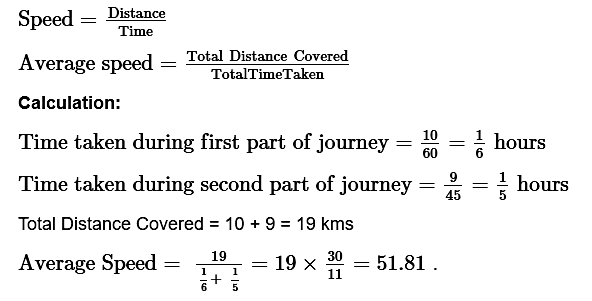
∴ The Average Speed of Car during the journey is 51.81 km/h
80. A shopkeeper has given two successive discounts 20% and 10% on the marked price Rs. 2500 of an article. Find the selling price of the article.
A. 1750
B. 1800
C. 180
D. 2025
E. 2250
Solution
Given:
Marked price of the article = Rs. 2500
Two successive discounts are 10% and 20%.
Formula used:
Selling Price (S.P) = Marked Price(M.P) × [(100 – Discount%)/100]
Formula used:
S.P = M.P × [(100 – Discount%)/100] × [(100 – Discount%)/100]
⇒ 2500 × [(100 – 10)/100] × [(100 – 20)/100]
⇒ 2500 × (90/100) × (80/100)
⇒ 2500 × (9/10) × (4/5)
⇒ Rs. 1800
∴ The selling price of the article is Rs. 1800.
Alternate Method
Formula used:
Final discount percent = A + B – (AB/100)
Calculation:
Final discount% = 10 + 20 – [(10 × 20)/100]
⇒ 30 – 2
⇒ 28%
Now, S.P = (M.P) × [(100 – Discount%)/100]
⇒ Rs. 2500 × [(100 – 28)/100]
⇒ Rs. 2500 × (72/100)
⇒ Rs. 1800
∴ The selling price of the article is Rs. 1800.