Direction: Study the following information carefully to answer the given questions.There are Eight boxes A, B, C, D, E, F, G, and H placed below one another not necessarily in same order. Four boxes are placed between H and B. Box H is not placed at the top position. Box H is placed above Box B. Box F is not placed immediately above or below Box B. Only one box is placed between B and D. Only one box is placed between H and A, where A is not placed at the top of the stack. Box E is placed immediately above Box C.
1.Which box is placed at the top of stack?
A. H
B. G
C. B
D. E
E. F
Solution
1) Four boxes are placed between H and B.
2) Box H is not placed at the top position.
3) Box H is placed above Box B.
| Number | Box Case 1 | Box Case 2 |
| 8 | ||
| 7 | H | |
| 6 | H | |
| 5 | ||
| 4 | ||
| 3 | ||
| 2 | B | |
| 1 | B |
4) Only one box is placed between B and D.
5) Only one box is placed between H and A, where A is not placed at the top of the stack.
| Number | Box Case 1 | Box Case 2 |
| 8 | ||
| 7 | H | |
| 6 | H | |
| 5 | A | |
| 4 | D | A |
| 3 | D | |
| 2 | B | |
| 1 | B |
6) Box E is placed immediately above Box C. Here Case 1 is eliminated.
7) Box F is not placed immediately above or below Box B.
| Number | Box Case 2 |
| 8 | E |
| 7 | C |
| 6 | H |
| 5 | F |
| 4 | A |
| 3 | D |
| 2 | G |
| 1 | B |
Hence, Box E is placed at the top of the Stack.
2. Which box is fifth from the bottom?
A. A
B. D
C. F
D. C
E. E
Solution
1) Four boxes are placed between H and B.
2) Box H is not placed at the top position.
3) Box H is placed above Box B.
| Number | Box Case 1 | Box Case 2 |
| 8 | ||
| 7 | H | |
| 6 | H | |
| 5 | ||
| 4 | ||
| 3 | ||
| 2 | B | |
| 1 | B |
4) Only one box is placed between B and D.
5) Only one box is placed between H and A, where A is not placed at the top of the stack.
| Number | Box Case 1 | Box Case 2 |
| 8 | ||
| 7 | H | |
| 6 | H | |
| 5 | A | |
| 4 | D | A |
| 3 | D | |
| 2 | B | |
| 1 | B |
6) Box E is placed immediately above Box C. Here Case 1 is eliminated.
7) Box F is not placed immediately above or below Box B.
| Number | Box Case 2 |
| 8 | E |
| 7 | C |
| 6 | H |
| 5 | F |
| 4 | A |
| 3 | D |
| 2 | G |
| 1 | B |
Hence, Box F is fifth from the bottom.
3. How many boxes are placed between box C and D?
A. Two
B. One
C. Three
D. Five
E. Four
Solution
1) Four boxes are placed between H and B.
2) Box H is not placed at the top position.
3) Box H is placed above Box B.
| Number | Box Case 1 | Box Case 2 |
| 8 | ||
| 7 | H | |
| 6 | H | |
| 5 | ||
| 4 | ||
| 3 | ||
| 2 | B | |
| 1 | B |
4) Only one box is placed between B and D.
5) Only one box is placed between H and A, where A is not placed at the top of the stack.
| Number | Box Case 1 | Box Case 2 |
| 8 | ||
| 7 | H | |
| 6 | H | |
| 5 | A | |
| 4 | D | A |
| 3 | D | |
| 2 | B | |
| 1 | B |
6) Box E is placed immediately above Box C. Here Case 1 is eliminated.
7) Box F is not placed immediately above or below Box B.
| Number | Box Case 2 |
| 8 | E |
| 7 | C |
| 6 | H |
| 5 | F |
| 4 | A |
| 3 | D |
| 2 | G |
| 1 | B |
Hence, three boxes are placed between box C and D.
4. How many boxes are placed above Box F?
A. One
B. Three
C. Four
D. Two
E. None of the above
Solution
1) Four boxes are placed between H and B.
2) Box H is not placed at the top position.
3) Box H is placed above Box B.
| Number | Box Case 1 | Box Case 2 |
| 8 | ||
| 7 | H | |
| 6 | H | |
| 5 | ||
| 4 | ||
| 3 | ||
| 2 | B | |
| 1 | B |
4) Only one box is placed between B and D.
5) Only one box is placed between H and A, where A is not placed at the top of the stack.
| Number | Box Case 1 | Box Case 2 |
| 8 | ||
| 7 | H | |
| 6 | H | |
| 5 | A | |
| 4 | D | A |
| 3 | D | |
| 2 | B | |
| 1 | B |
6) Box E is placed immediately above Box C. Here Case 1 is eliminated.
7) Box F is not placed immediately above or below Box B.
| Number | Box Case 2 |
| 8 | E |
| 7 | C |
| 6 | H |
| 5 | F |
| 4 | A |
| 3 | D |
| 2 | G |
| 1 | B |
Hence, three boxes are placed above Box F.
5. Which box is fourth from the bottom?
A. E
B. C
C. H
D. D
E. A
Solution
1) Four boxes are placed between H and B.
2) Box H is not placed at the top position.
3) Box H is placed above Box B.
| Number | Box Case 1 | Box Case 2 |
| 8 | ||
| 7 | H | |
| 6 | H | |
| 5 | ||
| 4 | ||
| 3 | ||
| 2 | B | |
| 1 | B |
4) Only one box is placed between B and D.
5) Only one box is placed between H and A, where A is not placed at the top of the stack.
| Number | Box Case 1 | Box Case 2 |
| 8 | ||
| 7 | H | |
| 6 | H | |
| 5 | A | |
| 4 | D | A |
| 3 | D | |
| 2 | B | |
| 1 | B |
6) Box E is placed immediately above Box C. Here Case 1 is eliminated.
7) Box F is not placed immediately above or below Box B.
| Number | Box Case 2 |
| 8 | E |
| 7 | C |
| 6 | H |
| 5 | F |
| 4 | A |
| 3 | D |
| 2 | G |
| 1 | B |
Hence, Box A is fourth from the bottom.
Direction: Study the following information carefully and answer the given questions. In a certain code language,
‘mai nai kai’ means ‘pretty face alarm’
‘dai bai mai’ means ‘done pretty work’
‘kai xai yai’ means ‘go alarm off’‘bai yai cai’ means ‘done off belong’
6. What does ‘mai’ mean in that code language?
A. off
B. work
C. alarm
D. face
E. pretty
Solution
According to given information:

Therefore, in the given code language,
‘mai’ means ‘pretty’
‘nai’ means ‘face’
‘kai’ means ‘alarm’
‘bai’ means ‘done’
‘dai’ means ‘work’
‘xai’ means ‘go’
‘yai’ means ‘off’
‘cai’ means ‘belong’
So, ‘pretty’ is coded as ‘mai’.Hence, ‘pretty’ is the correct answer.
7. What is the code of ‘off’?
A. yai
B. cai
C. xai
D. kai
E. None of the above
Solution
According to given information:
Therefore, in the given code language,
‘mai’ means ‘pretty’
‘nai’ means ‘face’
‘kai’ means ‘alarm’
‘bai’ means ‘done’
‘dai’ means ‘work’
‘xai’ means ‘go’
‘yai’ means ‘off’
‘cai’ means ‘belong’
So, ‘off’ is coded as ‘yai’Hence, ‘yai’ is the correct answer.
8. What does ‘kai’ mean in that code language?
A. belong
B. alarm
C., face
D. go
E. None of the above
Solution
According to given information:
Therefore, in the given code language,
‘mai’ means ‘pretty’
‘nai’ means ‘face’
‘kai’ means ‘alarm’
‘bai’ means ‘done’
‘dai’ means ‘work’
‘xai’ means ‘go’
‘yai’ means ‘off’
‘cai’ means ‘belong’
So, ‘alarm’ is coded as ‘kai’Hence, ‘alarm’ is the correct answer.
9. What is the code of ‘belong’?
A. cai
B. mai
C. nai
D. xai
E. Cannot be determined
Solution
According to given information:
Therefore, in the given code language,
‘mai’ means ‘pretty’
‘nai’ means ‘face’
‘kai’ means ‘alarm’
‘bai’ means ‘done’
‘dai’ means ‘work’
‘xai’ means ‘go’
‘yai’ means ‘off’
‘cai’ means ‘belong’
So, ‘belong’ is coded as ‘cai’Hence, ‘cai’ is the correct answer.
10. Direction:In the following question assuming the given statements to be true, find which conclusion(s) among the given conclusions is/are definitely true and then give your answers accordingly.
Statements:
V < B > H; J > M = V
Conclusions:
I. J > V
II. H ≥ M
A. Only II is true
B. Only I is true
C. Both I and II are true
D. Either I or II is true
E. None is true
Solution
Given Statements: V < B > H; J > M = V
On Combining: J > M = V < B > H
Conclusions:
I. J > V → True (As, J > M = V → J > V OR V < J)
II. H ≥ M → False (As, M = V < B > H → Clear relation between H and M cannot be determined)
Hence, only conclusion I is true
11. Direction: In the following question assuming the given statements to be true, find which conclusion among given conclusions is/are definitely true and then give your answers accordingly.
Statements:
Q ≤ W; E = V; W < L ≥ V
Conclusions:
I. Q < L
II. E ≤ L
A. Only II is true
B. Only I is true
C. Both I and II are true
D. Either I or II is true
E. None is true
Solution
Given Statements: Q ≤ W; E = V; W < L ≥ V
On Combining: Q ≤ W < L ≥ V = E
Conclusions:
I. Q < L → True (As, Q ≤ W < L → L > Q or Q < L)
II. E ≤ L → True (As, L ≥ V = E → L ≥ E or E ≤ L)
Hence, both the conclusion follows
12. Direction:In the following question assuming the given statements to be True, find which of the conclusion among given conclusions is/are definitely true and then give your answers accordingly.
Statements:
G < J = P ≤ L; M> R > L
Conclusions:
I.P > G
II. M > L
A. Only II is true
B. Only I is true
C. Both I and II are true
D. Either I or II is true
E. None is true
Solution
Given Statements: G < J = P ≤ L; M> R > L
On Combining: G < J = P ≤ L< R < M
Conclusions:
I. P > G → True (As, G < J = P → G < P or P > G)
II. M > L → True (As, L < R < M → L < M or M > L)
Hence, both the conclusions I and II are true.
Direction: Answer the questions based on the information given below:
Ramesh, Suresh, Mahesh, Yogesh, Dipesh and Paresh have different number of bikes. Ramesh has more bikes than Dipesh and Mahesh. Suresh has more bikes than Paresh, who doesn’t have fewer bikes than Ramesh. Suresh doesn’t have the highest number of bikes.
13. Who has the highest of bikes?
A. Ramesh
B. Yogesh
C. Mahesh
D. Paresh
E. Dipesh
Solution
Six persons: Ramesh, Suresh, Mahesh, Yogesh, Dipesh and Paresh
1) Ramesh has more bikes than Dipesh and Mahesh.
2) Suresh has more bikes than Paresh, who doesn’t have fewer bikes than Ramesh.
Suresh > Paresh > Ramesh > Dipesh/Mahesh > Dipesh/Mahesh
3) Suresh doesn’t have the highest number of bikes.
Yogesh > Suresh > Paresh > Ramesh > Dipesh/Mahesh > Dipesh/Mahesh
above is the final arrangement,
Hence, Yogesh has the highest number of bikes.
14. If Mahesh doesn’t have the least number of bikes, then who has the least number of bikes?
A. Ramesh
B. Yogesh
C. Mahesh
D. Paresh
E. Dipesh
Solution
Six persons: Ramesh, Suresh, Mahesh, Yogesh, Dipesh and Paresh
1) Ramesh has more bikes than Dipesh and Mahesh.
2) Suresh has more bikes than Paresh, who doesn’t have fewer bikes than Ramesh.
Suresh > Paresh > Ramesh > Dipesh/Mahesh > Dipesh/Mahesh
3) Suresh doesn’t have the highest number of bikes.
Yogesh > Suresh > Paresh > Ramesh > Dipesh/Mahesh > Dipesh/Mahesh
above is the final arrangement,
Hence, Dipesh has the least number of bikes.
15. How many persons have more bikes than Dipesh?
A. Four
B. Five
C. Two
D. Cannot be determined
E. Three
Solution
Six persons: Ramesh, Suresh, Mahesh, Yogesh, Dipesh and Paresh
1) Ramesh has more bikes than Dipesh and Mahesh.
2) Suresh has more bikes than Paresh, who doesn’t have fewer bikes than Ramesh.
Suresh > Paresh > Ramesh > Dipesh/Mahesh > Dipesh/Mahesh
3) Suresh doesn’t have the highest number of bikes.
Yogesh > Suresh > Paresh > Ramesh > Dipesh/Mahesh > Dipesh/Mahesh
above is the final arrangement,
Hence, either 4 or 5 persons have more number of bikes.
16. Who has 3rd highest number of bikes?
A. Yogesh
B. Mahesh
C. Paresh
D. Dipesh
E. Ramesh
Solution
Six persons: Ramesh, Suresh, Mahesh, Yogesh, Dipesh and Paresh
1) Ramesh has more bikes than Dipesh and Mahesh.
2) Suresh has more bikes than Paresh, who doesn’t have fewer bikes than Ramesh.
Suresh > Paresh > Ramesh > Dipesh/Mahesh > Dipesh/Mahesh
3) Suresh doesn’t have the highest number of bikes.
Yogesh > Suresh > Paresh > Ramesh > Dipesh/Mahesh > Dipesh/Mahesh
above is the final arrangement,
Hence, Paresh has the 3rd highest number of bikes.
17. Difference between the number of bikes Yogesh and Ramesh have is 16 and Ramesh has 6 bikes then Yogesh has ___ bikes.
A. 10
B. 22
C. 12
D. Cannot be determined
E. 18
Solution
Six persons: Ramesh, Suresh, Mahesh, Yogesh, Dipesh, and Paresh
1) Ramesh has more bikes than Dipesh and Mahesh.
2) Suresh has more bikes than Paresh, who doesn’t have fewer bikes than Ramesh.
Suresh > Paresh > Ramesh > Dipesh/Mahesh > Dipesh/Mahesh
3) Suresh doesn’t have the highest number of bikes.
Yogesh > Suresh > Paresh > Ramesh > Dipesh/Mahesh > Dipesh/Mahesh
above is the final arrangement,
Hence, Yogesh has 16 + 6 = 22 bikes.
18. If it is possible to make only one meaningful English word with the first, the fifth, the eighth and the ninth letters of the word SKEPTICAL, which of the following will be the third letter of that word? If no such word can be made give ‘X’ as the answer and if more than one such word can be made give ‘Y’ as the answer.
A. N
B. D
C. S
D. X
E. Y
Solution
Word: SKEPTICAL
First letter = S; Fifth letter = T; Eighth letter = A; Ninth letter = L
Letters given: STAL
Words possible: LAST, SALT, SLAT
Clearly, Y is the correct answer.
Directions: Study the following information carefully and answer the questions given below.
Six persons P, Q, R, S, T and U are sitting around a hexagon table such that all the persons are sitting on the corners of the table but not necessarily in the same order. All of them are facing inside. No person is sitting on the middle of the sides.Q is sitting second to the right of R. U sits at the immediate right of S. U is sitting second to the right of Q. R is not an immediate neighbour of S. Only two persons sit between U and T.
19. Who is sitting second to the right of R?
A. P
B. Q
C. S
D. T
E. None of these
Solution
1. U sits at the immediate right of S.
2. U is sitting second to the right of Q.
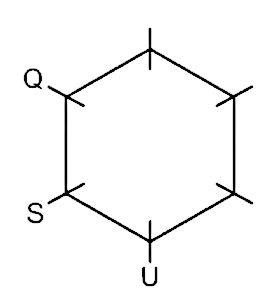
3. Only two persons sit between U and T.
4. Q is sitting second to the right of R.
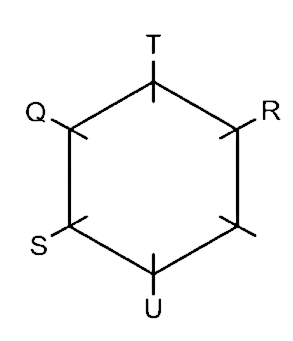
5. R is not an immediate neighbour of S.
The final arrangement is as follows:
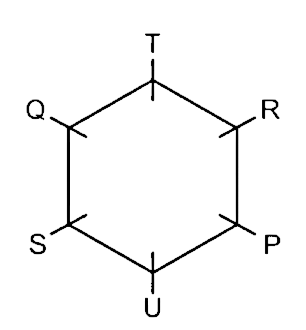
Hence, Q is sitting second to the right of R.
20. Who is the immediate neighbour of T?
A. P
B. U
C. S
D. R
E. None of these
Solution
1. U sits at the immediate right of S.
2. U is sitting second to the right of Q.
3. Only two persons sit between U and T.
4. Q is sitting second to the right of R.
5. R is not an immediate neighbour of S.
The final arrangement is as follows:
Hence, from the given options only R is an immediate neighbour of T.
21. How many persons sit between R and Q when counted from the left of R?
A. One
B. Three
C. Two
D. Four
E. None of these
Solution
1. U sits at the immediate right of S.
2. U is sitting second to the right of Q.
3. Only two persons sit between U and T.
4. Q is sitting second to the right of R.
5. R is not an immediate neighbour of S.
The final arrangement is as follows:
Hence, only three persons are sitting between R and Q when counted from the left of R.
22. Who sits fourth to the left of S?
A. P
B. U
C. T
D. R
E. None of these
Solution
1. U sits at the immediate right of S.
2. U is sitting second to the right of Q.
3. Only two persons sit between U and T.
4. Q is sitting second to the right of R.
5. R is not an immediate neighbour of S.
The final arrangement is as follows:
Hence, P sits fourth to the left of S.
23. Who sits opposite to R?
A. P
B. U
C. T
D. S
E. None of these
Solution
1. U sits at the immediate right of S.
2. U is sitting second to the right of Q.
3. Only two persons sit between U and T.
4. Q is sitting second to the right of R.
5. R is not an immediate neighbour of S.
The final arrangement is as follows:
Hence, S sits opposite to R.
Directions: These questions are based on the following information.
A family has six members – A, B, C, D, E, and F among three generations. There are two married couples in two generations of people. There are an equal number of males and females in the family. Further information is given as follows:
E is the mother of F. A is the son-in-law of B. E is the daughter of D who is the wife of B. C is the uncle of F. E is the only child of her parents.
24. How is C related to A?
A. Brother
B. Brother in law
C. Sister
D. Father in law
E. Wife
Solution
Answer: 1
From the given information,

1) E is the mother of F.
2) E is the daughter of D who is the wife of B.
The blood relation diagram is as follows,

3) A is the son in law of B. E is the only child of her parents.
4) C is the uncle of F.
Now the final blood relation diagram is as follows,
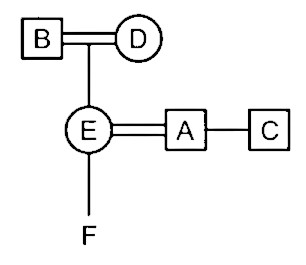
Hence, Correct answer is Brother.
25. How is E related to D?
A. Son
B. Daughter
C. Niece
D. Mother in law
E. Can not be determined
Solution
Answer: 2
From the given information,
1) E is the mother of F.
2) E is the daughter of D who is the wife of B.
The blood relation diagram is as follows,
3) A is the son in law of B. E is the only child of her parents.
4) C is the uncle of F.
Now the final blood relation diagram is as follows,
Hence, Correct answer is Daughter.
26. How is B related to F?
A. Grand mother
B. Mother
C. Grand father
D. Father
E. Can not be determined
Solution
Answer: 3
From the given information,
1) E is the mother of F.
2) E is the daughter of D who is the wife of B.
The blood relation diagram is as follows,
3) A is the son in law of B. E is the only child of her parents.
4) C is the uncle of F.
Now the final blood relation diagram is as follows,
Hence, B is the grandfather of F.
27. If each of the odd digits in the number 8463247 is increased by ‘1’ and each of the even digits is decreased by ‘1’, then which of the following will be the sum of the digits of the number?
A. 32
B. 31
C. 28
D. 29
E. 30
Solution
Given number: 8463247
After changing as per the question, the number becomes: 7354138
So, the sum of digits of the number is = 7 + 3 + 5 + 4 + 1 + 3 + 8 = 31.Hence, 31 is the correct ans.
Direction: Study the following arrangement carefully and answer the questions given below:C X S 2 & A T * 7 N Y % 9 H Q F # Z P 8 @ 3 6 D L 1 $ 5 E 4 J
28. How many such consonants are there in the above arrangement, each of which is immediately preceded by a consonant and immediately followed by a number?
A. One
B. Two
C. Three
D. None
E. More than three
Solution
Arrangement required: Consonant → Consonant → Number
Given series is: C X S 2 & A T * 7 N Y % 9 H Q F # Z P 8 @ 3 6 D L 1 $ 5 E 4 JHence, three such pairs are there i.e. X S 2, Z P 8, and D L 1.
29. How many such vowels are there between S and 9 each of which is immediately preceded by a symbol and immediately followed by a consonant?
A. None
B. One
C. Two
D. Three
E. More than three
Solution
Arrangement required: S →→ Symbol → Vowel → Consonant → → 9
Given series is: C X S 2 & A T * 7 N Y % 9 H Q F # Z P 8 @ 3 6 D L 1 $ 5 E 4 JHence, only one such pair i.e. & A T is there between S and 9 which follow the given condition.
30. How many such numbers are there in the above arrangement, each of which is immediately preceded by a consonant and immediately followed by a symbol?
A. None
B. Three
C. One
D. Two
E. More than three
Solution
Arrangement required: Consonant → Number → Symbol
Given series is: C X S 2 & A T * 7 N Y % 9 H Q F # Z P 8 @ 3 6 D L 1 $ 5 E 4 JHence, three numbers follows the given condition.
31. Which of the following is the ninth to the left of the seventeenth from the right end of the above arrangement?
A. &
B. 1
C. T
D. A
E. 7
Solution
Given series is: (Left) C X S 2 & A T * 7 N Y % 9 H Q F # Z P 8 @ 3 6 D L 1 $ 5 E 4 J (Right)
As left + right = right
⇒17th from the right + 9th to the left = 26th from rightHence, 26th from right is ‘A’.
32. Which of the following is exactly in the middle between the ninth from the left end and the nineteenth from the right end in the above arrangement?
A. 9
B. %
C. 7
D. N
E. Y
Solution
Given series is: (Left) C X S 2 & A T * 7 N Y % 9 H Q F # Z P 8 @ 3 6 D L 1 $ 5 E 4 J (Right)
9th from the left → 7
19th from right → 9Hence, terms between 7 and 9 are 7 N Y % 9 and Y is exactly in middle of them.
Direction: Study the following information to answer the given questions:
There are eight persons A, B, C, D, E, F, G and H in a company. Each of them has different ages (in years) among 16, 21, 25, 32, 36, 46, 64 and 94 but not necessarily in same order.
At least two persons are elder than H. C is 4 years elder than A. D’s age is a perfect square number. B is the youngest. H is elder than F, whose age is in even number. G is younger than D but not 46 years old.
33. Who among the following is the oldest?
A. F
B. D
C. B
D. A
E. E
Solution
Persons: A, B, C, D, E, F, G and H.
Ages: 16, 21, 25, 32, 36, 46, 64 and 94.
1) B is the youngest. So, B is 16 years old.
2) C is 4 years elder than A. So, ages of C and A can be (25, 21) and (36, 32) respectively.
3) D’s age is a perfect square number. So, D’s age can be 36 or 64.
| Case 1(a) | Case 1(b) | Case 2 | |
| Age | Person | Person | Person |
| 16 | B | B | B |
| 21 | A | A | |
| 25 | C | C | |
| 32 | A | ||
| 36 | D | C | |
| 46 | |||
| 64 | D | D | |
| 94 |
4) At least two persons are elder than H.
5) H is elder than F, whose age is in even number. So, case 2 would be invalid.
6) G is younger than D but not 46 years old. So, case 1(b) would be invalid. Also, E must be 94 years old.
| Age | Person |
| 16 | B |
| 21 | A |
| 25 | C |
| 32 | G/F |
| 36 | F/G |
| 46 | H |
| 64 | D |
| 94 | E |
Hence, E is the oldest.
34. What is the age of G?
A. 32 years
B. 21 years
C. 36 years
D. 46 years
E. Cannot be determined
Solution
Persons: A, B, C, D, E, F, G and H.
Ages: 16, 21, 25, 32, 36, 46, 64 and 94.
1) B is the youngest. So, B is 16 years old.
2) C is 4 years elder than A. So, ages of C and A can be (25, 21) and (36, 32) respectively.
3) D’s age is a perfect square number. So, D’s age can be 36 or 64.
| Case 1(a) | Case 1(b) | Case 2 | |
| Age | Person | Person | Person |
| 16 | B | B | B |
| 21 | A | A | |
| 25 | C | C | |
| 32 | A | ||
| 36 | D | C | |
| 46 | |||
| 64 | D | D | |
| 94 |
4) At least two persons are elder than H.
5) H is elder than F, whose age is in even number. So, case 2 would be invalid.
6) G is younger than D but not 46 years old. So, case 1(b) would be invalid. Also, E must be 94 years old.
| Age | Person |
| 16 | B |
| 21 | A |
| 25 | C |
| 32 | G/F |
| 36 | F/G |
| 46 | H |
| 64 | D |
| 94 | E |
G is either 32 or 36 years old.
Hence, ‘Cannot be determined’ is the correct answer.
35. How many persons are younger than C?
A. Three
B. Four
C. Two
D. Five
E. One
Solution
Persons: A, B, C, D, E, F, G and H.
Ages: 16, 21, 25, 32, 36, 46, 64 and 94.
1) B is the youngest. So, B is 16 years old.
2) C is 4 years elder than A. So, ages of C and A can be (25, 21) and (36, 32) respectively.
3) D’s age is a perfect square number. So, D’s age can be 36 or 64.
| Case 1(a) | Case 1(b) | Case 2 | |
| Age | Person | Person | Person |
| 16 | B | B | B |
| 21 | A | A | |
| 25 | C | C | |
| 32 | A | ||
| 36 | D | C | |
| 46 | |||
| 64 | D | D | |
| 94 |
4) At least two persons are elder than H.
5) H is elder than F, whose age is in even number. So, case 2 would be invalid.
6) G is younger than D but not 46 years old. So, case 1(b) would be invalid. Also, E must be 94 years old.
| Age | Person |
| 16 | B |
| 21 | A |
| 25 | C |
| 32 | G/F |
| 36 | F/G |
| 46 | H |
| 64 | D |
| 94 | E |
Hence, two persons are younger than C.
36. What is the difference in the ages of H and A?
A. 36 years
B. 16 years
C. 20 years
D. 25 years
E. 32 years
Solution
Persons: A, B, C, D, E, F, G and H.
Ages: 16, 21, 25, 32, 36, 46, 64 and 94.
1) B is the youngest. So, B is 16 years old.
2) C is 4 years elder than A. So, ages of C and A can be (25, 21) and (36, 32) respectively.
3) D’s age is a perfect square number. So, D’s age can be 36 or 64.
| Case 1(a) | Case 1(b) | Case 2 | |
| Age | Person | Person | Person |
| 16 | B | B | B |
| 21 | A | A | |
| 25 | C | C | |
| 32 | A | ||
| 36 | D | C | |
| 46 | |||
| 64 | D | D | |
| 94 |
4) At least two persons are elder than H.
5) H is elder than F, whose age is in even number. So, case 2 would be invalid.
6) G is younger than D but not 46 years old. So, case 1(b) would be invalid. Also, E must be 94 years old.
| Age | Person |
| 16 | B |
| 21 | A |
| 25 | C |
| 32 | G/F |
| 36 | F/G |
| 46 | H |
| 64 | D |
| 94 | E |
The ages of H and A are 46 and 21 years respectively
Difference = 46 – 21 = 25
Hence, the difference of ages of H and A is 25 years.
37. Who is just older than H?
A. D
B. E
C. A
D. F
E. G
Solution
Persons: A, B, C, D, E, F, G and H.
Ages: 16, 21, 25, 32, 36, 46, 64 and 94.
1) B is the youngest. So, B is 16 years old.
2) C is 4 years elder than A. So, ages of C and A can be (25, 21) and (36, 32) respectively.
3) D’s age is a perfect square number. So, D’s age can be 36 or 64.
| Case 1(a) | Case 1(b) | Case 2 | |
| Age | Person | Person | Person |
| 16 | B | B | B |
| 21 | A | A | |
| 25 | C | C | |
| 32 | A | ||
| 36 | D | C | |
| 46 | |||
| 64 | D | D | |
| 94 |
4) At least two persons are elder than H.
5) H is elder than F, whose age is in even number. So, case 2 would be invalid.
6) G is younger than D but not 46 years old. So, case 1(b) would be invalid. Also, E must be 94 years old.
| Age | Person |
| 16 | B |
| 21 | A |
| 25 | C |
| 32 | G/F |
| 36 | F/G |
| 46 | H |
| 64 | D |
| 94 | E |
Hence, D is just older than H
Directions: Study the information given below carefully and answer the questions that follow.A Boy starts from his house towards west. After walking the distance of 30m reach to market, he turns towards right and walked 40 meters reach Gym. He then turned left and moving a distance 10 meters reach park, turns to his left again and walk 20 meters reach school. He now turns to the left and walks 15 meters reach restaurant.
38. In which direction he is facing now?
A. North
B. South
C. East
D. West
E. None of these
Solution
According to the information given,
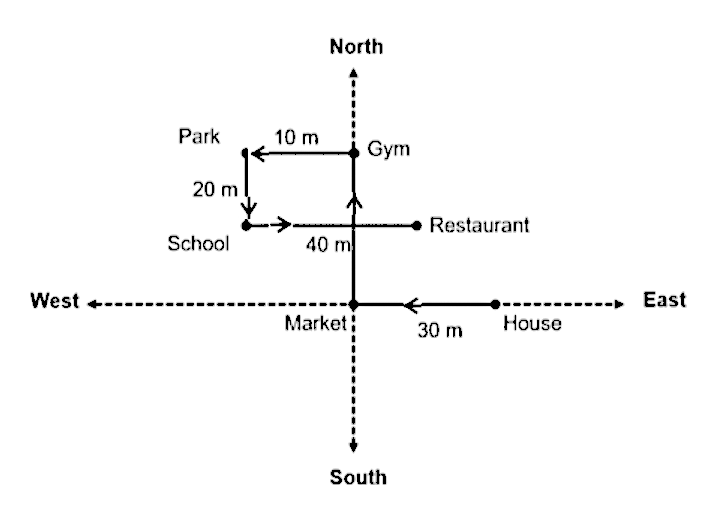
Finally, he is facing east direction.
39. What is the total distance between the house to the Gym?
A. 50 m
B. 60 m
C. 70 m
D. 80 m
E. 100 m
Solution
According to the information given,
Total distance = 30m + 40m = 70m.
40. Total distance travelled between the school and his house?
A. 50 m
B. 60 m
C. 70 m
D. 80 m
E. 100 m
Solution
According to the information given,
Total distance from school to house =30m + 40m + 10m + 20m = 100m.
Numerical Ability
Directions: Read the following information carefully and answer the questions based on it.
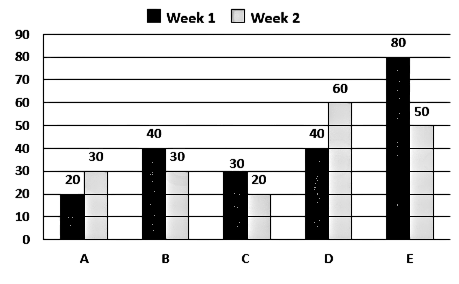
The given bar graph shows the run time (in hours) of five different OTT platforms in two different weeks.
Note: Total run time = Run time in week 1 + Run time in week 2
41.Which OTT platform has the highest percentage decrease in run time (in hours) from week 1 to week 2?
A. Both Platform E and D
B. Platform E
C. Platform A
D. Platform D
E. Both Platform E and A
Solution
For OTT platform A:
Run time (in hours) in week 1 = 20
Run time (in hours) in week 2 = 30
Percentage increase = (30-20)/20 x 100 = 50%
For OTT platform B:
Run time (in hours) in week 1 = 40
Run time (in hours) in week 2 = 30
Percentage decrease = (40-30)/40 x 100 = 25%
There is a decrease in run time.
For OTT platform C:
Run time (in hours) in week 1 = 30
Run time (in hours) in week 2 = 20
Percentage decrease = (30-20)/30 x 100 = 33.33%
There is a decrease in run time.
For OTT platform D:
Run time (in hours) in week 1 = 40
Run time (in hours) in week 2 = 60
Percentage increase = (60-40)/40 x 100 = 50%
For OTT platform E:
Run time (in hours) in week 1 = 80
Run time (in hours) in week 2 = 50
Percentage decrease = (80-50)/80 x 100 = 37.5%
Clearly, OTT platform E has the highest percentage decrease in run time (in hours) from week 1 to week 2.
Hence, the correct answer is option 2.
Directions: Read the following information carefully and answer the questions based on it.
The given bar graph shows the run time (in hours) of five different OTT platforms in two different weeks.
Note: Total run time = Run time in week 1 + Run time in week 2
42. What is the ratio of average run time (in hours) for week 1 and week 2 of all five OTT platforms?
A. 20 : 19
B. 21 : 19
C. 22 : 19
D. 23 : 18
E. None of these
Solution
Total run time (in hours) for all OTT platforms in week 1 = (20 + 40 + 30 + 40 + 80) = 210
Average = 210/5 = 42
Total run time (in hours) for all OTT platforms in week 2 = (30 + 30 + 20 + 60 + 50) = 190
Average = 38
Required ratio = 42 : 38 i.e., 21 : 19
Hence, the correct answer is option 2.
Directions: Read the following information carefully and answer the questions based on it.
The given bar graph shows the run time (in hours) of five different OTT platforms in two different weeks.
Note: Total run time = Run time in week 1 + Run time in week 2
43. If in week 3 run time (in hours) of OTT platforms D and E increases by 10% and 10% respectively with respect to week 1 and run time (in hours) of OTT platforms A, B, and C decreases by 10% respectively with respect to week 2, then find the total run time (in hours) for all five OTT platforms in week 3?
A. 212
B. 202
C. 205
D. 204
E. 210
Solution
In week 3:
Run time (in hours) of OTT platform D = 110% of 40 = 44
Run time (in hours) of OTT platform E = 110% of 80 = 88
Run time (in hours) of OTT platform A = 90% of 30 = 27
Run time (in hours) of OTT platform B = 90% of 30 = 27
Run time (in hours) of OTT platform C = 90% of 20 = 18
Total run time (in hours) of all five OTT platforms together in week 3 = (44 + 88 + 27 + 27 + 18) = 204
Hence, the correct answer is option 4.
Directions: Read the following information carefully and answer the questions based on it.
The given bar graph shows the run time (in hours) of five different OTT platforms in two different weeks.
Note: Total run time = Run time in week 1 + Run time in week 2
44. What is the percentage increase/decrease in run time (in hours) of all five OTT platforms together in Week 2 with respect to Week 1?
A. 8%
B. 12%
C. 11%
D. 16%
E. None of these
Solution
Total run time (in hours) for all OTT platforms in week 1 = (20 + 40 + 30 + 40 + 80) = 210
Total run time (in hours) for all OTT platforms in week 2 = (30 + 30 + 20 + 60 + 50) = 190
Required percentage = 210 – 190 /210 x 100 = 9.52%
Hence, the correct answer is option 5.
Directions: Read the following information carefully and answer the questions based on it.
The given bar graph shows the run time (in hours) of five different OTT platforms in two different weeks.
Note: Total run time = Run time in week 1 + Run time in week 2
45. Total run time (in hours) for E is what percent more/less than the total run time (in hours) of B and C together?
A. 8. 25%
B. 8. 33%
C. 16. 25%
D. 11. 11%
E. 9. 09%
Solution
Total run time (in hours) for E = (80 + 50) = 130
Total run time (in hours) for B = (40 + 30) = 70
Total run time (in hours) for C = (30 + 20) = 50
Required percentage = 130 – (70 + 50)/(70 + 50) x 100 = 8.33%
Hence, the correct answer is option 2.
46. Three pumps A, B and C can fill the cistern in 6, 8, 16 hours respectively. If the three pumps are opened together in how much time the cistern will be filled?
A. 6 hrs
B. 8 hrs
C.  hrs
hrs
D. 4 hrs
E. 10 hrs
Solution
Given:
Pipe A can fill the tank in = 6 hrs
Pipe B can fill the tank in = 8 hrs
Pipe C can fill the tank in = 16 hrs
Concept:
Let, Pipe A can fill a tank in x hrs.
∴ Pipe A can fill a tank in 1 hrs = 1/x
Calculation:
Pipe A fill the tank in 1 hr = 1/6
Pipe B fill the tank in 1 hr = 1/8
Pipe C fill the tank in 1 hr = 1/16
Three pipe fill the tank together in 1 hr = (1/6) + (1/8) + (1/16) = (17/48)Required time = 48/17 = hrs
47. What will come in the place of the question mark ‘?’ in the following question?
60% × 120 + 20 × √121 – 2 × 13 = ?
A. 290
B. 266
C. 278
D. 271
E. None
Solution
Concept used:
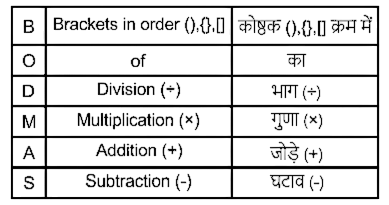
This type of question can be solved by the help of BODMAS
Calculation:
60% × 120 + 20 × √121 – 2 × 13 = ?
⇒ (60/100) × 120 + 20 × 11 – 26 = ?
⇒ 72 + 220 – 26 = ?
⇒ ? = 292 – 26 = 266
∴ The value of ? is 266
48. What will come in the place of the question mark ‘?’ in the following question?
30% × [15 + (10 × 0.5)] + 100 × 4 = ?
A. 426
B. 406
C. 326
D. 376
E. None
Solution
Concept used:
This type of question can be solved by the help of BODMAS
Calculation:
30% × [15 + (10 × 0.5)] + 100 × 4 = ?
⇒ (30/100) × [15 + 5] + 100 × 4 = ?
⇒ (30/100) × 20 + 400 = ?
⇒ 6 + 400 = ?
⇒ ? = 406
∴ The value of ? is 406
49. What will come in the place of ‘x’ in the following question?
(729)x = 9 × (81)4 × (729)7
A. 30
B. 15
C. 10
D. 27
E. None of these
Solution
Concept used:
Follow BODMAS rule to solve this question, as per the order given below,
Calculations:
(729)x = 9 × (81)4 × (729)7
⇒ (93)x = 9 × (92)4 × (93)7
⇒ 93x = 9 × (9)8 × (9)21
⇒ 93x = (9)1 + 8 + 21
⇒ 93x = (9)30
By comparing the powers,
3x = 30
⇒ x = 10
∴ The value of x is 10
50. What will come in the place of question mark (?) in the given expression?
122 + 132 – 15 × 45 ÷ 5 = 89 × ?
A. 3
B. 2
C. 4
D. 1
E. 7
Solution
Concept used:
Follow BODMAS rule to solve this question, as per the order given below
Calculations:
122 + 132 – 15 × 45 ÷ 5 = 89 × ?
⇒ 144 + 169 – 135 = 89 × ?
⇒ 178 = 89 × ?
⇒ ? = 178/89
⇒ ? = 2
∴ The value of ? is 2
51. What will come in the place of question mark (?) in the given expression?
30% of 150 + 22 = ?2 – 50% of 30
A. 8
B. 6
C. 7
D. 9
E. 10
Solution
Concept used:
Follow BODMAS rule to solve this question, as per the order given below
Calculations:
30% of 150 + 22 = ?2 – 50% of 30
⇒ (30/100) × 150 + 4 = ?2 – (50/100) × 30
⇒ 45 + 4 = ?2 – 15
⇒ ?2 = 64
⇒ ? = √64 = 8
∴ The value of ? is 8
52. What will come in the place of the question mark ‘?’ in the following question?
81 – 9 × √49 + 21 + √225 × 2 = ?
A. 99
B. 79
C. 89
D. 69
E. None of these
Solution
Concept used:
Follow BODMAS rule to solve this question, as per the order given below,
Calculation:
81 – 9 × √49 + 21 + √225 × 2 = ?
⇒ 81 – 9 × 7 + 21 + 15 × 2 = ?
⇒ 81 – 63 + 21 + 30 = ?
⇒ 81 – 63 + 51 = ?
⇒ 132 – 63 = ?
⇒ 69 = ?
∴ ? = 69.
53. Ajay Jadeja has certain average for 9 innings. In the 10th inning, he scores 100 runs thereby increasing his average by 8 runs. His new average is:
A. 20
B. 14
C. 22
D. 28
E. 32
Solution
The correct option is: 4
Given:
10th inning score= 100 runs
average is increased by 8 runs after 10th inning.
Formula used:
average = (sum of observations) / number of observations.
Calculation:
Let the old average = x and the new average = y
then, y = x + 8 —(1)
Also, y = (9x + 100)/10 —(2)
∴ we get x + 8 = (9x + 100)/10
⇒10x + 80 = 9x + 100
⇒ x = 20
∴ y = 20 + 8 = 28
His new average is 28
54. In how many ways can a person sent invitation cards to 6 of his friends if he has four servants to distribute the cards?
A. 24
B. 120
C. 36
D. 46
E. 64
Solution
Given:
A sent invitation cards to 6 of his friends.
The number of servants is 4.
Calculation:
There are 4 servant to send 6 invitation card.
The number of ways = 4 × 4 × 4 × 4 × 4 × 4 = 46
∴ The number can a person sent invitation is 46
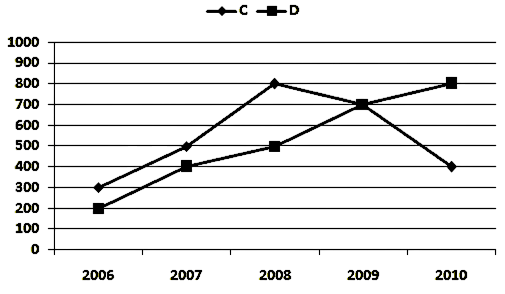
The following graph shows the number of cars sold by two companies C and D.
55. In which year the number of cars sold by both companies is equal?
A. 2006
B. 2008
C. 2007
D. 2009
E. None of these
Solution
Calculation:
from the graph,
graph of both companies meets in 2009. In 2009 C and D sells the same number of cars.
The following graph shows the number of cars sold by two companies C and D.
56. The ratio of the number of cars sold by C and D in 2008 is
A. 10:13
B. 9: 7
C. 5: 7
D. 8: 5
E. None of these
Solution
Formula used:
Required ratio = (number of cars sold by C in 2008)/ (number of cars sold by D in 2008)
Calculation:
Required ratio = 800/500
= 8:5
The following graph shows the number of cars sold by two companies C and D.
57. Number of cars sold in 2010 by C and D together is how much more/less than the number of cars sold in 2008 by C and D together?
A. 180
B. 110
C. 200
D. 100
E. None of these
Solution
Calculation:
Number of cars sold by C in 2010 = 400
Number of cars sold by D in 2010 = 800
Number of cars sold by C in 2008 = 800
Number of cars sold by D in 2008 = 500
Total cars sold by A and C in 2010 = 1200
Total cars sold by A and C in 2008 = 1300
Required difference (1300 – 1200) = 100.
The following graph shows the number of cars sold by two companies C and D.
58. In which year C and D has sold the minimum number of cars respectively?
A. 2006, 2006
B. 2008, 2006
C. 2007, 2006
D. 2009, 2008
E. None of these
Solution
Calculation:
From the graph,
Graph of C is at its lowest point in the year 2006.
Graph of D is at its lowest point in the year 2006.
The following graph shows the number of cars sold by two companies C and D.
59. Number of cars sold by C in 2007 is what percent of number of cars sold by D in 2009?
A. 79.82%
B. 74.66%
C. 73. 11%
D. 71.42%
E. None of these
Solution
Calculation:
Number of cars sold by C in 2007 = 500
Number of cars sold by D in 2009 = 700
Required percentage = (500/700 x 100) = 71.42%
60. A man spent ₹ 35606 on rent, ₹ 25810 on shopping and the remaining 28% of the total amount he saves. Find the total amount.
A. ₹ 81356
B. ₹ 80593
C. ₹ 78236
D. ₹ 85300
E. ₹ 83645
Solution
Given:
Spent on rent = ₹ 35606
Spent on shopping = ₹ 25810
and, Saving = remaining 28% of amount
Calculation:
Let, the total amount be x.
Then, (100 – 28)% of x = 35606 + 25810
⇒ 72% of x = 61416
⇒ x = (61416 × 100)/72
⇒ x = ₹ 85300
∴ The total amount is ₹ 85300.
61. Yogita deposited Rs. 15000 for 1 year at interest 5% compounded half yearly. Find the amount received by her at the end(approx)
A. Rs 14500
B. Rs 15759
C. Rs 16459
D. Rs 15349
E. None of these
Solution
Given :
Principal amount = 15000,
Rate of Interest = 5%,
Time = 1
Formula :
Amount = P [1+ (r/200]2t
Calculations :
Amount = 15000[1+ (5/200)]2
= 15000(41/40)2
= 15759 (approx)
∴ Amount received by her is Rs. 15759 (approx)
62. A solution of milk and water is in the ratio 3 : 6 in 54L of solution. How much milk must be added in the solution to make the ratio of milk and water 2 : 3.
A. 6 Litres
B. 2 Litres
C. 1 Litres
D. 3 Litres
D. 4 Litres
Solution
Given:
Total solution of milk and water = 54L
Ratio of milk and water = 3 : 6
New ratio of milk and water = 2 : 3
Calculation:
Volume of milk = (3/9) × 54L = 18L
Volume of water = (6/9) × 54 = 36L
Let the new volume of milk added be x litre
⇒ (18 + x)/36 = 2/3
⇒ 54 + 3x = 72
⇒ 3x = 18
⇒ x = 6
∴ 6 Litres of milk must be added to make the ratio of milk and water 2 : 3.
63. What should come in place of the question mark ‘?’ in the following number series?
10, 100, 1500, 30000, ?
A. 75000
B. 7500000
C. 750000
D. 7500
E. 75000000
Solution
The pattern of the series is
2 × 5 = 10
10 × 10 = 100
100 × 15 = 1500
1500 × 20 = 30000
30000 × 25 = 750000
64. What should come in the place of the question mark ‘?’ in the following number series?
67, 71, 80, ?, 121, 157
A. 98
B. 100
C. 96
D. 90
E. 110
Solution
The pattern followed by the series is
67 + 4 = 71
71 + 9 = 80
80 + 16 = 96
96 + 25 = 121
121 + 36 = 157
65. What should come in place of the question mark ‘?’ in the following number series?
1, 31, 91, 211, 451, ?
A. 959
B. 860
C. 763
D. 865
E. 931
Solution
Calculation:
The series follows the following pattern:
⇒ 1 + 30 = 31
⇒ 31 + 60 = 91
⇒ 91 + 120 = 211
⇒ 211 + 240 = 451
⇒ 451 + 480 = 931
∴ The missing term in the series is 931
66. What should come in place of the question mark ‘?’ in the following number series?
5, 7, 10, 15, 22, ?, 46
A. 27
B. 25
C. 29
D. 31
E. 33
Solution
Calculation:
The series follows the following pattern:
5 + 2 = 7
7 + 3 = 10
10 + 5 = 15
15 + 7 = 22
22 + 11 = 33
33 + 13 = 46
∴ The value of ? is 33
67. What should come in place of the question mark ‘?’ in the following number series?
30720, 3072, 384, 64, ?, 8
A. 32
B. 8
C. 12
D. 20
E. 16
Solution
The series follows the following pattern:
30720 ÷ 10 = 3072
3072 ÷ 8 = 384
384 ÷ 6 = 64
64 ÷ 4 = 16
16 ÷ 2 = 8
68. What should come in place of the question mark ‘?’ in the following number series?
2400, 2400, 1200, 400, ?, 20
A. 200
B. 100
C. 160
D. 80
E. 40
Solution
The series follows the following pattern:
2400 ÷ 1 = 2400
2400 ÷ 2 = 1200
1200 ÷ 3 = 400
400 ÷ 4 = 100
100 ÷ 5 = 20
69. The curved surface area of a right circular cylinder of height 25 cm is 3300 cm2. Find the diameter of the base of the cylinder.
A. 12 cm
B. 23 cm
C. 21 cm
D. 42 cm
E. None of these
Solution
Given:
Curved surface area of cylinder = 3300 cm2
Height of cylinder = 25 cm
Formula used:
Curved surface area of cylinder = 2π × radius × height
Calculation:
2 × (22/7) × radius × 25 = 3300
⇒ Radius = (3300 ×7)/(2 × 22 × 25)
⇒ Radius = 21 cm∴ Diameter = 2 × 21 = 42 cm
70. Salman goes A to B with a speed of 40 km/h, and returns to A from B with a speed of 60 km/h. find the average speed of Salman during the whole journey (in km/h) and in (m/s).
A. 48 km/h or 13.33 m/s
B. 56 km/h or 15.55 m/s
C. 50 km/h or 13.88 m/s
D. None of the above
E. 54 Km/h or 15 m/s
Solution
Given:
Speed of Salman going from A to B is 40 km/h
Speed of Salman going from B to A is 60 km/h
Formula used:
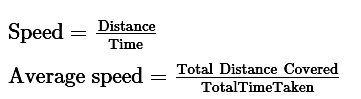
Conversion of speed from km/h to m/s = speed (km/h) × (5/18)
Calculation:
Let the distance between A to B be 120 kms.
TimetakenbySalmantotravelfromAtoB=120/40=3hoursurs
TimetakenbySalmantotravelfromBtoA=120/60=2hours
Total distance covered from A to B and back to A = 120 +120 = 240 kms.
Total time taken = 3 + 2 = 5 hours
AverageSpeed=240/5=48
Average speed of Salman is 48 km/h
Speedinmeterpersecond=48×5/18=13.33meterpersecond
∴ Average Speed of Salman during whole journey is 48 km/h or 13.33 m/s.
Shortcut Trick
AverageSpeed=2×a×b/a+b
Where ‘a’ is the speed from one side and ‘b’ is the speed of return journey
Averagespeed=2×40×60/40+60=48kilometerperhour
71. A shopkeeper increased 50% price of its cost price and give 20% discount. After that he gain Rs. 660 then find the difference between profit and discount.
A. 220
B. 330
C. 440
D. 550
E. None of these
Solution
Given:
M.R.P = 50% Increase to C.P
Discount = 20%
Gain = Rs. 660
Formula Used:
Cost price × (100 + Profit %)/100 = Selling price
Also, Cost price × (100 – Loss %)/100 = Selling price
(M.R.P – S.P)/M.R.P × 100 = Discount %
Calculation:
If C.P of a product = 100x
then, M.R.P = 100x(150/100)
⇒ 150x
Discount = 20%
⇒ 150x × 20/100 = 30x
S.P = 150x – 30x
⇒ 120x
Gain = S.P – C.P
⇒ 120x – 100x = 660
⇒ 20x = 660
⇒ x = 660/20
⇒ x = 33
Value of discount = 30x
⇒ 30 × 33
⇒ 990
Difference between discount and profit = 990 – 660
⇒ 330
∴ The difference between discount and profit is Rs. 330.
Direction: Study the following information carefully and answer based on it.
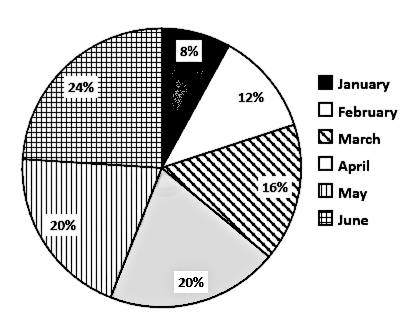
Pie chart given below shows percentage distribution of total income of Sangita in six different months. Study the data carefully and answer the following questions.
Total income = 15,000
72. Income of sangita in the month of January and April together is what percent less than income of Sangita in the month of March and June together.
A. 22%
B. 32%
C. 30%
D. 50%
E. 60%
Solution
Income of Sangita in the month of January and April together = 8 + 20 = 28%
Income of Sangita in the month of March and June together = 16 + 24 = 40%
Required percentage = (40 – 28)/(40) × 100 = 12/40 × 100 = 30%
Hence, correct answer is option 3.
Direction: Study the following information carefully and answer based on it.
Pie chart given below shows percentage distribution of total income of Sangita in six different months. Study the data carefully and answer the following questions.
Total income = 15,000
73. Income of Sangita in May and June together is how much more/less than the income of Sangita in February and March together.
A. 2400
B. 1800
C. 2200
D. 2800
E. 3200
Solution
Required difference = (20 + 24 – 12 – 16)/100 × 15000 = 2400
Hence, correct answer is option 1.
Direction: Study the following information carefully and answer based on it.
Pie chart given below shows percentage distribution of total income of Sangita in six different months. Study the data carefully and answer the following questions.
Total income = 15,000
74. Which month shows the highest percent increment in income as compare to previous month?
A. March
B. Feb
C. May
D. April
E. Both 1 and 2
Solution
It can be seen easily from the pie chart that February month shows the highest percent increase in income as compare to previous month which is equal to = (12 – 8)/8 × 100 = 4/8 × 100 = 50% increment.
Hence, correct answer is option 2.
Direction: Study the following information carefully and answer based on it.
Pie chart given below shows percentage distribution of total income of Sangita in six different months. Study the data carefully and answer the following questions.
Total income = 15,000
75. Income in the month of March and April together makes how much central angle of the total?
A. 133.3
B. 140.5
C. 129.6
D. 120.6
E. 130.5
Solution
Required central angle = (20 + 16) × 18/5 = 129.6
Hence, correct answer is option 3.
Direction: Study the following information carefully and answer based on it.
Pie chart given below shows percentage distribution of total income of Sangita in six different months. Study the data carefully and answer the following questions.
Total income = 15,000
76. Sangita’s average income in starting four months from the given six months is how much less than Sangita’s average income from last four months in the given six months(in Rs.)?
A. 950
B. 820
C. 870
D. 800
E. 900
Solution
Sangita’s average income in starting four months = (8 + 12 + 16 + 20)/(4 × 100) × 15000 = Rs. 2100
Sangita’s average income in last four months = (16 + 20 + 20 + 24)/(4 × 100) × 15000 = Rs. 3000
Required difference 3000 – 2100 = Rs. 900
Hence, correct answer is option 5.
77. Two trains running in opposite directions cross a pole in 43 seconds and 27 seconds respectively and cross each other in 37 seconds. What is the ratio of their speeds?
A. 5 : 3
B. 4 : 5
C. 6 : 1
D. 7 : 5
E. None of the above
Solution
Given:
Two trains running in opposite directions cross a pole in 43 seconds and 27 seconds respectively.
Time taken to cross each other = 37 sec
Concept:
Relative speed.
Calculation:
Let the speed of the trains be x and y m/s (meters per second) respectively.
∴ Length of first train = 43x and length of second train = 27y meters
Since the trains run in opposite directions, their relative speed = (x + y) m/s
∴ (43x + 27y)/(x + y) = 37
⇒ 43x + 27y = 37x + 37y
⇒ 6x = 10y
∴ Required Ratio
⇒ 10 : 6
⇒ 5 : 3
The ratio of their speeds is 5 : 3.
78. The area of a rectangle and its perimeter are in the ratio 1 ∶ 3. Then find the ratio of lengths of the shorter and longer sides of the rectangle.
A. 1 : 3
B. 3 : 8
C. 2 : 1
D. 1 : 4
E. Cannot be determined
Solution
Calculation:
The ratio of area and perimeter of rectangle = ab/2(a + b) (where a and b are sides of the rectangle)
The ratio of area and perimeter of rectangle = ab/2(a + b) = 1/3
ab/2(a + b) = 1/3
3ab = 2a + 2b
∴Ratio cannot be determined
79. The sum of two natural numbers is 128. Then find which of the following options cannot be the ratio of these two numbers.
A. 9 : 7
B. 7 : 1
C. 4 : 3
D. 2 : 2
E. 3 : 5
Solution
Given:
Sum of numbers = 128
Concept:
Simple addition and in this type of questions how we need to use options to extract Our answers.
Calculation:
In this types of questions check the options
Option (1)
Let the numbers be 9x and 7x respectively
⇒ 9x + 7x = 128
⇒ 16x = 128
⇒ x = 8
⇒ 9x = 9 × 8 = 72 and 7x = 7 × 8 = 56
Option (2):
Let the numbers be 7x and x respectively
⇒ 7x + 1x = 128
⇒ 8x = 128
⇒ x = 16
⇒ 7x = 7 × 16 = 112 and x = 1 × 16 = 16
Option (3):
Let the numbers be 4x and 3x respectively
⇒ 4x + 3x = 128
⇒ 7x = 128
⇒ x = 18.285
⇒ 4x = 4 × 18.285 = 73.1428 and 3x = 3 × 18.285 = 54.8571
Option (4):
Let the numbers be 2x and 2x respectively
⇒ 2x + 2x = 128
⇒ 4x = 128
⇒ x = 32
⇒ 2x = 2 × 32 = 64 and 2x = 2 × 32 = 64
Option (5):
Let the numbers be 3x and 5x respectively
⇒ 3x + 5x = 128
⇒ 8x = 128
⇒ x = 16
⇒ 3x = 3 × 16 = 48 and x = 5 × 8 = 80
∴ We can say that number 128 cannot be divided in the ratio 3 : 4
80. A boat moves downstream at the rate of 1 km in 3(1/3) minutes and upstream at the rate of 10km an hour. What is the speed of the boat in still water(in km/hr)?
A. 10
B. 12
C. 14
D. 16
E. 18
Solution
Given:-
Time for 1 km downstream distance = 3(1/3) minutes
Time for 10 km upstream = 1 hour.
Formula:-
Speed = Distance/Time
Downstream speed, D = u + v
Upstream speed, U = u – v
Speed of boat in still water = ½ (U + D)
u and v are boat and stream speeds.
Calculation:-
Time in hour = 3(1/3)/60 = 1/18
Downstream speed = 1/(1/18) = 18 km/hr
Upstream speed = 10 km/hr
Speed of boat in still water = ½ (18 + 10) = 14 km/hr