Direction: Read the following information carefully and answer the questions given below.
Eight people P, Q, R, S, T, U, V, and W live in an eight floor apartment numbered from 1 to 8, 8 being the topmost. Each of them lives on a different floor. P lived on the topmost floor. V who lived on the 4th floor lived just below U. S lived on an even-numbered floor above Q. There is a gap of three floors between R and T, where R lives above T. Q lives on an even-numbered floor.
1. Who lives on Floor 1?
A. p
B. W
C. R
D. S
E. T
Solution
Person: P, Q, R, S, T, U, V, and W
Floor: 1 to 8
1) P lived on the topmost floor. V who lived on 4th floor lived just below U.
| Floor | Person |
| 8 | P |
| 7 | |
| 6 | |
| 5 | U |
| 4 | V |
| 3 | |
| 2 | |
| 1 |
2) S lived on an even numbered floor above Q. So there are cases for this :
| Case I | Case II | |
| Floor | Person | Person |
| 8 | P | P |
| 7 | ||
| 6 | S | |
| 5 | U | U |
| 4 | V | V |
| 3 | ||
| 2 | Q | S |
| 1 | Q |
So here Case II gets eliminated as In case II it is on odd number floor.
3) There is a gap of three floor between R and T, where R lives above T.
| Case I | |
| Floor | Person |
| 8 | P |
| 7 | R |
| 6 | S |
| 5 | U |
| 4 | V |
| 3 | T |
| 2 | Q |
| 1 |
4) One person remaining who is W and only one place remaining floor 1.
So the final solution is as below.
| Case I | |
| Floor | Person |
| 8 | P |
| 7 | R |
| 6 | S |
| 5 | U |
| 4 | V |
| 3 | T |
| 2 | Q |
| 1 | W |
Hence, W lives on Floor 1.
Direction: Read the following information carefully and answer the questions given below.
Eight people P, Q, R, S, T, U, V, and W live in an eight floor apartment numbered from 1 to 8, 8 being the topmost. Each of them lives on a different floor. P lived on the topmost floor. V who lived on the 4th floor lived just below U. S lived on an even-numbered floor above Q. There is a gap of three floors between R and T, where R lives above T. Q lives on an even-numbered floor.
2. How many persons live between W and T?
A. Two
B. Three
C. Four
D. Five
E. One
Solution
Person: P, Q, R, S, T, U, V, and W
Floor: 1 to 8
1) P lived on the topmost floor. V who lived on 4th floor lived just below U.
| Floor | Person |
| 8 | P |
| 7 | |
| 6 | |
| 5 | U |
| 4 | V |
| 3 | |
| 2 | |
| 1 |
2) S lived on an even numbered floor above Q. So there are cases for this :
| Case I | Case II | |
| Floor | Person | Person |
| 8 | P | P |
| 7 | ||
| 6 | S | |
| 5 | U | U |
| 4 | V | V |
| 3 | ||
| 2 | Q | S |
| 1 | Q |
So here Case II gets eliminated as In case II it is on odd number floor.
3) There is a gap of three floor between R and T, where R lives above T.
| Case I | |
| Floor | Person |
| 8 | P |
| 7 | R |
| 6 | S |
| 5 | U |
| 4 | V |
| 3 | T |
| 2 | Q |
| 1 |
4) One person remaining who is W and only one place remaining floor 1.
So the final solution is as below.
| Case I | |
| Floor | Person |
| 8 | P |
| 7 | R |
| 6 | S |
| 5 | U |
| 4 | V |
| 3 | T |
| 2 | Q |
| 1 | W |
Hence, One person lives between W and T.
Direction: Read the following information carefully and answer the questions given below.
Eight people P, Q, R, S, T, U, V, and W live in an eight floor apartment numbered from 1 to 8, 8 being the topmost. Each of them lives on a different floor. P lived on the topmost floor. V who lived on the 4th floor lived just below U. S lived on an even-numbered floor above Q. There is a gap of three floors between R and T, where R lives above T. Q lives on an even-numbered floor.
3. Who lives immediate below Q?
A. P
B. R
C. S
D. T
E. W
Solution
Person: P, Q, R, S, T, U, V, and W
Floor: 1 to 8
1) P lived on the topmost floor. V who lived on 4th floor lived just below U.
| Floor | Person |
| 8 | P |
| 7 | |
| 6 | |
| 5 | U |
| 4 | V |
| 3 | |
| 2 | |
| 1 |
2) S lived on an even numbered floor above Q. So there are cases for this :
| Case I | Case II | |
| Floor | Person | Person |
| 8 | P | P |
| 7 | ||
| 6 | S | |
| 5 | U | U |
| 4 | V | V |
| 3 | ||
| 2 | Q | S |
| 1 | Q |
So here Case II gets eliminated as In case II it is on odd number floor.
3) There is a gap of three floor between R and T, where R lives above T.
| Case I | |
| Floor | Person |
| 8 | P |
| 7 | R |
| 6 | S |
| 5 | U |
| 4 | V |
| 3 | T |
| 2 | Q |
| 1 |
4) One person remaining who is W and only one place remaining floor 1.
So the final solution is as below.
| Case I | |
| Floor | Person |
| 8 | P |
| 7 | R |
| 6 | S |
| 5 | U |
| 4 | V |
| 3 | T |
| 2 | Q |
| 1 | W |
Hence, W lives immediate below Q.
Direction: Read the following information carefully and answer the questions given below.
Eight people P, Q, R, S, T, U, V, and W live in an eight floor apartment numbered from 1 to 8, 8 being the topmost. Each of them lives on a different floor. P lived on the topmost floor. V who lived on the 4th floor lived just below U. S lived on an even-numbered floor above Q. There is a gap of three floors between R and T, where R lives above T. Q lives on an even-numbered floor.
4. Who lives on 5th floor ?
A. Q
B. R
C. T
D. U
E. None of these
Solution
Person: P, Q, R, S, T, U, V, and W
Floor: 1 to 8
1) P lived on the topmost floor. V who lived on 4th floor lived just below U.
| Floor | Person |
| 8 | P |
| 7 | |
| 6 | |
| 5 | U |
| 4 | V |
| 3 | |
| 2 | |
| 1 |
2) S lived on an even numbered floor above Q. So there are cases for this :
| Case I | Case II | |
| Floor | Person | Person |
| 8 | P | P |
| 7 | ||
| 6 | S | |
| 5 | U | U |
| 4 | V | V |
| 3 | ||
| 2 | Q | S |
| 1 | Q |
So here Case II gets eliminated as In case II it is on odd number floor.
3) There is a gap of three floor between R and T, where R lives above T.
| Case I | |
| Floor | Person |
| 8 | P |
| 7 | R |
| 6 | S |
| 5 | U |
| 4 | V |
| 3 | T |
| 2 | Q |
| 1 |
4) One person remaining who is W and only one place remaining floor 1.
So the final solution is as below.
| Case I | |
| Floor | Person |
| 8 | P |
| 7 | R |
| 6 | S |
| 5 | U |
| 4 | V |
| 3 | T |
| 2 | Q |
| 1 | W |
Hence, U lives on 5th floor.
Direction: Read the following information carefully and answer the questions given below.
Eight people P, Q, R, S, T, U, V, and W live in an eight floor apartment numbered from 1 to 8, 8 being the topmost. Each of them lives on a different floor. P lived on the topmost floor. V who lived on the 4th floor lived just below U. S lived on an even-numbered floor above Q. There is a gap of three floors between R and T, where R lives above T. Q lives on an even-numbered floor.
5. Who lives just above S ?
A. P
B. Q
C. T
D. R
E. U
Solution
Person: P, Q, R, S, T, U, V, and W
Floor: 1 to 8
1) P lived on the topmost floor. V who lived on 4th floor lived just below U.
| Floor | Person |
| 8 | P |
| 7 | |
| 6 | |
| 5 | U |
| 4 | V |
| 3 | |
| 2 | |
| 1 |
2) S lived on an even numbered floor above Q. So there are cases for this :
| Case I | Case II | |
| Floor | Person | Person |
| 8 | P | P |
| 7 | ||
| 6 | S | |
| 5 | U | U |
| 4 | V | V |
| 3 | ||
| 2 | Q | S |
| 1 | Q |
So here Case II gets eliminated as In case II it is on odd number floor.
3) There is a gap of three floor between R and T, where R lives above T.
| Case I | |
| Floor | Person |
| 8 | P |
| 7 | R |
| 6 | S |
| 5 | U |
| 4 | V |
| 3 | T |
| 2 | Q |
| 1 |
4) One person remaining who is W and only one place remaining floor 1.
So the final solution is as below.
| Case I | |
| Floor | Person |
| 8 | P |
| 7 | R |
| 6 | S |
| 5 | U |
| 4 | V |
| 3 | T |
| 2 | Q |
| 1 | W |
Hence, R lives just above S.
Directions: These questions are based on the following information.
A family has six members – A, B, C, D, E, and F among three generations. There are two married couples in two generations of people. Further information is given as:
E is the mother of F. A is the son-in-law of B. E is the daughter of D who is the wife of B. C is the uncle of F. E is the only child of her parents. E has no siblings.
6. How is C related to A?
A. Brother
B. Brother in law
C. Sister
D. Father in law
E. Wife
Solution
From the given information,

1) E is the mother of F.
2) E is the daughter of D who is the wife of B. E has no siblings.
The blood relation diagram is as follows,

3) A is the son-in-law of B. E is the only child of her parents.
4) C is the uncle of F.
Now the final blood relation diagram is as follows,
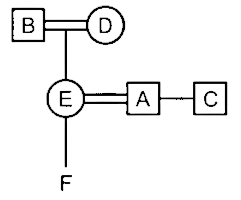
Hence, C is the brother of A.
Directions: These questions are based on the following information.
A family has six members – A, B, C, D, E, and F among three generations. There are two married couples in two generations of people. Further information is given as:
E is the mother of F. A is the son-in-law of B. E is the daughter of D who is the wife of B. C is the uncle of F. E is the only child of her parents. E has no siblings.
7. How is F related to A?
A. Son
B. Daughter
C. Niece
D. Mother in law
E. Can not be determined
Solution
From the given information
1) E is the mother of F.
2) E is the daughter of D who is the wife of B. E has no siblings.
The blood relation diagram is as follows,
3) A is the son-in-law of B. E is the only child of her parents.
4) C is the uncle of F.
Now the final blood relation diagram is as follows,
5) Here gender of F not defined.
Hence, Can not be determined.
Directions: These questions are based on the following information.
A family has six members – A, B, C, D, E, and F among three generations. There are two married couples in two generations of people. Further information is given as:
E is the mother of F. A is the son-in-law of B. E is the daughter of D who is the wife of B. C is the uncle of F. E is the only child of her parents. E has no siblings.
8. How is B related to F?
A. Grand mother
B. Mother
C. Grand father
D. Father
E. Can not be determined
Solution
From the given information,
1) E is the mother of F.
2) E is the daughter of D who is the wife of B. E has no siblings.
The blood relation diagram is as follows,
3) A is the son-in-law of B. E is the only child of her parents.
4) C is the uncle of F.
Now the final blood relation diagram is as follows,
5) Here gender of F not defined.
Hence, B is the grandfather of F.
9. Direction: In the following question assuming the given statements to be true, find which of the conclusion(s) among given conclusions is/are definitely true and then give your answers accordingly.
Statements:
F > H = K > L; D ≤ P < R = F
Conclusions:
I. R < K
II. R > D
A. Only I follows
B. Only II follows
C. Either I or Ii follows
D. None follow
E. Both I and II follow
Solution
Given statements: F > H = K > L; D ≤ P < R = F
By combining: D ≤ P < R = F > H = K > L
Conclusions:
I. R < K → False (as R = F > H = K, implies R > K)
II. R > D → True (as D ≤ P < R, implies R > D)
Hence, only II follows.
10. Direction: In the following question assuming the given statements to be true, find which of the conclusion(s) among given conclusions is/are definitely true and then give your answers accordingly.
Statements:
D ≤ E = L < M; U = L ≥ O > S
Conclusions:
I. E > S
II. U < M
A. Only I follows
B. Only II follows
C. Both I and II follows
D. None follow
E. Either I or II follows
Solution
Given statements: D ≤ E = L < M; U = L ≥ O > S
By combining: D ≤ E = L ≥ O > S; U = L < M
Conclusions:
I. E > S → True (as E = L ≥ O > S, implies E > S)
II. U < M → True (as U = L < M, implies U < M)
Hence, Both I and II follows.
11. Directions: In the following question assuming the given statements to be true, find which of the conclusion among given conclusions is/are definitely true and then give your answers accordingly.
Statements: E ≤ F < G > O = P ≥ Z ≥ A
Conclusions:
I. A < P
II. E ≥ O
A. Only conclusion I follows
B. Only conclusion II follows
C. Both conclusions I and II follows
D. None of the conclusions are follows
E. Either Conclusion I or II follows
Solution
Given Statements: E ≤ F < G > O = P ≥ Z ≥ A
Conclusions:
I. A < P → False (as E ≤ F < G > O = P ≥ Z ≥ A → P ≥ Z ≥ A → it is clear that P is greater or equal to A but it is not definite)
II. E ≥ O → False (Relation between E and O cannot be determined)
Hence, none of the conclusions is as follows.
Direction: The following questions are based on the five three-digit numbers given below.
713 486 635 562 875
12. If in each number three digits arranged in ascending order, which of the following will be the highest?
A. 486
B. 713
C. 875
D. 562
E. 635
Solution
Given series: 713 486 635 562 875
On each number three digits arranged in ascending order
The new series will be: 137 468 356 256 578
We obtained number as the highest numberTherefore, 875 is the correct option.
Direction: The following questions are based on the five three-digit numbers given below.
713 486 635 562 875
13. If each number second and third digits are interchanged, then how many odd numbers are there?
A. 2
B. 3
C. 4
D. 5
E. 1
Solution
Given series: 713 486 635 562 875
On interchanging each number second and third digits, we get:
731 468 653 526 857
Now there are three odd numbers in the seriesHence, 3 odd numbers are the right option.
Direction: The following questions are based on the five three-digit numbers given below.
713 486 635 562 875
14. If the second and third digits of each of the numbers are added then resulting sum of these two digits are divisible by 3 for which of the following number?
A. 486
B. 713
C. 562
D. 875
E. 635
Solution
Given series: 713 486 635 562 875
On adding second and third digits:
713 → 4
486 → 14
635 → 8
562 → 8
875 → 12
Here only 12 is divisible by 3.Hence, If the second and third digits of each of the numbers are added the resulting sum of “875” exactly divisible by 3.
Direction: The following questions are based on the five three-digit numbers given below.
713 486 635 562 875
15. If 2 is added to the last digit of each number and then the positions of the first and the third digits are interchanged, which of the following will be the lowest number?
A. 486
B. 713
C. 562
D. 875
E. 635
Solution
Given series: 713 486 635 562 875
Adding 2 to the last digit: 715 488 637 564 877
Interchanging first and the third digit: 517 884 736 465 778So, 465 is the lowest number which came from 562.
Direction: The following questions are based on the five three-digit numbers given below.
713 486 635 562 875
16. If the positions of the first and the third digit within each number are interchanged, which of the following will be the second-highest number?
A. 486
B. 713
C. 562
D. 875
E. 635
Solution
Given series: 713 486 635 562 875
Interchanging first and the third digit: 317 684 536 265 578Here 578 is the second-highest number which resulted from 875.
Direction: Study the following information carefully to answer the given questions.
Eight persons namely K, M, T, P, S, X, Z, and B are sitting around a circular table facing towards the centre not necessarily in same order. P is not a neighbour of X and B. Two persons sit between B and S. M is not a neighbour of B. X sits to the immediate left of S. T sits opposite to B. Number of persons who are sitting between T and X is same as number of persons between K and M.
17. What is the position of Z with respect to S?
A. Second to the right
B. Second to the left
C. Third to the left
D. Third to the right
E. Immediate right
Solution
Eight persons:- K, M, T, P, S, X, Z, and B
1) Two persons sit between B and S.
2) T sits opposite to B.
3) X sits to the immediate left of S.
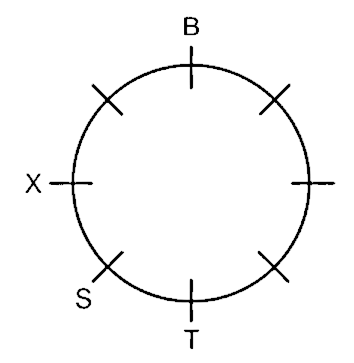
4) Number of persons who are sitting between T and X is same as number of persons between K and M.
5) M is not a neighbour of B.
6) P is not a neighbour of X and B.
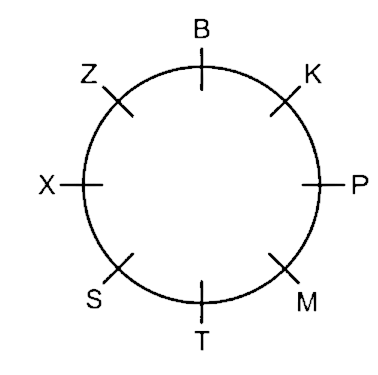
Hence, Z is sitting second to the left of S.
Direction: Study the following information carefully to answer the given questions.
Eight persons namely K, M, T, P, S, X, Z, and B are sitting around a circular table facing towards the centre not necessarily in same order. P is not a neighbour of X and B. Two persons sit between B and S. M is not a neighbour of B. X sits to the immediate left of S. T sits opposite to B. Number of persons who are sitting between T and X is same as number of persons between K and M.
18. Who sits third to the left of X?
A. M
B. P
C. B
D. K
E. T
Solution
Eight persons:- K, M, T, P, S, X, Z, and B
1) Two persons sit between B and S.
2) T sits opposite to B.
3) X sits to the immediate left of S.
4) Number of persons who are sitting between T and X is same as number of persons between K and M.
5) M is not a neighbour of B.
6) P is not a neighbour of X and B.
Hence, K sits third to the left of X.
Direction: Study the following information carefully to answer the given questions.
Eight persons namely K, M, T, P, S, X, Z, and B are sitting around a circular table facing towards the centre not necessarily in same order. P is not a neighbour of X and B. Two persons sit between B and S. M is not a neighbour of B. X sits to the immediate left of S. T sits opposite to B. Number of persons who are sitting between T and X is same as number of persons between K and M.
19. How many people are sitting between M and B, when counting from the right of M?
A. Three
B. One
C. Two
D. Four
E. None of the above
Solution
Eight persons:- K, M, T, P, S, X, Z, and B
1) Two persons sit between B and S.
2) T sits opposite to B.
3) X sits to the immediate left of S.
4) Number of persons who are sitting between T and X is same as number of persons between K and M.
5) M is not a neighbour of B.
6) P is not a neighbour of X and B.
Hence, two people P and K are sitting between M and B, when counting from the right of M.
20. How many such pairs of letters are there in a word which formed by replacing each vowel of the word ‘LIQUIDITY’ with the next letter and each consonant is replaced by immediate previous letter as per English alphabet, each of which has as many letters between them in the word, as they have in the English alphabet?
A. Two
B. One
C. Three
D. Four
E. Five
Solution
Given word: LIQUIDITY
⇒ Each vowel is replaced by immediate next letter and each consonant is replaced by an immediate previous letter.
Modified word: KJPVJCJSX
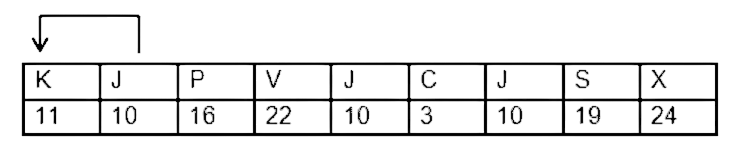
Hence, there is only one such pair.
Directions: Read the following information carefully and answer the questions.
Nine students, K, G, J, X, Z, T, M, O, and U who belong to the same school are divided into three houses, Yellow House, Green House and Blue House. The information given is not necessarily in the same order.Z doesn’t belong to either Green or Blue House. G and O belong to the same house. U, who belongs to Blue House, doesn’t belong to the same house as Z. K belongs to the Green House. X belongs to the same house as U. Z and J belong to the same house. M belongs to the same house as K. T doesn’t belong to the Yellow or Green House. G belongs to the same house as his twin brother K.
21. O belongs to the same house as?
A. M
B. T
C. X
D. Z
E. U
Solution
Given: Nine students are divided into three different houses.
Based on the given information, we get the following possibilities-
1. K belongs to the Green House. T doesn’t belong to the Yellow or Green House. Combining this, we get-
| HOUSE | PERSON |
| YELLOW | |
| GREEN | K |
| BLUE | T |
2. M belongs to the same house as K. G and O belong to the same house. G belongs to the same house as his twin brother K. Combining these, we get-
| HOUSE | PERSON |
| YELLOW | |
| GREEN | K,M,G,O |
| BLUE | T |
3. X belongs to the same house as U. U, who belongs to Blue House, doesn’t belong to the same house as Z. Combining this, we get-
| HOUSE | PERSON |
| YELLOW | |
| GREEN | K,M,G,O |
| BLUE | T, X, U |
4. U, who belongs to Blue House, doesn’t belong to the same house as Z. Z doesn’t belong to either Green or Blue House. Z and J belong to the same house. Combining these, we get the final table as follows-
| HOUSE | PERSON |
| YELLOW | Z, J |
| GREEN | K,M,G,O |
| BLUE | T, X, U |
From the above final table, we see that O belongs to the same house as M.Hence, O and M belong to the same house.
Comprehension:(Que No. 21 – 25)
Directions: Read the following information carefully and answer the questions.
Nine students, K, G, J, X, Z, T, M, O, and U who belong to the same school are divided into three houses, Yellow House, Green House and Blue House. The information given is not necessarily in the same order.Z doesn’t belong to either Green or Blue House. G and O belong to the same house. U, who belongs to Blue House, doesn’t belong to the same house as Z. K belongs to the Green House. X belongs to the same house as U. Z and J belong to the same house. M belongs to the same house as K. T doesn’t belong to the Yellow or Green House. G belongs to the same house as his twin brother K.
22. Who among the following belongs to Yellow House?
A. X
B. K
C. G
D. Z
E. U
Solution
Given: Nine students are divided into three different houses.
Based on the given information, we get the following possibilities-
1. K belongs to the Green House. T doesn’t belong to the Yellow or Green House. Combining this, we get-
| HOUSE | PERSON |
| YELLOW | |
| GREEN | K |
| BLUE | T |
2. M belongs to the same house as K. G and O belong to the same house. G belongs to the same house as his twin brother K. Combining these, we get-
| HOUSE | PERSON |
| YELLOW | |
| GREEN | K,M,G,O |
| BLUE | T |
3. X belongs to the same house as U. U, who belongs to Blue House, doesn’t belong to the same house as Z. Combining this, we get-
| HOUSE | PERSON |
| YELLOW | |
| GREEN | K,M,G,O |
| BLUE | T, X, U |
4. U, who belongs to Blue House, doesn’t belong to the same house as Z. Z doesn’t belong to either Green or Blue House. Z and J belong to the same house. Combining these, we get the final table as follows-
| HOUSE | PERSON |
| YELLOW | Z, J |
| GREEN | K,M,G,O |
| BLUE | T, X, U |
From the above final table, we see that Z belongs to Yellow House.
Hence, person Z belongs to Yellow House.
Comprehension:(Que No. 21 – 25)
Directions: Read the following information carefully and answer the questions.
Nine students, K, G, J, X, Z, T, M, O, and U who belong to the same school are divided into three houses, Yellow House, Green House and Blue House. The information given is not necessarily in the same order.Z doesn’t belong to either Green or Blue House. G and O belong to the same house. U, who belongs to Blue House, doesn’t belong to the same house as Z. K belongs to the Green House. X belongs to the same house as U. Z and J belong to the same house. M belongs to the same house as K. T doesn’t belong to the Yellow or Green House. G belongs to the same house as his twin brother K.
23. U belongs to the same house as?
A. J
B. K
C. M
D. G
E. T
Solution
Given: Nine students are divided into three different houses.
Based on the given information, we get the following possibilities-
1. K belongs to the Green House. T doesn’t belong to the Yellow or Green House. Combining this, we get-
| HOUSE | PERSON |
| YELLOW | |
| GREEN | K |
| BLUE | T |
2. M belongs to the same house as K. G and O belong to the same house. G belongs to the same house as his twin brother K. Combining these, we get-
| HOUSE | PERSON |
| YELLOW | |
| GREEN | K,M,G,O |
| BLUE | T |
3. X belongs to the same house as U. U, who belongs to Blue House, doesn’t belong to the same house as Z. Combining this, we get-
| HOUSE | PERSON |
| YELLOW | |
| GREEN | K,M,G,O |
| BLUE | T, X, U |
4. U, who belongs to Blue House, doesn’t belong to the same house as Z. Z doesn’t belong to either Green or Blue House. Z and J belong to the same house. Combining these, we get the final table as follows-
| HOUSE | PERSON |
| YELLOW | Z, J |
| GREEN | K,M,G,O |
| BLUE | T, X, U |
From the above final table, we see that U belongs to the same house as T.
Hence, U and T belong to the same house.
Directions: Read the following information carefully and answer the questions.
Nine students, K, G, J, X, Z, T, M, O, and U who belong to the same school are divided into three houses, Yellow House, Green House and Blue House. The information given is not necessarily in the same order.Z doesn’t belong to either Green or Blue House. G and O belong to the same house. U, who belongs to Blue House, doesn’t belong to the same house as Z. K belongs to the Green House. X belongs to the same house as U. Z and J belong to the same house. M belongs to the same house as K. T doesn’t belong to the Yellow or Green House. G belongs to the same house as his twin brother K.
24. K doesn’t belong to the same house as?
A. G
B. O
C. X
D. M
E. None of the above
Solution
Given: Nine students are divided into three different houses.
Based on the given information, we get the following possibilities-
1. K belongs to the Green House. T doesn’t belong to the Yellow or Green House. Combining this, we get-
| HOUSE | PERSON |
| YELLOW | |
| GREEN | K |
| BLUE | T |
2. M belongs to the same house as K. G and O belong to the same house. G belongs to the same house as his twin brother K. Combining these, we get-
| HOUSE | PERSON |
| YELLOW | |
| GREEN | K,M,G,O |
| BLUE | T |
3. X belongs to the same house as U. U, who belongs to Blue House, doesn’t belong to the same house as Z. Combining this, we get-
| HOUSE | PERSON |
| YELLOW | |
| GREEN | K,M,G,O |
| BLUE | T, X, U |
4. U, who belongs to Blue House, doesn’t belong to the same house as Z. Z doesn’t belong to either Green or Blue House. Z and J belong to the same house. Combining these, we get the final table as follows-
| HOUSE | PERSON |
| YELLOW | Z, J |
| GREEN | K,M,G,O |
| BLUE | T, X, U |
From the above final table, we see that K and X belong to different houses.
Hence, K doesn’t belong to the same house as X.
Directions: Read the following information carefully and answer the questions.
Nine students, K, G, J, X, Z, T, M, O, and U who belong to the same school are divided into three houses, Yellow House, Green House and Blue House. The information given is not necessarily in the same order.Z doesn’t belong to either Green or Blue House. G and O belong to the same house. U, who belongs to Blue House, doesn’t belong to the same house as Z. K belongs to the Green House. X belongs to the same house as U. Z and J belong to the same house. M belongs to the same house as K. T doesn’t belong to the Yellow or Green House. G belongs to the same house as his twin brother K.
25. Who among the following doesn’t belong to Green House?
A. G
B. K
C. T
D. O
E. M
Solution
Given: Nine students are divided into three different houses.
Based on the given information, we get the following possibilities-
1. K belongs to the Green House. T doesn’t belong to the Yellow or Green House. Combining this, we get-
| HOUSE | PERSON |
| YELLOW | |
| GREEN | K |
| BLUE | T |
2. M belongs to the same house as K. G and O belong to the same house. G belongs to the same house as his twin brother K. Combining these, we get-
| HOUSE | PERSON |
| YELLOW | |
| GREEN | K,M,G,O |
| BLUE | T |
3. X belongs to the same house as U. U, who belongs to Blue House, doesn’t belong to the same house as Z. Combining this, we get-
| HOUSE | PERSON |
| YELLOW | |
| GREEN | K,M,G,O |
| BLUE | T, X, U |
4. U, who belongs to Blue House, doesn’t belong to the same house as Z. Z doesn’t belong to either Green or Blue House. Z and J belong to the same house. Combining these, we get the final table as follows-
| HOUSE | PERSON |
| YELLOW | Z, J |
| GREEN | K,M,G,O |
| BLUE | T, X, U |
From the above final table, we see that apart from T, the rest all belong to Green House.
Hence, T doesn’t belong to Green House.
Directions: Study the information given below carefully and answer the questions that follow.
A person starts walking in north direction from point T, after walking 10 m he reached point U, then he takes right turn and walks 5 m to reach at point V after that he walks in south direction and walks 8 m to reach point W. Point X is 6 m east of point W. Point Y is 32 m north of X. Point Z is 8 m west of Y.
26. What is the direction of T with respect to X?
A. South-east
B. North-west
C. South-west
D. East
E. None of these
Solution
We have drawn the figure according to the information given in the question:
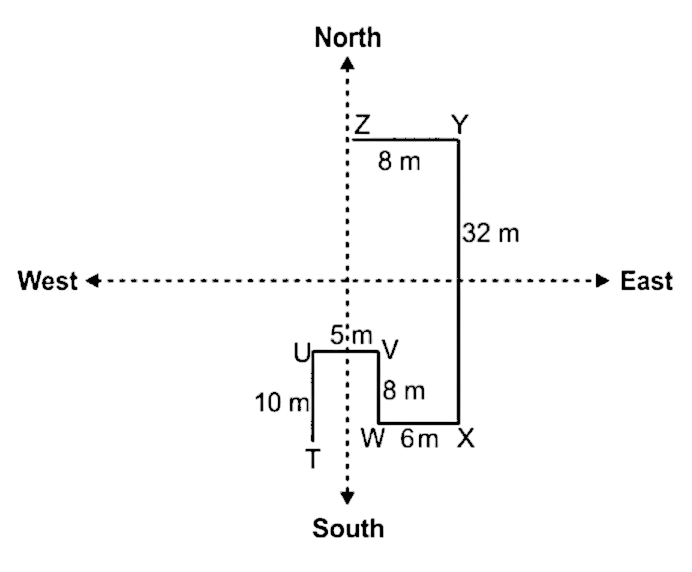
Hence, T is in the south-west direction to X.
Directions: Study the information given below carefully and answer the questions that follow.
A person starts walking in north direction from point T, after walking 10 m he reached point U, then he takes right turn and walks 5 m to reach at point V after that he walks in south direction and walks 8 m to reach point W. Point X is 6 m east of point W. Point Y is 32 m north of X. Point Z is 8 m west of Y.
27. What is the shortest distance between V and X?
A. 10
B. 15
C. 20
D. 25
E. None of these
Solution
We have drawn the figure according to the information given in the question:
The shortest distance between V and X is,
VX2 = VW2 + WX2
VX2 = 82 + 62
VX2 = 64 + 36
So,
VX = √100
VX = 10m.
Hence, the shortest distance between V and X is 10.
Directions: Study the information given below carefully and answer the questions that follow.
A person starts walking in north direction from point T, after walking 10 m he reached point U, then he takes right turn and walks 5 m to reach at point V after that he walks in south direction and walks 8 m to reach point W. Point X is 6 m east of point W. Point Y is 32 m north of X. Point Z is 8 m west of Y.
28. What is the direction of Y with respect to person’s initial position?
A. North
B. West
C. South-West
D. North-East
E. None of these
Solution
We have drawn the figure according to the information given in the question:
Hence, Y is in the Northeast direction with respect to the initial point.
29. If it is possible to make only one meaningful English word with the 1st, 4th, 7th, and 10th letters of the word RELAXATION, which of the following will be the third letter of that word? If no such word can be made give ‘X’ as the answer and if more than one such word can be made give ‘Y’ as the answer.
A. R
B. L
C. N
D. X
E. Y
Solution
| Given Word | R E L A X A T I O N |
| Chosen letters | R, A, T, N |
| possible word | TARN, RANT |
Hence, as more than one word can be formed from the chosen letters, the answer will be ‘Y’.
Comprehension:(Que No. 30 – 34)
Direction: Study the following information carefully and answer based on it.
Eight persons A, B, C, D, E, F, G and H are sitting in a row. First four persons from left end face north while rest face south. E sits second to the right of H and both face in different directions. F is second person from one of the ends. D and F face same direction. G sits to the right of B. A sits to the immediate right of C, who sits at the extreme end. G does not sit adjacent to E. F sits immediate left of D and both faces south direction.
30. How many persons sit between B and G?
A. One
B. Three
C. Five
D. Two
E. None
Solution
1. E sits second to the right of H and both face in different directions.
2. F is second person from one of the ends.
3. D and F face same direction. G sits to the right of B.
4. A sits to the immediate right of C, who sits at the extreme end.
5. G does not sit adjacent to E.
6. F sits immediate left of D and both faces south direction.
Case 1:
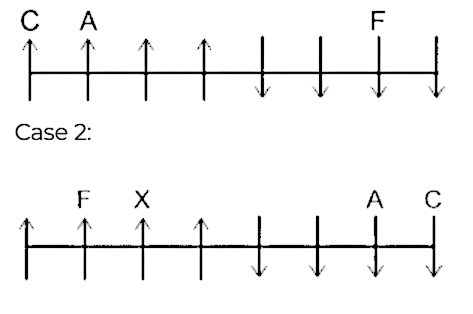
E sits second to the right of H and both face in different direction. F sits immediate left of D and both face south direction.
So, case 2, would be invalid as H and E can not be placed in the arrangement.
Case 1:

G sits to the right of B. G does not sit adjacent to E.
So, G must be immediate left of F.
Case 1:

Three persons sit between B and G.
Hence correct answer is option 2.
Direction: Study the following information carefully and answer based on it.
Eight persons A, B, C, D, E, F, G and H are sitting in a row. First four persons from left end face north while rest face south. E sits second to the right of H and both face in different directions. F is second person from one of the ends. D and F face same direction. G sits to the right of B. A sits to the immediate right of C, who sits at the extreme end. G does not sit adjacent to E. F sits immediate left of D and both faces south direction.
31. If H does not sit adjacent to A then who sits immediate left of H?
A. A
B. H
C. D
D. B
E. F
Solution
1. E sits second to the right of H and both face in different directions.
2. F is second person from one of the ends.
3. D and F face same direction. G sits to the right of B.
4. A sits to the immediate right of C, who sits at the extreme end.
5. G does not sit adjacent to E.
6. F sits immediate left of D and both faces south direction.
Case 1:
E sits second to the right of H and both face in different direction. F sits immediate left of D and both face south direction.
So, case 2, would be invalid as H and E can not be placed in the arrangement.
Case 1:
G sits to the right of B. G does not sit adjacent to E.
So, G must be immediate left of F.
Case 1:
Three persons sit between B and G.
Hence correct answer is option 3.
Direction: Study the following information carefully and answer based on it.
Eight persons A, B, C, D, E, F, G and H are sitting in a row. First four persons from left end face north while rest face south. E sits second to the right of H and both face in different directions. F is second person from one of the ends. D and F face same direction. G sits to the right of B. A sits to the immediate right of C, who sits at the extreme end. G does not sit adjacent to E. F sits immediate left of D and both faces south direction.
32. Who sits third to the right of F?
A. C
B. G
C. A
D. D
E. B
Solution
1. E sits second to the right of H and both face in different directions.
2. F is second person from one of the ends.
3. D and F face same direction. G sits to the right of B.
4. A sits to the immediate right of C, who sits at the extreme end.
5. G does not sit adjacent to E.
6. F sits immediate left of D and both faces south direction.
Case 1:
E sits second to the right of H and both face in different direction. F sits immediate left of D and both face south direction.
So, case 2, would be invalid as H and E can not be placed in the arrangement.
Case 1:
G sits to the right of B. G does not sit adjacent to E.
So, G must be immediate left of F.
Case 1:
Three persons sit between B and G.
Hence correct answer is option 5.
Direction: Study the following information carefully and answer based on it.
Eight persons A, B, C, D, E, F, G and H are sitting in a row. First four persons from left end face north while rest face south. E sits second to the right of H and both face in different directions. F is second person from one of the ends. D and F face same direction. G sits to the right of B. A sits to the immediate right of C, who sits at the extreme end. G does not sit adjacent to E. F sits immediate left of D and both faces south direction.
33. What is the position of A with respect to C?
A. Immediate right
B. Second to the left
C. Immediate left
D. Third to the left
E. Second to the right
Solution
1. E sits second to the right of H and both face in different directions.
2. F is second person from one of the ends.
3. D and F face same direction. G sits to the right of B.
4. A sits to the immediate right of C, who sits at the extreme end.
5. G does not sit adjacent to E.
6. F sits immediate left of D and both faces south direction.
Case 1:
E sits second to the right of H and both face in different direction. F sits immediate left of D and both face south direction.
So, case 2, would be invalid as H and E can not be placed in the arrangement.
Case 1:
G sits to the right of B. G does not sit adjacent to E.
So, G must be immediate left of F.
Case 1:
Three persons sit between B and G.
Hence correct answer is option 1.
Direction: Study the following information carefully and answer based on it.
Eight persons A, B, C, D, E, F, G and H are sitting in a row. First four persons from left end face north while rest face south. E sits second to the right of H and both face in different directions. F is second person from one of the ends. D and F face same direction. G sits to the right of B. A sits to the immediate right of C, who sits at the extreme end. G does not sit adjacent to E. F sits immediate left of D and both faces south direction.
34. Which of the statements is/are true?
1.C does not sit at end of the row.
2.B faces north direction.
3.D sits second to the left of G.
A. Both statements 2 and 3 are true
B. Only statement 3 is true
C. All statements 1, 2 and 3 are true
D. Only statement 2 is true.
E. Both statements 1 and 3 are true
Solution
1. E sits second to the right of H and both face in different directions.
2. F is second person from one of the ends.
3. D and F face same direction. G sits to the right of B.
4. A sits to the immediate right of C, who sits at the extreme end.
5. G does not sit adjacent to E.
6. F sits immediate left of D and both faces south direction.
Case 1:
E sits second to the right of H and both face in different direction. F sits immediate left of D and both face south direction.
So, case 2, would be invalid as H and E can not be placed in the arrangement.
Case 1:
G sits to the right of B. G does not sit adjacent to E.
So, G must be immediate left of F.
Case 1:
Three persons sit between B and G.
Hence correct answer is option 4.
35. How many pairs of letters are there in the word “VACCINATE” each of which has as many letters between them in the word (in the forward direction) as they have between them in the English alphabetical order?
A. Three
B. Four
C. One
D. Five
E. Two
Solution
The alphabets are positioned in the following order:

The word can be represented as follows:
In forward direction: “AC”

Thus, there is one pair of letters in the word “VACCINATE” as according to the English alphabetical series.
Hence, one is the correct answer.
 Mistake Points
We have to count pairs only in the forward direction.
Directions: Study the following information carefully to answer the given questions:
E 4 W 2 G 6 @ S 5 8 X A ! I M 9 & Q ^ J L # 7 * C $ G V % K
36. Which of the following is 8th to the right of 14th from the left end of the above arrangement?
A. 6
B. C
C. !
D. #
E. M
Solution
The logic follows here is :-
Given series :
Left side E 4 W 2 G 6 @ S 5 8 X A ! I M 9 & Q ^ J L # 7 * C $ G V % K Right side
8th to the right of 14th from the left end → 14th from left end + 8th to right of 14th → 22nd from left end
Clearly, 22nd from left end is ‘#’.
Thus, the correct answer is “#”.
Directions: Study the following information carefully to answer the given questions:
E 4 W 2 G 6 @ S 5 8 X A ! I M 9 & Q ^ J L # 7 * C $ G V % K
37. How many such vowels are there in above arrangement, each of which is immediately preceded by a symbol and immediately followed by a consonant?
A. Two
B. One
C. Four
D. None
E. Three
Solution
The logic follows here is :-
Given series :
Left side E 4 W 2 G 6 @ S 5 8 X A ! I M 9 & Q ^ J L # 7 * C $ G V % K Right side
Vowels that are which is immediately preceded by a symbol and immediately followed by a consonant is :
E 4 W 2 G 6 @ S 5 8 X A ! I M 9 & Q ^ J L # 7 * C $ G V % K
Hence, there is only one vowel which is immediately preceded by a symbol and immediately followed by a consonant.
Thus, the correct answer is “One”.
Directions: Study the following information carefully to answer the given questions:
E 4 W 2 G 6 @ S 5 8 X A ! I M 9 & Q ^ J L # 7 * C $ G V % K
38. Four of following five are alike in a certain way based on their positions in the above arrangement and so form a group. Which is the one that does not belong to that group?
A. W@G
B. XM!
C. @X5
D. LC7
E. &^M
Solution
The logic follows here is :-
Given series :
E 4 W 2 G 6 @ S 5 8 X A ! I M 9 & Q ^ J L # 7 * C $ G V % K
Here, the group formed is second element is +4 element of first element and third element is -2 of second element.
Hence, &^M does not belong to the group.
Thus, the answer is “&^M”.
Directions: Study the following information carefully to answer the given questions:
E 4 W 2 G 6 @ S 5 8 X A ! I M 9 & Q ^ J L # 7 * C $ G V % K
39. If all the numbers in the above arrangement are dropped, then which of the following will be the 8th from the left end?
A. M
B. Q
C. !
D. S
E. &
Solution
The logic follows here is :-
Given series :
E 4 W 2 G 6 @ S 5 8 X A ! I M 9 & Q ^ J L # 7 * C $ G V % K
If all numbers are dropped the series is :
E W G @ S X A ! I M & Q ^ J L # * C $ G V % K
Therefore, 8th from left end is ‘!’.
Thus, the correct answer is “!”.
Directions: Study the following information carefully to answer the given questions:
E 4 W 2 G 6 @ S 5 8 X A ! I M 9 & Q ^ J L # 7 * C $ G V % K
40. How many such symbols are there in the above arrangement each of which are immediately preceded by a number and followed by an alphabet?
A. One
B. Four
C. Three
D. Five
E. Two
Solution
The logic follows here is :-
Given series :
E 4 W 2 G 6 @ S 5 8 X A ! I M 9 & Q ^ J L # 7 * C $ G V % K
Symbols which are immediately preceded by a number and followed by an alphabet is :
E 4 W 2 G 6 @ S 5 8 X A ! I M 9 & Q ^ J L # 7 * C $ G V % K
Hence, there are three symbols which are immediately preceded by a number and followed by an alphabet.
Thus, the correct answer is “Three”.
Numerical Ability
Direction: Read the following graph carefully and answer the following questions:
Total production of fruits in city = 450 tones

41. Find the average number of Apples and Grapes production of fruits.
A. 85 tones
B. 40 tones
C. 90 tones
D. 80 tones
E. 45 tones
Solution
Calculation:
Total production of Grapes = 450 × (32/100) = 144 tones
Total production of Apples = 450 × (8/100) = 36 tones
Total production of Grapes and apples = (144 + 36) tones
⇒ 180 tones
Required average = (180/2) tones
⇒ 90 tones
∴ The required average is 90 tones
Direction: Read the following graph carefully and answer the following questions:
Total production of fruits in city = 450 tones
42. The production of Custard Apple is approximately what percent more than the production of Guava?
A. 49%
B. 51%
C. 42%
D. 40%
E. 46%
Solution
Calculation:
Total production of Custard Apple = 450 × (35/100)
⇒ 157.5 tones
Total production of Guava = 450 × (25/100)
⇒ 112.5 tones
Required percentage =[(157.5 – 112.5)/112.5] × 100
⇒ (45/112.5) × 100
⇒ 40%
∴ The required percentage is 40%
Shortcut Trick
Required percentage = ( 35 – 25)%/25% × 100 = 10/25 × 100 = 40 %
∴ The required percentage is 40%
Direction: Read the following graph carefully and answer the following questions:
Total production of fruits in city = 450 tones
43. If 5% of production is rotten of all fruits production then approximately the good production of Apples is what percent of the total production of fruits?
A. 8%
B. 9%
C. 6%
D. 10%
E. 11%
Solution
Calculation:
Total production of apples = 450 × (8/100)
⇒ 36
Total production of good apples = 36 × (95/100)
⇒ 34.2
Total production of fruits = 450 tones
Required percentage = (34.2/450) × 100
⇒ 7.6%
∴ The required percentage is 7.6%
Direction: Read the following graph carefully and answer the following questions:
Total production of fruits in city = 450 tones
44. Find the difference between the production of Grapes and Guava.
A. 33.8 tones
B. 29.6 tones
C. 31.5 tones
D. 33.5 tones
E. 30.4 tones
Solution
Calculation:
Total production of Grapes = 450 × (32/100)
⇒ 144 tones
Total production of Guava = 450 × (25/100)
⇒ 112.5 tones
Required difference = (144 – 112.5)
⇒ 31.5 tones
∴ The difference between production of Grapes and Guava is 31.5 tones
Direction: Read the following graph carefully and answer the following questions:
Total production of fruits in city = 450 tones
45. Find the ratio between the degree distribution of Custard Apple and Apple.
A. 2 : 3
B. 4 : 1
C. 8 : 35
D. 1 : 4
E. 35 : 8
Solution
Calculation:
Degree distribution of Custard Apple in total production = (35/100) × 360°
Degree distribution of Apple in total production = (8/100) × 360 = 28.8°
Required ratio = 126° : 28.8°
⇒ 35: 8
∴ The required ratio is 35 : 8
46. A person travels at 30 km/h for 2 hours by bike and 20 km/h by walk. If completes his total journey in 3 hours. What is the total distance travelled by him?
A. 60 km
B. 40 km
C. 30 km
D. 50 km
E. None of these
Solution
Given:
Speed by bike = 30 km/h
Speed by walk = 20 km/h
Time taken by bike = 2 hours
Total duration of journey = 3 hours
Formula used:
Speed = Distance/Time
Calculations:
Time taken by walk = 3 – 2 = 1 hour
Distance travelled by bike = 30 × 2 = 60 km
Distance travelled by walk = 20 × 1 = 20 km
Total distance travelled = 60 + 20 = 80 km
∴ Total distance travelled by him is 80 km.
47. In the given question, two equations numbered l and II are given. You have to solve both the equations and mark the appropriate answer-
I. x2 + 16x + 15 = 0
II. 2y2 + 3y + 1 = 0
A. x > y
B. x < y
C. x ≥ y
D. x ≤ y
E. x = y or relationship between x and y cannot be established.
Solution
I. x2 + 16x + 15 = 0
⇒ x2 + x + 15x + 15 = 0
⇒ x(x + 1) + 15(x + 1) = 0
⇒ (x + 15)(x + 1) = 0
⇒ x = -15, -1
II. 2y2 + 3y + 1 = 0
⇒ 2y2 + 2y + y + 1 = 0
⇒ 2y(y + 1) + 1(y + 1) = 0
⇒ (2y + 1)(y + 1) = 0
⇒ y = -1/2, -1
| Value of x | Value of y | Relation |
| -15 | -1/2 | x < y |
| -15 | -1 | x < y |
| -1 | -1/2 | x < y |
| -1 | -1 | x = y |
Hence x ≤ y
48. In the given question, two equations numbered l and II are given. Solve both the equations and mark the appropriate answer.
I. x2 – 17x + 70 = 0
II. y2 – 14y + 45 = 0
A. x > y
B. x < y
C. x ≥ y
D. x ≤ y
E. x = y or relationship between x and y cannot be established.
Solution
I. x2 – 17x + 70 = 0
⇒ x2 – 7x – 10x + 70 = 0
⇒ x(x – 7) – 10(x – 7) = 0
⇒ (x – 7) (x – 10) = 0
⇒ x = 7, 10
II. y2 – 14y + 45 = 0
⇒ y2 – 9y – 5y + 45 = 0
⇒ y(y – 9) – 5(y – 9) = 0
⇒ (y – 9) (y – 5) = 0
⇒ y = 9, 5
| Value of x | Value of y | Relation |
| 7 | 9 | x < y |
| 7 | 5 | x > y |
| 10 | 9 | x > y |
| 10 | 5 | x > y |
∴ The relationship between x and y cannot be established
49. In the given question, two equations numbered l and II are given. Solve both the equations and mark the appropriate answer.
I. 5x2 – 16x + 3 = 0
II. 8y2 – 58y + 105= 0
A. x > y
B. x < y
C. x ≥ y
D. x ≤ y
E. x = y or relationship between x and y cannot be established.
Solution
I. 5x2 – 16x + 3 = 0
⇒ 5x2 – 15x – x + 3 = 0
⇒ 5x (x – 3) – 1 (x – 3) = 0
⇒ (x – 3) (5x – 1) = 0
⇒ x = 3, 1/5
II. 8y2 – 58y + 105 = 0
⇒ 8y2 – 30y – 28y + 105 = 0
⇒ 2y (4y – 15) – 7 (4y – 15) = 0
⇒ (2y – 7) (4y – 15) = 0
⇒ y = 7/2, 15/4
| Value of x | Value of y | Relation |
| 3 | 7/2 | x < y |
| 3 | 15/4 | x < y |
| 1/5 | 7/2 | x < y |
| 1/5 | 15/4 | x < y |
Hence x < y
50. In the given question, two equations numbered l and II are given. Solve both the equations and mark the appropriate answer
i. x2 – 14x + 48 = 0
ii. y2 – 7y + 12 = 0
A. x > y
B. x < y
C. x ≥ y
D. x ≤ y
E. x = y or relationship between x and y cannot be established.
Solution
i. x2 – 14x + 48
⇒ x2 – 6x – 8x + 48 = 0
⇒ x(x – 6) – 8(x – 6) = 0
⇒ (x – 6) (x – 8) = 0
⇒ x = 6, 8
ii. y2 – 7y + 12 = 0
⇒ y2 – 4y – 3y + 12 = 0
⇒ y(y – 4) – 3(y – 4) = 0
⇒ (y – 4) (y – 3) = 0
⇒ y = 4, 3
| Value of x | Value of y | Relation |
| 6 | 4 | x > y |
| 6 | 3 | x > y |
| 8 | 4 | x > y |
| 8 | 3 | x > y |
∴ x > y
51. In the given question, two equations numbered l and II are given. Solve both the equations and mark the appropriate answer.
i. x2 – 6x – 112 = 0
ii. y3 = 3375
A. x > y
B. x < y
C. x ≥ y
D. x ≤ y
E. x = y or relationship between x and y cannot be established.
Solution
i. x2 – 6x – 112 = 0
⇒ x2 – 14x + 8x – 112 = 0
⇒ x(x – 14) + 8(x – 14) = 0
⇒ (x – 14) (x + 8) = 0
⇒ x = 14, -8
ii. y3 = 3375
⇒ y = 15
| Value of x | Value of y | Relation |
| 14 | 15 | x < y |
| -8 | 15 | x < y |
∴ x < y
52. The ratio of the speed of the boat and the speed of the current is 7:1. The ratio of time taken to travel the distance ‘D’ downstream and (D – 40) upstream is 5 : 4. Find distance D.
A. 135 km
B. 100 km
C. 110 km
D. 140 km
E. 120 km
Solution
The ratio of speed of boat and speed of current = 7 : 1
Then downstream speed = 8k and upstream speed = 6k
⇒Time = distance/speed
⇒(D / 8k) / [(D – 40) / 6k] = 5 /4
⇒(D/8) / [(D-40)/6] = 5 / 4
⇒D / (D – 40) = (5 × 8) / ( 4 × 6)
⇒D / (D – 40) = 5/3
⇒3D = 5D – 200
⇒5D – 3D = 200
⇒D = 100 km
Hence 100 km is the correct answer.
53. The length and breadth of a hall are 60 m and 50 m respectively. What will be the length of the 2 m wide carpet which should cover the entire floor?
A. 110 m
B. 150 m
C. 300 m
D. 1500 m
E. 3000 m
Solution
Given:
The length of the hall = 60 m
The breadth of the hall = 50 m
The breadth of the carpet = 2 m
Formula used:
A = a × b (Where, A = Area of the rectangle, a = Length and b = Breadth)
Calculation:
Let the length of the carpet be X
According to the question
⇒ 2 × X = 60 × 50
⇒ X = 1500 m
∴ The required result will be 1500 m.
54. A starts a business with Rs.3600. After a certain period of time B joined A with an investment of Rs.2700. At the end of the year they divided the profit in the ratio 8 : 3. For what time period did B joined A ?
A. 3 months
B. 6 months
C. 9 months
D. 15 months
E. 12 months
Solution
Given:
Investment of A = Rs.3600
Investment of B = Rs.2700
Ratio of profit of A and B = 8 : 3
Calculation:
⇒ Ratio of Profit = (Capital of A × Time)/(Capital of B × Time)
⇒ Let B’s time period in the investment = X month.
⇒ (3600 × 12)/(2700 × X) = 8/3
⇒ X = (3600 × 12 × 3)/(2700 × 8)
X = 6 months
∴ B joined A for 6 months.
The Number of Computer Manufactured by two companies over the years (Number is given in thousands)
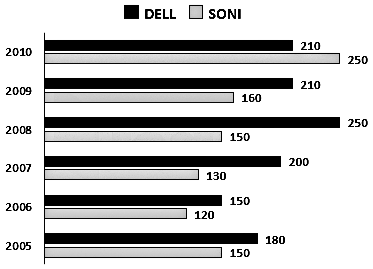
55. What is the difference between the number of manufactured Computers by Company DELL in 2007 and 2008?
A. 20,000
B. 50,000
C. 40,000
D. 60,000
E. NOT
Solution
Given:
The total manufactured Computer by Dell in 2007 = 200
The total manufactured Computer by Dell in 2008 = 250
Formula used
The required difference between the number of manufactured computers by Dell = manufactured computer in 2008 – manufactured computer in 2007
Calculation
Difference between number of manufactured computers = 250 – 200 = 50The required difference between number of manufactured computers = 50,000 (in thousands)
Comprehension:(Que No. 15 – 19)
The Number of Computer Manufactured by two companies over the years (Number is given in thousands)
56. What is the difference between the total production of computers in DELL and SONI in the given years?
A. 150,000
B. 200,000
C. 240,000
D. 50,000
E. None of these
Solution
Given:
The total production of computers by DELL company = 180 + 150 + 200 + 250 + 210 + 210 = 1200
The total production of computers by SONI company = 150 + 120 + 130 + 150 +160 + 250 = 960
Formula used
The difference between total required productions = total production of computers by DELL company – total production of computers by SONI company
Calculation
Difference between the total required production = 1200 – 960 = 240= 240,000 (in thousands)
Comprehension:(Que No. 15 – 19)
The Number of Computer Manufactured by two companies over the years (Number is given in thousands)
57. What is the average number of Computers manufactured by Company DELL over the given period? (Round of the nearest integer)
A. 200,000
B. 150,000
C. 220,000
D. 350,000
E. 300, 000
Solution
Given:
The total Production of computers by DELL = 180 + 150 + 200 + 250 + 210 + 210 = 1200
Formula used
Average number of computers manufactured by DELL = total production of computers by DELL ÷ total number of years
Calculation
The Average number of Dell Computer = 1200 ÷ 6 = 200The Average number of Dell Computer = 200, 000 (in thousands)
The Number of Computer Manufactured by two companies over the years (Number is given in thousands)
58. In which of the following years, the difference between the productions of SONI and DELL computers were the maximum among the given years?
A. 2007
B. 2008
C. 2009
D. 2006
E. NOT
Solution
Given:
The production of SONI and DELL computers in 2006 = 120 and 150
The production of SONI and DELL computers in 2007 = 130 and 200
The production of SONI and DELL computers in 2008 = 150 and 250
The production of SONI and DELL computers in 2009 = 160 and 210
Formula used
The required difference of production of computers = Production of SONI computers in particular year – Production of DELL computers in the same years
Calculation
The required difference in 2006 = 150 – 120 = 30
The required difference in 2007 = 200 – 130 = 70
The required difference in 2008 = 250 – 150 = 100
The required difference in 2009 = 210 – 160 = 50From the above, we can say that the difference in the production of SONI computers and the DELL computers in 2008 was maximum.
The Number of Computer Manufactured by two companies over the years (Number is given in thousands)
59. The production of SONI computers in 2008 was approximately what percent of the production of DELL computers in the same years?
A. 86%
B. 80%
C. 90%
D. 75%
E. 60%
Solution
Given:
The production of DELL computers in 2008 = 250
The production of SONI computers in 2008 = 150
Formula used
Production percentage = the production of SONI computers in 2008 ÷ the production of DELL computers in 2008 × 100
Calculation
The required production percentage = 150 ÷ 250 × 100= 60%
60. The probability of A climbing the mountain is 1 / 3 and B climbing the mountain is 3 / 8. What is the probability that either one climbs the mountain?
A. 11/24
B. 1/24
C. 1/8
D. 13/24
E. 19/24
Solution
Given:
P (A) = 1 / 3
P (B) = 3 / 8
Formula used:
P (U) = (P(A) × P’(B)) + (P’(A) × P(B))
P(A) = Probability of A event happening
P(B) = Probability of B event happening
Calculation:
P’ (A) = 2 / 3
P’ (B) = 5 / 8
⇒ P (U) = ((1 / 3) × (5 / 8)) + ((2 / 3) × (3 / 8))
⇒ P (U) = (5 / 24) + (6 / 24)
⇒ P (U) = 11 / 24
∴ Probability of either one climbing the mountain is 11/24
Key Points
P (U) = (P(A) × P’(B)) + (P’(A) × P(B))
P(A) = Probability of A event happening
P(B) = Probability of B event happening
61. A can do a piece of work in 6 hours, B and C together can do it in 2 hours, while A and C together can do it in 3 hours. How long will B alone take to do it?
A. 1 hours
B. 5 hours
C. 3 hours
D. 4 hours
E. None of these
Solution
Given:
A can do a piece of work in 6 hours
B and C together can do it in 2 hours
Formula:
(A + B + C)’s 1 day = 1/A + 1/B + 1/C
Calculation:
A can do a piece of work in 6 hours
A’s one hour work = 1/6
B and C together can do it in 2 hours
(B + C)’s one-hour work = 1/2
A and C together can do it in 3 hours
(A + C)’s one-hour work = 1/3
(A + B + C)’s 1 hour work = 1/6 + 1/2 = 8/12 = 2/3
B’s 1 hour work = 2/3 – 1/3 = 1/3
∴ B alone will take 3 hours to do the work.
62. A train crosses two persons walking in opposite direction in which the train is going, at the rate of 18kmph and 36kmph in 9 seconds and 6 seconds respectively. The Length of the train is –
A. 60 m
B. 90 m
C. 30 m
D. 40 m
E. 120 m
Solution
Given,
Let Length of train be L m.
Speed of train be S m/s.
Speed of one person = 18 km/h = 18 × 5/18 = 5 m/s
Speed of other person = 36 km/h = 36 × 5/18 = 10 m/s
Then,
⇒ 9 = L/(5 + S)
⇒ 6 = L/(10 + S)
Solving,
⇒ 45 + 9S = 60 + 6S
⇒ 3S = 15
⇒ S = 5 m/s
Then,⇒ L = (5 + 5) × 9 = 90 m
63. What will come in the place of the question mark ‘?’ in the following question?
9.09% of 1331 + 7.69% of 169 = ?
A. 120
B. 134
C. 150
D. 144
E. 124
Solution
GIVEN:
9.09% of 1331 + 7.69% of 169 = ?
FORMULA USED:
These types of questions, the knowledge of conversion from percentage to fraction should be known.
| Fraction | 1/11 | 1/12 | 1/13 | 1/14 |
| Percentage (%) | 9.09 | 8.33 | 7.69 | 7.14 |
Concept :
Follow BODMAS rule to solve this question, as per the order given below.
Step – 1: Parts of an equation enclosed in ‘Brackets’ must be solved first, and following BODMAS rule in the bracket –
Step – 2: Any mathematical ‘Of’ or ‘Exponent’ must be solved next.
Step – 3: Next, the parts of the equation that contain ‘Division’ and ‘Multiplication’ are calculated.
Step – 4: Last but not the least, the parts of the equation that contain ‘Addition’ and ‘Subtraction’ should be calculated.
CALCULATION:
9.09% of 1331 = (1/11) × 1331 = 121
7.69% of 169 = (1/13) × 169 = 13
Given expression is
9.09% of 1331 + 7.69% of 169 = ?
⇒ 121 + 13 = ?
⇒ 134 = ?
∴ ? = 134
64. What will come in the place of the question mark ‘?’ in the following question?
96 of 7 ÷ 14 + 54 of 6 – 18 = ?
A. 354
B. 364
C. 374
D. 392
E. 344
Solution
Concept used:
Follow BODMAS rule to solve this question, as per the order given below,
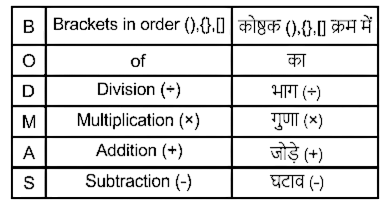
Calculation:
(96 × 7)/14 + (54 × 6) – 18 = ?
⇒ 672/14 + 324 – 18 = ?
⇒ 48 + 324 – 18 = ?
⇒ 372 – 18 = ?
⇒ 354 = ?
∴ The value of ? is 354
65. What will come in the place of the question mark ‘?’ in the following question?
165% × 24 ÷ 3 + 35% of 1200 = ?
A. 459.40
B. 440
C. 469.40
D. 449.40
E. 433.20
Solution
Follow BODMAS rule to solve this question, as per the order given below.
Step – 1: Parts of an equation enclosed in ‘Brackets’ must be solved first, and following BODMAS rule in the bracket –
Step – 2: Any mathematical ‘Of’ or ‘Exponent’ must be solved next.
Step – 3: Next, the parts of the equation that contain ‘Division’ and ‘Multiplication’ are calculated.
Step – 4: Last but not the least, the parts of the equation that contain ‘Addition’ and ‘Subtraction’ should be calculated.
Given expression is
165% × 24 ÷ 3 + 35% of 1200 = ?
⇒ (100% + 65%) of 24/3 + 420 = ?
⇒ (100% + 65%) of 8 + 420 = ?
⇒ 8 + 5.2 + 420 = ?
∴ ? = 433.2
66. What will come in place of question mark (?) in the following equation?
{36 + 28} ÷ { -12 + 4} = ?3
A. 2
B. 4
C. -4
D. -2
E. 1
Solution
Follow BODMAS rule to solve this question, as per the order given below,
Step-1: Parts of an equation enclosed in ‘Brackets’ must be solved first, and in the bracket,
Step-2: Any mathematical ‘Of’ or ‘Exponent’ must be solved next,
Step-3: Next, the parts of the equation that contain ‘Division’ and ‘Multiplication’ are calculated,
Step-4: Last but not least, the parts of the equation that contain ‘Addition’ and ‘Subtraction’ should be calculated
{36 + 28} ÷ { – 12 + 4} = ?3
⇒ 64 ÷ {- 8} = ?3
⇒ {- 8} = ?3
∴ ? = – 2
67. What will come in the place of the question mark ‘?’ in the following question?
[(8 × 7 + 2 × 8)/8] × 6 = 3 × ?
A. 24
B. 27
C. 21
D. 18
E. 15
Solution
Concept used:
Follow BODMAS rule to solve this question, as per the order given below.
Calculation:
[(8 × 7 + 2 × 8)/8] × 6 = 3 × ?
⇒ [(56 + 16)/8] × 6 = 3 × ?
⇒ (72/8) × 6 = 3 × ?
⇒ 9 × 6 = 3 × ?
⇒ ? = 18
∴ The value of ? is 18
68. What will come in the place of the question mark ‘?’ in the following question?9 × 82 = 4 × 17 + 1–√616 × ?
A. 64
B. 32
C. 128
D. 256
E. 127
Solution
Follow BODMAS rule to solve this question, as per the order given below.
Step – 1: Parts of an equation enclosed in ‘Brackets’ must be solved first, and following BODMAS rule in the bracket –
Step – 2: Any mathematical ‘Of’ or ‘Exponent’ must be solved next.
Step – 3: Next, the parts of the equation that contain ‘Division’ and ‘Multiplication’ are calculated.
Step – 4: Last but not the least, the parts of the equation that contain ‘Addition’ and ‘Subtraction’ should be calculated.
Given expression is
9 × 82 = 4 × 17 + 1–√616 × ?
⇒ (576) – (68) = 4 × ?
⇒ 508 = 4 × ?
⇒ 508/4 = ?
⇒ 127 = ?
⇒ ? = 127
∴ ? = 127
69. What will come in the place of the question mark ‘?’ in the following question?
√1089 ÷ 11 × 5 + 25 of 36 = 3 × ?
A. 285
B. 305
C. 315
D. 335
E. 275
Solution
Follow BODMAS rule to solve this question, as per the order given below.
Step – 1: Parts of an equation enclosed in ‘Brackets’ must be solved first, and following BODMAS rule in the bracket –
Step – 2: Any mathematical ‘Of’ or ‘Exponent’ must be solved next.
Step – 3: Next, the parts of the equation that contain ‘Division’ and ‘Multiplication’ are calculated.
Step – 4: Last but not the least, the parts of the equation that contain ‘Addition’ and ‘Subtraction’ should be calculated.
Given expression is
√1089 ÷ 11 × 5 + 25 of 36 = 3 × ?
⇒ 33 ÷ 11 × 5 + (100/4) of 36 = 3 × ?
⇒ 3 × 5 + 900 = 3 × ?
⇒ 3 × ? = 915
∴ ? = 305
70. Find the value of x.
√(7225) + 45 × 4 ÷ 6 = x% of 500
A. 26
B. 21
C. 24
D. 23
E. 22
Solution
Solution:
√(7225) + 45 × 4 ÷ 6 = x% of 500
85 + 30 = (x/100) × 500
115 = 5x
x = 23
71. Determine the value of the question mark (?) in the following expression:
? = 30% of 300 + 40% of 250
A. 200
B. 220
C. 300
D. 190
E. 100
Solution
Concept Used:
Apply the BODMAS rule for calculations.
Calculation:
? = 30% of 300 + 40% of 250
? = (30/100) × 300 + (40/100) × 250
? = 90 + 100
∴ ? = 190
72. What will come in the place of ‘?’ in the following question?
20% of 165 = [15% of 180 + √(?)]
A. 9
B. 12.25
C. 36
D. 25
E. None of these
Solution
Concept used:
Follow BODMAS rule to solve this question, as per the order given below,
Calculation:
20% of 165 = [15% of 180 + √(?)]
⇒ (20/100) × 165 = [(15/100) × 180 + √(?)]
⇒ 165/5 = 3 × 9 + √(?)
⇒ 33 = 27 + ✓(?)
⇒ √(?) = 6
⇒ ? = 62
⇒ ? = 36
∴ The value of ? is 36
73. A sum of money three times itself at compound interest in 10 years. In how many years will it becomes 9 times?
A. 30 years
B. 15 years
C. 20 years
D. 10 years
E. None of these
Solution
Given:
A sum of money three times itself at compound interest.
Time = 10 years
Formula used:
A = P[1 + (R/100)]n
Where A = Amount, P = Principal, R = Rate of interest, n = Number of years
Calculation:
Let sum of money be x.
After 10 years amount will be 3x.
A = P[1 + (R/100)]n
⇒ 3x = x[1 + (R/100)]10
⇒ 3 = [1 + (R/100)]10 —-(1)
Let sum of money becomes 9 times after n years.
A = P[1 + (R/100)]n
⇒ 9x = x[1 + (R/100)]n
⇒ 9 = [1 + (R/100)]n
⇒ (3)2 = [1 + (R/100)]n
From equation (1),
⇒ [{1 + (R/100)}10]2 = [1 + (R/100)]n
⇒ [1 + (R/100)]20 = [1 + (R/100)]n
⇒ n = 20 years
∴ A sum of money becomes 9 times in 20 years.
Shortcut Trick
n2 = (n1)t2/t1
Where n1, n2 = Number of times, t1, t2 = Number of years
⇒ 9 = (3)t2/10
⇒ (3)2 = (3)t2/10
⇒ 2 = (t2/10)
⇒ t2 = 10 × 2
⇒ t2 = 20 years
∴ A sum of money becomes 9 times in 20 years.
74. If 20% of the water from the bucket a is added to bucket b find out the ratio between bucket a, b and c, if the water in bucket b increases to 30% and a : c = 5 : 7
A. 10 : 15 : 21
B. 10 : 21 : 15
C. 15 : 10 : 21
D. 2 : 3 : 7
E. None of these
Solution
20% of water from a is added to b which in turn increases the proportion to 30%
∴ 0.2a + b = 1.3 b
∴ 0.2a = 0.3 b
Hence, a : b = 3 : 2
Now, a : b = 3 : 2 and a : c = 5 : 7
∴ b : a : c
= 2 : 3
5 : 7
————-
= 10 : 15 : 21
Hence, a : b : c = 15 : 10 : 21
Comprehension:(Que No. 35 – 39)
Total 800 students take admission in a college in different branches. If 21% of total students took admission in mechanical branch with the ratio of boys to girls be 4 : 3. If boys taken admission in computer science is thrice of the number of girls in the mechanical branch and boys to girls ratio in computer science branch is 6 : 5. Girls to boys ratio in the civil branch are 1 : 3.
75. Find the difference between the total number of boys and the total number of girls.
A. 148
B. 168
C. 178
D. 180
E. 198
Solution
Calculation:
Total student of mechanical branch = (21 / 100) × 800 = 168
⇒ Boys in mechanical branch = (4 / 7) × 168 = 96
⇒ Girls in mechanical branch = (3 / 7) × 168 = 72
According to the question:
Boys in computer science branch = 3 × Girls in mechanical branch
⇒ Boys in computer science = 3 × 72 = 216
⇒ Girls in computer science = (5 / 6) × 216 = 180
Student in civil branch = 800 – (96 + 72 + 216 + 180) = 236
⇒ Boys in civil = (3 / 4) × 236 = 177
⇒ Girls in civil = (1 / 4) × 236 = 59
So by these details, the below is formed
| Branch | Boys | Girls |
| Mechanical | 96 | 72 |
| Computer science | 216 | 180 |
| Civil | 177 | 59 |
Total number of boys = 96 + 216 + 177 = 489
Total number of girls = 72 + 180 + 59 = 311
∴ Required difference = 489 – 311 = 178
Total 800 students take admission in a college in different branches. If 21% of total students took admission in mechanical branch with the ratio of boys to girls be 4 : 3. If boys taken admission in computer science is thrice of the number of girls in the mechanical branch and boys to girls ratio in computer science branch is 6 : 5. Girls to boys ratio in the civil branch are 1 : 3.
76.If 30% of girls from computer science branch is transferred to the civil branch, then find the total number of girls in the civil branch.
A. 113
B. 110
C. 93
D. 103
E. 120
Solution
Calculation:
Total student of mechanical branch = (21 / 100) × 800 = 168
⇒ Boys in mechanical branch = (4 / 7) × 168 = 96
⇒ Girls in mechanical branch = (3 / 7) × 168 = 72
According to the question:
Boys in computer science branch = 3 × Girls in mechanical branch
⇒ Boys in computer science = 3 × 72 = 216
⇒ Girls in computer science = (5 / 6) × 216 = 180
Student in civil branch = 800 – (96 + 72 + 216 + 180) = 236
⇒ Boys in civil = (3 / 4) × 236 = 177
⇒ Girls in civil = (1 / 4) × 236 = 59
So by these details, the below is formed
| Branch | Boys | Girls |
| Mechanical | 96 | 72 |
| Computer science | 216 | 180 |
| Civil | 177 | 59 |
Number of girls transferred = (30 / 100) × 180 = 54
∴ Number of girls in civil = 59 + 54 = 113
Total 800 students take admission in a college in different branches. If 21% of total students took admission in mechanical branch with the ratio of boys to girls be 4 : 3. If boys taken admission in computer science is thrice of the number of girls in the mechanical branch and boys to girls ratio in computer science branch is 6 : 5. Girls to boys ratio in the civil branch are 1 : 3.
77. What is the ratio of boys in computer science to the girls in mechanical?
A. 1 : 3
B. 3 : 1
C. 4 : 7
D. 3 : 4
E. 1 : 4
Solution
Calculation:
Total student of mechanical branch = (21 / 100) × 800 = 168
⇒ Boys in mechanical branch = (4 / 7) × 168 = 96
⇒ Girls in mechanical branch = (3 / 7) × 168 = 72
According to the question:
Boys in computer science branch = 3 × Girls in mechanical branch
⇒ Boys in computer science = 3 × 72 = 216
⇒ Girls in computer science = (5 / 6) × 216 = 180
Student in civil branch = 800 – (96 + 72 + 216 + 180) = 236
⇒ Boys in civil = (3 / 4) × 236 = 177
⇒ Girls in civil = (1 / 4) × 236 = 59
So by these details, the below is formed
| Branch | Boys | Girls |
| Mechanical | 96 | 72 |
| Computer science | 216 | 180 |
| Civil | 177 | 59 |
∴ Required ratio = 216 : 72
⇒ 3 : 1
Total 800 students take admission in a college in different branches. If 21% of total students took admission in mechanical branch with the ratio of boys to girls be 4 : 3. If boys taken admission in computer science is thrice of the number of girls in the mechanical branch and boys to girls ratio in computer science branch is 6 : 5. Girls to boys ratio in the civil branch are 1 : 3.
78. By what percent of boys in computer science is greater than girls from the same branch.
A. 10%
B. 20%
C. 40%
D. 15%
E. 30%
Solution
Calculation:
Total student of mechanical branch = (21 / 100) × 800 = 168
⇒ Boys in mechanical branch = (4 / 7) × 168 = 96
⇒ Girls in mechanical branch = (3 / 7) × 168 = 72
According to the question:
Boys in computer science branch = 3 × Girls in mechanical branch
⇒ Boys in computer science = 3 × 72 = 216
⇒ Girls in computer science = (5 / 6) × 216 = 180
Student in civil branch = 800 – (96 + 72 + 216 + 180) = 236
⇒ Boys in civil = (3 / 4) × 236 = 177
⇒ Girls in civil = (1 / 4) × 236 = 59
So by these details, the below is formed
| Branch | Boys | Girls |
| Mechanical | 96 | 72 |
| Computer science | 216 | 180 |
| Civil | 177 | 59 |
∴ Required percentage = (216 – 180) / 180 × 100 = 20%
Total 800 students take admission in a college in different branches. If 21% of total students took admission in mechanical branch with the ratio of boys to girls be 4 : 3. If boys taken admission in computer science is thrice of the number of girls in the mechanical branch and boys to girls ratio in computer science branch is 6 : 5. Girls to boys ratio in the civil branch are 1 : 3.
79. Find Ratio of total boys of mechanical and civil together to the total girls from the same branches.
A. 131 : 273
B. 143 : 131
C. 273 : 131
D. 7 : 9
E. 14 : 19
Solution
Calculation:
Total student of mechanical branch = (21 / 100) × 800 = 168
⇒ Boys in mechanical branch = (4 / 7) × 168 = 96
⇒ Girls in mechanical branch = (3 / 7) × 168 = 72
According to the question:
Boys in computer science branch = 3 × Girls in mechanical branch
⇒ Boys in computer science = 3 × 72 = 216
⇒ Girls in computer science = (5 / 6) × 216 = 180
Student in civil branch = 800 – (96 + 72 + 216 + 180) = 236
⇒ Boys in civil = (3 / 4) × 236 = 177
⇒ Girls in civil = (1 / 4) × 236 = 59
So by these details, the below is formed
| Branch | Boys | Girls |
| Mechanical | 96 | 72 |
| Computer science | 216 | 180 |
| Civil | 177 | 59 |
Total boys of mechanical and civil = 96 + 177 = 273
Total girls of mechanical and civil = 72 + 59 = 131
∴ Required ratio = 273 : 131
80. A takes 14 hours less than B to complete the work. A and B together can complete the work in 24 hours. Find the time in which A can complete 25% of work.
A. 11.5 hours
B. 10.5 hours
C. 12.5 hours
D. 12 hours
E. 10 hours
Solution
Given:
A takes 14 hours less than B to complete the work
A and B both together can finish the task in 24 hours
Concept:
These types of questions can be solved using options.
Calculation:
Let B takes x hours to complete the task
So, A will complete the task in (x – 14) hours
A and B together can complete the work in 24 hours
Now,
⇒ 1/x + 1/(x – 14) = 1/24
⇒ 24 × (x – 14 + x) = x2 – 14x
⇒ 48x – 336 = x2 – 14x
⇒ x2 – 62x + 336 = 0
⇒ x2 – 56x – 6x + 336 = 0
⇒ x(x – 56) – 6 (x – 56) = 0
⇒ (x – 56)(x – 6) = 0
So x = 56 or 6
Value of x can’t be less than 14 as A takes (x – 14) hours to complete the work
⇒ time taken by A to complete the work = (56 – 14) = 42 hours
A will complete 25% of the work in 42/4 = 10.5 hours
∴ the correct answer is 10.5hrs