Directions: Read the following information carefully and answer the questions.
Eight persons, V, E, N, I, B, J, Z and W live in eight different floors, one above another but not necessarily in the same order. The first floor is numbered as 1, the second floor is numbered as 2, and so on. Only two persons live above I. N lives on the 2nd floor. Only two persons live between J and N. No one lives above B. Z lives on the floor immediately above V. W doesn’t live on the 1st floor. J lives on the floor immediately above Z.
1.Who lives on the 1st floor?
A. V
B. N
C. W
D. E
E. Z
Solution
Given: Eight persons live on eight different floors, one above another.
Based on the given conditions, we get the following possibilities-
1. Only two persons live above I. N lives on the 2nd floor. From these, we get-
| FLOOR NO. | PERSONS |
| 8 | |
| 7 | |
| 6 | I |
| 5 | |
| 4 | |
| 3 | |
| 2 | N |
| 1 |
2. Only two persons live between J and N. No one lives above B. From these, we get-
| FLOOR NO. | PERSONS |
| 8 | B |
| 7 | |
| 6 | I |
| 5 | J |
| 4 | |
| 3 | |
| 2 | N |
| 1 |
3. J lives on the floor immediately above Z. Z lives on the floor immediately above V. W doesn’t live on the 1st floor. From these, we get the final table as follows-
| FLOOR NO. | PERSONS |
| 8 | B |
| 7 | W |
| 6 | I |
| 5 | J |
| 4 | Z |
| 3 | V |
| 2 | N |
| 1 | E |
From the final table, we see that E lives on the first floor.Hence, E lives on the 1st floor.
2. Who lives on the floor immediately above I?
A. V
B. Z
C. W
D. B
E. N
Solution
Given: Eight persons live on eight different floors, one above another.
Based on the given conditions, we get the following possibilities-
1. Only two persons live above I. N lives on the 2nd floor. From these, we get-
| FLOOR NO. | PERSONS |
| 8 | |
| 7 | |
| 6 | I |
| 5 | |
| 4 | |
| 3 | |
| 2 | N |
| 1 |
2. Only two persons live between J and N. No one lives above B. From these, we get-
| FLOOR NO. | PERSONS |
| 8 | B |
| 7 | |
| 6 | I |
| 5 | J |
| 4 | |
| 3 | |
| 2 | N |
| 1 |
3. J lives on the floor immediately above Z. Z lives on the floor immediately above V. W doesn’t live on the 1st floor. From these, we get the final table as follows-
| FLOOR NO. | PERSONS |
| 8 | B |
| 7 | W |
| 6 | I |
| 5 | J |
| 4 | Z |
| 3 | V |
| 2 | N |
| 1 | E |
From the final table, we see that W lives on the 7th floor.
Hence, W lives immediately above I.
3. How many persons live above V?
A. 3
B. 4
C. 2
D. 1
E. 5
Solution
Given: Eight persons live on eight different floors, one above another.
Based on the given conditions, we get the following possibilities-
1. Only two persons live above I. N lives on the 2nd floor. From these, we get-
| FLOOR NO. | PERSONS |
| 8 | |
| 7 | |
| 6 | I |
| 5 | |
| 4 | |
| 3 | |
| 2 | N |
| 1 |
2. Only two persons live between J and N. No one lives above B. From these, we get-
| FLOOR NO. | PERSONS |
| 8 | B |
| 7 | |
| 6 | I |
| 5 | J |
| 4 | |
| 3 | |
| 2 | N |
| 1 |
3. J lives on the floor immediately above Z. Z lives on the floor immediately above V. W doesn’t live on the 1st floor. From these, we get the final table as follows-
| FLOOR NO. | PERSONS |
| 8 | B |
| 7 | W |
| 6 | I |
| 5 | J |
| 4 | Z |
| 3 | V |
| 2 | N |
| 1 | E |
From the final table, we see that V lives on the 3rd floor.
Hence, 5 persons live above V.
4. How many persons live between W and E?
A. 4
B. 3
C. 5
D. 2
E. 1
Solution
Given: Eight persons live on eight different floors, one above another.
Based on the given conditions, we get the following possibilities-
1. Only two persons live above I. N lives on the 2nd floor. From these, we get-
| FLOOR NO. | PERSONS |
| 8 | |
| 7 | |
| 6 | I |
| 5 | |
| 4 | |
| 3 | |
| 2 | N |
| 1 |
2. Only two persons live between J and N. No one lives above B. From these, we get-
| FLOOR NO. | PERSONS |
| 8 | B |
| 7 | |
| 6 | I |
| 5 | J |
| 4 | |
| 3 | |
| 2 | N |
| 1 |
3. J lives on the floor immediately above Z. Z lives on the floor immediately above V. W doesn’t live on the 1st floor. From these, we get the final table as follows-
| FLOOR NO. | PERSONS |
| 8 | B |
| 7 | W |
| 6 | I |
| 5 | J |
| 4 | Z |
| 3 | V |
| 2 | N |
| 1 | E |
From the final table, we see that 5 persons live between W and E.
Hence, 5 persons live between W and E.
5. Who lives three floors below W?
A. N
B. E
C. J
D. Z
E. B
Solution
Given: Eight persons live on eight different floors, one above another.
Based on the given conditions, we get the following possibilities-
1. Only two persons live above I. N lives on the 2nd floor.
| FLOOR NO. | PERSONS |
| 8 | |
| 7 | |
| 6 | I |
| 5 | |
| 4 | |
| 3 | |
| 2 | N |
| 1 |
2. Only two persons live between J and N. No one lives above B. From these, we get-
| FLOOR NO. | PERSONS |
| 8 | B |
| 7 | |
| 6 | I |
| 5 | J |
| 4 | |
| 3 | |
| 2 | N |
| 1 |
3. J lives on the floor immediately above Z. Z lives on the floor immediately above V. W doesn’t live on the 1st floor. From these, we get the final table as follows-
| FLOOR NO. | PERSONS |
| 8 | B |
| 7 | W |
| 6 | I |
| 5 | J |
| 4 | Z |
| 3 | V |
| 2 | N |
| 1 | E |
From the final table, we see that Z lives on the 4th floor.
Hence, Z lives three floors below W.
Direction : Read the following information carefully and answer the questions based on given information.
Point E is 2 km to west of point D. Point G is 9 km to the east of point F. Point B is 5 km to the north of point A. Point E is 1 km south of point F. Point C is 7 km to the north of point D. Point H is 1.5 Km to the north of G. Point B is 3 km to the east of point C.
6. What is the direction of H with respect to A ?
A. North
B. Northeast
C. South
D. East
E. West
Solution
We have drawn the figure according to the given information given in the question,
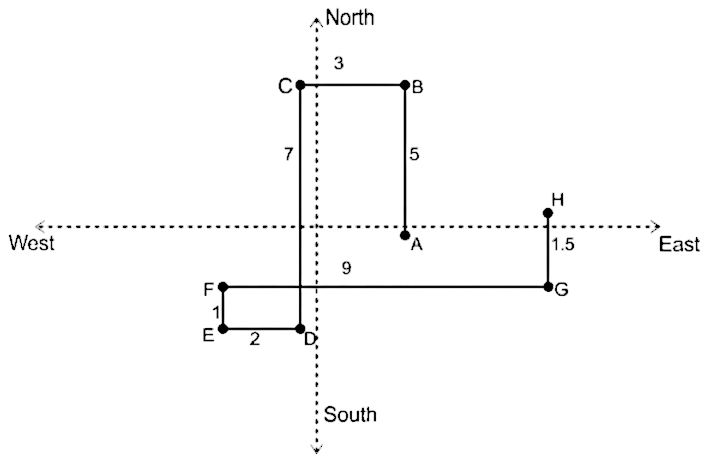
From the above diagram, point H is at the Northeast direction of point A. Hence, ‘Northeast’ is correct answer.
7. Find the odd one out.
A. FE
B. BA
C. CD
D. HG
E. ED
Solution
We have drawn the figure according to the given information given in the question,
Hence, all except ED are in North to South direction whereas point E is in West to point D. Hence, ‘ED’ is correct answer.
8. What is the position of point E with respect to point G ?
A. South
B. North
C. Northwest
D. Southwest
E. East
Solution
We have drawn the figure according to the given information given in the question,
From the above diagram, it is clear that point E is in Southwest direction to the point G. Hence, ‘Southwest’ is correct answer.
9. Directions: In the question below are given three statements followed by two conclusions I and II. You have to take the given statements to be true even if they seem to be at variance from commonly known facts. Read all the conclusions and then decide which of the given conclusions logically follows from the given statements disregarding commonly known facts.
Statements:
Some Apple are Mango.
No Mango is Grapes.
No apple is Banana.
Conclusions:
I.Some Banana are Mango.
II.Some Grapes are Apple.
A. Only I follow
B. Only II follow
C. Either I or II follow
D. Neither I nor II follow
E. Both I and II follows
Solution
The least possible Venn diagram for the given statements is as follows,

Conclusions:
I. Some Banana are Mango → False (It is possible but not definite. So, it is false)
II. Some Grapes are Apple → False (It is possible but not definite. So, it is false)
Hence, Neither I nor II follows.
10. Direction: In the question below are given three statements followed by two conclusions numbered I and II. You have to take the given statements to be true even if they seem to be at variance with commonly known facts. Read all the conclusions and then decide which of the given conclusions logically follows from the given statements disregarding commonly known facts.
Statements:
Some Table are Chair.
All Chair are Bat.
Some Bat are Wicket.
Conclusions:
I. Some Wicket are Table.
II. Some Bat are Table.
A. Only I follows
B. Only II follows
C. Either I or II follows
D. Neither I nor II follows.
E. Both I and II follows
Solution
The least possible Venn diagram for the given statements is as follows

Conclusions:
I. Some Wicket are Table → False (It is possible but not definite)
II. Some Bat are Table → True(Some Table are Chair and all Chair are Bat).
Hence, Only II follows.
11. Direction: In the question below are given three statements followed by two conclusions numbered I, and II. You have to take the given statements to be true even if they seem to be at variance with commonly known facts. Read all the conclusions and then decide which of the given conclusions logically follows from the given statements disregarding commonly known facts.
Statements:
Only a few pens are paper.
Some paper is chalk.
All pen is notebook.
Conclusions:
I. Some papers are pen.
II. Some notebook is paper.
A. Only conclusion I follows
B. Only conclusion II follows
C. Both conclusion I and II follow
D. Either conclusion I or II follows
E. Neither conclusion I or II follows
Solution
The least possible diagram for the given statements is as follows,
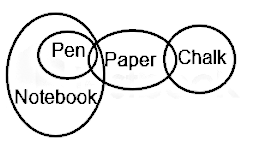
Conclusions:
I. Some papers are pen. → True (it is definitely true)
II. Some notebook is paper. → True (it is definitely true)
Hence, both conclusion I and II follows.
Comprehension:(Que No. 12 – 16)
Directions: Read the following information carefully and answer the questions.
Nine passengers, U, L, X, T, A, J, M, G and N belonging to three different countries, South Africa, New Zealand and Australia, board a chartered airplane together. Not more than four persons belong to the same country. All the information given are not necessarily in the same order.M and N belong to the same country. T, who belongs to Australia, doesn’t come from the same country as G. U and J belong to the same country. X doesn’t belong to New Zealand or South Africa. L belongs to the same country as M. A belongs to either Australia or South Africa. G belongs to South Africa. X belongs to the same country as U, who belongs to Australia. N belongs to New Zealand. A and G belong to the same country.
12. Who belongs to the same country as L?
A. T
B. U
C. A
D. N
E. X
Solution
Given: Nine persons belonging to three different countries board a chartered airplane together.
Based on the given conditions, we get the following possibilities-
1. X doesn’t belong to New Zealand or South Africa. T, who belongs to Australia, doesn’t come from the same country as G. From these, we get-
| COUNTRY | PERSONS |
| New Zealand | |
| Australia | X ,T |
| South Africa |
2. A belongs to either Australia or South Africa. G belongs to South Africa. A and G belong to the same country. From these, we get-
| COUNTRY | PERSONS |
| New Zealand | |
| Australia | X ,T |
| South Africa | A, G |
3. X belongs to the same country as U, who belongs to Australia. L belongs to the same country as M. N belongs to New Zealand. M and N belong to the same country. U and J belong to the same country. From these, we get the final table as follows-
| COUNTRY | PERSONS |
| New Zealand | L, M, N |
| Australia | X ,T, J, U |
| South Africa | A, G |
From the final table, we see that N belongs to the same country as L.Hence, L and N belong to the same country.
13. Who among the following belongs to Australia?
A. M
B. G
C. J
D. L
E. A
Solution
Given: Nine persons belonging to three different countries board a chartered airplane together.
Based on the given conditions, we get the following possibilities-
1. X doesn’t belong to New Zealand or South Africa. T, who belongs to Australia, doesn’t come from the same country as G. From these, we get-
| COUNTRY | PERSONS |
| New Zealand | |
| Australia | X ,T |
| South Africa |
2. A belongs to either Australia or South Africa. G belongs to South Africa. A and G belong to the same country. From these, we get-
| COUNTRY | PERSONS |
| New Zealand | |
| Australia | X ,T |
| South Africa | A, G |
3. X belongs to the same country as U, who belongs to Australia. L belongs to the same country as M. N belongs to New Zealand. M and N belong to the same country. U and J belong to the same country. From these, we get the final table as follows-
| COUNTRY | PERSONS |
| New Zealand | L, M, N |
| Australia | X ,T, J, U |
| South Africa | A, G |
From the final table, we see that J belongs to Australia.
Hence, J is the person who belongs to Australia.
14. Who among the following doesn’t belong to Australia?
A. U
B. X
C. T
D. J
E. G
Solution
Given: Nine persons belonging to three different countries board a chartered airplane together.
Based on the given conditions, we get the following possibilities-
1. X doesn’t belong to New Zealand or South Africa. T, who belongs to Australia, doesn’t come from the same country as G. From these, we get-
| COUNTRY | PERSONS |
| New Zealand | |
| Australia | X ,T |
| South Africa |
2. A belongs to either Australia or South Africa. G belongs to South Africa. A and G belong to the same country. From these, we get-
| COUNTRY | PERSONS |
| New Zealand | |
| Australia | X ,T |
| South Africa | A, G |
3. X belongs to the same country as U, who belongs to Australia. L belongs to the same country as M. N belongs to New Zealand. M and N belong to the same country. U and J belong to the same country. From these, we get the final table as follows-
| COUNTRY | PERSONS |
| New Zealand | L, M, N |
| Australia | X ,T, J, U |
| South Africa | A, G |
From the final table, we see that G belongs to South Africa.
Hence, G doesn’t belong to Australia.
15. What is the total number of persons belonging to Australia and South Africa together?
A. 7
B. 4
C. 5
D. 6
E. 8
Solution
Given: Nine persons belonging to three different countries board a chartered airplane together.
Based on the given conditions, we get the following possibilities-
1. X doesn’t belong to New Zealand or South Africa. T, who belongs to Australia, doesn’t come from the same country as G. From these, we get-
| COUNTRY | PERSONS |
| New Zealand | |
| Australia | X ,T |
| South Africa |
2. A belongs to either Australia or South Africa. G belongs to South Africa. A and G belong to the same country. From these, we get-
| COUNTRY | PERSONS |
| New Zealand | |
| Australia | X ,T |
| South Africa | A, G |
3. X belongs to the same country as U, who belongs to Australia. L belongs to the same country as M. N belongs to New Zealand. M and N belong to the same country. U and J belong to the same country. From these, we get the final table as follows-
| COUNTRY | PERSONS |
| New Zealand | L, M, N |
| Australia | X ,T, J, U |
| South Africa | A, G |
From the final table, we see that four persons belong to Australia and two persons belong to South Africa.
Hence, the total number of persons belonging to those two countries is 6.
16. What is the difference between the number of persons belonging to New Zealand and South Africa respectively?
A. 2
B. 1
C. 3
D. 0
E. 4
Solution
Given: Nine persons belonging to three different countries board a chartered airplane together.
Based on the given conditions, we get the following possibilities-
1. X doesn’t belong to New Zealand or South Africa. T, who belongs to Australia, doesn’t come from the same country as G. From these, we get-
| COUNTRY | PERSONS |
| New Zealand | |
| Australia | X ,T |
| South Africa |
2. A belongs to either Australia or South Africa. G belongs to South Africa. A and G belong to the same country. From these, we get-
| COUNTRY | PERSONS |
| New Zealand | |
| Australia | X ,T |
| South Africa | A, G |
3. X belongs to the same country as U, who belongs to Australia. L belongs to the same country as M. N belongs to New Zealand. M and N belong to the same country. U and J belong to the same country. From these, we get the final table as follows-
| COUNTRY | PERSONS |
| New Zealand | L, M, N |
| Australia | X ,T, J, U |
| South Africa | A, G |
From the final table, we see that three persons belong to New Zealand and two persons belong to South Africa.
Hence, the required difference is 1.
Direction: Answer the questions based on the sequence of numbers given.6 6 5 9 9 6 9 9 6 2 1 6 7 9 9 9 8 5 2 6 9 5 9 5 9 5 6 9 9
17. How many numbers are prime that are there in the sequence (consider each digit as a different one)?
A. 3
B. 4
C. 5
D. 7
E. 8
Solution
Consider the series given:
6 6 5 9 9 6 9 9 6 2 1 6 7 9 9 9 8 5 2 6 9 5 9 5 9 5 6 9 9Thus, there are 8 numbers that are prime.
18. How many distinct unique digits in the sequence are divisible by 2?
A. 3
B. 4
C. 5
D. 7
E. 8
Solution
Consider the series given:
6 6 5 9 9 6 9 9 6 2 1 6 7 9 9 9 8 5 2 6 9 5 9 5 9 5 6 9 9
Unique digits present in the sequence are 1 2 5 6 7 8 9 and the unique digits that are divisible by 2 are 2 6 8Thus, there are 3 digits that are divisible by 2.
19. Which of the following numbers have highest frequency?
A. 2
B. 4
C. 5
D. 6
E. 9
Solution
Consider the series given:
6 6 5 9 9 6 9 9 6 2 1 6 7 9 9 9 8 5 2 6 9 5 9 5 9 5 6 9 9
From the above sequence we can say that number 9 is repeated for 12 times in the series.Thus, number 9 has the highest frequency in the sequence.
20. If all the numbers are arranged in ascending order from left then which of the following will be in the centre of the sequence?
A. 2
B. 5
C. 6
D. 7
E. 8
Solution
Consider the series given:
6 6 5 9 9 6 9 9 6 2 1 6 7 9 9 9 8 5 2 6 9 5 9 5 9 5 6 9 9
Arranging the numbers in ascending order, we get the following:
1 2 2 5 5 5 5 5 6 6 6 6 6 6 6 7 8 9 9 9 9 9 9 9 9 9 9 9 9Thus, number 6 is at exactly middle of the sequence.
21. If the given digits in the sequence are used to form a highest three-digit number (all three digits need to be unique) and lowest three-digit number (all three digits need to be unique). What is the difference between highest three-digit number and lowest three-digit number?
A. 694
B. 862
C. 963
D. 764
E. None of the above
Solution
Consider the series given:
6 6 5 9 9 6 9 9 6 2 1 6 7 9 9 9 8 5 2 6 9 5 9 5 9 5 6 9 9
The highest three-digit number that can be formed from the given digits in the sequence (all three digits need to be unique) is = 987
6 6 5 9 9 6 9 9 6 2 1 6 7 9 9 9 8 5 2 6 9 5 9 5 9 5 6 9 9
The lowest three-digit number that can be formed from the given digits in the sequence is 125
Difference= Highest three-digit number – Lowest three-digit number
Highest number = 987
Lowest number =125
Difference = 987 – 125 = 862Thus, the difference between highest three-digit number and lowest three-digit number is 862
Direction: These questions are based on the following information..
There are three married couples in a family of three generation. A is the grandson of H. G is the mother-in-law of C. D and E are brothers. B is the only nephew of E. F is the sister in law of D. B is the son of C.
22. How is B related to H?
A. Grandson
B. Grandmother
C. Son
D. Nephew
E. Son-in-law
Solution
Ans: (1)
From the given information,

1.D and E are brothers.
2. B is the only nephew of E.

3. F is the sister in law of D.
4. B is the son of C. Therefore, C is the wife of D.

5. G is the mother-in-law of C. Thus, G is the mother of D.

6. A is the grandson of H. Therefore, H is the father of D.
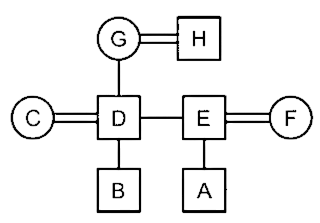
Hence, the grandson of H is B.
23. How is F related to G?
A. Daughter
B. Wife
C. Granddaughter
D. Daughter-in-law
E. Cannot be determined
Solution
ANS: (4)
From the given information,
1.D and E are brothers.
2. B is the only nephew of E.
3. F is the sister in law of D.
4. B is the son of C. Therefore, C is the wife of D.
5. G is the mother-in-law of C. Thus, G is the mother of D.
6. A is the grandson of H. Therefore, H is the father of D.
Hence, F is the daughter-in-law of G.
24. Who is the Uncle of A?
A. B
B. C
C. D
C. E
D. H
Solution
ANS: (3)
From the given information,
1.D and E are brothers.
2. B is the only nephew of E.
3. F is the sister in law of D.
4. B is the son of C. Therefore, C is the wife of D.
5. G is the mother-in-law of C. Thus, G is the mother of D.
6. A is the grandson of H. Therefore, H is the father of D.
Hence, D is the uncle of A.
25. How many pairs of letters are there in the word “DEMONETIZE “which have as many letters between them in the word as in alphabetical series?
A. Three
B. Two
C. One
D. More than three
E. None
Solution
These are DE and ON.
Study the following information carefully to answer the questions given below.
In a meeting, eight teachers A, B, C, D, E, F, G and H are sitting in two parallel rows, opposite to each other. Four persons with equal distance between them sit in each row. In row-1, A, B, D, E are sitting, and all are facing south. In row-2 C, F, H, G are sitting, and all are facing north.G sits second to the right of H who sits opposite to the one who is an immediate neighbour of E. D does not sit to the extreme end of the row. C sits second to the right of F who sits opposite to A. F is not a neighbour of G. B sits second to the left of D.
26. Who sits opposite to D?
A. F
B. G
C. H
D. C
E. None of these
Solution
People: A, B, C, D, E, F, G & H
- D does not sit at the extreme end of the row.
- B sits second to the left of D.
- C sits second to the right of F who sits opposite to A.
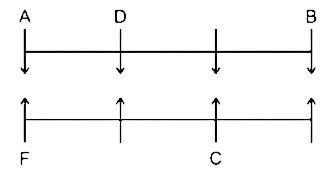
- G sits second to the right of H who sits opposite to the one who is an immediate neighbour of E.
- Thus, the final arrangement is,
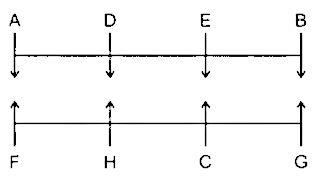
H sits opposite to D.
27. Who sits second to the right of E?
A. D
B. B
C. F
D. A
E. None of these
Solution
People: A, B, C, D, E, F, G & H
- D does not sit to the extreme end of the row.
- B sits second to the left of D.
- C sits second to the right of F who sits opposite A.
- G sits second to the right of H, who sits opposite to the one who is an immediate neighbour of E.
- Thus, the final arrangement is,
A sits second to the right of E.
28. Four of the following are alike in a certain way, then which of the following does not follow the same pattern?
A. B
B. E
C. A
D. F
E. G
Solution
People: A, B, C, D, E, F, G & H
- D does not sit at the extreme end of the row.
- B sits second to the left of D.
- C sits second to the right of F who sits opposite to A.
- G sits second to the right of H who sits opposite to the one who is an immediate neighbour of E.
- Thus, the final arrangement is,
Except for E, all others are sitting at corners. E does not follow the same pattern.
29. Who sits opposite to E?
A. B
B. C
C. F
D. D
E. None of these
Solution
People: A, B, C, D, E, F, G & H
- D does not sit at the extreme end of the row.
- B sits second to the left of D.
- C sits second to the right of F who sits opposite to A.
- G sits second to the right of H, who sits opposite to the one who is an immediate neighbour of E.
- Thus, the final arrangement is,
C sits opposite to E.
30. Who is an immediate neighbour of F?
A. A
B. C
C. H
D. G
E. None of these
Solution
People: A, B, C, D, E, F, G & H
- D does not sit at the extreme end of the row.
- B sits second to the left of D.
- C sits second to the right of F who sits opposite to A.
- G sits second to the right of H, who sits opposite to the one, who is an immediate neighbour of E.
- Thus, the final arrangement is,
H is an immediate neighbour of F.
31. If it is possible to make only one meaningful English word with the second, the fourth, the seventh and the eighth letters of the word OBSOLETE, which of the following will be the third letter of that word? If no such word can be made give ‘X’ as the answer and if more than one such word can be made give ‘Y’ as the answer.
A. N
B. D
C. S
D. X
E. Y
Solution
Given Word: OBSOLETE
2nd letter = B; 4th letter = O; 7th letter = T; 8th letter = E
Letters given: B O T E
Possible words: No such word can be madeHence, no such word can be made, and the answer is X.
Comprehension:(Que No. 32 – 34)
Direction: Read the following and answer the given questions.
In a certain code language,
‘price raise court martial’ is coded as ‘xy cd ab uv’
‘raise treat mine white’ is coded as ‘mn ef pq ab’‘couple treat raise martial’ is coded as ‘ef ab st uv’
32. What is the code of ‘Couple’?
A. cd
B. ab
C. ef
D. st
E. None of the above
Solution

So, ‘Couple’ is coded as ‘st’.
Hence, ‘st’ is the correct answer.
33. What is the code of ‘Raise’?
A. ab
B. cd
C. xy
D. st
E. Cannot be determined
Solution
The code of ‘raise’ is ‘ab’.
Hence, ‘ab’ is the correct answer.
34. Which of the following word is coded as ‘uv’?
A. Price
B. Treat
C. Court
D. Martial
E. None of the above
Solution
So, ‘uv’ is the code of ‘Martial’.
Hence, ‘Martial’ is the correct answer.
35. How many pairs of digits are there in the number “986145” each of which has as many numbers between them in the as series of natural numbers both in backward and forward direction?
A. Three
B. Four
C. One
D. Five
E. Two
Solution
The alphabets are positioned in the following order:
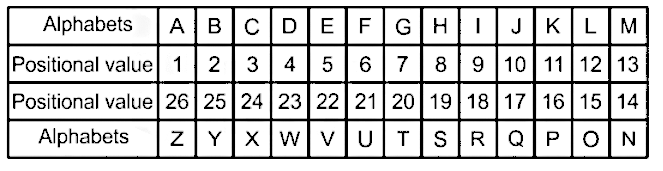
The number can be represented as follows:
In forward direction: “45”
In backward direction: “89”, “46”
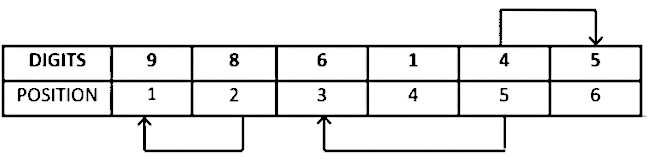
Thus, there are three pair of numbers in the number “986145” as according to the series of natural numbers.Hence, three is the correct answer.
Comprehension:(Que No. 36 – 40)
Direction: Study the following information carefully and answer the given question.
Eight people J, K, L, M, N, O, P and Q are sitting around a circular table, but not necessarily in the same order. No three people sitting together are facing the same direction.J sits second to the right of O and second to the left of N. P and Q are sitting immediately to the left of each other. P does not sit opposite to J. Q faces the opposite direction that of O. K and M are facing towards each other. L sits second to the right of M and faces the same direction as M.
36. Who among the following sits immediately to the right of J?
A. K
B. L
C. M
D. N
E. O
Solution
1) J sits second to the right of O and second to the left of N.
2) P and Q are sitting immediately to the left of each other.
3) P does not sit opposite to J.
4) Q faces the opposite direction that of O.
5) K and M are facing towards each other.
6) L sits second to the right of M and faces the same direction as M.
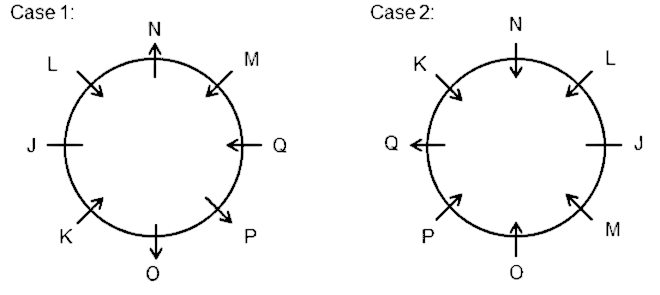
7) No three people sitting together are facing the same direction. (This eliminates case 2)
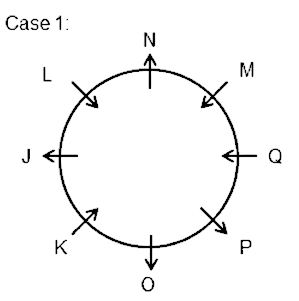
Hence, L sits immediately to the right of J.
37. How many people are facing towards the center?
A. 3
B. 5
C. 4
D. 2
E. 1
Solution
1) J sits second to the right of O and second to the left of N.
2) P and Q are sitting immediately to the left of each other.
3) P does not sit opposite to J.
4) Q faces the opposite direction that of O.
5) K and M are facing towards each other.
6) L sits second to the right of M and faces the same direction as M.
7) No three people sitting together are facing the same direction. (This eliminates case 2)
Hence, ‘four’ people are facing towards the center.
38. Four among the five are the same in a certain way and thus formed a group. Who among the following does not belong to that group?
A. J
B. O
C. P
D. N
E. M
Solution
1) J sits second to the right of O and second to the left of N.
2) P and Q are sitting immediately to the left of each other.
3) P does not sit opposite to J.
4) Q faces the opposite direction that of O.
5) K and M are facing towards each other.
6) L sits second to the right of M and faces the same direction as M.
7) No three people sitting together are facing the same direction. (This eliminates case 2)
All are facing opposite to the center except M.Hence, ‘M’ does not belong to the group.
39. Which of the following statement is wrong according to the above arrangement?
A. L is sitting opposite to P.
B. P sits immediately to the right of O.
C. J is facing opposite to the center.
D. L and Q are facing the same direction.
E. All statements are true.
Solution
1) J sits second to the right of O and second to the left of N.
2) P and Q are sitting immediately to the left of each other.
3) P does not sit opposite to J.
4) Q faces the opposite direction that of O.
5) K and M are facing towards each other.
6) L sits second to the right of M and faces the same direction as M.
7) No three people sitting together are facing the same direction. (This eliminates case 2)
Clearly, P sits immediately to the right of O is the wrong statement.
40. Who among the following sits third to the right of N?
A. P
B. K
C. O
D. J
E. Q
Solution
1) J sits second to the right of O and second to the left of N.
2) P and Q are sitting immediately to the left of each other.
3) P does not sit opposite to J.
4) Q faces the opposite direction that of O.
5) K and M are facing towards each other.
6) L sits second to the right of M and faces the same direction as M.
7) No three people sitting together are facing the same direction. (This eliminates case 2)
Clearly, P sits third to the right of N.
Numerical Ability
41.Find the wrong term in the given series.
422, 400, 444, 356, 531,180
A. 531
B. 422
C. 400
D. 444
E. 356
Solution
Solution :
The series follows the following pattern:
⇒ 422 – 22 = 400
⇒ 400 + 44 = 444
⇒ 444 – 88 = 356
⇒ 356 + 176 = 532
⇒ 532 – 352 = 180
The wrong term in the series will be 531.
Hence, 531 is the correct answer.
42. In each of the following number series, the wrong number is given, find out that number.
800, 2400, 6000, 12000, 18000, 15000, 9000
A. 12000
B. 800
C. 15000
D. 9000
E. 6000
Solution
Calculation:
The series follows the following pattern:
⇒ 800 × 3 = 2400
⇒ 2400 × 2.5 = 6000
⇒ 6000 × 2 = 12000
⇒ 12000 × 1.5 = 18000
⇒ 18000 × 1 = 18000
⇒ 18000 × 0.5 = 9000
∴ The wrong number is 15000
43. In each of the following number series, the wrong number is given, find out that number.
4, 6, 11, 18, 34, 66
A. 66
B. 34
C. 11
D. 18
E. 4
Solution
Calculation:
The given number series follows this pattern:
3 + 20 = 4
4 + 21 = 6
6 + 22 = 10
10 + 23 = 18
18 + 24 = 34
34 + 25 = 66
∴ The wrong number in the given series is 11
44. In the following number series, a wrong number is given. Find out the wrong number.
14, 28, 47, 80, 124, 179, 245
A. 14
B. 28
C. 47
D. 124
E. 179
Solution
Considering the given series
14, 28, 47, 80, 124, 179, 245
The logic of the given series can be explained as
14 + 11 = 25
25 + 22 = 47
47 + 33 = 80
80 + 44 = 124
124 + 55 = 179
179 + 66 = 245
∴ Wrong term in given number series is 28.
45. In the following number series, a wrong number is given. Find out the wrong number.
19, 28, 46, 73, 108, 154, 208
A. 46
B. 73
C. 108
D. 154
E. None of these
Solution
Considering the given series
19, 28, 46, 73, 108, 154, 208
The logic of the given series can be explained as
19 + 9 = 28
28 + 18 = 46
46 + 27 = 73
73 + 36 = 109
109 + 45 = 154
154 + 54 = 208
∴ Wrong term in given number series is 108.
46. In each of the following number series, the wrong number is given, find out that number.
252, 420, 570, 684, 780, 852, 900
A. 420
B. 852
C. 900
D. 780
E. 570
Solution
Given:
252, 420, 570, 684, 780, 852, 900
Calculation:
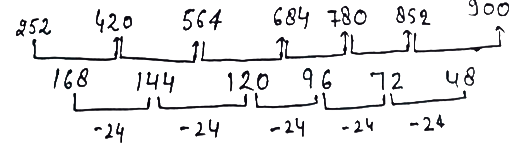
∴ The wrong term is 570.
47. Lokesh, Piyush and Suhani divide an amount of Rs 15,000 amongest themselves in the ratio 5 : 8 : 2 respectively. What is the Suhani’s share in the amount ?
A. Rs. 2000
B. Rs. 4000
C. Rs. 5000
D. Rs. 3000
E. None of these
Solution
Given:
Lokesh, Piyush and Suhani divide an amount of Rs 15,000 amongest themselves in the ratio 5 : 8 : 2 respectively.
Calculation:
Let the ratio of amount Lokesh, Piyush and Suhani be 5x, 8x and 2x.
According to the question,
⇒ 5x + 8x + 2x = 15000
⇒ 15x = 15000
⇒ x = 1000
Share of Suhani’s
⇒ 2 × 1000
⇒ Rs. 2000
∴ The Suhani’s share in the amount is Rs. 2000.
48. A train crosses a platform in 48 seconds travelling with a speed of 120 km/hr. if the length of the train be 600 metres, then find the length of the platform.
A. 800 m
B. 1200 m
C. 1500 m
D. 1000 m
E. 900 m
Solution
Concept:
Distance = Speed × Time
To convert km/hr into m/s, multiply by 5/18
Calculation:
Total distance covered by train in 48 seconds with the speed of 120 km/hr.
Distance = 120 km/hr × 48 sec
= 120 × 5/18 × 48
= 1600 metres.
Length of train + Length of platform = 1600 metres
600 + length of platform = 1600
Length of platform = 1000 m
Direction: Study the following information carefully and answer based on it.
The table given below shows the data of 3 different types of cars sold in 5 different cities.
| Cities | Creta | Honda City | Innova |
| Kolkata | 360 | 460 | 320 |
| Ahmedabad | 250 | 320 | 500 |
| Surat | 450 | 340 | 480 |
| Delhi | 420 | 340 | 540 |
| Mohali | 280 | 420 | 500 |
49. Number of honda city car sold in Ahmedabad is what percent of total innova car sold in Surat.
A. 33%
B. 50%
C. 20%
D. 40%
E. 66 (2/3)%
Solution
Number of honda city car sold in Ahmedabad = 320
Number of innova car sold in Surat = 480
Required percentage = 320/480 × 100 = 66 (2/3)%
Hence, correct answer is option 5.
Direction: Study the following information carefully and answer based on it.
The table given below shows the data of 3 different types of cars sold in 5 different cities.
| Cities | Creta | Honda City | Innova |
| Kolkata | 360 | 460 | 320 |
| Ahmedabad | 250 | 320 | 500 |
| Surat | 450 | 340 | 480 |
| Delhi | 420 | 340 | 540 |
| Mohali | 280 | 420 | 500 |
50. Find the respective ratio of Creta car sold in Delhi and Mohali together to the total of Innova car sold in Kolkata and Ahmedabad together.
A. 33:43
B. 35:41
C. 30:31
D. 42:37
D. 31:40
Solution
Required ratio = 700:820 = 35:41
Hence, correct answer is option 2.
Direction: Study the following information carefully and answer based on it.
The table given below shows the data of 3 different types of cars sold in 5 different cities.
| Cities | Creta | Honda City | Innova |
| Kolkata | 360 | 460 | 320 |
| Ahmedabad | 250 | 320 | 500 |
| Surat | 450 | 340 | 480 |
| Delhi | 420 | 340 | 540 |
| Mohali | 280 | 420 | 500 |
51. Find the total number of cars sold in Kolkata?
A. 1210
B. 1150
C. 1140
D. 1200
E. 1280
Solution
Total number of cars sold in Kolkata = 320 + 360 + 460 = 1140
Hence, correct answer is option 3.
Direction: Study the following information carefully and answer based on it.
The table given below shows the data of 3 different types of cars sold in 5 different cities.
| Cities | Creta | Honda City | Innova |
| Kolkata | 360 | 460 | 320 |
| Ahmedabad | 250 | 320 | 500 |
| Surat | 450 | 340 | 480 |
| Delhi | 420 | 340 | 540 |
| Mohali | 280 | 420 | 500 |
52. Find the difference between number of Innova cars sold in Delhi and number of Creta cars sold in Surat?
A. 90
B. 80
C. 75
D. 95
E. 85
Solution
Required difference = 540 – 450 = 90
Hence, correct answer is option 1.
Direction: Study the following information carefully and answer based on it.
The table given below shows the data of 3 different types of cars sold in 5 different cities.
| Cities | Creta | Honda City | Innova |
| Kolkata | 360 | 460 | 320 |
| Ahmedabad | 250 | 320 | 500 |
| Surat | 450 | 340 | 480 |
| Delhi | 420 | 340 | 540 |
| Mohali | 280 | 420 | 500 |
53. Find the average number of Honda city car sold in all the cities?
A. 440
B. 410
C. 400
D. 376
E. 420
Solution
Required average = (460 + 320 + 340 + 340 + 420)/5 = 376
Hence, correct answer is option 4.
54. Gold and Silver are in the ratio 2 : 3 in 200 g of an alloy. The quantity of Gold in gm to be added to it to make the ratio 3 : 2 is:
A. 90 gm
B. 120 gm
C. 100 gm
D. 150 gm
E. None of these
Solution
Given:
Quantity of the alloy = 200 g
Gold : Silver = 2 : 3
Calculation:
Let the quantity of Gold to be added to alloy to make the ratio 3 : 2 be X
Quantity of Gold in alloy = (2/5) × 200 = 80 g
And quantity of Silver in alloy = (3/5) × 200 g
According to question,
(80 + X)/120 = 3/2
⇒ 80 + x = 180
⇒ x = 100 g
∴ The quantity of Gold to be added is 100 gm.
55. The ratio between the radius of a circle and side of a square is 1 : 2. Find out the ratio of the areas between the circle and the in-circle to the square.
A. 2 : 3
B. 1 : 1
C. 3 : 2
D. 4 : 3
E. 3 : 4
Solution
Given:
Ratio between radius of the circle and length of a square is 1 : 2.
Formula used:
Area of circle, A=πr2
Where r = radius of the circle.
Calculations:
Let us assume,
Radius of the circle = x cm and length of the square = 2x

Clearly from the figure, we can see, radius of the incircle = ½ of the length of the square
= ½ × 2x = x cm
Required ratio of area = πx2/πx2 = 1 : 1
56. Amit purchased a book with a 10% discount on the labelled price. How much did he pay if the labelled price was Rs. 600?
A. Rs. 480
B. Rs. 360
C. Rs. 540
D. Rs. 340
E. None of these
Solution
Given
Book labeled price is = Rs. 600
Discount = 10%
Calculation
Let the MP of the book = 100% = 600
CP of the book = 100x − 10x
⇒ 90x
The cost price of the book = 600 × 90x/100x
⇒ Rs. 540
Shortcut Trick
C.P. for Book = 90% of 600
⇒ (600 × 90)/100
⇒ Rs. 540
=600×90/100= Rs. 540
57. What will come in the place of the question mark ‘?’ in the following question?
(? + 20) × 2 + 430 = 70 × 9
A. 41
B. 52
C. 87
D. 50
E. 80
Solution
Concept used:
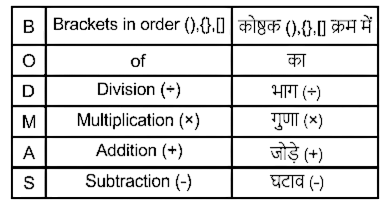
Calculation:
Considering the given equation
(? + 20) × 2 + 430 = 70 × 9
⇒ (? × 2) + 40 + 430 = 630
⇒ (? × 2) + 470 = 630
⇒ ? × 2 = 630 – 470
⇒ ? × 2 = 160
⇒ ? = 160/2 = 80
∴ ? = 80
58. What value should come in place of question mark(?) in the question?
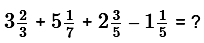
A. 1187/105
B. 1072/105
C. 1088/105
D. 1056105
E. 1196/105
Solution
Calculations:
Considering the given equation,
⇒ 11/3 + 36/7 + 13/5 – 6/5 = ?
Taking LCM of (3, 7, 5) = 105
⇒ (11 × 35 + 36 × 15 + 13 × 21 – 6 × 21)/105 = ?
⇒ (385 + 540 + 273 – 126)/105 = ?
⇒ 1072/105 = ?
∴ The value of ? is 1072/105.
59. What will come in place of the question mark ‘?’ in the following question?108 ÷ 9 + 12 × 6 – 20 = ?2
A. 4
B. 5
C. 6
D. 7
E. 8
Solution
Given:
The given equation is:
108 ÷ 9 + 12 × 6 – 20 = ?2
Concept Used:
Follow BODMAS rule to solve this question, as per the order given below
Calculation;
108 ÷ 9 + 12 × 6 – 20 = ?2
12 + 12 × 6 – 20 = ?2
12 + 72 – 20 = ?2
84 – 20 = ?2
64 = ?2
?2 = 82
? = 8
∴ The required value of “?” in the given equation is 8
60. What will come in the place of the question mark ‘?’ in the following question?
(990 ÷ 18 × 4 + 50 ÷ 8 × 16) ÷ 16 = ?
A. 12
B. 16
C. 20
D. 24
E. 28
Solution
Concept used:
Follow BODMAS rule to solve this question, as per the order given below,
Calculation:
(990 ÷ 18 × 4 + 50 ÷ 8 × 16) ÷ 16 = ?
(990/18 × 4 + 50/8 × 16) ÷ 16 = ?
(55 × 4 + 100) ÷ 16 = ?
320/16 = 20 = ?
∴ The value of ‘?’ is 20.
61. What will come in the place of the question mark ‘?’ in the following question?
37 × 5 – 428 ÷ 4 + 93 = ?
A. 165
B. 161
C. 175
D. 185
E. 171
Solution
Concept used:
Follow BODMAS rule to solve this question, as per the order given below,
Calculation:
37 × 5 – 428 ÷ 4 + 93 = ?
⇒ 37 × 5 – 107 + 93 = ?
⇒ 185 – 107 + 93 = ?
⇒ 185 + 93 – 107 = ?
⇒ 278 – 107 = ?
⇒ 171 = ?
∴ The value of ? is 171
62. What will come in the place of the question mark ‘?’ in the following question?
40% of 125 + (3/4) of 160 – 30 + x = 144
A. 5
B. 4
C. 8
D. 6
E. 2
Solution
Given:
40% of 125 + (3/4) of 160 – 30 + x = 144
Concept used:
Follow the BODMAS rule according to the table given below:
Calculation:
40% of 125 + (3/4) of 160 – 30 + x = 144
⇒ (40/100) × 125 + (3/4) × 160 – 30 + x = 144
⇒ (2/5) × 125 + 120 – 30 + x = 144
⇒ 50 + 120 – 30 + x = 144
⇒ 170 – 30 + x = 144
⇒ 140 + x = 144
⇒ x = 144 – 140
⇒ x = 4
∴ The value of x is 4.
63. What value should come in place of question mark (?) in the question?
2208 ÷ 48 × ? – 8 = 130
A. 2
B. 3
C. -1
D. 12
E. 7
Solution
Concept used :
Solution :
Let the ‘?’ be x
2208 ÷ 48 × x – 8 = 130
⇒ 46 × x – 8 = 130
⇒ 46 × x = 130 + 8
⇒ 46 × x = 138
⇒ x = 138/46
⇒ x = 3
∴ The requried number is 3
64. What value should come in place of question mark(?) in the question?
7/8 of 16 × (9 – 3) of 1/6 = ?
A. 72
B. 14
C. 7
D. -14
E. 28
Solution
Given-
7/8 of 16 × (9 – 3) of 1/6 = ?
Concept Used-
Follow BODMAS rule to solve this question, as per the order given below,
Calculation-
7/8 of 16 × (9 – 3) of 1/6
⇒ 14 × 6 × 1/6
⇒ 14 × 1
⇒ 14
∴ 14 should come in the place of ?.
65. What will come in the place of the question mark ‘?’ in the following question?
576 × 90 ÷ 24 ÷ 72 = ? + 44 ÷ 4 + 10
A. 9
B., 11
C. 21
D. 35
E. 46
Solution
Given:
576 × 90 ÷ 24 ÷ 72 = ? + 44 ÷ 4 + 10
Follow the BODMAS rule to solve this question, as per the order given below:
Calculation:
576 × 90 ÷ 24 ÷ 72 = ? + 44 ÷ 4 + 10
⇒ 576 × 0.052 = ? + 11 + 10
⇒ 30 = ? + 21
⇒ ? = 30 – 21
⇒ ? = 9
Hence, 9 will come in the place of ‘?’.
66. What value should come in place of question mark(?) in the question?
200% of 30 + √441 = ?2 – 40
A. 19
B. 17
C. 15
D. 13
E. 11
Solution
Concept used:
Follow BODMAS rule to solve this question, as per the order given below.
Calculation:
200% of 30 + √441 = ?2– 40
⇒ (200/100) × 30 + 21 = ?2 – 40
⇒ 60 + 21 + 40 = ?2
⇒ 121 = ?2
⇒ 11 = ?
∴ The value of ? is 11
67. Find the compound interest incurred on an amount of Rs 12500 at the rate of 10% per annum after 2 years.
A. 2500
B. 2526
C. 2540
D. 2625
E. 2850
Solution
Given
Principal (P) = Rs 12500
Rate of interest (r) = 10%
Time (n) = 2 years
Formula used
Compound interest = P (1 + r/100)n – P
Calculation
Compound interest = 12500 (1 + 10/100)2 – 12500
⇒ (12500 × 11/10 × 11/10) – 12500
⇒ 15125 – 12500
⇒ Rs. 2625
∴ The compound interest is Rs. 2625.
68. Ratio of downstream speed to upstream speed of a boat is 11 : 5. By what percentage speed of stream is less than boat’s speed?
A. 62.5
B. 37.5
C. 50
D. 60
E. 33.33
Solution
Given:-
Ratio of downstream speed to upstream speed = 11/5
Formula:-
Boat speed = ½ (D + U)
Stream speed = ½ (D – U)
Where D and U are downstream and upstream speeds respectively.
Calculation:-
Let U be 11x and D be 5x as ratio is 11/5
Boat speed = ½ (11x + 5x) = 8x
Stream speed = ½ (11x – 5x) = 3x
Required percentage = {(8x – 3x)/8x} × 100 = 62.5%
69. If 5/9 part of the total population in a village is males and 30% of the males are married, find the percentage of unmarried females in the villiage?
A. 26%
B. 27%
C. 27(7/9)%
D. 27/(2/9)%
E. 28%
Solution
Given:
5/9 part of the population in a village are males
30% of the males are married
Concept used:
% of unmarried females population = (unmarried females/Total population) × 100
Calculation:
let the population = x
Males in population = 5x/9
Married males in the population = 30% (5x/9) = 30x/100(5/9) = (x/6)
So the married females = (x/6)
Total females = (x – (5x/9)) = 4x/9
So,
Unmarried females in the villiage = 4x/9 – x/6 = 5x/18
% of unmarried females in the total population is = (5x/18)/x × 100 = 27(7/9)%
Required % of unmarried females population = 27(7/9)%.
70. A is 66(2/3)% more efficient than B. If A and B working together can do a piece of work in 45 days, in how much time B alone can do the same work?
A. 150 days
B. 130 days
C. 80 days
D. 120 days
E. 90 days
Solution
Given∶
A is 66(2/3)% more efficient than B.
A and B working together can do a piece of work in 45 days.
Concept Used∶
The ratio of efficiency is the inverse of the ratio of time taken.
Calculations∶
66(2/3)% = 2 / 3
Now, A : B
Efficiency – 5 ∶ 3
Time – 3 ∶ 5

A’s one-day work = 5 units/day
B’s one-day work = 3 units/day
(A + B)’s one day work = 8 units / day
According to question, A and B working together complete the work in 45 days
⇒ 15x/8 = 45 days
⇒ x = 24
Now total work = 15x
⇒ 15 × 24 = 360 units
Time taken by B to complete the work alone = 360 / 3
⇒ 120 days.
Direction – Study the given information carefully to answer the questions.
Every year, the Health Department conducts a survey of 1000 people. According to the survey in the year 2015, 2016, 2017, 2018 and 2019, the percentage of people affected by Dengu were 40%, 20%, 45%. 25% and 30% respectively. Health Department also found that every year out of the affected people 70% were students, 10% housewives and 20% were employees. The number of students, housewives and employees were in the ratio of 20 ∶ 11 ∶ 9 every year.
71. In the year 2017, find the number of house wives affected by Dengu?
A. 40
B. 42
C. 45
D. 43
E. None of these
Solution
Given that:
| Affected people | Total Number | |
| 2015 | 40% of 1000 | 400 |
| 2016 | 20% of 1000 | 200 |
| 2017 | 45% of 1000 | 450 |
| 2018 | 25% of 1000 | 250 |
| 2019 | 30% of 1000 | 300 |
Now, ratio of number of students, house wives and employees
⇒ 20 ∶ 11 ∶ 9
So, the total number of students =[ 20/(20 + 11 + 9 ) ] × 1000
⇒ 20 × 1000/40
⇒ 500
The total number of house wives = 11 × 1000/40 = 275
The total number of employees = 9 × 1000/40 = 225
Calculation:
In 2017, affected people by Dengue = 450
Out of this 10% were house wives .
⇒ 10% of 450 = 45
∴ in the year 2017, the number of house wives affected by Dengu is 45.
Direction – Study the given information carefully to answer the questions.
Every year, the Health Department conducts a survey of 1000 people. According to the survey in the year 2015, 2016, 2017, 2018 and 2019, the percentage of people affected by Dengu were 40%, 20%, 45%. 25% and 30% respectively. Health Department also found that every year out of the affected people 70% were students, 10% housewives and 20% were employees. The number of students, housewives and employees were in the ratio of 20 ∶ 11 ∶ 9 every year.
72. In the year 2019, find the number of employees who were not affected by Dengu?
A. 165
B. 189
C. 205
D. 250
E. None of these
Solution
Given that:
| Affected people | Total | |
| 2015 | 40% of 1000 | 400 |
| 2016 | 20% of 1000 | 200 |
| 2017 | 45% of 1000 | 450 |
| 2018 | 25% of 1000 | 250 |
| 2019 | 30% of 1000 | 300 |
Now, ratio of number of students, house wives and employees
⇒ 20 ∶ 11 ∶ 9
So, the total number of students =[ 20/(20 + 11 + 9 ) ] × 1000
⇒ 20 × 1000/40
⇒ 500
The total number of house wives = 11 × 1000/40 = 275
The total number of employees = 9 × 1000/40 = 225
Formula:
Not affected employees by Dengu = total employees – affected employees by Dengu
Calculation:
In the year 2019, the total population was affected by Dengue = 300
Out of 300 afected people, 20% were employees.
⇒ 20% of 300 = 60
So, the unaffected employees = 225 – 60 = 165
∴ The number of employees who were not affected by Dengue in 2019 is 165
Direction – Study the given information carefully to answer the questions.
Every year, the Health Department conducts a survey of 1000 people. According to the survey in the year 2015, 2016, 2017, 2018 and 2019, the percentage of people affected by Dengu were 40%, 20%, 45%. 25% and 30% respectively. Health Department also found that every year out of the affected people 70% were students, 10% housewives and 20% were employees. The number of students, housewives and employees were in the ratio of 20 ∶ 11 ∶ 9 every year.
73. What is the difference in the number of students affected and not affected by Dengue in the year 2016?
A. 200
B. 210
C. 220
D. 240
E. None of these
Solution
Given that:
| Affected people | Total | |
| 2015 | 40% of 1000 | 400 |
| 2016 | 20% of 1000 | 200 |
| 2017 | 45% of 1000 | 450 |
| 2018 | 25% of 1000 | 250 |
| 2019 | 30% of 1000 | 300 |
Now, ratio of number of students, house wives and employees
⇒ 20 ∶ 11 ∶ 9
So, the total number of students = [ 20/(20 + 11 + 9 ) ] × 1000
⇒ 20 × 1000/40
⇒ 500
The total number of house wives = 11 × 1000/40 = 275
The total number of employees = 9 × 1000/40 = 225
Formula:
Required difference = students affected by Dengu in 2016 – students unaffected by Dengue in 2016
Calculation:
Total students for each year = 500
In the year 2016, the number of students affected by Dengue
⇒ 70% of 200
⇒ 140
So, the number of students not affected by Dengue = 500 – 140 = 360
⇒ Difference = 360 – 140 = 220
∴ The difference between affected students and not affected students by Dengue in year 2016 is 220.
Direction – Study the given information carefully to answer the questions.
Every year, the Health Department conducts a survey of 1000 people. According to the survey in the year 2015, 2016, 2017, 2018 and 2019, the percentage of people affected by Dengu were 40%, 20%, 45%. 25% and 30% respectively. Health Department also found that every year out of the affected people 70% were students, 10% housewives and 20% were employees. The number of students, housewives and employees were in the ratio of 20 ∶ 11 ∶ 9 every year.
74. Find the ratio of the number of house wives affected by Dengue in the year 2015 to that affected by Dengue in the year 2018.
A. 3 : 4
B. 6 : 7
C. 9 : 10
D. 8 : 5
E. None of these
Solution
Given that:
| Affected people | Total | |
| 2015 | 40% of 1000 | 400 |
| 2016 | 20% of 1000 | 200 |
| 2017 | 45% of 1000 | 450 |
| 2018 | 25% of 1000 | 250 |
| 2019 | 30% of 1000 | 300 |
Now, ratio of number of students, house wives and employees
⇒ 20 ∶ 11 ∶ 9
So, the total number of students =[ 20/(20 + 11 + 9 ) ] × 1000
⇒ 20 × 1000/40
⇒ 500
The total number of house wives = 11 × 1000/40 = 275
The total number of employees = 9 × 1000/40 = 225
Formula:
Required ratio = number of house wives affected by Dengue in 2015 ∶ number of house wives affected ny Dengue in 2018
Calculation:
The number of housewives affected by Dengue in year 2015
⇒ 10% of 400 = 40
The number of house wives affected by Dengue in year 2018
⇒ 10% of 250 = 25
Ratio = 40 ∶ 25 ⇒ 8 ∶ 5.
∴ The ratio of the number of house wives affected in 2015 to that of affected in 2018 is 8 ∶ 5.
Direction – Study the given information carefully to answer the questions.
Every year, the Health Department conducts a survey of 1000 people. According to the survey in the year 2015, 2016, 2017, 2018 and 2019, the percentage of people affected by Dengu were 40%, 20%, 45%. 25% and 30% respectively. Health Department also found that every year out of the affected people 70% were students, 10% housewives and 20% were employees. The number of students, housewives and employees were in the ratio of 20 ∶ 11 ∶ 9 every year.
75. Which year had the maximum number of students not affected by Dengue?
A. 2016
B. 2017
C. 2015
D. 2018
E. None of these
Solution
Given that:
| Affected people | Total | |
| 2015 | 40% of 1000 | 400 |
| 2016 | 20% of 1000 | 200 |
| 2017 | 45% of 1000 | 450 |
| 2018 | 25% of 1000 | 250 |
| 2019 | 30% of 1000 | 300 |
Now, ratio of number of students, house wives and employees
⇒ 20 ∶ 11 ∶ 9
So, the total number of students =[ 20/(20 + 11 + 9 ) ] × 1000
⇒ 20 × 1000/40
⇒ 500
So, the total number of students = [ 20/(20 + 11 + 9 ) ] × 1000
⇒ 20 × 1000/40
Now, ratio of number of students, house wives and employees
⇒ 20 ∶ 11 ∶ 9
The total number of house wives = 11 × 1000/40 = 275
The total number of employees = 9 × 1000/40 = 225
Calculation:
Total number of students = 500
The number of students affected by Dengue in 2015 = 70% of 400 = 280
Number of students not affected by Dengue in 2015 = 500 – 280
⇒ 220
The number of students affected by Dengue in 2016 = 70% of 200 ⇒ 140
Number of students not affected by Dengue in 2016 = 500 – 140
⇒ 360
Number of students affected by Dengue in 2017 = 70% of 450
⇒ 315
Number of students not affected by Dengue in 2017 = 500 – 315
⇒ 185
Number of student affected by Dengue in 2018 = 70% of 250 = 175
Number of students not affected by Dengue in 2018 = 500 – 175
⇒ 325
The number of student affected by Dengue in 2019 = 70% of 300 = 210
Number of students not affected by Dengue in 2019 = 500 – 210
⇒ 290
∴ In 2016, the maximum number of students not affected by Dengue.
76. Find the number of ways 8 girls can be seated in a circle when two particular girls are to be seated adjacent to each other.
A. 720
B. 1440
C. 5040
D. 1080
E. None of these
Solution
Concept:-
1. Circular permutation.
2. Taking 2 girls as single girl and finding number of ways.
Formula:-
For circular arrangement, number of ways = (n – 1)!
Calculation:-
Total girls when 2 of them are taken as 1 = 8 – 2 + 1 = 7
Number of ways = (7 – 1)! = 720
But these two girls in themselves be arranged in two ways.
So, number of ways = 720 × 2 = 1440
77. 1 man or 3 boys or 2 girls can do a piece of work in 66 days. In how many days one man, one boy and one girl can do the same work?
A. 36 days
B. 30 days
C. 35 days
D. 40 days
E. None of these
Solution
Given:
1 man or 3 boys or 2 girls can do a piece of work in 66 days.
Formula used:
M1D1 = M2D2
Where M = Number of person, D = Number of days
Calculation:
1 man = 3 boys
And 2 girls = 3 boys
1 girl = (3/2) boys
Let time taken by one man, one boy and one girl be x days.
∵ 1 man + 1 boy + 1 girl = 3 boys + 1 boy + (3/2) boys
⇒ (6 + 2 + 3)/2 boys
⇒ (11/2) boys
(11/2) boys can do a work in x days.
And 3 boys can do a work in 66 days.
Now, M1D1 = M2D2
⇒ (11/2) × x = 3 × 66
⇒ x = (3 × 66 × 2)/11
⇒ x = 36
∴ one man, one boy and one girl can do the same work in 36 days.
78. In a 100 m race, A runs at 8 kmph. If A gives B a start of 4 m and still beats him by 15 seconds, what is the speed of B?
A. 5 kmph
B. 5.76 kmph
C. 6 kmph
D. 6.34 kmph
E. None of the above/More than one of the above
Solution
Given:
In a 100 m race, A runs at 8 kmph.
A gives B a start of 4 m and still beats him by 15 seconds.
Calculation:
Time taken by A to cover 100 m = (60 × 60/8000) × 100 sec = 45 sec
B covers (100 – 4) = 96 m in (45 + 15) sec = 60 sec
B’s speed = (96 × 60 × 60) / (60 × 1000) kmph = 5.76 kmph
Hence, option 2 is correct.
Alternate MethodGiven:
A’s speed = 8 km/h = 8 × (5/18) = 20/9 m/sec.
A gives B a start of 4 m and still beats him by 15 seconds
Formula used:
Time = distance/speed
Calculation:
Time is taken by A to cover a 100 m race = 100/(20/9)
⇒ 45
Distance covered by B = 100 – 4 = 96 m
Time taken by B = 45 + 15 = 60 sec.
The speed of B = 96/ 60
⇒ 96/60 m/sec
⇒ (96/60) × (18/5)
⇒ 5.76 km/h
∴ The speed of B is 5.76 km/h
79. If the radius of a cylinder gets doubled and height remains same then how much percent of volume get increased?
A. 100%
B. 200%
C. 300%
D. 500%
E. 400%
Solution
Given:
New cylinder radius = 2 × Radius of original cylinder
New cylinder height = Original cylinder height
Formula used:
Volume of cylinder= π × (radius)2 × height
Calculation:
Let the radius of original cylinder be r cm.
Radius of new cylinder = 2r cm
Height of new and original cylinder = h cm
Volume of original cylinder = πr2h cm2
Volume of new cylinder = π(2r)2h
Now, change in volume = 4πr2h – πr2h = 3πr2h∴ Required percentage = [3πr2h/πr2h × 100]% = 300 %
80. What will be the amount on the sum of Rs. 5,000 invested at 12% per annum at simple interest for 3 years?
A. Rs. 6,800
B. Rs. 1,800
C. Rs. 5,800
D. Rs. 7,800
E. Rs. 8,800
Solution
Given:
Principal = Rs. 5,000
Rate of Interest = 12%
Time = 3 years
Formula used:
(1) S.I = (P × R × T)/100
Where, S.I = Simple Interest
P = Principal
R = Rate of Interest
And, T = Time
(2) Amount = Principal + S.I
Calculation:
S.I = (P × R × T)/100
⇒ (5,000 × 12 × 3)/100
⇒ Rs. 1,800
And, Amount = P + S.I
⇒ Rs. 5,000 + Rs. 1,800
⇒ Rs. 6,800
∴ The amount on the sum of Rs. 5,000 invested at 12% per annum for 3 years is Rs. 6,800.
Alternate Method
Calculation:
Net rate for 3 years = 3 × 12 = 36%
Amount = Principal × (100 + 36)/100
⇒ Rs. 5,000 × (136/100)
⇒ Rs. 6,800
∴ The amount on the sum of Rs. 5,000 invested at 12% per annum for 3 years is Rs. 6,800.