Question 1
The average of four consecutive even numbers is 27. What is the highest number?
A.32
B. 28
C.30
D.34
Solutions
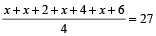
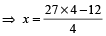

∴ Highest number = 24 + 6 = 30
Question 2
The product of two consecutive even numbers is 5328. What is the smaller number?
A. 70
B. 68
C. 74
D. 72
Solutions
Let the smaller number be x
x (x + 2) = 5358
⇒ x² + 2x – 5328 = 0
⇒ (x + 74) (x – 42) = 0
∴ x = 72
Question 3
The product of two consecutive odd numbers is 1763. What is the larger number?
A. 43
B. 39
C. 41
D. 37
Solutions
From the given alternatives,
1763 = 43 × 41
Question 4
The sum of a set of five consecutive even numbers is 140. What is the sum of the next set of five consecutive even numbers?
A. 190
B. 180
C. 200
D. 160
Solutions
According to the question,
x + x + 2 + x + 4 + x + 6 + x + 8 = 140
⇒ 5x + 20 = 140
⇒ 5x = 120
∴ x =  = 24
= 24
∴ x + 8 = 24 + 8 = 32
The next set of five consecutive even number will start with = 34
∴ Required sum
= 34 + 36 + 38 + 40 + 42 = 190
Question 5
The product of two consecutive even numbers is 16128. Which is the larger number?
A. 132
B. 128
C. 124
D. 126
Solutions
Quicker Approach:
The unit’s digit of the number 16128 is 8.
From the given answer choices,
126 × 128 = 16128
∴ Required larger number = 128
Question 6
The product of two successive numbers is 3192. What is the smaller number?
A. 59
B. 58
C. 57
D. 56
Solutions
Out of the given alternatives,
56 × 57 = 3192
Question 7
The sum of three consecutive integers is 39. Which of the following is the largest among the three?
A. 12
B.15
C.13
D.14
Solutions
Let the three consecutive integers be
x, x + 1 and x + 2
According to the question,
x + x + 1 + x + 2 = 39
⇒ 3x + 3 = 39
⇒ 3x = 39 – 3 = 36
⇒ x =  = 12
= 12
∴ Required largest number
= x + 2 = 12 + 2 = 14
Question 8
The product of two consecutive even numbers is 4488. Which is the smaller number?
A. 62
B. 71
C. 66
D. 65
Solutions
Let the smaller number be x
x × (x + 2) = 4488
⇒ x² + 2x – 4488 = 0
⇒ (x + 68) (x – 66) = 0
∴ x = 66
Question 9
The product of two successive numbers is 8556. What is the smaller number?
A. 89
B. 94
C. 90
D. 92
Solutions
Let the number be x and (x + 1).
∴ x(x + 1) = 8556
⇒ x² + x – 8556 = 0
⇒ x² + 93x – 92 x – 8556 = 0
⇒ (x² + 93) (x – 92) = 0
∴ x = 92
Question 10
The product of two consecutive odd numbers is 19043. Which is the smaller number?
A. 137
B. 131
C. 133
D. 129
Solutions
Out of the given alternatives,
137 × 139 = 19043
∴ Required smaller number = 137