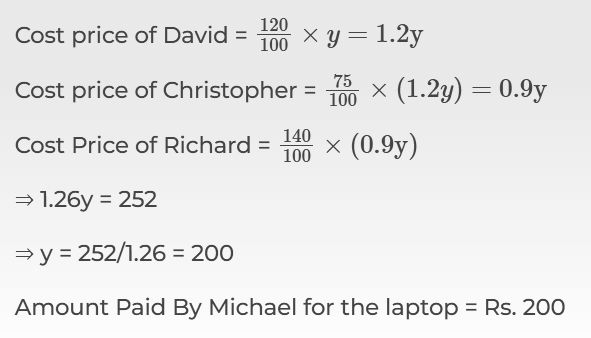
1. Michael sold a laptop to David at a profit of 20%. David sold the same laptop to Christopher at a loss of 25%. Christopher sold the same laptop to Richard at a profit of 40%. If Richard paid Rs. 252 for the laptop, then find how much did Michael pay for it?
A. Rs. 250
B. Rs. 300
C. Rs. 220
D. Rs. 200
E. Rs. 225
Solutions
Let the laptop costs Rs. y to Michael
2. A shopkeeper sells a watch worth Rs. 500 in Rs. 700 then find profit percent he gained in the dealing.
A. 40
B. 80
C. 60
D. 20
E. 25
Solutions
Worth of watch (CP) = Rs. 500
Selling price (SP) = Rs. 700
∴ Profit gained = (700 – 500/500) × 100 = 40%
3. Ankit sells an article to Meena at a profit of 25% and Meena sells it to Dhruvi at a loss of 20%. If Dhruvi pays Rs. 1065, then find how much it cost for Ankit.
A. Rs. 1065
B. Rs. 2130
C. Rs. 2840
D. Rs. 4260
E. None of these
Solutions
Short trick∶
Required cost = 1065/(1.25 × 0.8) = Rs. 1065
Detailed solution∶
Let the cost price for Ankit be ‘X’
Given- Ankit sold the article to Meena at a profit of 25%,
Selling price for Ankit = Cost Price × (1 + Profit%) = X × (1 + 25%) = 1.25X
The selling price of Ankit becomes the cost price for Meena
Cost Price for Meena = 1.25X
Given Meena sold the article to Dhruvi at a loss of 20%,
Selling Price for Meena = Cost Price × (1 – Loss%) = 1.25X × (1 – 20%) = 1.25X × 0.8 = X
Now the selling price of Meena is the cost price for Dhruvi which = Rs. 1065
⇒ X = Rs. 1065∴ Cost price for Ankit = ‘X’ = Rs. 1065
4. What is a single discount equivalent to the discount series of 20% and 35%?
A. 50
B. 55
C. 48
D. 59
E. 60
Solutions
For equivalent discount,
Equivalent discount = A + B – AB/100
⇒ Equivalent discount = 20 + 35 – (20 × 35)/100 = 55 – (700/100)∴ Equivalent discount = 55 – 7 = 48%
5. Due to Christmas, bakery owner decided to sell the cake of Rs. 500 at the price of Rs. 425. How much % of discount he offer to customer?
A. 8
B. 10
C. 12
D. 15
E. 18
Solutions
Marked price of cake = Rs. 500
Selling price = Rs. 425
⇒ Discount offer = Marked price – selling price = 500 – 425 = Rs.75∴ Discount = (75/500) × 100 = 15%
6. The marked price of a helmet increased by 30% and then decreased by 30%. If the price of a helmet now is Rs. 540.54, what was the initial marked price?
A. Rs. 594
B. Rs. 599
C. Rs. 607
D. Rs. 499
E. Rs. 652
Solutions
As per the details given,
Let the initial marked price be Rs. x
Increase in Marked price = 30%
Decrease in marked price = 30%
At last marked price = Rs. 540.54
Increment made = x + 30% of x = x + 0.3x = 1.3x
Decrement made = 70/100 × 1.3x = 0.91x [∵ Decrement had the affect of increment]
Final price = Rs. 540.54;
Final price = 0.91x = Rs. 540.54
⇒ x = 540.54/0.91 = Rs. 594
∴ Initial price = Rs. 594
7. Prajwal bought one plus six for Rs. 21000 and sold it to vrushali at 7% discount. In the entire transaction Prajwal made a profit of 9%. Calculate the marked price of one plus?
A. Rs. 24531
B. Rs. 24890
C. Rs. 24613
D. Rs. 29134
E. Rs. 21390
Solutions
CP of one plus six = Rs. 21000
According to the condition given in the problem,
109/100 × 21000 = Rs. 22890
Profit he earned = 22890 – 21000 = Rs. 1890
According to the condition given in the problem,
1890 = 0.93 × MP – 21000
⇒ 22890 = 0.93 × MP
⇒ MP = Rs. 24612.90 ≈ Rs. 24613∴ Marked price of one plus is Rs. 24613
8. A Reliance fresh retailer professes to sell his goods at cost price but he uses a weight 920 g instead of weight of 1 kg. Find his gain percent?
A. 8.6956%
B. 8.6356%
C. 8.3484%
D. 7.6596%
E. 7.2556%
Solutions
True weight = 1000 g
False weight = 920 g
Error = true weight – false weight = 1000 – 920 = 80 g
Now,
Gain % = [Error/(True value – Error) × 100
∴ Gain % = [80/920] × 100 = 8.6956%
9. A man sells mangoes at 20% more than the cost price but he uses a weight of 800 gm instead of 1 kg. Find his profit percent.
A. 50%
B. 60%
C. 40%
D. 45%
E. None of these
Solutions
Let the cost price of 1 gm mangoes = Rs. 1
The cost price of 1 kg (1000 gm) mangoes = Rs. 1000
The cost price of 800 gm mangoes = Rs. 800
Selling Price of 1 kg mangoes = 120% of cost price of 1 kg mangoes = 120% of 1000 = Rs. 1200∴ Profit percent = (1200 – 800)/800 × 100 = 400/800 × 100 = 50%
10. Rajiv sold an article for Rs. 56 which cost him Rs. p. If he had gained p% on his outlay, what was his cost?
A. Rs. 40
B. Rs. 50
C. Rs. 60
D. Rs. 72
E. None of these
Solutions
∵ Selling Price = Cost Price × (1 + %gain)
∴ Selling Price = p × [1 + (p/100)] = Rs. 56
⇒ 100p + p2 = 5600
∴ p = 40 or p = -140∴ Cost Price = Rs. 40
11. If a merchant offers a discount of 40% on the marked price of his goods and thus ends up selling at cost price, what was the % markup?
A. 42.85%
B. 58.54%
C. 66.67%
D. 79.85%
E. None of these
Solutions
If the merchant offers a discount of 40% on the marked price, then the goods are sold at 60% of the marked price.
∴ selling @ 40% discount = 60% of marked price (M) = cost price (C).
⇒ (60/100) × M = C
∴ M = (100/60) × C = 1.666667 × C∴ % markup = 66.67%
12. A shopkeeper sells two products at a profit of 20% and 15%. If he earns an overall profit of 18% on the two products, find the ratio of their cost prices.
A. 2/1
B. 3/2
C. 4/3
D. 5/4
E. 6/5
Solutions
Let the cost prices of the products be Rs. ‘x’ and Rs. ‘y’ respectively
Profit on first product = 20% of x = 0.2x
Selling price of first product = cost price + profit = x + 0.2x = 1.2x
Profit on second product = 15% of y = 0.15y
Selling price of second product = cost price + profit = y + 0.15y = 1.15y
Overall profit = 18% of (x + y) = 0.18(x + y)
Now,
Selling price of both products = selling price of first product + selling price of second product
⇒ (x + y) + 0.18(x + y) = 1.2x + 1.15y
⇒ 1.18x + 1.18y = 1.2x + 1.15y
⇒ 1.2x – 1.18x = 1.18y – 1.15y
⇒ 0.02x = 0.03y
⇒ x/y = 3/2∴ Their cost prices are in the ratio 3/2
13. Marked Price of a toy is Rs. 800. A shopkeeper offers a discount of 15% on it. Find the difference in selling price if a discount of 24% is applied instead of 15%.
A. 64
B. 72
C. 192
D. 180
E. 608
Solutions
Marked Price of the toy = 800
Discount offered = 15%
Selling Price = Marked Price – Discount offered × Marked Price
⇒ Selling Price = 800 – 15% of 800
= 800 – 120
= Rs. 680
For 24% discount,
⇒ Selling Price = 800 – 24% of 800
= 800 – 192
= 608
⇒ Difference in amount = 680 – 608
Rs. 72
14. A single discount equivalent to three successive discounts of 10%, 5%, 20% is:
A. 68.4
B. 35
C. 31.6
D. 32
E. None of These
Solutions
Let M.P = Rs. 100
∴ Discounted price = 100 × 0.90 × 0.95 × 0.80 = Rs. 68.4
∴ Total Discount = 100 – 68.4 = Rs. 31.6
∴ Equivalent discount = 31.6%
15. A shopkeeper sells one third amount of a particular item at 16% profit, three fifth at 19.5% profit and the rest at 25% profit. What was the overall profit percentage?
A. 18.7
B. 17.6
C. 19.2
D. 20.5
E. 20
Solutions
Let total items be 15 and cost price of each item be Rs. x
Selling price of 5 items = Rs. {(116/100) × 5x}
Selling price of 9 items = Rs. {(119.5/100) × 9x}
Selling price of 1 item = Rs. {(125/100) × x}
Total selling price = {(116/100) × 5x} + {(119.5/100) × 9x} + {(125/100) × x} = Rs. (17805x/1000)∴ Overall profit percentage = [{(17805/1000) – 15}x/15x] × 100 = 18.7%