1.Which report is NOT associated with Fundamental Rights?
A. Tej Bahadur Sapru Report
B. Sarkaria Commission Report
C. JB Kripalani Report
D. Motilal Nehru Report
Solutions
Concerned with Centre-State relations, not fundamental rights.
Recommended ways to improve cooperation between Centre and States.
2. Which of the following is responsible for attending to disputes concerning recruitment and conditions of service of public personnel at the Centre?
A. Joint Administrative Tribunal
B. The Settlement and Appellate Tribunal
C. The Competition Appellate Tribunal
D. Central Administrative Tribunal
Solutions
The Central Administrative Tribunal (CAT) was established under Article 323A of the Constitution of India by the Administrative Tribunals Act, 1985. Its main purpose is:
To resolve disputes and complaints related to recruitment and service conditions of public servants (civil servants) under the Central Government.
3. Who gave the concept of ‘money illusion’ for the first time?
A. Robertson
B. Adam Smith
C. Irving Fisher
D. JM Keynes
Solutions
The concept of ‘Money Illusion’ was first introduced by American economist Irving Fisher in the early 20th century.
4. Which of the following is NOT an example of a minor industrial region of India?
A. Durg-Raipur region
B. Ambala-Amritsar region
C. Northern Malabar region
D. Hugli region
Solutions
Explanation:
Industrial areas in India are divided into two categories:
Major industrial areas
Minor industrial areas
5. _________ land is suitable for cropping regularly.
A. Urban
B. Barren
C. Arable
D. Marginal
Solutions
Explanation:
Arable land refers to land that is suitable for growing crops regularly.
It has fertile soil, adequate water availability, and is generally well-maintained for agricultural purposes.
6. In which year Timur’s invasion of Delhi took place?
A. 1492
B. 1221
C. 1526
D. 1398
Solutions
Explanation:
- Timur, also known as Tamerlane, was a Mongol conqueror from Central Asia.
- His invasion of Delhi occurred in 1398 during the reign of Sultan Nasir-ud-Din Mahmud Tughlaq of the Tughlaq dynasty.
- Timur defeated the Delhi Sultanate forces and massacred the population of Delhi, causing widespread destruction.
7. Europeans entered India with a mindset of trading only. This streak was initiated by which of the following European nations?
A. French
B. Portuguese
C. British
D. Dutch
Solutions
Explanation:
The Portuguese were the first European nation to arrive in India with the primary intention of trade.
- In 1498, Vasco da Gama from Portugal landed at Calicut (Kozhikode) on the western coast of India.
- This marked the beginning of European sea trade with India.
- Initially, their interest was purely commercial, aiming to control the lucrative spice trade.
- Later, other European powers like the Dutch, British, and French followed.
8. A new Genus of Freshwater Fish namely Koima, was discovered recently by researchers. It is endemic to ________.
A. Eastern Ghats
B. Western Ghats
C. Andaman and Nicobar Islands
D. Western Himalayas
Solutions
A new genus of freshwater fish named “Koima” discovered by scientists recently is found only in the Western Ghats region. This fish is endemic, that is, it is found only in this region.
The Western Ghats are considered a hotspot for biodiversity.
Many endemic species are found here, including fish, plants, and amphibians.
9. Who among the following became the first Italian Champion to win the NITTO ATP Finals 2024 title on home soil?
A. Jannik Sinner
B. Carlos Alcaraz
C. Taylor Fritz
D. Novak Djokovic
Solutions
Correct Answer: Jannik Sinner
Jannik Sinner made history by becoming the first Italian to win the Nitto ATP Finals on home soil in Turin in 2024. He defeated Taylor Fritz in the final with a straight-sets victory (6–4, 6–4), and remarkably won the entire tournament without dropping a set
10. The Central Government recently launched ________ initiative aimed to support research in Universities specially Centre and State public universities.
A. PAIR
B. SCISSOR
C. SHOW
D. SHY
Solutions
Correct Answer: PAIR
The Central Government recently launched the PAIR (Promotion of Academic Research and Innovation) initiative. This program is aimed at supporting research in universities, particularly in Centre and State public universities.
11. In each question below is given a statement followed by two courses of action numbered I and II. You have to assume everything in the statement to be true and based on the information given in the statement, decide which of the suggested courses of action logically follow(s).
The Commissioner received the complaint of a police officer who was beating a citizen on the road harshly.
Course of Action:
I. The Commissioner should immediately suspend that Police Officer.
II. The Commissioner should give orders to inspect this matter.
A. Only I follows
B. Only II follows
C. Either I or II follows
D. Neither I nor II follows
Solutions
The correct answer is option 2 i.e. Only II follows
Course of Action:
I. The Commissioner should immediately suspend that Police Officer → Does not follow
The commissioner should not make such decisions in a hurry and should know first the reason behind such incidents.
II. The Commissioner should give orders to inspect this matter → Follows
The commissioner should give orders first to inspect the whole matter and should know why such an incident happened in the first place and who was responsible for it.
Hence, the correct answer is Only II follows.
12. In the question below, two statements (I) and (II) are given. These statements may be either independent causes or may be effects of independent causes or a common cause. One of these statements may be the effect of the other statement. Read both statements and decide which of the following answer choices correctly depicts the relationship between these two statements.
I. A resident of a city in Honduras, a country battling dengue fever caused by mosquitoes, released mosquitoes in the air from a jar as spectators cheered at this sight.
II. Scientists have successfully bred a species of mosquito capable of carrying the bacteria called Wolbachia that interrupts the transmission of dengue.
A. Statement I is the cause, and statement II is its effect.
B. Statement II is the cause, and statement I is its effect.
C. Both the statements I and II are independent causes.
D. Both the statements I and II are effects of some common cause.
Solutions
The correct answer is option 2 i.e. Statement II is the cause, and Statement I is its effect.
The sentence II presents us with a cause – a species of mosquito bred by scientists that is capable of interrupting the spread of dengue.
The sentence I presents us with its effect – residents of Honduras, a country fighting mosquito-borne dengue fever, cheering at the sight of the release of these mosquitoes bred by scientists.
Hence, the correct answer is Statement II is the cause, and Statement I is its effect.
13. In a code language, ‘DEVOTE’ is written as ‘71’, and ‘DIALECT’ is written as ‘54’. How will ‘DIESEL’ be written in that language?
A. 54
B. 53
C. 47
D. 49
Solutions
The correct answer is option 1 i.e. 54.
DEVOTE = 4 + 5 + 22 + 15 + 20 + 5 = 71
Similarly; DIESEL = 4 + 9 + 5 + 19 + 5 + 12 = 54
14. In a code language, ‘dark colors’ is coded as ‘yu nu’, ‘days are bright’ is coded as ‘wu tu ku’, ‘nights are dark’ is coded as ‘ku nu pu’, ‘paint bright’ is coded as ‘wu ru’. What is the code for the word ‘paint’?
A. ku
B. tu
C. wu
D. ru
Solutions
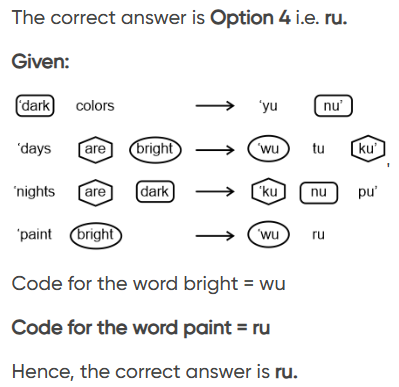
15. In a certain code language, ‘MANTLE’ is written as ‘JZKGIV’, and ‘TINKER’ is written as ‘QRKPBI’. How will ‘DERIVE’ be written in that language?
A. AVORSV
B. AUORST
C. KBORSN
D. KCQTUM
Solutions
The correct answer is Option 1 i.e. AVORSV.
The logic used here is:
‘MANTLE’ is written as ‘JZKGIV’
M – 3 = J
Opposite of A = Z
N – 3 = K
Opposite of T = G
L – 3 = I
Opposite of E = V
‘TINKER’ is written as ‘QRKPBI’
T – 3 = Q
Opposite of I = R
N – 3 = K
Opposite of K = V
E – 3 = B
Opposite of R = I
Similarly;
Code for the word DERIVE:
D – 3 = A
Opposite of E = V
R – 3 = O
Opposite of I = R
V – 3 = S
Opposite of E = V
Hence, AVORSV is the correct answer.
16. In a certain code language, ‘find a solution’ is coded as ‘418’, ‘be attentive’ is coded as ’29’, and ‘answers are correct’ is coded as ‘737’. How will ‘check the question’ be coded in that language?
A. 835
B. 427
C. 538
D. 649
Solutions
Word lengths give the code:
- check = 5 letters
- the = 3 letters
- question = 8 letters
So, code = 538
17. M is the sister of N, R is the niece of M and T is the mother of R. How is N related to T?
A. Brother
B. Daughter
C. Husband
D. Nephew
Solutions
The correct answer is option 3 i.e. Husband.
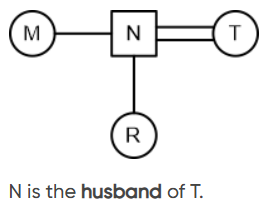
18. Three statements are given followed by three conclusions. Assuming the statements to be true, even if they seem to be at variance with commonly known facts, decide which of the conclusions logically follow(s) from the statements.
Statements:
Some silks are cotton.
All cotton are jute.
Some jute are not silk.
Conclusions:
1. Some jute are silk.
2. All silks are jute.
3. All cottons are silks.
A. Only conclusion 3 follows
B. Only conclusions 1 and 2 follow
C. Only conclusion 1 follows
D. Only conclusions 2 and 3 follow
Solutions
The correct answer is Option 3 i.e. Only conclusion 1 follows.
The least possible Venn Diagram for the given statements is drawn below:
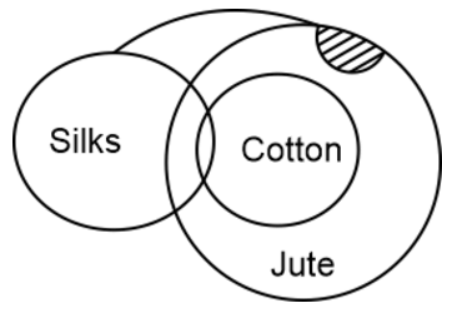
Conclusions:
1. Some jute are silk → True (As some jute are not silk, which means, there are some jute which are silk, hence, this is true.)
2. All silks are jute → False (As there is a negative statement, it cannot have positive conclusion.)
3. All cottons are silks → False (It is possible but no definite conclusion can be drawn.)
Hence, Only conclusion 1 follows.
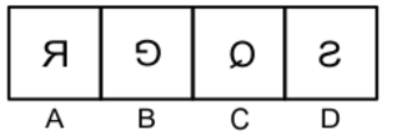
19. Select the figure that does NOT belong to the following group.
A. A
B. B
C. C
D. D
Solutions
- A: This is the mirror image of letter R
- B: This is the mirror image of letter G
- C: This is the mirror image of letter Q
- D: This is the mirror image of letter S
Now let’s find the odd one out.
All symbols A, C, and D are mirror images of letters that have symmetrical structure to some extent and their mirror images still resemble actual characters or are distinguishable.
However, option B (mirror image of G) does not form any valid or symmetric recognizable character — it becomes too distorted and less like a real or mirrored character compared to others.
Correct answer: Option B
20. If A is to the south of B and C is to the east of B. In what direction is A with respect to C?
A. North-East
B. North-West
C. South-East
D. South-West
Solutions
The correct answer is option 4 i.e South-West.
Using the above information we can draw the following diagram:

A is in the South-West direction with respect to C.
Hence, option 4 is the correct answer.
21. A man is facing south. He turns 120 degrees in the anticlockwise direction and then 180 degrees in the clockwise direction. Which direction is he facing now?
A. North-East
B. North-West
C. South-East
D. South-West
Solutions
Step 1: Initial Direction
- The man is facing South.
Step 2: Turns 120° anticlockwise
- From South, turning 120° anticlockwise moves him:
- 90° to East
- Then 30° more → now facing North-East
Step 3: Turns 180° clockwise
- From North-East, turning 180° clockwise points him directly South-West.
Final Direction: South-West
22. Find the next term of the series.
CX GT KP OL ?
A. SH
B. HS
C. RI
D. TG
Solutions
1st Letters:
C, G, K, O, ?
Check their positions in the alphabet:
- C = 3
- G = 7
- K = 11
- O = 15
These increase by +4 each time:
3 → 7 → 11 → 15 → 19, which is S
2nd Letters:
X, T, P, L, ?
Alphabet positions:
- X = 24
- T = 20
- P = 16
- L = 12
These decrease by -4 each time:
24 → 20 → 16 → 12 → 8, which is H
Final term: SH
23. If ‘+’ means ‘-‘, ‘-‘ means ‘×’, ‘×’ means ‘÷’ and ‘÷’ means ‘+’, then what will be the value of the following expression?
40 × 6 – 3 ÷ 9 + 2 = ?
A. 30
B. 27
C. 25
D. 22
Solutions
The correct answer is Option 2 i.e. 27
As per the question
40 × 6 – 3 ÷ 9 + 2 can be decoded as
40 ÷ 6 × 3 + 9 – 2
= 20 + 9 – 2
= 29 – 2
= 27
Hence, the correct answer is 27.
24. Select the combination of letters that when sequentially placed in the blanks of the given series will complete the series.
D E _ T H _ C P _ H D _ P T _ D Y _ T H
A. PDTAHP
B. PHPDTA
C. PPDTAH
D. PDHPTA
Solutions
The correct answer is option 1 i.e. PDTAHP.
Given series: D E _ T H _ C P _ H D _ P T _ D Y _ T H
Option 1: PDTAHP
D E _ T H _ C P _ H D _ P T _ D Y _ T H
D E P T H D C P T H D A P T H D Y P T H
This makes a sequence of D E P T H / D C P T H / D A P T H / D Y P T H
Hence, the correct answer is PDTAHP.
25 Select the option that is related to the third word in the same way as the second word is related to the first word.
Oxford University : England :: Stanford University : ?
A. Tokyo
B. England
C. California
D. New York
Solutions
The correct answer is option 3 i.e. California
Oxford University is located in England.
Similarly, Stanford University is located in California.
Hence, California is the correct answer.
26. Find the odd one out.
A. EVBY
B. JQGT
C. MNIR
D. DXAZ
Solutions
The correct answer is Option 4 i.e. DXAZ
The pattern that is followed here:
1. EVBY = EV BY = E ⇔ V, B ⇔ Y (opposite of letters)
2. JQGT = JQ GT = J ⇔ Q, G ⇔ T (opposite of letters)
3. MNIR = MN IR = M ⇔ N, I ⇔ R (opposite of letters)
4. DXAZ = DX AZ = D ⇔ W NOT X, A ⇔ Z (pattern of opposite of letters is not followed here)
DXAZ is odd from this.
Hence, the correct answer is DXAZ.
27. Select the number from among the given options that can replace the question mark (?) in the following series.
113, 114, 110, 119, 103, 128, ?
A. 98
B. 89
C. 92
D. 97
Solutions
The correct answer is option 3 i.e. 92.
113 + 12 = 113 + 1 = 114
114 – 22 = 114 – 4 = 110
110 + 32 = 110 + 9 = 119
119 – 42 = 119 – 16 = 103
103 + 52 = 103 + 25 = 128
128 – 62 = 128 – 36 = 92
28. Which of the following options will replace the question mark (?) in the given series?
3, 8, 18, 38, ?, 158, 318
A. 98
B. 78
C. 128
D. 108
Solutions
The correct answer is option 2 i.e. 78.
3 + 5 = 8; 8 + 10 = 18; 18 + 20 = 38; 38 + 40 = 78; 78 + 80 = 158; 158 + 160 = 318
29. Complete the following series.
e25, j100, o225, _____
A. t400
B. q400
C. u250
D. m250
Solutions
Step 1: Letters Pattern
Look at the letters:
- e, j, o, ?
Convert them to positions in the alphabet:
- e = 5
- j = 10
- o = 15
Clearly increasing by 5:
5 → 10 → 15 → 20
→ 20th letter is t
Step 2: Numbers Pattern
Check the numbers:
- 25, 100, 225, ?
This looks like perfect squares:
- 5² = 25
- 10² = 100
- 15² = 225
→ Next should be 20² = 400
Correct Answer: t400
30. Read the information carefully and answer the following questions.
Kirti is elder than Uma. Payal’s age is equal to Asha’s age. Neha is younger than Mona, whose age is equal to Asha’s age. Uma is elder than Payal.
Who among the following is the eldest one?
A. Asha
B. Uma
C. Neha
D. None of these
Solutions
The correct answer is Option 4 i.e. None of these
From the statements:
Kirti is elder than Uma. Uma is elder than Payal → Kirti > Uma > Payal
Payal’s age is equal to Asha’s age → Payal = Asha
Neha is younger than Mona whose age is equal to asha’s age → Asha = Mona > Neha
On combining the above statements, we get:
Kirti > Uma > Payal = Asha = Mona > Neha
Kirti is the eldest but it is not given in the option.
Hence, the correct answer is None of these.
31. Select the option that represents the correct order of the given words as they would appear in an English dictionary.
1- Unqualified
2- Urban
3- Ultimate
4- Urgent
5- Umbrella
A. 5, 3, 2, 1, 4
B. 3, 5, 1, 2, 4
C. 3, 1, 5, 2, 4
D. 5, 3, 1, 2, 4
Solutions
The correct answer is Option 2 i.e. 3, 5, 1, 2, 4
The correct dictionary order will be:
3- Ultimate, 5- Umbrella, 1- Unqualified, 2- Urban, 4- Urgent
So, ‘3, 5, 1, 2, 4’ represents the correct dictionary order.
Hence, the correct answer is 3, 5, 1, 2, 4.
32. Read the information carefully and answer the question.
Eight friends (A, B, C, D, P, Q, R, and S) are sitting around a circle (not necessarily in the same order) and all of them are facing inside the circle. A sits opposite D. S is an immediate neighbor of A and C. S sits opposite R. B sits opposite C. B sits between P and R. P sits opposite Q who does not sit to the immediate left of D.
How many people sit between B and Q, while counted from the right of B?
A. 0
B. 2
C. 3
D. 4
Solutions
The correct answer is option 2 i.e. 2.
1. A sits opposite D.
2. S is an immediate neighbor of A and C.
3. S sits opposite R.
4. B sits opposite C.
5. B sits between P and R.
6. P sits opposite Q who does not sit to the immediate left of D.
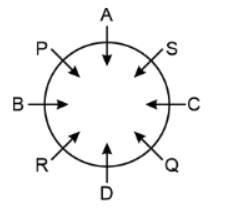
Cleary, 2 people sit between B and Q.
Hence, the correct answer is 2.
33. Arrange the following words in reverse order according to an English dictionary.
1. Deteriorate
2. Devastating
3. Despair
4. Diminish
5. Dictionary
A. 4 5 2 1 3
B. 1 2 3 4 5
C. 4 2 3 5 1
D. 3 1 2 5 4
Solutions
The correct answer is option 1 i.e. 4 5 2 1 3.
The correct dictionary order of the given words is:
3. Despair
1. Deteriorate
2. Devastating
5. Dictionary
4. Diminish
The reverse order will be: 4, 5, 2, 1, 3
Hence, the correct answer is 4, 5, 2, 1, 3.
34. How many sisters does K have?
Statement I: M is sister of K.
Statement II: K’s mother has three chlildren.
A. If the data in statement I is sufficient to answer the question
B. If the data in statement II is sufficient to answer the question
C. If the data either in statement I or statement II is sufficient to answer the question
D. If the data in both statements I and II together are not sufficient to answer the question
Solutions
The correct answer is Option 4 i.e. If the data in both statements I and II together are not sufficient to answer the question
From statement I it clears that K and M are siblings and M is female.
From statement II, we can conclude that K has two siblings.
But from both the statement, gender of K and the third child of K’s mother is not clear.
Hence, If the data in both statements I and II together are not sufficient to answer the question.
35. Choose the odd one out from the following image?
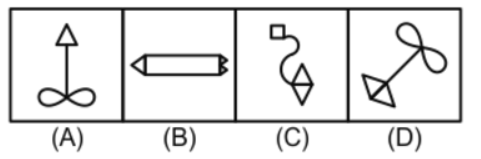
A. A
B. B
C. C
D. D
Solutions
The correct answer is Option 4 i.e. D.
The logic which follows here is:
All figures have one element on the top and two elements on the bottom, except for figure D, which has two elements attached on both sides.
Hence, the correct answer is D.
36. The line graph given below gives the temperature of a place on six days of a week starting from M
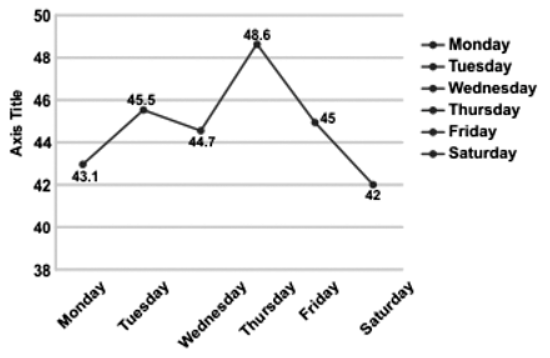
The temperature on Saturday is approximately what percentage of the temperature on Tuesday?
A. 92.6%
B. 92.5%
C. 91.7%
D. 92.3%
Solutions
The correct answer is option 4 i.e. 92.3%.
Temperature on Tuesday = 45.5°
Temperature on Saturday = 42°
Hence, Required percentage = (42/45.5) × 100 = 92.3%
37. Two angles are supplementary angles. One of the angles is 18° less than twice of other. Find both angles.
A. 60°, 120°
B. 66°, 114°
C. 20°, 120°
D. 50°, 130°
Solutions
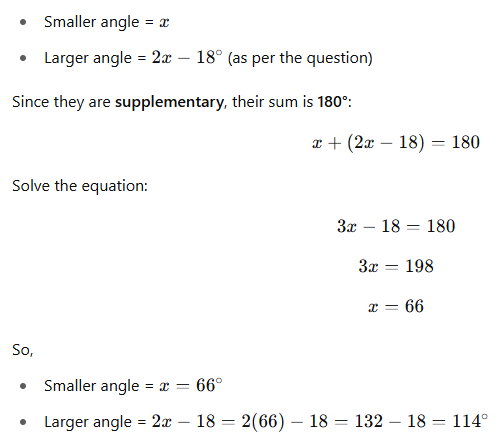
Answer: 66°, 114°
38. A 200 metres wide path is formed around a circular garden of area 6.16 km2. Find the area of the path.
A. 1.9 km2
B. 2.4 km2
C. 3.2 km2
D. 0.8 km2
Solutions
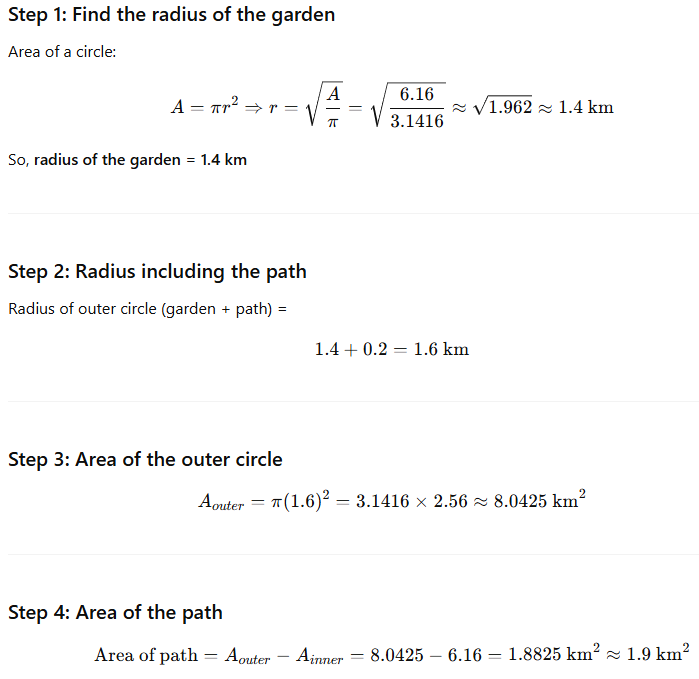
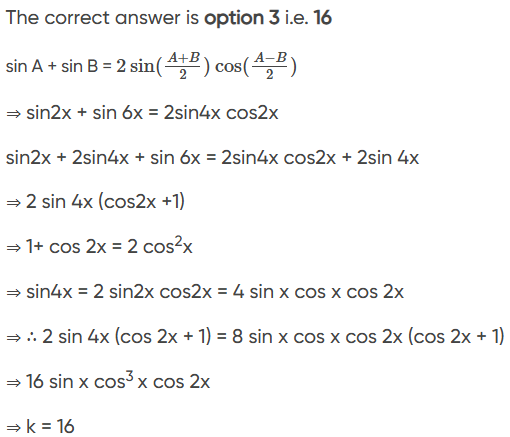
39. sin2x + 2 sin4x + sin 6x = k(sinx. cos3x . cos 2x) , what is the value of k?
A. 4
B. 8
C. 16
D. 32
Solutions
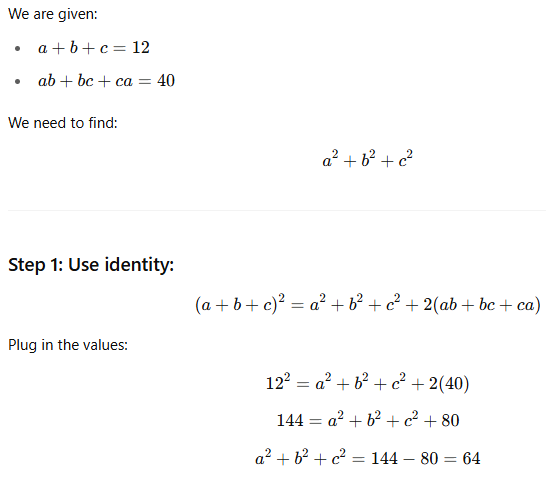
40. If a + b + c = 12 and ab + bc + ca = 40, then what is the value of a2 + b2 + c2 ?
A. 74
B. 98
C. 104
D. 64
Solutions
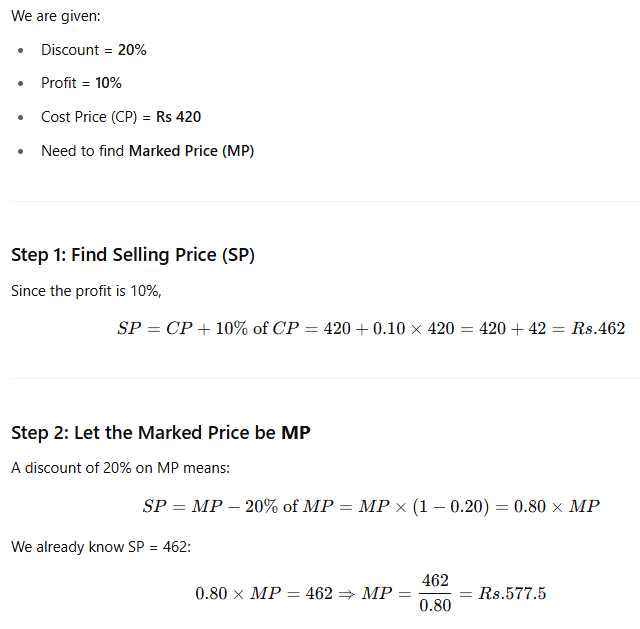
41. A shopkeeper allows a discount of 20% on the marked price of certain goods and makes a profit of 10%. If the goods cost Rs 420 for the shopkeeper, the marked price of the goods will be:
A. Rs 475.5
B. Rs 545
C. Rs 560
D. Rs 577.5
Solutions
42. Quantity x is increased by 68%. Due to its product with another quantity y, the product increases by 26%, what is the percentage decrease in the value of y?
A. 12%
B. 15%
C. 20%
D. 25%
Solutions
The correct answer is Option 4 i.e. 25%.
x = 68% increased
xy = 26% increased
Let’s assume y is -k% decreased
Successive discount = x + y + (xy)/100
26 = 68 – k – (68k)/100
⇒ 42 = k(168)/100
k = 4200/168 = 25%
So, the value of y decreases by 25%
43. What is the value of (61.25% of 26400) + [(16.67% of 996 ÷ 4) × (444 ÷ 3)?
A. 22312
B. 22576
C. 21895
D. 21762
Solutions
The correct answer is option 1 i.e. 22312.
By using BODMAS,
(61.25% of 26400) + [(16.67% of 996 ÷ 4) × (444 ÷ 3)
⇒ 61.25/100 × 26400 + (1/6 of 996 ÷ 4) × (444 ÷ 3)
⇒ 16170 + 41.5 × 148
⇒ 16170 + 6142
⇒ 22312
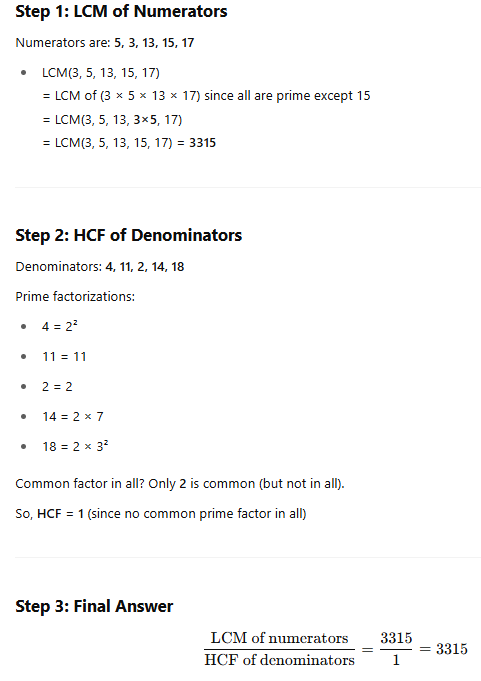
44. Find the LCM:
5/4, 3/11, 13/2, 15/14 and 17/18
A. 1580/77
B. 2450
C. 335/24
D. 3315
Solutions
45. Pipe A and B can fill the tank in 15 hours and 12 hours respectively. Pipe C can empty the full tank in 20 hours. If all the taps open simultaneously at 10 am, how much time will it take to fill the empty tank once, and what time will it be on clock?
A. 10 hours and 8 pm
B. 12 hours and 10 pm
C. 10 hours and 8 am
D. 12 hours and 10 am
Solutions
The correct answer is option 1 i.e. 10 hours and 8 pm
A = 15 hours
B = 12 hours
C = 20 hours
The total capacity of the tank is LCM of 15, 12 and 20 (let) = 60
Efficiency of A = 60/15 = 4
Efficiency of B = 60/12 = 5
Efficiency of C = 60/20 = 3
When all three pipes work together the net efficiency is
(A + B – C) efficiency = 4 + 5 – 3 = 6
Total time when start work together = Total work/efficiency = 60/6 = 10 Hours
Time on clock = 10 am + 10 hours = 8 pm
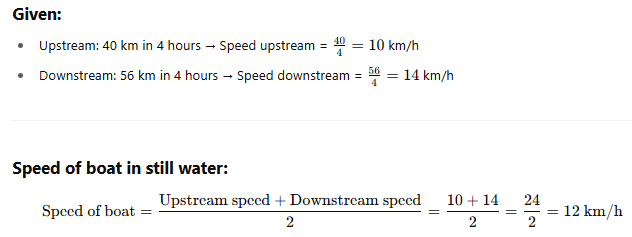
46. A boat travels upstream 40 km in 4 hours and downstream 56 km in 4 hours. Find the Speed (km/h) of the boat.
A. 2
B. 6
C. 8
D. 12
Solutions
47. When a person weighing 39 kg is replaced by a new person, the average weight of 24 persons increases by 0.7 kg. Find the weight of the new person.
A. 49.6 kg
B. 55.8 kg
C. 44.7 kg
D. 61.3 kg
Solutions
The correct answer is Option 2 i.e. 55.8 kg.
Increase in average weight = 0.7 kg
Total increase in the weight = 24 × 0.7 = 16.8 kg
It means the weight of the new person is 16.8 more than the weight of the person who weighs 39 kg.
Weight of the new person = (39 + 16.8) kg = 55.8 kg
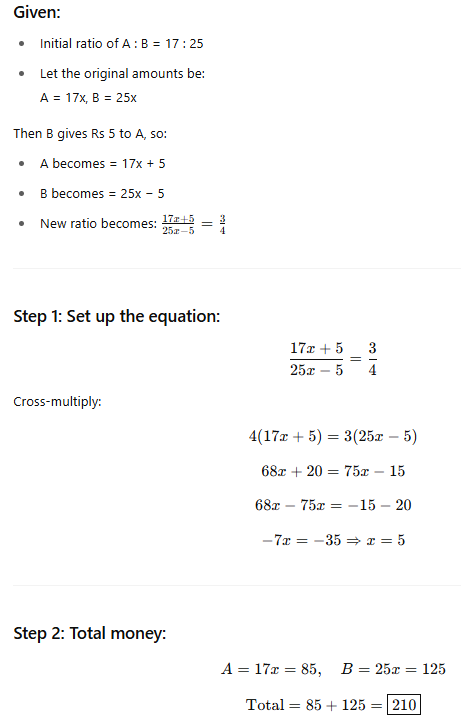
48. A sum of money was divided between A and B in the ratio 17 : 25. If B gives Rs 5 to A, the ratio would change to 3 : 4. What is the sum of money?
A. 196
B. 203
C. 217
D. 210
Solutions
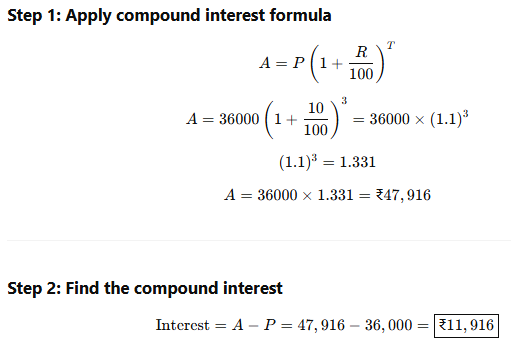
49. Suresh invested Rs. 36,000 in a scheme of LIC offering 10% compound interest for three years compounded annually. Find the interest earned by him.
A. Rs. 16,058
B. Rs. 11,916
C. Rs. 15,858
D. Rs. 25,758
Solutions
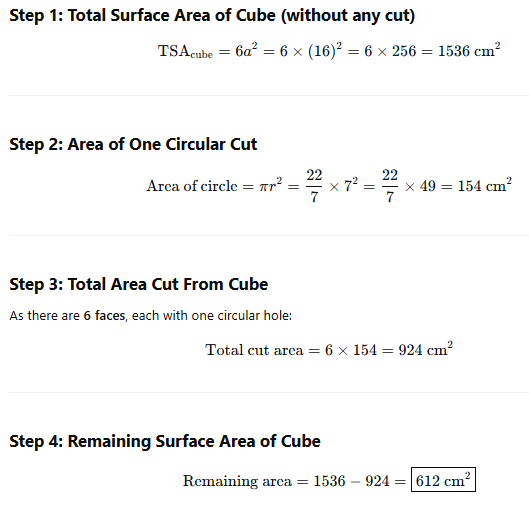
50. A circular shape disk is cut from each face of the cube of side 16 cm long. Find the remaining surface area of the cube if the radius of the circle is 7cm.
A. 924 cm2
B.616 cm2
C. 612 cm2
D. 1382 cm2
Solutions
51. A retailer sold an item for Rs 1221 at a 12% loss. At what price should he sell the item so that gains a profit of 20%?
A. Rs 1661
B. Rs 1550
C. Rs 1650
D. Rs 1665
Solutions
The correct answer is option 4 i.e. Rs 1665.
Cost price = (Selling price × 100)/(100 – loss%)
Sellin price = {C.P × (100 + P%)}/100
Selling price = Rs 1221 and he gets a loss of 12%
So, the cost price of the item = (1221 × 100)/(100 – 12) = 122100/88 = 11100/8
So, the selling price at which he gets a profit of 20%
⇒ {(11100/8) × (100 + 20)%/100}
⇒ (111/8) × (120) = 1665
So, The S.P = Rs 1665
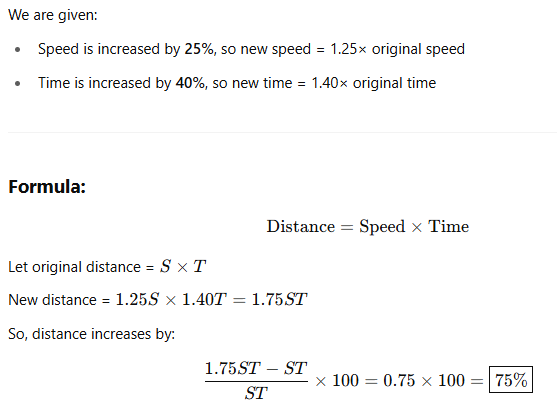
52. Raj decided to increase the speed of his car by 25% and also would like to increase the time of travel by 40%. What is the percentage increase in the distance he covers?
A. 50
B. 65
C. 75
D. 80
Solutions
53. Find the value of the expression: 56 + 12% of 1750 + [(520 ÷ 5 ÷ 2) of 3]
A. 422
B. 428
C. 434
D. 438
Solutions
The correct answer is option 1 i.e. 422.
56 + 12% of 1750 + [(520 ÷ 5 ÷ 2) of 3]
⇒ 56 + 210 + [(104 ÷ 2) of 3]
⇒ 266 + 156 = 422
54. Find the sum of digits in tens place in all the even numbers lesser than 100.
A. 225
B. 235
C. 245
D. 250
Solutions
The correct answer is option 1 i.e. 225.
Number of even numbers between 0 – 9: 4
The tens digit of those numbers = 0
Number of even numbers between 10 – 19: 5
The tens digit of those numbers = 1
Number of even numbers between 20 – 29: 5
The tens digit of those numbers = 2
Number of even numbers between 30 – 39: 5
The tens digit of those numbers = 3
Number of even numbers between 40 – 49: 5
The tens digit of those numbers = 4
Number of even numbers between 50 – 59: 5
The tens digit of those numbers = 5
Number of even numbers between 60 – 69: 5
The tens digit of those numbers = 6
Number of even numbers between 70 – 79: 5
The tens digit of those numbers = 7
Number of even numbers between 80 – 89: 5
The tens digit of those numbers = 8
Number of even numbers between 90 – 99: 5
The tens digit of those numbers = 9
Total sum = 1 × 5 + 2 × 5 + … + 9 × 5 = 225
55. 5 men, 10 women, and 5 children can complete a piece of work in 4, 3, and 8 days respectively. If 4 men, 3 women, and 8 children work on the project, how many days will it take for the work to be complete?
A. 1
B. 2
C. 3
D. 4
Solutions
The correct answer is Option 2 i.e. 2.
If 5 men can work in 4 days, then 4 men can complete the work in 5 days
If 10 women can complete the work in 3 days, 3 women can complete the work in 10 days
If 5 children can complete the work in 8 days, then 8 children can complete the work in 5 days
Amount of work completed in 4 men, 3 women, and 8 children in one day = 1/5 + 1/10 + 1/5
⇒ ½
Number of days taken to complete work = 2 days
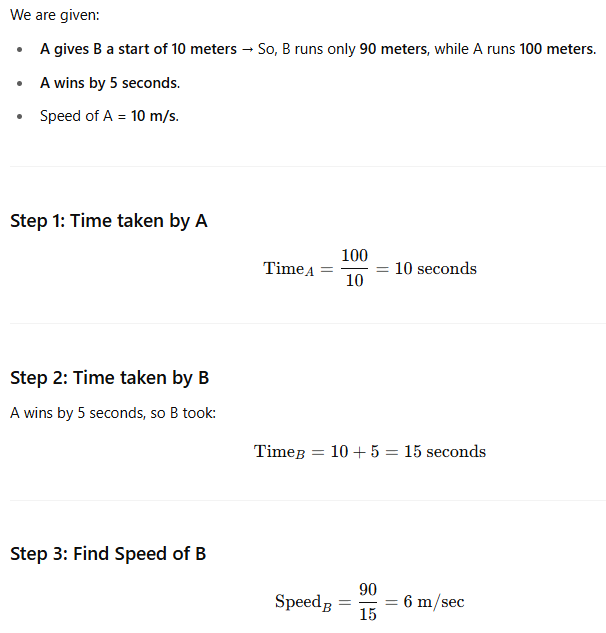
56. A gives B a start of 10 meters and wins by 5 seconds in a 100 meters race. Find the speed of B if the speed of A is 10 m/sec.
A. 4 m/sec
B. 6 m/sec
C. 2 m/sec
D. 5 m/sec
Solutions
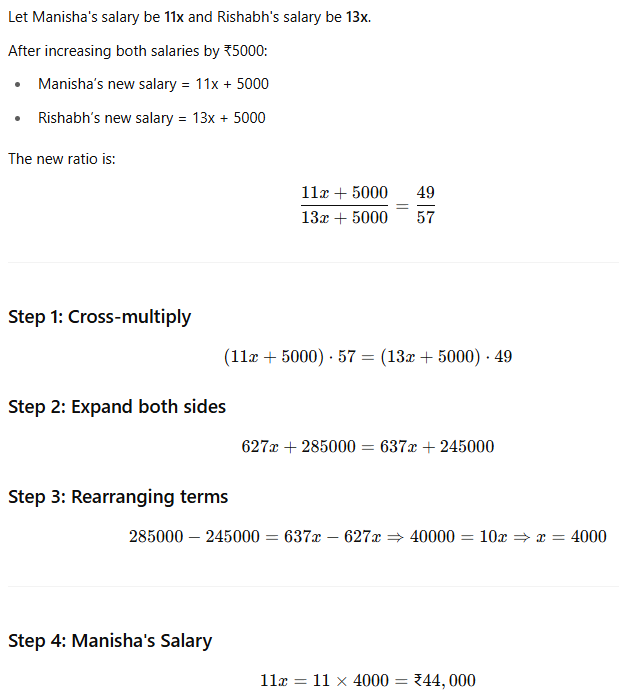
57. The ratio of salaries of Manisha and Rishabh is 11 : 13. If the salary of each is increased by Rs. 5000, the new ratio becomes 49 : 57. What is Manisha’s salary?
A. Rs 40000
B. Rs 44000
C. Rs 48000
D. Rs 42000
Solutions
58. Find the difference between Simple and Compound Interest for 1 year when Rs 16500 is lent at 10% per annum? (In case of C.I. interest is compounded semi annually.
A. 41.25
B. 1650
C. 1691.25
D. 48.75
Solutions
The correct answer is option 1 i.e. 41.25
Principal (P) = Rs 16500
Rate (r) = 10% p.a.
Time (t) = 1 year.
Simple Interest = (P × r × t)/100 = (16500 × 10 × 1)/100 = 1650
In case of Compound Interest, it is compounded semi annually, time will get doubled and interest will be halved.
C.I = P [1 + (r/100)]2 – P
C.I = 16500 × 1.05 × 1.05 – 16500
C.I = 18191.25 – 16500
C.I = 1691.25
Difference = 1691.25 – 1650 = 41.25
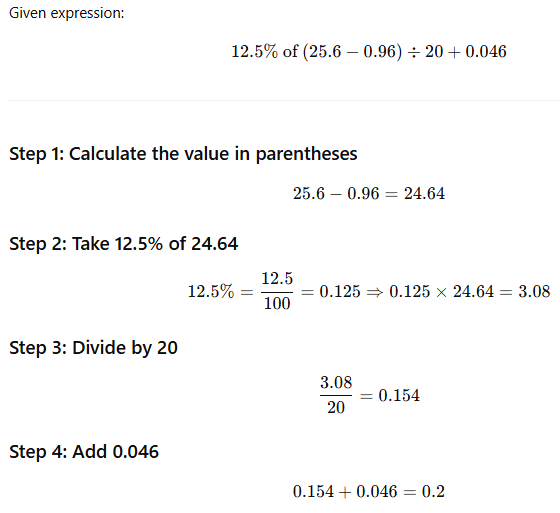
59. Simplify: 12.5% of (25.6 – 0.96) ÷ 20 + 0.046
A. 0.2
B. 0.02
C. 20
D. 2
Solutions
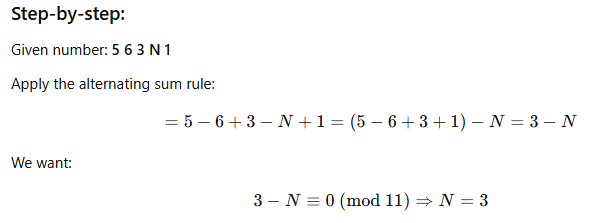
60. Find the value of N in 563N1, if this number is divisible by 11.
A. 0
B. 1
C. 2
D. 3
Solutions
A number is divisible by 11 if the alternating sum of its digits (i.e., digit1 – digit2 + digit3 – digit4 + …) is divisible by 11 (including 0).
61. In July 2018, an experiment aboard the International Space Station cooled a clouded a cloud of atoms of which chemical element to one ten-millionth of one kelvin above absolute zero, forming a Bose-Einstein Condensate in space?
A. Rubidium
B. Plutonium
C. Radium
D. Thorium
Solutions
The correct answer is option 1 i.e. Rubidium.
In July 2018, an experiment aboard the International Space Station (ISS) cooled a cloud of atoms of the chemical element rubidium to one ten-millionth of one kelvin above absolute zero, forming a Bose-Einstein Condensate (BEC) in space.
This experiment, known as the Cold Atom Laboratory (CAL), aimed to study the behavior of ultra-cold quantum gases in microgravity conditions.
62. Which Nobel Laureate conducted an experiment in the late 19th century and observe that a glass tube filled with a low-pressure gas emitted radiation when a voltage was applied between two metal plates?
A. Victory Francis Hess
B. Philipp Lenard
C. Paul Dirac
D. Hideki Yukawa
Solutions
The correct answer is option 2 i.e. Philipp Lenard.
Philipp Lenard, a German physicist, conducted the experiment in the late 19th century. He observed that a glass tube filled with a low-pressure gas emitted radiation when a voltage was applied between two metal plates. This phenomenon, known as the Lenard tube experiment, contributed to the understanding of cathode rays and the discovery of electrons.
Philipp Lenard was awarded the Nobel Prize in Physics in 1905 for his work on cathode rays.
63. 1 kilowatt is equivalent to:
A. 3600 KJ/h
B. 3600 calorie
C. 7200 KJ/h
D. 7200 Joule
Solutions
The correct answer is option 1 i.e. 3600 KJ/h.
Actually, 1 kilowatt (kW) is equivalent to 3.6 megajoules per hour (MJ/h), not 3600 kilojoules per hour (kJ/h).
Here’s the conversion:
1 kilowatt (kW) = 1000 watts (W)
1 kilojoule (kJ) = 1000 joules (J)
So, 1 kilowatt = 1000 joules per second (Watt definition)
= 1000 joules per second × 3600 seconds
= 3600 kilojoules per hour (kJ/h)
So, 1 kilowatt is equivalent to 3600 kilojoules per hour (kJ/h), not 3600 kJ/h.
64. Which are the four quantum numbers for an electron present in 4f orbital?
A. n = 4, I = 3, m = +1, s = +1/2
B. n = 3, I = 2, m = -2, s = +1/2
C. n = 4, I = 4, m = -4, s = -1/2
D. n = 4, I = 3, m = + 4, s = +1/2
Solutions
The correct answer is option 1 i.e. n = 4, I = 3, m = +1, s = +1/2.
For an electron in a 4f orbital, the four quantum numbers are:
- Principal Quantum Number (n): 4
- Azimuthal Quantum Number (l): 3 (for f orbitals)
- Magnetic Quantum Number (mₗ): Ranges from -3 to +3, so possible values are -3, -2, -1, 0, +1, +2, +3.
- Spin Quantum Number (mₛ): Can be either +1/2 or -1/2, indicating the electron’s spin direction.
65. By observing the motion of objects on an inclined plane ______ deduced that objects move with a constant speed when no force acts on them.
A. Michael Faraday
B. Johannes Kepler
C. Galileo
D. Archimedes
Solutions
Galileo Galilei, by observing the motion of objects on inclined planes, concluded that in the absence of external forces, objects continue to move with a constant speed. This observation laid the groundwork for Newton’s First Law of Motion.
Correct Answer: 3) Galileo
66. Who, in the 1860s, undertook a thorough investigation of the gas laws expressing the relationships of pressure. temperature and volume in carbon dioxide?
A. Thomas Andrews
B. Giulio Natta
C. John Dalton
D. Marguerite Perey
Solutions
In the 1860s, Thomas Andrews, an Irish chemist and physicist, conducted extensive studies on the behavior of gases, especially carbon dioxide. He investigated how pressure, temperature, and volume are interrelated and introduced the concept of critical temperature — the temperature above which a gas cannot be liquefied by pressure alone.
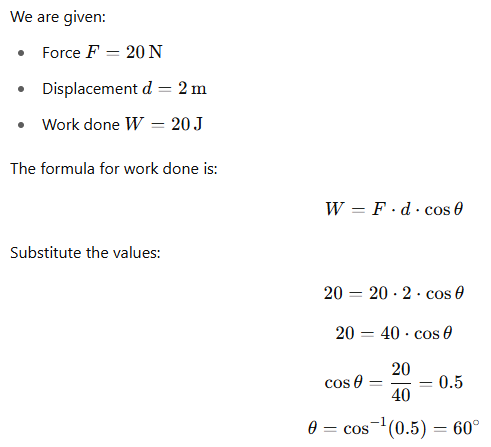
67. A force of 20 N displaces an object through 2 m and does a work of 20 J. The angle between the force and displacement is:
A. 90º
B. 40º
C. 30º
D. 60º
Solutions
68. What product is formed when electricity is passed through an aqueous solution of sodium chloride?
A. Sodium oxide
B. Sodium hydroxide
C. Sodium and chlorine
D. Sodium and water
Solutions
When electricity is passed through an aqueous solution of sodium chloride (NaCl), the process is called electrolysis of brine. The products formed are:
- Hydrogen gas at the cathode
- Chlorine gas at the anode
- Sodium hydroxide (NaOH) remains in the solution
Correct Answer: 2) Sodium hydroxide
69. At normal temperature and atmospheric pressure, ______ has a density of 1.87 kg/m3, which is 1.5 times heavier than air and exists as a liquid below the critical temperature of 31°C.
A. carbon dioxide
B. nitrogen
C. hydrogen
D. lithium
Solutions
- At normal temperature and atmospheric pressure, carbon dioxide (CO₂) has a density of about 1.87 kg/m³.
- This makes it approximately 1.5 times heavier than air.
- It also exists as a liquid below its critical temperature of 31°C, but only under high pressure.
Hence, the correct option is carbon dioxide.
70. Sound travels at a speed of 333 ms-1 in the air, thus, in 1 s, a distance of 333 m is travelled by:
A. particles
B. receiver
C. source
D. disturbance
Solutions
- Sound is a mechanical wave that propagates through the vibration of particles in a medium.
- However, the particles themselves do not travel from the source to the receiver; they only oscillate back and forth.
- The energy or disturbance is what travels through the medium at a speed of 333 m/s in air.
So, in 1 second, a distance of 333 meters is traveled by the sound disturbance, not by particles or the source.
71. Which of the following regions has the highest potential for wind energy?
A. The Deccan Plateau
B. Gangetic planes
C. The Himalayas
D. Western Ghats
Solutions
Among the given options, the Western Ghats have the highest potential for wind energy due to:
- High wind speeds and consistent wind flow.
- Elevated terrain and proximity to the western coastline, which enhances wind availability.
- States like Tamil Nadu, Maharashtra, and Karnataka (part of the Western Ghats region) are top producers of wind energy in India.
Thus, the Western Ghats offer the best conditions for wind energy development.
72. When a compressed slinky is released it converts potential energy into:
A. Mechanical energy
B. Heat energy
C. Chemical energy
D. Kinetic energy
Solutions
When a compressed slinky is released:
- It stores potential energy (specifically, elastic potential energy) when compressed.
- Upon release, this stored energy is converted into kinetic energy, causing the slinky to move and expand.
Hence, the correct conversion is: Potential energy → Kinetic energy.
73. The tendency of undisturbed objects to stay at rest or to keep moving with the same velocity is called_________.
A. momentum
B. force
C. Energy
D. Inertia
Solutions
- Inertia is the property of an object to resist changes in its state of motion.
- If an object is at rest, it tends to stay at rest.
- If it is moving at a constant velocity, it tends to keep moving at that velocity unless acted upon by an external force.
So, the correct answer is: Inertia.
74. When a ray of light travels from a denser medan to a rand medinant, it bends:
A. away from the normal and speeds up
B. towards the normal and speeds up
C. away from the normal and becomes medial
D. towards the normal and slows down
Solutions
When light travels from a denser medium (like water or glass) to a rarer medium (like air):
- It bends away from the normal (an imaginary line perpendicular to the surface at the point of incidence).
- It speeds up, because light travels faster in a rarer medium.
So, the correct answer is: 1) Away from the normal and speeds up.
75. What is the number of shells for elements of the 3rd period?
A. 3
B. 1
C. 0
D. 2
Solutions
The period number in the periodic table tells us the number of electron shells (also called energy levels) an element has.
- Elements in the 3rd period have 3 electron shells.For example:
- Sodium (Na): 2, 8, 1
- Magnesium (Mg): 2, 8, 2
- Chlorine (Cl): 2, 8, 7
So, the number of shells for elements in the 3rd period is: 3.
76. In 1784, who discovered the composition of water through his experiment with hydrogen and oxygen?
A. Henry Cavendish
B. Herbert C Brown
C. Joseph Priestley
D. John Dalton
Solutions
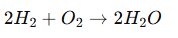
In 1784, Henry Cavendish, a British scientist, discovered that water is a compound made of hydrogen and oxygen. He performed experiments where he burned hydrogen in the presence of oxygen and observed the formation of water as a product.
His work laid the foundation for understanding the chemical composition of water:
- Chemical reaction:
Therefore, the correct answer is Henry Cavendish.
77. Which of the following is the most widely used method for refining impure metals?
A. Vapour-Phase Refining
B. Poling Refining
C. Electrolytic Refining
D. Liquidation Refining
Solutions
Electrolytic refining is the most widely used method for purifying impure metals like copper, zinc, silver, gold, etc.
How It Works:
- The impure metal is made the anode.
- A pure metal sheet is used as the cathode.
- An appropriate electrolyte (metal salt solution) is used.
- On passing electric current:
- Pure metal gets deposited at the cathode.
- Impurities either fall off as anode mud or remain in solution.
Therefore, the correct and most commonly used method is Electrolytic Refining.
78. With which scientist did William Ramsay show in 1894 that air also contained an element unknown till then, which was named argon?
A. Lord Rayleigh
B. Herrmann Staudinger
C. Glenn Seaborg
D. Harold Urey
Solutions
In 1894, William Ramsay and Lord Rayleigh discovered a new inert gas in air, which they named argon.
- They were investigating the composition of air and noticed a discrepancy in the density of nitrogen obtained from air versus chemically prepared nitrogen.
- This led to the discovery of a noble gas that did not react easily with other elements — argon (Ar).
Correct Answer: Lord Rayleigh
79. What is the number of atoms constituting a molecule known as?
A. Isotopes
B. Atomic mass
C. Atomicity
D. Atomic number
Solutions
Atomicity refers to the number of atoms present in a single molecule of an element or compound.
Examples:
- O₂ (Oxygen gas) → Atomicity = 2
- H₂O (Water) → Atomicity = 3 (2 Hydrogen + 1 Oxygen)
- P₄ (Phosphorus) → Atomicity = 4
So, the correct term for the number of atoms in a molecule is Atomicity.
80. Which of the following metals is NOT obtained by reduction using carbon?
A. Zinc
B. Sodium
C. Iron
D. Copper
Solutions
The correct answer is Option 2 i.e. Sodium.
Sodium and magnesium are most reactive metals (placed at the top in the reactivity series). They are very stable and cannot be reduced by carbon. They have more attraction to oxygen than carbon. Thus, carbon cannot combine with oxygen and reduce these metal oxides to metals.
81. In the Modern Periodic Table, a zig-zag line separates:
A. metals from non-metals
B. metals from metalloids
C. non-metals from metalloids
D. metals from halogens
Solutions
The correct answer is Option 1 i.e. metals from non-metals.
In the Modern Periodic Table, a zig-zag line separates the metals from the nonmetals. This line is often referred to as the “staircase” line and typically runs from boron (B) to polonium (Po). Elements to the left and below this line are generally metals, while elements to the right and above the line are nonmetals. Elements that are adjacent to the line, such as silicon (Si) and germanium (Ge), are metalloids, which have properties intermediate between metals and nonmetals.
82. Ice floats on water because its density is:
A. more than water
B. zero
C. Same as water
D. less than water
Solutions
Ice floats on water because its density is less than that of liquid water.
- When water freezes, its molecules arrange in a crystalline structure that is less compact.
- This structure causes ice to occupy more volume for the same mass, thus reducing its density.
Correct Option: 4) Less than water
83. Which German chemist was the first to show a graphical representation of the periodicity of an atomic volume plotted against atomic weight?
A. Lothar Meyer
B. John Newlands
C. William Ramsay
D. Glenn T Seaborg
Solutions
Lothar Meyer, a German chemist, was the first to graphically represent the periodicity in properties of elements. He:
- Plotted a graph of atomic volume vs. atomic weight (mass).
- Demonstrated that elements with similar properties appear at regular intervals (periodic).
- This graph visually supported the concept of periodic trends and was an important step toward the development of the Periodic Table.
Final Answer: 1) Lothar Meyer
84. Methyl ethyl ketone is also known as:
A. 2-butanone
B. propanone
C. methyl pentanone
D. 2-butanol
Solutions
Methyl ethyl ketone (MEK) is the common name for 2-butanone, a ketone with the following characteristics:
- It has four carbon atoms in total.
- The ketone group (C=O) is on the second carbon.
- Its IUPAC name is 2-butanone.
- The structure is:
CH3–CO–CH2–CH3
Final Answer: 1) 2-butanone
85. Which of the following does NOT belong to the family of organic compounds?
A. Ammonia
B. Nonane
C. Furan
D. Decane
Solutions
Organic compounds are primarily made up of carbon atoms bonded to hydrogen, often along with other elements like oxygen, nitrogen, etc.
Let’s analyze the options:
1) Ammonia (NH₃) – Not an organic compound
- Ammonia is a simple inorganic compound.
- It contains nitrogen and hydrogen, but no carbon, which is the backbone of organic compounds.
- Hence, does not belong to the family of organic compounds.
Final Answer: 1) Ammonia is not an organic compound.
86. Which one of the following oxides of Nitrogen is also known as Laughing Gas?
A. NO2
B. N2O5
C. NO
D. N2O
Solutions
The correct answer is option 4 i.e. N2O.
N2O, which is nitrous oxide, is commonly known as “laughing gas.”
It earned this nickname because of its euphoric effects when inhaled in small doses.
87. Comman salt (NACL) is made up of.
A. a strong acid and a weak base
B. a weak acid and a weak base
C. a weak acid and a strong base
D. a strong acid and a strong base
Solutions
Common salt (NaCl) is formed from the neutralization reaction of:
- Hydrochloric acid (HCl) → a strong acid
- Sodium hydroxide (NaOH) → a strong base
Neutralization Reaction:

This is a classic strong acid + strong base reaction producing a neutral salt (NaCl).
Final Answer: 4) a strong acid and a strong base
88. _______reproduces by multiple fission.
A. Rhizopus
B. Plasmodium
C. Planaria
D. Yeast
Solutions
Plasmodium, the parasite responsible for malaria, reproduces by multiple fission – a type of asexual reproduction where the nucleus divides many times before the cell splits into several daughter cells.
Why not the others?
- Rhizopus – reproduces by spores.
- Planaria – reproduces by regeneration and binary fission (not multiple).
- Yeast – reproduces by budding.
Final Answer: Plasmodium (Option 2)
89. What helps making the acidic food alkaline that is coming from the stomach?
A. Pepsin
B. Gastric juice
C. Hydrochloric acid
D. Bile
Solutions
When acidic food (chyme) from the stomach enters the small intestine, it needs to be neutralized so that the enzymes in the small intestine can work properly.
Bile, produced by the liver and stored in the gallbladder, is alkaline in nature and helps neutralize the acidic chyme.
So, the correct answer is: Bile (Option 4)
90. Match column A with column B.
| Column A (Type of algae) | Column B (Proper Name) |
| a. Blue-green algae | i. Sargassum |
| b. Red algae | ii. Chlamydomonas |
| c. Green algae | iii. Rhodophyta |
| d. Brown algae | iv. Cyanobacteria |
A. a-i, b-ii, c-iii, d-iv
B. a-i, b-iii, c-ii, d-iv
C. a-iv, b-iii, c-ii, d-i
D. a-iii, b-iv, c-ii, d-i
Solutions
| Column A (Type of Algae) | Column B (Proper Name) | Explanation |
|---|---|---|
| a. Blue-green algae | iv. Cyanobacteria | Blue-green algae are prokaryotic and belong to the group Cyanobacteria. |
| b. Red algae | iii. Rhodophyta | Red algae are known scientifically as Rhodophyta. |
| c. Green algae | ii. Chlamydomonas | Chlamydomonas is a common example of green algae. |
| d. Brown algae | i. Sargassum | Sargassum is a genus of brown algae |
Final Matching:
- a → iv (Cyanobacteria)
- b → iii (Rhodophyta)
- c → ii (Chlamydomonas)
- d → i (Sargassum)
Correct Option: 3) a-iv, b-iii, c-ii, d-i
91. Which of the following pairs is INCORRECTLY matched?
A. Wuchereria – Filaria worm
B. Ancylostoma – Pinworm
C. Taenia – Tapeworm
D. Ascaris – Roundworm
Solutions
The correct answer is Option 2 i.e. Ancylostoma – Pinworm.
The incorrectly matched pair is Ancylostoma – Pinworm. Ancylostoma is actually a genus of hookworms, not pinworms. Pinworms are caused by the genus Enterobius, with Enterobius vermicularis being the most common pinworm species. The correct pairs are: Wuchereria – Filaria worm, Taenia – Tapeworm, and Ascaris – Roundworm. Each of these matches the correct type of parasitic worm associated with the genus.
92. Pollen is produced in which part of the flower?
A. Ovary
B. Ovule
C. Anthers
D. Pistil
Solutions
- Pollen is produced in the anthers, which are part of the stamen — the male reproductive organ of a flower.
- The anther contains pollen sacs where pollen grains (male gametes) develop.
So, the pollen is formed in the anthers of the flower.
93. Which bacteria are oval-shaped or spherical?
A. Escherichila coli
B. Coccus
C. Bacillus
D. Vibrio
Solutions
Explanation:
- Coccus (plural: cocci) bacteria are spherical or oval-shaped.
- These bacteria may exist as:
- Single cells (monococcus)
- Pairs (diplococci)
- Chains (streptococci)
- Clusters (staphylococci)
So, the oval or spherical-shaped bacteria are Coccus.
94. Ferns, horsetails and lycophytes belong to which of the following groups?
A. Bryophyta
B. Pteridophyta
C. Algae
D. Fungi
Solutions
Explanation:
- Ferns, horsetails, and lycophytes are all vascular, spore-producing plants that belong to the group called Pteridophyta.
- They have true roots, stems, and leaves, but do not produce seeds or flowers.
- Reproduction occurs through spores, typically found on the underside of their leaves.
Conclusion: Ferns, horsetails, and lycophytes are classified under Pteridophyta, which includes seedless vascular plants.
Correct Answer: 2) Pteridophyta
95. What cells help in osmoregulation in platyhelminthes?
A. Nerve cells
B. Flame cells
C. Ganglia
D. Hooks
Solutions
Explanation:
- Flame cells are specialized excretory cells found in Platyhelminthes (flatworms).
- They help in osmoregulation (maintaining water and salt balance) and excretion.
- These cells have cilia that beat to move waste fluids through a network of tubules and eventually out of the body.
Conclusion: Flame cells are essential for the excretory and osmoregulatory functions in Platyhelminthes.
96. Which of the following cell organelles is made up of ribosomal RNA and protein?
A. Ribosome
B. Nucleus
C. Golgi body
D. Lysosome
Solutions
Explanation:
Ribosomes are non-membranous cell organelles that are composed of:
- Ribosomal RNA (rRNA)
- Proteins
They are the site of protein synthesis in cells and can be found either:
- Free-floating in the cytoplasm, or
- Attached to the endoplasmic reticulum (forming rough ER).
Summary: The ribosome is the only cell organelle in the list that is composed of ribosomal RNA and proteins.
Correct Answer: 1) Ribosome
97. Which is the only living representative of Sphenopsida that has an underground, creeping and perennial rhizome that gives off aerial as well as underground branches?
A. Adiantum
B. Dryopteris
C. Selaginella
D. Equisetum
Solutions
Explanation:
Equisetum, commonly known as horsetail, is the only living genus of the division Sphenopsida (also called Arthrophyta or Sphenophyta). It is characterized by:
- An underground, creeping, and perennial rhizome.
- The rhizome produces both aerial shoots and underground branches.
- The plant shows jointed stems and is rich in silica.
- It reproduces via spores, not seeds.
Conclusion: Equisetum is the only extant genus of Sphenopsida and fits the description of a plant with a perennial, creeping rhizome that gives off both aerial and underground branches.
98. What is the process of complete or incomplete oxidation or hydrolysis of fats and oils when exposed to air, light, moisture, or bacterial action that spoils food?
A. Rancidification
B. Hydrogenation
C. Auto-oxidation
D. Auto reduction
Solutions
Rancidification is the process by which fats and oils in food become spoiled or stale due to oxidation or hydrolysis, especially when exposed to:
- Air (oxygen)
- Light
- Moisture
- Bacterial or microbial action
This leads to the development of unpleasant odors and tastes, making the food unfit for consumption.
Correct Answer: 1) Rancidification
99. Match the columns:
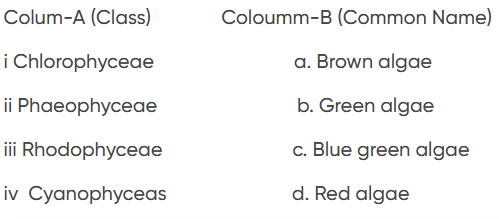
A. i-b, ii-c, iii-a, iv-d
B. i-b, ii-a, iii-d, iv-c
C. i-d, ii-c, iii-b, iv-a
D. i-a, ii-b, iii-c, iv-d
Solutions
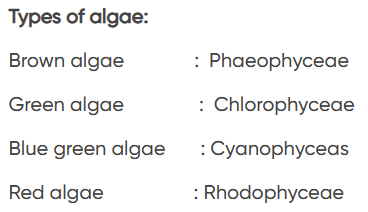
The correct answer is Option 2 i.e. i-b, ii-a, iii-d, iv-c.
Algae comes under the Thallophyta.
Thallophyta:- Thallophyta is an obsolete division in the plant kingdom that includes non-vascular, simple plants characterized by a thallus body plan.
100. Which organ in the human body produces insulin?
A. Liver
B. Pancreas
C. Spleen
D. Gall bladder
Solutions
Explanation:
Insulin is a hormone produced by the pancreas, specifically by the beta cells of the islets of Langerhans.
🔬 Function of Insulin:
- Helps regulate blood sugar (glucose) levels
- Allows cells to absorb glucose from the bloodstream
- Maintains glucose homeostasis
Correct Answer: 2) Pancreas