1. Read the sentence to find out whether there is any error in it or not. The error, if any, will be in one part of the sentence. The number of that part is the answer. If there is no error, the answer is (5).Ignore errors of punctuation, if any.
Although the shooting (A)/ has been stopped for now (B)/ but the destruction left (C)/ behind is enormous.(D)/ No error
A. A
B. B
C. C
D. D
E. No error
Solution
The correct answer is option 3) i.e. C.
KEY POINTS
- Option 3 is incorrect because of the wrong usage of ‘but’ in Part C of the sentence.
- Although…yet’ is correlative conjunction and is used in pairs.
- It is used to refer to two contrasting actions of the subject.
- ‘Although…yet’ follows this rule if it is used in a sentence :–
- Although + subject + verb + 1st action + yet + subject + verb + 2nd action.
- It is important to remember that ‘although’ is always followed by ‘yet’ and not ‘instead’/ ‘but’/ ‘else’ etc. ‘Yet’ cannot be replaced by any other word.
- Let’s see an example-
- Although he had a kidney transplant operation scheduled next month, yet he came to enjoy the success party of his friend’s latest business venture.
- Although he had a kidney transplant operation scheduled next month, but he came to enjoy the success party of his friend’s latest business venture.
- Hence, ‘but’ should be replaced by ‘yet’ to make the sentence correct.
Correct sentence is:“Although the shooting has been stopped for now yet the destruction left behind is enormous.”
ADDITIONAL INFORMATION
- Both ‘although’ and ‘though’ follow the same rule and are followed by ‘yet’ and no other word.
- For example- Though he abandoned me in the time of my need, yet I will stand by him during his emergency.
- Co-relative conjunctions are conjunctions that are used in pairs.
- For example- ‘either-or’, ‘neither-nor’, ‘both-and’, ‘whether-or’, ‘not only-but also’, etc.
2. Read the sentence to find out whether there is any error in it or not. The error, if any, will be in one part of the sentence. The number of that part is the answer. If there is no error, the answer is (5).Ignore errors of punctuation, if any.
We don’t need our (A)/ computers to be infinitely (B)/ fast, just a whole lot (C)/ faster when they are today.(D)/ No error.
A. A
B. B
C. C
D. D
E. No error
Solution
The correct answer is Option 4 i.e. D.
KEY POINTS
- Option 4 is incorrect because of the wrong usage of the subordinating conjunction ‘when’ in Part D of the sentence.
- The subordinating conjunction ‘when’ is used to refer to the time of occurrence of any event and the subordinating conjunction ‘than’ is used to suggest a comparison between two things.
- Let’s see a few examples-
- He is much sincere in his studies than his elder brother.
- He is much sincere in his studies when his elder brother.
- Hence, ‘when’ should be replaced by ‘than’ to make the sentence correct.
Correct sentence:“We don’t need our computers to be infinitely fast, just a whole lot faster than they are today.”
ADDITIONAL INFORMATION
- A subordinating conjunction connects a dependant clause with an independent clause.
- For example- ‘after’, ‘because’, ‘when’, ‘unless’, ‘because’, ‘as’, ‘although’, ‘than’, etc.
- I used to wake up at 5 A.M when I was in boarding school.
- I used to wake up at 5 A.M than I was in boarding school.
3. Read the following sentence and determine whether there is any error in it. The error, if any, will be in one part of the sentence. If the sentence is error-free, select ‘No error’ as your answer.
They feared to (A)/ spare the farmer (B)/ lest he would report (C)/ the matter to the king.(D)/ No error
A. A
B. B
C. C
D. D
E. No error
Solution
The correct answer is option 3 i.e. C.
KEY POINTS
- Option 3 is incorrect because of the wrong usage of ‘would’ in Part C of the sentence.
- The conjunction ‘lest’ is always followed by ‘should’ and carries a negative sense.
- ‘Lest…should’ is used to give caution or warnings and further hints at the outcome if the warning/ caution is not followed.
- Let’s see an example-
- Slowly drive lest you should hit the truck.
- Slowly drive lest you would hit the truck.
- Hence, ‘would’ should be replaced by ‘should’ to make the sentence correct.
Correct sentence: ” They feared to spare him lest he should report the matter to the king. ”
MISTAKE POINT
- ‘Lest…should’ itself carries a negative meaning, and no other negative words as in ‘not’, ‘never’, ‘not’ need to be used.
- For example-
- Use the knife properly lest you should cut your fingers.
- Use the knife properly lest you should not cut your fingers.
4. Read the following sentence and determine whether there is any error in it. The error, if any, will be in one part of the sentence. If the sentence is error-free, select ‘No error’ as your answer.
The committee were made (A)/ up of twenty-six individuals, (B)/ though illness and death (C)/ soon reduced their numbers.(D)/ No error
A. A
B. B
C. C
D. D
E. No error
Solution
The correct answer is option 1 i.e. A – the error lies in this part only.
Key Points
- The error lies in the wrong usage of the verb ‘were’ in Part A.
- ‘Were’ should be replaced by ‘was’ because a singular verb is used after a collective noun when the group refers to one entire unit.
- Let’s see a few examples-
- The committee has raised issues on a few clauses of the report submitted by the players.
- The committee have raised issues on a few clauses of the report submitted by the players.
- The team has played well in the last match.
- The team have played well in the last match.
- Therefore, the singular verb ‘was’ should be used instead of the plural verb ‘were’ to make the sentence correct.
Correct sentence is: “The committee was made up of twenty-six individuals, though illness and death soon reduced their numbers.”
ADDITIONAL INFORM
- A plural verb is used with a collective noun when the individuals of the collection are mentioned.
- For example-
- The committee have split on their opinions of giving grants to the Peace Foundation.
5. Directions: Given below is a word, followed by three sentences that consist of that word. Identify the sentence(s) that express(es) the meaning of the word.
ILLICIT
A. The police were cracking down on illicit drugs.
B. He went on a vacation to rest and enjoy the illicit beaches.
C. The company was closed down due to its illicit practices.
A. Only A
B. Only B
C. Both A and C
D. Only C
E. All of them
Solution
The correct answer is ‘Both A and C.’
Key Points
- The term ‘Illicit‘ as an adjective means forbidden by law, rules, or custom.
- In sentence A, ‘Illicit‘ is used accurately to refer to drugs that are illegal or forbidden by law.
- In sentence B, ‘Illicit‘ is used incorrectly, as beaches, generally, cannot be characterized as illicit.
- In sentence C, ‘Illicit‘ is correctly used concerning practices that are forbidden or prohibited by rules or law.
Hence, the only possible answer is option 3.
6. Directions: Given below is a word, followed by three sentences that consist of that word. Identify the sentence(s) that express(es) the meaning of the word.
PLUMMET
A. He plummeted his book on the bed.
B. The value of the currency is expected to plummet.
C. The mountain climber was careful not to plummet off the rocky cliff.
A. Only A
B. Both A and C
C. Only B
D. Both B and C
E. All of them
Solution
The correct answer is ‘Both B and C.’
Key Points
- The word ‘Plummet‘ as a verb means to decrease rapidly in value or amount, or to fall or drop straight down at high speed.
- In sentence A, the word ‘Plummet‘ is incorrectly used. ‘Plummet’ doesn’t fit the context of someone tossing a book onto a bed.
- In sentence B, ‘Plummet‘ is correctly used to describe the expectation of the currency’s rapid drop in value.
- In sentence C, ‘Plummet‘ has also been appropriately used to depict a potential dangerous fall from a cliff.
Hence, the only possible answer is option 4.
7. Directions: Read the passage given below and answer the questions that follow by choosing the correct/most appropriate options:
When the two brothers, Dukhiram Rui and Chidam Rui set out in the morning with axes in their hands to work as day laborers, their two wives were hurling insults and abuses _______ each other. But like other natural noises, the neighbors had become used to this shouting. As soon as they heard them, they would say to one another, “There they go again”. There was nothing unexpected about their quarreling every day; this was just their normal undeviating behavior. Just as nobody questions the rising of the sun in the east, nobody in the neighborhood was curious about why the two sisters-in-law started quarreling in the morning each day. There is no doubt that the discord between the two wives affected the two husbands much more than it did their neighbors, but even the two brothers did not consider it to be a serious problem. The two brothers considered domestic life as a long journey on a bullock cart, and the ceaseless creaking noises and jerking movements of springless wheels were only a natural, necessary part of this journey. In fact, on days when their home was quiet and a heavy silence hung over it, they were afraid that some unnatural, unforeseen danger was about to happen – they did not know what to expect. On the day when our story begins, the two brothers returned home just before evening, tired from their labors. The house was utterly still.
The heat outside was stifling. In the evening there was a slight shower and heavy clouds still hung overhead; there was not a breath of wind in the air. The jungle around the house and the weeds had grown luxuriantly during the monsoon, and the thick, heavy smell of rotting vegetation from the water-logged jute fields stood like motionless walls around the house. A frog was croaking from the swamp behind the cowshed and the still evening sky was full of the sounds of crickets. In the distance, the Padma, swollen with monsoon rains and overhung with new clouds, looked ominous. Nearby, the paddy fields were already flooded and the water lapped close to human habitations. The force of the sweeping waters had uprooted a few mangoes and jackfruit trees whose roots clawed the empty air like fingers desperately outspread to clutch something firm.
Question:
What did the two brothers consider domestic life?
A. The smooth movements of springless wheels.
B. A burden.
C. Some unnatural or unforeseen danger.
D. A serious problem.
E. A long journey on a bullock cart.
Solution
The correct answer is ‘A long journey on a bullock cart.‘
Key Points
- The seventh sentence of the first paragraph says “The two brothers considered domestic life as a long journey on a bullock cart, and the ceaseless creaking noises and jerking movements of springless wheels were only a natural, necessary part of this journey.”
- From the above sentence, we can say that according to the passage, the two brothers considered domestic life as a long journey on a bullock cart.
Hence, the only possible answer is option 5.
Was the solution helpful?YesNoPrevious
8. Directions: Read the passage given below and answer the questions that follow by choosing the correct/most appropriate options:
When the two brothers, Dukhiram Rui and Chidam Rui set out in the morning with axes in their hands to work as day laborers, their two wives were hurling insults and abuses _______ each other. But like other natural noises, the neighbors had become used to this shouting. As soon as they heard them, they would say to one another, “There they go again”. There was nothing unexpected about their quarreling every day; this was just their normal undeviating behavior. Just as nobody questions the rising of the sun in the east, nobody in the neighborhood was curious about why the two sisters-in-law started quarreling in the morning each day. There is no doubt that the discord between the two wives affected the two husbands much more than it did their neighbors, but even the two brothers did not consider it to be a serious problem. The two brothers considered domestic life as a long journey on a bullock cart, and the ceaseless creaking noises and jerking movements of springless wheels were only a natural, necessary part of this journey. In fact, on days when their home was quiet and a heavy silence hung over it, they were afraid that some unnatural, unforeseen danger was about to happen – they did not know what to expect. On the day when our story begins, the two brothers returned home just before evening, tired from their labors. The house was utterly still.
The heat outside was stifling. In the evening there was a slight shower and heavy clouds still hung overhead; there was not a breath of wind in the air. The jungle around the house and the weeds had grown luxuriantly during the monsoon, and the thick, heavy smell of rotting vegetation from the water-logged jute fields stood like motionless walls around the house. A frog was croaking from the swamp behind the cowshed and the still evening sky was full of the sounds of crickets. In the distance, the Padma, swollen with monsoon rains and overhung with new clouds, looked ominous. Nearby, the paddy fields were already flooded and the water lapped close to human habitations. The force of the sweeping waters had uprooted a few mangoes and jackfruit trees whose roots clawed the empty air like fingers desperately outspread to clutch something firm.
Question:
According to the passage, the swamp was behind what?
A. The cowshed.
B. A few mangoes and jackfruit trees.
C. The paddy fields.
D. The house.
E. The jute fields.
Solution
The correct answer is ‘The cowshed.‘
Key Points
- The fourth sentence of the second paragraph says ” A frog was croaking from the swamp behind the cowshed and the still evening sky was full of the sounds of crickets.”
- From the above sentence, we can say that according to the passage, the swamp was behind the cowshed.
Hence, the only possible answer is option 1.
Was the solution helpful?YesNoPrevious
9. Directions: Read the passage given below and answer the questions that follow by choosing the correct/most appropriate options:
When the two brothers, Dukhiram Rui and Chidam Rui set out in the morning with axes in their hands to work as day laborers, their two wives were hurling insults and abuses _______ each other. But like other natural noises, the neighbors had become used to this shouting. As soon as they heard them, they would say to one another, “There they go again”. There was nothing unexpected about their quarreling every day; this was just their normal undeviating behavior. Just as nobody questions the rising of the sun in the east, nobody in the neighborhood was curious about why the two sisters-in-law started quarreling in the morning each day. There is no doubt that the discord between the two wives affected the two husbands much more than it did their neighbors, but even the two brothers did not consider it to be a serious problem. The two brothers considered domestic life as a long journey on a bullock cart, and the ceaseless creaking noises and jerking movements of springless wheels were only a natural, necessary part of this journey. In fact, on days when their home was quiet and a heavy silence hung over it, they were afraid that some unnatural, unforeseen danger was about to happen – they did not know what to expect. On the day when our story begins, the two brothers returned home just before evening, tired from their labors. The house was utterly still.
The heat outside was stifling. In the evening there was a slight shower and heavy clouds still hung overhead; there was not a breath of wind in the air. The jungle around the house and the weeds had grown luxuriantly during the monsoon, and the thick, heavy smell of rotting vegetation from the water-logged jute fields stood like motionless walls around the house. A frog was croaking from the swamp behind the cowshed and the still evening sky was full of the sounds of crickets. In the distance, the Padma, swollen with monsoon rains and overhung with new clouds, looked ominous. Nearby, the paddy fields were already flooded and the water lapped close to human habitations. The force of the sweeping waters had uprooted a few mangoes and jackfruit trees whose roots clawed the empty air like fingers desperately outspread to clutch something firm.
Question:
”The two brothers did not consider it to be a serious problem”, what does ‘it’ refer to in the given phrase?
A. The conflict between the two wives and the neighbors.
B. The conflict between the two wives.
C. The daily conflict between the neighbors.
D. The flooded paddy fields.
E. The force of the sweeping waters.
Solution
The correct answer is ‘The conflict between the two wives.‘
Key Points
- The sixth sentence of the first paragraph says “There is no doubt that the discord between the two wives affected the two husbands much more than it did their neighbors, but even the two brothers did not consider it to be a serious problem.”
- From the above sentence, we can say that ‘it’ refers to the conflict between the two wives in the phrase ”The two brothers did not consider it to be a serious problem”.
Hence, the only possible answer is option 2.
10. Directions: Read the passage given below and answer the questions that follow by choosing the correct/most appropriate options:
When the two brothers, Dukhiram Rui and Chidam Rui set out in the morning with axes in their hands to work as day laborers, their two wives were hurling insults and abuses _______ each other. But like other natural noises, the neighbors had become used to this shouting. As soon as they heard them, they would say to one another, “There they go again”. There was nothing unexpected about their quarreling every day; this was just their normal undeviating behavior. Just as nobody questions the rising of the sun in the east, nobody in the neighborhood was curious about why the two sisters-in-law started quarreling in the morning each day. There is no doubt that the discord between the two wives affected the two husbands much more than it did their neighbors, but even the two brothers did not consider it to be a serious problem. The two brothers considered domestic life as a long journey on a bullock cart, and the ceaseless creaking noises and jerking movements of springless wheels were only a natural, necessary part of this journey. In fact, on days when their home was quiet and a heavy silence hung over it, they were afraid that some unnatural, unforeseen danger was about to happen – they did not know what to expect. On the day when our story begins, the two brothers returned home just before evening, tired from their labors. The house was utterly still.
The heat outside was stifling. In the evening there was a slight shower and heavy clouds still hung overhead; there was not a breath of wind in the air. The jungle around the house and the weeds had grown luxuriantly during the monsoon, and the thick, heavy smell of rotting vegetation from the water-logged jute fields stood like motionless walls around the house. A frog was croaking from the swamp behind the cowshed and the still evening sky was full of the sounds of crickets. In the distance, the Padma, swollen with monsoon rains and overhung with new clouds, looked ominous. Nearby, the paddy fields were already flooded and the water lapped close to human habitations. The force of the sweeping waters had uprooted a few mangoes and jackfruit trees whose roots clawed the empty air like fingers desperately outspread to clutch something firm.
Question:
According to the passage, the still evening sky was full of the sounds of what?
A. Stars.
B. Airplanes.
C. Crackers.
D. Crickets.
E. The sweeping waters.
Solution
The correct answer is ‘Crickets.‘
Key Points
- The fourth sentence of the second paragraph says “A frog was croaking from the swamp behind the cowshed and the still evening sky was full of the sounds of crickets.”
- From the above sentence, we can say that according to the passage, the still evening sky was full of the sounds of crickets.
11. Directions: Read the passage given below and answer the questions that follow by choosing the correct/most appropriate options:
When the two brothers, Dukhiram Rui and Chidam Rui set out in the morning with axes in their hands to work as day laborers, their two wives were hurling insults and abuses _______ each other. But like other natural noises, the neighbors had become used to this shouting. As soon as they heard them, they would say to one another, “There they go again”. There was nothing unexpected about their quarreling every day; this was just their normal undeviating behavior. Just as nobody questions the rising of the sun in the east, nobody in the neighborhood was curious about why the two sisters-in-law started quarreling in the morning each day. There is no doubt that the discord between the two wives affected the two husbands much more than it did their neighbors, but even the two brothers did not consider it to be a serious problem. The two brothers considered domestic life as a long journey on a bullock cart, and the ceaseless creaking noises and jerking movements of springless wheels were only a natural, necessary part of this journey. In fact, on days when their home was quiet and a heavy silence hung over it, they were afraid that some unnatural, unforeseen danger was about to happen – they did not know what to expect. On the day when our story begins, the two brothers returned home just before evening, tired from their labors. The house was utterly still.
The heat outside was stifling. In the evening there was a slight shower and heavy clouds still hung overhead; there was not a breath of wind in the air. The jungle around the house and the weeds had grown luxuriantly during the monsoon, and the thick, heavy smell of rotting vegetation from the water-logged jute fields stood like motionless walls around the house. A frog was croaking from the swamp behind the cowshed and the still evening sky was full of the sounds of crickets. In the distance, the Padma, swollen with monsoon rains and overhung with new clouds, looked ominous. Nearby, the paddy fields were already flooded and the water lapped close to human habitations. The force of the sweeping waters had uprooted a few mangoes and jackfruit trees whose roots clawed the empty air like fingers desperately outspread to clutch something firm.
Question:
What will fit in the blank taken from the passage: ”When the two brothers, Dukhiram Rui and Chidam Rui set out in the morning with axes in their hands to work as day laborers, their two wives were hurling insults and abuses _______ each other.”
A. For
B. Of
C. At
D. To
E. In
Solution
The correct answer is ‘At.‘
Key Points
- The given sentence is talking about the two wives who were hurling insults and abuses in the direction of each other.
- Let us explore the given options:
- The preposition ‘For‘ means Intended to help or benefit someone or something.
- The preposition ‘Of‘ means Belonging to, connected with, or part of something or somebody.
- The preposition ‘At’ means In the direction of somebody or something.
- The preposition ‘To‘ means Governing a phrase expressing someone’s reaction to something.
- The preposition ‘In‘ is used For expressing the situation of something that is or appears to be enclosed or surrounded by something else.
Hence, the correct answer is option 3.
Complete Sentence: When the two brothers, Dukhiram Rui and Chidam Rui set out in the morning with axes in their hands to work as day laborers, their two wives were hurling insults and abuses at each other.
Was the solution helpful?YesNoPrevious
12. Directions: Read the passage given below and answer the questions that follow by choosing the correct/most appropriate options:
When the two brothers, Dukhiram Rui and Chidam Rui set out in the morning with axes in their hands to work as day laborers, their two wives were hurling insults and abuses _______ each other. But like other natural noises, the neighbors had become used to this shouting. As soon as they heard them, they would say to one another, “There they go again”. There was nothing unexpected about their quarreling every day; this was just their normal undeviating behavior. Just as nobody questions the rising of the sun in the east, nobody in the neighborhood was curious about why the two sisters-in-law started quarreling in the morning each day. There is no doubt that the discord between the two wives affected the two husbands much more than it did their neighbors, but even the two brothers did not consider it to be a serious problem. The two brothers considered domestic life as a long journey on a bullock cart, and the ceaseless creaking noises and jerking movements of springless wheels were only a natural, necessary part of this journey. In fact, on days when their home was quiet and a heavy silence hung over it, they were afraid that some unnatural, unforeseen danger was about to happen – they did not know what to expect. On the day when our story begins, the two brothers returned home just before evening, tired from their labors. The house was utterly still.
The heat outside was stifling. In the evening there was a slight shower and heavy clouds still hung overhead; there was not a breath of wind in the air. The jungle around the house and the weeds had grown luxuriantly during the monsoon, and the thick, heavy smell of rotting vegetation from the water-logged jute fields stood like motionless walls around the house. A frog was croaking from the swamp behind the cowshed and the still evening sky was full of the sounds of crickets. In the distance, the Padma, swollen with monsoon rains and overhung with new clouds, looked ominous. Nearby, the paddy fields were already flooded and the water lapped close to human habitations. The force of the sweeping waters had uprooted a few mangoes and jackfruit trees whose roots clawed the empty air like fingers desperately outspread to clutch something firm.
Question:
Which of the following is/are correct according to the given passage?
A. The conflict between the two wives affected the two husbands.
B. The neighborhood was curious about why the two sisters-in-law started quarreling.
C. The two wives were in friendly relations with each other.
A. Only A
B. Both A and B
C. Only B
D. Both B and C
E. Only C
Solution
The correct answer is ‘Only A.‘
Key Points
- The sixth sentence of the first paragraph says “There is no doubt that the discord between the two wives affected the two husbands much more than it did their neighbors, but even the two brothers did not consider it to be a serious problem.”
- From the above sentence, we can say that statement A is correct according to the given passage.
- The fifth sentence of the first paragraph says “Just as nobody questions the rising of the sun in the east, nobody in the neighborhood was curious about why the two sisters-in-law started quarreling in the morning each day” and the fourth sentence of the first paragraph says “There was nothing unexpected about their quarreling every day; this was just their normal undeviating behavior”.
- From the above sentence, we can say that statements B and C are incorrect according to the given passage.
- From the above sentence, we can say that statements B and C are incorrect according to the given passage.
Hence, the only possible answer is option 1.
Was the solution helpful?YesNoPrevious
13. Directions: Read the passage given below and answer the questions that follow by choosing the correct/most appropriate options:
When the two brothers, Dukhiram Rui and Chidam Rui set out in the morning with axes in their hands to work as day laborers, their two wives were hurling insults and abuses _______ each other. But like other natural noises, the neighbors had become used to this shouting. As soon as they heard them, they would say to one another, “There they go again”. There was nothing unexpected about their quarreling every day; this was just their normal undeviating behavior. Just as nobody questions the rising of the sun in the east, nobody in the neighborhood was curious about why the two sisters-in-law started quarreling in the morning each day. There is no doubt that the discord between the two wives affected the two husbands much more than it did their neighbors, but even the two brothers did not consider it to be a serious problem. The two brothers considered domestic life as a long journey on a bullock cart, and the ceaseless creaking noises and jerking movements of springless wheels were only a natural, necessary part of this journey. In fact, on days when their home was quiet and a heavy silence hung over it, they were afraid that some unnatural, unforeseen danger was about to happen – they did not know what to expect. On the day when our story begins, the two brothers returned home just before evening, tired from their labors. The house was utterly still.
The heat outside was stifling. In the evening there was a slight shower and heavy clouds still hung overhead; there was not a breath of wind in the air. The jungle around the house and the weeds had grown luxuriantly during the monsoon, and the thick, heavy smell of rotting vegetation from the water-logged jute fields stood like motionless walls around the house. A frog was croaking from the swamp behind the cowshed and the still evening sky was full of the sounds of crickets. In the distance, the Padma, swollen with monsoon rains and overhung with new clouds, looked ominous. Nearby, the paddy fields were already flooded and the water lapped close to human habitations. The force of the sweeping waters had uprooted a few mangoes and jackfruit trees whose roots clawed the empty air like fingers desperately outspread to clutch something firm.
Question:
Choose the antonym of the word ‘Ceaseless‘.
A. Incessant
B. Intermittent
C. Interminable
D. Perpetual
E. Continual
Solution
The correct answer is: Option 2 i.e., ‘Intermittent‘.
Key Points
- The word “ceaseless” means continuous and without stopping or interruption. (अथक)
- Example: The ceaseless sound of the waves was soothing to listen to.
- “Intermittent” refers to something that occurs at irregular intervals; not continuous or steady. (रुक-रुक कर होने वाला)
- Example: The intermittent rain showers kept us indoors for most of the day.
- Hence, we can infer that the opposite of ‘ceaseless’ is ‘intermittent’.
Therefore, the correct answer is: Option 2 i.e., ‘Intermittent’.
Additional Information
Here are the other options explained along with their Hindi meanings and example sentences:
- Incessant (अविरत): Continuing without pause or interruption.
- Example: The incessant noise from the construction site was maddening.
- Interminable (अनन्त): Endless or seemingly endless; often used in the context of something that is monotonous and tiresome.
- Example: The lecture felt interminable as the professor droned on and on.
- Perpetual (लगातार): Never-ending or changing.
- Example: His perpetual optimism was a source of hope for everyone around him.
- Continual (लगातार): Frequently recurring; always happening.
- Example: The continual knocking on the door was very annoying.
Was the solution helpful?YesNoPrevious
14. Directions: Read the passage given below and answer the questions that follow by choosing the correct/most appropriate options:
When the two brothers, Dukhiram Rui and Chidam Rui set out in the morning with axes in their hands to work as day laborers, their two wives were hurling insults and abuses _______ each other. But like other natural noises, the neighbors had become used to this shouting. As soon as they heard them, they would say to one another, “There they go again”. There was nothing unexpected about their quarreling every day; this was just their normal undeviating behavior. Just as nobody questions the rising of the sun in the east, nobody in the neighborhood was curious about why the two sisters-in-law started quarreling in the morning each day. There is no doubt that the discord between the two wives affected the two husbands much more than it did their neighbors, but even the two brothers did not consider it to be a serious problem. The two brothers considered domestic life as a long journey on a bullock cart, and the ceaseless creaking noises and jerking movements of springless wheels were only a natural, necessary part of this journey. In fact, on days when their home was quiet and a heavy silence hung over it, they were afraid that some unnatural, unforeseen danger was about to happen – they did not know what to expect. On the day when our story begins, the two brothers returned home just before evening, tired from their labors. The house was utterly still.
The heat outside was stifling. In the evening there was a slight shower and heavy clouds still hung overhead; there was not a breath of wind in the air. The jungle around the house and the weeds had grown luxuriantly during the monsoon, and the thick, heavy smell of rotting vegetation from the water-logged jute fields stood like motionless walls around the house. A frog was croaking from the swamp behind the cowshed and the still evening sky was full of the sounds of crickets. In the distance, the Padma, swollen with monsoon rains and overhung with new clouds, looked ominous. Nearby, the paddy fields were already flooded and the water lapped close to human habitations. The force of the sweeping waters had uprooted a few mangoes and jackfruit trees whose roots clawed the empty air like fingers desperately outspread to clutch something firm.
Question:
Choose the synonym of the word ‘Discord‘.
A. Accord
B. Concord
C. Harmony
D. Agreement
E. Strife
Solution
The correct answer is ‘Strife.‘
Key Points
- The word ‘Discord‘ means Disagreement between people.
- Example: The verdict has increased racial discord in the country.
- Let’s look at the meaning of the given options:-
- Accord – Agreement or harmony.
- Example: We live in perfect accord with each other.
- Concord – Agreement or harmony between people or groups.
- Example: The couple dwelt together in harmony and concord.
- Harmony – The state of being in agreement or concord.
- Example: The couple lives in perfect harmony.
- Agreement – Harmony or accordance in opinion or feeling.
- Example: We are in agreement with their decision.
- Strife – Angry or bitter disagreement over fundamental issues; conflict.
- Example: The country was torn apart by strife.
- Example: The country was torn apart by strife.
- Accord – Agreement or harmony.
Hence, the only possible answer is option 5.
Additional Information
- The synonyms of the word ‘Discord‘ are “Strife, Conflict, Friction“.
- The antonyms of the word ‘Discord‘ are “Accord, Concord, Harmony“.
Was the solution helpful?YesNoPrevious
15. A sentence/a part of the sentence is underlined. Five alternatives are given to the underlined part which will improve the meaning of the sentence. Choose the correct alternative. In case no improvement is needed, click the option corresponding to “No improvement.”
Arnab is the best student in a class.
A. of the
B. in the
C. in
D. No improvement
E. None of the above
Solution
The correct answer is option 2), i.e. in the.
Explanation:
Reading the above sentence we find that:
- The article ‘a‘ is used and it is incorrect.
- The sentence is about the best student in a certain/specific class.
- Therefore, the definite article ‘the‘ should be used here instead of ‘a‘.
Hence, option 2) is the answer.
Important Points
- ‘Of‘ expresses possession or belonging.
- Example: He is the head of the department.
- ‘At‘ is used to express the position of something or the time when an event takes place.
- Example: She will stay at my house.
The correct sentence would be: “Arnab is the best student in the class.”
16. In the following question, out of the four alternatives, select the alternative which will improve the underlined part of the sentence. In case no improvement is needed, select “No improvement”.
Several parts of the Kashmir valley received light rain as most of the region awaits of the season’s first snow.
A. awaits for
B. awaits
C. waits
D. No improvement
E. None of the above
Solution
The correct answer is Option 2) i.e. awaits.
Let’s understand the difference between the two verbs given below:
- Wait- stay where one is or delay action until a particular time or event.
- Await- wait for (an event).
- The verb ‘await’ is never followed by ‘for’ as it makes the phrase superfluous.
- For example:
- Theresa was awaiting for her lover.
- Theresa was awaiting her lover.
- Of the given options, the 2nd option i.e ‘awaits’ is the most appropriate choice.
- Though we may use ‘for’ with the verb ‘wait’ as it is grammatically correct.
Correct sentence– “Several parts of the Kashmir valley received light rain as most of the region awaits the season’s first snow.”
Mistake point
- ‘wait for’ looks like the correct answer but we need a singular verb here as ‘region’ is a singular noun.
17. In the following question, out of the four alternatives, select the alternative which will improve the underlined part of the sentence. In case no improvement is needed, select “No improvement”.
It is not only what we do, but what we do not, for which we are accountable.
A. but if
B. but also
C. but too
D. but of
E. No improvement
Solution
The correct answer is Option 2) i.e. but also.
There are some conjunctions which are used in pair:
- Either/neither…or/nor, not only…but also, lest…should, whether…or, both…and, etc.
- For example:
- Both rugby as well as football are popular in France.
- Both rugby and football are popular in France.
- Of the given options, the 2nd option i.e. ‘but also’ is the most appropriate choice.
Correct sentence– “It is not only what we do, but also what we do not, for which we are accountable.”
18. In the following question, out of the four alternatives, select the alternative which will improve the underlined part of the sentence. In case no improvement is needed, select “No improvement”.
He was still afraid of staying away, lest anyone could suspect him.
A. should
B. shall
C. will
D. would
E. No improvement
Solution
The correct answer is Option 1.
Key Points
- The primary issue in the sentence is the use of “could” instead of “should” following the word “lest.”
- In English grammar, “lest” is followed by “should” to express a negative purpose or fear.
- The correct phrase should be “lest anyone should suspect him,” ensuring grammatical correctness and clarity.
- Thus, the error is located in the use of the modal verb after “lest.”
Therefore, the correct answer is Option 1.
Correct Sentence: “He was still afraid of staying away, lest anyone should suspect him.”
Additional Information
- Use of “lest”: “Lest” is commonly used to indicate fear or apprehension that something undesirable might happen.
- Grammatical Rule: According to the traditional rule, “lest” is followed by “should.” For example, “He ran quickly lest he should be late.”
- Modern Usage: While “lest” may sometimes directly pair with a base form verb in modern informal contexts, using “should” maintains grammatical precision.
- No improvement: This would be selected if no grammatical error existed in the original sentence, but there is a mistake with the modal verb.
19. Directions: Read the passage given below carefully and then answer the following questions that follow:
Tom and Jerry is an American animated media ___(1)___ and series of comedy short films created in 1940 by William Hanna and Joseph Barbera. Best known for its 161 theatrical short films by Metro-Goldwyn-Mayer, the series centres on the ___(2)___ between the titular characters of a cat named Tom and a mouse named Jerry. Many shorts also feature several recurring characters.
The series features comic fights between an iconic pair of adversaries, a house cat (Tom) and a mouse (Jerry). The plots of each short usually centre on Tom and Jerry’s ___(3)___ attempts to have the best of each other and the mayhem and destruction that follows. Despite Tom’s clever strategies (whether they work or not), determined and energetic mindset, large size, and exceptional overall intelligence, he rarely ___(4)___ in getting the best of Jerry, mainly because of Jerry’s cunning abilities, luck, and his lack of tendencies in being a bit too reckless. However, on several occasions, they have displayed genuine friendship and concern for each other’s well-being. At other times, the pair set aside their rivalry to pursue a common goal, such as when a baby escapes the watch of a negligent babysitter, causing Tom and Jerry to pursue the baby and keep it away from danger, in the shorts Busy Buddies and Tot Watchers respectively. Despite their endless attacks on one another, they have saved each other’s lives every time they were truly in danger, except in The Two Mouseketeers, which features an ____(5)____ morbid ending.
Question:
Which of these should be filled at (1) as per the context of the passage?
A. franchise
B. frivolous
C. superficial
D. emotional
E. poignant
Solution
The correct answer is ‘franchise‘.
Key Points
- The passage describes Tom and Jerry as a long-running collection of media works.
- The correct term should capture the idea of various kinds of related media content.
- “Franchise” (मताधिकार) is an appropriate term because it denotes a series or a related collection of works, which aligns with the context.
- Other options like (“frivolous“, “superficial“, “emotional“, “poignant“) do not fit this context.
Therefore, the correct answer is ‘Option 1‘.
Complete Passage: Tom and Jerry is an American animated media franchise and series of comedy short films created in 1940 by William Hanna and Joseph Barbera. Best known for its 161 theatrical short films by Metro-Goldwyn-Mayer, the series centres on the ___(2)___ between the titular characters of a cat named Tom and a mouse named Jerry. Many shorts also feature several recurring characters.
The series features comic fights between an iconic pair of adversaries, a house cat (Tom) and a mouse (Jerry). The plots of each short usually centre on Tom and Jerry’s ___(3)___ attempts to have the best of each other and the mayhem and destruction that follows. Despite Tom’s clever strategies (whether they work or not), determined and energetic mindset, large size, and exceptional overall intelligence, he rarely ___(4)___ in getting the best of Jerry, mainly because of Jerry’s cunning abilities, luck, and his lack of tendencies in being a bit too reckless. However, on several occasions, they have displayed genuine friendship and concern for each other’s well-being. At other times, the pair set aside their rivalry to pursue a common goal, such as when a baby escapes the watch of a negligent babysitter, causing Tom and Jerry to pursue the baby and keep it away from danger, in the shorts Busy Buddies and Tot Watchers respectively. Despite their endless attacks on one another, they have saved each other’s lives every time they were truly in danger, except in The Two Mouseketeers, which features an ____(5)____ morbid ending.
Additional Information
- Frivolous (फुर्सत): “Frivolous” means not having any serious purpose or value, which does not fit the context.
- Superficial (सतही): “Superficial” means existing or occurring at or on the surface, which is unrelated to the description of a media series.
- Emotional (भावात्मक): “Emotional” relates to feelings, which is not apt for describing the nature of the media enterprise.
- Poignant (मार्मिक): “Poignant” means evoking a keen sense of sadness or regret, which is not suitable for the context here.
Was the solution helpful?YesNoPrevious
20. Directions: Read the passage given below carefully and then answer the following questions that follow:
Tom and Jerry is an American animated media ___(1)___ and series of comedy short films created in 1940 by William Hanna and Joseph Barbera. Best known for its 161 theatrical short films by Metro-Goldwyn-Mayer, the series centres on the ___(2)___ between the titular characters of a cat named Tom and a mouse named Jerry. Many shorts also feature several recurring characters.
The series features comic fights between an iconic pair of adversaries, a house cat (Tom) and a mouse (Jerry). The plots of each short usually centre on Tom and Jerry’s ___(3)___ attempts to have the best of each other and the mayhem and destruction that follows. Despite Tom’s clever strategies (whether they work or not), determined and energetic mindset, large size, and exceptional overall intelligence, he rarely ___(4)___ in getting the best of Jerry, mainly because of Jerry’s cunning abilities, luck, and his lack of tendencies in being a bit too reckless. However, on several occasions, they have displayed genuine friendship and concern for each other’s well-being. At other times, the pair set aside their rivalry to pursue a common goal, such as when a baby escapes the watch of a negligent babysitter, causing Tom and Jerry to pursue the baby and keep it away from danger, in the shorts Busy Buddies and Tot Watchers respectively. Despite their endless attacks on one another, they have saved each other’s lives every time they were truly in danger, except in The Two Mouseketeers, which features an ____(5)____ morbid ending.
Question:
Which of these should be filled at (2) as per the context of the passage?
A. progression
B. rivalry
C. contentment
D. concord
E. continuance
Solution
The correct answer is ‘rivalry‘.
Key Points
- The passage focuses on the competitive and adversarial relationship
21. Directions: Read the passage given below carefully and then answer the following questions that follow:
Tom and Jerry is an American animated media ___(1)___ and series of comedy short films created in 1940 by William Hanna and Joseph Barbera. Best known for its 161 theatrical short films by Metro-Goldwyn-Mayer, the series centres on the ___(2)___ between the titular characters of a cat named Tom and a mouse named Jerry. Many shorts also feature several recurring characters.
The series features comic fights between an iconic pair of adversaries, a house cat (Tom) and a mouse (Jerry). The plots of each short usually centre on Tom and Jerry’s ___(3)___ attempts to have the best of each other and the mayhem and destruction that follows. Despite Tom’s clever strategies (whether they work or not), determined and energetic mindset, large size, and exceptional overall intelligence, he rarely ___(4)___ in getting the best of Jerry, mainly because of Jerry’s cunning abilities, luck, and his lack of tendencies in being a bit too reckless. However, on several occasions, they have displayed genuine friendship and concern for each other’s well-being. At other times, the pair set aside their rivalry to pursue a common goal, such as when a baby escapes the watch of a negligent babysitter, causing Tom and Jerry to pursue the baby and keep it away from danger, in the shorts Busy Buddies and Tot Watchers respectively. Despite their endless attacks on one another, they have saved each other’s lives every time they were truly in danger, except in The Two Mouseketeers, which features an ____(5)____ morbid ending.
Question:
Which of these should be filled at (3) as per the context of the passage?
A. haughty
B. numerous
C. emolument
D. affable
E. utility
Solution
The correct answer is ‘numerous‘.
Key Points
- The passage discusses the many attempts made by Tom and Jerry to outdo each other.
- The correct term should convey the idea of the frequency and variety of their attempts.
- “Numerous” (अनेक) fits well as it indicates a large number of attempts, which aligns with the context of the passage.
- Other options like (“haughty“, “emolument“, “affable“, “utility“) do not fit this context.
Therefore, the correct answer is ‘Option 2‘.
Complete Passage: Tom and Jerry is an American animated media franchise and series of comedy short films created in 1940 by William Hanna and Joseph Barbera. Best known for its 161 theatrical short films by Metro-Goldwyn-Mayer, the series centres on the rivalry between the titular characters of a cat named Tom and a mouse named Jerry. Many shorts also feature several recurring characters.
The series features comic fights between an iconic pair of adversaries, a house cat (Tom) and a mouse (Jerry). The plots of each short usually centre on Tom and Jerry’s numerous attempts to have the best of each other and the mayhem and destruction that follows. Despite Tom’s clever strategies (whether they work or not), determined and energetic mindset, large size, and exceptional overall intelligence, he rarely ___(4)___ in getting the best of Jerry, mainly because of Jerry’s cunning abilities, luck, and his lack of tendencies in being a bit too reckless. However, on several occasions, they have displayed genuine friendship and concern for each other’s well-being. At other times, the pair set aside their rivalry to pursue a common goal, such as when a baby escapes the watch of a negligent babysitter, causing Tom and Jerry to pursue the baby and keep it away from danger, in the shorts Busy Buddies and Tot Watchers respectively. Despite their endless attacks on one another, they have saved each other’s lives every time they were truly in danger, except in The Two Mouseketeers, which features an ___(5)___ morbid ending.
Additional Information
- Haughty (अभिमानी): “Haughty” means arrogantly superior and disdainful, which does not fit the context of attempts made by Tom and Jerry.
- Emolument (वेतन): “Emolument” means a salary or fee, which is irrelevant in the context of the passage.
- Affable (मिलनसार): “Affable” means friendly and good-natured, which does not describe the frequent attempts between rivals.
- Utility (उपयोगिता): “Utility” means the state of being useful, which does not convey the sense of numerous attempts.
Was the solution helpful?YesNoPrevious
22. Directions: Read the passage given below carefully and then answer the following questions that follow:
Tom and Jerry is an American animated media ___(1)___ and series of comedy short films created in 1940 by William Hanna and Joseph Barbera. Best known for its 161 theatrical short films by Metro-Goldwyn-Mayer, the series centres on the ___(2)___ between the titular characters of a cat named Tom and a mouse named Jerry. Many shorts also feature several recurring characters.
The series features comic fights between an iconic pair of adversaries, a house cat (Tom) and a mouse (Jerry). The plots of each short usually centre on Tom and Jerry’s ___(3)___ attempts to have the best of each other and the mayhem and destruction that follows. Despite Tom’s clever strategies (whether they work or not), determined and energetic mindset, large size, and exceptional overall intelligence, he rarely ___(4)___ in getting the best of Jerry, mainly because of Jerry’s cunning abilities, luck, and his lack of tendencies in being a bit too reckless. However, on several occasions, they have displayed genuine friendship and concern for each other’s well-being. At other times, the pair set aside their rivalry to pursue a common goal, such as when a baby escapes the watch of a negligent babysitter, causing Tom and Jerry to pursue the baby and keep it away from danger, in the shorts Busy Buddies and Tot Watchers respectively. Despite their endless attacks on one another, they have saved each other’s lives every time they were truly in danger, except in The Two Mouseketeers, which features an ____(5)____ morbid ending.
Question:
Which of these should be filled at (4) as per the context of the passage?
A. flounder
B. precedes
C. succeeds
D. preface
E. thresh
Solution
The correct answer is ‘succeeds‘.
Key Points
- The passage discusses how Tom rarely achieves his goal despite his many efforts and strategies.
- The correct term should convey the idea of success or failure.
- “Succeeds” (सफल होना) fits well as it directly addresses whether Tom accomplishes his aim of outwitting Jerry.
- Other options like (“flounder“, “precedes“, “preface“, “thresh“) do not fit this context.
Therefore, the correct answer is ‘Option 3‘.
Complete Passage: Tom and Jerry is an American animated media franchise and series of comedy short films created in 1940 by William Hanna and Joseph Barbera. Best known for its 161 theatrical short films by Metro-Goldwyn-Mayer, the series centres on the rivalry between the titular characters of a cat named Tom and a mouse named Jerry. Many shorts also feature several recurring characters. The series features comic fights between an iconic pair of adversaries, a house cat (Tom) and a mouse (Jerry). The plots of each short usually centre on Tom and Jerry’s numerous attempts to have the best of each other and the mayhem and destruction that follows. Despite Tom’s clever strategies (whether they work or not), determined and energetic mindset, large size, and exceptional overall intelligence, he rarely succeeds in getting the best of Jerry, mainly because of Jerry’s cunning abilities, luck, and his lack of tendencies in being a bit too reckless. However, on several occasions, they have displayed genuine friendship and concern for each other’s well-being. At other times, the pair set aside their rivalry to pursue a common goal, such as when a baby escapes the watch of a negligent babysitter, causing Tom and Jerry to pursue the baby and keep it away from danger, in the shorts Busy Buddies and Tot Watchers respectively. Despite their endless attacks on one another, they have saved each other’s lives every time they were truly in danger, except in The Two Mouseketeers, which features an ___(5)___ morbid ending.
Additional Information
- Flounder (तड़पना/असफल होना): “Flounder” means to struggle or stagger helplessly, which does not fit as well because the passage states Tom “rarely” achieves his goal, implying that he occasionally does succeed.
- Precedes (पूर्ववर्ती होना): “Precedes” means to come before something in time, which is unrelated to success or failure.
- Preface (भूमिका): “Preface” means an introduction to a book or speech, which is not relevant in this context.
- Thresh (पिटाई करना या जोर देना): “Thresh” typically relates to separating grain from a plant or is used metaphorically to talk about struggling or pushing through, which is not fitting here.
Was the solution helpful?YesNoPrevious
23. Directions: Read the passage given below carefully and then answer the following questions that follow:
Tom and Jerry is an American animated media ___(1)___ and series of comedy short films created in 1940 by William Hanna and Joseph Barbera. Best known for its 161 theatrical short films by Metro-Goldwyn-Mayer, the series centres on the ___(2)___ between the titular characters of a cat named Tom and a mouse named Jerry. Many shorts also feature several recurring characters.
The series features comic fights between an iconic pair of adversaries, a house cat (Tom) and a mouse (Jerry). The plots of each short usually centre on Tom and Jerry’s ___(3)___ attempts to have the best of each other and the mayhem and destruction that follows. Despite Tom’s clever strategies (whether they work or not), determined and energetic mindset, large size, and exceptional overall intelligence, he rarely ___(4)___ in getting the best of Jerry, mainly because of Jerry’s cunning abilities, luck, and his lack of tendencies in being a bit too reckless. However, on several occasions, they have displayed genuine friendship and concern for each other’s well-being. At other times, the pair set aside their rivalry to pursue a common goal, such as when a baby escapes the watch of a negligent babysitter, causing Tom and Jerry to pursue the baby and keep it away from danger, in the shorts Busy Buddies and Tot Watchers respectively. Despite their endless attacks on one another, they have saved each other’s lives every time they were truly in danger, except in The Two Mouseketeers, which features an ____(5)____ morbid ending.
Question:
Which of these should be filled at (5) as per the context of the passage?
A. relevant
B. distinctive
C. characteristic
D. symptomatic
E. uncharacteristically
Solution
The correct answer is ‘uncharacteristically‘.
Key Points
- The passage describes how Tom and Jerry typically save each other when in danger, except for the case mentioned in “The Two Mouseketeers.”
- The correct term should convey that the ending of this episode is unusual or not typical of their usual behaviour.
- “Uncharacteristically” (अस्वाभाविक रूप से) fits well as it indicates that the morbid ending is out of character for the series.
- Other options like (“relevant“, “distinctive“, “characteristic“, “symptomatic“) do not fit the context of describing the ending as unusual.
Therefore, the correct answer is ‘Option 5‘.
Complete Passage: Tom and Jerry is an American animated media franchise and series of comedy short films created in 1940 by William Hanna and Joseph Barbera. Best known for its 161 theatrical short films by Metro-Goldwyn-Mayer, the series centres on the rivalry between the titular characters of a cat named Tom and a mouse named Jerry. Many shorts also feature several recurring characters. The series features comic fights between an iconic pair of adversaries, a house cat (Tom) and a mouse (Jerry). The plots of each short usually centre on Tom and Jerry’s numerous attempts to have the best of each other and the mayhem and destruction that follows. Despite Tom’s clever strategies (whether they work or not), determined and energetic mindset, large size, and exceptional overall intelligence, he rarely succeeds in getting the best of Jerry, mainly because of Jerry’s cunning abilities, luck, and his lack of tendencies in being a bit too reckless. However, on several occasions, they have displayed genuine friendship and concern for each other’s well-being. At other times, the pair set aside their rivalry to pursue a common goal, such as when a baby escapes the watch of a negligent babysitter, causing Tom and Jerry to pursue the baby and keep it away from danger, in the shorts Busy Buddies and Tot Watchers respectively. Despite their endless attacks on one another, they have saved each other’s lives every time they were truly in danger, except in The Two Mouseketeers, which features an uncharacteristically morbid ending.
Additional Information
- Relevant (संबंधित): “Relevant” means closely connected to the topic, which is irrelevant in conveying the unusual nature of the ending.
- Distinctive (विशिष्ट): “Distinctive” means characteristic or typical, which does not fit the context of describing an unusual event.
- Characteristic (विशेष): “Characteristic” means typical of a particular person, place, or thing, which does not indicate the unusual nature of the ending.
- Symptomatic (लक्षणात्मक): “Symptomatic” means serving as a symptom or sign, which does not fit the context of describing an unusual or unprecedented event.
Was the solution helpful?YesNoPrevious
24. Direction: In the following sentence, four words printed in bold are given. One of these words printed in bold might either be wrongly spelt or inappropriate to the context of the sentence. Find out that word that is inappropriate or wrongly spelt, if any. If all of the words in bold are correct, then mark ‘No error’ as your answer.
About a month ago we were both dinning at the same residence and then he asked me to cocktail party a week later.
A. Dinning
B. Residence
C. Week
D. Later
E. No error
Solution
The correct answer is “Dinning”.
Key Points
- The word “Dining” has been incorrectly spelt here as “Dinning”.
- Let us see the meaning of “Dining” and “Dinning”.
- Dining: the activity of eating a meal.
- Dinning: chiming, iterating and repeating.
Additional Information
- Let us see the meaning of other options.
- Residence: a person’s home, especially a large and impressive one.
- Week: any of a series of 7-day cycles used in various calendars.
- Later: comparative of “late”.
25. Direction: In the following sentence, four words printed in bold are given. One of these words printed in bold might either be wrongly spelt or inappropriate to the context of the sentence. Find out that word that is inappropriate or wrongly spelt, if any. If all of the words in bold are correct, then mark ‘No error’ as your answer.
The criminals who lid an agreeable life have never touched any breath of suspicion.
A. Criminals
B. Lid
C. Agreeable
D. Suspicion
E. No error
Solution
The correct answer is “Lid”.
Key Points
- The word “Lead” has been incorrectly spelt here as “Lid”.
- Let us see the meaning of “Lead” and “Lid”.
- Lead: be a route or means of access to a particular place or in a particular direction.
- Lid: a removable or hinged cover for the top of a container.
Additional Information
- Let us see the meaning of other options.
- Criminals: persons who have committed a crime.
- Agreeable: willing to agree to something.
- Suspicion: a feeling or thought that something is possible, likely, or true.
26. Direction: In the following sentence, four words printed in bold are given. One of these words printed in bold might either be wrongly spelt or inappropriate to the context of the sentence. Find out that word that is inappropriate or wrongly spelt, if any. If all of the words in bold are correct, then mark ‘No error’ as your answer.
Romil is tall and line, his face was long and gloomy and his eyebrows are stiffly accented.
A. Line
B. Gloomy
C. Stiffly
D. Accented
E. No error
Solution
The correct answer is “Line”.
Key Points
- The word “Lean” has been incorrectly spelt here as “Line”.
- Let us see the meaning of “Lean” and “Line”.
- Lean: thin and bare.
- Line: a long, narrow mark or band.
Additional Information
- Let us see the meaning of other options.
- Gloomy: dark or poorly lit, especially so as to appear depressing or frightening.
- Stiffly: in a severe or strong manner.
- Accented: stressed or emphasized.
27. Direction: In the following sentence, four words printed in bold are given. One of these words printed in bold may either be wrongly spelt or inappropriate in the context of the sentence. Find out the word that is inappropriate or wrongly spelt, if any. If the words printed in bold are correctly spelt and appropriate in the context of the sentence then mark ‘No error’ as your answer.
The widespread availability of the web has produced considerable changes in education, allowing adolescents to tap into a vast arrant of information.
A. Widespread
B. Considerable
C. Adolescents
D. Arrant
E. No error
Solution
The correct answer is option 4 i.e. Arrant.
Explanation
Arrant which means “complete, utter” has been wrongly used in this context instead of Array which means “an impressive display or range of a particular type of thing.”
Meaning of the other words are:
- Widespread: found or distributed over a large area or number of people
- Adolescents: teenagers
- Tap: draw supply from (a resource)
28. The question below contains five scattered segments of a sentence. Indicate the sequence which correctly assembles the segments and completes the sentence.
A. metropolitan counties in the United States (US) suggests
B. a recent study on
C. explaining outcomes related to mortality
D. that socio-economic factors and
E. levels of education were better at
A. BADEC
B. EDCBA
C. ABCDE
D. ADCBE
E. None of the above
Solution
The correct answer is option 1 i.e. BADEC.
Explanation
- First is B as it establishes the subject i.e. a study. B is the only opening segment that can lead to the formation of a meaningful and grammatically correct sentence.
- Next is A as it tells which areas this study focused on.
- D follows A as it tells what the study suggests.
- Next is E as it further elaborates D.
- Last is C as it tells how these factors were favourable.
Correct sentence- A recent study on metropolitan counties in the United States (US) suggests that socio-economic factors and levels of education were better at explaining outcomes related to mortality.
29. The question below contains five scattered segments of a sentence. Indicate the sequence which correctly assembles the segments and completes the sentence.
A. the family and patient on
B. proper protocols, and monitors
C. the medical team guides
D. the health status of
E. the patient(s) on a daily basis
A. DEABC
B. ABCDE
C. DABCE
D. CABDE
E. EDCAB
Solution
The correct answer is option 4 i.e. CABDE.
Explanation
- First is C as it establishes the subject i.e. the medical team. C is the only opening segment that can lead to the formation of a meaningful and grammatically correct sentence.
- Next is A as it tells ‘who’ the medical team guides.
- B follows A as it tells ‘what’ the medical team guides the patient on.
- Next is D as it tells what is monitored by the medical team.
- Last is E as it contextually follows D.
Correct sentence- The medical team guides the family and patient on proper protocols, and monitors the health status of the patient(s) on a daily basis.
30. The question below contains five scattered segments of a sentence. Indicate the sequence which correctly assembles the segments and completes the sentence.
A. to the family keeps
B. being in close proximity
C. the patients psychologically upbeat
D. provides the necessary
E. environment for quick recovery
A. BACDE
B. CDAEB
C. EDABC
D. CBADE
E. ABCDE
Solution
The correct answer is option 1 i.e. BACDE.
Explanation
- First is B as it gives a suitable introduction. B is the only opening segment that can lead to the formation of a meaningful and grammatically correct sentence.
- Next is A as it mentions to whom there should be close proximity.
- C follows A as it mentions the effect of being in close proximity to family i.e. it keeps patients psychologically upbeat.
- Next is D as it mentions another effect.
- Last is E as it contextually follows D.
Correct sentence- Being in close proximity to the family keeps the patients psychologically upbeat, provides the necessary emotional environment for quick recovery.
31. Ratio of efficiency of A and B is 3:2. B complete a work in 18 days. Find the in how many days A can complete the work?
A. 24
B. 26
C. 22
D. 12
E. 14
Solution
Given:
Efficiency A : B = 3 : 2
B can complete work in 18 days
Formula used:
Work = Efficiency × Time
Since work is same, A’s time = (B’s efficiency / A’s efficiency) × B’s time
Calculations:
⇒ A’s time = (2 / 3) × 18 = 12 days
∴ A can complete the work in 12 days.
32. A train crosses a bridge and a platform of length 635 m and 725 m in 42 sec and 45 sec respectively. Find the speed of the train?
A. 28 m/s
B. 25 m/s
C. 30 m/s
D. 24 m/s
E. None of the above
Solution
Let the length of the train is x meters and the speed of the train is y m/s.
Formula:
Time = Total distance to be covered / Speed
Concept:
When the train crosses the bridge, it covers a distance equal to the sum of the length of the train and the length of the bridge, which is x + 635 meters.
Given that the time taken to cover this distance is 42 seconds.
Calculation:
Time = Total distance to be covered / Speed
42 = (x+635) / y
⇒ x = 42y – 635
Concept:
Similarly, when the train crosses the platform, it covers a distance equal to the sum of the length of the train and the length of the platform, which is x + 725 meters.
Given that the time taken to cover this distance is 45 seconds.
Calculation:
Time = Total distance to be covered / Speed
45 = (x+725) / y
⇒ x = 45y – 725
From both equations, we get:
42y – 635 = 45y – 725
⇒ 42y – 45y = -725 + 635
⇒ -3y = -90
⇒ y = 30
Therefore, the speed of the train is 30 m/s.
33. The investment made by A and B are in the ratio 5 : 7. If 20% of total profit is donated and A gets Rs. 4500 as his share of profit, then what is the amount of total profit?
A. Rs. 10800
B. Rs. 12000
C. Rs. 13500
D. Rs. 14500
E. None of these.
Solution
Given:
Investment ratio of A and B is 5 : 7
Out of total profit 20% is donated
A’s share of profit is Rs. 4500 after donation
Calculation:
Let total profit be 100%
20% is donated
after donation profit is 80% for distribution
profits are distributed in the ratio of 5 : 7
A gets Rs. 4500 from profits which is equal ro 5 units
⇒ (4500/5) × 12
⇒ Rs. 10800
10800 Rs. is equal to 80% of profits
⇒ (10800/80) × 100
⇒ Rs. 13500
∴ The total profit is 13500 Rs.
Alternate Method
let total profit be 60 units
20% donation is 12 units
after donation profit for distribution is 48 units
48 units distributed in the ratio if 5 : 7
now A get 20 units and B gets 28 units of profit
20 units is equal to Rs. 4500
Total profit 60 units is
⇒ (4500/20) × 60
⇒ Rs. 13500
∴ The total profit is Rs. 13500.
34. What value should come in place of the question mark (?) in the equation below?
? = 25% of 400 + 20% of 450
A. 180
B. 190
C. 200
D. 210
E. 220
Solution
Concept Used:
Utilize the BODMAS rule for calculating the expression correctly.
Calculation:
? = 25% of 400 + 20% of 450
? = (25/100) × 400 + (20/100) × 450
? = 100 + 90
∴ ? = 190
35. Find the value of x.
40% of 730 × 2.5 = x2 + 1
A. 21
B. 22
C. 23
D. 27
E. 29
Solution
Solution:
40% of 730 × 2.5 = x2 + 1
(40/100) × 730 × 2.5 = x2 + 1
730 = x2 + 1
x2 = 729
x = 27
36. What will come in the place of the question mark ‘?’ in the following question?
13468 + 7402 – 1468 = ? × 89
A. 218
B. 354
C. 936
D. 785
E. 469
Solution
Given:
13468 + 7402 – 1468 = ? × 89
Concept Used:
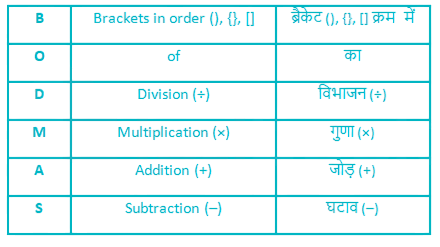
Calculation:
13468 + 7402 – 1468 = ? × 89
⇒ 12000 + 7402 = ? × 89
⇒ ? = 19402 ÷ 89
⇒ ? = 218
∴ The value of (?) is 218.
37. What should come in the place of the question mark ‘?’ in the following question?
(162 + 222) × 10 ÷ 370 = ?
A. 15
B. 20
C. 25
D. 30
E. None of these
Solution
Given:
(162 + 222) × 10 ÷ 370 = ?
Concept Used:
Follow the BODMAS rule according to the table given below:
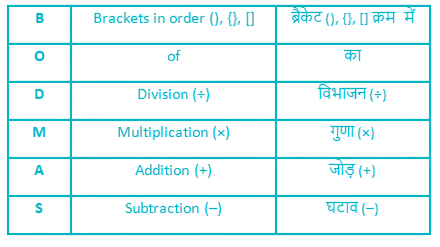
Calculation:
(162 + 222) × 10 ÷ 370 = ?
⇒ (256 + 484) × 10 ÷ 370 = ?
⇒ 740 × 10 ÷ 370 = ?
⇒ 7400/370 = ?
⇒ ? = 20
∴ The value of ‘?’ Is 20.
38. What should come in place of the question mark (?) in the following question?
34 ÷ 17 × 13 + 16 + ? = 60
A. 16
B. 17
C. 18
D. 19
E. 20
Solution
Given:
34 ÷ 17 × 13 + 16 + ? = 60
Concept used:
Follow the BODMAS rule according to the table given below:
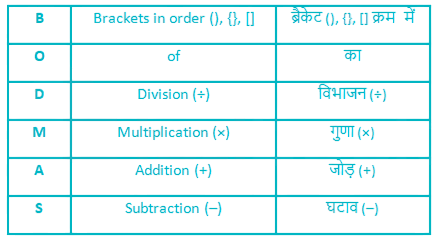
Calculation:
34 ÷ 17 × 13 + 16 + ? = 60
⇒ 26 + 16 + ? = 60
⇒ 42 + ? = 60
⇒ ? = 60 – 42
⇒ ? = 18
∴ The value of ? is 18.
39. What will come in the place of the question mark ‘?’ in the following question?
1456 ÷ 16 × 14 + 22 = (?)4
A. 6
B. 4
C. 16
D. 36
E. None of these
Solution
Given:
1456 ÷ 16 × 14 + 22 = (?)4
Concept used:
Follow the BODMAS rule according to the table given below:
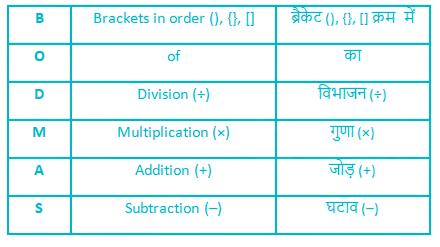
Calculation:
1456 ÷ 16 × 14 + 22 = (?)4
⇒ 91 × 14 + 22 = (?)4
⇒ 1274 + 22 = (?)4
⇒ (?)4 = 1296
⇒ ? = 6
∴ The value of ? is 6.
40. What will come in the place of the question mark ‘?’ in the following question?
[{2 × (1/4) + 4} × 8] = ? × 20
A. 1.9
B. 2.8
C. 3.8
D. 1.8
E. None of these
Solution
Given:
[{2 × (1/4) + 4} × 8] = ? × 20
Concept used:
Follow the BODMAS rule according to the table given below:
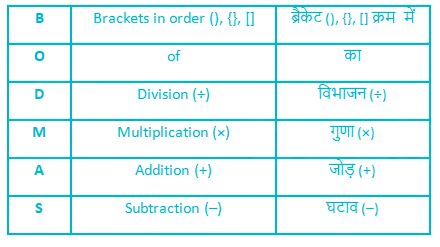
Calculation:
[{2 × (1/4) + 4} × 8] = ? × 20
⇒ [{(1/2) + 4} × 8] = ? × 20
⇒ [{(9/2) × 8] = ? × 20
⇒ 36 = ? × 20
⇒ ? = 36/20
⇒ ? = 1.8
∴ The value of ? is 1.8.
41. What will come in the place of the question mark ‘?’ in the following question?
45% of 4500 + (165/√225) = ?
A. 2036
B. 1036
C. 3036
D. 4036
E. None of these
Solution
Given:
45% of 4500 + (165/√225) = ?
Concept used:
Follow the BODMAS rule according to the table given below:
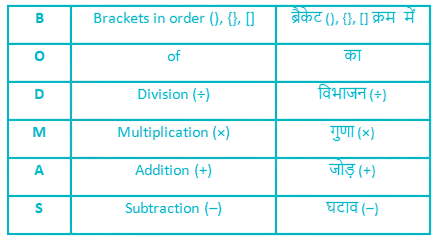
Calculation:
45% of 4500 + (165/√225) = ?
⇒ 45 × 45 + (165/15) = ?
⇒ 2025 + 11 = ?
⇒ ? = 2036
∴ The value of ? is 2036.
42. What will come in the place of the question mark ‘?’ in the following question?(?)2 × (15)2 ÷ (60)2 = 16
A. 36
B. 16
C. 64
D. 4
E. 12
Solution
Given:
(?)2 × (15)2 ÷ (60)2 = 16
Concept Used:
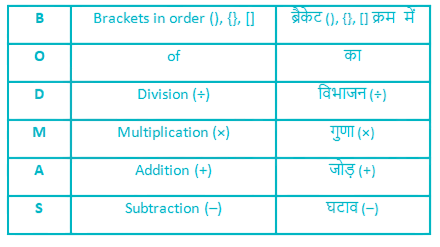
Calculation:
(?)2 × (15)2 ÷ (60)2 = 16
⇒ (?)2 × 15 × 15 × (1/60) × (1/60) = 16
⇒ (?)2 = 16 × 4 × 4
⇒ ? = √256
⇒ ? = 16
∴ The value of (?) is 16.
43. What will come in the place of the question mark ‘?’ in the following question?209 ÷ 19 + √36 – 27 ÷ 9 = ?
A. 9
B. 14
C. 11
D. 12
E. None of these.
Solution
Given:
209 ÷ 19 + √36 – 27 ÷ 9 = ?
Concept used:
Follow the BODMAS rule according to the table given below:

Calculation:
209 ÷ 19 + √36 – 27 ÷ 9 = ?
⇒ 11 + 6 – 3 = ?
⇒ ? = 17 – 3 = 14
∴ The value of ? is 14.
44. What will come in the place of the question mark ‘?’ in the following question?
[{(13)2 – (7)2}/(5)2] – (4/5) = ? × 4
A. 1
B. 2
C. 5
D. 4
E. 3
Solution
Given:
[{(13)2 – (7)2}/(5)2] – (4/5) = ? × 4
Concept:
Follow the BODMAS rule according to the table given below:

Calculation:
[{(13)2 – (7)2}/(5)2] – (4/5) = ? × 4
⇒ [{169 – 49}/25] – (4/5) = ? × 4
⇒ [120/25] – (4/5) = ? × 4
⇒ (24/5) – (4/5) = ? × 4
⇒ 20/5 = ? × 4
⇒ 4 = ? × 4
⇒ ? = (4/4)
⇒ ? = 1
∴ The value of ? is 1.
45. What will come in the place of the question mark ‘?’ in the following question?
82 × 93 ÷ 64 + 40% of 150 = ?
A. 72
B. 94
C. 96
D. 108
E. 85
Solution
Given:
82 × 93 ÷ 64 + 40% of 150 = ?
Concept used:
Follow the BODMAS rule according to the table given below:
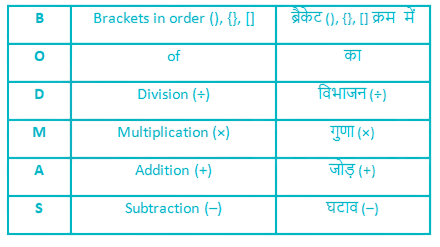
Calculation:
82 × 93 ÷ 64 + 40% of 150 = ?
⇒ 26 × 36 ÷ 64 + (2/5) × 150 = ?
⇒ 66 ÷ 64 + 60 = ?
⇒ 6(6 – 4) + 60 = ?
⇒ 62 + 60 = ?
⇒ 36 + 60 = ?
⇒ 96 = ?
∴ The value of ? is 96.
46. What will come in the place of ‘?’ in the following question?
680 × 24 ÷ 12 ÷ 17 + 12 of 6 = ?
A. 142
B. 152
C. 132
D. 165
E. None of the above
Solution
Concept used:

Calculation:
680 × 24 ÷ 12 ÷ 17 + 12 of 6 = ?
680 × 24/(12 × 17) + 12 × 6 = ?
80 + 72 = 152 = ?
∴ The value of ‘?’ is 152.
47. What will come in the place of ‘?’ in the following question?
500 + 7% of 700 – 13 × 5 = ?
A. 224
B. 384
C. 484
D. 548
E. None of the above
Solution
Concept used:

Calculation:
500 + 7% of 700 – 13 × 5 = ?
500 + (7/100 × 700) – 13 × 5 = ?
500 + 49 – 65 = ?
484 = ?
∴ The value of ‘?’ is 484.
48. What will come in the place of question mark?
111 ÷ 37 × 12 + 128 – 48 × 2 = ?
A. 52
B. 56
C. 58
D. 62
E. 68
Solution
Given:
111 ÷ 37 × 12 + 128 – 48 × 2
Concept used:
We have follow the BODMAS rule
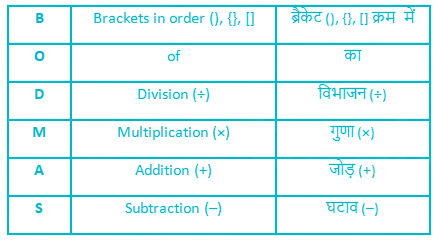
Calculation:
3 × 12 + 128 – 48 × 2 = ?
⇒ 36 + 128 – 96 = ?
⇒ 164 – 96 = ?
⇒ ? = 68
∴ The value of ? is 68.
49. Copper and Zinc are in the ratio 3 : 5 in 240 grams of an alloy. The quantity (in grams) of copper to be added to it to make the ratio 4 : 3 is:
A. 90
B. 100
C. 110
D. 210
E. None of the above
Solution
Given:
Quantity of the alloy = 240 gram
Copper : Zinc = 3 : 5
Calculation:
∴ Quantity of Copper = 3/8 × 240 = 90 gram
∴ Quantity of Zinc = 5/8 × 240 = 150 gram
As per the question, new ratio = 4 : 3
⇒ (90 + x)/150 = 4/3
⇒ 270 + 3x = 150 × 4
⇒ 270 + 3x = 600
⇒ 3x = 600 – 270 = 330
⇒ x = 110 gram
∴ The quantity of Copper to be added is 110 gram.
Alternate Method
⇒ Here, we are only changing the quantity of copper and not if zinc.
So, to keep the zinc quantity equal, take L.C.M. (5, 3) = 15
⇒ New ratio of Copper to zinc before adding copper = 3 : 5 = 9 : 15
⇒ New Ratio of zinc to copper after adding copper = 4 : 3 = 20 : 15
Let, the quantity of copper and zinc be 9x and 15x respectively before adding copper.
⇒ 9x + 15x = 24x = 240 (Given)
⇒ x = 10
Quantity of copper = 9x = 90 grams
New quantities of copper and zinc after adding copper will be 20x and 15x respectively.
⇒ Copper in a new mixture = 20x = 20 × 10 = 200 grams
⇒ Quantity of copper to be added = 200 – 90 = 110 grams
∴ The quantity of Copper to be added is 110 gram.
50. After allowing a discount of 40% on the marked price, a shopkeeper gains a profit of 20%. Find the cost price of the article whose marked price is Rs. 21240.
A. Rs.10,640
B. Rs.10,700
C. Rs.10,620
D. Rs.10,680
E. None of these
Solution
Shortcut TrickGiven:
Marked price (MP) = Rs. 21240
Profit = 20% = 1/5
Discount = 40% = 2/5
Calculation:
By Using Ratio Method

Multiplying the ratios of SP : MP to make the ratios same of SP

Here, M.P. = 10x
⇒ 10x = 21240
⇒ x = 2124
Therefore, C.P. = 5x
⇒ 5x = 5 × 2124 = 10,620
∴ The Cost Price of the article is Rs.10,620.
Alternate MethodGiven:
Marked price (MP) = Rs. 21240
Profit = 20% = 1/5
Discount = 40% = 2/5
Formula Used:
Selling Price = (100 – D)% of MP
S.P. = C.P. [1 + (Profit/100)]
M.P./C.P. = (100 + P)/(100 – D)
Calculation:
According to the question,
M.P./C.P. = (100 + P)/(100 – D)
⇒ 21240/C.P. = (100 + 20)/(100 – 40)
⇒ 21240/C.P. = 120/60
⇒ C.P. = (21240 × 60)/120
⇒ C.P. = Rs.10,620
∴ The Cost Price of the article is Rs.10,620.
Alternate MethodLet the Cost Price (C.P.) be Rs. X
Selling Price = (100 – 40)% of 21240
⇒ 60% of 21240 = 12,744
Again, S.P. = C.P. [1 + (Profit/100)]
⇒ 12,744 = 120% of X
⇒ X = (12,744/120) × 100 = Rs.10,620
∴ The Cost Price of the article is Rs.10,620.
51. Value of X is 20% more than value Y. Y is 30% less than Z. Value of Z is 320. Find the value 25% of sum of [X + Y]?
A. 123.2
B. 144.4
C. 164.8
D. 134.8
E. 162.5
Solution
Calculation
Y is 30% less than Z:
Y = Z – [30% of Z] = 320 − (0.3×320) = 320 – 96 = 224
X is 20% more than Y:
X = Y + (20% of Y) = 224 + (0.2 × 224) = 224 + 44.8 = 268.8
So, 25% of [X + Y] = [268.8 + 224] / 4 = 492.8 / 4 = 123.2
52. Direction: Read the following table carefully and answer the following questions:
Table shows the customers in the city of 5 companies of their two wheeler products
| Company/Customers (in Thousand) | Bike | Scooty |
| TVS | 60 | 65 |
| Yamaha | 35 | 40 |
| Honda | 80 | 75 |
| Suzuki | 25 | 50 |
| Bajaj | 20 | 30 |
Question:
Find the average customers of five companies of Bike in the city.
A. 44 thousand
B. 43 thousand
C. 48 thousand
D. 49 thousand
E. 40 thousand
Solution
From the given table we can say that,
Total customers of Bike of five companies in city = 60000 + 35000 + 80000 + 25000 + 20000
⇒ 220000
∴ Required average = 220000/5 = 44000
53. Direction: Read the following table carefully and answer the following questions:
Table shows the customers in the city of 5 companies of their two wheeler products
| Company/Customers (in Thousand) | Bike | Scooty |
| TVS | 60 | 65 |
| Yamaha | 35 | 40 |
| Honda | 80 | 75 |
| Suzuki | 25 | 50 |
| Bajaj | 20 | 30 |
Question:
Customers of scooty of five companies are approximately what percent of total customers of two – wheeler of five companies?
A. 58%
B. 50%
C. 51%
D. 54%
E. 56%
Solution
Total customers of Bike of five companies in city = 60000 + 35000 + 80000 + 25000 + 20000
⇒ 220000
Total customers of Scooty of five companies in city = 65000 + 40000 + 75000 + 50000 + 30000
⇒ 260000
Total two wheeler customers in city = 220000 + 260000 = 480000
∴ Required percentage = 260000/480000 × 100
⇒ 54.16% = 54% (approx.)
54. Direction: Read the following table carefully and answer the following questions:
Table shows the customers in the city of 5 companies of their two wheeler products
| Company/Customers (in Thousand) | Bike | Scooty |
| TVS | 60 | 65 |
| Yamaha | 35 | 40 |
| Honda | 80 | 75 |
| Suzuki | 25 | 50 |
| Bajaj | 20 | 30 |
Question:
Find the ratio between the number of customers of TVS and Honda.
A. 31 : 25
B. 25 : 28
C. 31 : 28
D. 29 : 28
E. 25 : 31
Solution
From the given table we can say that,
Total customers of TVS = 60000 + 65000 = 125000
Total customers of Honda = 80000 + 75000 = 155000
∴ Required ratio = 125 : 155 = 25 : 31
55. Direction: Read the following table carefully and answer the following questions:
Table shows the customers in the city of 5 companies of their two wheeler products
| Company/Customers (in Thousand) | Bike | Scooty |
| TVS | 60 | 65 |
| Yamaha | 35 | 40 |
| Honda | 80 | 75 |
| Suzuki | 25 | 50 |
| Bajaj | 20 | 30 |
Question:
Find the difference between the number of customers of Suzuki and Bajaj.
A. 25900
B. 25000
C. 25700
D. 25400
E. 24800
Solution
Total customers of Suzuki = 25 + 50 = 75 thousand
Total customers of Bajaj = 20 + 30 = 50 thousand
Required difference = 75 – 50 = 25000
56. Direction: Read the following table carefully and answer the following questions:
Table shows the customers in the city of 5 companies of their two wheeler products
| Company/Customers (in Thousand) | Bike | Scooty |
| TVS | 60 | 65 |
| Yamaha | 35 | 40 |
| Honda | 80 | 75 |
| Suzuki | 25 | 50 |
| Bajaj | 20 | 30 |
Question:
Bike customers of Yamaha are what percent less than the Scooty customers of Yamaha?
A. 12%
B. 12.5%
C. 10%
D. 15%
E. 33.33%
Solution
From the table we can say that,
Bike customers of Yamaha = 35000
Scooty customers of Yamaha = 40000
∴ Required percentage =
⇒ (40000 – 35000)/40000 × 100 = 12.5%
57. The income and expenditure of a person are in a ratio of 7 : 3. If the income of the person is ₹ 56000. then find his savings.
A. Rs. 32,000
B. Rs. 56,000
C. Rs. 24,000
D. Rs. 25,000
E. Rs. 23,000
Solution
Given:
The income of the person is ₹ 56,000
The ratio of income and expenditure is 7 : 3 respectively
Concept used:
Income = Expenditure + Savings
Calculation:
Let the income be 7x
Let the expenditure be 3x
7x = 56000
⇒ x = 56000/7
⇒ x = 8000
⇒ Expenditure = 3x = 3 × 8000 = 24000
Savings = Income – Expenditure
⇒ Savings = 56000 – 24000
⇒ Savings = 32000
∴ The savings of the person is ₹ 32000.
58. In the following number series, a wrong number is given. Find out the wrong number.
1, 2, 6, 24, 96, 720
A. 96
B. 2
C. 6
D. 24
E. 720
Solution
Given:
1, 2, 6, 24, 96, 720
Calculation:
The logic follows here is;
1 × 2 = 2
2 × 3 = 6
6 × 4 = 24
24 × 5 = 120 ≠ 96
120 × 6 = 720
There should be 120 instead of 96.
∴ 96 is the wrong term.
59. In each of the following number series, the wrong number is given, find out that number.8, 8.5, 11.5, 14, 17
A. 8
B. 8.5
C. 11.5
D. 14
E. 17
Solution
Calculation:
The logic of the given series can be explained as:
8
⇒ 8 + 1.5 = 9.5 ≠ 8.5,
⇒ 9.5 + 2 = 11.5,
⇒ 11.5 + 2.5 = 14,
⇒ 14 + 3 = 17
∴ Wrong term in given number series is 8.5
Logic: Addition of 0.5
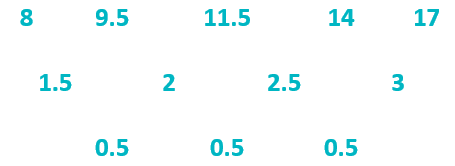
60. Find the wrong number in the following series.
2, 5, 12, 29, 58, 121
A. 58
B. 5
C. 12
D. 29
E. 121
Solution
Calculation:
Considering the above series,
2, 5, 12, 29, 58, 121
The logic of the series can be explained as,
2 × 2 + 1 = 5
5 × 2 + 2 = 12
12 × 2 + 3 = 27
27 × 2 + 4 = 58
58 × 2 + 5 = 121
27 should be in the place of 29
∴ The wrong number is 29.
61 .In each of the following number series, a wrong number is given. Find out that number.
1, 7, 19, 40, 61, 91
A. 7
B. 19
C. 40
D. 61
E. 91
Solution
Calculation:
The logic of the series can be explained as,
1 + (6 × 1) = 7
7 + (6 × 2) = 19
19 + (6 × 3) = 37
37 + (6 × 4) = 61
61 + (6 × 5) = 91
37 should be in the place of 40
∴ The wrong number is 40
62. In each of the following number series, the wrong number is given, find out that number.256, 260, 251, 267, 243, 278
A. 243
B. 278
C. 251
D. 260
E. 267
Solution
Given that,
256, 260, 251, 267, 243, 278
256
⇒ 256 + 22 = 260
⇒ 260 – 32 = 251
⇒ 251 + 42 = 267
⇒ 267 – 52 = 242
⇒ 242 + 62 = 278
∴ 243 is the wrong number in the given pattern
63. A box contains 10 green and 8 yellow balls. In how many ways, two balls of the same-colour can be drawn?
A. 73
B. 36
C. 28
D. 54
E. None of these
Solution
The correct answer is option 1.
Given: A box contains 10 green and 8 yellow balls.
Concept Used: When we need to draw two balls out of n number of balls then possible ways = nC2nC2
Calculation:
⇒ Two ball of same colour = two balls may be green + two balls may be yellow
So, two balls of same colour = 10C2+8C210C2+8C2
Possible ways to draw two ball of same colour = 10×92×1+8×72×110×92×1+8×72×1
= 45 + 28
= 73
So, two balls of same colour can be drawn in 73 ways.
64. If a sum of money invested at the simple interest becomes 8 times of itself in 14 years, then find the rate of interest.
A. 60%
B. 80%
C. 50%
D. 25%
E. None of these
Solution
Short Trick
If a sum of money becomes ‘x’ times in ‘t’ years at S.I, the rate of interest r = {100(x – 1)/t}%
Calculation:
Here, x = 8, t = 14
so, from the question, we can say,
r = {100(8 – 1)/14}%
⇒ r = 50%
∴ The rate of interest will be 50%.

Given:
The Sum of money becomes 8 times of itself in 14 years
Formula used:
S.I = PRT/100
Where S.I = Simple interest, P = Principal, R = Rate, T = time
Calculation:
Let the Principal be 100x and after 14 years, it will be 800x
So, the S.I will be (800x – 100x) = 700x
So, according to the formula, we can say,
700x = {(100x × R × 14)/100}
⇒ R = 50
∴ The rate of interest will be 50%.
65. A circular shaped wire in the form of a circle of radius 21 m is cut and again bent in the form of a square. what is the diagonal of the square?
A. 35√2m
B. 31√2m
C. 33√2m
D. 66m
E. 132m
Solution
Given:
Radius of circle = 21 m
Concept used:
Circumference of circle = 2πr
Perimeter of square = 4a
Diagonal of square = a√2
Calculations:
Radius of circle = 21m
Now, the circumference of the circle = 2πr
2πr = 2 × (22/7) × 21 = 132m
Here, is given that the wire is bent in the form of a circle to a square .so, circumference of the circle is equal to the perimeter of the square.
Side of square = 4a
4a = 132
a = 132/4
a = 33
Diagonal of square = a√2 = 33√2
Hence, the required diagonal of square = 33√2.
66. Direction: Study the following information carefully and answer the given questions.Eight friends K, L, M, N, O, P, Q, and R have to deliver lectures on either the 8th or 15th of four different months among January, April, June, and August but not necessarily in the same order. Not more than 2 persons will give a lecture in a month. Only one person will deliver a lecture each day. K delivers his lecture on the 8th of a month which has only 30 days. Only three lectures were delivered between K and L. O delivers the lecture immediately after L. Number of persons who give the lecture after O is the same as the number of persons who give the lecture before P. Only two persons give lectures between P and M. Q and M give their lectures in the same month. N gives the lecture before R.
Question:
Who gives the lecture on 15th April?
A. L
B. O
C. Q
D. M
E. K
Solution
Person: K, L, M, N, O, P, Q, and R.
Month: January, April, June, and August
Dates: 8th & 15th
1) K delivers his lecture on the 8th of a month which has only 30 days.
2) Only three lectures were delivered between K and L.
3) O delivers the lecture immediately after L.
(Here 2 cases are possible, Case1: K delivers his lecture on the 8th of April, Case2: K delivers his lecture on the 8th of June.
Case 1:
| Months | Dates | Person |
| January (31 days) | 8 | |
| 15 | ||
| April (30 days) | 8 | K |
| 15 | ||
| June (30 days) | 8 | |
| 15 | ||
| August (31 days) | 8 | L |
| 15 | O |
Case 2:
| Months | Dates | Person |
| January (31 days) | 8 | L |
| 15 | O | |
| April (30 days) | 8 | |
| 15 | ||
| June (30 days) | 8 | K |
| 15 | ||
| August (31 days) | 8 | |
| 15 |
4) Number of persons who give the lecture after O is the same as the number of persons who give the lecture before P.
5) Only two persons give lectures between P and M.
Case 1:
| Months | Dates | Person |
| January (31 days) | 8 | P |
| 15 | ||
| April (30 days) | 8 | K |
| 15 | M | |
| June (30 days) | 8 | |
| 15 | ||
| August (31 days) | 8 | L |
| 15 | O |
Case 2:
| Months | Dates | Person |
| January (31 days) | 8 | L |
| 15 | O | |
| April (30 days) | 8 | |
| 15 | M | |
| June (30 days) | 8 | K |
| 15 | ||
| August (31 days) | 8 | P |
| 15 |
6) Q and M give their lectures in the same month.
(From here Case 1 is eliminated because no vacant position for Q as according to statement 6 Q and M give their lecture in the same month)
| Months | Dates | Person |
| January (31 days) | 8 | L |
| 15 | O | |
| April (30 days) | 8 | Q |
| 15 | M | |
| June (30 days) | 8 | K |
| 15 | ||
| August (31 days) | 8 | P |
| 15 |
7) N gives the lecture before R.
The final arrangement will be as follows:
| Months | Dates | Person |
| January (31 days) | 8 | L |
| 15 | O | |
| April (30 days) | 8 | Q |
| 15 | M | |
| June (30 days) | 8 | K |
| 15 | N | |
| August (31 days) | 8 | P |
| 15 | R |
Hence, M gives the lecture on 15th April.
67. Direction: Study the following information carefully and answer the given questions.Eight friends K, L, M, N, O, P, Q, and R have to deliver lectures on either the 8th or 15th of four different months among January, April, June, and August but not necessarily in the same order. Not more than 2 persons will give a lecture in a month. Only one person will deliver a lecture each day. K delivers his lecture on the 8th of a month which has only 30 days. Only three lectures were delivered between K and L. O delivers the lecture immediately after L. Number of persons who give the lecture after O is the same as the number of persons who give the lecture before P. Only two persons give lectures between P and M. Q and M give their lectures in the same month. N gives the lecture before R.
Question:
Who delivers the lecture immediately before R?
A. M
B. L
C. P
D. O
E. Q
Solution
Person: K, L, M, N, O, P, Q, and R.
Month: January, April, June, and August
Dates: 8th & 15th
1) K delivers his lecture on the 8th of a month which has only 30 days.
2) Only three lectures were delivered between K and L.
3) O delivers the lecture immediately after L.
(Here 2 cases are possible, Case1: K delivers his lecture on the 8th of April, Case2: K delivers his lecture on the 8th of June.
Case 1:
| Months | Dates | Person |
| January (31 days) | 8 | |
| 15 | ||
| April (30 days) | 8 | K |
| 15 | ||
| June (30 days) | 8 | |
| 15 | ||
| August (31 days) | 8 | L |
| 15 | O |
Case 2:
| Months | Dates | Person |
| January (31 days) | 8 | L |
| 15 | O | |
| April (30 days) | 8 | |
| 15 | ||
| June (30 days) | 8 | K |
| 15 | ||
| August (31 days) | 8 | |
| 15 |
4) Number of persons who give the lecture after O is the same as the number of persons who give the lecture before P.
5) Only two persons give lectures between P and M.
Case 1:
| Months | Dates | Person |
| January (31 days) | 8 | P |
| 15 | ||
| April (30 days) | 8 | K |
| 15 | M | |
| June (30 days) | 8 | |
| 15 | ||
| August (31 days) | 8 | L |
| 15 | O |
Case 2:
| Months | Dates | Person |
| January (31 days) | 8 | L |
| 15 | O | |
| April (30 days) | 8 | |
| 15 | M | |
| June (30 days) | 8 | K |
| 15 | ||
| August (31 days) | 8 | P |
| 15 |
6) Q and M give their lectures in the same month.
(From here Case 1 is eliminated because no vacant position for Q as according to statement 6 Q and M give their lecture in the same month)
| Months | Dates | Person |
| January (31 days) | 8 | L |
| 15 | O | |
| April (30 days) | 8 | Q |
| 15 | M | |
| June (30 days) | 8 | K |
| 15 | ||
| August (31 days) | 8 | P |
| 15 |
7) N gives the lecture before R.
The final arrangement will be as follows:
| Months | Dates | Person |
| January (31 days) | 8 | L |
| 15 | O | |
| April (30 days) | 8 | Q |
| 15 | M | |
| June (30 days) | 8 | K |
| 15 | N | |
| August (31 days) | 8 | P |
| 15 | R |
Hence, P delivers the lecture immediately before R.
68. Direction: Study the following information carefully and answer the given questions.Eight friends K, L, M, N, O, P, Q, and R have to deliver lectures on either the 8th or 15th of four different months among January, April, June, and August but not necessarily in the same order. Not more than 2 persons will give a lecture in a month. Only one person will deliver a lecture each day. K delivers his lecture on the 8th of a month which has only 30 days. Only three lectures were delivered between K and L. O delivers the lecture immediately after L. Number of persons who give the lecture after O is the same as the number of persons who give the lecture before P. Only two persons give lectures between P and M. Q and M give their lectures in the same month. N gives the lecture before R.
Question:
Who among the following doesn’t deliver the lecture in the month having 30 days ?
A. Q
B. M
C. K
D. N
E. L
Solution
Person: K, L, M, N, O, P, Q, and R.
Month: January, April, June, and August
Dates: 8th & 15th
1) K delivers his lecture on the 8th of a month which has only 30 days.
2) Only three lectures were delivered between K and L.
3) O delivers the lecture immediately after L.
(Here 2 cases are possible, Case1: K delivers his lecture on the 8th of April, Case2: K delivers his lecture on the 8th of June.
Case 1:
| Months | Dates | Person |
| January (31 days) | 8 | |
| 15 | ||
| April (30 days) | 8 | K |
| 15 | ||
| June (30 days) | 8 | |
| 15 | ||
| August (31 days) | 8 | L |
| 15 | O |
Case 2:
| Months | Dates | Person |
| January (31 days) | 8 | L |
| 15 | O | |
| April (30 days) | 8 | |
| 15 | ||
| June (30 days) | 8 | K |
| 15 | ||
| August (31 days) | 8 | |
| 15 |
4) Number of persons who give the lecture after O is the same as the number of persons who give the lecture before P.
5) Only two persons give lectures between P and M.
Case 1:
| Months | Dates | Person |
| January (31 days) | 8 | P |
| 15 | ||
| April (30 days) | 8 | K |
| 15 | M | |
| June (30 days) | 8 | |
| 15 | ||
| August (31 days) | 8 | L |
| 15 | O |
Case 2:
| Months | Dates | Person |
| January (31 days) | 8 | L |
| 15 | O | |
| April (30 days) | 8 | |
| 15 | M | |
| June (30 days) | 8 | K |
| 15 | ||
| August (31 days) | 8 | P |
| 15 |
6) Q and M give their lectures in the same month.
(From here Case 1 is eliminated because no vacant position for Q as according to statement 6 Q and M give their lecture in the same month)
| Months | Dates | Person |
| January (31 days) | 8 | L |
| 15 | O | |
| April (30 days) | 8 | Q |
| 15 | M | |
| June (30 days) | 8 | K |
| 15 | ||
| August (31 days) | 8 | P |
| 15 |
7) N gives the lecture before R.
The final arrangement will be as follows:
| Months | Dates | Person |
| January (31 days) | 8 | L |
| 15 | O | |
| April (30 days) | 8 | Q |
| 15 | M | |
| June (30 days) | 8 | K |
| 15 | N | |
| August (31 days) | 8 | P |
| 15 | R |
Hence, L doesn’t deliver the lecture in the month having 30 days.
69. Direction: Study the following information carefully and answer the given questions.Eight friends K, L, M, N, O, P, Q, and R have to deliver lectures on either the 8th or 15th of four different months among January, April, June, and August but not necessarily in the same order. Not more than 2 persons will give a lecture in a month. Only one person will deliver a lecture each day. K delivers his lecture on the 8th of a month which has only 30 days. Only three lectures were delivered between K and L. O delivers the lecture immediately after L. Number of persons who give the lecture after O is the same as the number of persons who give the lecture before P. Only two persons give lectures between P and M. Q and M give their lectures in the same month. N gives the lecture before R.
Question:
How many lectures were delivered after Q?
A. 5
B. 6
C. 4
D. 7
E. 3
Solution
Person: K, L, M, N, O, P, Q, and R.
Month: January, April, June, and August
Dates: 8th & 15th
1) K delivers his lecture on the 8th of a month which has only 30 days.
2) Only three lectures were delivered between K and L.
3) O delivers the lecture immediately after L.
(Here 2 cases are possible, Case1: K delivers his lecture on the 8th of April, Case2: K delivers his lecture on the 8th of June.
Case 1:
| Months | Dates | Person |
| January (31 days) | 8 | |
| 15 | ||
| April (30 days) | 8 | K |
| 15 | ||
| June (30 days) | 8 | |
| 15 | ||
| August (31 days) | 8 | L |
| 15 | O |
Case 2:
| Months | Dates | Person |
| January (31 days) | 8 | L |
| 15 | O | |
| April (30 days) | 8 | |
| 15 | ||
| June (30 days) | 8 | K |
| 15 | ||
| August (31 days) | 8 | |
| 15 |
4) Number of persons who give the lecture after O is the same as the number of persons who give the lecture before P.
5) Only two persons give lectures between P and M.
Case 1:
| Months | Dates | Person |
| January (31 days) | 8 | P |
| 15 | ||
| April (30 days) | 8 | K |
| 15 | M | |
| June (30 days) | 8 | |
| 15 | ||
| August (31 days) | 8 | L |
| 15 | O |
Case 2:
| Months | Dates | Person |
| January (31 days) | 8 | L |
| 15 | O | |
| April (30 days) | 8 | |
| 15 | M | |
| June (30 days) | 8 | K |
| 15 | ||
| August (31 days) | 8 | P |
| 15 |
6) Q and M give their lectures in the same month.
(From here Case 1 is eliminated because no vacant position for Q as according to statement 6 Q and M give their lecture in the same month)
| Months | Dates | Person |
| January (31 days) | 8 | L |
| 15 | O | |
| April (30 days) | 8 | Q |
| 15 | M | |
| June (30 days) | 8 | K |
| 15 | ||
| August (31 days) | 8 | P |
| 15 |
7) N gives the lecture before R.
The final arrangement will be as follows:
| Months | Dates | Person |
| January (31 days) | 8 | L |
| 15 | O | |
| April (30 days) | 8 | Q |
| 15 | M | |
| June (30 days) | 8 | K |
| 15 | N | |
| August (31 days) | 8 | P |
| 15 | R |
Hence, 5 lectures were delivered after Q.
70. Direction: Study the following information carefully and answer the given questions.Eight friends K, L, M, N, O, P, Q, and R have to deliver lectures on either the 8th or 15th of four different months among January, April, June, and August but not necessarily in the same order. Not more than 2 persons will give a lecture in a month. Only one person will deliver a lecture each day. K delivers his lecture on the 8th of a month which has only 30 days. Only three lectures were delivered between K and L. O delivers the lecture immediately after L. Number of persons who give the lecture after O is the same as the number of persons who give the lecture before P. Only two persons give lectures between P and M. Q and M give their lectures in the same month. N gives the lecture before R.
Question:
Who gives the lecture on 8th August?
A. K
B. L
C. M
D. P
E. Q
Solution
Person: K, L, M, N, O, P, Q, and R.
Month: January, April, June, and August
Dates: 8th & 15th
1) K delivers his lecture on the 8th of a month which has only 30 days.
2) Only three lectures were delivered between K and L.
3) O delivers the lecture immediately after L.
(Here 2 cases are possible, Case1: K delivers his lecture on the 8th of April, Case2: K delivers his lecture on the 8th of June.
Case 1:
| Months | Dates | Person |
| January (31 days) | 8 | |
| 15 | ||
| April (30 days) | 8 | K |
| 15 | ||
| June (30 days) | 8 | |
| 15 | ||
| August (31 days) | 8 | L |
| 15 | O |
Case 2:
| Months | Dates | Person |
| January (31 days) | 8 | L |
| 15 | O | |
| April (30 days) | 8 | |
| 15 | ||
| June (30 days) | 8 | K |
| 15 | ||
| August (31 days) | 8 | |
| 15 |
4) Number of persons who give the lecture after O is the same as the number of persons who give the lecture before P.
5) Only two persons give lectures between P and M.
Case 1:
| Months | Dates | Person |
| January (31 days) | 8 | P |
| 15 | ||
| April (30 days) | 8 | K |
| 15 | M | |
| June (30 days) | 8 | |
| 15 | ||
| August (31 days) | 8 | L |
| 15 | O |
Case 2:
| Months | Dates | Person |
| January (31 days) | 8 | L |
| 15 | O | |
| April (30 days) | 8 | |
| 15 | M | |
| June (30 days) | 8 | K |
| 15 | ||
| August (31 days) | 8 | P |
| 15 |
6) Q and M give their lectures in the same month.
(From here Case 1 is eliminated because no vacant position for Q as according to statement 6 Q and M give their lecture in the same month)
| Months | Dates | Person |
| January (31 days) | 8 | L |
| 15 | O | |
| April (30 days) | 8 | Q |
| 15 | M | |
| June (30 days) | 8 | K |
| 15 | ||
| August (31 days) | 8 | P |
| 15 |
7) N gives the lecture before R.
The final arrangement will be as follows:
| Months | Dates | Person |
| January (31 days) | 8 | L |
| 15 | O | |
| April (30 days) | 8 | Q |
| 15 | M | |
| June (30 days) | 8 | K |
| 15 | N | |
| August (31 days) | 8 | P |
| 15 | R |
Hence, P gives the lecture on 8th August.
71. Directions: Read the following information carefully and answer the question that follows.A boy is going to meet his friend. He walks 60 metres to the north, then turns right and walks 40 metres. He then turns left and walks 30 metres, followed by another left turn and walks 70 metres. Still not finding his friend, he turns right and walks 20 metres, then takes another right and walks 50 metres. Finally, he turns left and walks 40 metres, where he meets his friend.
Question:
What is the total vertical distance covered by the boy before meeting his friend?
A. 150 m
B. 160 m
C. 170 m
D. 180 m
E. 140 m
Solution
1. He walks 60 metres to the north, then turns right and walks 40 metres. He then turns left and walks 30 metres, followed by another left turn and walks 70 metres.

2. Still not finding his friend, he turns right and walks 20 metres, then takes another right and walks 50 metres. Finally, he turns left and walks 40 metres, where he meets his friend.
According to the information given in the question we can draw the figure below:

Hence, the vertical distance = 60 + 30 + 20 + 40 = 150 m.
72. Directions: Read the following information carefully and answer the question that follows.A boy is going to meet his friend. He walks 60 metres to the north, then turns right and walks 40 metres. He then turns left and walks 30 metres, followed by another left turn and walks 70 metres. Still not finding his friend, he turns right and walks 20 metres, then takes another right and walks 50 metres. Finally, he turns left and walks 40 metres, where he meets his friend.
Question:
In which direction is the boy from his starting point after meeting his friend?
A. North
B. East
C. West
D. North-East
E. South-West
Solution
1. He walks 60 metres to the north, then turns right and walks 40 metres. He then turns left and walks 30 metres, followed by another left turn and walks 70 metres.

2. Still not finding his friend, he turns right and walks 20 metres, then takes another right and walks 50 metres. Finally, he turns left and walks 40 metres, where he meets his friend.
According to the information given in the question we can draw the figure below:

Hence, the boy is in north-east direction after meeting his friend with respect to his starting point.
73. Directions: Read the following information carefully and answer the question that follows.A boy is going to meet his friend. He walks 60 metres to the north, then turns right and walks 40 metres. He then turns left and walks 30 metres, followed by another left turn and walks 70 metres. Still not finding his friend, he turns right and walks 20 metres, then takes another right and walks 50 metres. Finally, he turns left and walks 40 metres, where he meets his friend.
Question:
What is the total distance the boy walked before meeting his friend?
A. 310 m
B. 300 m
C. 280 m
D. 260 m
E. 240 m
Solution
1. He walks 60 metres to the north, then turns right and walks 40 metres. He then turns left and walks 30 metres, followed by another left turn and walks 70 metres.

2. Still not finding his friend, he turns right and walks 20 metres, then takes another right and walks 50 metres. Finally, he turns left and walks 40 metres, where he meets his friend.
According to the information given in the question we can draw the figure below:

Hence, total distance = 60 + 40 + 30 + 70 + 20 + 50 + 40 = 310 m.
74. Direction: In the question below are given three statements followed by two conclusions numbered I and II. You have to take the given statements to be true even if they seem to be at variance with commonly known facts. Read all the conclusions and then decide which of the given conclusions logically follows from the given statements disregarding commonly known facts.
Statements:
Only a few income is salary.
No salary is dollar.
All salary is pound.
Conclusions:
I. All income is pound.
II. No income is pound.
A. Only conclusion I follows
B. Only conclusion II follows
C. Either conclusion I or II follows
D. Neither conclusion I nor II follows
E. Both conclusion I and II follows
Solution
The least possible Venn diagram is:

Conclusions:
I. All income is pound → FALSE (All salary is pound and only some part of salary is income, thus all part of income cannot be pound but some part of income will be pound).
II. No income is pound → FALSE (Some part of income is there in pound and thus no part of income is pound will be wrong).
Hence, “Neither conclusion I nor II follows”.
75. Direction: In the question below are given three statements followed by two conclusions numbered I and II. You have to take the given statements to be true even if they seem to be at variance with commonly known facts. Read all the conclusions and then decide which of the given conclusions logically follows from the given statements disregarding commonly known facts.
Statements:
All monitor are screen.
No monitor is scanner.
No mouse is monitor.
Conclusions:
I) All screen can be mouse.
II) All mouse being scanner is a possibility.
A. Only conclusion I follows
B. Only conclusion II follows
C. Either conclusion I or II follows
D. Neither conclusion I nor II follows
E. Both conclusion I and II follows
Solution
The least possible Venn diagram is:

Conclusions:
I) All screen can be mouse → False (No Monitor is Mouse and “All monitor are screen” so all screen can be mouse is not a possibility.)
II) All mouse being scanner is a possibility → True (There is no direct relation between mouse and scanner, thus the possibility is true here).
“Only conclusion II follows”.
76. Directions: In the question below are given three statements followed by three conclusions I, II and III. You have to take the given statements to be true even if they seem to be at variance from commonly known facts. Read all the conclusions and then decide which of the given conclusions logically follows from the given statements disregarding commonly known facts.
Statements:
All dogs are mammals.
Some mammals are carnivores.
No carnivore is herbivore.
Conclusions:
I. Some dogs are not herbivores.
II. Some carnivores are dogs.
A. Only I follows.
B. Only II follows.
C. Both I and II follows.
D. Either I or II follows.
E. Neither I nor II follows.
Solution
The least possible diagram for the given statements is as follows:

Conclusions:
I. Some dogs are not herbivores. → False (Since all dogs are mammals, and some mammals are carnivores, So the dogs have no direct negative relation with herbivores. So it is not definitely true. This conclusion is invalid.)
II. Some carnivores are dogs. → False (We cannot definitively conclude this from the given statements. Although all dogs are mammals and some mammals are carnivores, we don’t have enough information to establish that some dogs are also carnivores. This conclusion is not valid.)
Hence, the correct answer is “Neither I nor II follows”.
77. Directions: Read the following information carefully and answer the questions.
Eight persons, C, K, M, B, Z, R, Q and P live in eight different floors, one above another but not necessarily in the same order. The first floor is numbered as 1, the second floor is numbered as 2, and so on.
P lives on the immediate floor above C. Only two persons live below M. Only one person lives above Q. Only two persons live in between Q and B. R lives on the floor exactly in between M and K. No one lives above Z. C lives on the floor immediately above B. No one live below the floor in which K live.
Question:
How many persons live below C?
A. 5
B. 4
C. 2
D. 0
E. 1
Solution
Given: Eight persons live on eight different floors numbered as 1, 2 and so on.
Based on the given conditions, we get the following possibilities-
1. Only one person lives above Q. Only two persons live in between Q and B. From these, we get-
| FLOOR NO. | PERSON |
| 8 | |
| 7 | Q |
| 6 | |
| 5 | |
| 4 | B |
| 3 | |
| 2 | |
| 1 |
2. No one live below the floor in which K live. R lives on the floor in between M and K. From these, we get-
| FLOOR NO. | PERSON |
| 8 | |
| 7 | Q |
| 6 | |
| 5 | |
| 4 | B |
| 3 | M |
| 2 | R |
| 1 | K |
3. C lives on the floor immediately above B. P lives on the immediate floor above C. No one lives above Z. From these, we get the final table as follows-
| FLOOR NO. | PERSON |
| 8 | Z |
| 7 | Q |
| 6 | P |
| 5 | C |
| 4 | B |
| 3 | M |
| 2 | R |
| 1 | K |
From the final table, we see that C lives on the 5th floor and four persons live below.
Hence, only four persons live below C.
78. Directions: Read the following information carefully and answer the questions.
Eight persons, C, K, M, B, Z, R, Q and P live in eight different floors, one above another but not necessarily in the same order. The first floor is numbered as 1, the second floor is numbered as 2, and so on.
P lives on the immediate floor above C. Only two persons live below M. Only one person lives above Q. Only two persons live in between Q and B. R lives on the floor exactly in between M and K. No one lives above Z. C lives on the floor immediately above B. No one live below the floor in which K live.
Question:
Who lives on the floor immediately below Z?
A. P
B. B
C. Q
D. C
E. R
Solution
Given: Eight persons live on eight different floors numbered as 1, 2 and so on.
Based on the given conditions, we get the following possibilities-
1. Only one person lives above Q. Only two persons live in between Q and B. From these, we get-
| FLOOR NO. | PERSON |
| 8 | |
| 7 | Q |
| 6 | |
| 5 | |
| 4 | B |
| 3 | |
| 2 | |
| 1 |
2. No one live below the floor in which K live. R lives on the floor in between M and K. From these, we get-
| FLOOR NO. | PERSON |
| 8 | |
| 7 | Q |
| 6 | |
| 5 | |
| 4 | B |
| 3 | M |
| 2 | R |
| 1 | K |
3. C lives on the floor immediately above B. P lives on the immediate floor above C. No one lives above Z. From these, we get the final table as follows-
| FLOOR NO. | PERSON |
| 8 | Z |
| 7 | Q |
| 6 | P |
| 5 | C |
| 4 | B |
| 3 | M |
| 2 | R |
| 1 | K |
From the final table, we see that Q lives on the 7th floor, immediately below Z.
Hence, Q lives immediately below Z.
79. Directions: Read the following information carefully and answer the questions.
Eight persons, C, K, M, B, Z, R, Q and P live in eight different floors, one above another but not necessarily in the same order. The first floor is numbered as 1, the second floor is numbered as 2, and so on.
P lives on the immediate floor above C. Only two persons live below M. Only one person lives above Q. Only two persons live in between Q and B. R lives on the floor exactly in between M and K. No one lives above Z. C lives on the floor immediately above B. No one live below the floor in which K live.
Question:
How many persons live between P and R?
A. 4
B. 5
C. 1
D. 6
E. 3
Solution
Given: Eight persons live on eight different floors numbered as 1, 2 and so on.
Based on the given conditions, we get the following possibilities-
1. Only one person lives above Q. Only two persons live in between Q and B. From these, we get-
| FLOOR NO. | PERSON |
| 8 | |
| 7 | Q |
| 6 | |
| 5 | |
| 4 | B |
| 3 | |
| 2 | |
| 1 |
2. No one live below the floor in which K live. R lives on the floor in between M and K. From these, we get-
| FLOOR NO. | PERSON |
| 8 | |
| 7 | Q |
| 6 | |
| 5 | |
| 4 | B |
| 3 | M |
| 2 | R |
| 1 | K |
3. C lives on the floor immediately above B. P lives on the immediate floor above C. No one lives above Z. From these, we get the final table as follows-
| FLOOR NO. | PERSON |
| 8 | Z |
| 7 | Q |
| 6 | P |
| 5 | C |
| 4 | B |
| 3 | M |
| 2 | R |
| 1 | K |
From the final table, we see that only three persons live between P and R.
Hence, 3 persons live between P and R.
80. Directions: Read the following information carefully and answer the questions.
Eight persons, C, K, M, B, Z, R, Q and P live in eight different floors, one above another but not necessarily in the same order. The first floor is numbered as 1, the second floor is numbered as 2, and so on.
P lives on the immediate floor above C. Only two persons live below M. Only one person lives above Q. Only two persons live in between Q and B. R lives on the floor exactly in between M and K. No one lives above Z. C lives on the floor immediately above B. No one live below the floor in which K live.
Question:
Who lives on the floor immediately above M?
A. R
B. Q
C. Z
D. B
E. C
Solution
Given: Eight persons live on eight different floors numbered as 1, 2 and so on.
Based on the given conditions, we get the following possibilities-
1. Only one person lives above Q. Only two persons live in between Q and B. From these, we get-
| FLOOR NO. | PERSON |
| 8 | |
| 7 | Q |
| 6 | |
| 5 | |
| 4 | B |
| 3 | |
| 2 | |
| 1 |
2. No one live below the floor in which K live. R lives on the floor in between M and K. From these, we get-
| FLOOR NO. | PERSON |
| 8 | |
| 7 | Q |
| 6 | |
| 5 | |
| 4 | B |
| 3 | M |
| 2 | R |
| 1 | K |
3. C lives on the floor immediately above B. P lives on the immediate floor above C. No one lives above Z. From these, we get the final table as follows-
| FLOOR NO. | PERSON |
| 8 | Z |
| 7 | Q |
| 6 | P |
| 5 | C |
| 4 | B |
| 3 | M |
| 2 | R |
| 1 | K |
From the final table, we see that B lives on the fourth floor, immediately above M.
Hence, B lives immediately above M.
81. Directions: Read the following information carefully and answer the questions.
Eight persons, C, K, M, B, Z, R, Q and P live in eight different floors, one above another but not necessarily in the same order. The first floor is numbered as 1, the second floor is numbered as 2, and so on.
P lives on the immediate floor above C. Only two persons live below M. Only one person lives above Q. Only two persons live in between Q and B. R lives on the floor exactly in between M and K. No one lives above Z. C lives on the floor immediately above B. No one live below the floor in which K live.
Question:
Who lives on the sixth floor?
A. R
B. Q
C. P
D. B
E. M
Solution
Given: Eight persons live on eight different floors numbered as 1, 2 and so on.
Based on the given conditions, we get the following possibilities-
1. Only one person lives above Q. Only two persons live in between Q and B. From these, we get-
| FLOOR NO. | PERSON |
| 8 | |
| 7 | Q |
| 6 | |
| 5 | |
| 4 | B |
| 3 | |
| 2 | |
| 1 |
2. No one live below the floor in which K live. R lives on the floor in between M and K. From these, we get-
| FLOOR NO. | PERSON |
| 8 | |
| 7 | Q |
| 6 | |
| 5 | |
| 4 | B |
| 3 | M |
| 2 | R |
| 1 | K |
3. C lives on the floor immediately above B. P lives on the immediate floor above C. No one lives above Z. From these, we get the final table as follows-
| FLOOR NO. | PERSON |
| 8 | Z |
| 7 | Q |
| 6 | P |
| 5 | C |
| 4 | B |
| 3 | M |
| 2 | R |
| 1 | K |
From the final table, we see that P lives on the 6th floor.Hence, P lives on the sixth floor.
82. How many such pairs of digits are there in the number ‘84572135’, each of which has as many digits between them in the number (both forward and backward direction) as they have between them in the number system?
A. One
B. Two
C. Three
D. Four
E. Five
Solution
From the given information,

Hence, there are three pairs in the word ‘84572135’.
83. Directions: Read the information carefully and answer the given questions:
Eight persons – P, Q, R, S, T, U, V and W are sitting in a single row but not necessarily in the same order. Some of them are facing north while some are facing south. W, who sits at one of the ends, is sitting third to the left of R. Two persons are sitting between R and Q who is facing south. P is sitting third to the right of S who is adjacent to W. V, who is the immediate neighbour of P, is sitting second to the left of U. V is facing south. Persons sitting at the end are facing the same direction. P and T are facing the same direction but opposite to U who is facing north.
Question:
If W and U exchange their positions, who will sit third to the left of W?
A. No one
B. R
C. P
D. T
E. S
Solution
Persons: P, Q, R, S, T, U, V and W
1) Some of them are facing north while some are facing south.
2) W, who sits at one of the ends, is sitting third to the left of R. Two persons are sitting between R and Q who is facing south.
As the direction of R is not clear, two cases will be formed.
Case 1:

Case 2:

3) P is sitting third to the right of S who is adjacent to W.
4) V, who is the immediate neighbour of P, is sitting second to the left of U.
5) V is facing south.
Case 1:

Case 2:

6) Persons sitting at the end are facing the same direction.
7) P and T are facing the same direction but opposite to U who is facing north.
As U is facing south in case 2, it will get cancelled.
Final arrangement:

After exchanging:

Hence, P is sitting third to the left of W.
84. Directions: Read the information carefully and answer the given questions:
Eight persons – P, Q, R, S, T, U, V and W are sitting in a single row but not necessarily in the same order. Some of them are facing north while some are facing south. W, who sits at one of the ends, is sitting third to the left of R. Two persons are sitting between R and Q who is facing south. P is sitting third to the right of S who is adjacent to W. V, who is the immediate neighbour of P, is sitting second to the left of U. V is facing south. Persons sitting at the end are facing the same direction. P and T are facing the same direction but opposite to U who is facing north.
Question:
How many persons are facing north?
A. Three
B. Two
C. Five
D. Six
E. Four
Solution
Persons: P, Q, R, S, T, U, V and W
1) Some of them are facing north while some are facing south.
2) W, who sits at one of the ends, is sitting third to the left of R. Two persons are sitting between R and Q who is facing south.
As the direction of R is not clear, two cases will be formed.
Case 1:

Case 2:

3) P is sitting third to the right of S who is adjacent to W.
4) V, who is the immediate neighbour of P, is sitting second to the left of U.
5) V is facing south.
Case 1:

Case 2:

6) Persons sitting at the end are facing the same direction.
7) P and T are facing the same direction but opposite to U who is facing north.
As U is facing south in case 2, it will get cancelled.
Final arrangement:

Hence, four persons are facing north.
85. Directions: Read the information carefully and answer the given questions:
Eight persons – P, Q, R, S, T, U, V and W are sitting in a single row but not necessarily in the same order. Some of them are facing north while some are facing south. W, who sits at one of the ends, is sitting third to the left of R. Two persons are sitting between R and Q who is facing south. P is sitting third to the right of S who is adjacent to W. V, who is the immediate neighbour of P, is sitting second to the left of U. V is facing south. Persons sitting at the end are facing the same direction. P and T are facing the same direction but opposite to U who is facing north.
Question:
Four of them belong to a certain group and follow a certain pattern. Which of the following does not belong to that group?
A. W
B. U
C. R
D. S
E. T
Solution
Persons: P, Q, R, S, T, U, V and W
1) Some of them are facing north while some are facing south.
2) W, who sits at one of the ends, is sitting third to the left of R. Two persons are sitting between R and Q who is facing south.
As the direction of R is not clear, two cases will be formed.
Case 1:

Case 2:

3) P is sitting third to the right of S who is adjacent to W.
4) V, who is the immediate neighbour of P, is sitting second to the left of U.
5) V is facing south.
Case 1:

Case 2:

6) Persons sitting at the end are facing the same direction.
7) P and T are facing the same direction but opposite to U who is facing north.
As U is facing south in case 2, it will get cancelled.
Final arrangement:

Except for T, all of them are facing north
Hence, T is the odd one out.
86. Directions: Read the information carefully and answer the given questions:
Eight persons – P, Q, R, S, T, U, V and W are sitting in a single row but not necessarily in the same order. Some of them are facing north while some are facing south. W, who sits at one of the ends, is sitting third to the left of R. Two persons are sitting between R and Q who is facing south. P is sitting third to the right of S who is adjacent to W. V, who is the immediate neighbour of P, is sitting second to the left of U. V is facing south. Persons sitting at the end are facing the same direction. P and T are facing the same direction but opposite to U who is facing north.
Question:
Who is sitting second to the right of P?
A. T
B. S
C. U
D. W
E. V
Solution
Persons: P, Q, R, S, T, U, V and W
1) Some of them are facing north while some are facing south.
2) W, who sits at one of the ends, is sitting third to the left of R. Two persons are sitting between R and Q who is facing south.
As the direction of R is not clear, two cases will be formed.
Case 1:

Case 2:

3) P is sitting third to the right of S who is adjacent to W.
4) V, who is the immediate neighbour of P, is sitting second to the left of U.
5) V is facing south.
Case 1:

Case 2:

6) Persons sitting at the end are facing the same direction.
7) P and T are facing the same direction but opposite to U who is facing north.
As U is facing south in case 2, it will get cancelled.
Final arrangement:

Hence, T is sitting second to the right of P.
87. Directions: Read the information carefully and answer the given questions:
Eight persons – P, Q, R, S, T, U, V and W are sitting in a single row but not necessarily in the same order. Some of them are facing north while some are facing south. W, who sits at one of the ends, is sitting third to the left of R. Two persons are sitting between R and Q who is facing south. P is sitting third to the right of S who is adjacent to W. V, who is the immediate neighbour of P, is sitting second to the left of U. V is facing south. Persons sitting at the end are facing the same direction. P and T are facing the same direction but opposite to U who is facing north.
Question:
How many persons are sitting between V and S?
A. One
B. Four
C. Two
D. Three
E. Cannot be determined
Solution
Persons: P, Q, R, S, T, U, V and W
1) Some of them are facing north while some are facing south.
2) W, who sits at one of the ends, is sitting third to the left of R. Two persons are sitting between R and Q who is facing south.
As the direction of R is not clear, two cases will be formed.
Case 1:

Case 2:

3) P is sitting third to the right of S who is adjacent to W.
4) V, who is the immediate neighbour of P, is sitting second to the left of U.
5) V is facing south.
Case 1:

Case 2:

6) Persons sitting at the end are facing the same direction.
7) P and T are facing the same direction but opposite to U who is facing north.
As U is facing south in case 2, it will get cancelled.
Final arrangement:

Hence, three persons are sitting between V and S.
88. Direction: In a certain code language,
“last year solar eclipse” is written as “ry sa lt pc”,
“eight planet solar system” is written as “sa en ms gh”,
“last year computer system” is written as “ou lt ry ms”,
“using system last time ” is written as “ms kq mn lt”.
Question:
What is the code for ‘last eclipse’?
A. pc sa
B. lt pc
C. lt kg
D. pc mn
E. pc gh
Solution

Code for ‘last’ is ‘lt’.
Code for ‘eclipse’ is ‘pc’
Hence, the code for ‘last eclipse’ is ‘lt pc’.
89. Direction: In a certain code language,
“last year solar eclipse” is written as “ry sa lt pc”,
“eight planet solar system” is written as “sa en ms gh”,
“last year computer system” is written as “ou lt ry ms”,
“using system last time ” is written as “ms kq mn lt”.
Question:
What is the code for ‘planet’?
A. en
B. gh
C. sa
D. either 1) or 3)
E. either 1) or 2)
Solution

Hence, the code for ‘planet’ is either ‘en’ or ‘gh’.
90. Direction: In a certain code language,
“last year solar eclipse” is written as “ry sa lt pc”,
“eight planet solar system” is written as “sa en ms gh”,
“last year computer system” is written as “ou lt ry ms”,
“using system last time ” is written as “ms kq mn lt”.
Question:
What is the code for ‘computer’?
A. lt
B. ry
C. ms
D. ou
E. mn
Solution

Hence, the code for ‘computer’ is ‘ou’.
91. Directions: In the following question assuming the given statements to be true, find which of the conclusion among given conclusions is/are definitely true and then give your answers accordingly.
Statement:
K ≥ W = Y; Y ≤ P = G; F < W > V = H
Conclusion:
I. G = WII. W < G
A. Only conclusion I follow
B. Only conclusion II follow
C. Either conclusion I or II follow
D. Neither conclusion I nor II follow
E. None of these
Solution
Given Statements: K ≥ W = Y; Y ≤ P = G; F < W > V = H
On Combining: G = P ≥ Y = W > V = H; K ≥ W > F
Conclusion:
I. G = W → False (As G = P ≥ Y = W, clearly G ≥ W).
II. W < G → False (As G = P ≥ Y = W, clearly G ≥ W).
From the above conclusion it is clear that conclusion I and II form complementary pair.
Hence, either conclusion I or II follow.
Additional information:
i) If from statements, relation between two elements cannot be determined and in conclusion all three sign are present between that two elements, then individual conclusion will be false and the answer will be ‘either or’.
ii) If from statement, relation between two elements is inferred as ‘greater equals to’ or ‘lesser equals to’ and in conclusion ‘greater than and equals to’ or ‘less than and equals to’ are present between that two elements, then individual conclusion will be false and the answer will be ‘either or’.
92. Direction: In the following question assuming the given statements to be true, find which of the conclusion among given some conclusion is/are definitely true and then give your answers accordingly:
Statement: L ≥ P > B; M = B < R; U ≥ J > L
Conclusion:
I. U > P
II. L > M
A. Only I Follows
B. Only II Follows
C. Both I and II Follows
D. Either I or II Follows
E. Neither I nor II Follows
Solution
Given Series: L ≥ P > B; M = B < R; U ≥ J > L
On combining: U ≥ J > L ≥ P > B = M < R
I. U > P → True (as U ≥ J > L ≥ P → U > P)
II. L > M → True (as L ≥ P > B = M → L > M)
Hence, Both I and II follows.
Note: When we will compare the Symbols between (> or < ) and ( ≥ or ≤ ) then value for ( > or < ) will be greater.
93. Directions: In the following questions assuming the given statements to be true, find which of the conclusion among the given conclusions is/are definitely true and then give your answers accordingly.
Statements: M < C ≥ U < E; F ≥ G ≤ L < E
Conclusions:
I. L ≤ C
II. C < L
A. Only I follows
B. Only II follows
C. Both I and II follw
D. Neither I nor II follows
E. Either I or II follows
Solution
Given statements: M < C ≥ U < E; F ≥ G ≤ L < E
On combining: F ≥ G ≤ L < E > U ≤ C > M
Conclusions:
I. L ≤ C → False (as L < E > U ≤ C, thus clear relation cannot be determined)
II. C < L → False (as L < E > U ≤ C, thus clear relation cannot be determined)
Therefore, Conclusion I and Conclusion II form complementary pair
Hence, Either I or II is true
Key Points
Conditions for Either – or
I. Subject and predicate should be same
II. Both the individual conclusions must be false
III. Both the subject should have all the three possibilities i.e. >, <, =
There can be only three possibilities between two subjects
- A > B
- A < B
- A = B
94. Direction: Study the following information carefully to answer the given questions.
9 & A 3 5 $ I Q 7 6 J 4 U P 9 5 2 @ 7 # E ! ? P Q 5 * > < U T 3 ≤ ≥ O J 3 6 2 1 ≈
Question:
How many consonants are there in the given series each of which is immediately preceded by a vowel and followed by an odd number?
A. one
B. Four
C. two
D. none
E. Five
Solution
Given series– 9 & A 3 5 $ I Q 7 6 J 4 U P 9 5 2 @ 7 # E ! ? P Q 5 * > < U T 3 ≤ ≥ O J 3 6 2 1 ≈
New series– (Left) 9 & A 3 5 $ I Q 7 6 J 4 U P 9 5 2 @ 7 # E ! ? P Q 5 * > < U T
3 ≤ ≥ O J 3 6 2 1 ≈ (Right)
Total 4 Pair : I Q 7, U P 9, U T 3, O J 3
Hence, There are four consonant those are immediately preceded by a vowel and followed by odd no.
95. Direction: Study the following information carefully to answer the given questions.
9 & A 3 5 $ I Q 7 6 J 4 U P 9 5 2 @ 7 # E ! ? P Q 5 * > < U T 3 ≤ ≥ O J 3 6 2 1 ≈
Question:
If all the odd number and vowel are dropped from the series, which is the fourth element from the left of the seventh element from the left?
A. 2
B. Q
C. @
D. #
E. 5
Solution
Given series– 9 & A 3 5 $ I Q 7 6 J 4 U P 9 5 2 @ 7 # E ! ? P Q 5 * > < U T 3 ≤ ≥ O J 3 6 2 1 ≈
New series– (Left) & $ Q 6 J 4 P 2 @ # ! ? P Q * > < T ≤ ≥ J 6 2 ≈ (Right)
Seventh letter from left is P and fourth element left of P is Q.
Hence, The fourth element from the left of the seventh element from the left is Q
96. Direction: Study the following information carefully to answer the given questions.
9 & A 3 5 $ I Q 7 6 J 4 U P 9 5 2 @ 7 # E ! ? P Q 5 * > < U T 3 ≤ ≥ O J 3 6 2 1 ≈
Question:
How many symbols are followed by vowel and not preceded by even number?
A. one
B. two
C. three
D. four
E. More than four
Solution
Given series: 9 & A 3 5 $ I Q 7 6 J 4 U P 9 5 2 @ 7 # E ! ? P Q 5 * > < U T 3 ≤ ≥ O J 3 6 2 1 ≈
New series: (left) 9 & A 3 5 $ I Q 7 6 J 4 U P 9 5 2 @ 7 # E ! ? P Q 5 * > < U T 3 ≤ ≥ O J 3 6 2 1 ≈ (Right)
Total five pairs : 9 & A, 5 $ I, 7 # E, ≤ ≥ O, > < U
Hence, there are More than four symbols that are followed by a vowel and not preceded by even no.
97. Direction: Read the following information carefully and answer the questions based on given information.
There are seven members in a family which have two married couples and there is no single parent of a child. K is the brother – in – law of M. J is the grandson of R. T is not the sister of K. G is the mother of T’s brother. K is the uncle of J. O is the youngest member of the family. M and O have same gender.
Question:
How is G related to J?
A. Grandfather
B. Grandmother
C. Mother – in – law
D. Mother
E. Father
Solution

From the given information, we can conclude the family members are G, J, K, M, O, R and T.
1) J is the grandson of R.
2) K is the uncle of J.
3) K is the brother – in – law of M.
4) G is the mother of T’s brother. So, G is also T’s mother.
5) T is not the sister of K. So, T may be brother of K.
6) O is the youngest person of the family. So, O and J may be siblings since there is no single parent in the family.
7) M and O have same gender. Since, K is the brother – in – law of M so M is the wife of T and O is the female member. Hence, the family tree of the given family is as follows

Hence, G is the grandmother of J.
98. Direction: Read the following information carefully and answer the questions based on given information.
There are seven members in a family which have two married couples and there is no single parent of a child. K is the brother – in – law of M. J is the grandson of R. T is not the sister of K. G is the mother of T’s brother. K is the uncle of J. O is the youngest member of the family. M and O have same gender.
Question:
Find odd one out.
A. R
B. K
C. T
D. M
E. J
Solution

From the given information, we can conclude the family members are G, J, K, M, O, R and T.
1) J is the grandson of R.
2) K is the uncle of J.
3) K is the brother – in – law of M.
4) G is the mother of T’s brother. So, G is also T’s mother.
5) T is not the sister of K. So, T may be brother of K.
6) O is the youngest person of the family. So, O and J may be siblings since there is no single parent in the family.
7) M and O have same gender. Since, K is the brother – in – law of M so M is the wife of T and O is the female member. Hence, the family tree of the given family is as follows
Since, all the person except M are male member whereas M is the female member.
Hence, the odd one is M.
99.Direction: Read the following information carefully and answer the questions based on given information.
There are seven members in a family which have two married couples and there is no single parent of a child. K is the brother – in – law of M. J is the grandson of R. T is not the sister of K. G is the mother of T’s brother. K is the uncle of J. O is the youngest member of the family. M and O have same gender.
Question:
How is R related to G?
A. Father
B. Brother
C. Sister
D. Husband
E. Wife
Solution

From the given information, we can conclude the family members are G, J, K, M, O, R and T.
1) J is the grandson of R.
2) K is the uncle of J.
3) K is the brother – in – law of M.
4) G is the mother of T’s brother. So, G is also T’s mother.
5) T is not the sister of K. So, T may be brother of K.
6) O is the youngest person of the family. So, O and J may be siblings since there is no single parent in the family.
7) M and O have same gender. Since, K is the brother – in – law of M so M is the wife of T and O is the female member. Hence, the family tree of the given family is as follows
Hence, R is the husband of G.
100. If it is possible to make only one meaningful English word with the 2nd, 5th, 7th, 8th and 11th, letters of the word CARBOHYDRATE, which of the following will be the last letter of that word? If no such word can be made give ‘F’ as the answer and if more than one such word can be made give ‘Z’ as the answer.
A. Z
B. A
C. Y
D. T
E. F
Solution
| Given Word | C A R B O H Y D R A T E |
| Chosen letters | A O Y D T |
| Possible Word | Today, Toady |
Note – Toady means ‘act in an obsequious way’
As more than one word can be formed from the chosen letters, the answer will be ‘Z’.