1. Directions: In the following passage, some words have been deleted. Fill in the blanks with the help of the alternatives given. Select the most appropriate option for each blank.
The axiom that there are limits to human ability often faces its ___(1)___ resistance in elite sports. Novak Djokovic’s men’s record-extending 24th Major singles title might set him on a path toward ___(2)___. The straight-set victory over Russia’s Daniil Medvedev in the US Open final drew him ___(3)___ with Margaret Court’s record of 24 crowns and made him the first man to win three Slams in a single year four times. Two years ago in New York, Medvedev had stopped Djokovic from completing the Grand Slam, the ___(4)___ feat of winning all four Majors in a single year. Coming into Sunday, the 27-year-old was fresh off a ___(5)___ semifinal win over tournament-favorite and top-seed Carlos Alcaraz. But even at the age of 36, Djokovic showed he still had space to ___(6)___ and grow, rejigging his tactics by employing the serve-and-volley and mining every last reserve of his energy.
Question:
Select the most appropriate option to fill in blank number 1.
A. Jest
B. Request
C. Stiffest
D. Hoax
E. Deliberate
Solution
The correct answer is ‘Stiffest.‘
Key Points
- The given sentence “The axiom that there are limits to human ability often faces its ___(1)___ resistance in elite sports” talks about the axiom that there are limits to human ability often faces its strongest opposition in elite sports.
- Therefore, the most appropriate word to be filled in the blank is ‘Stiffest‘.
- The word ‘Stiffest’ means More difficult or stronger than usual. (सामान्य से अधिक कठिन या ज़ोरदार)
- Example: The stiffest competition came in the adult male events.
- Example: The stiffest competition came in the adult male events.
Hence, the correct answer is option 3.
The complete passage is- The axiom that there are limits to human ability often faces its stiffest resistance in elite sports. Novak Djokovic’s men’s record-extending 24th Major singles title might set him on a path toward immortality. The straight-set victory over Russia’s Daniil Medvedev in the US Open final drew him level with Margaret Court’s record of 24 crowns and made him the first man to win three Slams in a single year four times. Two years ago in New York, Medvedev had stopped Djokovic from completing the Grand Slam, the onerous feat of winning all four Majors in a single year. Coming into Sunday, the 27-year-old was fresh off a terrific semifinal win over tournament-favorite and top-seed Carlos Alcaraz. But even at the age of 36, Djokovic showed he still had space to evolve and grow, rejigging his tactics by employing the serve-and-volley and mining every last reserve of his energy.
Additional Information
- Let us explore the other options:
- ‘Jest‘ means A joke or prank; something said or done to amuse people. (चुटकुला या मज़ाक़; प्रहसन)
- ‘Request‘ means An act of asking for something. (अनुरोध या निवेदन; प्रार्थना)
- ‘Hoax‘ means A trick to make people believe something that is not true, especially something unpleasant. (कुछ असत्य को सत्य दर्शाने के लिए किया गया छल, झाँसा-पट्टी)
- ‘Deliberate‘ means Done on purpose; planned. (जान-बूझ कर किया हुआ; योजनानुसार)
2. Directions: In the following passage, some words have been deleted. Fill in the blanks with the help of the alternatives given. Select the most appropriate option for each blank.
The axiom that there are limits to human ability often faces its ___(1)___ resistance in elite sports. Novak Djokovic’s men’s record-extending 24th Major singles title might set him on a path toward ___(2)___. The straight-set victory over Russia’s Daniil Medvedev in the US Open final drew him ___(3)___ with Margaret Court’s record of 24 crowns and made him the first man to win three Slams in a single year four times. Two years ago in New York, Medvedev had stopped Djokovic from completing the Grand Slam, the ___(4)___ feat of winning all four Majors in a single year. Coming into Sunday, the 27-year-old was fresh off a ___(5)___ semifinal win over tournament-favorite and top-seed Carlos Alcaraz. But even at the age of 36, Djokovic showed he still had space to ___(6)___ and grow, rejigging his tactics by employing the serve-and-volley and mining every last reserve of his energy.
Question:
Select the most appropriate option to fill in blank number 2.
A. Immortality
B. Quality
C. Fatal
D. Superficial
E. Beneficial
Solution
The correct answer is ‘Immortality.‘
Key Points
- The given sentence “Novak Djokovic’s men’s record-extending 24th Major singles title might set him on a path toward ___(2)___” talks
3. Directions: In the following passage, some words have been deleted. Fill in the blanks with the help of the alternatives given. Select the most appropriate option for each blank.
The axiom that there are limits to human ability often faces its ___(1)___ resistance in elite sports. Novak Djokovic’s men’s record-extending 24th Major singles title might set him on a path toward ___(2)___. The straight-set victory over Russia’s Daniil Medvedev in the US Open final drew him ___(3)___ with Margaret Court’s record of 24 crowns and made him the first man to win three Slams in a single year four times. Two years ago in New York, Medvedev had stopped Djokovic from completing the Grand Slam, the ___(4)___ feat of winning all four Majors in a single year. Coming into Sunday, the 27-year-old was fresh off a ___(5)___ semifinal win over tournament-favorite and top-seed Carlos Alcaraz. But even at the age of 36, Djokovic showed he still had space to ___(6)___ and grow, rejigging his tactics by employing the serve-and-volley and mining every last reserve of his energy.
Question:
Select the most appropriate option to fill in blank number 3.
A. Cruel
B. Sequel
C. Migrant
D. Level
E. Indigenous
Solution
The correct answer is ‘Level.‘
Key Points
- The given sentence “The straight-set victory over Russia’s Daniil
- Medvedev in the US Open final drew him ___(3)___ with Margaret Court’s record of 24 crowns and made him the first man to win three Slams in a single year four times” talks about Novak Djokovic equalizing Margaret Court’s record of 24 crowns in the US Open.
- Therefore, the most appropriate word to be filled in the blank is ‘Level‘.
- The word ‘Level’ means Having the same position or score in a contest. (किसी प्रतियोगिता में समान स्थान या अंक प्राप्त करना)
- Example: The two teams finished level on points.
- Example: The two teams finished level on points.
- Hence, the correct answer is option 4.
- The complete passage is- The axiom that there are limits to human ability often faces its stiffest resistance in elite sports. Novak Djokovic’s men’s record-extending 24th Major singles title might set him on a path toward immortality. The straight-set victory over Russia’s Daniil Medvedev in the US Open final drew him level with Margaret Court’s record of 24 crowns and made him the first man to win three Slams in a single year four times. Two years ago in New York, Medvedev had stopped Djokovic from completing the Grand Slam, the onerous feat of winning all four Majors in a single year. Coming into Sunday, the 27-year-old was fresh off a terrific semifinal win over tournament-favorite and top-seed Carlos Alcaraz. But even at the age of 36, Djokovic showed he still had space to evolve and grow, rejigging his tactics by employing the serve-and-volley and mining every last reserve of his energy.
- Additional Information
- Let us explore the other options:
4. Directions: In the following passage, some words have been deleted. Fill in the blanks with the help of the alternatives given. Select the most appropriate option for each blank.
The axiom that there are limits to human ability often faces its ___(1)___ resistance in elite sports. Novak Djokovic’s men’s record-extending 24th Major singles title might set him on a path toward ___(2)___. The straight-set victory over Russia’s Daniil Medvedev in the US Open final drew him ___(3)___ with Margaret Court’s record of 24 crowns and made him the first man to win three Slams in a single year four times. Two years ago in New York, Medvedev had stopped Djokovic from completing the Grand Slam, the ___(4)___ feat of winning all four Majors in a single year. Coming into Sunday, the 27-year-old was fresh off a ___(5)___ semifinal win over tournament-favorite and top-seed Carlos Alcaraz. But even at the age of 36, Djokovic showed he still had space to ___(6)___ and grow, rejigging his tactics by employing the serve-and-volley and mining every last reserve of his energy.
Question:
Select the most appropriate option to fill in blank number 4.
A. Jealous
B. Envious
C. Malicious
D. Selfish
E. Onerous
Solution
The correct answer is ‘Onerous.‘
Key Points
- The given sentence “Two years ago in New York, Medvedev had stopped Djokovic from completing the Grand Slam, the ___(4)___ feat of winning all four Majors in a single year” talks about Medvedev stopping Djokovic from completing the Grand Slam, the difficult or laborious feat of winning all four Majors in a single year.
- Therefore, the most appropriate word to be filled in the blank is ‘Onerous‘.
- The word ‘Onerous’ means Difficult and needing a lot of effort. (कठिन और प्रयत्नसाध्य)
- Example: He will have the onerous task of reviving low morale.
- Example: He will have the onerous task of reviving low morale.
Hence, the correct answer is option 5.
The complete passage is- The axiom that there are limits to human ability often faces its stiffest resistance in elite sports. Novak Djokovic’s men’s record-extending 24th Major singles title might set him on a path toward immortality. The straight-set victory over Russia’s Daniil Medvedev in the US Open final drew him level with Margaret Court’s record of 24 crowns and made him the first man to win three Slams in a single year four times. Two years ago in New York, Medvedev had stopped Djokovic from completing the Grand Slam, the onerous feat of winning all four Majors in a single year. Coming into Sunday, the 27-year-old was fresh off a terrific semifinal win over tournament-favorite and top-seed Carlos Alcaraz. But even at the age of 36, Djokovic showed he still had space to evolve and grow, rejigging his tactics by employing the serve-and-volley and mining every last reserve of his energy.
Additional Information
- Let us explore the other options:
- ‘Jealous‘ means Feeling upset or angry because you think that somebody you like or love is showing interest in somebody else. (ईर्ष्यालु)
- ‘Envious‘ means Wanting something that somebody else has. (दूसरे के पास जो वस्तु है उसका इच्छुकविद्वेषी, दुर्भावनाशील)
- ‘Malicious‘ means Characterized by malice; intending or intended to do harm. (वैकल्पिक, विकल्पी, दूसरा)
- ‘Selfish‘ means Thinking only about your own needs or wishes and not about other people’s. (स्वार्थी, ख़ुदग़रज़)
5. Directions: In the following passage, some words have been deleted. Fill in the blanks with the help of the alternatives given. Select the most appropriate option for each blank.
The axiom that there are limits to human ability often faces its ___(1)___ resistance in elite sports. Novak Djokovic’s men’s record-extending 24th Major singles title might set him on a path toward ___(2)___. The straight-set victory over Russia’s Daniil Medvedev in the US Open final drew him ___(3)___ with Margaret Court’s record of 24 crowns and made him the first man to win three Slams in a single year four times. Two years ago in New York, Medvedev had stopped Djokovic from completing the Grand Slam, the ___(4)___ feat of winning all four Majors in a single year. Coming into Sunday, the 27-year-old was fresh off a ___(5)___ semifinal win over tournament-favorite and top-seed Carlos Alcaraz. But even at the age of 36, Djokovic showed he still had space to ___(6)___ and grow, rejigging his tactics by employing the serve-and-volley and mining every last reserve of his energy.
Question:
Select the most appropriate option to fill in blank number 5.
A. Sick
B. Terrific
C. Ruckus
D. Commotion
E. Chaotic
Solution
The correct answer is ‘Terrific.‘
Key Points
- The given sentence “Coming into Sunday, the 27-year-old was fresh off a ___(5)___ semifinal win over tournament-favorite and top-seed Carlos Alcaraz” talks about Medvedev’s excellent win over tournament-favorite and top-seed Carlos Alcaraz in the semifinals.
- Therefore, the most appropriate word to be filled in the blank is ‘Terrific‘.
- The word ‘Terrific’ means Extremely nice or good; excellent. (बहुत बढ़िया या अच्छा; उत्कृष्ट)
- Example: You’re doing a terrific job!
- Example: You’re doing a terrific job!
Hence, the correct answer is option 2.
The complete passage is- The axiom that there are limits to human ability often faces its stiffest resistance in elite sports. Novak Djokovic’s men’s record-extending 24th Major singles title might set him on a path toward immortality. The straight-set victory over Russia’s Daniil Medvedev in the US Open final drew him level with Margaret Court’s record of 24 crowns and made him the first man to win three Slams in a single year four times. Two years ago in New York, Medvedev had stopped Djokovic from completing the Grand Slam, the onerous feat of winning all four Majors in a single year. Coming into Sunday, the 27-year-old was fresh off a terrific semifinal win over tournament-favorite and top-seed Carlos Alcaraz. But even at the age of 36, Djokovic showed he still had space to evolve and grow, rejigging his tactics by employing the serve-and-volley and mining every last reserve of his energy.
Additional Information
- Let us explore the other options:
- ‘Sick‘ means Not well; ill. (स्वस्थ नहीं; बीमार)
- ‘Ruckus‘ means A noisy, confused situation or argument. (शोर-ग़ुल, हल्ला-गुल्ला, हंगामा)
- ‘Commotion‘ means Great noise or excitement. (शोरग़ुल, उत्तेजना, हुल्लड़, गड़बड़ी)
- ‘Chaotic‘ means In a state of complete confusion and disorder. (अव्यवस्थित, अस्त व्यस्त)
6. Directions: In the following passage, some words have been deleted. Fill in the blanks with the help of the alternatives given. Select the most appropriate option for each blank.
The axiom that there are limits to human ability often faces its ___(1)___ resistance in elite sports. Novak Djokovic’s men’s record-extending 24th Major singles title might set him on a path toward ___(2)___. The straight-set victory over Russia’s Daniil Medvedev in the US Open final drew him ___(3)___ with Margaret Court’s record of 24 crowns and made him the first man to win three Slams in a single year four times. Two years ago in New York, Medvedev had stopped Djokovic from completing the Grand Slam, the ___(4)___ feat of winning all four Majors in a single year. Coming into Sunday, the 27-year-old was fresh off a ___(5)___ semifinal win over tournament-favorite and top-seed Carlos Alcaraz. But even at the age of 36, Djokovic showed he still had space to ___(6)___ and grow, rejigging his tactics by employing the serve-and-volley and mining every last reserve of his energy.
Question:
Select the most appropriate option to fill in blank number 6.
A. Cease
B. Adjourn
C. Terminate
D. Evolve
E. Abolish
Solution
The correct answer is ‘Evolve.‘
Key Points
- The given sentence “But even at the age of 36, Djokovic showed he still had space to ___(6)___ and grow, rejigging his tactics by employing the serve-and-volley and mining every last reserve of his energy” talks about Djokovic who showed that he still had space to progress and grow even at the age of 36.
- Therefore, the most appropriate word to be filled in the blank is ‘Evolve‘.
- The word ‘Evolve’ means To develop or progress gradually. (सरल-साधारण से उच्चतर-जटिल रूपों में क्रमशः विकसित होना)
- Example: They were continuing to evolve, heading for a deeper sense of responsibility.
- Example: They were continuing to evolve, heading for a deeper sense of responsibility.
Hence, the correct answer is option 4.
The complete passage is- The axiom that there are limits to human ability often faces its stiffest resistance in elite sports. Novak Djokovic’s men’s record-extending 24th Major singles title might set him on a path toward immortality. The straight-set victory over Russia’s Daniil Medvedev in the US Open final drew him level with Margaret Court’s record of 24 crowns and made him the first man to win three Slams in a single year four times. Two years ago in New York, Medvedev had stopped Djokovic from completing the Grand Slam, the onerous feat of winning all four Majors in a single year. Coming into Sunday, the 27-year-old was fresh off a terrific semifinal win over tournament-favorite and top-seed Carlos Alcaraz. But even at the age of 36, Djokovic showed he still had space to evolve and grow, rejigging his tactics by employing the serve-and-volley and mining every last reserve of his energy.
Additional Information
- Let us explore the other options:
- ‘Cease‘ means To stop or end. (समाप्त होना या करना; रुकना या रोकना)
- ‘Adjourn‘ means To stop a meeting, a trial, etc. for a short time and start it again later. (किसी बैठक, न्यायिक कार्रवाही आदि को कुछ समय के लिए रोक देना, और बाद में पुनः आरंभ करना)
- ‘Terminate‘ means To end or to make something end. (समाप्त होना या करना)
- ‘Abolish‘ means To end a law or system officially. (किसी क़ानून या प्रथा को आधिकारिक रूप से समाप्त करना)
7. Directions: There are four sentences given as four options that may or may not contain an error. Choose the sentence that is grammatically as well as contextually correct and meaningful as your answer. If all the given sentences are correct, mark ‘All are correct’ as your answer.
A. Ram has been my best friend since I was in kindergarten and I will never forget his good nature and kindness as long as I lived.
B. He had an accident and was immediately taken to the emergency room, the doctor who operated said that she was optimistic about the outcome of the operation but it was too early to say anything else.
C. Our realtor showed us a very elegant house today that was a little outside the city, it met all our requirements and we made a offer without a second thought.
D. You have been inconsistent in your work and have taken so many unnecessary leaves that as the consequence, I am forced to dismiss you in immediate effect.
E. All are correct
Solution
The correct answer is option 2.
Key PointsThe correct sentence is – ‘He had an accident and was immediately taken to the emergency room, the doctor who operated said that she was optimistic about the outcome of the operation but it was too early to say anything else.’ This sentence is grammatically and contextually correct, it is given in the past perfect tense and follows all the rules.
Now, let’s see the other given options –
Option 1 – ‘Ram has been my best friend since I was in kindergarten and I will never forget his good nature and kindness as long as I lived.’
- This sentence is incorrect because the first half of the sentence is given in the present perfect tense while later the verb ‘live’ is given in its second form i.e. lived which is incorrect.
- In the sentence ‘I lived’ should be replaced with ‘I live’ as the sentence is in the present tense not in the past tense.
- Thus, the correct statement would be ‘Ram has been my best friend since I was in kindergarten and I will never forget his good nature and kindness as long as I live.’
Option 3 – ‘Our realtor showed us a very elegant house today that was a little outside the city, it met all our requirements and we made a offer without a second thought.’
- This sentence is incorrect because here, the noun ‘offer’ is preceded by the article ‘a’ which is incorrect.
- Use of articles ‘a’ and ‘an’ –
- Article ‘a’ is used before nouns that begin with a consonant sound while the article ‘an’ is used before nouns that begin with a vowel sound.
- For Example –
- I have a book in my bag.
- Do you have an extra pen?
- After looking at the usage of both articles we can now conclude that as the noun ‘offer’ begins with a vowel sound it will have the article ‘an’ before it and not ‘a’.
- Thus, the correct sentence would be ‘Our realtor showed us a very elegant house today that was a little outside the city, it met all our requirements and we made an offer without a second thought.’
Option 4 – ‘You have been inconsistent in your work and have taken so many unnecessary leaves that as the consequence, I am forced to dismiss you in immediate effect.’
- This sentence is incorrect because the term ‘in immediate effect’ is incorrect and the preposition ‘in’ should be replaced with the preposition ‘with’.
- The term ‘with immediate effect’ means something will happen or be applied or be valid immediately or from the stated time (तत्काल प्रभाव से)
- Thus, the correct sentence would be ‘You have been inconsistent in your work and have taken so many unnecessary leaves that as the consequence, I am forced to dismiss you with immediate effect.’
Therefore, as all the other sentences are erroneous, the correct answer would be option 2.
8. Directions: There are four sentences given as four options that may or may not contain an error. Choose the sentence that is grammatically as well as contextually correct and meaningful as your answer. If all the given sentences are correct, mark ‘All are correct’ as your answer.
A. If you decide to renovate your house now when you don’t have a steady income, it will not only make a big hole in your pocket but also the construction will impede your daily life.
B. He has become a successful businessman, not by slacking off but by being audacious, working hard consistently, and not letting the failures get to him.
C. My sister and I were very close as kids but we drifted apart when she went abroad to study and we didn’t get to talk much.
D. We have been going to our grandparents’ house every summer for ten years and I have very fond memories of the time I spent with my grandparents, cooking and playing games with them.
E. All are correct
Solution
The correct answer is option 5.
Key Points
Let’s look at all the given sentences –
Option 1 – ‘If you decide to renovate your house now when you don’t have a steady income, it will not only make a big hole in your pocket but also the construction will impede your daily life.’
- This sentence is grammatically and contextually correct and it is a conditional sentence.
- If in a conditional sentence If clause verb tense is in ‘simple present tense’ the main clause verb tense will be in ‘simple present tense’.
- For Example –
- If you study hard, you will definitely pass the test.
- Thus, as the sentences follow all the rules of a conditional sentence, it is correct.
Option 2 – ‘He has become a successful businessman, not by slacking off but by being audacious, working hard consistently, and not letting the failures get to him.’
- This sentence is grammatically and contextually correct, it is given in the present perfect tense.
- Structure of the present perfect tense –
- Subject + have/has + past participle + the rest of the sentence
- For Example –
- He has worked hard for his success.
- After looking at the sentence structure we can conclude that the given sentence doesn’t contain any errors and thus, it is correct.
Option 3 – ‘My sister and I were very close as kids but we drifted apart when she went abroad to study and we didn’t get to talk much.’
- This sentence is grammatically and contextually correct and it is given in past simple tense.
- Sentence structure of the past simple tense –
- Subject + Verb in the past form (base form of the verb + ed/d for regular verbs or past tense form of the irregular verbs) + rest of the sentence
- For Example –
- He cooked dinner for his guests.
- After looking at the sentence structure of the past simple tense we can conclude that the given sentence doesn’t contain any errors and thus, it is correct.
Option 4 – ‘We have been going to our grandparents’ house every summer for ten years and I have very fond memories of the time I spent with my grandparents, cooking and playing games with them.’
- This sentence is grammatically and contextually correct and it is given in the present perfect continuous tense.
- Sentence structure of the present perfect continuous tense –
- Subject + have/has + been + present participle + the rest of the sentence
- For Example –
- Sita has been working in this company for three years.
- After looking at the sentence structure of the past simple tense we can conclude that the given sentence doesn’t contain any errors and thus, it is correct.
Therefore, as all the given sentences are error-free, the correct answer is option 5 i.e. All are correct.
9. Directions: There are four sentences given as four options that may or may not contain an error. Choose the sentence that is grammatically as well as contextually correct and meaningful as your answer. If all the given sentences are correct, mark ‘All are correct’ as your answer.
A. The G20, or Group of 20, is an intergovernmental forum of the world’s major developed and developing economies.
B. In the G20 International Financial Architecture Working Group meeting, participants will discuss ways to enhancing the stability and cohesion of the global financial architecture.
C. The meeting will be jointly leading by the Ministry of Finance and Reserve Bank of India along with France and South Korea who are co-chairs of the International Financial Architecture Working Group.
D. The meeting will also concentrate on explore ways to provide maximum support to poor and vulnerable countries.
E. All are correct
Solution
The correct answer is option 1.
Key Points
The correct sentence is ‘The G20 or Group of 20, is an intergovernmental forum of the world’s major developed and developing economies.’
This sentence is grammatically and contextually correct and it talks about the G20 or Group of 20 which is an intergovernmental forum of the world’s biggest developed and developing economies
Let’s have a look at all the given sentences –
Option 2 – ‘In the G20 International Financial Architecture Working Group meeting, participants will discuss ways to enhancing the stability and cohesion of the global financial architecture.’
- This sentence is incorrect because the verb ‘enhance’ is given as its present participle ‘enhancing’ after the preposition ‘to’ which is incorrect.
- Use of the preposition ‘to’ –
- There are many uses of the preposition ‘to’ and one of them is to talk about the purpose or reason for something. Whenever ‘to’ is used before a verb the verb always comes in its basic form.
- For Example –
- My mother wants me to exercise more often.
- Hence, the verb ‘enhance’ in the given sentence should be in its base form.
- Thus, the correct sentence would be ‘In the G20 International Financial Architecture Working Group meeting, participants will discuss ways to enhance the stability and cohesion of the global financial architecture.’
Option 3 – ‘The meeting will be jointly leading by the Ministry of Finance and Reserve Bank of India along with France and South Korea who are co-chairs of the International Financial Architecture Working Group.’
- This sentence is incorrect because the verb ‘lead’ is used as its present participle which is incorrect. According to English grammar rules, a verb is always used in its third form after ‘will be’.
- Thus, the correct sentence would be ‘The meeting will be jointly led by the Ministry of Finance and Reserve Bank of India along with France and South Korea who are co-chairs of the International Financial Architecture Working Group.’
Option 4 – ‘The meeting will also concentrate on explore ways to provide maximum support to poor and vulnerable countries.’
- This sentence is incorrect because the verb ‘explore’ after the preposition ‘on’ is given in its base form which is incorrect.
- According to English grammar rules, a verb after the preposition ‘on’ always comes as its present participle (verb + ing) thus, the verb ‘explore’ in the given sentence should be replaced with its present participle ‘exploring’.
- Thus, the correct sentence would be ‘The meeting will also concentrate on exploring ways to provide maximum support to poor and vulnerable countries.’
Therefore, as all the other options are erroneous, the correct answer is option 1.
10. A sentence/part of the sentence is emboldened. Five alternatives are given to the emboldened part which will improve the sentence. Choose the correct alternative and choose the option corresponding to it. In case no improvement is needed, click the button corresponding to ‘No improvement required’.
The coast, once teeming along traffic, is now lonely and deserted.
A. Teeming with
B. Teemed across
C. Teemed by
D. Teeming by
E. No correction required
Solution
The correct answer is ‘Teeming with’.
Key Points
- The phrase “teeming along” is incorrect.
- The correct phrase is “teeming with”, which means full of or swarming with.
- Therefore, the correct usage should be “teeming with traffic”.
Hence, the correct answer is option 1.
Correct sentence: The coast, once teeming with traffic, is now lonely and deserted.
Additional Information
- The word “teeming” is often used with “with” to describe a place that is full of or swarming with something.
- For example, “The river was teeming with fish” means the river was full of fish.
11. A sentence/part of the sentence is emboldened. Five alternatives are given to the emboldened part which will improve the sentence. Choose the correct alternative and choose the option corresponding to it. In case no improvement is needed, click the button corresponding to ‘No improvement required’.
Meadow larks, as you have undoubtedly noticed, warble more different songs.
A. Warble much
B. Warble many
C. Warbled more
D. Warbled much
E. No correction required
Solution
The correct answer is ‘Option 2’ i.e. Warble many.
Key Points
- The phrase “more different songs” is awkward and grammatically incorrect.
- The word “more” is usually used for comparative purposes, while “many” is used to indicate a large number of countable items.
- In this context, “songs” are countable, so “many different songs” is the correct phrase.
- The verb “warble” should be followed by “many” to make the sentence grammatically correct and convey the intended meaning.
Therefore, the correct answer is Option 2.
Correct sentence: Meadow larks, as you have undoubtedly noticed, warble many different songs.
Additional Information
- Warble much: “Much” is generally used with uncountable nouns, so it is not suitable here.
- Warbled more: “Warbled” is the past tense, which changes the meaning of the sentence unnecessarily.
- Warbled much: Again, “much” is used with uncountable nouns, and “warbled” is past tense, making this option incorrect.
- No correction required: The original sentence is grammatically incorrect, so this option is not suitable.
12. A sentence/part of the sentence is emboldened. Five alternatives are given to the emboldened part which will improve the sentence. Choose the correct alternative and choose the option corresponding to it. In case no improvement is needed, click the button corresponding to ‘No improvement required’.
His appetite was not sate by any means, but he knew the danger of overloading his stomach, so he stopped.
A. Not sated with
B. Not sates by
C. Not sating by
D. Not sated by
E. No correction required
Solution
The correct answer is ‘Option 4’ i.e. Not sated by.
Key Points
- The word “sate” is an incorrect form in the given context.
- “Sated” is the correct past participle form of the verb “sate,” meaning to satisfy fully.
- The sentence is in the past tense, so the past participle “sated” should be used.
- “By” is the correct preposition to indicate the means through which his appetite was not satisfied.
Therefore, the correct answer is Option 4.
Correct sentence: His appetite was not sated by any means, but he knew the danger of overloading his stomach, so he stopped.
Additional Information
- Option 1: “Not sated with” – Incorrect preposition. “By” is the correct preposition in this context.
- Option 2: “Not sates by” – Incorrect verb form. “Sates” is present tense, while the sentence is in past tense.
- Option 3: “Not sating by” – Incorrect form. “Sating” is the present participle, which does not fit the past tense context.
- Option 5: “No correction required” – Incorrect because the original sentence contains an error.
13. Read the passage and answer the questions that follow. Some words may be highlighted for you. Pay careful attention.
The Directive Principle of State Policy to provide for primary education to all children has failed in its objectives. At present, almost half of India’s population is still illiterate. Through the ages, the illiterate masses have been exploited. The present-day politicians have exploited them for their perverted interests. This has resulted in the formation of unstable coalition governments at the Centre. Social evils like drug abuse, consumption of alcohol and child labour are a result of illiteracy among the masses. Kerala has concentrated on mass education and has, thus, controlled many social evils. With the nation hovering around the 1 billion marks and around 48 per cent of its population still illiterate, there is hardly a ray of hope for India. In the near future, the rising illiterate population would further impede the growth and development of the nation. The Directive Principles of State Policy inter alia provide that the State shall endeavour to provide for free and compulsory education to all children below the age of 14 years, within a period of ten years from the commencement of the Constitution of India. However, because of the lack of resources and foresight among politicians, this dream has never been realized. The prevalence of illiteracy among the masses has made them vulnerable to exploitation, as they are unaware of their rights and privileges. The Indian masses have through the age remained illiterate and naive because education had been the privilege of only the Brahmins and the upper classes. The underprivileged looked up to them, but never envied them. On the contrary, the masses resigned themselves to their fate. The Government launched the National Literacy Mission (NLM) with the objective of achieving total adult literacy in 1988. The objective was to achieve total adult literacy among 80 million adults in the age group of 15-35 by the year 1995. Non-Governmental Organization should also take part in the literacy mission to help the government in achieving its targets sooner than proposed. Though total adult literacy is a stupendous task, we must contribute our bit in achieving the desired targets.
Question:
Why did government launch National Literacy Mission (NLM) ?
A. To be socially strong
B. To gain resources
C. To achieve total literacy
D. To end exploitation.
E. To achieve total illiteracy
Solution
The correct answer is To achieve total literacy.
Key Points
- The given passage is about Adult Illiteracy.
- Let us refer to the line from the passage, “The Government launched the National Literacy Mission (NLM) with the objective of achieving total adult literacy in 1988. The objective was to achieve total adult literacy among 80 million adults in the age group of 15-35 by the year 1995″.
- From the given passage we get to know the National Literacy Mission was launched in 1988 by the Government with an objective to achieve total adult literacy in age groups of 15-30 by1995
- So, ’To achieve total literacy.’ is the correct option.
Was the solution helpful?YesNoPrevious
14. Read the passage and answer the questions that follow. Some words may be highlighted for you. Pay careful attention.
The Directive Principle of State Policy to provide for primary education to all children has failed in its objectives. At present, almost half of India’s population is still illiterate. Through the ages, the illiterate masses have been exploited. The present-day politicians have exploited them for their perverted interests. This has resulted in the formation of unstable coalition governments at the Centre. Social evils like drug abuse, consumption of alcohol and child labour are a result of illiteracy among the masses. Kerala has concentrated on mass education and has, thus, controlled many social evils. With the nation hovering around the 1 billion marks and around 48 per cent of its population still illiterate, there is hardly a ray of hope for India. In the near future, the rising illiterate population would further impede the growth and development of the nation. The Directive Principles of State Policy inter alia provide that the State shall endeavour to provide for free and compulsory education to all children below the age of 14 years, within a period of ten years from the commencement of the Constitution of India. However, because of the lack of resources and foresight among politicians, this dream has never been realized. The prevalence of illiteracy among the masses has made them vulnerable to exploitation, as they are unaware of their rights and privileges. The Indian masses have through the age remained illiterate and naive because education had been the privilege of only the Brahmins and the upper classes. The underprivileged looked up to them, but never envied them. On the contrary, the masses resigned themselves to their fate. The Government launched the National Literacy Mission (NLM) with the objective of achieving total adult literacy in 1988. The objective was to achieve total adult literacy among 80 million adults in the age group of 15-35 by the year 1995. Non-Governmental Organization should also take part in the literacy mission to help the government in achieving its targets sooner than proposed. Though total adult literacy is a stupendous task, we must contribute our bit in achieving the desired targets.
Question:
From the given options, select the most appropriate meaning for the phrase – ‘inter alia’.
A. among other things
B. to commence
C. ordered
D. endorse
E. None of the above
Solution
The correct answer is ‘among other things’.
Key Points
- The given passage is about Adult Illiteracy.
- The given phrase ‘inter alia’ means among other things.
- Here, in the passage, we can see ‘to provide education is one of all objectives of the Directive Principles of State Policy
- For example, The teacher wore many hats including counsellor and nurse, inter alia.
- So, ’among other things’ is the correct option.
Additional Information
- ‘inter alia’ is Latin for “among other things.”
- This phrase is often found in legal pleadings and writings to specify one example out of many possibilities.
15. Read the passage and answer the questions that follow. Some words may be highlighted for you. Pay careful attention.
The Directive Principle of State Policy to provide for primary education to all children has failed in its objectives. At present, almost half of India’s population is still illiterate. Through the ages, the illiterate masses have been exploited. The present-day politicians have exploited them for their perverted interests. This has resulted in the formation of unstable coalition governments at the Centre. Social evils like drug abuse, consumption of alcohol and child labour are a result of illiteracy among the masses. Kerala has concentrated on mass education and has, thus, controlled many social evils. With the nation hovering around the 1 billion marks and around 48 per cent of its population still illiterate, there is hardly a ray of hope for India. In the near future, the rising illiterate population would further impede the growth and development of the nation. The Directive Principles of State Policy inter alia provide that the State shall endeavour to provide for free and compulsory education to all children below the age of 14 years, within a period of ten years from the commencement of the Constitution of India. However, because of the lack of resources and foresight among politicians, this dream has never been realized. The prevalence of illiteracy among the masses has made them vulnerable to exploitation, as they are unaware of their rights and privileges. The Indian masses have through the age remained illiterate and naive because education had been the privilege of only the Brahmins and the upper classes. The underprivileged looked up to them, but never envied them. On the contrary, the masses resigned themselves to their fate. The Government launched the National Literacy Mission (NLM) with the objective of achieving total adult literacy in 1988. The objective was to achieve total adult literacy among 80 million adults in the age group of 15-35 by the year 1995. Non-Governmental Organization should also take part in the literacy mission to help the government in achieving its targets sooner than proposed. Though total adult literacy is a stupendous task, we must contribute our bit in achieving the desired targets.
Question:
Why it is said that there is hardly any ray of hope for India?
A. India’s poppulation is around 1 billion
B. 48 per cent of population is illiterate
C. It will provide free education to children
D. It has adult literacy.
E. None of the above
Solution
The correct answer is 48 per cent of the population is illiterate.
Key Points
- The given passage is about Adult Illiteracy.
- Let us refer to the line from the passage, “With the nation hovering around the 1 billion marks and around 48 per cent of its population still illiterate, there is hardly a ray of hope for India”.
- From the given passage we get to know India’s population is around 1 billion and out of this 48 per cent of the population is illiterate. This is a very large portion of the population.
- It is very hard to change this situation in a short period of time. So, it is said that there is hardly any ray of hope for India
- So, ’48 per cent of the population is illiterate’ is the correct option.
16. Read the passage and answer the questions that follow. Some words may be highlighted for you. Pay careful attention.
The Directive Principle of State Policy to provide for primary education to all children has failed in its objectives. At present, almost half of India’s population is still illiterate. Through the ages, the illiterate masses have been exploited. The present-day politicians have exploited them for their perverted interests. This has resulted in the formation of unstable coalition governments at the Centre. Social evils like drug abuse, consumption of alcohol and child labour are a result of illiteracy among the masses. Kerala has concentrated on mass education and has, thus, controlled many social evils. With the nation hovering around the 1 billion marks and around 48 per cent of its population still illiterate, there is hardly a ray of hope for India. In the near future, the rising illiterate population would further impede the growth and development of the nation. The Directive Principles of State Policy inter alia provide that the State shall endeavour to provide for free and compulsory education to all children below the age of 14 years, within a period of ten years from the commencement of the Constitution of India. However, because of the lack of resources and foresight among politicians, this dream has never been realized. The prevalence of illiteracy among the masses has made them vulnerable to exploitation, as they are unaware of their rights and privileges. The Indian masses have through the age remained illiterate and naive because education had been the privilege of only the Brahmins and the upper classes. The underprivileged looked up to them, but never envied them. On the contrary, the masses resigned themselves to their fate. The Government launched the National Literacy Mission (NLM) with the objective of achieving total adult literacy in 1988. The objective was to achieve total adult literacy among 80 million adults in the age group of 15-35 by the year 1995. Non-Governmental Organization should also take part in the literacy mission to help the government in achieving its targets sooner than proposed. Though total adult literacy is a stupendous task, we must contribute our bit in achieving the desired targets.
Question:
Why citizens are vulnerable to exploitation?
A. They are literate
B. They are unaware of their rights and privileges.
C. There’s mass education
D. Lack of resources
E. None of the above
Solution
The correct answer is They are unaware of their rights and privileges.
Key Points
- The given passage is about Adult Illiteracy.
- Let us refer to the line from the passage, “The prevalence of illiteracy among the masses has made them vulnerable to exploitation, as they are unaware of their rights and privileges”.
- Here, ‘prevalence’ means the fact or condition of being prevalent; commonness.
- From the given passage we get to know as the masses are illiterate, they lack knowledge on their rights and privileges. Due to these, they tend to become a target of exploitation.
- So, ‘They are unaware of their rights and privileges’ is the correct option.
17. Read the passage and answer the questions that follow. Some words may be highlighted for you. Pay careful attention.
The Directive Principle of State Policy to provide for primary education to all children has failed in its objectives. At present, almost half of India’s population is still illiterate. Through the ages, the illiterate masses have been exploited. The present-day politicians have exploited them for their perverted interests. This has resulted in the formation of unstable coalition governments at the Centre. Social evils like drug abuse, consumption of alcohol and child labour are a result of illiteracy among the masses. Kerala has concentrated on mass education and has, thus, controlled many social evils. With the nation hovering around the 1 billion marks and around 48 per cent of its population still illiterate, there is hardly a ray of hope for India. In the near future, the rising illiterate population would further impede the growth and development of the nation. The Directive Principles of State Policy inter alia provide that the State shall endeavour to provide for free and compulsory education to all children below the age of 14 years, within a period of ten years from the commencement of the Constitution of India. However, because of the lack of resources and foresight among politicians, this dream has never been realized. The prevalence of illiteracy among the masses has made them vulnerable to exploitation, as they are unaware of their rights and privileges. The Indian masses have through the age remained illiterate and naive because education had been the privilege of only the Brahmins and the upper classes. The underprivileged looked up to them, but never envied them. On the contrary, the masses resigned themselves to their fate. The Government launched the National Literacy Mission (NLM) with the objective of achieving total adult literacy in 1988. The objective was to achieve total adult literacy among 80 million adults in the age group of 15-35 by the year 1995. Non-Governmental Organization should also take part in the literacy mission to help the government in achieving its targets sooner than proposed. Though total adult literacy is a stupendous task, we must contribute our bit in achieving the desired targets.
Question:
Who has failed in its objectives?
A. The government
B. The illiterate citizens
C. The Directive Principle of State Policy
D. The Constitution of India.
E. None of the above
Solution
The correct answer is The Directive Principle of State Policy.
Key Points
- The given passage is about Adult Illiteracy.
- Let us refer to the line from the passage, “The Directive Principle of State Policy to provide for primary education to all children has failed in its objectives. At present, almost half of India’s population is still illiterate”.
- From the given passage we get to know the half of India’s population is still illiterate. This situation shows that the Directive Principle of State Policy has failed to achieve its objective of providing primary education to all children.
- So, ‘The Directive Principle of State Policy’ is the correct option.
18. Read the passage and answer the questions that follow. Some words may be highlighted for you. Pay careful attention.
The Directive Principle of State Policy to provide for primary education to all children has failed in its objectives. At present, almost half of India’s population is still illiterate. Through the ages, the illiterate masses have been exploited. The present-day politicians have exploited them for their perverted interests. This has resulted in the formation of unstable coalition governments at the Centre. Social evils like drug abuse, consumption of alcohol and child labour are a result of illiteracy among the masses. Kerala has concentrated on mass education and has, thus, controlled many social evils. With the nation hovering around the 1 billion marks and around 48 per cent of its population still illiterate, there is hardly a ray of hope for India. In the near future, the rising illiterate population would further impede the growth and development of the nation. The Directive Principles of State Policy inter alia provide that the State shall endeavour to provide for free and compulsory education to all children below the age of 14 years, within a period of ten years from the commencement of the Constitution of India. However, because of the lack of resources and foresight among politicians, this dream has never been realized. The prevalence of illiteracy among the masses has made them vulnerable to exploitation, as they are unaware of their rights and privileges. The Indian masses have through the age remained illiterate and naive because education had been the privilege of only the Brahmins and the upper classes. The underprivileged looked up to them, but never envied them. On the contrary, the masses resigned themselves to their fate. The Government launched the National Literacy Mission (NLM) with the objective of achieving total adult literacy in 1988. The objective was to achieve total adult literacy among 80 million adults in the age group of 15-35 by the year 1995. Non-Governmental Organization should also take part in the literacy mission to help the government in achieving its targets sooner than proposed. Though total adult literacy is a stupendous task, we must contribute our bit in achieving the desired targets.
Question:
From the options given below, select the most appropriate antonym for the word “prevalence“.
A. disappearance
B. ubiquity
C. universality
D. regularity
E. frequency
Solution
The correct answer is disappearance.
Key Points
- The given passage is about Adult Illiteracy.
- The given word prevalence means the fact or condition of being prevalent; commonness.
- In option 1, disappearance means an act or the fact of someone or something going missing.
- So, ‘disappearance’ is the correct antonym for the word.
Additional Information
- Let us see the meanings of the other words:
- ubiquity – the fact of appearing everywhere or of being very common.
- universality – the quality of involving or being shared by all people or things in the world or in a particular group.
- regularity – the state or quality of being regular.
- frequency – the rate at which something occurs over a particular period of time or in a given sample.
19. Read the passage and answer the questions that follow. Some words may be highlighted for you. Pay careful attention.
The Directive Principle of State Policy to provide for primary education to all children has failed in its objectives. At present, almost half of India’s population is still illiterate. Through the ages, the illiterate masses have been exploited. The present-day politicians have exploited them for their perverted interests. This has resulted in the formation of unstable coalition governments at the Centre. Social evils like drug abuse, consumption of alcohol and child labour are a result of illiteracy among the masses. Kerala has concentrated on mass education and has, thus, controlled many social evils. With the nation hovering around the 1 billion marks and around 48 per cent of its population still illiterate, there is hardly a ray of hope for India. In the near future, the rising illiterate population would further impede the growth and development of the nation. The Directive Principles of State Policy inter alia provide that the State shall endeavour to provide for free and compulsory education to all children below the age of 14 years, within a period of ten years from the commencement of the Constitution of India. However, because of the lack of resources and foresight among politicians, this dream has never been realized. The prevalence of illiteracy among the masses has made them vulnerable to exploitation, as they are unaware of their rights and privileges. The Indian masses have through the age remained illiterate and naive because education had been the privilege of only the Brahmins and the upper classes. The underprivileged looked up to them, but never envied them. On the contrary, the masses resigned themselves to their fate. The Government launched the National Literacy Mission (NLM) with the objective of achieving total adult literacy in 1988. The objective was to achieve total adult literacy among 80 million adults in the age group of 15-35 by the year 1995. Non-Governmental Organization should also take part in the literacy mission to help the government in achieving its targets sooner than proposed. Though total adult literacy is a stupendous task, we must contribute our bit in achieving the desired targets.
Question:
From the options given below, select the most appropriate synonym for the word “controlled“.
A. loose
B. wild
C. rampant
D. irrepressible
E. administer
Solution
The correct answer is administer.
Key Points
- The given passage is about Adult Illiteracy.
- The given word controlled means the power to influence or direct people’s behaviour or the course of events.
- In option 5, administer means to manage or supervise the execution, use, or conduct.
- So, ‘administer’ is the correct synonym for the word.
Additional Information
- Let us see the meanings of the other words:
- loose – set free; release.
- wild – living or growing in the natural environment; not domesticated or cultivated.
- rampant – flourishing or spreading unchecked.
- irrepressible – not able to be controlled or restrained.
20. Read the passage and answer the questions that follow. Some words may be highlighted for you. Pay careful attention.
The Directive Principle of State Policy to provide for primary education to all children has failed in its objectives. At present, almost half of India’s population is still illiterate. Through the ages, the illiterate masses have been exploited. The present-day politicians have exploited them for their perverted interests. This has resulted in the formation of unstable coalition governments at the Centre. Social evils like drug abuse, consumption of alcohol and child labour are a result of illiteracy among the masses. Kerala has concentrated on mass education and has, thus, controlled many social evils. With the nation hovering around the 1 billion marks and around 48 per cent of its population still illiterate, there is hardly a ray of hope for India. In the near future, the rising illiterate population would further impede the growth and development of the nation. The Directive Principles of State Policy inter alia provide that the State shall endeavour to provide for free and compulsory education to all children below the age of 14 years, within a period of ten years from the commencement of the Constitution of India. However, because of the lack of resources and foresight among politicians, this dream has never been realized. The prevalence of illiteracy among the masses has made them vulnerable to exploitation, as they are unaware of their rights and privileges. The Indian masses have through the age remained illiterate and naive because education had been the privilege of only the Brahmins and the upper classes. The underprivileged looked up to them, but never envied them. On the contrary, the masses resigned themselves to their fate. The Government launched the National Literacy Mission (NLM) with the objective of achieving total adult literacy in 1988. The objective was to achieve total adult literacy among 80 million adults in the age group of 15-35 by the year 1995. Non-Governmental Organization should also take part in the literacy mission to help the government in achieving its targets sooner than proposed. Though total adult literacy is a stupendous task, we must contribute our bit in achieving the desired targets.
Question:
Select the correct synonym of the word: Underprivileged
A. Deprived
B. Privileged
C. Wealthy
D. prosperous
E. None of the above
Solution
The correct answer is Deprived.
Key Points
- The given passage is about Adult Illiteracy.
- The underlined word underprivileged means deprived through the social or economic condition of some of the fundamental rights of all members of a civilized society.
- In option 1, Deprived means suffering a severe and damaging lack of basic material and cultural benefits.
- So, ‘Deprived’ is the correct word.
Additional Information
- Let us see the meanings of the other words:
- Privileged – having special rights, advantages, or immunities.
- Wealthy – having a great deal of money, resources, or assets; rich.
- prosperous – successful in material terms; flourishing financially.
21. Direction: In the following question, two columns are given containing three phrases each. The phrases are labeled A, B, and C in the first column and P, Q, and R in the second column. A phrase from the first column may or may not connect with a phrase in the second column to make a grammatically and contextually meaningful sentence. Identify the correct option from those given below that gives the correct sequence in which one or more sentences can be formed. If none of the options makes it possible for a meaningful sentence to be formed, indicate ‘None of these’ as your answer.
| Column 1 | Column 2 |
|---|---|
| (A) The train stopped only | (P) going to sleep at night. |
| (B) He liked to read before | (Q) on the new proposal. |
| (C) All the members agreed | (R) for a few minutes. |
A. A-P
B. C-Q
C. B-P and C-R
D. B-R
E. None of these
Solution
The correct answer is C-Q.
Key Points
The right combination from the given options is C and Q.
Let us look at the sentence combinations in detail:
- A can only make a meaningful sentence if it is combined with R.
The train stopped only for a few minutes. - A cannot be used with P or Q because it would not make a meaningful sentence:
The train stopped only going to sleep at night.
The train stopped only on the new proposal. - Then the next combination would be B-P: He liked to read before going to sleep at night.
- B cannot be used with Q since it would not make a meaningful sentence:
He liked to read before on the new proposal. - Finally, that leaves C-Q as the last combination which is given in the options: All the members agreed on the new proposal.
Thus, the right combination from the given options is: (C) All the members agreed (Q) on the new proposal.
Additional Information
The verb ‘to agree’ is used with different prepositions in different instances.
- ‘Agree with’ is used when we have the same opinion as someone else.
I agreed with my friend that we should start studying. - ‘Agree on’ is used to show agreement on a topic or plan.
Everyone finally agreed on the venue for the event. - ‘Agree that’ is followed by the subject that is agreed upon.
The manager agreed that the project was excellent. - ‘Agree to’ means a promise is made to perform an action. It is always followed by a verb to denote that action.
We agreed to paint the wall in the morning.
22. Direction: In the following question, two columns are given containing three phrases each. The phrases are labelled A, B, and C in the first column and P, Q, and R in the second column. A phrase from the first column may or may not connect with a phrase in the second column to make a grammatically and contextually meaningful sentence. Identify the correct option from those given below that gives the correct sequence in which one or more sentences can be formed. If none of the options makes it possible for a meaningful sentence to be formed, indicate ‘None of these’ as your answer.
| Column 1 | Column 2 |
|---|---|
| (A) The prayer hall was | (P) on business trips. |
| (B) He often goes to Delhi | (Q) full of devotees. |
| (C) I had left my car keys | (R) on the table |
A. B-Q
B. A-P
C. A-Q and C-R
D. B-R
E. None of these
Solution
The correct answer isA-Q and C-R.
Key Points
The correct combinations from the given options that can make meaningful sentences are A–Q and C-R.
Let us take a look at the sentence combinations:
- A is combined with Q to form a meaningful sentence: The prayer hall was full of devotees.
- A cannot be used with either P or R because it would not make a meaningful sentence.
The prayer hall was on business trips.
The prayer hall was on the table. - The next combination would have to be B-P: He often goes to Delhi on business trips.
- If we consider the combination B-R, it does not make any meaningful sentence:
He often goes to Delhi on the table. - Then, the final combination is C-R: I had left my car keys on the table.
Thus, the correct combination of sentences is: (A) The prayer hall was (Q) full of devotees, & (C) I had left my car keys (R) on the table.
Thus, the right answer is: A-Q and C-R.
Additional Information
The verb ‘to go’ is used interchangeably with the prepositions ‘on’ and ‘for’ sometimes.
Both ‘go for’ and ‘go on’ are used when specifying a particular purpose:
- I wanted to go for a ride in my car.
- We are going on a picnic at the beach.
23. In the following sentence, some parts have been printed in bold. One of the bold parts is incorrectly spelled. Pick up that part and choose its number. If there is no error in the bold parts, choose option 5- No error as the answer.
On their part, companies do not discourage meme creators or the sharing of greivances over social media in the form of jokes.
A. Companies
B. Meme
C. Greivances
D. Media
E. No error
Solution
The correct answer is Option 3.
Key Points
- The error lies in part 3 of the sentence as the word “Grievances: real or imagined cause for complaint, especially unfair treatment” is incorrectly spelled here.
- Example sentence: These interviews aim to deal with individual grievances.
- The meanings of some of the other words are:
- Meme: an image, video, piece of text, etc., typically humorous in nature, that is copied and spread rapidly by Internet users, often with slight variations.
- Hence the correct answer is option 3.
24. In the following sentence, some parts have been printed in bold. One of the bold parts is incorrectly spelt. Pick up that part and choose its number. If there is no error in the bold parts, choose option 5- No error as the answer.
The demand for advanced skills has, however, made employees increasingly vent their frustrations through such forums.
A. Advanced
B. Vent
C. Frustrations
D. Forums
E. No error
Solution
The correct answer is option 5- No error.
Key Points
There are no errors in the above sentence, all words in bold are spelt correctly here.
The meanings of some of the words are:
- Advanced: far on or ahead in development or progress
- Vent: give free expression to (a strong emotion)
- Frustrations: the feeling of being upset or annoyed as a result of being unable to change or achieve something
- Forums: mediums where ideas and views on a particular issue can be exchanged
Hence the correct answer is option 5.
25. In the following sentence, some parts have been printed in bold. One of the bold parts is incorrectly spelled. Pick up that part and choose its number. If there is no error in the bold parts, choose option 5- No error as the answer.
It is not yet known if any other service by the Internet giant such as Google Drive or YouTube was affected by the disruption.
A. Service
B. Giant
C. Affected
D. Disruption
E. No error
Solution
The correct answer is Option 5.
Key Points
- There are no errors in the above sentence, all words in bold are spelled correctly here.
- The meanings of some of the words are:
- Disruption: disturbance or problems which interrupt an event, activity, or process.
Hence the correct answer is option 5.
26. In the following sentence, some parts have been printed in bold. One of the bold parts is incorrectly spelt. Pick up that part and choose its number. If there is no error in the bold parts, choose option 5- no error as the answer.
The magician artfuly took out a rabbit from his hat and transformed it into a dove using a fine gesture.
A. Magician
B. Artfuly
C. Transformed
D. Gesture
E. No error
Solution
The correct answer is Artfuly.
Key Points
- In the sentence, out of all the bold parts ‘artfuly‘ is the word that has no meaning.
- So, ‘artfuly‘ is an incorrectly spelt word.
- The correct spelling is ‘artfully‘ which means in a way that is clever or skilful and also cunning.
- Therefore the correct answer is artfuly as it is wrongly spelt.
27. In the following sentence, some parts have been printed in bold. One of the bold parts is incorrectly spelt. Pick up that part and choose its number. If there is no error in the bold parts, choose option 5- no error as the answer.
The minister had purposly raised his voice. and assumed an air of command to intimidate those cowardly demons of men.
A. minister
B. purposly
C. command
D. intimidate
E. No error
Solution
The correct answer is purposly.
Key Points
- In the sentence, out of all the bold parts ‘purposly‘ is the word that has no meaning.
- So, ‘purposly‘ is an incorrectly spelt word.
- The correct spelling is ‘purposely‘ which means doing something on purpose; intentionally.
- Therefore the correct answer is purposly as it is wrongly spelt.
Additional Information
- Intimidate: frighten or overawe (someone), especially in order to make them do what one wants.
- Example: The forts are designed to intimidate the population.
28. Directions: The sentence given below is divided into four parts. The given sentence may or may not be grammatically or contextually correct. Interchange the parts of the sentence to make it correct, and mark the correct interchange as your answer. If no interchange is required mark ‘no interchange is required’ as your answer.
Experts have pointed out that (A) as it continues to have strained ties with Beijing since the border standoff, (B) there are concerns about how that would appear geopolitically (C) while India could use the yuan for payments. (D)
A. B-D
B. C-B, D-A
C. C-A, B-D
D. C-D
E. No interchange is required
Solution
The correct answer is ‘3’ i.e. C-A, B-D .
Key Points
- The given sentence introduces concerns about India’s potential use of the yuan for payments in the context of strained ties with Beijing.
- The best logical structure starts with **C-A**, which explains that India could use the yuan for payments and the strained relationship with Beijing.
- **B-D** follows, where concerns about the geopolitical implications of such a move are discussed.
Correct sentence: Experts have pointed out that while India could use the yuan for payments, as it continues to have strained ties with Beijing since the border standoff, there are concerns about how that would appear geopolitically.
Additional Information
- Contextual Flow: The corrected sentence flows logically from India’s use of the yuan to the concerns about geopolitical consequences due to strained relations with Beijing.
- Sentence Construction: The revised structure maintains grammatical accuracy and improves readability while delivering the intended message clearly.
29. Directions: The sentence given below is divided into four parts. The sentence may or may not be grammatically or contextually correct. Interchange the parts of the sentence to make it correct, and mark the correct interchange as your answer. If no interchange is required mark ‘no interchange is required’ as your answer.
Increasing the number of colleges-cum-hospitals (A) creating jobs, and promoting Ayurvedic treatment for minor ailments, (B) the abysmal status of Ayurvedic education in the Telugu States, (C) is attributed to lack of focussed approach in terms of allocation of special funds. (D)
A. C-B, D-A
B. C-A, B-D
C. A-B
D. C-D, A-B
E. No interchange is required
Solution
The correct answer is option 2.
Key Points
- To answer this question, let’s see all four parts of the given sentence separately –
- (A) Increasing the number of colleges-cum-hospitals
- (B) creating jobs and promoting Ayurvedic treatment for minor ailments
- (C) the abysmal status of Ayurvedic education in the Telugu States
- (D) is attributed to lack of focussed approach in terms of allocation of special funds
- After reading all the parts of the sentence, we can conclude that to make the sentence grammatically and contextually correct, we need to swap the (C) and (A), and also, (B) and (D) parts because the sentence first addresses the issue of the abysmal status of Ayurvedic education in the Telugu States (C), followed by attributing it to the lack of focused approach in terms of allocation of special funds (D). Then, it proposes solutions by increasing the number of colleges-cum-hospitals (A) and creating jobs and promoting Ayurvedic treatment for minor ailments (B).
- So, the correct order of all the parts of the given sentence would be CDAB.
- Therefore, the correct sentence after rearrangement would be – The abysmal status of Ayurvedic education in the Telugu States is attributed to lack of focussed approach in terms of allocation of special funds, increasing the number of colleges-cum-hospitals, creating jobs, and promoting Ayurvedic treatment for minor ailments.
30. Directions: The sentence given below is divided into four parts. The sentence may or may not be grammatically or contextually correct. Interchange the parts of the sentence to make it correct, and mark the correct interchange as your answer. If no interchange is required, mark ‘no interchange is required’ as your answer.
The decentralized social media site Mastodon website-builder WordPress, (A) Meta plans to make it compatible with the open social networking protocol ActivityPub, (B) so that Threads could one day work with platforms such as (C) though Threads is still in its early days. (D)
A. D-B
B. D-B, C-A
C. A-D
D. A-B, C-D
E. No interchange is required
Solution
The correct answer is ‘3’ i.e. A-D .
Key Points
- The sentence is about the relationship between Mastodon and Threads, explaining that Meta plans to make them compatible through ActivityPub.
- The best structure for the sentence places **A** at the beginning to introduce the decentralized social media site, followed by **D**, which provides a context of Threads still being in its early days.
Correct sentence: The decentralized social media site Mastodon, though Threads is still in its early days, Meta plans to make it compatible with the open social networking protocol ActivityPub, so that Threads could one day work with platforms such as Mastodon and WordPress.
Additional Information
- Contextual Flow: The sentence structure follows a logical progression, starting with the subject (Mastodon), introducing the condition about Threads, and then explaining Meta’s future plans and goals.
- Sentence Construction: The structure ensures clarity and fluency, presenting information in the most coherent order while maintaining grammatical correctness.
31. Meena bought two fans for Rs. 1200 each. She sold one at a loss of 5% and the other at a profit of 10%. What will be the total profit percent or loss percent?
A. 1.2% loss
B. 1.2% profit
C. 2.5% profit
D. 2.5% loss
E. None of these
Solution
Given
Meena bought two fan price = Rs. 1200 each fan
A fan profit = 5%
Another fan loss = 10%
Calculation
Total cost price two fan = 1200 + 1200
⇒ Rs. 2400
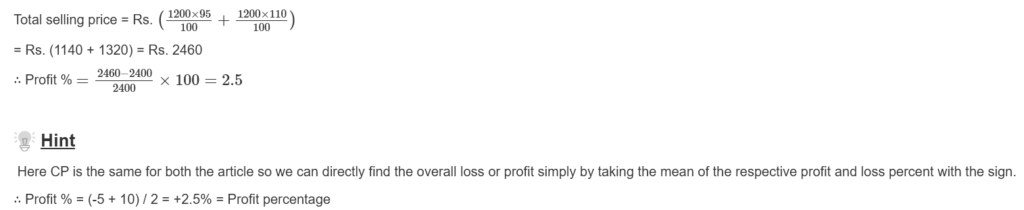
1st fan selling price = (1200 × 95)/100
⇒ Rs. 1140
2nd fan selling price = (1200 × 110)/100
⇒ Rs. 1320
Total selling price both fan = 1140 + 1320
⇒ Rs. 2460
Meen profit gain at whole transition = Rs. (2460 − 2400)
⇒ Rs. 60
Profit % = (60/2400) × 100
⇒ 2.5% profit
Shortcut Trick
Total cost price = 2 × 1200 = Rs. 2400
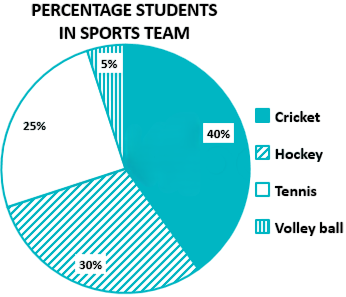
32. Direction: Read the following graph carefully and answer the questions that follow:
Total number of students in sports teams = 12000
Percentage of female in Cricket, Hockey, Tennis and Volley ball teams is 10%, 30%, 60% and 55% respectively.
Question:
Calculate the average number of female students in the four sports team (approximate value)?
A. 980
B. 929
C. 923
D. 977
E. 930
Solution
GIVEN:
Percentage of female in Cricket = 10%
Percentage of female in Hockey = 30%
Percentage of female in Tennis = 60%
Percentage of female in Volley ball = 55%
CONCEPT:
In this question we need to calculate the total number of female in all the four sports and then calculate the average number of female students.
FORMULAE USED:
Average = Total number of female students in four sports / Number of sports
CALCULATION:
Total number of female students in four sports team = [12000 × (40 / 100) × (10 / 100)] + (12000 × (30 / 100) × (30 / 100)) + [12000 × (25 / 100) × (60 / 100)] + [12000 × (5 / 100) × (55 / 100)]
Total number of female students in four sports team = 480 + 1080 + 1800 + 330
Total number of female students in four sports team = 3690
Required average = 3690 / 4 = 922.5 ≈ 923∴ Required average = 923
33. Direction: Read the following graph carefully and answer the questions that follow:
Total number of students in sports teams = 12000
Percentage of female in Cricket, Hockey, Tennis and Volley ball teams is 10%, 30%, 60% and 55% respectively.
Question:
Calculate the ratio between the number of male students of Cricket and Hockey sports team?
A. 8 : 15
B. 7 : 8
C. 15 : 8
D. 8 : 12
E. 12 : 7
Solution
GIVEN:
Male students of Hockey team = 70%
Male students of Cricket team = 90%
CONCEPT:
Here we need to calculate the number of male students in hockey and cricket team separately and then calculate the ratio.
FORMULAE USED:
Required ratio = number of male students of Cricket team: number of male students of Hockey team
CALCULATION:
Total number of male students of Cricket team = 12000 × (40 / 100) × (90 / 100) = 4320
Total number of male students of Hockey team = 12000 × (30 / 100) × (70 / 100) = 2520
Required ratio = 4320 : 2520Required ratio = 12 : 7
34. Direction: Read the following graph carefully and answer the questions that follow:
Total number of students in sports teams = 12000
Percentage of female in Cricket, Hockey, Tennis and Volley ball teams is 10%, 30%, 60% and 55% respectively.
Question:
What percent is the number of male students in Tennis team of total male students in all sports teams combined (approximate value)?
A. 13%
B. 18%
C. 12%
D. 14%
E. 16%
Solution
GIVEN:
Male students of Cricket team = 90%
Male students of Hockey team = 70%
Male students of Tennis team = 40%
Male students of Volley Ball team = 45%
CONCEPT:
Here we need to calculate the total number of male students in all the sports and then recall the concept of calculating percentage for the number of male students in tennis.
FORMULAE USED:
Percentage = Number of male students of Tennis team × 100 / Total number of male students in sports teams
CALCULATION:
Total number of male students of Cricket team = 12000 × (40 / 100) × (90 / 100) = 4320
Total number of male students of Hockey team = 12000 × (30 / 100) × (70 / 100) = 2520
Total number of male students of Tennis team = 12000 × (25 / 100) × (40 / 100) = 1200
Total number of male students of Volley ball team = 12000 × (5 / 100) × (45 / 100) = 270
Total number of male students in sports teams = 4320 + 2520 + 1200 + 270 = 8310
Required percentage = (1200 / 8310) × 100
Required percentage = 14.44%∴ Required percentage ≈ 14%
35. Direction: Read the following graph carefully and answer the questions that follow:
Total number of students in sports teams = 12000
Percentage of female in Cricket, Hockey, Tennis and Volley ball teams is 10%, 30%, 60% and 55% respectively.
Question:
What is the difference between the number of female and male students of Volleyball team?
A. 60
B. 80
C. 86
D. 40
E. 50
Solution
GIVEN:
Male students of Volley ball team = 45%
Female students of Volley ball team = 55%
CONCEPT:
Here we need to calculate the difference between the female students and volleyball team and the male students in the volleyball team and then calculate the number of students by multiplying it with the total number of students in the volleyball team.
FORMULAE USED:
Difference = number of female students of Volley ball – number of male students of Volley ball team
CALCULATION:
Total number of male students of Volley ball team = 12000 × (5 / 100) × (45 / 100) = 270
Total number of female students of Volley ball team = 12000 × (5 / 100) × (55 / 100) = 330
Required difference = 330 – 270∴ Required difference = 60
36. Direction: Read the following graph carefully and answer the questions that follow:
Total number of students in sports teams = 12000
Percentage of female in Cricket, Hockey, Tennis and Volley ball teams is 10%, 30%, 60% and 55% respectively.
Approximately, by what percent is the number of female students of Volleyball team less than the female students of the Tennis team?
A. 80%
B. 88%
C. 83%
D. 89%
E. 82%
Solution
GIVEN:
Female students of Volley ball team = 55%
Female students of Tennis team = 60%
CONCEPT:
Here we need to recall the concept of calculating percentage of one quantity with respect to other.
FORMULAE USED:
Percentage = (number of female students of Tennis team – number of female students of Volley ball team) × 100 / number of female students of Tennis team
CALCULATION:
Total number of female students of Volley ball team = 12000 × 5 × 55 / 10000 = 330
Total number of female students of Tennis team = 12000 × 25 × 60 / 10000 = 1800
Required percentage = (1800 – 330) × 100 / 1800∴ Required percentage = 81.66% ≈ 82%
37. The average of three numbers is 42. The first is twice of the second and the second is twice of the third. So what is the sum of the largest and smallest numbers?
A. 72
B. 76
C. 84
D. 90
E. 108
Solution
Given:
The average of three numbers = 42
Formula used:

Calculation:
Let the third number be X
According to the question
The second number = 2X
The first number = 4X
⇒ X + 2X + 4X = 42 × 3
⇒ 7X = 126
⇒ X = 18
The numbers = 72, 36, and 18
The sum of smallest and largest number
⇒ 18 + 72 = 90
∴ The required result will be 90.
38. What should come in place of the question mark ‘?’ in the following number series?
11, 24, 50, 102, 206, ?
A. 206
B. 212
C. 313
D. 414
E. 515
Solution
The series follows the following pattern:
11 × 2 + 2 = 24
24 × 2 + 2 = 50
50 × 2 + 2 = 102
102 × 2 + 2 = 206
206 × 2 + 2 = 414
∴ The missing term in the series is 414.
39. What will come in the place of question mark (?) in the following series?26, 62, 122, 212, 338,?
A. 422
B. 738
C. 506
D. 722
E. 518
Solution
Calculations:
The series follows the following pattern:
33 – 1 = 26
43 – 2 = 62
53 – 3 = 122
63 – 4 = 212
73 – 5 = 338
83 – 6 = 506∴ The missing term in the series is 506.
40. What should come in place of the question mark ‘?’ in the following number series?
188, 184, 175, ?, 134, 98
A. 169
B. 163
C. 159
D. 153
E. 147
Solution
The series follows the following pattern:
188 – 22 = 184
184 – 32 = 175
175 – 42 = 159
159 – 52 = 134
134 – 62 = 98
41. What should come in place of the question mark ‘?’ in the following number series?
35, 39, 47, 63, ?, 159
A. 85
B. 105
C. 95
D. 115
E. 75
Solution
The series follows the following pattern:
35 + 4 = 39
39 + 8 = 47
47 + 16 = 63
63 + 32 = 95
95 + 64 = 159
42. What should come in place of the question mark ‘?’ in the following number series?
0.5, 2, 7, 21, 52.5, ?
A. 72
B. 96
C. 105
D. 120
E. 84
Solution
The series follows the following pattern:
0.5 × 4 = 2
2 × 3.5 = 7
7 × 3 = 21
21 × 2.5 = 52.5
52.5 × 2 = 105
43. certain distance is covered at a certain speed. If one-third of the distance is covered in thrice time, what is the ratio of two speeds?
A. 9 ∶ 4
B. 19 ∶ 1
C. 9 ∶ 1
D. 1 ∶ 9
E. None of these
Solution
Given:
One-third of the distance is covered in thrice the time
Concept used:
Speed = Distance/Time
Calculation:
Let the total distance be x km
Time be y hr
⇒ Speed in first case = x/y km/hr
Distance covered in the second case = x/3
Time in second case = 3y hr
⇒ Speed in second case = (x/3)/3y km/hr
According to the question,
⇒ (x/y) ∶ (x/3)/3y
⇒ 1 ∶ (1/9)
⇒ 9 ∶ 1
∴ Required ratio 9 ∶ 1
44. Directions: Study the following Bar graph carefully and answer the question given beside.
Following bar chart showing the number of employees in 4 companies working in 4 sectors.
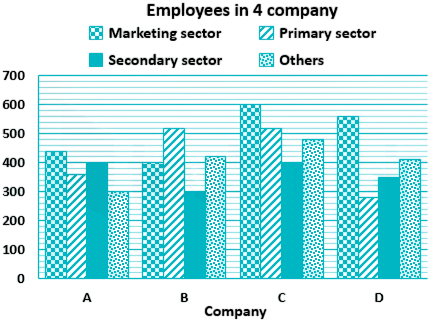
Question:
What percent of employee in company A are in marketing sector?
A. 29.33%
B. 30.33%
C. 31.33%
D. 32.33%
E. None of these
Solution
Given:
Total marketing sector in company is 440
Calculation:
Total employee in company A is
⇒ (440 + 360 + 400 + 300)
⇒ 1500
Percent of the employee in company A is in the marketing sector
⇒ (440 × 100)/ 1500
⇒ 29.33%
∴ Company A in the marketing sector is 29.33% (about)
45. Directions: Study the following Bar graph carefully and answer the question given beside.
Following bar chart showing the number of employees in 4 companies working in 4 sectors.
Question:
What is the ratio of the number of employees working in the primary sector in company B and working in the marketing sector in company D?
A. 13 : 42
B. 13 : 14
C. 40 : 13
D. 42 :13
E. 40 : 30
Solution
Given:
Employees working in the primary sector in company B = 520
Employees working in the marking sector in company D = 560
Calculation:
Required ratio = 520 : 560
⇒ 13 : 14
∴ The ratio of the number of employees working in the primary sector in company B and working in the marketing sector in company D is 13 : 14.
46. Directions: Study the following Bar graph carefully and answer the question given beside.
Following bar chart showing the number of employees in 4 companies working in 4 sectors.
Question:
What is the average of marketing sector and secondary sector in company A and B?
A. 700
B. 720
C. 670
D. 770
E. None of these
Solution
Calculation:
Marketing sector in company A and B = 840
Secondary sector in company A and B = 700
According to the question,
⇒ Average of company A and B = (840 + 700)/2
⇒ 770∴ The average of company A and B is 770
47. Directions: Study the following Bar graph carefully and answer the question given beside.
Following bar chart showing the number of employees in 4 companies working in 4 sectors.
Question:
What is the average of other sector in all company?
A. 412.5
B. 422.5
C. 402.5
D. 401.5
E. 400.5
Solution
Calculation:
Total number of other sector
⇒ (300 + 420 + 480 + 410)
⇒ 1610
The average of employees in all company in other sector
⇒ 1610/4
⇒ 402.5
∴ The average of other sector in all company is 402.5
48. Directions: Study the following Bar graph carefully and answer the question given beside.
Following bar chart showing the number of employees in 4 companies working in 4 sectors.
Question:
Employees in company E is 15% more than employees in company D. Then find the difference between employees in company E and A.
A. 340
B. 440
C. 320
D. 450
E. 540
Solution
Calculation:
According to the question,
Total employees in company D are
(560 + 280 + 350 + 410)
⇒ 1600
Total employees in company D are 1600
E is 15% more than employees in company D
⇒ (1600 × 115)/100
⇒ 1840
Total employees in company E are 1840
Total employees in company A are
⇒ (440 + 360 + 400 + 300)
⇒ 1500
Total employees in company A are 1500
Then difference between employees in company E and A
⇒ E – A = 1840 – 1500
⇒ 340
∴ The difference between E and A is 340
49. The ratio of the present ages of Geet and Sakshi is 5 ∶ 6. Six years ago, the ratio of their ages was 7 ∶ 9. Find their ages after 3 years.
A. 22, 25
B. 23, 26
C. 18, 21
D. 23, 27
E. 28, 33
Solution
Given:
Ratio of the present ages of Geet and Sakshi = 5 ∶ 6
6 years ago, the ratio of ages of Geet and Sakshi = 7 ∶ 9
Formula used:
Ages after 3 years = (present age + 3)
Calculation:
Let the present age of Geet = 5x
And the present age of Sakshi = 6x
So, 6 years ago
⇒ (5x – 6)/(6x – 6) = 7/9
⇒ 45x – 54 = 42x – 42
⇒ 3x = 12
⇒ x = 4
Present age of Geet = 5x = 5 × 4 = 20 years
Present age of Sakshi = 6x = 6 × 4 = 24 years
Now, the age of Geet after 3 years = 20 + 3 = 23 years
The age of Sakshi after 3 years = 24 + 3 = 27 years
∴ After 3 years ages of Geet and Sakshi are 23 years and 27 years respectively.
50. A vessel of 105 liters contains alcohol and water in the ratio 13 : 8. How much alcohol should be added to make the ratio 2 : 1?
A. 11 liters
B. 12 liters
C. 13 liters
D. 14 liters
E. 15 liters
Solution
Given:
| Ratio | Alcohol : Water |
| Old | 13 : 8 |
| New | 2 : 1 |
Calculation:
Let the quantity of alcohol added be x liters
Initial quantity of alcohol = [13/(13 + 8)] × 105 liters
⇒ (13/21) × 105 liters
⇒ 65 liters
and Initial quantity of water = [8/(13 + 8)] × 105 liters
⇒ (8/21) × 105 liters
⇒ 40 liters
Now, [(65 + x)/40] = (2/1)
⇒ 65 + x = 80
⇒ x = 15 liters
∴ 15 liters of alcohol is added to make the ratio 2 : 1.
51. A sum becomes Rs. 3800 in 6 years, and Rs. 3200 in 4 years at simple interest. Find the rate of interest.
A. 10%
B. 12%
C. 15%
D. 18%
E. 20%
Solution
Given:
A sum becomes Rs. 3800 in 6 years
And Rs. 3200 in 4 years at simple interest
Concept Used:
Simple Interest (SI) = (P × R × T)/100
Where, P = principal amount, R = rate of interest, and T = time duration
Calculation:
Let, the principal = P, and the interest earned in one year = A
According to the question,
⇒ P + 6A = 3800 ———– (i)
⇒ P + 4A = 3200 ———– (ii)
Subtracting, (i) – (ii)
⇒ A = 300
So, P = 3800 – (6 × 300) = Rs. 2000
Now, Rate (R) = (300 × 100)/2000 = 15%
∴ The correct answer is option 3
52. What approximate value should come in place of the question mark (?) in the following question?

A. 18
B. 19
C. 20
D. 21
E. 22
Solution
Concept used:
Follow the BODMAS rule according to the table given below:
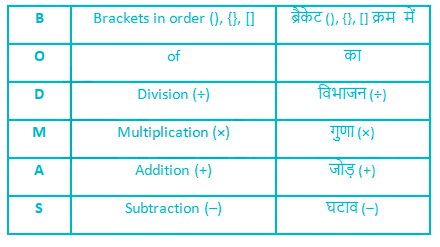
Calculation:
[7.9 is taken as 8 approx]
⇒ ? = (23)1/3 × (16) – 12
⇒ ? = 2 × 16 – 12⇒ ? = 32 – 12 = 20
53. What approximate value should come in place of the question mark (?) in the following question?

A. 3
B. 4
C. 7
D. 9
E. 13
Solution
Concept used:
Calculation:
⇒ ?3 = (216)1/3 × (54)2/(576)1/2
⇒ ?3 = (6 × 54 × 54)/24
⇒ ?3 = 93⇒ ? = 9
54. What approximate value should come in place of the question mark (?) in the following question?
7.52 × 3.89 + ? = 549 × 0.5
A. 46
B. 47
C. 50
D. 48
E. 45
Solution
We have,
7.52 × 3.89 + ? = 549 × 0.5
It can be approximated as,
⇒ 56.25 × 4 + ? = 550 × 0.5
⇒ 225 + ? = 275
⇒ ? = 275 – 225
∴ ? = 50
55. What approximate value should come in place of the question mark (?) in the following question?
93 ÷ 10.33 + 82 ÷ 13.66 = ?
A. 18
B. 17
C. 16
D. 15
E. 21
Solution
Follow BODMAS rule to solve this question, as per the order is given below:
Step-1: Parts of an equation enclosed in ‘Brackets’ must be solved first and in the bracket,
Step-2: Any mathematical ‘Of’ or ‘Exponent’ must be solved next,
Step-3: Next, the parts of the equation that contain ‘Division’ and ‘Multiplication’ are calculated,
Step-4: Last but not least, the parts of the equation that contain ‘Addition’ and ‘Subtraction’ should be calculated.
93 ÷ 10.33 + 82 ÷ 13.66
⇒ 93 ÷ 10 + 82 ÷ 14
⇒ 9 + 6 = 15
56. What approximate value should come in place of the question mark (?) in the following question?
2267.89 ÷ 9.01 ÷ 7.1 ÷ 2.98 = ?
A. 12
B. 15
C. 18
D. 13
E. 16
Solution
Follow BODMAS rule to solve this question, as per the order given below:
2267.89 ÷ 9.01 ÷ 7.1 ÷ 2.98 = ?
⇒ 2268 ÷ 9 ÷ 7 ÷ 3
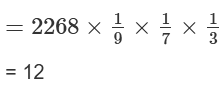
57. What approximate value should come in place of the question mark (?) in the following question?(240.001 × 8 × 7.01) ÷ 27.99 = ?2 + 39
A. 20
B. 25
C. 21
D. 24
E. None of these
Solution
Concept Used:
Follow BODMAS rule to solve this question, as per the order is given below:
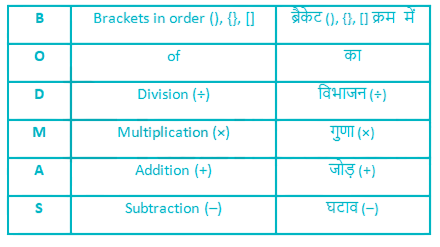
Calculation:
(240.001 × 8 × 7.01) ÷ 27.99 = ?2 + 39
⇒ 240 × 8 × 7 ÷ 28 = ?2 + 39
⇒ ?2 + 39 = 480
⇒ ?2 = 441
⇒ ? = 21
∴ The required value of “?” is 21
58. What approximate value will come in the place of the question mark ‘?’ in the following question?(32.99 + 18.02) ÷ 2.99 + ?3 = 32 + 42
A. 0
B. 2
C. 3
D. -2
E. 4
Solution
Concept Used:
Follow BODMAS rule to solve this question, as per the order is given below:
Calculation:
(32.99 + 18.02) ÷ 2.99 + ?3 = 32 + 42
⇒ (33 + 18)/3 + ?3 = 9 + 16
⇒ 17 + ?3 = 25
⇒ ?3 = 8∴ ? = 2
59. What approximate value will come in the place of the question mark ‘?’ in the following question?322 ÷ 13 × √795 = 12.5% of ?
A. 5500
B. 5550
C. 5600
D. 5650
E. 5700
Solution
Concept used:
Follow the BODMAS rule according to the table given below:
322 ÷ 13 × √795 = 12.5% of ?
[322/13 = 24.7 = 25(approx), √795 = 28.19 = 28(approx), 12.5 can be written as 25/2 ]
⇒ 25 × 28 = ? × 25%/2
⇒ ?/8 = 700⇒ ? = 5600
60. What approximate value will come in the place of the question mark ‘?’ in the following question?√4949 × √458 + 83% of 660 = ? + 889.89
A. 930
B. 990
C. 1130
D. 1700
E. 1501
Solution
Follow BODMAS rule to solve this question, as per the order given below,
Step–1: Parts of an equation enclosed in ‘Brackets’ must be solved first, and in the bracket,
Step–2: Any mathematical ‘Of’ or ‘Exponent’ must be solved next,
Step–3: Next, the parts of the equation that contain ‘Division’ and ‘Multiplication’ are calculated,
Step–4: Last but not least, the parts of the equation that contain ‘Addition’ and ‘Subtraction’ should be calculated.
√4949 × √450 + 83% of 660 = ? + 889.89
⇒ 70 × 21 + (50 + 33)% × 660 = ? + 890
⇒ 1470 + 330 + 660/3 = ? + 890
⇒ 2020 = ? + 890⇒ ? = 1130
61. What approximate value should come in place of x in the following question?(9.09)2 × (26.89)1/3 ÷ 8.99 + (16.97)2 = x
A. 299
B. 343
C. 316
D. 233
E. 330
Solution
Follow BODMAS rule to solve this question, as per the order is given below:
Step-1: Parts of an equation enclosed in ‘Brackets’ must be solved first and in the bracket,
Step-2: Any mathematical ‘Of’ or ‘Exponent’ must be solved next,
Step-3: Next, the parts of the equation that contain ‘Division’ and ‘Multiplication’ are calculated,
Step-4: Last but not least, the parts of the equation that contain ‘Addition’ and ‘Subtraction’ should be calculated.
(9.09)2 × (26.89)1/3 ÷ 8.99 + (16.97)2 = x
⇒⇒ (9)2 × (27)1/3 ÷ 9 + (17)2 = x
⇒⇒ 81 × 3 ÷ 9 + 289 = x
⇒⇒ 81 × (1/3) + 289 = x
⇒⇒ 27 + 289 = x⇒⇒ x = 316
62. 5/6 th of the tank is filled with petrol. When 350 liters are wasted due to a leakage, the tank is 1/4 th part full. What is the capacity of the tank?
A. 900 liters
B. 600 liters
C. 500 liters
D. 1200 liters
E. 800 liters
Solution
Given:
5/6 th of the tank is filled with petrol
when 350 liters is wasted due to a leakage, the tank is 1/4 th part full
Calculation:
let x be the capacity of the tank,
According to the question,
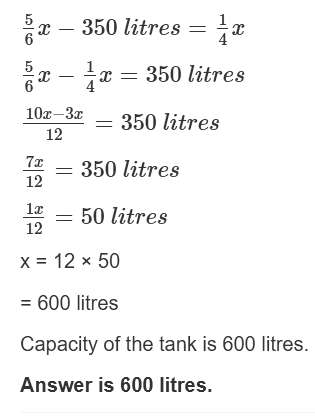
63. A boat can travel with a speed of 16 km/hr in still water. If the speed of the stream is 5 km/hr, find the time taken by the boat to go 63 km downstream.
A. 2 hours
B. 3 hours
C. 4 hours
D. 5 hours
E. None of these
Solution
Given:
Speed of boat in still water = 16 km/hr
Speed of the stream = 5 km/hr
Boat to go 63 km downstream
Formula used:
Time = distance/speed
If the speed of a boat in still water is u km/hr and the speed of the stream is v km/hr, then,
Speed downstream = (u + v) km/hr
Calculation:
Speed downstream = (16 + 5) km/hr = 21 km/hr
Time taken to travel 63 km downstream = (63/21) hrs = 3 hrs
∴ Time taken to travel 63 km downstream is 3 hrs.
64. A and B started a mercantile establishment with initial investments within the ratio 4: 5 and their annual profits were within the ratio 2: 5, If A invested the cash for 10 months then for how many months B invested his money?
A. 22 months
B. 25 months
C. 21 months
D. 20 months
E. None of these
Solution
Given:
Initial investments’ ratio of A and B = 4: 5
Ratio of their annual profits = 3: 5
Calculation
Let us assume that
A invests 4x amount for 10 months and
B invests 5x amount for y months
According to the question,
(4x × 10)/(5x × y) = 2/5
20x × 10 = 10xy
Y = 20 months
Hence, B invested for 20 months
65. If the heights of two cones are in the ratio of 1 ∶ 3 and their diameters are in the ratio 3 ∶ 5; the ratio of their volumes will be
A. 3 ∶ 25
B. 9 ∶ 16
C. 8 ∶ 25
D. 9 ∶ 25
E. None of these
Solution
The correct answer is option 1.
Given: If the heights of two cones are in the ratio of 1 ∶ 3 and their diameters are in the ratio 3 ∶ 5.
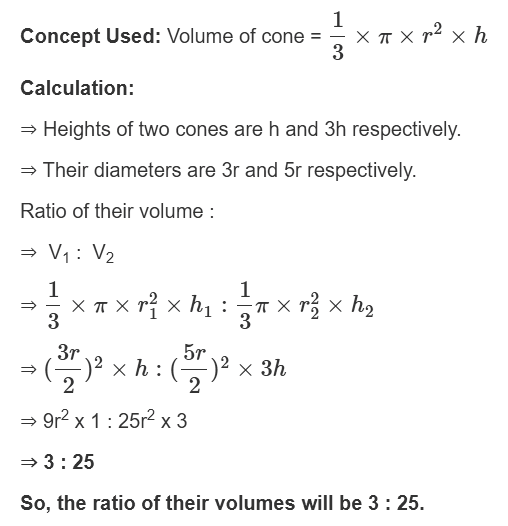
66. Direction: Read the following information carefully and answer the questions based on given information.
Seven candidates E, H, K, L, O, Q and T were called for an interview for the post of HR on seven different days of the week starting from Monday to Sunday but not necessarily in same order. Only one person will give his interview on a particular day of the week. O gave his interview three days before L. K gave his interview on one of the days before Q. Only three persons gave their interviews between H and E. Q did not give his interview on Wednesday. L gave his interview after Q. H gave his interview before T who had given his interview on Saturday. E did not give his interview on Monday.
Question:
Who among the following person gave his interview three days before E?
A. O
B. K
C. Q
D. L
E. H
Solution
Here, students are E, H, K, L, O, Q and T.
1) Only three persons gave their interviews between H and E.
2) H gave his interview before T who had given his interview on Saturday.
3) E did not give his interview on Monday.
| Days | Case – 1 | Case – 2 |
| Persons | Persons | |
| Monday | H | |
| Tuesday | ||
| Wednesday | H | |
| Thursday | ||
| Friday | E | |
| Saturday | T | T |
| Sunday | E |
4) L gave his interview after Q.
5) Q did not give his interview on Wednesday.
6) O gave his interview three days before L.
| Days | Case – 1(a) | Case – 1(b) | Case – 2 |
| Persons | Persons | Persons | |
| Monday | O | H | |
| Tuesday | O | Q | Q |
| Wednesday | H | H | |
| Thursday | L | O | |
| Friday | L | E | |
| Saturday | T | T | T |
| Sunday | E | E | L |
7) K gave his interview one of the days before Q. Therefore, case 1(b) and 2 are eliminated. Hence, the final arrangement is as follows
| Days | Persons |
| Monday | K |
| Tuesday | O |
| Wednesday | H |
| Thursday | Q |
| Friday | L |
| Saturday | T |
| Sunday | E |
Hence, Q gave his interview three days before E.
67. Direction: Read the following information carefully and answer the questions based on given information.
Seven candidates E, H, K, L, O, Q and T were called for an interview for the post of HR on seven different days of the week starting from Monday to Sunday but not necessarily in same order. Only one person will give his interview on a particular day of the week. O gave his interview three days before L. K gave his interview on one of the days before Q. Only three persons gave their interviews between H and E. Q did not give his interview on Wednesday. L gave his interview after Q. H gave his interview before T who had given his interview on Saturday. E did not give his interview on Monday.
Question:
Find the odd one out.
A. KH
B. OQ
C. QL
D. LE
E. HL
Solution
Here, students are E, H, K, L, O, Q and T.
1) Only three persons gave their interviews between H and E.
2) H gave his interview before T who had given his interview on Saturday.
3) E did not give his interview on Monday.
| Days | Case – 1 | Case – 2 |
| Persons | Persons | |
| Monday | H | |
| Tuesday | ||
| Wednesday | H | |
| Thursday | ||
| Friday | E | |
| Saturday | T | T |
| Sunday | E |
4) L gave his interview after Q.
5) Q did not give his interview on Wednesday.
6) O gave his interview three days before L.
| Days | Case – 1(a) | Case – 1(b) | Case – 2 |
| Persons | Persons | Persons | |
| Monday | O | H | |
| Tuesday | O | Q | Q |
| Wednesday | H | H | |
| Thursday | L | O | |
| Friday | L | E | |
| Saturday | T | T | T |
| Sunday | E | E | L |
7) K gave his interview one of the days before Q. Therefore, case 1(b) and 2 are eliminated. Hence, the final arrangement is as follows
| Days | Persons |
| Monday | K |
| Tuesday | O |
| Wednesday | H |
| Thursday | Q |
| Friday | L |
| Saturday | T |
| Sunday | E |
Since, each pair except QL represents one person gave interview between the two whereas Q and L gave interview immediate next to each other.
Hence, the odd one is QL.
68. Direction: Read the following information carefully and answer the questions based on given information.
Seven candidates E, H, K, L, O, Q and T were called for an interview for the post of HR on seven different days of the week starting from Monday to Sunday but not necessarily in same order. Only one person will give his interview on a particular day of the week. O gave his interview three days before L. K gave his interview on one of the days before Q. Only three persons gave their interviews between H and E. Q did not give his interview on Wednesday. L gave his interview after Q. H gave his interview before T who had given his interview on Saturday. E did not give his interview on Monday.
Question:
How many person gave interview between K and L?
A. Two
B. None
C. Three
D. Four
E. One
Solution
Here, students are E, H, K, L, O, Q and T.
1) Only three persons gave their interviews between H and E.
2) H gave his interview before T who had given his interview on Saturday.
3) E did not give his interview on Monday.
| Days | Case – 1 | Case – 2 |
| Persons | Persons | |
| Monday | H | |
| Tuesday | ||
| Wednesday | H | |
| Thursday | ||
| Friday | E | |
| Saturday | T | T |
| Sunday | E |
4) L gave his interview after Q.
5) Q did not give his interview on Wednesday.
6) O gave his interview three days before L.
| Days | Case – 1(a) | Case – 1(b) | Case – 2 |
| Persons | Persons | Persons | |
| Monday | O | H | |
| Tuesday | O | Q | Q |
| Wednesday | H | H | |
| Thursday | L | O | |
| Friday | L | E | |
| Saturday | T | T | T |
| Sunday | E | E | L |
7) K gave his interview one of the days before Q. Therefore, case 1(b) and 2 are eliminated. Hence, the final arrangement is as follows
| Days | Persons |
| Monday | K |
| Tuesday | O |
| Wednesday | H |
| Thursday | Q |
| Friday | L |
| Saturday | T |
| Sunday | E |
Hence, three persons gave interview between K and L.
69. Direction: Read the following information carefully and answer the questions based on given information.
Seven candidates E, H, K, L, O, Q and T were called for an interview for the post of HR on seven different days of the week starting from Monday to Sunday but not necessarily in same order. Only one person will give his interview on a particular day of the week. O gave his interview three days before L. K gave his interview on one of the days before Q. Only three persons gave their interviews between H and E. Q did not give his interview on Wednesday. L gave his interview after Q. H gave his interview before T who had given his interview on Saturday. E did not give his interview on Monday.
Question:
Which of the following statement(s) is correct regarding H?
A. He gave his interview on Wednesday.
B. Only two person gave interview between him and K.
C. L gave his interview just after him.
D. Not more than two person gave interview between him and E.
E. None of these.
Solution
Here, students are E, H, K, L, O, Q and T.
1) Only three persons gave their interviews between H and E.
2) H gave his interview before T who had given his interview on Saturday.
3) E did not give his interview on Monday.
| Days | Case – 1 | Case – 2 |
| Persons | Persons | |
| Monday | H | |
| Tuesday | ||
| Wednesday | H | |
| Thursday | ||
| Friday | E | |
| Saturday | T | T |
| Sunday | E |
4) L gave his interview after Q.
5) Q did not give his interview on Wednesday.
6) O gave his interview three days before L.
| Days | Case – 1(a) | Case – 1(b) | Case – 2 |
| Persons | Persons | Persons | |
| Monday | O | H | |
| Tuesday | O | Q | Q |
| Wednesday | H | H | |
| Thursday | L | O | |
| Friday | L | E | |
| Saturday | T | T | T |
| Sunday | E | E | L |
7) K gave his interview one of the days before Q. Therefore, case 1(b) and 2 are eliminated. Hence, the final arrangement is as follows
| Days | Persons |
| Monday | K |
| Tuesday | O |
| Wednesday | H |
| Thursday | Q |
| Friday | L |
| Saturday | T |
| Sunday | E |
Hence, the correct statement is H gave his interview on Wednesday.
70. Direction: Read the following information carefully and answer the questions based on given information.
Seven candidates E, H, K, L, O, Q and T were called for an interview for the post of HR on seven different days of the week starting from Monday to Sunday but not necessarily in same order. Only one person will give his interview on a particular day of the week. O gave his interview three days before L. K gave his interview on one of the days before Q. Only three persons gave their interviews between H and E. Q did not give his interview on Wednesday. L gave his interview after Q. H gave his interview before T who had given his interview on Saturday. E did not give his interview on Monday.
Question:
Which of the following statement is/ are incorrect?
A) E is the last person to be interviewed.
B) At least two person gave interview before O.
C) L gave his interview on Thursday.
A. Only A
B. Both A and B.
C. Both B and C
D. Only B
E. Only C
Solution
Here, students are E, H, K, L, O, Q and T.
1) Only three persons gave their interviews between H and E.
2) H gave his interview before T who had given his interview on Saturday.
3) E did not give his interview on Monday.
| Days | Case – 1 | Case – 2 |
| Persons | Persons | |
| Monday | H | |
| Tuesday | ||
| Wednesday | H | |
| Thursday | ||
| Friday | E | |
| Saturday | T | T |
| Sunday | E |
4) L gave his interview after Q.
5) Q did not give his interview on Wednesday.
6) O gave his interview three days before L.
| Days | Case – 1(a) | Case – 1(b) | Case – 2 |
| Persons | Persons | Persons | |
| Monday | O | H | |
| Tuesday | O | Q | Q |
| Wednesday | H | H | |
| Thursday | L | O | |
| Friday | L | E | |
| Saturday | T | T | T |
| Sunday | E | E | L |
7) K gave his interview one of the days before Q. Therefore, case 1(b) and 2 are eliminated. Hence, the final arrangement is as follows
| Days | Persons |
| Monday | K |
| Tuesday | O |
| Wednesday | H |
| Thursday | Q |
| Friday | L |
| Saturday | T |
| Sunday | E |
Since, E is the last person to be interviewed. Therefore, statement A is correct.
Only one person gave his interview before O. Therefore, statement B is incorrect.
L gave his interview on Friday. Therefore, statement C is incorrect.
Hence, the correct answer is both B and C.
71. Directions: Study the information carefully and answer the given questions
There are 7 members in a family having 3 generations and two married couples. No single person has a child. Taruna is the wife of Ramesh’s only son, Wasim. Preet and Farhan are the sisters of Wasim. Wasim is the father of Onam. Sarita, who is the grandmother of Onam, is married to Ramesh.
Question:
Which of the following pairs have the same relation between them?
A. Ramesh and Sarita
B. Taruna and Farhan
C. Wasim and Taruna
D. Both 2 and 3
E. Both 1 and 3
Solution
From the given information,
Given statements: Total members of a family are 7, including 3 generations and 2 married couples.
I. Taruna is the wife of Ramesh’s only son, Wasim ⇒ Wasim is the son of Ramesh and Taruna is the wife of Wasim
II. Preet and Farhan are the sisters of Wasim.

III. Wasim is the father of Onam.
IV. Sarita is the grandmother of Onam
V. Sarita is married to Ramesh
VI. No single person has a child
On combining:
Ramesh and Sarita → Husband-wife relation, where the former is the husband and the latter is the wife
Taruna and Farhan → Taruna is the siter-in-law of Farhan
Wasim and Taruna → Husband-wife relation, where the former is the husband and the latter is the wife
Hence, the answer is both 1 and 3
72. Directions: Study the information carefully and answer the given questions
There are 7 members in a family having 3 generations and two married couples. No single person has a child. Taruna is the wife of Ramesh’s only son, Wasim. Preet and Farhan are the sisters of Wasim. Wasim is the father of Onam. Sarita, who is the grandmother of Onam, is married to Ramesh.
Question:
If Onam is the son of Taruna, then how is he related to Farhan?
A. Brother
B. Son
C. Nephew
D. Father
E. None of these
Solution
From the given information,
Given statements: Total members of a family are 7, including 3 generations and 2 married couples.
I. Taruna is the wife of Ramesh’s only son, Wasim ⇒ Wasim is the son of Ramesh and Taruna is the wife of Wasim
II. Preet and Farhan are the sisters of Wasim.
III. Wasim is the father of Onam.
IV. Sarita is the grandmother of Onam
V. Sarita is married to Ramesh
VI. No single person has a child
On combining:
According to the question, if Onam is the son of Taruna, the arrangement is as follows:
Hence, if Onam is the son of Taruna, then Onam is the nephew of Farhan
Key Points
Unless the question specifies the gender, do not take it by yourself on the basis of the names e.g. Onam is generally the name of a boy, but it does not mean that in the question, Onam would always be the male, unless specified
73. Directions: Study the information carefully and answer the given questions
There are 7 members in a family having 3 generations and two married couples. No single person has a child. Taruna is the wife of Ramesh’s only son, Wasim. Preet and Farhan are the sisters of Wasim. Wasim is the father of Onam. Sarita, who is the grandmother of Onam, is married to Ramesh.
Question:
How is Taruna related to Ramesh?
A. Daughter
B. Daughter-in-law
C. Sister
D. Sister-in-law
E. Son
Solution
From the given information,
Given statements: Total members of a family are 7, including 3 generations and 2 married couples.
I. Taruna is the wife of Ramesh’s only son, Wasim ⇒ Wasim is the son of Ramesh and Taruna is the wife of Wasim
II. Preet and Farhan are the sisters of Wasim.
III. Wasim is the father of Onam.
IV. Sarita is the grandmother of Onam
V. Sarita is married to Ramesh
VI. No single person has a child
On combining:
Hence, Taruna is the daughter-in-law of Ramesh
74. Directions: In the following question assuming the given statement to be true, find which of the conclusion among the given conclusions is / are definitely true and then give your answer accordingly
Statement: A < T < Q > P ≤ R, Y > A < B ≤ C
Conclusions:
I. P < R
II. P = R
A. Only Conclusion I is True
B. Only Conclusion II is True
C. Either Conclusion I or II is True
D. Neither Conclusion I nor II is True
E. Both Conclusions I and II are True
Solution
Given Statement: A < T < Q > P ≤ R, Y > A < B ≤ C
Combined Statement: Y > A < T < Q > P ≤ R, A < B ≤ C
Conclusions:
I. P < R → (False) → (As, P ≤ R).
II. P = R → (False) → (As, P ≤ R).
But they form a complementary pair.
Hence, Either I or II follows.
75. Directions: – In these questions, the relationship between different elements is shown in the statements. These statements are followed by two conclusions. Marks answer as an option given.
Statements: U ≥ V = W ≤ X; T < X ≤ Y
Conclusions:
I. Y > W
II. U < Y
A. Only I follows
B. Only II follows
C. Either I or II follows
D. Neither I nor II follows
E. Both I and II follow
Solution
Given statements: U ≥ V = W ≤ X; T < X ≤ Y
Combined statement: U ≥ V = W ≤ X ≤ Y; T < X
(I) Y > W → False (as W ≤ X ≤ Y, implies Y ≥ W → Y > W and Y = W. So, it is false)
(II) U < Y → False (as V = W ≤ X ≤ Y, implies V ≤ Y → V < Y and V = Y. So, it is false)
Hence, Neither I nor II follows.
76. Directions: In the following question assuming the given statement to be true, find which of the conclusion among the given conclusions is / are definitely true and then give your answer accordingly.
Statement: A > B ≥ E < K, N < K = D > T
Conclusions:
I. A > D
II. E < N
A. Only Conclusion I is True
B. Only Conclusion II is True
C. Either Conclusion I or II is True
D. Neither Conclusion I nor II is True
E. Both Conclusions I and II are True
Solution
Given Statement: A > B ≥ E < K, N < K = D > T
Combined Statement: A > B ≥ E < K = D > T, K > N
Conclusions:
I. A > D → (False) → (As, A > B ≥ E < K = D, so definite relation between A and D cannot be determined).
II. E < N → (False) → (As, E < K > N, so definite relation between E and N cannot be determined).
Hence, Neither I nor II follows.
77. Directions: Study the following information carefully to answer the given question.
R @ I J 9 % B 4 O L 3 # N $ W A Y 2 7 E X © V Q 6 ! S M 1 P 8 ¥ 7 Z U
Question:
What is the sum of all the numbers which have a symbol immediately after number?
A. 30
B. 26
C. 29
D. 35
E. 32
Solution
Ans: Option (2)
Given Series:
Left Side R @ I J 9 % B 4 O L 3 # N $ W A Y 2 7 E X © V Q 6 ! S M 1 P 8 ¥ 7 Z U Right Side
Required: the sum of all numbers which are immediately after symbol.
Left Side R @ I J 9 % B 4 O L 3 # N $ W A Y 2 7 E X © V Q 6 ! S M 1 P 8 ¥ 7 Z U Right Side
Pairs – 9%, 3#, 6!, 8¥
There are four number which is immediately followed by a symbol: 9, 3, 6, 8
Ans the sum of the numbers are: 9 + 3 + 6 + 8 = 26Hence, the answer is 26.
78. Directions: Study the following information carefully to answer the given question.
R @ I J 9 % B 4 O L 3 # N $ W A Y 2 7 E X © V Q 6 ! S M 1 P 8 ¥ 7 Z U
Question:
How many such symbols are there in the above arrangement each of which is immediately followed by a letter and preceded by a number?
A. Three
B. One
C. Four
D. Two
E. More than four
Solution
Ans: Option (1)
Given Series:
Left Side R @ I J 9 % B 4 O L 3 # N $ W A Y 2 7 E X © V Q 6 ! S M 1 P 8 ¥ 7 Z U Right Side
Required pattern: Number → Symbol → Letter
Left Side R @ I J 9 % B 4 O L 3 # N $ W A Y 2 7 E X © V Q 6 ! S M 1 P 8 ¥ 7 Z U Right Side
Hence, there are three symbols which are immediately followed by a letter and preceded by a number: 9 % B, 3 # N, 6 ! S.
Hence, the answer is three.
79. Directions: Study the following information carefully to answer the given question.
R @ I J 9 % B 4 O L 3 # N $ W A Y 2 7 E X © V Q 6 ! S M 1 P 8 ¥ 7 Z U
Question:
Four of the following five are alike in a certain way based on their position in the above arrangement and so form a group. Which is the one that does not belong to that group?
A. J 9 @
B. 4 O %
C. # N L
D. E 7 2
E. 8 ¥ 1
Solution
Ans: Option (4)
Given Series:
Left Side R @ I J 9 % B 4 O L 3 # N $ W A Y 2 7 E X © V Q 6 ! S M 1 P 8 ¥ 7 Z U Right Side
Here the group is formed in which second element is just next to the first element, and the third element is 2nd to the left of first element.
Left Side R @ I J 9 % B 4 O L 3 # N $ W A Y 2 7 E X © V Q 6 ! S M 1 P 8 ¥ 7 Z U Right Side
I. J 9 @ → 9 is immediate next to J and @ is 2nd to the left of J.
II. 4 O % → O is immediate next to 4 and % is 2nd to the left of 4.
III. # N L → N is immediate next to # and L is 2nd to the left of #.
IV. E 7 2 → 7 is immediate left of E and 2 is immediate left of 7.
V. 8 ¥ 1 → ¥ is immediate next to 8 and 1 is 2nd to the left of 8.
Expect, E 7 2, rest of them follow certain rules.
Hence, the answer is E 7 2.
80. Directions: Study the following information carefully to answer the given question.
R @ I J 9 % B 4 O L 3 # N $ W A Y 2 7 E X © V Q 6 ! S M 1 P 8 ¥ 7 Z U
Question:. Which of the following is the 4th to the left of the 19th element from the left end of the above arrangement?
A. $
B. V
C. A
D. W
E. Q
Solution
Ans: Option (4)
Given Series:
Left Side R @ I J 9 % B 4 O L 3 # N $ W A Y 2 7 E X © V Q 6 ! S M 1 P 8 ¥ 7 Z U Right Side
Required: 4th element to the left of the 19th element from the left end.
19th element from the left end is 7.
Left Side R @ I J 9 % B 4 O L 3 # N $ W A Y 2 7 E X © V Q 6 ! S M 1 P 8 ¥ 7 Z U Right Side 4th element to the left of the 19th element from the left end ( i.e. 7 )
Left Side R @ I J 9 % B 4 O L 3 # N $ W A Y 2 7 E X © V Q 6 ! S M 1 P 8 ¥ 7 Z U Right Side
So, the 4th element to the left of the 19th element from the left end is W.
Tips & Tricks :
Required: 4th element to the left of the 19th element from the left end.
As we know, left – left = left
So, 19th element from the left end – 4th element to the left = 15th element from the left
Left Side R @ I J 9 % B 4 O L 3 # N $ W A Y 2 7 E X © V Q 6 ! S M 1 P 8 ¥ 7 Z U Right Side
Hence, the answer is W.
81. Directions: Study the following information carefully to answer the given question.
R @ I J 9 % B 4 O L 3 # N $ W A Y 2 7 E X © V Q 6 ! S M 1 P 8 ¥ 7 Z U
Question:
If all the symbols and numbers of the above arrangement are dropped then which of the following will be the tenth element from the left end?
A. L
B. A
C. W
D. O
E. Y
Solution
Ans: Option (5)
Given Series:
Left Side R @ I J 9 % B 4 O L 3 # N $ W A Y 2 7 E X © V Q 6 ! S M 1 P 8 ¥ 7 Z U Right Side
If all the symbols and numbers are dropped then the new arrangement is:
Left Side R I J B O L N W A Y E X V Q S M P Z U Right Side
Tenth element from the left end is Y
Hence, the answer is Y.
82. Direction: Study the information given below and answer the questions based on it.
Eight boxes P, Q, R, S, T, U, V and W are kept one above another not necessarily in the same order. Three boxes are between W and V and neither of them is at the top or bottom position. Two boxes are between U and R and box U is above box R. Two boxes are between V and R. The number of boxes is between P and W is the same as P and V. Box S is above box T and more than one box is between S and T. Box T is not at the bottom position.
Question:
Which of the following boxes is located just above Box Q?
A. Box V
B. Box T
C. Box P
D. Box W
E. Box S
Solution
Boxes: P, Q, R, S, T, U, V, and W
1) Three boxes are between W and V.
2) W and V neither at the top or bottom position.
| Case 1 | Case 2 | Case 3 | Case 4 |
| W | V | ||
| W | V | ||
| V | W | ||
| V | W | ||
3) Two boxes are between V and R.
4) Two boxes are between U and R and box U is above box R.
| Case 1 | Case 2 | Case 3 | Case 4 |
| U | |||
| W | V | ||
| R | W | V | |
| R | |||
| R | |||
| V | W | R | |
| V | W | ||
From here Case 1, Case 3 and Case 4 eliminated, as there is no place for U as two boxes are between U and R and there are only 8 boxes.
5) The number of boxes is between P and W is the same as P and V.
| Case 2 |
| U |
| W |
| R |
| P |
| V |
6) Box S is above box T and more than one box is there between them.
7) Box T is not at the bottom position.
| Case 2 |
| U |
| S |
| W |
| R |
| P |
| T |
| V |
| Q |
Hence, Box V is just above Box Q.
83. Direction: Study the information given below and answer the questions based on it.
Eight boxes P, Q, R, S, T, U, V and W are kept one above another not necessarily in the same order. Three boxes are between W and V and neither of them is at the top or bottom position. Two boxes are between U and R and box U is above box R. Two boxes are between V and R. The number of boxes is between P and W is the same as P and V. Box S is above box T and more than one box is between S and T. Box T is not at the bottom position.
Question:
Which of the following boxes is not below R?
A. Box P
B. Box T
C. Box V
D. Box S
E. Box Q
Solution
Boxes: P, Q, R, S, T, U, V, and W
1) Three boxes are between W and V.
2) W and V neither at the top or bottom position.
| Case 1 | Case 2 | Case 3 | Case 4 |
| W | V | ||
| W | V | ||
| V | W | ||
| V | W | ||
3) Two boxes are between V and R.
4) Two boxes are between U and R and box U is above box R.
| Case 1 | Case 2 | Case 3 | Case 4 |
| U | |||
| W | V | ||
| R | W | V | |
| R | |||
| R | |||
| V | W | R | |
| V | W | ||
From here Case 1, Case 3 and Case 4 eliminated, as there is no place for U as two boxes are between U and R and there are only 8 boxes.
5) The number of boxes is between P and W is the same as P and V.
| Case 2 |
| U |
| W |
| R |
| P |
| V |
6) Box S is above box T and more than one box is there between them.
7) Box T is not at the bottom position.
| Case 2 |
| U |
| S |
| W |
| R |
| P |
| T |
| V |
| Q |
Hence, Box S is not below Box R.
84. Direction: Study the information given below and answer the questions based on it.
Eight boxes P, Q, R, S, T, U, V and W are kept one above another not necessarily in the same order. Three boxes are between W and V and neither of them is at the top or bottom position. Two boxes are between U and R and box U is above box R. Two boxes are between V and R. The number of boxes is between P and W is the same as P and V. Box S is above box T and more than one box is between S and T. Box T is not at the bottom position.
Question:
What is the position of box W from the top?
A. 1st
B. 2nd
C. 3rd
D. 4th
E. 5th
Solution
Boxes: P, Q, R, S, T, U, V, and W
1) Three boxes are between W and V.
2) W and V neither at the top or bottom position.
| Case 1 | Case 2 | Case 3 | Case 4 |
| W | V | ||
| W | V | ||
| V | W | ||
| V | W | ||
3) Two boxes are between V and R.
4) Two boxes are between U and R and box U is above box R.
| Case 1 | Case 2 | Case 3 | Case 4 |
| U | |||
| W | V | ||
| R | W | V | |
| R | |||
| R | |||
| V | W | R | |
| V | W | ||
From here Case 1, Case 3 and Case 4 eliminated, as there is no place for U as two boxes are between U and R and there are only 8 boxes.
5) The number of boxes is between P and W is the same as P and V.
| Case 2 |
| U |
| W |
| R |
| P |
| V |
6) Box S is above box T and more than one box is there between them.
7) Box T is not at the bottom position.
| Case 2 |
| U |
| S |
| W |
| R |
| P |
| T |
| V |
| Q |
Hence, Box W is 3rd from the top.
85. Direction: Study the information given below and answer the questions based on it.
Eight boxes P, Q, R, S, T, U, V and W are kept one above another not necessarily in the same order. Three boxes are between W and V and neither of them is at the top or bottom position. Two boxes are between U and R and box U is above box R. Two boxes are between V and R. The number of boxes is between P and W is the same as P and V. Box S is above box T and more than one box is between S and T. Box T is not at the bottom position.
Question:
How many boxes are between box R and box T?
A. 1
B. 2
C. 3
D. 4
E. None
Solution
Boxes: P, Q, R, S, T, U, V, and W
1) Three boxes are between W and V.
2) W and V neither at the top or bottom position.
| Case 1 | Case 2 | Case 3 | Case 4 |
| W | V | ||
| W | V | ||
| V | W | ||
| V | W | ||
3) Two boxes are between V and R.
4) Two boxes are between U and R and box U is above box R.
| Case 1 | Case 2 | Case 3 | Case 4 |
| U | |||
| W | V | ||
| R | W | V | |
| R | |||
| R | |||
| V | W | R | |
| V | W | ||
From here Case 1, Case 3 and Case 4 eliminated, as there is no place for U as two boxes are between U and R and there are only 8 boxes.
5) The number of boxes is between P and W is the same as P and V.
| Case 2 |
| U |
| W |
| R |
| P |
| V |
6) Box S is above box T and more than one box is there between them.
7) Box T is not at the bottom position.
| Case 2 |
| U |
| S |
| W |
| R |
| P |
| T |
| V |
| Q |
Hence, there is only 1 Box between Box R and Box T.
86. Direction: Study the information given below and answer the questions based on it.
Eight boxes P, Q, R, S, T, U, V and W are kept one above another not necessarily in the same order. Three boxes are between W and V and neither of them is at the top or bottom position. Two boxes are between U and R and box U is above box R. Two boxes are between V and R. The number of boxes is between P and W is the same as P and V. Box S is above box T and more than one box is between S and T. Box T is not at the bottom position.
Question:
Which of the following boxes is at the top?
A. R
B. U
C. None of these
D. T
E. Q
Solution
Boxes: P, Q, R, S, T, U, V, and W
1) Three boxes are between W and V.
2) W and V neither at the top or bottom position.
| Case 1 | Case 2 | Case 3 | Case 4 |
| W | V | ||
| W | V | ||
| V | W | ||
| V | W | ||
3) Two boxes are between V and R.
4) Two boxes are between U and R and box U is above box R.
| Case 1 | Case 2 | Case 3 | Case 4 |
| U | |||
| W | V | ||
| R | W | V | |
| R | |||
| R | |||
| V | W | R | |
| V | W | ||
From here Case 1, Case 3 and Case 4 eliminated, as there is no place for U as two boxes are between U and R and there are only 8 boxes.
5) The number of boxes is between P and W is the same as P and V.
| Case 2 |
| U |
| W |
| R |
| P |
| V |
6) Box S is above box T and more than one box is there between them.
7) Box T is not at the bottom position.
| Case 2 |
| U |
| S |
| W |
| R |
| P |
| T |
| V |
| Q |
Hence, Box U is at the top.
87. How many such pairs of letters are there in the word “PLATFORM”, each of which has the same number of letters between them as in the English alphabetical order, in either forward or backward direction?
A. One
B. Two
C. Three
D. Four
E. More than four
Solution
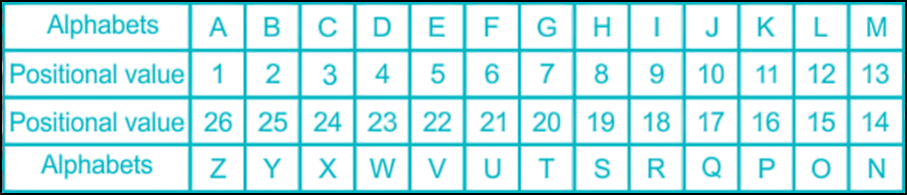
Given word: PLATFORM
| Letters | P | L | A | T | F | O | R | M |
| Positional Value | 16 | 12 | 1 | 20 | 6 | 15 | 18 | 13 |

Hence, the correct answer is One.
88. Directions: Study the following information carefully and answer the given questions.
In a certain language,
‘mutual exclusion for deadlock’ is coded as ‘but thing no every’
‘exclusion principle in system’ is coded as ‘experts know every some’
‘deadlock for operating system’ is coded as ‘all experts no but’‘principle in mutual operation’ is coded as ‘words some know thing’
Question:
Which of the following words is coded as “operating” in the given language?
A. all
B. experts
C. but
D. no
E. Cannot be determined
Solution
The words are decoded in the figure given below:
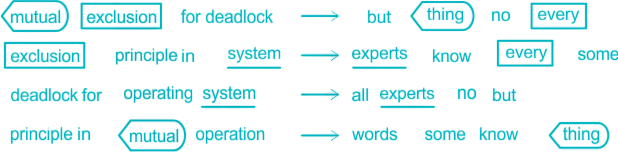
Deadlock / for – but / no
System – expertsHence, the code for “operating’’ is ‘all’
89. Directions: Study the following information carefully and answer the given questions.
In a certain language,
‘mutual exclusion for deadlock’ is coded as ‘but thing no every’
‘exclusion principle in system’ is coded as ‘experts know every some’
‘deadlock for operating system’ is coded as ‘all experts no but’‘principle in mutual operation’ is coded as ‘words some know thing’
Question:
Which of the following is the code for “mutual in system” in the given language?
A. None of these
B. experts know thing
C. every know but
D. thing experts some
E. either (2) or (4)
Solution
The words are decoded in the figure given below:
The code for “mutual in system” is either “experts know thing” or “thing experts some”
90. Directions: Study the following information carefully and answer the given questions.
In a certain language,
‘mutual exclusion for deadlock’ is coded as ‘but thing no every’
‘exclusion principle in system’ is coded as ‘experts know every some’
‘deadlock for operating system’ is coded as ‘all experts no but’‘principle in mutual operation’ is coded as ‘words some know thing’
Question:
Which of the following could be coded as ‘experts words’?
A. system operating
B. mutual operating
C. operation exclusion
D. operation system
E. None of these
Solution
The words are decoded in the figure given below:
Hence, ‘experts words’ is the code for ‘operation system’.
91. Directions: Study the following information carefully and answer the given questions.
In a certain language,
‘mutual exclusion for deadlock’ is coded as ‘but thing no every’
‘exclusion principle in system’ is coded as ‘experts know every some’
‘deadlock for operating system’ is coded as ‘all experts no but’‘principle in mutual operation’ is coded as ‘words some know thing’
Question:
How is the sentence ‘exclusion operating in’ coded in the given language?
A. every words know
B. know all every
C. either (2) or (4)
D. all every some
E. either (1) or (4)
Solution
The words are decoded in the figure given below:
Hence, ‘exclusion operating in’ is coded as either ‘know all every’ or ‘all every some’.
92. Direction: In the question below are given three statements followed by three conclusions numbered I and II. You have to take the given statements to be true even if they seem to be at variance with commonly known facts. Read all the conclusions and then decide which of the given conclusions logically follow from the given statements disregarding the commonly known facts.
Statements:
Some fate is date.
Only a few fate is rate.
Some rate is bate.
Conclusions:
I. All fate being bate is a possibility III. All Fate being Rate is possibility
A. Either I or II follows
B. Both II and I follow
C. Only II follows
D. Only I follows
E. Neither I nor II follow
Solution
The least possible Venn diagram for the given statements is as follows:
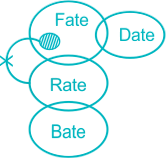
Conclusions:
I. All fate being bate is a possibility – True ( if fate is enclosed by Bate then no statement will contradict hence given conclusion can be possible.)
III. All Fate being Rate is possibility – False ( As Only a few fate is rate which means that some fate is rate and some fate is not rate, All fate cannot be enclosed by rate as it will contradict the meaning “some fate is not rate”.)
Hence Only conclusion I follows.
93. In the question below are given three statements followed by two conclusions numbered I and II. You have to take the given statements to be true even if they seem to be at variance with commonly known facts. Read all the conclusions and then decide which of the given conclusions logically follows from the given statements disregarding commonly known facts.
Statements:
I. Some R are T
II. Only a few U is O
III. Some R are not U
Conclusions:
I. Some O is U
II. Some O is not T
A. Only conclusion I follows
B. Only conclusion II follows
C. Both conclusion I and II follows
D. Either conclusion I or II follows
E. Neither conclusion I nor II follows
Solution
The least possible venn diagram is:

I. Some O is U → True (As the meaning of Only a few is Some + Some Not, so Some U is O and Some U is not O, from this it is clear that Some O is U).
II. Some O is not T → False (It can be possible, but it is not definite, as we don’t know about the remaining portion of O whether it is U or not)Hence, Only conclusion I follows.
94. Direction: In the question below are given three statements followed by four conclusions numbered I, II and III. You have to take the given statements to be true even if they seem to be at variance with commonly known facts. Read all the conclusions and then decide which of the given conclusions logically follows from the given statements disregarding commonly known facts.
Statements:
All moons are universes.
Only a few sun is moon.
Some moon is earth.
Conclusions:
I. Some sun is earth.
II. No sun is earth.
III. All moons are earth.
A. Only I follow
B. Only II follow
C. Only III follow
D. Either I or II follows
E. Neither I nor II follows
Solution
The least possible diagram for the given statements is as follows,
Conclusions:
I. Some sun is earth. → False (It is possible but not definite)
II. No sun is earth. → False (It is possible but not definite)
III. All moons are earth. → False (It is definitely false)
Conclusions I and II are complementary pair.
Thus, either I or II follows.
95. Read the following information carefully and answer the questions given below.Eight people – A, B, C, D, E, F, G and H are sitting around a square table in such a way that four of them are sitting at the corners of the table while the other four are sitting in the middle of each of the four sides (not necessarily in the same order). All are facing towards the centre. C is sitting fourth to the left of F. F is sitting second to the right of A. A is not sitting in the middle of any of the sides. D is sitting in the middle of one of the sides. Neither A nor F is an immediate neighbour of D. Only one person is sitting between B and D. E is not sitting in the middle of any of the sides. G is not an immediate neighbour of F.
Question:
Four of the following five pairs are alike in a certain way, find out the odd pair?
A. C, G
B. A, G
C. B, F
D. B, D
E. A, H
Solution
8 people: A, B, C, D, E, F, G, and H.
1) C is sitting fourth to the left of F.
2) F is sitting second to the right of A.
3) A is not sitting in the middle of any of the sides.
Here, we start from point no. 3 and then go to point no. 1.
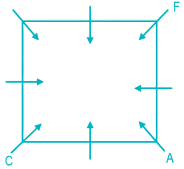
4) D is sitting in the middle of one of the sides.
5) Neither A nor F is an immediate neighbour of D.
6) Only one person is sitting between B and D.
7) E is not sitting in the middle of any of the sides.
8) G is not an immediate neighbour of F.
Thus, case 2 gets eliminated and we have the final arrangement as follows:
- C, G → Immediate neighbours
- A, G → Immediate neighbours
- B, F → Immediate neighbours
- B, D → Not immediate neighbours
- A, H → Immediate neighbours
Hence, “B, D” is the odd pair.
96. Read the following information carefully and answer the questions given below.Eight people – A, B, C, D, E, F, G and H are sitting around a square table in such a way that four of them are sitting at the corners of the table while the other four are sitting in the middle of each of the four sides (not necessarily in the same order). All are facing towards the centre. C is sitting fourth to the left of F. F is sitting second to the right of A. A is not sitting in the middle of any of the sides. D is sitting in the middle of one of the sides. Neither A nor F is an immediate neighbour of D. Only one person is sitting between B and D. E is not sitting in the middle of any of the sides. G is not an immediate neighbour of F.
Question:
Which of the following statement is true with respect to B?
A. Two persons are sitting between B and G
B. B is an immediate neighbour of E
C. B is not an immediate neighbour of F
D. B is sitting 3rd to the right of C
E. B is an immediate neighbour of A
Solution
8 people: A, B, C, D, E, F, G, and H.
1) C is sitting fourth to the left of F.
2) F is sitting second to the right of A.
3) A is not sitting in the middle of any of the sides.
Here, we start from point no. 3 and then go to point no. 1.
4) D is sitting in the middle of one of the sides.
5) Neither A nor F is an immediate neighbour of D.
6) Only one person is sitting between B and D.
7) E is not sitting in the middle of any of the sides.
8) G is not an immediate neighbour of F.
Thus, case 2 gets eliminated and we have the final arrangement as follows:
Hence, the statement “B is an immediate neighbour of E” is true.
97. Read the following information carefully and answer the questions given below.Eight people – A, B, C, D, E, F, G and H are sitting around a square table in such a way that four of them are sitting at the corners of the table while the other four are sitting in the middle of each of the four sides (not necessarily in the same order). All are facing towards the centre. C is sitting fourth to the left of F. F is sitting second to the right of A. A is not sitting in the middle of any of the sides. D is sitting in the middle of one of the sides. Neither A nor F is an immediate neighbour of D. Only one person is sitting between B and D. E is not sitting in the middle of any of the sides. G is not an immediate neighbour of F.
Question:
How many persons are sitting between D and G, when counting from the right side of G?
A. One
B. Three
C. Four
D. Five
E. Six
Solution
8 people: A, B, C, D, E, F, G, and H.
1) C is sitting fourth to the left of F.
2) F is sitting second to the right of A.
3) A is not sitting in the middle of any of the sides.
Here, we start from point no. 3 and then go to point no. 1.
4) D is sitting in the middle of one of the sides.
5) Neither A nor F is an immediate neighbour of D.
6) Only one person is sitting between B and D.
7) E is not sitting in the middle of any of the sides.
8) G is not an immediate neighbour of F.
Thus, case 2 gets eliminated and we have the final arrangement as follows:
Hence, five persons are sitting between D and G.
98. Read the following information carefully and answer the questions given below.Eight people – A, B, C, D, E, F, G and H are sitting around a square table in such a way that four of them are sitting at the corners of the table while the other four are sitting in the middle of each of the four sides (not necessarily in the same order). All are facing towards the centre. C is sitting fourth to the left of F. F is sitting second to the right of A. A is not sitting in the middle of any of the sides. D is sitting in the middle of one of the sides. Neither A nor F is an immediate neighbour of D. Only one person is sitting between B and D. E is not sitting in the middle of any of the sides. G is not an immediate neighbour of F.
Question:
What is the position of H with respect to B?
A. Immediate right
B. Immediate left
C. 2nd to the right
D. 2nd to the left
E. 3rd to the left
Solution
8 people: A, B, C, D, E, F, G, and H.
1) C is sitting fourth to the left of F.
2) F is sitting second to the right of A.
3) A is not sitting in the middle of any of the sides.
Here, we start from point no. 3 and then go to point no. 1.
4) D is sitting in the middle of one of the sides.
5) Neither A nor F is an immediate neighbour of D.
6) Only one person is sitting between B and D.
7) E is not sitting in the middle of any of the sides.
8) G is not an immediate neighbour of F.
Thus, case 2 gets eliminated and we have the final arrangement as follows:
Hence, H is sitting 2nd to the left of B.
99. Read the following information carefully and answer the questions given below.Eight people – A, B, C, D, E, F, G and H are sitting around a square table in such a way that four of them are sitting at the corners of the table while the other four are sitting in the middle of each of the four sides (not necessarily in the same order). All are facing towards the centre. C is sitting fourth to the left of F. F is sitting second to the right of A. A is not sitting in the middle of any of the sides. D is sitting in the middle of one of the sides. Neither A nor F is an immediate neighbour of D. Only one person is sitting between B and D. E is not sitting in the middle of any of the sides. G is not an immediate neighbour of F.
Question:
Who among the following is/are not sitting at any corners of the sides?
A. C
B. F
C. G
D. H
E. Both G & H
Solution
8 people: A, B, C, D, E, F, G, and H.
1) C is sitting fourth to the left of F.
2) F is sitting second to the right of A.
3) A is not sitting in the middle of any of the sides.
Here, we start from point no. 3 and then go to point no. 1.
4) D is sitting in the middle of one of the sides.
5) Neither A nor F is an immediate neighbour of D.
6) Only one person is sitting between B and D.
7) E is not sitting in the middle of any of the sides.
8) G is not an immediate neighbour of F.
Thus, case 2 gets eliminated and we have the final arrangement as follows:
Hence, both G and H are not sitting at any corners of the sides.
100. If it is possible to make a four letters meaningful word from the first letter, sixth letter, seventh letter and ninth letter of a word “ABSTINENCE”, then which of the following is the second letter of the word ? If more than one such word can be made, then give “X” as the answer, and if no such word can be formed then give “Z” as the answer.
A. C
B. A
C. N
D. X
E. Z
Solution
Given word:- ABSTINENCE
The first letter is ‘A’, the sixth letter is ‘N’, the seventh letter is ‘E’ and the ninth letter is ‘C’.
Therefore, two meaningful words formed by using these letters which are Acne and Cane.
Hence, the correct answer is X.