1. Direction: Find out which part of the sentence has an error and select the appropriate option. If a sentence is free from error, select ‘No Error’.
I respect, love (A)/ and care for (B)/ my parents and grandparents (C)/ more than his as I love them the most. (D)/ No error. (E)/
A. A
B. B
C. C
D. D
E. E
Solution
The correct answer is Option 4.
Key Points
- The primary issue in the sentence lies in part D.
- The word “his” should be changed to “he” to correctly compare the possessive “my” with the subject pronoun “he”.
- The revised segment should read: “more than he does”.
Therefore, the correct answer is D.
Correct Sentence: “I respect, love, and care for my parents and grandparents more than he does, as I love them the most.”
Additional Information
- A: “I respect, love” – This part of the sentence is grammatically correct and does not require any changes.
- B: “and care for” – This part of the sentence is grammatically correct and does not require any changes.
- C: “my parents and grandparents” – This part of the sentence is grammatically correct and does not require any changes.
- No error – This would be the correct option if there were no mistakes in the sentence, but there is an error in part D.
2. Direction: Find out which part of the sentence has an error and select the appropriate option. If a sentence is free from error, select ‘No Error’.
I delight to (A)/ prepare and eat (B)/ black forest cake, Pineapple Pastry, Fruit custard (C)/ more than him as I have a sweet tooth. (D)/ No error. (E)
A. A
B. B
C. C
D. D
E. E
Solution
The correct answer is Option 4.
Key Points
- The primary issue in the sentence is the use of “more than him” instead of “more than he does.”
- “More than he does” is the correct comparison structure in this context.
- Therefore, the correct phrase should be “more than he does” to maintain grammatical correctness and clarity.
- Thus, the error is located in part D of the sentence.
Therefore, the correct answer is D.
Correct Sentence: “I delight to prepare and eat black forest cake, Pineapple Pastry, Fruit custard more than he does as I have a sweet tooth.”
Additional Information
- A: “I delight to” – This part of the sentence is grammatically correct and does not require any changes.
- B: “prepare and eat” – This part of the sentence is grammatically correct and does not require any changes.
- C: “black forest cake, Pineapple Pastry, Fruit custard” – This part of the sentence is grammatically correct and does not require any changes.
- No error – This would be the correct option if there were no mistakes in the sentence, but there is an error in part D.
3. Direction: Find out which part of the sentence has an error and select the appropriate option. If a sentence is free from error, select ‘No Error’.
He must include more (A) calcium, protein, vitamins, and iron(B) in his diet to (C) keep himself fit and healthy (D) No error. (E)
A. A
B. B
C. C
D. D
E. E
Solution
The correct answer is Option 5.
Key Points
- The sentence is grammatically correct, and there are no errors in any part.
- The subject-verb agreement is accurate throughout the sentence.
- The list of nutrients (calcium, protein, vitamins, and iron) is appropriately structured and parallel.
- The phrase “in his diet to keep himself fit and healthy” is correct and conveys the intended meaning effectively.
Therefore, the correct answer is Option 5 (No error).
Correct Sentence: “He must include more calcium, protein, vitamins, and iron in his diet to keep himself fit and healthy.”
Additional Information
- Part A: “He must include more” – This part is grammatically correct.
- Part B: “calcium, protein, vitamins, and iron” – This part is grammatically correct and follows proper punctuation for a list.
- Part C: “in his diet to” – This part correctly specifies the context of the action.
- Part D: “keep himself fit and healthy” – This part is accurate and completes the sentence meaningfully.
4. Directions: Given below is a word, followed by three sentences that consist of that word. Identify the sentence(s) that express(es) the meaning of the word.
EFFECT
A. Every fourth clone born is either stillborn or suffers from a lethal effect.
B. News broadcasts can have a huge effect on public opinion.
C. Smoking tobacco can adversely effect your lungs and blood flow.
A. Only A
B. Both A and B
C. Only C
D. Only B
E. Both B and C
Solution
The correct answer is option 2.
Key Points
- To answer this question, let’s first understand the meaning of the word given in the question:
- Effect: a change that is a result or consequence of an action or other cause. (प्रभाव, असर, परिणति)
- Now, let’s examine the given sentences:
- Sentence A: Every fourth clone born is either stillborn or suffers from a lethal effect.
- This sentence correctly uses the word “effect” to describe a consequence of being a clone that is either stillborn or has a lethal outcome.
- Sentence B: News broadcasts can have a huge effect on public opinion.
- This sentence also correctly uses the word “effect” to describe the influence news broadcasts can have on shaping public opinion.
- Sentence C: Smoking tobacco can adversely effect your lungs and blood flow.
- This sentence incorrectly uses the word “effect” as a verb. The correct verb form should be “affect.”.
- So, sentences A and B correctly use the word “effect” while C does not.
Therefore, the correct answer is “Both A and B.”
5. Directions: Given below is a word, followed by three sentences that consist of that word. Identify the sentence(s) that express(es) the meaning of the word.
CONSULT
A. The way pupils use abusive language to consult each other presents particular problems for teachers.
B. Before taking action you are strongly recommended to consult an accountant.
C. The king is unlikely to forgive the consult offered to his ambassador.
A. Only A
B. Both A and B
C. Only B
D. Both A and C
E. Only C
Solution
The correct answer is ‘Only B.’
Key Points
- The word ‘Consult‘ as a verb means To seek information or advice from someone.
- In sentence A, the word ‘Consult‘ is inappropriately used and doesn’t fit the context of the sentence.
- In sentence B, the word ‘Consult‘ has been correctly used as a verb as the sentence is talking about seeking information or advice from an accountant before taking action.
- In sentence C, the word ‘Consult‘ is inappropriately used and doesn’t fit the context of the sentence.
Hence, the only possible answer is option 3.
6. Directions: Select the phrase from the options below that should replace the underlined phrase in the sentence to make it grammatically correct. If the sentence is already correct, select ‘No correction required’ as your answer.
He not only enjoys playing the guitar but rather finds solace in composing his own melodies and lyrics.
A. but rather finding solace
B. but also finds solace
C. but rather find solace
D. yet finds the solace
E. No correction required
Solution
The correct answer is option 2.
Key Points
- The correct phrase is “but also finds solace.”
- The underlined phrase “but rather finds solace” is incorrect because “but rather” suggests a contrast, but the sentence aims to express an additional activity.
- Here, the correlative conjunctions “not only…but also” should be used to show a parallel relationship, requiring the use of “but also” to maintain the intended meaning.
- The correct sentence after phrase replacement would be: “He not only enjoys playing the guitar but also finds solace in composing his own melodies and lyrics.“
Additional Information
- Let’s understand some more correlative conjunctions:
- Whether…or
- It is used to express a doubt or choice between two possibilities when the second part of this structure is negative.
- For Example –
- Whether you like it or not, you will have to go to the doctor’s to get yourself checked.
- No sooner…than
- It is used to show that one thing happens immediately after another thing.
- For Example –
- No sooner had the motivational speaker finished her speech than the lights went out.
- Both…and
- It is used to emphasize that each of the two things is true.
- For Example –
- She enjoys both reading classic novels and exploring contemporary literature.
7. Directions: Select the phrase from the options below that should replace the underlined phrase in the sentence to make it grammatically correct. If the sentence is already correct, select ‘No correction required’ as your answer.
She enjoys reading classical literature, hike in scenic landscapes, and spending time with close friends.
A. hiked in scenicly landscapes
B. hiking in through scenic landscapes
C. also hike in scenicly landscapes
D. hiking in scenic landscapes
E. No correction required
Solution
The correct answer is option 4.
Key Points
- The correct phrase is “hiking in scenic landscapes.”
- The underlined phrase “hike in scenic landscapes” is incorrect because it doesn’t match the structure of the sentence.
- To maintain parallelism with “enjoys reading classical literature” and “spending time with close friends,” the gerund form “hiking” should be used, making it “hiking in scenic landscapes.” This ensures consistency in the sentence structure.
- The correct sentence after phrase replacement would be: “She enjoys reading classical literature, hiking in scenic landscapes, and spending time with close friends.“
Additional Information
- Let’s understand the concept of parallelism:
- Parallelism in grammar ensures that the structure and form of words or phrases within a sentence are consistent. It involves using similar grammatical patterns for clarity and balance.
- For Example:
- She likes hiking, swimming, and jogging.
- The company values honesty, diligence, and punctuality.
- Sarah is both a talented writer and a skilled painter.
8. Directions: Select the phrase from the options below that should replace the underlined phrase in the sentence to make it grammatically correct. If the sentence is already correct, select ‘No correction required’ as your answer.
The person who helped me find my way in the city turned over to be a distance relative I had never met before.
A. turned out to be a distant relative
B. turning out to be a distance relative
C. turned over to be a distant relative
D. turned on to be a distance relative
E. No correction required
Solution
The correct answer is option 1.
Key Points
- The correct phrase is “turned out to be a distant relative.”
- The underlined phrase “turned over to be a distance relative” is incorrect because it uses the incorrect phrasal verb “turned over.”
- Here, the correct phrase should be “turned out to be,” indicating a revelation or discovery, not “turned over” which means to flip or rotate something.
- Additionally, it should be “distant” instead of “distance” as an adjective describing the relative.
- The correct sentence after phrase replacement would be: “The person who helped me find my way in the city turned out to be a distant relative I had never met before.“
9. Directions: In the following sentence, five words are given in bold, out of which one word is misspelled. Find the misspelled word.
The diversion(A) of a State’s own funds to centrally(B) sponsored schemes, thereby depleting(C) resources for its own schemes(D), violates a constitutional provition(E).
A. A
B. B
C. C
D. D
E. E
Solution
The correct answer is ‘E.‘
Key Points
- Let usexplore the options:-
- ‘Diversion‘ means The action of turning something aside from its course.
- ‘Centrally‘ means With the greatest importance or significance; essentially.
- ‘Depleting‘ means To diminish in number or quantity.
- ‘Schemes‘ means An official plan or system for doing or organizing something.
- ‘Provition‘: There is no such word in English or we can say that there is some spelling mistake in this word.
- The correct spelling is ‘Provision‘ means The action of providing or supplying something for use.
- The correct spelling is ‘Provision‘ means The action of providing or supplying something for use.
Hence, the correct answer is option 5.
Correct Sentence: The diversion of a State’s own funds to centrally sponsored schemes, thereby depleting resources for its own schemes, violates a constitutional provision.
Additional Information
- The synonyms of the word ‘Provision‘ are “Supplying, Providing, Purveying“.
- Example of ‘Provision‘ in a sentence:
- The provision of shelter was their main concern.
10. Directions: In the following sentence, five words are given in bold, out of which one word is misspelled. Find the misspelled word.
Sacks of cement stacked(A) against a freschoed(B) wall can irreversibly(C) abrade(D) its surface(E).
A. A
B. B
C. C
D. D
E. E
Solution
The correct answer is ‘B.‘
Key Points
- Let usexplore the options:-
- ‘Stacked‘ means To put or arranged in a stack or stacks.
- ‘Freschoed‘: There is no such word in English or we can say that there is some spelling mistake in this word.
- The correct spelling is ‘Frescoed‘ means A painting executed in fresco.
- ‘Irreversibly‘ means In a way that cannot be undone or altered.
- ‘Abrade‘ means Scrape or wear away by friction or erosion.
- ‘Surface‘ means The outside part or uppermost layer of something.
Hence, the correct answer is option 2.
Correct Sentence: Sacks of cement stacked against a frescoed wall can irreversibly abrade its surface.
Additional Information
- The Italian word fresco means “fresh” and comes from a Germanic word akin to the source of English fresh. In English, fresco appears earliest as part of the phrase in fresco; it does not appear as a noun referring to a painting until 1670.
- Example of ‘Frescoed‘ in a sentence:
- High, frescoed ceilings looked down on a marble floor worn smooth over the centuries.
11. Directions: In the following sentence, five words are given in bold, out of which one word is misspelled. Find the misspelled word.
Our popular image of a party is that of the classical(A) mass party, which rises from societal(B) movements(C) and is essentialy(D) internally(E) democratic.
A. A
B. B
C. C
D. D
E. E
Solution
The correct answer is ‘D.‘
Key Points
- Let usexplore the options:-
- ‘Classical‘ means Traditional, not modern.
- ‘Societal‘ means Relating to society or social relations.
- ‘Movements‘ means General activity or bustle.
- ‘Essentialy‘: There is no such word in English or we can say that there is some spelling mistake in this word.
- The correct spelling is ‘Essentially‘ means When you consider the basic or most important part of something.
- ‘Internally‘ means With reference to the inner surface or structure of something; inside.
Hence, the correct answer is option 4.
Correct Sentence: Our popular image of a party is that of the classical mass party, which rises from societal movements and is essentially internally democratic.
Additional Information
- The synonyms of the word ‘Essentially‘ are “Basically, Elementally, Fundamentally“.
- Example of ‘Essentially‘ in a sentence:
- He had an essentially subordinate role.
12. Directions: In the following sentence, five words are given in bold, out of which one word is misspelled. Find the misspelled word.
In the process(A), they were also deeply embeded(B) in the local networks of brokerage(C) and patronage(D) that are institutionalized through its grass-roots organizational structure(E).
A. A
B. B
C. C
D. D
E. E
Solution
The correct answer is ‘B.‘
Key Points
- Let usexplore the options:-
- ‘Process‘ means A series of actions that you do for a particular purpose.
- ‘Embeded‘: There is no such word in English or we can say that there is some spelling mistake in this word.
- The correct spelling is ‘Embedded‘ means To fix something firmly and deeply in something else.
- ‘Brokerage‘ means The business of acting as a broker.
- ‘Patronage‘ means The support given by a patron.
- ‘Structure‘ means To arrange something in an organized way.
Hence, the correct answer is option 2.
Correct Sentence: In the process, they were also deeply embedded in the local networks of brokerage and patronage that are institutionalized through its grass-roots organizational structure.
Additional Information
- The synonyms of the word ‘Embedded‘ are “Implanted, Set, Fixed“.
- Example of ‘Embedded‘ in a sentence:
- He has embedded his name in the minds of millions of people.
13. Directions: In the following sentence, five words are given in bold, out of which one word is misspelled. Find the misspelled word.
The presense(A) of the U.S.’s trans-Atlantic and trans-Pacific military allies(B) at one conference(C) sent out a clear message against a perceived(D) Russia-China alliance(E).
A. A
B. B
C. C
D. D
E. E
Solution
The correct answer is ‘A.‘
Key Points
- Let usexplore the options:-
- ‘Presense‘: There is no such word in English or we can say that there is some spelling mistake in this word.
- The correct spelling is ‘Presence‘ means The state or fact of existing, occurring, or being present.
- ‘Allies‘ means To combine or unite a resource or commodity with another for mutual benefit.
- ‘Conference‘ means A formal meeting of people with a shared interest, typically one that takes place over several days.
- ‘Perceived‘ means To become aware or conscious of something.
- ‘Alliance‘ means A union or association formed for mutual benefit, especially between countries or organizations.
- ‘Presense‘: There is no such word in English or we can say that there is some spelling mistake in this word.
Hence, the correct answer is option 1.
Correct Sentence: The presence of the U.S.’s trans-Atlantic and trans-Pacific military allies at one conference sent out a clear message against a perceived Russia-China alliance.
Additional Information
- The synonyms of the word ‘Presence‘ are “Existence, Appearance, Attendance“.
- Example of ‘Presence‘ in a sentence:
- Your presence is requested at the meeting.
14. Read the passage given below and then answer the questions given below the passage.
On December 30, 2024, the Indian Space Research Organisation (ISRO) launched its PSLV-C60 mission. Its primary payload was a pair of satellites for the Space Docking Experiment, or SpaDeX, to demonstrate orbital rendezvous and docking. The ability to execute it in orbit is an essential stepping stone to more complex missions. The launch was also hailed as ISRO ending the year on a high, but SpaDeX reminded us that sophisticated spaceflight missions care little for arbitrary deadlines. The satellites successfully docked on January 16 after a few abortive attempts. They were expected to dock on January 7, which ISRO postponed to January 9, then brought them close without docking on January 12 in an apparent data-taking effort. It nixed the January 9 attempt after the satellites were found to have drifted more than expected, prompting measures to arrest the displacement and reinitialise the experiment. Once docked, ISRO began tests to verify if the satellites could exchange electric power, then undock and separate, followed by testing their own payloads that would be spread over two years. The C60 mission also launched the fourth stage of the rocket as an orbital platform. It carried 24 payloads from various ISRO centres and private enterprises testing various technologies. The Vikram Sarabhai Space Centre’s Compact Research module for Orbital Plant Studies was able to have cowpea seeds germinate in orbit, capturing the popular imagination.
Docking allows spacefaring components to be launched separately and assembled in space to form a larger module. This allows a space agency to plan interplanetary missions whose spacecraft are heavier than what the heaviest rockets can launch. Docking is thus a symbolic gateway to new opportunities, with the Chandrayaan-4 lunar sample return mission being a good example. In anticipation, ISRO loaded the SpaDeX satellites with enough fuel for multiple tries and also continuously collected data. Its own nervousness became evident, too: after the first two attempts, it backed down from its promise to live-stream the successful one. Docking technology has become desirable thanks to the perceived inevitability of long-duration spaceflight. The pressure to lower costs imposed by, say, crewed missions to Mars or space-mining operations has rendered ideas such as in-space satellite servicing and orbital resupply platforms, both of which require docking, more lucrative. ISRO plans to start launching the ‘Bharatiya Antariksh Station’ (BAS) later this decade. As it embarks on a new phase of operations, with V. Narayanan as its new chairman, ISRO should also describe a _______ vision for the ex ante utility expected of BAS. Without this context, the larger pieces of the Indian space programme and their purpose relative to other countries’ plans seem adrift.
Question:
Which of the following words is opposite in meaning to “lucrative” as used in the passage?
A. profitable
B. unproductive
C. beneficial
D. promising
E. costly
Solution
The correct answer is: Option 2 i.e. ‘unproductive‘.
Key Points
- The word “lucrative” means producing a great deal of profit; profitable. (लाभदायक)
- Example: She left her job to start a lucrative business of her own.
- “Unproductive” refers to not producing the desired results; inefficient or unprofitable. (अनुत्पादक)
- Example: The meeting was unproductive and didn’t help us solve the issue.
- Hence, we can infer that the opposite of ‘lucrative’ is ‘unproductive’.
Therefore, the correct answer is: Option 2, i.e., ‘unproductive‘.
Additional Information
Here are the other options explained along with their Hindi meanings and example sentences:
- Profitable (लाभकारी): Yielding financial gain; synonymous with lucrative.
- Example: The new venture proved to be highly profitable.
- Beneficial (लाभदायक): Resulting in good; advantageous or helpful.
- Example: Regular exercise is beneficial for overall health.
- Promising (आशाजनक): Showing signs of future success; likely to develop positively.
- Example: She has a promising career ahead of her.
- Costly (महंगा): Entailing great expense, often implying it is not worth the cost.
- Example: The repair work on the house was very costly.
15. Read the passage given below and then answer the questions given below the passage.
On December 30, 2024, the Indian Space Research Organisation (ISRO) launched its PSLV-C60 mission. Its primary payload was a pair of satellites for the Space Docking Experiment, or SpaDeX, to demonstrate orbital rendezvous and docking. The ability to execute it in orbit is an essential stepping stone to more complex missions. The launch was also hailed as ISRO ending the year on a high, but SpaDeX reminded us that sophisticated spaceflight missions care little for arbitrary deadlines. The satellites successfully docked on January 16 after a few abortive attempts. They were expected to dock on January 7, which ISRO postponed to January 9, then brought them close without docking on January 12 in an apparent data-taking effort. It nixed the January 9 attempt after the satellites were found to have drifted more than expected, prompting measures to arrest the displacement and reinitialise the experiment. Once docked, ISRO began tests to verify if the satellites could exchange electric power, then undock and separate, followed by testing their own payloads that would be spread over two years. The C60 mission also launched the fourth stage of the rocket as an orbital platform. It carried 24 payloads from various ISRO centres and private enterprises testing various technologies. The Vikram Sarabhai Space Centre’s Compact Research module for Orbital Plant Studies was able to have cowpea seeds germinate in orbit, capturing the popular imagination.
Docking allows spacefaring components to be launched separately and assembled in space to form a larger module. This allows a space agency to plan interplanetary missions whose spacecraft are heavier than what the heaviest rockets can launch. Docking is thus a symbolic gateway to new opportunities, with the Chandrayaan-4 lunar sample return mission being a good example. In anticipation, ISRO loaded the SpaDeX satellites with enough fuel for multiple tries and also continuously collected data. Its own nervousness became evident, too: after the first two attempts, it backed down from its promise to live-stream the successful one. Docking technology has become desirable thanks to the perceived inevitability of long-duration spaceflight. The pressure to lower costs imposed by, say, crewed missions to Mars or space-mining operations has rendered ideas such as in-space satellite servicing and orbital resupply platforms, both of which require docking, more lucrative. ISRO plans to start launching the ‘Bharatiya Antariksh Station’ (BAS) later this decade. As it embarks on a new phase of operations, with V. Narayanan as its new chairman, ISRO should also describe a _______ vision for the ex ante utility expected of BAS. Without this context, the larger pieces of the Indian space programme and their purpose relative to other countries’ plans seem adrift.
Question:
Which of the following words is similar in meaning to “abortive” in the context of the passage?
A. successful
B. fruitful
C. premature
D. interrupted
E. determined
Solution
The correct answer is: Option 4 i.e. ‘interrupted‘.
Key Points
- The word “abortive” means failing to achieve the desired result; unsuccessful. (असफल)
- Example: The mission was abortive due to technical difficulties.
- “interrupted” refers to being stopped or hindered in progress. (बाधित)
- Example: The conversation was interrupted by a phone call.
- Hence, we can infer that the meaning of ‘abortive’ is similar to ‘interrupted’.
Therefore, the correct answer is Option 4, i.e., ‘interrupted‘.
Additional Information
Here are the other options explained along with their Hindi meanings and example sentences:
- Successful (सफल): Achieving the desired aim or result.
- Example: The project was successful in reaching its goals.
- Fruitful (फलदायक): Producing good or helpful results; productive.
- Example: Our discussions were fruitful and led to a new agreement.
- Premature (समय से पूर्व): Occurring or done before the proper time.
- Example: The baby was born prematurely and required special care.
- Determined (दृढ़): Having a firm decision or goal; resolute.
- Example: She was determined to succeed despite the challenges.
16. Read the passage given below and then answer the questions given below the passage.
On December 30, 2024, the Indian Space Research Organisation (ISRO) launched its PSLV-C60 mission. Its primary payload was a pair of satellites for the Space Docking Experiment, or SpaDeX, to demonstrate orbital rendezvous and docking. The ability to execute it in orbit is an essential stepping stone to more complex missions. The launch was also hailed as ISRO ending the year on a high, but SpaDeX reminded us that sophisticated spaceflight missions care little for arbitrary deadlines. The satellites successfully docked on January 16 after a few abortive attempts. They were expected to dock on January 7, which ISRO postponed to January 9, then brought them close without docking on January 12 in an apparent data-taking effort. It nixed the January 9 attempt after the satellites were found to have drifted more than expected, prompting measures to arrest the displacement and reinitialise the experiment. Once docked, ISRO began tests to verify if the satellites could exchange electric power, then undock and separate, followed by testing their own payloads that would be spread over two years. The C60 mission also launched the fourth stage of the rocket as an orbital platform. It carried 24 payloads from various ISRO centres and private enterprises testing various technologies. The Vikram Sarabhai Space Centre’s Compact Research module for Orbital Plant Studies was able to have cowpea seeds germinate in orbit, capturing the popular imagination.
Docking allows spacefaring components to be launched separately and assembled in space to form a larger module. This allows a space agency to plan interplanetary missions whose spacecraft are heavier than what the heaviest rockets can launch. Docking is thus a symbolic gateway to new opportunities, with the Chandrayaan-4 lunar sample return mission being a good example. In anticipation, ISRO loaded the SpaDeX satellites with enough fuel for multiple tries and also continuously collected data. Its own nervousness became evident, too: after the first two attempts, it backed down from its promise to live-stream the successful one. Docking technology has become desirable thanks to the perceived inevitability of long-duration spaceflight. The pressure to lower costs imposed by, say, crewed missions to Mars or space-mining operations has rendered ideas such as in-space satellite servicing and orbital resupply platforms, both of which require docking, more lucrative. ISRO plans to start launching the ‘Bharatiya Antariksh Station’ (BAS) later this decade. As it embarks on a new phase of operations, with V. Narayanan as its new chairman, ISRO should also describe a _______ vision for the ex ante utility expected of BAS. Without this context, the larger pieces of the Indian space programme and their purpose relative to other countries’ plans seem adrift.
Question:
What will fit in the blank taken from the passage: “As it embarks on a new phase of operations, with V. Narayanan as its new chairman, ISRO should also describe a _______ vision for the ex ante utility expected of BAS.”
A. precise
B. concrete
C. strategic
D. compelling
E. comprehensive
Solution
The correct answer is “comprehensive“.
Key Points
- The word comprehensive” means complete and including everything that is necessary. (व्यापक)
- A comprehensive vision would include detailed plans and objectives for BAS.
- The other options: “precise,” “concrete,” “strategic,” and “compelling” do not fit the context as appropriately.
Therefore, the correct answer is ‘Option 5‘.
Complete Sentence: As it embarks on a new phase of operations, with V. Narayanan as its new chairman, ISRO should also describe a comprehensive vision for the ex ante utility expected of BAS.
Additional Information
- Precise (सटीक): means exact and accurate in all details.
- Concrete (ठोस): means specific and definite.
- Strategic (रणनीतिक): means related to the identification of long-term or overall aims.
- Compelling (प्रभावशाली): means evoking interest or attention in an irresistible way.
17. Read the passage given below and then answer the questions given below the passage.
On December 30, 2024, the Indian Space Research Organisation (ISRO) launched its PSLV-C60 mission. Its primary payload was a pair of satellites for the Space Docking Experiment, or SpaDeX, to demonstrate orbital rendezvous and docking. The ability to execute it in orbit is an essential stepping stone to more complex missions. The launch was also hailed as ISRO ending the year on a high, but SpaDeX reminded us that sophisticated spaceflight missions care little for arbitrary deadlines. The satellites successfully docked on January 16 after a few abortive attempts. They were expected to dock on January 7, which ISRO postponed to January 9, then brought them close without docking on January 12 in an apparent data-taking effort. It nixed the January 9 attempt after the satellites were found to have drifted more than expected, prompting measures to arrest the displacement and reinitialise the experiment. Once docked, ISRO began tests to verify if the satellites could exchange electric power, then undock and separate, followed by testing their own payloads that would be spread over two years. The C60 mission also launched the fourth stage of the rocket as an orbital platform. It carried 24 payloads from various ISRO centres and private enterprises testing various technologies. The Vikram Sarabhai Space Centre’s Compact Research module for Orbital Plant Studies was able to have cowpea seeds germinate in orbit, capturing the popular imagination.
Docking allows spacefaring components to be launched separately and assembled in space to form a larger module. This allows a space agency to plan interplanetary missions whose spacecraft are heavier than what the heaviest rockets can launch. Docking is thus a symbolic gateway to new opportunities, with the Chandrayaan-4 lunar sample return mission being a good example. In anticipation, ISRO loaded the SpaDeX satellites with enough fuel for multiple tries and also continuously collected data. Its own nervousness became evident, too: after the first two attempts, it backed down from its promise to live-stream the successful one. Docking technology has become desirable thanks to the perceived inevitability of long-duration spaceflight. The pressure to lower costs imposed by, say, crewed missions to Mars or space-mining operations has rendered ideas such as in-space satellite servicing and orbital resupply platforms, both of which require docking, more lucrative. ISRO plans to start launching the ‘Bharatiya Antariksh Station’ (BAS) later this decade. As it embarks on a new phase of operations, with V. Narayanan as its new chairman, ISRO should also describe a _______ vision for the ex ante utility expected of BAS. Without this context, the larger pieces of the Indian space programme and their purpose relative to other countries’ plans seem adrift.
Question:
According to the passage, which of the given statements is/are correct?
A) The Vikram Sarabhai Space Centre participated in the PSLV-C60 mission.
B) ISRO’s SpaDeX satellites required multiple attempts to successfully dock.
C) ISRO decided to live-stream the successful docking attempt.
A. Only A
B. Only B
C. Only C
D. A and B
E. B and C
Solution
The correct answer is Option 4.
Key Points
- Statement A: The Vikram Sarabhai Space Centre participated in the PSLV-C60 mission.
- This statement is correct as the passage mentions the Vikram Sarabhai Space Centre’s Compact Research module for Orbital Plant Studies being part of the PSLV-C60 mission.
- Statement B: ISRO’s SpaDeX satellites required multiple attempts to successfully dock.
- This statement is correct as the passage mentions that the satellites successfully docked on January 16 after a few abortive attempts.
- Statement C: ISRO decided to live-stream the successful docking attempt.
- This statement is incorrect as the passage states that ISRO backed down from its promise to live-stream the successful docking attempt.
- Hence, the statements A and B are identified as correct in the context of the passage.
Therefore, the correct answer is: ‘A and B’.
18. Read the passage given below and then answer the questions given below the passage.
On December 30, 2024, the Indian Space Research Organisation (ISRO) launched its PSLV-C60 mission. Its primary payload was a pair of satellites for the Space Docking Experiment, or SpaDeX, to demonstrate orbital rendezvous and docking. The ability to execute it in orbit is an essential stepping stone to more complex missions. The launch was also hailed as ISRO ending the year on a high, but SpaDeX reminded us that sophisticated spaceflight missions care little for arbitrary deadlines. The satellites successfully docked on January 16 after a few abortive attempts. They were expected to dock on January 7, which ISRO postponed to January 9, then brought them close without docking on January 12 in an apparent data-taking effort. It nixed the January 9 attempt after the satellites were found to have drifted more than expected, prompting measures to arrest the displacement and reinitialise the experiment. Once docked, ISRO began tests to verify if the satellites could exchange electric power, then undock and separate, followed by testing their own payloads that would be spread over two years. The C60 mission also launched the fourth stage of the rocket as an orbital platform. It carried 24 payloads from various ISRO centres and private enterprises testing various technologies. The Vikram Sarabhai Space Centre’s Compact Research module for Orbital Plant Studies was able to have cowpea seeds germinate in orbit, capturing the popular imagination.
Docking allows spacefaring components to be launched separately and assembled in space to form a larger module. This allows a space agency to plan interplanetary missions whose spacecraft are heavier than what the heaviest rockets can launch. Docking is thus a symbolic gateway to new opportunities, with the Chandrayaan-4 lunar sample return mission being a good example. In anticipation, ISRO loaded the SpaDeX satellites with enough fuel for multiple tries and also continuously collected data. Its own nervousness became evident, too: after the first two attempts, it backed down from its promise to live-stream the successful one. Docking technology has become desirable thanks to the perceived inevitability of long-duration spaceflight. The pressure to lower costs imposed by, say, crewed missions to Mars or space-mining operations has rendered ideas such as in-space satellite servicing and orbital resupply platforms, both of which require docking, more lucrative. ISRO plans to start launching the ‘Bharatiya Antariksh Station’ (BAS) later this decade. As it embarks on a new phase of operations, with V. Narayanan as its new chairman, ISRO should also describe a _______ vision for the ex ante utility expected of BAS. Without this context, the larger pieces of the Indian space programme and their purpose relative to other countries’ plans seem adrift.
Question:
Which of the following best states the central idea of the passage?
A. ISRO’s PSLV-C60 mission faced several challenges before achieving its goals.
B. The successful docking of SpaDeX satellites marks a significant technological advancement for ISRO.
C. The PSLV-C60 mission included multiple payloads for various technological tests.
D. ISRO’s future missions depend on the success of current experimental technologies like SpaDeX.
E. The accomplishment of the PSLV-C60 mission showcases ISRO’s capabilities and future potential.
Solution
The correct answer is Option 2.
Key Points
- The passage emphasizes the successful docking of the SpaDeX satellites as a technological milestone for ISRO.
- It presents the challenges faced by ISRO throughout the mission and highlights the importance of successful docking.
- The accomplishment symbolizes a significant advancement and promises new opportunities for future missions.
- The focus on the technological achievement rather than the overall capabilities or potential of ISRO aligns with Option 2.
Therefore, the correct answer is Option 2.
Additional Information
- Option 1: “ISRO’s PSLV-C60 mission faced several challenges before achieving its goals.” – This option highlights the challenges but does not encapsulate the central idea of the docking achievement.
- Option 3: “The PSLV-C60 mission included multiple payloads for various technological tests.” – This option mentions the additional payloads but does not focus on the main achievement.
- Option 4: “ISRO’s future missions depend on the success of current experimental technologies like SpaDeX.” – This option emphasizes dependency on future missions but not the significance of the current achievement.
- Option 5: “The accomplishment of the PSLV-C60 mission showcases ISRO’s capabilities and future potential.” – This option speaks to ISRO’s overall capabilities and future potential rather than the specific achievement of the SpaDeX docking.
19. Read the passage given below and then answer the questions given below the passage.
On December 30, 2024, the Indian Space Research Organisation (ISRO) launched its PSLV-C60 mission. Its primary payload was a pair of satellites for the Space Docking Experiment, or SpaDeX, to demonstrate orbital rendezvous and docking. The ability to execute it in orbit is an essential stepping stone to more complex missions. The launch was also hailed as ISRO ending the year on a high, but SpaDeX reminded us that sophisticated spaceflight missions care little for arbitrary deadlines. The satellites successfully docked on January 16 after a few abortive attempts. They were expected to dock on January 7, which ISRO postponed to January 9, then brought them close without docking on January 12 in an apparent data-taking effort. It nixed the January 9 attempt after the satellites were found to have drifted more than expected, prompting measures to arrest the displacement and reinitialise the experiment. Once docked, ISRO began tests to verify if the satellites could exchange electric power, then undock and separate, followed by testing their own payloads that would be spread over two years. The C60 mission also launched the fourth stage of the rocket as an orbital platform. It carried 24 payloads from various ISRO centres and private enterprises testing various technologies. The Vikram Sarabhai Space Centre’s Compact Research module for Orbital Plant Studies was able to have cowpea seeds germinate in orbit, capturing the popular imagination.
Docking allows spacefaring components to be launched separately and assembled in space to form a larger module. This allows a space agency to plan interplanetary missions whose spacecraft are heavier than what the heaviest rockets can launch. Docking is thus a symbolic gateway to new opportunities, with the Chandrayaan-4 lunar sample return mission being a good example. In anticipation, ISRO loaded the SpaDeX satellites with enough fuel for multiple tries and also continuously collected data. Its own nervousness became evident, too: after the first two attempts, it backed down from its promise to live-stream the successful one. Docking technology has become desirable thanks to the perceived inevitability of long-duration spaceflight. The pressure to lower costs imposed by, say, crewed missions to Mars or space-mining operations has rendered ideas such as in-space satellite servicing and orbital resupply platforms, both of which require docking, more lucrative. ISRO plans to start launching the ‘Bharatiya Antariksh Station’ (BAS) later this decade. As it embarks on a new phase of operations, with V. Narayanan as its new chairman, ISRO should also describe a _______ vision for the ex ante utility expected of BAS. Without this context, the larger pieces of the Indian space programme and their purpose relative to other countries’ plans seem adrift.
Question:
What can be inferred from ISRO’s decision not to live-stream the successful docking attempt after the first two failed attempts?
A. ISRO wanted to maintain operational secrecy.
B. ISRO was unsure about the capability of the docking technology.
C. ISRO aimed to avoid public scrutiny in case of another failure.
D. ISRO lacked sufficient technological infrastructure for live streaming.
E. ISRO underestimated the interest of the public in the event.
Solution
The correct answer is Option 3.
Key Points
- The passage mentions that ISRO’s nervousness became evident after backing down from its promise to live-stream the successful docking.
- This indicates a desire to avoid public scrutiny in the event of another failure.
- The decision was likely made to manage expectations and protect the organisation’s reputation.
- The nervousness and postponements also suggest a lack of confidence in ensuring a successful docking on the next attempt.
Therefore, the correct answer is Option 3.
Correct Sentence: “ISRO aimed to avoid public scrutiny in case of another failure.”
Additional Information
- Option 1: “ISRO wanted to maintain operational secrecy.” – This option implies secrecy, but the passage suggests the motivation was more about scrutiny rather than secrecy.
- Option 2: “ISRO was unsure about the capability of the docking technology.” – This option partially aligns with the nervousness but does not fully capture the intention of avoiding public scrutiny.
- Option 4: “ISRO lacked sufficient technological infrastructure for live streaming.” – There is no evidence in the passage to suggest technological infrastructure was an issue.
- Option 5: “ISRO underestimated the interest of the public in the event.” – This option is not supported by the passage since public interest is not discussed as a factor.
20. Read the passage given below and then answer the questions given below the passage.
On December 30, 2024, the Indian Space Research Organisation (ISRO) launched its PSLV-C60 mission. Its primary payload was a pair of satellites for the Space Docking Experiment, or SpaDeX, to demonstrate orbital rendezvous and docking. The ability to execute it in orbit is an essential stepping stone to more complex missions. The launch was also hailed as ISRO ending the year on a high, but SpaDeX reminded us that sophisticated spaceflight missions care little for arbitrary deadlines. The satellites successfully docked on January 16 after a few abortive attempts. They were expected to dock on January 7, which ISRO postponed to January 9, then brought them close without docking on January 12 in an apparent data-taking effort. It nixed the January 9 attempt after the satellites were found to have drifted more than expected, prompting measures to arrest the displacement and reinitialise the experiment. Once docked, ISRO began tests to verify if the satellites could exchange electric power, then undock and separate, followed by testing their own payloads that would be spread over two years. The C60 mission also launched the fourth stage of the rocket as an orbital platform. It carried 24 payloads from various ISRO centres and private enterprises testing various technologies. The Vikram Sarabhai Space Centre’s Compact Research module for Orbital Plant Studies was able to have cowpea seeds germinate in orbit, capturing the popular imagination.
Docking allows spacefaring components to be launched separately and assembled in space to form a larger module. This allows a space agency to plan interplanetary missions whose spacecraft are heavier than what the heaviest rockets can launch. Docking is thus a symbolic gateway to new opportunities, with the Chandrayaan-4 lunar sample return mission being a good example. In anticipation, ISRO loaded the SpaDeX satellites with enough fuel for multiple tries and also continuously collected data. Its own nervousness became evident, too: after the first two attempts, it backed down from its promise to live-stream the successful one. Docking technology has become desirable thanks to the perceived inevitability of long-duration spaceflight. The pressure to lower costs imposed by, say, crewed missions to Mars or space-mining operations has rendered ideas such as in-space satellite servicing and orbital resupply platforms, both of which require docking, more lucrative. ISRO plans to start launching the ‘Bharatiya Antariksh Station’ (BAS) later this decade. As it embarks on a new phase of operations, with V. Narayanan as its new chairman, ISRO should also describe a _______ vision for the ex ante utility expected of BAS. Without this context, the larger pieces of the Indian space programme and their purpose relative to other countries’ plans seem adrift.
Question:
The passage states that after the successful docking of the SpaDeX satellites, ISRO began tests to verify:
A. The ability of the satellites to communicate with ground stations
B. If the satellites could exchange electric power
C. The stability of the satellites’ orbital paths
D. The effectiveness of onboard sensors and cameras
E. The efficiency of the new propulsion systems
Solution
The correct answer is Option 2.
Key Points
- The passage explicitly states that after the successful docking, ISRO began tests to verify if the satellites could exchange electric power.
- This verification was an important step in the overall mission plan.
Therefore, the correct answer is Option 2.
Correct Sentence: “ISRO began tests to verify if the satellites could exchange electric power.”
Additional Information
- Option 1: “The ability of the satellites to communicate with ground stations.” – This is not mentioned as a test conducted after docking.
- Option 3: “The stability of the satellites’ orbital paths.” – Stability of orbital paths is not mentioned as a focus of the tests conducted after docking.
- Option 4: “The effectiveness of onboard sensors and cameras.” – The passage does not discuss testing of onboard sensors and cameras after docking.
- Option 5: “The efficiency of the new propulsion systems.” – Testing the efficiency of new propulsion systems is not mentioned in the passage in relation to the post-docking tests.
21. Read the passage given below and then answer the questions given below the passage.
On December 30, 2024, the Indian Space Research Organisation (ISRO) launched its PSLV-C60 mission. Its primary payload was a pair of satellites for the Space Docking Experiment, or SpaDeX, to demonstrate orbital rendezvous and docking. The ability to execute it in orbit is an essential stepping stone to more complex missions. The launch was also hailed as ISRO ending the year on a high, but SpaDeX reminded us that sophisticated spaceflight missions care little for arbitrary deadlines. The satellites successfully docked on January 16 after a few abortive attempts. They were expected to dock on January 7, which ISRO postponed to January 9, then brought them close without docking on January 12 in an apparent data-taking effort. It nixed the January 9 attempt after the satellites were found to have drifted more than expected, prompting measures to arrest the displacement and reinitialise the experiment. Once docked, ISRO began tests to verify if the satellites could exchange electric power, then undock and separate, followed by testing their own payloads that would be spread over two years. The C60 mission also launched the fourth stage of the rocket as an orbital platform. It carried 24 payloads from various ISRO centres and private enterprises testing various technologies. The Vikram Sarabhai Space Centre’s Compact Research module for Orbital Plant Studies was able to have cowpea seeds germinate in orbit, capturing the popular imagination.
Docking allows spacefaring components to be launched separately and assembled in space to form a larger module. This allows a space agency to plan interplanetary missions whose spacecraft are heavier than what the heaviest rockets can launch. Docking is thus a symbolic gateway to new opportunities, with the Chandrayaan-4 lunar sample return mission being a good example. In anticipation, ISRO loaded the SpaDeX satellites with enough fuel for multiple tries and also continuously collected data. Its own nervousness became evident, too: after the first two attempts, it backed down from its promise to live-stream the successful one. Docking technology has become desirable thanks to the perceived inevitability of long-duration spaceflight. The pressure to lower costs imposed by, say, crewed missions to Mars or space-mining operations has rendered ideas such as in-space satellite servicing and orbital resupply platforms, both of which require docking, more lucrative. ISRO plans to start launching the ‘Bharatiya Antariksh Station’ (BAS) later this decade. As it embarks on a new phase of operations, with V. Narayanan as its new chairman, ISRO should also describe a _______ vision for the ex ante utility expected of BAS. Without this context, the larger pieces of the Indian space programme and their purpose relative to other countries’ plans seem adrift.
Question:
According to the passage, which of the following was NOT part of the PSLV-C60 mission launched by ISRO on December 30, 2024?
A. Demonstration of orbital rendezvous and docking with SpaDeX satellites
B. Launch of the fourth stage of the rocket as an orbital platform
C. Deployment of crewed modules for future lunar missions
D. Testing of various technologies by ISRO centres and private enterprises
E. Germination of cowpea seeds in orbit
Solution
The correct answer is Option 3.
Key Points
- The passage mentions several aspects of the PSLV-C60 mission:
- It included the demonstration of orbital rendezvous and docking with SpaDeX satellites.
- It launched the fourth stage of the rocket as an orbital platform.
- It carried 24 payloads from various ISRO centres and private enterprises testing various technologies.
- It included the germination of cowpea seeds in orbit, which was part of the Vikram Sarabhai Space Centre’s research module.
- However, there is no mention of the deployment of crewed modules for future lunar missions being part of the PSLV-C60 mission.
Therefore, the correct answer is Option 3.
Additional Information
- Option 1: “Demonstration of orbital rendezvous and docking with SpaDeX satellites.” – This was a primary goal of the mission.
- Option 2: “Launch of the fourth stage of the rocket as an orbital platform.” – This was specifically mentioned as part of the mission.
- Option 4: “Testing of various technologies by ISRO centres and private enterprises.” – The mission included launching payloads for testing by ISRO centres and private enterprises.
- Option 5: “Germination of cowpea seeds in orbit.” – This was part of the mission’s research experiments.
22. Directions: Select the most appropriate word to fill in the blank.
Implicit in this warning is that Moscow may be planning to embark on a nuclear _______.
A. Conflict
B. Addict
C. Predict
D. Convict
E. Verdict
Solution
The correct answer is ‘Conflict.‘
Key Points
- The given sentence is saying that Moscow may be planning to embark on nuclear war.
- Therefore, the most appropriate word to be filled in the blank is ‘Conflict’.
- Also, the use of the word ”nuclear” in the sentence indicates the use of the word ‘conflict’ in the blank.
- The word ‘Conflict‘ means A prolonged armed struggle.
- Example: The local war escalated into a major conflict.
- Example: The local war escalated into a major conflict.
Hence, the correct answer is option 1.
Complete Sentence: Implicit in this warning is that Moscow may be planning to embark on a nuclear conflict.
Additional Information
- Let us explore the other options:
- Addict means A person who cannot stop taking or doing something harmful.
- Predict means To say that something will happen in the future.
- Convict means To say officially in a court of law that somebody is guilty of a crime.
- Verdict means A decision on an issue of fact in a civil or criminal case or an inquest.
23. Directions: Select the most appropriate word to fill in the blank.
Heads of state and government need to assert their authority or _______ the FTA as an unachievable goal.
A. Pardon
B. Abide
C. Decide
D. Abandon
E. Meritorious
Solution
The correct answer is ‘Abandon.‘
Key Points
- The given sentence is talking about stopping to do something related to the unachievable goal of FTA.
- Therefore, the most appropriate word to be filled in the blank is ‘Abandon’.
- Also, the use of the word ”unachievable” in the sentence indicates the use of the word ‘abandon’ in the blank.
- The word ‘Abandon‘ means To stop doing something without finishing it or without achieving what you wanted to do.
- Example: The consequence of these reports of the hostility of the church led him to abandon all thoughts of publishing.
- Example: The consequence of these reports of the hostility of the church led him to abandon all thoughts of publishing.
Hence, the correct answer is option 4.
Complete Sentence: Heads of state and government need to assert their authority or abandon the FTA as an unachievable goal.
Additional Information
- Let us explore the other options:
- Pardon means An official decision not to punish somebody for a crime.
- Abide means To be able to tolerate someone or something.
- Decide means To come or bring to a resolution in the mind as a result of consideration.
- Meritorious means Deserving reward or praise.
24. Directions: Select the most appropriate word to fill in the blank.
The _______ of political will was another factor behind scaling down before the community health volunteer program was forgotten.
A. Sack
B.Slack
C. Lack
D. Back
E. Hack
Solution
The correct answer is ‘Lack.‘
Key Points
- The given sentence is talking about not having enough political will.
- Therefore, the most appropriate word to be filled in the blank is ‘Lack’.
- Also, the use of the phrase ”scaling down” in the sentence indicates the use of the word ‘lack’ in the blank.
- The word ‘Lack‘ means The state of being without or not having enough of something.
- Example: Lack of money necessitated a change of plan.
- Example: Lack of money necessitated a change of plan.
Hence, the correct answer is option 3.
Complete Sentence: The lack of political will was another factor behind scaling down before the community health volunteer program was forgotten.
Additional Information
- Let us explore the other options:
- Sack means Dismissal from employment.
- Slack means Having or showing laziness or negligence.
- Back means To give help or support to somebody or something.
- Hack means A strategy or technique for managing one’s time or activities more efficiently.
25. Directions: Select the most appropriate word to fill in the blank.
In Jammu and Kashmir today, as also elsewhere, there is no all-in-one grand strategy to _______ with the situation.
A. Zeal
B. Heal
C. Deal
D. Unveil
E. Steal
Solution
The correct answer is ‘Deal.‘
Key Points
- The given sentence is talking about coping with or controlling a difficult situation.
- Therefore, the most appropriate word to be filled in the blank is ‘Deal’.
- Also, the use of the word ”situation” in the sentence indicates the use of the word ‘deal‘ in the blank.
- The word ‘Deal‘ means To cope with or control a difficult person or situation.
- Example: We must deal with the situation before it gets out of hand.
- Example: We must deal with the situation before it gets out of hand.
Hence, the correct answer is option 3.
Complete Sentence: In Jammu and Kashmir today, as also elsewhere, there is no all-in-one grand strategy to deal with the situation.
Additional Information
- Let us explore the other options:
- Zeal means Great energy or enthusiasm in pursuit of a cause or an objective.
- Heal means To cause a wound, injury, or person to become sound or healthy again.
- Unveil means To show something new to the public for the first time.
- Steal means Taking another person’s property without permission or legal right and without intending to return it.
26. Directions: Select the most appropriate word to fill in the blank.
The debates sensed and cautioned against a looming _______ over free speech.
A. Threat
B. Greet
C. Treat
D. Forfeit
E. Debt
Solution
The correct answer is ‘Threat.‘
Key Points
- The given sentence is talking about a hostile action over free speech.
- Therefore, the most appropriate word to be filled in the blank is ‘Threat’.
- Also, the use of the word ”cautioned” in the sentence indicates the use of the word ‘threat‘ in the blank.
- The word ‘Threat‘ means A statement of an intention to inflict pain, injury, damage, or other hostile action on someone in retribution for something done or not done.
- Example: They pose a serious threat to security.
- Example: They pose a serious threat to security.
Hence, the correct answer is option 1.
Complete Sentence: The debates sensed and cautioned against a looming threat over free speech.
Additional Information
- Let us explore the other options:
- Greet means To receive or acknowledge something in a specified way.
- Treat means To behave towards or deal with in a certain way.
- Forfeit means A fine or penalty for wrongdoing.
- Debt means A sum of money that is owed or due.
27. The question below contains five scattered segments of a sentence. Indicate the sequence which correctly assembles the segments and completes the sentence.
A. essential to make our
B. there are many new ideas
C. incorporated in the
D. New Education Policy which are
E. education system more holistic and flexible
A. BCDAE
B. DECAB
C. BAECD
D. CDEAB
E. EDCBA
Solution
The correct answer is option 1 i.e. BCDAE.
Explanation
- First is B as it establishes the subject i.e. new ideas. B is the only opening segment that can lead to the formation of a meaningful and grammatically correct sentence.
- Next is C as it tells what was done with the new ideas.
- D follows C as it tells where they were incorporated.
- Next is A as it describes the ideas.
- Last is E as it mentions the effect this will have on the education system.
Correct sentence- There are many new ideas incorporated in the New Education Policy which are essential to make our education system more holistic and flexible.
28. The question below contains five scattered segments of a sentence. Indicate the sequence which correctly assembles the segments and completes the sentence.
A. social interactions are higher in
B. with a larger number of people,
C. cities, and an infected person
D. thus hastening the spread of the disease
E. is likely to come in contact
A. BACDE
B. ACEBD
C. DEABC
D. ABCDE
E. None of the above
Solution
The correct answer is option 2 i.e. ACEBD.
Explanation
- First is A as it establishes the subject i.e. social interactions. A is the only opening segment that can lead to the formation of a meaningful and grammatically correct sentence.
- Next is C as it tells ‘where’ the social interactions are higher.
- E contextually follows C.
- Next is B as it tells to ‘whom’ this infected person can come in contact with.
- Last is D as it tells the consequence of an infected person coming in contact with a large number of people.
Correct sentence- Social interactions are higher in cities, and an infected person is likely to come in contact with a larger number of people, thus hastening the spread of the disease.
29. The question below contains five scattered segments of a sentence. Indicate the sequence which correctly assembles the segments and completes the sentence.
A. many of the difficult sewage
B. the metropolitan council
C. and water problems; it
D. worked well: it resolved
E. greatly improved transportation
A. ABCDE
B. BDACE
C. ACDBE
D. EBCDA
E. BACDE
Solution
The correct answer is option 2 i.e. BDACE.
Explanation
- First is B as it establishes the subject i.e. the metropolitan council. B is the only opening segment that can lead to the formation of a meaningful and grammatically correct sentence.
- Next is D as it describes their work by saying that they resolved some issues.
- A follows D as it tells which problems were resolved.
- Next is C as it further elaborates A.
- Last is E as it mentions what else the council did.
Correct sentence- The metropolitan council worked well: it resolved many of the difficult sewage and water problems; it greatly improved transportation.
30. The question below contains five scattered segments of a sentence. Indicate the sequence which correctly assembles the segments and completes the sentence.
A. 20th and 21st centuries are natives
B. many of the most
C. Canadian writers of the
D. influential and important
E. of Toronto or have been residents of the city
A. CDEBA
B. ABCDE
C. CBADE
D. BDCAE
E. DECBA
Solution
The correct answer is option 4 i.e. BDCAE.
Explanation
- First is B as it gives a suitable introduction. We can understand that the given sentence is about Canadian writers. B is the only opening segment that can lead to the formation of a meaningful and grammatically correct sentence.
- Next is D as it describes the writers. They are described as ‘influential and important’.
- C follows D as it mentions the subject i.e. Canadian writers.
- Next is A as it mentions to which time periods these writers belonged to.
- Last is E as it contextually follows A by giving more information about these writers.
Correct sentence- Many of the most influential and important Canadian writers of the 20th and 21st centuries are natives of Toronto or have been residents of the city.
31. In each of the following number series, the wrong number is given, find out that number.
15, 14, 27, 87, 352, 1755
A. 1755
B. 14
C. 87
D. 27
E. 352
Solution
The series follows the following pattern:
15 × 1 – 1 = 14
14 × 2 + 2 = 30
30 × 3 – 3 = 87
87 × 4 + 4 = 352
352 × 5 – 5 = 1755
∴ The wrong term in the series is 27.
32. In each of the following number series, the wrong number is given, find out that number.
50, 194, 305, 415, 496, 560
A. 194
B. 560
C. 496
D. 415
E. 305
Solution
The series follows the following pattern:
50 + 144 = 194
194 + 121 = 315
315 + 100 = 415
415 + 81 = 496
496 + 64 = 560
∴ The wrong term in the series is 305.
33. In the following number series, a wrong number is given, find out that number.
28, 30, 33, 38, 48, 56
A. 48
B. 56
C. 30
D. 38
E. 33
Solution
Logic: Difference between consecutive number is prime number. 2,3,5,7,11
The series follows the following pattern:
28 + 2 = 30
30 + 3 = 33
33 + 5 = 38
38 + 7 = 45
45 + 11 = 56
∴ The wrong term in the series is 48.
34. In each of the following number series, a wrong number is given. Find out that number.
111, 115, 106, 122, 102, 133
A. 102
B. 115
C. 106
D. 122
E. 134
Solution
Given:
111, 115, 106, 122, 102, 133
Calculation:
The series follows the following pattern:
111 + 22 = 115
115 – 32 = 106
106 + 42 = 122
122 – 52 = 97
97 + 62 = 133
∴ The wrong term in the series is 102.
35. In each of the following number series, the wrong number is given, find out that number.
19, 40, 82, 166, 332, 670
A. 82
B. 40
C. 166
D. 670
E. 332
Solution
The series follows the following pattern:
19 × 2 + 2 = 40
40 × 2 + 2 = 82
82 × 2 + 2 = 166
166 × 2 + 2 = 334
334 × 2 + 2 = 670
∴ The wrong term in the series is 332.
36. Dhoni invested sum of Rs. 22000 at 12% per annum simple interest and Rs. 15000 at 10% per annum compound interest then find how much total amount received at the end of 2 years
A. Rs. 45,430
B. Rs. 45,000
C. Rs. 45,400
D. Rs. 40,000
E. None of these
Solution
Given:
For simple interest, P = Rs. 22000, R = 12%, T = 2 years
For Compound interest, P = Rs. 15000, R = 10%, n = 2 years
Formula used:
SI = P × R × T / 100
for compound interest,
A = P (1 + R / 100)n
Calculation:
For simple interest,
⇒ SI = 22000 × 12 × 2 / 100 = Rs. 5280
Amount earn by simple interest = 22000 + 5280 = Rs. 27280
For Compound interest,
⇒ A = 15000 (1 + 10 / 100)2
⇒ A = 15000 × (110 / 100) × (110 /100)
⇒ A = 18150
So, Total amount received = 18150 + 27280 = Rs. 45430
∴ The required answer is Rs. 45430
37. Directions: The given line graph shows the number of cars produced and cars sold in four different years.

Question:
Find the total number of unsold cars in all four years together.
A. 1180
B. 1220
C. 1230
D. 1300
E. 1340
Solution
Number of Cars Unsold = Number of Cars Produced – Number of cars sold
Therefore,
Number of unsold cars in 2016 = (480 – 370) = 110
Number of unsold cars in 2017 = (740 – 280) = 460
Number of unsold cars in 2018 = (580 – 440) = 140
Number of unsold cars in 2019 = (840 – 320) = 520
| Years | Number of Cars Produced | Number of Cars sold | Number of Cars unsold |
| 2016 | 480 | 370 | 110 |
| 2017 | 740 | 280 | 460 |
| 2018 | 580 | 440 | 140 |
| 2019 | 840 | 320 | 520 |
From the above table, the total number of unsold cars in all four years together = (110 + 460 + 140 + 520) = 1230
Hence, the correct answer is option 3.
38. Directions: The given line graph shows the number of cars produced and cars sold in four different years.
Question:
Find the ratio of number of unsold cars in year 2018 to the number of cars produced in year 2019.
A. 1 : 3
B. 1 : 4
C. 1 : 6
D. 1 : 8
E. 1 : 9
Solution
Number of Cars Unsold = Number of Cars Produced – Number of cars sold
Therefore,
Number of unsold cars in 2016 = (480 – 370) = 110
Number of unsold cars in 2017 = (740 – 280) = 460
Number of unsold cars in 2018 = (580 – 440) = 140
Number of unsold cars in 2019 = (840 – 320) = 520
| Years | Number of Cars Produced | Number of Cars sold | Number of Cars unsold |
| 2016 | 480 | 370 | 110 |
| 2017 | 740 | 280 | 460 |
| 2018 | 580 | 440 | 140 |
| 2019 | 840 | 320 | 520 |
From the above table, the number of unsold cars in 2018 = 140
Number of cars produced in 2019 = 840
Therefore, required ratio = 140 : 840 = 1 : 6
Hence, the correct answer is option 3.
39. Directions: The given line graph shows the number of cars produced and cars sold in four different years.
Question:
Find the sum of the difference between cars sold and cars unsold in year 2016 and year 2018 together.
A. 360
B. 560
C. 760
D. 900
E. 1100
Solution
Number of Cars Unsold = Number of Cars Produced – Number of cars sold
Therefore,
Number of unsold cars in 2016 = (480 – 370) = 110
Number of unsold cars in 2017 = (740 – 280) = 460
Number of unsold cars in 2018 = (580 – 440) = 140
Number of unsold cars in 2019 = (840 – 320) = 520
| Years | Number of Cars Produced | Number of Cars sold | Number of Cars unsold |
| 2016 | 480 | 370 | 110 |
| 2017 | 740 | 280 | 460 |
| 2018 | 580 | 440 | 140 |
| 2019 | 840 | 320 | 520 |
From the above table, the number of cars sold in 2016 = 370
Number of cars unsold in 2016 = 110
The difference between sold and unsold cars in 2016 = (370 – 110) = 260
Similarly, the number of cars sold in 2018 = 440
Number of cars unsold in 2018 = 140
The difference between cars sold and unsold in 2018 = (440 – 140) = 300
The sum of the difference between sold cars and unsold cars in the year 2016 and year 2018 together = (260 + 300) = 560
Hence, the correct answer is option 2.
40. Directions: The given line graph shows the number of cars produced and cars sold in four different years.
Question:
Find the average number of cars sold in all four years. (Approximately)
A. 315
B. 330
C. 350
D. 370
E. 375
Solution
Number of Cars Unsold = Number of Cars Produced – Number of cars sold
Therefore,
Number of unsold cars in 2016 = (480 – 370) = 110
Number of unsold cars in 2017 = (740 – 280) = 460
Number of unsold cars in 2018 = (580 – 440) = 140
Number of unsold cars in 2019 = (840 – 320) = 520
| Years | Number of Cars Produced | Number of Cars sold | Number of Cars unsold |
| 2016 | 480 | 370 | 110 |
| 2017 | 740 | 280 | 460 |
| 2018 | 580 | 440 | 140 |
| 2019 | 840 | 320 | 520 |
Average number of cars sold in all four years = (Cars sold in 2016 + Cars sold in 2017 + Cars sold in 2018 + Cars sold in 2019)/4
= (370 + 280 + 440 + 320)/4 = 1410/4 = 352. 5 ≈ 350
Hence, the correct answer is option 3.
41. Directions: The given line graph shows the number of cars produced and cars sold in four different years.
Question:
If in the year 2020, the number of cars produced is 50% more than the cars produced in the year 2016, and the cars sold in the year 2020 is 50% of the unsold cars in the year 2019, then find the number of unsold cars in the year 2020.
A. 460
B. 480
C. 500
D. 520
E. 540
Solution
Number of Cars Unsold = Number of Cars Produced – Number of cars sold
Therefore,
Number of unsold cars in 2016 = (480 – 370) = 110
Number of unsold cars in 2017 = (740 – 280) = 460
Number of unsold cars in 2018 = (580 – 440) = 140
Number of unsold cars in 2019 = (840 – 320) = 520
| Years | Number of Cars Produced | Number of Cars sold | Number of Cars unsold |
| 2016 | 480 | 370 | 110 |
| 2017 | 740 | 280 | 460 |
| 2018 | 580 | 440 | 140 |
| 2019 | 840 | 320 | 520 |
Number of cars produced in 2020 = 150% of cars produced in 2016
= 150% of 480 = 720
Number of cars sold in 2020 = 50% of unsold cars in 2019 = 50/100 × 520 = 260
Number of unsold cars in 2020 = (Number of cars produced in 2020 – Number of cars sold)
= (720 – 260) = 460
Hence, the correct answer is option 1.
42. If 30% of the water from the bucket a is added to bucket b find out the ratio between bucket a, b and c, if the water in bucket b increases by 40% and a : c = 8 : 7
A. 2 : 3 : 7
B. 5 : 8 : 7
C. 6 : 7 : 8
D. 8 : 6 : 7
E. None of these
Solution
Given:
30% of water from bucket a is added to bucket b
Hence the water in the bucket b increases by 40%
Final ratio of water in the buckets a and c = 8 : 7
Formula Used:
If the volume of a quantity increase by x%,
New Quantity = [(100 + x)/100] × Initial Quantity
Calculation:
We are adding 30% of the quantity from the bucket a into bucket b and the quantity in bucket b increases by 40%,
⇒ [(30/100) × a] + b = [(100 + 40)/100] × b
⇒ 0.3a + b = 1.4 b
⇒ 0.3a = 0.4 b
Hence, a : b = 4 : 3
Now, a : b = 4 : 3 and a : c = 8 : 7
Also, to equate the two ratios, we can multiply the two parts of the ratio of a and b by 2 as:
a : b = (4 × 2) ∶ (3 × 2) = 8 ∶ 6
∴ a : b : c = 8 : 6 : 7
43. What approximate value will come at the place of ‘?’ in the following question?
16.40 ÷ 4.20 × 3.10 + 17.91 = 120.11 ÷ ?
A. 10
B. 4
C. 1
D. 18
E. 15
Solution
Concept:
Follow BODMAS rule to solve this question, as per the order given below,
Step-1: Parts of an equation enclosed in Brackets must be solved first, and in the bracket, the BODMAS rule must be followed,
Step-2: Any mathematical Of or Exponent must be solved next,
Step-3: Next, the parts of the equation that contain Division and Multiplication are calculated
Step-4: Last but not least, the parts of the equation that contain Addition and Subtraction should be calculated.
Calculation:
16.40 ÷ 4.20 × 3.10 + 17.91 = 120.11 ÷ ?
Given expression becomes =
16 ÷ 4 × 3 + 18 = 120 ÷ ?
⇒ 4 × 3 + 18 = 120 ÷ ?
⇒ 12 + 18 = 120 ÷ ?
⇒ 30 = 120 ÷ ?
⇒ ? = 4
44. What approximate value will come at the place of ‘?’ in the following question?
√(63.86 + 79.70) + √289.21 = √(960.92) – ?
A. 2
B. 14
C. 8
D. 22
E. 18
Solution
Concept:
Follow BODMAS rule to solve this question, as per the order given below,
Step-1: Parts of an equation enclosed in Brackets must be solved first, and in the bracket, the BODMAS rule must be followed,
Step-2: Any mathematical Of or Exponent must be solved next,
Step-3: Next, the parts of the equation that contain Division and Multiplication are calculated
Step-4: Last but not least, the parts of the equation that contain Addition and Subtraction should be calculated.
Calculation:
√(63.86 + 79.70) + √289.21 = √(960.92) – ?
Given expression becomes
√(64 + 80) + √289 = √961 – ?
⇒ √144 + 17 = 31 – ?
⇒ 12 + 17 = 31 – ?
⇒ 29 = 31 – ?⇒ ? = 2
45. What approximate value should come in the place of question mark (?) in the following question?
24.99% of (24.99 × 6.06 + 13.94) = ?
A. 45
B. 49
C. 51
D. 53
E. 41
Solution
Follow BODMAS rule to solve this question, as per the order given below.
Step – 1: Parts of an equation enclosed in ‘Brackets’ must be solved first, and following BODMAS rule in the bracket –
Step – 2: Any mathematical ‘Of’ or ‘Exponent’ must be solved next.
Step – 3: Next, the parts of the equation that contain ‘Division’ and ‘Multiplication’ are calculated.
Step – 4: Last but not the least, the parts of the equation that contain ‘Addition’ and ‘Subtraction’ should be calculated.
Since, we need to find out the approximate value, we can write these values to their nearest integers.
Given expression is
24.99% of (24.99 × 6.06 + 13.94) = ?
⇒ 25% of (25 × 6 + 14) = ?
⇒ 25% of (150 + 14) = ?
⇒ 25% of 164 = ?
∴ ? = 41
46. What approximate value should come in place of ‘?’ in the following equation:
[(23.91 × 17.11) ÷ (2.07)3] + 41 = (?)2 + 11
A. 81
B. 9
C. 3
D. 27
E. None of these
Solution
Solution:
Rules of Approximation:
1. If a number has digits to the right of the decimal less than 5, then just drop the digits to the right of the decimal. The number so obtained will be the approximated value.
2. If a number has digits to the right of the decimal more than 5, then just drop the digits to the right of the decimal and raise the remaining number by ‘1’.The number so obtained will be the approximated value.
Concept Used:
Follow BODMAS rule to solve this question, as per the order given below,
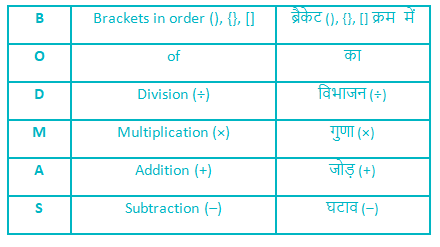
Calculation:
[(24 × 17) ÷ (2)3] + 41 = (?)2 + 11
⇒ [408 ÷ 8] + 41 = (?)2 + 11
⇒ 51 + 41 = (?)2 + 11
⇒ 92 – 11 = (?)2
⇒ (?)2 = 81
∴ ? = 9
47. What approximate value will come in the place of the question mark ‘?’ in the following question?
35.01 × 19.96 + 22.02 – ?% of 600 = 200
A. 60
B. 90
C. 75
D. 87
E. None
Solution
Concept used:
Follow the BODMAS rule to solve this question, as per the order given below:
Calculation:
Considering the following given question
35.01 × 19.96 + 22.02 – ?% of 600 = 200
On taking the approximate values, we get:
⇒ 35 × 20 + 22 – ?% of 600 = 200
⇒ 700 + 22 – (?/100) × 600 = 200
⇒ 722 – (? × 6) = 200
⇒ 722 – 200 = (? × 6)
⇒ ? = 522/6
⇒ ? = 87
∴ The value of ? is 87
48. A class consists of 12 boys and X girls. If the probability of getting a girls if a student is selected at random is 2/5, the value of X is?
A. 5
B. 6
C. 7
D. 8
E. 9
Solution
Concept:-
Classical concept of probability.
Calculation:-
Let total strength be = (12 + X)
Probability of getting a girl picked = X/(12 + X)
X/(12 + X) = 2/5
5X = 24 + 2X
X = 8
49. Study the following pie chart and answer the following questions.
Percentage-wise distribution of simple interest rate in six different banks
Total simple interest rate = 80%

Total principal = Rs. 50000
Question:
What will be the difference of simple interest of company A and company B after 5 years?
A. Rs. 20000
B. Rs. 3000
C. Rs. 2000
D. Rs. 400000
E. Rs. 200000
Solution
Calculation :
Company A
Simple interest rate = (80/360) × 90
⇒ 20%
Company B
Simple interest rate = (80/360) × 54
⇒ 12%
Now
Company A
Simple interest after 5 years = (principal × rate × time)/100
⇒ (50000 × 20 × 5)/100
⇒ Rs. 50000
Company B
Simple interest after 5 years = (principal × rate × time)/100
⇒ (50000 × 12 × 5)/100
⇒ Rs. 30000
Difference of simple interest = 50000 – 30000
⇒ Rs. 20000
50. Study the following pie chart and answer the following questions.
Percentage-wise distribution of simple interest rate in six different banks
Total simple interest rate = 80%

Total principal = Rs. 50000
Question:
What is the sum of total interest after 10 years of all companies?
A. 20000
B. 300000
C. 400000
D. 4000
E. 40000
Solution
Calculation :
Company A
Simple interest rate = (80/360) × 90
⇒ 20%
Company B
Simple interest rate = (80/360) × 54
⇒ 12%
Company C
Simple interest rate = (80/360) × 72
⇒ 16%
Company D
Simple interest rate = (80/360) × 54
⇒ 12%
Company E
Simple interest rate = (80/360) × 18
⇒ 4%
Company F
Simple interest rate = (80/360) × 72
⇒ 16%
Total rate = 20 + 12 + 16 + 12 + 4 + 16
⇒ 80%
Simple interest after 10 years of all companies = (principal × rate × time)/100
⇒ (50000 × 80 × 10)/100
⇒ Rs. 400000
51. Study the following pie chart and answer the following questions.
Percentage-wise distribution of simple interest rate in six different banks
Total simple interest rate = 80%
Total principal = Rs. 50000
Question:
What is the ratio of interest between company C and company D after 15 years?
A. 2 : 3
B. 1 : 2
C. 15 : 16
D. 4 : 3
E. 3 : 4
Solution
Calculation :
Company C
Simple interest rate = (80/360) × 72
⇒ 16%
Company D
Simple interest rate = (80/360) × 54
⇒ 12%
Now
Company C
Simple interest after 15 years = (principal × rate × time)/100
⇒ (50000 × 16 × 15)/100
⇒ Rs. 120000
Company D
Simple interest after 15 years = (principal × rate × time)/100
⇒ (50000 × 12 × 15)/100
⇒ Rs. 90000
∴ Required Ratio = 120000 : 90000
⇒ 4 : 3
Alternate Method As the simple interest varies proportionally to the degree allocated to different banks.
The ratio of degrees for Bank C:D = 72: 54
⇒ this comes out to be 4:3
⇒ 4 : 3
52. Study the following pie chart and answer the following questions.
Percentage-wise distribution of simple interest rate in six different banks
Total simple interest rate = 80%
Total principal = Rs. 50000
Question:
Find out after how many years the ratio of company A’s interest and company F’s interest will become 5 : 4?
A. 2
B. 3
C. 4
D. 5
E. Not dependent on time
Solution
Calculation :
Company A
Simple interest rate = (80/360) × 90
⇒ 20%
Company F
Simple interest rate = (80/360) × 72
⇒ 16%
Let’s assume after t years their ratio of interest will become 2 : 3
Company A
Simple interest after t years = (principal × rate × time)/100
⇒ (50000 × 20 × t)/100
⇒ Rs. 10000t
Company F
Simple interest after t years = (principal × rate × time)/100
⇒ (50000 × 16 × t)/100
⇒ Rs. 8000t
Now compare it with the given ratio
⇒ 10000t/8000t = 4/5
⇒ 4 : 5 = 4 : 5
So that the ratio of interest will not be dependent on time.
53. Study the following pie chart and answer the following questions.
Percentage-wise distribution of simple interest rate in six different banks
Total simple interest rate = 80%
Total principal = Rs. 50000
Question:
What is the sum of interest of company E after 5 years and company F after 20 years?
A. 170000
B. 180000
C. 160000
D. 155555
E. 140000
Solution
Calculation :
Company E
Simple interest rate = (80/360) × 18
⇒ 4%
Company F
Simple interest rate = (80/360) × 72
⇒ 16%
Now
Company E
Simple interest after 5 years = (principal × rate × time)/100
⇒ (50000 × 4 × 5)/100
⇒ Rs. 10000
Company F
Simple interest after 20 years = (principal × rate × time)/100
⇒ (50000 × 16 × 20)/100
⇒ Rs. 160000
∴ Required Sum = 10000 + 160000
⇒ Rs. 170000
54. E is 1/4 more efficient than F. E alone can complete a particular task in 15 days. Then, in how many days F and E completes a particular task, if both work together.
A. 12/17 days
B. 25/3 days
C. 15/19 days
D. 17/15 days
E. 13/16 days
Solution
Given:
E can complete the work = 15 days
Calculation:
Let the time taken by F to complete a task is x days.
125 ∶ 100 ∶∶ x ∶ 15
⇒ x = (125 × 15/100)
⇒ x = 75/4
E’s 1 day work = 1/15
F’s 1 day work = 4/75
Work done by E and F together in 1 day = [(1/15) + (4/75)]
= [(5 + 4)/75]
= 9/75∴ Work completed by E and F in = 75/9 days = 25/3 days.
55. How many litres of water should be added to a 90 litre mixture of milk and water containing milk and water in the ratio of 2 : 3 such that the resultant mixture has 70% water in it?
A. 15 litres
B. 30 litres
C. 12 litres
D. 18 litres
E. 21 litres
Solution
Let the quantity of new mixture be y litres.
The total quantity of mixture = 90 litres
The ratio in which milk and water is divided = 2 : 3
Now,
2x + 3x = 90
⇒ 5x = 90
⇒ x = 18
The quantity of milk in mixture = 2x = 2 × 18 = 36 litres
The quantity of water in mixture = 3x = 3 × 18 = 54 litres
According to question,
The quantity of milk in new mixture = 30%
30% of new mixture = quantity of milk in previous mixture
30% of y = 36 litres
70% of y = (36/30) × 70 = 84 litres∴ The quantity of water to be mixed = 84 – 54 = 30 litres.
56. In the given question, two equations numbered l and II are given. Solve both the equations and mark the appropriate answer.
I. x2 – 9x + 20 = 0
II. y2 – 5y + 6 = 0
A. x > y
B. x < y
C. x ≥ y
D. x ≤ y
E. x = y or relationship between x and y cannot be established.
Solution
I. x2 – 9x + 20 = 0
⇒ x2 – 5x – 4x + 20 = 0
⇒ (x – 4) (x – 5) = 0
⇒ x =4, 5
II. y2 – 5y + 6 = 0
⇒ y2 – 3y – 2y + 6 = 0
⇒ (y – 2) (y – 3) = 0
⇒ y = 2, 3
| Value of x | Value of y | Relation |
| 4 | 2 | x > y |
| 4 | 3 | x > y |
| 5 | 2 | x > y |
| 5 | 3 | x > y |
Hence, x > y
57. In the given question, two equations numbered l and II are given. Solve both the equations and mark the appropriate answer.
I. x2 – x – 2 = 0
II. y2 + 5y + 6 = 0
A. x > y
B. x < y
C. x ≥ y
D. x ≤ y
E. x = y or relationship between x and y cannot be established.
Solution
I. x2 – x – 2 = 0
⇒ x2 – 2x + x – 2 = 0
⇒ (x – 2)(x + 1) = 0
⇒ x = 2, –1
II. y2+ 5y + 6 = 0
⇒ y2 + 3y + 2y + 6 = 0
⇒ (y + 2)(y + 3) = 0
⇒ y = –2, –3
| Value of x | Value of y | Relation |
| 2 | –2 | x > y |
| 2 | –3 | x > y |
| –1 | –2 | x > y |
| –1 | –3 | x > y |
Hence, x > y.
58. In the given question, two equations numbered l and II are given. Solve both the equations and mark the appropriate answer.
I.x2 – 31x + 238 = 0
II. y2 – 26y + 168 = 0
A. x > y
B. x < y
C. x ≥ y
D. x ≤ y
E. x = y or relationship between x and y cannot be established.
Solution
I. x2 – 31x + 238 = 0
⇒x2 – 17x – 14x + 238 = 0
⇒ (x – 14) (x – 17) = 0
⇒ x = 14, 17
II. y2 – 26y + 168 = 0
⇒ y2 – 12y – 14y + 168 = 0
⇒ (y – 12)(y – 14) = 0
⇒ y = 12, 14
| Value of x | Value of y | Relation |
| 14 | 12 | x > y |
| 14 | 14 | x = y |
| 17 | 12 | x > y |
| 17 | 14 | x > y |
Hence, x ≥ y.
59. In the given question, two equations numbered l and II are given. Solve both the equations and mark the appropriate answer.
i. x2 + 4x + 3 = 0ii. 2y2 + 7y + 6 = 0
A. if x > y
B. if x < y
C. if x ≥ y
D. if x ≤ y
E. if x = y or relationship can’t be established
Solution
Equation i
x2 + 4x + 3 = 0
⇒ x2 + 3x + x + 3 = 0
⇒ x (x + 3) + 1(x + 3) = 0
⇒ (x + 3) (x + 1) = 0
⇒ x = – 3, – 1
Equation ii
2y2 + 7y + 6 = 0
⇒ 2y2 + 4y + 3y + 6 = 0
⇒ 2y (y + 2) + 3 (y + 2) = 0
⇒ (y + 2) (2y + 3) = 0
⇒ y = -2, – 1.5Hence, relation between x and y cannot be established.
60. In the given question, two equations numbered l and II are given. Solve both the equations and mark the appropriate answer.
x2 + 8x + 12 = 0y2 + 14y + 45 = 0
A. if x > y
B. if x < y
C. if x ≥ y
D. if x ≤ y
E. if x = y or relationship can’t be established
Solution
Equation i
x2 + 8x + 12 = 0
⇒ x2 + 6x + 2x + 12 = 0
⇒ x (x + 6) + 2(x + 6) = 0
⇒ (x + 6) (x + 2) = 0
⇒ x = – 6, – 2
Equation ii
y2 + 14y + 45 = 0
⇒ y2 + 9y + 5y + 45 = 0
⇒ y (y + 9) + 5 (y + 9) = 0
⇒ (y + 9) (y + 5) = 0
⇒ y = – 9, – 5
| Value of x | Value of y | Relation |
| – 6 | –9 | x > y |
| – 6 | – 5 | x < y |
| – 2 | –9 | x > y |
| – 2 | – 5 | x > y |
Hence, relation between x and y can’t be established
61. A empty tank has capacity 6,600 litres. If water flows into the tank from pipe A at a rate of 9 litre/min and water is pumped out by pipe B at a rate of 7 litre/min, then in how many hours will the tank be filled?
A. 110 hr
B. 165 hr
C. 44 hr
D. 55 hr
E. 33 hr
Solution
Given:
Capacity of tank = 6,600 litres
Efficiency of pipe A = 9 litre /min.
Efficiency of pipe B = 7 litre /min.
Calculations:
Pipe A works as an inlet pipe and pipe B works as an outlet pipe.
In 1 min tank filled by pipe A and B = 9 – 7 = 2 litre
Total time taken to fill the tank = 6,600/2 = 3,300 min
Total time taken in hours = 3,300/60 = 55 hours∴ Total times taken in hours = 55 hours
62. Raghav covered a distance of 122 km in 10 hours. He covered partly on bicycle at speed of 8 km/hr and partly on bike at the speed of 18 km/hr. How much distance covered by bicycle?
A. 44.4 km
B. 45.4 km
C. 46.4 km
D. 47.4 km
E. 48.4 km
Solution
Time taken by bicycle + time taken by bike = time taken to cover whole distance
Let the distance covered by the bicycle be d.
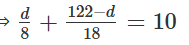
⇒ 18d + 122 × 8 – 8 d = 18 × 10 × 8
⇒ d = 46.4 km∴ 46.4 km covered by bicycle.
63. A vegetable vendor claims to sell his vegetables at a cost price but uses a weight of 800 gm instead of kg weight. Thus he makes a profit of :
A. 10%
B. 20%
C. 30%
D. 22%
E. 25%
Solution
Given:
True weight = 1000 g
False length = 800 g
Formula Used:
Profit% = True weight – false weight/false weight × 100
Calculations:
According to the formula,
Profit% = True weight – false weight/false weight × 100
⇒ 1000 – 800/800 × 100
⇒ 200/800 × 100
⇒ 100/4
⇒ 25%The vegetable vendor made a profit of 25%.
64. If the radius of the circle is 7/5 side of the square. The perimeter of the square is 80 meters. Find the area of the circle ?
A. 1728 sq m
B. 2464 sq m
C. 2326 sq m
D. 1525 sq m
E. 1764 sq m
Solution
Perimeter of the square is 80m
⇒ 4a = 80m
⇒ a = 20m
Then side of square is 20m
Relation of radius of circle to side of square is given
⇒ R = ( 7/ 5 ) × 20
⇒ R = 28
Then, Area of the circle is 22/7 ×R × R
⇒ (22/ 7) × 28 × 28
⇒ 88 × 28
⇒ 2464 sq m
Hence 2464 is the correct answer.
65. A man can row 60 km upstream and 100km downstream in same time. If the speed of boat in still water is 20 km / hr, find the speed of stream?
A. 7 km / hr
B. 8 km / hr
C. 5 km / hr
D. 9 km / hr
E. 10 km / hr
Solution
Given∶
Distance travelled upstream = 60 km
Distance travelled upstream = 100 km
The speed of boat in still water is 20 km / hr.
Formula used∶
Let u and v be the speed of boat in still water and speed of stream respectively.
Speed upstream = (u – v)
Speed downstream = (u + v)
Calculations∶
Let the speed of stream be x.
Speed upstream = (20 – x) km / hr
Speed downstream = (20 + x) km / hr

According to the question time taken in travelling upstream and downstream is same;
On equating (1) and (2) we get x = 5km / hrHence the speed of stream is 5 km / hr
66. Direction: Study the following information carefully to answer the given questions.
Eight persons A, B, C, D, E, F, G and H sit around a square table. Four persons sit at corner and face away from centre. Two persons sit on each of the two opposite sides of the table, some of them face towards the centre and some of them face away from centre.
A sits at one of the corners of the square table. E sits diagonally opposite A. B who sits to the immediate left of E faces towards the centre. One person sits between B and H who is not an immediate neighbour of A. F who faces direction same as B is neither an immediate neighbour of H nor A. G is not an immediate neighbour of A and face direction same as that of B. C face direction opposite to that of G but does not sit at any of the corner of the table.
Question:
Which of the following statements are true according to the given arrangement?
i) C sits third to the left of D.
ii) Four persons face away from centre.
iii) E sits second to the right of G.
A. Only statement I is true
B. Both statements I and II are true.
C. Both statements I and III are true.
D. Only statement III is true.
E. Only statement II is true.
Solution
Eight persons: A, B, C, D, E, F, G and H
i) Four persons sit at corner and face away from centre.
ii) Two persons sit on each of the two opposite sides of the table, some of them face towards the centre and some of them face away from centre.

iii) A sits at one of the corners of the square table.
iv) E sits diagonally opposite A.
v) B who sits to the immediate left of E faces towards the centre.
This means B sits at one of the sides of the table.
vi) One person sits between B and H who is not an immediate neighbour of A.

vii) F who faces direction same as B is neither an immediate neighbour of H nor A.
viii) G is not an immediate neighbour of A and face direction same as that of B.
ix) C face direction opposite to that of G but does not sit at any of the corner of the table.

i) C sits third to the left of D. → False (as C sits second to the left of D)
ii) Four persons face away from centre. → False (as five persons face away from centre)
iii) E sits second to the right of G. → True
Hence, only statement III is true.
67. Direction: Study the following information carefully to answer the given questions.
Eight persons A, B, C, D, E, F, G and H sit around a square table. Four persons sit at corner and face away from centre. Two persons sit on each of the two opposite sides of the table, some of them face towards the centre and some of them face away from centre.
A sits at one of the corners of the square table. E sits diagonally opposite A. B who sits to the immediate left of E faces towards the centre. One person sits between B and H who is not an immediate neighbour of A. F who faces direction same as B is neither an immediate neighbour of H nor A. G is not an immediate neighbour of A and face direction same as that of B. C face direction opposite to that of G but does not sit at any of the corner of the table.
Question:
What is the position of G with respect to F?
A. Third to the right
B. Second to the left
C. Fourth to the right
D. Third to the left
E. Second to the right
Solution
Eight persons: A, B, C, D, E, F, G and H
i) Four persons sit at corner and face away from centre.
ii) Two persons sit on each of the two opposite sides of the table, some of them face towards the centre and some of them face away from centre.
iii) A sits at one of the corners of the square table.
iv) E sits diagonally opposite A.
v) B who sits to the immediate left of E faces towards the centre.
This means B sits at one of the sides of the table.
vi) One person sits between B and H who is not an immediate neighbour of A.
vii) F who faces direction same as B is neither an immediate neighbour of H nor A.
viii) G is not an immediate neighbour of A and face direction same as that of B.
ix) C face direction opposite to that of G but does not sit at any of the corner of the table.
Hence, G sits fourth to the right of F.
68. Direction: Study the following information carefully to answer the given questions.
Eight persons A, B, C, D, E, F, G and H sit around a square table. Four persons sit at corner and face away from centre. Two persons sit on each of the two opposite sides of the table, some of them face towards the centre and some of them face away from centre.
A sits at one of the corners of the square table. E sits diagonally opposite A. B who sits to the immediate left of E faces towards the centre. One person sits between B and H who is not an immediate neighbour of A. F who faces direction same as B is neither an immediate neighbour of H nor A. G is not an immediate neighbour of A and face direction same as that of B. C face direction opposite to that of G but does not sit at any of the corner of the table.
Question:
Who sits second to the right of D?
A. B
B. E
C. A
D. G
E. H
Solution
Eight persons: A, B, C, D, E, F, G and H
i) Four persons sit at corner and face away from centre.
ii) Two persons sit on each of the two opposite sides of the table, some of them face towards the centre and some of them face away from centre.
iii) A sits at one of the corners of the square table.
iv) E sits diagonally opposite A.
v) B who sits to the immediate left of E faces towards the centre.
This means B sits at one of the sides of the table.
vi) One person sits between B and H who is not an immediate neighbour of A.
vii) F who faces direction same as B is neither an immediate neighbour of H nor A.
viii) G is not an immediate neighbour of A and face direction same as that of B.
ix) C face direction opposite to that of G but does not sit at any of the corner of the table.
Hence, B sits second to the right of D.
69. Direction: Study the following information carefully to answer the given questions.
Eight persons A, B, C, D, E, F, G and H sit around a square table. Four persons sit at corner and face away from centre. Two persons sit on each of the two opposite sides of the table, some of them face towards the centre and some of them face away from centre.
A sits at one of the corners of the square table. E sits diagonally opposite A. B who sits to the immediate left of E faces towards the centre. One person sits between B and H who is not an immediate neighbour of A. F who faces direction same as B is neither an immediate neighbour of H nor A. G is not an immediate neighbour of A and face direction same as that of B. C face direction opposite to that of G but does not sit at any of the corner of the table.
Question:
Four of the five are alike and thus form a group. Find the person who does not belong to the group.
A. A
B. D
C. E
D. H
E. C
Solution
Eight persons: A, B, C, D, E, F, G and H
i) Four persons sit at corner and face away from centre.
ii) Two persons sit on each of the two opposite sides of the table, some of them face towards the centre and some of them face away from centre.
iii) A sits at one of the corners of the square table.
iv) E sits diagonally opposite A.
v) B who sits to the immediate left of E faces towards the centre.
This means B sits at one of the sides of the table.
vi) One person sits between B and H who is not an immediate neighbour of A.
vii) F who faces direction same as B is neither an immediate neighbour of H nor A.
viii) G is not an immediate neighbour of A and face direction same as that of B.
ix) C face direction opposite to that of G but does not sit at any of the corner of the table.
Here, A, D, E and H sit at four corners of the seat.
Hence, C does not belong to the group.
70. Direction: Study the following information carefully to answer the given questions.
Eight persons A, B, C, D, E, F, G and H sit around a square table. Four persons sit at corner and face away from centre. Two persons sit on each of the two opposite sides of the table, some of them face towards the centre and some of them face away from centre.
A sits at one of the corners of the square table. E sits diagonally opposite A. B who sits to the immediate left of E faces towards the centre. One person sits between B and H who is not an immediate neighbour of A. F who faces direction same as B is neither an immediate neighbour of H nor A. G is not an immediate neighbour of A and face direction same as that of B. C face direction opposite to that of G but does not sit at any of the corner of the table.
Question:
How many persons face away from centre?
A. Four
B. Five
C. Six
D. Seven
E. Eight
Solution
Eight persons: A, B, C, D, E, F, G and H
i) Four persons sit at corner and face away from centre.
ii) Two persons sit on each of the two opposite sides of the table, some of them face towards the centre and some of them face away from centre.
iii) A sits at one of the corners of the square table.
iv) E sits diagonally opposite A.
v) B who sits to the immediate left of E faces towards the centre.
This means B sits at one of the sides of the table.
vi) One person sits between B and H who is not an immediate neighbour of A.
vii) F who faces direction same as B is neither an immediate neighbour of H nor A.
viii) G is not an immediate neighbour of A and face direction same as that of B.
ix) C face direction opposite to that of G but does not sit at any of the corner of the table.
Hence, five persons face away from centre.
71. In the word DEVELOPERS, all the even position letters are replaced with previous letter and all the odd positions letters are replaced with next letter. Then are arranged in English alphabetical order. Which letter is at the fifth position from the left in the final result?
A. M
B. R
C. S
D. W
E. D
Solution
Given word: DEVELOPERS
According to the conditions,
I. Even positions – Previous letters and odd positions – next letter;
II. Consonants alphabetical order followed by vowels alphabetical order;
| Letters | D | E | V | E | L | O | P | E | R | S |
| Even Position – -1, Odd position – +1 | +1 | -1 | +1 | -1 | +1 | -1 | +1 | -1 | +1 | -1 |
| Resultant | E | D | W | D | M | N | Q | D | S | R |
| Alphabetical order | D | D | D | E | M | N | Q | R | S | W |
Hence, ‘M’ is at the fifth position from the left in the final result.
72. Direction: Study the following information carefully and answer the given questions.
In a certain code language
‘ti si ni hi’ means ‘there is one hill’,
‘si te mi di’ means ‘the mountain is dangerous’,
‘hi te ci se’ means ‘seema climbs the hill’,
’li mi si sa’ means ‘mountain is all snowy’.
Question:
Which of the following code represents the word ‘seema’?
A. ci
B. si
C. Se
D. Either 1) or 3)
E. hi
Solution
In certain coding language,

Hence, code for ‘seema’ is either ‘ci’ or ‘se’.
73. Direction: Study the following information carefully and answer the given questions.
In a certain code language
‘ti si ni hi’ means ‘there is one hill’,
‘si te mi di’ means ‘the mountain is dangerous’,
‘hi te ci se’ means ‘seema climbs the hill’,
’li mi si sa’ means ‘mountain is all snowy’.
Question:
In a certain language ‘the snowy hill of the mountain is dangerous’ is coded as ‘te sa hi fi te mi si di’, then what would be the code for ‘of’?
A. te
B. sa
C. fi
D. Either 2) or 3)
E. si
Solution
In certain coding language,
Code for ‘the’ is ‘te’,
Code for ‘snowy is either ‘li’ or ‘sa’, here it is ‘sa’,
Code for ‘hill’ is ‘hi’,
Code for ‘mountain’ is ‘mi’
Code for ‘is’ is ‘si’
Thus code for ‘of’ should be ‘fi’.
Hence, ‘fi’ is correct answer.
74. Direction: Study the following information carefully and answer the given questions.
In a certain code language
‘ti si ni hi’ means ‘there is one hill’,
‘si te mi di’ means ‘the mountain is dangerous’,
‘hi te ci se’ means ‘seema climbs the hill’,
’li mi si sa’ means ‘mountain is all snowy’.
Question:
What would be the code for ‘the hill is dangerous’?
A. te hi si di
B. ti hi sa mi
C. ti hi si di
D. ni hi si di
E. te hi sa di
Solution
In certain coding language,
Code for ‘the’ is ‘te’,
Code for ‘hill’ is ‘hi’,
Code for ‘is’ is ‘si’,
Code for ‘dangerous’ is ‘di’,Hence, ‘te hi si di’ is the correct answer.
75. Direction: Study the following information carefully and answer the given questions.
In a certain code language
‘ti si ni hi’ means ‘there is one hill’,
‘si te mi di’ means ‘the mountain is dangerous’,
‘hi te ci se’ means ‘seema climbs the hill’,
’li mi si sa’ means ‘mountain is all snowy’.
Question:
Code ‘sa’ is for which word in the given language?
A. all
B. is
C. snowy
D. Either 1) or 2)
E. Either 1) or 3)
Solution
In certain coding language,
Hence ‘sa’ is code for either ‘all’ or ‘snowy’.
76. In the question below are given two statements followed by two conclusions numbered I and II. You have to take the given statements to be true even if they seem to be at variance with commonly known facts. Read all the conclusions and then decide which of the given conclusions logically follows from the given statements disregarding commonly known facts.
Statements:
I. Only a few Doctors are Engineers
II. Some Doctors are not Nurse
Conclusions:
I. Some Nurse are DoctorsII. Some Engineers are Nurse
A. Only conclusion I follows
B. Only conclusion II follows
C. Both conclusion I and II follows
D. Either conclusion I or II follows
E. None of the conclusion follows
Solution
The least possible Venn diagram for the given statements is as follows,

I. Some Nurse are Doctors → False (It is not definite)
II. Some Engineers are Nurse → False (It is not definite)
Hence, ‘none of the conclusion follows’.
77. Direction: In the question below are given two statements followed by two conclusions numbered I and II. You have to take the given statements to be true even if they seem to be at variance with commonly known facts. Read all the conclusions and then decide which of the given conclusions logically follows from the given statements disregarding commonly known facts.
Statement:
Only a few movies are serials.
Only a few movies are shows.
Conclusion:
I. Some serials are movies.II. All movies are serials is a possibility
A. Only I follows
B. Only II follows
C. Either I or II follows
D. Neither I nor II follows
E. Both I and II follow
Solution
The least possible diagram for the given statements is as follows

Conclusions:
I. Some serials are movies → True (Part of serials are movies)
II. All movies are serials is a possibility → False (It is given that only few movies are serials that mean some part of movies are definitely not serials)
Only I follows.
78. Direction: In the question below are given two statements followed by two conclusions numbered I and II. You have to take the given statements to be true even if they seem to be at variance with commonly known facts. Read all the conclusions and then decide which of the given conclusions logically follows from the given statements disregarding commonly known facts.
Statement:
Only a few teachers are professors.
All professors are principal.
Conclusion:
I. All teachers are principal.II. Some teachers are principal
A. Only I follows
B. Only II follows
C. Either I or II follows
D. Neither I nor II follows
E. Both I and II follow
Solution
The least possible diagram for the given statements is as follows

Conclusions:
I. All teachers are principal → False (It is possible but not definite)
II. Some teachers are principal → True (Part of teachers are principal)
Only II follows.
79. Direction: Read the following information carefully and answer the questions.Nine boxes – A, B, C, D, E, F, G, H, and I are placed one above the other vertically, not necessarily in the same order. Only three boxes are placed between B and F which is not the lowermost box. H is placed three places below C but kept immediately above E. Number of boxes placed between D and G is same as G and F. B is kept immediately below I which is not the topmost box. G and H are placed one of the places below B. Only three boxes are placed between D and C.
Question:
Four of the following five belongs to a group in a certain way, find which of the one does not belong to that group?
A. F – E
B. D – B
C. I – G
D. A – F
E. A – H
Solution
1) B is kept immediately below I which is not the topmost box.
2) Only three boxes are placed between B and F which is not the lowermost box.
3) Number of boxes placed between D and G is same as G and F.
4) G and H are placed one of the places below B.
Case 1:
| Sl No. | Box |
| 1 | |
| 2 | I |
| 3 | B |
| 4 | |
| 5 | D |
| 6 | G |
| 7 | F |
| 8 | |
| 9 |
Case 2:
| Sl No. | Box |
| 1 | D |
| 2 | I |
| 3 | B |
| 4 | G |
| 5 | |
| 6 | |
| 7 | F |
| 8 | |
| 9 |
Case 3:
| Sl No. | Box |
| 1 | |
| 2 | |
| 3 | I |
| 4 | B |
| 5 | |
| 6 | D |
| 7 | G |
| 8 | F |
| 9 |
5) H is placed three places below C but kept immediately above E.
6) Only three boxes are placed between D and C.
Case 1:
This case cannot be considered.
| Sl No. | Box |
| 1 | |
| 2 | I |
| 3 | B |
| 4 | |
| 5 | D |
| 6 | G |
| 7 | F |
| 8 | H |
| 9 | E |
Case 2:
| Sl No. | Box |
| 1 | D |
| 2 | I |
| 3 | B |
| 4 | G |
| 5 | C |
| 6 | |
| 7 | F |
| 8 | H |
| 9 | E |
Case 3:
This case is eliminated as there is no place for E.
| Sl No. | Box |
| 1 | |
| 2 | C |
| 3 | I |
| 4 | B |
| 5 | H |
| 6 | D |
| 7 | G |
| 8 | F |
| 9 |
So the final arrangement is
Case 2:
| Sl No. | Box |
| 1 | D |
| 2 | I |
| 3 | B |
| 4 | G |
| 5 | C |
| 6 | A |
| 7 | F |
| 8 | H |
| 9 | E |
Only one box is kept between them except A and F.
80. Direction: Read the following information carefully and answer the questions.Nine boxes – A, B, C, D, E, F, G, H, and I are placed one above the other vertically, not necessarily in the same order. Only three boxes are placed between B and F which is not the lowermost box. H is placed three places below C but kept immediately above E. Number of boxes placed between D and G is same as G and F. B is kept immediately below I which is not the topmost box. G and H are placed one of the places below B. Only three boxes are placed between D and C.
Question:
C is place immediately above which of the following box?
A. H
B. F
C. A
D. D
E. I
Solution
1) B is kept immediately below I which is not the topmost box.
2) Only three boxes are placed between B and F which is not the lowermost box.
3) Number of boxes placed between D and G is same as G and F.
4) G and H are placed one of the places below B.
Case 1:
| Sl No. | Box |
| 1 | |
| 2 | I |
| 3 | B |
| 4 | |
| 5 | D |
| 6 | G |
| 7 | F |
| 8 | |
| 9 |
Case 2:
| Sl No. | Box |
| 1 | D |
| 2 | I |
| 3 | B |
| 4 | G |
| 5 | |
| 6 | |
| 7 | F |
| 8 | |
| 9 |
Case 3:
| Sl No. | Box |
| 1 | |
| 2 | |
| 3 | I |
| 4 | B |
| 5 | |
| 6 | D |
| 7 | G |
| 8 | F |
| 9 |
5) H is placed three places below C but kept immediately above E.
6) Only three boxes are placed between D and C.
Case 1:
This case cannot be considered.
| Sl No. | Box |
| 1 | |
| 2 | I |
| 3 | B |
| 4 | |
| 5 | D |
| 6 | G |
| 7 | F |
| 8 | H |
| 9 | E |
Case 2:
| Sl No. | Box |
| 1 | D |
| 2 | I |
| 3 | B |
| 4 | G |
| 5 | C |
| 6 | |
| 7 | F |
| 8 | H |
| 9 | E |
Case 3:
This case is eliminated as there is no place for E.
| Sl No. | Box |
| 1 | |
| 2 | C |
| 3 | I |
| 4 | B |
| 5 | H |
| 6 | D |
| 7 | G |
| 8 | F |
| 9 |
So the final arrangement is
Case 2:
| Sl No. | Box |
| 1 | D |
| 2 | I |
| 3 | B |
| 4 | G |
| 5 | C |
| 6 | A |
| 7 | F |
| 8 | H |
| 9 | E |
So the answer is A.
81. Direction: Read the following information carefully and answer the questions.Nine boxes – A, B, C, D, E, F, G, H, and I are placed one above the other vertically, not necessarily in the same order. Only three boxes are placed between B and F which is not the lowermost box. H is placed three places below C but kept immediately above E. Number of boxes placed between D and G is same as G and F. B is kept immediately below I which is not the topmost box. G and H are placed one of the places below B. Only three boxes are placed between D and C.
Question:
What is the position B in the arrangement?
A. Kept at Top
B. Lowermost box
C. Second from the bottom
D. Third from the top
E. Second from the top
Solution
1) B is kept immediately below I which is not the topmost box.
2) Only three boxes are placed between B and F which is not the lowermost box.
3) Number of boxes placed between D and G is same as G and F.
4) G and H are placed one of the places below B.
Case 1:
| Sl No. | Box |
| 1 | |
| 2 | I |
| 3 | B |
| 4 | |
| 5 | D |
| 6 | G |
| 7 | F |
| 8 | |
| 9 |
Case 2:
| Sl No. | Box |
| 1 | D |
| 2 | I |
| 3 | B |
| 4 | G |
| 5 | |
| 6 | |
| 7 | F |
| 8 | |
| 9 |
Case 3:
| Sl No. | Box |
| 1 | |
| 2 | |
| 3 | I |
| 4 | B |
| 5 | |
| 6 | D |
| 7 | G |
| 8 | F |
| 9 |
5) H is placed three places below C but kept immediately above E.
6) Only three boxes are placed between D and C.
Case 1:
This case cannot be considered.
| Sl No. | Box |
| 1 | |
| 2 | I |
| 3 | B |
| 4 | |
| 5 | D |
| 6 | G |
| 7 | F |
| 8 | H |
| 9 | E |
Case 2:
| Sl No. | Box |
| 1 | D |
| 2 | I |
| 3 | B |
| 4 | G |
| 5 | C |
| 6 | |
| 7 | F |
| 8 | H |
| 9 | E |
Case 3:
This case is eliminated as there is no place for E.
| Sl No. | Box |
| 1 | |
| 2 | C |
| 3 | I |
| 4 | B |
| 5 | H |
| 6 | D |
| 7 | G |
| 8 | F |
| 9 |
So the final arrangement is
Case 2:
| Sl No. | Box |
| 1 | D |
| 2 | I |
| 3 | B |
| 4 | G |
| 5 | C |
| 6 | A |
| 7 | F |
| 8 | H |
| 9 | E |
Therefore, the answer is third from the top.
82. Direction: Read the following information carefully and answer the questions.Nine boxes – A, B, C, D, E, F, G, H, and I are placed one above the other vertically, not necessarily in the same order. Only three boxes are placed between B and F which is not the lowermost box. H is placed three places below C but kept immediately above E. Number of boxes placed between D and G is same as G and F. B is kept immediately below I which is not the topmost box. G and H are placed one of the places below B. Only three boxes are placed between D and C.
Question:
How many boxes are kept between D and I?
A. None
B. One
C. Two
D. Three
E. Five
Solution
1) B is kept immediately below I which is not the topmost box.
2) Only three boxes are placed between B and F which is not the lowermost box.
3) Number of boxes placed between D and G is same as G and F.
4) G and H are placed one of the places below B.
Case 1:
| Sl No. | Box |
| 1 | |
| 2 | I |
| 3 | B |
| 4 | |
| 5 | D |
| 6 | G |
| 7 | F |
| 8 | |
| 9 |
Case 2:
| Sl No. | Box |
| 1 | D |
| 2 | I |
| 3 | B |
| 4 | G |
| 5 | |
| 6 | |
| 7 | F |
| 8 | |
| 9 |
Case 3:
| Sl No. | Box |
| 1 | |
| 2 | |
| 3 | I |
| 4 | B |
| 5 | |
| 6 | D |
| 7 | G |
| 8 | F |
| 9 |
5) H is placed three places below C but kept immediately above E.
6) Only three boxes are placed between D and C.
Case 1:
This case cannot be considered.
| Sl No. | Box |
| 1 | |
| 2 | I |
| 3 | B |
| 4 | |
| 5 | D |
| 6 | G |
| 7 | F |
| 8 | H |
| 9 | E |
Case 2:
| Sl No. | Box |
| 1 | D |
| 2 | I |
| 3 | B |
| 4 | G |
| 5 | C |
| 6 | |
| 7 | F |
| 8 | H |
| 9 | E |
Case 3:
This case is eliminated as there is no place for E.
| Sl No. | Box |
| 1 | |
| 2 | C |
| 3 | I |
| 4 | B |
| 5 | H |
| 6 | D |
| 7 | G |
| 8 | F |
| 9 |
So the final arrangement is
Case 2:
| Sl No. | Box |
| 1 | D |
| 2 | I |
| 3 | B |
| 4 | G |
| 5 | C |
| 6 | A |
| 7 | F |
| 8 | H |
| 9 | E |
Hence, the answer is none.
83. Direction: Read the following information carefully and answer the questions.Nine boxes – A, B, C, D, E, F, G, H, and I are placed one above the other vertically, not necessarily in the same order. Only three boxes are placed between B and F which is not the lowermost box. H is placed three places below C but kept immediately above E. Number of boxes placed between D and G is same as G and F. B is kept immediately below I which is not the topmost box. G and H are placed one of the places below B. Only three boxes are placed between D and C.
Question:
Which of the following box is placed immediately below B?
A. D
B. G
C. I
D. H
E. C
Solution
1) B is kept immediately below I which is not the topmost box.
2) Only three boxes are placed between B and F which is not the lowermost box.
3) Number of boxes placed between D and G is same as G and F.
4) G and H are placed one of the places below B.
Case 1:
| Sl No. | Box |
| 1 | |
| 2 | I |
| 3 | B |
| 4 | |
| 5 | D |
| 6 | G |
| 7 | F |
| 8 | |
| 9 |
Case 2:
| Sl No. | Box |
| 1 | D |
| 2 | I |
| 3 | B |
| 4 | G |
| 5 | |
| 6 | |
| 7 | F |
| 8 | |
| 9 |
Case 3:
| Sl No. | Box |
| 1 | |
| 2 | |
| 3 | I |
| 4 | B |
| 5 | |
| 6 | D |
| 7 | G |
| 8 | F |
| 9 |
5) H is placed three places below C but kept immediately above E.
6) Only three boxes are placed between D and C.
Case 1:
This case cannot be considered.
| Sl No. | Box |
| 1 | |
| 2 | I |
| 3 | B |
| 4 | |
| 5 | D |
| 6 | G |
| 7 | F |
| 8 | H |
| 9 | E |
Case 2:
| Sl No. | Box |
| 1 | D |
| 2 | I |
| 3 | B |
| 4 | G |
| 5 | C |
| 6 | |
| 7 | F |
| 8 | H |
| 9 | E |
Case 3:
This case is eliminated as there is no place for E.
| Sl No. | Box |
| 1 | |
| 2 | C |
| 3 | I |
| 4 | B |
| 5 | H |
| 6 | D |
| 7 | G |
| 8 | F |
| 9 |
So the final arrangement is
Case 2:
| Sl No. | Box |
| 1 | D |
| 2 | I |
| 3 | B |
| 4 | G |
| 5 | C |
| 6 | A |
| 7 | F |
| 8 | H |
| 9 | E |
Therefore answer is G.
84. Direction: Study the following arrangement carefully and answer the questions given below:
A K 4 H € U N 8 % Q F $ L 1 I B # O 6 Z @ 3 7 C V 2 A 5 W 9 G
Question:
Which of the following is exactly in the middle the tenth element from the left end and the eighth element from the right end in the given arrangement?
A. #
B. K
C. 2
D. $
E. None of these
Solution
Given series is: (Left) A K 4 H € U N 8 % Q F $ L 1 I B # O 6 Z @ 3 7 C V 2a 5 W 9 G (Right)
10th from the left end → Q
8th from the right end → C
(Left) A K 4 H € U N 8 % Q F $ L 1 I B # O 6 Z @ 3 7 C V 2 a 5 W 9 G (Right)
Terms between Q and C are F, $, L, 1, I, B, #, O, 6, Z, @, 3, 7 and # is exactly in the middle of them.Hence, # is the correct answer.
85. Direction: Study the following arrangement carefully and answer the questions given below:
A K 4 H € U N 8 % Q F $ L 1 I B # O 6 Z @ 3 7 C V 2 A 5 W 9 G
Question:
Which of the following is the fourth element to the left of the twentieth element from the right end of the given arrangement?
A. U
B. N
C. %
D. Q
E. 8
Solution
Given series is: (Left) A K 4 H € U N 8 % Q F $ L 1 I B # O 6 Z @ 3 7 C V 2 a 5 W 9 G (Right)
20th element from the right = $
4th element to the left of $ = 8Hence, 8 is the correct answer.
86. Direction: Study the following arrangement carefully and answer the questions given below:
A K 4 H € U N 8 % Q F $ L 1 I B # O 6 Z @ 3 7 C V 2 A 5 W 9 G
Question:
How many such numbers are there in the given arrangement, each of which is immediately preceded by a consonant and immediately followed by a symbol?
A. None
B. One
C. Two
D. Three
E. None of these
Solution
Given series is: A K 4 H € U N 8 % Q F $ L 1 I B # O 6 Z @ 3 7 C V 2 a 5 W 9 G
Arrangement required: Consonant → Number→ Symbol
(Left) A K 4 H € U N 8 % Q F $ L 1 I B # O 6 Z @ 3 7 C V 2 a 5 W 9 G (Right)Hence, One such pairs are there i.e. N 8 %
87. Direction: Study the following arrangement carefully and answer the questions given below:
A K 4 H € U N 8 % Q F $ L 1 I B # O 6 Z @ 3 7 C V 2 A 5 W 9 G
Question:
How many such numbers are there in the given arrangement, each of which is both immediately preceded and immediately followed by a consonant?
A. None
B. One
C. Two
D. Three
E. More than three
Solution
Given series is: A K 4 H € U N 8 % Q F $ L 1 I B # O 6 Z @ 3 7 C V 2 a 5 W 9 G
Arrangement required: Consonant → Number → Consonant
(Left) A K 4 H € U N 8 % Q F $ L 1 I B # O 6 Z @ 3 7 C V 2 a 5 W 9 G (Right)Hence two such pairs are there i.e. K 4 H and W 9 G.
88. Direction: Study the following arrangement carefully and answer the questions given below:
A K 4 H € U N 8 % Q F $ L 1 I B # O 6 Z @ 3 7 C V 2 A 5 W 9 G
Question:
How many such vowels are there in the given arrangement, each of which is immediately preceded by a number and immediately followed by a consonant?
A. None
B. One
C. Two
D. Three
E. More than three
Solution
Given series is: A K 4 H € U N 8 % Q F $ L 1 I B # O 6 Z @ 3 7 C V 2 a 5 W 9 G
Arrangement required: Number → Vowel → Consonant
(Letter) A K 4 H € U N 8 % Q F $ L 1 I B # O 6 Z @ 3 7 C V 2 a 5 W 9 G (Right)Hence, only one such pair is there i.e. 1 I B.
89. Directions: Read the information and answer the given questions.
Eight persons, namely, P, Q, R, S, T, U, V, and W, each purchased a ring of one of three types: Gold, Platinum, or Diamond, but not necessarily in the same order. At least two people purchased the same type of ring.
Exactly three people purchased diamond rings. U did not purchase either a gold or a diamond ring. R did not purchase the same type of ring as S. Only Q purchased the same type of ring as W. Both P and V purchased the same type of ring. S purchased a diamond ring. T doesn’t purchase the same type of ring as P.
Question:
Who among the following purchased the same type of ring as P?
A. Q
B. U
C. R
D. S
E. T
Solution
1. U did not purchase either a gold or a diamond ring.
2. S purchased a diamond ring.
| Ring Types | Persons |
| Gold | |
| Platinum | U |
| Diamond | S |
3. R did not purchase the same type of ring as S.
Here, we have 2 Cases, i.e., Case 1 and Case 2.
| Ring Types | Persons | |
| Case 1 | Case 2 | |
| Gold | R, | |
| Platinum | U, R | U |
| Diamond | S | S |
4. Exactly three people purchased diamond rings.
| Ring Types | Persons | |
| Case 1 | Case 2 | |
| Gold | R, | |
| Platinum | U, R | U |
| Diamond | S, _, _ | S, _, _ |
5. Only Q purchased the same type of ring as W.
Now, we can eliminate Case 2. (Because only Q and W, i.e., only 2 people, like any type of ring)
| Ring Types | Persons |
| Case 1 | |
| Gold | Q, W |
| Platinum | U, R |
| Diamond | S, _, _ |
6. Both P and V purchased the same type of ring.
| Ring Types | Persons |
| Case 1 | |
| Gold | Q, W |
| Platinum | U, R |
| Diamond | S, P, V |
7. T doesn’t purchase the same type of ring as P.
This is our final arrangement,
| Ring Types | Persons |
| Case 1 | |
| Gold | Q, W |
| Platinum | U, R, T |
| Diamond | S, P, V |
Hence, the correct answer is S.
90. Directions: Read the information and answer the given questions.
Eight persons, namely, P, Q, R, S, T, U, V, and W, each purchased a ring of one of three types: Gold, Platinum, or Diamond, but not necessarily in the same order. At least two people purchased the same type of ring.
Exactly three people purchased diamond rings. U did not purchase either a gold or a diamond ring. R did not purchase the same type of ring as S. Only Q purchased the same type of ring as W. Both P and V purchased the same type of ring. S purchased a diamond ring. T doesn’t purchase the same type of ring as P.
Question:
How many persons purchased the Gold ring?
A. One
B. Two
C. Three
D. Four
E. Can’t be determined
Solution
1. U did not purchase either a gold or a diamond ring.
2. S purchased a diamond ring.
| Ring Types | Persons |
| Gold | |
| Platinum | U |
| Diamond | S |
3. R did not purchase the same type of ring as S.
Here, we have 2 Cases, i.e., Case 1 and Case 2.
| Ring Types | Persons | |
| Case 1 | Case 2 | |
| Gold | R, | |
| Platinum | U, R | U |
| Diamond | S | S |
4. Exactly three people purchased diamond rings.
| Ring Types | Persons | |
| Case 1 | Case 2 | |
| Gold | R, | |
| Platinum | U, R | U |
| Diamond | S, _, _ | S, _, _ |
5. Only Q purchased the same type of ring as W.
Now, we can eliminate Case 2. (Because only Q and W, i.e., only 2 people, like any type of ring)
| Ring Types | Persons |
| Case 1 | |
| Gold | Q, W |
| Platinum | U, R |
| Diamond | S, _, _ |
6. Both P and V purchased the same type of ring.
| Ring Types | Persons |
| Case 1 | |
| Gold | Q, W |
| Platinum | U, R |
| Diamond | S, P, V |
7. T doesn’t purchase the same type of ring as P.
This is our final arrangement,
| Ring Types | Persons |
| Case 1 | |
| Gold | Q, W |
| Platinum | U, R, T |
| Diamond | S, P, V |
Hence, the correct answer is Two.
91. Directions: Read the information and answer the given questions.
Eight persons, namely, P, Q, R, S, T, U, V, and W, each purchased a ring of one of three types: Gold, Platinum, or Diamond, but not necessarily in the same order. At least two people purchased the same type of ring.
Exactly three people purchased diamond rings. U did not purchase either a gold or a diamond ring. R did not purchase the same type of ring as S. Only Q purchased the same type of ring as W. Both P and V purchased the same type of ring. S purchased a diamond ring. T doesn’t purchase the same type of ring as P.
Question:
Which of the following is the odd one out?
A. S, T
B. R, U
C. Q, P
D. T, W
E. U, V
Solution
1. U did not purchase either a gold or a diamond ring.
2. S purchased a diamond ring.
| Ring Types | Persons |
| Gold | |
| Platinum | U |
| Diamond | S |
3. R did not purchase the same type of ring as S.
Here, we have 2 Cases, i.e., Case 1 and Case 2.
| Ring Types | Persons | |
| Case 1 | Case 2 | |
| Gold | R, | |
| Platinum | U, R | U |
| Diamond | S | S |
4. Exactly three people purchased diamond rings.
| Ring Types | Persons | |
| Case 1 | Case 2 | |
| Gold | R, | |
| Platinum | U, R | U |
| Diamond | S, _, _ | S, _, _ |
5. Only Q purchased the same type of ring as W.
Now, we can eliminate Case 2. (Because only Q and W, i.e., only 2 people, like any type of ring)
| Ring Types | Persons |
| Case 1 | |
| Gold | Q, W |
| Platinum | U, R |
| Diamond | S, _, _ |
6. Both P and V purchased the same type of ring.
| Ring Types | Persons |
| Case 1 | |
| Gold | Q, W |
| Platinum | U, R |
| Diamond | S, P, V |
7. T doesn’t purchase the same type of ring as P.
This is our final arrangement,
| Ring Types | Persons |
| Case 1 | |
| Gold | Q, W |
| Platinum | U, R, T |
| Diamond | S, P, V |
Except for R, U, in other pairs, they purchase different types of rings.
Hence, the correct answer is R, U.
92. Directions: Read the information and answer the given questions.
Eight persons, namely, P, Q, R, S, T, U, V, and W, each purchased a ring of one of three types: Gold, Platinum, or Diamond, but not necessarily in the same order. At least two people purchased the same type of ring.
Exactly three people purchased diamond rings. U did not purchase either a gold or a diamond ring. R did not purchase the same type of ring as S. Only Q purchased the same type of ring as W. Both P and V purchased the same type of ring. S purchased a diamond ring. T doesn’t purchase the same type of ring as P.
Question:
Which of the following statements is true?
A. R and P purchased the same type of ring
B. P and Q purchased the same type of ring
C. Exactly three people purchased Platinum rings
D. Q and V purchased the same type of ring
E. U purchased a Gold ring
Solution
1. U did not purchase either a gold or a diamond ring.
2. S purchased a diamond ring.
| Ring Types | Persons |
| Gold | |
| Platinum | U |
| Diamond | S |
3. R did not purchase the same type of ring as S.
Here, we have 2 Cases, i.e., Case 1 and Case 2.
| Ring Types | Persons | |
| Case 1 | Case 2 | |
| Gold | R, | |
| Platinum | U, R | U |
| Diamond | S | S |
4. Exactly three people purchased diamond rings.
| Ring Types | Persons | |
| Case 1 | Case 2 | |
| Gold | R, | |
| Platinum | U, R | U |
| Diamond | S, _, _ | S, _, _ |
5. Only Q purchased the same type of ring as W.
Now, we can eliminate Case 2. (Because only Q and W, i.e., only 2 people, like any type of ring)
| Ring Types | Persons |
| Case 1 | |
| Gold | Q, W |
| Platinum | U, R |
| Diamond | S, _, _ |
6. Both P and V purchased the same type of ring.
| Ring Types | Persons |
| Case 1 | |
| Gold | Q, W |
| Platinum | U, R |
| Diamond | S, P, V |
7. T doesn’t purchase the same type of ring as P.
This is our final arrangement,
| Ring Types | Persons |
| Case 1 | |
| Gold | Q, W |
| Platinum | U, R, T |
| Diamond | S, P, V |
Hence, the correct answer is Exactly three people purchased Platinum rings.
93. Directions: Read the information and answer the given questions.
Eight persons, namely, P, Q, R, S, T, U, V, and W, each purchased a ring of one of three types: Gold, Platinum, or Diamond, but not necessarily in the same order. At least two people purchased the same type of ring.
Exactly three people purchased diamond rings. U did not purchase either a gold or a diamond ring. R did not purchase the same type of ring as S. Only Q purchased the same type of ring as W. Both P and V purchased the same type of ring. S purchased a diamond ring. T doesn’t purchase the same type of ring as P.
Question:
Who among the following persons purchased a Platinum ring?
A. U
B. S
C. V
D. P
E. W
Solution
1. U did not purchase either a gold or a diamond ring.
2. S purchased a diamond ring.
| Ring Types | Persons |
| Gold | |
| Platinum | U |
| Diamond | S |
3. R did not purchase the same type of ring as S.
Here, we have 2 Cases, i.e., Case 1 and Case 2.
| Ring Types | Persons | |
| Case 1 | Case 2 | |
| Gold | R, | |
| Platinum | U, R | U |
| Diamond | S | S |
4. Exactly three people purchased diamond rings.
| Ring Types | Persons | |
| Case 1 | Case 2 | |
| Gold | R, | |
| Platinum | U, R | U |
| Diamond | S, _, _ | S, _, _ |
5. Only Q purchased the same type of ring as W.
Now, we can eliminate Case 2. (Because only Q and W, i.e., only 2 people, like any type of ring)
| Ring Types | Persons |
| Case 1 | |
| Gold | Q, W |
| Platinum | U, R |
| Diamond | S, _, _ |
6. Both P and V purchased the same type of ring.
| Ring Types | Persons |
| Case 1 | |
| Gold | Q, W |
| Platinum | U, R |
| Diamond | S, P, V |
7. T doesn’t purchase the same type of ring as P.
This is our final arrangement,
| Ring Types | Persons |
| Case 1 | |
| Gold | Q, W |
| Platinum | U, R, T |
| Diamond | S, P, V |
Hence, the correct answer is U.
94. Direction: In this question, relationship between different elements is shown in the statements. The statements are followed by two conclusions, study the conclusion based on the given statements and select the appropriate answer.
Statements: S ≥ V, V ≤ A, A < I, I ≥ W
Conclusions:
I. S ≥ I
II. V ≤ I
A. Only I follows
B. Only II follows
C. Both I and II follow
D. None follows
E. Either I or II follow
Solution
Statements: S ≥ V, V ≤ A, A < I, I ≥ W
On Combining: S ≥ V ≤ A < I ≥ W
Conclusions:
I. S ≥ I → False (as S ≥ V ≤ A < I so, there is no direct relation between S and I)
II. V ≤ I → False (as V ≤ A < I so, there is no direct relation between V and I)
There is no direct relation between S and I from conclusion I, so conclusion I does not follow.
There is no direct relation between V and I from conclusion II, so conclusion II does not follow.
Thus, None follows.
95. Direction: In the following question, assuming the given statement to be true, find which of the conclusion(s) among the given conclusions is/are definitely true, and then give your answers accordingly.
Statement:
H > D ≤ B; X ≤ Q = S ≤ D
Conclusions:
I. X < D
II. D = X
A. Only I follows
B. Only Il follows
C. Either I or II follows
D. Neither I or II follows
E. Both I and II follow
Solution
Given statements: H > D ≤ B; X ≤ Q = S ≤ D
On combining: X ≤ Q = S ≤ D < H, X ≤ Q = S ≤ D ≤ B
Conclusions:
I. X < D → False (as X ≤ Q = S ≤ D, so X is smaller than or equal to D. The conclusion is possible but not definite.)
II. D = X → False (as X ≤ Q = S ≤ D, so X is smaller than or equal to D. The conclusion is possible but not definite.)
Individually, both conclusions are false but have the same elements also there is > and = sign present between them. On combining both conclusions, we can say that either of the conclusions follows.
Hence, the correct answer is Either I or II follows.
96. Direction: In the following question assuming the given statement to be true, find which of the conclusion among the given conclusions is/are definitely true and then give your answers accordingly.
Statements: O > C ≤ L < I, I < M ≥ N
Conclusions:
I. C < M
II. O ≥ N
A. Only II follow
B. Only I follow
C. Both follows
D. None follow
E. Either I or II follow
Solution
Given statements: O > C ≤ L < I, I < M ≥ N
On combining: O > C ≤ L < I < M ≥ N
Conclusions:
I. C < M → True (as C ≤ L < I < M, clearly C is less than M)
II. O ≥ N → False (as O > C ≤ L < I < M ≥ N, so no definite relationship can be determined between O and N)
Hence, only I follow.
97. Direction: These questions are based on the following information.
In a family of eight members, there are two married couples. W is the brother of S, who is the daughter-in-law of P. T is the grandson of Q. R is only the nephew of V. U is the sister of T and the daughter of R. Q does not have any sibling, W is the brother-in-law of R.
Question:
How is P’s grandson related to R’s brother-in-law?
A. Nephew
B. Brother
C. Uncle
D. Son
E. None of these
Solution
ANS: (1)
From the given information,
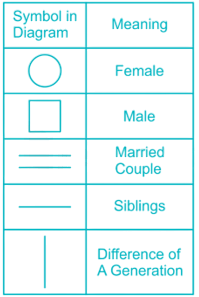
1. W is the brother of S, who is the daughter-in-law of P
2. W is the brother-in-law of R.


3. U is the sister of T and the daughter of R.
4. T is the grandson of Q.


Case 2 is not possible as number of person is more than eight.
5. R is only the nephew of V.
6. Q does not have any sibling.

P’s grandson is T. R’s brother-in-law is W. Hence, T is W’s nephew.
98. Direction: These questions are based on the following information.
In a family of eight members, there are two married couples. W is the brother of S, who is the daughter-in-law of P. T is the grandson of Q. R is only the nephew of V. U is the sister of T and the daughter of R. Q does not have any sibling, W is the brother-in-law of R.
Question:
How is W related to U?
A. Aunt
B. Maternal uncle
C. Father
D. Grandfather
E. Cannot be determined
Solution
ANS: (2)
From the given information,
1. W is the brother of S, who is the daughter-in-law of P
2. W is the brother-in-law of R.
3. U is the sister of T and the daughter of R.
4. T is the grandson of Q.


Case 2 is not possible as number of person is more than eight.
5. R is only the nephew of V.
6. Q does not have any sibling.
Hence, W is U’s maternal uncle.
99. Direction: These questions are based on the following information.
In a family of eight members, there are two married couples. W is the brother of S, who is the daughter-in-law of P. T is the grandson of Q. R is only the nephew of V. U is the sister of T and the daughter of R. Q does not have any sibling, W is the brother-in-law of R.
Question:
If P is a male then how is Q related to S?
A. Father
B. Mother
C. Father-in-law
D. Mother-in-law
E. Uncle
Solution
ANS: (4)
From the given information,
1. W is the brother of S, who is the daughter-in-law of P
2. W is the brother-in-law of R.
3. U is the sister of T and the daughter of R.
4. T is the grandson of Q.


Case 2 is not possible as number of person is more than eight.
5. R is only the nephew of V.
6. Q does not have any sibling.
If P is male then Q is female. Hence, Q is the mother-in-law of S.
100. If it is possible to make only one 4 letters meaningful word without repetition of the letter with the First, third, seventh and the eleventh letters of the word ‘SUPERSTITION’, which would be the second letter of the word? If more than one such word can be formed, give X as the answer. If no such word can be formed, give K as your answer.
A. T
B. R
C. O
D. K
E. X
Solution
First, third, seventh and the eleventh letters of the word ‘SUPERSTITION’ are S, P, T and O respectively.
The words that can be formed with S, P, T and O = SPOT, POST, STOP, TOPS, POTS
More than one such word can be formed.Hence, ‘X’ is the answer.