1. Directions: Read the following sentence and determine whether there is an error in it. The error, if any, will be in one part of the sentence. If the sentence is error-free, select ‘No Error’ as your answer.
In case the pandemic (A) ever came to an end, (B) Patrick decided to (C) go to an adventure. (D)
A. A
B. B
C. C
D. D
E. No Error
Solution
The correct answer is D
Key Points
- The sentence is in the past tense as can be seen by the use of the verbs ‘came’ and ‘decided’ in the past tense.
- An ‘adventure’ means ‘an unusual and exciting or daring experience’.
- This means that an adventure is an experience, it is an intangible thing. It is not a place or a location that one can visit or go to.
- One can only ‘go to’ a definite place, ‘an adventure’ could refer to anything as it has a subjective meaning.
Hence, ‘to’ needs to be replaced by ‘on’ in order to make the sentence grammatically correct.
Thus, the correct sentence is: In case the pandemic ever came to an end, Patrick decided to go on an adventure.
2. Directions: Read the following sentence and determine whether there is an error in it. The error, if any, will be in one part of the sentence. If the sentence is error-free, select ‘No Error’ as your answer.
The farmers, including the (A) village Sarpanch, were late (B) in paying their dues to the zamindar, (C) caused the zamindar to confiscate their lands. (D)
A. A
B. B
C. C
D. D
E. No Error
Solution
The correct answer is D
Key Points
- The sentence deals with the usage of the present participle.
- We need to replace the verb ’cause’ in D with ‘causing’- the present participle form of ’cause’.
Thus, the correct sentence is: The farmers, including the village Sarpanch, were late in paying their dues to the zamindar, causing the zamindar to confiscate their lands.
3. Directions: Read the following sentence and determine whether there is an error in it. The error, if any, will be in one part of the sentence. If the sentence is error-free, select ‘No Error’ as your answer.
India and USA seem (A) to have improved their (B) political relations after (C) the new trade agreement. (D)
A. A
B. B
C. C
D. D
E. No Error
Solution
The correct answer is A
Key Points
- The given sentence is in the present tense shown by the use of the verb ‘have’ and ‘seem’ in the present tense.
- ‘India’ and ‘USA’ are both nouns, ‘India‘ is a proper noun and thus does not have to be preceded by an article.
- ‘USA’ stands for ‘United States of America’ and while ‘America’ is a proper noun, ‘United States of America’ becomes a descriptive name of the country with the adjective ‘united’ and the noun ‘states’.
- This means that ‘USA’ to be preceded by an article and since there is only one ‘USA’, the article will be ‘the’.
Hence, the article ‘the’ needs to be added before the noun ‘USA’.
Thus, the correct sentence will be: India and the USA seem to have improved their political relations after the new trade agreement.
4. Directions: Read the following sentence and determine whether there is an error in it. The error, if any, will be in one part of the sentence. If the sentence is error-free, select ‘No Error’ as your answer.
The recipe mentioned (A) that the cake comprised of (B) eggs and wheat flour, (C) but Riva was vegan. (D)
A. A
B. B
C. C
D. D
E. No Error
Solution
The correct answer is B
Key Points
- The given sentence is in the past tense as can be seen by the use of the verb ‘mentioned’ and ‘comprised’ in the past tense.
- The sentence mentions the verb ‘comprised’ which means to ‘consist of; be made up of’.
- The meaning of the word already mentions the preposition ‘of’ meaning that it is not required after the verb in the sentence.
Hence, the ‘of’ following ‘comprised’ needs to be removed.
Thus, the correct sentence is: “The recipe mentioned that the cake comprised eggs and wheat flour, but Riva was vegan.”
5. Directions: Read the following sentence and determine whether there is an error in it. The error, if any, will be in one part of the sentence. If the sentence is error-free, select ‘No Error’ as your answer.
The terrorist decided (A) to take revenge from (B) the country’s Prime Minister (C) because he did not take his threats seriously. (D)
A. A
B. B
C. C
D. D
E. No Error
Solution
The correct answer is B i.e. error lies in this part of the sentence.
Key Points
- The given sentence is in the past tense as can be seen by the usage of the verb ‘decided’ and ‘did’ in the past tense.
- The sentence uses the term ‘revenge‘ which means ‘the action of hurting or harming someone in return for an injury or wrong suffered at their hands’.
- This is not an object that can be taken ‘from’ someone, it is an act of doing something harmful to someone.
- It can be directed towards something or someone and so a preposition like ‘on’ is more apt as it points to the target of the revenge.
Hence, ‘from’ needs to be replaced with ‘on’ in order to make the sentence grammatically correct.
Thus, the correct sentence is: ‘The terrorist decided to take revenge on the country’s Prime Minister because he did not take his threats seriously.’
6. Directions: In the following passage, some words have been deleted. Select the most appropriate option to fill in each blank.
Climate change mitigation consists of actions to ___(1)___ global warming and its related effects. Climate change is mostly caused by the greenhouse gases that are ___(2)___ when burning coal, oil, and gas. Fossil fuel use can be ___(3)___ through energy conservation and by switching to clean energy sources. Wind power and solar photovoltaics (PV) are increasingly becoming cheaper than fossil fuels, though these ___(4)___ energy storage and improved electrical grids. As low-emission energy is ___(5)___ at a large scale, transport and heating can shift to these mostly electric sources.
Question:
Select the most appropriate option to fill in blank number 1.
A. Remit
B. Limit
C. Exit
D. Edit
E. Predict
Solution
The correct answer is ‘Limit.‘
Key Points
- The given sentence “Climate change mitigation consists of actions to ___(1)___ global warming and its related effects” is saying that climate change mitigation consists of actions to restrict global warming.
- Therefore, the most appropriate word to be filled in the blank is ‘Limit‘.
- Also, the use of the word ”mitigation” in the sentence indicates the use of the word ‘limit‘ in the blank.
- The word ‘Limit‘ means To keep somebody or something within or below a certain amount, size, degree, or area.
- Example: The summit ended with a joint pledge to limit pollution.
- Example: The summit ended with a joint pledge to limit pollution.
Hence, the correct answer is option 2.
Complete Sentence: Climate change mitigation consists of actions to limit global warming and its related effects.
Additional Information
- Let us explore the other options:
- Remit means To cancel somebody’s debt or free somebody from duty or punishment.
- Exit means To go out of or leave a place.
- Edit means To prepare something for publication by correcting, condensing, or otherwise modifying it.
- Predict means To say that something will happen in the future.
7. Directions: In the following passage, some words have been deleted. Select the most appropriate option to fill in each blank.
Climate change mitigation consists of actions to ___(1)___ global warming and its related effects. Climate change is mostly caused by the greenhouse gases that are ___(2)___ when burning coal, oil, and gas. Fossil fuel use can be ___(3)___ through energy conservation and by switching to clean energy sources. Wind power and solar photovoltaics (PV) are increasingly becoming cheaper than fossil fuels, though these ___(4)___ energy storage and improved electrical grids. As low-emission energy is ___(5)___ at a large scale, transport and heating can shift to these mostly electric sources.
Question:
Select the most appropriate option to fill in blank number 2.
A. Stressed
B. Appeased
C. Released
D. Disposed
E. Enclosed
Solution
The correct answer is ‘Released.‘
Key Points
- The given sentence “Climate change is mostly caused by the greenhouse gases that are ___(2)___ when burning coal, oil, and gas” is talking about the greenhouse gases that are allowed to flow freely when burning coal, oil, and gas.
- Therefore, the most appropriate word to be filled in the blank is ‘Released‘.
- Also, the use of the word ”burning” in the sentence indicates the use of the word ‘released‘ in the blank.
- The word ‘Released‘ means To allow something to move, act, or flow freely.
- Example: A high concentration of bottled carbon monoxide gas is released.
- Example: A high concentration of bottled carbon monoxide gas is released.
Hence, the correct answer is option 3.
Complete Sentence: Climate change is mostly caused by the greenhouse gases that are released when burning coal, oil, and gas.
Additional Information
- Let us explore the other options:
- Stressed means To be subject to pressure or tension.
- Appeased means To pacify or placate someone by acceding to their demands.
- Disposed means To get rid of by throwing away or giving or selling to someone else.
- Enclosed means To surround or close off on all sides.
8. Directions: In the following passage, some words have been deleted. Select the most appropriate option to fill in each blank.
Climate change mitigation consists of actions to ___(1)___ global warming and its related effects. Climate change is mostly caused by the greenhouse gases that are ___(2)___ when burning coal, oil, and gas. Fossil fuel use can be ___(3)___ through energy conservation and by switching to clean energy sources. Wind power and solar photovoltaics (PV) are increasingly becoming cheaper than fossil fuels, though these ___(4)___ energy storage and improved electrical grids. As low-emission energy is ___(5)___ at a large scale, transport and heating can shift to these mostly electric sources
Question:
Select the most appropriate option to fill in blank number 3.
A. Reduced
B. Amused
C. Refused
D. Diffused
E. Induced
Solution
The correct answer is ‘Reduced.‘
Key Points
- The given sentence “Fossil fuel use can be ___(3)___ through energy conservation and by switching to clean energy sources” is saying that the use of fossil fuel can be lessened or lowered.
- Therefore, the most appropriate word to be filled in the blank is ‘Reduced‘.
- Also, the use of the word ”use” in the sentence indicates the use of the word ‘reduced‘ in the blank.
- The word ‘Reduced‘ means To make something less or smaller in quantity, price, size, etc.
- Example: The use of money supply can be reduced directly by using open market operations.
- Example: The use of money supply can be reduced directly by using open market operations.
Hence, the correct answer is option 1.
Complete Sentence: Fossil fuel use can be reduced through energy conservation and by switching to clean energy sources.
Additional Information
- Let us explore the other options:
- Amused means To cause someone to find something funny.
- Refused means To indicate or show that one is not willing to do something.
- Diffused means To spread over a wide area or between a large number of people.
- Induced means To succeed in persuading or leading someone to do something.
9. Directions: In the following passage, some words have been deleted. Select the most appropriate option to fill in each blank.
Climate change mitigation consists of actions to ___(1)___ global warming and its related effects. Climate change is mostly caused by the greenhouse gases that are ___(2)___ when burning coal, oil, and gas. Fossil fuel use can be ___(3)___ through energy conservation and by switching to clean energy sources. Wind power and solar photovoltaics (PV) are increasingly becoming cheaper than fossil fuels, though these ___(4)___ energy storage and improved electrical grids. As low-emission energy is ___(5)___ at a large scale, transport and heating can shift to these mostly electric sources.
Question:
Select the most appropriate option to fill in blank number 4.
A. Acquire
B. Desire
C. Aspire
D. Require
E. Retire
Solution
The correct answer is ‘Require.‘
Key Points
- The given sentence “Wind power and solar photovoltaics (PV) are increasingly becoming cheaper than fossil fuels, though these ___(4)___ energy storage and improved electrical grids” is saying that wind power and solar photovoltaics (PV) are increasingly becoming cheaper than fossil fuels but it needs energy storage.
- Therefore, the most appropriate word to be filled in the blank is ‘Require‘.
- Also, the use of the word ”improved” in the sentence indicates the use of the word ‘require‘ in the blank.
- The word ‘Require‘ means To need something for a particular purpose.
- Example: Great designs require great consideration.
- Example: Great designs require great consideration.
Hence, the correct answer is option 4.
Complete Sentence: Wind power and solar photovoltaics (PV) are increasingly becoming cheaper than fossil fuels, though these require energy storage and improved electrical grids.
Additional Information
- Let us explore the other options:
- Acquire means To obtain or buy something.
- Desire means To strongly wish for or want something.
- Aspire means To direct one’s hopes or ambitions towards achieving something.
- Retire means To leave one’s job and cease to work.
10. Directions: In the following passage, some words have been deleted. Select the most appropriate option to fill in each blank.
Climate change mitigation consists of actions to ___(1)___ global warming and its related effects. Climate change is mostly caused by the greenhouse gases that are ___(2)___ when burning coal, oil, and gas. Fossil fuel use can be ___(3)___ through energy conservation and by switching to clean energy sources. Wind power and solar photovoltaics (PV) are increasingly becoming cheaper than fossil fuels, though these ___(4)___ energy storage and improved electrical grids. As low-emission energy is ___(5)___ at a large scale, transport and heating can shift to these mostly electric sources
Question:
Select the most appropriate option to fill in blank number 5.
A. Annoyed
B. Overjoyed
C. Conveyed
D. Delayed
E. Deployed
Solution
The correct answer is ‘Deployed.‘
Key Points
- The given sentence “As low-emission energy is ___(5)___ at a large scale, transport and heating can shift to these mostly electric sources” is saying that low-emission energy is brought into effective action at a large scale.
- Therefore, the most appropriate word to be filled in the blank is ‘Deployed‘.
- Also, the use of the phrase ”large scale” in the sentence indicates the use of the word ‘deployed‘ in the blank.
- The word ‘Deployed‘ means To bring into effective action.
- Example: She rejected the arguments that had been deployed against her.
- Example: She rejected the arguments that had been deployed against her.
Hence, the correct answer is option 5.
Complete Sentence: As low-emission energy is deployed at a large scale, transport and heating can shift to these mostly electric sources.
Additional Information
- Let us explore the other options:
- Annoyed means To make someone a little angry; irritate.
- Overjoyed means Extremely happy.
- Conveyed means To make an idea, impression, or feeling known or understandable.
- Delayed means To make someone or something late or slow
11. Directions: Which of the following phrases given below in the options should replace the phrase that is underlined in the sentence to make it grammatically correct? If the sentence is correct and does not require any correction mark ‘No correction required’ as your answer.
Pollution in Delhi is increasing day by day; try to cover so many of your head as you can.
A. as many of your head as
B. as much of your head as
C. so much of your head as
D. as much of your head so
E. No improvement required
Solution
The correct answer is option 2.
Key Points
The underlined phrase ‘so many of your head as‘ is incorrect.
- The usage of the adjective ‘so many ’ is erroneous.
- A person can only have one head.
- Hence, the usage of ‘many’ in front of ‘head’ is erroneous.
- The sentence talks about covering head/part of the head due to pollution.
- Hence the expression “as much as” is perfect in the context.
- “As much of your head as you can” makes perfect sense both grammatically and contextually.
- Besides, “as much as” is a standard expression, It cannot be changed whimsically. “As” cannot be substituted with “so”.
- Thus, the correct sentence after phrase replacement would be- Pollution in Delhi is increasing day by day; try to cover as much of your head as you can.
Additional Information
Let’s understand the meanings and usage of the words given in the options –
- so much- something (such as an amount or price) unspecified or undetermined.
- Example:- Charge so much a mile.
12. Directions: Which of the following phrases given below in the options should replace the phrase that is underlined in the sentence to make it grammatically correct? If the sentence is correct and does not require any correction mark ‘No correction required’ as your answer.
Mr. Bakshi is eclipsed by his wife who is much lively and more intelligent than he is.
A. more lively and intelligent
B. much livelier and more intelligent
C. much more lively and much more intelligent
D. much liveliest and most intelligent
E. No correction required
Solution
The correct answer is option 2.
Key Points
The underlined phrase ‘much lively and more intelligent‘ is incorrect.
- A comparison is made between Mr. Bakshi and his wife.
- Hence, the comparative degree of the adjectives has to be used.
- Though “more intelligent” is the comparative degree of “intelligent”, “lively” is the positive degree.
- Hence, the sentence would be correct if “lively” is replaced by its comparative degree “livelier”.
- Correct Sentence :
- Mr. Bakshi is eclipsed by his wife who is much livelier and more intelligent than he is.
Therefore, option 2 is the correct answer.
Important Points
- The positive degree of comparison is not used to make any comparisons. It is just used to state the quality possessed by a particular noun or pronoun that acts as the subject in a sentence.
- The first thing that you have to bear in mind when using the positive degree of comparison is that it is the form of an adjective or adverb.
- The sentence structures that can use the positive degree of comparison are SVC, SVCA, SVA, SVOC, SVAA, ASVC, etc.
- For example:
- The weather is bad.
- Vinita walks quickly.
- Neena is angry.
- The comparative degree of comparison is used to compare two nouns that have the same quality or the particular quality of a noun at two different times. It shows which one of the two has the greater or lesser degree of the particular quality being referred to.
- For example:
- Tina looks sadder than Katie.
- This bed is more comfortable than the other bed.
- The sun is brighter than yesterday.
13. Directions: Which of the following phrases given below in the options should replace the phrase that is underlined in the sentence to make it grammatically correct? If the sentence is correct and does not require any correction mark ‘No correction required’ as your answer.
In a recent lecture, the minister laid out the rational and indispensability of the foreign policy that had emerged since last year.
A. rationale and indispensability
B. rationale and indispensable
C. rational and indispensable
D. ration and indispensable
E. No improvement required
Solution
The correct answer is option 1.
Key Points
The underlined phrase ‘ rational and indispensability‘ is incorrect.
- The usage of the adjective ‘rational’ is erroneous.
- The correct word in place of ‘rational’ would be ‘rationale’ which means ‘a set of reasons or a logical basis for a course of action or belief’. (कार्रवाई या विश्वास के लिए कारणों का एक सेट या तार्किक आधार’।)
- ‘Rationale and indispensability’ makes the sentence correct both grammatically and contextually.
- Thus, the correct sentence after phrase replacement would be- In a recent lecture, the minister laid out the rationale and indispensability of the foreign policy that had emerged since last year.
Additional Information
Let’s understand the meanings and usage of the words given in the options –
- rational– based on or in accordance with reason or logic. (कारण या तर्क के आधार पर या उसके अनुसार।)
- Example:- “I’m sure there’s a perfectly rational explanation”
- indispensable– absolutely necessary. (बिल्कुल जरूरी।)
- Example:- “he made himself indispensable to the parish priest”
14. Directions: In the following question, the given table has two columns (I and II) containing three phrases each. The phrases are labelled A, B, and C in the first column and P, Q, and R in the second column. A phrase from the first column may or may not connect with a phrase in the second column to make a grammatically and contextually meaningful sentence. Identify the correct option given below that gives the correct sequence in which one or more sentences can be formed. If none of the options make a meaningful sentence, mark ‘None of these’ as your answer.
| Column I | Column II |
| (A) The government aims to improve public services, | (P) the American, the British press operates on a national scale. |
| (B) He always brown-bagged his lunch,unlike | (Q) for American servicemen unaccustomed to subarctic conditions. |
| (C) The weather presented a particular challenge, especially | (R) the big losers will be the undeveloped countries. |
A. A-P
B. B-R
C. C-Q
D. A-P and B-Q
E. None of these
Solution
The correct answer is ‘C-Q.‘
Key Points
- From the given options, only the combination of phrases ‘C-Q’ creates the correct sentence.
- Let’s look at the sentences:
- ‘C-Q’ talks about the weather that presented a particular challenge (चुनौती) particularly for American servicemen unaccustomed (अपरिचित) to subarctic (relating to the region immediately south of the Arctic Circle) conditions.
- ‘Especially‘ means ”more than other things, people, situations, etc.; particularly” is used to single out one person or thing over all others. (विशेषतया, ख़ास तौर पर, विशेषकर, सर्वप्रधान)
- ‘Especially‘ means ”more than other things, people, situations, etc.; particularly” is used to single out one person or thing over all others. (विशेषतया, ख़ास तौर पर, विशेषकर, सर्वप्रधान)
- ‘C-Q’ talks about the weather that presented a particular challenge (चुनौती) particularly for American servicemen unaccustomed (अपरिचित) to subarctic (relating to the region immediately south of the Arctic Circle) conditions.
Hence, the correct answer is option 3.
15. Directions: In the following sentence, four words, marked as A, B, C, and D, are given in bold, out of which one word may or may not be misspelt. Identify the misspelt word and mark it as your answer. If all the highlighted words are correctly spelt, mark “All are correctly spelt” as your answer.
The villain’s mischievous (A) laughter echoed (B) through the cavernous (C) corridors of the decietful (D) fortress.
A. Mischievous
B. Echoed
C. Cavernous
D. Decietful
E. All are correctly spelt
Solution
The correct answer is option 4.
Key Points
The misspelled word is ‘decietful’.
- The correct spelling would be ‘deceitful’.
- The word ‘deceitful’ is an adjective which means ‘guilty of or involving deceit; deceiving or misleading others’. (धोखेबाज)
- For Example –
- The deceitful merchant was caught cheating his customers.
Therefore, the correct answer is ‘decietful’.
Additional Information
Let’s understand the meanings of the other marked words –
- Mischievous – causing or showing a fondness for causing trouble in a playful way (शरारती)
- Echoed – a sound that is reflected and repeated (गूंजना)
- Cavernous – like a cavern in size, shape, or atmosphere (गुफा जैसा)
16. Directions: In the following sentence, four words, marked as A, B, C, and D, are given in bold, out of which one word may or may not be misspelt. Identify the misspelt word and mark it as your answer. If all the highlighted words are correctly spelt, mark “All are correctly spelt” as your answer.
The team’s perseverance (A) was evident when they continued despite the irresistable (B) challenges and unpredictable (C) setbacks they encountered (D).
A. Perseverance
B. Irresistable
C. Unpredictable
D. Encountered
E. All are correctly spelt
Solution
The correct answer is option 2.
Key Points
The misspelled word is ‘Irresistable’.
- The correct spelling would be ‘Irresistible’.
- The word ‘irresistible‘ is an adjective which means ‘too powerful or convincing to be resisted’. (अत्यधिक आकर्षक)
- For Example –
- The aroma of freshly baked cookies was irresistible.
Therefore, the correct answer would be ‘Irresistable’.
Additional Information
Let’s understand the meanings of the other marked words –
- Perseverance – persistence in doing something despite difficulty or delay in achieving success (धैर्य)
- Unpredictable – not able to be predicted; changeable (अप्रत्याशित)
- Encountered – unexpectedly faced or experienced something difficult or hostile (सामना करना)
17. Directions: In the following sentence, four words, marked as A, B, C, and D, are given in bold, out of which one word may or may not be misspelt. Identify the misspelt word and mark it as your answer. If all the highlighted words are correctly spelt, mark “All are correctly spelt” as your answer.
The general’s redoubtable (A) presence instilled fear in adversaries, yet his acts of clemency (B) revealed a rare largesse (C) often deemed anachornistic (D).
A. Redoubtable
B. Clemency
C. Largesse
D. Anachornistic
E. All are correctly spelt
Solution
The correct answer is option 4.
Key Points
The misspelled word is ‘anachornistic’.
- The correct spelling would be ‘anachronistic’.
- The word ‘anachronistic‘ is an adjective which means ‘belonging to a period other than that being portrayed’. (कालविपरीत)
- For Example –
- His ideas about gender roles seem anachronistic in today’s society.
Therefore, the correct answer is ‘anachornistic’.
Additional Information
Let’s understand the meanings of the other marked words –
- Redoubtable – (adjective) inspiring fear or respect through being impressively large, powerful, intense, or capable (प्रभावशाली)
- Clemency – (noun) mercy; lenience (दयालुता)
- Largesse – (noun) generosity in bestowing money or gifts upon others (उदारता)
18. Directions: In the following sentence, four words, marked as A, B, C, and D, are given in bold, out of which one word may or may not be misspelt. Identify the misspelt word and mark it as your answer. If all the highlighted words are correctly spelt, mark “All are correctly spelt” as your answer.
The king’s munifecent (A) gesture of forgiving his enemies enhanced his reputation for rectitude (B) and benevolence (C). His noblesse (D) was legendary.
A. Munifecent
B. Rectitude
C. Benevolence
D. Noblesse
E. All are correctly spelt
Solution
The correct answer is option 1.
Key Points
The misspelled word is ‘munifecent’.
- The correct spelling would be ‘munificent’.
- The word ‘munificent‘ is an adjective which means ‘larger or more generous than is usual or necessary’. (उदार)
- For Example –
- The philanthropist made a munificent donation to the orphanage.
Therefore, the correct answer would be ‘munifecent’.
Additional Information
Let’s understand the meanings of the other marked words:
- Rectitude – morally correct behavior or thinking; righteousness (नैतिकता)
- Benevolence – the quality of being well-meaning; kindness (भलाई)
- Noblesse – the moral obligation of those of high birth or rank to act with honor, kindness, and generosity (उच्च कुलीनता)
19. Directions: In the following sentence, four words, marked as A, B, C, and D, are given in bold, out of which one word may or may not be misspelt. Identify the misspelt word and mark it as your answer. If all the highlighted words are correctly spelt, mark “All are correctly spelt” as your answer.
The company’s bankrupcy (A) was inevitable due to years of mismanagement (B), corruption (C), and extravagant (D) spending.
A. Bankrupcy
B. Mismanagement
C. Corruption
D. Extravagant
E. All are correctly spelt
Solution
The correct answer is option 1.
Key Points
The misspelled word is ‘bankrupcy’.
- The correct spelling would be ‘bankruptcy’.
- The word ‘bankruptcy‘ is a noun which means ‘the state of being bankrupt or unable to pay debts’. (दिवालियापन)
- For Example –
- The company declared bankruptcy after years of financial struggles.
Therefore, the correct answer would be ‘bankrupcy’.
Additional Information
Let’s understand the meanings of the other marked words –
- Mismanagement – the process of managing something inefficiently or improperly (कुप्रबंधन)
- Corruption – dishonest or fraudulent conduct by those in power, typically involving bribery (भ्रष्टाचार)
- Extravagant – lacking restraint in spending money or using resources (अपव्ययी)
20. Directions: Read the passage given below and answer the questions that follow by choosing the correct/most appropriate options:
Banudhar, the patient, complained of progressive pain in his stomach which was abnormally swollen, a symptom building up over the past four hours. Despite some relief from the painkillers and intravenous fluids provided by the ER team, his continuous discomfort was clear. I suspected an inguinal hernia—a condition that could not have been a sudden occurrence. It had been troubling him for months, but he had ignored the symptoms, carrying on with his work as a rickshaw puller to feed his family. He attributed the increased pain to “heavier customers”, as he was required to pull more weight. But that night, he just could not carry on.
An acquaintance had driven him to the hospital, but could not stay. Banudhar was alone and terrified. He asked me if his condition was serious, his eyes wide with worry. I fumbled my words, stricken by inexperience and emotion. Should I be honest? There was no family member with whom I could discuss these matters. Would honesty distress him further? Would showing sympathy affect my ability to perform my duties? More importantly, how could he be expected to make rational, critical decisions in his state? There must be someone to be here for him, I thought and did my best to contact his loved ones.
Banudhar, his wife, and his son were landless laborers and lived in village five hours away from Cuttack. To call someone in those days, one had to find an STD or long-distance call booth. I rushed to one across the road from the ER. The village had fewer than a handful of phones. The first three calls did not go through. A few more went unanswered. By then, it was almost dawn and my hope was fading. Finally, a man answered and assured me he would call back after getting hold of Banudhar’s wife. Twenty-five minutes later she called and I was able to let her know that he needed emergency surgery. She burst into tears and said she would try to get there as soon as she could. Meanwhile, Banudhar’s CT scan confirmed that he had a strangulated inguinal hernia and that sepsis had set in. We raced against time, rallying our team of anesthetists and senior registrars for an urgent laparotomy.
Emergency surgery comes with peculiar challenges, with each difficulty magnified in government hospitals plagued by a dearth of resources and staff. We also had to take Banudhar’s thumb impressions on consent forms and decisions that needed to be made at the operating table. I still remember his words just before he went under a whispered prayer to his village deity. When Banudhar awoke from surgery two hours later, I was by his side. He clutched my hand and fell back to sleep.
It took a few days for his wife Gitanjali to make it to the hospital. I led her to her husband—frail, hooked to an IV, with drains attached to his belly, but alive—and she wept with relief and worry. Meanwhile, Banudhar was being closely monitored. With a nurse by my side, I would supervise the dressing of his wounds, and drain outputs et al. During these visits, Banudharbegan to open up to me. He told me his family worked on a small plot of land where they grew paddy, that the village priest regularly appeased the rain gods, and that Odisha had hundreds of varieties of rice. Banudhar clearly missed his days on the farm. Working as a rickshaw puller was a grueling job but he had moved to the city so their teenage son could soon join him for a better education. 18 days later, he was discharged. He had a few follow-ups but these did not coincide with my shifts. I did not get a chance to meet him again.
Question:
What is the name of Banudhar’s wife?
A. Parvathi
B. Geetha
C. Seeta
D. Gitanjali
E. Not mentioned in the passage
Solution
The correct answer is ‘Gitanjali.‘
Key Points
- The first sentence of the fifth paragraph says “It took a few days for his wife Gitanjali to make it to the hospital.”
- From the above sentence, we can say that the name of Banudhar’s wife is Gitanjali.
Hence, the only possible answer is option 4.
21. Directions: Read the passage given below and answer the questions that follow by choosing the correct/most appropriate options:
Banudhar, the patient, complained of progressive pain in his stomach which was abnormally swollen, a symptom building up over the past four hours. Despite some relief from the painkillers and intravenous fluids provided by the ER team, his continuous discomfort was clear. I suspected an inguinal hernia—a condition that could not have been a sudden occurrence. It had been troubling him for months, but he had ignored the symptoms, carrying on with his work as a rickshaw puller to feed his family. He attributed the increased pain to “heavier customers”, as he was required to pull more weight. But that night, he just could not carry on.
An acquaintance had driven him to the hospital, but could not stay. Banudhar was alone and terrified. He asked me if his condition was serious, his eyes wide with worry. I fumbled my words, stricken by inexperience and emotion. Should I be honest? There was no family member with whom I could discuss these matters. Would honesty distress him further? Would showing sympathy affect my ability to perform my duties? More importantly, how could he be expected to make rational, critical decisions in his state? There must be someone to be here for him, I thought and did my best to contact his loved ones.
Banudhar, his wife, and his son were landless laborers and lived in village five hours away from Cuttack. To call someone in those days, one had to find an STD or long-distance call booth. I rushed to one across the road from the ER. The village had fewer than a handful of phones. The first three calls did not go through. A few more went unanswered. By then, it was almost dawn and my hope was fading. Finally, a man answered and assured me he would call back after getting hold of Banudhar’s wife. Twenty-five minutes later she called and I was able to let her know that he needed emergency surgery. She burst into tears and said she would try to get there as soon as she could. Meanwhile, Banudhar’s CT scan confirmed that he had a strangulated inguinal hernia and that sepsis had set in. We raced against time, rallying our team of anesthetists and senior registrars for an urgent laparotomy.
Emergency surgery comes with peculiar challenges, with each difficulty magnified in government hospitals plagued by a dearth of resources and staff. We also had to take Banudhar’s thumb impressions on consent forms and decisions that needed to be made at the operating table. I still remember his words just before he went under a whispered prayer to his village deity. When Banudhar awoke from surgery two hours later, I was by his side. He clutched my hand and fell back to sleep.
It took a few days for his wife Gitanjali to make it to the hospital. I led her to her husband—frail, hooked to an IV, with drains attached to his belly, but alive—and she wept with relief and worry. Meanwhile, Banudhar was being closely monitored. With a nurse by my side, I would supervise the dressing of his wounds, and drain outputs et al. During these visits, Banudharbegan to open up to me. He told me his family worked on a small plot of land where they grew paddy, that the village priest regularly appeased the rain gods, and that Odisha had hundreds of varieties of rice. Banudhar clearly missed his days on the farm. Working as a rickshaw puller was a grueling job but he had moved to the city so their teenage son could soon join him for a better education. 18 days later, he was discharged. He had a few follow-ups but these did not coincide with my shifts. I did not get a chance to meet him again.
Question:
According to the passage, how many kids does Banudhar have?
A. Only four
B. Only one
C. Only two
D. None
E. Five
Solution
The correct answer is ‘Only one.‘
Key Points
- The first sentence of the third paragraph says “Banudhar, his wife, and his son were landless laborers and lived in village five hours away from Cuttack.”
- From the above sentence, we can say that according to the passage, Banudhar has only one son.
Hence, the only possible answer is option 2.
22. Directions: Read the passage given below and answer the questions that follow by choosing the correct/most appropriate options:
Banudhar, the patient, complained of progressive pain in his stomach which was abnormally swollen, a symptom building up over the past four hours. Despite some relief from the painkillers and intravenous fluids provided by the ER team, his continuous discomfort was clear. I suspected an inguinal hernia—a condition that could not have been a sudden occurrence. It had been troubling him for months, but he had ignored the symptoms, carrying on with his work as a rickshaw puller to feed his family. He attributed the increased pain to “heavier customers”, as he was required to pull more weight. But that night, he just could not carry on.
An acquaintance had driven him to the hospital, but could not stay. Banudhar was alone and terrified. He asked me if his condition was serious, his eyes wide with worry. I fumbled my words, stricken by inexperience and emotion. Should I be honest? There was no family member with whom I could discuss these matters. Would honesty distress him further? Would showing sympathy affect my ability to perform my duties? More importantly, how could he be expected to make rational, critical decisions in his state? There must be someone to be here for him, I thought and did my best to contact his loved ones.
Banudhar, his wife, and his son were landless laborers and lived in village five hours away from Cuttack. To call someone in those days, one had to find an STD or long-distance call booth. I rushed to one across the road from the ER. The village had fewer than a handful of phones. The first three calls did not go through. A few more went unanswered. By then, it was almost dawn and my hope was fading. Finally, a man answered and assured me he would call back after getting hold of Banudhar’s wife. Twenty-five minutes later she called and I was able to let her know that he needed emergency surgery. She burst into tears and said she would try to get there as soon as she could. Meanwhile, Banudhar’s CT scan confirmed that he had a strangulated inguinal hernia and that sepsis had set in. We raced against time, rallying our team of anesthetists and senior registrars for an urgent laparotomy.
Emergency surgery comes with peculiar challenges, with each difficulty magnified in government hospitals plagued by a dearth of resources and staff. We also had to take Banudhar’s thumb impressions on consent forms and decisions that needed to be made at the operating table. I still remember his words just before he went under a whispered prayer to his village deity. When Banudhar awoke from surgery two hours later, I was by his side. He clutched my hand and fell back to sleep.
It took a few days for his wife Gitanjali to make it to the hospital. I led her to her husband—frail, hooked to an IV, with drains attached to his belly, but alive—and she wept with relief and worry. Meanwhile, Banudhar was being closely monitored. With a nurse by my side, I would supervise the dressing of his wounds, and drain outputs et al. During these visits, Banudharbegan to open up to me. He told me his family worked on a small plot of land where they grew paddy, that the village priest regularly appeased the rain gods, and that Odisha had hundreds of varieties of rice. Banudhar clearly missed his days on the farm. Working as a rickshaw puller was a grueling job but he had moved to the city so their teenage son could soon join him for a better education. 18 days later, he was discharged. He had a few follow-ups but these did not coincide with my shifts. I did not get a chance to meet him again.
Question:
According to the passage, Banudhar’s CT scan confirmed that he had:
A. Rheumatoid arthritis
B. Microscopic polyangiitis
C. Brain Cancer
D. Inguinal hernia
E. Alzheimer’s disease
Solution
The correct answer is ‘Inguinal hernia.‘
Key Points
- The second-last sentence of the third paragraph says “Meanwhile, Banudhar’s CT scan confirmed that he had a strangulated inguinal hernia and that sepsis had set in.”
- From the above sentence, we can say that according to the passage, Banudhar’s CT scan confirmed that he had an Inguinal hernia.
Hence, the only possible answer is option 4.
23. Directions: Read the passage given below and answer the questions that follow by choosing the correct/most appropriate options:
Banudhar, the patient, complained of progressive pain in his stomach which was abnormally swollen, a symptom building up over the past four hours. Despite some relief from the painkillers and intravenous fluids provided by the ER team, his continuous discomfort was clear. I suspected an inguinal hernia—a condition that could not have been a sudden occurrence. It had been troubling him for months, but he had ignored the symptoms, carrying on with his work as a rickshaw puller to feed his family. He attributed the increased pain to “heavier customers”, as he was required to pull more weight. But that night, he just could not carry on.
An acquaintance had driven him to the hospital, but could not stay. Banudhar was alone and terrified. He asked me if his condition was serious, his eyes wide with worry. I fumbled my words, stricken by inexperience and emotion. Should I be honest? There was no family member with whom I could discuss these matters. Would honesty distress him further? Would showing sympathy affect my ability to perform my duties? More importantly, how could he be expected to make rational, critical decisions in his state? There must be someone to be here for him, I thought and did my best to contact his loved ones.
Banudhar, his wife, and his son were landless laborers and lived in village five hours away from Cuttack. To call someone in those days, one had to find an STD or long-distance call booth. I rushed to one across the road from the ER. The village had fewer than a handful of phones. The first three calls did not go through. A few more went unanswered. By then, it was almost dawn and my hope was fading. Finally, a man answered and assured me he would call back after getting hold of Banudhar’s wife. Twenty-five minutes later she called and I was able to let her know that he needed emergency surgery. She burst into tears and said she would try to get there as soon as she could. Meanwhile, Banudhar’s CT scan confirmed that he had a strangulated inguinal hernia and that sepsis had set in. We raced against time, rallying our team of anesthetists and senior registrars for an urgent laparotomy.
Emergency surgery comes with peculiar challenges, with each difficulty magnified in government hospitals plagued by a dearth of resources and staff. We also had to take Banudhar’s thumb impressions on consent forms and decisions that needed to be made at the operating table. I still remember his words just before he went under a whispered prayer to his village deity. When Banudhar awoke from surgery two hours later, I was by his side. He clutched my hand and fell back to sleep.
It took a few days for his wife Gitanjali to make it to the hospital. I led her to her husband—frail, hooked to an IV, with drains attached to his belly, but alive—and she wept with relief and worry. Meanwhile, Banudhar was being closely monitored. With a nurse by my side, I would supervise the dressing of his wounds, and drain outputs et al. During these visits, Banudharbegan to open up to me. He told me his family worked on a small plot of land where they grew paddy, that the village priest regularly appeased the rain gods, and that Odisha had hundreds of varieties of rice. Banudhar clearly missed his days on the farm. Working as a rickshaw puller was a grueling job but he had moved to the city so their teenage son could soon join him for a better education. 18 days later, he was discharged. He had a few follow-ups but these did not coincide with my shifts. I did not get a chance to meet him again.
Question:
What is the profession of Banudhar?
A. A rickshaw puller
B. A doctor
C. A cleaner
D. A respiratory therapist
E. A surgeon
Solution
The correct answer is ‘A rickshaw puller‘
Key Points
- The fourth sentence of the first paragraph says “It had been troubling him for months, but he had ignored the symptoms, carrying on with his work as a rickshaw puller to feed his family.”
- From the above sentence, we can say that Banudhar is a rickshaw puller by profession.
Hence, the only possible answer is option 1.
24. Directions: Read the passage given below and answer the questions that follow by choosing the correct/most appropriate options:
Banudhar, the patient, complained of progressive pain in his stomach which was abnormally swollen, a symptom building up over the past four hours. Despite some relief from the painkillers and intravenous fluids provided by the ER team, his continuous discomfort was clear. I suspected an inguinal hernia—a condition that could not have been a sudden occurrence. It had been troubling him for months, but he had ignored the symptoms, carrying on with his work as a rickshaw puller to feed his family. He attributed the increased pain to “heavier customers”, as he was required to pull more weight. But that night, he just could not carry on.
An acquaintance had driven him to the hospital, but could not stay. Banudhar was alone and terrified. He asked me if his condition was serious, his eyes wide with worry. I fumbled my words, stricken by inexperience and emotion. Should I be honest? There was no family member with whom I could discuss these matters. Would honesty distress him further? Would showing sympathy affect my ability to perform my duties? More importantly, how could he be expected to make rational, critical decisions in his state? There must be someone to be here for him, I thought and did my best to contact his loved ones.
Banudhar, his wife, and his son were landless laborers and lived in village five hours away from Cuttack. To call someone in those days, one had to find an STD or long-distance call booth. I rushed to one across the road from the ER. The village had fewer than a handful of phones. The first three calls did not go through. A few more went unanswered. By then, it was almost dawn and my hope was fading. Finally, a man answered and assured me he would call back after getting hold of Banudhar’s wife. Twenty-five minutes later she called and I was able to let her know that he needed emergency surgery. She burst into tears and said she would try to get there as soon as she could. Meanwhile, Banudhar’s CT scan confirmed that he had a strangulated inguinal hernia and that sepsis had set in. We raced against time, rallying our team of anesthetists and senior registrars for an urgent laparotomy.
Emergency surgery comes with peculiar challenges, with each difficulty magnified in government hospitals plagued by a dearth of resources and staff. We also had to take Banudhar’s thumb impressions on consent forms and decisions that needed to be made at the operating table. I still remember his words just before he went under a whispered prayer to his village deity. When Banudhar awoke from surgery two hours later, I was by his side. He clutched my hand and fell back to sleep.
It took a few days for his wife Gitanjali to make it to the hospital. I led her to her husband—frail, hooked to an IV, with drains attached to his belly, but alive—and she wept with relief and worry. Meanwhile, Banudhar was being closely monitored. With a nurse by my side, I would supervise the dressing of his wounds, and drain outputs et al. During these visits, Banudharbegan to open up to me. He told me his family worked on a small plot of land where they grew paddy, that the village priest regularly appeased the rain gods, and that Odisha had hundreds of varieties of rice. Banudhar clearly missed his days on the farm. Working as a rickshaw puller was a grueling job but he had moved to the city so their teenage son could soon join him for a better education. 18 days later, he was discharged. He had a few follow-ups but these did not coincide with my shifts. I did not get a chance to meet him again.
Question:
Choose the synonym of the word ‘Critical‘.
A. Frivolous
B. Peripheral
C. Paltry
D. Extraneous
E. Pivotal
Solution
The correct answer is ‘Pivotal.‘
Key Points
- The word ‘Critical‘ means Of the greatest possible importance.
- Example: The inquiry was critical of her work.
- Let’s look at the meaning of the given options:-
- Frivolous – Not having any serious purpose or value.
- Example: The court discourages frivolous lawsuits.
- Peripheral – Of secondary or minor importance; marginal.
- Example: The men are somewhat peripheral to this society.
- Paltry – Petty; trivial.
- Example: She made some paltry excuse and left.
- Extraneous – Irrelevant or unrelated to the subject being dealt with.
- Example: We shall ignore factors extraneous to the problem.
- Pivotal – Of crucial importance in relation to the development or success of something else.
- Example: Accountancy, law, and economics are pivotal to a successful career in any financial services area.
- Example: Accountancy, law, and economics are pivotal to a successful career in any financial services area.
- Frivolous – Not having any serious purpose or value.
Hence, the only possible answer is option 5.
Additional Information
- The synonyms of the word ‘Critical‘ are “Pivotal, Crucial, Vital“.
- The antonyms of the word ‘Critical‘ are “Frivolous, Peripheral, Extraneous“.
25. Directions: Read the passage given below and answer the questions that follow by choosing the correct/most appropriate options:
Banudhar, the patient, complained of progressive pain in his stomach which was abnormally swollen, a symptom building up over the past four hours. Despite some relief from the painkillers and intravenous fluids provided by the ER team, his continuous discomfort was clear. I suspected an inguinal hernia—a condition that could not have been a sudden occurrence. It had been troubling him for months, but he had ignored the symptoms, carrying on with his work as a rickshaw puller to feed his family. He attributed the increased pain to “heavier customers”, as he was required to pull more weight. But that night, he just could not carry on.
An acquaintance had driven him to the hospital, but could not stay. Banudhar was alone and terrified. He asked me if his condition was serious, his eyes wide with worry. I fumbled my words, stricken by inexperience and emotion. Should I be honest? There was no family member with whom I could discuss these matters. Would honesty distress him further? Would showing sympathy affect my ability to perform my duties? More importantly, how could he be expected to make rational, critical decisions in his state? There must be someone to be here for him, I thought and did my best to contact his loved ones.
Banudhar, his wife, and his son were landless laborers and lived in village five hours away from Cuttack. To call someone in those days, one had to find an STD or long-distance call booth. I rushed to one across the road from the ER. The village had fewer than a handful of phones. The first three calls did not go through. A few more went unanswered. By then, it was almost dawn and my hope was fading. Finally, a man answered and assured me he would call back after getting hold of Banudhar’s wife. Twenty-five minutes later she called and I was able to let her know that he needed emergency surgery. She burst into tears and said she would try to get there as soon as she could. Meanwhile, Banudhar’s CT scan confirmed that he had a strangulated inguinal hernia and that sepsis had set in. We raced against time, rallying our team of anesthetists and senior registrars for an urgent laparotomy.
Emergency surgery comes with peculiar challenges, with each difficulty magnified in government hospitals plagued by a dearth of resources and staff. We also had to take Banudhar’s thumb impressions on consent forms and decisions that needed to be made at the operating table. I still remember his words just before he went under a whispered prayer to his village deity. When Banudhar awoke from surgery two hours later, I was by his side. He clutched my hand and fell back to sleep.
It took a few days for his wife Gitanjali to make it to the hospital. I led her to her husband—frail, hooked to an IV, with drains attached to his belly, but alive—and she wept with relief and worry. Meanwhile, Banudhar was being closely monitored. With a nurse by my side, I would supervise the dressing of his wounds, and drain outputs et al. During these visits, Banudharbegan to open up to me. He told me his family worked on a small plot of land where they grew paddy, that the village priest regularly appeased the rain gods, and that Odisha had hundreds of varieties of rice. Banudhar clearly missed his days on the farm. Working as a rickshaw puller was a grueling job but he had moved to the city so their teenage son could soon join him for a better education. 18 days later, he was discharged. He had a few follow-ups but these did not coincide with my shifts. I did not get a chance to meet him again.
Question:
Choose the antonym of the word ‘Consent‘.
A. Assent
B. Acquiescence
C. Interdiction
D. Concurrence
E. Accord
Solution
The correct answer is ‘Interdiction.‘
Key Points
- The word ‘Consent‘ means Permission for something to happen or agreement to do something.
- Example: He took the car without the owner’s consent.
- Let’s look at the meaning of the given options:-
- Assent – The expression of approval or agreement.
- Example: He gave his assent to the proposed legislation.
- Acquiescence – The reluctant acceptance of something without protest.
- Example: There was general acquiescence to the UN sanctions.
- Interdiction – The action of prohibiting or forbidding something.
- Example: U.S. authorities have sent six helicopters stationed in Peru for drug interdiction.
- Concurrence – Agreement or consistency.
- Example: The doctor may seek the concurrence of a relative before carrying out the procedure.
- Accord – An official agreement or treaty.
- Example: The club members voted with one accord to raise the dues.
- Example: The club members voted with one accord to raise the dues.
- Assent – The expression of approval or agreement.
Hence, the only possible answer is option 3.
Additional Information
- The antonyms of the word ‘Consent‘ are “Interdiction, Prohibition, Proscription“.
- The synonyms of the word ‘Consent‘ are “Assent, Acquiescence, Concurrence”.
26. Directions: Read the passage given below and answer the questions that follow by choosing the correct/most appropriate options:
Banudhar, the patient, complained of progressive pain in his stomach which was abnormally swollen, a symptom building up over the past four hours. Despite some relief from the painkillers and intravenous fluids provided by the ER team, his continuous discomfort was clear. I suspected an inguinal hernia—a condition that could not have been a sudden occurrence. It had been troubling him for months, but he had ignored the symptoms, carrying on with his work as a rickshaw puller to feed his family. He attributed the increased pain to “heavier customers”, as he was required to pull more weight. But that night, he just could not carry on.
An acquaintance had driven him to the hospital, but could not stay. Banudhar was alone and terrified. He asked me if his condition was serious, his eyes wide with worry. I fumbled my words, stricken by inexperience and emotion. Should I be honest? There was no family member with whom I could discuss these matters. Would honesty distress him further? Would showing sympathy affect my ability to perform my duties? More importantly, how could he be expected to make rational, critical decisions in his state? There must be someone to be here for him, I thought and did my best to contact his loved ones.
Banudhar, his wife, and his son were landless laborers and lived in village five hours away from Cuttack. To call someone in those days, one had to find an STD or long-distance call booth. I rushed to one across the road from the ER. The village had fewer than a handful of phones. The first three calls did not go through. A few more went unanswered. By then, it was almost dawn and my hope was fading. Finally, a man answered and assured me he would call back after getting hold of Banudhar’s wife. Twenty-five minutes later she called and I was able to let her know that he needed emergency surgery. She burst into tears and said she would try to get there as soon as she could. Meanwhile, Banudhar’s CT scan confirmed that he had a strangulated inguinal hernia and that sepsis had set in. We raced against time, rallying our team of anesthetists and senior registrars for an urgent laparotomy.
Emergency surgery comes with peculiar challenges, with each difficulty magnified in government hospitals plagued by a dearth of resources and staff. We also had to take Banudhar’s thumb impressions on consent forms and decisions that needed to be made at the operating table. I still remember his words just before he went under a whispered prayer to his village deity. When Banudhar awoke from surgery two hours later, I was by his side. He clutched my hand and fell back to sleep.
It took a few days for his wife Gitanjali to make it to the hospital. I led her to her husband—frail, hooked to an IV, with drains attached to his belly, but alive—and she wept with relief and worry. Meanwhile, Banudhar was being closely monitored. With a nurse by my side, I would supervise the dressing of his wounds, and drain outputs et al. During these visits, Banudharbegan to open up to me. He told me his family worked on a small plot of land where they grew paddy, that the village priest regularly appeased the rain gods, and that Odisha had hundreds of varieties of rice. Banudhar clearly missed his days on the farm. Working as a rickshaw puller was a grueling job but he had moved to the city so their teenage son could soon join him for a better education. 18 days later, he was discharged. He had a few follow-ups but these did not coincide with my shifts. I did not get a chance to meet him again.
Question:
Choose the antonym of the word ‘Dearth‘.
A. Scarcity
B. Surfeit
C. Paucity
D. Scantiness
E. Meagreness
Solution
The correct answer is ‘Surfeit.‘
Key Points
- The word ‘Dearth‘ means Scarcity or lack of something.
- Example: There was a dearth of reliable information on the subject.
- Let’s look at the meaning of the given options:-
- Scarcity – The state of being scarce or in short supply; shortage.
- Example: The scarcity of skilled workers is worrying the government.
- Surfeit – An excessive amount of something.
- Example: A surfeit of rich food is bad for you.
- Paucity – The presence of something in only small or insufficient quantities or amounts.
- Example: There is a paucity of information on the ingredients of many cosmetics.
- Scantiness – The quality of being small or insufficient in quantity or amount.
- Example: Scantiness of modesty is short of knowledge.
- Meagreness – Lack of quantity or quality; inadequacy.
- Example: Job satisfaction eclipses the meagreness of income.
- Example: Job satisfaction eclipses the meagreness of income.
- Scarcity – The state of being scarce or in short supply; shortage.
Hence, the only possible answer is option 2.
Additional Information
- The antonyms of the word ‘Dearth‘ are “Surfeit, Abundance, Adequacy“.
- The synonyms of the word ‘Dearth‘ are “Scarcity, Paucity, Scantiness”.
27. The question below contains five scattered segments of a sentence. Indicate the sequence which correctly assembles the segments and completes the sentence.
A. according to Stanley is neuroception
B. one of the brain’s most important functions
C. an unconscious process of rapidly
D. environment for safety and danger
E. scanning the internal and external
A. BCAED
B. BDCAE
C. BACED
D. ACDEB
E. EDCAB
Solution
The correct answer is BACED.
Key Points
- B is the part that establishes the subject of the matter that is the brain. Hence, it will be the first part after rearrangement.
- In part A neuroception is ‘the most important function’ that is mentioned in part B. Hence A follows B.
- Part C further explains the process of neuroception. Hence C follows A.
- Part E and C form a complementary pair where part E refers to the function of the process mentioned in part C. So E follows C.
- Part D concludes the sentence as it refers to where the scanning is done and for what purpose.
Correct rearrangement of segments is: One of the brain’s most important functions, according to Stanley, is neuroception, an unconscious process of rapidly scanning the internal and external environment for safety and danger.
IMPORTANT POINTS
- While solving jumbles one must look for any independent segments/sentences or the option that establishes the subject matter.
- Then one must look for the connection between sentences and segments.
- Some sentences/segments will have some concluding notion so those options will always be at the end.
28. The question below contains five scattered segments of a sentence. Indicate the sequence which correctly assembles the segments and completes the sentence.
A. and progress in society
B. we have to think
C. and work for the broader
D. beyond the petty interests
E. goals of bringing prosperity
A. ABCED
B. BDCEA
C. DBECA
D. CBEDA
E. EBDCA
Solution
The correct answer is BDCEA.
Key Points
- B is the part that establishes the subject of the matter i.e. ‘The ones who will think’. Hence, it’ll be the first part after rearrangement.
- Part D talks about what we must think i.e. beyond petty interests. Hence, D follows B.
- Part C talks about working rather than thinking about petty things. Hence, C follows D.
- Part E tells us that we must work towards our goals. So, E follows C.
- Part A is a continuation of part E which says that we must work towards our goals and bring prosperity and progress to society. Hence, A follows E.
Correct rearrangement of segments is: We have to think beyond the petty interests and work for the broader goals of bringing prosperity and progress in society.
Hint
- While solving jumbles, one must first look for any independent sentences/segments or the option which establishes the subject matter.
- Then, one must look for connections between the sentences/segments.
- Some sentences/segments might have some concluding notion. So those options will be always at the end.
29. The question below contains five scattered segments of a sentence. Indicate the sequence which correctly assembles the segments and completes the sentence.
A. google is the ultimate
B. a fast-paced, high-energy
C. working setting
D. and is defined as
E. global company
A. BADEC
B. ABCDE
C. BCDEA
D. AEDBC
E. CDBEA
Solution
The correct answer is AEDBC.
Key Points
- A is the part that establishes the subject of the matter i.e. ‘Google’. Hence, it’ll be the first part after rearrangement.
- Part E talks about a global company that refers to Google mentioned A. Hence, E follows A.
- Part B and C are related and they are words used to define Google. Hence, C follows B.
- Part D mentions ‘defined’ which is used for google and it is continued in parts B and C. So, D follows E and B follows D.
Correct rearrangement of segments is: Google is the ultimate global company and is defined as a fast-paced, high-energy working setting.
Hint
- While solving jumbles, one must first look for any independent sentences/segments or the option which establishes the subject matter.
- Then, one must look for connections between the sentences/segments.
- Some sentences/segments might have some concluding notion. So those options will be always at the end.
30. The question below contains five scattered segments of a sentence. Indicate the sequence which correctly assembles the segments and completes the sentence.
A. access to unlimited
B. entertainment instantly.
C. we can connect
D. with our loved ones
E. easily and get
A. BDECA
B. EDBCA
C. CDEAB
D. DBCEA
E. ABCDE
Solution
The correct answer is CDEAB.
Key Points
- C is the part that establishes the subject of the matter i.e. ‘the ones who connect’. Hence, it’ll be the first part after rearrangement.
- Part D talks about loved ones with whom we connect. Hence, Dfollows C.
- Part E talks about how we connect with our loved ones easily. Hence, E follows D.
- Part A tells us that connecting to loved ones also grants us unlimited access to something. So, A follows E.
- Part B talks about entertainment which is the unlimited access that is mentioned in A. Hence, B follows A.
Correct rearrangement of segments is: We can connect with our loved ones easily and get access to unlimited entertainment instantly.
Hint
- While solving jumbles, one must first look for any independent sentences/segments or the option which establishes the subject matter.
- Then, one must look for connections between the sentences/segments.
- Some sentences/segments might have some concluding notion. So those options will be always at the end.
31. A shopkeeper offers a discount of 10% and still makes a profit of 20%. If the marked price is Rs. 300 then find the selling price of the article.
A. Rs. 225
B. Rs. 240
C. Rs. 245
D. Rs. 270
E. Rs. 280
Solution
Given:
Discount = 10%
Profit = 20%
Market price (M.P.) = Rs. 300
Formula used:

Where, S.P. = Selling price
M.P. = Market price
Calculation:
According to the question, a shopkeeper offers a discount of 10% and still makes a profit of 20%.
Discount = 10%
Market price (M.P.) = Rs. 300

= (90/100) × 300
= 270
∴ The selling price of the article is Rs. 270
32. A train cross a pole in 18 sec. Speed of train is 72 km /hr. Find the time taken by train to cross a 180 m long bridge?
A. 44
B. 22
C. 25
D. 27
E. 32
Solution
Calculation
Speed of train is 72 km /hr. so,
[72 × 5 /18] = 20 m/s
Time to cross pole = 18 s
Train length = 20 × 18 = 360 m
Total distance = 360 + 180 = 540 m
Time = [540/20] = 27 seconds
33. Direction: Study the graph and answer the following questions.
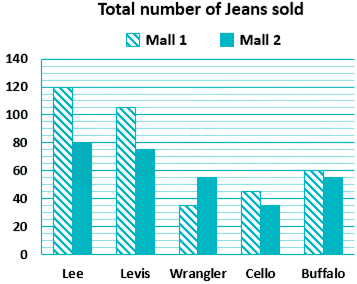
Question:
What average number of Lee, Levis and Cello jeans sold from Mall 1?
A. 100
B. 112
C. 84
D. 92
E. 90
Solution
Given:
Number of Lee jeans sold from Mall 1 = 120
Number of Levis jeans sold in Mall 1 = 105
Number of Cello jeans sold in Mall 1 = 45
Calculation:
Total number of Lee, Levis and Cello jeans sold from Mall 1 = (120 + 105 + 45) = 270
∴ Average number of Lee, Levis and Cello jeans sold from Mall 1 = 270 / 3 = 90
Alternate Method
Another Way to calculate Average:
The Three numbers were 120, 105 and 45
Let 105 be the average [Middle number can be considered]
Now 120 – 105 = 15
and 45 – 105 = -60
Final Conclusion = 15 – 60 = -45
As there were 3 numbers, Divide -45 by 3 we get -15
∴ Required Average = 105 – 15 = 90
34. Direction: Study the graph and answer the following questions.
Question:
Total number of Levis jeans sold from both the malls is what percentage more than the number of Lee jeans sold from Mall 1?
A. 75%
B. 80%
C. 15%
D. 50%
E. 25%
Solution
Given:
Number of Lee jeans sold from Mall 1 = 120
Number of Levis jeans sold in Mall 1 = 105
Number of Levis jeans sold in Mall 2 = 75
Calculation:
Total number of Levis jeans sold = (105 + 75) = 180
∴ Required percentage = (180 – 120) / 120 × 100% = 50%
35. Direction: Study the graph and answer the following questions.
Question:
What is the ratio of number of Levis and Wrangler jeans sold together from Mall 1 with respect to the number of Lee and Buffalo jeans sold together from Mall 2?
A. 25 ∶ 27
B. 25 ∶ 24
C. 28 ∶ 27
D. 28 ∶ 23
E. 20 ∶ 21
Solution
Given:
Number of Wrangler jeans sold in Mall 1 = 35
Number of Levis jeans sold in Mall 1 = 105
Number of Lee jeans sold in Mall 2 = 80
Number of Buffalo jeans sold in Mall 2 = 55
Calculation:
Required Ratio = (35 + 105) ∶ (80 + 55) = 140 ∶ 135 = 28 ∶ 27
36. Direction: Study the graph and answer the following questions.
Question:
What is the difference between total number of Wrangler jeans sold and total number of Cello jeans sold?
A. 12
B. 15
C. 7
D. 10
E. 14
Solution
Given:
Number of Wrangler jeans sold in Mall 1 = 35
Number of Cello jeans sold in Mall 1 = 45
Number of Wrangler jeans sold in Mall 2 = 55
Number of Cello jeans sold in Mall 2 = 35
Calculation:
Total number of Wrangler jeans sold = (35 + 55) = 90
Total number of Cello jeans sold = (45 + 35) = 80
∴ Required difference = (90 – 80) = 10
37. Direction: Study the graph and answer the following questions.
Question:
What is the total number of Jeans sold in Mall 2?
A. 312
B. 300
C. 341
D. 313
E. 295
Solution
Given:
Number of Lee jeans sold in Mall 2 = 80
Number of Levis jeans sold in Mall 2 = 75
Number of Wrangler jeans sold in Mall 2 = 55
Number of Cello jeans sold in Mall 2 = 35
Number of Buffalo jeans sold in Mall 2 = 55
Calculation:
∴Total number of jeans sold in Mall 2 = (80 + 75 + 55 + 35 + 55) = 300
38. There are 20 boys and 30 girls in a class. The average score of boys is 25 points and girls is 40 points. then what will be the average score of the class?
A. 30
B. 40
C. 34
D. 38
E. 36
Solution
Given:
Average score of 20 boys = 25 points
Average score of 30 girls = 40 points
Calculation:
Total score of 20 boys = 20 × 25 = 500
Total score of 30 girls = 30 × 40 = 1200
Total score of (20 + 30) Students = 500 + 1200 = 1700 points
Average score of the whole class = 1700/50 = 34
∴ The average score of the class is 34
39. What should come in place of the question mark ‘?’ in the following number series?12, 17, 24, 35, 48, 65, 84, ?
A. 99
B. 107
C. 112
D. 144
E. 129
Solution
The series follows the following pattern:
12 + 5 = 17
17 + 7 = 24
24 + 11 = 35
35 + 13 = 48
48 + 17 = 65
65 + 19 = 84
84 + 23 = 107
∴ The next term in the series will be 107
40. What should come in place of the question mark ‘?’ in the following number series?6, 14, 30, 62, ?, 254
A. 126
B. 100
C. 150
D. 175
E. 206
Solution
Calculation:
The series follows the following pattern:
⇒ 6 × 2 + 2 = 14
⇒ 14 × 2 + 2 = 30
⇒ 30 × 2 + 2 = 62
⇒ 62 × 2 + 2 = 126
⇒ 126 × 2 + 2 = 254∴ The next term in the series will be 126
41. What should come in place of ‘?’ in the following number series?
19, 23, 50, 66, 191, 227, ?
A. 630
B. 570
C. 276
D. 336
E. 470
Solution
GIVEN :
19, 23, 50, 66, 191, 227, ?
CALCULATION :
The pattern of the given number series is as following:
19 + 22 = 23
23 + 33 = 50
50 + 42 = 66
66 + 53 = 191
191 + 62 = 227
227 + 73 = 570
∴ The number which will come in place of ‘?’ is 570
42. What should come in place of the question mark ‘?’ in the following number series?
5.5, 11, 33, 165, ?, 12705
A. 1155
B. 1425
C. 995
D. 1205
E. 1365
Solution
The series follows the following pattern:
5.5 × 2 = 11
11 × 3 = 33
33 × 5 = 165
165 × 7 = 1155
1155 × 11 = 12705
∴ The required term in the series will be 1155.
43. What should come in place of the question mark ‘?’ in the following number series?
9, 10, 22, ?, 280, 1405
A. 65
B. 56
C. 58
D. 62
E. 69
Solution
The series follows the following pattern:
9 × 1 + 1 = 10
10 × 2 + 2 = 22
22 × 3 + 3 = 69
69 × 4 + 4 = 280
280 × 5 + 5 = 1405
∴ The required term in the series will be 69.
44. A, B and C enter into a partnership and their shares are in the ratio 1/2 : 1/3 : 1/4. After 2 months, A withdraws half of his capital, then after 1 year a loss of Rs. 378 is divided among them. What is the B’s share ?
A. 225
B. 169
C. 144
D. 139
E. 339
Solution
Given:
Ratio of initial investments of A, B and C is 1/2 : 1/3 : 1/4 = 6 : 4 : 3.
Concept Used:
L1 : L2 : L3 = I1 × T1 : I2 × T2 : I3 × T3
Here L = Loss, I = Investment, T = Time
Calculation:
Ratio of initial investments of A, B and C = 1/2 : 1/3 : 1/4 = 6 : 4 : 3.
Let their initial investments of A, B and C be 6x, 4x and 3x respectively.
The investment of A for 2 months = 6x × 2 = 12x
The investment of A for 10 month = 3x × 10 = 30x
The total investment of A after 1 year = 12x + 30x = 42x
The total investment of B after 1 year = 4x × 12 = 48x
The total investment of C after 1 year = 3x × 12 = 36x
Then, L1 : L2 : L3 = 42x : 48x : 36x
⇒ L1 : L2 : L3 = 7 : 8 : 6
Then, B’s share = 8/21 × 378 = 144
∴ The B’s share is Rs. 144.
Alternate Method
Ratio of initial investments of A, B and C = 1/2 : 1/3 : 1/4 = 6 : 4 : 3.
Then, A : B : C = (6x × 2 + 3x × 10) : (4x × 12) : (3x × 12) = 42 : 48 : 36 = 7 : 8 : 6.
B’s share = (8/21 × 378) = Rs. 144
∴ The B’s share is Rs. 144.
45. Year – wise production of wheat, rice, maize, and grain are given in the below table for 5 consecutive years.
Study the given table and answer the following questions.
| Year | Wheat | Rice | Maize | Grain |
| 2011 | 768 | 925 | 525 | 530 |
| 2012 | 892 | 835 | 329 | 439 |
| 2013 | 653 | 438 | 430 | 835 |
| 2014 | 770 | 938 | 532 | 768 |
| 2015 | 680 | 759 | 680 | 892 |
Question:
Find average production of wheat in the given years?
A. 755.6
B. 752.6
C. 750.6
D. 758.6
E. None of these
Solution
Given:
Year wise production of wheat, rice, maize and grain
Formula used:
Average = total production / total no. of years
Calculation:
Total production of wheat = 768 + 892 + 653 + 770 + 680
Average = total production / total no. of years = 768 + 892 + 653 + 770 + 680 / 5
= 752.6
46. Year – wise production of wheat, rice, maize, and grain are given in the below table for 5 consecutive years.
Study the given table and answer the following questions.
| Year | Wheat | Rice | Maize | Grain |
| 2011 | 768 | 925 | 525 | 530 |
| 2012 | 892 | 835 | 329 | 439 |
| 2013 | 653 | 438 | 430 | 835 |
| 2014 | 770 | 938 | 532 | 768 |
| 2015 | 680 | 759 | 680 | 892 |
Question:
Find difference in amount of rice production in 2011 & 2015?
A. 168
B. 110
C. 199
D. 166
E. 167
Solution
Given:
Year wise production of wheat, rice, maize and grain
Formula used:
Required difference = production of rice in 2011 – production of rice in 2015
Calculation:
Required difference = production of rice in 2011 – production of rice in 2015= 925 – 759 = 166
47. Year – wise production of wheat, rice, maize, and grain are given in the below table for 5 consecutive years.
Study the given table and answer the following questions.
| Year | Wheat | Rice | Maize | Grain |
| 2011 | 768 | 925 | 525 | 530 |
| 2012 | 892 | 835 | 329 | 439 |
| 2013 | 653 | 438 | 430 | 835 |
| 2014 | 770 | 938 | 532 | 768 |
| 2015 | 680 | 759 | 680 | 892 |
Question:
Wheat produced in 2015 is what% more than grain produced in 2011?
A. 28.30%
B. 26.05%
C. 31.05%
D. 20.05%
E. None of these
Solution
Calculation:
Wheat produced in 2015 – Grain produced in 2011 = 680 – 530
⇒ 150
Required percentage = (150/530) × 100
⇒ 28.30%
∴ Required percentage is 28.30%
48. Year – wise production of wheat, rice, maize, and grain are given in the below table for 5 consecutive years.
Study the given table and answer the following questions.
| Year | Wheat | Rice | Maize | Grain |
| 2011 | 768 | 925 | 525 | 530 |
| 2012 | 892 | 835 | 329 | 439 |
| 2013 | 653 | 438 | 430 | 835 |
| 2014 | 770 | 938 | 532 | 768 |
| 2015 | 680 | 759 | 680 | 892 |
Question:
Find the difference in total amount of wheat produced in all 5 years and total amount of maize produced in all 5 years?
A. 1233
B. 1287
C. 1267
D. 1204
E. 1255
Solution
Given:
Year wise production of wheat, rice, maize and grain
Formula used:
Required difference = Total production of wheat – Total production of maize
Calculation:
Total production of wheat = 768 + 892 + 653 + 770 + 680
Total production of maize = 525 + 329 + 430 + 532 + 680
Required difference = Total production of wheat – Total production of maize
= (768 + 892 + 653 + 770 + 680) – (525 + 329 + 430 + 532 + 680)
= 3763 – 2496= 1267
49. Year – wise production of wheat, rice, maize, and grain are given in the below table for 5 consecutive years.
Study the given table and answer the following questions.
| Year | Wheat | Rice | Maize | Grain |
| 2011 | 768 | 925 | 525 | 530 |
| 2012 | 892 | 835 | 329 | 439 |
| 2013 | 653 | 438 | 430 | 835 |
| 2014 | 770 | 938 | 532 | 768 |
| 2015 | 680 | 759 | 680 | 892 |
Question:
Which crop has showed maximum production increment percentage as we move from 2014 to 2015 , also calculate its percentage increment?
A. Maize by 13.9%
B. Grain by 13.9%
C. Maize by 27.8%
D. Grain by 27.8%
E. Rice by 27.8%
Solution
Given:
Year – wise production of wheat, rice, maize, and grain
Formula used:
Percentage increment = (Difference in production value of 2014 and 2015 \ production value of 2014) × 100
Calculation:
The Amount of Wheat, Rice produced is decreased as we move from 2014 to 2015 so it is negative
Difference in Maize production = 680 – 532 = 148
Percentage increment in Maize production = (148/532) × 100 = 27.8%
Difference in Grain production = 892 – 768
Percentage increment in Grain production = (124/768 × 100) = 16.14%
∴ Maize has shown maximum production increment percentage as we move from 2014 to 2015, and its increment percentage is 27.8%
50. A man spends 4% of his total income on traveling and 25% of the rest spent on food and then he donates Rs. 200 and still has Rs. 1600, find his income?
A. Rs. 2400
B. Rs 2200
C. Rs. 2500
D. Rs. 2300
E. Rs. 2000
Solution
Given:
A man spent 4% of his total income on traveling,
25% of the rest spent on food
He donates = Rs. 200
Money left with him = Rs. 1600
Calculation:
Let the total income x
A man spent on travelling = 4x/100
A man spent on food = 25% of (x – 4x/100) = 1/4 (96x/100) = 24x/100
⇒ 1600 = x – 4x/100 – 24x/100 – 200
⇒ 1600 + 200 = 72x/100
⇒ 1800 = 72x/100
⇒ x = 1800 × 100 /72
⇒ x = 2500
Total income of man = Rs. 2500.
51. What will come in place of question mark (?) in the following equation?
(3/8 of 168) × 15 ÷ 5 = ?
A. 172
B. 182
C. 194
D. 197
E. 189
Solution
Follow BODMAS rule to solve this question, as per the order given below,
Step-1: Parts of an equation enclosed in ‘Brackets’ must be solved first, and in the bracket,
Step-2: Any mathematical ‘Of’ or ‘Exponent’ must be solved next,
Step-3: Next, the parts of the equation that contain ‘Division’ and ‘Multiplication’ are calculated,
Step-4: Last but not least, the parts of the equation that contain ‘Addition’ and ‘Subtraction’ should be calculated
(3/8 of 168) × 15 ÷ 5 = ?
⇒ (504 ÷ 8) × 3 = ?
⇒ 63 × 3 = ?
∴ ? = 189
52. What will come in place of question mark (?) in the following equation?
5 × √25 + 300 – 100 = ?2
A. 12
B. 20
C. 15
D. 25
E. 30
Solution
Follow BODMAS rule to solve this question, as per the order given below,
Step-1: Parts of an equation enclosed in ‘Brackets’ must be solved first, and in the bracket,
Step-2: Any mathematical ‘Of’ or ‘Exponent’ must be solved next,
Step-3: Next, the parts of the equation that contain ‘Division’ and ‘Multiplication’ are calculated,
Step-4: Last but not least, the parts of the equation that contain ‘Addition’ and ‘Subtraction’ should be calculated
5 × √25 + 300 – 100 = ?2
⇒ 5 × 5 + 200 = ?2
⇒ 225 = ?2
∴ 15 = ?
53. What will come in place of question mark (?) in the following question?
232 – 413 ÷ 59 = ? × 18
A. 24
B. 34
C. 29
D. 39
E. None of these
Solution
232 – 413 ÷ 59 = ? × 18
⇒ 529 – 7 = ? × 18
⇒ 522/18 = ?
⇒ ? = 29
54. What will come in place of the question mark ‘?’ in the following question?
1280% of 75 ÷ 30 + ? = 80
A. 42
B. 44
C. 46
D. 48
E. 50
Solution
1280% of 75 ÷ 30 + ? = 80
⇒ 960 ÷ 30 + ? = 80
⇒ 32 + ? = 80
⇒ ? = 80 – 32 = 48
55. What will come in place of question mark ‘?’ in the following question?
√841 + √361 – √324 = ? × √225
A. 1
B. 2
C. 3
D. 4
E. 5
Solution
√841 + √361 – √324 = ? × √225
⇒ 29 + 19 – 18 = ? × 15
⇒ 30 = ? × 15
⇒ ? = 30/15 = 2
56. What should come in place of question mark (?) in the following questions?
2000 % of 15 ÷ 5 × 12 = ?
A. 730
B. 620
C. 710
D. 720
E. None of these
Solution
Concept Used:
Follow BODMAS rule to solve this question, as per the order given below,
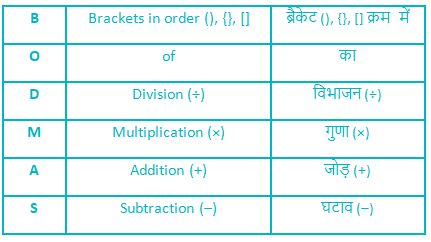
Calculation:
⇒ 2000 % of 15 ÷ 5 × 12 = ?
⇒ 300 ÷ 5 × 12 = ?
⇒ 60 × 12 = ?
⇒ ? = 720
∴ ? = 720
57. What will come in the place of the question mark ‘?’ in the following question?
∛1728 ÷ √144 + ?2 = 257
A. 256
B. 16
C. 26
D. √258
E. None of these
Solution
Concept used:
Follow BODMAS rule to solve this question, as per the order given below,
Calculations:
∛1728 ÷ √144 + ?2 = 257
⇒ 12 ÷ 12 + ?2 = 257
⇒ 1 + ?2= 257
⇒ ?2 = 257 – 1
⇒ ?2 = 256
⇒ ? = √256
⇒ ? = 16
∴ The value of x is 16
58. What value should come in place of question mark(?) in the question?
352 ÷ 4 – 108 + 17 × 4 = ?
A. 48
B. 35
C. 57
D. 64
E. None of these
Solution
Concept used:
Calculation:
Our equation is 352 ÷ 4 – 108 + 17 × 4
⇒ 88 – 108 + 17 × 4
⇒ 88 – 108 + 68
⇒ 156 – 108
⇒ 48
∴ The value of the given expression is 48
59. What value should come in place of questions (?) in the following equations ?
325 – (12)2 + 75 = ?2 – 68
A. 324
B. 384
C. 12
D. 18
E. None of these
Solution
Given:
325 – (12)2 + 75 = ?2 – 68
Concept used:
Follow BODMAS rule to solve this question, as per the order given below,
325 – (12)2 + 75 = ?2 – 68
⇒ 325 – 144 + 75 + 68 = ?2
⇒ ?2 = 324
⇒ ? = 18
∴ The value of ? is 18.
60. What should come in place of question mark (?) in the following question
108 ÷ 18 + 12 × 16 ÷ 8 = ?
A. 30
B. 20
C. 15
D. 25
E. None
Solution
Concept:
Calculation:
⇒ 108 ÷ 18 + 12 × 16 ÷ 8 = ?
⇒ 6 + 12 × 2 = ?
⇒ 6 + 24 = ?
⇒ ? = 30
∴ The required result will be 30.
61. What value should come in place of questions (?) in the following equations ?
13498 + 8932 – 1159 = ? × 89
A. 289
B. 271
C. 239
D. 261
E. None of these
Solution
Concept used:
Follow BODMAS rule to solve this question, as per the order given below.
Calculation:
13498 + 8932 – 1159 = ? × 89
⇒ ? = 21271 / 89⇒ ? = 239
62. Difference between compound interest for 2 years at 20% rate of interest and Simple interest for 4 years at 10% interest is Rs. 115. Find the principle?
A. 2875
B. 2245
C. 3245
D. 7855
E. 2144
Solution
Given:
CI for 2 years at 20%
SI for 4 years at 10%
Difference = ₹115
Formula used:
CI = P × ( (1 + r/100)t − 1 )
SI = P × r × t ÷ 100
Difference = CI − SI
Calculations:
⇒ CI = P × ( (1 + 20/100)2 − 1 ) = P × (1.22 − 1) = P × (1.44 − 1) = 0.44P
⇒ SI = P × 10 × 4 ÷ 100 = 0.4P
⇒ Difference = 0.44P − 0.4P = 0.04P
⇒ 0.04P = 115
⇒ P = 115 ÷ 0.04 = 2875
∴ Principal = ₹2875.
63. P and Q were assigned to do a work for an amount of Rs. 24,000. P alone can do it in 15 days while Q can do it in 12 days. With the help of S, they finish the work in 6 days. Find the share of S.
A. Rs. 2400
B. Rs. 1900
C. Rs. 2800
D. Rs. 2200
E. None of these
Solution
P’s one day work = 1/15
Q’s one day work = 1/12
According to the question,
1/15 + 1/12 + 1/(S) = 1/6
⇒ 1/(S) = 1/6 – (1/15 + 1/12)
⇒ 1/(S) = 1/6 – 9/60 = 1/60
∴ ‘S’ will take 60 days to complete the work alone.
∴ Ratio of work done by P : Q : S = 1/15 : 1/12 : 1/60 = 4 : 5 : 1
∴ Share of ‘S’ = (1/10) × 24000 = Rs.2,400.
64. A Motor boat’s speed in still water is 18 km/h. What will be the downstream speed of the motorboat, when the river is flowing at a speed of 12 km/h.
A. 15 km / h
B. 25 km / h
C. 30 km / h
D. 35 km / h
E. 40 km / h
Solution
Given:
Speed of Motorboat in still water (x) = 18 km/h
Speed of River (y) = 12 km/h
Formula Used:
Speed Downstream = (x + y)
Calculations:
Speed of motorboat in still water (x) = 18 km/h
Speed of River (y) = 12 km/h
∴ Downstream Speed of the motorboat = (x + y)
⇒ 18 + 12
⇒ 30 km/hThe downstream speed of the motorboat is 30 km/h.
65. If the length and breadth of a rectangle is in the ratio of 4: 9 and its perimeter is 104 m, find the area of the rectangle?
A. 625 m2
B. 576 m2
C. 627 m2
D. 578 m2
E. None of these
Solution
Given:
The ratio of length and breadth of the rectangle = 4: 9
Perimeter of rectangle = 104m
Concept used:
The perimeter of rectangle = 2(l + b)
Area of rectangle = l × b
Calculations:
The ratio of length and breadth of the rectangle = 4: 9
The perimeter of rectangle = 2(l + b)
⇒ 2(4x + 9x) = 104
⇒ 2(13x) = 104
x = 4m
Now, l = 4x = 4(4m) = 16m
b = 9x = 9(4m) = 36m
Area of rectangle = l × b
= 16 × 36
= 576 m2
The required area of the rectangle = 576m2.
66. Direction: read the following information carefully to answer the questions given below,
Eight friends M, N, O, P, W, X, S and T lives on separate floors of an eight floor apartment building. ground floor is numbered one and so on till the topmost floor is numbered eight. T lives on an even numbered floor just above to X and there are gap of two floors between X and N who lives just below P. P lives on odd number of floor below X. N lives immediately above M. Two people live between O and M. S lives on Odd numbered floor above 4th floor. The number of people lives above T is equal to the number of people lives below the P. O lives on the 4th floor.
Question:
Who lives exact between T and O?
A. X
B. M
C. N
D. W
E. S
Solution
From the given information,
Eight friends M, N, O, P, W, X, S and T lives on eight separate floors.
1) O lives on the 4th floor, two people live between O and M. N lives immediately above M.
Case 1
| No of floor | Person |
| 8 | |
| 7 | |
| 6 | |
| 5 | |
| 4 | O |
| 3 | |
| 2 | N |
| 1 | M |
Case 2
| No of floor | Person |
| 8 | N |
| 7 | M |
| 6 | |
| 5 | |
| 4 | O |
| 3 | |
| 2 | |
| 1 | |
2) T lives on an even numbered floor just above to X and there are gap of two floors between X and N who lives just below P.
3) P lives on odd number of floor below X. Number of people lives above T is equal to the number of people lives below the P.
Here Case 2 canceled and we continue with Case 1.
| No of floor | Person |
| 8 | |
| 7 | |
| 6 | T |
| 5 | X |
| 4 | O |
| 3 | P |
| 2 | N |
| 1 | M |
4) S lives on Odd numbered floor above 4th floor.
| No of floor | Person |
| 8 | W |
| 7 | S |
| 6 | T |
| 5 | X |
| 4 | O |
| 3 | P |
| 2 | N |
| 1 | M |
Hence, X lives between T and O.
67. Direction: read the following information carefully to answer the questions given below,
Eight friends M, N, O, P, W, X, S and T lives on separate floors of an eight floor apartment building. ground floor is numbered one and so on till the topmost floor is numbered eight. T lives on an even numbered floor just above to X and there are gap of two floors between X and N who lives just below P. P lives on odd number of floor below X. N lives immediately above M. Two people live between O and M. S lives on Odd numbered floor above 4th floor. The number of people lives above T is equal to the number of people lives below the P. O lives on the 4th floor.
Question:
How many people live below X?
A. 5
B. 4
C. 6
D. 7
E. None of these
Solution
From the given information,
Eight friends M, N, O, P, W, X, S and T lives on eight separate floors.
1) O lives on the 4th floor, two people live between O and M. N lives immediately above M.
Case 1
| No of floor | Person |
| 8 | |
| 7 | |
| 6 | |
| 5 | |
| 4 | O |
| 3 | |
| 2 | N |
| 1 | M |
Case 2
| No of floor | Person |
| 8 | N |
| 7 | M |
| 6 | |
| 5 | |
| 4 | O |
| 3 | |
| 2 | |
| 1 | |
2) T lives on an even numbered floor just above to X and there are gap of two floors between X and N who lives just below P.
3) P lives on odd number of floor below X. Number of people lives above T is equal to the number of people lives below the P.
Here Case 2 canceled and we continue with Case 1.
| No of floor | Person |
| 8 | |
| 7 | |
| 6 | T |
| 5 | X |
| 4 | O |
| 3 | P |
| 2 | N |
| 1 | M |
4) S lives on Odd numbered floor above 4th floor.
| No of floor | Person |
| 8 | W |
| 7 | S |
| 6 | T |
| 5 | X |
| 4 | O |
| 3 | P |
| 2 | N |
| 1 | M |
Hence, four people lives below X.
68. Direction: read the following information carefully to answer the questions given below,
Eight friends M, N, O, P, W, X, S and T lives on separate floors of an eight floor apartment building. ground floor is numbered one and so on till the topmost floor is numbered eight. T lives on an even numbered floor just above to X and there are gap of two floors between X and N who lives just below P. P lives on odd number of floor below X. N lives immediately above M. Two people live between O and M. S lives on Odd numbered floor above 4th floor. The number of people lives above T is equal to the number of people lives below the P. O lives on the 4th floor.
Question:
Who sits just above P?
A. T
B. X
C. M
D. O
E. N
Solution
From the given information,
Eight friends M, N, O, P, W, X, S and T lives on eight separate floors.
1) O lives on the 4th floor, two people live between O and M. N lives immediately above M.
Case 1
| No of floor | Person |
| 8 | |
| 7 | |
| 6 | |
| 5 | |
| 4 | O |
| 3 | |
| 2 | N |
| 1 | M |
Case 2
| No of floor | Person |
| 8 | N |
| 7 | M |
| 6 | |
| 5 | |
| 4 | O |
| 3 | |
| 2 | |
| 1 |
2) T lives on an even numbered floor just above to X and there are gap of two floors between X and N who lives just below P.
3) P lives on odd number of floor below X. Number of people lives above T is equal to the number of people lives below the P.
Here Case 2 canceled and we continue with Case 1.
| No of floor | Person |
| 8 | |
| 7 | |
| 6 | T |
| 5 | X |
| 4 | O |
| 3 | P |
| 2 | N |
| 1 | M |
4) S lives on Odd numbered floor above 4th floor.
| No of floor | Person |
| 8 | W |
| 7 | S |
| 6 | T |
| 5 | X |
| 4 | O |
| 3 | P |
| 2 | N |
| 1 | M |
Hence, O sits just above P.
69. Direction: read the following information carefully to answer the questions given below,
Eight friends M, N, O, P, W, X, S and T lives on separate floors of an eight floor apartment building. ground floor is numbered one and so on till the topmost floor is numbered eight. T lives on an even numbered floor just above to X and there are gap of two floors between X and N who lives just below P. P lives on odd number of floor below X. N lives immediately above M. Two people live between O and M. S lives on Odd numbered floor above 4th floor. The number of people lives above T is equal to the number of people lives below the P. O lives on the 4th floor.
Question:
Who lives on topmost floor?
A. X
B. W
C. P
D. M
E. O
Solution
From the given information,
Eight friends M, N, O, P, W, X, S and T lives on eight separate floors.
1) O lives on the 4th floor, two people live between O and M. N lives immediately above M.
Case 1
| No of floor | Person |
| 8 | |
| 7 | |
| 6 | |
| 5 | |
| 4 | O |
| 3 | |
| 2 | N |
| 1 | M |
Case 2
| No of floor | Person |
| 8 | N |
| 7 | M |
| 6 | |
| 5 | |
| 4 | O |
| 3 | |
| 2 | |
| 1 |
2) T lives on an even numbered floor just above to X and there are gap of two floors between X and N who lives just below P.
3) P lives on odd number of floor below X. Number of people lives above T is equal to the number of people lives below the P.
Here Case 2 canceled and we continue with Case 1.
| No of floor | Person |
| 8 | |
| 7 | |
| 6 | T |
| 5 | X |
| 4 | O |
| 3 | P |
| 2 | N |
| 1 | M |
4) S lives on Odd numbered floor above 4th floor.
| No of floor | Person |
| 8 | W |
| 7 | S |
| 6 | T |
| 5 | X |
| 4 | O |
| 3 | P |
| 2 | N |
| 1 | M |
Hence, W lives on topmost floor.
70. Direction: read the following information carefully to answer the questions given below,
Eight friends M, N, O, P, W, X, S and T lives on separate floors of an eight floor apartment building. ground floor is numbered one and so on till the topmost floor is numbered eight. T lives on an even numbered floor just above to X and there are gap of two floors between X and N who lives just below P. P lives on odd number of floor below X. N lives immediately above M. Two people live between O and M. S lives on Odd numbered floor above 4th floor. The number of people lives above T is equal to the number of people lives below the P. O lives on the 4th floor.
Question:
Who lives on 2nd floor?
A. W
B. N
C. M
D. O
E. X
Solution
From the given information,
Eight friends M, N, O, P, W, X, S and T lives on eight separate floors.
1) O lives on the 4th floor, two people live between O and M. N lives immediately above M.
Case 1
| No of floor | Person |
| 8 | |
| 7 | |
| 6 | |
| 5 | |
| 4 | O |
| 3 | |
| 2 | N |
| 1 | M |
Case 2
| No of floor | Person |
| 8 | N |
| 7 | M |
| 6 | |
| 5 | |
| 4 | O |
| 3 | |
| 2 | |
| 1 |
2) T lives on an even numbered floor just above to X and there are gap of two floors between X and N who lives just below P.
3) P lives on odd number of floor below X. Number of people lives above T is equal to the number of people lives below the P.
Here Case 2 canceled and we continue with Case 1.
| No of floor | Person |
| 8 | |
| 7 | |
| 6 | T |
| 5 | X |
| 4 | O |
| 3 | P |
| 2 | N |
| 1 | M |
4) S lives on Odd numbered floor above 4th floor.
| No of floor | Person |
| 8 | W |
| 7 | S |
| 6 | T |
| 5 | X |
| 4 | O |
| 3 | P |
| 2 | N |
| 1 | M |
Hence, N lives on 2nd floor.
71. Direction: Read the following information carefully and answer the questions based on given information.
Raj starts walking from his school 4 Km towards the north direction reaches at Bus stand then he takes his first right turn and walks for 5 Km and reaches at the park. From here, he takes left turn and walks for 3 Km to reach at coffee shop. Again he takes a left turn and walks for 6 Km to reach at a temple. From here, he takes another left turn and walks for 8 Km to reach at Gym. From here, he takes left turn and walks for 4 Km to reach his home.
Question:
What is the direction of his home with respect to his school?
A. Northwest
B. Northeast
C. Southwest
D. Southeast
E. East
Solution
We have drawn the figure according to the information given in the question:
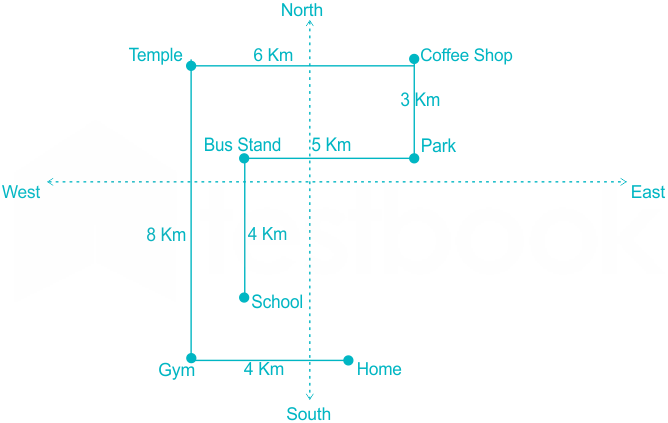
Since, his home is in Southeast direction with respect to his school.
72. Direction: Read the following information carefully and answer the questions based on given information.
Raj starts walking from his school 4 Km towards the north direction reaches at Bus stand then he takes his first right turn and walks for 5 Km and reaches at the park. From here, he takes left turn and walks for 3 Km to reach at coffee shop. Again he takes a left turn and walks for 6 Km to reach at a temple. From here, he takes another left turn and walks for 8 Km to reach at Gym. From here, he takes left turn and walks for 4 Km to reach his home.
Question:
What is the total distance traveled by Raj from Coffee Shop to the Gym?
A. 10 Km
B. 15 Km
C. 17 Km
D. 14 Km
E. 12 Km
Solution
We have drawn the figure according to the information given in the question:
Since, total distance travelled = distance between Coffee Shop and the Temple + distance between Temple and the Gym = 6 Km + 8 Km = 14 Km.
Hence, the total distance travelled by Raj from Coffee Shop to the Gym is 14 Km.
73. Direction: Read the following information carefully and answer the questions based on given information.
Raj starts walking from his school 4 Km towards the north direction reaches at Bus stand then he takes his first right turn and walks for 5 Km and reaches at the park. From here, he takes left turn and walks for 3 Km to reach at coffee shop. Again he takes a left turn and walks for 6 Km to reach at a temple. From here, he takes another left turn and walks for 8 Km to reach at Gym. From here, he takes left turn and walks for 4 Km to reach his home.
Question:
What is the direction of Bus Stand with respect to the Coffee Shop?
A. Northeast
B. South
C. West
D. Southwest
E. None of these
Solution
We have drawn the figure according to the information given in the question:
Hence, the Bus Stand is in Southwest direction with respect to the Coffee Shop.
74. Directions: Study the following information carefully to answer the given questions:
D I 1 # P & S A % Q 7 I ( A @ K L X } : ] E K 8 O ] 9 C ! Y & B O # * X 5 M 9 @ U E O
Question:
Which should be 14th to the right of 6th from the left end?
A. :
B. 8
C. %
D. Q
E. None of these
Solution
Given series:
Left side D I 1 # P & S A % Q 7 I ( A @ K L X } : ] E K 8 O ] 9 C ! Y & B O # * X 5 M 9 @ U E O Right side
As, Left element + Right element = Left element
14th from left + 6th from right = 20th from left.
As the question says 14th to the right i.e. 14th element to the right from starting series So, 20th object from left is ‘:’.
Some important concepts:
- Right element – Right element = Right element.
- Left element – Left element = Left element.
- Left element + Right element = Left element.
- Right element + Left element = Right element.
75. Directions: Study the following information carefully to answer the given questions:
D I 1 # P & S A % Q 7 I ( A @ K L X } : ] E K 8 O ] 9 C ! Y & B O # * X 5 M 9 @ U E O
Question:
Which of the following is the 21st to the left of the 2nd element from the right end of the above arrangement?
A. }
B. ]
C. :
D. E
E. None of these
Solution
Given series:
Left side D I 1 # P & S A % Q 7 I ( A @ K L X } : ] E K 8 O ] 9 C ! Y & B O # * X 5 M 9 @ U E O Right side
2nd from right end
D I 1 # P & S A % Q 7 I ( A @ K L X } : ] E K 8 O ] 9 C ! Y & B O # * X 5 M 9 @ U E O
Then, count till 21st element from the left of E
D I 1 # P & S A % Q 7 I ( A @ K L X } : ] E K 8 O ] 9 C ! Y & B O # * X 5 M 9 @ U E O
Hence, symbol ‘]’ is the correct answer.
Note: Another way
Right element + Left element = Right element → 2 + 21 → 23rd element from Right End.
76. Directions: Study the following information carefully to answer the given questions:
D I 1 # P & S A % Q 7 I ( A @ K L X } : ] E K 8 O ] 9 C ! Y & B O # * X 5 M 9 @ U E O
Question:
Four out of the following five follow some pattern while 1 of these 5 violate that pattern. Which is the one that violates the pattern among these 5?
A. Y&#
B. 7I@
C. 9C&
D. 1#S
E. 59@
Solution
Given series:
Left side D I 1 # P & S A % Q 7 I ( A @ K L X } : ] E K 8 O ] 9 C ! Y & B O # * X 5 M 9 @ U E O Right side
The pattern followed here is:
First element of the group is followed by the element which is next to the first element (of the group) in the series and further second element is followed by the element which is third to the right of the second element.
1) Y&#, it appears in the series as Y & B O #
2) 7I@, it appears in the series as 7 I ( A @
3) 9C&, it appears in the series as 9 C ! Y &
4) 1#S, it appears in the series as 1 # P & S
5) 59@, it appears in the series as 5 M 9 @ (violates the pattern)
Hence, 59@ is the correct answer.
77. Directions: Study the following information carefully to answer the given questions:
D I 1 # P & S A % Q 7 I ( A @ K L X } : ] E K 8 O ] 9 C ! Y & B O # * X 5 M 9 @ U E O
Question:
How many such symbols are there in the above arrangement each of which are immediately preceded by a number and followed by an alphabet?
A. None
B. Two
C. One
D. Three
E. More than three
Solution
Given series:
Left side D I 1 # P & S A % Q 7 I ( A @ K L X } : ] E K 8 O ] 9 C ! Y & B O # * X 5 M 9 @ U E O Right side
1) Symbols which are immediately preceded by a number and followed by an alphabet:
D I 1 # P & S A % Q 7 I ( A @ K L X } : ] E K 8 O ] 9 C ! Y & B O # * X 5 M 9 @ U E O
Hence, there are 2 symbols which is immediately preceded by number and followed by an alphabet: 1 # P and 9 @ U.
78. Directions: Study the following information carefully to answer the given questions:
D I 1 # P & S A % Q 7 I ( A @ K L X } : ] E K 8 O ] 9 C ! Y & B O # * X 5 M 9 @ U E O
Question:
If all the symbols in the above arrangement are dropped, then which of the following will be the 23rd from the right end?
A. K
B. H
C. ]
D. Q
E. None of these
Solution
Given series:
Left side D I 1 # P & S A % Q 7 I ( A @ K L X } : ] E K 8 O ] 9 C ! Y & B O # * X 5 M 9 @ U E O Right side
If all the symbols are dropped, the series will be as follows:
Left side D I 1 P S A Q 7 I A K L X E K 8 O 9 C Y B O X 5 M 9 U E O Right side
Hence, 23rd letter from the right end is Q.
79. Directions: In the following question three statements are given below followed by two conclusions numbered I and II. You have to take the given statements to be true even if they seem to be at variance from commonly known facts. Read both the conclusions and decide which of the given conclusions logically follows from the given statements.
Statements:
I. All Phones are Network.
II. Only a few Wires is Phones.
III. No Signal is Network.
Conclusions:
I. Some Network is Wires.
II. All Signal being Phones is a possibility.
A. Only conclusion I is true
B. Only conclusion II is true
C. Both conclusions I and II are true
D. Either conclusion I or II is true
E. Neither of the conclusions is true
Solution
The least possible diagram is as follows:

Conclusions:
I. Some Network is Wires – True (As all Phones are Network and Only a few Wires is Phones.)
II. All Signal being Phones is a possibility – False (As All Phones are Network and No Signal is Network.)Hence, only conclusion I is true
80. Directions: In the following questions three statements are given below followed by two conclusions numbered I and II. You have to take the given statements to be true even if they seem to be at variance from commonly known facts. Read both the conclusions and decide which of the given conclusions logically follows from the given statements.
Statements:
I. Some Pencils are Pens.
II. Some Plates are Pencils.
III. All Cups are Pens.
Conclusions:
I. Some Cups are Plates.II. Some Pens are Plates.
A. Only conclusion I is true
B. Only conclusion II is true
C. Both conclusions I and II are true
D. Either conclusion I or II is true
E. Neither I nor II is true
Solution
The least possible diagram is as follows:

Conclusions:
I. Some Cups are Plates – False (it is possible but not definite)
II. Some Pens are Plates – False (it is possible but not definite)Hence, neither of the conclusions is true
81. Directions: In the following questions three statements are given below followed by two conclusions numbered I and II. You have to take the given statements to be true even if they seem to be at variance from commonly known facts. Read both the conclusions and decide which of the given conclusions logically follows from the given statements.
Statements:
I. All Shops are Markets.
II. All Grounds are Halls.
III. No Shop is Ground.
Conclusions:
I. Some Markets being Ground is a possibility.II. All Grounds being Markets is a possibility.
A. Only conclusion I is true
B. Only conclusion II is true
C. Both conclusions I and II are true
D. Either conclusion I or II is true
E. Neither of the conclusions is true
Solution
The least possible diagram is as follows:

Conclusions:
I. Some Markets being Ground is a possibility – True

II. All Grounds being Markets is a possibility – True

Hence, both conclusions I and II are true
82. Direction: Study the following information carefully and answer the questions given below
Nine persons D, E, F, G, H, I, J, K and L are working in three different organizations namely Finance, HR and Accounts, not necessarily in the same order. At least two and not more than four employees are working in any of the departments.
F who works neither in Accounts nor in Finance department works only with one person. E who is not working in HR department has two or more members with him. More than two employees are working both in finance and Accounts department. Both E and D are not working together but D is an immediate neighbour of L. I is working only with F in HR department. J who neither works with G nor F is working with L. H works in accounts department. K neither works in department which has the highest or the lowest number of employees working with the departments. No members of the group are working together in the same order as they would appear in the English alphabetical series.
Question:
G is working in which department and with whom among the following?
A. E, Finance
B. H, Accounts
C. K, HR
D. L, Finance
E. D, HR
Solution
Given:
Nine persons: D, E, F, G, H, I, J, K and L
Three departments: Finance, HR, Accounts
Now,
1) F who works neither in Accounts nor in Finance department works only with one person.
2) E who is not working in HR department has two or more members with him.
| CASE 1 | CASE 2 | |
| Department | Person | Person |
| Finance | E | |
| HR | F | F |
| Accounts | E |
3) More than two employees are working both in finance and Accounts department.
4) Both E and D are not working together but D is an immediate neighbour of L.
| CASE 1 | CASE 2 | |
| Department | Person | Person |
| Finance | E | D, L |
| HR | F | F |
| Accounts | D, L | E |
5) I is working only with F in HR department. J who neither works with G nor F is working with L.
6) H works in accounts department. K neither works in department which has the highest or the lowest number of employees working with the departments.
As it is mentioned in the question that no person is in the same order as they would appear in the English alphabetical series, so position of K cannot be there in Finance department in CASE 2. Also it given that K is not with the highest nor the lowest number of employees.
Case 2 thus gets eliminated
| CASE 1 | CASE 2 | |
| Department | Person | Person |
| Finance | E, G, K | D, L, J |
| HR | F, I | F, I |
| Accounts | D, L, J, H | E, G, H, K |
We have the final arrangement in CASE 1
| CASE 1 | |
| Department | Person |
| Finance | E, G, K |
| HR | F, I |
| Accounts | D, L, J, H |
Hence, the correct answer is “E, Finance”.
83. Direction: Study the following information carefully and answer the questions given below
Nine persons D, E, F, G, H, I, J, K and L are working in three different organizations namely Finance, HR and Accounts, not necessarily in the same order. At least two and not more than four employees are working in any of the departments.
F who works neither in Accounts nor in Finance department works only with one person. E who is not working in HR department has two or more members with him. More than two employees are working both in finance and Accounts department. Both E and D are not working together but D is an immediate neighbour of L. I is working only with F in HR department. J who neither works with G nor F is working with L. H works in accounts department. K neither works in department which has the highest or the lowest number of employees working with the departments. No members of the group are working together in the same order as they would appear in the English alphabetical series.
Question:
Which among the following has the highest number of employees working with them?
A. Management
B. Marketing
C. Finance
D. HR
E. Accounts
Solution
Given:
Nine persons: D, E, F, G, H, I, J, K and L
Three departments: Finance, HR, Accounts
Now,
1) F who works neither in Accounts nor in Finance department works only with one person.
2) E who is not working in HR department has two or more members with him.
| CASE 1 | CASE 2 | |
| Department | Person | Person |
| Finance | E | |
| HR | F | F |
| Accounts | E |
3) More than two employees are working both in finance and Accounts department.
4) Both E and D are not working together but D is an immediate neighbour of L.
| CASE 1 | CASE 2 | |
| Department | Person | Person |
| Finance | E | D, L |
| HR | F | F |
| Accounts | D, L | E |
5) I is working only with F in HR department. J who neither works with G nor F is working with L.
6) H works in accounts department. K neither works in department which has the highest or the lowest number of employees working with the departments.
As it is mentioned in the question that no person is in the same order as they would appear in the English alphabetical series, so position of K cannot be there in Finance department in CASE 2. Also it given that K is not with the highest nor the lowest number of employees.
Case 2 thus gets eliminated
| CASE 1 | CASE 2 | |
| Department | Person | Person |
| Finance | E, G, K | D, L, J |
| HR | F, I | F, I |
| Accounts | D, L, J, H | E, G, H, K |
We have the final arrangement in CASE 1
| CASE 1 | |
| Department | Person |
| Finance | E, G, K |
| HR | F, I |
| Accounts | D, L, J, H |
Hence, the correct answer is “Accounts”.
84. Direction: Study the following information carefully and answer the questions given below
Nine persons D, E, F, G, H, I, J, K and L are working in three different organizations namely Finance, HR and Accounts, not necessarily in the same order. At least two and not more than four employees are working in any of the departments.
F who works neither in Accounts nor in Finance department works only with one person. E who is not working in HR department has two or more members with him. More than two employees are working both in finance and Accounts department. Both E and D are not working together but D is an immediate neighbour of L. I is working only with F in HR department. J who neither works with G nor F is working with L. H works in accounts department. K neither works in department which has the highest or the lowest number of employees working with the departments. No members of the group are working together in the same order as they would appear in the English alphabetical series.
Question:
Who among the following are working in the same department as H?
A. D
B. J
C. L
D. All of the above
E. Cannot be determined
Solution
Given:
Nine persons: D, E, F, G, H, I, J, K and L
Three departments: Finance, HR, Accounts
Now,
1) F who works neither in Accounts nor in Finance department works only with one person.
2) E who is not working in HR department has two or more members with him.
| CASE 1 | CASE 2 | |
| Department | Person | Person |
| Finance | E | |
| HR | F | F |
| Accounts | E |
3) More than two employees are working both in finance and Accounts department.
4) Both E and D are not working together but D is an immediate neighbour of L.
| CASE 1 | CASE 2 | |
| Department | Person | Person |
| Finance | E | D, L |
| HR | F | F |
| Accounts | D, L | E |
5) I is working only with F in HR department. J who neither works with G nor F is working with L.
6) H works in accounts department. K neither works in department which has the highest or the lowest number of employees working with the departments.
As it is mentioned in the question that no person is in the same order as they would appear in the English alphabetical series, so position of K cannot be there in Finance department in CASE 2. Also it given that K is not with the highest nor the lowest number of employees.
Case 2 thus gets eliminated
| CASE 1 | CASE 2 | |
| Department | Person | Person |
| Finance | E, G, K | D, L, J |
| HR | F, I | F, I |
| Accounts | D, L, J, H | E, G, H, K |
We have the final arrangement in CASE 1
| CASE 1 | |
| Department | Person |
| Finance | E, G, K |
| HR | F, I |
| Accounts | D, L, J, H |
Hence, the correct answer is “All of the above”.
85. Direction: Study the following information carefully and answer the questions given below
Nine persons D, E, F, G, H, I, J, K and L are working in three different organizations namely Finance, HR and Accounts, not necessarily in the same order. At least two and not more than four employees are working in any of the departments.
F who works neither in Accounts nor in Finance department works only with one person. E who is not working in HR department has two or more members with him. More than two employees are working both in finance and Accounts department. Both E and D are not working together but D is an immediate neighbour of L. I is working only with F in HR department. J who neither works with G nor F is working with L. H works in accounts department. K neither works in department which has the highest or the lowest number of employees working with the departments. No members of the group are working together in the same order as they would appear in the English alphabetical series.
Question:
Which among the following department has the lowest number of employees working with them?
A. Accounts
B. HR
C. Finance
D. Both Accounts and HR department
E. Both HR and Finance departments
Solution
Given:
Nine persons: D, E, F, G, H, I, J, K and L
Three departments: Finance, HR, Accounts
Now,
1) F who works neither in Accounts nor in Finance department works only with one person.
2) E who is not working in HR department has two or more members with him.
| CASE 1 | CASE 2 | |
| Department | Person | Person |
| Finance | E | |
| HR | F | F |
| Accounts | E |
3) More than two employees are working both in finance and Accounts department.
4) Both E and D are not working together but D is an immediate neighbour of L.
| CASE 1 | CASE 2 | |
| Department | Person | Person |
| Finance | E | D, L |
| HR | F | F |
| Accounts | D, L | E |
5) I is working only with F in HR department. J who neither works with G nor F is working with L.
6) H works in accounts department. K neither works in department which has the highest or the lowest number of employees working with the departments.
As it is mentioned in the question that no person is in the same order as they would appear in the English alphabetical series, so position of K cannot be there in Finance department in CASE 2. Also it given that K is not with the highest nor the lowest number of employees.
Case 2 thus gets eliminated
| CASE 1 | CASE 2 | |
| Department | Person | Person |
| Finance | E, G, K | D, L, J |
| HR | F, I | F, I |
| Accounts | D, L, J, H | E, G, H, K |
We have the final arrangement in CASE 1
| CASE 1 | |
| Department | Person |
| Finance | E, G, K |
| HR | F, I |
| Accounts | D, L, J, H |
Hence, the correct answer is “HR”.
86. Direction: Study the following information carefully and answer the questions given below
Nine persons D, E, F, G, H, I, J, K and L are working in three different organizations namely Finance, HR and Accounts, not necessarily in the same order. At least two and not more than four employees are working in any of the departments.
F who works neither in Accounts nor in Finance department works only with one person. E who is not working in HR department has two or more members with him. More than two employees are working both in finance and Accounts department. Both E and D are not working together but D is an immediate neighbour of L. I is working only with F in HR department. J who neither works with G nor F is working with L. H works in accounts department. K neither works in department which has the highest or the lowest number of employees working with the departments. No members of the group are working together in the same order as they would appear in the English alphabetical series.
Question:
Who among the following works in Finance department with K?
A. FI
B. EH
C. EG
D. DJ
E. HL
Solution
Given:
Nine persons: D, E, F, G, H, I, J, K and L
Three departments: Finance, HR, Accounts
Now,
1) F who works neither in Accounts nor in Finance department works only with one person.
2) E who is not working in HR department has two or more members with him.
| CASE 1 | CASE 2 | |
| Department | Person | Person |
| Finance | E | |
| HR | F | F |
| Accounts | E |
3) More than two employees are working both in finance and Accounts department.
4) Both E and D are not working together but D is an immediate neighbour of L.
| CASE 1 | CASE 2 | |
| Department | Person | Person |
| Finance | E | D, L |
| HR | F | F |
| Accounts | D, L | E |
5) I is working only with F in HR department. J who neither works with G nor F is working with L.
6) H works in accounts department. K neither works in department which has the highest or the lowest number of employees working with the departments.
As it is mentioned in the question that no person is in the same order as they would appear in the English alphabetical series, so position of K cannot be there in Finance department in CASE 2. Also it given that K is not with the highest nor the lowest number of employees.
Case 2 thus gets eliminated
| CASE 1 | CASE 2 | |
| Department | Person | Person |
| Finance | E, G, K | D, L, J |
| HR | F, I | F, I |
| Accounts | D, L, J, H | E, G, H, K |
We have the final arrangement in CASE 1
| CASE 1 | |
| Department | Person |
| Finance | E, G, K |
| HR | F, I |
| Accounts | D, L, J, H |
Hence, the correct answer is “EG”.
87. How many such pairs of letters are there in the word ‘ACKNOWLEDGE’ each of which has as many letters between them in the word (in both forward and backward directions), as they have between them in the English alphabetical series?
A. One
B. Two
C. Three
D. Four
E. More than Four
Solution
The word can be represented as follows,
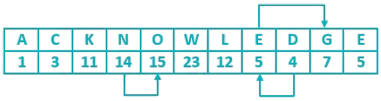
Hence, we get 3 such pairs ‘NO’, ‘DE’ and ‘EG’.
88. Direction: Study the following information carefully and answer the given questions.
In a certain code language,
‘submit enforce subsidy status’ means ‘gv ur su mp’
‘update identity submit details’ means ‘ur kt cr dl’
‘subsidy details enforce identity’ means ‘kt mp su dl’
‘identity version people subsidy’ means ‘fg mp dl ib’
Question:
Which of the following is coded as ‘mp’ in that language?
A. update
B. people
C. version
D. subsidy
E. identify
Solution
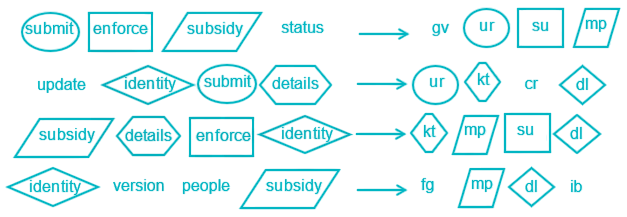
Thus ‘mp’ is decoded as ‘subsidy’.
89. Direction: Study the following information carefully and answer the given questions.
In a certain code language,
‘submit enforce subsidy status’ means ‘gv ur su mp’
‘update identity submit details’ means ‘ur kt cr dl’
‘subsidy details enforce identity’ means ‘kt mp su dl’
‘identity version people subsidy’ means ‘fg mp dl ib’
Question:
What is the code for ‘submit identity’ in that language?
A. ur su
B. dl ur
C. fg kt
D. gv mp
E. kt dl
Solution
Thus ‘submit identity’ is coded as ‘dl ur’.
90. Direction: Study the following information carefully and answer the given questions.
In a certain code language,
‘submit enforce subsidy status’ means ‘gv ur su mp’
‘update identity submit details’ means ‘ur kt cr dl’
‘subsidy details enforce identity’ means ‘kt mp su dl’
‘identity version people subsidy’ means ‘fg mp dl ib’
Question:
Which of the following is coded as ‘su mp’ in the given code language?
A. subsidy people
B. update enforce
C. identify status
D. enforce subsidy
E. new enforce
Solution
Thus ‘su mp’ is decoded as ‘enforce subsidy’
91. Direction: Study the following information carefully and answer the given questions.
In a certain code language,
‘submit enforce subsidy status’ means ‘gv ur su mp’
‘update identity submit details’ means ‘ur kt cr dl’
‘subsidy details enforce identity’ means ‘kt mp su dl’
‘identity version people subsidy’ means ‘fg mp dl ib’
Question:
What is the code for ‘submit update details’ in that language?
A. ib mp ur
B. cr ib ur
C. ib kt fg
D. fg ib cr
E. cr ur kt
Solution
Thus ‘submit update details’ is coded as ‘cr ur kt’.
92. Direction: Study the following information carefully and answer the questions based on it.
Eight friends Divya, Dev, Piyush, Shiv, Nisha, Geeta, Bhavna, Govinda are sitting around the circular table but not necessarily in the same order and are facing towards the center of the table.Nisha is third to the Right of Bhavna. Dev and Piyush are neighbors. Divya is sitting opposite to Geeta. Shiv is an immediate neighbor of Bhavna. There are two persons sitting between Nisha and Geeta. Dev and Govinda are sitting opposite to each other.
Question:
Which of the following is true regarding Divya?
A. Nisha is not neighbor of Divya
B. Divya is third to the left of Dev
C. Piyush is an immediate neighbor of Divya
D. Divya Facing in opposite direction of Shiv
E. There are 2 persons between Divya and Bhavna
Solution
Persons: Divya, Dev, Piyush, Shiv, Nisha, Geeta, Bhavna, Govinda
1) Shiv is an immediate neighbor of Bhavna.
Case 1:
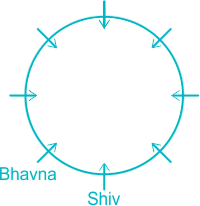
Case 2:
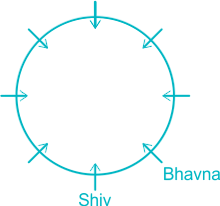
2) Nisha is third to the left of Bhavna.
Case 1:
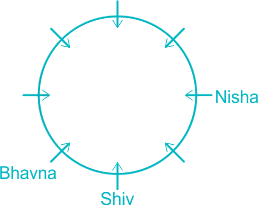
Case 2:
3) There are two persons sitting between Nisha and Geeta.
Case 1:
Case 2:
4) Divya is sitting opposite to Geeta.
Case 2:
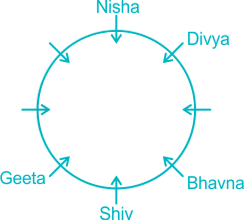
5) Dev and Piyush are neighbors.
6) Dev and Govinda are sitting opposite to each other.
Case 1 cannot satisfy the above conditions. Hence, Case 1 gets eliminated.
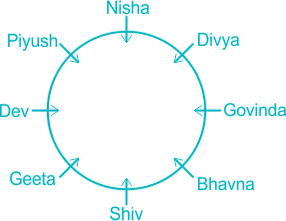
Hence, option 2 is the correct answer.
93. Direction: Study the following information carefully and answer the questions based on it.
Eight friends Divya, Dev, Piyush, Shiv, Nisha, Geeta, Bhavna, Govinda are sitting around the circular table but not necessarily in the same order and are facing towards the center of the table.Nisha is third to the Right of Bhavna. Dev and Piyush are neighbors. Divya is sitting opposite to Geeta. Shiv is an immediate neighbor of Bhavna. There are two persons sitting between Nisha and Geeta. Dev and Govinda are sitting opposite to each other.
Question:
Who among the following sits immediate left of Nisha?
A. Govinda
B. Piyush
C. Divya
D. Dev
E. Shiv
Solution
Persons: Divya, Dev, Piyush, Shiv, Nisha, Geeta, Bhavna, Govinda
1) Shiv is an immediate neighbor of Bhavna.
Case 1:
Case 2:
2) Nisha is third to the left of Bhavna.
Case 1:
Case 2:
3) There are two persons sitting between Nisha and Geeta.
Case 1:
Case 2:
4) Divya is sitting opposite to Geeta.
Case 2:
5) Dev and Piyush are neighbors.
6) Dev and Govinda are sitting opposite to each other.
Case 1 cannot satisfy the above conditions. Hence, Case 1 gets eliminated.
Hence, Divya is the correct answer.
94. Direction: Study the following information carefully and answer the questions based on it.
Eight friends Divya, Dev, Piyush, Shiv, Nisha, Geeta, Bhavna, Govinda are sitting around the circular table but not necessarily in the same order and are facing towards the center of the table.Nisha is third to the Right of Bhavna. Dev and Piyush are neighbors. Divya is sitting opposite to Geeta. Shiv is an immediate neighbor of Bhavna. There are two persons sitting between Nisha and Geeta. Dev and Govinda are sitting opposite to each other.
Question:
How many people sit between Divya and the person sitting at the immediate left of Shiv (when counted from right of Divya)?
A. Three
B. Four
C. Two
D. One
E. None
Solution
Persons: Divya, Dev, Piyush, Shiv, Nisha, Geeta, Bhavna, Govinda
1) Shiv is an immediate neighbor of Bhavna.
Case 1:
Case 2:
2) Nisha is third to the left of Bhavna.
Case 1:
Case 2:
3) There are two persons sitting between Nisha and Geeta.
Case 1:
Case 2:
4) Divya is sitting opposite to Geeta.
Case 2:
5) Dev and Piyush are neighbors.
6) Dev and Govinda are sitting opposite to each other.
Case 1 cannot satisfy the above conditions. Hence, Case 1 gets eliminated.
Hence, Three is the correct answer.
95. Direction: Study the following information carefully and answer the questions based on it.
Eight friends Divya, Dev, Piyush, Shiv, Nisha, Geeta, Bhavna, Govinda are sitting around the circular table but not necessarily in the same order and are facing towards the center of the table.Nisha is third to the Right of Bhavna. Dev and Piyush are neighbors. Divya is sitting opposite to Geeta. Shiv is an immediate neighbor of Bhavna. There are two persons sitting between Nisha and Geeta. Dev and Govinda are sitting opposite to each other.
Question:
What is the position of Govinda with respect to Geeta?
A. Exactly opposite
B. Immediate left
C. Third to the right
D. Immediate right
E. Second to the right
Solution
Persons: Divya, Dev, Piyush, Shiv, Nisha, Geeta, Bhavna, Govinda
1) Shiv is an immediate neighbor of Bhavna.
Case 1:
Case 2:
2) Nisha is third to the left of Bhavna.
Case 1:
Case 2:
3) There are two persons sitting between Nisha and Geeta.
Case 1:
Case 2:
4) Divya is sitting opposite to Geeta.
Case 2:
5) Dev and Piyush are neighbors.
6) Dev and Govinda are sitting opposite to each other.
Case 1 cannot satisfy the above conditions. Hence, Case 1 gets eliminated.
Hence, “Third to the right” is the correct answer.
96. Direction: Study the following information carefully and answer the questions based on it.
Eight friends Divya, Dev, Piyush, Shiv, Nisha, Geeta, Bhavna, Govinda are sitting around the circular table but not necessarily in the same order and are facing towards the center of the table.Nisha is third to the Right of Bhavna. Dev and Piyush are neighbors. Divya is sitting opposite to Geeta. Shiv is an immediate neighbor of Bhavna. There are two persons sitting between Nisha and Geeta. Dev and Govinda are sitting opposite to each other.
Question:
Who sits third to the left of Bhavna?
A. Piyush
B. Dev
C. Divya
D. Govinda
E. Nisha
Solution
Persons: Divya, Dev, Piyush, Shiv, Nisha, Geeta, Bhavna, Govinda
1) Shiv is an immediate neighbor of Bhavna.
Case 1:
Case 2:
2) Nisha is third to the left of Bhavna.
Case 1:
Case 2:
3) There are two persons sitting between Nisha and Geeta.
Case 1:
Case 2:
4) Divya is sitting opposite to Geeta.
Case 2:
5) Dev and Piyush are neighbors.
6) Dev and Govinda are sitting opposite to each other.
Case 1 cannot satisfy the above conditions. Hence, Case 1 gets eliminated.
Hence, Dev is the correct answer.
97. Direction: Study the following information carefully and answer the questions based on it.
In a family, there are eight members A, B, C, D, P, Q, R, and S. There are equal numbers of males and females, belongs to the three different generations and having two married couples. A is the paternal grandfather of P, who is the brother of C. R has only one son, who is married to S. B is unmarried and uncle of C. S is the mother of C and Sister-in-law of D.
Question:
How is C related to D?
A. Niece
B. Aunt
C. Sister-in-law
D. Daughter
E. None of these
Solution
Answer: 1
From the given information,
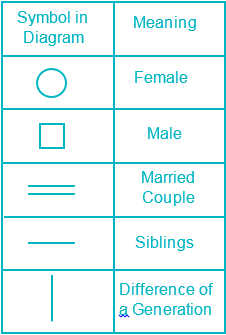
1) R has only one son, who is married to S.

2) S is the mother of C.
3) S is the sister-in-law of D.
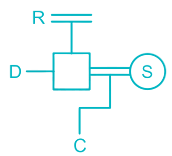
4) P is the brother of C.
5) A is the parental grandfather of P. (From here we got the relation of A and R as A is the husband of R)
6) B, who is an unmarried uncle of C. (R have only one son which means B is the brother of S)
7) In the above statement given that there is an equal number (4) of male and female, from here we know that D and C are female and undefined Q will be the husband of S.
Here C is the daughter of S and S is the sister-in-law of D.
Hence, C is the niece of D.
98. Direction: Study the following information carefully and answer the questions based on it.
In a family, there are eight members A, B, C, D, P, Q, R, and S. There are equal numbers of males and females, belongs to the three different generations and having two married couples. A is the paternal grandfather of P, who is the brother of C. R has only one son, who is married to S. B is unmarried and uncle of C. S is the mother of C and Sister-in-law of D.
Question:
Which of the following group of pairs represents the married couples correctly?
A. A-S, Q-R
B. B-D, Q-R
C. B-C, P-D
D. A-R, Q-S
E. None of these
Solution
Answer: 4
From the given information,
1) R has only one son, who is married to S.
2) S is the mother of C.
3) S is the sister-in-law of D.
4) P is the brother of C.
5) A is the parental grandfather of P. (From here we got the relation of A and R as A is the husband of R)
6) B, who is an unmarried uncle of C. (R have only one son which means B is the brother of S)
7) In the above statement given that there is an equal number (4) of male and female, from here we know that D and C are female and undefined Q will be the husband of S.
From the obtained family relation we got two married couples (A is the husband of R and Q is the husband of S)
Hence, A-R and Q-S are the groups of pairs represents the married couples.
99. Direction: Study the following information carefully and answer the questions based on it.
In a family, there are eight members A, B, C, D, P, Q, R, and S. There are equal numbers of males and females, belongs to the three different generations and having two married couples. A is the paternal grandfather of P, who is the brother of C. R has only one son, who is married to S. B is unmarried and uncle of C. S is the mother of C and Sister-in-law of D.
Question:
Who is the father of C?
A. R
B. Q
C. A
D. D
E. None of these
Solution
Answer: 2
From the given information,
1) R has only one son, who is married to S.
2) S is the mother of C.
3) S is the sister-in-law of D.
4) P is the brother of C.
5) A is the parental grandfather of P. (From here we got the relation of A and R as A is the husband of R)
6) B, who is an unmarried uncle of C. (R have only one son which means B is the brother of S)
7) In the above statement given that there is an equal number (4) of male and female, from here we know that D and C are female and undefined Q will be the husband of S.
In the above relation, we know that S is the mother of C and wife of Q.
Hence, Q is the father of C.
100. What will be the third letter of a meaningful English word which can be formed by using the first, the second, the third, the fifth, the ninth, the tenth and the last letters of the word EXTRAORDINARY, using each letter only once in each word? (To be counted from left)
A. T
B. A
C. Y
D. I
E. X
Solution
Word: EXTRAORDINARY
1st letter = E; 2nd letter = X; 3rd letter = T; 5th letter = A; 9th letter = I; 10th letter = N; Last letter = Y
Letters given are: E X T A I N Y
Word that can be formed: ANXIETY
Clearly, the third letter is X