1. Directions: The following sentence has been split into five segments. Identify the segment that contains a grammatical error.
Fortunately, most banks (A)/ offer a locator tool (B)/ on their websites, so (C)/ you can always find an (D)/ ATM machine close to you (E)/.
A. A
B. B
C. C
D. D
E. E
Solution
The correct answer is ‘E.‘
Key Points
- In the given sentence, the words ‘ATM‘ and ‘machine‘ are used, thus the sentence is corrupted by redundancy.
- ‘ATM’ is an abbreviation for Automated Teller Machine.
- Adding the word ‘machine’ with ‘ATM’ is in fact amongst the funny redundancy phrases that many overuse.
- So, both ‘ATM‘ and ‘machine‘ can’t be used in a single sentence.
- Therefore, we can say that using the word ‘machine‘ along with ‘ATM‘ is redundant.
Hence, the only possible answer is option 5.
Correct Sentence: Fortunately, most banks offer a locator tool on their websites, so you can always find an ATM close to you.
2. Directions: The following sentence has been split into five segments. Identify the segment that contains a grammatical error.
The teacher explained (A)/ that the numbers (B)/ in the problem (C)/ continue to repeat (D)/ again in a pattern of plus three (E)/.
A. A
B. B
C. C
D. D
E. E
Solution
The correct answer is ‘E.‘
Key Points
- In the given sentence, the words ‘repeat‘ and ‘again‘ are used, thus the sentence is corrupted by redundancy.
- The word ‘repeat‘ means to occur again in the same way or form.
- The word ‘again‘ is included in the meaning of ‘repeat‘.
- So, both ‘repeat‘ and ‘again‘ can’t be used in a single sentence.
- Therefore, we can say that using the word ‘again‘ along with ‘repeat‘ is redundant.
Hence, the only possible answer is option 5.
Correct Sentence: The teacher explained that the numbers in the problem continue to repeat in a pattern of plus three.
3. Directions: The following sentence has been split into five segments. The parts in bold are fixed and contain no errors. Identify the segment that contains a grammatical error.
She has made (A)/ me repeat again (B)/ the story of Little Red Riding Hood (C)/ so often that I believe (D)/ I could say it backward. (E)/.
A. A
B. B
C. C
D. D
E. E
Solution
The correct answer is ‘B.‘
Key Points
- In the given sentence, the words ‘repeat‘ and ‘again‘ are used side by side, thus the sentence is corrupted by redundancy.
- The word ‘repeat‘ means to say or do the same thing again.
- The word ‘again‘ is included in the meaning of ‘repeat‘.
- So, both ‘repeat‘ and ‘again‘ can’t be used in a single sentence.
- Therefore, we can say that using the word ‘again‘ along with ‘repeat‘ is redundant.
Hence, the only possible answer is option 2.
Correct Sentence: She has made me repeat the story of Little Red Riding Hood so often that I believe I could say it backward.
4. Directions: The following sentence has been split into five segments. The parts in bold are fixed and contain no errors. Identify the segment that contains a grammatical error.
He had managed (A)/ without a housekeeper (B)/ before she came, (C)/ and he could (D)/ gets along fine now (E)/.
A. A
B. B
C. C
D. D
E. E
Solution
The correct answer is ‘E‘ i.e. this part of the sentence has an error.
Key Points
- In the fifth part of the given sentence, the third-person present singular form of the verb ‘gets‘ is incorrect.
- The verb ‘could’ in the fourth part of the given sentence is a modal verb.
- The modal verb ‘could’ is followed by the main verb and the main verb also stays in its base form.
- Also, the main verb that is used with ‘could’ does not change form according to the subject.
- Therefore, the base form of the verb ‘get‘ should be used in place of the third-person present singular form of the verb ‘gets‘.
Hence, the correct answer is option 5.
Correct sentence: He had managed without a housekeeper before she came, and he could get along fine now.
5. Direction: A sentence/part of the sentence is emboldened. Five alternatives are given to the embolden part which will improve the sentence. Choose the correct alternative and choose the option corresponding to it. In case no improvement is needed, click the option corresponding to ‘No improvement required’.
The restaurant has a diverse menu that include entree from all over the world.
A. include entrees
B. included entrees
C. including entrees
D. includes entrees
E. No improvement required
Solution
The correct answer is includes entrees.
Key Points
- In the given sentence, the emboldened part include entree is grammatically incorrect.
- In the given sentence, the word diverse suggest something is more than one so it is plural.
- Here, it suggests that the menu will have more than one entree so entrees is the correct word.
- The subject is menu that is singular so the verb following it will also be singular.
- includes is singular of the verb include.
- So, includes entrees is the correct answer.
So, the correct sentence is, The restaurant has a diverse menu that includes entrees from all over the world.
Additional Information
- The word include means to comprise or contain as part of a whole.
- Let us look into other options:
- included is past tense of the verb include.
- including is the continuous form of the verb include.
6. Direction: A sentence/part of the sentence is emboldened. Five alternatives are given to the embolden part which will improve the sentence. Choose the correct alternative and choose the option corresponding to it. In case no improvement is needed, click the option corresponding to ‘No improvement required’.
If he was here, you’d be pleased.
A. as here
B. is here
C. were here
D. have here
E. No improvement required
Solution
The correct answer is were here.
Key Points
- In the given sentence, the emboldened part was here is grammatically incorrect.
- In the given sentence, the subject is he is singular but the sentence is an example of the subjunctive mood because here a hypothetical situation has been talked about- the person is not physically present.
- In subjunctive mood, singular subjects are paired with plural verbs in the past tense.
- Here, were is the plural form of was.
- So, were here is the correct answer.
So, the correct sentence is, If he were here, you’d be pleased.
Additional Information
- The subjunctive mood is used for expressing wishes, suggestions, or desires, and is usually indicated by an indicative verb such as wish or suggest, paired then with a subjunctive verb.
- In the subjunctive, we use the plural form of the verb for the third-person singular with the ‑s dropped, but the verb to be is a special case.
- For example,
- It is recommended that she prepare a short speech before the ceremony.
- I wish it were Friday.
- Let us look into other options:
- as is used in comparisons to refer to the extent or degree of something.
- is is present tense third-person singular of ‘to+be’ form.
- have is used for plural nouns (except I, you) in the present tense.
7. Direction: Read the given passage and choose the correct answers for the questions given below.
The pockets of methane trapped within Canada’s frozen Lake Abraham are a natural wonder, ____1____ yet with a deadly core. These beautiful, ethereal blue orbs indeed have a dark side. Although produced by a natural process, the alluring ice-encased bubbles enclose a ____2____ greenhouse gas and therefore a threat to the planet.
The story of how the bubbles come into being is far from appealing and, as with many a horror story, it ____3____ with dead bodies. Microbes feeding on the decomposing organic matter at the bottom of the lake release methane, which floats to the surface in bubbles. When the water freezes in winter, these bubbles become trapped, producing magical landscapes. But come the spring thaw, the bubbles pop, releasing the methane within them to the atmosphere. Methane is highly inflammable and so the bubbles explode when set ____4____. Its real danger lies in its impact on Earth’s temperature. Although methane doesn’t stick around in the atmosphere like carbon dioxide, its heat-trapping effect is 34 times stronger, making it potentially far more ____5____ to our climate.
This pretty-but-pressing problem isn’t limited to Canada. Russia and US scientists have also measured methane emissions from thawing bogs in Siberia, and as the climate warms, more once-frozen lakes could also start releasing their gases.
Question:
Choose the correct word to fill the 1st blank.
A. absolute
B. dazzling
C. lethal
D. salubrious
E. fatal
Solution
The correct answer is “dazzling”.
Key Points
The passage begins by mentioning the pockets of methane that are tapped within Canada’s frozen lake. They are described as a natural wonder. Further, looking at that part of the sentence with the 1st blank, it is followed by the conjunction ‘yet’ which is usually used to show contrast.
- Therefore, we need to find a word that contrasts with the ‘deadly’ core or sets off the negative connotation of the same.
- Considering the meanings of the words in the options, “dazzling” which means extremely attractive or exciting, is the correct word. The pockets of methane are a natural wonder and thus can be attractive/interesting. Also, “dazzling” contrasts the connotation of ‘wonder’ with that of ‘the deadly core’ to make the sentence coherent.
- The word “absolute”(option 1) is incorrect as it is neither specific nor related to the context of the sentence. “Lethal” (option 3) and “fatal” (option 5) are incorrect as they are synonymous with ‘deadly’ and inappropriate to complete the sentence. Option 4 “salubrious” is incorrect as it is out of context.
Therefore, option 2- “dazzling” is the correct answer.
Additional Information
Let us look at the meanings of other words in the options:
| Word | Meaning |
| absolute | complete, perfect |
| lethal | devastating, deadly |
| salubrious | favourable to health or well-being |
| fatal | deadly, killer |
8. Direction: Read the given passage and choose the correct answers for the questions given below.
The pockets of methane trapped within Canada’s frozen Lake Abraham are a natural wonder, ____1____ yet with a deadly core. These beautiful, ethereal blue orbs indeed have a dark side. Although produced by a natural process, the alluring ice-encased bubbles enclose a ____2____ greenhouse gas and therefore a threat to the planet.
The story of how the bubbles come into being is far from appealing and, as with many a horror story, it ____3____ with dead bodies. Microbes feeding on the decomposing organic matter at the bottom of the lake release methane, which floats to the surface in bubbles. When the water freezes in winter, these bubbles become trapped, producing magical landscapes. But come the spring thaw, the bubbles pop, releasing the methane within them to the atmosphere. Methane is highly inflammable and so the bubbles explode when set ____4____. Its real danger lies in its impact on Earth’s temperature. Although methane doesn’t stick around in the atmosphere like carbon dioxide, its heat-trapping effect is 34 times stronger, making it potentially far more ____5____ to our climate.
This pretty-but-pressing problem isn’t limited to Canada. Russia and US scientists have also measured methane emissions from thawing bogs in Siberia, and as the climate warms, more once-frozen lakes could also start releasing their gases.
Question:
Choose the correct word to fill the 2nd blank.
A. nocuous
B. vital
C. requisite
D. conducive
E. nocuous, requisite
Solution
The correct answer is “nocuous”.
Key Points
Looking at the sentence with the 2nd blank, the word ‘therefore’ which is used after the blank implies that the threat is due to an attribute of the greenhouse gas. So, we can infer that the gas might be dangerous.
- Therefore, we need to find a word that is similar in meaning to dangerous or harmful.
- Considering the meanings of the words in the options, “nocuous” which means harmful or noxious, is the correct word. It completes the sentence, conveying the meaning precisely.
- The word “vital” (option 2) is incorrect as it is not appropriate in conveying the message of the sentence. Further, “requisite” (option 3) and “conducive” (option 4) are incorrect as they are inappropriate in the context. Option 5 consists of a set of incorrect words, so it is incorrect too.
Therefore, option 1- “nocuous” is the correct answer.
Additional Information
Let us look at the meanings of other words in the options:
| Word | Meaning |
| vital | extremely important |
| requisite | necessary, essential |
| conducive | facilitative, helpful |
9. Direction: Read the given passage and choose the correct answers for the questions given below.
The pockets of methane trapped within Canada’s frozen Lake Abraham are a natural wonder, ____1____ yet with a deadly core. These beautiful, ethereal blue orbs indeed have a dark side. Although produced by a natural process, the alluring ice-encased bubbles enclose a ____2____ greenhouse gas and therefore a threat to the planet.
The story of how the bubbles come into being is far from appealing and, as with many a horror story, it ____3____ with dead bodies. Microbes feeding on the decomposing organic matter at the bottom of the lake release methane, which floats to the surface in bubbles. When the water freezes in winter, these bubbles become trapped, producing magical landscapes. But come the spring thaw, the bubbles pop, releasing the methane within them to the atmosphere. Methane is highly inflammable and so the bubbles explode when set ____4____. Its real danger lies in its impact on Earth’s temperature. Although methane doesn’t stick around in the atmosphere like carbon dioxide, its heat-trapping effect is 34 times stronger, making it potentially far more ____5____ to our climate.
This pretty-but-pressing problem isn’t limited to Canada. Russia and US scientists have also measured methane emissions from thawing bogs in Siberia, and as the climate warms, more once-frozen lakes could also start releasing their gases.
Question:
Choose the correct word to fill the 3rd blank.
A. depicts
B. narrates
C. starts
D. entails
E. concludes
Solution
The correct answer is “starts”.
Key Points
The sentence with the 3rd blank conveys that the story of the formation of bubbles is rather pleasant and like any horror story, it involves dead bodies. As we read further, the next sentence describes the same process that begins with microbes feeding on decomposing matter. So, we can infer that the story possibly ‘begins’ with dead bodies.
- Therefore, we need to find a word similar in meaning to ‘begins’.
- Considering the meanings of the words in the options, “starts” which means ‘begins’ is the correct word.
- The words “depicts” (option 1), “narrates” (option 2), and “entails” (option 4) are incorrect as they are transitive verbs and take on direct objects and do not need any preposition (in the given sentence, ‘with’ which follows the blank). Besides, these words are not specific in the context. The word “concludes” is incorrect it conveys the opposite meaning.
Therefore, option 3- “starts” is the correct answer.
Additional Information
Let us look into the meanings of other words in the options:
| Word | Meaning |
| depicts | represents, describes |
| narrates | describes something in detail |
| entails | involves, includes |
| concludes | ends, closes |
10. Direction: Read the given passage and choose the correct answers for the questions given below.
The pockets of methane trapped within Canada’s frozen Lake Abraham are a natural wonder, ____1____ yet with a deadly core. These beautiful, ethereal blue orbs indeed have a dark side. Although produced by a natural process, the alluring ice-encased bubbles enclose a ____2____ greenhouse gas and therefore a threat to the planet.
The story of how the bubbles come into being is far from appealing and, as with many a horror story, it ____3____ with dead bodies. Microbes feeding on the decomposing organic matter at the bottom of the lake release methane, which floats to the surface in bubbles. When the water freezes in winter, these bubbles become trapped, producing magical landscapes. But come the spring thaw, the bubbles pop, releasing the methane within them to the atmosphere. Methane is highly inflammable and so the bubbles explode when set ____4____. Its real danger lies in its impact on Earth’s temperature. Although methane doesn’t stick around in the atmosphere like carbon dioxide, its heat-trapping effect is 34 times stronger, making it potentially far more ____5____ to our climate.
This pretty-but-pressing problem isn’t limited to Canada. Russia and US scientists have also measured methane emissions from thawing bogs in Siberia, and as the climate warms, more once-frozen lakes could also start releasing their gases.
Question:
Choose the correct word to fill the 4th blank.
A. intense
B. aside
C. shining
D. frozen
E. alight
Solution
The correct answer is “alight”.
Key Points
The sentence with the blank says that Methane is highly inflammable i.e. capable of being easily ignited. So, it is clear that it explodes when set on fire.
- Therefore, we need to find a word that is similar in meaning to ‘on fire’.
- Considering the meanings of the words given in the options, “alight” which means ‘burning’ or ‘on fire’, is the correct word. As Methane can easily catch fire, evidently it explodes when it is set on fire.
- The word “intense” (option 1) is incorrect as it is completely out of the context. Also, “aside” (option 2) is incorrect as it is inappropriate in the context- methane explodes when it is set away, has no meaning. Option 3- “shining” is not related to the context in any way and therefore it is incorrect. The word “frozen” (option 4) is incorrect as Methane cannot explode when set frozen, it explodes only when it is set on fire.
Therefore, option 5- “alight” is the correct answer.
Additional Information
Let us look at the meanings of other words in the options:
| Word | Meaning |
| intense | existing in an extreme degree |
| aside | away |
| shining | emitting light |
| frozen | icy, frigid |
11. Direction: Read the given passage and choose the correct answers for the questions given below.
The pockets of methane trapped within Canada’s frozen Lake Abraham are a natural wonder, ____1____ yet with a deadly core. These beautiful, ethereal blue orbs indeed have a dark side. Although produced by a natural process, the alluring ice-encased bubbles enclose a ____2____ greenhouse gas and therefore a threat to the planet.
The story of how the bubbles come into being is far from appealing and, as with many a horror story, it ____3____ with dead bodies. Microbes feeding on the decomposing organic matter at the bottom of the lake release methane, which floats to the surface in bubbles. When the water freezes in winter, these bubbles become trapped, producing magical landscapes. But come the spring thaw, the bubbles pop, releasing the methane within them to the atmosphere. Methane is highly inflammable and so the bubbles explode when set ____4____. Its real danger lies in its impact on Earth’s temperature. Although methane doesn’t stick around in the atmosphere like carbon dioxide, its heat-trapping effect is 34 times stronger, making it potentially far more ____5____ to our climate.
This pretty-but-pressing problem isn’t limited to Canada. Russia and US scientists have also measured methane emissions from thawing bogs in Siberia, and as the climate warms, more once-frozen lakes could also start releasing their gases.
Question:
Choose the correct word to fill the 5th blank.
A. deleterious
B. affecting
C. pervasive
D. invisible
E. significant
Solution
The correct answer is “deleterious”.
Key Points
The sentence with the blank mentions the impact of Methane on the earth’s atmosphere and climate, in comparison with carbon dioxide. It says that though Methane does not stick around in the atmosphere, its heat-trapping effect is 34 times stronger. Thus, we can infer that it is more harmful to our climate.
- Therefore, we need to find a word that is similar in meaning to the word ‘harmful’.
- Considering the meanings of the words given in the options, “deleterious” which means harmful often in a subtle or unexpected way, is the correct answer. It is most appropriate in the context too, as methane does not remain in the atmosphere like carbon dioxide, it is not expected to be more harmful. However, the fact is otherwise owing to methane’s heat-trapping effect.
- The word “affecting” (option 1) is incorrect, though it seems related as it is used often to mean ‘affecting adversely’. But, the word can be used for both positive as well as negative impacts. So, as it is unspecific in the given context, it is incorrect. The word “pervasive” (option 3) is incorrect as it is inappropriate in conveying the message of the sentence. Also, “invisible” (option 4) and “significant” (option 5) are incorrect as they are not relevant in the context.
Therefore, option 2- “deleterious” is the correct answer.
Additional Information
Let us look at the earnings of other words in the options:
| Word | Meaning |
| affecting | influencing to cause a change |
| pervasive | present in every part of thing or place |
| invisible | impossible to see |
| significant | important, noticeable |
12. Directions: Given below is a word, followed by three sentences that consist of that word. Identify the sentence(s) that best express(es) the meaning of the word. Choose option 5 ‘None of the above’ if the word is not suitable in any of the sentences.
SMIDGE
A. She stood on the smidge of the lake at the line where the water met the sand.
B. In an effort to get the job, the applicant chose to smidge on his resume and list evidence he didn’t really have.
C. Make sure to only add a smidge of sage to your recipe since even a small bit of the seasoning can be overpowering.
A. Only A
B. Only B
C. Only C
D. Both A and B
E. None of the above
Solution
The correct answer is ‘Only C.‘
Key Points
- The given word ‘Smidge‘ means a very small amount or part. (बहुत छोटी मात्रा या भाग)
- Let us explore the given sentences:
- The word ‘verge‘ should be used in the first sentence as it talks about standing on the edge of the lake.
- The word ‘verge’ means an edge or border. (किनारा या सीमा)
- The word ‘fudge’ should be used in the second sentence as it talks about an applicant who chose to manipulate facts on his resume to get the job.
- The word ‘fudge‘ means to adjust or manipulate facts or figures so as to present a desired picture. (टालमटोल करना; हेरफेर करना, झूठी बात)
- The word ‘smidge’ is used correctly in the third sentence as it talks about adding a very small amount of seasoning to a recipe.
- Example: On the top of the machine was a round clear disc, a petri dish, with just a smidge of gray matter.
- The word ‘verge‘ should be used in the first sentence as it talks about standing on the edge of the lake.
- Therefore, only sentence C best expresses the meaning of the given word.
Hence, the correct answer is option 3.
Sentence A: She stood on the verge of the lake at the line where the water met the sand.
Sentence B: In an effort to get the job, the applicant chose to fudge on his resume and list evidence he didn’t really have.
Sentence C: Make sure to only add a smidge of sage to your recipe since even a small bit of the seasoning can be overpowering.
13. Directions: Given below is a word, followed by three sentences that consist of that word. Identify the sentence(s) that express(es) the meaning of the word.
RELEASED
A. The released died from an overdose of diet pills.
B. The financier was released from jail last week.
C. Their new movie is due to be released next week.
A. Only A
B. Both A and B
C. Only B
D. Both B and C
E. Only C
Solution
The correct answer is ‘Both B and C.’
Key Points
- The word ‘Released‘ as a verb means To allow somebody or something to be free.
- The word ‘Released‘ as a verb means To make a film, record, etc. available so the public can see or hear it.
- In sentence A, the word ‘Released‘ is inappropriately used and doesn’t fit the context of the sentence.
- In sentence B, the word ‘Released‘ has been correctly used as a verb as the sentence is talking about allowing someone to be free from jail.
- In sentence C, the word ‘Released‘ has been correctly used as a verb as the sentence is talking about a film to be available for the public next week.
Hence, the only possible answer is option 4.
14. Directions: Read the passage given below and answer the questions that follow by choosing the correct/most appropriate options:
Chandra Shekhar Azad was a great Indian freedom fighter. His fierce patriotism and courage inspired others of his generation to enter the freedom struggle. Chandra Shekhar Azad was the mentor of Bhagat Singh, another great freedom fighter, and along with Bhagat Singh, he is considered one of the greatest revolutionaries that India has produced. The daring freedom fighter and fearless revolutionary Chandrashekhar Azad was born in the month of July 23 1906, in the village Bhavra now Allirajpur district of Madhya Pradesh, his mother’s name was Jagrani Devi Tiwari who was the third wife of Sitaram Tiwari. Azad’s mother wanted him to be a Sanskrit scholar.
He received his early schooling in Bhavra. For higher studies, he went to the Sanskrit Pathshala at Varanasi. He was fond of wandering and hunting with Bhil boys of his neighbourhood with bows and arrows. This was very much disliked by his orthodox father. Chandra Shekhar grown up with Bhils who inhabited the area and learnt wrestling and swimming along with archery. He was an ardent follower of Lord Hanuman from a young age. He practised javelin throwing and developed an enviable physique. As a child, Chandra Shekhar was wayward and preferred the outdoors. As a student he was average but once in Benares, he came in contact with several young nationalists. From a very young age, he was a patriot and wished to do something for his motherland.
Chandra Shekhar Azad was deeply troubled ____ the Jallianwala Bagh Massacre in Amritsar in 1919. In 1921, when Mahatma Gandhi launched the Non-Cooperation Movement, Chandra Shekhar Azad actively participated in revolutionary activities. He received his first punishment at the age of fifteen. Chandra Shekhar was caught while indulging in revolutionary activities. Chandra Shekhar Azad was sentenced to fifteen lashes. With each stroke of the whip, the young Chandra Shekhar shouted “Bharat Mata Ki Jai“. From then on Chandra Shekhar assumed the title of Azad and came to be known as Chandra Shekhar Azad. Chandra Shekhar Azad vowed that he would never be arrested by the British police and would die as a free man.
Question:
Choose the Synonym of the word ‘ardent’.
A. disloyal
B. fervent
C. apathetic
D. frigid
E. indifferent
Solution
The correct answer is ‘fervent’.
Key Points
- The word ‘ardent’ means very enthusiastic or passionate.
- Example: He is an ardent supporter of our present prime minister.
- Let’s look at the meanings of the given options:
- Disloyal– failing to be loyal to a person, country, or organization to which one has obligations.
- Example: He was disloyal to his present company and leaked much important information.
- Fervent- having or displaying a passionate intensity.
- Example: Bhagat Singh was a fervent supporter of the Indian Freedom Movement.
- Apathetic- showing or feeling no interest, enthusiasm, or concern.
- Example: She was apathetic to the festivities going on around her.
- Frigid- very cold in temperature.
- Example: The air was frigid and it was difficult to roam around the streets.
- Indifferent-having no particular interest or sympathy; unconcerned.
- Example: The young politician was indifferent to the plight of the citizens of the nation.
- Disloyal– failing to be loyal to a person, country, or organization to which one has obligations.
Hence the only possible answer is option 2.
Additional Information
- The synonyms of the word ‘ardent’ are “keen, intense, eager”
- The antonyms of the word ‘ardent’ are “calm, dull, unexcited”
15. Directions: Read the passage given below and answer the questions that follow by choosing the correct/most appropriate options:
Chandra Shekhar Azad was a great Indian freedom fighter. His fierce patriotism and courage inspired others of his generation to enter the freedom struggle. Chandra Shekhar Azad was the mentor of Bhagat Singh, another great freedom fighter, and along with Bhagat Singh, he is considered one of the greatest revolutionaries that India has produced. The daring freedom fighter and fearless revolutionary Chandrashekhar Azad was born in the month of July 23 1906, in the village Bhavra now Allirajpur district of Madhya Pradesh, his mother’s name was Jagrani Devi Tiwari who was the third wife of Sitaram Tiwari. Azad’s mother wanted him to be a Sanskrit scholar.
He received his early schooling in Bhavra. For higher studies, he went to the Sanskrit Pathshala at Varanasi. He was fond of wandering and hunting with Bhil boys of his neighbourhood with bows and arrows. This was very much disliked by his orthodox father. Chandra Shekhar grown up with Bhils who inhabited the area and learnt wrestling and swimming along with archery. He was an ardent follower of Lord Hanuman from a young age. He practised javelin throwing and developed an enviable physique. As a child, Chandra Shekhar was wayward and preferred the outdoors. As a student he was average but once in Benares, he came in contact with several young nationalists. From a very young age, he was a patriot and wished to do something for his motherland.
Chandra Shekhar Azad was deeply troubled ____ the Jallianwala Bagh Massacre in Amritsar in 1919. In 1921, when Mahatma Gandhi launched the Non-Cooperation Movement, Chandra Shekhar Azad actively participated in revolutionary activities. He received his first punishment at the age of fifteen. Chandra Shekhar was caught while indulging in revolutionary activities. Chandra Shekhar Azad was sentenced to fifteen lashes. With each stroke of the whip, the young Chandra Shekhar shouted “Bharat Mata Ki Jai“. From then on Chandra Shekhar assumed the title of Azad and came to be known as Chandra Shekhar Azad. Chandra Shekhar Azad vowed that he would never be arrested by the British police and would die as a free man.
Question:
Choose the antonym of the word ‘enviable’.
A. privileged
B. desirable
C. superior
D. beneficial
E. undesired
Solution
The correct answer is ‘undesired’.
Key Points
- The word ‘enviable’ means to arouse or likely to arouse envy.
- Example: They were enviable of their neighbours.
- Let’s look at the meanings of the given options:
- Privileged– having special rights, advantages, or immunities.
- Example: Only men were privileged to vote in the 19th century.
- Desirable-wished for as being an attractive, useful, or necessary course of action.
- Example: The woman was desirable because of her intelligence.
- Superior- having or showing an overly high opinion of oneself; conceited.
- Example: The girl considered herself superior to her peers.
- Beneficial- resulting in good; favourable or advantageous.
- Example: The new export laws had a beneficial effect on the economy.
- Undesired-(especially of an act or consequence) not wanted or desired.
- Example: Her quarrelsome nature had an undesirable effect on her character development.
- Privileged– having special rights, advantages, or immunities.
Hence the only possible answer is option 5.
Additional Information
- The synonyms of the word ‘enviable’ are “attractive, sought-after, desired”
- The antonyms of the word ‘enviable’ are “abominable, ghastly, horrid”
16. Directions: Read the passage given below and answer the questions that follow by choosing the correct/most appropriate options:
Chandra Shekhar Azad was a great Indian freedom fighter. His fierce patriotism and courage inspired others of his generation to enter the freedom struggle. Chandra Shekhar Azad was the mentor of Bhagat Singh, another great freedom fighter, and along with Bhagat Singh, he is considered one of the greatest revolutionaries that India has produced. The daring freedom fighter and fearless revolutionary Chandrashekhar Azad was born in the month of July 23 1906, in the village Bhavra now Allirajpur district of Madhya Pradesh, his mother’s name was Jagrani Devi Tiwari who was the third wife of Sitaram Tiwari. Azad’s mother wanted him to be a Sanskrit scholar.
He received his early schooling in Bhavra. For higher studies, he went to the Sanskrit Pathshala at Varanasi. He was fond of wandering and hunting with Bhil boys of his neighbourhood with bows and arrows. This was very much disliked by his orthodox father. Chandra Shekhar grown up with Bhils who inhabited the area and learnt wrestling and swimming along with archery. He was an ardent follower of Lord Hanuman from a young age. He practised javelin throwing and developed an enviable physique. As a child, Chandra Shekhar was wayward and preferred the outdoors. As a student he was average but once in Benares, he came in contact with several young nationalists. From a very young age, he was a patriot and wished to do something for his motherland.
Chandra Shekhar Azad was deeply troubled ____ the Jallianwala Bagh Massacre in Amritsar in 1919. In 1921, when Mahatma Gandhi launched the Non-Cooperation Movement, Chandra Shekhar Azad actively participated in revolutionary activities. He received his first punishment at the age of fifteen. Chandra Shekhar was caught while indulging in revolutionary activities. Chandra Shekhar Azad was sentenced to fifteen lashes. With each stroke of the whip, the young Chandra Shekhar shouted “Bharat Mata Ki Jai“. From then on Chandra Shekhar assumed the title of Azad and came to be known as Chandra Shekhar Azad. Chandra Shekhar Azad vowed that he would never be arrested by the British police and would die as a free man.
Question:
Which of the following is/are correct according to the given passage?
A. Chandra Shekhar Azad was the mentor of Bhagat Singh, another great freedom fighter, and along with Bhagat Singh, he is considered one of the weakest revolutionaries that India has produced.
B. For higher studies, Chandra Shekhar Azad went to the Sanskrit Pathshala at Varanasi.
C. As a student Chandra Shekhar Azad was average but once in Benares, he came in contact with several young nationalists.
A. Only A
B. Only B
C. Only C
D. Both A and C
E. Both B and C
Solution
The correct answer is ‘Both B and C’
Key Points
- The third sentence of the first paragraph says, ‘Chandra Shekhar Azad was the mentor of Bhagat Singh, another great freedom fighter, and along with Bhagat Singh, he is considered one of the greatest revolutionaries that India has produced.’, so Sentence A is incorrect.
- The second sentence of the second paragraph says, ‘For higher studies, he went to the Sanskrit Pathshala at Varanasi.’, so Sentence B is correct.
- The second last sentence of the second paragraph says, ‘ As a student he was average but once in Benares, he came in contact with several young nationalists.’, so Sentence C is also correct.
Hence, the correct answer is option 5.
17. Directions: Read the passage given below and answer the questions that follow by choosing the correct/most appropriate options:
Chandra Shekhar Azad was a great Indian freedom fighter. His fierce patriotism and courage inspired others of his generation to enter the freedom struggle. Chandra Shekhar Azad was the mentor of Bhagat Singh, another great freedom fighter, and along with Bhagat Singh, he is considered one of the greatest revolutionaries that India has produced. The daring freedom fighter and fearless revolutionary Chandrashekhar Azad was born in the month of July 23 1906, in the village Bhavra now Allirajpur district of Madhya Pradesh, his mother’s name was Jagrani Devi Tiwari who was the third wife of Sitaram Tiwari. Azad’s mother wanted him to be a Sanskrit scholar.
He received his early schooling in Bhavra. For higher studies, he went to the Sanskrit Pathshala at Varanasi. He was fond of wandering and hunting with Bhil boys of his neighbourhood with bows and arrows. This was very much disliked by his orthodox father. Chandra Shekhar grown up with Bhils who inhabited the area and learnt wrestling and swimming along with archery. He was an ardent follower of Lord Hanuman from a young age. He practised javelin throwing and developed an enviable physique. As a child, Chandra Shekhar was wayward and preferred the outdoors. As a student he was average but once in Benares, he came in contact with several young nationalists. From a very young age, he was a patriot and wished to do something for his motherland.
Chandra Shekhar Azad was deeply troubled ____ the Jallianwala Bagh Massacre in Amritsar in 1919. In 1921, when Mahatma Gandhi launched the Non-Cooperation Movement, Chandra Shekhar Azad actively participated in revolutionary activities. He received his first punishment at the age of fifteen. Chandra Shekhar was caught while indulging in revolutionary activities. Chandra Shekhar Azad was sentenced to fifteen lashes. With each stroke of the whip, the young Chandra Shekhar shouted “Bharat Mata Ki Jai“. From then on Chandra Shekhar assumed the title of Azad and came to be known as Chandra Shekhar Azad. Chandra Shekhar Azad vowed that he would never be arrested by the British police and would die as a free man.
Question:
What will fit in the blank taken from the passage:
‘Chandra Shekhar Azad was deeply troubled ____ the Jallianwala Bagh Massacre in Amritsar in 1919.’
A. on
B. by
C. for
D. to
E. in
Solution
The correct answer is ‘by’.
Key Points
- The given sentence is talking about the effect Jallianwala Bagh Massacre had on Azad.
- Let us explore the given options:
- The preposition ‘on’ indicates that something is already in the position.
- The preposition ‘by’ is indicating the means of achieving something.
- The preposition ‘for’ means used for saying who or what is intended to receive something or get the benefit of it.
- The preposition ‘to’ means We can use to as a preposition to indicate a destination or direction, We also use to with verbs such as give, hand, send, and write, to indicate the person or thing that receives or experiences the object of the verb.
- The preposition ‘in’ means something inside or enclosed by something else.
- The proposition ‘by’ will be used in the above sentence as Chandra Shekhar Azad was troubled and the cause of the trouble was the massacre.
Hence, the correct answer is option 2.
18. Directions: Read the passage given below and answer the questions that follow by choosing the correct/most appropriate options:
Chandra Shekhar Azad was a great Indian freedom fighter. His fierce patriotism and courage inspired others of his generation to enter the freedom struggle. Chandra Shekhar Azad was the mentor of Bhagat Singh, another great freedom fighter, and along with Bhagat Singh, he is considered one of the greatest revolutionaries that India has produced. The daring freedom fighter and fearless revolutionary Chandrashekhar Azad was born in the month of July 23 1906, in the village Bhavra now Allirajpur district of Madhya Pradesh, his mother’s name was Jagrani Devi Tiwari who was the third wife of Sitaram Tiwari. Azad’s mother wanted him to be a Sanskrit scholar.
He received his early schooling in Bhavra. For higher studies, he went to the Sanskrit Pathshala at Varanasi. He was fond of wandering and hunting with Bhil boys of his neighbourhood with bows and arrows. This was very much disliked by his orthodox father. Chandra Shekhar grown up with Bhils who inhabited the area and learnt wrestling and swimming along with archery. He was an ardent follower of Lord Hanuman from a young age. He practised javelin throwing and developed an enviable physique. As a child, Chandra Shekhar was wayward and preferred the outdoors. As a student he was average but once in Benares, he came in contact with several young nationalists. From a very young age, he was a patriot and wished to do something for his motherland.
Chandra Shekhar Azad was deeply troubled ____ the Jallianwala Bagh Massacre in Amritsar in 1919. In 1921, when Mahatma Gandhi launched the Non-Cooperation Movement, Chandra Shekhar Azad actively participated in revolutionary activities. He received his first punishment at the age of fifteen. Chandra Shekhar was caught while indulging in revolutionary activities. Chandra Shekhar Azad was sentenced to fifteen lashes. With each stroke of the whip, the young Chandra Shekhar shouted “Bharat Mata Ki Jai“. From then on Chandra Shekhar assumed the title of Azad and came to be known as Chandra Shekhar Azad. Chandra Shekhar Azad vowed that he would never be arrested by the British police and would die as a free man.
Question:
What is the central theme of the passage?
A. Jallianwala Bagh Massacre
B. Azad mentor of Bhagat Singh
C. Life of Azad
D. Birth of Azad
E. Freedom struggle of Azad
Solution
The correct answer ‘Life of Azad‘
Key Points
- ‘Jallianwala Bagh Massacre’ means the passage is about the massacre that happened in 1919.
- ‘Azad mentor of Bhagat Singh’ means the passage tells us how Azad mentored Singh during the freedom struggle.
- ‘Life of Azad’ means the passage is a narrative about the life and interests of Chandra Shekhar Azad.
- ‘Birth of Azad’ means the passage is about the birth and childhood of Chandra Shekhar Azad.
- ‘Freedom struggle of Azad’ means the passage is about how Azad was a part of the freedom struggle.
- The entire passage talks about the life of Chandra Shekhar Azad and what led to his development of interest in the freedom struggle, therefore Life of Azad is a correct theme for the passage.
Hence, the correct option is option 3.
19. Directions: Read the passage given below and answer the questions that follow by choosing the correct/most appropriate options:
Chandra Shekhar Azad was a great Indian freedom fighter. His fierce patriotism and courage inspired others of his generation to enter the freedom struggle. Chandra Shekhar Azad was the mentor of Bhagat Singh, another great freedom fighter, and along with Bhagat Singh, he is considered one of the greatest revolutionaries that India has produced. The daring freedom fighter and fearless revolutionary Chandrashekhar Azad was born in the month of July 23 1906, in the village Bhavra now Allirajpur district of Madhya Pradesh, his mother’s name was Jagrani Devi Tiwari who was the third wife of Sitaram Tiwari. Azad’s mother wanted him to be a Sanskrit scholar.
He received his early schooling in Bhavra. For higher studies, he went to the Sanskrit Pathshala at Varanasi. He was fond of wandering and hunting with Bhil boys of his neighbourhood with bows and arrows. This was very much disliked by his orthodox father. Chandra Shekhar grown up with Bhils who inhabited the area and learnt wrestling and swimming along with archery. He was an ardent follower of Lord Hanuman from a young age. He practised javelin throwing and developed an enviable physique. As a child, Chandra Shekhar was wayward and preferred the outdoors. As a student he was average but once in Benares, he came in contact with several young nationalists. From a very young age, he was a patriot and wished to do something for his motherland.
Chandra Shekhar Azad was deeply troubled ____ the Jallianwala Bagh Massacre in Amritsar in 1919. In 1921, when Mahatma Gandhi launched the Non-Cooperation Movement, Chandra Shekhar Azad actively participated in revolutionary activities. He received his first punishment at the age of fifteen. Chandra Shekhar was caught while indulging in revolutionary activities. Chandra Shekhar Azad was sentenced to fifteen lashes. With each stroke of the whip, the young Chandra Shekhar shouted “Bharat Mata Ki Jai“. From then on Chandra Shekhar assumed the title of Azad and came to be known as Chandra Shekhar Azad. Chandra Shekhar Azad vowed that he would never be arrested by the British police and would die as a free man.
Question:
What is the Tone of the passage?
A. Satirical
B. Narrative
C. Introspective
D. Apathetic
E. Expository
Solution
The correct answer is ‘Expository’
Key Points
- A passage is said to be Satirical when the writer has to want to see reform, and he or she uses irony and criticism in the written piece. Satire uses sarcasm or irony to make fun of something.
- A passage is said to be Narrative when the author tries to convey a story or an event. It usually answers the question- “Then what happened?”. A narrative type of RC often present situations like a dispute, conflicts, problems & solutions, motivational events, etc. The basic purpose is to gain a readers’ interest and thus, to engage the reader.
- A passage is said to be Introspective when the tone is employed in the passage so as to self-examine and reflect upon one’s actions and feelings.
- A passage is said to be Apathetic when the tone indicates that the written piece is emotionless, the writer is not interested/ concerned and is indifferent and unresponsive towards the topic.
- A passage is said to be Expository when the writing is such that it exposes facts. In other words, it’s writing that explains and educates its readers, rather than entertaining or attempting to persuade them.
- Because in the given passage the writer is shedding light on the life of Chandra Shekhar Azad, the tone is expository, where writer is providing facts and information to the reader.
Hence, the correct option is Option 5.
20. Directions: Read the passage given below and answer the questions that follow by choosing the correct/most appropriate options:
Chandra Shekhar Azad was a great Indian freedom fighter. His fierce patriotism and courage inspired others of his generation to enter the freedom struggle. Chandra Shekhar Azad was the mentor of Bhagat Singh, another great freedom fighter, and along with Bhagat Singh, he is considered one of the greatest revolutionaries that India has produced. The daring freedom fighter and fearless revolutionary Chandrashekhar Azad was born in the month of July 23 1906, in the village Bhavra now Allirajpur district of Madhya Pradesh, his mother’s name was Jagrani Devi Tiwari who was the third wife of Sitaram Tiwari. Azad’s mother wanted him to be a Sanskrit scholar.
He received his early schooling in Bhavra. For higher studies, he went to the Sanskrit Pathshala at Varanasi. He was fond of wandering and hunting with Bhil boys of his neighbourhood with bows and arrows. This was very much disliked by his orthodox father. Chandra Shekhar grown up with Bhils who inhabited the area and learnt wrestling and swimming along with archery. He was an ardent follower of Lord Hanuman from a young age. He practised javelin throwing and developed an enviable physique. As a child, Chandra Shekhar was wayward and preferred the outdoors. As a student he was average but once in Benares, he came in contact with several young nationalists. From a very young age, he was a patriot and wished to do something for his motherland.
Chandra Shekhar Azad was deeply troubled ____ the Jallianwala Bagh Massacre in Amritsar in 1919. In 1921, when Mahatma Gandhi launched the Non-Cooperation Movement, Chandra Shekhar Azad actively participated in revolutionary activities. He received his first punishment at the age of fifteen. Chandra Shekhar was caught while indulging in revolutionary activities. Chandra Shekhar Azad was sentenced to fifteen lashes. With each stroke of the whip, the young Chandra Shekhar shouted “Bharat Mata Ki Jai“. From then on Chandra Shekhar assumed the title of Azad and came to be known as Chandra Shekhar Azad. Chandra Shekhar Azad vowed that he would never be arrested by the British police and would die as a free man.
Question:
In this question, a sentence (in bold) from the passage has been divided into four parts (A), (B), (C) and (D). Read the sentence to find out whether there is any grammatical error in it. The error if any will be in one part of the sentence. If there is no error the answer is ‘No Error/(E)’. Ignore the error of punctuation if any.
Chandra Shekhar grown up(A)/ with Bhils who inhabited(B)/ the area and learnt wrestling(C)/ and swimming along with archery. (D)/ No Error(E)
A. A
B. B
C. C
D. D
E. E
Solution
The correct answer is ‘A’, i.e This part of sentence has an error.
Key Points
- In the given sentence the use of the past participle of the verb ‘grow’, ‘grown’, is incorrect.
- The sentence is in the past tense, but the past participle needs an auxiliary verb before it, so instead of using grown, the use of the simple past form of ‘grow’ would be correct.
- The simple past form of the verb ‘grow’ which is ‘grew’ should be used in this case.
Hence, the correct answer is option 1.
Correct Sentence: Chandra Shekhar grew up with Bhils who inhabited the area and learnt wrestling and swimming along with archery.
Additional Information
- Verb GrowPast GrewPast Participle Grown
21. In each of the following sentences, a sentence is given with certain words in bold. Choose the pair/s of such words which need to be interchanged so as to make the sentence grammatically correct and meaningful.
In (a) theory, (b) expand uranium and heavy water allow Iran to (c) enriched its nuclear program, but it hasn’t (d) announced any such plan.
A. a-b
B. b-c
C. c-d
D. d-a
E. None of the above.
Solution
The correct option is option 2.
Key Points
- The word “expand” means to make something larger or wider. In the context of the sentence, it doesn’t make sense to say that “expand uranium and heavy water allow Iran to enriched its nuclear program”.
- The word “enriched” means to make something richer or more concentrated. In the context of the sentence, it makes sense to say that “expand uranium and heavy water allow Iran to enriched its nuclear program”.
Correct sentence: In theory, expanding uranium and heavy water allows Iran to enrich its nuclear program, but it hasn’t announced any such plan.
Additional Information
- Theory – सिद्धांत
- Expand – विस्तार करना
- Enriched – समृद्ध करना
- Announced – घोषित करना
22. In each of the following sentences, a sentence is given with certain words in bold. Choose the pair/s of such words which need to be interchanged so as to make the sentence grammatically correct and meaningful.
While President Hassan Rouhani (a) clinched the agreement in 2015 (b) despite opposition from hardliners, his promise was that it would help lift (c) sanctions, providing (d) relief to Iran’s economy.
A. a-b
B. b-c
C. c-d
D. d-a
E. None of the above.
Solution
The correct option is option 5.
Key Points
- The sentence is about President Hassan Rouhani clinching the agreement in 2015 despite opposition from hardliners. He promised that it would help lift sanctions, providing relief to Iran’s economy.
- The sentence requires no changes.
Additional Information
- Clinched – हासिल किया
- Despite – के बावजूद
- Sanctions – प्रतिबंध
- Relief – राहत
- Economy – अर्थव्यवस्था
23. In each of the following sentences, a sentence is given with certain words in bold. Choose the pair/s of such words which need to be interchanged so as to make the sentence grammatically correct and meaningful.
Most judgments on (a) lest action (b) indicate that the courts are laying down constitutional limitations, (c) affirmative the equality norm, a basic feature of the Constitution, be (d) given the go-by.
A. a-b
B. b-d
C. a-c
D. c-d
E. None of the above.
Solution
The correct option is option 3.
Key Points
- The sentence is about most judgments on legal action indicating that the courts are laying down constitutional limitations and affirming the equality norm, a basic feature of the Constitution, should not be ignored.
- The error in the sentence is in the usage of the words “affirmative” and “lest”.
- The word “lest” in the given context means: so that not, to prevent, for fear that
- The word “affirmative ” means positive or supportive.
Corrected sentence: Most judgments on affirmative action indicate that the courts are laying down constitutional limitations, lest the equality norm, a basic feature of the Constitution, be given the go-by.
Additional Information
- Lest – कहीं ऐसा न हो कि, ताकि ऐसा न हो
- Affirmative – सकारात्मक, पुष्टि करने वाला
- Given – दिया हुआ, निर्धारित
- Indicate – संकेत करना, इशारा करना
24. In each of the following sentences, a sentence is given with certain words in bold. Choose the pair/s of such words which need to be interchanged so as to make the sentence grammatically correct and meaningful.
Indian policymakers would do well to closely (a) monitor how the latest (b) volatility in trade tensions (c) pans out for global demand and international energy prices, given that the RBI has flagged oil price (d) escalation as a factor that would have a (e) bearing on India’s inflation outlook.
A. a-b
B. b-d
C. c-e
D. e-a
E. None of the above.
Solution
The correct answer is ‘Option 5’.
Key Points
- The word “monitor” (a) is correctly placed. It means to observe or check the progress of something, which fits the context.
- The word “volatility” (b) is also correctly placed. It refers to the unpredictability or instability in trade tensions.
- The phrase “pans out” (c) is correctly used in the context of how the situation develops.
- The word “escalation” (d) is correctly placed, referring to the increase in oil prices.
- The word “bearing” (e) is correctly placed, meaning influence or impact on India’s inflation outlook.
Hence, the correct answer is ‘Option 5‘.
Additional Information
- Option 1: Interchanging “a” and “b” would not make sense as “volatility” correctly follows “latest” and “monitor” correctly indicates what policymakers need to do.
- Option 2: Interchanging “b” and “d is incorrect because “volatility” and “escalation” are correctly placed in their respective contexts.
- Option 3: Interchanging “c” and “e” doesn’t fit because “pans out” and “bearing” are correctly used in their contexts.
- Option 4: Interchanging “e” and “a” would not make sense as these words are correctly placed.
25. In each of the following sentences, a sentence is given with certain words in bold. Choose the pair/s of such words which need to be interchanged so as to make the sentence grammatically correct and meaningful.
The US-China trade war has (a) flared up again after a (b) deceptive lull over the last few months, (c) when both sides were trying to (d) negotiate a deal.
A. a-d
B. c-d
C. b-d
D. d-c
E. None of the above.
Solution
The correct answer is ‘Option 5’.
Key Points
- The words in the sentence “The US-China trade war has (a) flared up again after a (b) deceptive lull over the last few months, (c) when both sides were trying to (d) negotiate a deal.” are correctly placed and convey a clear and correct meaning.
- The phrase “flared up” (a) means to suddenly become active, which is appropriate for describing the trade war.
- The word “deceptive” (b) correctly describes the lull as something that was misleadingly calm.
- The placement of “when both sides were trying to negotiate a deal” (c and d) is also grammatically correct and logically consistent with the context.
Hence, the correct answer is ‘None of the above‘.
26. Rearrange the following five sentences (A), (B), (C), (D) and (E) in the proper sequence to form a meaningful paragraph then answer the questions given below them.
A. Amid a crisis, therefore, leaders of government and Opposition must put their heads together to come up with ideas to ensure that India’s Parliament can perform its full and vital role in exceptional circumstances.
B. But the timetables of major Parliaments meeting during the pandemic, be it in UK or New Zealand, have remained largely unchanged even as there have been alterations in the modalities
C. Even within India, Question Hour has not been done away with by all state assemblies that have met during the pandemic.
D. For instance, questions to the Prime Minister in the British parliament were posed both by members in the chamber and remotely.
E. Parliaments throughout the world have had to adapt to the COVID outbreak.
Question:
Which of these should be the FIRST sentence after rearrangement?
A. A
B. B
C. C
D. D
E. E
Solution
The correct answer is option 5 i.e. E.
Explanation-
- The first sentence should be E as it introduces the subject i.e. the effect of the outbreak on parliaments around the world.
- The second sentence is B as it starts with ‘but’ and is clearly making a statement that is contradicting the previous statement i.e. E.
- The third sentence should be D as it gives an instance to prove sentence B.
- The fourth sentence is C as it further elaborates D and describes the condition of the state assemblies.
- The last sentence should be A as it gives a conclusion i.e. what must be done so that the Parliament can function properly.
- Thus, the correct sentence is EBDCA.
- The first sentence is E.
27. Rearrange the following five sentences (A), (B), (C), (D) and (E) in the proper sequence to form a meaningful paragraph then answer the questions given below them.
A. Amid a crisis, therefore, leaders of government and Opposition must put their heads together to come up with ideas to ensure that India’s Parliament can perform its full and vital role in exceptional circumstances.
B. But the timetables of major Parliaments meeting during the pandemic, be it in UK or New Zealand, have remained largely unchanged even as there have been alterations in the modalities
C. Even within India, Question Hour has not been done away with by all state assemblies that have met during the pandemic.
D. For instance, questions to the Prime Minister in the British parliament were posed both by members in the chamber and remotely.
E. Parliaments throughout the world have had to adapt to the COVID outbreak.
Question:
Which of these should be the THIRD sentence after rearrangement?
A. A
B. B
C. C
D. D
E. E
Solution
The correct answer is option 4 i.e. D.
Explanation-
- The first sentence should be E as it introduces the subject i.e. the effect of the outbreak on parliaments around the world.
- The second sentence is B as it starts with ‘but’ and is clearly making a statement that is contradicting the previous statement i.e. E.
- The third sentence should be D as it gives an instance to prove sentence B.
- The fourth sentence is C as it further elaborates D and describes the condition of the state assemblies.
- The last sentence should be A as it gives a conclusion i.e. what must be done so that the Parliament can function properly.
- Thus, the correct sentence is EBDCA.
- The third sentence is D.
28. Rearrange the following five sentences (A), (B), (C), (D) and (E) in the proper sequence to form a meaningful paragraph then answer the questions given below them.
A. Amid a crisis, therefore, leaders of government and Opposition must put their heads together to come up with ideas to ensure that India’s Parliament can perform its full and vital role in exceptional circumstances.
B. But the timetables of major Parliaments meeting during the pandemic, be it in UK or New Zealand, have remained largely unchanged even as there have been alterations in the modalities
C. Even within India, Question Hour has not been done away with by all state assemblies that have met during the pandemic.
D. For instance, questions to the Prime Minister in the British parliament were posed both by members in the chamber and remotely.
E. Parliaments throughout the world have had to adapt to the COVID outbreak.
Question:
Which of these pairs will form two consecutive sentences after rearrangement?
A. E-A
B. D-A
C. C-A
D. A-B
E. B-C
Solution
The correct answer is option 3 i.e. C-A.
Explanation-
- The first sentence should be E as it introduces the subject i.e. the effect of the outbreak on parliaments around the world.
- The second sentence is B as it starts with ‘but’ and is clearly making a statement that is contradicting the previous statement i.e. E.
- The third sentence should be D as it gives an instance to prove sentence B.
- The fourth sentence is C as it further elaborates D and describes the condition of the state assemblies.
- The last sentence should be A as it gives a conclusion i.e. what must be done so that the Parliament can function properly.
- Thus, the correct sentence is EBDCA.
- The only pair which forms 2 consecutive sentences and is mentioned in the options is C-A i.e. the fourth and fifth sentence.
29. Rearrange the following five sentences (A), (B), (C), (D) and (E) in the proper sequence to form a meaningful paragraph then answer the questions given below them.
A. Amid a crisis, therefore, leaders of government and Opposition must put their heads together to come up with ideas to ensure that India’s Parliament can perform its full and vital role in exceptional circumstances.
B. But the timetables of major Parliaments meeting during the pandemic, be it in UK or New Zealand, have remained largely unchanged even as there have been alterations in the modalities
C. Even within India, Question Hour has not been done away with by all state assemblies that have met during the pandemic.
D. For instance, questions to the Prime Minister in the British parliament were posed both by members in the chamber and remotely.
E. Parliaments throughout the world have had to adapt to the COVID outbreak.
Question:
Which of these should be the SECOND sentence after rearrangement?
A. A
B. B
C. C
D. D
E. E
Solution
The correct answer is option 2 i.e. B.
Explanation-
- The first sentence should be E as it introduces the subject i.e. the effect of the outbreak on parliaments around the world.
- The second sentence is B as it starts with ‘but’ and is clearly making a statement that is contradicting the previous statement i.e. E.
- The third sentence should be D as it gives an instance to prove sentence B.
- The fourth sentence is C as it further elaborates D and describes the condition of the state assemblies.
- The last sentence should be A as it gives a conclusion i.e. what must be done so that the Parliament can function properly.
- Thus, the correct sentence is EBDCA.
- The second sentence is B.
30. Rearrange the following five sentences (A), (B), (C), (D) and (E) in the proper sequence to form a meaningful paragraph then answer the questions given below them.
A. Amid a crisis, therefore, leaders of government and Opposition must put their heads together to come up with ideas to ensure that India’s Parliament can perform its full and vital role in exceptional circumstances.
B. But the timetables of major Parliaments meeting during the pandemic, be it in UK or New Zealand, have remained largely unchanged even as there have been alterations in the modalities
C. Even within India, Question Hour has not been done away with by all state assemblies that have met during the pandemic.
D. For instance, questions to the Prime Minister in the British parliament were posed both by members in the chamber and remotely.
E. Parliaments throughout the world have had to adapt to the COVID outbreak.
Question:
Which of these should be the FIFTH sentence after rearrangement?
A. A
B. B
C. C
D. D
E. E
Solution
The correct answer is option 1 i.e. A.
Explanation-
- The first sentence should be E as it introduces the subject i.e. the effect of the outbreak on parliaments around the world.
- The second sentence is B as it starts with ‘but’ and is clearly making a statement that is contradicting the previous statement i.e. E.
- The third sentence should be D as it gives an instance to prove sentence B.
- The fourth sentence is C as it further elaborates D and describes the condition of the state assemblies.
- The last sentence should be A as it gives a conclusion i.e. what must be done so that the Parliament can function properly.
- Thus, the correct sentence is EBDCA.
- The fifth sentence is A.
31. A trader gained a profit of 15% after selling a radio set at a discount of 10% on marked price, Then find the ratio of Cost price to Marked price of the radio.
A. 56 ∶ 23
B. 18 ∶ 23
C. 15 ∶ 19
D. 45 ∶ 17
E. 38 ∶ 15
Solution
Given:
Profit percentage = 15%
Discount percentage = 10%
Formula Used:
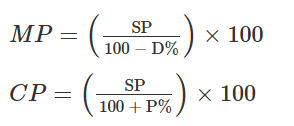
Calculations:
Let the Marked price of the radio be Rs. x
Selling price of the radio = 90% of x = (90/100)x
Cost price of the radio = ((90/100)x/115) × 100 = (90/115)x
⇒ CP = 18x / 23
According to question:
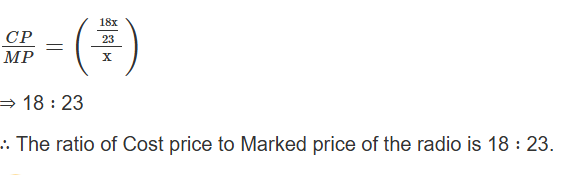
Given:
Profit percentage = 15%
Discount percentage = 10%
Formula Used:
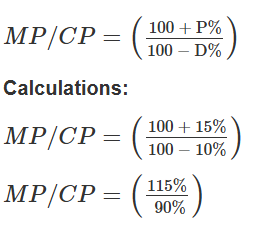
MP/CP = 23/18
CP/MP = 18/23
∴ The ratio of Cost price to Marked price of the radio is 18 ∶ 23.
32. Direction: Study the table carefully and solve the following questions:
The table below will feature data that could be related to bank transactions across different branches.
| Branch | Savings Account Transactions | Current Account Transactions | Personal Loan Disbursements. | Total Transactions |
|---|---|---|---|---|
| Branch A | 250 | 150 | 90 | 490 |
| Branch B | 320 | 180 | 60 | 560 |
| Branch C | 200 | 220 | 50 | 470 |
| Branch D | 400 | 100 | 80 | 580 |
| Branch E | 180 | 240 | 70 | 490 |
Question:
Which branch had the highest total number of transactions?
A. Branch A
B. Branch C
C. Branch E
D. Branch B
E. Branch D
Solution
Solution:
To determine which branch had the highest total number of transactions, we need to compare the total transactions at each branch:
Branch A: 490 transactions
Branch B: 560 transactions
Branch C: 470 transactions
Branch D: 580 transactions
Branch E: 490 transactions
From the values listed above, Branch D had the highest number of transactions, totaling 580.
33. Direction: Study the table carefully and solve the following questions:
The table below will feature data that could be related to bank transactions across different branches.
| Branch | Savings Account Transactions | Current Account Transactions | Personal Loan Disbursements. | Total Transactions |
|---|---|---|---|---|
| Branch A | 250 | 150 | 90 | 490 |
| Branch B | 320 | 180 | 60 | 560 |
| Branch C | 200 | 220 | 50 | 470 |
| Branch D | 400 | 100 | 80 | 580 |
| Branch E | 180 | 240 | 70 | 490 |
Question:
How many more transactions were there in savings accounts than in current accounts across all branches?
A. 410
B. 430
C. 460
D. 480
E. 490
Solution:
Total in Savings Accounts = 250 + 320 + 200 + 400 + 180 = 1350
Total in Current Accounts = 150 + 180 + 220 + 100 + 240 = 890
The difference between transactions in savings and current accounts is:
Difference = 1350 (Savings) – 890 (Current) = 460
There are 460 more transactions in savings accounts than in current accounts across all branches.
34. Direction: Study the table carefully and solve the following questions:
The table below will feature data that could be related to bank transactions across different branches.
| Branch | Savings Account Transactions | Current Account Transactions | Personal Loan Disbursements. | Total Transactions |
|---|---|---|---|---|
| Branch A | 250 | 150 | 90 | 490 |
| Branch B | 320 | 180 | 60 | 560 |
| Branch C | 200 | 220 | 50 | 470 |
| Branch D | 400 | 100 | 80 | 580 |
| Branch E | 180 | 240 | 70 | 490 |
Question:
Calculate the average number of personal loan disbursements across all branches.
A. 40
B. 50
C. 60
D. 70
E. 80
Solution:
Total Personal Loans = 90 + 60 + 50 + 80 + 70 = 350
Average = Total Personal Loans / Number of Branches
= 350 / 5 = 70
The average number of personal loan disbursements across all branches is 70.
35. Direction: Study the table carefully and solve the following questions:
The table below will feature data that could be related to bank transactions across different branches.
| Branch | Savings Account Transactions | Current Account Transactions | Personal Loan Disbursements. | Total Transactions |
|---|---|---|---|---|
| Branch A | 250 | 150 | 90 | 490 |
| Branch B | 320 | 180 | 60 | 560 |
| Branch C | 200 | 220 | 50 | 470 |
| Branch D | 400 | 100 | 80 | 580 |
| Branch E | 180 | 240 | 70 | 490 |
Question:
Which branch has the least number of transactions in current accounts?
A. Branch A
B. Branch B
C. Branch C
D. Branch D
E. Branch E
Solution
To determine the branch with the least number of transactions in current accounts, we need to compare the current account transactions at each branch:
Branch A: 150 transactions
Branch B: 180 transactions
Branch C: 220 transactions
Branch D: 100 transactions
Branch E: 240 transactions
Branch D has the least number of transactions in current accounts with only 100 transactions.
36. Direction: Study the table carefully and solve the following questions:
The table below will feature data that could be related to bank transactions across different branches.
| Branch | Savings Account Transactions | Current Account Transactions | Personal Loan Disbursements. | Total Transactions |
|---|---|---|---|---|
| Branch A | 250 | 150 | 90 | 490 |
| Branch B | 320 | 180 | 60 | 560 |
| Branch C | 200 | 220 | 50 | 470 |
| Branch D | 400 | 100 | 80 | 580 |
| Branch E | 180 | 240 | 70 | 490 |
Question:
If Branch D aims to increase its total transactions by 10% next quarter, calculate the target number of total transactions. How many additional transactions would be required to meet this target?
A. 50
B. 58
C. 62
D. 67
E. 74
Solution:
Branch D’s current total transactions are 580. To find 10% of this number:
=10% of 580 = 0.10 × 580 = 58
Target of next quarter,
Target Total Transactions = Current Total + 10% Increase
Target Total Transactions = 580 + 58 = 638
To meet the target of 638 transactions, Branch D needs to increase from their current total. The additional transactions required are:
Additional Transactions Needed = Target Total – Current Total
Additional Transactions Needed = 638 – 580 = 58
In summary, Branch D needs 58 additional transactions to meet their target of a 10% increase, bringing the total to 638 transactions for the next quarter.
37. A and B can do a work in 10 days and 15 days respectively. With the help of C, they can finish the work in 5 days. If A and B decided to work for Rs.4800, how much should be paid (in Rs.) to C?
A. 750
B. 600
C. 700
D. 800
E. 650
Solution
GIVEN :
A and B can do a work in 10 days and 15 days respectively.
With the help of C, they can finish the work in 5 days.
Total Amount received for work = Rs.4800
CONCEPT :
Time and work
FORMULA USED :
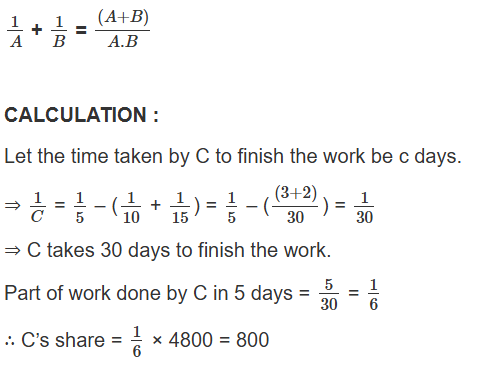
Important Points
“Money is always distributed on the basis of work done not on the time taken ”
38. What should come in place of the question mark ‘?’ in the following number series?
2, 3, 7, 16, ?, 57
A. 36
B. 32
C. 61
D. 45
E. None
Solution:
The series follows the following pattern
⇒ 2 + 12 = 3
⇒ 3 + 22 = 7
⇒ 7 + 32 = 16
⇒ 16 + 42 = 32
⇒ 32 + 52 = 57
∴ Required term is 32.
39. What should come in place of the question mark ‘?’ in the following number series?
3, 3, 4.5, 9, 22.5, ?
A. 67.5
B. 42.5
C. 53.5
D. 60.5
E. None
Solution
The series follows the following pattern:
⇒ 3 × 1 = 3
⇒ 3 × 1.5 = 4.5
⇒ 4.5 × 2 = 9
⇒ 9 × 2.5 = 22.5
⇒ 22.5 × 3 = 67.5
∴ The missing term in the series is 67.5
40. What should come in place of the question mark ‘?’ in the following number series?
3, 6.5, 13.5, ?, 38
A. 21
B. 24
C. 26
D. 23
E. 29
Solution
Calculation:
The series follows following pattern:
⇒ 3 + 3.5 = 6.5
⇒ 6.5 + 7 = 13.5
⇒ 13.5 + 10.5 = 24
⇒ 24 + 14 = 38
∴ The value of ? is 24
41. What should come in place of the question mark ‘?’ in the following number series?
1, 2, 8, 48, ?, 3840
A. 360
B. 384
C. 400
D. 250
E. None
Solution
Solution:
The series follows the following pattern:
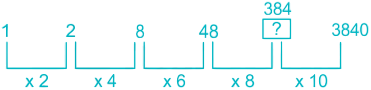
1 × 2 = 2
2 × 4 = 8
8 × 6 = 48
48 × 8 = ? = 384
384 × 10 = 3840
∴ The missing term in the series is 384.
42. What should come in place of the question mark ‘?’ in the following number series?
1, 2, 6, 33, ?, 3414
A. 295
B. 456
C. 289
D. 625
E. 176
Solution:
The series follows the following pattern:
⇒ 1 + 11 = 2
⇒ 2 + 22 = 6
⇒ 6 + 33 = 33
⇒ 33 + 44 = 289
⇒ 289 + 55 = 3414
∴ 289 will come in place of the question mark
43. A solution of syrup has 15% water. Another solution has 35% water. How many litres of the first solution must be added to the 40L of second solution to make a solution of 23% water?
A. 30
B. 40
C. 60
D. 55
E. 50
Solution
Given:
In first solution of syrup quantity of water = 15%
In second solution syrup quantity of water = 35%
Calculation:
Let, x litres of first solution must be added
According to the question,
⇒ x × (15/100) + 40 × (35/100) = (x + 40) × (23/100)
⇒ 0.15x + 14 = 0.23x + 9.2
⇒ 0.08x = 4.8
⇒ 8x = 480
⇒ x = 60
∴ 60 litres of first solution must be added
Alternate Method
2 = 40 Ltr
3 = 60 Ltr
44. The perimeter of a rectangle is 44 cm and the area is 120 cm2. Find the length of the rectangle. (length > breath)
A. 10
B. 15
C. 17
D. 12
E. 20
Solution
Let breath be x cm and length be y cm
⇒ Perimeter = 2(length + breadth)
⇒ 2(x + y) = 44
⇒ x + y = 22
⇒ x = 22 – y —-(1)
Now,
⇒ Area = length × breadth
⇒ xy = 120
⇒ y(22 – y) = 120 (∵ from equation 1)
⇒ 22y – y2 = 120
⇒ y2 − 22y + 120 = 0
⇒ y = 12, 10
Now, for y = 12
⇒ x = 22 – 12 = 10
As, length > breadth∴ Length of rectangle is 12 cm
45. Direction: Read the bar graph carefully and answer the following questions:
The bar graph shows the income of two persons A and B from the years 2015 to 2020.
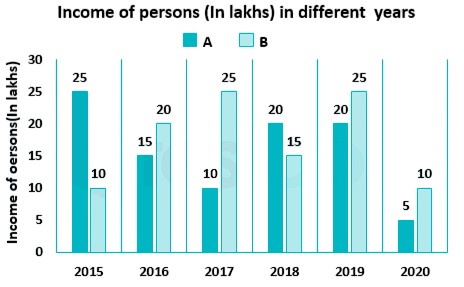
Question:
The income of A in 2014 is 12% more than that of B in 2017, then what will be the ratio between the income of A in 2016 and 2018 together and that of A in 2014 and B in 2020 together?
A. 34 ∶ 37
B. 35 ∶ 38
C. 2 ∶ 3
D. 38 ∶ 35
E. 1 ∶ 1
Solution
Given:
| Year | Income of persons(In lakhs) in different years | |
| A | B | |
| 2016 | 15 | 20 |
| 2017 | 10 | 25 |
| 2018 | 20 | 15 |
| 2020 | 5 | 10 |
The income of A in 2014 = 12% more than the income of B in 2017
Calculation:
The income of A in 2014 = 25 lakhs × (100 + 12)%
⇒ 25 × (112/100)
⇒ 112/4
⇒ Rs. 28 lakhs
The total income of A in 2016 and 2018 together = 15 + 20
⇒ Rs. 35 lakhs
The total income of A in 2014 and B in 2020 together = 28 + 10
⇒ Rs. 38 lakhs
The required ratio = 35 : 38
∴ The ratio between the income of A in 2016 and 2018 together and that of A in 2014 and B in 2020 together will be 35 ∶ 38.
46. Direction: Read the bar graph carefully and answer the following questions:
The bar graph shows the income of two persons A and B from the years 2015 to 2020.
Question:
If the profit of B in 2019 is 20% of total income of B in 2019, then what will be its expenditure in 2019?
A. Rs. 20 lakhs
B. Rs. 25 lakhs
C. Rs. 15 lakhs
D. Rs. 21 lakhs
E. Rs. 19 lakhs
Solution
Given:
The income of B in 2019 = Rs. 25 lakhs
The profit of B in 2019 = 20% of total Income
Formula Used:
Profit = Income – Expnediture
Calculation:
Income = 25,00,000
Profit is 20% of total income of B in 2019.
⇒ Profit = 25,00,000 × (20/100)
⇒ Profit = 5,00,000
⇒ Expenditure = 25,00,000 – 5,00,000
⇒ Expenditure = 20,00,000
∴ The expenditure of B in 2019 will be Rs. 20 lakhs.
47. Direction: Read the bar graph carefully and answer the following questions:
The bar graph shows the income of two persons A and B from the years 2015 to 2020.
Question:
If the ratio of income and expenditure of A in 2017 is 5 ∶ 2 and saving of B in 2019 is 27% more than that of A in 2017, then find the expenditure of B in 2019.
A. Rs. 17 lakhs
B. Rs. 16.38 lakhs
C. Rs. 17.38 lakhs
D. Rs. 15 lakhs
E. Rs. 14 lakhs
Solution
Given:
| Year | Income of persons(In lakhs) in different years | |
| A | B | |
| 2019 | 20 | 25 |
| 2017 | 10 | 25 |
The ratio of income and expenditure of A in 2017 = 5 ∶ 2
The saving of B in 2019 = 27% more than the saving of A in 2017
Formula Used:
Income = Expenditure + Saving
Calculation:
Let the income and expenditure of A in 2017 be Rs. 5x and Rs. 2x.
According to the question,
5x = Rs. 10 lakhs
⇒ x = Rs. 2 lakhs
⇒ 2x = Rs. 4 lakhs
The expenditure of A in 2017 = Rs. 4 lakhs
The saving of A in 2017 = Income – Expenditure
⇒ 10 – 4
⇒ Rs. 6 lakhs
The saving of B in 2019 = 6 × (100 + 27)%
⇒ 6 lakhs × (127/100)
⇒ Rs. 7.62 lakhs
Hence the expenditure of B in 2019 = Income – Saving
⇒ (25 – 7.62) lakhs
⇒ 17.38 lakhs
∴ The expenditure of B in 2019 will be Rs. 17.38 lakhs.
48. Direction: Read the bar graph carefully and answer the following questions:
The bar graph shows the income of two persons A and B from the years 2015 to 2020.
Question:
The income of A increases by 30%, 20% and 40% respectively in 2016, 2017 and 2019, then what will be the ratio of income of A in these three years now?
A. 24 ∶ 39 ∶ 56
B. 56 ∶ 39 ∶ 24
C. 22 ∶ 56 ∶ 39
D. 39 ∶ 24 ∶ 56
E. 33 ∶ 24 ∶ 56
Solution
Given:
| Year | Income of persons(In lakhs) in different years | |
| A | B | |
| 2016 | 15 | 20 |
| 2017 | 10 | 25 |
| 2019 | 20 | 25 |
The income of A in 2016 now = 30% more than the initial income of A in 2016
The income of A in 2017 now = 20% more than the initial income of A in 2017
The income of A in 2019 now = 40% more than the initial income of A in 2019
Calculation:
The income of A in 2016 now = 15 × (100 + 30)%
⇒ {15 × (130/100)} lakhs
The income of A in 2017 now = 10 × (100 + 20)%
⇒ {10 × (120/100)} lakhs
The income of A in 2019 now = 20 × (100 + 40)%
⇒ {20 × (140/100)} lakhs
The ratio of income of A in 2016 and 2017 now = {15 × (130/100)}/{10 × (120/100)}
⇒ 13 : 8 —(1)
The ratio of income of A in 2017 and 2019 now = {10 × (120/100)}/{20 × (140/100)}
⇒ 3 : 7 —(2)
Now multiply by 3 in equation (1) and 8 in equation (2) respectively,
The ratio of income of A in 2016 and 2017 now = 39 ∶ 24
The ratio of income of A in 2017 and 2019 now = 24 ∶ 56
Hence the ratio of income of A in 2016, 2017 and 2019 now = 39 ∶ 24 ∶ 56
∴ The ratio of income of A in 2016, 2017 and 2019 now will be 39 ∶ 24 ∶ 56.
49. Direction: Read the bar graph carefully and answer the following questions:
The bar graph shows the income of two persons A and B from the years 2015 to 2020.
Question:
If the profit of A in 2016 is 20% of total Income of A in 2016 and the ratio of expenditure of A in 2016 to that of B in 2017 is 4 ∶ 5, then find the saving of B in 2017.
A. Rs. 15.625 lakhs
B. Rs. 12.5 lakhs
C. Rs. 14 lakhs
D. Rs. 9 lakhs
E. Rs. 9.375 lakhs
Solution
Given:
| Year | Income of persons(In lakhs) in different years | |
| A | B | |
| 2016 | 15 | 20 |
| 2017 | 10 | 25 |
The profit of A in 2016 = 20% of Total Income
The ratio of expenditure of A in 2016 to that of B in 2017 = 4 ∶ 5
Formula Used:
Expenditure = Income × {100/(100 + Profit )}
Income = Expenditure + Saving
Calculation:
The expenditure of A in 2016 = Income × {100/(100 + Profit)}
⇒ 15 lakhs × {100/(100 + 20)}
⇒ 15 × (100/120)
⇒ Rs. 12.5 lakhs
Let the expenditure of A in 2016 and B in 2017 be Rs. 4x and Rs. 5x
Now, 4x = 12.5 lakhs
⇒ x = 3.125 lakhs
⇒ 5x = 15.625 lakhs
The expenditure of B in 2017 = Rs. 15.625 lakhs
The saving of B in 2017 = Income – Expenditure
⇒ (25 – 15.625) lakhs
⇒ 9.375 lakhs
∴ The saving of B in 2017 will be Rs. 9.375 lakhs.
50. Entry fee of movie sholay was Rs. 1. Later, It was reduced by 25% which increased the sale by 20%. Then, find the percentage of slump in business.
A. 10%
B. 25%
C. 20%
D. 30%
E. None of these
Solution
Given
Entry fee reduced by = 25%
Formula Used
Percentage = (actual/total) × 100
Calculation
Let the total original sale be Rs. 100.
Then, original number of visitors = 100.
New rate of entry fee = [(100 – 25)/100] × 1 = Rs.0.75
number of visitors = [(100 + 20)/100] × 100 = 120
New total sale = 120 × 0.75 = Rs.90
Percentage of slump in the business = [(100 – 90)/100] × 100 = 10%
∴ The percentage of slump in business is 10%
51. A train 145 meters long is running at a speed of 21 km/hr. In what time will it pass a running man at a speed of 3 km/h, in the same direction of train?
A. 23 seconds
B. 43 seconds
C. 45 seconds
D. 29 seconds
E. 13 seconds
Solution
GIVEN:
Length of train = 145 m
Speed of train = 21 km/h
Speed of man= 3 km/h
FORMULA USED:
Time = distance / speed
CALCULATION:
Relative speed = (21 – 3) km/h
⇒ (18 × 1000) / (60 × 60) ⇒ 5 m/s∴ Time = 145 / 5 ⇒ 29 seconds
52. What approximate value will come in the place of the question mark (?) in the following question?34.93 × 64.01 – ? = 13
A. 2550
B. 2236
C. 2941
D. 2227
E. 3214
Solution
Given:
34.93 × 64.01 – ? = 13
Concept Used:
Follow the BODMAS rule according to the table given below:
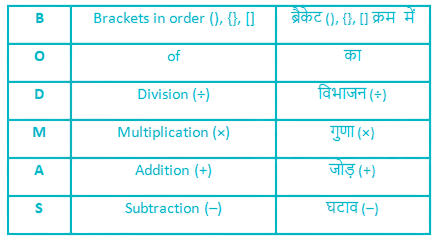
Calculation:
34.93 × 64.01 – ? = 13
Taking approximate values as,
⇒ 35 × 64 – ? = 13
⇒ ? = 2240 – 13
⇒ ? = 2227
∴ The value of (?) is 2227.
53. What approximate will come in the place of the question mark ‘?’ in the following question?
?3 + 27.19 = 152 + 145.26
A. 2
B. 5
C. 3
D. 7
E. 4
Solution
Concept:
Calculation:
Giving expression is,
?3 + 27.19 = 152 + 145.26
Taking approximate values as,
⇒ ?3 + 27 = 225 + 145
⇒ ?3 + 27 = 370
⇒ ?3 = 370 – 27
⇒ ?3 = 343
⇒ ? = 7
∴ The value of ? is 7
54. What approximate value will come in the place of the question mark ‘?’ in the following question?
(√50 + √8.7) × 2.98 = ? × 4.89
A. 5
B. 4
C. 6
D. 7
E. 8
Solution:
We have to follow the BODMAS rule
Calculation:
⇒ (7 + 3) × 3 = ? × 5
⇒ 10 × 3 = ? × 5
⇒ ? = (10 × 3)/5
⇒ ? = 2 × 3
⇒ ? = 6
∴ The value of ? is 6
55. What approximate will come in the place of the question mark ‘?’ in the following question?

A. 60
B. 65
C. 55
D. 40
E. 45
Solution
CONCEPT:
Rules of Approximation:
1. If a number have digits to the right of the decimal less than 5. Then just drop the digits to the right of the decimals. The number so obtained will be the approximated value.
2. If a number have digits to the right of the decimal more than 5. Then just drop the digits to the right of the decimals and raise the remaining number by ‘1’.The number so obtained will be the approximated value.
Follow BODMAS rule to solve this question, as per the order given below,
CALCULATION :
Given expression is,
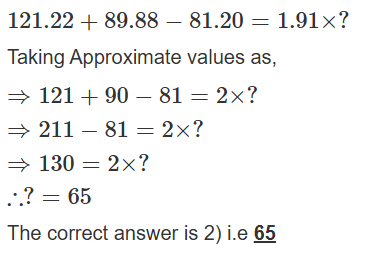
56. What approximate value should come in the place of the question mark (?) in the following question?
69.89% × 29.85 + √120.88 × 8.98 = ?
A. 100
B. 120
C. 150
D. 170
E. 200
Solution
Concept used:
Follow the BODMAS rule as given in the below:
Calculation:
69.89% × 29.85 + √120.88 × 8.98 = ?
⇒ 70% × 30 + √121 × 9 = ?
⇒ 21 + 11 × 9 = ?
⇒ 21 + 99 = ?
⇒ ? = 120
∴ The value of ‘?’ is 120.
57. What approximate will come in the place of the question mark ‘?’ in the following question?
25.01% of 976.22 × 4.96 = ?
A. 3990
B. 3890
C. 4070
D. 3730
E. None of these
Solution
Concept Used:
Follow BODMAS rule to solve this question, as per the order given below,
Calculation:
25.01% of 976.22 × 4.96 = ?
25/100 × 976 × 5 = ?
⇒ 1/4 × 976 × 5 =?
⇒ 244 × 5 = ?
⇒ ? = 1220
∴ The required answer = 1220
58. What approximate value should come in the place of question mark (?) in the following question?
(2.99)3 + (1.99)4 – (3.99)2 = ? × 8.89
A. 1
B. 2
C. 3
D. 4
E. 5
Solution
Rules of Approximation:
1. If a number have digits to the right of the decimal less than 5. Then just drop the digits to the right of the decimals. The number so obtained will be the approximated value.
2. If a number have digits to the right of the decimal more than 5. Then just drop the digits to the right of the decimals and raise the remaining number by ‘1’.The number so obtained will be the approximated value.
Concept:
Follow BODMAS rule to solve this question, as per the order given below,
Calculation:
Given expression is
(3)3 + (2)4 – (4)2 = ? × 9
⇒ 27 + 16 – 16 = ? × 9
⇒ 27/9 = ?
⇒ 3 = ?
∴ The approx. value of ? is 3
59. What approximate value should come in the place of question mark (?) in the following question?
391.99 ÷ 13.94 × 4.95 – 130.91 = √?
A. 3
B. 9
C. 27
D. 243
E. 81
Solution
Follow BODMAS rule to solve this question, as per the order given below.
Step – 1: Parts of an equation enclosed in ‘Brackets’ must be solved first, and following BODMAS rule in the bracket –
Step – 2: Any mathematical ‘Of’ or ‘Exponent’ must be solved next.
Step – 3: Next, the parts of the equation that contain ‘Division’ and ‘Multiplication’ are calculated.
Step – 4: Last but not the least, the parts of the equation that contain ‘Addition’ and ‘Subtraction’ should be calculated.
Since, we need to find out the approximate value, we can write these values to their nearest integers.
Given expression is
391.99 ÷ 13.94 × 4.95 – 130.91 = √?
⇒ 392 ÷ 14 × 5 – 131 = √?
⇒ 28 × 5 – 131 = √?
140 – 131 = √?
⇒ 9 = √?
∴ ? = 81
60. What approximate value should come in place of question mark (?) in the following question?
3.9872 × 25.0071 + ?3 = 829
A. 9
B. 1
C. 12
D. 5
E. 18
Solution
Concept:
Follow BODMAS rule to solve this question, as per the order given below.
Step – 1: Parts of an equation enclosed in ‘Brackets’ must be solved first, and following BODMAS rule in the bracket.
Step – 2: Any mathematical ‘Of’ or ‘Exponent’ must be solved next.
Step – 3: Next, the parts of the equation that contain ‘Division’ and ‘Multiplication’ are calculated.
Step – 4: Last but not the least, the parts of the equation that contain ‘Addition’ and ‘Subtraction’ should be calculated.
Calculation:
Writing the approximate values to the nearest integer
3.9872 ≈ 4, 25.007 ≈ 25
Now, the expression is 4 × 25 + ?3 = 829
∴ ?3 = 729
⇒ ? = 9
61. What approximate value should come in the place of question mark (?) in the following question?
344.98 + √? = 18.992 + 9.09
A. 5
B. 25
C. 125
D. 50
E. 625
Solution
Follow BODMAS rule to solve this question, as per the order given below.
Calculation:
344.98 + √? = 18.992 + 9.09
⇒ 345 + √? = 192 + 9
⇒ 345 + √? = 361 + 9
⇒ 345 + √? = 370
⇒ √? = 25
⇒ ? = 625
∴ The value of ? is 625
62. Nisha borrowed sum of money at simple interest amounts to Rs. 815 in 3 years and to Rs. 854 in 4 years. The sum is:
A. Rs. 698
B. Rs. 712
C. Rs. 690
D. Rs. 695
E. None of these
Solution
Given:
Amount after 4 years = Rs. 854
Amount after 3 years = Rs. 815
Formula:
Amount = Principal + Interest
Calculations:
Simple Interest for 1 year = Rs. (854 − 815)
⇒ Rs. 39
Simple Interest for 3 years = Rs. 39 × 3
⇒ Rs. 117
Principal = Rs. 815 − Rs. 117
⇒ Rs. 698
∴ The sum is Rs. 698.
63. Direction: Each of the questions given below consists of 2 statements, number I and II respectively. Please read the questions carefully and decide which of the statement (s) is / are necessary to answer the questions.
Find the present age of Kusum.
Statement I: Kusum’s age after 10 years will be 3 times his age of 2 years ago.
Statement II: Kusum’s age after 10 years is 18 years.
A. The data in statement I alone is sufficient to answer the question, while the data in statement II alone is not sufficient to answer the question.
B. The data in statement II alone is sufficient to answer the question, while the data in statement I alone is not sufficient to answer the question.
C. Either statement I or statement II alone is sufficient to answer the question.
D. The data in both the statements I and II is not sufficient to answer the questions.
E. The data in both the statement I and II together is necessary to answer.
Solution
Both the statement are sufficient to find the present age of Kusum.
Statement I
Let the present age of Kusum is x years
Kusum age after 10 years (x + 10) years.
Kusum age 2 years ago (x – 2)
(x + 10) = 3(x – 2)
⇒ x = 8
Statement II
After 10 years is 18 years old. So, present age is 8 years.∴ Either statement I or statement II alone is sufficient to answer the question
64. Direction: Each of the questions given below consists of 2 statements, number I and II respectively. Please read the questions carefully and decide which of the statement (s) is / are necessary to answer the questions.
Find the price of refrigerator.
Statement I: Ratio of price of T.V. and refrigerator is 1 : 3. Refrigerator price is Rs. 50,000 more than a T.V.
Statement II: Price of refrigerator is Rs. 75,000
A. The data in statement I alone is sufficient to answer the question, while the data in statement II alone is not sufficient to answer the question.
B. The data in statement II alone is sufficient to answer the question, while the data in statement I alone is not sufficient to answer the question.
C. Either statement I or statement II alone is sufficient to answer the question.
D. The data in both the statements I and II is not sufficient to answer the questions.
E. The data in both the statement I and II together is necessary to answer.
Solution
Statement 1
Given:
Ratio of price of T.V. and refrigerator = 1 : 3
Price of refrigerator = price of T.V. + Rs. 50,000
Calculation:
Let the price of T.V. and refrigerator is x and 3x.
According to question:
⇒ 3x = x + 50,000
⇒ 2x = 50,000
⇒ x = Rs. 25,000
∴ Price of refrigerator is Rs. 75,000 (i.e. 3 × 25,000)
Statement II:
Price of refrigerator = Rs. 75,000∴ Either statement I or statement II alone is sufficient to answer the question.
65. Direction: Each of the questions given below consists of 2 statements, number I and II respectively. Please read the questions carefully and decide which of the statement (s) is / are necessary to answer the questions.
Find the principal.
Statement I: If simple interest rate increased by 2%. It would fetch Rs. 200 more.
Statement II: Time = 2 years
A. The data in statement I alone is sufficient to answer the question, while the data in statement II alone is not sufficient to answer the question.
B. The data in statement II alone is sufficient to answer the question, while the data in statement I alone is not sufficient to answer the question.
C. Either statement I or statement II alone is sufficient to answer the question.
D. The data in both the statements I and II is not sufficient to answer the questions.
E. The data in both the statement I and II together is necessary to answer.
Solution
Given:
Time: 2 years; rate of interest increased by 2%
Formula used:
Simple interest: (Principal × rate × time / 100)
Calculation:
[p × (r + 2) × 2 / 100] – [p × r × 2 / 100] = 200
⇒ [p × (r + 2) × 2] – [ p × r × 2] / 100 = 200
⇒ [p × (r + 2) × 2] – [ p × r × 2] = 200 × 100
⇒ p × 2[(r + 2) – r] = 20000
⇒ 4p = 20,000
⇒ p = Rs. 5,000
∴ Principal is Rs. 5,000∴ The data in both the statement I and II together is necessary to answer.
66. Direction: Read the following information carefully and answer the question that follows.
Eight person – A, B, C, D, E, F, G and H are going to watch a movie on two different dates (17th and 26th) in four different months i.e., July, August, September and October but not necessarily in the same order.B goes in September. Three persons go between B and E. The equal number of persons goes after E and before C. More than one person goes between C and D. One person goes between A and H. Equal number of persons goes after G and before F who goes on an odd number date. A doesn’t go in the same month in which B goes. D neither goes on an odd date nor goes in July.
Question:
Who among the following person goes on 17th October?
A. F
B. A
C. B
D. C
E. H
Solution
Persons: A, B, C, D, E, F, G and H
Months: July, August, September, October
Date: 17th and 26th
1) B goes in September.
| Months | Date | Person case 1 | Person case 2 |
| July (31) | 17 | ||
| 26 | |||
| August (31) | 17 | ||
| 26 | |||
| September (30) | 17 | B | |
| 26 | B | ||
| October (31) | 17 | ||
| 26 |
2) Three persons go-between B and E.
| Months | Date | Person case 1 | Person case 2 |
| July (31) | 17 | E | |
| 26 | E | ||
| August (31) | 17 | ||
| 26 | |||
| September (30) | 17 | B | |
| 26 | B | ||
| October (31) | 17 | ||
| 26 |
3) The equal number of persons goes after E and before C.
| Months | Date | Person case 1 | Person case 2 |
| July (31) | 17 | E | |
| 26 | E | ||
| August (31) | 17 | ||
| 26 | |||
| September (30) | 17 | B | |
| 26 | B | ||
| October (31) | 17 | C | |
| 26 | C |
4) More than one person goes between C and D. Neither D goes the odd date nor goes in July.
| Months | Date | Person case 1 | Person case 2 |
| July (31) | 17 | E | |
| 26 | E | ||
| August (31) | 17 | ||
| 26 | D | D | |
| September (30) | 17 | B | |
| 26 | B | ||
| October (31) | 17 | C | |
| 26 | C |
5) An equal number of persons goes after G and before F who goes on an odd number date.
| Months | Date | Person case 1 | Person case 2 | Person case 1b |
| July (31) | 17 | E | F | E |
| 26 | E | G | ||
| August (31) | 17 | F | ||
| 26 | D | D | D | |
| September (30) | 17 | B | B | |
| 26 | G | B | ||
| October (31) | 17 | C | F | |
| 26 | C | G | C |
6) One person goes between A and H. A doesn’t go in the month of B.
Case 1 and 1b eliminated here, as there is no dates avaialable in these cases in which one day gap is present for A and H.
Hence, the final arrangement will be as follows:
| Months | Date | Person |
| July (31) | 17 | F |
| 26 | E | |
| August (31) | 17 | A |
| 26 | D | |
| September (30) | 17 | H |
| 26 | B | |
| October (31) | 17 | C |
| 26 | G |
Hence, C is to going movie on 17th October.
67. Direction: Read the following information carefully and answer the question that follows.
Eight person – A, B, C, D, E, F, G and H are going to watch a movie on two different dates (17th and 26th) in four different months i.e., July, August, September and October but not necessarily in the same order.B goes in September. Three persons go between B and E. The equal number of persons goes after E and before C. More than one person goes between C and D. One person goes between A and H. Equal number of persons goes after G and before F who goes on an odd number date. A doesn’t go in the same month in which B goes. D neither goes on an odd date nor goes in July.
Question:
Which of the following combination is true?
A. F is going to the movie on 17th August.
B. H is going in the month having even number of days
C. G is going movie before the person H.
D. E is going between D and B.
E. None of these
Solution
Persons: A, B, C, D, E, F, G and H
Months: July, August, September, October
Date: 17th and 26th
1) B goes in September.
| Months | Date | Person case 1 | Person case 2 |
| July (31) | 17 | ||
| 26 | |||
| August (31) | 17 | ||
| 26 | |||
| September (30) | 17 | B | |
| 26 | B | ||
| October (31) | 17 | ||
| 26 |
2) Three persons go-between B and E.
| Months | Date | Person case 1 | Person case 2 |
| July (31) | 17 | E | |
| 26 | E | ||
| August (31) | 17 | ||
| 26 | |||
| September (30) | 17 | B | |
| 26 | B | ||
| October (31) | 17 | ||
| 26 |
3) The equal number of persons goes after E and before C.
| Months | Date | Person case 1 | Person case 2 |
| July (31) | 17 | E | |
| 26 | E | ||
| August (31) | 17 | ||
| 26 | |||
| September (30) | 17 | B | |
| 26 | B | ||
| October (31) | 17 | C | |
| 26 | C |
4) More than one person goes between C and D. Neither D goes the odd date nor goes in July.
| Months | Date | Person case 1 | Person case 2 |
| July (31) | 17 | E | |
| 26 | E | ||
| August (31) | 17 | ||
| 26 | D | D | |
| September (30) | 17 | B | |
| 26 | B | ||
| October (31) | 17 | C | |
| 26 | C |
5) An equal number of persons goes after G and before F who goes on an odd number date.
| Months | Date | Person case 1 | Person case 2 | Person case 1b |
| July (31) | 17 | E | F | E |
| 26 | E | G | ||
| August (31) | 17 | F | ||
| 26 | D | D | D | |
| September (30) | 17 | B | B | |
| 26 | G | B | ||
| October (31) | 17 | C | F | |
| 26 | C | G | C |
6) One person goes between A and H. A doesn’t go in the month of B.
Case 1 and 1b eliminated here, as there is no dates avaialable in these cases in which one day gap is present for A and H.
Hence, the final arrangement will be as follows
| Months | Date | Person |
| July (31) | 17 | F |
| 26 | E | |
| August (31) | 17 | A |
| 26 | D | |
| September (30) | 17 | H |
| 26 | B | |
| October (31) | 17 | C |
| 26 | G |
Hence, H is going in the month having even number of days
68. Direction: Read the following information carefully and answer the question that follows.
Eight person – A, B, C, D, E, F, G and H are going to watch a movie on two different dates (17th and 26th) in four different months i.e., July, August, September and October but not necessarily in the same order.B goes in September. Three persons go between B and E. The equal number of persons goes after E and before C. More than one person goes between C and D. One person goes between A and H. Equal number of persons goes after G and before F who goes on an odd number date. A doesn’t go in the same month in which B goes. D neither goes on an odd date nor goes in July.
Question:
Who among the following persons goes on even number date of the month which has even number of days?
A. B
B. H
C. F
D. G
E. None of these
Solution
Persons: A, B, C, D, E, F, G and H
Months: July, August, September, October
Date: 17th and 26th
1) B goes in September.
| Months | Date | Person case 1 | Person case 2 |
| July (31) | 17 | ||
| 26 | |||
| August (31) | 17 | ||
| 26 | |||
| September (30) | 17 | B | |
| 26 | B | ||
| October (31) | 17 | ||
| 26 |
2) Three persons go-between B and E.
| Months | Date | Person case 1 | Person case 2 |
| July (31) | 17 | E | |
| 26 | E | ||
| August (31) | 17 | ||
| 26 | |||
| September (30) | 17 | B | |
| 26 | B | ||
| October (31) | 17 | ||
| 26 |
3) The equal number of persons goes after E and before C.
| Months | Date | Person case 1 | Person case 2 |
| July (31) | 17 | E | |
| 26 | E | ||
| August (31) | 17 | ||
| 26 | |||
| September (30) | 17 | B | |
| 26 | B | ||
| October (31) | 17 | C | |
| 26 | C |
4) More than one person goes between C and D. Neither D goes the odd date nor goes in July.
| Months | Date | Person case 1 | Person case 2 |
| July (31) | 17 | E | |
| 26 | E | ||
| August (31) | 17 | ||
| 26 | D | D | |
| September (30) | 17 | B | |
| 26 | B | ||
| October (31) | 17 | C | |
| 26 | C |
5) An equal number of persons goes after G and before F who goes on an odd number date.
| Months | Date | Person case 1 | Person case 2 | Person case 1b |
| July (31) | 17 | E | F | E |
| 26 | E | G | ||
| August (31) | 17 | F | ||
| 26 | D | D | D | |
| September (30) | 17 | B | B | |
| 26 | G | B | ||
| October (31) | 17 | C | F | |
| 26 | C | G | C |
6) One person goes between A and H. A doesn’t go in the month of B.
Case 1 and 1b eliminated here, as there is no dates avaialable in these cases in which one day gap is present for A and H.
Hence, the final arrangement will be as follows:
| Months | Date | Person |
| July (31) | 17 | F |
| 26 | E | |
| August (31) | 17 | A |
| 26 | D | |
| September (30) | 17 | H |
| 26 | B | |
| October (31) | 17 | C |
| 26 | G |
Hence, even number date of the month which has even number of days is 26 September and B goes on 26th september.
69. Direction: Read the following information carefully and answer the question that follows.
Eight person – A, B, C, D, E, F, G and H are going to watch a movie on two different dates (17th and 26th) in four different months i.e., July, August, September and October but not necessarily in the same order.B goes in September. Three persons go between B and E. The equal number of persons goes after E and before C. More than one person goes between C and D. One person goes between A and H. Equal number of persons goes after G and before F who goes on an odd number date. A doesn’t go in the same month in which B goes. D neither goes on an odd date nor goes in July.
Question:
How many persons go before B?
A. Two
B. Four
C. Five
D. One
E. None
Solution
Persons: A, B, C, D, E, F, G and H
Months: July, August, September, October
Date: 17th and 26th
1) B goes in September.
| Months | Date | Person case 1 | Person case 2 |
| July (31) | 17 | ||
| 26 | |||
| August (31) | 17 | ||
| 26 | |||
| September (30) | 17 | B | |
| 26 | B | ||
| October (31) | 17 | ||
| 26 |
2) Three persons go-between B and E.
| Months | Date | Person case 1 | Person case 2 |
| July (31) | 17 | E | |
| 26 | E | ||
| August (31) | 17 | ||
| 26 | |||
| September (30) | 17 | B | |
| 26 | B | ||
| October (31) | 17 | ||
| 26 |
3) The equal number of persons goes after E and before C.
| Months | Date | Person case 1 | Person case 2 |
| July (31) | 17 | E | |
| 26 | E | ||
| August (31) | 17 | ||
| 26 | |||
| September (30) | 17 | B | |
| 26 | B | ||
| October (31) | 17 | C | |
| 26 | C |
4) More than one person goes between C and D. Neither D goes the odd date nor goes in July.
| Months | Date | Person case 1 | Person case 2 |
| July (31) | 17 | E | |
| 26 | E | ||
| August (31) | 17 | ||
| 26 | D | D | |
| September (30) | 17 | B | |
| 26 | B | ||
| October (31) | 17 | C | |
| 26 | C |
5) An equal number of persons goes after G and before F who goes on an odd number date.
| Months | Date | Person case 1 | Person case 2 | Person case 1b |
| July (31) | 17 | E | F | E |
| 26 | E | G | ||
| August (31) | 17 | F | ||
| 26 | D | D | D | |
| September (30) | 17 | B | B | |
| 26 | G | B | ||
| October (31) | 17 | C | F | |
| 26 | C | G | C |
6) One person goes between A and H. A doesn’t go in the month of B.
Case 1 and 1b eliminated here, as there is no dates avaialable in these cases in which one day gap is present for A and H.
Hence, the final arrangement will be as follows:
| Months | Date | Person |
| July (31) | 17 | F |
| 26 | E | |
| August (31) | 17 | A |
| 26 | D | |
| September (30) | 17 | H |
| 26 | B | |
| October (31) | 17 | C |
| 26 | G |
Hence, five persons go before B.
70. Direction: Read the following information carefully and answer the question that follows.
Eight person – A, B, C, D, E, F, G and H are going to watch a movie on two different dates (17th and 26th) in four different months i.e., July, August, September and October but not necessarily in the same order.B goes in September. Three persons go between B and E. The equal number of persons goes after E and before C. More than one person goes between C and D. One person goes between A and H. Equal number of persons goes after G and before F who goes on an odd number date. A doesn’t go in the same month in which B goes. D neither goes on an odd date nor goes in July.
Question:
How many persons go between G and D?
A. One
B. Five
C. Four
D. Three
E. None
Solution
Persons: A, B, C, D, E, F, G and H
Months: July, August, September, October
Date: 17th and 26th
1) B goes in September.
| Months | Date | Person case 1 | Person case 2 |
| July (31) | 17 | ||
| 26 | |||
| August (31) | 17 | ||
| 26 | |||
| September (30) | 17 | B | |
| 26 | B | ||
| October (31) | 17 | ||
| 26 |
2) Three persons go-between B and E.
| Months | Date | Person case 1 | Person case 2 |
| July (31) | 17 | E | |
| 26 | E | ||
| August (31) | 17 | ||
| 26 | |||
| September (30) | 17 | B | |
| 26 | B | ||
| October (31) | 17 | ||
| 26 |
3) The equal number of persons goes after E and before C.
| Months | Date | Person case 1 | Person case 2 |
| July (31) | 17 | E | |
| 26 | E | ||
| August (31) | 17 | ||
| 26 | |||
| September (30) | 17 | B | |
| 26 | B | ||
| October (31) | 17 | C | |
| 26 | C |
4) More than one person goes between C and D. Neither D goes the odd date nor goes in July.
| Months | Date | Person case 1 | Person case 2 |
| July (31) | 17 | E | |
| 26 | E | ||
| August (31) | 17 | ||
| 26 | D | D | |
| September (30) | 17 | B | |
| 26 | B | ||
| October (31) | 17 | C | |
| 26 | C |
5) An equal number of persons goes after G and before F who goes on an odd number date.
| Months | Date | Person case 1 | Person case 2 | Person case 1b |
| July (31) | 17 | E | F | E |
| 26 | E | G | ||
| August (31) | 17 | F | ||
| 26 | D | D | D | |
| September (30) | 17 | B | B | |
| 26 | G | B | ||
| October (31) | 17 | C | F | |
| 26 | C | G | C |
6) One person goes between A and H. A doesn’t go in the month of B.
Case 1 and 1b eliminated here, as there is no dates avaialable in these cases in which one day gap is present for A and H.
Hence, the final arrangement will be as follows:
| Months | Date | Person |
| July (31) | 17 | F |
| 26 | E | |
| August (31) | 17 | A |
| 26 | D | |
| September (30) | 17 | H |
| 26 | B | |
| October (31) | 17 | C |
| 26 | G |
Hence, there are three persons are going between G and D.
71. Directions: Study the information given below carefully and answer the questions that follow.
There are 8 persons- A, B, C, D, E, F, G, and H. A is 5m towards the South of F, who is 12 m towards the East of B. E is 12 m towards the west of A and is 5 m towards the North of D, who is 10 m towards the West of H. G is 5 m towards the North of B and is 10 m towards the west of C.
Question:
In which direction is H with respect to C?
A. North
B. South-east
C. South-west
D. South
E. None of these
Solution
From the given information following direction and distance diagram can be drawn:
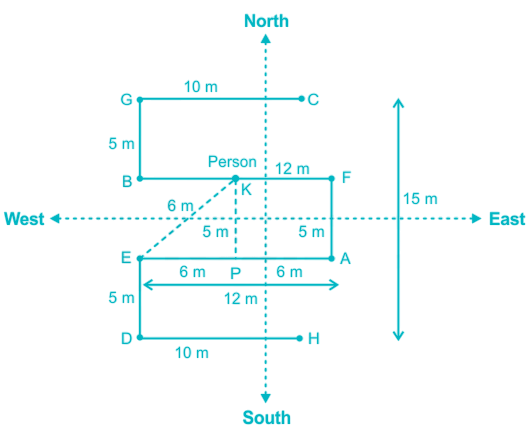
Hence, H is towards the south of C.
72. Directions: Study the information given below carefully and answer the questions that follow.
There are 8 persons- A, B, C, D, E, F, G, and H. A is 5m towards the South of F, who is 12 m towards the East of B. E is 12 m towards the west of A and is 5 m towards the North of D, who is 10 m towards the West of H. G is 5 m towards the North of B and is 10 m towards the west of C.
Question:
If a person K stands exactly between F and B, then how far and in which direction is E with respect to K (approximately)?
A. 9 m, South-east
B. 6 m, South-east
C. 7.8 m, South-west
D. 8 m, South
E. None of these
Solution
From the given information following direction and distance diagram can be drawn:
By using Pythagoras theorem,
C = √a2 + b2
In Δ EKP
KE = √ KP2 + PE2
= √ 52 + 62
= √ 25 + 36
= √ 61
= 7.8 m
Hence, E is 7.8 m towards the South-west of K.
73. Directions: Study the information given below carefully and answer the questions that follow.
There are 8 persons- A, B, C, D, E, F, G, and H. A is 5m towards the South of F, who is 12 m towards the East of B. E is 12 m towards the west of A and is 5 m towards the North of D, who is 10 m towards the West of H. G is 5 m towards the North of B and is 10 m towards the west of C.
Question:
How far and in which direction is A with respect to B?
A. 14 north-west
B. 13 m, South-east
C. 13 m, South-west
D. 13 m, North-east
E. None of these
Solution
From the given information following direction and distance diagram can be drawn,
By using Pythagoras theorem
C = √a2 + b2
In Δ ABF
AB = √ BF2 + FA2
= √ 122 + 52
= √ 144 + 25
= √ 169
= 13 m
Hence, A is 13 m towards the South-east of B.
74. Directions: In the question below are given three statements followed by two conclusions numbered I and II. You have to take the given statements to be true even if they seem to be at variance with commonly known facts. Read all the conclusions and then decide which of the given conclusions logically follows from the given statements disregarding commonly known facts.
Statement:
All trucks are bus.
Some trucks are car.
No car is a luxury.
Conclusions:
I. All luxury being truck is a possibility.II. At least some bus may be luxury.
A. If only conclusion I follows.
B. If only conclusion II follows.
C. If either conclusion I or conclusion II follows.
D. If neither conclusion I nor conclusion II follows.
E. If both conclusion I and conclusion II follows.
Solution
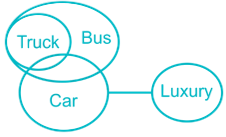
Conclusions:
I. All luxury being Truck is a possibility → since there is no direct relation between luxury and truck, so possibility can follow.
II. At least some bus may be luxury → since there is also no direct relation between bus and luxury, so possibility can follow.
Thus, both conclusions I and II follow.
75. Directions: In the question below are given three statements followed by two conclusions numbered I and II. You have to take the given statements to be true even if they seem to be at variance with commonly known facts. Read all the conclusions and then decide which of the given conclusions logically follows from the given statements disregarding commonly known facts.
Statements:
No book is a pencil.
All pencils are pens.
No pen is copy.
Conclusions:
I. Some books are pen.II. No pens are books.
A. If only conclusion I follows.
B. If only conclusion II follows.
C. If either conclusion I or conclusion II follows.
D. If neither conclusion I nor conclusion II follows.
E. If both conclusion I and conclusion II follow.
Solution
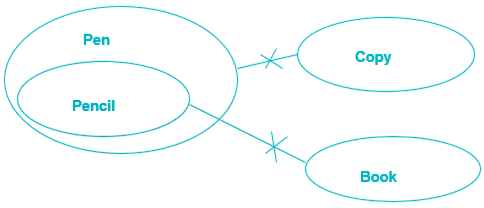
Conclusions:
I. Some books are pen → False.
II. No pens are book → False.
Due to complimentary pair, either I or II follows.
Hence, option 3 is the correct answer.
76. Directions: In each question given below three statements are followed by two conclusions numbered I and II. You have to take all the given statements to be true even if they seen to be at variance with the commonly known facts. Read the conclusion and decide which conclusion logically follow(s) from the given statement and give answer
Statements:
Some doors are windows.
No window is a wall.
All walls are buildings.
Conclusions:
I. Some buildings are not window.
II. Some buildings are walls.
A. If either conclusion I or II follows.
B. If only conclusion I follows.
C. If neither conclusion I nor II follows.
D. If both conclusion I and II follow.
E. If only conclusion II follows.
Solution
Let’s draw a least possible Venn diagram using given statements
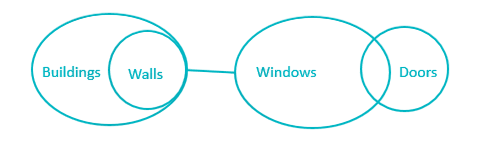
Conclusions:
I) Some buildings are not window → True.
II) Some buildings are walls → It’s true.Hence, conclusions I and II follows.
77. Directions: Read the information given below and answer the questions that follow.J, K, L, M and N are five mobile in a flagship. They are ranked in the order of Memory – from the Highest to the Lowest- and in order of Price – from the Maximum to the Minimum. K’s memory is higher than N, but not as expensive as J and L, whereas M has the Maximum price of all but memory capacity is lower than J. While L memory is lower than M but higher than K, L is not as expensive as J. No two mobile got the same ranks in any of these parameters.
Question:
How many mobile has memory definitely less than K?
A. 1
B. 2
C. 3
D. None of these
E. Can’t be determine
Solution
Let us first write down all the conditions given and then tabulate the data.
Memory Capacity
K > N
J > M
M > L
L > K
Now let us put together all the information we have.
Memory Capacity
| Highest | J | M | L | K | N | Lowest |
Price (Maximum to Minimum)
J > K
L > K
M is the Maximum.
M > L
Price
| Maximum | M | J L K | Minimum |
We do not know where N will come in the order of Price but he will definitely be less expansive as M. but N can’t be least expansive as it lowest memory.
⇒ But let’s assume N is 2nd least expansive, then
M > J > L > N > K (here L is at 3rd lowest which is same as his rank in Memory capacity)
Hence, this cannot be the case.
⇒ Now let Assume N is 3rd lest expansive, then
M > J > N > L > K (this is possible case)
⇒ Now let assume N is 4th least expansive. Then
M > N > J > L > K (This is also a possible case)
Hence there will be two possible cases.
Price:
| Maximum | Case – 1 | M | N | J | L | K | Minimum |
| Case – 2 | M | J | N | L | K |
Memory Capacity
| Highest | J | M | L | K | N | Lowest |
Hence only N has less memory than K.Therefore Only 1 mobile has less memory than K.
78. Directions: Read the information given below and answer the questions that follow.J, K, L, M and N are five mobile in a flagship. They are ranked in the order of Memory – from the Highest to the Lowest- and in order of Price – from the Maximum to the Minimum. K’s memory is higher than N, but not as expensive as J and L, whereas M has the Maximum price of all but memory capacity is lower than J. While L memory is lower than M but higher than K, L is not as expensive as J. No two mobile got the same ranks in any of these parameters.
Question:
Who among the following has more price as well as higher capacity than K?
A. L and J only
B. N
C. L and N
D. J, L and M
E. None of these
Solution
Let us first write down all the conditions given and then tabulate the data.
Memory Capacity
K > N
J > M
M > L
L > K
Now let us put together all the information we have.
Memory Capacity
| Highest | J | M | L | K | N | Lowest |
Price (Maximum to Minimum)
J > K
L > K
M is the Maximum.
J > L
Price
| Maximum | M | J L K | Minimum |
We do not know where N will come in the order of Price but he will definitely be less expansive as M. but N can’t be least expansive as it lowest memory.
⇒ But let’s assume N is 2nd least expansive, then
M > J > L > N > K (here L is at 3rd lowest which is same as his rank in Memory capacity)
Hence, this cannot be the case.
⇒ Now let Assume N is 3rd lest expansive, then
M > J > N > L > K (this is possible case)
⇒ Now let assume N is 4th least expansive. Then
M > N > J > L > K (This is also a possible case)
Hence there will be two possible cases.
Price:
| Maximum | Case – 1 | M | N | J | L | K | Minimum |
| Case – 2 | M | J | N | L | K |
Memory Capacity
| Highest | J | M | L | K | N | Lowest |
By looking at the tables we made above and from the answer choices, we End that L, J and M has higher memory as well as more price than K.
79. Directions: Read the information given below and answer the questions that follow.J, K, L, M and N are five mobile in a flagship. They are ranked in the order of Memory – from the Highest to the Lowest- and in order of Price – from the Maximum to the Minimum. K’s memory is higher than N, but not as expensive as J and L, whereas M has the Maximum price of all but memory capacity is lower than J. While L memory is lower than M but higher than K, L is not as expensive as J. No two mobile got the same ranks in any of these parameters.
Question:
If N is the third in order of Price who is the Minimum of all?
A. M
B. N
C. L
D. Cannot be determined
E. None of these
Solution
Let us first write down all the conditions given and then tabulate the data.
Memory Capacity
K > N
J > M
M > L
L > K
Now let us put together all the information we have.
Memory Capacity
| Highest | J | M | L | K | N | Lowest |
Price (Maximum to Minimum)
J > K
L > K
M is the Maximum.
M > L
Price
| Maximum | M | J L K | Minimum |
We do not know where N will come in the order of Price but he will definitely be less expansive as M. but N can’t be least expansive as it lowest memory.
⇒ But let’s assume N is 2nd least expansive, then
M > J > L > N > K (here L is at 3rd lowest which is same as his rank in Memory capacity)
Hence, this cannot be the case.
⇒ Now let Assume N is 3rd lest expansive, then
M > J > N > L > K (this is possible case)
⇒ Now let assume N is 4th least expansive. Then
M > N > J > L > K (This is also a possible case)
Hence there will be two possible cases.
Price:
| Maximum | Case – 1 | M | N | J | L | K | Minimum |
| Case – 2 | M | J | N | L | K |
Memory Capacity
| Highest | J | M | L | K | N | Lowest |
If N is at Third then case – 2 arrangement will be followed.Hence, K will be having the lowest price.
80. How many pairs of digits in the number 649971 have as many numbers between them as in the series of natural numbers both in backward and forward directions?
A. One
B. Two
C. Three
D. Four
E. Five
Solution
Given number: 649971
Forward: (6, 9), (4, 7); Backward: (7, 9), (1, 6)
Hence, we can see that four such pairs are there.
81. Direction: Study the information given below carefully and answer the questions that follow.
Eight students Ty, Su, Po, Vr, Zk, Kt, Ht and Ra were given assignments to make a project on one of the rivers among Tigris, Thames, Yellow, Tsang Po, Mississippi, Amazon, Danube and Nile but not necessarily in the same order.Either Vr or Ra worked on Yellow river. Ty worked on Tigris river. Ra worked on either Nile or Mississippi. Either Po or Vr worked on Amazon. Su and Kt worked on Tsang Po and Thames but not necessarily in the same order. Ht did not work on Mississippi or Yellow river. Zk worked on river Danube.
Question:
If Ty and Po decided to exchange the topics of their project then who worked on Amazon river?
A. Ty
B. Ra
C. Ht
D. Su
E. Vr
Solution
Student: Ty, Su, Po, Vr, Zk, Kt, Ht and Ra
Rivers: Tigris, Thames, Yellow, Tsang Po, Mississippi, Amazon, Danube and Nile
i) Zk worked on river Danube.
ii) Su and Kt worked on Tsang Po and Thames but not necessarily in the same order.
| Student | River |
| Ty | |
| Su | Tsang Po/ Thames |
| Po | |
| Vr | |
| Zk | Danube |
| Kt | Tsang Po/ Thames |
| Ht | |
| Ra |
iii)Ty worked on Tigris river.
iv) Ra worked on either Nile or Mississippi.
| Student | River |
| Ty | Tigris |
| Su | Tsang Po/ Thames |
| Po | |
| Vr | |
| Zk | Danube |
| Kt | Tsang Po/ Thames |
| Ht | |
| Ra | Nile/ Mississippi |
v) Either Po or Vr worked on Amazon.
vi) Ht did not work on Mississippi or Yellow river.
Now the rivers left are Amazon, Yellow, Mississippi and Nile.
Ht cannot work on Amazon as either Po or Vr are working on it and from v) he is not working on Mississippi and Yellow river.
Thus, Ht worked on Nile.
If Ht worked on Nile then Ra must have worked on Mississippi.
| Student | River |
| Ty | Tigris |
| Su | Tsang Po/ Thames |
| Po | |
| Vr | |
| Zk | Danube |
| Kt | Tsang Po/ Thames |
| Ht | Nile |
| Ra | Mississippi |
vii) Either Vr or Ra worked on Yellow river.
Since Ra worked on Mississippi, Vr must have worked on Yellow river.
Finally, Po must have worked on Amazon.
| Student | River |
| Ty | Tigris |
| Su | Tsang Po/ Thames |
| Po | Amazon |
| Vr | Yellow |
| Zk | Danube |
| Kt | Tsang Po/ Thames |
| Ht | Nile |
| Ra | Mississippi |
Hence, if Ty and Po decided to exchange the topics of their project then Ty worked on Amazon river.
82. Direction: Study the information given below carefully and answer the questions that follow.
Eight students Ty, Su, Po, Vr, Zk, Kt, Ht and Ra were given assignments to make a project on one of the rivers among Tigris, Thames, Yellow, Tsang Po, Mississippi, Amazon, Danube and Nile but not necessarily in the same order.Either Vr or Ra worked on Yellow river. Ty worked on Tigris river. Ra worked on either Nile or Mississippi. Either Po or Vr worked on Amazon. Su and Kt worked on Tsang Po and Thames but not necessarily in the same order. Ht did not work on Mississippi or Yellow river. Zk worked on river Danube.
Question:
Which of the following is an incorrect combination?
A. Ty – Tigris
B. Po – Amazon
C. Vr – Tsang Po
D. Ra – Mississippi
E. Zk – Danube
Solution
Student: Ty, Su, Po, Vr, Zk, Kt, Ht and Ra
Rivers: Tigris, Thames, Yellow, Tsang Po, Mississippi, Amazon, Danube and Nile
i) Zk worked on river Danube.
ii) Su and Kt worked on Tsang Po and Thames but not necessarily in the same order.
| Student | River |
| Ty | |
| Su | Tsang Po/ Thames |
| Po | |
| Vr | |
| Zk | Danube |
| Kt | Tsang Po/ Thames |
| Ht | |
| Ra |
iii)Ty worked on Tigris river.
iv) Ra worked on either Nile or Mississippi.
| Student | River |
| Ty | Tigris |
| Su | Tsang Po/ Thames |
| Po | |
| Vr | |
| Zk | Danube |
| Kt | Tsang Po/ Thames |
| Ht | |
| Ra | Nile/ Mississippi |
v) Either Po or Vr worked on Amazon.
vi) Ht did not work on Mississippi or Yellow river.
Now the rivers left are Amazon, Yellow, Mississippi and Nile.
Ht cannot work on Amazon as either Po or Vr are working on it and from v) he is not working on Mississippi and Yellow river.
Thus, Ht worked on Nile.
If Ht worked on Nile then Ra must have worked on Mississippi.
| Student | River |
| Ty | Tigris |
| Su | Tsang Po/ Thames |
| Po | |
| Vr | |
| Zk | Danube |
| Kt | Tsang Po/ Thames |
| Ht | Nile |
| Ra | Mississippi |
vii) Either Vr or Ra worked on Yellow river.
Since Ra worked on Mississippi, Vr must have worked on Yellow river.
Finally, Po must have worked on Amazon.
| Student | River |
| Ty | Tigris |
| Su | Tsang Po/ Thames |
| Po | Amazon |
| Vr | Yellow |
| Zk | Danube |
| Kt | Tsang Po/ Thames |
| Ht | Nile |
| Ra | Mississippi |
Hence, Vr – Tsang Po is an incorrect combination.
83. Direction: Study the information given below carefully and answer the questions that follow.
Eight students Ty, Su, Po, Vr, Zk, Kt, Ht and Ra were given assignments to make a project on one of the rivers among Tigris, Thames, Yellow, Tsang Po, Mississippi, Amazon, Danube and Nile but not necessarily in the same order.Either Vr or Ra worked on Yellow river. Ty worked on Tigris river. Ra worked on either Nile or Mississippi. Either Po or Vr worked on Amazon. Su and Kt worked on Tsang Po and Thames but not necessarily in the same order. Ht did not work on Mississippi or Yellow river. Zk worked on river Danube.
Question:
Which river did Ht work on?
A. Nile
B. Amazon
C. Tigris
D. Danube
E. Mississippi
Solution
Student: Ty, Su, Po, Vr, Zk, Kt, Ht and Ra
Rivers: Tigris, Thames, Yellow, Tsang Po, Mississippi, Amazon, Danube and Nile
i) Zk worked on river Danube.
ii) Su and Kt worked on Tsang Po and Thames but not necessarily in the same order.
| Student | River |
| Ty | |
| Su | Tsang Po/ Thames |
| Po | |
| Vr | |
| Zk | Danube |
| Kt | Tsang Po/ Thames |
| Ht | |
| Ra |
iii)Ty worked on Tigris river.
iv) Ra worked on either Nile or Mississippi.
| Student | River |
| Ty | Tigris |
| Su | Tsang Po/ Thames |
| Po | |
| Vr | |
| Zk | Danube |
| Kt | Tsang Po/ Thames |
| Ht | |
| Ra | Nile/ Mississippi |
v) Either Po or Vr worked on Amazon.
vi) Ht did not work on Mississippi or Yellow river.
Now the rivers left are Amazon, Yellow, Mississippi and Nile.
Ht cannot work on Amazon as either Po or Vr are working on it and from v) he is not working on Mississippi and Yellow river.
Thus, Ht worked on Nile.
If Ht worked on Nile then Ra must have worked on Mississippi.
| Student | River |
| Ty | Tigris |
| Su | Tsang Po/ Thames |
| Po | |
| Vr | |
| Zk | Danube |
| Kt | Tsang Po/ Thames |
| Ht | Nile |
| Ra | Mississippi |
vii) Either Vr or Ra worked on Yellow river.
Since Ra worked on Mississippi, Vr must have worked on Yellow river.
Finally, Po must have worked on Amazon.
| Student | River |
| Ty | Tigris |
| Su | Tsang Po/ Thames |
| Po | Amazon |
| Vr | Yellow |
| Zk | Danube |
| Kt | Tsang Po/ Thames |
| Ht | Nile |
| Ra | Mississippi |
Hence, Ht worked on Nile river.
84. Direction: Study the information given below carefully and answer the questions that follow.
Eight students Ty, Su, Po, Vr, Zk, Kt, Ht and Ra were given assignments to make a project on one of the rivers among Tigris, Thames, Yellow, Tsang Po, Mississippi, Amazon, Danube and Nile but not necessarily in the same order.Either Vr or Ra worked on Yellow river. Ty worked on Tigris river. Ra worked on either Nile or Mississippi. Either Po or Vr worked on Amazon. Su and Kt worked on Tsang Po and Thames but not necessarily in the same order. Ht did not work on Mississippi or Yellow river. Zk worked on river Danube.
Question:
If Su worked on Thames, who worked on Tsang Po river?
A. Po
B. Vr
C. Ty
D. Kt
E. Ra
Solution
Student: Ty, Su, Po, Vr, Zk, Kt, Ht and Ra
Rivers: Tigris, Thames, Yellow, Tsang Po, Mississippi, Amazon, Danube and Nile
i) Zk worked on river Danube.
ii) Su and Kt worked on Tsang Po and Thames but not necessarily in the same order.
| Student | River |
| Ty | |
| Su | Tsang Po/ Thames |
| Po | |
| Vr | |
| Zk | Danube |
| Kt | Tsang Po/ Thames |
| Ht | |
| Ra |
iii)Ty worked on Tigris river.
iv) Ra worked on either Nile or Mississippi.
| Student | River |
| Ty | Tigris |
| Su | Tsang Po/ Thames |
| Po | |
| Vr | |
| Zk | Danube |
| Kt | Tsang Po/ Thames |
| Ht | |
| Ra | Nile/ Mississippi |
v) Either Po or Vr worked on Amazon.
vi) Ht did not work on Mississippi or Yellow river.
Now the rivers left are Amazon, Yellow, Mississippi and Nile.
Ht cannot work on Amazon as either Po or Vr are working on it and from v) he is not working on Mississippi and Yellow river.
Thus, Ht worked on Nile.
If Ht worked on Nile then Ra must have worked on Mississippi.
| Student | River |
| Ty | Tigris |
| Su | Tsang Po/ Thames |
| Po | |
| Vr | |
| Zk | Danube |
| Kt | Tsang Po/ Thames |
| Ht | Nile |
| Ra | Mississippi |
vii) Either Vr or Ra worked on Yellow river.
Since Ra worked on Mississippi, Vr must have worked on Yellow river.
Finally, Po must have worked on Amazon.
| Student | River |
| Ty | Tigris |
| Su | Tsang Po/ Thames |
| Po | Amazon |
| Vr | Yellow |
| Zk | Danube |
| Kt | Tsang Po/ Thames |
| Ht | Nile |
| Ra | Mississippi |
Hence, if Su worked on Thames, then Kt worked on Tsang Po river.
85. Direction: Study the information given below carefully and answer the questions that follow.
Eight students Ty, Su, Po, Vr, Zk, Kt, Ht and Ra were given assignments to make a project on one of the rivers among Tigris, Thames, Yellow, Tsang Po, Mississippi, Amazon, Danube and Nile but not necessarily in the same order.Either Vr or Ra worked on Yellow river. Ty worked on Tigris river. Ra worked on either Nile or Mississippi. Either Po or Vr worked on Amazon. Su and Kt worked on Tsang Po and Thames but not necessarily in the same order. Ht did not work on Mississippi or Yellow river. Zk worked on river Danube.
Question:
Who worked on Yellow river?
A. Ty
B. Su
C. Ht
D. Vr
E. Ra
Solution
Student: Ty, Su, Po, Vr, Zk, Kt, Ht and Ra
Rivers: Tigris, Thames, Yellow, Tsang Po, Mississippi, Amazon, Danube and Nile
i) Zk worked on river Danube.
ii) Su and Kt worked on Tsang Po and Thames but not necessarily in the same order.
| Student | River |
| Ty | |
| Su | Tsang Po/ Thames |
| Po | |
| Vr | |
| Zk | Danube |
| Kt | Tsang Po/ Thames |
| Ht | |
| Ra |
iii)Ty worked on Tigris river.
iv) Ra worked on either Nile or Mississippi.
| Student | River |
| Ty | Tigris |
| Su | Tsang Po/ Thames |
| Po | |
| Vr | |
| Zk | Danube |
| Kt | Tsang Po/ Thames |
| Ht | |
| Ra | Nile/ Mississippi |
v) Either Po or Vr worked on Amazon.
vi) Ht did not work on Mississippi or Yellow river.
Now the rivers left are Amazon, Yellow, Mississippi and Nile.
Ht cannot work on Amazon as either Po or Vr are working on it and from v) he is not working on Mississippi and Yellow river.
Thus, Ht worked on Nile.
If Ht worked on Nile then Ra must have worked on Mississippi.
| Student | River |
| Ty | Tigris |
| Su | Tsang Po/ Thames |
| Po | |
| Vr | |
| Zk | Danube |
| Kt | Tsang Po/ Thames |
| Ht | Nile |
| Ra | Mississippi |
vii) Either Vr or Ra worked on Yellow river.
Since Ra worked on Mississippi, Vr must have worked on Yellow river.
Finally, Po must have worked on Amazon.
| Student | River |
| Ty | Tigris |
| Su | Tsang Po/ Thames |
| Po | Amazon |
| Vr | Yellow |
| Zk | Danube |
| Kt | Tsang Po/ Thames |
| Ht | Nile |
| Ra | Mississippi |
Hence, Vr worked on Yellow river.
86. Direction: The following questions are based on three digit numbers given below.
847 742 989 628 516
Question:
How many numbers are there which are divisible by 3, if two is added to the last digit of each number?
A. None
B. One
C. Two
D. Three
E. Four
Solution
Given series: 847 742 989 628 516
1) If two is added to the last digit of each number
Series after adding two to the last digit: 849 744 991 630 518
2) Numbers are there which are divisible by 3 are 849, 744, 630Hence, there are three numbers which are divisible by three after adding two to the last digit of each number.
87. Direction: The following questions are based on three digit numbers given below.
847 742 989 628 516
Question:
If in each number the position of the first and second digit is interchanged. Which number will be the third largest?
A. 847
B. 989
C. 742
D. 628
E. 516
Solution
Given series: 847 742 989 628 516
1) In each number, the position of first and second digits is interchanged
Actual numbers: 847 742 989 628 516
Corresponding results: 487 472 899 268 156Hence, ‘742’ will be the third largest number after the position of the first and second digit is interchanged.
88. Direction: The following questions are based on three digit numbers given below.
847 742 989 628 516
Question:
If first and last digits are reversed and then numbers are arranged in descending order, which number will be second from left?
A. 628
B. 989
C. 516
D. 847
E. 742
Solution
Given series: 847 742 989 628 516
1) First and last digits are reversed
Actual numbers: 847 742 989 628 516
Corresponding results: 748 247 989 826 615
2) Now, numbers are arranged in descending order:
Actual numbers: 989 628 847 516 742
Corresponding results: 989 826 748 615 247
Hence, ‘628’ is second from the left.
89. Direction: In the following question assuming the given statement to be true. Find which of the following conclusion(s) among given conclusions is/are definitely true then give your answer accordingly.
Statement: A > B ≥ C, D < E ≤ C, D > F ≥ G
Conclusion:
I. B ≥ E
II. E > G
A. None is true
B. Only II is true
C. Both I and II are true
D. Only I is true
E. Either I or II is true
Solution
Given Statements: A > B ≥ C, D < E ≤ C, D > F ≥ G
On combining: A > B ≥ C ≥ E > D > F ≥ G
Conclusions:
I. B ≥ E → True (as B ≥ C ≥ E > N → B ≥ E)
II. E > G → True (as E > D > F ≥ G → E > G)Hence, both I and II are true.
90. Direction: In the following question assuming the given statement to be true. Find which of the following conclusion(s) among given conclusions is/are definitely true then give your answer accordingly.
Statement: D > M ≥ N ≥ Z, P < Q > Z = R ≥ S
Conclusion:
I. S ≤ N
II. M > Q
A. None is true
B. Only II is true
C. Both I and II are true
D. Only I is true
E. Either I or II is true
Solution
Given Statements: D > M ≥ N ≥ Z, P < Q > Z = R ≥ S
On combining: D > M ≥ N ≥ Z = R ≥ S, D > M ≥ N ≥ Z < Q > P
Conclusions:
I. S ≤ N → True (as N ≥ Z = R ≥ S → N ≥ S)
II. M > Q → False (as M ≥ N ≥ Z < Q → relation cannot be determined between M and Q)Hence, only I is true.
91. Directions: In the following question assuming the given statements to be True, find which of the conclusion among given conclusions is/are definitely true and then give your answers accordingly.
Statements: G ≤ S = E < W, D > K = A ≥ G
Conclusions:
I. D ≤ S
II. K ≤ S
A. If only conclusion l is true.
B. If only conclusion ll is true.
C. If either l or ll is true.
D. If neither l nor ll is true.
E. If both l and ll are true.
Solution
Given statements: G ≤ S = E < W, D > K = A ≥ G
On combining: D > K = A ≥ G ≤ S = E < W
Conclusions:
I. D ≤ S → False (as D > K = A ≥ G ≤ S → thus clear relation between D and S cannot be determined)
II. K ≤ S → False (as K = A ≥ G ≤ S → thus clear relation between K and S cannot be determined)Hence, neither l nor ll is true.
92. Directions: Read the information given below and answer the questions that follow.
Ten people P, Q, R, S, T, U, V, W, X and Y are sitting in a row. Three of them are facing south, others are facing north. T and V sit at the extreme ends and both face North. S is second to the left of V and faces the same direction as V. R and Y are facing South and sit adjacent to each other. Q is third to the right of T and face opposite direction of T. Both neighbors of Q face the opposite direction of Q. P and U are neighbors and P sits to the immediate right of T. W sits between Q and R.
Question:
Who sits third to the left of R?
A. X
B. W
C. Q
D. U
E. P
Solution
Ten people: P, Q, R, S, T, U, V, W, X and Y.
1) T and V sit at the extreme ends and both face north.
2) S is second to the left of V and faces the same direction as V.

3) Q is third to the right of T and face in the opposite direction of T.
4) Both neighbors of Q face the opposite direction of Q.

5) P and U are neighbors and P sits to the immediate right of T.

6) R and Y are facing South and sit adjacent to each other.
7) W sits between Q and R.

8) Three people are facing south while others are facing North.
So, the final arrangement is:

Hence, X sits third to the left of R.
93. Directions: Read the information given below and answer the questions that follow.
Ten people P, Q, R, S, T, U, V, W, X and Y are sitting in a row. Three of them are facing south, others are facing north. T and V sit at the extreme ends and both face North. S is second to the left of V and faces the same direction as V. R and Y are facing South and sit adjacent to each other. Q is third to the right of T and face opposite direction of T. Both neighbors of Q face the opposite direction of Q. P and U are neighbors and P sits to the immediate right of T. W sits between Q and R.
Question:
With respect to V, on which place does U sits?
A. Eighth to the right
B. Seventh to the left
C. Sixth to the left
D. Fifth to the right
E. Cannot be determined
Solution
Ten people: P, Q, R, S, T, U, V, W, X and Y.
1) T and V sit at the extreme ends and both face north.
2) S is second to the left of V and faces the same direction as V.
3) Q is third to the right of T and face in the opposite direction of T.
4) Both neighbors of Q face the opposite direction of Q.
5) P and U are neighbors and P sits to the immediate right of T.
6) R and Y are facing South and sit adjacent to each other.
7) W sits between Q and R.
8) Three people are facing south while others are facing North.
So, the final arrangement is:
Hence, X sits third to the left of R.
94. Directions: Read the information given below and answer the questions that follow.
Ten people P, Q, R, S, T, U, V, W, X and Y are sitting in a row. Three of them are facing south, others are facing north. T and V sit at the extreme ends and both face North. S is second to the left of V and faces the same direction as V. R and Y are facing South and sit adjacent to each other. Q is third to the right of T and face opposite direction of T. Both neighbors of Q face the opposite direction of Q. P and U are neighbors and P sits to the immediate right of T. W sits between Q and R.
Question:
Q is related to U in the same way as W is related to R. Which of the following is related to S in the same manner?
A. U
B. P
C. Y
D. Q
E. V
Solution
Ten people: P, Q, R, S, T, U, V, W, X and Y.
1) T and V sit at the extreme ends and both face north.
2) S is second to the left of V and faces the same direction as V.
3) Q is third to the right of T and face in the opposite direction of T.
4) Both neighbors of Q face the opposite direction of Q.
5) P and U are neighbors and P sits to the immediate right of T.
6) R and Y are facing South and sit adjacent to each other.
7) W sits between Q and R.
8) Three people are facing south while others are facing North.
So, the final arrangement is:
Q faces opposite direction to U and are sitting adjacent to each other. Similarly, W faces opposite direction of R and are sitting adjacent to each other.
Similarly, Y faces opposite direction of S and is sitting adjacent to each other.
Hence, Y is the correct answer.
95. Directions: Read the information given below and answer the questions that follow.
Ten people P, Q, R, S, T, U, V, W, X and Y are sitting in a row. Three of them are facing south, others are facing north. T and V sit at the extreme ends and both face North. S is second to the left of V and faces the same direction as V. R and Y are facing South and sit adjacent to each other. Q is third to the right of T and face opposite direction of T. Both neighbors of Q face the opposite direction of Q. P and U are neighbors and P sits to the immediate right of T. W sits between Q and R.
Question:
Which of the following statement is false?
A. Q and S have three people in between them
B. U and Q are immediate neighbours
C. S is second to the right of Y
D. W and X have three people in between them
E. None of these
Solution
Ten people: P, Q, R, S, T, U, V, W, X and Y.
1) T and V sit at the extreme ends and both face north.
2) S is second to the left of V and faces the same direction as V.
3) Q is third to the right of T and face in the opposite direction of T.
4) Both neighbors of Q face the opposite direction of Q.
5) P and U are neighbors and P sits to the immediate right of T.
6) R and Y are facing South and sit adjacent to each other.
7) W sits between Q and R.
8) Three people are facing south while others are facing North.
So, the final arrangement is:
Lets check each option:
1) Q and S have three people in between them → True.
2) U and Q are immediate neighbours→ True.
3) S is second to the right of Y → False.
4) W and X have three people in between them → True.
Hence, statement 3 is incorrect as S is to the left of Y.
96. Directions: Read the information given below and answer the questions that follow.
Ten people P, Q, R, S, T, U, V, W, X and Y are sitting in a row. Three of them are facing south, others are facing north. T and V sit at the extreme ends and both face North. S is second to the left of V and faces the same direction as V. R and Y are facing South and sit adjacent to each other. Q is third to the right of T and face opposite direction of T. Both neighbors of Q face the opposite direction of Q. P and U are neighbors and P sits to the immediate right of T. W sits between Q and R.
Question:
Who sits to the immediate right of S?
A. W
B. R
C. V
D. X
E. None of these
Solution
Ten people: P, Q, R, S, T, U, V, W, X and Y.
1) T and V sit at the extreme ends and both face north.
2) S is second to the left of V and faces the same direction as V.
3) Q is third to the right of T and face in the opposite direction of T.
4) Both neighbors of Q face the opposite direction of Q.
5) P and U are neighbors and P sits to the immediate right of T.
6) R and Y are facing South and sit adjacent to each other.
7) W sits between Q and R.
8) Three people are facing south while others are facing North.
So, the final arrangement is:
Therefore, X sits to the immediate right of S.
97. Directions: These questions are based on the following information.
There are 7 members K, L, T, W, S, Q, and Y in a family of three-generation. There is no single parent in the family. W is the mother-in-law of K, who is the mother of L. Q is the father-in-law of Y. L is the niece of T, who is the son of S.
Question:
Find odd one out in terms of gender.
A. S
B. Y
C. K
D. Q
E. T
Solution
From the given information,
1) W is the mother-in-law of K, who is the mother of L.
2) Q is the father-in-law of Y.
3) L is the niece of T, who is the son of S.
S → Male
Y → Male
K → Female
Q → Male
T → Male
Hence, K is odd among the given options.
98. Directions: These questions are based on the following information.
There are 7 members K, L, T, W, S, Q, and Y in a family of three-generation. There is no single parent in the family. W is the mother-in-law of K, who is the mother of L. Q is the father-in-law of Y. L is the niece of T, who is the son of S.
Question:
Who is the sister-in-law of T?
A. W
B. S
C. K
D. Y
E. None of these
Solution
From the given information,
1) W is the mother-in-law of K, who is the mother of L.
2) Q is the father-in-law of Y.
3) L is the niece of T, who is the son of S.
Hence, K is the sister-in-law of T.
99. Directions: These questions are based on the following information.
There are 7 members K, L, T, W, S, Q, and Y in a family of three-generation. There is no single parent in the family. W is the mother-in-law of K, who is the mother of L. Q is the father-in-law of Y. L is the niece of T, who is the son of S.
Question:
How L is related to S?
A. Son
B. Daughter
C. Father
D. Granddaughter
E. Grandson
Solution
From the given information,
1) W is the mother-in-law of K, who is the mother of L.
2) Q is the father-in-law of Y.
3) L is the niece of T, who is the son of S.
Hence, L is the granddaughter of S.
100. If it is possible to make a meaningful word (starting with N) with the second, fifth, sixth and ninth letters of the word “UNEATABLE”, which of the following will be the second letter of that word from the left end? If no such word can be made give ‘P’ as the answer and, if more than one such word can be made, give ‘X’ as the answer.
A. X
B. A
C. P
D. E
E. N
Solution
Given word: UNEATABLE
2nd letter = N; 5th letter = T; 6th letter = A; 9th letter = E
Letters given: N T A E
Possible words: NEAT (tidy)
So, the second letter of the word from the left is E.
Hence, the correct answer is E.