1.After the death of Guru Gobind Singh in 1708, the Khalsa revolted against the Mughal authority under the leadership of ______
A. Guru Angad
B. Guru Amar Das
C. Banda Bahadur
D. Guru Nanak Dev
Solution
The correct answer is Banda Bahadur.
Key Points
- After Guru Gobind Singh’s death, the institution of Guruship came to an end and the leadership of the Sikhs passed to his trusted disciple Banda Singh Bahadur.
- Banda Singh Bahadur was a Sikh warrior & a commander of the Khalsa army.
- Since creating his Khalsa rule at Punjab, Banda Singh Bahadur had abolished the zamindari regime & had given “property rights” to the land tiller.
- Banda Singh had rallied together with the lower castes & peasants of Punjab from “Delhi to Lahore” and had undertaken a vigorous “unequal struggle” against the army of Mughal for almost 8 years.
- However, in the year 1715, he was captured and put to death. There many reasons for his failure. One, the Mughal army was very strong, and second the upper castes & classes of Punjab had joined forces against Banda Singh Bahadur because of his campaign for the rural poor & the lower castes.
Additional Information
- Guru Nanak Dev was the first Sikh guru.
- Guru Arjan Dev was executed by Mughal Emperor Jahangir.
- Khalsa Panth – a kind of Praetorian Guard was founded by Guru Gobind Singh on April 13, 1699.
- Guru Har Krishan was the youngest Sikh guru, he became guru at the age of 5.
Important Points
- Golden temple:-
- Guru Arjan Sahib got its foundation laid by a muslim saint Hazrat Mian Mir ji of Lahore on 1st of Magh, 1645 Bikrmi Samvat (December,1588).
- The construction work was directly supervised by Guru Arjan Sahib himself.
- The planning to excavate the holy tank (Amritsar or Amrit Sarovar ) was chalked out by Guru Amardas Sahib, the Third Nanak.
- But it was executed by Guru Ramdas Sahib under the supervision of Baba Budha ji.
2. Humayun’s Tomb situated in Delhi is built by_____.
A. Gulbadan Begum
B. Biga Begum
C. Hamida Begum
D. Maham Begum
Solution
The correct answer is Biga Begum.
Key Points
- Humayun’s Tomb:
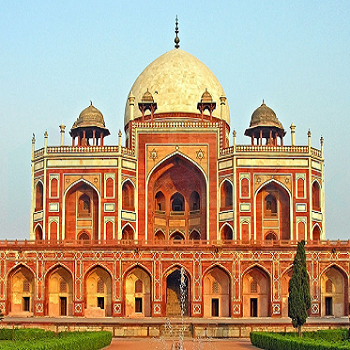
- The tomb of Humayun is located in Delhi.
- Humayun died in 1556, and his widow Biga Begum, also known as Haji Begam, commenced the construction of his tomb in 1569, fourteen years after his death. It is the first distinct example of proper Mughal style, which was inspired by Persian architecture. It is well known that Humayun picked up the principles of Persian architecture during his exile, and he himself is likely to have planned the tomb, although there is no record to that effect. The tomb was constructed at a cost of 15 lakh rupees (1.5 million).
- Mirak Mirza Ghiyath, a Persian, was the architect employed by Haji Begam for this tomb.
- It was also the first structure of its size to use red sandstone.
- In 1993, the tomb was designated as a UNESCO World Heritage Site.
Additional Information
- Humayun (1530-1540, 1555-1556):
- Humayun was the eldest son of Babar.
- In the Battle of Chausa, in 1539 and Battle of Bilgram, in 1540 (Battle of Kanauj), Humayun was defeated by Sher Khan.
- After losing his kingdom, Humayun became an exile for the next 15 years.
- In 1555, Humayun defeated the Afghans and recovered the Mughal Throne.
- He died in 1556 due to his fall from the staircase of his library.
- He loved painting and wrote poetry in the Persian language.
Important Points
- Tombs of important Mughal rulers:
| Ruler | Location |
| Babur | Kabul, Afghanistan |
| Akbar | Sikandra, Agra |
| Jahangir | Lahore, Pakistan |
| Shah Jahan | Agra |
| Aurangzeb | Daulatabad (Khuldabad), Maharashtra |
| Bahadur Shah Zafar | Yangon, Myanmar |
3. Who among the following took away the famous Koh-i-Noor diamond and Shah Jahan’s jewel-studded Peacock Throne?
A. Muhammad Shah
B. Ranjeet Singh
C. Shah Alam II
D. Nadir Shah
Solution
The correct answer is Nadir Shah.
Key Points
- Nadir Shah took away the famous Koh-i-Noor diamond and Shah Jahan’s jewel-studded Peacock Throne.
- In 1739, The Kohinoor, mounted at the head of one of the peacocks on Shah Jahan’s Peacock Throne, left India and the Mughal treasury when Nader Shah carved the Peacock Throne out of the Delhi Cloth.
- He carries the Kohinoor to his native Iran, along with the treasury of eight generations of Mughals.
- The Peacock Throne, along with other Mughal jewels, is then on display at Herat.
- Ahmad Khan Abdali, Nader Shah’s most loyal and senior Afghan general, is gifted with the Kohinoor diamond and the Timur Ruby, both of which Nader Shah stripped from the Peacock Throne, the first lady of Nader Shah’s harem as a reward for protecting the harem and overpowering the renegade looters in the aftermath of the assassination.
- Ahmad Khan Abdali, who then continues to wear the Kohinoor in a bracelet, leaves for Kandahar, taking the Kohinoor with him.
- Nadir Shah was one of Iran’s most powerful rulers in Iranian history, reigning as Shah of Iran (Persia) from 1736 to 1747 when he was assassinated during an uprising.
Additional Information
- Muhammad Shah:
- He was an ineffective, pleasure-seeking Mughal emperor of India.
- Due to his pleasure-loving attitude, he was also called Rangila.
- His name was Roshan Akhtar.
- Maharaja Ranjit Singh:
- He is known for uniting the various Sikh factions into one prosperous empire.
- He expanded his empire by annexing states around him. The Sikh Empire existed
from 1799 till 1849. - The major towns in Ranjit Singh’s empire were Lahore, Amritsar, Multan, Peshawar, Jammu, Srinagar, Rawalpindi, and Sialkot.
- Ranjit Singh was declared the ‘Maharaja of Punjab’ on 12 April 1801.
- Ranjit Singh’s army was known as the Khalsa army.
- Ranjit Singh, renowned as Sher-e-Punjab (Lion of Punjab), is remembered for the
possession of the Koh-i-Noor diamond. - Maharaja Ranjit Singh is well-known for the golden beautification of the Harmandir Sahib Gurdwara in Amritsar, famously known as the Golden Temple.
- Shah Alam II:
- He is popularly known as ‘Ali Gauhar’, was defeated in the Battle of Buxar.
- Shah Alam II, born Ali Gauhar was the seventeenth Mughal Emperor and the son of Alamgir II.
- Shah Alam II became the emperor of a crumbling Mughal empire.
- He was popularly known as Shahi-i- Bekhabar by Khafi Khan due to his appeasement parties by grants of title and rewards.
- Shah Alam also penned the famous book Ajaib-ul-Qasas which is considered one of the earliest and prominent books of prose in Urdu.
4. Banabhatta wrote the biography of King_________.
A. Harshavardhana
B. Chandragupta Maurya
C. Samudragupta
D. Ashoka
Solution
The correct answer is Harshavardhana.
Key Points
- Banabhatta:
- Banabhatta was a court poet of King Harshavardhana.
- He was one of the great patronages of Sanskrit Literature.
- Banabhatta was the Asthana Kavi in the court of King Harsha.
- He was the writer of King Harsha’s biography Harshacharitra.
- He was the writer of the world’s earliest novel Kadambari.
Additional Information
- Harshavardhana:
- With the commencement of the 7th century, Harshavardhana (606-647 A.D.) ascended the throne of Thaneshwar and Kannauj on the death of his brother, Rajyavardhana.
- By 612 Harshavardhana consolidated his kingdom in northern India.
- Harshavardhana is well known for his religious toleration, able administration and diplomatic relations.
- He maintained diplomatic relations with China and sent envoys, who exchanged ideas of the Chinese rulers and developed their knowledge about each other.
- The Chinese traveller, Hiuen Tsang, who visited India during his reign, has given a vivid description of the social, economic and religious conditions, under the rule of Harsha spoke highly of the king.
- Chandragupta:
- Chandragupta Maurya was the founder of the Mauryan Empire.
- At the young age of 25, he captured Pataliputra from the last ruler of the Nanda dynasty, Dhanananda.
- In this task, he was assisted by Kautilya, who was also known as Chanakya or Vishnugupta.
- In 305 B.C., he marched against Selukas Niketar, who was Alexander’s General controlling northwestern India.
- Chandragupta Maurya defeated him and a treaty was signed. By this treaty, He gave his daughter in marriage to the Mauryan prince.
- Megasthenes was sent to the Mauryan court as a Greek ambassador.
- Chandragupta embraced Jainism towards the end of his life and stepped down from the throne in favour of his son Bindusara.
- Then he went to Sravana Belgola, near Mysore along with Jain monks led by Bhadrabhagu and starved himself to death.
- Ashoka:
- Ashoka was a Mauryan emperor.
- Bindusara and Subhadrangi (or Dharma) were Ashoka’s father and mother respectively.
- He was the grandson of Chandragupta Maurya, the founder of the Maurya dynasty.
- Ashoka is considered by many to be one of India’s greatest emperors, Ashoka expanded Chandragupta’s empire to reign over a realm covering the entire Indian subcontinent except for parts of present-day Kerala, Tamilnadu, and Karnataka.
- After the Kalinga war, the Mauryan emperor Ashoka converted to Buddhism from Hinduism, to propagate Buddhism he sent his son Mahendra and his daughter Sanghmitra as missionaries to Ceylon about 251 BC.
- They converted the royal family of Ceylon, who helped them in propagating Buddhism across the state.
5 Who among the following is the sixth Guru of Sikhism?
A Guru Hargobind
B Guru Ram Das
C Guru Angad
D Guru Arjan
Solution
The correct answer is Guru Hargobind.
Key Points
- Guru Hargobind
- He became a guru at the age of 11 after the death of his father Guru Arjan Dev
- Guru Hargobind is credited with developing a strong Sikh army. This brought him into direct conflict with the Mughals.
- It is believed that Guru Hargobind carried two swords at his succession ceremony.
- He was an adept swordsman, wrestler and rider as he had been imparted training in military warfare and martial arts.
- He constructed the Akal Takht, the highest seat temporal seat of the Sikhs. Spiritual and temporal matters related to the Sikh community are resolved at Akal Takht.
- Besides building an army, he founded congregational prayers to promote Sikhism.
- He sent his followers to various places across India to spread the word of Guru Nanak, the first Guru of Sikhs.
Additional Information
- Guru Nanak– He was the founder of Sikhism as well as the first Sikh Guru. He started the practice of “Langer”.
- Guru Angad- He also developed the Gurumukhi script.
- Guru Amar Das- Composed the Anand Sahib, introduced the simple Anand Karaj marriage and abolished Sati among the Sikhs.
- Guru Ram Das- He laid the foundation of the holy city of Amritsar and initiated the construction of the Golden Temple.
- Guru Arjan Dev- Compiled the Adi Granth and constructed the Golden Temple.
- Guru Hargobind- Created the Sikh martial art called Gatka. Built the Akal Takhat.
- Guru Har Rai- He was known as the “tender-Hearted Guru”.
- Guru Har Kishan- Youngest Sikh Guru, installed at the age of 5.
- Guru Teg Bahadur- Refused to convert to Islam and was beheaded by Aurangzeb.
- Guru Gobind Singh- He was the last Sikh Guru. He established the military force of “Khalsa”.
6. In which year was the Treaty of Bassein signed between Baji Rao II, the Maratha Peshwa of Poona in India, and the British?
A. 1820
B. 1810
C. 1802
D. 1801
Solution
The correct answer is 1802.
Key Points
- The treaty of Bassein was signed on 31st December 1802.
- It was signed between East India Company and Baji Rao II.
- Baji Rao II was the Maratha Peshwa of Pune, and the treaty was signed after the battle of Poona.
- This treaty led to the decisive victory of the British and it eventually led to the domination of the East India Company and the dissolution of Maratha power.
- Baji Rao accepted the subsidiary alliance imposed by Lord Wellesley.
- He lost his independence in return for the gaddi of Peshwa.
- An English force Arthur Wellesley entered Poona on May 13, 1803, and Baji Rao was declared the Peshwa.
Important Points
- This treaty was not acceptable to all Marathas chieftains and resulted in the Second Anglo-Maratha War.
- Three Anglo Maratha war was fought between the British and Maratha which are as follows
- First – 1775-1782
- Second – 1803-1805
- Third – 1817-1818
7. Bengal gradually broke away from Mughal control under______.
A. Mukarram Khan
B. Ali Kadir
C. Alivardi Khan
D. Murshid Quli Khan
Solution
The correct answer is Murshid Quli Khan.
Key Points
- Bengal gradually broke away from Mughal control under Murshid Quli Khan.
- Murshid Quli Khan declared himself the Nawab of Bengal.
- He shifted his capital from Dhaka to Murshidabad.
- Murshid Quli Khan, also known as Mohammad Hadi and born as Surya Narayan Mishra, was the first Nawab of Bengal, serving from 1717 to 1727.
Additional Information
- Mukarram Khān Chishtī was the Subahdar of Bengal during the reign of Mughal emperor Jahangir from 1626 to 1627.
- Alivardi Khan was the Nawab of Bengal from 1740 to 1756.
- He toppled the Nasiri dynasty of Nawabs and assumed power himself.
- He is also known for his victory during the Battle of Burdwan against the Maratha Empire during the Maratha invasions of Bengal.
8. Hauz-i-Sultani was a large reservoir, just outside Delhi, constructed by:
A. Nasiruddin Mahmud
B. Sultan Iltutmish
C. Qutb-ud-din Aibak
D. Ghiyas-ud-din Balban
Solution
The correct answer is Sultan Iltutmish.
Key Points
- Sultan Iltutmish constructed Hauz-i-Sultani a large reservoir, just outside Delhi.
- This pond, excavated in the year 1230, is still present in Mehrauli (South Delhi) in the name of Hauz-e-Sultani or Hauz-e-Shamsi.
- This pond was excavated during the reign of Iltutmish.
- About Iltutamish–
- Iltutmish was the second Sultan of the Slave dynasty.
- He ruled the Delhi Sultanate from 1211-1236.
- He was also the son-in-law of Qutubuddin Aibak.
- The construction of Qutub Minar was completed by Iltutmish.
- Qutab-ud-din Aibak commenced the construction of the Qutab Minar in 1192 AD.
- Qutb Minar is also located in Mehrauli (Delhi) and is a UNESCO World Heritage Site.
- After Iltutmish’s death, he was buried near Qutub Minar.
- He declared his Razia as his successor before dying.
- After much opposition, Razia became the Sultan of Delhi.
Additional Information
- Nasiruddin Mahmud:
- He was the 8th Sultan of the Mamluk dynasty who succeeded Alauddin Masud.
- He was the grandson of Iltutmish.
- He strictly followed monogamy and spent most of his time reciting the Quran.
- Ghiyasuddin Balban was his chief and took care of all the affairs and works of Nasir-ud-din Mahmud.
- Ghiyas ud din Balban:
- He belonged to the Mamluk dynasty.
- He was the 9th sultan of the Mamluk dynasty. Since Sultan Nasiruddin did not have a male heir, Balban became the Sultan of Delhi.
- There were 5 dynasties in the Delhi Sultanate.
- Qutb ud-Din Aibak:
- He founded the Mamluk/Slave Dynasty in 1206 AD.
- He assumed the title of sultan and made Lahore his capital.
- The Mamluk dynasty was also known as the slave dynasty.
- Qutb ud-Din Aibak used to play Polo and died while playing it in 1210 AD.
- The reign of the Mamluk Dynasty ended in 1290 AD.
9. In which of the following years the Mughal Emperor Shah Alam II appointed the English East India Company as the Diwan of the province of Bengal?
A. 1865
B. 1665
C. 1735
D. 1765
Solution
The correct answer is 1765.
Key Points
- In 1765 the Mughal Emperor Shah Alam II appointed the English East India Company as the Diwan of the province of Bengal.
- Shah Alam II agreed to:
- Reside at Allahabad, to be ceded to him by the Nawab of Awadh, under the Company’s protection.
- Issue a Farman granting the Diwani of Bengal, Bihar and Orissa to the East India Company in lieu of an annual payment of Rs 26 lakh.
- A provision of Rs 53 lakh to the Company in return for Nizamat functions (military defence, police, and administration of justice) of the said provinces.
- Robert Clive did not want to annex Awadh because it would have placed the Company under an obligation to protect an extensive land frontier from the Afghan and the Maratha invasions.
Additional Information
- The Treaty of Allahabad, 1765:
- Robert Clive concluded two important treaties at Allahabad in August 1765
- With the Nawab of Awadh and,
- With the Mughal Emperor, Shah Alam II.
10. Ballabhgarh became an important trading centre under the leadership of the Jat ruler ________.
A. Raja Ram
B. Suraj Mal
C. Randhir Singh
D. Badan Singh
Solution
The correct answer is Suraj Mal.
Key Points
- Maharaja Suraj Mal was born in the year 1707 in Bharatpur, Rajasthan.
- He was the son of Badan Singh.
- He considered “India as one nation” and fought for the integration of the nation.
- He was also called as “the Plato of the Jat people”.
- He created Bharatpur city.
- Under his reign, Ballabhgarh became an important trading centre.
- He played important role in the 3rd Battle of Panipat.
Additional Information
| Ruler | State |
| Raja Ram | Raigad, Maharashtra |
| Randhir Singh | Kapurthala, Punjab |
| Badan Singh | Bharatpur, Rajasthan |