1. Quit India movement was started in the year
A. 1943
B. 1946
C. 1942
D. 1941
Solution
The correct answer is 1942.
Key Points
- Quit India Movement was launched on 8 August 1942.
- It was launched by Mohandas Karamchand Gandhi at the All-India Congress Committee session in Bombay.
- It was also known as the August Movement.
- In April 1942, the Cripps Mission failed.
- Within less than four months, the third great mass struggle of the Indian people for freedom started.
- The ‘Quit India’ movement united the Indian people against the British people.
Thus, we can say that the Quit India Movement was started in the year 1942.
2. The Radcliffe line is a boundary between
A. India and Pakistan
B. India and China
C. India and Myanmar
D. India and Afghanistan
Solution
The correct answer is India and Pakistan.
Confusion Points
- Radcliffe Line divided British India into two independent countries India and Pakistan in 1947.
- Border between India and Bangladesh – Purbachal(operating zero lines) – 4096.7 km.
Key Points
- Radcliffe Line is the boundary line between India and Pakistan.
- Radcliffe Line divided British India into two independent countries India and Pakistan in 1947.
- Radcliffe Line was named after its architect Sir Cyril Radcliffe.
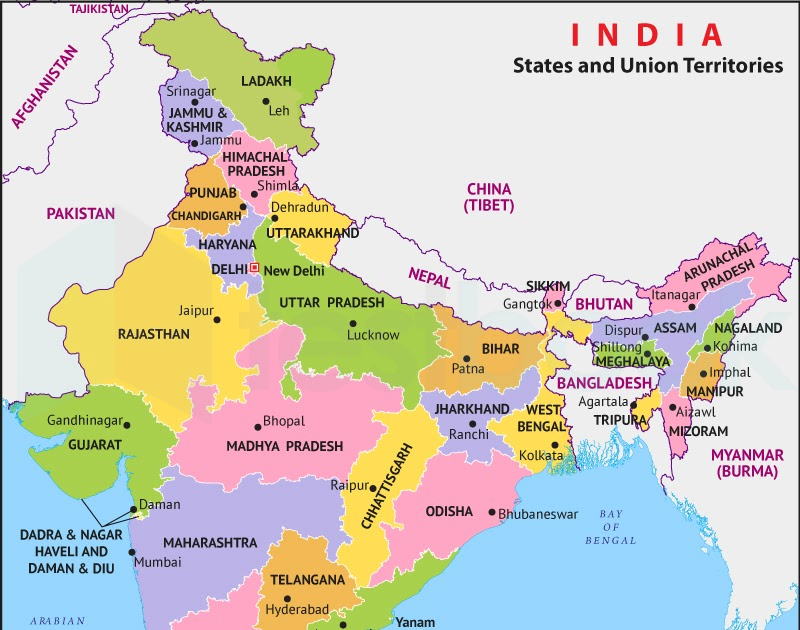
- Three Indian states and two union territory share a boundary with Pakistan.
- Indian states/union territory that share borders with Pakistan are:
- Jammu and Kashmir
- Ladakh
- Rajasthan
- Gujarat.
- Punjab.
Additional Information
- McMahon Line is the boundary line between China and India.
- The diplomatic relations between India and Bhutan were established in 1968.
- Five Indian states namely, Assam, West Bengal, Mizoram, Meghalaya, and Tripura share borders with Bangladesh.
- The Durand Line is the International border between Pakistan and Afghanistan.
- List of International Boundary Lines Names of All Borders Line Of India
- Pakistan – Radcliffe Line (3323 km)
- Bangladesh – Purbachal(operating zero lines) – 4096.7 km.
- China – McMohan Line – 3380 km.
- Bhutan – Indo-Bhutan – 699 km.
- Afghanistan – Durand Line – 106 km.
- Srilanka – Palk Strait –30kms.
3. With reference to the Naval Mutiny 1946, which of the following statement is correct?
A. The mutineers hoisted thirteen flags tied together on the ships which they had captured
B. The mutiny started as a strike by the ratings to protest against the hardships regarding pay only.
C. The mutiny was ended by intervention of Mahatama Gandhi.
D. The mutiny made an impression on the British, that it would be better to leave the country.
Solution
The correct answer is Option 4.
Key Points
Naval Mutiny 1946
- On February 18, 1946, some 1,100 Indian sailors or “ratings” of the HMIS Talwar and the Royal Indian Navy (RIN) Signal School in Bombay declared a hunger strike, triggered by the conditions and treatment of Indians in the Navy.
- The mutiny started as a strike by the ratings to protest against the hardships regarding pay, food and racial discrimination. Hence, Statement 2 is not correct.
- On the same night, a Naval Central Strike committee was created by the Ratings.
- This committee was presided by Signalman M.S Khan and the Vice president was Petty Officer Telegraphist Madan Singh.
- The populace of India was already fascinated by the heroic tales of the Indian National Army. Therefore, the strikes and hartals spread from Bombay to Calcutta, Madras and even Karachi. The foolish British commander made some derogatory remarks about the nationality of this personnel and the result was that they took possession of some ships, mounted guns over there and started firing.
- The mutineers hoisted three flags tied together on the ships which they had captured -One of Congress, One of the Muslim League, and the third Red Flag of the Communist Party of India. Hence, Statement 1 is not correct.
- The mutiny was ended by the intervention of Sardar Patel, who after a meeting with M. S. Khan made a statement about ending the strike. Hence, Statement 3 is not correct.
- A similar statement was made by Jinnah in Calcutta. The mutineers surrendered but despite the assurances of Congress and the Muslim League, many mutineers were arrested, subjected to court-martial and dismissed from the services.
- The violence broke out in Mumbai and over 200 people lost their lives in this disturbance.
- The mutiny made an impression on the British, that it would be better to leave the country. Hence, Statement 4 is correct.
- On February 19, the second day of this mutiny, Cabinet Mission was sent to India.
4. Who was the President of the Indian National Congress at the time of partition of India?
A. J. B. Kripalani
B. Jawaharlal Nehru
C. Maulana Abul Kalam Azad
D. C. Rajagopalachari
Solution
The correct answer is J. B. Kripalani.
Key Points
- J B Kripalani was recognized as a Gandhian and a socialist.
- He became the Congress President in 1946 and resigned from his position in 1947, soon after Independence, when equations within the party started changing.
- Kripalani was a sharp critic of both Jawaharlal Nehru and Indira Gandhi.
- He opposed Nehru’s policies, which he believed were against Gandhian values, and later opposed Indira’s policies too.
- In 1975, when an Emergency was declared, Kripalani was among the first political leaders to be arrested.
Additional Information
- About Indian National Congress(INC):
- The INC was established in 1885, by A.O. Hume under the viceroyship of Lord Dufferin.
- On 28 December 1885 Indian National Congress (INC) was established on the premises of Gokuldas Tejpal Sanskrit School at Bombay.
- It was presided over by W.C Banerjee and attended by 72 delegates.
- The main aim of Congress is to train the Indian youth in political agitation and to organise or to create public opinion in the country.
- They use the method of an annual session where they discuss the problem and passed the resolution.
5. Which among the following statements about the Cripps Mission is correct?
A. It proposed that a fully Independent Indian Union would be set up.
B. It proposed that After the end of the war, a constituent assembly would be convened to frame a new constitution.
C. Members of this assembly would be partly elected by the provincial assemblies through first passed the post system.
D. In March 1946, a mission headed by Stafford Cripps was sent to India with constitutional proposals to seek Indian support for the World War II.
Solution
The correct answer is Option 2.
Key Points
- Cripps Mission
- It proposed that After the end of the war, a constituent assembly would be convened to frame a new constitution. Hence, Statement 2 is correct.
- Members of this assembly would be partly elected by the provincial assemblies through proportional representation and partly nominated by the princes. Hence, all members would be Indians. Hence, Statement 3 is not correct.
- The British government would accept the new constitution subject to two conditions:
- Any province not willing to join the Union could have a separate constitution and form a separate Union
- The new constitution-making body and the British government would negotiate a treaty to effect the transfer of power and to safeguard racial and religious minorities.
- In the meantime, the defence of India would remain in British hands and the Governor-General’s powers would remain intact.
- In March 1942, a mission headed by Stafford Cripps was sent to India with constitutional proposals to seek Indian support for World War II. Hence, Statement 4 is not correct.
- It proposed that An Indian Union with a dominion status would be set up; it would be free to decide its relations with the Commonwealth and free to participate in the United Nations and other international bodies. Hence, Statement 1 is not correct.
6. Which mission was initiated by the British Government to India to secure full Indian cooperation for their efforts in World War II?
A. Irwin
B. Simon
C. Cripps
D. Cornwallis
Solution
The correct answer is Cripps.
Key Points
- Cripps mission was initiated by the British Government to India to secure full Indian cooperation for their efforts in World War II.
- Cripps Mission came to India in 1942.
- Stafford Cripps was a labour minister in Winston Churchill’s coalition government in Britain.
- The Cripps Mission came to India from 22 March to 11 April 1942.
- Its aim was to obtain Indian cooperation for the British war in the 2nd World war.
Additional Information
- Proposals of Cripps Mission:
- Setting up of an Indian dominion.
- A constituent Assembly would be formed to frame a new constitution for the country.
- India’s defence would be controlled by the British until this new constitution came into force.
- The transfer of power and the rights of minorities would be safeguarded by negotiations between the Constituent Assembly and the British government.
7. On which national festival is the National Flag of India hoisted by the Prime Minister at the Red Fort in old Delhi?
A. National Constitution Day
B. Independence Day
C. Gandhi Jayanti
D. Republic Day
Solution
The correct answer is ‘Independence Day’.
Key Points
- The Prime Minister hoists the National Flag of India at the Red fort in old Delhi on Independence Day.
- India becomes Independent on 15th August 1947.
- On that day the British flag flying on the Red fort was removed and India’s national flag was hoisted.
- Pandit Jawaharlal Nehru, The first Prime Minister of India hoisted the flag on this day.
- since then, every year the Prime Minister hoists the flag on Red fort and addresses the nation.
Was the solution helpful?Yes
8. Who among the following was the Viceroy of British India when the Shimla conference was held in 1945?
A. Lord Linlithgow
B. Lord Willingdon
C. Lord Irwin
D. Lord Wavell
Solution
The correct answer is Lord Wavell.
Key Points
- Lord Wavell (1943-1947) served as the Viceroy of India during a crucial period of World War II and the lead-up to Indian independence, including the Bengal famine and the Quit India Movement.
- In 1945, Lord Wavell introduced the “Wavell Plan,” proposing a reorganization of the Indian government to include more Indian representatives.
- The Shimla Conference was convened by Lord Wavell in an attempt to discuss India’s political future and the formation of a new executive council that would include more Indian members.
- It was a key event in India’s path to independence but ended unsuccessfully due to disagreements between the Indian National Congress and the Muslim League.
Additional Information
| Viceroy | Tenure | Key Contribution(s) |
|---|---|---|
| Lord Canning | 1856-1862 | First Viceroy; oversaw the 1857 Revolt and subsequent transfer of power to the Crown. |
| Lord Lytton | 1876-1880 | Organized the Delhi Durbar; passed the Vernacular Press Act, and faced the Great Famine. |
| Lord Ripon | 1880-1884 | Repealed the Vernacular Press Act; introduced local self-government reforms. |
| Lord Curzon | 1899-1905 | Partition of Bengal (1905); reforms in education and preservation of monuments. |
| Lord Minto | 1905-1910 | Morley-Minto Reforms (1909), introducing limited electoral representation. |
| Lord Hardinge | 1910-1916 | Capital moved from Calcutta to Delhi in 1911; faced the Delhi Conspiracy Case. |
| Lord Chelmsford | 1916-1921 | Montagu-Chelmsford Reforms (1919); Jallianwala Bagh massacre occurred under his tenure. |
| Lord Reading | 1921-1926 | Non-cooperation movement and Chauri Chaura incident; repressive laws against Indian protests. |
| Lord Irwin | 1926-1931 | Gandhi-Irwin Pact; First Round Table Conference; Civil Disobedience Movement. |
| Lord Mountbatten | 1947-1948 | Last Viceroy; oversaw the Partition of India and independence. |
9. The leader of the Muslim League who drafted the Pakistan Resolution was :
A. Khan Abdul Gaffar Khan
B. Maulana Azad
C. Sikandar Hayat Khan
D. Muhammad Iqbal
Solution
The leader of the Muslim League who drafted the Pakistan Resolution was Sikandar Hayat Khan.
Key Points
- By 1940, the Pakistan demand was formalised gradually.
- On 23 March 1940, the League moved a resolution demanding a measure of autonomy for the Muslim-majority areas of the subcontinent.
- This ambiguous resolution never mentioned partition or Pakistan.
- In fact Sikandar Hayat Khan, Punjab Premier and leader of the Unionist Party, who had drafted the resolution, declared in a Punjab assembly speech on 1 March 1941 that he was opposed to a Pakistan that would mean “Muslim Raj here and Hindu Raj elsewhere … If Pakistan means unalloyed Muslim Raj in the Punjab then I will have nothing to do with it.”
- He reiterated his plea for a loose (united), confederation with considerable autonomy for the confederating units.
Therefore, the correct answer is Sikandar Hayat Khan.
Additional Information
- Khan Abdul Gaffar Khan, also known as Frontier Gandhi, was a close associate of Mahatma Gandhi and shared his philosophy of non-violence and civil disobedience.
- Maulana Azad was a prominent member of the Indian National Congress and worked closely with leaders like Mahatma Gandhi, Jawaharlal Nehru, and Sardar Patel in the struggle for India’s independence from British colonial rule.
- Muhammad Iqbal was a strong advocate of Indian Muslim nationalism and played a significant role in the Pakistan Movement, which aimed to create a separate homeland for Indian Muslims.
10. ______ is an Act of the Parliament of the United Kingdom that partitioned British India into two new independent dominions of India and Pakistan in 1947.
A. Rowlatt Act
B. Indian Independence Act
C. Government of India Act
D. Pitt’s India Act
Solution
The correct answer is Option 2.
Key Points
- The Indian Independence Act of 1947 partitioned British India into two separate dominions, India and Pakistan, based on religious lines.
- The act facilitated the transfer of power from British colonial rule to the newly formed governments of India and Pakistan.
- It granted full legislative authority to India and Pakistan, establishing them as independent and sovereign nations.
- The partition resulted in widespread communal violence and riots between religious communities, leading to a significant loss of life and displacement of people.
- The act allowed princely states to choose between joining India, joining Pakistan, or remaining independent, leaving the decision to the rulers of these states.
Additional Information
- The Rowlatt Act, also known as the Anarchical and Revolutionary Crimes Act of 1919, was a legislative act passed by the British colonial government in India during the period of British rule.
- It was named after its sponsor, Sir Sidney Rowlatt, who was a British judge.
- The Government of India Act refers to several legislative acts passed by the British Parliament during the period of British rule in India.
- These acts were intended to regulate and govern the administration of British India.
- Pitt’s India Act, officially known as the East India Company Act 1784, was an important piece of legislation passed by the British Parliament under the leadership of Prime Minister William Pitt the Younger.
- The act was designed to bring about significant reforms in the governance and administration of the British East India Company’s territories in India.