1. Who was the Prime Minister of India during Indo-Pak war in 1965?
A. Jawaharlal Nehru
B. Indira Gandhi
C. Lal Bahadur Shastri
D. Rajiv Gandhi
Solution
The correct answer is Lal Bahadur Shastri.
Key Points
- Lal Bahadur Shastri was the second Prime minister in India.
- He served as the Prime minister of India from 1964 to 1966.
- He was the Prime Minister of India during the Indo-Pak war in 1965.
- His birthday also falls on 2nd October along with Mahatma Gandhi’s birthday.
- The famous slogan “Jai Jawan, Jai Kisan” was raised by Lal Bahadur Shastri.
- He signed on Tashkent Declaration along with the then-President of Pakistan Muhammad Ayub Khan on 10th January 1966.
- He is the first prime minister to die abroad.
- He was honoured with the Bharat Ratna in 1966.
- He was the first person to receive Bharat Ratna posthumously.
- The resting place of Lal Bahadur Shastri is called Vijayghat.
Additional Information
- Jawaharlal Nehru was the Prime Minister of India during the Indo-China war in 1962.
- Indira Gandhi was the Prime Minister of India during the Indo-Pak war in 1971.
- Rajiv Gandhi was the Prime Minister of India when the Bhopal gas tragedy took place in 1984.
2. Which of the following leaders signed the Tashkent Agreement?
A. Vallabhbhai Patel and Jinnah
B. Jawaharlal Nehru and Ayub Khan
C. Lal Bahadur Shastri and Ayub Khan
D. Jawaharlal Nehru and Jinnah
Solution
The correct answer is Lal Bahadur Shastri and Ayub Khan.
Key Points
- The Tashkent Agreement was a peace treaty signed by India and Pakistan in 1965 to end the Indo-Pakistani War.
- Lal Bahadur Shastri is the prime minister who signed on Tashkent agreement.
- On January 10, 1966, Lal Bahadur Shastri and Pakistan’s then-President Muhammad Ayub Khan signed the Tashkent Agreement.
- Tashkent is the capital city of Uzbekistan.
- Aleksey Kosygin, the Soviet premier, mediated the agreement.
- The parties agreed that all armed forces would be withdrawn to positions held prior to August 5, 1965.
- In India, the agreement was criticized because it did not include a no-war pact or any commitment to refrain from guerilla warfare in Kashmir.
- Lal Bahadur Shastri died in Tashkent on (11th January 1966) the day after the Tashkent Declaration .
Additional Information
- Lal Bahadur Shastri was the second Prime minister of India.
- He served as the Prime minister of India from 1964 to 1965.
- He is popularly called “man of peace”.During the 1965 Indo-Pak conflict, he served as Prime Minister of India.
- On the same day as Mahatma Gandhi’s birthday, he was born on October 2nd.
- Lal Bahadur Shastri popularised the term “Jai Jawan, Jai Kisan.”
- He is the first Prime Minister of India to die abroad.
- In 1966, the Bharat Ratna was bestowed upon him.
- He was the first posthumous recipient of the Bharat Ratna.
- Lal Bahadur Shastri’s resting spot is known as Vijayghat.
3. Till which year was Bangladesh a part of Pakistan?
A. 1962
B. 1974
C. 1971
D. 1956
Solution
The correct answer is 1971.
Key Points
- Bangladesh (East -Pakistan) was part of Pakistan from 1947 to 1971.
- India joined the war on 3 December 1971, after Pakistan launched preemptive air strikes on North India.
- The subsequent Indo-Pakistani War witnessed engagements on two war fronts
- The Indian government decided to save the Bangali Muslims and Hindus
- On 16 December 1971, 93,000 Pakistani military and govt officials surrendered before the Indian Army,
- ending the Bangladesh Liberation War that began on 3 December
Additional Information
- 26 march is the independence day of Bangladesh
- General A A K Niazi signed the Instrument of Surrender on 16 December 1971 in Dhaka, marking the formation of East Pakistan as the new nation of Bangladesh.
- On December 6, she announced in Parliament that India had accorded recognition to the Bangladesh Government
- On July 2, 1972, India and Pakistan signed the Shimla Agreement under which the former agreed to release all the 93,000 Pakistani prisoners of war
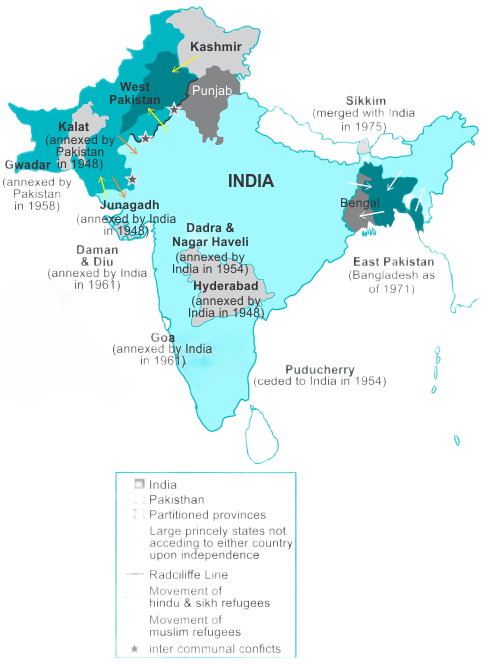
4. Who was the prime minister of India when the fundatmental duties were included in the Indian constitution?
A. Indira Gandhi
B. Rajiv Gandhi
C. Manmohan Singh
D. Jawaharlal Nehru
Solution
The correct answer is Indira Gandhi.
Key Points
- Indira Gandhi served as Prime Minister during a critical period in India’s history.
- She held office from 1966 to 1977 and then from 1980 to 1984.
- The Fundamental Duties were included in the Indian Constitution during the period of her leadership, specifically during the period known as the Emergency (1975-1977).
- Under her leadership, India achieved self-sufficiency in food grains due to the Green Revolution, which introduced high-yield crops and modern agricultural techniques.
- During her tenure, India won the 1971 war against Pakistan, leading to the creation of Bangladesh.
- She also implemented several significant reforms and policies in the economic and social sectors.
Additional Information
| Prime Minister | Tenure |
|---|---|
| Rajiv Gandhi | 1984-1989 |
| Manmohan Singh | 2004-2014 |
| Jawaharlal Nehru | 1947-1964 |
5. Goa became India’s 25th state on ______________.
A. 30 May 1990
B. 30 May 1986
C. 30 May 1987
D. 30 May 1988
Solution
The correct answer is 30 May 1987.
- Goa became India’s 25th state on 30 May 1987.
Key Points
- Goa is India’s smallest state by area.
- Goa remained under the Portuguese administration even after India gained independence in 1947.
- After a 36-hour battle, the Indian Army invaded and captured Goa in 1961.
- Goa, Daman, and Diu merged to become the union territory of Goa, Daman, and Diu.
- From 19 December 1961 until 30 May 1987, the territory of Goa, Daman, and Diu was a union territory of India.
- Goa was granted statehood in 1987.
- Every year on December 19, Goa commemorates its liberation.
- The Indian government recognized Konkani as Goa’s official language in February 1987.
- Pratapsingh Rane was the first Chief Minister of the newly established Goa state and had previously served as Chief Minister of Goa, Daman, and Diu.
Important Points
- Goa is located on the southwestern coast of India within the region known as the Konkan and geographically separated from the Deccan highlands by the Western Ghats.
- Capital: Panji.
- Official Language:
- Konkani which is one of the 22 languages from the Eight Schedule.
- Borders:
- It is surrounded by Maharashtra to the north and Karnataka to the east and south, with the Arabian Sea forming its western coast.
- Geography:
- The highest point of Goa is Sonsogor.
- Goa’s seven major rivers are the Zuari, Mandovi, Terekhol, Chapora, Galgibag, Kumbarjua canal, Talpona and the Sal.
- Most of Goa’s soil cover is made up of laterites.
6. How many banks were nationalised in 1969?
A. 8
B. 10
C. 7
D. 14
Solution
The correct answer is option 4, i.e., 14.
- 14 banks were nationalized in 1969.
- The nationalization of Indian banks happened in two phases.
- In the first phase, 14 banks were nationalized on July 19, 1969.
- In the second phase, 6 banks were nationalized in 1980.
- For the nationalization of the 14 banks the then PM of India, Indira Gandhi, brought an ordinance.
- The nationalization was done to take over the control of the major banks from the hands of industrialists as they were only providing financial assistance to the corporates and the agriculture sector was totally ignored.
7. Which of the following was the objective of the Mahalanobis Model in India?
A. Development of Agriculture.
B. Industrial Development.
C. Self-sufficiency in food, and economy.
D. Self-reliance and sustained growth.
Solution
P. C. Mahalanobis Model, 1953
- It was implemented as the second Five Year Plan from 1956-61.
- The main objective was Industrial Development. Hence, option B is correct.
- Target growth rate – 4.5%
- Actual growth rate – 4.27%.
| Model | Objectives |
| Harrod Domar Model(1951-56) | Development of Agriculture. |
| Gadgil Yojana(1961-66) | Self-sufficiency in food, and economy |
| Green Revolution(1969-74) | Self-reliance and sustained growth. |
- Hence, options A, C, and D are incorrect.
8. With which country did India had a war in the region of the McMahon line in 1962?
A. China77% answered correctly
B. Bhutan
C. Pakistan
D. Nepal
Solution
The correct answer is China.
Key Points
- Jawaharlal Nehru was the Prime Minister of India during the Indo-China war in 1962.
- India was attacked on October 20, 1962, in what famously came to be known as the Sino-India war of 1962 in the region of the McMahon line.
- The war continued for about a month and ended on November 21, after China declared a ceasefire.
- When China announced that it would be occupying Tibet, India sent a letter of protest proposing negotiations on the Tibet issue.
- China was more active in deploying troops on the Aksai-Chin border.
Additional Information
- India was so concerned about its relations with China that it did not even attend a conference for the conclusion of a peace treaty with Japan because China was not invited.
- In 1954, China and India concluded the Five Principles of Peaceful Coexistence i.e. Panchsheel principles.
- Under this agreement, India acknowledged Chinese rule in Tibet.
- Chinese maps showed some 120,000 square kilometers of Indian territory as Chinese.
- China felt humiliated by the reception Dalai Lama obtained in India when he fled there in March 1959.
- Tensions increased between the two nations when Mao stated that the Lhasa rebellion in Tibet was caused by Indians.
- China’s perception of India as a threat to its rule of Tibet became one of the most prominent reasons for the Sino-Indian War.
- On October 20, 1962, China’s People’s Liberation Army invaded India in Ladakh, and across the McMahon Line in the then North-East Frontier Agency.
- The Chinese also cut Indian telephone lines, preventing the defenders from making contact with their headquarters.
- India, thinking that the war would not take place, did not prepare itself for the war.
- The war ended on November 21, after China declared a ceasefire.
- In 1954, China and India concluded the Five Principles of Peaceful Coexistence i.e. Panchsheel principles.
9. Which of the following agreements between India and Pakistan is also known as the ‘Nehru-Liaquat Agreement’?
A. Agreement between India and Pakistan regarding resumption of rail traffic
B. Agreement between India and Pakistan regarding security and rights of minorities
C. Agreement between India and Pakistan relating to air services
D. Agreement for avoidance of double taxation between India and Pakistan
Solution
The correct answer is Agreement between India and Pakistan regarding the security and rights of minorities.
. Key Points
- Nehru-Liaquat Agreement
- The Nehru–Liaquat Pact, also known as the Delhi Pact, was a bilateral agreement between India and Pakistan.
- To provide a framework for the treatment of minorities in both countries.
- It was signed in 1950 in Delhi by former Prime Minister Nehru and former Prime Minister of Pakistan Liaquat Ali Khan.
- According to the agreement, India and Pakistan will be accountable to each other for the treatment of minorities in their countries.
Additional Information
- Key takeaways
- Refugees were allowed to return undisturbed to dispose of their property.
- Abducted women and looted property had to be returned.
- Forced conversions were unrecognized.
- Minority rights were confirmed.
10. In which year did the Bhopal Gas Tragedy take place?
A. 1986
B. 1982
C. 1984
D. 1980
Solution
The correct answer is 1984.
Key Points
- Bhopal Gas Tragedy:
- It happened on December 3, 1984.
- It was happened due to leakage of Methyl Isocyanate (CH3NCO) from the pesticide plant of Union Carbide (now Dow Chemicals), an MNC, in Madhya Pradesh capital Bhopal.
- It is estimated that about 40 tonnes of gas and other chemicals leaked from the Union Carbide factory.
- Methyl isocyanate is an extremely toxic gas and if its concentration in the air touches 21ppm (parts per million), it can cause death within minutes of inhaling the gas.
- It is one of the worst chemical disasters globally and still continues to have its ill effects on the people of the affected areas.
- After the tragedy, the government of India enacted a Public Liability Insurance Act (1991) that meant to provide immediate relief to victims of accidents involving hazardous industries.
- Under the Act, an environment relief fund was set up to compensate affected people.