1. Plasma is formed in the stars because of very _______________.
A. low pressure
B. high temperature
C. high pressure
D. low temperature
Solution
The correct answer is high temperature.
Key Points
- Star: The celestial body which consists of a luminous sphere of plasma held together by its own gravitational field is called a star.
- The Stars are classified by their spectrum and their temperature
- Stars form a pattern in a group, which has a recognizable shape.
- This group of stars is called a constellation.
- At present, there are about 88 constellations.
- Each constellation has been given a name according to its shape.
- Some of the important constellations are Ursa Major, Ursa Minor, Orion, Leo Major, and Cassiopeia.
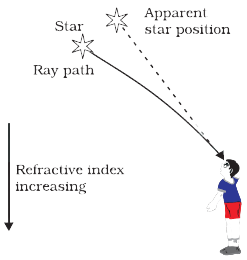
- The twinkling of a star is due to the atmospheric refraction of starlight.
- The starlight, on entering the earth’s atmosphere, undergoes refraction continuously before it reaches the earth.
- The atmospheric refraction occurs in a medium of gradually changing refractive index.
- Since the atmosphere bends starlight towards the normal, the apparent position of the star is slightly different from its actual position.
- When we rub a matchstick against the rough surface of a matchbox, then friction between the head of the matchstick and the rough side of the matchbox produces heat. This heat burns the chemicals present on the head of the matchstick due to which the matchstick lights up.
- A mirage is an optical phenomenon that creates the illusion of water and results from the refraction of light through a non-uniform medium.
- Mirages are most commonly observed on sunny days when driving down a roadway.
- As you drive down the roadway, there appears to be a puddle of water on the road several yards (maybe one hundred yards) in front of the car. Of course, when you arrive at the perceived location of the puddle, you recognize that the puddle is not there. Instead, the puddle of water appears to be another one-hundred yards in front of you.
2. What is the International Date Line?
A. It is the 90° east longitude
B. It is the equator
C. It is the 180° longitude
D. It is the 0° longitude
Solution
The correct answer is it is 180° Longitude.
- The dateline, also called the International Date Line, is a boundary from which each calendar day starts. Areas to the west of the dateline are one calendar day ahead of areas to the east.
- The dateline runs from the North Pole to the South Pole through the Pacific Ocean. It is not a straight line, however.
Important Points
- The dateline, which roughly follows the 180-degree meridian, is about halfway around the globe from the prime meridian, which measures 0-degrees longitude.
- The dateline curves around several landmasses. For example, it curves around the islands that make up the nation of Kiribati, so that all regions of the country remain on the same day.
- The dateline makes a big detour between Asia and North America in the Bering Strait. Cape Dezhnev, Russia, is always a day ahead of Cape Prince of Wales, Alaska, even though the landmasses are less than 80 kilometres (50 miles) apart.
Hence, The International Date Line follows the 180° longitude meridian. It is the boundary from which each calendar day starts.
3. Which planet is called the ‘twin sister’ of the earth?
A. Mercury
B. Venus
C. Mars
D. Uranus
Solution
The correct answer is Venus
Key Points
- Venus is called the ‘twin sister’ of the Earth because Venus and Earth are almost the same size, have about the same mass (they weigh about the same), and have a very similar composition (are made of the same material).
- They are also neighboring planets.
- However, Venus and Earth are also very different as Venus has an atmosphere that is about 100 times thicker than Earth’s and has surface temperatures that are extremely hot.
- Venus does not have life or water oceans like Earth does.
- Venus also rotates backwards compared to Earth and the other planets.
Hence, the correct answer is – Venus.
Additional Information
- Venus takes the longest time to rotate around its axis and it is the longest in the solar system when compared to all other planets.
- The planet is often called the “morning star” or “evening star” because it is visible at dawn and dusk.
- Venus rotates in the opposite direction, hence the sun rises in the West and sets in the East.
- Venus is the hottest planet in our solar system.
- Its thick atmosphere is full of greenhouse gas carbon dioxide, and it has clouds of sulfuric acid.
4. Which of the following is the nearest and Farthest planet to the sun?
A. Mercury and Earth
B. Mars and venus
C. Mercury and Neptune
D. Mercury and Mars
Solution
The correct answer is Mercury and Neptune.
Key Points
- Planets are large round objects in space that move around the sun or another star.
- There are eight planets in our solar system.
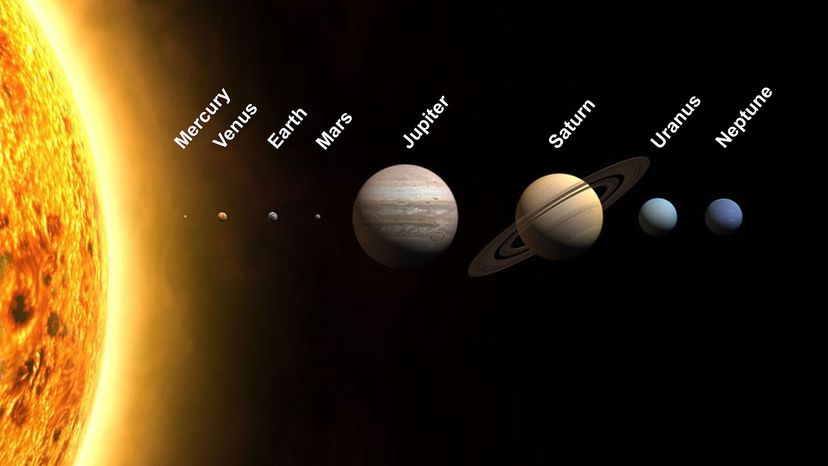
- The order from the nearest to the farthest planet in the solar system is as follows:
- Mercury
- Venus
- Earth
- Mars
- Jupiter
- Saturn
- Uranus
- Neptune
- The nearest planet to the sun is Mercury and the farthest is Neptune.
- Thus, we can say that the nearest planet to the sun is Mercury and farthest planet is Neptune.
Additional Information
- The first four planets – Mercury, Venus, Earth, and Mars- are called terrestrial planets.
- The last four planets – Jupiter, Saturn, Uranus, and Neptune- are called gas giants.
5. Longitudes divides earth into how many time zones?
A. 3 time zones
B. 5 time zones
C. 24 time zones
D. 360 time zones
Solution
The earth has been divided into 24 zones (Because there are 24 hours in a day) depending upon the longitudes.
Key Points
- In 1878, Sir Sandford Fleming (1827? 1915) developed the system of worldwide time zones that we still use today.
- He proposed that the world be divided into 24 time zones, each spaced 15 (fifteen degrees) of longitude apart (like 24 sections of an orange)
- The earth has been divided into 24 zones (Because there are 24 hours in a day) depending upon the longitudes.
- Each time zone differs from the next by 1 hour. Each zone is 15° wide. The time zones have been named from 0 to 23.
6. Which of the following is an outer planet of the solar system?
A. Venus
B. Earth
C. Mercury
D. Saturn
Solution
Saturn is an outer planet of the solar system. It is the sixth planet from the sun and is known for its beautiful rings. Outer planets, also called gas giants, are primarily composed of gas and have thick atmospheres. They are located beyond the asteroid belt and include Jupiter, Saturn, Uranus, and Neptune.
7. Which country has the most time zones?
A. France
B. Australia
C. Denmark
D. Spain
Solution
The correct answer is France.
Key Points
- Countries are sorted by the total time zones in their region.
- The time zones of a country include dependent territories (except for Antarctic claims).
- France, including its overseas territories, has the most time zones with 12 (13 including its claim in Antarctica).
- Many countries have daylight saving time, an hour added during the local summer, but this list does not include that information.
- The UTC offset in the list is not valid in practice during daylight saving time.
Important Points
- List of time zones by country:
- Russia – 11
- United States – 11
- Antarctica – 9
- Australia – 9
8. Which is the longest latitude on the globe ?
A. Equator
B. Tropic of Cancer
C. Tropic of Capricorn
D. Arctic circle
Solution
The correct answer is the Equator.
Key Points
- Latitude is a measurement on the globe or map of location north or south of the Equator.
- The longest latitude on the globe is the Equator.
- The Equator is located at 0º latitude.
- It divides the Earth into two equal halves.
Thus, we can say that the longest latitude on the globe is the Equator.
9. One of the planets has the least density among all the planets. The planet is
A. Jupiter
B. Saturn
C. Uranus
D. Neptune
Solution
Concept:
- The order of the planets in the solar system starting nearest the sun: Mercury, Venus, Earth, Mars, Jupiter, Saturn, Uranus, Neptune.
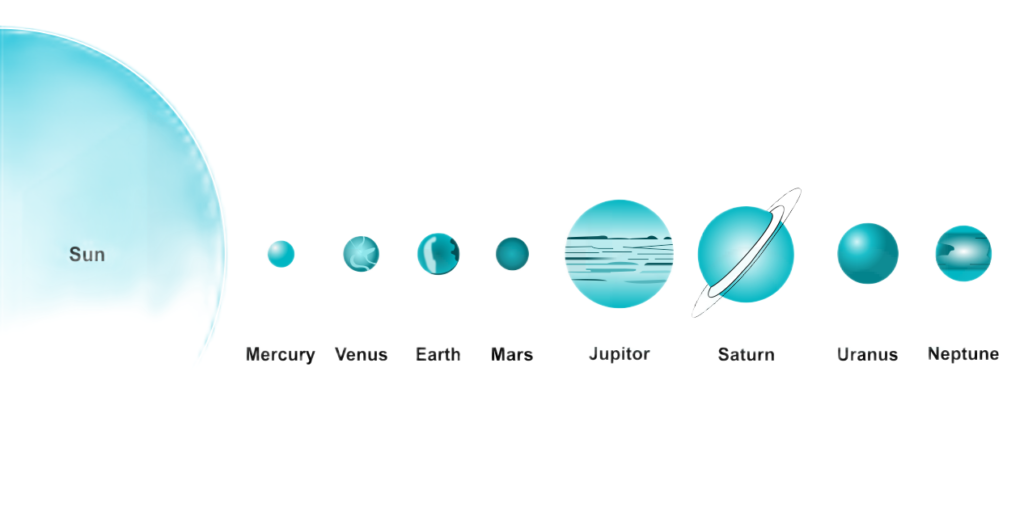
- All the planets orbit the sun in a counter-clockwise direction and rotate on their axis west to east, except Venus and Uranus.
- Venus and Uranus rotate clockwise east to west while Uranus rolls on its side as it orbits the sun.
Explanation:
Saturn:
- Saturn is very large and is the second largest planet in the Solar System.
- Saturn is mainly composed of the lightest two gases known, hydrogen and helium.
- It is the only planet in our solar system whose density is less than water.
- The least dense planet in the Solar System is Saturn, which has an average density of only 687 kg/m3. (0.687 grams per cubic centimeter)
Therefore, the correct answer is Saturn.
Key Points
- Earth has the highest density in the Solar System which has a density of 5.514 g/cm3.
- Venus is the hottest planet in the solar system.
- Sun is not a planet is a star at the center of the solar system.
- Jupiter is the 5th planet from the sun and the largest planet in the solar system.
- Mars is called the red planet because it appears in the sky as a red star, and also its surface is covered with fine sand & dust full of iron oxide.
10. Consider the following pairs:
| Planet | Time taken(for one spin on axis) | |
| I. | Uranus | 17 hours 14 minutes |
| II. | Neptune | 16 hours 07 minutes |
| III. | Saturn | 25 hours 40 minutes |
| IV. | Mars | 09 hours 56 minutes |
How many above mentioned pairs are correctly matched?
A. Only one
B. Only two
C. Only three
D. All the four
Solution
Only two pairs are correctly matched out of the given pairs.
Important Points
- Uranus takes approximately 17 hours 14 minutes for one spin on its axis, which is correct.
- Neptune takes approximately 16 hours 07 minutes for one spin on its axis, which is also correct.
- Saturn takes approximately 10 hours 33 minutes for one spin on its axis, which does not match with the given value of 25 hours 40 minutes.
- Mars takes approximately 24 hours 37 minutes for one spin on its axis, which does not match with the given value of 09 hours 56 minutes.
Therefore, only two pairs are correctly matched, which are:
- Uranus 17 hours 14 minutes
- Neptune 16 hours 07 minutes