1. What is the term for the large cauldron-like hollow formed when a volcano erupts and collapses?
A. Caldera
B. Sills
C. Conduit
D. Cinder core
Solution
The correct answer is Caldera.
Key Points
- Caldera
- Caldera is the term for the large cauldron-like hollow formed when a volcano erupts and collapses.
- When a volcano erupts and collapses, a large depression called a caldera is created.
- Magma that is present in the magma chamber beneath the volcano is ejected during a volcanic eruption, frequently violently.
- The development of a caldera is an uncommon occurrence, happening only a few times every century, in comparison to the hundreds of volcanic eruptions that take place per century.
- Between 1911 and 2016, there are only known to have been seven caldera-forming collapses. When the depression in the shape of a bowl is filled with water, some calderas form a lake.
Additional Information
- Volcano
- A volcano is a fissure in a planet’s crust, like the one on Earth, through which gases, hot lava, and volcanic ash can leak out of a magma chamber beneath the planet’s surface.
- Volcanoes are most usually found when tectonic plates are divergent or converging, and the majority of them are underwater.
- For instance, the Pacific Ring of Fire has volcanoes created by convergent tectonic plates while the Mid-Atlantic Ridge has volcanoes caused by divergent tectonic plates.
2. Which one of the following layer is thinnest of all?
A. Crust
B. Mantle
C. Core
D. None of the above
Solution
The Earth is divided into four main layers: the solid crust on the outside, the mantle, the outer core, and the inner core.
Key Points
Interior of the Earth:
Crust:
- The uppermost layer over the earth’s surface is called the crust.
- It is the thinnest of all the layers.
- On the continental masses, It is about 35 km and on the ocean floors, only 5 km.
- The crust is the thinnest layer of the Earth and it amounts to less than 1% of our planet’s volume.
- The earth is made up of several concentric layers with one inside another, just like an onion.
- The crust is the outermost layer of Earth and is made up of igneous, metamorphic, and sedimentary rocks.
- The Earth’s crust is unstable because of the exogenic forces.
Mantle:
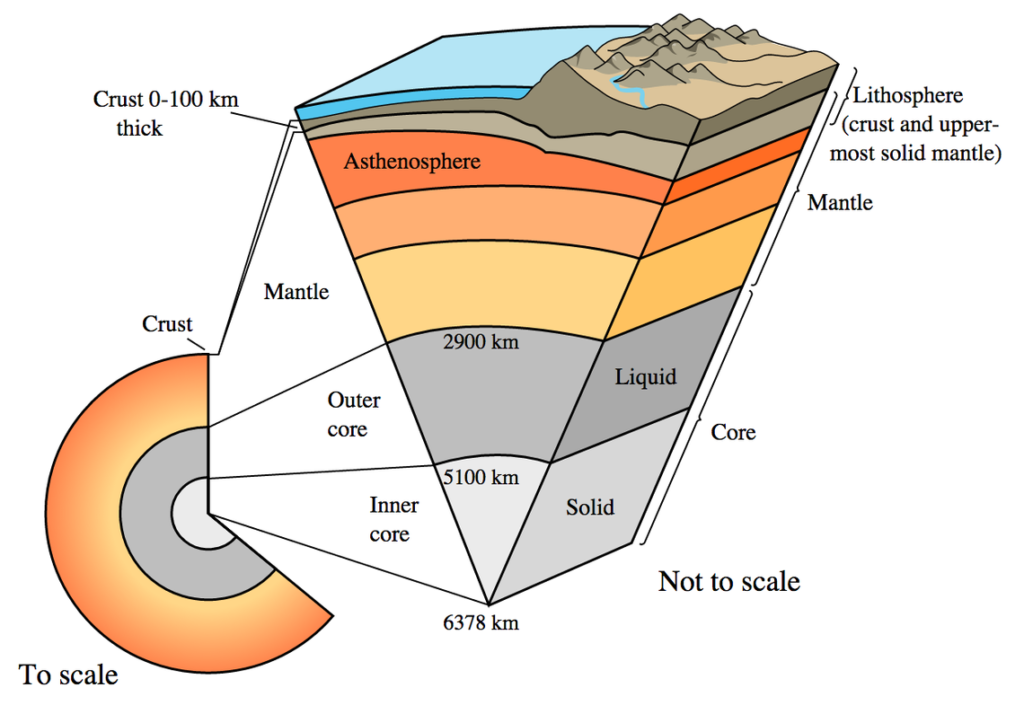
- The Mantle extends up to a depth of 2900 km below the crust.
- It is the widest section of the Earth.
- The uppermost part of the mantle is known as the asthenosphere.
Core:
- The innermost layer is the core with a radius of about 3500 km.
- The central core has a very high temperature and pressure.
- The inner core (1200 km) is in the solid-state whereas the outer core (2300 km) is in the liquid state.
- The innermost layer is the core with a radius of about 3500 km and divided into Inner and Outer core.
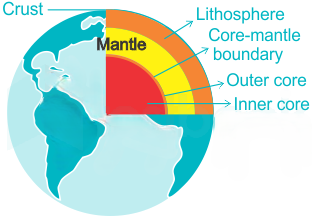
So it is clear that the crust is the thinner most layer of the earth.
Hence, option 1 is the correct answer.
Important Points
Discontinuity:
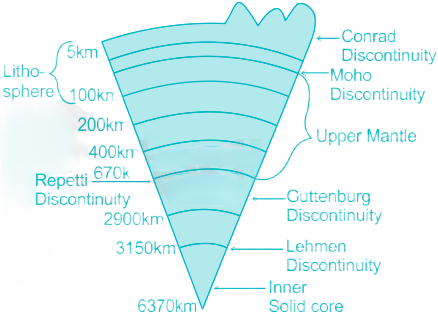
- All those layers are separated from each other through a transition zone.
- These transition zones are called discontinuities.
- Conrad Discontinuity: It lies between the Upper crust and Lower crust.
- Mohorovicic Discontinuity: It lies between crust and mantle.
- Repiti Discontinuity: It lies between the Upper mantle and Lower mantle.
- Gutenberg Discontinuity: It lies between core and mantle.
- Lehman Discontinuity: It lies between the upper core and lower core.
3. The crust is the Earth’s outermost layer that is less than percent of Earth by mass, with oceanic crust and continental crust often consisting of more felsic rocks.
A. 5
B. 1
C. 2
D. 10
Solution
Correct Answer 1
Key Points:Crust:
- The uppermost layer over the earth’s surface is called the crust.
- It is the thinnest of all the layers.
- On the continental masses, It is about 35 km and on the ocean floors, only 5 km.
- The density of the rocks found at the surface rocks: 2.7 – 2.9 gm/cm3
- The density of rocks found at the sea floor is around: 3.0 gm/cm3
- The oceanic crust is denser than the continental crust.
- The crust is the thinnest layer of the Earth and it amounts to less than 1% of our planet’s volume.
- The earth is made up of several concentric layers with one inside another, just like an onion.
- The crust is the outermost layer of Earth and is made up of igneous, metamorphic, and sedimentary rocks.
- The Earth’s crust is unstable because of the exogenic forces.
Discontinuity:
- All those layers are separated from each other through a transition zone.
- These transition zones are called discontinuities.
- Conrad Discontinuity: It lies between the Upper crust and Lower crust.
- Mohorovicic Discontinuity: It lies between crust and mantle.
- Repiti Discontinuity: It lies between the Upper mantle and Lower mantle.
- Gutenberg Discontinuity: It lies between core and mantle.
- Lehman Discontinuity: It lies between the upper core and lower core.
- Discontinuities are the transition zones that separated the layers of the earth.
- Earth’s interior is made of different kinds of materials.
- Each of those materials is different from the others by their physical and chemical properties, such as temperature, density, etc.
4. The partially molten upper mantle material called ___________ is a mechanically vulnerable layer beneath the lithosphere characterised by low seismic wave velocity and high attenuation.
A. asthenosphere
B. magnetosphere
C. mesosphere
D. stratosphere
Solution
The correct answer is asthenosphere.
Key Points
- Asthenosphere:-
- It is a partially molten layer of the upper mantle that lies beneath the lithosphere, which is the solid, outermost shell of the Earth.
- The asthenosphere is characterized by low seismic wave velocity and high attenuation, which means that seismic waves slow down and lose energy as they pass through this layer.
- The asthenosphere is mechanically weak and ductile, which allows the lithosphere to move and float on top of it.
Additional Information
- Magnetosphere:-
- It is the region around a planet where its magnetic field is dominant and protects it from the solar wind.
- Mesosphere:-
- It is the layer of the Earth’s atmosphere above the stratosphere and below the thermosphere.
- Stratosphere:-
- It is the layer of the Earth’s atmosphere above the troposphere and below the mesosphere.
5. Which is the outermost solid layer of the earth?
A. Mantle
B. Core
C. Crust
D. Asthenosphere
Solution
The correct answer is Crust
Key Points
- The outermost solid layer of the Earth is called the crust.
- It is the thinnest layer of the Earth, with a thickness of approximately 40 kilometres (25 miles).
- The crust is made up of solid rocks and minerals and is divided into two types: continental crust and oceanic crust.
- The continental crust is thicker and less dense than the oceanic crust and is composed mainly of granite and other light-coloured rocks.
- The oceanic crust is thinner and denser than the continental crust and is composed mainly of basalt and other dark-coloured rocks.
- The crust is one of the three main layers of the Earth, the other two being the mantle and the core.
Additional Information
- The Earth is composed of four layers:
- Crust
- Mantle
- Outer core
- Inner core
- The crust is the outermost layer and is made up of rocks and granites, while the innermost layer is composed of nickel and iron.
- The mantle is the widest section of the Earth and is mainly made up of semi-molten rock known as magma.
- The outer core is similar to a very hot ball of metals, whose temperature is around 4000 oF to 90000F.
- The inner core is the hottest layer of the Earth and is solid, made up of iron and nickel with temperatures up to 5,500oC.
6. Which of the following is a large group of rock-forming silicate minerals that constitutes more than 50% of the Earth’s crust and is widely used in the glass and ceramic industries?
A. Amphibole
B. Feldspar
C. Zeolites
D. Pyroxene
Solution
The correct answer is Feldspar.
Key Points
- Feldspar is the name of a large organization of rock-forming silicate minerals that make up over 50% of Earth’s crust.
- They are discovered in igneous, metamorphic, and sedimentary rocks in all components of the sector.
- Feldspar minerals have very similar structures, chemical compositions, and physical properties.
- Silicate minerals are rock-forming minerals made up of silicate groups. They are the largest and most important class of minerals and make up approximately 90 per cent of Earth’s crust.
Additional Information
- Amphiboles are a major group of hydrous minerals that occur in a wide range of rock types
- They occur predominantly in metamorphic and igneous rocks of the Earth’s crust and upper mantle.
- Zeolites are microporous, three-dimensional crystalline solids of aluminium silicate.
- Zeolites have small openings of fixed size in them which allow small molecules to pass through them easily but larger molecules cannot pass through them; that is why they are sometimes called molecular sieves.
- Pyroxenes are the most significant and abundant group of rock-forming ferromagnesian silicates.
- They are found in almost every variety of igneous rock and also occur in rocks of widely different compositions formed under conditions of regional and contact metamorphism.
7. Conrad discontinuity separates between
A. the outer and inner crusts
B. the crust and the mantle
C. the outer and the inner mantle
D. the outer and the inner core
Solution
The Correct Answer is the outer and inner crusts.
Key Points
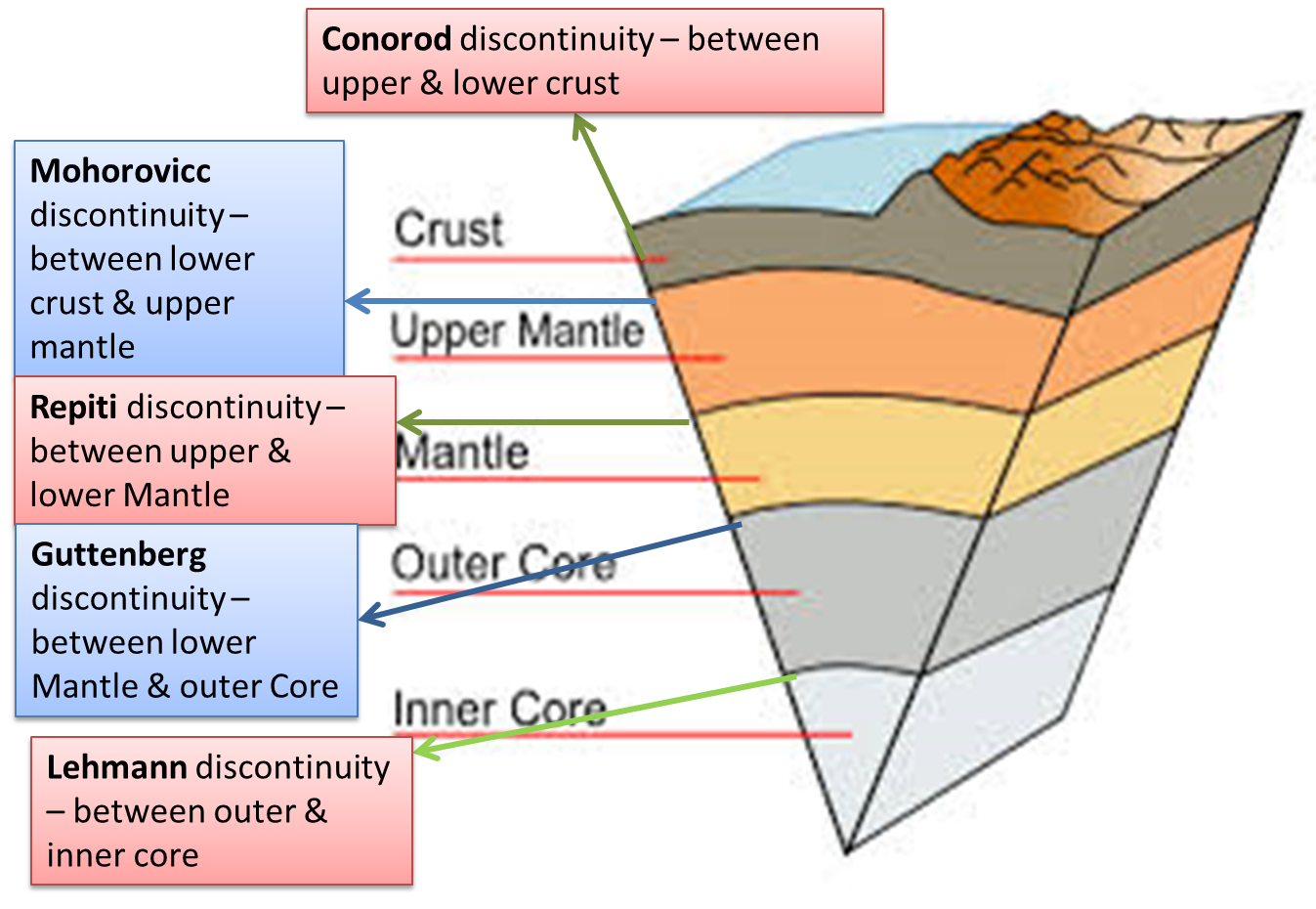
- Conrad discontinuity refers to the zone between the upper crust and lower crust.
- Mohorovic discontinuity also called Moho discontinuity is the zone that separates the Earth’s crust from the upper mantle. It can be detected by a sharp increase downward in the speed of earthquake waves there.
- Repiti discontinuity refers to the zone between the upper mantle and lower mantle.
- Gutenberg discontinuity refers to the zone separating the lower mantle from the core. It is located at a depth of about 2,900 km.
- Lehmann discontinuity refers to the zone separating the solid inner core from the liquid outer core.
Additional Information
- The border at which the density of SIAL and SIMA changes is known as Conrad discontinuity.
- SIAL indicates the composition of Silica and Aluminium whereas SIMA indicates the composition of Silica and Magnesium.
- A boundary within the Earth’s continental crust that can be detected seismically at about 10–12 km depth
- The exploratory deep drilling has failed to locate it.
- The boundary separates the crust into a lower, basic layer and an upper, granitic layer.
8. The crust is the Earth’s outermost layer that is less than percent of Earth by mass, with oceanic crust and continental crust often consisting of more felsic rocks.
A. 5
B. 1
C. 2
D. 10
Solution
Correct Answer 1
Key Points:Crust:
- The uppermost layer over the earth’s surface is called the crust.
- It is the thinnest of all the layers.
- On the continental masses, It is about 35 km and on the ocean floors, only 5 km.
- The density of the rocks found at the surface rocks: 2.7 – 2.9 gm/cm3
- The density of rocks found at the sea floor is around: 3.0 gm/cm3
- The oceanic crust is denser than the continental crust.
- The Earth’s crust is the thinnest layer and makes up less than 1% of the Earth’s volume and about 0.5% of the Earth’s mass.
- The earth is made up of several concentric layers with one inside another, just like an onion.
- The crust is the outermost layer of Earth and is made up of igneous, metamorphic, and sedimentary rocks.
- The Earth’s crust is unstable because of the exogenic forces.
Discontinuity:
- All those layers are separated from each other through a transition zone.
- These transition zones are called discontinuities.
- Conrad Discontinuity: It lies between the Upper crust and Lower crust.
- Mohorovicic Discontinuity: It lies between crust and mantle.
- Repiti Discontinuity: It lies between the Upper mantle and Lower mantle.
- Gutenberg Discontinuity: It lies between core and mantle.
- Lehman Discontinuity: It lies between the upper core and lower core.
- Discontinuities are the transition zones that separated the layers of the earth.
- Earth’s interior is made of different kinds of materials.
- Each of those materials is different from the others by their physical and chemical properties, such as temperature, density, etc.
9. The innermost layer of Earth’s core is made up of _______
A. Silica and Alumina
B. Silica and Magnesium
C. Nickel and Iron
D. Nickel and Magnesium
Solution
The correct answer is Nickel and Iron
Key Points
- The Earth is composed of several layers, each with distinct properties and compositions.
- The Earth’s core, which is the innermost layer, is further divided into two main parts: the outer core and the inner core.
- The inner core is a solid, dense sphere located at the center of the Earth, with a radius of approximately 1,220 kilometers (760 miles).
- It is primarily composed of a combination of nickel and iron, often referred to as an iron-nickel alloy.
- The temperature in the inner core is estimated to be between 5,000 and 7,000 degrees Celsius (9,000 and 13,000 degrees Fahrenheit), which is similar to or even higher than the temperature on the surface of the Sun.
- Despite these extremely high temperatures, the inner core remains solid due to the immense pressure exerted by the surrounding layers.
- The pressure at the inner core is so great that it forces the nickel and iron to remain in a solid state, even though they would typically be in a liquid or gaseous state at such high temperatures under normal conditions.
- Surrounding the inner core is the outer core, which is also composed of a mixture of nickel and iron, but in a molten, liquid state. The outer core’s movement generates Earth’s magnetic field through a process called the geodynamo.
In summary, the innermost layer of Earth’s core is made up of nickel and iron, and it remains in a solid state due to the immense pressure from the layers above it.
10. The most abundant metal in the earth crust is
A. Sodium
B. Aluminium
C. Calcium
D. Iron
Solution
Option 2 is correct, i.e. Aluminium.
Key Points
- Aluminium is the most plentiful (most abundant) of metals in the crust of the earth.
- Aluminium is around 8.1 per cent of the total metals on the surface of the earth.
Important Points
- The most plentiful non-metal in the earth’s surface is Oxygen.
- The most plentiful metalloid in the crust of the earth is Silicon.
- O > Si > Al > Fe > Ca are the most abundant elements in the earth crust.