1. Which of the following oceans’ deepest point is Java Trench?
A. Indian Ocean
B. Pacific Ocean
C. Atlantic Ocean
D. Arctic Ocean
Solution
The correct answer is the Indian Ocean.
Key Points
- Java Trench
- It is also called Sunda Double Trench, the deepest point of the Indian Ocean.
- The trench is considered to be part of the Pacific Ring of fire as well as one of a ring of oceanic trenches around the northern edges of the Australian Plate.
- Indian Ocean
- It is the third biggest ocean in the world.
- It is bounded by Asia to the North, Africa to the west, and Australia to the east.
- The deepest point in the Indian Ocean is the Java Trench.
- The majority of the Indian Ocean is in the Southern Hemisphere.
Additional Information
- Pacific Ocean
- It is the largest ocean among all the oceans.
- It is bounded by the continents of Asia in the West and America in the East.
- The Mariana Trench, in the Pacific Ocean, is the deepest location on Earth.
- In the pacific ocean, El Nino affects the weather conditions.
- It was named after Portuguese explorer Ferdinand Magellan.
- Atlantic Ocean
- It is the second-largest ocean.
- Its deepest point is Milwaukee Trench.
- It has the largest coastline.
- It is the busiest route for trade and commerce in the world.
- Southern Ocean
- The Southern Ocean is also known as the Antarctic Ocean comprises the southernmost waters of the World Ocean.
- It is the second smallest ocean among all the oceans.
- The South Sandwich Trench is the deepest point of this ocean.
2. The rhythmic rise and fall of ocean water twice in a day is called_____________.
A. Waves
B. Tides
C. Ocean currents
D. Tsunami
Solution
The correct answer is Tides.
Key Points
- The rhythmic rise and fall of the ocean twice a day is called a tide.
- The intense gravitational force exerted by the sun and the moon on the surface of the earth induce tides.
- When water covers most of the shore by rising to its maximum level, it is known as high tide.
- It is low tide as the waterfalls to its lowest level and recedes from the sea.
- The water of Earth closer to the moon is drawn under the influence of the gravitational force of the moon which creates a high tide.
- The sun, the moon, and the earth are in the same line during the full moon and new moon days and the tides are highest. These tides are called the spring tides.
- But when the moon is in its first and last quarter, the ocean waters are drawn in diagonally opposite directions through the gravitational force of the sun and earth resulting in low tides. These tides are called neap tides.
Additional Information 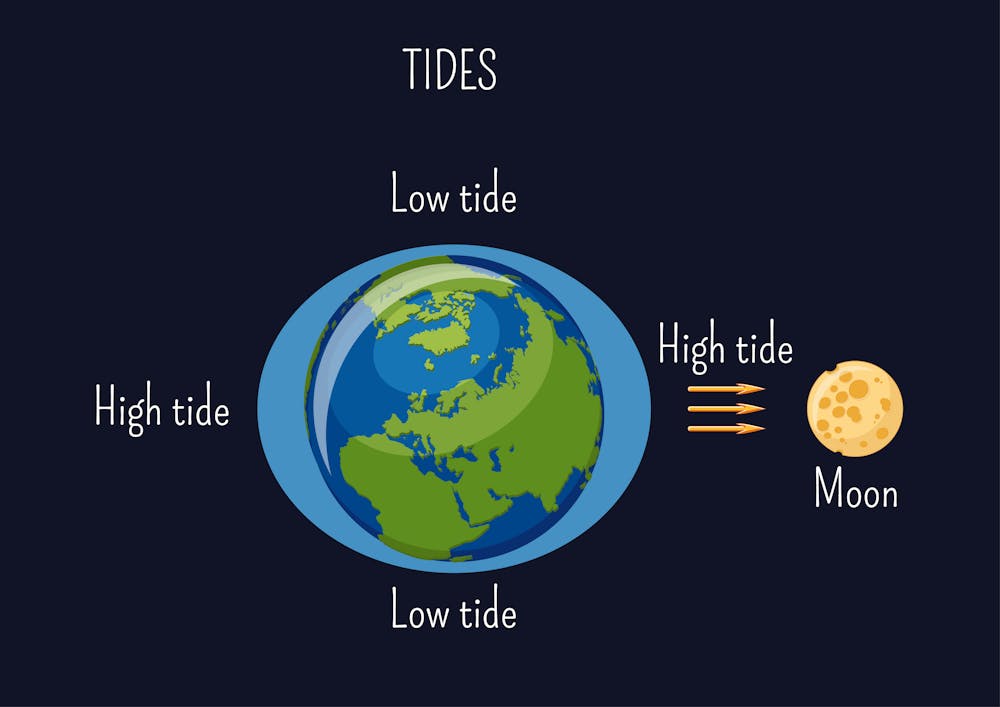
3. Where is the Mariana Trench located?
A. Indian Ocean
B. Atlantic Ocean
C. Pacific Ocean
D. Black Sea
Solution
The correct answer is the Pacific Ocean.
Important Points
- Mariana Trench, also called Marianas Trench is a deep-sea trench on the floor of the western North Pacific Ocean.
- It is the deepest such trench known on Earth.
- It is located mostly in the east as well as south of the Mariana Islands.
- The first attempt at finding the depth was made in 1875 during the Challenger Expedition (1872–76).
- It was formed due to the convergence of Oceanic-Oceanic plates.
Additional Information
- The Indian ocean’s deepest point is Sunda Trench.
- Puerto Rico Trench is the deepest point in the Atlantic ocean.
- The deepest measured point of the Black Sea is located south of Yalta(Crimea).
Hence, The Mariana Trench is located in the Pacific Ocean.
4. Which ocean is ‘S’ shaped?
A. Pacific Ocean
B. Atlantic ocean
C. Mediterranean
D. Indian Ocean
Solution
The correct answer is the Atlantic ocean.
Key Points
Atlantic Ocean:
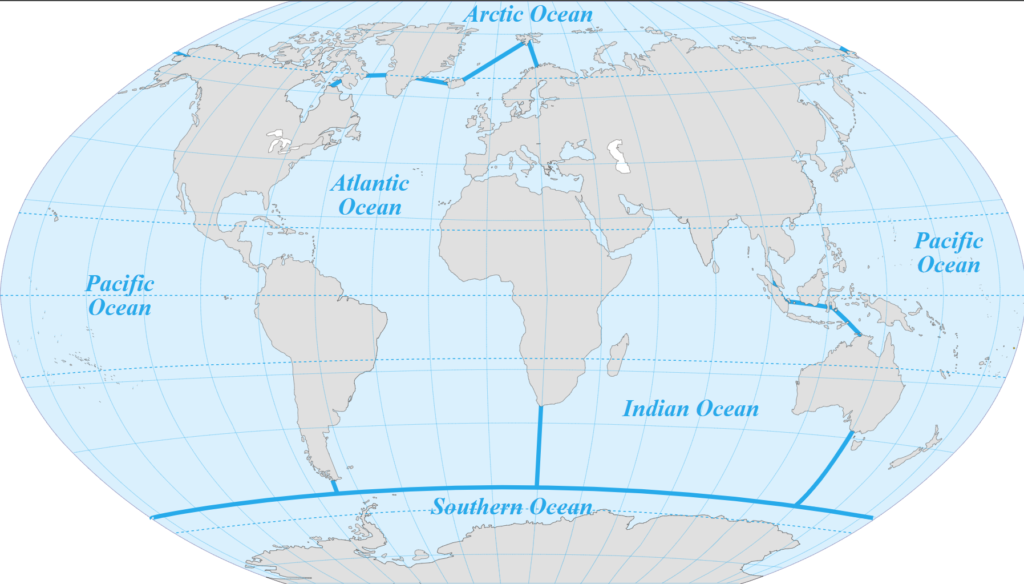
- The ocean that forms the shape of the letter “S”, is the Atlantic ocean if it is looked closely on the world map.
- The Arctic Ocean is connected/ linked through the Barents Sea, Norwegian Sea, Greenland Sea, and the Denmark Strait.
- The Puerto Rico Trench, which is about 28,230 feet deep, is the deepest point in the Atlantic Ocean.
- It is also the busiest ocean in terms of Commerce and Trade
Additional Information
Pacific Ocean:
- It is the largest and deepest ocean on Earth.
- The Extension of this ocean is from the Arctic Ocean in the north to the Southern Ocean in the south.
- This ocean is also bounded by the continents of Asia, Australia, and the Americas.
- The Challenger Deep depth of 10,902 to 10,929 m, lies in the Mariana Trench, which is the deepest point in the world located in this ocean.
Mediterranean:
- The sea was an important and famous route for merchants and travellers of ancient times.
- It also facilitated trade and cultural exchange between peoples of the region and around the world.
- The Strait of Gibraltar connects the Atlantic Ocean to the Mediterranean Sea and it also separates Spain in Europe from Morocco in Africa.
Indian Ocean:
- It is the third-largest of the world’s oceans on Earth’s surface.
- It is bounded by Asia, Africa and Australia to the north, west and east respectively.
- The Southern Ocean or Antarctica bounds it to the south.
- The Indian Ocean has some regional seas such as the Arabian Sea, Bay of Bengal, the Laccadive Sea, the Somali Sea, and the Andaman Sea.
5. Madagascar is located in the ______ Ocean.
A. Arctic
B. Atlantic
C. Indian
D. Pacific
Solution
The correct answer is Indian.
Important Points
- Madagascar is an island country in the Indian Ocean.
- Madagascar is the largest African island situated in the Indian Ocean, about 450 km (280 mi) east of the coast of Mozambique.
- The fourth-largest island in the world has been isolated for about 88 million years and many of its plants and animals are unique to the island.
- Madagascar consists of three parallel longitudinal zones, the central plateau, the coastal strip in the east, and the zone of low plateaus and plains in the west.
Additional Information
- Greenland located near North America is the largest island in the world.
- The Great Nicobar Island is the largest island in India. It is the southernmost point of India.
- A group of islands is termed as archipelago.
6. The percentage of earth’s water found in the oceans is ______.
A. 94 percent
B. 97.2 percent
C. 90.2 percent
D. 92.2 percent
Solution
The correct answer is 97.2 per cent.
Key Points
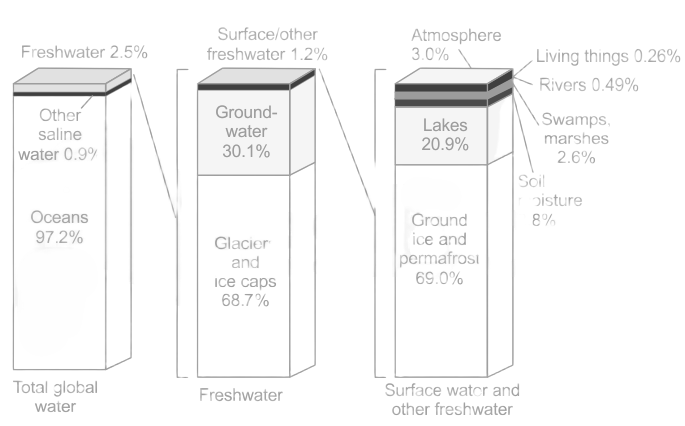
- 97.3 per cent of the water on earth is found in the oceans.
- The ice caps contain 2% of the world’s water.
- 0.68 per cent of all water comes from groundwater.
- Rivers make up less than 0.0001 % of all water.
- In comparison to inland seas and salt lakes, freshwater lakes contain 0.009% of the earth’s water.
- 0.0019 per cent of the water on Earth is in the atmosphere.
Additional Information
- Fresh water sources:
- Water that seeps further into the soil through porous materials is known as groundwater.
- It fills cracks and pores in aquifers, or layers of subterranean rock.
- Some of this water is too deep underground to be retrieved at a reasonable price.
- Surface-water runoff is precipitation that drains into bodies of water including streams, rivers, lakes, wetlands, and reservoirs but does not seep into the earth or return to the atmosphere.
- The amount of water in 10 cm of snow is roughly equivalent to 1 cm of rain.
7. Which one of the following is called rainforest of the oceans?
A. Corals
B. Ocean deposits
C. Tides
D. Currents of the Oceans
Solution
The correct answer is corals.
Key Points
- Coral reefs are communities of organisms in which corals provide the dominant structural elements.
- They need a range of specific conditions, such as clear agitated waters of normal salinity, free from sediment, and a temperature between about 18 and 30 degrees celsius.
- Coral reefs are the Rainforest of the oceans.
- Not only are they diverse communities, but the coral skeletons- like trees- contain potentially long-term records of climate.
- The key to the existence of coral reefs lies in the rapid recycling of nutrients between all the components of the community.
Thus, we can say that Corals are called the rainforests of the oceans.
8. Which is the correct sequence of oceans according to size (from largest to smallest)?
A. Pacific Ocean > Antarctic Ocean > Indian Ocean > Atlantic Ocean
B. Pacific Ocean > Indian Ocean > Antarctic Ocean > Atlantic Ocean
C. Pacific Ocean > Atlantic Ocean > Indian Ocean > Antarctic Ocean
D. Pacific Ocean > Indian Ocean > Atlantic Ocean > Antarctic Ocean
Solution
The correct answer is Pacific Ocean > Atlantic Ocean > Indian Ocean > Antarctic Ocean.
Key Points
- The correct sequence of oceans according to size (from largest to smallest) Pacific Ocean > Atlantic Ocean > Indian Ocean > Antarctic Ocean.
Additional Information Pacific Ocean
- The largest ocean on Earth is the Pacific Ocean.
- It is the largest of the world’s oceans, covering an area of about 63.8 million square miles (165.25 million square kilometers), which is roughly one-third of the Earth’s total surface area.
- The Pacific Ocean lies between the continents of Asia and Australia on the west and North America and South America on the east., and it is also the deepest ocean in the world.
Atlantic Ocean
- The Atlantic Ocean is the second-largest of the world’s five oceans, with an area of about 106,460,000 km².
- It covers approximately 20% of Earth’s surface and about 29% of its water surface area.
- the Atlantic drives our weather patterns, including hurricanes, and is home to many species from sea turtles to dolphins. For centuries the Atlantic Ocean has been a key avenue of trade and travel.
- The ocean’s name, derived from Greek mythology, means the “Sea of Atlas.” The oldest known mention of this name is contained in The Histories of Herodotus around 450 BC.
Indian Ocean
- The Indian Ocean is the third-largest in the world.
- The Java Trench is the deepest point in the Indian Ocean.
- It makes up approximately 20% of the Earth’s water surface.
Arctic Ocean
- The Arctic Ocean is the smallest ocean.
- It is located within the Arctic Circle and surrounds the North Pole.
- It is connected with the Pacific Ocean by a narrow stretch of shallow water known as the Bering Strait.
- It is surrounded by the northern coasts of North America and Eurasia.
- It is completely covered with ice for the majority of the year.
9. Which one of the following is the second-largest island in Indian Ocean?
A. Grande Terre
B. Sri Lanka
C. Zanzibar
D. Socotra
Solution
The correct answer is Sri Lanka.
Key Points
- Sri Lanka is an island country in South Asia.
- Sri Lanka is the second-largest island in the Indian Ocean.
- Sri Lanka covering an area of approximately 25,200 square miles.
- Sri Lanka is separated from the Indian subcontinent by the Gulf of Mannar and the Palk Strait.
- Sri Lanka gained independence from the British on 4th February 1948.
- Sri Jayawardenepura Kotte is the legislative capital of Sri Lanka.
- Colombo is the executive and judicial capital of Sri Lanka.
- As per Hindu mythology, a land bridge existed between the Indian mainland and Sri Lanka.
- Sri Lanka consists of 103 rivers.
Additional Information
- Madagascar is the largest island in the Indian Ocean.
- Grande Terre is the primary and largest island of New Caledonia and the third largest island in the Indian ocean.
- Socotra is the fifth-largest island in the Indian Ocean.
- Zanzibar is the seventh-largest island in the Indian Ocean.
10. Which of the following places consists of 12 atolls?
A. Andaman
B. Lakshadweep
C. Maldives
D. Seychelles
Solution
The correct answer is Lakshadweep
Key Points
- Lakshadweep is the place that consists of 12 atolls
- This archipelago in the Arabian Sea is made up of 36 islands, including 12 atolls, three reefs, and five submerged banks.
- The islands are mostly low-lying, with most rising no more than five meters above sea level.
- The name Lakshadweep comes from Malayalam and Sanskrit, and means “a hundred thousand islands”.
Additional Information
About Lakshadweep:
- India’s smallest Union Territory Lakshadweep is an archipelago consisting of 36 islands with an area of 32 square km.
- The name Lakshadweep in Malayalam and Sanskrit means ‘a hundred thousand islands’.
- Amendivi Islands are the northern most while the Minicoy island is the southernmost.
- It is a uni-district Union Territory and is comprised of 12 atolls, 3 reefs, 5 submerged banks and 10 inhabited islands.
- The capital is Kavaratti and it is also the principal town of the UT.
- The Union Territory was formed in 1956 and it was named Lakshadweep in 1973.
- Kolkali and Parichakali are the two popular folk art forms in the Territory.
- They are an integral part of the cultural milieu except in Minicoy where “LAVA” is the most popular dance form.
- For marriages “OPPANA” is a common feature, a song sung by a lead singer and followed by a group of women.
Census of Lakshadweep:
- As per details from Census 2011, Lakshadweep has population of 64 Thousands, an increase from figure of 60 Thousand in 2001 census.
- Total population of Lakshadweep as per 2011 census is 64,473 of which male and female are 33,123 and 31,350 respectively.
- In 2001, total population was 60,650 in which males were 31,131 while females were 29,519.
- The total population growth in this decade was 6.30 percent while in previous decade it was 17.19 percent.
- The population of Lakshadweep forms 0.01 percent of India in 2011.
- In 2001, the figure was 0.01 percent.
- It has the highest population share of Muslims (96%) and Scheduled Tribes (94.8%) among the UTs.
- Malayalam is the official as well as the widely spoken native language in the territory.